A Novel Method of Optimized Bacteriosin
Production from Marine Water and Testing
its Efficiency as an Anti-Microbial Agent
Aravind Jagannathan
1, Barath Muralidharan
1, Dr. V. Gayathri
2U.G Student, Dept of Biotechnology, Rajalakshmi Engineering College, Chennai, Tamil Nadu, India1
Assistant Professor, Dept of Biotechnology, Rajalakshmi Engineering College, Chennai, Tamil Nadu, India2
ABSTRACT: A strain of Lacto bacillus (LAB) was isolated from marine water in order to obtain a novel bacteriosin.
Culture conditions for bacteriosin production were obtained in macconkey media, when incubated at 37°C for 48hrs in a rotary shaker at 100rpm. SDS-PAGE showed molecular mass of 4.5kDa, produced prominent inhibition zone in activity gel. Antibacterial efficacy of bacteriosin was proved against some food spoilage in sea foods which are caused by Staphylococcus aureus, Vibrio cholera.
KEYWORDS: Antibacterial; Bacteriosin; Lacto bacillus; Macconkey media;
I. INTRODUCTION
Lactic acid bacteria (LAB) are a group of Gram- positive, catalase-negative bacteria that produce various types of compounds such as bacteriosin, organic acid, diacetyl and hydrogen peroxide during lactic acidfermentation [10]. Among these compounds, bacteriosin is the most effective, as they can destroy or inhibit bacteria closely related to the producer strain. Bacteriosin are proteinaceous compounds that are inhibitory towards sensitive bacterial strains of their closely related members that are produced by both Gram-positive and Gram-negative bacteria [16]. Their efficacy has a predominant role in food preservation [1, 8, 12].
In the present study, in order to isolate a novel bacteriosinfor efficient use as food preservative, we report a optimum conditions for the production from marine water source to isolate Lacto bacillus (LAB) in our laboratory [7,9].
II. BACTERIOSIN
bacteria isolated from Sydney Harbor (Australia), possess antibacterial activity. Proteinase K treatment showed that this inhibitory activity was associated with proteinaceous substances such as bacteriosin or BLIS [18]. Given the fact that bacteriosin and BLIS have been characterized in most bacterial species, it is appealing to speculate about the diversity of new substances. The marine environment will reveal.
III. APPLICATIONS AND IMPLICATIONS OF MARINE BACTERIA
The international sea food industry is one of the world’s most profitable merchandise, worth more than $75 billion per year (Food and Agriculture Organization of the United Nations [FAO], 2006). Fish and seafood are major proteins in some areas of the world. In 2006, of the 143 million tons of total fishery production (including fish, crustacean, and mollusks); 110 million tons was for direct human consumption [14]. To meet this demand, we had witnessed a noticeable rise in aquaculture (the farming of aquatic plants and animals) in the last decade (FAO, 2006). Recently, there have been spectacular changes in the seafood industry due to technological advances, consumer habits, and globalization of the food market [5]. In particular, there has been an increase in consumer preference for foods that are modestly processed or preserved (especially those that claim health-promoting benefits). Consumers are also demanding that these foods be fresh tasting and ready-to-eat [5]. The demands on the industry to provide fresh, modestly preserved products in the ever growing globalized food market is requiring a longer and more complex food-chain and increasing the risk of microbial contamination and spoilage [6].
MATERIALS AND METHODS
IV. BACTERIAL STRAINS AND MEDIA
A strain of Lacto bacillus LAB 5 was isolated from Marine Organisms, which was confirmed by morphological and biochemical studies. This was screened for bacteriosin production against two bacteriosin sensitive indicator strains Staphylococcus aureus, Vibrio cholera. Identification of the producer strain was done based on the cell morphology.
V. IDENTIFICATION OF LACTO BACILLUS
a) GRAM STAINING TEST:
The isolated bacteria were examined using gram staining kit and observed under light microscope with a magnification of 100x [17].
b) CATALASE TEST:
To perform this test, a single isolated colony was streaked on a glass slide and a drop of 3% hydrogen peroxide was added on to it. The effervescence of oxygen was not noticed which gives a negative response of the bacteria to catalase test [13].
VI. RESPONSE SURFACE METHODOLOGY (RSM CONTOUR PLOTS)
When a regression model is fitted using two or more continuous predictors, it is helpful to demonstrate a graphical visualization of the fitted surface [11]. A Response surface method (RSM) is an influential optimization tools in the arsenal of statistical design of experiments (DOE). Before employing RSM, process should take full advantage of a far simpler tool for DOE – two-level factorials, which can be very valuable for screening the few vital factors (including interactions) from the trivial many that have no significant impact. Assuming the potential for further financial gain, it’s best to follow up screening studies by doing an in-depth investigation of the surviving factors via RSM. Then generate a response surface map and move the process to the optimum location.
1. The table was shaped from the subsequent second-order polynomial model, called a “quadratic,” via least squares regression:
Ŷ = 808.77 − 250.45 X − 328.58 X2
2. The curve was created by the following values obtained for mean and the standard deviation.
Mean = 255.71 + 23.69A − 49.06B − 35.14C − 25.54AC − 16.57B2 + 27.75C2 (p<0.0001, Adjusted R2 0.84) Log10 Std Dev = 1.82 − 0.077B + 0.012C + 0.18C2 (p<0.0001, Adjusted R2 0.76)
VII.PRODUCTION OF BACTERIOSIN
Bacteriosin producer strain Pediococcus acidilactici LAB 5 and indicator LAB strains were cultured in Lacto bacillus macconkey agar and maintained at 4ºC. The colonies are isolated from the marine water is inoculated in MRS media and incubated at 37°C for 24 hrs in a rotary shaker at 100 rpm. Then the culture was sonicated to break open the cells and produce the secondary metabolites (Figure 4).
VIII. ANTI-MICROBIAL ACTIVITY
The bacteriosin produced were examined by the disc diffusion method [11]. S. aureus, V.cholera were used for antibacterial test. The test microorganisms were seeded into relevant medium by spread plate method 10 μl (106 cells/ml) with the 24h cultures of bacteria growth in nutrient broth. After solidification the filter paper discs (5 mm in diameter) impregnated with the bacteriosin of 20 μl were sited on test organism-seeded plates. Streptomycin (10 μg ml 1) used as positive control and MRS media (100 μg ml 1) used as negative control. The antibacterial assay plates were incubated at 37°C for 24h. The diameters of the inhibition zones were measured in mm.
IX. SDS-PAGE
Sodium Dodecyl Sulfate-Polyacrylamide Gel Electrophoresis (SDS-PAGE) is probably the world’s most broadly used biochemical method to detect the molecular weight of a compound [15]. To estimate the molecular weight of this bacteriosin, 15% SDS-PAGE gel is prepared. Protein marker is added to the first lane of this gel. Now the sample is mixed with the buffer and heated for 1-2 mins. Now 20 μl is added to the gel. Gel electrophoresis is carried out at 100v for 1 hr.
X. RESULTS AND DISCUSSION
1. The above method shows how bacteriosin can be produced from marine water in an easy and efficient way, which could be scaled up for large scale production. Thus the produced bacteriosin was confirmed with a morphological and biochemical test. The catalase test (Figure 1) showed a negative result which proved the LAB from marine water is suitable for the production of bacteriosin.
FIGURE 1: CATALASE TEST
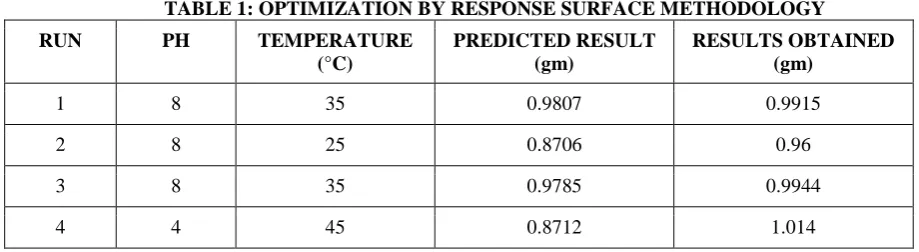
2. Response surface methodology contour plot (Figure 3) was obtained from “Design expert 9”, in order to produce optimum condition for the production of bacteriosin. So, the table (Table 1), the RSM plot (Figure 2) gives us the most optimized production and the curve, which was also confirmed by practical evidences.
TABLE 1: OPTIMIZATION BY RESPONSE SURFACE METHODOLOGY
RUN PH TEMPERATURE
(°C)
PREDICTED RESULT (gm)
RESULTS OBTAINED (gm)
1 8 35 0.9807 0.9915
2 8 25 0.8706 0.96
3 8 35 0.9785 0.9944
5 4 35 0.8558 0.9215
6 8 35 1.023 1.019
7 8 45 1.027 1.094
8 8 35 0.8709 1.009
9 8 35 0.8894 1.002
10 8 35 0.8536 0.937
11 8 35 0.9824 0.8893
12 8 35 0.8494 0.985
13 4 25 1.024 1.044
14 12 35 1.011 1.156
15 12 25 0.9225 1.182
16 8 35 1.007 1.031
17 8 35 0.975 1.051
18 8 35 0.9922 1.025
19 12 45 1.157 1.34
Experimental design for bacteriosin production of lab by RSM comparing actual vs. predicted values
FIGURE 2: RSM PLOT FIGURE 3: CONTOUR PLOT
1 – Bacteriosin 2 – Marker
FIGURE 4: SDS – PAGE
4. The bacteriosin also showed an effective anti-bacterial property against the common pathogens namely
Staphylococcus aureus, Vibrio cholera which are most predominant in the sea food industry. (Figure 5) (Table 2)
TABLE 2: ANTI-MICROBIAL ACTIVITY
Micro-organism Positive Control
(Streptomycin)
Negative Control TEST
Vibrio cholera 5.0 cm 0 5.5 cm
Staphylococcus aureus 6.0 cm 0 7.0 cm
Test sample (Bacteriosin) has higher potential against the test microorganisms than the positive control (streptomycin). FIGURE 5: ANTIMICROBIAL ACTIVITY
Staphylococcus aureus Vibrio cholera
A- Negative control; B- Positive control; C- Test
So this bacteriosin which is produced from the marine water could be used in sea food industry in packaging and transportation of the food across the country. This would save a huge amount of money that goes waste due to spoilage of food. The bacteriosin produced, is sensitive to temperature, pH and other hurdles that are mentioned in Hurdle technology of food preservation. But this could overcome, by combining bacteriosin with other food preservative for better efficiency.
XI. FUTURE RESEARCH
persuasive against marine pathogens and environmentally safe, due to the fact that they do not create intensive selection pressures for antibiotic resistance. Clearly, bacteriosin could prove extremely beneficial to the sea food industry and more research should be dedicated to exploring their potential applications as probiotics and therapeutics. Given the fact that all species of bacteria have the potential to produce bacteriosin, and only a handful has thus far been identified from marine microorganisms. We are confident that existing studies have exposed only the tip of the iceberg, in terms of bacteriosin diversity and potential use in the seafood industry.
XII.ACKNOWLEDGEMENT
We wish to express our sincere gratitude to Dr. Johanna Rajkumar, professor and Dean, Department of Biotechnology, Rajalakshmi Engineering College for providing us an opportunity to do our project work.
We sincerely thank Dr. V. Gayathri for her guidance and encouragement in carrying out this project work. We also wish to express our gratitude to our Head of the department and other faculty members who rendered their help during the period of our project work.
REFERENCES
[1] Brink, B., Minekns, M., Vander Vossen, J. M. B. M., Leer, R. J., and Huis in’t Veld J. H. J., “Antimicrobial activity of lactobacilli: preliminary characterization and optimization of production of acidocin B, a novel bacteriocin produced by Lactobacillus acidophilus M46”, Journal of Applied Bacteriology, vol. 77, no. 2, pp. 140-145, 1994.
[2] Cascales, E., Buchanan, S.K., Duche, D., Kleanthous, C., Lloubes, R., Postle, K., Riley, M.,Slatin, S., and Cavard, D., “Colicin biology”, Microbiology and molecular biology reviews: MMBR, vol. 71, no. 1, pp. 158-229, 2007.
[3] Chavan, M. A., and Riley, M. A., “Molecular Evolution of Bacteriosins in Gram Negative Bacteria, In Bacteriosins: Ecology and Evolution, Riley, M.A., Chavan, M.A. (Eds.)”, pp.5-18, 2007.
[4] De la Rosa-Garcia, S. C., Munoz-Garcia, A. A., Barahona-Perez, L. F., Gamboa-Angulo M. M., “Antimicrobial properties of moderately halotolerant bacteria from cenotes of the Yucatan peninsula”, Letters in Applied Microbiology, vol.45, no.3, pp. 289-294, 2007.
[5] Galvez, A., Lopez, R. L., Abriouel, H., Valdivia, E., and Omar, N.B., “Application of bacteriosins in the control of foodborne pathogenic and spoilage bacteria”, Critical reviews in biotechnology, vol. 28, no. 2, pp. 125-152, 2008.
[6] García, P., Rodríguez, L., Rodríguez, A., and Martínez, B., “Food biopreservation: promising strategies using bacteriosins, bacteriophages and endolysins”, Trends in Food Science & Technology, vol. 21, no. 8, pp. 373-382, 2010.
[7] Gross, E., and Morell, J. L., “Structure of Nisin”, Journal of American Chemical Society, vol. 93, no. 18, pp. 4634-4635, 1971. [8] Hugenholz, J., and de Veer G. J. C. M., “Nisin and Novel antibiotics”, Escom Publishers, pp. 404-412, 1991.
[9] Hurst A., “Nisin”, Advance Applied Microbiology, vol. 27, pp. 85-123, 1981.
[10] Lindgren S. W., and Dobrogosz W. J., “Antagonistic activities of lactic acid bacteria in food and feed fermentation”, FEMS Microbiology Review, vol. 87, pp. 149-154, 1990.
[11] Microbiological methods, Collins and Lyne, pp. 90, 8th edition, London, 2004.
[12] Moliter, E., and Sahl H. G., “Nisin and Novel lantibiotics”, Escom Publishers, pp. 434-439, 1991.
[13] Nelson, G., and George, S., “Comparison of media for selection and enumeration of mouse fecal flora populations”, Journal of Microbiological Methods, vol. 22, Issue 3, pp 293-300, 1995.
[14] Pilet, M.F., and Leroi, F., “Applications of protective cultures, bacteriosins, and bacteriophages in fresh seafood and seafood products, In: Protective cultures, antimicrobial metabolites and bacteriophages for food and bevarage biopreservation”, 2011.
[15] Snezana Jovanovic, Miroljub Barac, Ognjen Macej, Tanja Vucic, and Caslav Lacnjevac, “SDS-PAGE Analysis of Soluble Proteins in Reconstituted Milk Exposed to Different Heat Treatments”, Sensors, vol. 7, pp. 371-383, 2007.
[16] Tagg J R., Dajani A. S., and Wannamaker L. W., “Bacteriosins of gram-positive bacteria”, Bacteriology Review, vol. 40, no. 3, pp. 722-756, 1976.
[17] Russell V. Lenth, “Surface Plots in the rsm Package”, The University of Iowa, 2012.
[18] Wilson, G.S., Raftos, D.A., Corrigan, S.L., and Nair, S.V., “Diversity and antimicrobial activities of surface-attached marine bacteria from Sydney Harbour, Australia”, Microbiological research, vol. 165, no. 4, pp. 300-311, 2010.
BIOGRAPHY
Dr. V. Gayathri was born in Salem, Tamil nadu. She got her doctoral degree in the field of biochemistry-zoology from Presidency College, University of Madras. She has extensive passion and interest towards biochemistry and marine biotechnology. She currently holds the assistant professor position in Department of Biotechnology, Rajalakshmi engineering college. For the past decade, she has been guiding more than hundreds of students with their thesis work. Her extensive passion towards research let her publish a couple of books and papers . She always advises students to carry out product oriented research as they would have a great value to the society. In order to enhance the value of her Bio-products developed she has applied patents for three of her research work.
Aravind Jagannathan was born and brought up in Chennai, Tamil Nadu. He did his schooling at Velammal group of schools. He believes that almost every soul on this world is so much excited about the promises made by life science and the technology involved in to cure disease and to relieve suffering. Due to extensive passion towards the field of Life science, he pursues his undergrad in the field of Biotechnology from Rajalakshmi Engineering College, Chennai. His interest towards the subject was not definite at the beginning; but got the momentum from his second year. His dedication towards research and the subject fetched him great credits in and around the place including Indian Institute of Technology. He started excelling in academics as well as research, published papers and presented them in various international conferences. Though academics have conquered his major time he also proved his excellence in the field of photography. And he also holds the PRO post in BT society. The fire in him for research and his social motto has driven him to do his doctoral program in cancer biology.