ABSTRACT
BANCROFT, ERIN ELIZABETH. Shard Intersections and Cambrian Congruence Classes in TypeA. (Under the direction of Nathan Reading.)
©Copyright 2011 by Erin Elizabeth Bancroft
Shard Intersections and Cambrian Congruence Classes in TypeA
by
Erin Elizabeth Bancroft
A dissertation submitted to the Graduate Faculty of North Carolina State University
in partial fulfillment of the requirements for the Degree of
Doctor of Philosophy
Mathematics
Raleigh, North Carolina
2011
APPROVED BY:
Ernest Stitzinger Patricia Hersh
Michael Singer Nathan Reading
DEDICATION
BIOGRAPHY
The author was born in Fort Collins, Colorado to Chris and Anne Lukasiewicz. As the daughter of an officer in the US Army, she soon moved from Colorado to the first of many military bases in states including California, Virginia, Missouri, Washington and Maryland and abroad in Germany. Along the way, Erin was joined by two sisters, Jessica and Tracy, a brother, Mark, and two special dogs, Jake and Nikki. She has many fond memories of road trips across the U.S. and Europe with everyone piled into their big brown van. To this day, Erin loves to travel, especially by car.
ACKNOWLEDGEMENTS
I want to begin by thanking my advisor, Dr. Nathan Reading, for sharing so much of his time and knowledge with me. I have grown immensely by working with him. I also want to thank Dr. Reading for introducing me to the beauty of combinatorics, a subject for which I have developed a passion. He has been an inspiring teacher and mentor; one that I hope to emulate as I begin my academic career.
Thank you to my husband for his encouragement, patience, and advice. I could not have made it through without him.
I also want to thank my family for their love and support from afar. Through my parents’ example, I have learned the importance of perseverance and doing your best for the glory of God.
Thank you to my undergraduate professor, Dr. Gary Thompson, for encouraging me to pursue a graduate degree. He gave me the confidence I needed to follow in his footsteps.
I also want to thank one of my dearest friends, Marie Tyler, for sticking by me for the last eight years. Our visits and phone conversations have allowed me to keep my sanity.
Thank you to my church family at Redeemer Presbyterian Church in Raleigh. My time spent fellowshipping and woshipping with them has made Raleigh feel like home.
TABLE OF CONTENTS
List of Figures . . . vi
Chapter 1 Introduction . . . 1
Chapter 2 The Shard Intersection Order on Permutations . . . 5
2.1 Introduction . . . 5
2.2 Shards and Shard Intersections . . . 6
2.3 Permutation Pre-orders . . . 11
2.4 The Shard Intersection Order onSn . . . 18
2.5 Noncrossing Pre-orders . . . 29
Chapter 3 Tamari Congruence Classes . . . 34
3.1 Introduction . . . 34
3.2 Tamari Congruence Classes . . . 35
3.3 C-poset Characterizations . . . 38
3.4 Algorithms . . . 40
3.5 Sizes of Tamari Classes . . . 48
LIST OF FIGURES
Figure 1.1 Parenthesizations for n= 3 . . . 2
Figure 1.2 Objects counted by the Catalan number . . . 2
Figure 2.1 Shards in the Coxeter arrangement A(S4) . . . 8
Figure 2.2 The pre-order representing Γ . . . 12
Figure 2.3 µ(26314758) . . . 12
Figure 2.4 Illustration of the proof of Proposition 2.7 . . . 14
Figure 2.5 The permutation pre-order ω . . . 15
Figure 2.6 The shard intersection order on S4 . . . 18
Figure 2.7 Covers of a permutation pre-order ω∈(Ω,≤S) . . . 20
Figure 2.8 Labeled maximal chains in the shard intersection order . . . 21
Figure 2.9 Cycle corresponding to c=s2s1s3s7s6s4s5s8 . . . 30
Figure 2.10 c-noncrossing partition . . . 31
Figure 3.1 η(467198352) . . . 36
Figure 3.2 τ(467198352) . . . 37
Figure 3.3 Algorithm 3.12 acting onx= 219534768 . . . 47
Figure 3.4 Algorithm 3.14 acting onx= 967824531 . . . 48
Chapter 1
Introduction
The Catalan numbers
(1.1) Cn= 1
n+ 1
2n n
enumerate various combinatorial objects. For instance
triangulations: decomposition of a convex (n+ 2)-gon inton triangles
parenthesizations: binary parenthesizations of a string ofn+ 1 letters
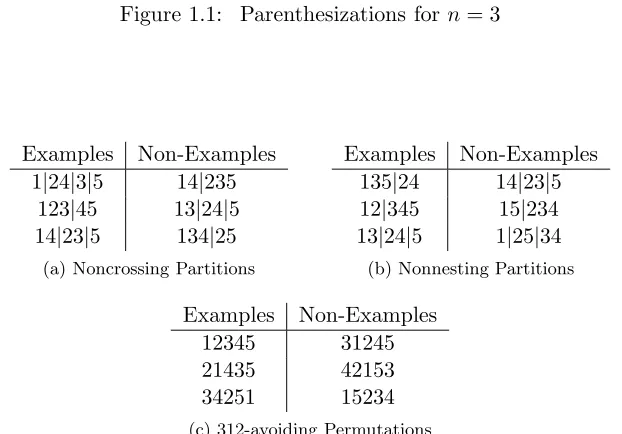
noncrossing partitions of [n]: partitions of [n] such that there do not exist 1 ≤a < b < c < d ≤nwith a and c together in a block and b and dtogether in a different block
nonnesting partitions of [n]: partitions of [n] such that if 1≤a < b < d < e≤nwith aandetogether in a blockB andbanddtogether in a different blockB0, then there exists a c∈B satisfying b < c < d
312-avoiding permutations: permutationsx =x1x2· · ·xn ∈Sn such that there does not exist a triplexi, xj, xk satisfying xj < xk< xi fori < j < k.
maintains a growing list of additional objects.
((ab)c)d, (a(bc))d, a((bc)d), a(b(cd)), (ab)(cd) Figure 1.1: Parenthesizations forn= 3
Examples Non-Examples 1|24|3|5 14|235
123|45 13|24|5 14|23|5 134|25
(a) Noncrossing Partitions
Examples Non-Examples 135|24 14|23|5 12|345 15|234 13|24|5 1|25|34 (b) Nonnesting Partitions
Examples Non-Examples
12345 31245
21435 42153
34251 15234
(c) 312-avoiding Permutations
Figure 1.2: Examples and Non-examples of objects counted by the Catalan number forn= 5
In recent years, connections between the Catalan numbers and Coxeter groups have been studied, including a generalization of the Catalan number to any Coxeter groupW. A Coxeter groupW is a group with presentation given by a set of generatorsSand relations (ss0)m(s,s0)
= 1 for all s, s0 ∈ S. Here m(s, s) = 1 and m(s, s0) ≥2 for s6= s0, and m(s, s0) =m(s0, s) for all
s, s0∈S. We will callS the simple generators. W is represented by a Coxeter diagram, which
is a graph whose nodes are the simple generators and edges connect pairss, s0 if m(s, s0)≥3.
By convention, edges are labeled by the valuem(s, s0) only ifm(s, s0)≥4.
in one-to-one correspondence with the elements ofW. The weak order is a natural partial order on the elements ofW, and it is also defined in terms of the geometry of Coxeter arrangements. The classic example of a Coxeter group is the symmetric group Sn=An−1, and it will be
the focus of the thesis. The simple generators forSnare the adjacent transpositions (i, i+ 1) for i∈ {1, . . . , n−1}. The Coxeter diagram forSn is a path withn−1 nodes andn−2 unlabeled edges. By switching two adjacent entries in a permutationπso as to put them out of numerical order, you obtain a permutation π0 which covers π in the weak order on S
n. The W-Catalan number of a finite Coxeter groupW is
(1.2) Cat(W) =
n Y i=1
h+ei+ 1 ei+ 1
where h and e1, . . . , en are certain numerical invariants ofW. In the case where W =Sn, the W-Catalan number is just the Catalan number because h = n and e1, . . . , en−1 are equal to
1, . . . , n−1 respectively.
As with the classical Catalan numbers, theW-Catalan numbers are combinatorially rich and have appeared in many different fields. They have also been shown to count generalizations of several of the combinatorial objects counted by classical Catalan numbers. For example, given any finite Coxeter group, there is a construction of W-noncrossing partitions that are counted by the W-Catalan number. Another example is triangulations of a convex polygon. In this case, the W-Catalan number enumerates the clusters of almost positive roots, which are the vertices of generalized associahedron. Nonnesting partitions of W are defined to be the set of antichains in the root poset and are again counted by the W-Catalan number. Finally, there is a definition of c-sortable elements of a Coxeter group W which are counted by theW-Catalan number, and when W is the symmetric group, these are just the 312-avoiding permutations. For definitions and details, see [2, Section 1.1], [9, Lecture 5], [15, Sections 2 and 4].
order on the generalized W-noncrossing partitions. The nonnesting partitions can be ordered as a distributive lattice of order ideals in the root poset. A partial order on triangulations gives the Tamari lattice, which is isomorphic to the restriction to 312-avoiding permutations of the weak order onSn. The corresponding generalizations in this last case are the Cambrian lattices. Although this thesis concentrates on the symmetric group and is thus tied to the “classical” Catalan combinatorics, both objects of study in the thesis came out of an effort to further un-derstand the more general W-Catalan combinatorics and in particular, noncrossing partitions and Cambrian lattices.
In Chapter 2 we begin with the shard intersection order. The shard intersection order is a new lattice structure on a finite Coxeter groupW which encodes the geometry of the reflection arrangement and the lattice theory of the weak order. It was shown in [16] that the noncross-ing partition lattice is a sublattice of the shard intersection order. In the case whereW is the symmetric group, we characterize shard intersections as certain pre-orders which we call permu-tation pre-orders. We then use this combinatorial characterization to determine properties of the shard intersection order. In particular, in Section 2.4 of Chapter 2, we give an EL-labeling. We conclude the chapter by describing the set of permutation pre-orders which correspond to thec-sortable elements of Sn. These are closely related to noncrossing partitions.
Chapter 2
The Shard Intersection Order on
Permutations
2.1
Introduction
Shards were introduced in [13] as a way to understand lattice congruences of the weak order on a finite Coxeter group. They are defined in terms of the geometry of the associated simplicial hyperplane arrangement. The collection Ψ of arbitrary intersections of shards, studied in [16], forms a lattice under reverse containment. This lattice is called the shard intersection order. Surprisingly, Ψ was found to be in bijection with the elements of the finite Coxeter group W, and thus the shard intersection order defines a new lattice structure on W. This lattice is graded and contains the W-noncrossing partition lattice NC(W) as a sublattice. Indeed, for any Coxeter elementc, the subposet induced by c-sortable elements [15] is a sublattice isomor-phic to NC(W). A formula for calculating the M¨obius numbers of lower intervals was given in [16], but overall the structure of the shard intersection order is not yet well-understood.
We then specifically describe shards and shard intersections in the symmetric group. Through-out the chapter, no prior knowledge of Coxeter groups will be assumed. Following a suggestion from Aguiar [1], in Section 2.3 we characterize shard intersections of typeA by realizing them combinatorially as certain pre-orders, which we call permutation pre-orders. In Section 2.4, we realize the shard intersection order as an order on the permutation porders and use this re-alization to determine properties of the order, including an EL-labeling. Finally, in Section 2.5 we characterize noncrossing pre-orders, which correspond toc-sortable permutations.
2.2
Shards and Shard Intersections
In this section we begin by defining a central hyperplane arrangement and the construction of shards within it. We then focus on the symmetric group, starting with necessary background and concluding with an explicit description of the correspondence between shard intersections and permutations. Alinear hyperplane in a real vector space V is a codimension-1 linear sub-space ofV. Acentral hyperplane arrangement AinV is a finite collection of linear hyperplanes. The regions of A are the closures of the connected components ofV \(S
A). Each region is a closed convex polyhedral cone whose dimension equals dim(V).
Fix a base region B in the set of regions. We define a partial order on the set of regions called theposet of regions. In the poset of regions,Qis belowR if and only if the set of hyper-planes separating Q from B is contained in the set of hyperplanes separating R from B. The unique minimal element in the poset is B and the unique maximal element is−B, the region antipodal toB. A region R covers Qif and only if R and Qshare a facet-defining hyperplane which separatesR fromB but does not separateQfromB. (More information on the poset of regions can be found in [4, 8].)
this subarrangement there exists a unique region B0 containing B, and the two facet-defining hyperplanes ofB0 are called the basic hyperplanes of A0.
Shards are defined by “cutting” the hyperplanes inA. For each nonbasic hyperplaneH in a rank-two subarrangementA0, cut Hinto connected components by removing the subspace∩A0
fromH. A hyperplaneH is cut in every rank-two subarrangement in which it is non-basic, so it may be cut many times. Cutting every hyperplaneH in this way, we obtain a set of connected components, the closures of which are the shards of A. The set of intersections of shards of an arrangement Ais denoted Ψ(A, B) or simply Ψ whenAand the choice of B are clear. The empty intersection of shards is the entire space V.
A shard Σ is alower shard of a regionRif it contains a facet-defining hyperplane ofRwhich separates R from a region covered byR. One of the primary results regarding shard intersec-tions is a bijection [16, Proposition 4.7] between regions of a simplicial hyperplane arrangement and intersections of shards. The bijection sends a region R to the intersection of the lower shards of R. The shard intersections form a lattice under reverse containment, which induces, via the bijection, a partial order on the regions. Called theshard intersection order, this partial order is different from the poset of regions and will be discussed further in Section 2.4.
Now that we have considered the construction of shards in a general setting, let us turn to the symmetric group Sn. We begin with some background on Sn and its Coxeter arrange-ment. Throughout this thesis, permutations π ∈ Sn will be written in one-line notation as π=π1π2· · ·πn withπi =π(i). Aninversion of π is a pair (πi, πj) such that i < j andπi> πj.
A descent of π is a pairπiπi+1 such that πi > πi+1. A descending run of π is a maximal
de-scending sequence πiπi+1· · ·πs. In this context, maximal implies that either i= 1 orπi> πi−1
and eithers=norπs< πs+1. For example, the permutationπ = 1642735 has descending runs
1,642,73 and 5.
as follows: the permutation π ∈ Sn corresponds to the region Rπ = {~x ∈ Rn : xπ1 ≤ xπ2 ≤ · · · ≤xπn}. We choose the base region to be the one corresponding toπ = 123· · ·n.
There are 2j−i−1 shards in each hyperplane Hij. Each shard is obtained by choosing
k ∈ {±1} for each k with i < k < j, and defining Σ to be the cone {~x :xi =xj and kxi ≤ kxkfori < k < j}. An intersection of shards can be represented similarly, by taking the union of the equalities and inequalities defining the shards being intersected.
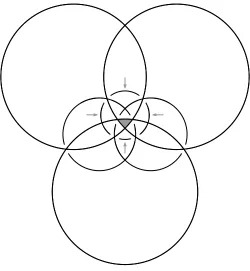
Figure 2.1: Shards in the Coxeter arrangement A(S4)
Example 2.1. The Coxeter arrangementA(S4) consists of six hyperplanes through the origin
the hyperplanes H12 on the top left, H23 on the bottom, and H34 on the top right. The two
medium circles are the hyperplanes H13 on the left andH24 on the right. The smallest circle
is the hyperplane H14. Regions of A(S4) appear as curve-sided triangles. The base region,
corresponding to 1234, is shaded in gray. The shards are closed 2-dimensional cones, so they appear as full circles or as circular arcs in the figure. To clarify the picture, where shards intersect, certain shards are offset slightly from the intersection to indicate that they do not continue through the intersection. The four shards contained in the hyperplaneH14are marked
by arrows in the figure. The top shard inH14is defined by{~x:x1 =x4, x1 ≤x2, −x1 ≤ −x3}.
The left shard in H14 is defined by {~x : x1 = x4, x1 ≤ x2, x1 ≤ x3}. The bottom shard in
H14 is defined by {~x: x1 =x4, −x1 ≤ −x2, x1 ≤ x3}. The right shard in H14 is defined by
{~x:x1=x4, −x1≤ −x2, −x1≤ −x3}.
Given a permutationπ and the corresponding regionR, the descents ofπcorrespond to the hyperplanes containing the lower shards ofR. For example, 43 and 31 are descents inπ= 4312 and the hyperplanes containing the shards below R are H13 and H34. The cone formed by
the intersection of the lower shards of R satisfies xi = xj for each descent ji of π. Now we need to determine which shards from these hyperplanes are the lower shards of R. The shard below R contained in Hij is the shard on the same side as R of each hyperplane cutting Hij. Thus, for each k withi < k < j, the cone satisfies xi ≥xk if and only if (k, i) is an inversion of π, and the cone satisfies xi ≤ xk if and only if (k, i) is not an inversion of π. Continuing Example 2.1, the shard below R contained in H13 will satisfy x1 ≤ x2, since (2,1) is not an
inversion in π = 4312. The following proposition summarizes this explicit description for the shard intersection associated to a given permutation.
Proposition 2.2. For a permutation π, the corresponding shard intersection is the cone con-sisting of points (x1, . . . , xn) satisfying the following conditions for each descent ji of π.
1. xi ≡xj
3. xi ≤xk if and only if i < k < j and (k, i) is not an inversion of π.
We conclude this section with a lemma relating inversions of a permutation to intersections between descending runs. The notation [a, b] stands for the set{c∈Z:a≤c≤b}. We will say that two descending runs D=d1d2· · ·dm and E =e1e2· · ·en overlap if [dm, d1]∩[en, e1]6=∅.
This lemma will be used in Section 2.3.
Lemma 2.3. Suppose (i, j) is an inversion in π such that i and j are in distinct descending runs i1i2· · ·is and j1j2· · ·jt respectively. If [is, i1]∩[jt, j1] = ∅, then there exists a chain of
descending runs D1, D2, . . . , Dn between is and j1 such that [is, i1]∩D1 6=∅, Dn∩[jt, j1]6=∅,
and Dk and Dk+1 overlap for 1≤k≤n−1.
Proof. Let π = · · ·i1i2· · ·is· · ·j1j2· · ·jt· · · as in the statement of the lemma. Since [is, i1]∩
[jt, j1] = ∅ and i > j, we know thatix > jy for all x ∈ [s] and y ∈[t]. We claim there must be a descending run d1d2· · ·dp between is and j1 such that d1 > is and dp < is. We know
is> j1 andisandj1 are both part of different descending runs. Directly to the right ofis is the
descending runf1· · ·fr withf1 > issince it is a descending run distinct fromi1· · ·is. Suppose
f1· · ·fr does not satisfy the claim. Then fz > is for all z ∈ [r]. Directly to the right of fr
is the descending run g1· · ·gp with g1 > fr since it is a distinct descending run. This implies
g1 > is. Suppose g1· · ·gl does not satisfy the claim. Then gz > fr > is for all z ∈ [l]. We
can continue considering adjacent descending runs until we reach the descending runh1· · ·hw
which is directly to the left of j1. Again h1 > is and if h1· · ·hw does not satisfy the claim, thenhz > is for all z∈[w]. From this we obtain hz > is> j1 for all z∈[w] and in particular
hw > j1. This implies that h1· · ·hw and j1· · ·jt are not separate descending runs, which is a
contradiction. Therefore, at least one descending rund1. . . dpbetweenisandj1must satisfy the
claim. Thus [is, i1]∩[dp, d1]6=∅. Letd1· · ·dp beD1. Also, sinced1 > is, we know thatd1> j1.
Then, by induction on the number of descending runs between is andj1, there exists a chain of
descending runs D1, D2, . . . , Dn between is and j1 such that [is, i1]∩D1 6=∅, Dn∩[jt, j1]6=∅,
2.3
Permutation Pre-orders
This section begins with background and notation concerning pre-orders, leading to an injection from shard intersections to pre-orders. Composing with the bijection between shard intersec-tions and permutaintersec-tions yields an injectionµ from permutations to pre-orders. We characterize the image ofµand we finish the section with the description of the inverse of µ.
A pre-order is a reflexive, transitive, binary relation. A pre-orderP on [n] defines an equiv-alence relation on [n] by setting i ≡ j if and only if i j i. We will call the classes of this equivalence relation blocks. We simultaneously think of P as a pre-order on [n] and as a partial order on its blocks. Notationally, when considering a specific pre-order P, a block will be labeled as B[i,j] wherei is the minimal element in the block and j is the maximal element
in the block. For example, a singleton block containing the element l ∈ [n] will be labeled as B[l,l]. B(v) is defined to be the block in P containing the element v∈[n]. We will say blocks
B[i,j] and B[k,l] overlap if the intervals [i, j] and [k, l] have a non-empty intersection. A block
B[i,j]is covered by a blockB[k,l]if B[i,j]≺B[k,l]and there does not exist a blockB[s,t]such that
B[i,j]≺B[s,t]≺B[k,l]. To indicate that blockB[k,l]covers blockB[i,j]we will writeB[i,j]≺·B[k,l].
An elementiis covered by an element j inP if i≺j and for any ssuch thatisj, either s≡ior s≡j.
We now describe an injection from the set Ψ of shard intersections inA(Sn) to the setP of pre-orders on [n]. The pre-orderP ∈ P corresponding to a shard intersection Γ∈ Ψ is found by only considering the indices in the equalities and inequalities defining Γ. Thus fori, j∈[n], ij in P if and only if the inequality xi ≤xj holds in Γ. In particular, if xi =xj in Γ then ijiinP.
Example 2.4. The shard intersection Γ = {~x : x1 = x4, x6 = x7, x1 ≤ x2,
−x1 ≤ −x3} in R7 corresponds to the pre-order in Figure 2.2 which has blocks B[3,3] =
{3}, B[1,4] = {1,4}, B[2,2] = {2}, B[5,5] = {5} and B[6,7] = {6,7}. Γ is the intersection of
3
14 5 67
2
Figure 2.2: The pre-order representing Γ ={~x∈R7:x1 =x4, x6=x7, x1 ≤x2, −x1≤ −x3}
Letµ:Sn→ P be the map that takes a permutationπ ∈Snto a pre-orderP ∈ Pas follows: each descending runπmπm+1· · ·πm+t inπ is a block B[πm+t,πm] ={πm, πm+1, . . . , πm+t}in P.
For distinct blocksB[πi+j,πi]andB[πk+l,πk]which overlap,B[πk+l,πk]B[πi+j,πi]inP if and only
if πk· · ·πk+l occurs to the right of πi· · ·πi+j in π, i.e. (i+j) < k. The transitive closure of these relations defines the pre-orderP.
2 136 8
4 57
Figure 2.3: µ(26314758)
Example 2.5. For π = 26314758 the descending runs form the following blocks: B[2,2] =
{2}, B[1,6] ={1,3,6}, B[4,4] ={4}, B[5,7] ={5,7}, B[8,8] ={8}. The pre-order µ(π) is shown in
Figure 2.3.
Proposition 2.6. µis the composition of the bijection between permutations and shard inter-sections with the injection from shard interinter-sections to pre-orders.
are in the same descending run inπ and in µ(π) they will be in the same block, implying that i≡ j. Suppose k is an element ofπ with i < k < j. In µ(π) the block B(k) must be related to the block B(i) since they overlap. If (k, i) is an inversion in π, then we have B(i) B(k) implying i k. If (k, i) is not an inversion, then we have B(i) B(k) implying i k. This corresponds to the relations given in Proposition 2.2.
Define a permutation pre-order as a pre-order P on [n] satisfying the following two condi-tions:
(P1) if any two blocks inP overlap, they must be comparable inP (P2) all covering relationships inP must be between blocks that overlap. Let Ω be the set of permutation pre-orders.
As noted previously, a single shard Σ∈Ψ can be represented as Σ ={~x:xi =xjandkxi≤ kxk for i < k < j}. Thus Σ corresponds to a pre-order P with one block B[i,j] of size two
and n−2 singleton blocks: B[v,v] for v ∈ [n]\ {i, j}. Each block B[k,k] for i < k < j will be comparable to B[i,j] in P and all other blocks will be incomparable to it. All covering relationships in P involve overlapping blocks. Therefore P ∈Ω. Define ΩΣ ⊂Ω to be the set
of permutation pre-orders corresponding to single shards.
Proposition 2.7. µ is a bijection from permutations in Sn to pre-orders in Ω.
Proof. By Proposition 2.6, µis a bijection onto its image. All that remains to be shown is that Ω is the image of µ. It is clear from the definition ofµthat the image of µis contained in Ω.
Let ω ∈Ω. It is sufficient to find a set of pre-orders in ΩΣ such that the transitive closure of the unions of these pre-orders is ω. For each B[i,k] in ω consider each s∈B[i,k] with i < s. Define ωis to be the pre-order on [n] with one two element block B[i,s] and the remaining
(1) for v∈[i, s] :
if iv inω,theniv inωis if iv inω,theniv inωis if i≡v inω,theniv inωis
((P1) rules out the possibility that iand v are incomparable.)
(2) for v /∈[i, s]: v is incomparable inωis to x for allx∈[n]\ {v}.
Clearly, ωis∈ΩΣ. Taking the transitive closure of unions ofωis for each pairi, s we obtain all the blocks of ω. (P2) guarantees that all of the covering relationships of ω are obtained as well. Thus, taking the transitive closure of unions of the set of pre-ordersωis (for each pairi, s described above) gives ω.
ω =
5 1 247
3 689
ω24 =
1 24 5 6 7 8 9
3 ω27 =
5
1 27 8 9
3 4 6
ω68 =
1 2 3 4 5 7 9
68 ω69 =
7
1 2 3 4 5 69
8
Figure 2.4: Illustration of the proof of Proposition 2.7
blocks B1, B2 ∈ω if B1 ≺B2 inω, then we place the descending run containing the elements
ofB2 to the right of the descending run containing the elements ofB1 inπ. LetB[i,j]andB[k,l]
be blocks that are incomparable inω. By (P1), the two blocks do not overlap, so without loss of generality, j < k. We place the descending run containing the elements of B[k,l] to the right
of the descending run containing the elements of B[i,j]inπ.
2 79
13 48
5 6
Figure 2.5: The permutation pre-orderω
Example 2.8. Suppose ω is the permutation pre-order shown in Figure 2.5. Then λ(ω) = 231978456.
Next we give a lemma establishing thatλis indeed a permutation and conclude the section with the proof that λ=µ−1.
Lemma 2.9. For any permutation pre-order ω, the image λ(ω) is a permutation.
Proof. The definition of λ(ω) defines a directed graph on the blocks of ω such that any two blocks are connected by a single directed edge. We will show that the digraph is acyclic, meaning that we have defined a total order on the blocks of ω and λ(ω) is a permutation. It is enough to show that any set of three blocks from ω is acyclically ordered by λ. Suppose B[i,j], B[k,l], B[s,t]∈ω. There are four cases to consider.
Case 1: If B[i,j], B[k,l], and B[s,t] are all incomparable in ω, then [i, j],[k, l] and [s, t] are
pair-wise disjoint, andλorders them numerically based on the positions of [i, j],[k, l] and [s, t] inR. Thus, they will be ordered acyclically.
and let B[s,t] be incomparable to both B[i,j] and B[k,l]. We claim that either t < i and t < k
or s > j and s > l. Since B[s,t] is incomparable to both B[i,j] and B[k,l] in ω, we know that
[s, t]∩[i, j] =∅and [s, t]∩[k, l] =∅. There are two subcases to consider: either [i, j]∩[k, l]6=∅ or [i, j]∩[k, l] =∅.
Case 2a: If [i, j]∩[k, l] 6= ∅, then it follows that [s, t]∩[min(i, k),max(j, l)] = ∅ and the claim is true.
Case 2b: If [i, j] ∩ [k, l] = ∅, then by (P2) there exists a chain of covers B[i,j]≺·B1
≺·B2≺· · · · ≺·Bn≺·B[k,l] in ω such that B[i,j] and B1 overlap, Bn and B[k,l] overlap, and
Bx and Bx+1 overlap for 1 ≤x ≤n−1. Since B[s,t] is incomparable to both B[i,j] and B[k,l],
it must be incomparable toBx for x∈[n]. Therefore Bx and B[s,t] do not overlap forx ∈[n].
Again it follows that [s, t]∩[min(i, k),max(j, l)] =∅ and the claim is true.
Since the claim is true, the definition of λimplies that B[s,t] is to the left or to the right of
both B[i,j]and B[k,l] inλ(ω). Thus the blocks will be ordered acyclically byλ.
Case 3: Suppose two pairs of blocks are comparable and one pair is incomparable. Without loss of generality, either B[s,t]≺B[i,j]andB[s,t]≺B[k,l]or B[i,j]≺B[s,t]and B[k,l]≺B[s,t], with
B[i,j] and B[k,l] incomparable in both instances. In the first instance, by the definition of λ,
B[s,t]is to the left of bothB[i,j]and B[k,l] inλ. SinceB[i,j] andB[k,l]are incomparable inω, we
know that [i, j]∩[k, l] =∅, so the blocksB[i,j]and B[k,l]are ordered numerically inλbased on
the positions of [i, j] and [k, l] inR. Thus the three blocks will be ordered acyclically byλ. The second instance follows similarly, and again the three blocks will be ordered acyclically by λ.
Case 4: Finally, if B[i,j], B[k,l] and B[s,t] are all comparable inω, then by the transitivity of ω
they must be ordered acyclically.
Therefore,λ(ω) defines a total order on the blocks ofω, which corresponds to a unique permu-tation π.
Proposition 2.10. λ=µ−1
that the relative positions of any two descending runs in π remain the same in λ(µ(π)). De-scending runs in π are preserved in λ(µ(π)) becauseµ converts the descending runs to blocks and λconverts each block back to the original descending run. (The descending runs do not increase in length since covering pairsB[i,j]and B[k,l]have [i, j]∩[k, l]6=∅ andλplaces
incom-parable blocks in increasing order.) Let i1i2· · ·is and j1j2· · ·jt be descending runs in π with
π=· · ·i1i2· · ·is· · ·j1j2· · ·jt· · ·. Each of the descending runs inπ will become blocks inµ(π),
soB[is,i1] and B[jt,j1] are blocks inµ(π). There are two cases to consider.
Case 1: Suppose [is, i1]∩[jt, j1] 6= ∅. Then B[is,i1] ≺ B[jt,j1] in µ(π) and λ will place the
descending runi1i2· · ·is to the left of the descending runj1j2· · ·jt inλ(µ(π)).
Case 2: Suppose [is, i1]∩[jt, j1] =∅. Then we have two subcases to consider: either ix > jy
for all x∈[s] and y∈[t] or ix< jy for all x∈[s] andy ∈[t].
Case 2a: Supposeix > jy for allx∈[s] and y∈[t]. Then by Lemma 2.3,B[is,i1]≺B[jt,j1]
inµ(π) andλwill place the descending runi1i2· · ·is to the left of the descending runj1j2· · ·jt
inλ(µ(π)).
Case 2b: Supposeix< jy for all x∈[s] and y ∈[t]. For the purpose of contradiction, sup-pose that the descending runi1i2· · ·isis to the right of the descending runj1j2· · ·jtinλ(µ(π)). Since ix < jy forx∈[s] and y∈[t], the descending runs were not ordered based on their posi-tions inRimplying thatB[jt,j1]≺B[is,i1]inµ(π). Since [is, i1]∩[jt, j1] =∅, we know thatB[jt,j1]
is not covered byB[is,i1]. Thus we have a chain of coversB[jt,j1]≺·B1≺·B2≺· · · · ≺·Bn≺·B[is,i1]
in µ(π) where n ≥ 1. Since B[jt,j1]≺·B1 in µ(π), the descending run j1· · ·jt must be to the
left of the descending run containing the elements of B1 in π. Similarly, the descending run
containing the elements ofBx must be to the left of the descending run containing the elements of Bx+1 inπ for 1≤x≤n−1 and the descending run containing the elements of Bn must be
2.4
The Shard Intersection Order on
S
nIn this section we describe the shard intersection order on Sn in terms of an order on the permutation pre-orders. We then define a labeling for the order and spend the majority of the section proving various lemmas concerning cover relations and the labeling. The section, and the chapter, culminate in the proof that the given labeling is an EL-labeling of the shard intersection order onSn.
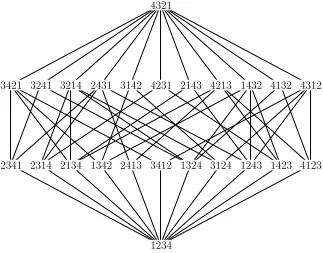
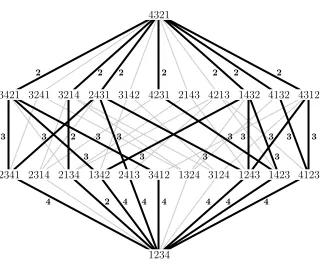
Theshard intersection order is the set Ψ(A, B) partially ordered by reverse containment. It was shown in [16] to be a graded, atomic and coatomic lattice and is denoted as (Ψ(A, B),⊇). We will continue considering the case whereW =Sn. Thus (Ψ(A(Sn), B),⊇) can be realized as the permutation pre-orders partially ordered by containment of relations, which we will denote as (Ω,≤S). (See Figure 2.6 for the shard intersection order on S4.)
1234
2341 2314 2134 1342 2413 3412 1324 3124 1243 1423 4123 3421 3241 3214 2431 3142 4231 2143 4213 1432 4132 4312
4321
To avoid confusion, we remind the reader that the three order relations appearing in the chapter are the total order ≤on real numbers, the partial orderon blocks in a given permu-tation pre-order and the order relation ≤S on permutation pre-orders in (Ω,≤S). The minimal element ˆ0 is the empty intersection, which is the permutation pre-order with each number in a singleton block and no order relations among the blocks. The maximal element ˆ1 is the permutation pre-order with all numbers together in one block. In [16] it was shown that the rank of Γ∈ Ψ is the codimension of Γ. From this, one easily deduces the following result for permutation pre-orders. The notation |ω|stands for the number of blocks inω.
Proposition 2.11. The rank of ω∈Ω in the graded lattice (Ω,≤S) is n− |ω|.
To go up by a cover from a shard intersection Γ in (Ψ(A, B),⊇) we intersect Γ with one additional shard Σ, chosen so that dim(Σ∩Γ) = dim(Γ)−1. Thus to go up by a cover fromωin (Ω,≤S), any two blocks which are unrelated or related by a cover can be combined. All relations fromωare maintained in the permutation pre-order that covers it, and relations involving either of the combined blocks fromωbecome an order relation involving the new block in the cover. If by combining two unrelated blocks inωan interval is formed which now intersects the intervals of other unrelated blocks, then the newly overlapping blocks may be greater than or less than the combined block in the cover.
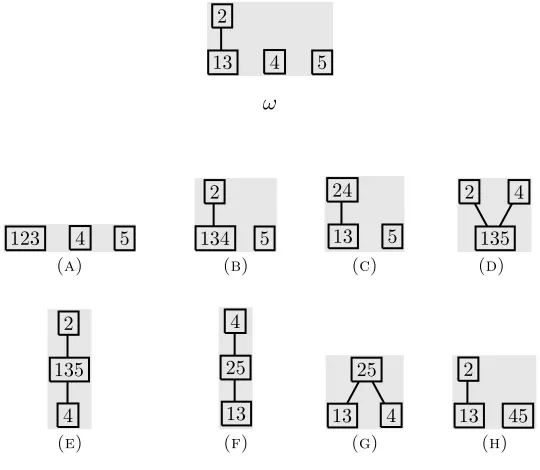
Example 2.12. Figure 2.7 shows a permutation pre-order labeledωand the eight permutation pre-orders labeled(A)through (H)which cover it. Notice that if we combine blocks B[1,3] and
B[5,5] in ω, blocks B[1,5] and B[4,4] overlap in the permutation pre-order which covers ω. By
(P2) this means thatB[1,5] and B[4,4] must be related. Since B[4,4] is unrelated to blocksB[1,3]
and B[5,5] in ω there is no restriction on the direction of this relation, so B[4,4] can be either
greater than or less than B[1,5]. Thus we obtain the two permutation pre-orders (D) and (E).
Each of these pre-orders arise by intersectingω with a permutation pre-order corresponding to a single shard in ΩΣ with 3 and 5 together in one block.
13 4 5 2
ω
123 4 5 134 5
2
13 5 24
135
2 4
(a) (b) (c) (d)
4 135
2
13 25 4
13 4 25
13 45 2
(e) (f) (g) (h)
Figure 2.7: Covers of a permutation pre-orderω ∈(Ω,≤S)
the other hand, in the permutation pre-order labeled (F), blocks B[1,3] and B[4,4] cannot be
combined to form a cover since this would force all numbers to be in one block and the rank would go up by two instead of one.
The main result of this chapter is an edge-lexicographic or EL-labeling [3, 5] of (Ω,≤S). A sequence a1a2· · ·an is lexicographically smaller than a sequence b1b2· · ·bn if there exists a j ∈ [n] such that ai = bi for all i < j but aj < bj. Define a labeling of the poset to be an
EL-labeling if the edges of the poset are labeled with positive integers such that the following two conditions hold.
(EL1) Each interval (ω, ω0) in the poset has a unique maximal chainω=ω
0lSω1lS· · ·lSωk=ω0 whose edge label sequence,σ(ω0, ω1)σ(ω1, ω2)· · ·σ(ωk−1, ωk) is weakly increasing in value, and
Given a permutation pre-order ω, number the descending runs in λ(ω) from 1 to |ω|, pro-ceeding from left to right. Define this number to be the placement of the descending run i1· · ·in in λ(ω) or the placement of its corresponding block B[in,i1] in ω. We will denote the
placement of a block B in ω as plω(B). The total order on the blocks of ω defined by the placements is equivalent to the total order defined by λ. Also, if B[i,j] ≺ B[k,l] in ω, then
plω(B[i,j]) < plω(B[k,l]) since the descending run corresponding to B[i,j] is to the left of the
descending run corresponding to B[k,l]inλ(ω).
For (Ω,≤S) we will describe a labeling σ. Let σ(ωi, ωi+1) = the maximum of the
place-ments of the two blocks from ωi that were combined to formωi+1. We will prove the following
theorem.
Theorem 2.13. σ is an EL-labeling.
1234
2341 2314 2134 1342 2413 3412 1324 3124 1243 1423 4123 3421 3241 3214 2431 3142 4231 2143 4213 1432 4132 4312
4321
4 2
2 2
3 3
2 2
4 4 4 4 4 4
3 3
3 3 3
3 3
3 3
3 3
2 2 2 2
Example 2.14. The unique increasing maximal chain and the thirteen strictly decreasing maximal chains in the shard intersection order onS4 with respect to the labelingσ are shown
in Figure 2.8.
The proof of Theorem 2.13 requires a proposition and several lemmas concerning relations in (Ω,≤S). Given a permutation pre-orderωand the interval (ω, ω0) in (Ω,≤S), we will denote by T(ω, ω0) the set of pairs of blocks inω that could be combined to form a permutation pre-order in (ω, ω0) which covers ω. A pair of blocks in ω will be called combinable if either one block covers the other or the pair is incomparable inω.
Lemma 2.15. Suppose ω and ω0 are permutation pre-orders with ω <
S ω0. Let B1 and B2 be
combinable blocks inω such that they are contained in the same block inω0. Then there exists a permutation pre-order ω00 withωlSω00≤Sω0 such that B1 andB2 are in the same block in ω00.
Proof. Label the elements of B1 as a1, a2, . . . , am with ai < ai+1 for 1 ≤ i ≤ m−1 and the
elements of B2 as b1, b2, . . . , bn with bj < bj+1 for 1 ≤ j ≤ n−1. Without loss of generality
suppose thata1< b1. Since blocksB1 andB2 are in the same block inω0 we know thatai ≡bj
inω0 fori∈[m], j∈[n]. Defineω∗ to be the permutation pre-order on [n] with one two element block B[a1,b1] and the remaining elements in singleton blocks B[v,v] for v ∈ [n]\ {a1, b1} with
the following order relations:
(1) for v∈[a1, b1] :
if a1 v inω0,then a1vinω∗
if a1 v inω0,then a1vinω∗
if a1 ≡v inω0,then a1vinω∗
((P1) rules out the possibility that a1 and v are incomparable.)
(2) for v /∈[a1, b1]: v is incomparable in ω∗ to x for all x∈[n]\ {v}.
Clearly, ω∗ ∈ΩΣ. Taking the transitive closure of the union of ω withω∗ gives the
Proposition 2.16. Let ω and ω0 be permutation pre-orders withωlSω0. SupposeB1 and B2
are the blocks in ω that are combined to form a block B in ω0, with plω(B1) =a < c=plω(B2).
Let B∗ be in ω.
1. If a < plω(B∗)< c, then B∗ is comparable to B in ω0.
2. IfB∗ is incomparable toB1 andB2inω and comparable toB inω0, thena < plω(B∗)< c.
3. If plω(B∗)< a, then plω0(B∗) =plω(B∗). If a≤plω(B∗)≤c, then a≤plω0(B∗)≤c−1. If plω(B∗)> c, then plω0(B∗) =plω(B∗)−1.
4. Let B0 be a block in ω0 such that pl
ω0(B0) =b < c. If blocks B and B0 are combinable in
ω0, then B0 is combinable with B1 in ω.
5. If plω(B∗) =b < c, then B0, the block containing B∗ in ω0, has plω0(B0)< c.
Proof. Let B1 =B[i,j]and B2=B[k,l]. Then B=B[s,t]fors= min(i, k) and t= max(j, l).
Proof of (1): There are two cases to consider. Suppose, in the first case, that B[i,j] and B[k,l]
form a cover in ω. Arguing as in Case 2a of Lemma 2.9, any block which is incomparable to both B[i,j] and B[k,l] must be to the left of both B[i,j] and B[k,l] or to the right of both B[i,j]
and B[k,l] inλ(ω) and thus does not have a placement between a and c. Therefore, all blocks
B∗ with a < plω(B∗) < cmust be comparable to either B[i,j] or B[k,l] inω. Since all relations
from ω must also be in ω0, the blocksB∗ must be comparable toB[s,t] inω0.
In the second case we suppose thatB[i,j]andB[k,l]are incomparable inω. Again, any block
B∗ witha < plω(B∗)< cwhich is comparable to either B[i,j] orB[k,l]inω must be comparable
toB[s,t]inω0. Thus, all that is left to consider is a blockB[p,q]witha < plω(B[p,q])< c which is
incomparable to bothB[i,j] andB[k,l]inω. Since the three blocks B[i,j], B[k,l]and B[p,q] are in-comparable inω, we know that [i, j],[k, l] and [p, q] are pairwise disjoint and the three blocks are ordered inλ(ω) based on the positions of [i, j],[k, l] and [p, q] inR. Given that the placements of the three blocks correspond to their ordering inλ(ω) and plω(B[i,j])< plω(B[p,q])< plω(B[k,l]),
B[i,l]=B[s,t], and we know that [p, q]⊂[i, l] = [s, t]. Therefore by (P1), B[p,q] must be related
to B[s,t] inω0.
Proof of (2): Suppose for the purpose of contradiction, a block B[f,g] with plω(B[f,g]) < a is
incomparable to both B[i,j] and B[k,l] in ω and is comparable to B[s,t] in ω0. Since λ orders
incomparable blocks based on their intervals, g < i and g < k. Thus, g < min(i, k) and [f, g]∩[s, t] =∅. This implies thatB[f,g]andB[s,t]do not cover one another in ω0 and therefore
must be related by a chain of covers: B[f,g]≺·B[x1,x2]≺·B[x3,x4]≺· · · · ≺·B[xd
−1,xd]≺·B[s,t]. By
(P2), we have [f, g]∩[x1, x2]6=∅,[x1, x2]∩[x3, x4]6=∅, . . . ,[xd−1, xd]∩[s, t]6=∅. Thus, some interval [xm, xm+1] for 1 ≤m ≤d−1 must overlap either [i, j] or [k, l]. The block B[xm,xm+1] corresponding to this interval must be less than eitherB[i,j]orB[k,l]inω(whichever it overlaps)
because if it were greater than either of them it would be greater than B[s,t] in ω0 and thus
would not be part of the chain of covers. Since all blocks except forB[i,j]andB[k,l]are the same
in bothωandω0, we have thatB[f,g]is related to eitherB[i,j]or B[k,l]by a chain of covers in ω.
This contradicts our assumption that B[f,g] is incomparable to bothB[i,j] and B[k,l] in ω and
thusplω(B[f,g])≮a. Similarly, ifplω(B[f,g])> cwe see that f >max(j, l) and there must exist
a chain of covers betweenB[s,t]and B[f,g] such that one block in the chain has an interval that
overlaps either [i, j] or [k, l]. Reaching the same contradiction we conclude thatplω(B[f,g])≯c
and thus a < plω(B[f,g])< c.
Proof of (3): Let B[u,v] be a block in ω with plω(B[u,v]) = x < a. We first show that
plω0(B[u,v]) < plω0(B[s,t]). Suppose that B[u,v] is incomparable to both B[i,j] and B[k,l]. Since
x < a and x < c, v < min(i, k) = s and the descending run corresponding to B[s,t] must be
to the right of the descending run corresponding to B[u,v] in λ(ω0). Now suppose that B[u,v] is
comparable toB[i,j] or B[k,l]inω. Then either B[u,v]≺B[i,j] or B[u,v]≺B[k,l], sincex < a and
x < c. All relations from ω must also hold in ω0 so B
[u,v] ≺B[s,t] inω0. Thus the descending
run corresponding to the new block B[s,t] will always be to the right of the descending run
corresponding toB[u,v]inλ(ω0).
B[i,j], B[k,l] and B[u,v]. IfB[u,v] is incomparable to B[f,g]in both ω and ω0 then the descending
runs corresponding to B[u,v] andB[f,g]must be ordered the same in bothλ(ω) andλ(ω0), since
λ orders them based on the positions of [u, v] and [f, g] in R. If B[u,v] is comparable to B[f,g]
inω, then again the descending runs corresponding to each of them must be ordered the same in both λ(ω) and λ(ω0), since relations from ω are preserved inω0. If B[u,v] is incomparable to
B[f,g]in ω and comparable to it in ω0, then we claim that v < f and B[u,v]≺B[f,g] inω0. Two
blocks which are comparable inω0 and incomparable inω can only occur when both blocks are
comparable through the new block B[s,t] in ω0. Since we already showed that B[u,v] must be
less thanB[s,t] inω0 if they are comparable, we must haveB[u,v]≺B[s,t]≺B[f,g]inω0. In order
for the relationB[s,t]≺B[f,g]to exist inω0, the descending run corresponding toB[f,g]must be
to the right of the descending run corresponding to B[i,j] in λ(ω). Since B[u,v] and B[f,g] are
incomparable in ω, this implies that v < f. Thus the claim is true. Therefore, all descending runs to the right of the descending run corresponding to B[u,v] inλ(ω) will remain to the right
inλ(ω0) and all descending runs to the left inλ(ω) will remain to the left inλ(ω0). ThusB[u,v]
will retain the placement x inω0, i.e.plω(B[u,v]) =plω0(B[u,v]).
Now let B[u,v] be a block in ω with plω(B[u,v]) > c. By similar arguments, all descending
runs to the right of the descending run corresponding to B[u,v] inλ(ω) will remain to the right
inλ(ω0) and all descending runs to the left inλ(ω) will remain to the left inλ(ω0). Since the
de-scending runs corresponding toB[i,j]andB[k,l]have been combined to form a single descending
run, there is one less descending run to the left of the descending run corresponding to B[u,v].
Thus plω0(B[u,v]) = plω(B[u,v])−1. We can now also conclude that if a ≤ plω(B∗) ≤ c, then
a≤plω0(B∗)≤c−1.
Proof of (4): Suppose, for the purpose of contradiction, B1 and B0 are not combinable in ω.
ThenB1andB0are comparable by a chain of covers inω, i.e. eitherB1≺·A1≺·A2≺· · · · ≺·Ak≺· B0 or B0≺·A
1≺·A2≺· · · · ≺·Ak≺·B1 for k ≥ 1. Since B1 and B2 are combinable in ω they
must either be incomparable or related by a cover in ω. If B1 and B2 are incomparable in ω
ThusB and B0 would not be combinable in ω0, which is a contradiction. ThereforeB1 and B2
are related by a cover in ω. If B1 and B2 are related by a cover then k = 1 and B2 = A1 in
the chain of covers sinceB andB0 are combinable inω0. Thus we have eitherB1≺·B2≺·B0 or
B0≺·B2≺·B1 in ω. B0≺·B2≺·B1 is not possible because plω(B2) > plω(B1). B1≺·B2≺·B0
implies by part 3 of this Proposition thatplω0(B0)≥c, which is a contradiction. Therefore B1
and B0 are combinable inω0.
Proof of (5): There are two cases to consider. In the first case suppose thatB∗isB
1(it cannot be
B2 due to its placement). ThenB0=B. By part 3 of this Proposition,a=b≤plω0(B0)≤c−1.
In the second case suppose that B∗ is neither B
1 nor B2. Then B0 = B∗. If b < a, then by
part 3 of this Proposition, plω0(B0) =b. If a < b < c, then again by part 3 of this Proposition,
plω0(B0)≤c−1.
Lemma 2.17. Let B and B0 be blocks in ω ∈(Ω,≤S) with plω(B) = a and plω(B0) =a+ 1. Then B and B0 are combinable inω.
Proof. IfB and B0 are incomparable inω then they are combinable and we are done. IfB and B0 are comparable in ω suppose that one block does not cover the other. Then there exists a blockC such that B ≺C ≺B0 inω. This implies that plω(B)< plω(C)< plω(B0), which is a contradiction. ThusB and B0 are related by a cover and are therefore combinable.
Lemma 2.18. Given ω and an interval (ω, ω0) ∈(Ω,≤S), there exists a unique pair of blocks
B1 and B2 whose larger placement is minimal among all pairs in T(ω, ω0). Furthermore, there
exists a unique cover of ω in which B1 and B2 are combined.
in ω due to their placements, so the only case left to consider is when block b is greater than blocka but does not cover it. In this case there exists a chain of covers froma to b such that all of the blocks in the chain have placements less thanb, i.e.a≺·a1≺·a2≺· · · · ≺·ak≺·bwhere
aj < b for allj∈[k]. Therefore (a, a1) is inT(ω, ω0), contradicting the minimality ofc.
We have established that there exists a unique pair of blocks B1 and B2 whose larger
placement cis minimal among all pairs inT(ω, ω0). We know by Lemma 2.15 that there exists at least one cover of ω in which B1 and B2 are combined. Suppose, again for the purpose of
contradiction, there is more than one cover that can be obtained by combining B1 and B2 in
ω. The only way for this to occur is if a block is incomparable to both B1 and B2 in ω and
comparable to the combined block in the covers. Thus we have the following situation. B1
and B2 are combined to form block B in ω1 and ω2 for ωlS ω1 and ω lS ω2. Block B0 is
incomparable to bothB1 and B2 in ω. Inω1,B≺B0 and in ω2,B B0 implying thatB0 and
B are in the same block in ω0. This means that B0 is also in the same block asB1 and B2 in
ω0. By Proposition 2.16 part 2 we know that plω(B0) =b such that a < b < c. Since B0 and B1 are incomparable in ω they are a pair in T(ω, ω0), which contradicts the minimality of c.
Therefore, there exists a unique cover of ω in which B1 and B2 are combined.
We now have the necessary tools to prove Theorem 2.13.
Proof. We need to establish that σ satisfies conditions (EL1) and (EL2). Let (ω, ω0) be an interval in (Ω,≤S). Denote by ζ the maximal chain ω = ω0lS ω1lS · · ·lSωk = ω0 where each ωi+1 is obtained by combining a pair of blocks fromT(ωi, ω0) such that the larger of the
two placements is minimal among all pairs. By Lemma 2.18, this maximal chain is unique and thus does not share its label sequence with any other chain.
Now we will show that the edge label sequence for ζ is weakly increasing. Suppose, for the purpose of contradiction, there is a descent in the edge label sequence, i.e. σ(ωj, ωj+1) =c and
σ(ωj+1, ωj+2) =b forc > b. LetB and B0 with plωj+1(B) =a < b=plωj+1(B
0) be the blocks
not have minimal larger placement.
Proof of claim: There are three cases to consider. In the first case we suppose thatB andB0are the same blocks inωj and ωj+1. Since blocks B and B0 are not the blocks that were combined
inωj to form ωj+1 and they both have placements less than cinωj+1, Proposition 2.16 part 3
tells us thatplωj(B)< candplωj(B
0)< c. The only way in whichB andB0 are not combinable
in ωj but are combinable in ωj+1 is if B≺·B∗≺·B0 in ωj and either B and B∗ or B∗ and B0
are combined to form ωj+1. Since we are assuming that B and B0 are the same blocks in ωj and ωj+1, this cannot occur. This implies that B and B0 are combinable in ωj. Thus B and B0 are a combinable pair of blocks inω
j with larger placement less thanc. In the second case, suppose that B is the new block in ωj+1 formed by combining blocks B1 and B2 inωj where
plωj(B1) = c1 < c =plωj(B2). Then by Proposition 2.16 part 4, B
0 and B
1 are a combinable
pair inωj with larger placement less thanc. In the third case, suppose thatB0 is the new block in ωj+1 formed by combining blocks B10 and B20 where plωj(B
0
1) = c2 < c = plωj(B
0
2). Then
again by Proposition 2.16 part 4,B and B10 are a combinable pair inωj with larger placement less than c. In each case, we obtain a pair of blocks in ωj such that the larger placement of the pair is less thanc. Therefore, the claim is true and we have reached a contradiction. Thus, there cannot be a descent in the edge label sequence forζ, meaningζ is weakly increasing.
All that remains to be shown for (EL1) is that ζ is the only weakly increasing maximal chain. As established above,ζ does not share its label sequence with any other chain. Suppose we follow some other maximal chain χ from ω to ω0. At some step these chains must differ, meaning that inζ we combine two blocks fromωj to formωj+1 such that the larger placement
of the pair of blocks in ωj is minimal among pairs inT(ωj, ω0), whereas in χ we combine two blocks from ωj to formω∗j+1 such that the larger placement of the pair of blocks inωj is not minimal among pairs in T(ωj, ω0). Thus we have the following situation. Let B1 and B2 be
blocks of ωj withplωj(B1) =a < c=plωj(B2) that were combined to form ωj+1. LetB
∗
1 and
B∗
2 be blocks of ωj with plωj(B
∗
1) = b < d=plωj(B
∗
2), ford > c, that were combined to form
some later step in χ, a block containing B1 must be combined with a block containing B2. By
Proposition 2.16 part 5, if we continue to pick pairs of blocks that cause the label sequence of χto increase, the placements of the blocks containingB1 andB2 inωk∗ fork > j will always be smaller than the edge label leading toωk∗ assigned byσ (because in ωj∗+1 B1 and B2 have edge
labels less thand). Eventually we are forced to combine the blocks containingB1 andB2 (or a
pair with smaller larger placement) creating a descent in the edge label sequence for χ. Thus, all other maximal chains have at least one descent. Therefore, ζ satisfies (EL1).
Since we chose the smallest possible label at each step in ζ, its label sequence is lexico-graphically smaller than the label sequences of all other maximal chains. Therefore,ζ satisfies (EL2).
Since (Ω,≤S) is a graded poset, Theorem 2.13 implies that it is EL-shellable and hence shellable [3, Theorem 2.3]. Thus the M¨obius number of an interval in (Ω,≤S), µ(ω, ω0), is
equal to (−1)|ω|−|ω0|
times the number of strictly decreasing maximal chains from ω to ω0. To
count the strictly decreasing maximal chains fromω toω0, we need to determine the number of ways in which the combinable block with the highest placement can be combined with blocks with lower placements at each step in the chain. At each step in a maximal chain there may be multiple ways to go up by a cover and obtain the maximum possible label on that edge. For this reason, counting strictly decreasing maximal chains is not completely straightforward, and at this time we do not know how to count strictly decreasing maximal chains for general intervals. Interestingly, the M¨obius number of the entire lattice has a simple description [16]. It is the number of indecomposable permutations, or equivalently, the number of permutations with no global descents. See Sequence A003319 of [17] for details and references.
2.5
Noncrossing Pre-orders
A Coxeter group W is generated by a set S of simple generators. For W =Sn the simple generators areS ={s1, s2, . . . , sn−1}wheresi= (i, i+ 1) for 1≤i≤n−1. A Coxeter element
c is the product of the simple generators in any order. For a chosen Coxeter element c∈ Sn, we can define abarring on the numbers{2,3, . . . , n−1}as follows:
1. if si−1 is before si inc theniis lower-barred, and we denote this by i 2. if si−1 is after si incthen iis upper-barred, and we denote this byi.
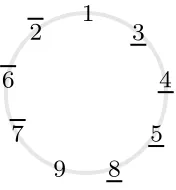
A Coxeter element in Sn can be written as an n-cycle using the barring by placing 1 at the 12 o’clock position on a circle followed clockwise by the lower-barred numbers in ascending numerical order, the number n, and then the upper-barred numbers in descending numerical order.
1
2
3
4
5
6
7
8
9
Figure 2.9: Cycle corresponding toc=s2s1s3s7s6s4s5s8
Example 2.19. Forc=s2s1s3s7s6s4s5s8∈S9 the lower-barred numbers are 3,4,5,8 and the
upper-barred numbers are 2,6,7. This gives us the cycle shown in Figure 2.9.
For a permutation π ∈Sn andx∈Sm we will say thatπ contains the pattern x if there are integers 1 ≤i1 < i2 < · · ·< im ≤n such that for all 1 ≤j < k ≤ m we have xj < xk if and
only if πij < πik. Otherwise we will say that π avoids the pattern x. In this section we will be
an instance of the pattern 231 in which the number representing the 2 in π is upper-barred. Similarly, we say π contains the pattern 312 if it contains an instance of the pattern 312 in which the number representing the 2 in π is lower-barred. If these conditions do not hold, we again say thatπ avoids the given pattern.
Example 2.20. As a continuation of Example 2.19, suppose c=s2s1s3s7s6s4s5s8∈S9. Then
π = 163425897 contains four instances of the pattern 312: 634, 635, 645, and 625, and avoids the pattern 231.
There is a general definition of c-sortable elements of a Coxeter group which can be found in [15]. For this chapter, the following characterization [15, Lemmas 4.1 and 4.8] of c-sortable elements in Sn is sufficient. Given a Coxeter element c, a permutation π ∈ Sn is c-sortable if and only if π avoids the patterns 231 and 312.
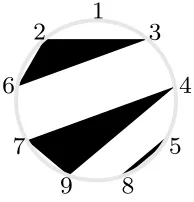
A c-noncrossing partition is a partition of [n] into blocks such that when the blocks are drawn on the cycle c, the convex hulls of the blocks do not overlap.
1
2
3
4
5
6
7
8
9
Figure 2.10: c-noncrossing partition
Example 2.21. Continuing Example 2.19, a c-noncrossing partition of the cyclec is shown in Figure 2.10.
1. blocks in ω form ac-noncrossing partition of the cycle c, and
2. suppose blocksB[is,i1] andB[jt,j1] intersect in ω, so that, without loss of generality, there
exists ajx∈B[jt,j1]forx∈[t] such thatis< jx< i1. Ifjxis upper-barred with respect to
cthenB[is,i1]≺B[jt,j1]inωand ifjxis lower-barred with respect tocthenB[is,i1]B[jt,j1]
inω. Let ΩN C
c = {ω ∈ Ω : ω is a noncrossing pre-order}, and let Ωc be the image of the c-sortable permutations under µ.
Proposition 2.22. Ωc= ΩN Cc
Proof. For any c-noncrossing partition there is at most one partial order on the blocks which defines a noncrossing pre-order. In [15, Theorem 6.1] it was shown that there exists a bijection between c-noncrossing partitions and c-sortable permutations. Thus |Ωc| ≥ |ΩN C
c |, and it is enough to show that Ωc ⊆ ΩN C
c . Let ω ∈ Ωc and let λ(ω) =π. Suppose i1· · ·is and j1· · ·jt
are distinct descending runs in π corresponding respectively to blocks B[is,i1] and B[jt,j1] inω such thatB[is,i1] and B[jt,j1] overlap. Then without loss of generality there exists ajx∈B[jt,j1]
such that is < jx < i1 for x ∈ [s]. Suppose jx is upper-barred with respect to c. Then if B[is,i1] B[jt,j1] in ω, π = · · ·j1· · ·jt· · ·i1· · ·is· · · and jxi1is forms a 231 pattern, which is
a contradiction of π beingc-sortable. Thus B[is,i1] ≺ B[jt,j1] in ω. Supposejx is lower-barred
with respect toc. Then if B[is,i1]≺B[jt,j1],π=· · ·i1· · ·is· · ·j1· · ·jt· · · andi1isjx forms a 312
pattern which is a contradiction ofπ beingc-sortable. ThusB[is,i1]B[jt,j1]inω.
The choice c=s1s2· · ·sn−1 is the case where every number is lower-barred and the choice
c =sn−1sn−2· · ·s1 is the case where every number is upper-barred. In these specific cases, if
two distinct blocks B[i,j] and B[k,l] overlap inω, then either [i, j]⊂[k, l] or [k, l]⊂[i, j]. Thus
we have the following corollaries.
Corollary 2.23. Let c =s1s2· · ·sn−1 and let ω ∈ΩN Cc . Then B[i,j]B[k,l] in ω if and only
Corollary 2.24. Let c=sn−1sn−2· · ·s1 and letω ∈ΩN Cc . Then B[i,j]B[k,l]in ω if and only
Chapter 3
Tamari Congruence Classes
3.1
Introduction
3.2
Tamari Congruence Classes
We will begin this section by discussing the weak order on the symmetric group. We then define Tamari congruence classes and discuss how to realize them combinatorially as partial orders on {1,2, . . . , n}. We finish with two propositions that present useful properties of any Tamari congruence class.
The inversion set of a permutation x, denoted by I(x), is the set of all inversions (see Chapter 2, Section 2.2) of x. The (right) weak order on Sn is a partial order which sets the permutations x ≤ y if and only if I(x) ⊆I(y). For the remainder of this chapter, “the weak order” will be taken to mean “the weak order onSn.” To go up by a cover in the weak order, a pair of adjacent entries inx are transposed so that they are out of numerical order. The weak order is a lattice withx= 12· · ·nas the minimal element andx=n(n−1)· · ·1 as the maximal element. If we take A(Sn) to be the Coxeter arrangement as described in Chapter 2, then the poset of regions is the weak order on Sn.
General Cambrian congruences are certain families of lattice congruences on the weak order on a finite Coxeter groupW. The quotient of the weak order modulo a Cambrian congruence is a Cambrian lattice. In every case where W is the symmetric group, the Cambrian congruence classes can be defined as the fibers of a map from permutations to triangulations. We will be considering the simplest case of this map, the fibers of which give the Tamari congruence. In the language of [14], we are considering the case where W is the symmetric group and every edge in the Coxeter diagram is orientedsi+1→si, or equivalently, every symbol is upper-barred
(see Chapter 2, Section 2.5). In this case, the Cambrian lattice is the Tamari lattice.
1 2
3
4 5 6 7 8 9 0 10 1 2 3
4 5 6 7 8 9 0 10 1 2 3
4 5 6 7 8 9 0 10 1 2 3
4 5 6 7 8 9 0 10 1 2 3
4 5 6 7 8 9 0 10 1 2 3
4 5 6 7 8 9 0 10 1 2 3
4 5 6 7 8 9 0 10 1 2 3
4 5 6 7 8 9 0 10 1 2 3
4 5 6 7 8 9 0 10 1 2 3
4 5 6 7
8 9
0 10
Figure 3.1: η(467198352)
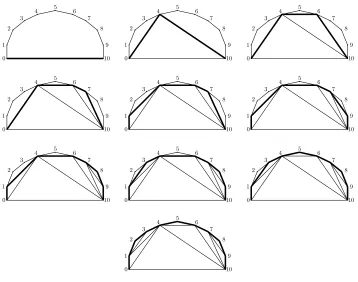
Example 3.1. Figure 3.1 shows the step-by-step construction (reading from left to right and top to bottom) of η(467198352). The permutations 467918352,461798352, and 416798352 (among others) also map to this triangulation.
Let τ be the map taking xto the above/below poset of η(x). Thus the set of fibers ofτ(x) is equal to the set of fibers of η(x). Up to an antisymmetry of the weak order (reversing the order of entries in x) and a symmetry of the plane, this is the same map studied by A. Bj¨orner and M. Wachs in [7]. The mapτ is defined recursively byτ(empty permutation) = empty tree, and for n > 0 andx ∈ Sn, τ(x) is the binary tree whose root is x1, left subtree is τ(x−) and
right subtree isτ(x+), wherex− andx+ are the subwords ofxconsisting of all letters less than x1 and all letters greater thanx1, respectively. Here, a binary tree is taken to be a tree rooted
at the bottom and growing upwards in which each node has either no children, a left child, a right child, or both a left and right child. Asubtree of a treeT is defined to be the tree formed by a node ofT with all of its descendants.
4
1 6
3 5 7
2 9
8
Figure 3.2: τ(467198352)
Example 3.2. Continuing Example 3.1, Figure 3.2 showsτ(467198352), the above/below poset for the triangulation given in Figure 3.1.
The following proposition is essentially [7, Proposition 9.10]. For the generalization to other Cambrian congruences, see [14]. (See Chapter 2, Section 2.5 for the definition of pattern avoidance.)
Let π↑x denote the top element of the Tamari class containing the permutation x, and likewise π↓x the bottom element of the Tamari class containing x. Define the C-poset for a
Tamari class containing an element x asτ(x), the above/below poset forη(x).
Inside the proof of [6, Proposition 5.1], Bj¨orner and Wachs show thatτ−1(T) =L(T) where L(T) is the set of linear extensions of the tree T produced by τ. Thus the elements of the Tamari class ofx(the fiberη−1(η(x))) are the linear extensions of the C-poset. In the geometric setting of Chapter 2, the linear extensions of the C-poset are the permutations corresponding to regions contained in the cone defined by the C-poset. The facets of this cone are defined by the ascents ofπ↑xand the descents ofπ
↓x. This implies that the covers in the C-poset areilj
such thatij is an ascent inπ↑x and jli such thatji is a descent in π ↓x.
We conclude this section with a proposition that describes how to move within a Tamari class, which will be used in Section 3.4. Suppose the entriesxi, xj andxj+1 form a 213 pattern
in the permutation x. Switching the entries xj and xj+1 is called a 213→231-move and gives
the permutation y, which covers x in the weak order. The following is a special case of [14, Proposition 5.3].
Proposition 3.4. The permutationx is covered by y in the weak order andη(x) =η(y) if and only ify is obtained from x by a 213→231-move.
3.3
C-poset Characterizations
notion of posets avoiding∨231,∧231, and∧123.
Theorem 3.5. Given a poset P on [n] the following are equivalent (i) P is a C-poset.
(ii) P is a rooted planar binary tree where at each node, the left subtree contains only numer-ically smaller descendants and the right subtree contains only numernumer-ically larger
descen-dants.
(iii) P is a rooted tree that avoids 213,231,∨213, and ∨231.
(iv) P is a connected poset avoiding 213,231,∨213,∨231,∧123,∧231, and ∧213.
Proof. Bj¨orner and Wachs proved in [7, Proposition 9.10] that the map τ is surjective onto the trees described in (ii). Thus, (i) and (ii) are equivalent. Now we will show that (iii) and (ii) are equivalent.
Let P be a poset as described in (iii) and let x be a node in P. Since P avoids 213 and 231, a subtree at x cannot contain both smaller and larger descendants. Suppose P has a node x with two subtrees Ta and Tb that each contain only descendants that are smaller than x. Let a and b be the elements covering x in subtress Ta and Tb respectively. Then axb or bxa forms a ∨231 pattern. Thus each node in P can have at most one subtree with smaller descendants. Similarly, since P avoids ∨213, each node in P can have at most one subtree with larger descendants. We make the convention to drawP such that the left subtree at each node only contains smaller descendants and the right subtree at each node only contains larger descendants. ThusP is a rooted planar binary tree where at each node, the left subtree contains only smaller descendants and the right subtree contains only larger descendants. Therefore, all posets in the set described in (iii) are contained in the set of posets described in (ii).
LetP∗ be a poset as described in (ii). Since the left subtree at each node ofP∗ contains only
in the set of posets described in (iii).
The conditions that P avoids∧123,∧231, and∧213 and that P is connected are equivalent to the condition that P is rooted, thus (iii) and (iv) are equivalent.
3.4
Algorithms
This section gives several algorithms which are used to navigate within a Tamari class. We will begin with algorithms that can be used on any element of the class. Then, using the pattern avoidance characteristics of the bottom and top elements of the class, we will give more streamlined algorithms that can be used onπ↑x or π↓x.
Define a left-noncrossing descending run or ln-descending run of a permutation x as a maximal descending sequencexjxj+1· · ·xs of adjacent entries such that there does not exist an
xi withxj > xi > xs fori < j. In this context, maximal implies that eitherj= 1 or xj> xj−1
or there exists an xi such that xj−1 > xi > xj for i < j−1 and either s=nor xs < xs+1 or
there exists an xi such that xs > xi > xs+1 fori < j. Define a left-noncrossing ascending run
or ln-ascending run of x as a maximal ascending sequence xkxk+1· · ·xt such that there does
not exist anxf withxk< xf < xtforf < k. In this context, maximal implies that eitherk= 1 or xk< xk−1 or there exists andxf such that xk−1< xf < xk forf < k−1 and either t=nor
xt> xt+1 or there exists anxf such that xt < xf < xt+1 for f < k. This first algorithm takes
any elementx of a Tamari class to π↑x.
Algorithm 3.6. (x to π↑x)
• Step 1: Label the ln-descending runs D1 through Dr, with D1 the first on the left and
Dr the last on the right.