Estimating
Effective Population Size
and
Mutation Rate
From
Sequence Data
Using
Metropolis-Hastings
Sampling
Mary
K. Kuhner,
JonYarnato and Joseph Felsenstein
Departmat of Genetics, University of Washington, Seattle, Washington 98195-7360
Manuscript received April 5, 1994
Accepted for publication May 8, 1995
ABSTRACT
We present a new way to make a maximum likelihood estimate of the parameter 4N4~ (effective population size times mutation rate per site, or
e)
based on a population sample of molecular sequences. We use a Metropolis-Hastings Markov chain Monte Carlo method to sample genealogies in proportionto the product of their likelihood with respect to the data and their prior probability with respect to a
coalescent distribution. A specific value of 8 must be chosen to generate the coalescent distribution,
but the resulting trees can be used to evaluate the likelihood at other values of 8, generating a likelihood cuwe. This procedure concentrates sampling on those genealogies that contribute most of the likelihood, allowing estimation of meaningful likelihood curves based on relatively small samples. The method can
potentially be extended to cases involving varying population size, recombination, and migration.
T
HE genealogy representing the relationship be- tween a set of gene copies randomly chosen from a population can be thought of as a series of coales- cences, points at which two lineages had a common ancestor (see Figure 1 ).
The time intervals between one coalescence and the next are expected to have a distribution that depends on the effective population size 4Ne in a diploid population. This paper will assume diploids, but the method is identical when applied to haploids, with 4Ne replaced by 2Ne, and to mitochon- dria, with 4N, replaced by 2N-. In the absence of an outside standard, molecular sequence data cannot give information on the actual durations of these intervals but only on the amount of change that occurred during them. Therefore, instead of estimating 4N,we must esti- mate its product with the neutral mutation rate p. This paper discusses a new method for estimating the prod- uct 4N& also called 0, using sequence data taken from a random sample of individuals from a population.We wish to use the relationship between the intervals in the genealogy and 0 to make a maximum likelihood estimate of 8 from genealogies inferred from a popula- tion sample (for example, of nucleotide sequences). An
earlier paper ( FEUENSTEIN 1992b) approached this proh lem using bootstrapping. Since the true genealogy is gen- erally unknown, we wish to base the estimate on a number of plausible genealogies, weighting each one according to its plausibility. FIXSENSTEIN suggested bootstrap resam- pling the DNA data and using the genealogies recon- structed from each bootstrap sample to estimate 0, ar-
guing that this resampling procedure effectively chooses
Caesponding authm: Mary K. Kuhner, Department of Genetics, Box
357360, University of Washington, Seattle, WA 981957360. E-mail: [email protected]
Genetics 140 1421-1490 (August, 1995)
genealogies in proportion to their likelihood with respect to the data, which is equivalent (if a large number of samples are taken) to weighting the genealogies by their likelihood. For reasons that will be discussed below, we now believe this approach to be incorrect.
In the current paper we present a new method of sampling genealogies. The strategy is Metropolis-Has- tings sampling: a repeated process of modifying a gene- alogy and accepting or rejecting it in proportion to the ratio of its probability to the probability of the previous genealogy, as described by METROPOLIS et al. (1953) and modified by HASTINGS (1970). We present the method as it applies to DNA or RNA sequence data, but it could readily be adapted to other types of infor- mation for which models of the change process are available, such as restriction site data.
As
presented, this method is appropriate for use in cases where recombi- nation does not occur, such as mitochondrial DNA, but we hope in the future to extend it to cases involving recombination, migration, and varying population size.We would like to compute the likelihood of the o h
served sequence data for a given value of 0, L (
e),
to find the value of 8 that maximizes the likelihood of the data and to assess how well supported this value is compared to others. For a given genealogy, L( 0 ) is the product of the prior probability of the genealogy based on the coalescent distribution, P ( GIe ) ,
and the proba- bility of the sequence data given the genealogy, P ( Dl G).
1422 M. K. Kuhner, J. Yamato and J. Felsenstein
/
/
t3....".."..."."._
\
...."."."._...".."..
Y / /
..."."."...
..""".."_..._.
FIGURE 1.-A coalescent genealogy.
1981). However, computation of the overall likelihood
L (
8 )
=CG
P(DI G ) P ( GI8 )
demands a summationover a huge number of topologies, each with an infinite number of possible branch lengths.
Rather than sampling all genealogies, we could con- sider making a random sample, but in practice most genealogies are extremely implausible explanations of the sequence data and therefore contribute almost no information to the estimate. To get an accurate esti- mate, the random sample would have to be unmanage- ably large. Therefore, we use an importance sampling approach: we concentrate sampling on those genealo- gies that are plausible and therefore will contribute sub- stantially to the estimate of 8.
To use this approach, we need to choose a known dk-
tribution from which to sample. One approach would be to sample with respect to the coalescent prior
P( GI
e),
the prior probability of a genealogy at a given value of 8, without regard to the data. This is easily done, but most of the genealogies drawn from P ( GI8 )
do not contribute substantially to the likelihood be- cause their topology is implausible for the given data, making this type of sampling very inefficient.
Another approach would be to sample genealogies from a probability density proportional to the probabil- ity of the data given the genealogy, P(DI G)
.
One of us ( FFLSENSTEIN 1992b) previously proposed to estimate8 by bootstrapping, that is, repeatedly making new data sets by sampling with replacement from the original one, estimating the genealogy from each new data set, and treating each of the resulting genealogies as an independent sample from P(
Dl
C).
Only limited simu- lation of this method was undertaken due to its slownessand to technical difficulties (when the true value of 8
is small, some bootstrap replicate data sets contain no variable sites, and such data sets disrupt the estimate). These simulations were not sufficient to establish
whether or not this method (the bootstrap Monte Carlo
method) is unbiased. We now know it to be biased for the following reason.
The bootstrap resampling is attempting to sample points from a distribution proportional to P(DI G)
.
This is not a legitimate distribution to sample from; it has infinite area. Consider the case of only two se- quences and suppose that the data provide no informa- tion about the correct branch length back to their co- alescence (for example, zero bases were sampled). In this case, the branch length could take any value from zero to infinity with equal probability, which means its expectation is infinitely large. If the data provide some information, but not enough to establish the branch length with perfect certainty, there will be an upward bias in the estimate of 8 because the space of longer trees to sample is infinitely larger than the space of smaller trees, and longer trees lead to a higher estimate of 8. The proposal by FELSENSTEIN ( 1992b) to use Me- tropolis-Hastings sampling based on P(DI G) in place of bootstrapping has proven, when implemented, to suffer from the same flaw, since it was sampling from the same illegitimate distribution.The practical consequence of sampling from this ille- gitimate distribution is always an upward bias in the esii- mate of 8. This has been verified empirically by RICHARD
HUDSON (personal communication) in simulations eval-
uating the initially proposed form of the Metropolis-Has- tings algorithm. HUDSON'S simulations showed this effect to be fairly severe with small data sets (200 bp from each of 20 individuals), with estimates two to three times higher than the true value (data not shown).
Therefore, the strategy that we have chosen is to sam- ple with respect to the posterior probability of the gene-
a l o g y , P ( G ( D , 8 ) =P(D(G)P(G18)/P(D18),fora
specific value of 8 that we will call
8,.
Although the denominator P (Dl
8 ) is unknown, we need only com- pute the ratio of the posterior probability for two gene- alogies, allowing this term to be cancelled. To find the relative likelihood at other values of 8, we divide the contribution of each genealogy by its probability density under the importance sampling function (where n is the number of sampled genealogies),alogies. It avoids the bias created by sampling propor- tional to P ( Dl G ) , and practical experience suggests that it is much less computationally intensive than the bootstrap approach.
MATERIALS AND METHODS
Metropolis-Hastings sampling: Our sampling strategy is to begin with an initial genealogy and make a small modification to it, choosing among a set of possible modifications ac- cording to their relative probabilities based on the distribu- tion P( GI
e,). The probability of the data on the new geneal-
ogy ( P ( D ( G ) ) is then calculated and compared with the probability on the previous genealogy to decide whether or not the new genealogy should be accepted. If it is not, the old genealogy is retained. Repeating this process creates a Markov chain of genealogies that, if run long enough, will travel among all genealogies in proportion to their posterior probabilities ( P ( D 1 G ) P ( G l 0 , ) / P ( D l e 0 ) for the given 80.
For the parameter 4N& we have chosen 8 rather than 0 as in other studies because we are measuring p in terms of mutations per site, not mutations per locus as in studies that use the infinite-sites model. Time is rescaled in terms of the mutation rate such that in 1 unit of time the expected number of mutations per site is 1 (this simplifies use of the coalescent approximation). We consider bifurcating, rooted, clocklike (ultrametric) genealogies. Throughout this discussion, “down” is toward the root. For ease of discussion, we will use the following convention: a node’s “parent” is below it and its “children” are above it. In actuality such a child represents a descendent of the parent a large number of generations later, at the time of the next coalescence event.
Figure 2 shows the modification process: choosing a neigh- borhood (the region of the genealogy to be changed), rear- ranging the topology in that neighborhood, and choosing new branch lengths within the neighborhood. This is the fundamental operation of the algorithm, and if applied re- peatedly can transform any genealogy into any other geneal- ogy, thus allowing all possible genealogies to be searched. In practice, making larger rearrangements would probably make the sampling less efficient, because if a genealogy already has fairly high probability, a large rearrangement of it is liable to be much worse and therefore be rejected. However, such techniques may prove useful in analyzing very large numbers of sequences, where the chance that the process will become trapped in a local maximum of the posterior probability distri- bution is greater.
To make a rearrangement, a node is chosen at random from among all nodes that have both parents and children
( ie., are neither tips nor the bottommost node of the geneal- ogy) . This node will be referred to as the “target”. The neigh- borhood of rearrangement consists of the target node, its children, parent, and parent’s other child (see Figure 2 A ) . A rearrangement makes changes of two kinds: it may reassort the three children among target and parent, and it modifies the branch lengths within the neighborhood. The new branch lengths must remain within the constraints imposed by the times of the three children and of the parent’s ancestor; these times define the boundaries of the neighborhood. Conceptu- ally, the portion of the genealogy involving these nodes is erased (see Figure 2B) and must now be redrawn. The lin- eages to be erased and redrawn will be referred to as “active” lineages, and the lineages existing at the same time but out- side the neighborhood as “inactive” lineages.
To choose the times of the target and parent nodes, we draw from a conditional coalescent distribution with a given
0, which we call
eo,
conditioned on the number of inactive lineages. For each time interval, the probability of coalescence among the active lineages depends on the numbers of active and inactive lineages present in the genealogy during that interval. A random walk, weighted by these probabilities, is used to select a specific set of times. This procedure is related to the VITERBI state-array algorithm (VITERBI 1967) and is explained in detail in the APPENDICES. When the coalescence times have been determined, a topology compatible with them is chosen at random (incompatible topologies are those in which a child would be joined to a node whose branching time is above the child’s time).Once the new genealogy is generated, the probability of the sequence data on that genealogy is calculated under a standard model ( FELSENSTEIN 1981 ) much as is done in maxi- mum likelihood phylogeny estimation. The KIMURA twc-pa- rameter model ( KIMURA 1980) of sequence evolution, modi- fied to allow unequal base frequencies (algorithm described by KISHINO and HASEGAWA 1989; J. FELSENSTEIN unpublished results), is used to assess the probability of generating the observed data for the given genealogy. A different model could be substituted to handle, for example, restriction site or amino acid data; the rest of the method would be unchanged. The objective of this algorithm is to create a Markov chain whose states are genealogies, and whose stationary probabili- ties are equal to the posterior probability P( Dl G ) P( GI 8 ) /
P( Dl 8) of each genealogy. HASTINGS ( 1970) shows that this can be done using the following relation, where G is the old genealogy and G’ is the new,
Q is the probability of generating the second genealogy starting from the first under the sampling strategy used. In the simple form of the Metropolis-Hastings algorithm presented here, the terms Q( G’, G ) and Q( G, G’) are equal (they depend on the choice of target node and of final topology, both of which have equal probabilities in either direction) and therefore need not be calculated since their ratio is always 1. However, more complex versions of the algorithm, such as those dealing with recombination, will probably require calculation of the Q terms.
If r > 1, the new genealogy is accepted, replacing the old. If r < 1, the new genealogy is accepted with probability r; otherwise the old one is retained.
Computing the likelihood curve for 8: At intervals, geneal- ogies created by this process can be sampled for use in con- structing a likelihood curve for 8. The question of how often to sample will be touched on in DISCUSSION. The genealogies were produced using importance sampling based on the known distribution P( GI@,). Computation of their likeli- hood under other values of 8 must therefore take this impor- tance sampling function into account,
This equation can be reduced to a quickly calculatable form that depends only on the structure of the genealogies
To compute the term P ( GI 8 ) (the prior probability of
K. J. J.
child
u
/ /A B C D E F
...
I
ancestorFIGURE 2.-Steps in rearranging a genealogy. (A) Selecting a neighborhood of rearrangement. ( B ) Erasing the active lineages.
( C ) Redrawing the active lineages.
the genealogy is a product over all intervals ( KINGMAN 1982a, b; FELSENSTEIN 1992b)
A likelihood curve can be constructed using Equation 3 for various values of 8. The maximum of this curve is a maximum likelihood estimate of €3 and can be found by standard meth- ods. The curve is not guaranteed to have a single maximum, but in practice we have found that it generally does as long as the Markov chain has had sufficient time to approach equi- librium.
Combining multiple estimates: The closer the assumed value of
eo
is to the true value of 8, the more efficient this strategy becomes. Therefore, it will often be useful to repeat the Markov chain sampling several times, using the estimate of 8 from each chain as theeo
of the next. For maximum efficiency, the results of the earlier chains should not be dis- carded but combined with the results of the final chain toproduce an estimate of the overall likelihood curve using an appropriate weighting. The strategy we use is due to GEXER
(1991) and treats the genealogies as having been sampled from a mixture distribution of their various values of 8,.
Suppose that m Markov chains have been run. For a given run j , nj genealogies have been sampled and associated with a given value of 8, that will be called
e,.
The overall L (ej)
can be found by iterating the following relationship, where
CG represents a summation over all of the sampled genealo- gies from all of the Markov chains,
When
(3,
is theeo
value at which one of the chains was run, this is a nonlinear set of equations in the L (e j ) ,
which can be solved iteratively by calculating new values of the L (e,)
from the left-hand side. Good starting values of the L (
e,)
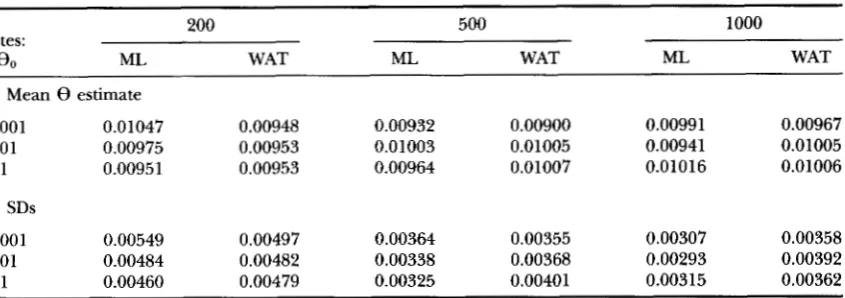
TABLE 1
Estimates of 8 with 20 sampled individuals
200 500 1000
Sites:
8 0 WAT ML
ML WAT
ML WAT
A. Mean 8 estimate
0.001 0.01047 0.00948 0.00932 0.00900 0.00991 0.00967
0.01 0.00975 0.00953 0.01003 0.01005 0.00941 0.01005
0.1 0.00951 0.00953 0.00964 0.01007 0.01016 0.01006
B. SDs
0.001 0.00549 0.00497 0.00364 0.00355 0.00307 0.00358
0.01 0.00484 0.00482 0.00338 0.00368 0.00293 0.00392
0.1 0.00460 0.00479 0.00325 0.00401 0.00315 0.00362
Means and SDs of estimated 8 from samples of 20 individuals with the true value of 8 = 0.01. Five short Markov chains were run, each running for 1000 cycles without sampling and then 200 cycles sampling every 10th genealogy; then one longer Markov chain was run, running for 1000 cycles without sampling and then 5000 cycles sampling every 20th genealogy. Each entry is the mean or SD of 100 replicates. The same data were used for the WATTERSON (WAT) and maximum likelihood (ML) estimations.
chain. Likelihoods for other values of 8, can then be interpo- lated using the same set of equations.
The likelihood curves produced by this approach are not guaranteed to be unimodal, but in practice they usually are as long as enough iterations were done to approach equilib- rium. We have found it best to run a series of very short chains whose results are not used in the combined estimate, so that the genealogy and working value of 8, approach their final values. Then a small number of much longer chains can be used to make the final estimate.
RESULTS
Simulated data: We used computer simulation to ex- plore the performance of this method. Trees were con- structed randomly according to the coalescent model, and DNA sequence data evolved according to the twe
parameter model of K”RA (1980) using a transition/
transversion ratio of 2.0. The UPGMA phylogeny recon-
struction algorithm (as implemented in the PHYLIP pro- gram NEIGHBOR v3.5) was used to construct the start- ing tree to be used by the Metropolis-Hastings algorithm. We investigated several parameters that could influence the performance of the method: length of sequence, number of individuals sampled, and closeness of 0, to the true 0. The simulations presented are far from ex- haustive but can give a preliminary impression.
Table 1 shows results for samples of 20 individuals under three conditions: 0, 10 times too low, equal to the true 0, and 10 times too high. Results from the method of WATTERSON ( 1975) are provided for com-
parison. We used an implementation of WAITERSON’S
test that scores positions with three segregating nucleo- tides as two variable sites and positions with four segre- gating nucleotides as three, to take into account multiple hits. Because WAITERSON’S test is based on the infinite-sites model, even with this modification its mean
and variance are both expected to be biased slightly downward. In general, the two methods perform about equally well. The Metropolis-Hastings method shows lit- tle or no bias toward 0,. This contrasts with runs in which only a single Markov chain
was
used, in which a substantial bias toward 8, was seen (data not shown).Table 2 shows similar results for samples of 100 indi- viduals. SDs for the Metropolis-Hastings method are a little lower than those for the method of WATTERSON.
Maximum likelihood methods in phylogenetics have typically been rather computer intensive. We timed our Metropolis-Hastings runs on a DECstation 5000/125
( a workstation of middling speed). A representative
TABLE 2
Estimates of 8 with 100 sampled individuals
8 0 WAT ML
A. Mean 8 estimate
0.001 0.01 106 0.01023
0.01 0.01012 0.01002
0.1 0.01070 0.00980
B. SDs
0.001 0.00245 0.00337
0.01 0.00157 0.00274
0.1 0.00167 0.0031 1
Means and SDs of estimated 8 from samples of 100 individ- uals with the true value of 8 = 0.01. Sequences were of length 1000 bp. Five short Markov chains were run, each running for 1000 cycles without sampling and then 500 cycles sampling every 10th genealogy; then one longer Markov chain was run, running for 2000 cycles without sampling and then 50,000 cycles sampling every 20th genealogy. Each entry is the mean of 20 replicates. The same data were used for the WATTERSON
entry from Table 2 (105,500 steps total along the Mar- kov chains) took 181.4 min. The majority of the run- time is consumed by likelihood calculations. When a change is made, only the likelihoods for the nodes in the neighborhood of rearrangement and their ances- tors down to the root of the tree need to be re-evalu- ated. The mean number of such nodes increases slowly with number of sequences, and therefore runtime is not strongly dependent on number of sequences. For
a given number of iterations, runtime is expected to increase less than linearly with sequence length, since identical sites are collapsed together during likelihood calculation. However, more iterations will be needed to adequately search the space of plausible genealogies as
the number of sequences increases.
When Metropolis-Hastings and related algorithms fail to perform well, it is generally because they become trapped in one part of their state space and fail to sample other parts. We have found it helpful to begin with a UPGMA genealogy rather than a random geneal- ogy to avoid wasting time searching irrelevant parts of the genealogy space.
Mitochondrial DNAsequence data: WARD et ul. ( 1991 )
examined 360 bp from the mitochondrial control re- gion of 63 Amerindians of the Nuu-Chah-Nulth tribe. We analyzed both the full data set and two restricted data sets, purine-only and pyrimidine-only (there are no sites with both purines and pyrimidines in these data) to allow comparison with the purine-only results of GRIFFITHS and TAV& ( 1993). For the purine-only and pyrimidine-only data sets, base frequencies were set at 0.49 for bases appearing in the data set and 0.01 for bases not appearing; for the total data set they were calculated from the data. The transition/ transversion ratio was set to 100.0. UPGMA was used to generate initial trees for each data set separately. The 8 estimate of WATTERSON ( 1975) based on the number of segre- gating mutations was used as the initial value for 80.
We did 10 short runs of 1500 steps (sampling every tenth genealogy from the final 500 steps) and two long runs of 12,000 steps (sampling every twentieth geneal- ogy from the final 10,000 steps) ; the final estimate used only genealogies from the long runs.
For the full data the final estimate was 0.0396; the likelihood curve is shown in Figure 3. Note that in this case 8 = 2 N f p , where Nf is the number of females, since mtDNA is haploid and maternally inherited. This is substantially higher than the estimate of 0.0186 pro- duced by the method OfWATTERSON ( 1975) ; this differ- ence is expected, since some of the sites in this data set have clearly had multiple substitutions. Purine sites alone produced an estimate of 0.00466 (WATTERSON estimate 0.00808) and pyrimidine sites alone produced an estimate of 0.05237 (WATTERSON estimate 0.02217). Proportionally more of the pyrimidine sites are variable, suggesting that there may be a difference in mutation
0.0
-
2.0-
4.0W )
-
6.0-
8.0-
10.00.02 0.04 0.06
e
FIGURE 3.-Likelihood curve for the WARD et al. ( 1991)
Nuu-Chah-Nulth mtDNA data.
rate between the two classes. An appropriate extension of our method would be to assign purine and pyrimi- dine sites to different mutation rate categories.
DISCUSSION
practical considerations: The Metropolis-Hastings sampler requires an initial value of
eo
and an initial genealogy. The results presented in Table 1 suggest that the initial value ofeo
is not critical as long as several Markov chains are run. However, the method is more efficient ifeo
is not too distant from 8, and therefore we recommend using the method of WATTEMON ( 1975)or other quick estimators to select an initial value for
8,. The method is somewhat more successful when it begins from a reasonable genealogy (data not shown).
We found the most successful search strategy to be running a fair number (5-10) of relatively short Mar- kov chains to provide a good working estimate of @,
and a good genealogy, and then one to two much longer chains to give the final estimate. Genealogies from the short chains should not be used in the final estimate, because such chains have not had time to approach equilibrium and can produce distortions in the likelihood curve.
the number of genealogies sampled may sound more impressive than it actually is), but should be considered when using the sampled genealogies for other pur- poses. A sample of 100 successive genealogies is not an
adequate replacement for 100 bootstrap samples, for
example. It is not clear how many iterations are needed to make successive sampled genealogies approximately independent. Minimally, n - 2 iterations are needed to transform any genealogy into any other (where n is the number of sequences). Practical experience sug- gests that on most data sets about
5
of the proposed modifications are accepted, so a minimal sampling in- crement for bootstrap use would be at least 3 n steps along the chain.Each individual step of the Metropolis-Hastings pro- cess is relatively quick, since it requires a likelihood evaluation of the genealogy rather than a likelihood maximization. However, more steps will be required as the number of individuals sampled increases to make an adequate search of the region of plausible genealo- gies. We do not have an exact measure of the number of steps required.
Comparison with other approaches: It has been shown ( FELSENSTEIN 1992a) that nonphylogenetic methods for estimating 8 do not make the most efficient possible use of the information present in the data. The advantage of phylogenetic methods will increase as the value of 8 per locus increases, since this advantage is primarily due to additional information provided by the tree structure, and the higher the value of 8 ( i.e., the longer and more variable the sequences), the more information about the tree structure is available. In Table 1 a considerable ad- vantage over the method of WATTERSON is seen with 1000 bp; shorter sequences would be expected to show such
an advantage if the value of 8 were higher.
A method based on a single genealogy has been pro- posed by FU ( 1994a) ; he uses a UPGMA reconstruction of the genealogy, correcting the resulting estimate by a factor derived from simulations. For the WARD et al.
(1991 ) Amerindian mtDNA data, Fu’s estimate of 8
was 13.32 per locus (8 of 0.037 per site), extremely close to our estimate of 0.0396. Fu’s method is computa- tionally simple in cases where the genealogy is known or can be confidently reconstructed. It has recently been extended (Fu 1994b) to cases in which migration or
recombination are occurring, although genealogy re-
construction presents greater difficulties in such cases.
GRIFFITHS and TAVARP ( 1993) have proposed a
method that also sums across possible genealogies but uses a random sampling rather than a Metropolis-Has- tings approach. For the infinite-sites model it is very fast (the set of possible genealogies is relatively small),
but its performance under more complex models is not
yet known. This method has been used to analyze the purine sites of the WARD et al. ( 1991 ) data ( G R I ~ I T H S
and TAV& 1993), omitting some sequences to make the data conform to the infinite-sites requirement. Their estimate of 0 per locus was 1.19, corresponding to a
8
of 0.007 per site, slightly higher than our 0.005 per site. Further testing is needed to clarify the relation- ship among these methods.Future directions: The basic method described here has several possible extensions. Since it uses a maximum likelihood genealogy evaluation, it can take advantage of any improvements which are developed in likelihood
models, such as the work of FEUENSTEIN and CHURCHILL
(unpublished data) on using Hidden Markov Model methods to deal with mutation rates that vary from one site to another.
Other forms of data, such as protein sequences or restriction sites, can be analyzed as long as an appro- priate likelihood method is available, for example the amino acid likelihood model of KISHINO et al. (1990) or the restriction site likelihood models of SMOUSE and LI ( 1987) and FELSENSTEIN ( 1992) ; the rest of the algo- rithm will be unchanged.
A more complex model of genealogy structure is also
possible. The genealogy space that the program
searches could be extended to include genealogies in- volving population size changes, migration, recombina- tion, or genetic rearrangement. This would allow simul- taneous estimation of the parameters controlling these processes. We are currently working on a version of the method that allows recombination and gene conver- sion. This will be very useful in analyzing nuclear DNA samples from sexual populations.
Finally, the collection of genealogies produced can be used to test other hypotheses; for example, it can be used in the same way as a bootstrap to measure the strength of support for a particular group or rooting by counting the number of sampled genealogies that show that group or rooting, as long as the interval be- tween sampled genealogies is generous enough that they are reasonably independent.
Availability of software: The Metropolis-Hastings Monte Carlo algorithm described here is available from
the authors as program COALESCE in the package
LA-
MARC, which uses the same input/output formats as the PHYLIP package. The program is written in C and
can be obtained by anonymous ftp from evolution.genet-
ics. washington.edu in directory pub
/
lamarc.We thank CHARLES GEYER for suggesting the idea behind the tree modification algorithm, ELIZABETH THOMPSON for helpful discussion and for recommending the use of GEYER’S method for combining estimates, ELLEN WIJSMAN for helpful discussion, EMfLIA MARTINS for comments on the manuscript, RICHARD HUDSON for testing the algo- rithm and commenting on the manuscript, and SEAN LAMONT and PETER BEERLI for programming assistance. This research was sup
K
LITERATURE CITED
FEUENSTEIN, J., 1981 Evolutionaly trees from DNA sequences: a maximum likelihood approach. J. Mol. Evol. 17: 368-376. FELSENSTEIN, J., 1992a Estimating effective population size from sam-
ples of sequences: inefficiency of painvise and segregating sites
as compared to phylogenetic estimates. Genet. Res. 59: 139-147. FELSENSTEIN, J., 199213 Estimating effective population size from samples of sequences: a bootstrap Monte Carlo integration method. Genet. Res. 6 0 209-220.
FEUENSTEIN, J., 1992c Phylogenies from restriction sites, a maxi- mum likelihood approach. Evolution 46: 159-173.
R i , Y.-X., 1994a A phylogenetic estimator of effective population size or mutation rate. Genetics 136 685-692.
F v , Y.-X., 1994h Estimating effective population size or mutation
rate using the frequencies of mutations of various classes in a sample of DNA sequences. Genetics 138: 1375-1386.
GEYER, C. J., 1991 Estimating normalizing constants and re- weighting mixtures in Markov chain Monte Carlo. Technical Re- port No. 568, School of Statistics, University of Minnesota.
G R I ~ S , R. C., and S . TAV&, 1993 Sampling theory for neutral alleles in a varying environment. Proc. R. SOC. Lond. Ser. B 344:
HASTINGS, W. K., 1970 Monte Carlo sampling methods using Mar- kov chains and their applications. Biometrika 57: 97-109. KIMURA, M., 1980 A simple model for estimating evolutionaly rates
of base substitutions through comparative studies of nucleotide sequences. J. Mol. Evol. 16 11 1-120.
KINGMAN, J. F. C., 1982a The coalescent. Stochastic Processes and Their Applications 13: 235-248.
KINGMAN, J. F. C., 1982b On the genealogy of large populations. J. Appl. Prob. 19A: 27-43.
KISHINO, H., and M. HASEGAWA, 1989 Evaluation of the maximum likelihood estimate of the evolutionary tree topologies from DNA sequence data, and the branching order in Hominoidea. J. Mol.
KISHINO, H., T. MIIATA and M. HASEGAWA, 1990 Maximum likeli- hood ingerence of protein phylogeny and the origin of chloro- plasts. J. Mol. Evol. 31: 151-160.
METROPOLIS, N., A. W. ROSENBLUTH, M. N. ROSENBLUTH, A. H. TELLER and E. TELLER, 1953 Equations of state calculations by fast computing machines. J. Chem. Phys. 21: 1087-1092. SMOUSE, P. E., and W.-H. LI, 1987 Likelihood analysis of mitochon-
drial restrictioncleavage patterns for the human-chimpanzee- gorilla trichotomy. Evolution 41: 1162-1176.
VITERBI, A. J., 1967 Error bounds for convolutional codes and an asymptotically optimum decoding algorithm. IEEE Trans. In- form. Theoly IT-13 260-269.
WARD, R. H., B. L. FRAZIER, K. D E W - J A G E R ~ ~ ~ S. PA.U%0,1991 Exten- sive mitochondrial diversity within a single Amerindian tribe. Proc. Natl. Acad. Sci. USA 8 8 8720-8724.
WAITERSON, G. A., 1975 On the number of segregating sites in geneti- cal models without recombination. Theor. Popul. Biol. 7: 256-276.
Communicating editor: M. J. SIMMONS 403-410.
E d . 2 9 170-179.
APPENDIX 1
Calculating probabilities of coalescence: We use a modified VITERBI state-array approach (VITERBI 1967)
to select coalescence times for the active lineages in the neighborhood of rearrangement. The strategy is to create a lattice showing the probability of each possible set of coalescences and then to select a path through this lattice in a manner proportional to the probability at each step. This has the effect of sampling randomly from the conditional coalescent distribution that is con- strained by the limits of the neighborhood. It differs from the standard VITERBI algorithm in that it chooses a random path, not the optimum path. A legal set of
coalescences is one in which all three active lineages have coalesced with each other by the time of the bot- tom of the neighborhood, and none have coalesced with any inactive lineages.
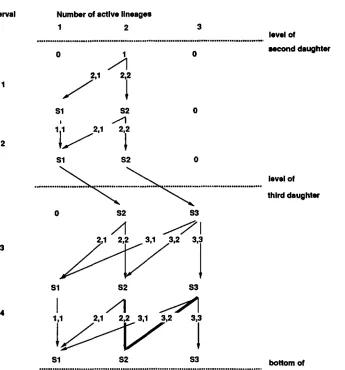
The genealogy is divided into a series of intervals with an interval boundary at each node. We can calculate the probability, within interval i, of no coalescence, one coalescence, or two coalescences among the active lin- eages. We will refer to these as Pj,? (the probability that the number of active lineages is j at the top of the inter- val and j at the bottom), Pj,y-i, and Pj,&, respectively. APPENDIX 2 gives the full form of these probabilities.
At the top of the neighborhood there are two or three active lineages, depending on the genealogy structure. We work our way down the genealogy, calcu- lating the cumulative probability of the presence of three, two, or one active lineages (
sii),
si’),
sii),
respec- tively, for interval i) at the bottom of each interval. Figure 4 shows the structure of these probabilities. If only two lineages were active at the top of the neighbor- hood, the third is added at the interval in which it first becomes active. For example, the probability that there are two active lineages at the end of interval 4 is the sum of two components: the chance that interval 3ended with two lineages and no coalescences occurred in interval 4 ( Si3) X P i $ ) ) , and the chance that interval
3 ended with three lineages and one coalescence oc- curred among them in interval 4 ( Si” X Pi$) ) . This example is shown by the bold arrows in Figure 4.
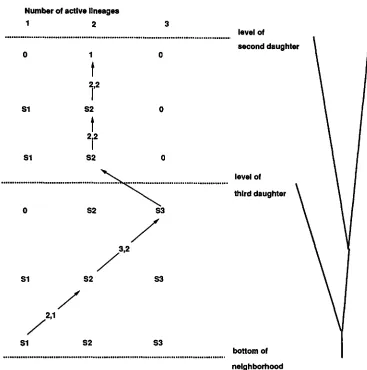
The SI entry of the bottom-most interval provides the total probability of an allowed series of events in this neighborhood, as opposed to the disallowed events of coalescence with an inactive lineage, or failure of the active lineages to coalesce with one another. Starting from this bottom-most entry and working back upward, we make a weighted random walk (choosing a specific set of coalescences) based on the cumulative probabili- ties in the state array and the transition probabilities among them. This is shown in Figure 5. For example, if the state in interval i has one active lineage, the state in the previous interval ( i - 1 ) might have had one,
two or three, corresponding to transition probabilities
P ( * ) , J.1 Pj,?-i and Pj,:c2, respectively. The chance that j
lineages in interval i came from j‘ lineages in interval
i - 1 (where j’ 5 j) is
S;i-I)p(:)
9
Sji)
.
( 7 )At each interval a random choice is made proportional to the transition probabilities. A complete series of such choices chooses a random path whose bottom end is in state 1 and thus defines a legal set of coalescences.
Metropolis-Hastings
Interval Number of actlve lineages
1 2 3
...
...
level ofsecond daughter
0 0
3
4
s1 s2 0
I
s1
52 0
....
"...
\ \
level of FIGURE 4."VITERBI state array. h-third daughtw bels on arrows are subscripts of the P terms. Bold mows indicate example used in text.
0
/I
/
/
I
s2 s3
si s2 s3
lilH
I
A
A
',[
s1 s2 s3 bottom of
...
nelghborhood
by setting the integral of the density equal to a random fraction and then solving for the length x. For cases in which three lineages coalesce during the same interval, a similar approach can be used, although an
explicit solution is not available and iteration must be used to find the correct length x for the first coales- cence. See Appendix 2 , Equations 10 and 11, for the full form of these equations.
APPENDIX 2
Transition probabilities: Pi:; ( t ) gives the probabil- ity for a genealogy of TZ individuals that in time interval
i (counting downward from the tips of the genealogy), which is of length t , the number of active lineages will change from x to y.
These probabilities do not sum to one because of the possibility ( disallowed in our procedure ) that the active lineages could coalesce with inactive ones.
Pj,;)
( t ) is derived directly from the coalescent theory as the probability of no coalescence in interval i with duration t .Pj,;Ll
( t ) is then the probability of no coales- cence from the start of the interval up to a time x, timesthe probability density of a coalescence at x, times the probability of no coalescence from x to the end of the interval. This is integrated over all possible values of x.
Pj,7-2
( 1 ) is constructed similarly by integrating over all possible values of the two coalescence times.M. K Kuhner, J. Yamato and J. Felsenstein Number of active llneages
1 2 3
...
0 1 0
t
i”
s1 s2 0
s1 s2 0
...
0 s2
\
53s1 s2 s3
i”
s1 s2 s3
nelghborhood
FIGURE 5.-One path through the state array. A tree structure corresponding to this path through the array is shown on the right. Only active lineages are indicated.
To select a time within an interval where one coales- to a random fraction and solving for length, then use cence occurs, we set ( 8 ) equal to a random fraction T , (10) to find the time of the upper one. We have not then solve for the length x: been able to find a noniterative solution to this equa-
3 e-2 nt/ e
( n
+
1) (2n - 3 ) (Pj,i-z(t))(11) x = - r e - ( 4 n + 6 ) ( x / 8 ) - 1
In an interval where two coalescences occur, we find