Analyzing the Present Strategy and Proposing
Effective Training Modules for Various
Categories of Technicians Involved in
Construction Projects Effective Training
Modules- A prelimary study
Deepak Reddy P, Arunima Jayakumar
Department of Civil Engineering, SRM University, Chennai, India Department of Civil Engineering, SRM University, Chennai, India
ABSTRACT: This study attempts to identify the various categories of technicians and study their details about their experience, knowledge, skills. Accordingly data will be collected from respondents working in construction projects of various companies. Data collected aided to come out the factors in each stage that needs to be focused for effective work.
From the data collected from the various stages of project we will be find the problem and factors that contribute for problem will also be identified. The project recommends the key areas where technicians should be trained by preparing a report on the workers and their performance for having good communication with other workers technically and for getting better quality of work.
KEYWORDS: training modules; better quality;
I. INTRODUCTION
Construction projects requires trained technicians as the projects will take place in an uncontrolled, unprepared, and dynamic environment where each project goes through several phases leading to completion. For this different training module should be prepared for improving the quality of work an overcoming the crisis.
FOR BAR BENDING
Since many years labour work has been playing an important role in construction including mixing coarse aggregate-sand-water-cement, moving sand, levelling the land, digging the foundation for base of structure, cutting rod in required length, bending the rod and pouring of concrete mix in columns and beams. Now days, due to development in technology there have been a need to reduce the labour time.
FOR WELDERS
The ECA of pipeline field girth welds has been successfully used to construct many cross-country pipelines and was made possible by: n Advancements in the understanding and application of fracture mechanics and validated by full-scale testing; n Advancements in automated ultrasonic testing (AUT) to accurately size weld imperfection height and length.
Higher strength and toughness welding consumable
Increased use and industry acceptance of mechanized welding
Higher quality line pipe steels
Favourable stress profile of the girth weld (axial stress is half the hoop stress resulting from internal pressure)
FOR CARPENTERS
Spatial skills are crucial for carpentry and are a major learning objective in the initial vocational training of carpenter apprentices. Carpenters specifically need to develop the capability to switch between two-dimensional (2D) and three-dimensional (3D) representations. Previous studies have explored spatial skills, but never in the context of vocational education and training (VET).
METHOD
726 subjects (98 females) who were either carpenter apprentices, apprentices of another profession, or high school students, took a test on spatial skills with three parts: mental rotation, paper folding, and orthographic projections. The first two parts are widely used tests for spatial skills, while the last one was specifically designed to address the 2D-3D transition that is a core skill of carpenters.
FOR MASONS
A Work Content (WC) scale for the selected construction activity was proposed. Work content is a non-mathematical term referring to the complexity of the design, where the integers from 5 to 1 represent activity complexity in descending order (5 being the most complex, 1 the least complex). Masonry activity that contained both simple and more complex work was ranked based on the complexity of the work content as a whole. Table (1) demonstrates the work content scale for masonry, where the work performed in all fourteen projects was similar in scope, size of components, specifications, quality requirements and design features and was ranked as a low work content of 1 (the least complex). The data-collection process assured to the greatest possible extent that consistent data were collected, processed and converted to a standard of 20 mm x 20 mm x 40 mm concrete masonry units (Thomas and Raynar 1997). The daily productivity is defined as the work hours per unit of work.
II. SITE DETAILS
• PRR Constructions, Almatti, Karnataka. • Sri Keerthi Projects, Bijapur, Karnataka. • KMC Constructions limited, Hyderabad. • GKC projects, Hyderabad.
• BNR Constructions, Anantapur, Andhra Pradesh. • Delta constructions system Ltd, Hyderabad. • MSR Constructions, Visakhapatnam.
• RCM Infrastructures Limited, Visakhapatnam. • RVR Projects Pvt Ltd , Visakhapatnam. • Vijay Nirman Company Pvt Ltd, Visakhapatnam. • Indenture Group, Hyderabad.
• Quantract Infra and Projects, Visakhapatnam. • Pride constructions, Visakhapatnam.
• Navinas Homes & Projects Pvt Ltd, Visakhapatnam. • Prasad & Company (PW) Ltd , Visakhapatnam. • Elite Engineering and Constructions, Hyderabad. • KMV Projects Ltd ,Hyderabad.
III. METHODOLOGY
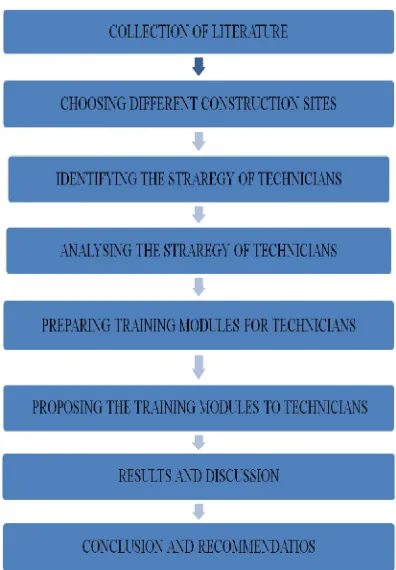
Flow chart
Methodology can be defined as the way in which the project objectives can be achieved .The explanation of mass behaviour often requires mass attitude data that can only be obtained by a survey .The people who provide information for the study are referred to as subjects, study participants, or respondents in quantitative survey or as study participants or informants in qualitative survey. Data may take the form of narrative information (qualitative data) or numerical values (quantitative data). Quantitative survey is objective in nature. It is defined as an inquiry into a social human problem, based on testing a hypothesis or a theory composed of variables, measured with members, and analysis with statistical procedures .Quantitative studies focus on the relationship between the independent variables and dependant variables. Quantitative study is an objective measurement of the problem. The methodology of this project is shown in fig 3.1 in the form of flow chart.
In this project, both qualitative and quantitative approaches are used. The questionnaire of this study is designed to get the factual information about local practices of managing construction materials in building projects as well as the opinions of Project managers about these practices.
IV. RESULTS AND DISCUSSION
In Or d er t o com pr eh en si vel y increase the quality of work, we have to increase the quality of technicians for that we have collected the details of the technicians from the companies and analyzed by using the spss software. SPSS is a widely used program for statistical analysis in social science. It is also used by market researchers, health researchers, survey companies, government, education researchers, marketing organizations, data miners, and others. The original SPSS manual (Nie, Bent & Hull, 1970) has been described as one of "sociology's most influential books" for allowing ordinary researchers to do their own statistical analysis. In addition to statistical analysis, data management (case selection, file reshaping, creating derived data) and data documentation (a metadata dictionary was stored in the datafile) are features of the base software.
Descriptive statistics: Cross tabulation, Frequencies, Descriptives, Explore, Descriptive Ratio Statistics
Bivariate statistics: Means, t-test, ANOVA, Correlation (bivariate, partial, distances), Nonparametric tests
Prediction for numerical outcomes: Linear regression
Prediction for identifying groups: Factor analysis, cluster analysis (two-step, K-means, hierarchical), Discriminant The many features of SPSS Statistics are accessible via pull-down menus or can be programmed with a proprietary 4GL command syntax language. Command syntax programming has the benefits of reproducibility, simplifying repetitive tasks, and handling complex data manipulations and analyses. Additionally, some complex applications can only be programmed in syntax and are not accessible through the menu structure. The pull-down menu interface also generates command syntax: this can be displayed in the output, although the default settings have to be changed to make the syntax visible to the user. They can also be pasted into a syntax file using the "paste" button present in each menu. Programs can be run interactively or unattended, using the supplied Production Job Facility. Additionally a "macro" language can be used to write command language subroutines. A Python programmability extension can access the information in the data dictionary and data and dynamically build command syntax programs. The Python programmability extension, introduced in SPSS 14, replaced the less functional SAX Basic "scripts" for most purposes, although SaxBasic remains available. In addition, the Python extension allows SPSS to run any of the statistics in the free software package R. From version 14 onwards, SPSS can be driven externally by a Python or a VB.NET program using supplied "plug-ins". (From Version 20 onwards, these two scripting facilities, as well as many scripts, are included on the installation media and are normally installed by default.)
SPSS Statistics places constraints on internal file structure, data types, data processing, and matching files, which together considerably simplify programming. SPSS datasets have a two-dimensional table structure, where the rows typically represent cases (such as individuals or households) and the columns represent measurements (such as age, sex, or household income). Only two data types are defined: numeric and text (or "string"). All data processing occurs sequentially case-by-case through the file. Files can be matched one-to-one and one-to-many, but not many-to-many. The graphical user interface has two views which can be toggled by clicking on one of the two tabs in the bottom, For more information concerning consultation assistance, see the list of consultation project publication. Voluntary Protection Programs (VPPs) and onsite consultation services, when coupled with an effective enforcement program, expand worker protection to help meet the goals of the Act. The three VPPs -- Star, Merit, and Demonstration -- are designed to recognize outstanding achievement by companies that have successfully incorporated comprehensive safety and health programs into their total management system. They motivate others to achieve excellent safety and health results in the same outstanding way as they establish a cooperative relationship among employers, employees For additional information on VPPs and how to apply, contact the OSHA area or regional offices listed at the end Training
OSHA area offices offer a variety of information services, such as publications, audiovisual aids, technical advice, and speakers for special engagements. The OSHA Training Institute in Des Plaines, IL, provides basic and advanced courses in safety and health for federal and state compliance officers, state consultants, federal agency personnel, and private sector.
OSHA also provides funds to nonprofit organizations, through grants to conduct workplace training and education in subjects where OSHA believes there is a lack of workplace training. Grants are awarded annually and grant recipients are expected to contribute 20 % For more information on grants, training, and education, contact the OSHA Training Institute, Office of Training and Education, 1555 Times Drive, Des Plaines, For further information on any OSHA program, contact your nearest OSHA area or regional office listed at the end of this publication.
The present study has been investigated the technicians characteristics such as understanding the design,communication with other technicians their performance . It is found that this study can help to understand the knowledge of the tecnician.
The proposed project presents the training modules for various technicians for overcoming internal as well as external risks in construction sites. This information is gathered through the interviews and discussion with the team of key personnel working in the construction sites.
A checklist of qualifications, experiences and other details are generated as an outcome of this study. Subjective ratings for both, probability of occurrence and consequences were also gathered from the same teams for screening the risks having substantial influence on objective of the company.
This approach can be used by the company for deciding the risk response strategies.
It can be used fairly for decision making at the starting point of every project.
It helps in identifying the high risk areas which need to be controlled and monitored.
• Internal risks and external risks cannot be avoided completely, yet suitable training modules can definitely be adopted. Studying the present strategy of technicians and tracking the problems in the current projects and the effects leading to the turning of project phase due to technicians.
• To stabilize the organization by preparing training modules before crisis occur on ongoing projects, so that the program will overcome the damage or loss in construction projects.
• Proposing those training modules for the technicians.
To challenge the anti-conflict value system that causes the crisis due to inefficiency of technicians.
To understand modern training trends in quality and process re-engineering and overcoming damage.
For making the technicians effective in their category of work.
For better communication between the technicians and the project managers.
For adopting the new technologies from the developed countries.
To increase the skills of technicians by proposing the training modules.
ACKNOWLEDGMENT
The authors would like to acknowledge the project managers on the construction site to help us out to perform the entire study.
REFERENCES
1. P.Kah and J.Martikainen, current trends in welding processes and materials: improve in effectiveness, Received September 28, 2011, Rev.
Adv. Mater. Sci.30 (2012) 189-200.
2. Milan Virani, Jagdish Vekariya, Saurin Sheth and Ketan Tamboli, Design and Development f Automatic Stirrup Bending Mechanism,
published December 18-2013.
3. Kenneth Y.Lee, M.S., The Lincoln Electric Company, Reducing Pipeline Construction Costs With Girth Weld ECA, September 2008.
4. Sebastien Cuendet, Jessica Dehler-Zufferey, Christoph Arn, Engin Bumbacher and Pierre Dillenbourg, A study of carpenter apprentice’s
spatial skills, Cuendet et al. Empirical Research in Vocational Education and Training 2014, 6:3.
5. Rateb J.Sweis, Ghaleb J. Sweis, Ayman A. Abu Hammad and Malek Abu Rumman, Modeling the variability of labor productivity in
masonry construction, Jordan Journal of civil engineering, volume 3, No. 3, 2009.
6. Ruseel H(2009),empowering individuals for team innovation in china: conflict management and problem solving, negotiation and conflict
management research, vol 2,issue 2,pp 185-205
7. Patric Lagadec (2002),crisis management in France: Trends, shifts and perspectives, journal of contingencies and crisis management, volume 10,issue 4,pp 159-172
8. To increase the skills of technicians by proposing the training modules. Argyrous, G. Statistics for Research: With a Guide to SPSS.
London: SAGE. ISBN 1-4129-1948-7.
9. Levesque, R. (2007). SPSS Programming and Data Management: A Guide for SPSS and SAS Users (4th ed.). Chicago, Illinois: SPSS
Inc. ISBN 1-56827-390-8.
10. SPSS 15.0 Command Syntax Reference. Chicago, Illinois: SPSS Inc. 2006.
11. Wellman, B. (1998). "Doing It Ourselves: The SPSS Manual as Sociology's Most Influential Recent Book". In Clawson, Dan. Required