INTERCHROMOSOMAL GENOTYPIC INTERACTIONS I. AN ANALYSIS OF MORPHOLOGICAL CHARACTERS','
E. C. KELLER, JR.384 A N D D. F. MITCHELL"
Department of Botany and Plant Pathology,
The Pennsylvania State University, University Park, Pennsylvania
Received June 29, 1962
M A T H E R ( 1941 ) hypothesized that there are two levels of genotypic organi- zation, a genic balance within a single chromosome (internal balance), and a genic balance which exists between homologous chromosomes (relational balance). He demonstrated the existence of internal balance, and inferred the existence of relational balance from the predominance of heterozygotes found in wild populations. He also concluded (1942) that the types of balance within different populations vaned. For example, in a naturally inbred population a good internal balance would probably exist, while large random breeding popu- latiolis would be characterized by a relatively higher amount of relational balance. SCHMALHAUSEN (1949) pointed out that the harmoniously balanced genotype can be disrupted by the introduction of chromosomes of a differently balanced system, and further, WRIGHT (1 952) discussed linked factors in terms of a balance among those genes that are fixed, or nearly fixed, in a population. He stated that interrial balance is difficult to define in MATHER'S terms, since the system as a whole forms a harmoniously balanced system in relation to its en- vironment. He also stated that interaction systems are found as a rule in studies of the effects of major multiple factors on a single character. He could find no reason for assuming that they would be different in polygenic systems.
It has been found that in most analyzed cases, combinations of genetically divergent chromosomes have shown inconsistent results. WIGAN ( 1944, 1949), and MATHER and HARRISON (1949) working with the quantitative trait sterno- pleural bristle number observed interactions resulting from the effects of com- bining genes from chromosomes from different inbred lines of Drosophila mel- anogaster. ROBERTSON (1952, 1954), studying the effects of selection on body
I This investigation was supported by a grant from the U. S. Public Health Service,
2 Authorized for publication on May 20, 1960, as paper No. 2461 of the journal series of the 3 U S.P.H.S. Research Fellow.
4 Present address, Department of Biochemistry and Nutrition, University of North Carolina, 5 Present address, Astrosystems and Research Lab., Norair, Northrop Corp., Hawthorne, No. RG-4447.
Pennsylvania Agricultural Experiment Station
Chapel Hill, N.C. California.
1558 E. C. KELLEH, J R . A N D D. F. MITCHELL
size in Drosophila melanogaster, found gross interactions which seemed to de- pend upon the heterozygosity of a single homologous pair. ROBERTSON and REEVE
(1 953) observed from their study of the effects of selection on body size that when chromosomes from pairs of selected and standard strains were combined in various ways significant deviations from additive effects occurred when the e€- fects of different nonhomologous chromosomes were considered. In general, the interaction of various portions of a species genotype when thrown out of balance by genetic manipulation usually brings about responses which could be at- tributed either to additive gene action or gene interaction. In all cases, the data of
the characters undei consideration here have been found to produce no detectable metric bias.
The general approach used in this experiment consisted of an analysis of van-
ous combinations of X chromosomes and autosomal sets in an attempt to identify and characterize their relationships. The sex chromosomes of one inbred line of
Drosophila melanogaster were transferred, in various states of homozygosity and heterozygosity, to another inbred line by the use of three complex inversion systems. The results of the various sex chromosome transfers on the means and variances of three quantitative characters were analyzed and compared to the original inbred lines from which they were derived.
The primary objective of this experiment was to determine if there were de- finable quantitative response patterns to the insertion of the X chromosomes onto the "isogenic" autosomal background of three unique inbred lines. The de- termination of the nature of these response patterns with reference to the con- cept of an integrated genotype was a secondary objective.
The effects of these genetic manipulations on fitness will be reported in a subsequent paper dealing directly with the estimation of some components of
viability.
MATERIALS A N D METHODS
Derivation of the inbred lines: The inbred lines which comprised the basic stocks for the experiment were derived from a sample of a wild population of
GENIC BALANCE 1559
derived from each of the 20 original females. by June of 1956 only six of the original female parents were represented in the surviving lines.
Occasionally it was necessary to make double first cousin matings, or non- virgin full-sib matiiigs to maintain the lines. The effect on the ultimate level of inbreeding, however, was negligible. The lines remaining after 50 generations represented a small series of highly homozygous genotypes of relatively high fitness. Three of these inbred lines were randomly chosen for this experiment. These lines are designated 354, 655, and 1753. The 3, 6, and 1 7 refer to the female from which the original lines were derived, and the 54, 55, and 53 refer to the number of generations of inbreeding in each line at the time at which the present experiment was initiated.
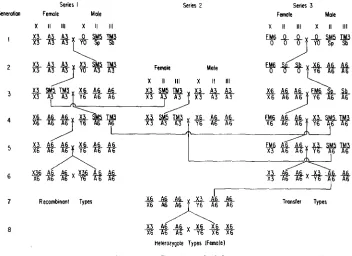
Derivation of the experimental lines: I n order to measure the interchromo- somal effects the X chromosome from each of the iiibred lines was transferred onto a background of autosomes from each of the other two lines. Secondly, in order to determine the effects of dominance (interallelic interaction), if any, it was necessary to obtain the various X chromosome heterozygotes. Thirdly, the effects of crossing-over i n the X chromosomes on interchromosomal interaction were determined by allowing the heterozygote populations to recombine for one generation and then testing the recombined chromosome (Figure 1 ) . I n the derivation of the lines, the genotypes, with the exception of the small fourth chromosome, were completely controlled.
Generation
I
2
3
4
5
6
7
8
Series I
Fenmle Male
x II 111 x II 111
Series 2 Series 3
F m l e Mole
x II 111 x II 111
M Q Q
Recombinant Types Tronsfer Types
X3 A6 A X6 X6 X6
X 7& -ti8 Y6 X6 X6 Heterozygote Types Ifemole1
1560 E. C. KELLER, JR. A N D D. F . MITCHELL
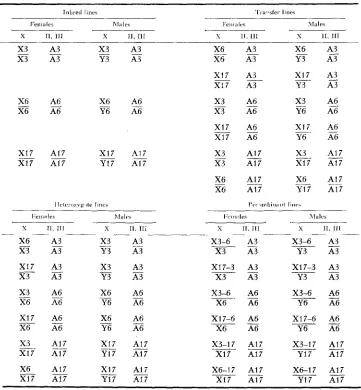
The lines which were derived for analysis are listed in Table 1. There were four types of experimental lines: the three inbreds, the six X chromosome trans- fers, the six X chromosome heterozygotes, and the six X chromosome recombi- nants (crossovers). In Table 1 the X, Y, second, and third chromosomes are indicated for the males and females of each line. A3, A6, or A17 refers to a
specific set of autosomes from the respective inbred line; the source of the X and
TABLE 1
The genotypes of the inbred, the X chromosome transfer, the X chromosome heterozygote, and the X chromosome recombinant lines
X3 A3
X3 - - A3
X3 - A3
Y3
z
X6 X6 XI 7 XI 7 x 3 x 3 X17 X17 x 3 x 3 X6 X6 - __
-
__ - - X6 A3A3 - Y3 - A3 A3 A3 A3 A6 -
-
KG
g
A6 AI 7 A1 7 A1 7 A t 7__
-
A3 x 1 7
A3 Y3
x 3 A6
A6 Y6
A6 XI 7
A6 Y6
__ __
- - __
X6 A6
X6 A6
X6 Y6 - A6 -
-
X17 A17 X17 A17
X T A T Y17
~-
A17AI 7 x 3 A1 7 - X17 __
A t 7 X6 A I 7 Y17
~ ~
I"c1na IC's hlillrc
11. I l l
A3 A3 A3 - A3 X
- _ 11, _IIi
-A3 A3 A3 A3 A6 A6 -
x 11. I11 - __
X6 x 3
- x 3
Y3
- X3-6 A3
T A 3
X3-6 A3
Y3 A3
- -
X I 7
x3
x 3 X6 - x 3 Y3-
Xi7-3 _ _ _ - A3X3 A3
x i 7 - 3 &3 _ _
Y3 A3
A6 A6 A6 - As X6 Y6 X6 Y6 - -
x3-6
- A6X6 A6
X3-6 A6
Y6 A6
_ _ -
X I 7
x6
x3
X17 _. A6 AsX17-6 A6
X6 A6
- -
X I 7 A17
X17-6
2
Y6 A6
X3-17 A17 Y17 A17
_ _
- -
A I 7 A I 7
A I 7 A I 7 ~
__
X I 7 Y17
X17 Y17
__
__
A I 7 A1 7 ~
X6
xi7 A1 A17 7
X6-17 A17 X i 7 A17
- _ _ X6-I7 A17
Y17 A17
_ _ -
GENIC BALANCE 1561
Y chromosomes is similarly designated. In the recombinant lines one of the X chromosomes in each female was a mixture of X chromosome material due to crossing-over which occurred in the previous generation.
The derivation of the transfer, heterozygote, and recombinant lines involved the use of three complex inversions, one for each major chromosome. These in- versions were FM6 ( y s S d scs d m B ) ; SM5 (aP itv C y s?); In.8421. 10.3 ( y + ri p p bx9he Ser) (TN13). FM6 is an X chromosome inversion which has a total of
eight breaks and inverted reconstitutions, and carries the dominant gene marker for Bar eye; SM5 is a second chromosome inversion with a total of 13 breaks and carries the dominant gene marker of Curly wings; In.8421. 10.3 is a third chromosome inversion of 11 breaks and carries the dominant gene marker for Serrate wings. FM6 and SM5 were synthesized by
E.
B. LEWIS. The inversion 111.8421. 10.3 was also synthesized by LEWIS, but was modified and described by VICTOR TINDERHOLT (personal communication) who renamed it TM3. In.8421. 10.3 will be referred to as TM3 throughout the paper; the second chromosome inversion will be referred to as SM5, and the first (X) chromosome inversion will be referred to as FM6.These inversions when heterozygous with structurally normal homologues effectively eliminate recombination. The suppression effect exists in the single or double heterozygote, but in attempting to obtain the triple heterozygote high sterility was encountered. The dominant mutants in these stocks produce lethality in the homozygous condition.
The breeding procedures used for the synthesis of the transfer, heterozygote, and recombinant populations are illustrated in Figure 1. The genotypes are symbolized in the same manner as in 'Table 1. Only derivations involving the X3 X chromosome and the A6 autosomes are illustrated; the other populations were derived in an identical manner. For convenience the figure is divided into three series of crosses. In Series 1 the procedure was to transfer the SM5 and TM3 inversions into a background of A3 autosomes (generations one t o three), and then backcross to the 6 inbred line to obtain females heterozygous for X3 and X6 X chromosomes but homozygous for A6 autosomes (generations four and five). The progeny of a cross between these females and a 6 male carried either re- combinant X chromosomes or nonrecombinant X3 and X6 X chromosomes. The effects of the new linkages were masked to some extent in the female progeny where varying degrees of genic heterozygosity exist. The full effect of the X chromosome linkages resulting from recombination appear in the male progeny. The first portion of Series 2 was used to obtain the male heterozygote used in Series 3. The last portion of Series 2 illustrates the derivation of the heterozygote types by backcrossing to the 6 inbred line.
1562 E. C . KELLER, J R . A N D D. F. MITCHELL
Series 2 (generations four and five). The wild-type offspring of the fifth cross then carried X3 X chromosomes and A6 second and third chromosomes.
The same procedure was carried out for all six recombinant, heterozygote, and transfer types respectively. Some difficulty was encountered in the selection of wild-type flies in the transfer types since the average viability was quite low; i n fact, sublethal in two lines (X3A17 and X6A3 transfers). It was possible, however, to obtain samples of all recombinant and transfer groups and most heterozygote types, for subsequent analysis.
Description of characters and their determination: All of the lines listed in Table 1 were derived and maintained under standard laboratory conditions in 25 mm by 95 mm shell vials on agar, cornmeal, and molasses medmm seeded with dry Fleischmann’s yeast. Sufficient lampblack was added to darken the food. The cultures were maintained throughout the experiment at a temperature of 26°C 2 1. The characters measured for each line were body length, wing length, and bristle number.
To assess the morphological traits the flies from the various populations were placed in an 18°C constant temperature room for a week and then measured. From each population a random sample of approximately 50 males and 50 f e males was obtained. The number of heterozygote determinations were lower, and, in a few cases, absent. Measurements of body length, and wing length were made with a device designed and constructed by the Drummond Scientific Com- pany of Philadelphia specifically for use with Drosophila (MITCHELL 1958). The dimension used for gross body length was the distance from the anterior edge of the eye to the posterior tip of the abdomen recorded in millimeters. In the females, the anal plate which protrudes from the abdomen proper was not included in the measurement. The flies were positioned i n the grooves on their sides and the lateral dimension measured. Wing length was determined by measuring the distance from the humeral plate, at the base of the wing, to the tip of the wing. After these measurements were completed the flies were inverted and the number of bristles on the fourth and fifth abdominal segments were counted.
Statistical methods: Under the restrictions of the experimental design. we shall let YL3k be the kth observation of progeny with autosomal component from line
i
and X chromosome from line j . Then under an additive model Y z j h = A ,+
X i-k e+ I n most instances,
k
ranges from 1 to 50.G E N I C BALANCE 1563
average estimates of individual X chromosomal and autosomal effects were obtained with the transfer and inbred genotypes and tested to determine if there were any multiplicative effects in the data giving biased interaction estimates. These tests were accomplished by using Tukey’s test for nonadditivity.
RESULTS A N D DISCUSSION
Preliminary analyses: T h e first problem concerning the analysis was that of characterization of the three original inbred lines in terms of the three morpho- logical traits. The first set of analyses concerned only these lines, and revealed that line 3 was low for all characters (Tables
4,
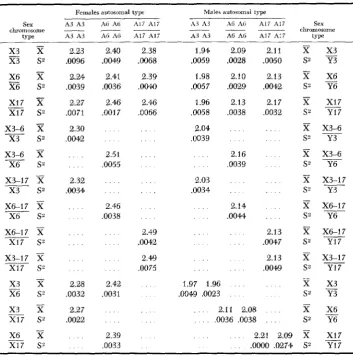
5 , and 6 ) . Lines 6 and 17 were identical in wing length and bristle number (Tables 5 and 6). Differences in the degree of sexual dimorphism were evident. Significant differences occurred be- tween the means of the various inbred lines in terms of body length and wing length. In the females of line 17 there was a mean body length as low as that ofline 3 (2.59 mm us. 2.57 mm) ; whereas line 6 was significantly longer. The males of line 1 7 were significantly longer than those of 3 (2.21 mm us. 2.08 mm) and probably not different from the males of line 6 (2.30 mm, Table 4). The same pattern occurs in wing length. The importance of the results of the first step of the analysis was the determination that each line was characterized by
a different total set of means, and that each set of means was in part a function
of a genetically fixed sexual dimorphism. The pheEotypes, therefore, of the three lines were to some extent divergent, with their genotypes doubtlessly far more divergent.
Another problem concerned the effects of uncontrolled or unknown factors during the derivation of the transfer, recombinant, and heterozygote lines on the mean phenotypic values of the characters. This source of error was estimated by comparisons of the means of the males of a particular inbred line with those of the appropriate heterozygous line. As indicated in Table I the chromosomal constitution of these males should have been identical, except for the effects of uncontrolled factors (the fourth chromosome, possible failure of inversion s u p pression, etc.).
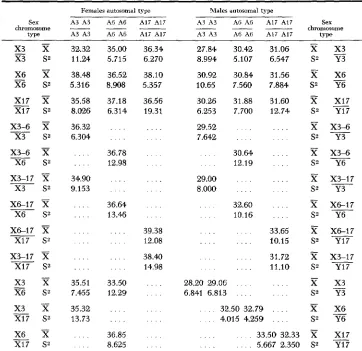
In each case two values were available for the heterozygotes. The consistency of the duplicate estimates for each heterozygous line combination and for all characters suggested that any uncontrolled effects of the breeding procedure on the means was constant within a genotype. Comparison of the inbred and hetero- zygote means further suggested that the derivation procedure had no effect but might have resulted in a slight increase in bristle number of the derived males. Unfortunately the line 6 and 17 male data were based on small samples (Table 6). If this apparent increase is meaningful, it might have been the result of a
fourth chromosome contribution. Despite the possible discrepancy, the overall pattern suggested that considerable confidence could be placed in the breeding procedure, at least within the limits of the present report.
1564 E. C. KELLER, JR. A N D D. F. MITCHELL
No transformations of the data were carried out previous to the analyses since it was assumed from the work of others that the two components, X and autosomal chromosomal substitution, would act additively in determining the means for the three characters. The statistical interactions observed would then be direct esti- mates of a nonadditive genetic interaction between the genotypic components. A
test of this assumption was carried out by applying Tukey’s test for nonadditivity to average estimates of the three X chromosomal and three autosomal effects determined from the inbred and transfer data sets. The results indicate that in all cases, for all characters, the estimates of interaction were not due to propor- tional effects on the data. The interaction estimates could therefore be considered indices of inherent genetic effects.
Interactions: Estimates of interactions between the genotypic components were obtained through analyses of variance involving first, the inbred and transfer lines; second, the inbred, transfer, and recombinant lines; and third, the inbred, transfer, recombinant, and heterozygote lines ( KELLER 1959). The main vari- ables considered in these analyses were the autosomal components and the types of populations. In addition, one analysis involved sex chromosome effects with respect to the different types of populations. I n all cases the terms measuring the interaction between these variables were significant (P
<
. O l ) . The main variables were probably different, but their effects in the various combinations were highly inconsistent. The interaction effects were of such a magnitude that the differences in the main variables were found to be statistically nonsignificant in comparison. Generally, the result was that the nonadditive genetic interactions between the autosomal and sex chromosome components of the genotypes were the primary determinants of the phenotypes of the characters studied, but that the magnitude and direction of such effects were not predictable. Thus, inter- chromosomal, nonadditive, epistatic interactions completely masked any pre- dictable additive effects.Despite the overall effect of interactions on the phenotypic expression, a pattern was discernible. The pattern was made obvious by a consideration of the inbred and transfer lines in terms of the effect of the X chromosome transfers on deviations from the grand mean of a particular character. The estimates of the mean effects of a particular autosomal set are deviations from the grand mean and should be equal to the mean of the sum of the three genotypes which carry these specific autosomes from the grand mean. The effects of the X chromosomes could be estimated in the same way. That is:
3 3
Z
Xi.
Z Aj.- 1 - 1
x i = y - - and q = Y - ___
3 3
2 2
L. n i . -5 r l j .
- 1 - 1
x i = y - - and q = Y - ___
3 3
GENIC BALANCE 1565
aj = The average additive autosomal contribution to the phenotype, i.e.,
Y = The grand mean.
A3, A6, or AI 7.
-
Xi
= The combination of identical X chromosomes.Aj = The combination of identical autosomal backgrounds.
ei, j = The nonadditive, nonsquared, deviation from the grand mean.
For any character, within a sex, this set of values provides estimates of the additive contribution of each X chromosome or autosomal set in terms of devia- tions from the graiid mean. The genotypic value Y would then be:
and the nonadditive, interaction component ( e i , j ) would be:
It is of importance to emphasize that the x and a contribution, and the interaction term, e, are estimates of deviations from the grand mean.
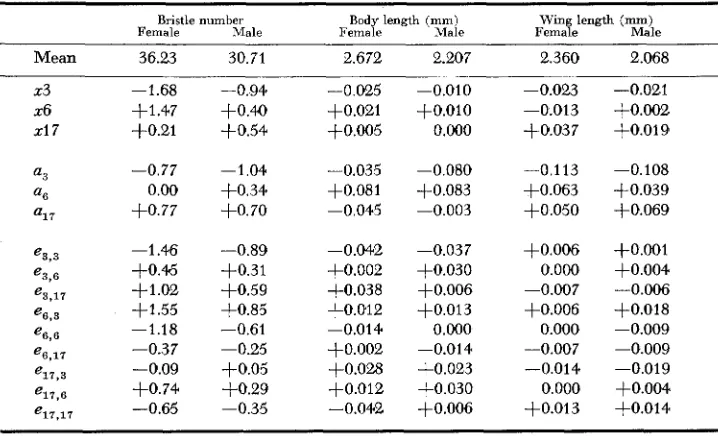
The values obtained from the genotypic components and their interaction, based on the assumptions above, are enumerated in Table 2. The autosomes and
TABLE 2
X chromosome, autosome, and interaction component estimates in terms of
deviation f r o m the grand mean
Bristle number Body length (mm) W i n g length (mm)
Female Male Female Male Female Male
Mean 36.23 30.71 2.672 2.207 2.360 2.068
23 -1.68 -0.94 -0.025 -0.010 -0.023 -0.021
2-6 +1.47 $0.40 +o.o21 +O.OlO -0.013 +0.002
21 7 4-0.21 +0.54 +0.005 0.000 +0.037 +0.019
-
a3 -0.77 -1.04 -0.035 -0.080 -0.113 -0.108
' 6 0.00 +0.34 +O.OSl +0.083 +OB63 $0.039
a1 7 +0.77 +0.70 -0.045 -0.003 +0.050 +0.069
-1.46 +O.* +1.02 +1.55 -1.18 -0.37 -0.09 +0.74 -0.65
-0.89 +0.31 +0.59 +OB5 -0.61 -0.25 +0.05 +0.29 -0.35
-0.042 +o.o02 +0.038 +0.012
+0.002 +0.028 +0.012 -0.014
-0.042
-0.037 $0.030 +0.006 +0.013 0.000 -0.014
+0.023
+0.030
+O.ooS
+0.006 0.000 -0.007 +0.006
0.000 -0.007 -0.014 0.ooo +0.013
+O.Oal
+0.004 -0.006
1566 E. C. KELLER, J R . A N D D. F. M I T C H E L L
X chromosomes of line 3 had the overall effect of reducing the phenotypic ex- pression of all of the characters studied, a n effect which is consistent with the lower values in the original line. From Tables 4, 5, and 6, it can be seen that this effect was consistent throughout all populations, including the recombinant and heterozygote lines, and the magnitude was greater than the positive inter- action terms observed in the transfer lines.
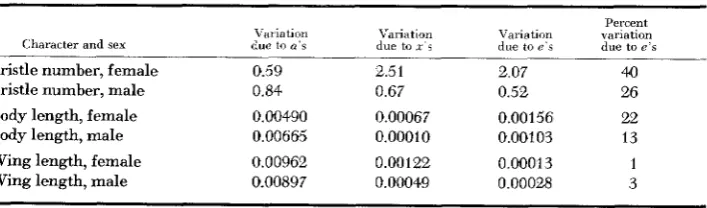
From the data in Table 3 it is again ohvious that there are quite diverse re- sponses of the different characters to the d-iff erent genetic treatments. The inter- action controlled variation is rather extensive in bristle number and body length, but almost negligible in the case of wing length.
The effects of the two components (X chromosomes and autosomes) of inbred lines 6 and 17 were not so consistent. The line 17 autosomes were associated with the highest bristle counts (Table 6) and with low to intermediate body and wing lengths (Tables 4 and 5 ) . The X,, component, i.e., the sex chromosomes of the 17 inbred, contributed to greater wing length but to intermediate values of the other characters. The line 6 autosomes were associated with high body length (Table 5 ) , while the X chromosome of line 6 appeared to be intermediate with respect to all characters. This general pattern was consistent with the differences observed in the original inbred lines.
The X chromosomes of the recombinant lines were mixtures which included the original linkages of the two lines involved, and various new linkages which were the result of a single generation of free crossing-over. Various degrees of heterozygosity existed in the females of these lines. A comparison of the sex differences might therefore provide an estimate of dominance or genic heterosis for the sex-linked genes. The data suggest, however, that heterozygotic effects were negligible, since in most cases the mean phenotypic values for the recombi- nant lines were intermediate between those of the inbred and transfer lines for both sexes. For bristle number the mean recombinant minus inbred was less than the mean trmefer minus inbred in the females but was greater in the males. Therefore, if heterozygous effects are postulated, they would be associated with lower bristle numbers; however, it seems highly improbable that such effects existed at least within the sensitivity of the experiment. These effects should have
TABLE 3
Partitioning of uariution
Character and sex
Bristle number, female Bristle number, male
Body length, female Body length, male
Wing length, female Wing length, male
Vallvtlon
due to U ' S 0.59 0.84
0.00490 0,00665
0.00962 0.00897
Variation
due to Y s Variation due to E ' S
Percent %ariation due to e's
2.5 1 0.67
0.00067 0.00010
0.00122 0.00049
2.07 0.52
0.00156 0.00103
0.00013 0.00028
40 26
22 13
GENIC B A L A N C E 1567
TABLE 4.
Means and variances of the body lengths, females and males
Females autosomal type Males autosomal type
Sex A3 A3 A6 A6 A17 A17 A3 A3 A6 A6 A17 A17 type A3 A3 A6 A6 A17 A17 A3 A3 A6 A6 A17 A17
~ __
_ _
chromosome
-
-
_ _-
x3
x
x 3
s2
X6 X X6 S2
X17
x
XI7 S 2
-
--
-
_.
x3-6
-
x
x 3s2
X3-6
x
X6 S 2X3-17 ?T x 3 SZ
X6-17
ff
X6 S2X6-17
x
XI7 S2 X3-17 ?T XI7 S2x 3
x
X6 S 2x 3
x
XI7 S2X6 X XI7 S2
-
- --
-
- - 2 57 .0098 2 67 .a122 2.67 .0210 2.63 ,0202 2 61 .0115 2.59 ,0117 2.73 0100 2.73 ,0117 2.76 .0144 2.77 .0101 . . . . . . . . 2.80 .0141) . . . . . . . . 2.66 ,0086 . . . . . . . . . . . . . . 2.62 .0100 . . . . . . 2.66 .0095 2.64 .0117 2.65 ,0125 2 59 ,0088 2 75 .0166 2.68 .oo99 2.08 ,0048 2.15 .0058 2.15 .0054 2.18 . W O. . . . . . 2.14 .0047 . . . . . . . . . . . . . . . . . . . . . . .
2.08 2.10 ,0052 ,0065
2 31 .0047
2 30 .0085 2 26 0086 2 27 0041 225 .0048 2.20 ,0074 2.20 ,0036 2.21 .W38 2.22 .0056 2.18 ,0050
2.29 2.24 .
,0040 ,0028
Sex chromosome
type
-
x
x 3s2
Y3 X6S 2 X6
-
-
XI7
S 2 Y17
X3-6
-
__
s2
Y3X X3-6
-
-
S2 Y6
X X3-17 s2 Y3
fT
Xf3-17S2 Y6
ff
X6-17 S2 Y17?I X3-17 Sz Y17
x
x 3s2
Y3X X6 S2 Y6
-
-
-
_ _ __ - - --
2.27 2.17
ff
X17 .0130 . a 1 4 S 2 __ Y17been identifiable in the heterozygote female means, but none were apparent, perhaps because of masking by the interchromosomal interactions.
1568 E. C . KELLER, J R . A N D D. F. MITCHELL
TABLE 5
Means and uariances of the wing lengths, females and males
Females autosomal type Males autosomal typc
Sex A3 A3 Ao A6 AI7 A17 A3 A3 AG A0 A17 A17 Sex
chromosome __ __ -
-
__-
chromosometype A3 A3 Ah A6 A17 A17 A3 A3 A6 AB A17 A17 type
-
x 3
x
x 3 s2X6 X X6 S 2
X17 X17 S2
X3-6
x
x 3 s2X3-6
x
X6 S 2X3-17 ‘)7
x3
SZ X6-1751
X6 S2 X6-17x
XI7 S z
X3-17
x
XI7 S2 x 3x
X6 S2x 3
x
X17 S2X6 X XI7 S2
-
-
-
__-
-
-
~-
- - __ - __ 2 23 .0096 2.24. ,0039 2.27 .0071 2.30 0042 2 32 ,00342 2 8 .0032 2.27 .0022 2.40 .0049 2.41 .0036 2.46 ,0017 . . . . . . 2.51 ,0055 . . . . . . . . 2.46 .0038 . . . . . . . . . . . . 2.42 ,0031 . . . . . . 2.39 ‘0033 2.38 .0068 2.39 .0040 2.46 .0066 2.49 .0042 249 ,0075
1.94 2.09 2.11 .0059 .0028 .OM0 1.98 2.10 2.13 BO57 .0029 .0042
1.96 2.13 2.17 .0058 ,0038 .0032
2.04 . . . . . . . .0039 . . . . . . .
. . 2.16 . . . . . ,0039 . .
2.03 . . , . .
.0034 . . . . . .
. . . 2.14 . . .
. . . .0044 . . . .
. . . . 2.13
. . . .0047
. . . . . . 2.13
. . . . . . . . ,0049
1.97 1.96 . . . .0049 .0023 . . . . . .
. . . 2.11 2.08 . . . . . . ,0036 .0038 . . . .
. . . . . . . 2.21 2.09 . . . . .OW0 ,0274
-
x
x3
s2 Y3
x
X6S2 Y6
x
XI7S2 Y17
x
X3-6 s2 Y3x
X3-6S2 Y6
x
x3-17 s2 Y3x
X6-17 S2 Y6x
X6-17 S2 Y17x
X3-17 S2 Y17x
x 3 s2 Y3x
X6S2 Y6 X X17 S2 Y17
- - __ __ __ - ~
-
-
_ _
-
- - __The only dependable heterozygote male values were those for the X , A , geno- types, since inadequate samples were obtained for the other two lines. For all three characters thc X , A , values are essentially equivalent; therefore, the posi- tive interaction terms observed in Table 2 for the transfer lines, for example,
e3,fj; e3,17, etc.; and negative terms for the inbred lines. probably represented a
real phenomenon, an interchromosomal component of “heterosis.”
GENIC BALANCE 1569
TABLE 6
Means and variances of the bristle numbers, females and males
Females autosomal type Males autosomal type
Sex A3 A3 A 6 A 6 A17 A17 A3 A3 A6 A6 A17 A17 Sex
chromosome __ - - - chromosome
type A3 A3 A6 A6 A17 A17 A3 A3 A6 A6 A17 A17 type
-
x 3
x
x 3 s2 X6 XX6 S 2
XI7
x
X17 S2 X3-6
x
x 3 s2 X3-6
x
X6 S2 X3-17
x
x 3 s2 X6-17
x
X6 S2 X6-17 ?I X17 S2
X3-17
x
X17 S2 x 3x
X6 S2 x 3x
X17 S2 X6 X XI7 S2-
-
-
-
__ --
- __-
_. 32.32 11.24 38.48 5.316' 35.58 8.026 36.32 6.304 . . . . . . . . 34.90 9.153 . . . . . . . . . . . . . . . . . . . . . . . . 35.51 7.455 35.32 13.73 35.00 5.715 36.52 8.908 37.18 6.314 36.78 12.98 36.64 13.46 33.50 12 29 36.85 8.625 36.34 6.270 38.10 5,*357 36.56 19.31 . . . . . . . . . . . . . . . . . . . . . . . . . . . . . 39.38 12.08 38.41) 14.98 . . . . . . . . . . . . . . . . . . . . . . . 27.84 8.994 30.92 10.65 30 26 6.253 29.52 7.642 29.00 8.000 -30.42 31.06 X 5.107 6.547 S2
30.84 31.56 7.560 7.884 S2
31.88 31.60 % 7.700 12.74 S2 . . . . . . . .
x
. . . . . . . . s230.64 . . . . % 12.19 . . . . S2 . . . . . . . .
x
. . . . . . .s2
32.60 . . . .
x
10.16 . . . . S2. . . . 33.65 %
. . . . 31.72 %
. . . . 10.15 S2
. . . . 11.10 s2 x 3 Y3 X6 Y6 X17 Y17 x3-6 Y3 x3-6 Y6 X3-17 Y3 X6-I7 Y6 X6-17 Y17 X3-17 Y17
-
-
-
-
-
-
-
-
-
28.20 29.06 . . . X3 6.841 6.813 . . . S2 Y3 . . . 32.50 32.79' . . . . X X6 . . . 4.015 4.2591 . . . . S2 Y6 . . . . 33.50 32.33 % XI7 . . . . . . . . 5.667 2.350 S2 Y17
-
-
-
. . .
-
Nevertheless, some consistencies are detectable in the data, both in terms of the contributions of specifiable genotypic components and in terms of their inter- actions.
SUMMARY
1570 E. C. K E L L E R , J R . A N D D. F. M I T C H E L L
lations. The first type of population consisted of the inbred lines. In the second group of populations, the X chromosomes from each inbred line were inserted unchanged, and homozygous onto identical autosomal backgrounds of each of the other two lines. In a third type of population the X chromosomes were combined i n a heterozygotic state (in the females). I n the final population the X chromo- somes were allowed to recombine for one generation with X chromosomes from the recipient inbred line.
I t was found that the insertion of identical X chromosomes onto different auto- somal background resulted in differential mean expression for these three charac- ters. This has been interpreted as being partially the result of internonallelic interactions (epistasis), rather important in bristle number and body length. The specific epistatic interchromosomal interactions were unique in their response patterns, being principally dependent upon the genotypes being combined.
Although no differences were measurable in the comparison of the male and female recombinant types (except those attributed to inherent sex differences), dominance effects were observed. The male “heterozygote” class was found to be generally homozygous, i.e., similar to the inbred males.
I t was also found that a n interchromosomal interaction component (epistatic in nature) was present i n the apparent interchromosomal “heterotic” responses observed.
A C K N O W L E D G M E N T S
The authors wish to express appreciation to EVERETT DEMPSTER, ROBERT ELSTON, PAUL GRUN, AMP HICKS, and KEN-ICHI KOJIMA, many of whose sug- gestions have been incorporated into the final draft.
L I T E R A T U R E C I T E D
KELLER, E. C. JR., 1959 Preliminary analysis of interchromosomal genotypic balance i n inbred lines of Drosophila melanogaster. M.S. Thesis. Pennsylvania State University, University Park, Pa.
MATHER, K., 1941 Variation and selection of polygenic characters. J. Genet. 41: 159-193. 1942 The balance of polygenic combinations. J. Genet. 42 : 309-336.
MATHER, K., and B. J. HARRISON, 1949 The manifold effects of selection. Heredity 3: 1-52,
MITCHELL, D. F., 1958 A device for obtaining accurate measurements in large samples. ROBERTSON, F. W., 1952 Interactions between chromosomes of Drosophila melanogaster.
pp. 123-134. Quantitative Inheritance. Edited by E. C. R. REEVE and C. H. WADDINGTON. H.M.S.O.: London, England.
Studies on quantitative inheritance. V. Chromosome analyses of crosses between selected and unselected lines of different body size in Drosophila melanogaster. J. Genet. 5 2 :
494-52Q.
Studies i n quantitative inheritance. IV. The effects of substituting chromosomes from selected strains in different genetic backgrounds in
Drosophila melanogaster. J. Genet. 51 : 586-610. 1 3 1-1 62.
Drosophila Inform. Serv. 32 : 170.
1954
GENIC BALANCE 1571
SCHMALHAUSEN, I. I., 1949 Factors of Evolution. The Blakiston Co. Philadelphia, Pa. WIGAN, L. G., 1944 Balance and potence in wild populations. J. Genet. 46: 150-160.
1949 The distribution of polygenic activity OIL X-chromosomes of Drmophila melanognster.
The genetics of quantita tive variability. pp. 5-42. Quantitative Inheritance. Heredity 3: 53-66.