TRAN, LYNN UYEN. Teaching science in museums. (Under the guidance of Drs. John Penick and Eileen Parsons)
ABSTRACT
Museums are free-choice, non-threatening, non-evaluative learning and teaching environments. They enable learners to revisit contents, authentic objects, and
experiences at their own leisure as they continually build an understanding and
appreciation of the concepts. Schools in America have used museums as resources to supplement their curriculum since the 19th century. Field trip research is predominantly from the teachers’ and students’ perspectives, and draws attention to the importance for classroom teachers and students to prepare prior to field trips, have tasks, goals, and objectives during their time at the museum, and follow up afterwards. Meanwhile,
museum educators’ contributions to field trip experiences have been scantily addressed. These educators develop and implement programs intended to help students explore science concepts and make sense of their experiences, and despite their limited time with students, studies show they can be memorable. First, field trips are a break in the usual routine, and thus have curiosity and attention attracting power. Second, classroom science teaching literature suggests teachers’ teaching knowledge and goals can affect their behaviors, and in turn influence student learning. Third, classroom teachers are novices at planning and implementing field trip planners, and museum educators can share this responsibility. But little is reported on how the educators teach, what guides their instruction, how classroom teachers use these lessons, and what is gained from these lessons. This study investigates two of these inquiries.
Teaching Science in Museums
by
Lynn Uyen Tran
A dissertation submitted to the Graduate Faculty of North Carolina State University
in partial fulfillment of the requirements for the Degree of
Doctor of Philosophy
Department of Mathematics, Science and Technology Education
Raleigh
2004
Approved by:
Glenda S. Carter Eileen R. C. Parsons
Co-chair of Advisory Committee
For all those moments in your life when despair and depression consumes you,
read me and remember …
Strength comes in many forms
and is tested in many ways.
Search deep within yourself and find that
you are stronger than you think.
AUTOBIOGRAPHY
My family history. My family and I were refugees of the Vietnam War. I was born the year the South fell and the U.S. troops withdrew from Vietnam. We remained in the country for a few years, but my parents and family elders knew they needed to leave for a better life and for the sake of the next generation. They packed what they could carry and fled the country cloaked in the darkness of the night via a dilapidated boat packed with hundreds of other refugees. In modern American terms, we were boat people. We were among the many thousands of people displaced by the atrocities of warfare. My family surreptitiously escaped Vietnam by boat after the fall of the South, and then floated in the Pacific Ocean for months waiting to be rescued by any country willing and able to take in refugees. We were lucky enough to be picked up after 11 months at sea, and arrived in Alaska in the middle of winter. I was two and a half years old at the time, and the flashes of images that I once thought were from my dreams, I realize now to be memories through the eyes of a toddler.
However, fleeing for freedom was not unfamiliar. My family had only settled in Vietnam one generation ago. World War II drove both sets of my grandparents to
Vietnam from China. For the same reason many Chinese families resettled in Southeast Asia, my grandparents, like my parents, packed what they could carry and escaped China amidst the Japanese invasion and occupation of China during the late 1930s. However, soon after settlement in Vietnam, rebellion against French colonial rule and then civil war drove my grandparents further and further south into Saigon and surrounding rural communities and eventually out to sea.
States. Our first home was in Korea town, a poor, rundown community in Los Angeles, California. We eventually settled into Alhambra, a white, middle class suburban city 15 miles east of downtown Los Angeles. This has become our new home.
My journey into science education. My experience in scientific research and learning in museums started with a special high school program at the Natural History Museum in Los Angeles County during my sophomore year of high school. The next nine years consisted of working with and learning from Dr. Gordon Hendler, the museum’s curator of echinoderms. It’s incredible how one little project during a critical moment in your youth can take you to so many places, give you so much confidence, and continue to teach you so much even though it’s been more than a decade since you started. The most integral component of that experience was not the research itself, but the support and guidance from Gordon, my incredibly patient and caring teacher. I would never have predicted then that 12 years later my high school science fair project would be published, that I would have graduated with a degree in biology, and am now pursuing graduate degrees to teach science. Especially since science was my least favorite subject in school.
the educator was doing all that I could to teach my students. That snowballed into graduate school at NC State with John Penick in pursuit of improving my instructional methods. Thanks to the support from John and the faculty here, I am beginning my trailblazing journey into the world of non-formal science education.
ACKNOWLEDGEMENTS
There are so many people who made this whole adventure possible and successful. This is only a short list of those who cannot be overlooked. I thank John Penick for all his support and confidence in me and my ideas over the last four and a half years. Special thanks to Glenda Carter, Dave Eggleston, and Eileen Parsons for challenging me to take intellectual risks and helping me grow cognitively. I greatly appreciate all the great people at the Institute for Learning Innovation for taking me in and helping me grow professionally, especially the invaluable thoughts, advice, and support from Kirsten Ellenbogen, Joe Heimlich, John Falk, and Lynn Dierking. Vicki Grantham is my super-important behind-the-scenes “text” support, without whom this massive document could not be written. I am grateful to Debra Constantine (my physical therapist), Brett Hightower (my chiropractor), and Michael LePardt (my massage
therapist), whose expertise and gentle touch helped me prevail beyond the physical pains of tendonitis and carpal tunnel.
Berger along with all the Black Belts and students of Sun Yi’s Academy in North Carolina for teaching me courtesy, respect, perseverance, self-control, and indomitable spirit. Thanks to my family for their patience, support, and wonderful food.
Final praises go to the educators and Fred. None of this would be possible without the educators who welcomed me into their classrooms and volunteered their time and thoughts. Thank you for putting up with me and teaching me so much about the amazing things you do. Though they remain anonymous in this dissertation, their
TABLE OF CONTENTS
LIST OF TABLES XI
LIST OF FIGURES XII
CHAPTER I. INTRODUCTION 1
Research Questions ... 2
Defining Terminology... 3
Museum ... 3
Educator and Teacher ... 3
Rationale ... 4
General Overview of Research Design ... 8
Limitations of the Study ... 9
CHAPTER II. LITERATURE REVIEW 11 Introduction... 11
Section 1. Museums are Learning and Teaching Environments ... 12
Education in Museums... 12
Education Agenda ... 12
Learning Potential in Museums ... 14
Learner roles and the lifelong learning perspective. ... 14
Novelty, attention, and curiosity... 15
Teaching the Public... 17
Schools Use Museums as Resources ... 22
Teachers Affect Student Learning... 23
Value of teacher preparation. ... 23
Value of student preparation... 25
Students Affect Student Learning... 27
Do Educators Affect Student Learning? ... 29
Section 2. Museum Educators... 33
Teaching Science ... 33
Teaching Element: Student Knowledge ... 35
Teaching Element: Time ... 39
Teaching Element: Classroom Climate ... 43
Teaching Element: Teacher Role... 45
Section 3. Methodology Review ... 48
Participant Observation... 48
Inductive Analysis ... 50
Summary ... 51
CHAPTER III. METHODOLOGY 53 Introduction... 53
Study Sample ... 54
Research Settings... 54
General Procedures ... 62
Data Sources ... 62
Data Collection... 67
Validity and Reliability ... 68
Data Analysis... 69
CHAPTER IV. FINDINGS 74 Introduction... 74
Section 1. Describing the Science Lessons ... 74
Characteristics of the Lessons... 74
Repetition Develops Consistency ... 89
Comfort with lessons. ... 91
Insight for future lessons. ... 94
Comfort and Insight Summary... 101
Section 2. Describing Nuances in Instruction ... 104
Distinct Reasons for Making Changes in Lessons... 104
Students Influence Changes ... 104
Time Influences Changes... 109
Educators Influence Changes ... 111
Distinct Reasons for Making Changes Summary... 112
Manipulate Controllable Elements, Take Advantage of Others. ... 115
Lessons Comprised of Segments. ... 115
Omit a segment. ... 116
Lengthen or shorten a segment... 120
Rearrange the segments. ... 122
Lessons comprised of segments summary ... 125
Ways of Modifying the Dialogue... 128
Student involvement in dialogue of lesson. ... 128
Depth and detail of discussions. ... 134
Ways of modifying the dialogue summary. ... 138
Taking Advantage of Teachers and Chaperones... 141
Classroom teachers as timekeepers. ... 141
Classroom teachers as student managers. ... 143
Chaperones as activity helpers... 151
Using teachers and chaperones summary. ... 154
Section 3. Teaching Goals and Philosophies ... 158
Nurture Science and Learning ... 158
Goals and Philosophies Summary... 160
CHAPTER V. DISCUSSION, IMPLICATIONS, & RECOMMENDATIONS 162 Introduction... 162
Discussion ... 162
Adapting Instruction to Individual Classes ... 162
1. Repeating lessons compensate for one-time nature of lessons... 163
2. Details within science lessons can vary according to the students. ... 166
3. Educators’ roles and goals are the foundation for their choices... 169
Implications... 178
Make Connections between Schools and Field Trips Explicit... 178
Educator Education as a Task for Teacher Educators ... 180
Field Trip Education for Teachers should be More Than Just Preparing... 183
Recommendations... 185
Actions for Practitioners ... 185
Research Questions ... 186
REFERENCES 189 APPENDICES 200 Appendix A. Consent Form ... 201
Appendix B. Initial Interview Protocol ... 202
Appendix C. Post-lesson Interview Protocol... 203
Appendix D. Interview Unit of Analysis... 204
Appendix E. Observation Unit of Analysis ... 205
Appendix F. Domains ... 206
Appendix G. Analysis Round 1 Outline ... 207
Initial Interview ... 207
Post-lesson Interview... 207
Appendix H. Interviews. Analysis Round 2 Outline ... 209
Appendix I. Analysis Round 2 with Observation data... 210
Janet ... 210
Sally ... 211
Gary ... 213
Julia... 215
Appendix J. Analysis Round 2 Refined Outline ... 217
Appendix K. Findings Diagram ... 219
LIST OF TABLES
Table 1. Types of education programs each museum offers to teachers and school groups extrapolated from the 2003–2004 published and distributed teachers’
resource guide... 21 Table 2. Information about governance, education staff and annual visitation each
museum in this study... 56 Table 3. List of objects featured in collection and activities offered for both NC and MD
Museums... 57 Table 4. Education and teaching experience of educators in this investigation... 61 Table 5. Descriptions of observed lessons as published in 2003–2004 teacher resource
guide... 63 Table 6. Observation schedule for all videotaped lessons with post-lesson interview
immediately following. ... 66 Table 7. Descriptions of the three types of segments that made up the lessons observed
in this study. ... 75 Table 8. Descriptions of the lessons based on observations at NC Museum. Lessons
were made up of three different segments... 77 Table 9. Descriptions of the lessons based on observations at MD Museum... 80 Table 10. Summary of findings and excerpts from Repetition Develops Consistency
section. ... 102 Table 11. Summary of findings and excerpts from Distinct Reasons for Making Changes
section. ... 113 Table 12. Summary of findings and excerpts from Manipulate Controllable Elements:
Lessons Comprised of Segments section. ... 126 Table 13. Summary of findings and excerpts from Manipulate Controllable Elements:
Ways of Modifying the Dialogue section. ... 139 Table 14. Number of chaperones and students per lesson. ... 152 Table 15. Summary of findings and excerpts from Taking Advantage of Others section.
... 155 Table 16. Summary of findings and excerpts from Teaching Goals and Philosophies
LIST OF FIGURES
Figure 1. Floor plan for both classrooms in NC Museum... 59 Figure 2. Floor plan for classrooms in MD Museum. ... 60 Figure 3. Order in sequence and amount of time for segments in lessons observed at
NC Museum. ... 85 Figure 4. Order in sequence and amount of time for segments in lessons observed at
CHAPTER I. INTRODUCTION
“Learning is the reason people go to museums, and learning is the primary ‘good’ that visitors to museums derive from their experience.”
(Falk & Dierking, 2000, p. 2, quotation in the original) Free choice, non-evaluative, and non-threatening learning environments promote and nurture learning (Falk & Dierking, 1992, 2000; Falk, Koran Jr., & Dierking, 1986; Oppenheimer, 1975). Csikszentmihalyi and Hermanson (1995) state that humans, especially children, have an innate desire to learn and the attributes that characterize informal settings drive the intrinsic motivation of learning. Thus informal science education institutions are unique learning environments. And we can say that experiences at informal science education institutions such as botanical gardens, science centers, aquariums, and zoos are valuable to science learning and interest.
Similarly they are unique teaching environments. Whether through self-guided exploration of exhibits and corresponding labels or more formal lectures and
demonstrations, informal science education institutions are places where science teaching occurs although not always in direct ways. The scientist and educator writing the labels and designing the exhibits indirectly teach the visitors who eventually explore the exhibition. Additionally, the educator leading tours through galleries or the expert presenting in a lecture series also teach visitors.
The question arises as to how fully the teaching in informal settings takes advantage of the learning potentials characteristic of informal science education
lessons taught to school groups visiting these settings during field trips. These informal institution lessons are pre-planned, instructor-led, self-contained experiences that usually accommodate one class of students at a time and relate to the science contents and resources featured at the institution (Tran, 2002). This study examines the
instruction by educators who teach these lessons and investigates how they address factors that could limit their instruction.
Research Questions
This investigation continued a prior exploration of the teaching culture in museums through a participant observation study with educators at two science museums in the United States. The previous inquiry examined instruction by eight different educators at eight museums and reported a general description of how educators teach ephemeral lessons based on observable teaching behaviors (Tran, 2002). Despite variability in the learning environments in that study, there were strong similarities in instruction, lesson plan design, and variables that constrain instruction among all eight educators. This current inquiry refined and continued this previous study with an in-depth examination of the educators’ instruction and how they adapt their instruction to the variety of students that enter their classroom. Further, this study explored educators’ actions and goals, and searched for an appropriate theoretical framework to understand and describe instruction in museums. The following questions guided this dissertation research:
• How do educators teaching one-hour, one-time lessons in museums adapt their instruction to the students that they teach?
Defining Terminology
Museum
The International Council of Museums (ICOM) defines a museum as “a non-profit making, permanent institution in the service of society and of its development, and open to the public which acquires, conserves, researches, communicates and exhibits, for the purposes of study, education and enjoyment, material evidence of people and their environment” (McManus, 1992, p. 157 quoted from ICOM Statutes, 1989). Similarly, the Museum Services Act of 1977 defines a museum as a “public or private non-profit agency or institution organized on a permanent basis for essentially educational or esthetic purposes which, utilizing a staff, owns or utilizes tangible objects, cares for them, and exhibits them to the public on a regular basis” (Hein, 2000, p. 3).
These definitions are inclusive of museums for art, history, science, and children, nature centers, aquariums, zoos, historic sites, visitor centers, and botanical gardens. They are educational institutions with goals and responsibilities to educate the public, and often use objects to visualize, stimulate, and communicate complex subject matters (McManus, 1992; Roberts, 1997; Storksdieck, 2004). American museums have
embraced this responsibility since their inception in the 18th century (Orosz, 1990).Thus museum is used as an umbrella term referencing all such institutions for the public in this dissertation, unless explicitly indicated.
Educator and Teacher
are individuals in museums and schools who hold these roles and responsibilities. In this study, “educator” or “museum educator” refers to those teaching in museums and
“teacher” or “classroom teacher” references those teaching in schools. Rationale
Significant members of the public that museums serve include teachers and students. Museums have been used as school field trip destinations since the 1800s (Griffin, 1998; Orosz, 1990). Classroom teachers use field trips to out-of-school learning environments as a way to teach subject matter that cannot be covered effectively in the classroom, for complementing and supplementing classroom instruction, for variety, and for introducing students to resources in their community (Anderson & Zhang, 2003; Kisiel, 2003; Storksdieck, 2004). The National Science Teachers Association (NSTA, 1998) formally recognizes the value of and need to include informal settings in school curriculum as a way to supplement and complement school children’s science
experiences in its 1998 position statement. In addition, the National Science Education Standards (National Research Council, 1996) recommend that teachers of science (Teaching Standard D) and K-12 science programs (Program Standard D) provide opportunities for students to engage in science inquiry activities outside of the school environment. This includes field trips to museums.
as well as offer science instruction resources to classroom teachers. The programs and resources include, but are not limited to, tours, demonstrations, teacher in-services, and summer internships for classroom teachers. Short, one-time educator-led science lessons are also commonly offered to visiting school groups to enhance their field trip, and is sometimes the primary activity in which students participate during their field trip (Tran, 2002).
Educators in museums are responsible for developing and implementing these programs intended to teach the scientific phenomena featured at their institutions. This responsibility includes developing resources for teachers, such as activity kits and school loan materials, and creating and teaching lessons to school groups. Educators teaching one-hour science lessons to school groups visiting informal settings are analogous to teachers teaching in traditional schools. Both are in positions at their learning environments, where they are responsible for teaching groups of students and nurturing student learning. However, there is little reported in the literature regarding how museum educators teach and whether they are effective. While they are responsible for teaching and promoting learning in museums, and are a major factor in the potential success of museums, little is known about their actions, qualifications, efficacy, and potential influence on learning. What are these educators doing or not doing? How does their teaching accommodate with their learners? This study examined museum
of the experience with school and personal experiences. The educators, their lessons, and the learning environment are usually novel to the students, and therefore, have tremendous attention attracting power (Carson, Shih, & Langer, 2001; Phaf & Wolters, 1993). Though these lessons typically are only one hour in duration, they are memorable to the students (Anderson, Lucas, Ginns, & Dierking, 2000; Anderson, Piscitelli, Weier, Everett, & Tayler, 2002; Wollins, Jensen, & Ulzheimer, 1992) possibly because they offer tangible and personal experiences to which students can relate their pre-existing knowledge and experiences. Thus, the educators have the potential to influence the contributions of a one-hour experience towards the conceptual understanding that students build.
Second, the wealth of science classroom teacher research literature suggests that teachers’ teaching knowledge and goals can affect their behaviors, and in turn influence student learning (Doran, Lawrenz, & Helgeson, 1994; Fraser, 1994; Tobin, Tippins, & Gallard, 1994). This sentiment is perhaps applicable to museum educators. Tran (2002) and Rhoads (2001) report that these educators tend to lack formal
Finally, increased research and refined methodologies in recent years (Dierking & Martin, 1997; Feher & Rennie, 2003; Lucas, 1991) provide growing evidence that learning takes place in museums, and have been predominantly from the perspective of teachers and students. Current field trip literature indicates that the ways in which classroom teachers use field trips and the extent of their preparation prior to the museum visit influence student learning from field trips (Chesebrough, 1994; Olson, Cox-Peterson, & McComas, 2001). Novelty to the field trip environment and going on field trips in general, referred to as novelty space (Falk & Balling, 1982; Falk, Martin, & Balling, 1978; Martin, Falk, & Balling, 1981; Orion & Hofstein, 1994) also affect how students behave and how much they learn on field trips. The effects of these individuals on student learning in museums are consistent with the wealth of science education literature identifying the contributions of the teacher and student prior knowledge to science learning in schools (Gabel, 1994).
Smith, McLaughlin, & Tunicliffe, 1998), many teachers are inexperienced novices who conduct field trips based on memories of experiences from their time as school children (Kisiel, 2001). This investigation proposes that perhaps it is time to reflect on
contributions from museum educators through their instructional approaches in order to explore ways to maximize field trip experiences.
General Overview of Research Design
This participant observation study was situated in the post-positivist research paradigm (Glesne, 1999; Hatch, 2002), and explored how four educators taught short, one-time lessons offered to school groups visiting two museums during February to May 2004. It examined one specific aspect of the teaching culture in informal settings, that is instruction during short-duration science lessons. Two full-time paid educators from each museum, one in North Carolina and the other in Maryland, participated. Data for each educator included a semi-structured interview, four to six videotaped lessons at their respective museums, researcher field notes, and post-lesson interviews. The lessons observed were all pre-planned, approximately one-hour science lessons taught to intact classes of 2nd through 5th grade students visiting the museum during a school field trip. Classroom teachers determined availability of observed lessons since they planned the field trips and brought the students, thus topics of observed lessons varied among institutions and educators.
private immediately following each lesson or set of lessons if the educators taught two or three consecutive lessons on the same topic to the same grade level. All interviews were verbatim transcribed by paid transcribers.
An inductive analysis model (Hatch, 2002) incorporating elements of constant comparative (Glaser & Strauss, 1967) and domain analysis methods (Spradley, 1980) provided a framework to analyze and compare all the data. The results were rich descriptions explicating how these educators taught and the factors influencing their instruction. The findings offer an understanding of the teaching culture in informal settings that could be useful in future investigations into teaching preparation for educators.
Limitations of the Study
As with any research investigation, there are limitations to generalizability inherent in this study. First, the topics of lessons observed were not always consistent between the two museums. Although the two museums featured similar science content and concepts, only a few lesson topics overlapped. Selection of observed lessons was limited to the pool of lessons that classroom teachers scheduled for their field trips, which varied considerably in the North Carolina museum. Consequently, the lessons observed were selected according to age group and availability of lessons at a museum so that both educators from the same museum would teach the same lesson.
lesson more than once on the same day. The sets of lessons were treated as one data point since the lessons were taught consecutively and only one post-lesson interview was conducted following the last lesson.
Finally, only two museums were included in this study. Time, access, and
financial support restricted the inclusion of more museums. Furthermore, the researcher intended to conduct an in-depth investigation of instruction in museums, and believed two museums allowed for comparisons between locations while offering a manageable sample size. The findings were not generalizable to all educators teaching in all
CHAPTER II. LITERATURE REVIEW Introduction
This chapter reviews selected research and writings relevant to this investigation into teaching science in museums. Organized into three sections, the first section examines museums in America as learning and teaching environments. It begins with a glance at the historical roots of education in American museums and emergence of the education agenda. The section transitions into the learning potential in museums, and offers a perspective on the role of learners in these free-choice learning environments, and considers how the novelty, curiosity, and attention that they incite can be
advantageous to educators. This section concludes with a discussion on the relationship between the two most dominant educational institutions in American society, schools and museums. It delves into research on field trips to science museums and elements the literature has identified as most influential on student learning, and proposes an element that seems to have been overlooked, the museum educators.
Section two explores the potential influence educators responsible for teaching in museums may have on student learning. This section addresses the dearth of literature on the value, purpose, and role of museum educators and relies on the bountiful
research on effects of schoolteachers’ attitude, beliefs, and behaviors on student
Section 1. Museums are Learning and Teaching Environments
Education in Museums
Education Agenda
Museums in America have recognized and debated their responsibility to educate the public since their inception in the 18th century, despite their roots as
European transplants of privately owned cabinets of curiosity for the elite and privileged upper class (Orosz, 1990; Roberts, 1997). The first American museums were
established in Charleston, Philadelphia, and Boston as cabinets of curiosity. These cabinets housed unorganized collections of objects owned by and exclusively opened to the plutocrats. The American Revolution incited museums in America to move towards a style that distinguished this new nation from its mother country, “… one open to all and useful to all” (Orosz, 1990, p. 25). The museums that emerged during the late 18th and 19th centuries admitted their role and responsibility to educate the public and be accessible to all, while at the same time, struggled to establish and maintain their commitment to scholarly research and intellectual contributions to their respective disciplines. This professional struggle, however, was hindered by the reluctance of returning museums to the exclusive and elitist attitude indicative of its European
counterparts. Thus the American compromise in the 1870s officially embraced American museums as both educational and scholarly institutions, and has been marked as the starting point of the museum movement in America (Hein, 2000; Orosz, 1990; Roberts, 1997).
driven by the plutocrats to maintain control of American society in response to the socio-political changes taking place around them, first was the decline of the respectability and then emergence of a middle class. The education agenda transitioned towards popular education with Charles Willson Peale leading the way, and has remained so as the middle class grew stronger and more socially and politically influential (Orosz, 1990). Peale and his sons’ conception of popular education emphasized
… the presentation of supposedly objective facts to the people so that they could make their own decisions. For those who would not or could not learn, the museum would at least provide ‘rational amusement’ that would reduce the need for frivolous pleasures or vices. The museum would thus be simultaneously a school in which the sovereign people could learn to make wise choices and a place of wholesome diversion for the thoughtless (Orosz, 1990, p. 81).
Peale knew the value of education while sympathetic to its need to be entertaining. He realized that for museums to be truly useful, they needed to accommodate both the serious scholars searching for knowledge and casual visitors in pursuit of amusement. He was the first to grasp the essence of the modern American museum, “an institution that promotes scholarly research, provides popular education, and offers an acceptable form of entertainment” (Orosz, 1990, p.83). Thus emerged the education agenda of American museums.
specialists in design, education, and content area was intended to “… develop exhibits with more popular appeal and effectiveness and move away from the elitist, exclusive, rarefied atmosphere that many collections-based exhibits seemed to have” (Bitgood, Serrell, & Thompson, 1994). Interestingly, this correlates with the thoughts and research on learning and role of the learner that gained popularity and acceptance in schools with perhaps each educational institution influencing the other.
Learning Potential in Museums
Learner roles and the lifelong learning perspective.
Museums are environments where learning can occur. They are free-choice, non-evaluative, non-threatening, social environments that are conducive to nurture learning. Csikszentmihalyi and Hermanson (1995) suggest that these same
Learning is “multifaceted and unbounded by time, institution, or social context” (Anderson, Lucas, & Ginns, 2003, p. 178). Reflecting on the burgeoning learning literature that extend beyond school, Rennie and Johnston (2004) identify three
characteristics of learning. It is a personal process of building an understanding of one’s world as one continually remembers and connects new experiences with those in the past. It is a contextualized process of making sense of one’s experiences in terms of extant knowledge within social and physical contexts. It is a lifelong process that develops over time. Thus when it comes to learning, time, place, and mental state matters. Learning is viewed beyond the comprehension and memory of singular incidences, information, and thought irrespective of time and place as if occurring in a factory.
Learners construct an understanding of their world as they engage in mental, physical, and social activities, connect them with past experiences and thought, and continually add to this throughout their lifetime. The information that learners already hold and the way in which this information is transformed and organized in their mind play an important role in what and how they learn. Piaget argued that “no behavior, even if it is new to the individual, constitutes an absolute beginning. It is always grafted onto previous schemes and therefore amounts to assimilating new elements to already constructed structures” (p. 707, Piaget, 1983). Thus, learners are active participants in constructing an understanding of their world, rather than empty vessels waiting to be filled.
Novelty, attention, and curiosity.
(Falk & Balling, 1982; Falk et al., 1978; Martin et al., 1981). Their findings reveal that the familiarity of a location influences student learning. On field trips to an outdoor
environment, students familiar with that kind of environment engage in learning activities planned by the educators while those unfamiliar with the environment are consumed with exploratory behaviors. The novelty incited a curiosity that impeded participation in the intended lesson. These investigations and the volume of others that follow offer empirical data to the discussion above about the role of place and mind-state on learning, and will be examined in further detail below. They also show how novelty can hinder learning.
Conversely, novelty can attract attention and curiosity, and can be advantageous to educators during limited teaching and interaction time with students. Taken to the extreme, this is perhaps the premise underlying showcasing and exploiting nature’s anomalies as museums competed with sideshows for patrons a century ago (Orosz, 1990; Roberts, 1997), and the criticism for perception of museums’ focus on
data for explicitly linking novelty, attention, and memory. “The perception of novelty both increases our attention level and activates our ability to think and concentrate” (Carson
et al., 2001).
The potential connections between novelty, curiosity, attention, and learning have far reaching implications for educators in museums. The nature of the singular lessons educators teach, which are under investigation in this study, is novel partly because it is a change in the usual routine of school. There is also novelty in the location even if the students have visited the museum with family or friends because this
visitation is with their teacher and classmates, thus the social and physical contexts are different. The educator leading the lesson is a different instructor, and may trigger tremendous curiosity and attention from the students, which in turn can influence learning (Carson et al., 2001; Iran-Nejad & Cecil, 1992; Phaf & Wolters, 1993).
Furthermore, students’ perception of their learning environment is important because it can influence their cognitive and affective learning outcomes (Fraser, 1994; Moos, 1991; Raviv, Raviv, & Reisel, 1990).
Teaching the Public
techniques, and professional publications, emerged at the turn of the century (Roberts, 1997). By the end of World War I interpretive mechanisms standard in most museums today, including school tours, loan programs, brochures, and labels, were in place. Bierbaum (1988) reported museums offered an average of 13 education programs. The science museums in this study provide a glimpse of what are available to schools. The term NC Museum refers to the museum in North Carolina and MD Museum refers to the museum in Maryland.
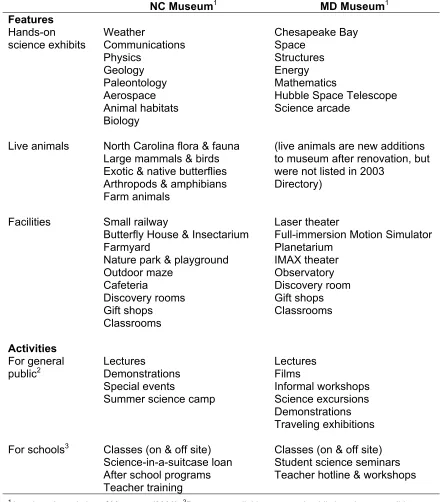
NC Museum, located in North Carolina, is a regional science and technology center established in the 1946. School groups from all over North Carolina and neighboring Virginia and South Carolina visit the museum. However, NC museum establishes special arrangements with the local community, such as free public admission during specified times and free classroom programs for all teachers in the local public school district. The museum features interactive exhibits in biology including live animals, physics, astronomy and space exploration, meteorology, and geology. There is gallery space for two separate traveling exhibitions. The main building has three enclosed discovery rooms featuring biology, physics, and early childhood exploration, respectively. There are also five classrooms dedicated to school programs, but are also used as multi-purpose rooms
as needed.
American rainforest with native plants and hundreds of butterflies all year round. There is also a seasonal extension that highlights butterflies and plants native to North Carolina. The arthropod room showcases insects, arachnids, and their relatives in their respective glass terrariums. NC Museum is in the design phase for expansion of its outdoor
exhibits. A web site details all the exhibits featured at the museum along with directions, membership information, descriptions of all the education programs described in Table 1, and field trip tips for teachers. There are also two gift shops, a cafeteria, and indoor and outdoor eating areas on site.
MD Museum in Maryland is a state science museum established in 1797. The museum has been relocated several times in its long history and was near completion of an 18-month renovation and expansion of its entire facility during the time of data
collection (reopening occurred on the last day of data collection). School groups from all over Maryland and neighboring Virginia and Pennsylvania visit the museum. MD
Museum offers special arrangements to schools in the local community, such as free admission to school groups. Only two exhibits, the planetarium, and an IMAX theater are open to the public at the time of construction and data collection. Since there is limited exhibit space open to the public, all classes are required to schedule at least one
education program during the 2003–2004 school year in order to be permitted to visit the museum.
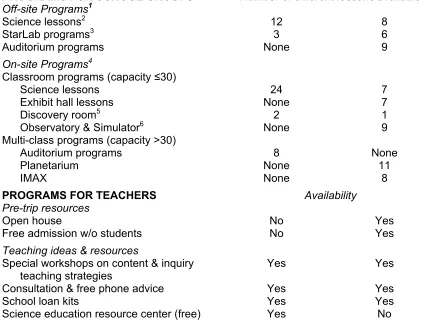
Table 1. Types of education programs each museum offers to teachers and school groups extrapolated from the 2003–2004 published and distributed teachers’ resource guide.
NC Museum MD Museum
PROGRAMS FOR SCHOOL GROUPS Number of different lessons available
Off-site Programs1
Science lessons2 12 8
StarLab programs3 3 6
Auditorium programs None 9
On-site Programs4
Classroom programs (capacity ≤30)
Science lessons 24 7
Exhibit hall lessons None 7
Discovery room5 2 1
Observatory & Simulator6 None 9
Multi-class programs (capacity >30)
Auditorium programs 8 None
Planetarium None 11
IMAX None 8
PROGRAMS FOR TEACHERS Availability
Pre-trip resources
Open house No Yes
Free admission w/o students No Yes
Teaching ideas & resources
Special workshops on content & inquiry teaching strategies
Yes Yes
Consultation & free phone advice Yes Yes
School loan kits Yes Yes
Science education resource center (free) Yes No
1Off-site programs refer to programs that travel to school campuses. Educators bring all necessary materials and conduct one or more lessons.
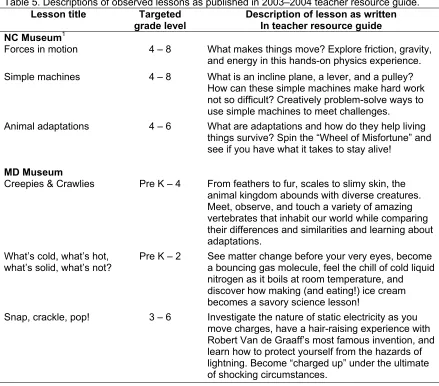
2Science lessons are the one-hour, one-time lessons examined in this study. The lessons are advertised for 50 minutes at NC Museum and 45 minutes at MD Museum.
3 StarLab is a mobile planetarium that can accommodate one class of students at a time and is set up on the school campus for a pre-determined amount of time.
4On-site programs refer to programs offered to school groups during field trips to the museum. 5Discovery room is a self-contained, free-discovery room available to school groups. An educator is
assigned to remain in the room to help the students and teachers. The rooms focus on biological or physical science, and contain objects, artifacts, and equipment for students to explore related concepts. Time in the room is free and for one hour, but requires reservation.
Schools Use Museums as Resources
The first recorded partnership in America between schools and museums for the purposes of popular education is credited to Charles Willson Peale in 1821 (Orosz, 1990). Peale extended the educational programs of his museum beyond public lectures and access to his collection by offering free admission to schoolteachers when
accompanied by their students who paid 12.5 cents each (half the regular admission price). In 1834, Peale’s son modified this arrangement to a school admission for all its students at the annual price of seven dollars. By 1936, field trips to museums were a standard part of museums’ and schools’ education programs (Melton, Feldman, & Mason, 1936). Educational resources for schools today extend beyond reduced admission, as suggested in Table 1. Reporting exclusively on science centers, the Association of Science-Technology Centers (2001) reveal that 89% of science centers offer classes and demonstrations to visiting field trip groups and 75% provide outreach programs to schools worldwide. Eighty three percent of science centers worldwide reported offering workshops for teachers. In addition, the number of schoolchildren museums serve is phenomenal. A nationwide survey conducted by the American
Association of Museums (1994, AAM) reported that museums served 49 million children in school groups in 1988, compared to the U.S. Census Bureau estimate of 49.1 million children ages 5–18 for that year.
Museums are important resources to schools. This is established in
echoed this sentiment in its position statement two years later. Furthermore, increased research interest and refined methodologies in the last 25 years have resulted in greater understanding of the factors most influential to learning during school field trips to museums (Feher & Rennie, 2003; Griffin, 2004). Current literature acknowledges the affect of teachers and students with emerging recognition of value and importance of other individuals, such as chaperones and museum staff (Griffin, 2004).
Teachers Affect Student Learning
Value of teacher preparation.
Classroom teacher knowledge of how to use informal settings in their curriculum and their use of informal settings both contribute to student learning. Science educators and researchers find that teaching classroom teachers how to use museums can affect teacher attitude towards teaching science, student learning, and taking field trips. Olson, Cox-Peterson, and McComas (2001) examine teacher educator preparation of in-service and pre-service teachers to incorporate museums into their lesson plans, while Smith, McLaughlin, and Tunicliffe (1998) and Chesebrough (1994) review the impact of teacher preparation by museum educators. Pre-service teachers are initially unsure of their own ability to take students out of the classroom, and find the task overwhelming (Olson et al., 2001). However, aid from their cooperating teacher help reduce that fear. Olson et al.
conclude that the task of taking students on field trips to museums is less intimidating if teachers are provided experiences modeling effective field trip strategies and receive guidance from their cooperating teachers and university faculty.
museum can have a positive effect on the teachers’ instructional practices. Trained teachers are better able to incorporate their lesson plans into zoo-related instruction, which affect the students’ zoo experiences later in the school year. Results from interviews immediately following their viewing of a zoo exhibit indicate that students of both trained and untrained teachers made low level irrelevant, descriptive, or
identification comments about their experiences at the exhibit. However, students of trained teachers are able to apply concepts learned in classroom, and make
observations and comparisons about animals studied in the classroom and those viewed at the zoo.
Furthermore, Chesebrough (1994) reports a positive attitude change towards science and science teaching by pre-service elementary teachers as a result of a
science methods course taught at a museum by museum educators who a held masters degree in education. The course focuses on pre-service teachers engaging in and conducting hands-on activities, observing children engaging in free-choice science activities, and interacting with the museum’s scientists, exhibits, and other special features. These experiences give the teachers a chance to explore scientific concepts. Thus they develop a more positive attitude towards science, which leads to a more positive attitude towards teaching science.
These findings are consistent with preliminary results from a focus group study investigating elements that characterize a quality field trip (Falk & Storksdieck,
include mental preparation in regards to comfort level in leading groups of students off-site, logistical preparation in terms of agenda, chaperones, and awareness of facilities features, scholastic preparation pertaining to integration of the field trip into the
classroom curriculum, and student preparation.
Value of student preparation.
The evidence for classroom teachers to prepare their students prior to a field trip and debrief with them afterwards in an attempt to place the whole experience into context and thus make the learning meaningful is increasing. Pre-visit strategies for enhancing learning during school field trips to museums (Gennaro, 1981) include reducing novelty of the environment (Anderson & Lucas, 1997; Kubota & Olstad, 1991; Orion & Hofstein, 1994). Additionally, Anderson and his colleagues (Anderson et al., 2003; Anderson et al., 2000) report value in post-visit activities to help students make meaning out of their field trip experience.
findings correlate with investigations of student factors that influence student learning from museums.
Anderson et al. (2003; 2000) examine students’ knowledge construction of scientific concepts before, during, and after a visit to a museum. Their studies report that prior knowledge have a powerful influence on how students interpret their field trip experience and construct understanding from new information. Post-visit activities are crucial for students to further develop understanding, incorporate their informal science experience, and identify alternative conceptions. The learning experience as a whole (before, during, and after the field trip) is a synergism between home, school, and visits to the museum. Thus they conclude that it is important that teachers conduct post-visit activities in order to give students the opportunity to synthesize the experiences and construct their understanding.
Students Affect Student Learning
Learners actively build knowledge through interactions and experiences with objects in the learners’ world. Since this is a lifelong, continuous process, the learners’ pre-existing knowledge contributes immensely to their construction of understanding (Driver, Asoko, Leach, Mortimer, & Scott, 1994; von Glasersfeld, 1989; Wheatley, 1991). In reference to student learning from informal science settings, student pre-existing knowledge is not limited to prior knowledge with concepts or content. Research suggests that student prior knowledge and experience with the scientific concepts (Rix &
McSorley, 1999), with a particular informal setting (Falk & Balling, 1982; Falk et al., 1978; Martin et al., 1981), and with field trips as a whole (Gerber, Cavallo, & Marek, 2001; Orion & Hofstein, 1994) can all contribute to student learning. Rix and McSorley (1999) report that more children who had previously been taught about static electricity understand how an exhibit communicating this phenomenon work compared with students who had no previous knowledge of this area. Additionally, Gennaro (1981), finds that students who receive instructional material prior to their science center visit achieve higher cognitive gains pertaining to the intended scientific concept.
the informal setting, but unfamiliar students engage in behavior that interfere with learning. Conducting a similar study, Falk and Balling (1982) also compare the novelty phenomenon with different aged students, specifically third and fifth grades. They find that effect of the location is influenced by the students’ developmental level. Fifth grade students at a novel setting and third grade students at a familiar setting show
significantly greater cognitive gains and on-task behavior than their counterparts, i.e. other fifth grade students at the familiar site and other third grade students at the novel site. Nonetheless, they conclude, “single-visit field trips can promote cognitive learning and retention” (p. 26).
Do Educators Affect Student Learning?
There remain two groups of individuals who are part of the field trip experience but have scantily been recognized in the literature, chaperones and museum staff. Museums generally require adult chaperones to accompany visiting school groups with students to adult ratio varying according to age of students.MD Museum requires one chaperone per 10 students, but prefers a ratio of 2 to 10. NC Museum requires one adult chaperone per eight students grade K–12, and one to five for preschool children age 5 and younger. Museums’ work force includes part- and full-time paid staff and volunteers. AAM (1994) report that museums employ approximately 150,000 people, two-fifths of whom work part-time, and attract the services of 377,000 volunteers, nine-tenths of whom volunteer part-time. MD Museum employs 211 full- and part-time staff, and receives services from part-time 150 volunteers. NC Museum has 72 full- and part-time paid staff and part-time 350 volunteers (American Association of Museums, 2002).
low levels of learning based on complexity of responses, and questions are asked without follow up, elaboration, or probing.
Schauble et al. (2002) conduct a two-part study of parents’ and museum staffs’ perception and use of the learning potential of a science exhibit at the Indianapolis Children’s Museum. Interviews for one part of the study query parents and museum educators about their opinions on the educational strengths and weaknesses of the target gallery and how adults might work with a child to enhance the learning potential of the target gallery. They find that both parents and educators are challenged and
sometimes puzzled about how to help children learn in the exploratory gallery. Parents and educators cherish children’s fascination and engagement with the exhibits, but are not sure how to determine whether children really learn and how they can help children learn without getting in the way. Educators, however, report this is the interesting challenge of the job. The authors comment that “unless careful attention is paid to helping the helpers, the energy and resources devoted to deepening museum learning may be wasted, or at best, underexploited” (p. 449).
alone. While interaction with the exhibits only is superior to the control (no exhibit, no lecture) for conveying science concepts, museum experience that includes the
structured lesson is more effective at communicating vocabulary and application. Parks (1985) examine student cognitive achievement and attitude towards science from a one-time lesson at the Red Mountain Museum in Alabama. The one-one-time lesson is a lecture-demonstration on dinosaurs that uses objects, a dinosaur video, and a question-and-answer period. Both cognitive and attitude scores are determined through pre, post, and delayed-post multiple-choice exams. She finds that there is a significant, positive
difference between pre and delayed-post cognitive exam scores for students who participated in the lesson, but not for those who did not partake in the museum lesson. However, there is no difference in cognitive scores between students who had the lesson and those who did not. Furthermore, she reports no change in attitude towards science, learning science, dinosaurs, or the museum. Parks concludes that while the one-time lesson may affect student retention of content, the program alone is not enough for affecting change on scientific attitude and cognitive learning.
preparing students, teaching methods during the museum visit, and methods for concluding the museum visit. Melton et al. reported the following findings:
• Pre-visit activities had a positive effect on student learning and method of instruction most affected student scores. These were usually silent reading lessons on the topic to be studied at the museum.
• Fifteen-minute introductory lecture was more effective than 30 minutes. An additional 15 minutes in the exhibit halls where students had access with the authentic objects was more beneficial than spending it introducing students to the hall. Fifth grade students benefited more from the 15-minute introduction than did students 6th grade and above.
• Method of instruction within the exhibit hall (lecture, game, or discussion) most affected student scores, and this could be related to grade level. Fifth grade students scored higher when they had a lecture-based lesson in the exhibit hall. Seventh and eighth grade students scored higher when their lesson in the exhibit hall was conducted more as a discussion than lecture. Sixth grade students benefited from the discussion as long as there was a brief summarizing lecture at the end of the museum visit.
• Teaching ability of the docent affected student scores. Teaching
The authors concluded that “… the teaching ability of … docents appear to be the most important consideration of all, and without an objective check of the docents, a museum may be falling far short of the degree of effectiveness of which it is capable” (p. 74).
This study explores how museum educators embrace their teaching challenge and considers what can be done to help them. Teachers and students affect student learning from field trips to science museums. Research suggests that learning is possible, but requires knowledgeable and prepared classroom teachers and students. For classroom teachers, their knowledge and comfort in using museums within their curriculum can affect student learning. Teachers putting the field trip into a learning context via activities before, during, and after a field trip also impact student gains. Students’ existing knowledge of the science phenomena featured at the museum and their personal experiences at that science setting also contribute to what students do on the field trip and what they learn. The responsibility of promoting meaningful learning for millions of school children visiting museums each year, thus, stands on the shoulders of already overwhelmed classroom teachers. However, an element that is given little attention in the literature on field trips and learning in museums is the effects of those in the museums who are responsible for the teaching, program development, and
curriculum design of the museum’s education program. What are these educators doing or not doing? How do they influence student learning during field trips? How can they share the responsibility?
Section 2. Museum Educators
Teaching Science
first professional niche in museums. In 1958, Robert Hellmann from the American Museum of Natural History in New York identified the presence of 20 educators in the Museum’s Department of Public Instruction. Their teaching responsibilities included science lessons for visiting elementary school groups, science and pedagogy lessons for classroom teachers, and guided tours for the public. For their qualifications, he
described that
… each [educator] be as scientifically accurate as possible, even though he must be expected to teach as wide a variety of topics as ‘Conservation,’ ‘Prehistoric Life,’ ‘The American West,’ ‘The American Indians,’ and ‘Plants and animals of New York State.’ Furthermore it should be noted that he or she is handling children of elementary school grades from all possible kinds of background and ability. [pp. 49–50] … The [educator] must have
achieved some level of specialized proficiency so that he can speak with authority to his students. (p. 51)
Thus it was recognized that educators in museums taught a broad spectrum of learners (adults and children, professionals and laymen), content area, and program type. Today, most museums have an independent department devoted to the educational
responsibilities of the institution. Educators develop, coordinate, and teach programs for school groups, teachers, and the general public. And in some museums, educators are contributing members of exhibit design teams (Bitgood et al., 1994; Roberts, 1997). In their 2001 statistical report, ASTC reports that more than 50% of education staff in science centers worldwide are women. Tran (2002) and Rhoads (2001) find that the educators’ teaching and education backgrounds are variable with formal and informal preparation in teaching and science content.
regardless of where it is done. The strategies change or are modified according to the goals of the lessons, the audience, and the setting. Nonetheless, the individuals responsible for teaching are affected by similar concerns, referred to here as teaching elements. These elements include student knowledge, time, classroom climate, and educator role. Two elements, time and student knowledge, are identified as salient concerns for teaching in museums (Tran, 2002), and thus are examined in this study. A teacher’s teaching rationale, or theoretical framework, is valuable to her instruction and is also considered. The plentiful research in classroom instruction provides most of the literature foundation for this section since research specifically focusing on educators is scant.
Teaching Element: Student Knowledge
The ideas on learning discussed above requires teaching to take into account what students know and how they understand it before, during, and after instruction. Educators recognize the importance as well as challenge of this element (Schauble et al., 2002; Tran, 2002). If the students only enter an educator’s classroom once for one hour out of their entire lifetime, how will the educator determine what and how the students know and understand prior to and as a result of the lesson? Does it really matter? The novelty discussion above suggests that student knowledge is important for the educator to assess even for such an ephemeral experience because the experience has learning potential through the curiosity and attention it incites. How this is done in museums is currently under investigation. Nevertheless, literature on student knowledge and instruction in school can offer insights for museum teaching.
and suggestions. The body of literature on which this discussion relies is classroom assessment. This refers to activities undertaken by teachers and students to provide information on student understanding and the information obtained “… is used to adapt the teaching to meet student needs” (Black & Wiliam, 1998b). It is proposed that assessment be integrated with instruction so that assessment results can guide
instruction (Gong, Venezky, & Mioduser, 1992; Graue, 1993; National Research Council, 1996; Shepard, 2000) and in this way work towards students’ conceptual development (Bell & Cowie, 2001). Teachers provide assistance as a part of assessment in order to gain valuable insights about how understanding might be extended. Meanwhile, students constructing an understanding of science concepts receive input on whether their
construction makes sense and is consistent with canonical knowledge (Shepard, 2000). Bell and Cowie (2001) refer to this relationship generated through classroom
assessment as the intersection of student-teacher interactions for student learning and understanding.
Black and Wiliam (1998a) and Fuchs and Fuchs (1986)review over 40
Brookhart (1997) uses national, longitudinal data of public school students in 1987–1991 from grades 7–12 to compare classroom assessment with student science achievement. She extracts students’ background information (gender, socio-economic status, and general academic ability) and extrapolates the classroom assessment environment for the respective students and teachers from their survey responses to the Longitudinal Study of American Youth. She correlates this with the students’ science achievement and finds that the type of assessment is important to student achievement. Some activities are more helpful than others; science projects yielded positive effects while oral reports had negative effects on achievement.
Bell and Cowie (2001) note that while there is much written about the importance and need for formative assessment, little exists regarding the process. Their two-year study with 10 classroom science teachers in New Zealand explores the purpose and ways in which these teachers conduct classroom assessment. Emerging from their interviews are nine characteristics:
• Classroom assessment is responsive. Teachers and students respond to the information gained in many ways.
• Classroom assessment has many sources of evidence. The information can take many forms and gathered through different means, such as verbal and non-verbal responses to videos or whole class discussions.
• Classroom assessment is tacit. The information can also be based on instincts. • Classroom assessment relies upon professional knowledge and experience.
• Classroom assessment is an integral part of teaching and learning. Teaching to facilitate students learning involves taking action based on information about how students understand what is taught, and includes changing teaching techniques and giving students feedback.
• Classroom assessment involves students and teachers. Students take part in information gathering through self-assessment.
• Classroom assessment has purpose. The purposes include improving learning and changing teaching.
• Classroom assessment is contextualized. The information gathered, how it’s interpreted, and the actions that follow need to be taken in context of the situation.
• Classroom assessment is managing dilemmas. There may not be obvious solutions to situations emerging from the assessments. Teachers rely on their professional judgment to manage the dilemma.
These characteristics suggest there are many ways to gather information about what and how students understand, and the teacher as the professional uses her knowledge and experience with teaching and content matter to make changes to her instruction to meet the needs of the students. The last characteristic Bell and Cowie (2001) discuss that emerged from interviews with the students of these teachers is the level of student disclosure, that is, the amount and truthfulness of student understanding that is
Teaching Element: Time
Time is an extremely valuable commodity in many aspects of life, and is recognized as a critical factor on learning in terms of time available, time spent on learning, and time lapsed. Cotton (1989, ¶9) lists different ways of conceptualizing time and its expenditure in education, which is based on school time and builds from the works of Lorin Anderson, Benjamin Bloom, and Charles Fischer.
• Allocated time is the amount of time specified for an activity or event. When
educators and educational researchers speak of allocated time, they are referring to one of the following elements:
• School time – the amount of time spent in school. When used this way, allocated time may refer to the number of school days in a year or the number of hours in a school day.
• Classroom time – the amount of time spent in the classrooms within the school (i.e., excluding lunch, recess, time spent changing classes, etc.).
• Instructional time – the portion of classroom time spent teaching students particular knowledge, concepts, and skills pertaining to school subjects (i.e., excludes routine procedural matters, transitions, and discipline).
• Engaged time, or, Time-on-task, refers to portions of time during which students are paying attention to a learning task and attempting to learn. This excludes time spent socializing, daydreaming, engaging in antisocial behavior, etc.
tasks at an appropriate level of difficulty for them and experiencing high levels of success (excludes time spent engaged in tasks which are too easy or too difficult). • Dead time – refers to periods of classroom time during which there is nothing
students are expected to be doing; that is, time that the teacher has failed to manage in any way.
Cotton offers further clarification to distinguish between time-on-task and
academic learning time. She explains that time-on-task informs one about teaching as it “reveals the teacher's skill in selecting learning activities which engage students'
attention and in keeping them focused” (¶17). Academic learning time informs one about learning in that it “refers to situations in which student and learning material are well-matched and learning is occurring in a fairly ideal fashion” (¶18). The distinction emerges from time-on-task investigations as researchers realize that not all forms of time-on-task are equal in their effects. Helmke and Schrader (1988) examine student achievement and teacher supervision during independent seatwork among 39 fifth grade classes in Germany. They report that quantity of seatwork is unrelated to student
achievement despite students’ engagement in the activity. Student time-on-task may be unfruitful when interrupted by lectures and questions because the activity is not within the students’ appropriate competency level. Interruptions can also be attributed to disciplinary events, which relates to the role of classroom management on learning. Thus the quality of time spent engaged in an activity is important.
museum, which can be influenced by length of school day, teacher use of the museum, museum hours, and transportation availability schedule. The allocated museum time is the total time students spend at the museum from when they enter the museum to when they leave, which is analogous to school time. Regardless of the quality and efficiency of the teachers’ planned agenda, time is allocated for students to engage in activities that includes free time in the museum, time in specific galleries, and time in the museum’s education programs. These times are analogous to classroom and instructional time. Within these allotted activity times, student behavior is observed to determine time-on-task and academic learning time. Dead time includes lunch breaks, travel between galleries and programs, and any unscheduled time. It is this use and misuse of time that is the source of criticism and concernfor classroom teachers using museums
(Chesebrough, 1994; Chin, 2004; Griffin & Symington, 1997; Olson et al., 2001). This study examines the time allocated to and used by the museum educators in their one-time science lessons, and uses findings from schools for some insight.
disciplinary activities, ineffective instructional techniques, inappropriate curriculum and student inattention or absence reduce time available for engaging in tasks and learning. Not all time allocated for learning is used in activities that allow for learning. Aronson et al. (1999) propose that this is perhaps the reason for the inconsistent findings pertaining to achievement and allocated time.
This is not to say that amount of time is not important. Gettinger (1985; 1989) conducted two studies that experimented with time available for engaging in activities and measured student achievement and retention. The first study (1985) measured reading achievement and retention among 171 fourth and fifth grade students when the researcher allocated less time than needed or allowed students to self-select less time than needed for the task. In both situations, achievement and retention were lower for students who spent less time than needed for learning the content. The second study (1989) manipulated time needed with incentives for completing the task for 118 third grade students. Extra time-on-task yielded improved return for lower-ability students, but had no effect on higher-ability students. Offering incentives minimized time required for learning while improving retention for both groups of students. In both studies, the researcher determines the tasks, which are not part of students’ ongoing curriculum, and learning is measured through retention of factual information. However, as
acknowledged by the author, they are useful to “… ascertain the effects of maximized time spent and minimized time needed for learning on degree of learning in general” (Gettinger, 1989, p. 88). Thus enough time is needed to engage in a task, but more time does not lead to more learning if the students do not need it.