
.22 CALIBER BOLT ACTION RIFLE
19
0
0
Full text
(2) New gun owner’s record.. Contents. Use the space below to record information about your new Winchester Model 63 rifle.. Features . . . . . . . . . . . . . . . . . . . . . . . . . . . . . . . . .6. Serial Number ____________________________________ Caliber __________________________________________. Page. Gun safety warnings . . . . . . . . . . . . . . . . . . . . . . . .3 General description . . . . . . . . . . . . . . . . . . . . . . . .8 Terminology and descriptions . . . . . . . . . . . . . . . .9 Serial number . . . . . . . . . . . . . . . . . . . . . . . . . . . .11 Ammunition . . . . . . . . . . . . . . . . . . . . . . . . . . . .11 Initial cleaning . . . . . . . . . . . . . . . . . . . . . . . . . . .12. Grade ___________________________________________ Purchase Price ____________________________________ Purchased From ___________________________________. Oiling the action . . . . . . . . . . . . . . . . . . . . . . . . .12 Full disassembly/takedown . . . . . . . . . . . . . . . . . .13 Operating instructions . . . . . . . . . . . . . . . . . . . . .17 How to load the magazine . . . . . . . . . . . . . . . . .20 How to operate the action . . . . . . . . . . . . . . . . . .21. Date of Purchase __________________________________. To unload the magazine and chamber . . . . . . . . .25 Sight adjustments . . . . . . . . . . . . . . . . . . . . . . . . .26 Mounting a scope . . . . . . . . . . . . . . . . . . . . . . . . .29 Cleaning and maintenance suggestions . . . . . . . .30 Ordering parts . . . . . . . . . . . . . . . . . . . . . . . . . . .34 Service or repair . . . . . . . . . . . . . . . . . . . . . . . . . 34 Questions & Winchester-guns.com . . . . . . . . . . .35. Winchester trademarks licensed from Olin Corporation Made in USA. Printed in USA. ©1997 • KP97082.5/96228. 1.
(3) MODEL 63 SEMIAUTOMATIC RIFLE. GUN SAFETY WARNINGS. In 1933 Winchester introduced the Model 63 rifle. It was an improved variation on the Model 1903 which had been made only for an old style Winchester 22 cartridge called the “22 Winchester Automatic Rimfire Smokeless.” The Model 1903 was the first Winchester semiautomatic firearm of any type.. IT IS ESSENTIAL THAT THESE OPERATING INSTRUCTIONS BE THOROUGHLY STUDIED BEFORE USING THIS FIREARM TO ASSURE PROPER AND SAFE GUN HANDLING. FAILURE TO FOLLOW THESE INSTRUCTIONS OR FAILURE TO OBEY ANY SAFETY WARNING MAY RESULT IN INJURY TO YOURSELF OR OTHERS, OR CAUSE DAMAGE TO YOUR GUN.. The new Model 63 soon proved a success. It incorporated the more modern 22 caliber Long Rifle cartridge. It was like the 1903 in many ways — but with slight improvements in some areas. It was a quick handling, easy-to-use design with traditional craftsmanship and elegant design. Its blow-back semi-auto action proved highly reliable. Its stockpositioned loading port convenient. The quick takedown system was handy. And its forearm-mounted cocking system (called the operating sleeve) has always been regarded as extremely functional. Despite the differences between the ’03 and the 63, the design of the 63 can still be attributed to the great Winchester designer, Thomas Crossley Johnson. The last of the original 63s was produced over 35 years ago. Your new Model 63 is faithful in nearly every way — with a level of beautiful finish and fine engraving that you would usually associate only with Winchesters of the "Highly Finished Rifles" era at the turn of the century. Study all of the instructions in this manual carefully to be sure you have covered all information about your Model 63.. 2. As a gun owner, you accept a set of demanding responsibilities. How seriously you take these responsibilities can be the difference between life and death. There is no excuse for careless or abusive handling of any firearm. At all times handle your rifle and any other firearm with intense respect for its power and potential danger.. PLEASE READ AND UNDERSTAND ALL OF THE CAUTIONS, PROPER HANDLING PROCEDURES AND INSTRUCTIONS OUTLINED IN THIS BOOKLET BEFORE USING YOUR NEW FIREARM. 1. Do not carry a loaded gun with a live round in the chamber while walking, running, climbing a tree, crossing a fence or anywhere you might slip or fall, drop the gun or otherwise bump or jar the gun. A gun that is dropped, bumped, or jarred with a chambered round might accidentally discharge even with the safety on, causing serious injury to you or someone else. When a round is chambered keep the safety on until you are ready to shoot. 2. Do not rely on the safety to prevent accidental discharge. Many safeties merely block the trigger and prevent firing by pulling the trigger. The safety may not prevent an accidental discharge due to. 3.
(4) dropping, jarring, or bumping a gun. 3. Use only ammunition for which the gun is chambered as indicated on the barrel, to prevent excessive pressure and possible serious personal injury. 4. Incorrectly reloaded ammunition can cause serious personal injury and damage to the firearm due to excessive pressure. Reload only after proper instruction and in strict compliance with instruction and data contained in current reloading manuals. 5. Never point a gun at anything you do not intend to shoot. Always keep it pointed in a safe direction in case of accidental discharge. 6. Always check to ensure that the barrel is free of obstructions before loading and using the gun. If you experience light recoil or off sound, check the barrel for an obstruction. 7. Before firing, clean any grease or oil out of barrel with cleaning rod and patch. Grease or heavy accumulation of oil can cause excessive pressure and result in serious personal injury. 8. Keep barrel, chamber and action free of rust. Rust in the barrel and chamber can cause excessive pressures resulting in serious injury. A rusted, pitted or eroded barrel should be replaced. 9. Use hearing protection to prevent ear damage from repeated exposure to gunfire. 10. Always use proper shooting glasses to prevent eye injury from flying particles.. 4. 11. Never carry a loaded gun in a motor vehicle or carry one into a dwelling. Always carefully unload the gun before entering a motor vehicle, a dwelling or an area such as a camp. Always point a gun in a safe direction while loading or unloading to prevent serious injury in case of an accidental discharge. Never load in the house or in your vehicle. 12. Never shoot at a hard, flat surface or at the surface of water to avoid a ricochet and possible serious personal injury to yourself or a bystander. 13. Store your gun in a clean, dry place out of the reach of children and separated from stored ammunition. 14. Never alter any parts of your gun. Any alterations or adjustments that may become necessary to the operating mechanism should be performed by a qualified gunsmith. 15. Hunting from elevated surfaces such as tree stands is dangerous. Doing so may increase the risk of handling any firearm. Always make certain that the stand being used is safe, sturdy and stable. Always make certain your firearm is unloaded when it is being taken up and down from the stand. Always make certain that your firearm is not dropped from the stand or dropped while it is being taken up or down from the stand. 16. Discharging firearms in poorly ventilated areas, cleaning firearms, or handling ammunition may result in exposure to lead and other substances known to cause birth defects, reproductive harm and other serious physical injury. Have adequate ventilation at all times. Wash hands thoroughly after exposure.. 5.
(5) FIGURE 1. MODEL 63 FEATURES Sights are made to handle rough conditions. Front and rear sights are drift adjustable for windage. The rear sight also features an elevator system for quick elevation changes.. The receiver top is machined to accept a groove-type scope mount. Even though it is a takedown design, the special way that the barrel and receiver top stay together locks in precision and assures accuracy no matter how many times you take down your rifle.. The quick take-down feature allows you to easily disassemble your Model 63 into two halves. Loosening a knob on the rear of the receiver is all it takes. The takedown feature also makes it easy to clean and oil your rifle.. Operating the action is fast and convenient with the unique operating sleeve design. Push in on the end of the sleeve to work the action. Depressing then turning the operating sleeve tip locks the action open.. The buttstock loading system is convenient and easy for any hands, young or old. Loading the magazine is performed with the rifle comfortably cradled in your arm. (opposite side). Semiautomatic blow-back action design. The Model 63 is based on the Model 1903, which was the first semiauto made by Winchester. The basic design proved so reliable that it lead to the development of a full line of Winchester rimfire and centerfire semiautos.. All-steel receiver and steel components. Every component of every mechanism is of durable metal — just like the originals. Elegantly contoured pistol grip stock.. Convenient cross bolt safety design.. The styling of the Model 63 is uncommonly balanced. And its good looks are matched by equally balanced handling and natural shouldering.. 6. All Model 63 Classic Traditions feature beautifully finished walnut stocks and cut checkering.. The magazine tube is mounted in the buttstock. A twist on the knob and it partially removes for loading or fully removes for easy unloading. 7.
(6) FIGURE 2A Takedown Screw. Ejection Port. Rear Sight Front Sight. Loading Port. Magazine. Forearm. Operating Sleeve. Muzzle. Buttplate Buttstock. Safety. Trigger. Receiver. GENERAL DESCRIPTION The Model 63 is a semiautomatic rifle that allows the shooter to fill the magazine and shoot consecutive rounds — taking loaded rounds from the tubular magazine to the chamber automatically — until the magazine is empty. After each cartridge fires, the action automatically ejects the empty cartridge out the ejection port to the right. The action is operated manually using a cocking system mounted on the forearm tip. The rod protruding from the tip is called the operating sleeve. Pushing it fully in (rearward) opens the action: extracting and ejecting any cartridge in the chamber and loading a cartridge (if present) from the magazine into the chamber. The action itself uses a blowback design, where the firing of the cartridge actually begins the rearward motion of the bolt. Inertia completes the bolt’s motion rearward, cycling the action. The magazine is loaded through a port in the right side of the butt8. stock. The screw on the rear of the receiver is used to disconnect the front of the receiver from the rear. The entire rifle then easily takes down into two convenient halves.. TERMINOLOGY AND DESCRIPTIONS Descriptions in this booklet generally refer to the gun in the horizontal position. That is, in the normal firing position. For example, the muzzle is forward or front; the butt stock is rearward or rear; the trigger is downward or underneath; the sights are upward or on top. Figure 1 covers the general features and benefits of the Model 63 design. For general parts terminology, refer to Figure 2A. For breech bolt and bolt slide terminology refer to figures 2B and 2C. The Winchester Model 63 is also shown disassembled to the extent necessary in order to follow. 9.
(7) FIGURE 2B Takedown screw. Hammer Throat of Magazine. Magazine Follower. instructions contained in this book (refer to Figure 7 later in this manual). Throughout this manual the “action” refers to the mechanism of this rifle which loads and secures the cartridges in the chamber.. SERIAL NUMBER The serial number is located on the bottom of the forward receiver/frame assembly (barrel half of the rifle) toward the front (see Figure 3). Record the serial number at the front of this book for future reference. Cross bolt safety. Hammer spring. The caliber of your Model 63 is inscribed on left side of the barrel, toward the receiver.. FIGURE 2C Rear of firing pin. (Bottom view). AMMUNITION. Bolt Face. Extractor. Ejector Bolt. FIGURE 3. Serial Number. Record it for future reference.. 10. Receiver. U.S. Repeating Arms Co. can assume no responsibility for incidents which occur through use of cartridges of nonstandard dimension or those developing pressures in excess of SAAMI (Sporting Arms and Ammunition Manufacturer’s Institute) established standards. Winchester ammunition is always an excellent choice for your new Winchester rifle, delivering the unmatched performance and dependability you want.. DISCHARGING FIREARMS IN POORLY VENTILATED AREAS, CLEANING FIREARMS, OR HANDLING AMMUNITION MAY RESULT IN EXPOSURE TO LEAD AND OTHER SUBSTANCES KNOWN TO CAUSE BIRTH DEFECTS, REPRODUCTIVE HARM AND OTHER SERIOUS PHYSICAL INJURY. HAVE ADEQUATE VENTILATION AT ALL TIMES. WASH HANDS THOROUGHLY AFTER EXPOSURE.. 11.
(8) INITIAL CLEANING Some metal parts of your new rifle have been coated at the factory with a rust preventative compound. Before using your new Model 63, clean the anti-rust compound from the inside of the barrel, receiver, breech bolt mechanism and the action chamber areas. A high quality, light weight gun oil should be used to remove this compound and to give your gun its first lubrication. Clean the barrel using a cleaning rod and patch as explained under “Cleaning and Maintenance Suggestions” found later in this booklet. Take down your rifle for cleaning as explained under “Full Disassembly/Take down” explained later in this manual. First lubrication suggestions are also outlined below. If your new Model 63 is for collector’s purposes and you wish to store it for a long period of time, it is permissible to leave the rust preventative compound in place and keep your Model 63 in its box for maximum protection during long-term storage.. IMPORTANT: CLEAN THE INSIDE OF THE BARREL AND CHAMBER TO REMOVE ALL GREASE AND OTHER POSSIBLE OBSTRUCTIONS BEFORE FIRING YOUR GUN.. Avoid applying to much oil. Only a light film is necessary. Excessive oil should be wiped off.. FULL DISASSEMBLY / TAKEDOWN Knowing how to easily take down your Model 63 is important for cleaning and maintenance.. TO ENSURE THAT YOUR RIFLE IS UNLOADED, OPEN THE ACTION AND CAREFULLY CHECK THE CHAMBER, FEED MECHANISM AND MAGAZINE TUBE FOR AMMUNITION. LOCK THE ACTION IN THE OPEN POSITION. The action can be locked in the open position by depressing the operating sleeve and rotating (turning) the end clockwise or counterclockwise as explained under “ How to Operate the Action” later in this manual. It is a good idea to always wear eye protection when disassembling any firearm to prevent springs or spring-tensioned parts from injuring you. Carefully follow the unloading instructions found FIGURE 4. OILING THE ACTION Before the first firing, and with your rifle disassembled as explained below, it is important to wipe the mechanism clean and apply a few drops of quality oil on the following surfaces (see Figure 4). • On the bearing surfaces of the internal hammer. • Inside top of the front portion of the receiver. • Breech bolt, on all sides.. Lightly oil the action at these points. • All internal surfaces that slide against each other. 12. 13.
(9) later in this manual to assure there are no rounds in the magazine, chamber or feed areas before taking down your rifle.. FIGURE 6. DISASSEMBLY —. 1. Remove the magazine from the buttstock by turning the Magazine plug handle about 1/8 turn counterclockwise and then pulling the inner magazine tube out rearward from the outer magazine tube 2. Begin to takedown the rifle by loosening the takedown screw on the rear of receiver (see Figure 5). To prevent dropping either half, it’s a good idea to do this with the rifle laying on a table, on top of a padded surface like a soft rag or other non-marring protection. 3. Separate the gun into two halves by pulling the butt stock to the rear and forearm to the front (see Figure 6). Your rifle is now in two compact halves. 3. This exposes most of the internal mechanisms to FIGURE 5 Carefully loosen the take down screw at the rear of the receiver.. 14. With the rifle laying down, carefully pull the two halves apart.. inspection and cleaning. All normal cleaning and basic maintenance can be performed with the rifle at this stage of disassembly.. WE RECOMMEND THAT YOUR MODEL 63 NOT BE TAKEN APART FURTHER THAN THIS. THERE ARE MANY SMALL, FINELY FITTED PARTS, SMALL PINS, SMALL SPRINGS AND SPRING-LOADED PARTS THAT CAN EASILY BECOME DAMAGED OR LOST. SOME REASSEMBLY PROCEDURES REQUIRE SPECIAL TOOLS AND AN ADVANCED LEVEL OF EXPERTISE TO ACCOMPLISH. IF YOUR RIFLE SHOULD NEED FURTHER DISASSEMBLY CONTACT ONE OF THE AUTHORIZED SERVICE CENTERS ON THE LIST ACCOMPANYING YOUR RIFLE.. 15.
(10) FIGURE 7. FIGURE 9 Slide the two halves together. Do not force. Barrel/forearm half. Buttstock half. Inner magazine tube Full disassembly. Your Model 63 will now be in these pieces (see Figure 7):. Make sure the take down screw starts correctly into the threads.. • Inner magazine tube. (see Figure 9). This can be done with the bolt in the locked or unlocked position. Make sure that the takedown screw doesn’t obstruct this by pulling it rearward and making sure it stays aligned. The internal hammer can be lowered for better cleaning access by pulling the trigger and slowly lowering the internal hammer with your thumb to the dropped/forward position (see Figure 8).. 5. With the two halves correctly in place, carefully turn the takedown screw in the clockwise direction. Screw it in until it is finger tight with a fair amount of finger pressure.. REASSEMBLY —. 6. Reinsert the inner magazine tube. To lock it in place, turn it until its retainer pin falls into the retainer slot, then turn clockwise about 1/8 turn until it stops in the locked position.. • Barrel/forearm half (receiver portion) • Buttstock half (frame portion). 1. Cock the hammer (if it was previously dropped) back to the full cock position with your thumb. 2. Slide the buttstock half (frame) into the barrel/forearm half (receiver portion) from the rear FIGURE 8. 7. Your Model 63 is now fully assembled.. OPERATING INSTRUCTIONS CAUTION — ALWAYS KEEP THE MUZZLE POINTED IN A SAFE DIRECTION. PRIOR TO USING LIVE AMMUNITION, FAMILIARIZE YOURSELF THOROUGHLY WITH THESE OPERATING INSTRUCTIONS. Get accustomed to the feel of your new gun — know the forces required to operate the action,* to pull the trigger, to work the action, and above all, know how to place your rifle’s safety in the “on safe”. The hammer can be lowered to the dropped position for easier cleaning.. 16. 17.
(11) F I G U R E 11. position. The rifle is in the “on safe” position when the manual safety is moved fully to the right. *ACTION: The mechanism of a firearm which loads and secures the cartridge in the chamber. Your Model 63 rifle is designed with a cross bolt type safety. It is located just rearward o f the trigger on the trigger guard: convenient for gloved or ungloved fingers (see Figure 10). It is essential that you become very familiar with the feel, look and operation of the safety on this rifle before attempting to load or shoot. With the safety in the “ON SAFE” position the trigger is blocked and the rifle cannot be fired with a normal pull of the trigger. In the “OFF SAFE” position — if your gun is loaded with a round in the chamber — the chambered round can be fired by simply squeezing the trigger. • “ON SAFE”. The safety button is pushed fully to the right (see Figure 10). The red band on the left side is NOT showing. •“OFF SAFE”. The safety button is pushed fully to the left. A large red band is exposed on the button as it protrudes on the left side (see Figure 11). The red band is an added aid to safe gun handling. F I G U R E 10 Safety in the “on safe” position.. (View from right side.). 18. Safety in the “fire” position. (View from left side.). However, with time and exposure to the elements it can wear off. Never rely totally on your gun’s safety button. It is merely an aid to safe gun handling. Like any mechanical device the safety can possible fail: it can be jarred or inadvertently manipulated into an unsafe condition. Always keep your rifle pointed in a safe direction.. THIS MECHANISM WILL NOT NECESSARILY PREVENT THE ACCIDENTAL DISCHARGE OF THIS FIREARM AS A RESULT OF JARRING OR ABUSE SUCH AS OCCURS WHEN A FIREARM IS DROPPED. At all times in the field keep the safety in the “ON SAFE” position and the barrel pointed in a safe direction. It is a good idea never to load your rifle until you are in the field and shooting is imminent or, if you are at a range, until it is your turn to shoot. For extra safety, and as a courtesy to others, always keep your rifle’s muzzle pointing down range. At any range (or around any other people, even when hunting), unless shooting is actually in progress, always keep the action locked open at all times (see procedures under “How to Operate the Action”). It is a proper gun handling practice to place your rifle in a. 19.
(12) case when going to or coming from the shooting area.. F I G U R E 13. HOW TO LOAD THE MAGAZINE Use the correct ammunition referenced by the inscription on the barrel. Again, before loading your gun be sure all grease and oil has been removed from the barrel and chamber, and there is no obstruction. To load the magazine, first place the safety in the “ON SAFE” position. Leave the action (breech bolt) closed at this time. 1. Twist the knob on the end of the magazine tube about 1/8 turn counterclockwise to unlock.. Push rearward on the operating sleeve with your finger to operate the action .. 2. As you pull out the tube watch it move past the loading port in the right side of the buttstock.. 5. Next, push the magazine tube down into position and lock into place. Turn it until its retainer pin falls into the retainer slot, then turn clockwise about 1/8 turn until it stops in the locked position.. 3. Pull the tube out until the magazine follower clears the loading port in the outer magazine tube.. Care should be taken while pushing the tube in, as it is under spring tension.. 4. With the muzzle pointed downward slightly, insert the bullet end of the cartridges into the magazine facing forward (Figure 12) and allow them to slide down towards the action. Do not exceed the recommended capacity of the magazine (ten rounds).. The rifle is now ready for operation.. F I G U R E 12. HOW TO OPERATE THE ACTION Make sure the safety is in the “ON SAFE” position. 1. Load the chamber by pushing the end of the operating sleeve fully rearward with one of your fingers on your forward hand (hand that holds the forearm when you shoot). Using your pointing finger makes working the action easy. Push the operating sleeve fully rearward until the rearward movement of the action stops (see Figure 13). 2. To move a cartridge from the magazine to the chamber, let go of the end of the operating sleeve and allow the sleeve to move forward under spring. Insert the cartridge through th loading port into the magazine tube, bullet forward.. 20. 21.
(13) pressure (see Figure 14). The operating sleeve is linked directly to the bolt inside the receiver — so the bolt will close shut at the same time, and move a cartridge from the magazine to the chamber.. F I G U R E 14 Release the operating sleeve to automatically load a round from the magazine into the chamber.. CAUTION: YOUR RIFLE IS LOADED, COCKED AND READY TO FIRE. When ready to shoot, move the safety to the “OFF SAFE” position, then . . . take aim and when on target, squeeze the trigger. The semiautomatic function of your rifle will automatically extract and eject the fired cartridge. The bolt will then automatically close, while at the same time moving a loaded cartridge from the magazine into the chamber. Since the safety remains in the “OFF SAFE” position, your rifle is again ready to fire with simply a squeeze of the trigger.. IF SHOOTING IS NO LONGER IMMINENT, IMMEDIATELY MOVE THE SAFETY TO THE “ON SAFE” POSITION BY PUSHING IT FULLY TO THE RIGHT. LOCKING THE ACTION REARWARD —. The Model 63 has an easy-to-use system for locking the action rearward. This is an important operation and you should practice it until you can do it with ease.. 1. FIRST PLACE THE SAFETY IN THE “ON SAFE” POSITION. Then push the operating sleeve in fully with your finger. Usually this will be the pointing finger of the hand holding the forearm. If you intend to lock the action rearward it helps to do this with both your pointing finger and your thumb grasping the tip. 2. With the operating sleeve pushed in grip the operating sleeve tip between your pointing finger and your thumb. 22. F I G U R E 15. Pull the operating sleeve rearward with your thumb and finger. Then turn it about 1/4 to 1/2 turn to lock.. 3. Turn the operating sleeve tip approximately 1/4 to 1/2 turn in either the clockwise or counterclockwise direction. A built-in limiter will prevent you from turing the tip past 1/2 turn. Turning the tip with the operating sleeve in the rearward position locks the operating sleeve in the rearward position (see Figure 15). The action is now locked open and inspection of the chamber and feed mechanisms can be easily performed. Remember, a limiter keeps you from turning the tip of the operating sleeve more than 1/2 turn. Use this procedure to lock the action open for cleaning and safety purposes as outlined in the manual. 4. To release the locking mechanism and to allow the action to return forward, turn the operating 23.
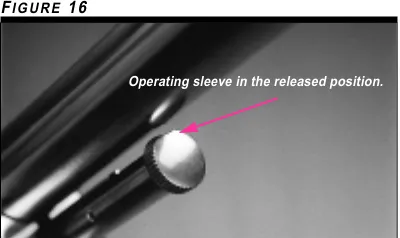
(14) F I G U R E 16. TO UNLOAD THE MAGAZINE AND C HAMBER Operating sleeve in the released position.. sleeve tip until it unlocks. This will release the operating sleeve to travel fully forward and close the action. There is only one position of the tip that the sleeve will unlock — simply turn the operating sleeve tip until you are in alignment with this position and the operating sleeve will release forward. There is a slight radius shape cut on one side of the tip. When this is facing up, toward the barrel, the operating sleeve is in the released position (see Figure 16). If you turn the tip until it stops and the operating sleeve does not release forward it is because you have turned it until it encountered the limiter. Simply turn the operating sleeve tip in the opposite direction until the operating sleeve releases and goes fully forward, at the same time closing the action.. CAUTION: IF THE MAGAZINE IS LOADED, RELEASING THE OPERATING SLEEVE LOCKING MECHANISM WILL ALWAYS MOVE A CARTRIDGE FROM THE MAGAZINE INTO THE CHAMBER. WITH THE SAFETY IN THE OFF SAFE POSITION AND A ROUND IN THE CHAMBER YOUR RIFLE CAN BE FIRED BY SIMPLY PULLING THE TRIGGER.. 24. ALWAYS KEEP THE MUZZLE OF YOUR RIFLE POINTED IN A SAFE DIRECTION WHEN LOADING OR UNLOADING YOUR RIFLE. Place the safety in the “ON SAFE” position. Lock the action rearward by locking the operating sleeve tip rearward. With the muzzle pointed downward withdraw the inside magazine tube from the rifle. Then carefully tip the rifle muzzle up, buttstock down, allowing the cartridges to slide out the outer magazine tube into a suitable container. Replace the inside magazine tube into the buttstock and lock in place. Release the operating sleeve. Work the action several times by pushing in and releasing the operating sleeve to assure that there are no rounds in the magazine, in the chamber or in the action feed areas. Lock the action open again. Look into the open action making sure there are no cartridges in the action, and observe the empty chamber and the magazine follower (see Figure 17). Always unload your gun and lock the action rearward when you have finished shooting, and before F I G U R E 17 Make sure you can see the magazine follower.. Look into the action to make sure there are no cartridges in the chamber or feed mechanism.. 25.
(15) putting your gun away. Consider your rifle fully unloaded when the magazine, chamber and feed areas contain no cartridges and the action is locked rearward.. F I G U R E 19. SIGHT ADJUSTMENTS All Model 63 rifles are fitted with open sights. The style and adjustment system may vary between models and grades.. Tap carefully. Do not mar the barrel or sight.. The proper procedure is to shoot a group with the sights set as they come from the factory (intermediate position on both elevation and windage), and then make incremental adjustments to move the sight blade and blade holder to position the group on your target.. BEFORE MAKING ANY SIGHT ADJUSTMENTS, MAKE SURE YOUR RIFLE IS FULLY UNLOADED AND THE MUZZLE IS POINTED IN A SAFE DIRECTION. PLACE THE SAFETY IN THE “ON SAFE” POSITION. UP OR DOWN ELEVATION ADJUSTMENTS —. Adjusting elevation on your Model 63 requires you to lift up the rear notch blade holder on your rifle’s F I G U R E 18 Lift up on the notch blade holder and move the elevator forward or rearward with your fingers.. rear sight with your fingers and move the notched elevator either forward or backward (see Figure 18). To raise point of impact, use your fingers to lift up on the blade and slide the elevator rearward. Adjusting the sight to make your gun shoot lower is just the opposite — move the elevator forward. Remember: • Move the blade and holder up to shoot higher. • Move the blade and holder down to shoot lower. RIGHT OR LEFT WINDAGE ADJUSTMENTS —. On Model 63 sights, the entire rear sight blade holder is dove-tailed in the rear sight base. To adjust for windage, gently move the rear sight blade to the right or left by tapping at the dove-tail using a wood or fiber dowel or hammer that will not mar the sight (see Figure 19). If you tap to the right your gun will. 26. 27.
(16) shoot more to the right. Moving the blade holder to the left is just as easily done. Note how much you adjust the sight as you sight-in your Model 63. Remember: • Move the rear sight to the right to shoot farther to the right on the target.. F I G U R E 20 Correct sight picture.. Target bull’s-eye Bead. • Move the rear sight to the left to shoot farther to the left on the target. Care should be taken not to mar the finish or bend sight components when adjustments are made. The front sight bead is also held in a dove-tail mount on the sight base. It is possible to make windage adjustments by tapping it to one side or the other, just like the rear base. Remember, when adjusting the front sight you get the opposite results: move to the right and you shoot more to the left, move the bead to the left and you’ll shoot more to the right. All sight adjustments — of course — are a matter of trial and error. Remember, it is usually necessary to reset your sights when you change type or even brand of ammunition. High velocity 22 Long Rifle ammunition will almost always have a different point of impact than a target grade load or a hollow point load. SIGHT MAINTENANCE —. Occasionally check your sights to make sure they have not been jarred or vibrated out of adjustment. This is especially important after extensive shooting or after hunting under rugged conditions. Front and rear sight bases should always be tight on the barrel and dove-tails should be snug.. 28. Notch. SIGHT PICTURE —. The correct sight picture for the sights on your Model 63 is with the front bead resting in the Ushaped notch in the sight blade. The bead itself should rest directly under the point of impact. For example, if you were shooting a conventional small bore target, the round, black bull’s-eye would appear to rest on top of the front bead (see Figure 20).. MOUNTING A SCOPE The top of the receiver on every Model 63 is grooved to accept standard 22 caliber rifle-type scope mounts. Depending on the type of bases and/or mounts you purchase, your rifle will accept thin-tube scopes, red-dot type sights or standard rifle scopes. On the 63 the barrel is attached rigidly to the top portion of the receiver. So, even though your rifle is a take-down design, your scope stays sighted in even after the action is taken down. Carefully follow all instructions provided with your scope mounts, rings and scope when mounting your scope.. 29.
(17) CLEANING AND MAINTENANCE SUGGESTIONS. Take down your Model 63 into the barrel/receiver half and the buttstock half as explained previously.. Your Model 63 will function better and more reliably over a longer period of time if it is properly maintained and kept clean.. Take extra care to protect the rifling at the muzzle of your rifle from damage (which can affect accuracy). A muzzle protector (available at most good gun shops) is always a good idea.. BEFORE PERFORMING ANY CLEANING PROCEDURES, ALWAYS MAKE CERTAIN THERE ARE NO CARTRIDGES IN THE CHAMBER, MAGAZINE OR ACTION/FEED AREAS. You should clean your Model 63 after every day of shooting and more often if it becomes excessively dirty. A minimum cleaning includes wiping down the action and oiling key parts. Most regular maintenance will also include cleaning the barrel. If you encounter a function problem be sure to give your gun a thorough cleaning to see if it solves the problem before seeking the services of one of our Authorized Repair Centers, our service facility or a competent gunsmith. To clean your firearm, adhere to the following general guidelines. CLEANING PROCEDURES —. BE CERTAIN YOUR GUN’S CHAMBER AND MAGAZINE ARE UNLOADED. ALWAYS WEAR PROTECTIVE SAFETY GLASSES DURING ALL CLEANING PROCEDURES. KEEP AMMUNITION AWAY FROM THE CLEANING AREA. DO NOT TEST THE FUNCTION OF YOUR FIREARM WITH LIVE AMMUNITION.. 30. 1. Use a cleaning rod with a tip and patch suitable for the size of your Model 63’s .22 caliber bore. Make sure the patch is large enough for a snug fit in the bore. Insert the rod and patch into the barrel at the muzzle end and run it back and forth several times. Although it is possible to remove the bolt from the Model 63, it requires special tools and some expertise — and is therefore, not recommended. 2. Push the operating sleeve fully in and lock it (and the action) rearward to inspect the chamber and bore for brass, copper, lead and powder fouling. A normal amount of powder residue can be expected and is not serious. It can usually be removed by repeating step one, using a patch saturated with solvent. If or when fouling should become heavy, it can be removed with a brass bore brush. Dip or spray the brush with solvent and scrub the chamber and bore until the fouling is removed. To prevent brass bristles from breaking off, the brush should be pushed completely through the bore before being withdrawn. Because you are cleaning the barrel with the breech bolt in place it is helpful to use a brush that has a shorter overall length so it is possible to push it past the chamber. Keep the operating sleeve (and bolt) locked rearward during the cleaning procedure.. 31.
(18) 3. After fouling has been removed the bore should be wiped dry. Then pass a slightly oiled patch through the bore for preservation. A fine, light gun oil is recommended. 4. Wipe all exposed metal surfaces of the receiver, forearm and barrel with a clean rag. Finger marks should be removed because they provide a place where moisture can accumulate. Any dried oil in the receiver area should also be removed. 5. Lightly oil your gun at the points described under “Oiling the Action” found earlier in this manual. Ordinary good judgment will, of course, indicate that the metal of the gun should receive a light film of oil any time the rifle has been exposed to weather or handling. This is very important and must be done with every gun. Remember, the polished, finely fitted surfaces of the receiver and action mechanisms must always have a thin film of oil. Make sure that the surfaces of the breech bolt and bolt slide are especially clean and lightly oiled with a high quality gun oil. Use solvent and a toothbrush or other suitable brush to clean around the extractor, ejector and other small breech bolt components. With the Model 63 an aerosol-type oil can help greatly in “spraying away” residues on the breech bolt. When satisfied, wipe clean and lightly oil. 6. INSPECT THE BARREL AND CHAMBER. TO MAKE CERTAIN THAT NO PATCHES HAVE BEEN INADVERTENTLY LEFT IN THEM. Remove any that remain.. 8. Wipe all wood surfaces with a soft cloth. 9. When transporting only, store your Model 63 in a quality protective case to prevent scratches and dents. For long term storage, store in a dry place to prevent corrosion. It is acceptable to store your Model 63 taken down. Store away from children.. MAKE SURE YOUR RIFLE IS UNLOADED AND ALWAYS STORE AMMUNITION SEPARATELY. OTHER CLEANING SUGGESTIONS —. • Never pour large quantities of oil into the receiver or other parts. It can drain down to the wood and soften it — and cause permanent damage and loosening of the stock. • After extended periods of heavy use, your rifle should be taken to a qualified gunsmith to have the action disassembled for professional cleaning and lubrication.. NEVER ATTEMPT TO TAKE YOUR MODEL 63 APART FURTHER THAN EXPLAINED IN THIS MANUAL. This is a specialized, finely fitted mechanism. You may permanently mar it by attempting to disassemble the inner mechanism assemblies. If further disassembly for service or cleaning is required, take your gun to a U. S. Repeating Arms Company Authorized Repair Center or a competent gunsmith as explained under “Service or Repair.”. 7. Reassemble your rifle if you performed a complete cleaning.. 32. 33.
(19) ORDERING PARTS. QUESTIONS. To order parts, please write our parts department and furnish the following: your name, address, and telephone number. Also specify the model and serial number of your gun. When we receive your request, we will send an order form and a parts breakdown with prices.. If you have other questions about Winchester rifles and shotguns, call or write our Customer Service Department:. Write to: Parts Department U.S. Repeating Arms Company, Inc. 275 Winchester Avenue New Haven, Connecticut 06511-1970. CAUTION: PARTS ARE MADE FOR WINCHESTER BRAND FIREARMS MANUFACTURED BY OR FOR U.S. REPEATING ARMS COMPANY, INC., AND SHOULD NOT BE USED IN OTHER GUNS EVEN THOUGH MODELS MAY BE SIMILAR. IMPROPERLY FITTED PARTS MAY BE DANGEROUS.. Customer Service U.S. Repeating Arms Company, Inc. 275 Winchester Avenue Morgan, Utah 84050-9333 Phone: 1-800-945-5237. WINCHESTER -GUNS.COM U.S. Repeating Arms Company offers an information resource for you on the world wide web. • List of authorized repair centers. • Customer service information. • Answers to many technical and historical questions. • Links to helpful sites. Go to: www.winchester-guns.com. SERVICE OR REPAIR If your Winchester firearm should ever need repair or service, please utilize one of the world-wide network of U.S. Repeating Arms Company Authorized Repair Centers for Winchester firearms. If you have any questions about how to obtain service for your Winchester firearm, call or write the Authorized Repair Center (ARC) nearest you. A list of ARCs is packaged with your new gun. If you need to obtain a new list of ARCs call us at: 1-203-789-5000. 34. 35.
(20)
Figure
Related documents