Copyright 0 1996 by the Genetics Society of America
DNA Sequence Analyses Support the Role
of
Interrupted Gap Repair
in
the
Origin
of
Internal Deletions
of
the Maize Transposon, MuDR
An-Ping Hsia*
and
Patrick
S.
Schnable*’+
*Department of Zoology and Genetics and ?Department of Agronomy, Iowa State University, Ames, Iowa 50010
Manuscript received May 2, 1995 Accepted for publication November 1, 1995
ABSTRACT
Previous research has demonstrated that the autonomous Cy transposon can activate the excision of M u transposons. To determine the relationship between Cy and the more recently described autonomous M u transposon, M u D R a Cy transposon inserted at the mutable a1 allele, al-m5216, was isolated and cloned. DNA sequence analyses established that this Cy insertion is identical to MuDR ( M u 9 , GenBank accession No.: m76978.gb-pl). Therefore, Cy will henceforth be termed MuDRCy. Defective derivatives
of MuDR:Cy were isolated that had lost their capacity to activate their own excision or the excision of a
M u 7 transposon. Most of these derivatives are nonautonomous transposons because they can excise, but only in the presence of unlinked MuDR:Cy transposons. Physical mapping and DNA sequence analyses have established that six of these defective derivatives carry internal deletions. It has been proposed previously that such deletions arise via interrupted gap repair. The DNA sequences of the break points associated with all four sequenced deletions are consistent with this model. The finding that three of the excision-defective derivatives carry deletions that disrupt the coding region of the mudrA (but not the mudrB) transcript supports the view that mudrA plays a role in the excision of M u transposons.
A
BOUT a dozen families of transposons have beenidentified in maize since the discovery of the Ac/
Ds family by MCCLINTOCK during the 1940s (for a re-
view, see PETERSON 1988). Transposons within a family
share homologous inverted repeats and respond to the same transposase. A transposon that contains the inter- nal sequence encoding the family-specific transposase
is termed the autonomous (or regulatory) transposon
of the family. Autonomous transposons can catalyze their own excision and activate, in trans, the excision of other nonautonomously transposing sequences termed receptors.
Originally identified by ROBERTSON in 1975, the Mu-
tator transposon family of maize exhibits forward muta- tion rates 50-fold above the spontaneous rate (ROBERT-
SON 1978). This elevated mutation rate is termed
“Mutator activity.” Lines that exhibit Mutator activity
and that are derived from ROBERTSON’S stocks are
termed Mutatorstocks. The inheritance of Mutatoractiv- ity is usually non-Mendelian; among the progeny of a cross between Mutatorand non-Mutatorstocks, -90% of the progeny retain Mutator activity (ROBERTSON 1978). Many of the mutations recovered from Mutator stocks contain Mu transposon insertions. Mu transposons gen- erally generate 9-bp direct target site duplications upon insertion. To date, eight classes of nonautonomous Mu transposons have been cloned either as insertions into previously cloned genes or by homology to the -220-
Corresponding author: Patrick S. Schnable, G405 Agronomy Hall, Iowa State University, Ames, IA 50011.
E-mail: [email protected]
Grnrtica 142: 603-618 (Fehruary, 1996)
bp terminal inverted repeat sequences that are shared by all Mu transposons (for reviews, see WALBOT 1991;
CHANDLER and HARDEMAN 1992). In most instances,
members of different classes of Mu transposons do not exhibit internal sequence similarity.
The non-Mendelian inheritance of Mutator activity in Mutator stocks hampered the genetic identification of the autonomous transposon that regulates the transpo- sition of Mu transposons. Working with the TEL (trans-
poson element laden) population, which does not have
recent common ancestors with Mutator stocks, SCHNA-
BLE and PETERSON (1986) identified an autonomous
transposon (Cy), which segregates in a near-Mendelian
manner (SCHNABLE and PETERSON 1988) and that regu-
lates the transposition of Mu transposons (SCHNABLE
and PETERSON 1989). The Cy transposon was first identi- fied by virtue of its ability to regulate the somatic insta- bility of a nonautonomous allele (bzl-rcy) isolated from the TEL population. Cloning and sequencing of the rcy:Mu
7
transposon inserted at the bzl-rcy allele demon- strated that it had all the characteristics of a Mu transpo- son (SCHNABLE et al. 1989). Other tests established that: the Cy transposon is capable of regulating the excision of the Mu1 transposon inserted at the al-mum2 allele(SCHNABLE and PETERSON 1989); strongly active Cy
transposons are present only in the TEL population
and Mutator stocks (SCHNABLE and PETERSON 1986);
and in Mutatorstocks, the presence of genetically active Cy transposons is correlated with Mutator activity
(SCHNABLE and PETERSON 1989). In total, these data
604 A.-P. Hsia and P. S. Schnable
More recently, a 4.9-kb transposon was cloned from Mutator stocks by several laboratories and termed vari- ously M u 9 (HERSHBERGER et al. 1991), M u R (CHOMET et al. 1991) and MuA2 (QIN et al. 1991). Because MuA2 and M u 9 have only a single base pair difference (JAMES
et al. 1993), it was agreed at the 1993 Maize Genetics
Conference to rename this 4.9-kb transposon MuDR in
recognition of DONALD ROBERTSON’S contribution to
the study of the Mututor family. Using a one-MuDR line carrying al-mum2and related to a one-MuDRline devel-
oped by ROBERTSON and STINARD (1989), it was demon-
strated that MuDR represents the autonomous transpo- son of the Mutator family (CHOMET et nl. 1991; HERSH-
BERCER et al. 1991;
QIN
et al. 1991). Based upon thisresult, it became important to determine whether Cy and MuDR exhibit DNA sequence similarity.
Internal deletions arise within MuDR transposons at
high rates (HARDEMAN and CHANDLER 1993; LISCH and
FREELING 1994; LISCH et al. 1995). LISCH et al. (1995) proposed that these deletions may arise via interrupted gap repair, a model developed to explain the behavior of the P transposons of Drosophila (ENGELS et al. 1990). This model makes specific predictions regarding the characteristics of the sequences that define deletion
end points. Hence, although sequences flanking MuDR
deletions have not been reported, such sequences
would represent a significant test of this model.
MuDR encodes two convergent transcripts (HERSH-
BERGER et al. 1991; JAMES et al. 1993), mudrA and mudrB
(HERSHBERGER et al. 1995). Both transcripts are present in active Mutator stocks at all developmental stages in all tissue types tested, but not in inactive or non-Mutator lines (HERSHBERGER et al. 1995). Deletions that remove part of the mudrA coding region (as assayed via restric-
tion mapping) generate defective MuDR transposons
that appear incapable of conditioning excision of a non-
autonomous Mu1 transposon (LISCH and FREELING
1994). This suggests that mudrA plays a role in excision.
Indeed, the protein predicted to be encoded by mudrA
(MURA) shares a sequence motif with a group of bacte- rial insertion sequences suggesting that it encodes a transposase (EISEN et al. 1994). The biological role (if any) of mudrB is less clear. None of the MuDR deletions
analyzed by LISCH and FREELINC; (1994) affected mudrB
coding sequences exclusively (all their deletions in-
cluded large portions of mudrA coding sequences).
In an effort to test the hypothesis that Cy and MUDR are one-in-the-same, we “trapped” a Cy transposon at the a1 locus. In this report we substantiate the prediction that Cy is the autonomous transposon of the Mutator family (SCHNABLE et nl. 1989) by demonstrating the abso-
lute sequence identity between Cy and MuDR. Accord-
ingly, C$ will henceforth be termed MuDR:Cy. We also describe the isolation and characterization of six nonau-
tonomous deletion derivatives of M.UDR:Cy. The DNA
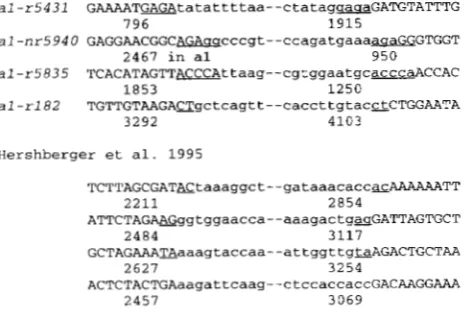
sequences flanking all four of the deletion junctions that were sequenced support the view that MuDR deletions arise via interrupted gap repair. The nature of these
deletions also adds supports for a role of mudrA (and suggests a role for mudrB) in M u transposon excision.
MATERIALS AND METHODS
Genetic stocks and gene symbols: According to the stan- dard maize genetics nomenclature, loci and recessive alleles are designated by lowercase gene symbols, while dominant alleles are designated by uppercase symbols. The a1 (anthocya- ninlessl) gene codes for dihydroflavonol reductase (REDDY et al. 1987) and is involved in the biosynthesis of anthocyanin throughout the plant, including the aleurone layer of the kernels. The aI-m5216 allele contains a MUUR:Cy insertion (as reported in this manuscript). The a1 ::rdt allele has a rdt
insertion at the fourth exon of a1 and has been reviewed by XU et al. (1995). The stable, recessive al-dl allele (previously termed al-s by CIVARDI et al. 1994) contains a premature trans- lation termination codon in the third exon (L. J. QIU and P. S. SCHNABLE, personal communication). This allele was obtained in coupling with et1 in 1985 from P. A. PETERSON (Iowa State University) who had maintained it since 1955 (its pedigree prior to 1955 remains under investigation). The et1 (etchedl) gene product is thought to be involved in amylolytic enzyme activity (SANGEETHA and REDDY 1988) and is 12 cM centromere distal of a l . Homozygous recessive kernels have pitted endosperms (Figure IC). Sweet Belle is an F, hybrid (from Asgrow) homozygous for a1 ::rdt, sh2, Shl and BzI (see CIVARDI et al. 1994, for details). The shrunken2 (sh2) locus encodes ADP-glucose pyrophosphorylase, which is involved in starch biosynthesis (TSAI and NELSON 1966). The bzl (bronzel) locus encodes flavonol (0) 3glucosyl transferase (IARSON and COE 1968). Kernels homozygous for the recessive reference allele exhibit a pale to reddish brown (bronze) aleurone color. The bzl-rcy allele contains an rcy:Mu7 insertion that can excise in the presence of Cy transposons (SCHNABIX and PETERSON 1986). The bzl tester stock carries the bzl reference allele in coupling with the closely linked ( 2 cM) marker shl ( s h r u n k m l ) and has the genotype A 1 E t l / A l Et1 shl bzl/shl bzl. The shl locus encodes sucrose synthase (CHOUWY and NEISON 1976) and homozygous recessive kernels have smoothly indented endosperm upon drying. The bzl-rcy tester stock carries the bz1-rq allele in coupling with Shl and has the genotype A I E t l / A 1 Et1 Shl bzl-rcy/shl b z l . The bzl and
bzl-rcy stocks do not harbor Cy activity. The Cy (Cycler) transpo son controls the transposition of rcy:Mu7and Mu1 (SCHNAHIX and PETERSON 1986, 1988, 1989).
Genetic crosses:
Cross 1: Cy A1 Sh2 E t l / A I Sh2 Et1 Shl bzl-rcy/(Shl bzl-rcy
or shl bzl) X a1::rdt sh2 E t l / a l : : r d t sh2 Et1 Shl Bzl/Shl Bzl
(Sweet Belle).
Cross 2: al-m5216 Sh2 Etl/al::rdt sh2 Et1 Shl bzl-rcy/Shl B z l X al-dl Sh2 e t l / a l - d l S h 2 et1 S h l B z l / S h l B z l .
Cross 3: A 1 Sh2 E t l / A l Sh2 Et1 Shl bzl-rcy/shl bzl X a l - m5216 Sh2 E t l / a l - d l Sh2 Et1 Shl b z l - r q / S h l B z l .
Cross 4: al-m5216 Sh2 E t l / A I Sh2 Et1 Shl bzl-rcy/(Shl bz1- rcy or shl b z l ) X al-dl Sh2 e t l / a l d l Sh2 et1 Shl B z l / S h l B z l . Cross 5: AI Sh2 E t l / A l Sh2 Et1 Shl bzl-rcy/shl bzl X ( a l - m5216 Sh2Etl or A 1 S h Z E t l ) / A l Sh2 Et1 Shl bzl-rcy/(Shl bzl- rcy or s h l b z l ) .
Cross 6: al-m5216 Sh2 Etl/al-dl Sh2 et1 S h l B z l / ( S h l bzl-rcy
or Shl bzl) X al-dl Sh2 etl/al-dl Sh2 et1 S h l B z l / S h l B z l .
Isolation of the aZ-rn5216 allele: New mutations at the a1
locus were recovered in exceptional kernels with the genotype
a l - m Sh2/al::rdt sh2 (where n l - m is a newly arisen mutant allele). The analysis of one of these mutants (al-m5216) is the subject of this report; two other confirmed a l - m mutants recovered from this screen remain under analysis (al-m5046
. \ / ~ d N : ( . : y ;~nd l h i w t i v r s 605 tioncd h y thr t w o ;~llc*lc*s (higI1 715. vcn. l o w spotting lxlttcrns) ; 1 n d t 1 1 c lilct t h a t n / : : r d / , I,III n o t n/-::l52/h. was i n coupling
wit11 the- tightly linkrtl ( 0 . 1 e l l ) sh2 nwation. Thr d t i n l : I t c *
s ~ ~ c c ( * s s 01' Illic proccdurc W;IS confirnlcd b v conlparing t11r
DS;\ S C Y ~ I I ( ~ I I C ~ ~ ~ o f a / : : r ( / / ;~nd rllr ..I / propwitor 01' o / - : : I j ? / h (I..
.I.
QII. ;~nd 1'. S. S(:IIS.WI.I;.. unphlisllcd h t x ) I O u / sv-qlwnc(*s flanking thr .\\///)/< transposon insc.rtion i n ;III ( I / -
::t52/h clone*: thcsc. s(*qurnccs arr distinct l i - o n 1 thaw o l '
( r / : : r d / ;1nd idcntic;ll t o rhosc. ol' t h c ;I/ pr(~gcnitc~r o l ' ( I / - ) : / 5 2 / h ;II a11 sis l)S;\ scywncr ~ ~ o l v ~ l l o r ~ ~ l ~ i s ~ ~ l s i n lh(- -200
1 , p 3' 01. t h c . \ \ I t / ) / { inscwion sit<* i n t l w n / IOCIIS ( ( I A I ~ 1 1 0 1
s l ~ o w n and l,..j. ($1. ;mtl 1'. S. S(:IIS.\I\I.I~.. pcrso11;11 conlnwncia- tion).
Estimating the number of Cy transposons segregating in a
cross: 'l'l~r wn11x-r o l gcnc*ric;dlv i w l i v r (:v trmsposons car-
r i d b v the. (l/-::tj2/6 Ihnt w s rstinlatcd h v t l w riltio 0 1 ' 1 ~ 1 -
k / - r r T IC'SI cross: For c-silnlplr. r h r n l ; I l c * p w c n t i n crow 3 w i l l
'I'hr I+n~alr p x r c n t 01' cross 3 w i l l also prodr~cc. t w o c.l;tssc*s o f g ; ~ n ~ c * t r s w i t h thc grnotylxs: IC/+? i ~ n t l / x / . T l ~ c ~ r c ~ l i ) r c ~ . thr
rcwlting progt*ny w i l l l w o f thrrc- ryprs i n ;I 1 2 : l r;ltio / E / - r ~ / / ~ / - r ? . ( / ~ / - r ? ( ~ r / ~ / ) / / ~ : / i ~ I l ( l / d / k / - r ? . Kc*rnc*lsIlc~trrtr
zygous l o r /I:/ w i l l I)<* colored. ; ~ n d thus. w i l l n o t l w i n l i ~ r n ~ a - t i \ ( * . ;\mong t h r rrnlainclrr o f thr kcwlrls (which c;u.~? thr / ~ / - r ? :~llrl(*). rllc- lw.l-sp:l~~ ratio is rsprrtc-tl t o I w I : I in t l l r
prw-rlct- 0 1 OIW copy o f an activr (;v transposon. 'Thc cs-
p w t c d ratios whrn t w o and tl1rc.c- active (,:v sc-grc-gating arc :<:I ; 1 n d i:l rcsprctivrlv. This c-stinntion mc.thotl can I>(. i ~ p -
plirtl t o ot11c.r cross(*s. I lo\wvc*r. i t is ncccwar) t o clistinguisll
I ) c ~ t w c ~ * n r l w /x/+? ;lnd /e/ ~11l~~Ic~s in some rrossrs (sr1c.11 ;IS crosses 4 ; 1 n d .3). Srocks used i n this study c;lr-I? t l w /z/-rc? allc+* i n corlpling with a S / I / ; 1 1 I c l c , and t h r / E / rc.li.rc*~~cr
; ~ l l c * l c in coupling with ;I sir/ a l l d c . I-lrnrc. t h r s h / phcnotypr
e m l w IISCYI t o Im-dirt t h r / E / grnoryws o f progc.ny lor 1l1r
p ~ ~ r p o s c ol' c.st;Ildishing c x p c ~ t c ~ l sc*grc*g;ltion ratios i n t l w prrs(-nrc* of\;lr)ing nurnhrrs o f (:s (S(:IIS.\I\~.E ; ~ n d I'I;.WKSOX I!)Mi). T l l c clli-sqww valucs i ~ r r sl1own i n piwcntI1rsc.s. ;.I,., ( ). For t l ; m thxt ( l o n o t l i t (a1 t l ~ r 93% Icvrl ofconlitlrncc~) ; ~ n y o f thr three- ratios tcstctl (onc-, t w o and t l l r c ~ copirs o l '
(,j), t h r nrlnllwr o f f,j ;Issoci;ltctl with t h c snlalkst chi-squilrc.
\;llu(* is shown in hrarlicts, i.c. [
1.
Sonw o f thrsc. ratios nlay lmvr ariscn via Typr I statisticid crrors ( i . r . . statistical tlrviations): otlwrs may rrprcsrnt nlorc complrs l>iologir:dnrln1lx.r c*stinl;~tc-s prcwntrtl in Ix~ckrts sho111tl l w intcrpc- rrtl with cilrltion. 11. t h r d i l t ; ~ lit mor(- t h m onc ratio. ;dl n11n1- spotl(*d ( l ' ~ l - s ~ ~ ) : l ~ r o l l ~ ~ ~ ( l w ) kc*rnc-ls ;1n10ng pr".'.T"n\' frolll ;I
pro'lucc. t\co cl;1ssrs o f gilIl1~'trs o f gc'notypc.s: /z/-r9 ;uld /k/.
prOC<'SSCS (!%:llS.\l\l.F. i l l l d I'E'I'I<KSOS I!)88). I It'tlCC. (;S C'Ol)!'
I.'I(.KRI.. I . - l ' l ~ c ~ ~ ~ o r \ ~ ~ ~ c ~ ~ o I U / - : : ~ ? ~ / / I ; I I I ( ~ it\ ( l t . l ( - ( . t i \ ( * tlc.riv-
;ltivc- ;~llrlcs. (;\) St;~n(l:~rd ; ~ l - s p o t ~ ( * d k ( ~ n c * l s on ;III c a r rc-
srllting fronl rllr cross: . . \ / / ( / / - : : 1 5 2 / 0 X ( / / - ( / / / ( / / d (912!)08-
1 / 2 i ( i . 3 ) . (1%) Escc.ptional l o w ;~l-spottrtl phrnotyp<* found o n an car resulting Iron] rhr cross: (u/-:::52/6 /:I/ X ( ~ / + / / / n / + / /
(!)I 2!)04-I 4/27 I I ) whc-rc. the. liwxdr p ; w m t h;ld Iwrn srlrc~rtl
;IS having no (;vactivity (;I ~ h n t tlrrivcd from 21 I)ronzc* kc]-nc.1). This nonst;lncliwd ;~I-spott(d phc-notvpc is corrc~l;~tc*tl with ab- errant (,:s activity ( S W liwtnotrs rr. / I , ; \ n d , / i n ' I ' a b k 3 ) . Also n o t ( ' t h a t t h c w ;IW lc*~rx.r spottc-tl krrnels sc*grc.g;\ting 111;ln
( ~ s p ( ~ t r d . ((:) Escc-ption;ll c~~lol-lc~ss krrnrls on ;In car rc- sulting from t h r cross: .,I/ k : / / / ( / / - : : 1 5 2 / 6 r / / X ( / I - ( / / r / / / o / - d /
r / / (!~:%g2007-I /!?027). SIICII k c ~ n c + potcwiitlly C ; I ~ I ? tlrlcclivc.
;dlclcs 01' n / - m 5 2 / h . TIN- colorlrss kc*rnc*l in r h c . IOWCT right- h;\ntl corncr is c*tchctl. Thc o t h r r colorlrss k ~ n c . l prolx~l)ly c;lrrirs f . i / ;IS ;I rcsiult o f ;I crossov(~r.
t h r frc*qut*nt, late sonlatic rc*vcwions typical o f . \ \ l r t ~ ~ n s p o s o n - intluccd n1ut;Ints (Figure. I X ) . To c-ontlrlct ; I I I ; I ~ ~ S C ~ S on ( / I - ::t52/h. i r w s nccc-ssill? t o distinguish i t Iron1 u / : : r d / . This rorlltl hv t l o n c - b y v i r t w o f r l l c tlilli.rrnt phrnotyprs contli-
Iwrs o f (,:s ( I ~ t ~ t w ~ n o n ( * ;Ind thrrr) with nonsignilic;mt chi-
square v;~luc*s ; ~ r c sho\cn. ll' t h c o l ~ * n c ~ l srgrrgation ratio
tloc*s not lit a n y o f t h r t h r r c ratios ;~nd the- clli-sqltarc \;~lr~c*s
for t h c - c ~ s p c ~ c t ~ ~ d ratios o f on(' (:s arc I;~rgc-r t11an c*sp*ct(d ratios for t h r w (;s. t h r plant is c*stirn;ltc-tl t o r;lrr-\. ~ n o r c t l l i l n
thrcv* copics o f (;y.
Southern blot analyses: Slaizr D X \ s:lnlplrs 1 1 s c ~ 1 li)r Soullwrn I h t ;tn;dysc~ w w isol;ltc.tl Ironl frrwc-dricd I d fionl swtllings o r inlnl;lttlr(* cars ;Iceording t o thc n l r t l l o t l of D I < I . I ~ \ I Y N I ~ , \ r / n/. ( I ! ) K % ) . DSA si1n~plc-s wrrv tligc*st(d lor 3- 4 11r using ronlnlcrcially a\;Iilaldr rrstriction CII/VIIICS :IC-
cording t o ~ l ~ ~ ~ ~ l ~ ~ l i l r t ~ ~ r ( ~ r s ' spccilic;Itiorls, c.lretrol~llc~rc.sc.tl on
c.l~argr, Slicron Sqx";ttions In e.. \\'rsrhoro. SI;\) ;\ccortling
t o t l w n w t l l o d tlcscril)c*tl h y S.\JII\KOOK r / d . ( I ! ) W ) . Prolws
llscd for hylx-idization w * r r p r q x ~ r r c l I)\ rxndonl1Irs;lnlc.r
priming (FF.ISI\I.K(; ; ~ n d \'O(;F.I-WI:.~S I W % ) using V - I : I I W I C ~ cl(T1'. 4lrnll,l;ulcs w*r(- hyl~ritli~cd. w.;lshrtl ;Ind c-sposcd 1 0 X-ray lilnl using st;~ntl;trtl procrdurrs (S.\\IIW)OK e/ r d . I W ! ) ) .
Genomic library preparation and screening.: Thrrr grntr
rnic lilxu.irs \ \ ~ r v p r q x ~ r t d IO isol;~tr t l w ovcd;lpping rlonrs silmplrs h y t I I C rnrrhod o f S.\c;1 1.\1-Sl:\K00F e/ n/. ( I!)X.I) o r
606 A.-P. Hsia and P. S. Schnable
that comprise the al-m5216 sequence. In all instances, DNA was prepared from plants with the genotype aI-m5216/al-d1.
Plant DNA was isolated from immature ears by the method of DELIAAPORTA et al. (1983), digested to completion with the appropriate enzymes according to manufacturers' specifica- tions and electrophoresed on agarose gels (GTG grade, Sea- Kem agarose; FMC, Rockland, ME). DNA fragments of the desired sizes were recovered by electroelution (SAMBROOK et al. 1989) and extracted sequentially with phenol (pH 8.0), pheno1:chloroform:isoamyl alcohol (25:24:1) and chloro- form:isoamyl alcohol (24:l). The EcoRI clone was obtained from a genomic library prepared with DNA from plant 9187017 and the NM1149 lambda vector. Recovered maize DNA inserts were ligated into EcoRI-digested NM1149 arms overnight at 16", packaged with commercial packaging ex- tracts (Gigapack 11, Stratagene, La Jolla, CA) and plated on the Escherichia coli host POP13. Plaques were screened using the 2.8-kb HindIII/BglII fragment from pALC2 (SCHWARE SOMMER et al. 1987, see DNA sequence analysis in MATERIAIS AND METHODS) as a probe. The Hind111 clone was obtained from a NM1149 genomic lambda library prepared as de- scribed above, except Hind111 was used for restriction digests and maize DNA was obtained from plant 906828-6. The SalI
clone was obtained from a genomic library with maize inserts isolated from plant 92B403, cloned into Charon35 (Charon35 was a gift from F. R. BIATTNER, University of Wisconsin, Madi- son). Charon 35 arms were prepared by sucrose gradient cen- trifugation (SAMBROOK rt al. 1989) to separate the stuffer frag- ment from the arms. The library was screened as described above on E. coli host NM538. A total of 12 independent clones from the SaZI library were analyzed and shown to be identical at the level afforded by restriction mapping.
PCR analysis: PCR reactions were performed using 200- 400 ng of genomic DNA (SAMBROOK et al. 1989) and 0.5-1 p~ of primers. The final concentration of reagents in the 50 p1 reactions were: 200 mM dNTP/1.5 to 2.5 mM MgC12/50 mM KC1/10 mM Tris-HCL, pH 9.0/0.1% Triton X-100. The reactions were denatured at 94" for 0.5 to 1 min, annealed at
55-65' for 0.5-2 min, extended at 72" for 3-5 min (de-
pending on the sizes of expected products), cycled 30-40 times and given a final 10-min extension at 72". Reactions were electrophoresed on agarose gels using 5-10 pl of re- actions, blotted and hybridized with the indicated probes. PCR products were purified by the GeneClean kit (BIO 101, Inc., Vista, CA) either directly (if a single product was ob- tained, as determined by gel electrophoresis) or after elec- trophoresis (if there were multiple products) and were sub- jected to restriction enzyme digestions followed by gel elec- trophoresis. Primers were prepared at the ISU Nucleic Acid Facility using a 394 DNA/RNA Synthesizer from Applied Biosystems (Foster City, CA). The primers, sp152, sp3-4, sp153 and sp7-2 were gifts from M. G. JAMES and M. J. SCAN- LON of the A. M. MXRS' Laboratory (Iowa State University). The positions (numbering according to zmalg.gb-pl and m76978.gb-pl) and sequences (5' to 3') of primers are listed as follows: A1 . 1 (GTCTTCATTGCACATGCACTGCAC, 2287-
2301 of n l ) ; A1.2 (GATTGTTGCTTAAGCGCCICGT,
3286-3263 of a l ) ; A2667 (GGGTGGACATAAATAAAAGG, 2667-2648 of a l ) ; Mu715 (ATCACAACTGGACTGGGA, 715- 733 of MuDR); ~ ~ 1 5 2 (TAGTGTGGACTCGAC, 1578-1592
of MuDR); Mu2270 (TGGCAGAGGTACGAGACAGC, 2270-
2289 of MuDR); Mu2646 (GAAAACGAAAAAGCGACTCAAA-
AGG, 2646-2670 of MuDR); sp3-4 (GCAGAAAACAGAT,
3492-3504 of MuDR); Mu3960 (TCATCTACGGAAGGGTT-
GTC, 3960-3979 of MuDR); XX153 (CGCCTCCATTTCGTC-
GAATC, near-"universal" primer for Mu transposon inverted terminal repeats); sp153 (TACATGTGCTCTGAC, 1967-1981
of MuDR) ; Mu21 17 (TCAGCCAAATCAAC~CAGGAAG,
2117-2095 of MUD@; Mu2183 (GAGCTCAGACAGATGGCA-
TABLE 1
Results of al-m5216 confirmation crosses
No. of kernels with indicated phenotypes
Plant no. al-spotted" Colorless x21:l"
A. Results from cross 2: al-m5216/aI::rdt X at-ldl/nl-dl
895216/5430 145 147 0.1'
895432/5216t" 114 140 2.48'
No. of kernels with indicated phenotypes
Plant no. bzl-sp' Bronzef Colored No. of C y
B. Results from cross 3: A l / A l bzl-rcy/bzl X al-m5216/al::rdt bzl-rcy/Bzl
895463/5216 210 50 208 [ 21 (4.6)
''
al-spotted indicates a phenotype of colored spots on a
colorless background (Figure 1A). "Chi-square value for a 1:l ratio.
''
t indicates tiller. This is a reciprocal cross of cross 2. 'bzl-sp (bzl-spotted) indicates a phenotype of colored[Bronze indicates a phenotype of bronze aleurone. "Number of genetically active Cy elements carrying by the
al-m5216 plant. See MATERIALS AND METHODS.
''
According to the chi-square test results, the observed segre- gation ratio is significantly different than that expected for all possible numbers of Cy. The best fit is for two copies of Cy.No significant difference.
spots on a bronze background.
AAATAATAC, 2183-2162 of MUDR PIUS GAGCTC); ~p7-2
(TCTGTCTGGGATATA, 3671-3657 of MUDR).
DNA sequencing and analyses: aI-m5216 genomic clones were subcloned into the vectors pBluescript SK(+) or pBlue- script K S ( +) (Stratagene). PCR products were purified using a GeneClean kit (BIO 101, Inc.) directly or after gel electro- phoresis and quantified for direct sequencing. DNA samples were sequenced at the ISU Nucleic Acid Facility using the double-stranded dye terminator technique on a AB1 S73A Automated DNA Sequencer (Applied Biosystems). Sequence analyses were performed using the GCG program (Version 7, April 1991, Genetics Computer Group, Inc., Madison, Wiscon- sin) and comparison made to accessions m76978.gb-pl (Mu9)
and zmalg.gb-pl ( a ] ) from GenBank.
RESULTS
Isolation of the al-m5216 allele: As a first step in cloning a genetically active Cy transposon, cross 1 was used to "trap" a Cy transposon at the a1 locus. The a1 locus is one of several genes involved in the anthocyanin
biosynthetic pathway (for a review, see DOONER and
ROBBINS 1991). In the absence of mutations, all kernels
MUDR:Cy and Derivatives
88295012 X Sweet Belle
(Cy present) AI/AI Shl bzl-rcy/shl bzl X al::rdt/al::rdt Shl Bzl/Shl Bz.1
1
al-spotted 8952 1 64
\ \
607
Al/AI Shl bzl-rcy/shl bzl X aI-m5216/al::rdt Shl bzl-rcy/Shl B t l 895463 X 895216 (2 Cy present*)
i
s
4
bzl -spotted round bronze round89g5298-5299 89g5300-5301 8al-m5216/Al wl Cy, 5 al::rdt/Al wl Cy 10 al::rdt/Al wlo Cy ( one of them is a receptor allele,
I al-r5826), 1 al-?/AI wl Cy
+
AI/Al Shl bzl-rcy/shl bzl X AI/aI-m5216Shl bzl-rcy/Shl bzl-rcy 8985358 X 5298-9 (2 Cy present*)
bzl -spotted round bronze round
906824-6825 (see Table 2 for detail) 906822-6823 (see Table 2 for details)
17 aI-m5216/AI
_"
wl 2 , 9 Al/AI (7 w/ Cy, 2 wlo) 18 AUAI (17 wlo Cy, 1 wl)," " 2 al-m5216/AI wl Cy (low spot), 1 aI-m5216/AI wlo Cy (low
c
#
""
-"
-"
spot), 1 al-?/AI wlo Cy4 - ' C
906825-5 X 6926 906824-7 (1 Cy present) X 6935
al-&216/Al sh] btl-rCy/shl bzl-rcy
x
al-dual-dl al-m5216/AI Shl bzl-rcy/Shl bzl-rcy X al-dual-dl Shl Btl/Shl BZl Shl Bzl/Shl Bzl4
colorless a1 -spotted colorlessaI-rS301 912877-2878
(a defective derivative receptor allele, 14 al-m5216/al-dl wl Cy 11 al-?/al-d[ W/O c y (one ofthem is a receptor allele, 912879-2880 aI-rs835)
not analyzed) \
\
4
AUAl Shl bzl-rcy/shl bzl X al-m5216/al-d1 Shl Bzl/Shl bzl-rcy 912786 X 2877-2 (1 Cy present)
1
bzl -spotted round1
bronze round 9 1 g704 1-7042 9187043-704410 al-m5216/AI w l p , 4 al-dVAl wl Cy IO al-dVAl wlo Cy, 1 al-m5216LAI w/o Cy (low spot)
b'
91g7041-10
x
7030al-r/al-dl Sh1 Bzl/Shl bzl-rcy X al-dual-dl Shl Bzl/Shl Bzl
1
colorlessaI-r5341 appears to be the same as al-rS835
608 A.-P. Hsia and P. S. Schnable
TABLE 2
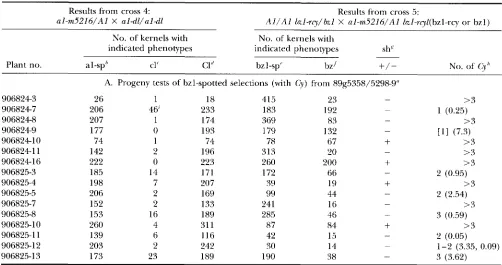
Analysis of progeny with and without Cy activity from family 89g.5298-9
Results from cross 4:
al-m5216/Al X al-dl/al-dl
Results from cross 5:
A l / A l bzl-rcy/bzl X al-m5216/Al &I-rql(bz1-rcy or bzl)
No. of kernels with No. of kernels with
indicated phenotypes indicated phenotypes shx
~
Plant no. al-sp" cl' C1" bzl-sp" bz'
+/-
No. of(3''
A. Progeny tests of bzl-spotted selections (with Cy) from 89g5358/5298-9"
9068243 26 1 18 415 23
9068247 206 46' 233 183 192
9068248 207 1 174 369 83
9068249 177 0 193 179 132 - [I1 (7.3)
90682410 74 1 74 78 67
+
9068241 1 142 2 196 313 2 0 -
90682416 222 0 223 260 200
+
185 14 171 172 66 - 2 (0.95)
- >3
>3
> 3 > 3
906825-3
> 3
906825-4 198 7 207 39 19
+
>3906825-5 206 2 169 99 44 - 2 (2.54)
906825-7 152 2 133 24 1 16 - >3
906825-8 153 16 189 285 46 - 3 (0.59)
906825-10 260 4 31 1 87 84
+
> 3906825-1 1 139 6 116 42 15 - 2 (0.05)
906825-12 203 2 242 30 14 - 1-2 (3.35, 0.09)
906825-13 173 23 189 190 38 - 3 (3.62)
~
1 (0.25)
-
Cross 1: Cy AI Sh2/AI Sh2 X a1::rdt sh2/al::rdt shP.
The somatic instability of the al-spotted kernels sug- gested that a transposon had inserted into the a1 gene, thereby disrupting that gene's function, resulting in the colorless background phenotype. Somatic excisions of the transposon out of the mutant a1 allele restore the gene function during development, resulting in somatic clonal sectors that express anthocyanin (colored spots).
One of the mutants derived from cross 1, al-m5216,
exhibited the frequent, late somatic reversions typi- cal of M u transposon-induced mutants (Figure 1A). Crosses to an al-dl et1 stock (cross 2 ) tested the inheri- tance of this mutable phenotype. The resulting segrega- tion ratios are shown in Table 1A.
Cross 2: al-m5216 Sh2/al::rdt sh2 X al-dl Sh2/al-dl Sh2.
If the insertion at d m 5 2 1 6 is a nonautonomous
transposon and only one copy of an unlinked autono-
mous transposon is segregating among the progeny of cross 2, the ratio of al-spotted to stable colorless would be 13. Instead, progeny from cross 2 exhibited a segre- gation ratio not significantly different than 1:l. This segregation ratio indicated that: the al-m5216 allele is
under autonomous control, a nonautonomous transpo-
son insertion at al-m5216 is responding to multiple transacting autonomous transposons present in the par- ents of crosses
2,
or a nonautonomous transposon inser-*
To avoid confusion, only the genes that are immediately relevant to the discussion at hand are indicated in each cross. The complete genotypes of each cross are listcd in lvL4TERIAI.S .WL) METIIOIIS.tion at al-rn5216 is responding to an autonomous
transposon closely linked to the a1 locus. Further tests described below will establish that al-rn5216 arose via the insertion of an autonomous Cy transposon.
Mutability of al-m5216 is dependent upon Cy activ-
ity: To determine if somatic mutability of aI-rn5216 is
conferred by a Cy transposon, b z l - r q was used as a re- porter allele in cross 3.
Cross 3: A I / A 1 b z l - r q / b z l X aI-m5216/al-d1 bzl-rcy/ U Z l .
In the absence of Cy transposons, bzl-rq conditions a stable bronze phenotype. In the presence of a Cy
transposon, however, the rry:Mu7 transposon insertion
can excise from bzl-rry, giving rise to somatic instability
(bzl-spotted) (SCHNABLE and PETERSON 1989). The
plant derived from the exceptional al-spotted kernel isolated from cross 1 was crossed to bzl-rcy stocks (cross
3 ) . The appearance of bzl-spotted kernels among the
progeny of cross 3 demonstrated that this al-spotted kernel carried Cy transposons (see Table 1B). The ratio of bzl-spotted to bronze kernels among the progeny of cross 3 suggests that two genetically active Cy transpo- sons are present. However, the presence of Cy activity in this cross does not establish that Cy activity is associ- ated with al-rn5216 somatic instability.
MU0R:Cy and Derivatives
TABLE 2
Continued
609
Results from cross 5 :
Results from cross 4: A l / A l bzl-rcy/bzl X (al-m5216or a l - d l ) /
(al-5216or A l ) / A l X al-dl/al-dl A1 bzl-rcy/ (bzl-rq or 621)
No. of kernels with No. of kernels with
indicated phenotypes indicated phenotypes sh
-
Plant no. al-sp cl bz C1 1 -SP bZ
+/-
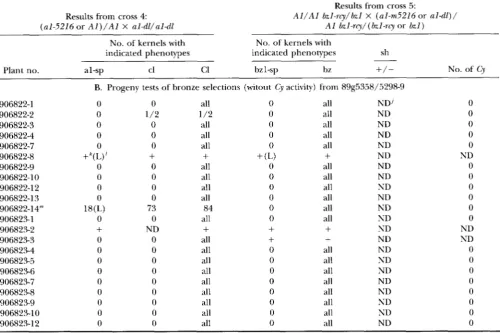
No. of CyB. Progeny tests of bronze selections (witout Cy activity) from 89g5358/5298-9
906822-1 0 0 all 0 all ND' 0
906822-2 0 1 / 2 1 /2 0 all ND 0
906822-3 0 0 all 0 all ND 0
906822-4 0 0 all 0 all ND 0
906822-7 0 0 all 0 all ND 0
906822-8 +"(L)'
+
+
+ (L)+
ND ND906822-9 0 0 all 0 all ND 0
906822-10 0 0 all 0 all ND 0
906822-12 0 0 all 0 all ND 0
906822-13 0 0 all 0 all ND 0
906822-14" 18(L) 73 84 0 all ND 0
906823-1 0 0 all 0 all ND 0
906823-2
+
ND+
+
+
ND ND906823-3 0 0 all
+
+
ND ND906823-4 0 0 all 0 all ND 0
906823-5 0 0 all 0 all ND 0
906823-6 0 0 all 0 all ND 0
906823-7 0 0 all 0 all ND 0
906823-8 0 0 all 0 all ND 0
906823-9 0 0 all 0 all ND 0
906823-10 0 0 all 0 all ND 0
906823-12 0 0 all 0 all ND 0
'I Bronze, round, spotted kernels from ear 89g5358/5298-9 (that resulted from the cross: A l / A l S h l bzl-rcy/shl bzl X A l / a l -
m5216 Shl hzl-rcy/shl b z l ) were planted in rows 9068246825. The resulting plants were crossed by al-dl (cross 4) and onto bzl- rcy testers (cross 5 ) . The resulting ears were analyzed and counts of kernels with the indicated phenotypes are presented in section A. Data from the nine plants with A l / A I genotypes (seven with Cy activity and two without C Y activity) are not shown. Bronze, round kernels were selected and planted in rows 906822-6823 and crossed as described for rows 906824-6825. The resulting data are shown in section B.
"al-sp (al-spotted): kernels with colorless background and colored spots (Figure 1A).
' cl (colorless) : colorless kernels.
''
C1 (colored): colored kernels.'bz (bronze) : bronze kernels.
bzl-sp (bzl-spotted): kernels with bronze background and colored spots.
+
indicates the presence of shrunken kernels; - indicates the absence of shrunken kernels.Estimated number of Cy elements in plants. see MATERIALS AND METHODS.
'Colorless kernels of ear 9068247/6934 were further tested and shown to carry a deletion-derivative of al-m5216 (a receptor
'Not determined.
'
Kernels with the indicated phenotypes were present but the numbers were not recorded. 'Low spotting pattern."' Ears from the a1 test cross contained al-spotted kernels with the standard al-spotted pattern. al-spotted and colorless kernels were tested in the next generation by crossing to a bzl-rcy tester. The resulting ears from both selections had very few bzl-spotted kernels and the spotting patterns were low compared to standard bzl-spotted. This result indicated that the Cy element(s) carried by these plants had aberrant Cy activity. This is thought to explain the nonconcordant results (the presence of a l - mutability in the apparent absence of Cy activity) in the previous generation.
instability at al-rn5216 is dependent upon Cy activity, other families were subjected to similar tests over several
then only progeny that carry Cy (as assayed via the bzl- generations. The results of these tests are summarized
r q crosses) should exhibit the al-spotted phenotype in in Table 3. As indicated above, the critical result in crosses t o a l - d l stocks, and none of the progeny that these tests is whether the al-spotted phenotype occurs lack Cy should exhibit the al-spotted phenotype. Data in the absence of Cy. If such entries are not observed,
from one family tested in this manner are presented in then it can be concluded that Cy is responsible for muta-
610 A.-P. Hsia and P. S. Schnable
TABLE 3
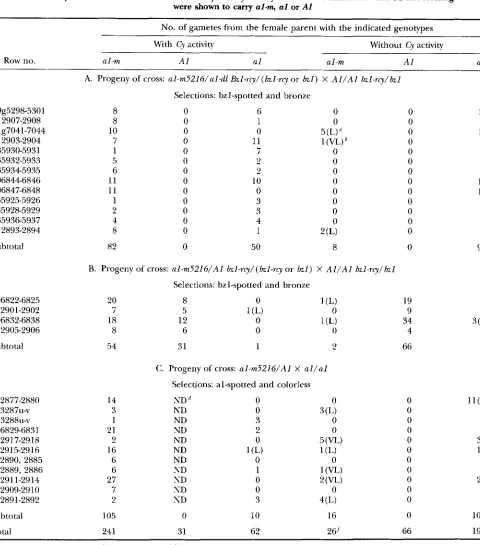
S u m m a r y of the association of al-m mutability and Cy activiqc numbers of individuals that on test crossing
were shown to cany al-m, a1 or A1
No. of gametes from the female parent with the indicated genotypes
With Cy activity Without Cy activity
Row no. al-m AI a1 al-m AI a1
89g5298-5301 912907-2908 9187041-7044 91 2903-2904 935930-5931 935932-5933 9359345935 9068446846 906847-6848 935925-5926 935928-5929 9359365937 91 2893-2894
Subtotal
906822-6825 9 1290 1-2902 906832-6838 91 2905-2906
Subtotal
912877-2880 923287u-v 923288~-v 906829-6831 912917-2918 912915-2916 912890, 2885 912889, 2886 91291 1-2914 912909-2910 912891-2892
Subtotal
Total
A. Progeny of cross: aI-m5216/aI-dl Bzl-rcy/(bzzI-rq or bzl) X A l / A I bzl-rq/bzl
Selections: bzl-spotted and bronze
8 0 6 0 0
8 0 1 0 0
10 0 0 5 (L) 0
7 0 11 1 ( W 0
1 0 7 0 0
5 0 2 0 0
6 0 2 0 0
11 0 10 0 0
11 0 0 0 0
1 0 3 0 0
2 0 3 0 0
4 0 4 0 0
8 0 1 2 (L) 0
82 0 50 8 0
B. Progeny of cross: aI-m5216/AI b z l - r q / ( b z l - r q or b z l ) X A I / A I bzl-rq/bzI
Selections: bzl-spotted and bronze
20 8 0 1 (L) 19
7 5 1 (L) 0 9
18 12 0 1 (L) 34
8 6 0 0 4
54 31 1 2 66
C. Progeny of cross: aI-m5216/AI X a l / a l
Selections: al-spotted and colorless
14 ND 0 0 0
1 ND 3 0 0
21 ND 2 0 0
2 ND 0 5 ( W 0
16 ND 1 (L) 1 (L) 0
6 ND 0 0 0
6 ND 1 1 ( W 0
27 ND 0
2
( W 07 ND 0 0 0
2 ND 3 4(L) 0
105 0 10 16 0
241 31 62 26'' 66
3 ND 0 3(L) 0
10 3 10 7 9 4 5 15 11 6 6 6 2
94
1 0 3 b ) '
2
4
l l ( r ) ' 0 5 1 34 1 1 2 3 23 5 5
100
198
'' Low spotting pattern and very few spotted kernels.
"Very low spotting pattern and very few spotted kernels. See Figure 1B.
' Progeny from one of these ears was tested and shown to carry a responsive defective derivative allele, al-rl82.
''
ND indicates no data; colored selection ( A I / - ) were not tested."Progeny from one of these ears was tested and shown to carry a responsive defective derivative allele, aI-r5835.
'All aberrant spotting patterns. See text for discussion.
metes, all of the 241 gametes that conditioned a stan- excision pattern. Hence, it can be concluded that Cy
dard, high excision rate from al-m5216 carried Cy activity is necessary to achieve the standard, high rate
activity as measured by mutability at bzl-rcy, and none of excision from al-m5216. These extensive genetic tests
M d R : C y and Derivatives 61 1
cision of the resident transposon) is dependent upon the action of a Cy transposon.
Although Cy is clearly required for the standard high
rate of excision at aI-m5216,26 gametes were recovered
from this experiment that conditioned nonstandard (low or very low) al-spotting, even though they appar- ently lacked Cy activity when assayed with the bzl-rcy reporter allele (Table 3). Two of these exceptional dis- cordant gametes were further tested and shown to in fact harbor aberrant Cy transposon (s)
.
The analysis of one of those cases is described in footnote m in Table 2. In addition, the numbers of al-spotted kernels resulting from the crosses between the discordant gametes and the al-dl stock were, in 13 of these 22 instances, much less than expected, e.g., one to 10 al-spotted kernels out of several hundred. We therefore hypothesize that the rare appearance of the nonstandard al-spotted phe- notype in the apparent absence of Cy activity reflects a difference in the sensitivity of al-m5216 and bzl-rg to the action of novel, aberrant Cy transposons that arose during these tests.The genetic tests described above established that
mutability at al-m5216 is dependent upon a Cy transpo-
son. It remained to be established whether the transpo- son inserted at al-m5216 is itself a Cy transposon. If this transposon is a Cy transposon (or a Cy transposon is closely linked in coupling to al-m5216), then selection for Cy activity should select for al-m5216 us. AI in fami- lies such as those presented in Table 3B. This tendency would be most pronounced in families segregating for few Cy transposons. Hence, within the families tested for the association between Cy activity and al-mutability, progeny from ears that exhibited a one-Cy segregation pattern were preferentially selected and used for fur-
ther crosses. However, the copy numbers of Cy transpo-
sons in the following generations failed to respond to this selection. This tendency is illustrated by an example presented in Table 2A. bzl-spotted kernels were se- lected from an ear with two Cy transposons (89g5358/ 5298-9) and were tested (9068246825). Only five out of 16 analyzed progeny had one or two copies of Cy transposons; the remainder had three or more copies of Cy. However, even given the relatively high Cy copy number in many families, within some families (e.g., 906822-6825, Table 3B), the pronounced association of Cy with al-m5216 gametes (20/28), suggests that Cy is either inserted at or closely linked to a1 in al-m5216.
Further evidence for this conclusion comes from the identification of plants that harbor only one or two Cy transposons (as assayed by segregation ratios in the bzl-
rq crosses) but that have ratios of greater than 3:l al- sp0tted:colorless on ears resulting from al-dl testcrosses
(e.g., 906825-3, -5, -11, -12 in Table 2A). Given that the standard high rate of mutability at aI-m5216 is depen- dent upon Cy activity (see above), this result could only occur if a Cy transposon is inserted at or closely linked to al-m5216.
Molecular cloning and analyses of al-m5216: The pu-
tative Cy insertion in the aI-m5216 allele was isolated as several overlapping genomic clones using a1 se- quences as a probe (Figure 3). TheSaA, Hind111 and EcoRI al-hybridizing clones were isolated from genomic
lambda libraries prepared from al-m5216DNA (see MA-
TERIALS AND METHODS). With one exception, the restric-
tion maps of the EcoRI, Hind111 and SUA clones (which overlaps both the HindIII and EcoRI clones) are indis- tinguishable from that of M u D R The single difference detected in the SUA clone resulted from an -600-bp deletion (extending from position 1251 to 1854, num- bering according to GenBank m76978.gb-pl) that re- moved the left-most Hind111 site (position 1410). Be- cause 12 out of 12 independent clones from the SUA library carry this deletion (data not shown), it appeared that the plant from which this library was prepared carried a deleted transposon at the a1 locus. This hy-
pothesis was confirmed by PCR amplification using
primers Al.l and Mu2183 directly from the genomic DNA that was used to prepare the SUA library (data not shown). Furthermore, the Hind111 clone (isolated from
DNA prepared from a different al-m521Gcontaining
plant) included the Hind111 site missing in the SUA clones. PCR primers with homology to sites within the MuDR transposon (Mu2183) and a1 sequences near the transposon insertion in the a1 gene (Al.l) were used to amplify from genomic DNA containing the nl-rn5216 allele the 600-bp region that was deleted in the SalI clone. Restriction mapping, hybridization and se- quence results confirmed that the resulting PCR prod- uct is from al-m5216 and includes the 600 bp present in MuDR that were deleted in the SUA clones. Hence, it can be concluded that the deletion present in the SUA clone does not reflect the structure of the intact a l - m5216 allele. The complete sequence of the al-m5216 transposon (derived from the HindIII, EcoRI, and SalI
clones and the Al.l/Mu2183 PCR product covering the
deletion in the SUA clone) is 100% identical to
MUDR
(Mu9, GenBank accession m76978.gb pl)
.
Sequenceanalysis also demonstrated that the aI-rn5216 transpo- son generated a 9-bp target-site-duplication upon its insertion into the third exon of the a1 locus between
positions 2484 and 2485 (numbering according to
zmalg.gb pl in GenBank), characteristic of the Mu
transposon family. These results demonstrate that the
transposon cloned from aI-m5216is identical to MuDR,
Genetic data presented earlier established that a high rate of excision of the transposon inserted at al-m5216 is absolutely dependent upon Cy activity. Further tests established that Cy activity maps genetically to the vicin- ity of the al-m5216allele. Hence, given that the transpo- son inserted at al-m5216 is a MuDR transposon, either MUDR is not autonomous and instead is dependent upon a closely linked Cy transposon for full excision activity or MuDR and Cy are one-in-the-same. Because MUDR is an autonomous transposon (CHOMET et al. 1991; HERSHBERGER et al. 1991; QIN et nl., 1991), we conclude that MuDR and Cy are identical. Therefore, Cy will henceforth be termed MuDRXy.
fil? ..\.-I>. I Isi;l ;lnd 1'. S. Scl~n;Il>lc*
PCR
clone
0.5 kh4 1 I hlu?lR3
+
"
Sal1 clone
-//
""_
Hind111 clone
EcoRI clone
4-1 / . Y h d / /-
Si,, I Ramlll //,ndlll I h R V R d l l Hmdlll S'hd RmHI .Yk~l E< nRI Scrll Scrll .Sm I
:.19.l
a/-m5216
.\\'
terminal inverted repeats " deletion-
sequenced regioncxons of N I gene
//
sequence not shown-
PCR primenFM;I'KI- 3.-(:loning o f rhc n/-ttr52/h ; ~ l l c ~ l c * . F O I I ~ ovcrhpping clol1c.s s p n t h c cr1til-c. rtI-1tr52/h ; d l d c . . Tlw ins(-rtion s i w 01' (,:Y i n r h c . o / gc-rlc. is intlicatcd.
The isolation o f defective derivatives of MrtDR. I t Iws tivc crl-r ;mtl cll-ttr cw-q~tions tvc*rc sclcctctl ;IS 110- IXWI sho\vn t h ; ~ tlclvtion tkricltivrs o f ' .\ftrl)l< ;u-isc ;II ;I nctclwtl. colorless kc-rnc-ls i n m r s ( ~ t o r s .
high rate (I-~.\RI)I<\IAS m t l (:I I..\SI)I.I.K 1!1!13: I.ISC:I I ;mtl Put;Itivc (11-r ;wd nI-ttr ;dlclcs rlc*rivctl l i - o m cross('s 4 F K I . I I . I S ~ ; 1!1W: I,IX:II (11 d . I91.5). ;\II intcrruptcd g ; ~ p ; I I ~ (i w * r c subjcctc-tl t o thrcc crosscs: X c ~ l - d / / ~ r I + l /
repair m o t l d W;IS proposctl t o be rcsponsihlc for t h c stocks t o confirnl t h c ;d,scncc of;II-mutahilit~: X Irl-rtT erration of these clclction tIcri\;ltivcs (IXX:II P/ crl. I W i ) . stocks t o t c s t for t h c prc.scncc o f (:yactivity: and t o stocks i\lthollgh tlclction dcrivativcs of , \ I d ) / < I1;n.c. bccn istr c;mTing active .\ftr/)/<:C;y transposons t o t c s t thcir ability I;~tcd ; u ~ d physic;dly m;lppctl (HARI)I<\IAS ; I n d (:I IASDIKR t o be rcacti\-,~tctl. TIM. classific;ltion o f thrsc cscq~tions
l!1!13: I.ISC:II ; I I ~ FKI.I.I.IS(; 1!1!14; I,IS(:II P/ crl. 199.5). now- a s crl-ror c r l - ~ t r a l l ~ ~ l ~ ~ s is lx~sctl 11po11 t h c results of tllcsc h;wc bcw s c q w I 1 c d Rcc;~r~sc. s w h scqwwccs ~ v o r ~ l t l gcvwtic trsts. r\IIclcs tI1;ll h ; I d lost al-mutahility l ~th;lt t rcprc-scnt a 1 1 important test o f this motlcl. tlclction tkriv- arc responsivc* t o ;Ictivc* ,\lt//)/<:(,j tI';msposoIls : I ~ C cl;lssi- ;Itivcs o f t l w .\lttl)l<tl;lllsposon inscrtctl ;II crl-nr5216\vc.rc f i c d a s crI-r;dIcIcs. Xllrlc*s that lost aI-m~~t;hility I)III ciIlI isol;ltcd, ;u~;dy~tl ;tnd sc-qwnccd. 1101 bc ;Icti\.;ltcd
by
active 4 \ f / r / X f : y transposou i ~ r c classi-1)efcctivc- dcriv;Itivc idlclcs of crl-m5216 that contlition fied ;IS c ~ l - t ~ r ; ~ l l c l ~ ~ s . A s w i l l bc tliscusscd I>c-low, sc*qucIlc(' :I st;~hlc. nonspottctl pl~c*notypc w o d t l be cxpccrc~l t o t l ; ~ t ; ~ Iron1 ; w o u n t l t h c cntl points of . \ l t r / M dclction lid1 i n t o t w o classes. TIN. first c l ; ~ ~ v o r ~ l t l consist o f those dcri\.;ltivc*s support t 1 w hypotlwsis t h a t t l ~ c w tlclction tlrrivativc* ;~llclcs (01-r) t h a t can not untlergo sonlatic dcri\.ativc*s arise. through intcrrllptcd gap repair. rcvcv-sion ~ ~ ~ ~ t o ~ ~ o ~ l l o ~ ~ s l y , IMII arc rcsponsivc. t o /rcrtw;Icti- Molecular analysis of al-rand al-nralleles: (;crlonlic
w t i o n by ;lcti\.(. .\fd)I<:Cy trimsposons. Allclcs of t h c scc- m;qq'ing.
I Y X
;maIyscs ;mtl scqucncing \ w r c r~sc*tl t oo n t l class (crl-nr) w o ~ ~ l t l n o t cshihit somatic excision idc*ntify the moIc*cd;lr Icsions prcw-nt i n crl-jtr and (11-
C * ~ C I I I S ( - v ~ i n the prc*sc*tlcc o f aclivc ,\~!trI)I?:C:y transpo- r ;~Ilc*lcs rehtivc t o thc intact nI-tn5216 iIllcl(*. Initial
S i n c - ptltativc nl-rant1 three n l - ~ ~ r ; ~ l l c l c s \v(*r(* isol;ttctl ~ "I,lotting. Subscquc~ntly, 1 P(:R primers wcrc tlcsigncd
sons. cllal-;~ctcriz;~tions WTC pc.rformctl via gcnomic Sorlth-
from crosscs 4 ;llld ti. t o furthcr dissect t11c Icsions within c;lch ; l l l ( B l c .
(:~(I.s.s 4: crl-tn5216 d I / A l I.21 x c r / - d / ~ t l / c r l 4 / P I I .
Ct71v.s 6: rrI-ttt5216 I..'/l/crl-dl P I I
x
c r l d rll/crl-dl ('I/.I'rogc~ny of cross 1 \\*OllItl be cspcctcYl t o scgr"g;ll~' 1 : 1 for iII-spottctl and colorctl kcrncls. <:olorlcss Ilollspottc*tl kcrnc-Is (Figure 1 (;) from cross 4 \ w " * isolated ;IS c w c p tions t h a t potcnti;dly c;wric-tl crl-r o r ctl-ttr ;~llclcs ( s w
cross (i w o u l d bc cspc-ctcd t o sc-grc-gxtc 1 : 1 for nonctched
;~I-spottctl:ctchc.d, nonspottctl. colorlcss k e r d s . I'tItiI-
T;~l>lc 211 l i ~ (.s;llnplcs) ; I d :Il1;Il~~cd. Prog<.Ily TIWITI
1\11 csamplc o f onc o f thcsc analyses is shown i n Figurc 4. Pmcl ,\ shows t h c 2.4-kb PCR protlt~ct ( x -
pcctc~l t o bc ;unplifictl from c r 1 - m 5216 wing primers A I . I a n t 1 Mu!?! 83. This prodr~ct is obsc*n.c*tl i n I;IIW 2
o f P;lnc.l R. I n contrast, ;lmplific;Ition o f
DS;\
from i1plant can-\.ing ~ I - t t r 5 0 4 0 yiclclctl ;I novc.1 1 .+kb prod- uct ( h n c 3 ) . Iloth o f thcsc PCR protlr~cts hybridize t o ,\!tr/l/< probes (lanc-s 2 ;md 3 i n panc.1 C , Figtlrc 3 ) .
MUnRCy and Derivatives 613
exons of 11 I gene ". expected PCR products
n
terminal inverted repeats ofMllDR:CJ c z s s ~ ~ prohes used for hyhridizationU
MIIDK:CJ sequence +PCR
primers//
Sequence not shownFIGURE 4.-PCR analysis of the defective derivative allele, aI-nr5940. (A) Partial restriction map of nI-m5216. The positions of the PCR primers used in this experiment (Al.l and Mu2183) are indicated by arrows. The 2.4-kb PCR product expected from nI-rn5216 using these primers is shown. The expected sizes of the DNA fragments resulting from the digestion of this PCR product with BnmHI and BgnI are indicated. (B) PCR products and digestion results. The PCR products obtained from a l -
m5216 and al-nr5940using primers Al.l and M~12183 are shown in lanes two and three, respectively. These PCR products were gel purified and subject to HnmHI and RgflI double digestion (lanes 4 and 5, respectively). The faint bands in lanes 3 and 5 are probably nonspecific products from the PCR reactions. The faint band in lane 4 is probably a partial digestion product. ( C )
The gel shown in Figure 4B was transferred to nylon membrane and hybridized with probes indicated in A. The 698-bp BnmHI
fragment in lane four became visible following a longer exposure (data not shown).
the PCR product derived from the intact MuDR
transposon revealed two of the expected three frag-
ments (lane 4, Panel B). (The expected 0.1-kb frag-
ment was too small to observe in this analysis.) In
contrast, doubledigestion of the PCR product derived
from nl-nr5940 released a 1.3-kb fragment (lane 5,
Figure 4B). This result suggested that the BgZII site,
but not the BnmHI site, was retained in nl-nr5940.
Further investigations, including direct sequencing of
the PCR products (using the primers indicated in Fig-
ure 5 ) , revealed that nl-nr5940 contains a deletion
from position 2468 in a1 to position 949 in MuDR
(Figure 5). The deletion removed part of exon 3 of
n l and the promoter region and the 5' end of the
mudrA transcript.
In total, 15 defective derivative alleles of aI-m5216
were analyzed in this fashion. Nine out of the 15 did not exhibit any changes at the resolution level of PCR analysis (nl-rl74, al-rl77, al-rI80, al-rl84, a l - ~ 1 8 6 ,
aI-r5826, aI-r5828, al-nrI
76,
al-nr187). Summaries ofthe results obtained from al-nr5940 and of 5 al-r al-
leles that did exhibit sequence changes are shown in
Figures 5 and 6. Two of these alleles were analyzed at
the restriction mapping and hybridization level but
not sequenced (al-r5306 and nl-r5938). Allele n l -
r5306 carries a 700-bp deletion between the BnmHI
(at position 2865) and XbaI (at position 3945) sites
that could affect either or both of the mudrA and
mudrB transcripts (Figure 5 ) . Allele aI-r5938 has a
A.-P. Hsia and P. S. Schnahle
,SUI BamHl BRnl Mu2117
aJ-r5835
----
r-
1251 1854
Sod BamHl Mu715 Rgnl
aJ-r543J
"--- I 69792 (7%) 1914(1918)
.SU I Hindlll knRV
-5M) bp \ I I
aJ-r5938
&
ElAI.1 Hindlll R ~ n l
aJ-nr5940
y ; ~ ;
-
-
I I ;p n
949
xhul &HI knRl Mu4321
aJ-rJ82
h9 I I ""3292 4103
-
0.5 kb
EJ MuDR terminal invetied repeats MuDR transcripts
-w PCR primers used for sequencing
-
-
-
deletionFKXIKI 5"Comparisons of six defective derivative alleles of nI-rn521h to M u D R Deleted regions are indicated by dashed lines. Deletion end points (as detected via sequencing) are listed under the restriction map. Deletions that were not sequenced were mapped between adjacent restriction enzyme site as indicated by parentheses. The sizes of parentheses are not proportional to the sizes of deletions. Restriction enzyme sites tested on the PCR products are indicated for each allele. The transcripts from M d I R are indicated by hold lines (rnzrrlrA and mzLdrB) under the partial restriction map of MzcDR
and Sac1 (at position 127) in M u D R that will disrupt
the MudrA transcript (Figure 5). T w o of the nl-ralleles
(nl-1-5835 and nI-r5431) that have been sequenced
have deletions that will disrupt the mudrA coding re-
gion (1251-1854; 792-1914 o r 796-1918, respec-
tively) (Figures 5 and 6 ) . In contrast, nl-7-182 harbors a deletion from position 3292 to 4103 in M u D R that
disrupts the mudrll transcript coding region and the
polyadenylation sites (HERSHDERGER et nl. 1995) of mu-
drA (Figures 5 and 6 ) .
DISCUSSION
Cy and MuDR are identical: Previous studies ( SCHNA-
I ~ L E and PETERSON 1986,1989) suggested that the genet-
ically defined Cy transposon is the autonomous transpo-
son of the Mutator transposon system. More recently,
the MuDR transposon has been cloned from Mutntm
stocks and shown to be the autonomous transposon of
this transposon system. (CHOMET ~t nl. 1991; HERSH-