Abstract
TOMLINSON, MICHAEL RALPH. Surface-grafted Polymer and Copolymer Assemblies with Gradient in Molecular Weight and Composition. (Under the direction of Jan Genzer.)
The chief goal of this Ph.D. dissertation was to develop methodologies facilitating the formation of assemblies comprising grafted polymers on surfaces with gradually varying length (or, alternatively, molecular weight). Our additional goals accomplished include expansion of these methodologies to incorporate multiple monomer systems and block copolymer assemblies. Lastly we demonstrate the utility of these gradient assemblies to study some complex phenomena of scientific interest. Surface-grafted polymer gradients represent important tools in the combinatorial study of tethered polymer layers. This
approach can lead to rapid screening of properties and development of new or more efficient technologies involving tethered polymer films. The areas/technologies of interest are cited throughout the work and span organic electronic materials, responsive surfaces, nonfouling coatings, drug delivery applications, and manipulation of matter on “small scales” leading to developments in nanotechnology.
In Chapter 3, I describe procedures, methods, and several evolutions of a gradient chamber designed to create homopolymer gradient assemblies. Chapter 3 also includes studies using polymer gradients to understand polymer surface growth kinetics and an introduction to the concept of orthogonal gradient samples. I include, as supplemental information, my studies involving Atom Transfer Radical Polymerization (ATRP) simulations using a step time based Fortran program.
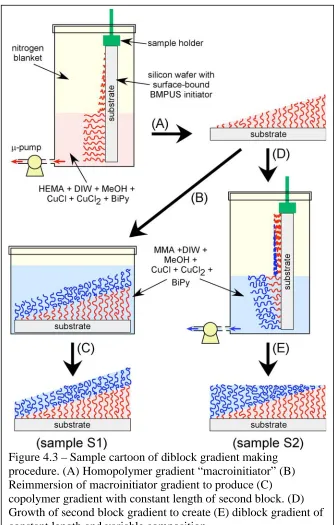
copolymer gradient assemblies. I also discuss several studies involving these tethered copolymers. I use a combinatorial approach to create “step” multiblocks on one sample surface in order to study the efficiency and characteristics of growth of these multiblock layers. I describe how I was able to produce surface-grafted diblock copolymer gradients and how I was able to chemically modify these layers. A major portion of Chapter 4 is devoted to describing a study in which a tethered diblock copolymer gradient was subjected to two selective-solvent exposure procedures designed to collapse the top and bottom blocks, respectively. I was able to study, combinatorially, the formation of and characteristics of micellar and bicontinuous structures formed via these solvent exposure techniques. Clear AFM images, ellipsometric thickness, and wettability measurements made on this sample reveal a possible relationship between surface morphology and the rearrangement of the diblock surface. I also introduce a triangular triblock triple gradient, which I successfully created. Such gradients will yield a wealth of information when applied to the study of tethered triblock copolymers.
Surface-Grafted Polymer and Copolymer
Assemblies with Gradient in Molecular
Weight and Composition
by
Michael Ralph Tomlinson, Jr.
A dissertation submitted to the Graduate Faculty of North Carolina State University
in partial fulfillment of the requirements for the Degree of
Doctor of Philosophy
Chemical and Biomolecular Engineering
Dedication
Biography
Michael Ralph Tomlinson, Junior was born on December 8th 1976 in Mobile, Alabama. His loving parents, Susan Tomlinson and Michael Tomlinson, provided a healthy environment in which he was taught to enjoy learning, appreciate music, and believe in himself. He was active in the Boy Scouts of America for many years and received his Eagle Scout award, the highest honor in the organization, just before his 18th birthday. He attended public schools in Mobile until the end of his sophomore year at Davidson High School at which time he transferred to the Alabama School of Mathematics and Science. Thanks to many caring and intelligent teachers and some supportive friends, he was empowered with a love of diversity, a passion for thinking, and the self-confidence to succeed.
He attended Auburn University from 1995 to 2000 where he earned a bachelors degree in Chemical Engineering. He tutored physics, chemistry, and mathematics while at Auburn and was active in The American Institute of Chemical Engineering and the Auburn University Concert Choir. He received practical research experience both with the Auburn University Space Power Institute and the Auburn University Glass Shop.
Acknowledgements
With every journey there are people who make the journey easier, more exciting, and worthwhile. Having completed my Ph.D., I look back on all those who have stood by me and helped me in their own ways.
Table Of Contents
List of Tables………..……….………...………....viii
List of Figures………..………...….…...……..ix
List of Abbreviations/Symbols………...………...….….……...xiii
1. General Introduction and Project Goals………..……...……..1
1.1.Surface-Grafted Polymers………..………..…1
1.2.Controlled/Living Polymerizations………..…………....5
1.3.Applications in Polymer Thin Films………...………..8
1.3.1. Selected Applications in Polymer Electronic Materials………..………..9
1.3.2. Selected Applications in Responsive/”Smart” Surfaces………..……….12
1.4.Combinatorial Science and Gradients………..…………..14
1.4.1. Importance of Combinatorial Methods in Research………..………14
1.5.References………...………16
2. A Review of Surface-Grafted Macromolecular Gradients………..….……….27
2.1.Introduction………...…………..27
2.2.Review of Techniques of Preparation and Characterization of Polymer Gradients………...………..……28
2.2.1. Surface-Grafted Polymers Through Corona Treatment………..….…29
2.2.2. Polymer Gradients Prepared by “Grafting onto” Technique………..….……29
2.2.3. Gradients Prepared by “Grafting from” Technique…………..………..…….32
2.2.4. Miscellaneous Methods for Immobilizing Polymers in Gradient Pattern...…33
2.2.5. Gradient Graft Copolymers………..…..………….34
2.2.6. Methods of Characterizing Gradient Properties………..………..……..36
2.3.Anchored Polymers with Grafting Density Gradients…………..……….……40
2.3.1. Formation and Properties of the Gradient Initiator………...………….40
2.3.2. “Grafting from” on the Gradient Initiator Surfaces………....…….42
2.3.4. Anchored Polymers with Molecular Weight Gradients…….………...……...47
2.4.References……….……..48
3. Methods, Procedure, & Equipment in Production of Surface-Grafted Macromolecular Gradients………..66
3.1.Project Goals and Motivation………..……...…66
3.2.Initiator Deposition, Characterization, and Growing Brushes.……..………….……67
3.3.The Evolution of the Gradient Chamber……….………..……….69
3.3.1. 1st and 2nd Generation Exhaust Gradient Chamber…….………..……...…...69
3.3.2. 1st Generation Dipping Gradient Chamber………..……...……72
3.4.Formation and Characterization of Polymer Brushes with Molecular Weight Gradients………...………..…73
3.4.1. Kinetics of Surface-Confined Polymerizations………..………….73
3.4.2. Macroinitiator Reinitiation Efficiency Studies………...……...79
3.4.3. Added Deactivator (AD) vs. Sacrificial Initiator (SI) in Control of ATRP….80 3.4.3.1. Gradient Study of Surface Growth Kinetics with SI for Control….……82
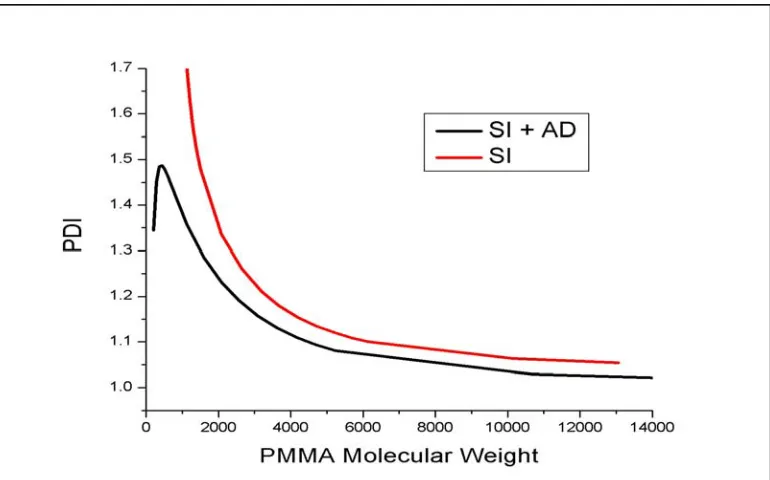
3.4.3.2. GPC Data Confirming Low PDI In-solution Polymer From AD System……….83
3.4.3.3. Fortran ATRP Simultations………..…………84
3.5.Formation of Orthogonal Polymer Brush Gradients………..……87
3.5.1. Orthogonal Homopolymer Molecular Weight / Grafting Density Gradients……….…………87
3.5.2. Application of Orthogonal Homopolymer Molecular Weight / Grafting Density Gradients……….…………..88
3.6.References……….…….91
4. Gradient Block Copolymer Assemblies……….……….…109
4.1.Formation of Tethered Copolymers……….………109
4.1.1. Necessary Conditions to Prepare Copolymers……….…….…109
4.1.2. Adjusting Co-solvent to Promote Copolymerization of PMMA and PHEMA………..…...…110
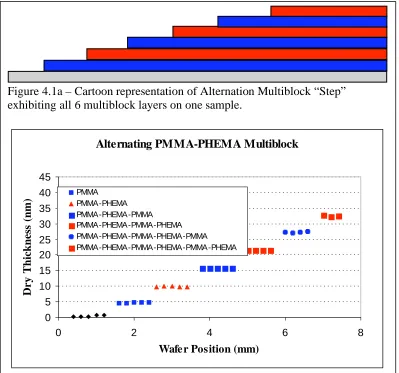
4.2.1. Macroinitiator Efficiency in Grafted Alternating Multiblock
Copolymer………...……….…….111
4.2.2. Surface-Grafted Diblock Copolymer Gradients………..……..…114
4.2.3. Chemically Modified Diblock Copolymer Gradients…………...……….…115
4.3.The “Orthogonal Gradient” ………..…...118
4.3.1. Solvent Exposure Study of Tethered Diblock Copolymer Brushes…….….119
4.3.2. Study of Chain Conformations After Selective Solvent Treatment…….….122
4.3.2.1.AFM Studies of Surface Morphologies……….……..……122
4.3.2.2.Wettability Studies of Surface Morphologies………..……125
4.4.Studies of Grafted Triblock Copolymers………..……127
4.5.References……….……..…..130
5. Outlook ………...………150
5.1.Polymer Gradients in Electronic/Photonic Materials………...……150
5.2.Polymer Gradients in Biomedical Applications………...……..…..152
5.3.Polymer Gradients to Study Anti-fouling Surfaces………..……152
5.4.Polymer Gradients in Polymer-Nanoparticle Composite Materials……...…….…153
5.5.Polymer Gradients in Studying Polymer Surface Growth………..…….…154
5.6.Conclusion………154
List of Tables
Table 3.1 – Polymerization Recipe Used to Determine PDI of Polymer Grown from
AD System………...………..………..………95
Table 3.2 – Polydispersity from Three PMMA AD Runs………….………..………95
Table 3.3a – Kinetic Parameters Used in Fortran ATRP Simulation………..………95
Table 3.3b – Initial Conditions Used in Fortran ATRP Simulation………..…..…95
Table 4.1 – Solubility of PHEMA and PMMA Polymers in Various Solvents………….…133
List of Figures
Figure 1.1 – Formation of Surface-Anchored Polymer Assemblies
by “Grafting onto” and “Grafting from” Methods……….………...…24
Figure 1.2 – Schematic of Surface-Anchored Polymer in Good and Poor Solvents………..…….24
Figure 1.3 – Polymer Architectures Formed via ATRP………..……....25
Figure 1.4 – Diagram of an Organic Light Emitting Diode (OLED) ………..…...26
Figure 1.5 – Diagram of a Photoelectric (Solar) Cell………..…...….26
Figure 2.1 – Schematic of Surface-Anchored Polymers with Gradients in Grafting Density and Molecular Weight………...……54
Figure 2.2 – Schematic of Surface-Anchored Copolymer Gradients and Double Homopolymer Gradients with Variance in Composition and Length. ………....…...54
Figure 2.3 - Schematic Showing Comb-like Poly(ethylene oxide) Gradient on Polymer Surface………..……….……55
Figure 2.4 - Preparation of Ultra thin Tethered Polymer Layers with Gradually Changing Thickness by Utilizing a “Grafting to” Approach Using a Temperature Gradient…..………..……55
Figure 2.5 - Ellipsometric Mapping of PBA/P2VP Gradient Brush………..…………..……56
Figure 2.6 - Contact Angle at Different pH of PAA/P2VP Brush vs. Composition……...….56
Figure 2.7 - Schematic Representation of Controlled Topologies, Compositions, and Functionalities and Molecular Composites Prepared by Atom Transfer Radical Polymerization (ATRP) ………...………..…..57
Figure 2.8 – Synthesis of Gradient Comb Copolymer of Poly(MMA-graft-nBuA) ……..….58
Figure 2.9 – Chemical Formulas of PAAm, PMMA, PHEMA, PtBA, PAA, and PDMAEMA………...………..……59
Figure 2.10 - Method of Preparing Surface-Grafted Polymer Assemblies with Gradients in Grafting Density………..………..……..60
Figure 2.12 – PEY NEXAFS Intensity Measured at E=284.2 eV
as a Function of Position on the Substrate Containing Initiator Gradients ……...……..……61 Figure 2.13 – Dry and Wet Thickness of PAAm as a Function
of Position on the Substrate Prepared from Initiator Gradients of CMPE. …….………..…..62 Figure 2.14 – Wet Thickness of PAAm as a Function of PAAm Grafting Density……..…..63 Figure 2.15 – Dry Thickness of PAAm and Contact Angle with DI
Water for PAAm Grafting Density Gradient………..…….64 Figure 2.16 – Negative Cosine of Contact Angle as a Function of PAAm Grafting
Density………....….65 Figure 3.1 – BMPUS Initiator Deposited at 25˚C and –10˚C
as a Function of Deposition Time……….………..….96 Figure 3.2 – Growth Rate Data for PMMA Grown on
Silicon Wafers Using Deposited BMPUS Initiator Monolayer………...……..…...96 Figure 3.3 - 1st Generation Gradient Chamber (Illustration) ………..……97 Figure 3.4 – 1st Generation Gradient Chamber (photograph) ………..…………..….97 Figure 3.5 - 2nd Generation Exhaustive Gradient Chamber (Photograph) …….….…………98 Figure 3.6 – 1st Generation Dipping Gradient Chamber……….………....….99 Figure 3.7 – PAAM Gradient Showing Nonlinear Behavior of PAAM Growth….…..….…99 Figure 3.8 – Two PAAM Gradients Formed with Different Pump Speeds…………....…...100 Figure 3.9 – Variation of Pump Speed Changes Steepness
of Slope in PMMA Gradients………..………..100 Figure 3.10 – PMMA Gradients Showing Growth Rate
Dependence on CuCl2/CuCl Ratio………..……..…….…….……...…101 Figure 3.11 – Surface Kinetics Plot for PMMA Growth
in Aqueous Methanol Media………..……..……..…………101 Figure 3.12 – PHEMA Gradients Showing Growth Rate
Dependence on CuCl2/CuCl Ratio………..………..…………...……102 Figure 3.13 - Surface Kinetics Plot for PHEMA Growth in
Figure 3.14 – 10-Step Reinitiation of PMMA from Underlying Macroinitiator. ……...…103 Figure 3.15 – Graph Showing Constant Growth Rate of PMMA
Regardless of Washing/Brush Collapse………..……..…...104 Figure 3.16 – Apparent Growth Rates of 10-Step PMMA Reinitiation……...……...……104 Figure 3.17 – PMMA Dipped Gradient Prepared with SI Added 24
Minutes into Process. Time-dependent Growth of PMMA Observed.
Subsequent PMMA Layer Grown from Macroinitiator. ………..…..……..….…105 Figure 3.18 – Percentage of Chains Growing as Compared with
Growth on BMPUS Monolayer from PMMA Macroinitiator Gradient…………..……..…105 Figure 3.19 – Simulation Results for PMMA CuBr/PMDETA System………...…106 Figure 3.20 - Simulation Results for PMMA CuCl/PMDETA System
Using a More Sluggish Initiator………..………...……..……..……106 Figure 3.21 – Cartoon Representation of a Molecular Weight /
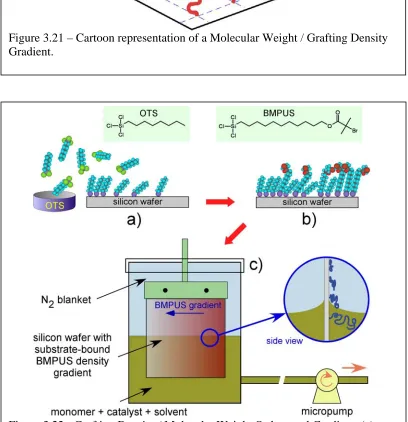
Grafting Density Gradient………..………107 Figure 3.22 – Formation of Grafting Density /
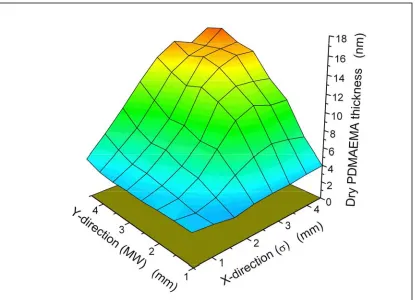
Molecular Weight Orthogonal Gradient………..……..……107 Figure 3.23 - Orthogonal Grafting Density /
Molecular Weight Gradient of PDMAEMA……….…………108 Figure 4.1a – Cartoon Representation of Alternation Multiblock “Step”
Exhibiting All Six Multiblock Layers on One Sample………...….134 Figure 4.1b – First Alternating Multiblock of PMMA-b-PHEMA.
Figure 4.7 – Contact Angle Data from Fluorinated PHEMA-b-PtBA
Before and after Hydrolysis of PtBA to PAA………...………...…139 Figure 4.8 – PHEMA-b-PMMA Orthogonal Molecular Weight Gradient
Sample (Ellipsometric Data) ………...………..…140 Figure 4.9 –PHEMA-b-PMMA Molecular Weight Gradient Sample (Photograph).………141 Figure 4.10 – Diagram Showing Phase Predictions of Tethered AB Diblock Layer
Exposed to Theta Solvent for A (Bottom Block) and Poor Solvent for B (Top)………...…141 Figure 4.11 - Morphology Diagram of Ethanol-Quenched PHEMA-b-PMMA
Brushes Based on Atomic Force Microscopy (AFM) Results Revealing the Existence
of Flat (F), Micellar (M), and Continuous (C) Morphologies…….……….……..…...142 Figure 4.12 – Approximate Phase Diagram Produced from AFM Images.
Flat (F), Micellar (M), and Bicontinuous (BC) Regions are Labeled…..………..…….…..143 Figure 4.13 – AFM Images of Transition (a) Across PHEMA-b-PMMA Orthogonal
Sample Exposed to Selective Solvent for Bottom (PHEMA) Block……….……..…….…144 Figure 4.14 – AFM Images of Transition (b) Across PHEMA-b-PMMA Orthogonal
Sample Exposed to Selective Solvent for Bottom (PHEMA) Block. ………...……...……144 Figure 4.15 – AFM Images of Transition (c ) Across PHEMA-b-PMMA Orthogonal
Sample Exposed to Selective Solvent for Bottom (PHEMA) Block. ………...………145 Figure 4.16 – AFM Images of Transition (d) Across PHEMA-b-PMMA Orthogonal
Sample Exposed to Selective Solvent for Bottom (PHEMA) Block. ………...………145 Figure 4.17 – “Spongy” Morphology Observed Over Most of Sample After Solvent
Treatment to Collapse Bottom PHEMA Block. ………..….…146 Figure 4.18 – Transition at Intermediate PMMA Thickness (~12nm) from Short
to Long PHEMA. ………...………..….…147 Figure 4.19 – DI Contact Angle Data Taken after Solvent Treatment to Collapse
Top PMMA Block……..………..….…148 Figure 4.20 – DI Contact Angle Data Taken after Solvent Treatment to Collapse
List of Symbols
AD = Added Deactivator
ATRP = Atom Transfer Radical Polymerization
BMPUS = (11-(2-Bromo-2-methyl)propionyloxy)undecyltrichlorosilane (surface initiator)
BPY = 2,2'-dipyridyl
CMPE = Chloromethylpheylethyl trichlorosilane initiator
EBiB = Ethyl-α-bromoisobutyrate (in-solution initiator)
PAAm = Poly(acryl amide)
PDI = Polydispersity Index
PDMAEMA = Poly(dimethylaminoethyl methacrylate)
PHEMA = Poly(2-hydroxyethyl methacrylate)
PMDETA = N,N,N’,N’,N’’-pentamethyl-diethylene-triamine
PMMA = Poly(methyl methacrylate)
PtBA = Poly(tert-butyl acrylate)
SI = Sacrificial Initiator
ρ = Volumetric Density
Chapter 1: General Introduction & Project Goals
It would be appropriate to introduce two significantly important concepts before explaining the motivation and goals of my project. Those two broad areas are surface-grafted polymers and controlled/living polymerizations (specifically Atom Transfer Radical Polymerization). For those who need no introduction to these key subjects, please skip to 1.4 Project Goals and Motivation. For the rest, please enjoy the next sections.
1.1. Surface-grafted polymers
Polymer coatings offer an efficient and convenient way of modifying
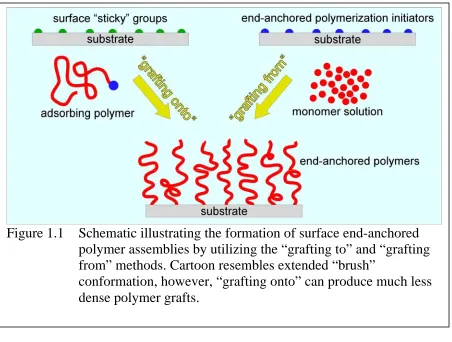
Traditionally, polymer coatings are created by physically attaching a polymer layer to the surface of interest. Typical methods of forming physisorbed polymer coatings include spin casting or solution dip-coating. The nature of interaction between the polymer and the surface in these coatings is usually non-covalent. Although physisorbed polymer coatings serve their purpose immediately after the fabrication process, their performance diminishes over a protracted time period due to the erosion of the coating under harsh application conditions. In order to overcome these shortcomings, it is highly beneficial to chemically bind the polymers to the surface. Grafting polymers to a substrate provides a permanent chemical bond between each polymer molecule and the chosen surface. There are two ways of grafting polymers to a solid substrate (figure 1.1). In the “grafting onto” method, polymer molecules are grown in solution and then end-tethered onto the substrate. In the “grafting from” method, the surface is functionalized with initiator molecules and then a polymer brush is grown from the surface. A polymer brush can be defined as a relatively densely packed formation of grafted polymer molecules extending from the surface via the grafting points on the surface. The “grafting onto” method produces brushes with a low grafting density, due to a large entropy barrier for packing/extending the chain. The preferred “grafting from” method produces high-density polymer brushes and can be used to permanently modify many different surfaces with many types of polymers. Figure 1.2, which will be explained in more detail later, illustrates a brush conformation (expected for “grafting from” polymerizations) as well as a mushroom conformation (expected for “grafting onto” tethered polymers)
polymer-compatible initiator to begin polymerization, (3) tethering the initiator molecule to the substrate, and (4) growing the polymer brush. A variety of surfaces in different geometries (planar, nanoparticle, pores) have been modified with tethered polymer brushes including silicon, gold, alumina, germanium, mica, and polymeric substrates[11]. Once the surface is chosen there are a variety of functionalized molecules that may react and self-assemble with the chosen substrate. Self assembly has been known to occur with many different types of molecules. Thiols assemble on gold, and chloro- and alkoxysilanes assemble on metal oxides like SiO2 [11]. The process of self-assembly produces a highly ordered and
chemically bound monolayer of a given molecule to the chosen substrate. A reactive group, compatible as a polymerization initiator, must then be coupled with the reactive “tethering” functionality. This process produces a molecule that will self-assemble and allow a “grafted from” polymerization to take place directly off of the substrate surface. Polymerization schemes to produce well-ordered brushes will be discussed in the following section.
entropy drives the polymer chain to minimize its contact with the solvent. In the case of theta solvents the polymer and solvent have equal interaction and thus produce chains with an intermediate radius of gyration between good and poor solvents. Radius of gyration of a polymer chain, which is a measure of average size of the chain, is given by Rg ~ N3/5 under good solvent conditions. This scaling relationship shows a much weaker dependence on N (or equivalently molecular weight) under poor solvent conditions with Rg ~ N1/3. In the so-called theta solvents the chain dimension scales as the unperturbed radius of gyration, Rg ~ N1/2. Grafting of polymer chains to a surface dramatically modifies the way in which the constraints of monomer-monomer interaction and chain stretching on polymer
in which polymer chains are stretched away from the grafting surface, has been coined as a polymer brush (Figure 1.2)[13]. The wet thickness of a brush in a good solvent scales as H ~ Nσ1/3. Thus, compared to free polymer chains in solution, the size of grafted chains exhibits a stronger dependence on N and an additional dependence on grafting density. When placed in poor solvents, the surface-tethered polymers collapse, giving rise to
collapsed chain conformations. At small σ the individual chains remain isolated (Figure 1.2), with increasing σ they form surface-bound collapsed aggregates of various shapes and sizes [14, 15].
As the conformation of the grafted polymer chains governs the effectiveness of the polymer thin film for a given application, it is desirable to be able to manipulate the conformation by controlling N and σ of the grafted chains. For example, it has been
1.2 Controlled/living polymerizations
Living polymerizations, first discovered in 1956 by Szwarc [19], allowed for the synthesis of polymers without irreversible chain transfer and termination. This process paved the way for complex macromolecular architectures since polymer chemists now had wide control over endgroup functionality and were able to synthesize block copolymers via sequential monomer addition. Controlled polymerization is a synthetic method to prepare polymers with well-defined topology (linear, star, dendritic, etc), terminal functionality, composition and arrangement of comonomers (e.g., statistical, periodic, block, graft, gradient). The combination of these two concepts brings us to controlled/living
polymerizations, which are characterized by forming a variety of different polymer and copolymer architectures with a very narrow polydispersity index (PDI).
polymer brush growth especially complex topologies and arrangement/composition of
comonomer. Many industrially important polymers are synthesized via ROP, which has been successfully used in “grafting from” polymerizations on surfaces. For example, lactones, lactides, and lactic acid (producing a potentially important biodegradable polymer) have all been polymerized via this method. Polymer brushes may also be synthesized via ROMP. Many electronically active polymers and brushes made using ROMP may be very important in the future realm of electronic materials (see section 1.3). The last three schemes rely on the reversible end-capping of growing polymer radical chains. NMP relies on a nitroxide leaving group, RAFT on a dithiol ester, and ATRP on transition metal halide complexes. In all three schemes, the fundamental reactions are similar. Unlike other schemes, radical polymerizations can function well in a variety of solvents, at more reasonable temperatures, and with less rigorous cleanliness. The most widely used “controlled”/living radical scheme is atom transfer radical polymerization (ATRP) due to its increasing flexibility and ease of use (see eqn. 1.1 & 1.2). In strict radical polymerization the propagation step is much faster than the initiation step, which leads to polymers with wide PDI’s. ATRP, pioneered by the Sawamoto [20-24] and Matyjaszewski [25-28] groups, solves this problem by utilizing a mechanism in which the radicals used for polymerization are kept mostly inactive during polymerization due to halogen addition from a transition metal halide complex [eqn. 1]. In ATRP, the radical polymerization shifts from being monomer diffusion limited to being limited by the halogen exchange.
Halogen Exchange
P-X + LnMtz ' P• + LnMtz+1X (1.1)
Controlled Propagation
Pn• + Monomer → Pn+1 (1.2)
ATRP also allows for end-functionalized and body-functionalized polymers to be synthesized, thereby opening the doors to a variety of different polymer architectures such as block copolymers, multi-armed star, hyperbranched polymers, polymer combs, or brushes (figure 1.3). ATRP is a versatile and relatively inexpensive technique. Many types of polymers including acrylates, methacrylates, styrenes, vinylpyridines, acrylonitrile, and acrylamides [26, 29-33] have been synthesized via ATRP. Recently, ATRP of some acrylates, methacrylates, and modified styrenes, has been achieved in a room temperature water/methanol solvent system [34-39] making ATRP even simpler, more industrially sound (except perhaps when high conversions are expected), and more eco-friendly. The polar nature of the water/MeOH system increases solubility and activity of the catalyst and thereby increases the rate of polymerization. The rate of reaction is quickened such that the
polymerization can take place at room temperature. Aqueous ATRP is ideal for precise modification of surfaces due to its many advantages: simplicity of procedure, mild
1.3 Applications in Polymer Thin Films
Polymer thin films have been studied for numerous applications including the realms of electronic materials, sensor technologies, photonics, organic memory storage devices, property-tailored coatings, biomedical applications, and responsive surfaces and materials. Polymers and copolymers have peaked interest in these areas due to their flexible/tailorable properties, low-cost, biocompatibility, stimuli-responsive nature, and relative ease of fabrication. In this section, we will introduce some more specific applications for polymers particularly in the thin film regime.
1.3.1 Selected Applications in Polymer Electronic Materials
The discovery of semiconducting and conducting polymers for applications in electronic materials was initially discovered in the 1970’s. Since then, conducting polymers have become their own unique class of materials for investigation. Polymeric light emitting diodes (PLEDs), organic light emitting diodes (OLED), based on luminescent
Recombination of the electrons and holes excites the semiconducting polymer molecules and causes light to be emitted. PLEDs are on the way to being the next candidates for OLED-based displays[40-44]. The luminescent properties of PLEDs makes them attractive for other applications like IR optical communications technologies [45] or chemical sensors [46-48] (in which polymers interact with target molecules to induce luminescence quenching). In all PLED applications primary characteristics like the polymers chemical properties and
physical properties are important as well as secondary properties including morphology, surface/interface contact and film preparation history. It will become evident in chapter 4 that polymer gradients may play an important role in characterizing and tuning specific morphological characteristics of thin polymer films.
Another contemporary area of research for polymer films is in solar cell or
existing cells as well as for fabrication of polymer or polymer composite solar cells. Several factors decrease the potential efficiency of existing solar cells. Electron-hole recombination proves to be a major impediment to solar cell efficiency. As the technology exists today, most photon-excited electrons produced in the cell are lost as they quickly recombine with electron “holes” also created during the photoexcitation. The best way to minimize this effect is to increase the surface area of the pn junction such that electrons and holes flow in
opposite directions across the barrier fast enough that recombination is minimized. Polymer photocells would offer a less expensive and easily fabricated version of a traditional solar cell, but as it stands currently conversion efficiencies are only now reaching 3% [49].
interconnected morphology. This can increase the efficiency of the cell orders of magnitude due to the huge increase in the surface area of the heterojunction [49]. As mentioned before, this increase in the surface area of the pn junction can help minimize electron-hole
recombination. Arguably, the most tunable of polymer systems utilizes copolymers, whose highly controllable morphologies can form naturally bicontinuous interconnecting structures. It is likely that semiconducting block copolymer films will play an important role in
developing efficient polymer-based solar cells. Unlike spin coated homopolymer blends, films of block copolymers form highly reproducible, highly tunable morphologies. The characteristics of the heterojunction interface is so important for these applications that some research is gearing toward studying the exact effects of morphology on the electrical
properties of these types of films [55-57]. See section 4.3 for a detailed investigation of tethered copolymer film morphologies using grafted copolymer gradients.
1.3.2 Selected Applications in Responsive/”Smart” Surfaces
There is little argument that surfaces and interfaces play a very important role in the performance of many materials in all different areas of technology. Friction, shear,
lubrication, abrasion, wetting, adhesion, adsorption, biocompatibility, and fouling properties are all important issues dealing directly with surfaces. Due to the increasing need for surfaces with dual, often opposite, properties (acidic/basic, hydrophilic/hydrophobic, adhesive/repellant, conductive/insulating) a current approach is to fabricate and study materials with properties that change due to external stimuli, so-called “smart” surfaces.
surfaces and can be tailored to meet any of the dualistic criteria above. Poly(2-hydroxyethyl methacrylate) (PHEMA) as well as polysiloxane have been studied as surface responsive homopolymers [58, 59]. PHEMA begins with a relatively hydrophobic surface and becomes hydrophilic when exposed to water as the hydrophilic alcohol groups reorient to contact the water. Most homopolymers exhibit some degree of responsiveness but there are many ways to broaden the responsive nature of brushes. One method is to use end-group modification. Low energy fluorinated end-groups have been studied on a variety of different polymers as a way to create adaptive surfaces [60, 61]. These studies show an abundance of fluorine at the surface when the polymer layers are exposed to air causing hydrophobicity. These same surfaces demonstrated some rearrangement upon exposure to saturated water vapor. The location of functionalities along the chain backbone has also been shown to be important. A study by O’Rourke-Muisener et al. [62] using self-consistent mean field (SCF) theory
determined that the optimal distribution of groups to provide surface segregation was to have similar functionalized units grouped sequentially on a chain. Surface segregation was always best when two functional groups of like character were next to each other as opposed to two of opposite character. It was concluded that low surface energy releasing polymers were conveniently formed when adjacent low energy functionalities were present at one end of the polymer chain, high energy adhesive surfaces were best formed when high energy
functionalities were placed adjacently in the middle of the chain.
block beneath the surface. Upon exposure to water, channels open up and allow contact with the underlying hydrophilic block. Russell adequately comments that this system could easily be used as a time-release drug delivery mechanism [2]. Combining clever placement of specific functionalities along the chain, choosing a polymer backbone that is flexible or rigid, introducing sidechains of specific functionality, and creating blocky or random copolymers, polymers provide unique flexible-property materials for responsive surfaces.
1.4 Combinatorial Science and Gradients
1.4.1 Importance of Combinatorial Methods in Research
Traditional “one-sample” preparation and characterization has been and is now the primary tool by which experimental scientists explore the properties of different materials. A great deal of time is spent simply preparing each sample when essentially only one data point for each type of characteristic being tested is generated. A significant number of data points must usually be taken before trends are identified and the researcher can begin to calculate or guess what must be varied in the future to optimize sample characteristics. Also, simple unavoidable environmental variances between sample preparations can introduce
variables and properties (i.e. monomers used, degree of polymerization, block polymer composition, and annealing conditions) that combine to make unique polymer materials make traditional characterization extremely slow and cumbersome. Combinatorial methods offer ways to circumvent these difficulties simultaneously. Using combinatorial methods polymer materials with broad ranges of properties may be simultaneously synthesized and tested making characterization of these materials much more efficient and accurate.
Typically, discrete arrays are employed in combinatorial methods. Arrays are prepared by systematically varying composition of small sample points down rows and columns along a single sample tray or surface. This way, with rows and columns, two variables (polymer type, polymer fraction, temperature, thickness, etc) may be
simultaneously varied. Alternatively, gradients may be prepared with continuously varying characteristics. A few particular characteristics of gradients allow them to be more
1.5 References
1. Granick, S., S.K. Kumar, E.J. Amis, M. Antonietti, A.C. Balazs, A.K. Chakraborty, G.S. Grest, C. Hawker, P. Janmey, E.J. Kramer, R. Nuzzo, T.P. Russell, and C.R. Safinya, Macromolecules at surfaces: Research challenges and opportunities from tribology to biology. Journal of Polymer Science Part B-Polymer Physics, 2003. 41(22): p. 2755-2793.
2. Russell, T.P., Surface-responsive materials. Science, 2002. 297(5583): p. 964-967. 3. Lin Q, P.R., Hedrick J, Polymers for Microelectronics and Nanoelectronics. 2004,
Weimar: C.H.I.P.S.
4. Yerushalmirozen, R., J. Klein, and L.J. Fetters, Suppression of Rupture in Thin, Nonwetting Liquid-Films. Science, 1994. 263(5148): p. 793-795.
5. Gupta, S.A., H.D. Cochran, and P.T. Cummings, Shear behavior of squalane and tetracosane under extreme confinement .1. Model, simulation method, and interfacial slip. Journal of Chemical Physics, 1997. 107(23): p. 10316-10326.
6. Napper, D., Steric Stabilization of Colloidal Particles, in Academic Press. 1983: New York.
7. Leckband, D., S. Sheth, and A. Halperin, Grafted poly(ethylene oxide) brushes as nonfouling surface coatings. Journal of Biomaterials Science-Polymer Edition, 1999. 10(10): p. 1125-1147.
8. Halperin, A., Polymer brushes that resist adsorption of model proteins: Design parameters. Langmuir, 1999. 15(7): p. 2525-2533.
9. Satulovsky, J., M.A. Carignano, and I. Szleifer, Kinetic and thermodynamic control of protein adsorption. Proceedings of the National Academy of Sciences of the United States of America, 2000. 97(16): p. 9037-9041.
10. Nath, N. and A. Chilkoti, Creating "Smart" surfaces using stimuli responsive polymers. Advanced Materials, 2002. 14(17): p. 1243.
11. Edmondson S, e.a., Polymer brushes via surface-initiated polymerizations. Chemical Society Reviews, 2004. 33(1): p. 14-22.
14. Douglas JF, K.M., Satija SK, Karim A,, Polymer Brushes: Structure and Dynamics.
Encyclopedia of Materials: Science and Technology, 2001.
15. Singh, C., G.T. Pickett, and A.C. Balazs, Interactions between polymer-coated surfaces in poor solvents .1. Surfaces grafted with A and B homopolymers.
Macromolecules, 1996. 29(23): p. 7559-7570.
16. Currie, E.P.K., W. Norde, and M.A.C. Stuart, Tethered polymer chains: surface chemistry and their impact on colloidal and surface properties. Advances in Colloid and Interface Science, 2003. 100: p. 205-265.
17. Reiter, G., P. Auroy, and L. Auvray, Instabilities of thin polymer films on layers of chemically identical grafted molecules. Macromolecules, 1996. 29(6): p. 2150-2157. 18. Bureau, L. and L. Leger, Sliding friction at a rubber/brush interface. Langmuir, 2004.
20(11): p. 4523-4529.
19. Szwarc, M., Living Polymers. 176, 1956. 4543: p. 1168-1169.
20. Kato, M., M. Kamigaito, M. Sawamoto, and T. Higashimura, Polymerization of Methyl-Methacrylate with the Carbon-Tetrachloride
Dichlorotris(Triphenylphosphine)Ruthenium(Ii) Methylaluminum Bis(2,6-Di-Tert-Butylphenoxide) Initiating System - Possibility of Living Radical Polymerization.
Macromolecules, 1995. 28(5): p. 1721-1723.
21. Ando, T., M. Kato, M. Kamigaito, and M. Sawamoto, Living radical polymerization of methyl methacrylate with ruthenium complex: Formation of polymers with
controlled molecular weights and very narrow distributions. Macromolecules, 1996. 29(3): p. 1070-1072.
22. Kotani, Y., M. Kato, M. Kamigaito, and M. Sawamoto, Living radical polymerization of alkyl methacrylates with ruthenium complex and synthesis of their block
copolymers. Macromolecules, 1996. 29(22): p. 6979-6982.
23. Sawamoto, M. and M. Kamigaito, Living radical polymerization based on transition metal complexes. Trends in Polymer Science, 1996. 4(11): p. 371-377.
24. Sawamoto, M. and M. Kamigaito, Transition metal-mediated living radical polymerization: Recent advances. Abstracts of Papers of the American Chemical Society, 1997. 213: p. 503.
25. Matyjaszewski, K., T.E. Patten, and J.H. Xia, Controlled/''living'' radical
26. Matyjaszewski, K. and J.H. Xia, Atom transfer radical polymerization. Chemical Reviews, 2001. 101(9): p. 2921-2990.
27. Matyjaszewski, K., P.J. Miller, N. Shukla, B. Immaraporn, A. Gelman, B.B. Luokala, T.M. Siclovan, G. Kickelbick, T. Vallant, H. Hoffmann, and T. Pakula, Polymers at interfaces: Using atom transfer radical polymerization in the controlled growth of homopolymers and block copolymers from silicon surfaces in the absence of untethered sacrificial initiator. Macromolecules, 1999. 32(26): p. 8716-8724. 28. Matyjaszewski, K., M.H. Acar, K.L. Beers, S. Coca, K.A. Davis, S.G. Gaynor, P.J.
Miller, H.J. Paik, D.A. Shipp, M. Teodoresco, J.H. Xia, and X. Zhang, Block
copolymer synthesis by atom-transfer radical polymerization. Abstracts of Papers of the American Chemical Society, 1999. 218: p. U410-U410.
29. Patten, T.E. and K. Matyjaszewski, Atom transfer radical polymerization and the synthesis of polymeric materials. Advanced Materials, 1998. 10(12): p. 901.
30. Qiu, J. and K. Matyjaszewski, Polymerization of substituted styrenes by atom transfer radical polymerization. Macromolecules, 1997. 30(19): p. 5643-5648.
31. Shipp, D.A., J.L. Wang, and K. Matyjaszewski, Synthesis of acrylate and methacrylate block copolymers using atom transfer radical polymerization.
Macromolecules, 1998. 31(23): p. 8005-8008.
32. Coessens, V., T. Pintauer, and K. Matyjaszewski, Functional polymers by atom transfer radical polymerization. Progress in Polymer Science, 2001. 26(3): p. 337-377.
33. Coca, S., C.B. Jasieczek, K.L. Beers, and K. Matyjaszewski, Polymerization of acrylates by atom transfer radical polymerization. Homopolymerization of
2-hydroxyethyl acrylate. Journal of Polymer Science Part a-Polymer Chemistry, 1998. 36(9): p. 1417-1424.
34. Qiu, J., B. Charleux, and K. Matyjaszewski, Progress in controlled/living
polymerization in aqueous media Part I. Principles and methods. Polimery, 2001. 46(7-8): p. 453-460.
35. Qiu, J., B. Charleux, and K. Matyjaszewski, Controlled/living radical polymerization in aqueous media: homogeneous and heterogeneous systems. Progress in Polymer Science, 2001. 26(10): p. 2083-2134.
37. Lobb, E.J., I. Ma, N.C. Billingham, S.P. Armes, and A.L. Lewis, Facile synthesis of well-defined, biocompatible phosphorylcholine-based methacrylate copolymers via atom transfer radical polymerization at 20 degrees C. Journal of the American Chemical Society, 2001. 123(32): p. 7913-7914.
38. Robinson, K.L., M.A. Khan, M.V.D. Banez, X.S. Wang, and S.P. Armes, Controlled polymerization of 2-hydroxyethyl methacrylate by ATRP at ambient temperature.
Macromolecules, 2001. 34(10): p. 3155-3158.
39. Wang, X.S., R.A. Jackson, and S.P. Armes, Facile synthesis of acidic copolymers via atom transfer radical polymerization in aqueous media at ambient temperature.
Macromolecules, 2000. 33(2): p. 255-257.
40. Chang, C.C., C.L. Pai, W.C. Chen, and S.A. Jenekhe, Spin coating of conjugated polymers for electronic and optoelectronic applications. Thin Solid Films, 2005. 479(1-2): p. 254-260.
41. Kulkarni, A.P., Y. Zhu, and S.A. Jenekhe, Quinoxaline-containing polyfluorenes: Synthesis, photophysics, and stable blue electroluminescence. Macromolecules, 2005. 38(5): p. 1553-1563.
42. Tsai, F.C., C.C. Chang, C.L. Liu, W.C. Chen, and S.A. Jenekhe, New thiophene-linked conjugated poly(azomethine)s: Theoretical electronic structure, synthesis, and properties. Macromolecules, 2005. 38(5): p. 1958-1966.
43. Kulkarni, A.P., A.P. Gifford, C.J. Tonzola, and S.A. Jenekhe, Efficient blue organic light-emitting diodes based on an oligoquinoline. Applied Physics Letters, 2005. 86(6): p. -.
44. Kulkarni, A.P., C.J. Tonzola, A. Babel, and S.A. Jenekhe, Electron transport
materials for organic light-emitting diodes. Chemistry of Materials, 2004. 16(23): p. 4556-4573.
45. Suzuki, H., Organic light-emitting materials and devices for optical communication technology. Journal of Photochemistry and Photobiology a-Chemistry, 2004. 166 (1-3): p. 155-161.
46. Fan, L.J., Y. Zhang, C.B. Murphy, and W.E. Jones, Fluorescent "turn-on" conjugated polymer chemosensor for HG2+and other divalent cations. Abstracts of Papers of the American Chemical Society, 2004. 228: p. U449-U449.
47. Grabchev, I., J.M. Chovelon, and V. Bojinov, New green fluorescent
48. Chang, C.P., C.Y. Chao, J.H. Huang, A.K. Li, C.S. Hsu, M.S. Lin, B.R. Hsieh, and A.C. Su, Fluorescent conjugated polymer films as TNT chemosensors. Synthetic Metals, 2004. 144(3): p. 297-301.
49. Brabec, C.J., N.S. Sariciftci, and J.C. Hummelen, Plastic solar cells. Advanced Functional Materials, 2001. 11(1): p. 15-26.
50. Roman, L.S., W. Mammo, L.A.A. Pettersson, M.R. Andersson, and O. Inganas, High quantum efficiency polythiophene/C-60 photodiodes. Advanced Materials, 1998. 10(10): p. 774-777.
51. Yu, G., J. Gao, J.C. Hummelen, F. Wudl, and A.J. Heeger, Polymer Photovoltaic Cells - Enhanced Efficiencies Via a Network of Internal Donor-Acceptor
Heterojunctions. Science, 1995. 270(5243): p. 1789-1791.
52. Halls, J.J.M., C.A. Walsh, N.C. Greenham, E.A. Marseglia, R.H. Friend, S.C. Moratti, and A.B. Holmes, Efficient Photodiodes from Interpenetrating Polymer Networks. Nature, 1995. 376(6540): p. 498-500.
53. Granstrom, M., K. Petritsch, A.C. Arias, A. Lux, M.R. Andersson, and R.H. Friend,
Laminated fabrication of polymeric photovoltaic diodes. Nature, 1998. 395(6699): p. 257-260.
54. Winder, C., G. Matt, J.C. Hummelen, R.A.J. Janssen, N.S. Sariciftci, and C.J. Brabec,
Sensitization of low bandgap polymer bulk heterojunction solar cells. Thin Solid Films, 2002. 403: p. 373-379.
55. Moons, E., Conjugated polymer blends: linking film morphology to performance of light emitting diodes and photodiodes. Journal of Physics-Condensed Matter, 2002. 14(47): p. 12235-12260.
56. van Hutten, P.F., et. al, Role of Interfaces in Semiconducting Polymer Optoelectronic Devices, in Molecular Interfaces: Science and Technology for Photonic and
Optoelectronic Applications, W. Salaneck, Seki, K., Kahn, A., Pireaux, J., Editor. 2001, Marcel Dekker: New York. p. 113-148.
57. Schwartz, B.J., Conjugated polymers as molecular materials : How chain conformation and film morphology influence energy transfer and interchain interactions. Annual Review of Physical Chemistry, 2003. 54: p. 141-172. 58. Holly, F.J. and M.F. Refojo, Water Wettability of Hydrogels. ACS Symposium
Series, 1976(31): p. 252-266.
60. Wong, D., C. Jalbert, and J.T. Koberstein, Surface reorganization kinetics of a model end-functionalized polymer system. Abstracts of Papers of the American Chemical Society, 1998. 216: p. U70-U70.
61. Mason, R., C.A. Jalbert, P.A.V.O. Muisener, J.T. Koberstein, J.F. Elman, T.E. Long, and B.Z. Gunesin, Surface energy and surface composition of end-fluorinated polystyrene. Advances in Colloid and Interface Science, 2001. 94(1-3): p. 1-19. 62. O'Rourke-Muisener, P.A.V., J.T. Koberstein, and S. Kumar, Optimal chain
architectures for the molecular design of functional polymer surfaces.
Macromolecules, 2003. 36(3): p. 771-781.
63. Magnani, A., R. Barbucci, K.B. Lewis, D. Leachscampavia, and B.D. Ratner,
Surface-Properties and Restructuring of a Cross-Linked Polyurethane-Poly(Amido-Amine) Network. Journal of Materials Chemistry, 1995. 5(9): p. 1321-1330.
64. Lewis, K.B. and B.D. Ratner, Observation of Surface Rearrangement of Polymers Using ESCA. Journal of Colloid and Interface Science, 1993. 159(1): p. 77-85. 65. Nakahama, S., A. Hirao, H. Mori, and K. Senshu, Phase Restructuring at the Surface
of the Hydrophilic-Hydrophobic Block-Copolymers Corresponding to the
Environmental-Change. Abstracts of Papers of the American Chemical Society, 1995. 209: p. 3-Poly.
66. Paul, J.S., R. Janssens, J.F.M. Denayer, G.V. Baron, and P.A. Jacobs, Optimization of MoVSb oxide catalyst for partial oxidation of isobutane by combinatorial
approaches. Journal of Combinatorial Chemistry, 2005. 7(3): p. 407-413. 67. Bricker, M.L., A. Sachtler, R. Gillespie, and J. Holmgren, Application of
combinatorial methods and high throughput screening to discovery of NON-PT catalysts for hydrocarbon dehydrogenation. Abstracts of Papers of the American Chemical Society, 2004. 228: p. U884-U884.
68. Krantz, K. and S. Senkan, Systematic evaluation of monometallic catalytic materials for lean-burn NOx reduction using combinatorial methods. Catalysis Today, 2004. 98(3): p. 413-421.
69. Saalfrank, J.W. and W.F. Maier, Doping, selection and composition spreads, a combinatorial strategy for the discovery of new mixed oxide catalysts for low-temperature CO oxidation. Comptes Rendus Chimie, 2004. 7(5): p. 483-494. 70. Errington, A.C., T. Stohr, and G. Lees, Voltage gated ion channels: Targets for
71. Houghten, R.A., Evolution of mixture-based synthetic combinatorial methods for basic research and drug discovery. Abstracts of Papers of the American Chemical Society, 2004. 227: p. U169-U169.
72. Berezovskaya, Y.V., M.V. Chudinov, and A.M. Yurkevich, Optimization of antiviral prodrug properties using combinatorial methods. Nucleosides Nucleotides & Nucleic Acids, 2003. 22(5-8): p. 837-839.
73. Kingston, D.G.I. and D.J. Newman, Mother nature's combinatorial libraries; their influence on the synthesis of drugs. Current Opinion in Drug Discovery &
Development, 2002. 5(2): p. 304-316.
74. Hulme, C. and V. Gore, "Multi-component reactions : Emerging chemistry in drug discovery" 'From xylocain to crixivan'. Current Medicinal Chemistry, 2003. 10(1): p. 51-80.
75. Cabral, J.T. and A. Karim, Discrete combinatorial investigation of polymer mixture phase boundaries. Measurement Science & Technology, 2005. 16(1): p. 191-198. 76. Huisinga, L.R., R.Y. Lochhead, C. Welch, S. Maggio, and T. McKay, Development
of combinatorial methods for formulation of polymer-surfactant systems. Abstracts of Papers of the American Chemical Society, 2004. 227: p. U561-U561.
77. Davis, C.H., A. Karim, K.L. Beers, E.J. Amis, C.M. Stafford, C. Harrison, A. Forster, A.P. Smith, and W.H. Zhang, Polymer science at the NIST combinatorial methods center. Abstracts of Papers of the American Chemical Society, 2003. 225: p. U695-U695.
78. Meier, M.A.R., R. Hoogenboom, and U.S. Schubert, Combinatorial methods, automated synthesis and high-throughput screening in polymer research: The evolution continues. Macromolecular Rapid Communications, 2004. 25(1): p. 21-33. 79. Schubert, U.S. and C.S. Kniep, High-throughput and combinatorial methods in
polymer research: Their time has come. Macromolecular Rapid Communications, 2003. 24(1): p. 13-14.
80. Meredith, J.C., A. Karim, and E.J. Amis, Combinatorial methods for investigations in polymer materials science. MRS Bulletin, 2002. 27(4): p. 330-335.
Figure 1.1 Schematic illustrating the formation of surface end-anchored
polymer assemblies by utilizing the “grafting to” and “grafting
from” methods. Cartoon resembles extended “brush”
conformation, however, “grafting onto” can produce much less
dense polymer grafts.
Figure 1.4 – Typical example of an Organic Light Emitting Diode (OLED).
Organic layer is excited by hole/electron recombination driven by the
voltage across the layer.
Chapter 2: A Review of Surface-Grafted Macromolecular
Gradients
2.1 Introduction
Gradient surfaces offer powerful avenues enabling systematic variation of one or more brush properties. Employing a gradient surface to study a complex, multivariate phenomenon enables unambiguous interpretation of the system’s response to a given
stimulus. Since all other properties of the system remain constant, the system’s response can be unequivocally attributed to the gradually changing surface property along the gradient. Additionally, gradient surfaces offer combinatorial platforms for quick and inexpensive investigation of the multivariate phenomenon [1, 2]. Similar study by traditional methods typically requires preparation of numerous samples, ostensibly under similar experimental conditions. Various types of surface-grafted polymer gradients are illustrated in Figure 2.1 (homopolymer gradients) andFigure 2.2 (copolymer, mixed polymer gradients). These can be gradients in polymer chain length, grafting density, composition (lateral as well as transverse) or a combination of any of these parameters. These polymer gradients not only work as combinatorial substrates for investigation of a complex phenomenon but they also serve as soft-matter templates, thus allowing fabrication of gradient assemblies of
non-polymeric objects. From a materials point of view, polymer gradients offer a unique material platform wherein physico-chemical characteristics such as wetting, or chemical composition change gradually, typically over a broad range of properties. Such surfaces with
droplets or nano-objects thus acting as a molecular motor. Some of these applications are addressed in greater detail towards the end of this chapter.
While the field of surface-bound polymer gradients is still in its nascent stages, it has a great potential for further exploration. Accordingly, the goal of this review is to familiarize the reader with existing methodologies that enable the formation and characterization of surface-attached polymer gradients, with an emphasis on their utility to study complex phenomena. Specifically, we will elaborate on the role of gradient structures in advancing basic knowledge of polymer behavior in confined spaces as well as fabricating functional devices. We restrict the review to polymer gradients that are chemically bound to a substrate. Although industrially relevant, we will not venture into the area of gradient polymer coatings that lack a chemical bond between polymer chains and substrate [1, 2].
2.2. Review of techniques of preparation and characterization of
polymer gradients
Although a multitude of methodologies exist for the creation of gradient assemblies of short organic modifiers [3], relatively few techniques are available for generating
gradients of surface-bound polymers. Most of them rely on selective physical or chemical ”cure” of surfaces before or during growth/attachment of polymer. These treatments include creation of density gradient of surface sites used for adsorbing or growing polymers, gradual immersion or withdrawal of a substrate from a polymerization solution, regulation of
2.2.1 Surface-grafted polymers through corona treatment
In this technique, radio-frequency corona discharge treatment was first used to create oxygen-rich moieties on a polyethylene (PE) substrate [4, 5]. The density of these moieties on PE sheet was varied by continuously increasing the power of the corona discharge from a knife-type electrode as the substrate was gradually exposed to the electrode. PE substrate was then dipped in monomer solution maintained at an elevated temperature. At this temperature, oxygen-rich moieties on the surface decomposed into free radicals, which served as initiators for “grafting from” polymerization. The density gradient of oxygen-rich moieties on the substrate thus resulted in density gradient of grown polymers. Typical monomers used were acrylic acid, sodium p-styrene sulfonate, and
N,N-dimethylaminopropyl acrylamide. These gradients were employed to investigate the effect of wettability, functional group density and charge on protein adsorption and cell growth on these surfaces [4, 5]. Although this technique was successful in creating density gradients of functional groups, no information about the molecular parameters of these surface-bound gradients, such as N or σ, was provided.
2.2.2 Polymer Gradients prepared by the “grafting onto” technique
functional group (typically end-group) on the polymer. Lee and coworkers prepared grafting density gradients of comb-like poly(ethylene glycol) (PEG) on PE substrate (cf. figure 2.3) [6, 7]. To achieve this, the researchers first subjected PE sheet to a corona discharge treatment, with the corona power increasing gradually along the length of the sheet. As mentioned in section 2.2.1, this type of corona treatment produces a density gradient of oxygen-rich moieties on PE surface. At elevated temperatures, these moieties served as binding sites for the attachment of poly(ethylene glycol) methacrylate (PEG-MA) chains. Immersing a PE sheet with a continuous gradient in binding sites in a solution of PEG-MA maintained at high temperature resulted in the formation of grafted polymers with a gradient in grafting density of chains. In PEG-MA gradient, the chain length of PEG-MA remained presumably constant along the substrate; only the density of chains varied. Since PEG is well known for its protein-resistant nature, Lee et al. used the PEG-comb gradients to study plasma protein and platelet adsorption. They found that as the surface density of PEG chains increased, protein and cell adsorption decreased [6, 7] and the surfaces became more non-fouling. Major advantages of their gradient approach were that it reduced the number of experiments as well as the methodological error associated with those experiments.
Ionov et al. employed temperature gradient to create grafting density gradient of surface-attached polymer chains (cf. Figure 2.4, left) [8]. For this purpose, they first either dip-coated a silica wafer with a thin layer of poly(glycidyl methacrylate) or attached a monolayer of epoxy silane, which served as an anchoring layer for further attachment of polymer chains. A layer of end-functionalized polymer was spin-coated on top of the
along the length of the stage. Temperature was varied from a few degrees below glass transition temperature (Tg) to tens of degrees above Tg. Due to the temperature-dependent grafting kinetics, the extent of grafting of polymer chains at a given point on the surface depended on the temperature prevailing at that point. Consequently, the temperature gradient along the substrate was translated into grafting density gradient of anchored chains. The right portion of Figure 2.4 shows that the amount of polymer attached increases as grafting temperature increases along the substrate. The gradient also displayed a continuous change in morphology (cf. Figure 2.4, left part) and wetting properties.
Recently, Ionov and coworkers used their gradient formation technique to form a mixed brush grafting density gradient [9]. In this assembly, gradients of two different polymers run counter to each other, i.e., grafting density of one polymer increases in one direction along the substrate whereas that of the other decreases, and vice versa (cf. Figure 2.2b). To create such a two-component polymer gradient assembly, the authors first formed a gradient of poly(tert-butyl acrylate) (PtBA) according to technique described in above paragraph. This gradient was then “backfilled” by poly(2-vinyl pyridine) (P2VP) by utilizing the same procedure as was used for grafting the first polymer. The resultant structure
2.2.3 Gradients prepared by the “grafting from” technique
The “grafting from” method generates surface-bound polymers with a high grafting density due to the minimal diffusion resistance offered to monomer molecules as the
polymerization proceeds on the surface. For a given polymer molecular weight (Mn), higher grafting density of polymers grafted to a surface increases the thickness (h) of the resulting film, h=σ Mn/(ρNA), where Mn and ρ are molecular weight and density of polymer,
respectively, and NA is Avogadro's number. Such thick and dense coatings are useful in a number of applications, such as etch-barrier material in photolithography. Although a large variety of polymerization reactions can be used to grow polymers from surface bound initiators, controlled/“living” polymerizations are preferred because: (1) they retain the simplicity of the radical reactions while producing nearly monodisperse polymers due to fast initiation and minimal termination, (2) high molecular weight polymers can be routinely synthesized due to the controlled nature of the polymerization, and (3) they potentially allow for tailoring the chain microstructure (linear, grafted, star, and others) and facilitate the synthesis of block copolymers. The controlled polymerization techniques that have been applied to create surface-grafted polymer assemblies include [10]: living anionic
polymerization [11, 12], living cationic polymerization [13], living ring opening polymerization [14-16], ring opening metathesis polymerization [17, 18], living radical polymerization, mainly nitroxide mediated polymerization [19], reversible
polymerization technique, the interest in the field of surface-initiated polymerization has shown a dramatic surge. This is predominantly due to the ease with which ATRP can be carried out on surfaces. Unlike ionic polymerizations, ATRP is not as demanding with regard to monomer and solvent purity, the presence of moisture and oxygen, etc. A large number of functional monomers that do not undergo ionic polymerization, such as water-soluble monomers, can be easily polymerized by ATRP [23, 24, 27, 28]. ATRP is especially powerful in synthesizing polymers with novel topologies, composition profiles, and
functionalities on flat as well as curved semiconductor, metal, polymer surfaces (cf. Figure 2.7).
Our group has used ATRP extensively to synthesize a variety of “grafted from” polymer gradients. These include gradients in (1) grafting density of polymer chains, (2) polymer molecular weight, (3) polymer chain composition, and (4) a combination of these gradients. While these gradients are schematically illustrated in Figures 2.1 and 2.2, their synthesis, characterization and applications are described in detail later in this chapter and in chapter 3.
2.2.4 Miscellaneous methods for immobilizing polymers in gradient pattern
photomask. Grafting of EGF took place only on those parts of the substrate that were exposed to UV rays. The EFG gradient pattern was visualized by immunostaining with anti-EGF antibody. The anti-EGF gradient facilitated quantitative evaluation of cell growth as a function of the concentration of immobilized biomolecule. In a similar study, a
thermoresponsive polymer was attached to a polystyrene substrate using the gradient micropattern [30]. This gradient was employed to examine the effect of concentration of immobilized thermoresponsive polymer and temperature on the adhesion of fibroblast cells. Hu and coworkers used laser activation to generate a microscale gradient of a protein tagged to a photoactive cross-linking agent [31]. For this purpose, they rastered the laser beam over a protein-coated surface at progressively faster speeds, thereby varying the laser exposure time across the length of the sample. Since the immobilization of protein on the surface was proportional to the laser exposure time, the raster pattern of the beam produced a gradient pattern of immobilized protein.
2.2.5 Gradient graft copolymers
Graft copolymers are systems, in which one type of polymer (say A) is grafted
Copolymers with composition gradient are needed as precursors for the synthesis of gradient graft copolymers. In the composition gradient copolymer the local concentration of one monomer unit along the polymer backbone varies continuously from one end of the chain to the other (cf. Figure 2.7) [33, 34]. As far as the sequence of the two co-monomers along the backbone is concerned, the gradient composition copolymers can be considered to be intermediate between random and block copolymers. This sequence distribution along the backbone can result either from the differences in the reactivity ratios of the two monomers (spontaneous gradient) or from different rates of addition of the two monomers in the reaction vessel (forced gradient). The reactivity ratio is defined as the ratio of the rate
constant of homo-propagation (i.e., tendency of active species to react with species of its own kind) to that of cross-propagation (i.e., predisposition of a monomer species to react with species of other kind in preference to species of its kind). When one monomer tends to homo-propagate but the other prefers to cross-propagate, the resulting copolymer is a gradient composition copolymer, where the two ends of the polymer are enriched with two monomers and the middle part of the polymer has a composition gradient. The
are envisaged to be useful as polymer blend compatibilizers, pressure sensitive adhesives and as novel materials for vibration and noise dampening [35, 36].
As mentioned above, copolymers with compositional gradient can serve as precursors for generating gradient graft copolymers, where the number of side chains attached to the polymer backbone gradually decreases from one end of the backbone to the other [32]. Börner et al. synthesized such gradients according to the scheme shown in Figure 2.8. First, Börner and coworkers created a forced compositional gradient along the backbone by
continuously adding one monomer in the reaction vessel while the other monomer is steadily consumed. One of the two monomers along the backbone then served as an initiator for growing side chains made of a third monomer. Since the backbone itself had a concentration gradient, the grafted copolymer showed a continuous change in side chain grafting density. Such grafted copolymer gradient brushes are highly anisotropic with a bulky head and a thin tail. For further details, reader is referred to excellent review articles by Matyjaszewski and coworkers dealing with the synthesis of gradient copolymers by controlled radical
polymerization techniques [35, 36].
2.2.6 Methods of characterizing gradient properties
Characterization of gradient substrates involves determining the same
distance on the surface over which the gradient is present (gradient steepness). Only
techniques in which the lateral resolution is better than the gradient steepness can be utilized. Depending on the lateral scanning ability of a given technique vis-à-vis gradient steepness, one can distinguish between two modes of operation. If the lateral scanning ability of the technique is comparable to or slightly larger than the gradient steepness, information content about the gradient substrate can be accessed in a single measurement. We refer to such a mode as “global”. If, however, the probe’s lateral scanning ability is much smaller than the distance over which the gradient exists, one has to repeat the measurement on various portions of the substrate along the gradient in order to fully characterize the specimen. We call this a “local” mode. In order to illustrate the difference between the two modes let us consider using chemical force microscopy (CFM) [37]. CFM measures the forces between the surface and a chemical moiety, such as end-functionalized alkanethiol, that has been covalently attached to the probing tip. Considering that the largest scanning area accessible with a single CFM measurement is ≈125 x 125 μm2, CFM can be used as a “global”
technique on gradient samples whose gradient steepness is equal to or smaller than ≈125 x 125 μm2. If the gradient variation occurs over much larger lateral distance on the substrate, multiple individual measurements with CFM have to be carried out at various positions on the substrate in order to characterize the entire specimen. In the latter case, CFM operates in the “local” mode. The following paragraphs offer a brief overview of several “local”
Static or dynamic contact angle measurements are the easiest and most widely available methods of determining wettability [38]. In static contact angle experiments, one measures the wetting angle of a small volume of probing liquid on the surface. The typical area on the surface probed by contact angle techniques ranges from hundreds of square micrometers to square millimeters. On homogeneous surfaces, contact angle measurements are typically performed under the conditions where the needle and the probing liquid are not separated. This allows for determining the so-called advancing and receding contact angles. However, contact angle measurements on wettability gradients are usually performed such that the needle is in contact with the probing liquid, so that the droplet does not move towards the more wettable region on the substrate. Separating the needle from the liquid would allow the liquid to move on the surface (see [38]), particularly in gradients with steep boundaries between the hydrophobic and hydrophilic regions. The dynamic contact angle (DCA) measurements are usually performed using the Wilhelmy plate. Examples of the DCA measurements on gradient substrates can be found elsewhere [39]. While useful in providing macroscopic level information about the chemistry on the gradient surfaces, contact angle methods are not capable of delivering information about the structural properties of the gradients on a molecular level (such as concentration of a particular chemical group, orientation of molecules, etc).