Implementation of an Intelligent Target
Classifier with Bicoherence Feature Set
Mohankumar K., Supriya M. H., P. R. Saseendran Pillai
Department of Electronics, Cochin University of Science and Technology, Cochin, India
ABSTRACT: This paper examines the feasibility of bispectral analysing of acoustic signals emanated from underwater targets, for the purpose of classification. Higher order analysis, especially bispectral analysis has been widely used to analyse signals when non-Gaussianity and non-linearity are involved. Bicoherence, which is a normalized form of bispectrum, has been used to extract source specific features, which is finally fed to a neural network classifier. Vector quantization has been used to reduce the dimensionality of the feature set, thereby reducing computational costs. Simulations were carried out with linear, tan and log-sigmoid transfer functions and also with different code book sizes. It is found that the bicoherence feature set can provide acceptable levels of classification accuracy with a properly trained neural network classifier.
KEYWORDS: Bispectrum, Bicoherence, Neural Networks, Target Classification. I. INTRODUCTION
The development of intelligent systems for classifying marine noise sources, based on their acoustic features, has gained considerable attention due to their wide applicability in military as well as commercial fields. Traditionally, power spectral analysis, which shows the distribution of the periodic components in a signal, and its variants have been used as the feature extraction technique for such systems. However, being a linear method, and most complex signals being nonlinear, the use of power spectral analysis may turn out to be inappropriate in certain cases. Nonlinear methods must be used in such cases, in order to gain a more complete understanding of signal dynamics.
The bispectrum, which is based on the third order cumulant sequence of a signal, can play a key role in characterizing non-linearities of the underlying signal generating mechanisms, especially those containing quadratic non-linearities[1]. Bispectral analysis is also capable of providing information pertaining to deviations from Gaussianity of a stochastic process and thus, is found to be capable of providing much more classification clues than the conventional power spectral methods. Higher order spectral analysis, especially the bispectrum, has been used in many signal processing applications including transient signal reconstruction [2], speaker identification[3], biomedical signal analysis [4], [5], radar target identification [6] etc. This paper investigates the feasibility of implementing an artificial neural network based classifier for ocean noises, making use of the higher order spectral features.
II. RELATED WORKS
III.BISPECTRUMANDBICOHERENCE
For a time series. {x(n)}, n = 0,…,N, with zero mean, the third-order cumulant[15] is defined as
)}
(
)
(
)
(
{
)
,
(
k
l
E
x
n
x
n
k
x
*n
l
C
xx
Since the third-order cumulant of a Gaussian process is always equal to zero, this makes it useful for the analysis of non-Gaussian signals. The bispectrum
B
(
f
1,
f
2)
, which is the second member of the polyspectrum family, is definedas the Fourier transform of the third order cumulant.
)
2
exp(
*
)
2
exp(
)
,
(
)
,
(
f
1f
2C
k
l
j
f
1k
j
f
2l
B
k l
xx
)}
(
)
(
)
(
{
1 2* 2
1
X
f
X
f
f
f
X
E
(1)However, in the case of bispectrum, it is found that, at the bifrequency
(
f
1,
f
2)
, the complex variance is proportionalto the product of the power of the signals[16] at the frequencies f1, f2 and
(
f
1
f
2)
. i.e.,)
(
)
(
)
(
)]
,
(
var[
B
f
1f
2
P
f
1P
f
2P
f
1
f
2Thus, in order to make the bispectrum independent of the energy content at the bifrequencies, another parameter, referred to as the bicoherence can be used. Bicoherence, which is a normalized form of the bispectrum, can be defined as ) 2 1 ( ) 2 ( ) 1 ( ) 2 , 1 ( ) 2 , 1 ( f f P f P f P f f B f f bic (2)
Since the bicoherence is independent of the energy or amplitude of the signal, it can be used as a convenient test statistic for the detection of non-Gaussian, non-linear and coupled processes.
IV.NEURALNETWORKS
An artificial neural network (ANN) is an information processing system[17], composed of simple elements called neurons, operating in parallel. Each neuron is connected to the other neurons by means of directed links, each with an associated weight. The neural network can be trained to perform a particular function or task by adjusting the weights between the elements. The basic operation of a neuron involves summing its weighted input signals and applying an output, or activation, function. The capability of learning from examples, the ability of reproducing arbitrary nonlinear functions of input, and the highly parallel and regular structure of ANN make them especially suitable for pattern classification[18]. ANN could also be used in situations, where the statistical properties of the processes are difficult to predict, as in the case of marine noise signals.
In order to train the neural network, for classification purpose, the feature sets of the objects to be classified are applied as input to the network. At the training stage, the network adjusts its variable parameters (synaptic weights) for capturing the features of the object.
V. METHODOLOGY
A. Framing and Bicoherence
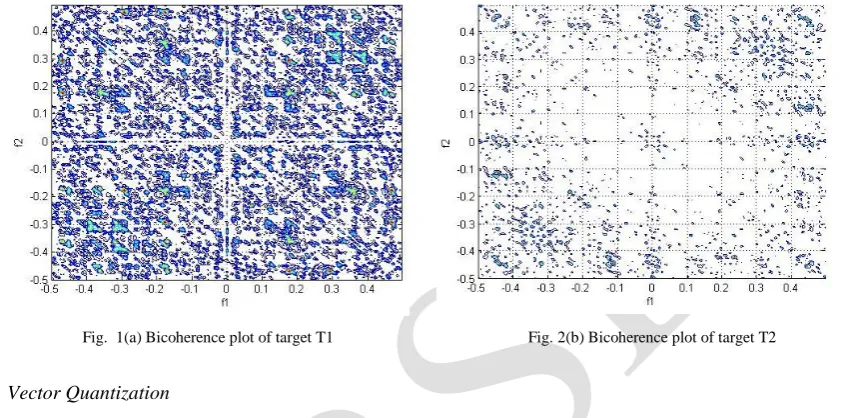
The preprocessed noise data waveforms are segmented into records of 10K samples each. The bicoherence of each record is computed using eqn. (2), with 256 point DFT. The contour plot of the bicoherence of two targets T1 and T2 are presented in Figs. 1(a) and 1(b).
processing. This could be well justified due to the six-fold symmetry of the bispectrum plot [1]. Thus, the final matrix to be processed will have a dimension of
n
n
, where n = 128, which is four times smaller than the original matrix. The reducedn
n
bicoherence matrix is transformed into aN
1
column vector, where N is equal to n2. All the Bicoherence values from the M records are used to generate aN
M
matrix, which is vector quantized to get a lower dimension matrix.Fig. 1(a) Bicoherence plot of target T1 Fig. 2(b) Bicoherence plot of target T2
B. Vector Quantization
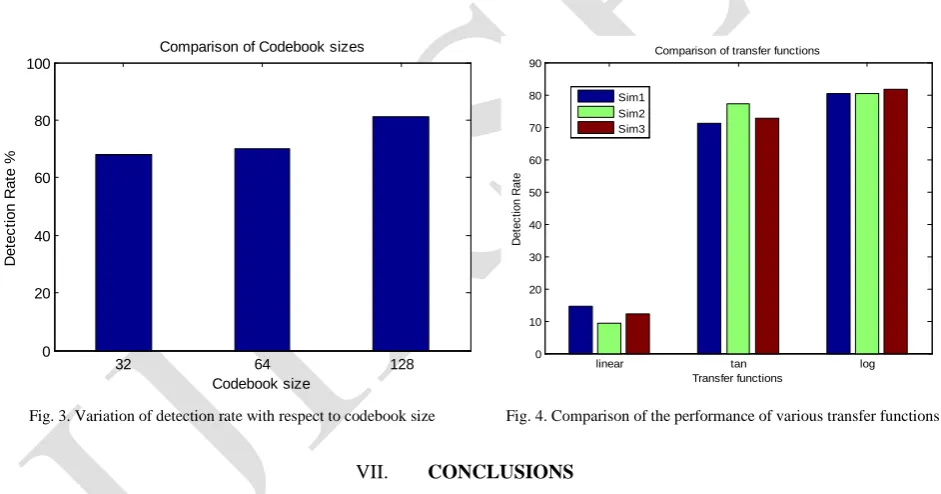
Vector Quantization is a lossy data compression method based on the principle of block coding, which codes the values from a multidimensional vector space into values in a discrete subspace of lower dimension. The Bicoherence data set were vector quantized to reduce the dimensionality. The analysis was carried out with various code book sizes of 32, 64, and 128.
C. Training and choice of network parameters
The dimensionally reduced bispectral feature set is used to train an artificial neural network. A feed forward network with back propagation algorithm was used for the analysis. The whole process of feature extraction and training is illustrated in Fig. 2.As the ANN architecture has many parameters which can affect its working, it is important to find out a proper set of network parameters for the optimum performance. The various parameters that were analyzed include codebook sizes, the number of hidden layers, and the transfer functions for each layer. Simulation studies were carried out in Matlab environment by varying the relevant parameters to obtain an optimal combination, for making the classification process more efficient.
Fig. 2. Feature extraction and training
were also carried out by varying the numbers of hidden layers and a network with two hidden layers is found to give better performance. As the number of hidden layers is increased, the learning process is found to become inefficient, resulting in unacceptable generalization of the network. The number of neurons in the hidden layers was also varied to get the optimal performance.
Simulations were carried out with linear, tan and log-sigmoid transfer functions. Better performance was observed, when the log-sigmoid transfer function is used for all the layers in the network. Fig. 4 illustrates the variation of the detection rate for various transfer functions, for 3 different simulations carried out. It is observed that, in all the three simulations, the network with log-sigmoid transfer function exhibited better performances.
VI.RESULTSANDDISCUSSIONS
A neural network with two hidden layers was implemented with log-sigmoid as transfer function, for both the layers, and the output of the vector quantizer was given as the input to the network, so that the quantized code books will be used to train the neural network. Variable Learning Rate Backpropagation algorithm was chosen to be the training algorithm.
The network was trained with a total of sixteen targets and the proposed method could classify targets successfully with a success rate of 81%. It is also observed that the waveforms used should not be too small, as the performance of the system declined if the number of samples used for the bicoherence computation is well below 10K samples.
VII. CONCLUSIONS
Bicoherence, a normalized form of bispectrum whose variance is independent of the energy content of the signal can play a key role in the analysis of acoustic noise sources. A properly trained neural network with carefully chosen parameters, in combination with dimensionality reduction technique like vector quantization, can be effectively made use of, for implementing intelligent target classifiers. Efforts are being made to further improve the detection rates by fine tuning the network architecture, incorporating more classification clues.
ACKNOWLEDGEMENTS
The authors gratefully acknowledge the Department of Electronics, Cochin University of Science and Technology, for extending all the facilities for carrying out this work.
Fig. 3. Variation of detection rate with respect to codebook size Fig. 4. Comparison of the performance of various transfer functions
32 64 128
0 20 40 60 80 100
Comparison of Codebook sizes
Codebook size
D
e
te
c
ti
o
n
R
a
te
%
linear tan log 0
10 20 30 40 50 60 70 80 90
Transfer functions
D
e
te
c
ti
o
n
R
a
te
Comparison of transfer functions
REFERENCES
[1] C. Nikias and M. Raghuveer, “Bispectrum estimation: A digital signal processing framework,” Proc. IEEE, vol. 75, no. 7, pp. 869–891, 1987.
[2] C. K. Papadopoulos and C. L. Nikias, “Bispectrum estimation of transient signals,” in ICASSP-88., International Conference on Acoustics, Speech, and Signal Processing, pp. 2404–2407, 1988,.
[3] S. Wenndt and S. Shamsunder, “Bispectrum features for robust speaker identification,” in 1997 IEEE International Conference on Acoustics, Speech, and Signal Processing, vol. 2, no. 2, pp. 1095–1098,1997.
[4] J. Jakubowski, K. Kwiatos, A. Chwaleba, and S. Osowski, “Higher order statistics and neural network for tremor recognition.,” IEEE Trans. Biomed. Eng., vol. 49, no. 2, pp. 152–9, Feb. 2002.
[5] S. Taplidou and L. Hadjileontiadis, “Analysis of wheezes using wavelet higher order spectral features,” Biomed. Eng. IEEE …, vol. 57, no. 7, pp. 1596–1610, 2010.
[6] P. O. Molchanov, J. T. Astola, K. O. Egiazarian, and A. V Totsky, “Classification of ground moving targets using bicepstrum-based features extracted from Micro-Doppler radar signatures,”EURASIP J. Adv. Signal Process., vol. 2013, no. 1, p. 61, 2013.
[7] M. Kucukbayrak, O. Gunes, and N. Arica, “Underwater Acoustic Signal Recognition Methods,” J. Nav. Sci. Eng., vol. 5, no. 3, pp. 64–78, 2009.
[8] Q. Q. Huynh, L. N. Cooper, N. Intrator, and H. Shouval, “Classification of underwater mammals using feature extraction based on time-frequency analysis and BCM theory,” IEEE Trans. Signal Process., vol. 46, no. 5, pp. 1202–1207, May 1998.
[9] M. R. Azimi-Sadjadi, D. Yao, Q. Huang, and G. J. Dobeck, “Underwater target classification using wavelet packets and neural networks.,” IEEE Trans. Neural Netw., vol. 11, no. 3, pp. 784–94, Jan. 2000.
[10] S. Yang and Z. Li, “Classification of ship-radiated signals via chaotic features,” Electron. Lett., vol. 39, no. 4, p. 395, 2003.
[11] S. Yang, Z. Li, and X. Wang, “Ship recognition via its radiated sound: The fractal based approaches,” J. Acoust. Soc. Am., vol. 112, no. 1, p. 172, 2002.
[12] F. Bao, C. Li, X. Wang, Q. Wang, and S. Du, “Ship classification using nonlinear features of radiated sound: an approach based on empirical mode decomposition.,” J. Acoust. Soc. Am., vol. 128, no. 1, pp. 206–14, Jul. 2010.
[13] M. Farrokhrooz and M. Karimi, “Ship noise classification using Probabilistic Neural Network and AR model coefficients,” in Europe Oceans 2005, vol. 2, pp. 1107–1110, 2005.
[14] M. R. Azimi-Sadjadi, D. Yao, a a Jamshidi, and G. J. Dobeck, “Underwater target classification in changing environments using an adaptive feature mapping.,”IEEE Trans. Neural Netw., vol. 13, no. 5, pp. 1099–111, Jan. 2002.
[15] M. J. Hinich, “Bispectrum of ship-radiated noise,” J. Acoust. Soc. Am., vol. 85, no. 4, p. 1512, 1989.
[16] P. L. Brockett and G. R. W. Patrick.L.Brockett, Melvin Hinich, “Nonlinear and non-Gaussian ocean noise,” J. Acoust. Soc. Am., vol. 82, no. 4, pp. 1386–1394, 1987.
[17] A. Jain, J. Mao, and K. Mohiuddin, “Artificial neural networks: A tutorial,” IEEE Comput., 1996.