Copyright 0 1995 by the Genetics Society of America
Host
and
@X
1'74
Mutations Affecting the Morphogenesis or Stabilization of the
50s
Complex, a Single-Stranded
DNA
Synthesizing Intermediate
Martina C. Ekechukwu, D. Jason Oberste
and
Bentley A. Fane
Department of Biological Sciences, University of Arkansas, Fayetteuille, Arkansas 72701 Manuscript received January 3, 1995
Accepted for publication May 1, 1995
ABSTRACT
The morphogenetic pathway of bacteriophage +X 174 was investigated in rep mutant hosts that specifi- cally block stage I11 single-stranded DNA synthesis. The defects conferred by the mutant rep protein most likely affect the formation or stabilization of the 50.5 complex, a single-stranded DNA synthesizing intermediate, which consists of a viral prohead and a DNA replicating intermediate (preinitiation com- plex). +X 174 mutants, ogr(rep), which restore the ability to propagate in the mutant rep hosts, were isolated. The ogr(rep) mutations confer amino acid substitutions in the viral coat protein, a constituent of the prohead, and the viral A protein, a constituent of the preinitiation complex. Four of the six coat
protein substitutions are localized on or near the twofold axis of symmetry in the atomic structure of the mature virion.
B
ACTERIOPHAGE c$X 174 is a small icosahedral vi- rus of the class Microviridae. The mature virion contains 60 copies of gpF, the major coat protein, gpG,the major spike protein, 12 copies of gpH, the minor spike protein and a single-stranded (
+
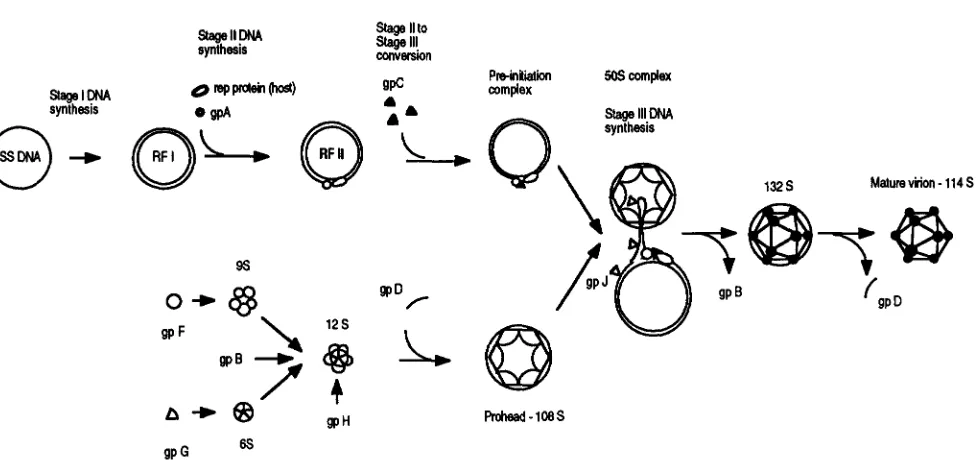
) DNA genome complexed with 60 copies of gpJ, the DNA binding protein. The atomic structure of the mature virion is known ( MCKENNA et al. 1992, 1994). This, combined with well defined genetics and biochemistry, creates an ideal system in which to investigate icosahedral virion morphogenesis.The morphogenetic pathway is presented in Figure
1. A comprehensive review of this material can be found in HAYASHI et al. ( 1988)
.
Initially morphogenesis pro- ceeds via two independent pathways, prohead assembly and DNA synthesis, through the formation of the pre- initiation complex (stages I and 11). The preinitiation complex consists of RFII DNA, viral gpA, viral gpC and the host cell rep protein or DNA helicase (AOYAMA et al. 1983; AOYAMA and HAYASHI 1986). The two pathways converge with the formation of the 505 complex, in which single-stranded DNA is synthesized (stage 111) and concurrently packaged into the prohead ( FUJISAWA and HAYASHI 1976).The host cell rep protein is required for both stage I1
and stage I11 DNA synthesis (
DENHARDT
et al. 1967; FRANCKE and RAY 1971a; TESSMAN and PETERSON 1978). TESSMAN and PETERSON ( 1978), however, isolated Esch-m'chiu coli rep mutants (gro87 and gro89) that exclu- sively inhibited stage I11 DNA synthesis. In deprotei- nized samples of infected rep mutant cells, TESSMAN and PETERSON detected no single-stranded DNA. Protein
Corresponding author; Bentley A. Fane, Department of Biological Sciences, 629 SCEN, University of Arkansas, Fayetteville, AR 72701. E-mail: [email protected]
Genetics 1 4 0 1167-1174 (August, 199.5)
containing assembly intermediates, such as the 50s
complex, were not examined. There are several blocks in the assembly pathway that could result in an inhibi- tion of single-stranded DNA synthesis: the 50s complex may not assemble due to either a block in prohead morphogenesis or preinitiation complex formation, as- sembled proheads and preinitiation complexes may be unable to associate, and association may lead to a non- functional 50s complex.
To distinguish between these alternatives, DNA and protein assembly intermediates synthesized in gro89 in- fected cells were examined. The results of these experi- ments suggest that stable 50s complexes do not assem- ble in gro89 infected cells. Prohead morphogenesis, however, is not inhibited. A second-site genetic analysis identified several mutations within the major coat pro- tein, ogr(rep) mutations, which restore the ability of 4 X 174 to propagate in gro89 cells. Functional preiniti- ation complexes can form i n v i t r o in the absence of the viral coat protein (AOYAMA et al. 1983; AOYAMA and
HAYASHI 1986). Since single amino acid substitutions
in the viral coat protein are enough to confer a viable phenotype in the gro89 host, the mutant rep proteins probably do not inhibit the formation of the preinitia- tion complex. Hence, the defect conferred by the mu- tant rep protein is most likely the stable association of proheads and preinitiation complexes. The clustering of the ogr(rep) substitutions within the atomic structure suggests that the twofold axis of symmetry ( MCKENNA et al. 1994) may play a critical role in 50s complex morphogenesis.
MATERIALS AND METHODS
stage II to
Stage Ill,
ConVersKHI
synthesis
9s
132 s Malurevirion-114s
FIGURE 1.-The #J X174 morphogenetic pathway.
Isolation of ogr(rqb) mutants: The ogr( rep) mutants were isolated by plating 105-107 plaque-forming units (pfu) on the gro87 or gro89 host. After a 5-hr incubation at 33", re- vertant plaques were stabbed into indicator lawns seeded with either the gro87, gro89, or the gro' host. Gro87, gr089 and gro+ plates were incubated at 33", and an additional gro+ plate was incubated at 42". Putative ogr( rep) mutants were identified as those phage that could propagate on the gro87 or gro89 hosts. Temperature-sensitive mutants were identified as those which failed to grow at 42" on the pro' host.
Phage plating, stock preparation, DNA isolation, DNA se- quencing, media: Detailed protocols are described in FANE
and HAYASHI ( 1991 )
.
Burst size experiments The protocols for these experi- ments are identical to those described in FANE and HAYASHI ( 1991) with the exception that phage were preabsorbed to cells in HFB buffer (FANE and HAYASHI 1991) with 10 mM MgC1, and 5.0 mM CaCl, for 12 min at 37". The adsorption mixtures were then spun in a microcentrifuge for 5.0 min. The supernatants were removed and the cell pellets were re- suspended in TK (tryptone-KC1) broth with 10 mM MgCI2 and 5 mM CaC1,. The level of unabsorbed phage was deter- mined by titering both the resuspended pellet before further incubation and the supernatant. Infections were then han- dled as previously described.
Mutagenic oligonucleotide rescue experiments The in vitro DNA synthesis and transformation protocols are de- scribed in FANE et al. ( 1993). Mutagenic oligonucleotides were purchased from Genostys Biotechnologies Inc., and de- signed to introduce the ogr( rep) mutations into a wild-type background. Gro* cells were transformed with the in vitro DNA synthesis reactions and incubated at 33". After 5 hr, plaques were stabbed into two indicator lawns seeded with either the gro+ or gr089 host. Rescue was defined as the ability to propagate on the gro89 host. As a control, a nonmu- tagenic primer, which annealed to the site of one of the
ogr(rep) mutations, was used. When a mutagenic primer was used, 100 plaques were assayed. Two hundred plaques were assayed in the experiment with the nonmutagenic primer.
Preparation of radioactive lysates and sucrose gradient cen- trifugation: Lysates were prepared as described in FANE et al.
(1992). Cells were infected at an moi of 5.0 with #JX 174 am(E)W4 to prevent cell lysis, and incubated at 37". At t =
11, infections were pulsed with 'H thymidine or 3H leucine (20 mCi/ml) and chased at t = 40 with cold thymidine or leucine (200 ,ug/ml)
.
Cells were harvested at t = 60 as pre- viously described. Sucrose gradients (5-30%, 5.0 ml) were made with a Gradient Master purchased from Biocomp Inc., following the manufacturers' instructions. Centrifugation was performed in an SW50.1 rotor at 4". To examine larger parti- cles ( 2 7 0 S ) , gradients were spun for 60 min at 45,000 rpm. To examine smaller particles ( 550S), gradients were spun for 16 hr at 34,000 rpm. Gradients were fractionated and TCAprecipitable counts determined as previously described.
RESULTS
Characterization of the 4 X 174 assembly pathway in gro 89 cells: Earlier experiments conducted with the
E. coli rep mutant gro89 ( TESSMAN and PETERSON 1976)
,
are described in the Introduction. To further investi- gate the nature of the assembly defect conferred by the mutant rep protein in the gro89 host, radio-labeled DNA and protein extracts were prepared from gro89 and gro' infected cells and analyzed by sucrose gradient sedimentation as described in MATERIALS AND METH-ODS. The sedimentation profiles of these experiments are depicted in Figure 2.
In extracts prepared from infected gro
'
cells, radio- labeled proteins sediment at both132s
and 114S, the positions of the penultimate infectious intermediate4 X
174 Morphogenesis1400
1169
1400
A
108s
l2O0
I
1 3 2 sJ(
11451000
800 8
600
400
200
"
0 2 4 6 8
F r a c t i o n
1 0
RF DNA's
J
12
F r a c t i o n
FIGURE 2.- ( A ) 3H-protein sedimenta- tion profiles of 4 X 174 infected cells. ( B ) 'H-DNA sedimentation profiles of 4 X 174
infect cells. The sedimentation profile of infected gro+ cell extracts is depicted ( 0 )
as is the sedimentation profile of infected gro89 cell extracts ( 0 ) . Mature virions sed-
iment at 114s. Proheads sediment at 108s. The 132s particle is an infectious interme- diate. Protocols are described in MATERIALS AND METHODS.
phage in a separate experiment. The fractions were then titered on a sup" host. The marker phage sedi- mented to the left of the radioactive peak (data not shown). The results indicate that viral proheads accu- mulate in gro89 infected cells.
The radio-labeled DNA extracts were examined for the presence of the 50s complex and replicative form
(RF')
DNAs (Figure 2 ) . In extracts of gro+ infected cells, radioactive counts sediment at 50s. In extracts of g o 8 9 infected cells, on the other hand, radioactive counts were not observed to sediment in this region. Instead, counts sediment at 20s and 30S, the positions of the RF intermediates. Sedimentation profiles gener- ated from radio-labeled DNA extracts of g o 8 9 infected cells, furthermore, contained no radioactive counts in the 108s-114s region (data not shown). The results of the sedimentation analyses indicate that the primary defect conferred by the mutant gro89 rep protein is the formation or stabilization of the 50s complex.Isolation of cPX 174 mutant+ogr(rep): Mutant phage- ogr(rep)-able to propagate in the grog7 and g o 8 9 hosts were selected as described in MATERIALS AND
METHODS. The frequencies of recovery on the gro87 and gro89 hosts were 10" and respectively. To screen for the existence of secondary ts phenotypes, the putative ogr(rep) mutants were assayed for their ability to grow at 42" on the gro + (wild-type) host (Table 2 ) . Of the
75
putative isolates, 10 displayed strong second- ary phenotypes on the wild-type host. The secondary ts phenotype was used to map the ogr(rep) mutations by spot-test complementation. The results of these assays suggested that the ts ogr( rep) mutations resided in geneF, which encodes the viral coat protein. Fifteen mutants were selected for further study.
The DNA of the all ogr(rep) mutants was sequenced
in the regions of gene F (coat protein) and gene A (DNA replication protein)
.
Nucleotide substitutions were found in gene Fin all of the mutants that displayed a secondary ts phenotype. No changes in gene F were found in ogr( rep) mutants that did not display a second- ary ts phenotype. Substitutions, however, were found in gene A . The nucleotide mutations and the amino acid substitutions conferred by these mutations are listed in Table 1 . Of the 15 mutants analyzed, six different mutations were found in gene F, and two different mu- tations were recovered in gene A . In addition, one A/ Fand one A / A double mutant were recovered. Several of these mutations confer changes at or to proline resi- dues.Oligonucleotide rescue experiments were performed to confirm the results of the DNA sequence analysis. Mutagenic primers were designed to introduce the ogr( rep) mutations into wild-type +X 174 DNA. The res- cue frequency, percentage of ogr(rep) progeny, by the mutagenic ogr(rep)-F P417S, A3464 S227P, S221L and PI 74R primers were 33, 31, 14, 18 and 8%, respectively. The rescue frequency by a nonmutagenic oligonucleo- tide was only 0.5%.
TABLE 1
Amino acids changes conferred by the ogrfrep) mutations
Mutation Location and substitution" Host of isolation Number of isolates
~~~ ~~ ~ ~
ogr(r@)-F G88V F88 gly "* Val gro89 1
ogr(rep)-F PI 74R FI 74 pro "* arg gro89 1
ogr(rep)-F S221L F22 1 ser "* leu gro89 1
ogr(rep)-F S227P F227 ser "* pro gro89 2
ogr(rep)-F A346V F346 ala "* Val gro89 1
ogr(rep)-F P417S F417 pro "* ser gro89 4
ogr(rep)-A A80P A80 ala -+ pro gro89
1
ogr(rep)-A D82G A82 asp "* glY gro89 2
ogr(rep)-A/A S59F/D82G ser A59 "* phe gro87 1
ogr(rep)-F/A S221L/A80P F221 ser -+ leu gro87 1
~~
A82 asp -+ glY
A80
ala "* pro
The 4x174 sequence was originally determined by SANCER et al. (1978). Capital letters indicate the affected protein, numbers indicate the amino acid. Amino acid numbering for the F protein commences with serine 1 as in MCKENNA et al. 1992.
for the ability to propagate in the gro89 host. The s u D mutations were unable to propagate in this host. The serine + proline substitution at amino acid
227
appearsto be unique in conferring both s u D and ogr(r@) phe- notypes.
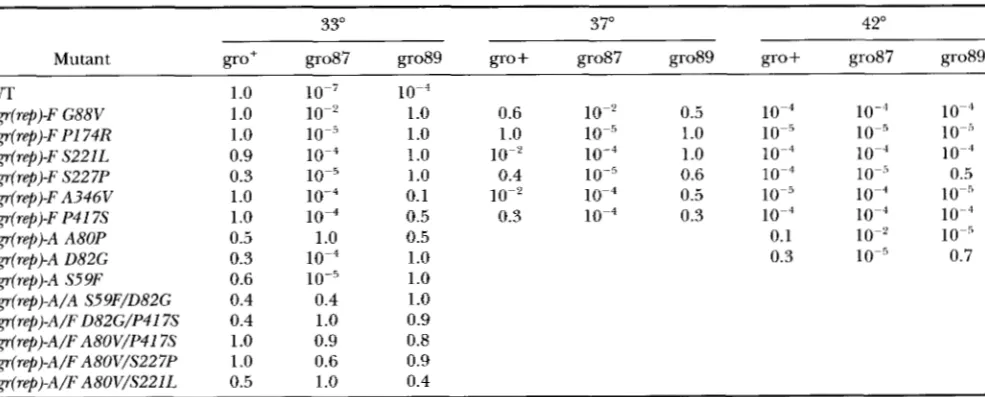
Characterization of the ogr(ref~) mutants. The eop's (efficiency of plating) of the ogr(rep) mutations are displayed in Table
2 .
The ogr( rep) -F mutations only restore growth in the gro89 host. Although the mutants plate with relatively high efficiencies, plaque morpholo- gies of some of these mutants, most notably ogr(rep)-F S221L and ogr(rep)-FS227P, are characteristically small. In addition, gene F mutants display a strong secondary ts phenotype in either the gro' or gro89 hosts at ele- vated temperatures ( 237").
In many cases the tspheno- type has a host range component. The ogr(rep)-FS227Pmutant, for example, is permissive for growth in the
gro89 host at 42", but restrictive in the grot host. This suggests that the secondary ts phenotypes reflect defects in assembly or function. If the ts defect affected protein folding, for example, it is reasonable to assume that the mutant would not exhibit this host range phenomenon, but display the same ts phenotype in all hosts. The iso- lated ogr(rep) mutants do not propagate in an E. coli C strain containing the rep3 allele (data not shown). The rep3 allele ( DENHARDT et al. 1967) blocks 4 X 174 stage I1 DNA synthesis, an earlier point in the pathway than
50s complex formation, and most likely represents a null allele of this gene.
Only one single mutant, ogr( rep)-A A80P, restores growth in the g o 8 7 host. While the ogr(rep)-A/A S59F/ D82G double mutant propagates in the gro
87
host, the ogr(rep)-A D82G single mutant does not. The two mutations in the ogr(rep)-A/A S59F/D82G were sepa-TABLE 2
Efficiency of plating of ogr(rep) mutants
33"
37" 42"
Mutant gro+ gro87 gro89 gro+ gro87 gro89 gro+ go87 grot39
WT 1
.o
10"ogr(rep)-F G88V 1
.o
10" 1.o
0.6 10" 0.5 lo-"ogr(rep)-F PI 74R 1
.o
10-5 1.o
1.o
ogr(rep)-F S221 L 0.9 1
.o
10" IO-^ 1.o
1 0 - ~ 10-4ogr(rep)-F S22 7P 0.3 1 0 - 5 1
.o
0.4ogr(rep)-F A346V 1.0 IO-^ 0.1 10-2 0.5 10-9
ogr(rep)-F P417S 1
.o
0.5 0.3 0.3 10-4ogr(rep)-A A80P 0.5 1
.o
0.5 0.1 IO"ogr(rep)-A D82G 0.3 1
.o
0.3ogr(rep)-A S59F 0.6 10" 1
.o
ogr(rep)-A/A S59F/D82G 0.4 0.4 1
.o
ogr(rep)-A/F D82G/P417S 0.4 1
.o
0.9ogr(rep)-A/F A80V/P417S 1
.o
0.9 0.8ogr(rep)-A/F A80V/S22 7P 1
.o
0.6 0.9ogr(rep)-A/F A80V/S221L 0.5 1
.o
0.4l0-5 1
.o
lo" 10-5l0-5 0.6 1 0 ~ 10-5 0.5
10-5
10-5 l o p 0.7
4 X 174 Morphogenesis 1171
TABLE 3
Burst sizes of ogr(rep) mutants in single and coinfections with wild-type 4x174
Progeny ratio" Host cell o F w t
Infection/coinfection gro+ gro89 gro' gro89
WT 143 0.1
ogr(rep)-F PI 74R 6.9 42
ogr(rep)-F PI 74R XWT 18 46 2:3 3: 1
ogr(rep)-F S221L 170 2.3
ogr(r@)-F S22IL X WT 89 19
ogr(rep)-F S22 7P 12 2.7 4:5 3: 1
ogr(rqb)-F S227P X WT 88 4.0
ogr(rep)-F A346V 380 9.1
ogr(rep)-F A346V X WT 130 9.7
ogr(rep)-F P417S 140 16
ogr(rep)-F P417S X WT 310 18
ogr(rqb)-A A80P 25 280 2:5 44:l
ogr(rep)-A A80P X WT 44 113
Moi of 10. In coinfections the moi of each infecting phage was 5.0. Burst sizes are 4/cell.
"Progeny ratios were determined by assaying progeny to grow on the gro+ and gro89 hosts. These ratios were deter- mined by assaying 2 4 5 progeny.
rated by oligonucleotide mediated mutagenesis. The mutagenic primers were designed to restore the wild- type sequence in codons 59 and
82.
The mutagenized progeny were screened for phenotypes differing from the ogr(rep)-A/A S59F/D82G parent. In both instances, progeny that could only grow in the gr089 host were recovered. DNA was isolated and sequenced in gene A.The sequence analysis revealed that the nonparental phage were single ogr( rep) -A S59Fand ogr( rep) -A D82G mutants. To investigate the possibility of interacting mu- tations in genes A and F, A / F double mutants were selected by plating ogr ( rqb) -FS221L, S227Pand P417S mutants on the gro87 host. Regardless of the parental ogr( rqb) -F mutant used, the second mutations were al- ways located in gene A and conferred amino acid substi- tutions at the common positions of 80 or
82.
These results suggest that at least these A / F interactions are not allele specific (Table2
).
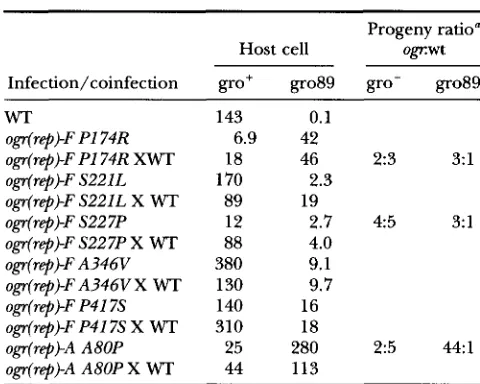
To obtain a more quantitative measure of ogr( rep)- Fmutant growth, burst sizes were assayed in the gro89 and gro+ hosts. The results of these experiments are in Table 3. The ogr( rep)-F infections yielded bursts ranging from 2.3-46 +/cell in the gro89 host. These burst sizes reflect titers that were at least fivefold higher than the titer of unabsorbed phage, determined as de- scribed in MATERIALS AND METHODS. These results indi- cate that the ogr( rqb) mutations raise burst sizes to a level consistent with the conditions under which the mutants were isolated. The wild-type +X 174 infection, on the other hand, produced a burst of 0.1 +/cell, which was equal to the titer of unabsorbed virions. The burst sizes of coinfected cells were also determined.
The bursts produced were equal to those produced in ogr( rqb) single infections, indicating that the ogr( rep)
phenotype is dominant.
TESSMAN and PETERSON (1976) reported that an S13 ogrmutation in gene Fconferred a cis dominant pheno- type. S13 and +X 174 are very closely related with -98 and 98.5% homology on the DNA and protein level, respectively (
LAu
and SPENCER 1985). They reported a ratio of progeny phage from coinfected gro89 in- fected cells ( ogrxon-ogr ) of-
12:l. The non-ogr parents were various S13 amber mutants. A much smaller cis dominant effect, which may not be significant, was ob- served in the experiments reported in Table 3. The ratio of recovery ( ogr.wt) was skewed toward ogr(rep)-F progeny when gro89 was the infected host. Conversely, the ratio of recovery was skewed toward wt progeny in gro+ infected cells. These ratios were determined by plating the progeny on the mutually permissive gro+host. Progeny plaques were then stabbed into gro89 and gro+ indicator lawns. This slight cis dominant effect, however, was dramatically lower than that observed from the ogr(rqb)-A X wt coinfection (44:l)
.
The cis acting nature of the gene A protein has been well docu- mented (FRANCKE and RAY 1971b; EISENBERG andKORNBERG 1979 )
.
Three factors may account for the differences be- tween the two data sets. First, the use of amber mutants
as the non-ogr parent in the experiments of TESSMAN and PETERSON (1976) may have skewed the recovery toward ogr progeny. Second, the S13 coat protein may indeed be ckacting while the +X 174 coat protein is not. And finally, it is possible that the mutant used in the studies of TESSMAN and PETERSON was an A / F dou- ble mutant. Like the ogr(rqb)-F mutants described in this report, it had a secondary ts phenotype that was used to map the mutation to gene F by complementa- tion. The nucleotide sequences of +X 174 and S13, however, were unknown in 1976; hence a DNA se- quence analysis could not have been conducted. Unlike the ogr(rep)-Fmutants described in this report, the mu- tant isolated by TESSMAN and PETERSON ( 1976) propa- gated on the gro87 host. The ability to propagate on the gro87 host is consistent with the phenotype of the ogr(rep)-A and ogr(rep)-A/F double mutants reported here.
DISCUSSION
The mutant grot39 rep protein blocks the formation
of the 50s complex: Stage I11 DNA synthesis and pack- aging occurs exclusively in the 50s complex assembly intermediate ofwhich the viral prohead is a component
cally block stage 111 DNA synthesis. In deproteinized samples, no single-stranded DNA was detected in in- fected rep mutant cells. The formation of the 50s com- plex, however, was not examined.
As discussed in the Introduction, there are several blocks in the assembly pathway that could result in the absence of single-stranded DNA synthesis. To distin- guish between these possibilities, radio-labeled extracts (“-protein or 3H-DNA) were prepared from gro89 and gro + (wild-type) infected cells and analyzed by sucrose gradient sedimentation. The results of these experiments suggest that the 50s complex cannot form in gro89 infected cells. The mutant rep proteins, how- ever, do not interfere with the formation of the viral prohead or block earlier stages of DNA replication as reported by TESSMAN and PETERSON ( 1976). A similar analysis was also conducted with radio-labeled protein extracts prepared from gro87 cells (data not shown). In these extracts, a particle that sediments at 50s was ob- served. It was, however, present in reduced amounts when compared to the gro + extract. As evinced by the
ogr(rep)-A
A80P
mutation, which restores growth in both of the gro89 and gro87 hosts, the defects con- ferred by the mutant rep proteins are related. The gro87 rep protein may inhibit, but not prohibit, 50s complex formation. The 50s complexes that do form, however, are most likely not functional.Two models could account for the lack of 50s com- plex formation and/or stabilization in the gro89 host. If the mutant rep proteins cannot associate with the other components of the preinitiation complex, the 50s
complex would not form. AOYAMA et al. ( 1983) demon- strated that 50s complex formation is blocked if any component of the RF 11-gpA-rep-gpC preinitiation com- plex is not present. Alternatively, the preinitiation com- plex may form but be unable to associate with the viral prohead. Genetic data argue for the second alternative. Preinitiation complex formation does not require the F protein (AOYAMA et al. 1983). Because single muta- tions in gene Fare enough to confer a viable phenotype in the gro89 host, the gro89 rep protein most likely does not interfere with preinitiation complex formation. This hypothesis, however, will need to be tested further.
Characterization of ogr(rep) mutants: Two distinct ogr(rep) phenotypes were apparent among the selected mutants, ts and ts’. All of the ts ogr(rep) mutations were located in gene F. The ts+ ogr(rep) mutations, on the other hand, were found in gene A . The ogr(rep) mutants do not propagate in cells carrying a putative null allele of the rep gene and the allele specificty of the ogr(rep)- F mutants indicate that the ogr(rep) mutations do not confer the ability to propagate independently of rep protein function. The bursts produced in wild-type X ogr(rep)-Fco-infections indicate that the ogr(rep)pheno- type is dominant. Although this suggests that hybrid proheads are capable of 50s complex formation and DNA packaging, a model in which the two different
coat proteins independently assemble into homoge- nous proheads cannot be ruled out. Regardless of the model, the dominant phenotype is not surprising. If the two coat proteins do not associate, homogenous ogr(rep)-Fproheads would be present and phage would be produced. In a hybrid prohead model, only a limited number of ogr(rep)-Fcoat proteins need be present as long as they form a productive association site for the preinitiation complex.
The location of the ogr (rep) -F mutations in the atomic structure of the virion: Two previous second- site genetic analyses have laid the foundation of a rudi- mentary structure/function map of the +X 174 coat protein (FANE and HAYASHI 1991; FANE et al. 1993). These analyses identified assembly sequences that in- fluence the formation of the 12s particle, and second- ary structures that influence the stabilization of the viral prohead ( EKECHUKWU and FANE 1995). A schematic of the major coat protein is presented in Figure 3. Analyses of atomic structures and dissociation studies conducted with a wide variety of virions led to the hypothesis that these loops, as opposed to the beta-barrel core, may play a crucial role in viral assembly ( K I M et al. 1990; LIDDINGTON et al. 1991; MCKENNA et al. 1992). As ob- served with the other assembly mutations, all of the
ogr(rep)-F mutations are located in the loops of the atomic structure. This is consistent with the hypothesis that assembly interactions are mediated by the amino acid loops of icosahedral coat proteins.
The locations of these various mutations may also provide insights into the functions of various structures found in the major coat protein. The suD mutations, for example, are located in a-helical regions that are found near the threefold axis of symmetry in the folded protein. The ogr(rep)-Fmutations, on the other hand, are localized near the twofold axis of symmetry and have access to the surface of the virion. Four of these mutations map to a striking depression which skirts the twofold axis of symmetry.
50s complex formation/stabilization, general consid- erations and mechanisms: Unlike tailed bacteriophage, Microviridae capsids do not contain a unique vertex for translocating DNA into the prohead. The structure of the +X 174 prohead, as determined by cryoelectron mi- croscopy reconstruction ( ILAC et al. 1995), reveals large pores at the threefold axis of symmetry in each face of the icosahedral. No such pores exist at the fivefold axis. Packaging, as ILAG et al. suggest, may occur through a face of the prohead, not a vertex. If the virus is to efficiently propagate, conformational changes must oc- cur in the prohead upon the formation of the 50s com- plex to ensure that packaging proceeds at only one location.
4 X
174 Morphogenesis 1173ogr (rep) 88
D suppressor 316 suppressor 213 F K X W 3.-schcmatic map
or
the &X 174 coat protein. Elon- gated boxes represent the
p-
sheets comprising the P-harrcl. Cvlinders depict a-helices. Substi- tutions are tlcnotetl by genotvpe.
The 11 sz~~~/~r~.s.sor.s affect the forma- tion of the 12s particle; the l ) n+ prcssms affect the stability of the prohead ( F:\NE antl HAYASIII
1991; FANE: P/ nl. 1993; EKE(:t{l.- KWU and FANE 199.5). The ogr(rrp) mutations are described in this report.
B suppressor 38
D suppressor 227
Five-fdd axis of symmetry
ppressor in J protein
Three-fdd axis
of symmetry Threefold axis
ogr J 7 D - s Z e s T \ w r y (rep) of symmetry ogr (rep) I
substitutions are all in contact with the mutated amino tions in gpA, may facilitate this association in the gro89 acid in the grog9 r$ protein. T h e mechanism of s u p infected cells. This model is also consistent with the pression is most likely general. The amino acid sites observed dominant phenotype of the ogr(r@)-Frnuta- identified by the ogr(r@)-Fmutations, or the depression tions, because binding and packaging would occur at along the twofold axis of symmetry in which the major- only o n e site in the particle.
ity of them are located, may be crucial to mediating
The authon thank H. Woon for rtlitori;d assistance, Ih. R. M(:- conFormational changes in the prohead “POn binding QNNA and M. Rossa&\ss fbr discussion, and Dr. M;\s1\li1 H;\s;\s111
OF the preinitiation
comp1ex*
In this mode1, the mutant for cell strains and many other~.nluahlc gifts. This work was supported preinitiation complexes would be unable to trigger the by a National Science Forlndation/l.:xperimental Progranl IO Stimn- conformations] changes necessary for 50s complex sta- late Competitive Research (EPSCOR) gtxnt t o the Center for Protein bilization. ln turn, the o p ( r p l ) - ~ mutations w o u ~ c ~ re- Dynamics at the University of Arkansas. M.C.E. was s~tpportc.tl in parthy a grant from the Arkansas Science antl R.A.F. b y a TechnoIqy store the ability to achieve the required conformational k~sociation gmt,t (ASTA-I)41U)6)
changes and subsequent stability. Because the ogr(rep)-
Fmutations confer a dominant phenotype, it follows
that only a subset of the coat proteins need be the LITERATURE CITED
ogr(re/l)-F species. Alternatively, the o g r ( r $ ) P muta-
tions, or the depression along the twofold axis of sym- AOYAMA, A., and M. H,\Y;\sItI, 1986 Sythesis of h;trteriophage metry, may identi9 the actual contact site between the
c$X 174 in r d m : Mechanism of switch from DNA rc-plication t o
DNA packaging. (:ell 47: 99- 1 0 6 .
abortive replication of +X 174 DNA in a recombination deficient mutant of E. coli. Proc. Natl. Acad. Sci. USA 57: 813-820. EISENBERG, S., and A. KORNBERG, 1979 Purification and character-
ization of +X 174 gene A protein: a multifunctional enzyme of duplex DNA replication. J. Biol. Chem. 254: 5328-5332. EKECHUKW, M. C., and B. A. FANE, 1995 Characterization of the
morphogenetic defects conferred by cold-sensitive prohead ac- cessory and scaffolding proteins of +X 174. J. Bact. 177: 829-
830.
FANE, B. A,, and M. HAYASHI, 1991 Second-site suppressors of a cold- sensitive prohead accessory protein of bacteriophage +X 174. Genetics 128: 663-671.
FANE, B. A., S. HEAD and M. HAYASHI, 1992 The functional relation- ship between the J proteins of bacteriophages +X 174 and G4 during phage morphogenesis. J. Bact. 174: 2717-2719. FANE, B. A,, S. SHIEN and M. HAYASHI, 1993 Second-site suppressors
of a cold sensitive external scaffolding protein of bacteriophage +X 174. Genetics 134: 1003-1011.
FRANCKE, B., and D. S. RAY, 1971a Formation of the replicative form DNA of bacteriophage +X 174 and initial events in its replication. J. Mol. Biol. 61: 565-586.
FRANCKE, B., 2nd D. S. RAY, 1971b Cis-limited action of the gene A product of bacteriophage. Proc. Natl. Acad. Sci. USA 6 9 475-479 FUJISAWA, H., and M. HAYASHI, 1976 Viral DNA- synthesizing inter-
mediate complex isolated during assembly of bacteriophage +X 174. J. Virol. 19: 409-415.
HAYMHI, M., A. AOYAMA , D. L. RICHARDSON and M. N. HAYASHI, 1988 Biology of the bacteriophage +X 174, pp. 1-71 in The Bacteriophages, Vol. 2, edited by R. CALENDAR. Plenum Publishing Corporation, New York.
ILAG, L. L., N. H. OLSON, T. DOKLAND, C. L. MUSIC, R. H. CHENG et al.,
1995 DNA packaging Intermediates of bacteriophage +X 174. Structure 3: 353-363.
KIM, S., U. BOEGE, S. KRISHNASWAMY, I. MINOR, T. J. SMITH et aZ., 1990 Conformational variability of a picornavirus capsid pHdependent structural changes of Mengo virus related to its host receptor attachment site and disassembly. Virology 175: 176-190. LAU, P. C. K , and J. H. SPENCER, 1985 Nucleotide sequence and ge-
nome organization of bacteriophage SI3 DNA. Gene 40: 273-284. LIDDINGTON, R. C., Y. YAN, J. MOUIAI, R. SAHLI,
T.
L. BENJAMIN et al.,1991 Structure of simian virus 40 at 3.8 A resolution. Nature
MCKENNA, R., L. L. IIAG and M. G. ROSSMANN, 1994 Analysis of the single-stranded DNA bacteriophage +X 174 at a resolution of 3.0 A. J. Mol. Biol. 237: 517-543.
MCKENNA, R., D. XIA, P. WILUNGMANN, L. L. ILAG, S. KRISHNASWAMY et al., 1992 Atomic structure of singlestranded DNA bacteriophage +X 174 and its functional implications. Nature 355: 137-143. MUM, R., R. K. HAMATAKE and M. HAYASHI, 1979 Isolation of the
bacteriophage +X 174 prohead. Proc. Natl. Acad. Sci. USA 7 6
4877-4881.
SANGER, F., A. R. COULSON, C. T. FRIEDMANN, G. M. A I R , B. G. BARRELI.
et al., 1978 The nucleotide sequence of bacteriophage +X 174. J. Mol. Biol. 125: 225-246.
TESSMAN, E. S., and P. K. PETERSON, 1976 Bacterial ref mutations that block development of small DNA bacteriophages late in infection. J. Virol. 20: 400-412.
354: 278-284.