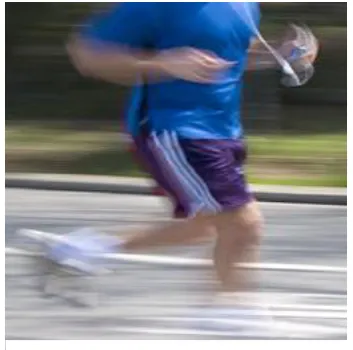
MOTION BLUR: An INTRODUCTION
Jaipuneet Singh
1, Simarpreet Singh
2Student, Computer Science Dept., RBIENT, Hoshiarpur, Punjab, India 1
Asst. Professor, Computer Science Dept., RBIENT, Hoshiarpur, Punjab, India 2
Abstract: The paper describes about the Techniques that can be used to control the motion Blur. The paper also describes that the Shutter Speed matters a lot in the concept of the motion Blur whereas ISO Setting’s and the aperture makes the Motion Blur to take place.
Keywords: Shutter Speed, Exposure, Aperture, ISO Settings
I. INTRODUCTION
Motion blur is the apparent streaking of rapidly moving objects in a still image or a sequence of images such as a movie or animation and it is essential used for producing high-quality animations. In computer animation (2D or 3D) it is computer simulation in time and/or on each frame that the 3D rendering/animation is being made with real video camera during its fast motion or fast motion of "cinematized" objects or to make it look more natural or smoother. The frame rate of most films and videos is either 24 or 30 Hz, whereas human vision is reported to be sensitive up to 60 Hz. Due to the lower frame rate of film and video, when each frame is drawn as a simple instantaneous sampling of the dynamic phenomena, artifacts such as Temporal Strobing can occur. The graphics community has been aware of this Strobing and several motion blur techniques have been proposed to solve this problem.
Our Major Problem:
Fluids are very important components of the cinematized as well as of dynamic scenes and to produce a scene without a flaw. A person tries to render the fluids by applying the modern Motion Blur techniques which are in great number and unfortunately, as we see in the image (above) these all techniques doesn’t produce satisfactory results
because there are two methods of
Figure1: Temporal Strobing
handling motion Blur. One is Lagrangian motion Blur used mostly for Solids and other is Eulerian Motion Blur used Mostly for Liquids. This paper describes the existing motion Blur Techniques uses the main concept of Shutter Speed.
Motion blur techniques developed so far are intended for rendering simulation that are performed in the Lagrangian framework. We will call this type of motion blur techniques Lagrangian motion blur (LMB). The majority of objects encountered in 3D graphics scenes (including rigid bodies, articulated figures, deformable solids, and clothes) mostly the Solid part of the scene are simulated in the Lagrangian framework, thus their motion blur can be readily rendered with LMB. Liquids Motion Blur is carried out by Eulerian Motion Blur which is more Complex and complicated Technique than LMB.
II. BACKGROUNDOFRELATEDWORK
Motion blur was first introduces to the computer graphics filed by Kerian and Badler [7], and Potmesil and Chakravarty [14], Korein and Badler proposed a method that works on an analytically parameterized motion and creates a continuous motion blur. Potmesil and Chakravarty proposed another method that creates continuous motion blur by taking the image-space convolution of the object with the moving path. We will classify the above sort of motion blur techniques as Analytic methods
Analytical Methods of a Blur:-
In Analytical Methodology Image Blurring by an optical System, sampling with finite area aperture or imaging through
atmosphere Turbulence, may be written in the superposition Integral Eq:-
G x y
( , )
P
( , ) ( , ; , )
J x y
d d
Where P(Tilde)(x,y) and G(x,y) denote input & Output Fields of the Linear System Respectively and Kernel J(x,y; α,β) represents the impulse response of linear System model.(Tilde) over the Variable indicates that the spatial indices over the variable are bipolar in nature. They range from +ve to –ve.
Blurring can occur if there exist a Blur Matrix and the formation of the Blur Matrix.
G=Bf
Where as blur Matrix =M2 × N2
11 12 13
,
0
0
m nB
B
B
B
B
Whereas G & f can be formed by column Scanning Matrices & in Formation of f
We do:- 1 N n
f
NnFVn
Where F represents the Stacking operation and Vn extracts the nth column from F and Matrix Nn places this column into the nth Segment of the Vector f. Therefore, f contains column scanned element of F.
The above given Analytical image of the Blurring doesn’t solve the problem of the Liquids Blurring.
The third class of motion blur is known as image-based methods. Max and Lerner [12] proposed an algorithm to achieve motion blur effect by considering the motion on the image plane. Brostow and Essa [1] also proposed an entirely image-based method which can create motion blur from stop motion or raw video sequences. These methods are suited to cases where the 3D motion is not available or the motion is already rendered. A more complete survey of motion blur techniques can be found in Sung et al. [16]
We assume in this work that the 3D data of the fluid at every frame are available, but the data are not given in parameterized forms. Therefore the temporal super-sampling method seems to fit to the situation. In this paper, we develop a motion blur techniques on the temporal super-sampling method.
Realistic rendering of fluids has been studies as well as the fluid simulation itself in the graphic community. Fedkiw et al. [5] visualized smoke simulation using a Monte Carlo ray-tracing algorithm with photo mapping, and Nguyen et al. [13] presented a technique based on Monte Carlo ray tracing for rendering free simulations. Techniques for rendering liquids were also develop by Enright et al. [4]. However motion blur was not considered in those studies.
Muller et al [11] used blobby style rendering for visualizing water represented with particles, and their method was subsequently improved by Zhu and Bridson [21] to have smoother surfaces.
Motion blur of Eulerian simulation has rarely mentioned/practiced before; To our knowledge, there have been only two reports on motion blur of Eulerian simulations in computer graphics thus far. In rendering water simulation, Enright et al. [4] mentioned that a simple interpolation between two signed distance volumes can be applied in order to find ray and water surface intersection. A few years later, Zhu and Bridsion [21] mentioned that the method will de-story surface features that move further than their width in one frame.
III.COMPUTINGMOTIONBLUR
The basic principle of motion blur is to add up the radiance contribution over time, which can be expressed as
Lp = ∫ts ∫A L (x′ , w , t) s (x′,w, t) g(x′) dA (x′) dt, (1)
Where g () is the filter function, s () represents the shutter exposure, and L () is the radiance contribution from the ray [2]. The above principle applies to both Lagrangian and Eulerian motion blurs. As s () refers to the shutter Exposure
Where as s () =ISO Setting’s + Shutter Speed + Aperture.
ISO SETTING’S:
1. In traditional (film) photography ISO (or ASA) was the indication of how sensitive a film was to light. It was measured in numbers (you’ve probably seen them on films – 100, 200, 400, 800 etc). The lower the number the lower the sensitivity of the film and the finer the grain in the shots you’re taking.
2. In Digital Photography ISO measures the sensitivity of the image sensor. The same principles apply as in film photography – the lower the number the less sensitive your camera is to light and the finer the grain.
SHUTTER SPEED:
The agreed standards for shutter speeds are: [23]
Table 1
Standard Shutter Speeds
1/1000 s 1/500s 1/250 s 1/125 s 1/60 s 1/30s 1/15s 1/8s 1/4s 1/2s 1s
APERTURE:
Aperture is the size of the opening in the lens when a picture is taken. Aperture is measured in f-number.
IV.MATERIALSANDMETHODS MATERAILS USED FOR STUDY:
1) Nikon DX Professional Camera 2) Nikkor 18-135mm 1.3.5 Lens.
STUDY AREA:
The study was performed in a Digital photographic Lab using professional lens and a professional Camera.
V. RESULTSANDDISCUSSIONS
Shutter Speed is an essentially important to produce a motion blur in
images or in Animation and it is more important field of practice than
Aperture and ISO Setting’s. Shutter speed is one of several methods
used to control the amount of light recorded by the camera's digital
sensor or film. It is also used to manipulate the visual effects of the final
image beyond its luminosity. Slower shutter speeds are often selected to
suggest movement in a still photograph of a moving subject.
Excessively fast shutter speeds can cause a moving subject to appear
unnaturally frozen. For instance, a running person may be caught with
both feet in the air with all indication of movement lost in the frozen
moment.
When a slower shutter speed is selected, a longer time passes from the
moment the shutter opens till the moment it closes. More time is
available for movement in the subject to be recorded by the camera. A
slightly slower shutter speed will allow the photographer to introduce
an element of blur.
Figure3: Nikon Dx Camera and DSLR Lens
CONCLUSION
The paper has described how the shutter speed is important concept in the field of the motion Blur. Other parameters like aperture and ISO Settings are not as important parameter used to set motion Blur. Shutter Speed is used to control the degree of the blur if the shutter speed is fast then there will be less motion Blur and if shutter speed is slow it’s easily able to capture motion Blur in its frame.
ACKNOWLEDGMENT
We extend our sincere acknowledgements to faculty members of our institutes and other contributors for providing us the Technical assistance for carrying out the experiments and study.
REFERENCES
[1] Brostow G.J. Essa 1.:Image-based motion blur for stop motion animation Computer Graphics (Proc. ACM SIGGRAPH 2001) 35 (2001), 561-566. [2] Cammarano M., Jenesh H.W.: Time dependent photon mapping. In EGRW '02: Proceedings of the 13th Eurographics workshp on Rendering (2002),
pp.135-144.
[3] Cook R.L. Porter T. Carpenter L.: Distributed ray tracing. In SIGGRAPH '84" Proceedings of the 11the annual conference on Computer graphics and interactive techniques (1984), pp. 137-145.
[4] Enright D. Marchner S. , Fedkiw R.: Animation and rendering of complex water surface. ACM Transaction on Graphics 21, 3 (2002). 736-744. [5] Fedkiw R. Stam J., Jenesh H.W.: Visual simulation of smoke. Computer Graphic (Proc. ACM Siggraph 2001), 35 (2001), 15-22.
[6] Doyub Kim AND Hyeong-Seok Ko: Eulerian Motion Blur, Seoul National University. Categories and Subject Descriptors (according to ACM CCS): I.3.7 [Computer Graphics]: Three-Dimensional Graphics and Realism
[7] Korein J., Badler N.: Temporal anti-aliasing in computer generated animation. In SIGGRAPH '83: Proceedings of the 10th annual conference on Computer
graphics and interactive techniques (1983), pp.377-388.
[8] Lorensen W.E. Cline H.E.: Marching cubes: A high resolution 3d surface construction algorithm. In SIGGRAPH '87: Proceeding of the 14th annual
conference on computer graphics and interactive techniques (1987), pp. 193-169.
[9] Losasso F., Gibou F., Fedkiw R.: Simulating water and smoke with an octree data structure. ACM Transaction on Graphics 23,3 (2004) 457-462.
[10] Losasso F., Irving G., Guendelman E.: Melting and burring solids int liquids and gases. IEEE Transactionson Visualization and Computer Graphic 12, 3 (2006), 343-352
[11] Muller M., Charypar D., Gross M.: Particle-based fluid simulation for interactive applications. In Proceedings of the 2003 ACM SIGRAPH/ Eurographics symposium on computer animation (2003), pp. 154-159.
[12] Max N.L., Lerner D.M : A two-and-a-half-d motion-blur algorithm. Vol 19, ACM Press, pp. 85-93.
[13] Nguyen D.Q., Fedkiw R., Jensen H.W.: Physically abased modeling and animation of fire. ACM trans. graph. 21, 3(2002) 721-728.
[14] Potomesil M., Chakrawarty I.: Modeling motion blur in Computer-generated image. In SIGGRAPH '83: Proceeding of the 10th annual conference on
computer graphics and interactive techniques (1983), pp. 389-399.
[15] Staniforth A., Cote J.: Semi-Lagrangina integrations scheme for atmospheric model-a review. Mon. Whether Rev. 119, 12 (1991) 2206-2223. [16] Sung K., Pearce A., Wang C.: Spatial temporal antialiassing. IEEE Transactionson Visualization and Computer Graphic 8,2 (2002), 144-153. [17] Song O.-Y, Shin H., Ko H.-S: Stable but non-dissipative water. ACM Transactions on Graphics 24, 1 (2005), 81-97.
[18] Stm J.: Stable fluids. Computer Graphics {Proc. ACM SIGGRAPH '99) 33, Annual Confreence series (1999), 121-128. [19] Wandell B.A.: Foundation of Vision. sinauer Associates, 1995.
[20] Yabe T., Xiao F., Utsumi T.: The constrained interpolation method for multiphase analysis. J. Comp. Phys. 169 (2001), 556-593. [21] Zhu Y., Bridson R.: Animating sand as a fluid. ACM Transaction on Graphic 24,3 (2005), 965-972.
[22] Sidney F. Ray (2000). "Camera Features". In Ralph Eric Jacobson et al.. Manual of Photography: A Textbook of Photographic and Digital Imaging (Ninth ed. ed.). Focal Press. pp. 131–132. ISBN 0-240-51574-9.
[23]Cub Kahn (1999). Essential Skills for Nature Photography. Amherst Media. ISBN 1-58428-009-3.
Biography
Jaipuneet Singh is the student of the Rayat Bahra Institute of Nano Technology, Hoshiarpur and he is pursuing with his B.Tech degree in Computer Science Engineering.
He can be contacted by his e-mail Id:[email protected]
Simarpreet Singh is the Assistant Professor in Rayat Bahra Institute of Nano Technology, Hoshiarpur.He has completed his B.Tech from Punjabi University and M.Tech from GNDU,Amritsar.