Abstract
GUPTA, NIKHIL
Slipstream-Based Steering for Clustered Microarchitectures
(Under the direction of Dr. Eric Rotenberg)
To harvest increasing levels of ILP while maintaining a fast clock, clustered
microarchitectures have been proposed. However, the fast clock enabled by clustering
comes at the cost of multiple cycles to communicate values among clusters. A chief
performance limiter of a clustered microarchitecture is inter-cluster communication
between instructions. Specifically, inter-cluster communication between critical-path
instructions is the most harmful. The slipstream paradigm identifies critical-path
instructions in the form of effectual instructions.
We propose eliminating virtually all inter-cluster communication among effectual
instructions, simply by ensuring that the entire effectual component of the program
executes within a cluster. This thesis proposes two execution models: the replication
model and the dedicated-cluster model. In the replication model, a copy of the effectual
component is executed on each of the clusters and the ineffectual instructions are shared
among the clusters. In the dedicated-cluster model, the effectual component is executed
on a single cluster (the effectual cluster), while all ineffectual instructions are steered to
the remaining clusters. Outcomes of ineffectual instructions are not needed (in hindsight),
hence their execution can be exposed to inter-cluster communication latency without
significantly impacting overall performance.
on average, for a dual-cluster and quad-cluster microarchitecture, respectively, when
inter-cluster communication latency increases from 2 cycles to 16 cycles. In contrast, IPC
of the best-performing dependence-based steering decreases by 35% and 55%, on
average, for a dual-cluster and quad-cluster microarchitecture, respectively, over the
same latency range. For dual clusters and quad clusters with low latencies (fewer than 8
cycles), slipstream-based steering underperforms conventional steering because improved
latency tolerance is outweighed by higher contention for execution bandwidth within
clusters. However, the balance shifts at higher latencies. For a dual-cluster
microarchitecture, dedicated-cluster-based steering outperforms the best conventional
steering on average by 10% and 24% at 8 and 16 cycles, respectively. For a quad-cluster
microarchitecture, replication-based steering outperforms the best conventional steering
on average by 10% and 32% at 8 and 16 cycles, respectively.
Slipstream-based steering desensitizes the IPC performance of a clustered
microarchitecture to tens of cycles of inter-cluster communication latency. As feature
sizes shrink, it will take multiple cycles to propagate signals across the processor chip.
For a clustered microarchitecture, this implies that with further scaling of feature size, the
inter-cluster communication latency will increase to the point where microarchitects must
manage a distributed system on a chip. Thus, if individual clusters are clocked faster, at
the expense of increasing inter-cluster communication latency, performance of a
clustered microarchitecture using slipstream-based steering will improve considerably as
Slipstream-Based Steering for Clustered Microarchitectures
by
Nikhil Gupta
A thesis submitted to the Graduate Faculty of North Carolina State University
in partial fulfillment of the requirements for the Degree of
Master of Science
COMPUTER ENGINEERING
Raleigh
2003
Approved by
Dr. Eric Rotenberg, Chair of Advisory Committee
Dr. Gregory T. Byrd
BIOGRAPHY
Nikhil Gupta was born on December 31, 1979, in Amritsar, India. He graduated
with a Bachelor of Engineering (B.E.) degree in Instrumentation and Control Engineering
from Nirma Institute of Technology (affiliated with Gujarat University), Ahmedabad,
India, in June 2001.
In fall 2001, he joined the masters program in Computer Engineering at North
Carolina State University, Raleigh, NC. He was part of the slipstream project and
ACKNOWLEDGEMENT
I would like to dedicate this thesis to my parents Yash and Ashoki. My father, for
his boundless (well almost) knowledge, which never ceases to amaze and inspire me. My
mother, under whose meticulous care, life has been such a breeze. Their love and
encouragement means a lot to me. My sister Richa, who with her effervescent smile
lights up our family. I would like to thank Shubha for her love and constant support.
I would really like to thank Dr. Eric Rotenberg for having provided me with this
opportunity to work with him. Working for him has been a pleasant and fantastic learning
experience. He is easily one of the best teachers I have ever studied under (though he has
not heard me say that). His ability to breakdown the most complex of problems and
explain them even to a layman always amazes me. I have learnt a lot from him about
computer architecture, better writing, and a good work ethic.
I would like to thank Dr. Greg Byrd and Dr. Tom Conte for agreeing to be on my
Masters thesis committee.
I would also like to thank Sandy Bronson for all that she does to make the life of
all of us students easy.
I would like to thank Aravindh Anantaraman, Karthik Sunadaramoorthy, Prakash
and (then) in Partners-I, as friendly as it could possibly be. Their invaluable insights and
regular help that they provided on the simulator and other practical aspects was always
very helpful. I would also like to thank Huiyang Zhou, Mark Toburen, Saurabh Sharma,
and Ugur Gunal for providing a ready ear for my doubts.
I would also like to thank the technical support team of the Electrical and
Computer Engineering department, who were always prompt in solving my problems.
I would like to thank Aaditya Goswami, Viraj Mehta, and Vikas Garg for having
put up with my cooking, erratic behavior, bad jokes and an occasional mania for
cleanliness, all of these two years. A special thanks to Chintan Trivedi, Harshit Shah,
Manas Somaiya, Jinal Dalal, and Vishal Khanderia for making the transition of living in a
new country, a new environment so easy. I have always valued their friendship and
advice and will continue to do so in the future. A special thanks to Shalin Dalal, Magathi
INDEX
List of Figures ... vii
List of Tables ... xii
1 Introduction... 1
1.1 Contributions... 5
1.2 Organization of the Thesis ... 8
2 Processors with a Clustered Microarchitecture... 9
2.1 Clustered Microarchitecture... 11
2.1.1 Number of write ports to a cluster register file ... 15
2.1.2 Number of read ports to a cluster register file ... 16
2.2 Bottlenecks in a Clustered Microarchitecture... 17
2.3 Steering Heuristics... 17
3 Slipstream Components used for Steering... 21
3.1 IR-predictor... 22
3.2 IR-detector ... 23
3.3 Use of IR-detector/IR-predictor in Steering Mechanisms ... 24
4 Thesis Contribution: Slipstream-Based Steering... 25
4.1 Replication of Effectual Component (Rep0) ... 25
4.1.1 Implications of redundant execution... 28
4.1.2 Regarding memory disambiguation... 29
4.1.3 Implication of IR-mispredictions... 30
4.1.4 Changes to the microarchitecture... 30
4.2 Replication of Effectual Component with Store Distribution (RepS) ... 31
4.3 Dedicated Cluster for Effectual Component (DEC0) ... 34
4.4 Dedicated Cluster for Effectual Component with Store Distribution (DECS) 36 5 Simulation Methodology ... 39
5.1 Microarchitecture Configuration ... 39
5.2 Benchmarks... 41
6 Experimental Results ... 42
6.1 Conventional steering ... 43
6.1.1 Dual_2x4_b8... 44
6.1.2 Quad_4x2_b8... 48
6.1.3 Quad_4x3_b12... 51
6.2 Slipstream-based steering ... 54
6.2.1.1 Trends among slipstream-based steering... 57
6.2.1.2 Comparison of slipstream-based steering with conventional steering.. 58
6.2.2 Quad_4x2_b8... 63
6.2.2.1 Trends among slipstream-based steering... 64
6.2.2.2 Comparison of slipstream-based steering with conventional steering.. 65
6.2.3 Quad_4x3_b12... 69
6.2.3.1 Trends among slipstream-based steering... 70
6.2.3.2 Comparison of slipstream-based steering with conventional steering.. 72
7 Related Work ... 77
8 Summary and Future Work... 81
8.1 Summary ... 81
8.2 Future Work... 83
Bibliography ... 87
List of Figures
Figure 1-1: Replication model of instruction execution in a clustered microarchitecture.. 4
Figure 1-2: Dedicated-cluster model of instruction execution in a clustered microarchitecture. ... 5
Figure 2-1: Comparison between a non-clustered microarchitecture and a quad-clustered microarchitecture. ... 12
Figure 4-1: A breakdown of the dynamic instruction stream. ... 26
Figure 4-2: Replication of the effectual component. ... 28
Figure 4-3: A breakdown of the dynamic instruction stream. ... 32
Figure 4-4: Replication of effectual component with store distribution... 33
Figure 4-5: Dedicated cluster for effectual component. ... 35
Figure 4-6: Dedicated cluster for effectual component with store distribution. ... 38
Figure 6-1: Relative performance of conventional steering on dual_2x4_b8, with respect to Base_8, for gap.... 45
Figure 6-2: Relative performance of conventional steering on dual_2x4_b8, with respect to Base_8, for gcc.... 45
Figure 6-3: Relative performance of conventional steering on dual_2x4_b8, with respect to Base_8, for perl.... 46
Figure 6-4: Relative performance of conventional steering on dual_2x4_b8, with respect to Base_8, for twolf.... 46
Figure 6-5: Relative performance of conventional steering on dual_2x4_b8, with respect to Base_8, for vortex.... 46
Figure 6-6: Average load disambiguation stall cycles of Dep0 and DepR on dual_2x4_b8, for perl. ... 47
Figure 6-7: Relative performance of conventional steering on dual_2x4_b8, with respect to Base_8. Results are averaged across five benchmarks. ... 48
Figure 6-8: Relative performance of conventional steering on quad_4x2_b8, with respect to Base_8, for gap... 49
Figure 6-9: Relative performance of conventional steering on quad_4x2_b8, with respect to Base_8, for gcc.... 49
Figure 6-10: Relative performance of conventional steering on quad_4x2_b8, with respect to Base_8, for perl.... 50
Figure 6-11: Relative performance of conventional steering on quad_4x2_b8, with respect to Base_8, for twolf.... 50
Figure 6-12: Relative performance of conventional steering on quad_4x2_b8, with respect to Base_8, for vortex.... 50
Figure 6-13: Relative performance of conventional steering on quad_4x2_b8, with respect to Base_8. Results are averaged across five benchmarks... 51
Figure 6-14: Relative performance of conventional steering on quad_4x3_b12, with respect to Base_12, for gap.... 52
Figure 6-17: Relative performance of conventional steering on quad_4x3_b12, with respect to Base_12, for twolf.... 53 Figure 6-18: Relative performance of conventional steering on quad_4x3_b12, with
respect to Base_12, for vortex.... 53 Figure 6-19: Relative performance of conventional steering on quad_4x3_b12, with
respect to Base_12. Results are averaged across five benchmarks... 53 Figure 6-20: Percentage of predicted-ineffectual instructions... 56 Figure 6-21: Relative performance of slipstream-based steering (confidence threshold of
15 and no WSV) and dependence-based steering on dual_2x4_b8, with respect to Base_8, for bzip.... 60 Figure 6-22: Relative performance of slipstream-based steering (confidence threshold of
15 and no WSV) and dependence-based steering on dual_2x4_b8, with respect to Base_8, for gap.... 60 Figure 6-23: Relative performance of slipstream-based steering (confidence threshold of
15 and no WSV) and dependence-based steering on dual_2x4_b8, with respect to Base_8, for gcc.... 60 Figure 6-24: Relative performance of slipstream-based steering (confidence threshold of
15 and no WSV) and dependence-based steering on dual_2x4_b8, with respect to Base_8, for gzip.... 61 Figure 6-25: Relative performance of slipstream-based steering (confidence threshold of
15 and no WSV) and dependence-based steering on dual_2x4_b8, with respect to Base_8, for parser.... 61 Figure 6-26: Relative performance of slipstream-based steering (confidence threshold of
15 and no WSV) and dependence-based steering on dual_2x4_b8, with respect to Base_8, for perl.... 61 Figure 6-27: Relative performance of slipstream-based steering (confidence threshold of
15 and no WSV) and dependence-based steering on dual_2x4_b8, with respect to Base_8, for twolf.... 62 Figure 6-28: Relative performance of slipstream-based steering (confidence threshold of
15 and no WSV) and dependence-based steering on dual_2x4_b8, with respect to Base_8, for vortex.... 62 Figure 6-29: Relative performance of slipstream-based steering (confidence threshold of
15 and no WSV) and dependence-based steering on dual_2x4_b8, with respect to Base_8, for vpr.... 62 Figure 6-30: Relative performance of slipstream-based steering (confidence threshold of
15 and no WSV) and dependence-based steering on dual_2x4_b8, with respect to Base_8. Results are averaged across all benchmarks. ... 63 Figure 6-31: IPC improvement of slipstream-based steering (confidence threshold of 15
and no WSV) with respect to dependence-based steering on dual_2x4_b8. Results are averaged across all benchmarks... 63 Figure 6-32: Relative performance of slipstream-based steering (confidence threshold of
15 and no WSV) and dependence-based steering on quad_4x2_b8, with respect to Base_8, for bzip.... 66 Figure 6-33: Relative performance of slipstream-based steering (confidence threshold of
Figure 6-34: Relative performance of slipstream-based steering (confidence threshold of 15 and no WSV) and dependence-based steering on quad_4x2_b8, with respect to Base_8, for gcc.... 66 Figure 6-35: Relative performance of slipstream-based steering (confidence threshold of
15 and no WSV) and dependence-based steering on quad_4x2_b8, with respect to Base_8, for gzip.... 67 Figure 6-36: Relative performance of slipstream-based steering (confidence threshold of
15 and no WSV) and dependence-based steering on quad_4x2_b8, with respect to Base_8, for parser.... 67 Figure 6-37: Relative performance of slipstream-based steering (confidence threshold of
15 and no WSV) and dependence-based steering on quad_4x2_b8, with respect to Base_8, for perl.... 67 Figure 6-38: Relative performance of slipstream-based steering (confidence threshold of
15 and no WSV) and dependence-based steering on quad_4x2_b8, with respect to Base_8, for twolf.... 68 Figure 6-39: Relative performance of slipstream-based steering (confidence threshold of
15 and no WSV) and dependence-based steering on quad_4x2_b8, with respect to Base_8, for vortex.... 68 Figure 6-40: Relative performance of slipstream-based steering (confidence threshold of
15 and no WSV) and dependence-based steering on quad_4x2_b8, with respect to Base_8, for vpr.... 68 Figure 6-41: Relative performance of slipstream-based steering (confidence threshold of
15 and no WSV) and dependence-based steering on quad_4x2_b8, with respect to Base_8. Results are averaged across all benchmarks. ... 69 Figure 6-42: IPC improvement of slipstream-based steering (confidence threshold of 15
and no WSV) with respect to dependence-based steering on quad_4x2_b8. Results are averaged across all benchmarks... 69 Figure 6-43: Relative performance degradation of slipstream-based algorithms for
dual_2x4_b8 and quad_4x3_b12, for vortex.... 71 Figure 6-44: Relative performance of slipstream-based steering (confidence threshold of
15 and no WSV) and dependence-based steering on quad_4x3_b12, with respect to Base_12, for bzip.... 73 Figure 6-45: Relative performance of slipstream-based steering (confidence threshold of
15 and no WSV) and dependence-based steering on quad_4x3_b12, with respect to Base_12, for gap.... 73 Figure 6-46: Relative performance of slipstream-based steering (confidence threshold of
15 and no WSV) and dependence-based steering on quad_4x3_b12, with respect to Base_12, for gcc.... 73 Figure 6-47: Relative performance of slipstream-based steering (confidence threshold of
15 and no WSV) and dependence-based steering on quad_4x3_b12, with respect to Base_12, for gzip.... 74 Figure 6-48: Relative performance of slipstream-based steering (confidence threshold of
Figure 6-49: Relative performance of slipstream-based steering (confidence threshold of 15 and no WSV) and dependence-based steering on quad_4x3_b12, with respect to Base_12, for perl.... 74 Figure 6-50: Relative performance of slipstream-based steering (confidence threshold of
15 and no WSV) and dependence-based steering on quad_4x3_b12, with respect to Base_12, for twolf.... 75 Figure 6-51: Relative performance of slipstream-based steering (confidence threshold of
15 and no WSV) and dependence-based steering on quad_4x3_b12, with respect to Base_12, for vortex.... 75 Figure 6-52: Relative performance of slipstream-based steering (confidence threshold of
15 and no WSV) and dependence-based steering on quad_4x3_b12, with respect to Base_12, for vpr.... 75 Figure 6-53: Relative performance of slipstream-based steering (confidence threshold of
15 and no WSV) and dependence-based steering on quad_4x3_b12, with respect to Base_12. Results are averaged across all benchmarks. ... 76 Figure 6-54: IPC improvement of slipstream-based steering (confidence threshold of 15
and no WSV) with respect to dependence-based steering on quad_4x3_b12. Results are averaged across all benchmarks... 76
Figure A-1: Relative performance of slipstream-based steering (confidence threshold of 3) on dual_2x4_b8, with respect to Base_8, for gap.... 89 Figure A-2: Relative performance of slipstream-based steering (confidence threshold of
15) on dual_2x4_b8, with respect to Base_8, for gap.... 89 Figure A-3: Relative performance of slipstream-based steering (confidence threshold of
3) on dual_2x4_b8, with respect to Base_8, for gcc.... 90 Figure A-4: Relative performance of slipstream-based steering (confidence threshold of
15) on dual_2x4_b8, with respect to Base_8, for gcc.... 90 Figure A-5: Relative performance of slipstream-based steering (confidence threshold of
3) on dual_2x4_b8, with respect to Base_8, for perl.... 90 Figure A-6: Relative performance of slipstream-based steering (confidence threshold of
15) on dual_2x4_b8, with respect to Base_8, for perl.... 91 Figure A-7: Relative performance of slipstream-based steering (confidence threshold of
3) on dual_2x4_b8, with respect to Base_8, for twolf.... 91 Figure A-8: Relative performance of slipstream-based steering (confidence threshold of
15) on dual_2x4_b8, with respect to Base_8, for twolf.... 91 Figure A-9: Relative performance of slipstream-based steering (confidence threshold of
3) on dual_2x4_b8, with respect to Base_8, for vortex.... 92 Figure A-10: Relative performance of slipstream-based steering (confidence threshold of
15) on dual_2x4_b8, with respect to Base_8, for vortex.... 92 Figure A-11: Relative performance of slipstream-based steering (confidence threshold of
15) on quad_4x2_b8, with respect to Base_8, for perl.... 93 Figure A-12: Relative performance of slipstream-based steering (confidence threshold of
15) on quad_4x2_b8, with respect to Base_8, for vortex.... 93 Figure A-13: Relative performance of slipstream-based steering (confidence threshold of
Figure A-14: Relative performance of slipstream-based steering (confidence threshold of 15) on quad_4x3_b12, with respect to Base_12, for gcc.... 94 Figure A-15: Relative performance of slipstream-based steering (confidence threshold of
3) on quad_4x3_b12, with respect to Base_12, for perl.... 95 Figure A-16: Relative performance of slipstream-based steering (confidence threshold of
15) on quad_4x3_b12, with respect to Base_12, for perl.... 95 Figure A-17: Relative performance of slipstream-based steering (confidence threshold of
3) on quad_4x3_b12, with respect to Base_12, for vortex.... 95 Figure A-18: Relative performance of slipstream-based steering (confidence threshold of
List of Tables
Table 2-1: Comparison of hardware resources between a base superscalar processor and a
quad-clustered processor... 14
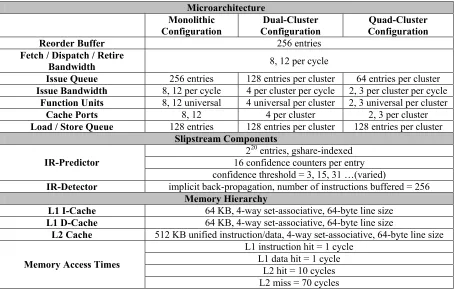
Table 5-1: Microarchitecture configuration... 40
Table 5-2: Benchmarks and input data sets. ... 41
1
Introduction
Microarchitects attempt to exploit higher levels of instruction-level parallelism
(ILP) by developing processors with larger instruction windows and higher peak issue
rates. Studies have shown that it is not possible to increase processor complexity without
adversely affecting cycle time [2][18]. To harvest increasing levels of ILP while
maintaining a fast clock, clustered microarchitectures have been proposed. A clustered
microarchitecture breaks the monolithic execution window of a conventional superscalar
processor into multiple smaller windows, called clusters. Each cluster contains a
relatively small issue queue, a copy of the register file, a small number of dedicated
function units, and short (i.e., fast) bypasses among its function units. Effectively, each
cluster is a small-scale superscalar processor. The efficiency of individual clusters (less
complex issue logic, fast local bypasses, fewer register file read ports, etc.) allows the
clustered microarchitecture to be clocked faster than a monolithic microarchitecture.
Because of its significant advantages, clustering has already been implemented in the
Alpha 21264 [13].
However, the fast clock enabled by clustering comes at the cost of multiple cycles
to communicate values among clusters. If producer and consumer instructions are routed
to different clusters, the execution of consumer instructions will be delayed due to
inter-cluster communication. Thus, performance in terms of instructions executed per cycle
(IPC) is significantly affected by how instructions are steered, i.e., how instructions are
static (compiler-based) [9][17], while others are dynamic (based on run-time decisions)
[4][6][7]. More recent steering approaches are based on critical-path prediction [10][30],
the idea being that the execution of instructions on the critical path should not be delayed
by global communication.
Instructions that constrain the execution time of a program constitute its critical
path. To improve processor performance, the execution of critical-path instructions has to
be optimized. In the case of a processor with a clustered microarchitecture, this implies
that resource bottlenecks (e.g., limited function units in a cluster) and inter-cluster
communication latency must have minimum impact on the execution of critical-path
instructions.
This thesis proposes exploiting the distinction between effectual and ineffectual
instructions, originally defined in the context of slipstream processors
[14][20][21][24][28], in the context of clustered microarchitectures. The key idea put
forth in the slipstream paradigm is that only some of the instructions in the dynamic
instruction stream are needed for the correct forward progress of the program. These
instructions are called effectual instructions. Instructions that are non-essential for correct
forward progress are called ineffectual instructions. Ineffectual instructions include
unreferenced writes, non-modifying writes, and highly predictable branches (and all of
the computation chains feeding these instructions). We observe that ineffectual
instructions are by definition not critical. Their outcomes are not needed, hence their
Unreferenced writes: These instructions produce values that are never consumed.
Non-modifying writes: These instructions do not change machine state and so
effectual dependent instructions are not truly dependent on them.
Correctly-predicted branches: Since the predictions are correct, verification can
be deferred without penalty (other than tying up rename checkpoints).
We conclude that the effectual component of the program is critical and the
ineffectual component is not, and this distinction should shape the way in which
instructions are assigned to clusters on a clustered microarchitecture.
The chief performance limiter of a clustered microarchitecture is inter-cluster
communication between instructions. Specifically, inter-cluster communication between
path instructions is the most harmful. The slipstream paradigm identifies
critical-path instructions in the form of effectual instructions. We propose eliminating virtually
all inter-cluster communication among effectual instructions, simply by ensuring that the
entire effectual component of the program executes within a cluster. We propose two
alternative execution models that achieve this.
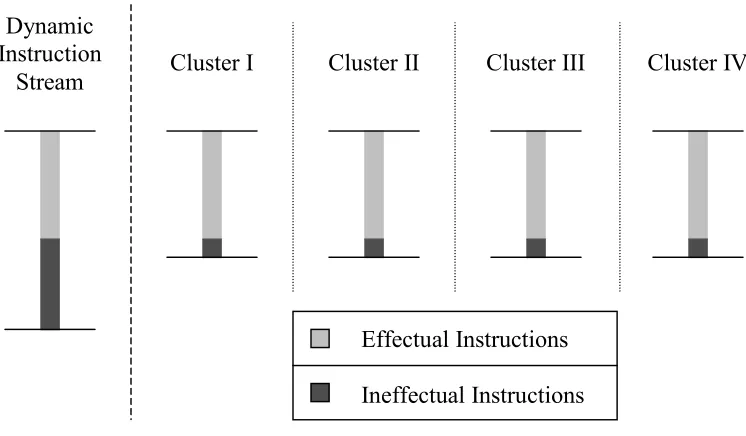
In the first model (called the replication model), the effectual program component
(called the A-stream in slipstream processors [20]) is replicated and executed on
all clusters. Ineffectual instructions are not replicated, i.e., they are executed in a
distributed manner on all clusters. Consider the quad-cluster configuration shown
component and an ineffectual component. A full copy of the effectual component
is executed on each cluster, whereas ineffectual instructions are distributed among
the clusters.
Effectual Instructions
Ineffectual Instructions Cluster I
Dynamic Instruction
Stream Cluster II Cluster III Cluster IV
Figure 1-1: Replication model of instruction execution in a clustered microarchitecture.
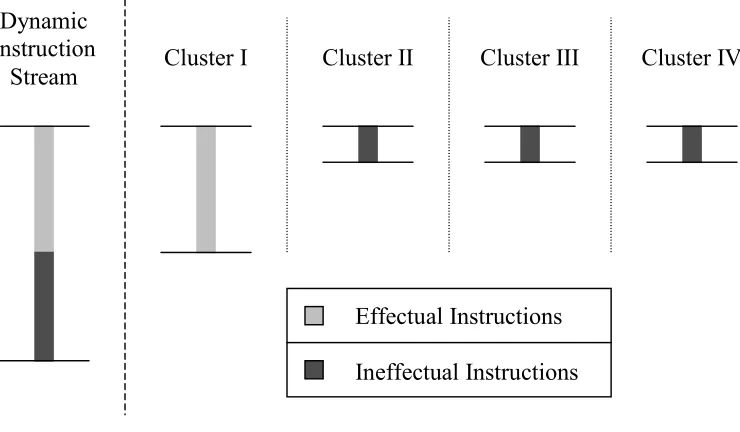
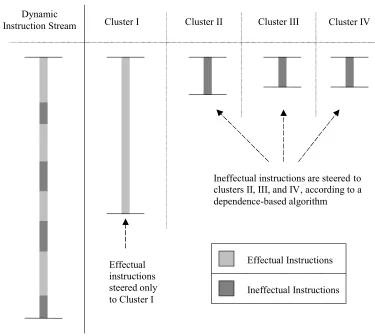
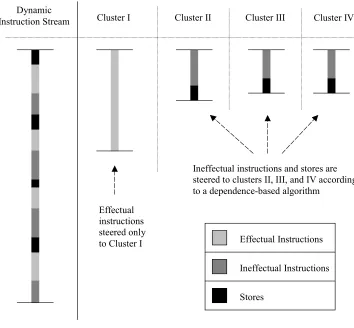
In the second model (called the dedicated-cluster model), a single copy of the
effectual program component is executed on a dedicated cluster (i.e., no
replication). Ineffectual instructions are executed in a distributed manner on all
other clusters. From Figure 1-2, it can be seen that the effectual component of the
dynamic instruction stream is executed only on cluster I, while ineffectual
Effectual Instructions
Ineffectual Instructions Cluster I
Dynamic Instruction
Stream Cluster II Cluster III Cluster IV
Figure 1-2: Dedicated-cluster model of instruction execution in a clustered microarchitecture.
1.1
Contributions
This thesis proposes methods for minimizing inter-cluster communication
between effectual instructions, virtually desensitizing the performance of a clustered
microarchitecture to inter-cluster communication latency. The contributions of this thesis
are as follows.
• A clustered microarchitecture has been developed that incorporates slipstream
components for distinguishing effectual and ineffectual instructions. The rename
stage is enhanced with conventional steering heuristics and new heuristics,
including assigning the same instruction to multiple clusters (replication)
existing renaming/register file mechanisms for supporting the new execution
models transparently.
• Four new algorithms (two based on the replication model and two based on the
dedicated-cluster model) for instruction execution in a clustered microarchitecture
are developed.
Replication of effectual component: A copy of the effectual program component is
executed on each of the clusters. Thus, virtually no inter-cluster communication
takes place between effectual instructions. The execution of ineffectual
instructions is distributed across all clusters as the delay experienced in their
execution can be tolerated.
Replication of effectual component with store distribution: The first algorithm
puts extra pressure on the limited issue bandwidth of a cluster. To ease this
pressure, the algorithm is slightly modified. Effectual stores are distributed
instead of replicated, like ineffectual instructions. The rationale is that effectual
stores are potentially more latency-tolerant than register-writing instructions, due
to typically longer separation between stores and loads as compared to producers
and consumers of register values. Issue bandwidth is freed within each cluster
because each cluster no longer executes all effectual stores (effectual stores, like
Dedicated-cluster for effectual component: The effectual program component is
executed on a single dedicated cluster called the effectual cluster. Ineffectual
instructions are steered to clusters other than the effectual cluster. No inter-cluster
communication exists between effectual instructions as they are executed on a
single cluster.
Dedicated-cluster for effectual component with store distribution: In the previous
algorithm, a large number of instructions are executed on the effectual cluster as
compared to the number of instructions executed on each of the other clusters.
Off-loading effectual stores to other clusters reduces demand on the effectual
cluster and does not increase inter-cluster register communication. All effectual
instructions except effectual stores are executed on a single cluster, while
effectual stores and all ineffectual instructions are steered to the remaining
clusters. The speedup gained by freeing execution resources on the effectual
cluster compensates for the increase in inter-cluster communication between
effectual stores and loads. This is especially beneficial in the case of low
inter-cluster bypass latencies, where execution bandwidth, not communication, is the
bottleneck.
• We study the effect of increasing inter-cluster communication latency on the
performance of various steering heuristics for dual-cluster and quad-cluster
configurations. To the best of our knowledge, no other research considers the
(However, Aggarwal and Franklin [1] indirectly observed the effect of increasing
inter-cluster communication latency by increasing the number of clusters.) We are
interested in the impact of ramping up the clock rate of each cluster to the point
where inter-cluster communication is in the tens-of-cycles regime. This scenario
is effectively a distributed system on a single chip.
• We evaluate slipstream-related parameters in the design space of slipstream-based
clustered microarchitectures. We vary instruction-removal confidence threshold
and instruction-removal criteria.
1.2
Organization of the Thesis
Chapter 2 gives an overview of clustered microarchitectures and conventional
steering heuristics. Chapter 3 gives an overview of slipstream components that separate
effectual and ineffectual instructions. In Chapter 4, slipstream-based steering models are
proposed and explained. The simulation methodology and benchmarks are described in
Chapter 5. Chapter 6 presents the experimental results. Related work is discussed in
2
Processors with a Clustered Microarchitecture
The amount of instruction-level parallelism (ILP) that can be extracted from a
program plays a major role in the performance of a superscalar processor. Larger
instruction windows combined with higher peak issue rates and more function units can
exploit large amounts of ILP. Studies have shown that large instruction windows and
high issue rates result in slower wakeup and select logic [2][18]. Also, larger register files
and more function units result in slower bypasses. Therefore, it is not possible to build
large monolithic instruction windows without adversely affecting the cycle time of a
processor.
In order to harvest increasing levels of ILP while maintaining a fast clock,
clustered microarchitectures have been proposed. A clustered microarchitecture divides
the monolithic execution window of a conventional superscalar processor into multiple
smaller windows called clusters. A cluster consists of a relatively small instruction
window, a copy of the register file, a small number of dedicated function units, and short
bypasses among its function units called intra-cluster bypasses. Intra-cluster bypasses
are fast because they span only a few function units. A global bypass bus called the
inter-cluster bypass bus interconnects all the clusters in the processor. The longer inter-cluster
bypasses are slow because they span all clusters.
clustered microarchitecture. For the type of clustered microarchitecture described earlier,
the dispatch stage performs steering. This has been called dispatch-driven instruction
steering by Parlacharla and Smith [18]. Dispatch-driven steering results in a
highly-efficient design for individual clusters. The smaller instruction window and moderate
issue bandwidth imply less complex (i.e., fast) wakeup and select logic. Fewer function
units and a smaller register file (due to fewer read ports) enable the use of shorter (i.e.,
faster) bypasses within a cluster. Thus, a clustered microarchitecture can be clocked
faster than a monolithic microarchitecture.
A second form of clustered microarchitecture uses a monolithic instruction
window that issues instructions to multiple clusters. In this case, a cluster only has a copy
of the register file, a small number of dedicated function units, and short bypasses among
its function units. As before, inter-cluster bypasses connect the clusters and are slower
than the fast intra-cluster bypasses. In this form of clustered microarchitecture, an
instruction resides in the monolithic issue queue and is assigned to a cluster only when it
becomes ready to issue. Thus, instruction steering is performed in the issue stage. This
approach has been called execution-driven instruction steering by Parlacharla and Smith
[18]. This form of clustered microarchitecture has been implemented in the integer
pipeline of the Alpha 21264 [13]. The integer pipeline has a single issue queue with two
clusters. Each integer cluster consists of a copy of the integer register file and an equal
number of integer function units. A value produced in a cluster is communicated to
consumers in the same cluster, in the same cycle the value is produced. However, the
Execution-driven steering tends to be more effective than dispatch-driven steering
because it defers steering until a more informed decision can be made. However, this
approach uses a large instruction window and is therefore less complexity-effective.
Also, steering logic is added to the issue stage, making it even more complex. Therefore,
the dispatch-driven approach is the better method in terms of efficiency.
2.1
Clustered Microarchitecture
In this thesis, we will consider a clustered microarchitecture that utilizes
dispatch-driven steering. Instructions are steered to clusters at the time of dispatch. Consequently,
instructions issue and execute within the cluster to which they are steered, as they would
on a small-scale superscalar processor. A value produced within a cluster is quickly
bypassed to consumers in the same cluster, via the intra-cluster bypasses. Thus, producers
and consumers execute in consecutive cycles if they are in the same cluster. All values
produced within a cluster are also communicated to the other clusters. However, values
produced in a cluster are available to consumers in another cluster only after a certain
delay called the inter-cluster communication latency. This delay depends on the number
of clusters and the size of the clusters.
As we move from a centralized microarchitecture to a clustered microarchitecture,
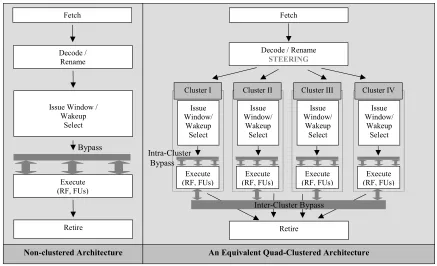
several changes are needed. The salient features of a clustered microarchitecture are
highlighted by comparing a quad-clustered configuration to a non-clustered
Non-clustered Architecture
Fetch
Decode / Rename
Issue Window / Wakeup Select Execute (RF, FUs) Retire Bypass
An Equivalent Quad-Clustered Architecture
Decode / Rename
STEERING Fetch Retire Intra-Cluster Bypass Issue Window/ Wakeup Select Execute (RF, FUs) Cluster I Issue Window/ Wakeup Select Execute (RF, FUs) Cluster II Issue Window/ Wakeup Select Execute (RF, FUs) Cluster III Issue Window/ Wakeup Select Execute (RF, FUs) Cluster IV Inter-Cluster Bypass
Figure 2-1: Comparison between a non-clustered microarchitecture and a quad-clustered microarchitecture.
Note that the execution resources of the monolithic microarchitecture are divided
equally among all clusters. From the figure, the following observations can be made.
• Each cluster has a copy of the physical register file. A value produced within a
cluster is written into its copy of the register file, and all other copies. However, it
takes longer for the value to propagate to other copies of the register file (i.e.,
register files in other clusters), and it is dictated by the inter-cluster bypass
latency. The crucial advantage of replicating the register file is that the number of
read ports for each copy of the register file is far fewer than the number of read
ports for the register file of a monolithic configuration. The reason is that fewer
instructions issue each cycle within a cluster.
• The issue window, issue bandwidth, and function units of the monolithic
• An intra-cluster bypass bus is used to communicate values within a cluster and an
inter-cluster bypass bus is added to connect all clusters. The intra-cluster bypasses
are much faster than the inter-cluster bypass.
• To ensure that store-load dependences are observed, the memory disambiguation
unit is replicated, i.e., all clusters maintain a copy of the load/store queue. Stores
broadcast their addresses and values to all clusters, incurring the penalty of
inter-cluster communication latency. The store addresses and values are used by each
cluster to detect memory dependences and perform store-load forwarding as
needed.
• There is no change to the in-order front-end (fetch unit, decode, and rename unit)
and in-order back-end (retirement unit). The fetch, dispatch, and retire stages
remain centralized. Only the out-of-order execution window is distributed. The
only modification is that steering functionality is added to the dispatch stage.
Table 2-1 summarizes how the various resources of a non-clustered
microarchitecture change after distributing them among clusters in a quad-clustered
configuration. The first column in the table shows the hardware resources. The second
column characterizes the resources for the monolithic configuration. The third column
characterizes the resources for the quad-cluster configuration. From the table, the
following observations can be made regarding a clustered microarchitecture.
• The fetch and dispatch stages are common to all clusters, hence the fetch
bandwidth and dispatch bandwidth are not distributed. Likewise, the retirement
• The organization of the execution window is effectively transparent to renaming
and retirement, hence there is only one architectural map table, rename map table,
and free list, as usual.
• The issue bandwidth, cache ports, instruction queue, and function units of the
monolithic microarchitecture are divided equally among the four clusters.
• The register file is replicated, one copy per cluster. However, the number of read
ports to each cluster register file is reduced with respect to the monolithic register
file, since each cluster register file only needs to support reads from instructions
within the cluster. The number of write ports to each cluster register file is not
reduced with respect to the monolithic register file because all values are written
into each cluster register file.
• The load/store queue is replicated, one copy per cluster, as described earlier.
Table 2-1: Comparison of hardware resources between a base superscalar processor and a quad-clustered processor.
Hardware Resource Base Superscalar Quad – Cluster
Fetch bandwidth 8 8 (common to all)
Dispatch bandwidth 8 8 (common to all)
Active list size 128 128 (common to all)
Free list size 128 128 (common to all)
Rename map table 1 1 (common to all)
Architectural map table 1 1 (common to all)
Issue bandwidth 8 2 per cluster
Cache ports 4 1 per cluster
Issue queue 128 32 per cluster
Registers 195 195 per cluster
Register read ports 16 4 per cluster
Register write ports 8 8 per cluster
Load / store unit 1 1 per cluster
Each cluster has a copy of the physical register file. This not only provides fast
local access, but it also reduces the number of read ports to the register file. The number
of read ports affects the size and hence the speed of the register file. This gives the
clustered microarchitecture an edge over the non-clustered microarchitecture. The
number of read and write ports are calculated in the following two sections.
2.1.1
Number of write ports to a cluster register file
An instruction can produce only one value. Thus, a single write port is needed per
instruction per cycle. Therefore, the maximum number of write ports (WP) needed for a
monolithic microarchitecture is as follows.
WPmonolithic = IW ……… Equation 2-1
The number of writes that can occur simultaneously within a cluster is equal to
the aggregate issue width of the clustered microarchitecture. The reason is that all values
have to be written in each cluster register file, even those produced by other clusters.
Thus, the number of write ports is determined by the aggregate issue width of the
clustered microarchitecture.
WPcluster = n * CIW ……… Equation 2-2
Above, n is the number of clusters and CIW is the cluster issue width.
The aggregate issue width of the clustered microarchitecture equals the total issue
width of the monolithic microarchitecture, therefore:
WPcluster = IW ……… Equation 2-4
WPcluster = WPmonolithic ……… Equation 2-5
Thus, the number of write ports to the cluster register file is equal to the number
of write ports to the monolithic register file.
2.1.2
Number of read ports to a cluster register file
In general, the number of read ports to a register file is determined by the issue
width (IW) of the processor. An instruction can have a maximum of two source operands.
Hence, two reads are performed at the same time for one instruction, which implies that
two read ports are needed per instruction per cycle. Therefore, the maximum number of
read ports (RP) needed for a monolithic microarchitecture is as follows.
RPmonolithic = 2 * IW ……… Equation 2-6
The number of instructions that can be issued per cycle within a cluster is the
cluster issue width (CIW). The number of read ports to the cluster register file is
determined by this cluster issue width, as follows.
RPcluster = 2 * CIW ……… Equation 2-7
RPcluster = 2 * IW / n ……… Equation 2-8
RPcluster = RPmonolithic / n ……… Equation 2-9
It can be seen that the number of read ports per cluster register file is reduced by a
factor of n with respect to the monolithic register file, thereby reducing its complexity
RPcluster = ¼ RPmonolithic ……… Equation 2-10
2.2
Bottlenecks in a Clustered Microarchitecture
The efficiency of various hardware resources enables a clustered
microarchitecture to have a shorter clock period than a monolithic microarchitecture.
However, clustered microarchitectures suffer from the following bottlenecks.
• Inter-Cluster Communication Latency: It takes multiple clock cycles to
communicate values via the long inter-cluster bypasses. The execution of an
instruction whose source operands are produced in another cluster is delayed due
to the extra time it takes for values to be communicated via the inter-cluster
bypass.
• Smaller Cluster Issue Bandwidth: There may be more instructions ready for issue
on a cluster than can be issued in a cycle, while at the same time, there may be
empty issue slots available in another cluster. This imbalance leads to issue
bandwidth stalls on one cluster and under-utilization of resources on the other.
2.3
Steering Heuristics
Steering heuristics dictate the performance achieved by a clustered
microarchitecture. Effective steering can reduce inter-cluster communication and
optimize resource usage, whereas ineffective steering can cause significant performance
degradation and negate the advantage that a clustered microarchitecture provides over a
Modulon (Mod3) [4]: A new cluster is selected every n instructions on the basis of a
round-robin policy. For example, for Mod3 steering in a quad-cluster configuration, the
first three instructions are assigned to cluster I, the next three to cluster II, and so on. This
algorithm does not try to minimize inter-cluster communication but achieves a fairly
good load balance via equal instruction distribution among clusters.
Branch-Cut (BC) [4]: Instructions are assigned to the same cluster until a branch is
reached. Instructions after the branch are then assigned to a new cluster according to a
round-robin policy. Therefore, instructions are steered on a basic block level. It has been
observed that instructions within a basic block typically belong to the same dependence
chain(s). Thus, forcing a possible dependent chain of instructions onto the same cluster
would reduce inter-cluster communication and achieve a balanced distribution of
instructions among the clusters.
Load-Cut (LC) [4]: Instructions are assigned to the same cluster until a load is reached.
The load and instructions following the load are assigned to a new cluster according to a
round-robin policy. Loads often begin a chain of dependent instructions. Thus, by
changing the cluster on encountering a load, a possible dependent chain of instructions is
Least-Loaded (LL) [4]: This algorithm tries to balance the distribution of instructions
among clusters. Every new instruction is assigned to the least-loaded cluster. The least
loaded cluster is the cluster with the least number of instructions in its issue queue.
Dependence-Based (Dep0): This steering heuristic was proposed by Canal et. al. [6]. An
explicit attempt is made to minimize inter-cluster communication by steering consumer
instructions to the same cluster as their producers. The information needed for steering is
obtained during instruction decoding/renaming because register dependences have to be
taken into consideration. The algorithm works as follows.
• If an instruction has no source operands, it is assigned to the least-loaded cluster.
• If an instruction has one source operand, it is assigned to the cluster where the
source operand has been produced or will be produced.
• If an instruction has two source operands, and both are in the same cluster, then
the instruction is assigned to that cluster. If the two source operands are
produced in different clusters, then the instruction is assigned to the least-loaded
cluster among the producer clusters.
Readiness-Dependence-Based (DepR): This steering heuristic is very similar to the one
proposed by Baniasadi et. al. [4]. Like the previous dependence-based scheme, this
scheme also explicitly tries to minimize inter-cluster communication, but it takes the
readiness of the source operands into account. A source operand is said to be globally
ready if it is ready for consumption in all the clusters, and not just its producer cluster.
• If an instruction has no source operands, it is assigned to the least-loaded cluster.
• If an instruction has one source operand and that operand is globally ready, it is
assigned to the least-loaded cluster. Otherwise, the instruction is steered to the
cluster that produced or will produce the source operand.
• If an instruction has two source operands and both are globally ready, it is
assigned to the least-loaded cluster. Otherwise, it is assigned to the cluster that
produces the youngest source. The youngest source refers to the source operand
3
Slipstream Components used for Steering
The slipstream paradigm [20] proposes that only a fraction of the dynamic
instruction stream is needed for a program to make correct forward progress. This
component of the dynamic instruction stream is termed effectual. Many general-purpose
programs contain a significant number of instruction sequences that either have no effect
on the final outcome of a program or are highly predictable. Such instructions are called
ineffectual instructions. Ineffectual instructions include unreferenced writes,
non-modifying writes, highly-predictable branches, and computation chains leading up to
them.
A slipstream processor runs two redundant copies of a program, one slightly
ahead of the other, on a chip multiprocessor (CMP) or a simultaneous multithreading
(SMT) processor. Ineffectual instructions are speculatively removed from the leading
program, called the advanced stream (A-stream). The A-stream is sped up because it
fetches and executes fewer instructions than the original program. All data and control
outcomes from the A-stream are communicated to the trailing program, called the
redundant stream (R-stream). The R-stream compares the communicated outcomes
against its own outcomes. If a deviation is detected, the corrupted A-stream context is
recovered from the R-stream context. This deviation is called an IR-misprediction. The
R-stream also exploits the outcomes of the A-stream as accurate branch and value
original program, it fetches and executes much more efficiently. As a result, both
program copies finish sooner than the original program.
Two slipstream components are needed for identifying ineffectual instructions.
1. The instruction-removal predictor, or IR-predictor, is essentially a branch predictor
augmented for instruction removal. It generates the program counter (PC) for the next
block of instructions to be fetched in the A-stream, similar to a conventional branch
predictor. The IR-predictor also specifies a bit-vector that identifies ineffectual
instructions within a fetch block.
2. The instruction-removal detector, or IR-detector, identifies past instructions which
were not essential for the R-stream’s correct forward progress. The IR-detector then
conveys to the IR-predictor that these instructions can potentially be skipped in the
A-stream, in the future. The IR-predictor removes the corresponding instructions from
the A-stream after repeated indications by the IR-detector, i.e., after a certain
confidence threshold has been reached.
3.1
IR-predictor
The IR-predictor is a conventional branch predictor augmented to keep track of
instruction removal information. It is indexed like the gshare predictor[15], by XORing
the PC with the global branch history bits. Each table entry contains the following
• Tag: This is the start PC of the basic block and is used to determine whether the
entry contains information for the block being fetched. A partial tag can be used
to reduce the total storage, if predictor aliasing is negligible.
• 2-bit counter: A 2-bit counter is used to predict the outcome of a basic block that
ends with a conditional branch.
• Confidence counters: A resetting confidence counter [12] is provided for each
instruction in the basic block. The counter corresponding to a particular
instruction is incremented if the IR-detector identified that instruction to be
ineffectual. Otherwise, the counter is reset to zero. Repeated indications by the
IR-detector saturate the confidence counter, in which case the corresponding
instruction is predicted to be ineffectual by the IR-predictor and removed from the
A-stream when it is next encountered.
3.2
IR-detector
The IR-detector consumes retired R-stream instructions and data. It then identifies
instructions which were not essential for correct forward progress, in retrospect. The
IR-detector watches for any of the following three triggering conditions for instruction
removal.
•
Unreferenced writes, i.e., a write followed by a write to the same location, withno intervening read.
•
Non-modifying writes, i.e., a write that does not modify the value of a location.When any of the above conditions are observed, the corresponding instruction is
selected for removal and this information is passed on to the IR-predictor. Additional
ineffectual instructions are selected by a technique called back-propagation.
Back-propagation detects computation chains that feed the instructions selected for removal
based on the triggering conditions mentioned above. An instruction can be selected for
removal if all of its dependent instructions are selected for removal. For example, once a
branch is selected, the computation leading to that branch is no longer needed and can be
selected for removal, if no other instructions depend on the computation.
3.3
Use of IR-detector/IR-predictor in Steering Mechanisms
For our purposes, the IR-detector and IR-predictor are used only as a means for
identifying predicted-ineffectual instructions. That is, they are not actually used to
remove instructions, since there is no separate A-stream thread.
The bit vector produced by the IR-predictor identifies ineffectual instructions and
this is used by the steering mechanism directly, for distinguishing between effectual and
4
Thesis Contribution: Slipstream-Based Steering
The goal of slipstream-based steering is to desensitize IPC performance to tens of
cycles of inter-cluster communication latency. We conjecture that executing the effectual
component entirely on a single cluster will achieve this goal while still effectively
exploiting the parallel resources available in the clustered microarchitecture.
4.1
Replication of Effectual Component (Rep0)
We attempt to eliminate inter-cluster communication among effectual instructions
by executing a copy of the effectual component on each of the clusters. On the other
hand, the ineffectual component of the program is distributed (shared) among the
clusters. Thus, the only potential inter-cluster communication is between ineffectual
instructions in different clusters. Intra-cluster communication is guaranteed between (1)
effectual producers and effectual consumers, and (2) effectual producers and ineffectual
consumers. The latter aspect distinguishes the replication models described in this section
and Section 4.2 from the non-replication models (dedicated-cluster models) described in
Sections 4.3 and 4.4.
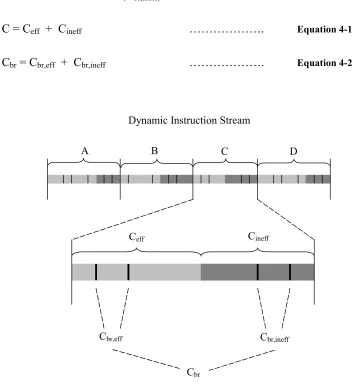
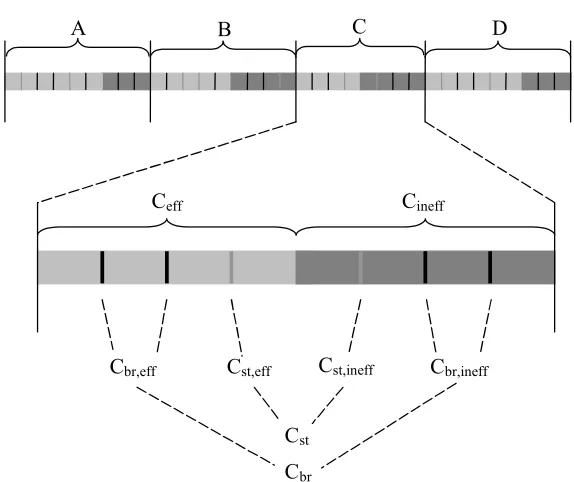
To manage the distribution of ineffectual instructions, the dynamic instruction
stream is divided into traces. A trace consists of one or more basic blocks and is
composed of both effectual and ineffectual instructions. This can be seen in Figure 4-1
the dynamic instruction stream. Ceff is the predicted-effectual component and Cineff is the
predicted-ineffectual component of trace C. We use Cbr to refer to all the branches in
trace C. Branches can also be divided into predicted-effectual branches (Cbr,eff) and
predicted-ineffectual branches (Cbr,ineff).
C = Ceff + Cineff ………. Equation 4-1
Cbr = Cbr,eff + Cbr,ineff ………. Equation 4-2
Dynamic Instruction Stream
Ceff Cineff
Cbr,eff Cbr,ineff
Cbr
A B C D
Figure 4-1: A breakdown of the dynamic instruction stream.
We say that each trace is owned by a particular cluster. A new trace is assigned to
a cluster in a round-robin manner. For an n-cluster configuration, each cluster owns one
out of every n traces. All instructions in a trace are executed within the cluster that owns
are executed within the cluster which owns that trace. Only the predicted-effectual
instructions of the trace are executed on clusters that do not own the trace. In this way,
predicted-effectual instructions are replicated and predicted-ineffectual instructions are
distributed equally among the clusters.
According to this policy, effectual branches are redundantly executed on all
clusters, raising the question of how to resolve mispredicted branches. The first option is
to exploit redundancy and thereby allow the earliest resolved branch to redirect the fetch
unit. However, we found the complexity of managing multiple branches with a single
rename checkpoint to be cumbersome. So, we instead implemented the second option,
which is to steer effectual branches to only a single cluster, the one that owns the trace
containing the branch. This also reduces contention for issue bandwidth within the
clusters slightly. Note also that it does not increase inter-cluster communication.
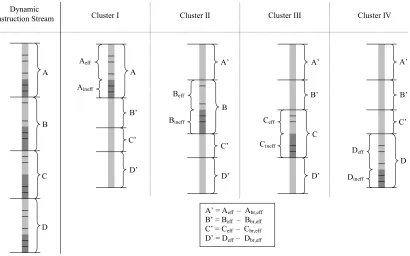
Figure 4-2 shows how this heuristic works for a quad-cluster configuration. A
segment of the dynamic instruction stream is divided into four traces, A, B, C, and D. A’
is the reduced version of trace A. For the quad-cluster configuration shown, cluster I
owns trace A, cluster II owns trace B, cluster III owns trace C, and cluster IV owns trace
D. Thus, a cluster owns one in every four traces. All instructions in trace A are executed
on cluster I, but predicted-ineffectual instructions and branches of trace A are not
executed on clusters II, III, and IV. In other words, predicted-effectual instructions minus
predicted-effectual branches of trace A are executed on clusters II, III, and IV. The
A’ = A – Aineff – Abr,eff ………. Equation 4-3
Since A = Aeff + Aineff,
A’ = Aeff – Abr,eff ………. Equation 4-4
The same logic can be applied to the other traces.
Dynamic
Instruction Stream Cluster I Cluster II Cluster III Cluster IV
A’ = Aeff – Abr,eff
B’ = Beff – Bbr,eff
C’ = Ceff – Cbr,eff
D’ = Deff – Dbr,eff
A
B
C
D
Aineff
Aeff
C’ B’
D’ A
A’
C’
D’ Beff
Bineff
B
A’
D’ B’
Ceff
Cineff
C
A’
C’ B’
Deff
Dineff
D
Figure 4-2: Replication of the effectual component.
4.1.1
Implications of redundant execution
In a clustered microarchitecture, each cluster has a copy of the physical register
file. While decoding and renaming an instruction, the logical destination register is
mapped to the same physical register on all clusters. Using our steering algorithm, a
predicted-effectual instruction is dispatched to each of the clusters for redundant
an instruction will write their identical values to the same location in all the physical
register files. Note that it is wasteful for effectual copies to broadcast their values to other
clusters. We could eliminate communication for these redundant values, and thereby
reduce register file write ports, reduce power consumption on inter-cluster bypasses, etc.
This aspect is discussed in the future work section (Section 8.2).
As predicted-effectual instructions are executed redundantly on each of the
clusters, it is possible that the result of a predicted-effectual instruction executed on
cluster I is communicated to cluster II before cluster II’s copy of the instruction has
executed. In this case, dependent instructions in cluster II may issue/execute before the
parent instruction executes in cluster II. Since the values produced by redundant
instructions are identical, there is no problem with this scenario.
4.1.2
Regarding memory disambiguation
In the base clustered microarchitecture, broadcast of store addresses and values to
other clusters is delayed by the inter-cluster communication latency. This may make
memory disambiguation a major bottleneck due to loads conservatively waiting for all
prior store addresses. A solution is to use aggressive memory dependence speculation. It
has been shown that memory dependence speculation is almost as accurate as oracle
memory disambiguation [8][16]. In any case, our architecture is less sensitive to this
problem since effectual stores and loads reside in the same cluster. There is still the
problem of ineffectual stores delaying disambiguation of effectual loads in other clusters.
dependences in this situation, since presumably effectual loads should not depend on
ineffectual stores.
4.1.3
Implication of IR-mispredictions
An instruction-removal misprediction, or IR-misprediction, occurs when an
effectual instruction is incorrectly predicted as an ineffectual instruction [20]. In our
context, this implies that an instruction that should have executed redundantly on each of
the clusters is now executed on only one of the clusters. Thus, effectual instructions that
depend on an IR-mispredicted-instruction in another cluster will have to wait for the
value to be communicated via the inter-cluster bypass. Therefore, an IR-misprediction
results in inter-cluster communication between effectual instructions.
4.1.4
Changes to the microarchitecture
Key changes that must be introduced in the microarchitecture for implementing
this scheme are as follows.
• After fetching an instruction, it is dispatched to all clusters if it is
predicted-effectual (except for predicted-predicted-effectual branches), or steered to one of the
clusters (depending on the owner of the trace) if it is predicted-ineffectual or a
predicted-effectual branch.
• Instruction dispatch is stalled if any of the cluster issue queues are full. This is
only true for predicted-effectual instructions (except branches) since they must be
• A predicted-effectual instruction is retired only after all copies have completed
execution on each of the clusters. In other words, multiple instances of an
instruction are re-integrated into a single instance before retiring.
4.2
Replication of Effectual Component with Store Distribution
(RepS)
We modify the algorithm in Section 4.1 to reduce contention for cluster issue
bandwidth. Instead of replicating effectual stores, we distribute them just like ineffectual
instructions, based on the fact that memory dependence distances are longer than register
dependence distances. Therefore, all effectual instructions except
predicted-effectual branches and predicted-predicted-effectual stores are replicated. This implies that no
branches or stores are replicated.
Distributing effectual stores increases inter-cluster communication between
effectual stores and loads. On the other hand, by not executing stores redundantly,
resources are freed for executing the residual effectual component faster. The
newly-exposed inter-cluster communication between effectual stores and loads may be offset by
the speedup gained by freeing execution resources in each cluster.
Figure 4-3 shows a segment of the dynamic instruction stream with a breakdown
more terms are introduced. Cst indicates all the stores in trace C, Cst,eff indicates the
predicted-effectual stores, and Cst,ineff indicates the predicted-ineffectual stores.
Dynamic Instruction Stream
C eff Cineff
A B C D
Cst Cst,ineff
Cst,eff Cbr,ineff
C br,eff
Cbr
Figure 4-3: A breakdown of the dynamic instruction stream.
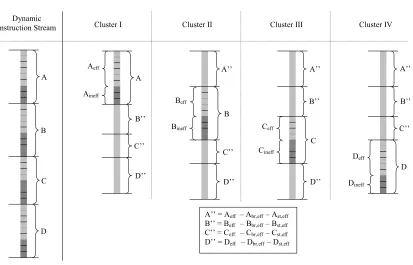
Consider the quad-cluster configuration shown in Figure 4-4. A segment of the
dynamic instruction stream is divided into traces A, B, C, and D. A’’ indicates the
reduced version of a trace. As in the first algorithm, a cluster owns one in every four
traces. Therefore, cluster I owns trace A, cluster II owns trace B, and so on. A cluster that
owns a trace executes all instructions in that trace. On the other hand, a cluster that does
not own a trace does not execute the branches, stores, and predicted-ineffectual
other than predicted-effectual stores and predicted-effectual branches, shown below for
A”.
A’’ = A – Aineff – Abr,eff – Ast,eff ………. Equation 4-5
A’’ = Aeff – Abr,eff – Ast,eff ………. Equation 4-6
The same logic applies to other traces.
Dynamic
Instruction Stream Cluster I Cluster II Cluster III Cluster IV
A’’ = Aeff – Abr,eff – Ast,eff B’’ = Beff – Bbr,eff – Bst,eff C’’ = Ceff – Cbr,eff – Cst,eff D’’ = Deff – Dbr,eff – Dst,eff A
B
C
D
A
Aineff Aeff
C’’ B’’
D’’
C’’
D’’ Beff
Bineff
B
A’’ A’’
D’’ B’’
Ceff
Cineff
C
A’’
C’’ B’’
Deff
Dineff
D
Figure 4-4: Replication of effectual component with store distribution.
Below are the key changes that must be introduced in the microarchitecture for
implementing this scheme (in addition to the changes described for the previous
• After fetching an instruction, it is dispatched to all clusters if it is
predicted-effectual (except for predicted-predicted-effectual branches/stores), or steered to one of the
clusters (depending on the owner of the trace) if it is predicted-ineffectual or a
predicted-effectual branch/store.
4.3
Dedicated Cluster for Effectual Component (DEC0)
We propose another model for eliminating inter-cluster communication between
effectual instructions: All predicted-effectual instructions are executed on a single
dedicated cluster and all predicted-ineffectual instructions are steered to clusters other
than the dedicated cluster to which effectual instructions are steered. In this way,
inter-cluster communication between effectual instructions is eliminated, except in the rare
case of an IR-misprediction (since an effectual instruction is misclassified as an
ineffectual instruction and steered to a different cluster). Ineffectual instructions, which
depend on both effectual and ineffectual instructions, experience delays in execution due
to inter-cluster communication latency. As these instructions are less critical, these delays
can be tolerated. Note that the advantage of this model with respect to the previous
models is that computation is compressed to just the effectual component on the
dedicated cluster. On the other hand, ineffectual instructions must now wait longer for
values from effectual instructions, since the effectual component is not replicated on all
clusters.
Figure 4-5 shows how this heuristic works for a quad-cluster configuration. The