
Graded Encoding Schemes from Obfuscation
∗
Pooya Farshim
†,1,2, Julia Hesse
1,2,3, Dennis Hofheinz
‡,3, and Enrique Larraia
§1
DIENS, ´
Ecole normale sup´
erieure, CNRS, PSL Research University, Paris, France
2INRIA
3
Karlsruhe Institute of Technology, Germany
{
pooya.farshim, julia.hesse
}
@ens.fr,
[email protected], [email protected]
April 12, 2018
Abstract
We construct a graded encoding scheme (GES), an approximate form of graded multilinear maps. Our construction relies on indistinguishability obfuscation, and a pairing-friendly group in which (a suitable variant of) the strong Diffie–Hellman assumption holds. As a result of this abstract approach, our GES has a number of advantages over previous constructions. Most importantly:
• We can prove that the multilinear decisional Diffie–Hellman (MDDH) assumption holds in our setting, assuming the used ingredients are secure (in a well-defined and standard sense). Hence, our GES does not succumb to so-called “zeroizing” attacks if the underlying ingredients are secure.
• Encodings in our GES do not carry any noise. Thus, unlike previous GES constructions, there is no upper bound on the number of operations one can perform with our encodings. Hence, our GES essentially realizes what Garg et al. (EUROCRYPT 2013) call the “dream version” of a GES. Technically, our scheme extends a previous, non-graded approximate multilinear map scheme due to Albrecht et al. (TCC 2016-A). To introduce a graded structure, we develop a new view of encodings at different levels as polynomials of different degrees.
Keywords. Multilinear maps, graded encoding schemes, indistinguishability obfuscation.
∗An extended abstract of this work appears in the proceedings of PKC 2018. This is the full version. †Supported in part by grant ANR-14-CE28-0003 (Project EnBid)
‡Supported by ERC grant 724307, and by DFG grants HO 4534/2-2 and HO 4534/4-1.
Contents
1 Introduction 3
1.1 The (non-graded) approximate multilinear map of AFHLP . . . 4
1.2 Our new graded encoding scheme . . . 5
2 Preliminaries 7 2.1 Homomorphic public-key encryption . . . 8
2.2 Obfuscators . . . 8
2.3 Dual-mode NIZK proof systems . . . 9
2.4 Languages with hard membership . . . 10
3 Graded Encoding Schemes 11 4 Approximate Multilinear Maps 12 4.1 Syntax . . . 12
4.2 Overview of AFHLP . . . 13
5 The GES Construction 13 5.1 Setup . . . 14
5.2 Encodings and equality . . . 14
5.3 Addition . . . 15
5.4 Multiplication . . . 17
5.5 Sampling . . . 18
5.6 Extraction . . . 18
6 Indistinguishability of Encodings 18 7 Hardness of MDDH 20 7.1 Hardness of MDDH . . . 21
7.2 Downgrading attacks . . . 22
A Details of the AFHLP Symmetric Multilinear Map 25 A.1 Setup . . . 25
A.2 Encodings . . . 26
A.3 Equality . . . 26
A.4 Addition . . . 26
A.5 The multilinear map . . . 27
A.6 Sampling . . . 27
A.7 Extraction . . . 28
B Proof of Theorem 6.1: Indistinguishability of Encodings 28
C Proof of Lemma 6.2 29
1
Introduction
The GGH candidate multilinear map. In 2013, Garg, Gentry, and Halevi (GGH) [GGH13a] proposed
the first plausible construction of an (approximate) multilinear map (MLM). In a nutshell, an MLM is a map
e:Gκ −→
GT (for groupsGandGT) that is linear in each input. Of course, we are most interested in the
case of “cryptographically interesting” groupsG(in which, e.g., computing discrete logarithms is infeasible), non-trivial mapse(with non-trivial kernel), and preferably large values of κ. The surprising cryptographic consequences of such “cryptographically interesting” MLMs were already investigated in 2003 by Boneh and Silverberg [BS03], but an actual construction of an MLM remained elusive until the candidate construction of GGH.
Unfortunately, GGH only presented an “approximate” MLM in the following sense:
• Instead of group elements, their einputs (and outputs) are encodings. An encoding is a non-unique representation of a group element, and there is no guarantee about which particular encoding the group operation (or e) outputs. However, every encoding allows to derive a “canonical form” that uniquely determines the encoded group element. (This canonical form allows no further operations, though.)
• Each encoding carries a “noise level” that increases with each operation. If the noise level grows beyond a certain threshold, no further operations are possible.
However, the GGH MLM also has an important graded property that allows to evaluate e partially, in a sense we will detail later. In particular this graded structure has made the GGH MLM tremendously useful: notable applications ofgraded MLMs include indistinguishability obfuscation [GGH+13b], witness
encryp-tion [GGSW13], attribute-based encrypencryp-tion for general circuits [GGH+13c], and constrained pseudorandom
functions for general circuits [BW13]. Furthermore, graded MLMs enable a very powerful class of pro-grammable hash functions [HK08], which in turn allows to implement random oracles in certain “algebraic” applications [HSW13, FHPS13].
After GGH’s MLM construction, several other (graded and approximate) MLM constructions have been proposed [CLT13, LSS14, GGH15, CLT15]. However,all of these constructions (including the original GGH scheme) succumb to cryptanalytic attacks [CHL+15, CGH+15, CLLT16, MSZ16]. In particular, currently there is no obvious way to instantiate schemes relying on multilinear maps, e.g., the schemes from [GGSW13, GGH+13c, BW13, HSW13, FHPS13].1
Graded MLMs. There is one (approximate) MLM construction of Albrecht, Farshim, Hofheinz, Larraia,
and Paterson (AFHLP) [AFH+16] that does not fall victim to any of the mentioned cryptanalytic attacks
on MLMs. However, this construction does not offer agraded MLM, and thus cannot be used to bootstrap, e.g., witness encryption. Graded MLMs are algebraic tools that can enable other algebraic tools such as multilinear Groth-Sahai proofs, or multilinear programmable hash functions. It is thus still an interesting open problem whether graded MLMs exist, and whether the results of [GGH+13b] can be augmented to
even show equivalence to indistinguishability obfuscation.
Our contribution. In this work, we construct graded, approximate MLMs that do not succumb to any
of the known attacks. Technically, we extend the non-graded MLM construction from AFHLP [AFH+16]
to a graded MLM. We prove that the multilinear decisional Diffie–Hellman (MDDH) assumption [GGH13a] holds relative to our MLM, provided that the used ingredients are secure.
Interestingly, our MLM has two technical features that previous graded approximate MLMs do not have: 1. Our encodings do not carry any noise (although they are not unique). In particular, there is no limit
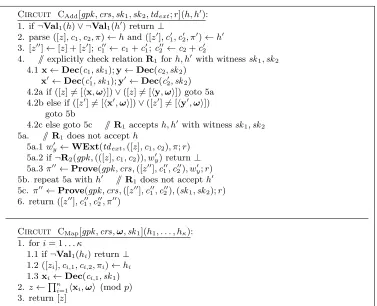
on the number of operations that one can perform with our encodings.
2. The canonical forms derived from encodings allow further group operations (but no further pairings). Our new MLM (when implemented with the indistinguishability obfuscator from [GGH+13b, GMS16])
cur-rently forms the only plausible graded MLM, and thus the only plausible way to implement a number of MLM-based constructions [GGSW13, GGH+13c, BW13, HSW13, FHPS13].
1We note, however, that the cryptographic tasks that the constructions from [GGSW13, BW13] aim to achieve can be
Furthermore, our construction is generic and modular. In particular, we reduce the quest to develop a secure (graded) MLM to the quest for a secure indistinguishability obfuscator. This seems natural (and is standard in most areas of cryptography), but given the history of previous MLM candidates (which were based on complex algebraic or combinatorial assumptions), this is not an “understood feature” at all for MLMs.
In fact, taken together with recent constructions of indistinguishability obfuscation (iO) from multilinear maps (e.g., [GGH+13b, Lin16, AS17, LT17]), our result shows a (somewhat loose) equivalence of
indis-tinguishability obfuscation (iO) and (graded and approximate) MLMs, in the presence of a pairing-friendly group. This equivalence is loose in the following sense. First, the assumptions on both ends of the equivalence do not match: some of these works (e.g., [GGH+13b]) construct iO from MLMs which support very strong
computational assumptions (much stronger than MDDH) or require asymmetric multilinear maps. On the other hand, we use iO to construct symmetric MLMs in which we can (at this point) only prove compara-tively mild (though still useful) computational assumptions (such as MDDH). Still, there seems no inherent barrier to proving stronger computational assumptions for our construction, or to adapt our construction to asymmetric pairings, and we leave open to tighten this equivalence. Second, going through our equivalence suffers subexponential security loss. Namely, we requireprobabilisticindistinguishability obfuscation, which can be constructed from iO [CLTV15], but currently only through a sub-exponential reduction.
However, we note that such an equivalence would not be highly surprising given recent results on con-structing iO from MLMs [Lin16, AS17]. These works only require “one-shot” (but asymmetric) MLMs, and not evengraded encodings as we construct them.
Related Work. Our work is closely related to [AFH+16], since the non-graded MLM there serves as a
starting point for our graded MLM. We will summarize their construction in Section 4 and give an informal overview below.
Recently, Paneth and Sahai [PS15] have shown a near-equivalence of a suitable abstraction of MLMs with iO. Their result requires no computational assumptions at all, but also does not consider MLMs in our sense. In particular, they construct an abstraction of a MLM that only admits restricted access to encodings similar to the one in [GGH+13b]. Beyond the group operation and the multilinear map, efficient procedures for, e.g., uniform sampling, comparison or rerandomization of encodings, are not part of this abstraction. Conversely, our notion of a MLM, like the ones from [AFH+16, GGH13a], contains descriptions of efficient procedures for these tasks.
It would be interesting to see how the restricted MLMs of [PS15] can be used to instantiate the construc-tions from [FHPS13, HSW13, BWZ14, BLR+15] directly, i.e., without making the detour via iO. However,
since iO alone is not even known to imply one-way functions (see [GR07] for a discussion), this will require additional assumptions.
Pass et al. [PST14] give a security definition of graded MLMs that requires that whenever encodings are generically equivalent (that is, cannot be distinguished with generic operations alone), they should be computationally indistinguishable as encodings. They show that this MLMs which satisfy this strong assumption imply indistinguishability obfuscation. It is not clear, however, how to construct such strongly secure MLMs (without resorting to idealized models such as the generic group model).
1.1
The (non-graded) approximate multilinear map of AFHLP
Encodings. Since our own construction is an extension of the (non-graded) approximate MLM of [AFH+16],
we first recall their work. Simplifying slightly, AFHLP encode a group elementgz (from a cyclic group
Gof
orderp) as
h = (gz,c=Enc((α, β),pk), π),
where
• c is a homomorphic encryption (under some public keypk) of exponentsα, β∈Zp,
• πis a non-interactive zero-knowledge proof that these exponents representzin the sense thatgz=gαuβ
Hence, AFHLP simply enhance the group element gz ∈ G by an encrypted representation of its discrete
logarithmz (and a suitable consistency proof). This added information will be instrumental in computing a multilinear map on many encodings. Note that since c andπ will not be uniquely determined, there are many possible encodings of aG-elementgz.
Addition. Encodings in the AFHLP construction can be added with an (obfuscated) public circuitAdd.
This circuit takes as input two encodings h1 = (gz1,c1, π1) and h2 = (gz2,c2, π2), and computes the new
encodingh1+h2= (gz,c, π) as follows:
1. gz=gz1+z2 is computed using the group operation in
G;
2. c is computed homomorphically fromc1andc2 (adding the encrypted exponent vectors (αi, βi));
3. the consistency proofπis computed using the decryption keysk as a witness to show that the resulting
c indeed contains a valid representation ofz=z1+z2.
Here, only the computation of π requires secret information (namely, the decryption key sk). This secret information allows to derive a valid representation (α, β) ofgz. The most delicate part of the security proof from [AFH+16] is to argue that the obfuscated circuit knowing sk does not help in solving (a multilinear variant of) the decisional Diffie–Hellman problem.
The multilinear map. The AFHLP encodings can also be multiplied with an (obfuscated) public circuit
Mult; this takes as input κencodingsh1, . . . , hκ withhi= (gzi,ci, πi), and outputs a single group element
gQκi=1zi. (Hence, elements from the target group
GT are trivially and uniquely encoded asG-elements.) To
computegQzi from theh
i,Mult first checks the validity of all proofsπi, and then uses the decryption key sk to retrieve representations (αi, βi). If allπi are verifying proofs, we may assume thatzi=αi+βi·ω(for
u=gω), so we can write
gQκi=1zi =
κ Y
i=0
(gωi)γi for (γ
0, . . . , γκ) = (α1, β1)∗ · · · ∗(ακ, βκ), (1)
where “∗” denotes the convolution product of vectors.2 The valuesgωi
(fori≤κ) are hardwired intoMult, soMultcan computegQzithrough (1). Note that this way,Multcan compute aκ-linear map on encodings,
but not a (κ+ 1)-linear map. This observation is the key to showing that the MDDH assumption holds in this setting. (Indeed, the MDDH assumption states that givenκ+ 1 encodings h1, . . . , hκ+1 as above, it is
hard to distinguishgQκi=1+1zi from random.)
1.2
Our new graded encoding scheme
Before proceeding any further, we briefly recall the notions of a graded multilinear map and a graded encoding scheme.
Graded maps. In agradedmultilinear map setting, we have groupsG1, . . . ,Gκ, and (efficiently computable)
bilinear mapsei,j:Gi×Gj −→Gi+j fori+j≤κ. Hence, theei,j also allow the evaluation of a multilinear
mape:Gκ1 −→Gκ iteratively, e.g., through
e(g1, . . . , gκ) := e1,κ−1(g1, e1,κ−2(g2,· · ·, e1,1(gκ−1, gκ)· · ·)).
However, theei,j also allow “partial” evaluation ofe, which is the key to entirely new applications such as
those in [GGH+13b, GGSW13, GGH+13c, BW13].
Unfortunately, we do not currently know how to implement such a “clean” graded multilinear map. Instead, all known graded MLM constructions work on encodings (i.e., non-unique representations of group elements). Such a construction is usually called a graded encoding scheme (GES). Following the GES notation, we will henceforth also call an encoding of aG`-element alevel-`encoding.
In the following, we will describe the main ideas for our GES.
2Recall that the multiplication of polynomials can be implemented through the convolution product on the respective
coefficient vectors. In particular, we havePκ
Encodings in our scheme. In our GES, we generalize the linear representation of exponents in AFHLP to polynomials of higher degree. Additionally, we divide encodings into levels by restricting the maximum degree of the representing polynomial in each level. More formally, level-` encodings take the form
h = (gz,c=Enc(P,pk), π, `),
where
• gz∈Gfor a cyclic groupG(that does not depend on`) of prime orderp,
• P ∈Zp[X] is a polynomial of degree up to`, represented by its coefficient vector fromZ`p+1,
• c is the encryption (under a fully homomorphic encryption scheme) ofP,
• π is a non-interactive zero-knowledge proof of the equality gz = gP(ω), where ω is defined through
public values u0, . . . , uκ ∈ G with ui = gω
i
. (Hence, gz = gP(ω) is equivalent to gz = Q iu
γi
i for
P(X) =P iγiXi.)
The encodings of AFHLP can be viewed as level-1 encodings in our scheme (with linear polynomialsP).
Adding encodings. Encodings can be added using a public (obfuscated) circuit Add that proceeds
similarly to the AFHLP scheme. In particular, Add adds the gz and c parts of the input encodings
homomorphically, and derives a consistency proofπwith the decryption keysk as witness.
Multiplying encodings. The pairings ei,j : Gi ×Gj −→ Gi+j are implemented over our encodings
by (obfuscated) circuits Multi,j. Circuit Multi,j takes as input two encodings h1 = (gz1,c1, π1, i) and
h2 = (gz2,c2, π2, j) at levels i and j, respectively. The output of Multi,j is a level-(i+j) encoding h=
(gz,c, π, i+j), computed as follows:3
• gzis computed asgz=g(P1·P2)(ω), where the polynomialsP
1andP2are extracted fromc1andc2with
sk, then multiplied to formP :=P1·P2∈Zp[X], and finally used to compute
g(P1·P2)(ω) = gP(ω) =
i+j Y
`=0
uγ`
` for P(X) = i+j X
`=0
γ`X` .
(Since theu` are public, this value can be computed as long as i+j≤κ.)
• c is computed homomorphically fromc1andc2, as an encryption of the polynomialP1·P2.
• The consistency proof π (showing that indeed gz = gP(ω) for the polynomial P encrypted in c) is
computed with the decryption keysk as witness.
The key insight needed to show that the MDDH assumption holds for our GES is the same as in AFHLP’s non-graded, approximate MLM. Namely, observe that anyMulti,j can only multiply encodings ifi+j≤κ.
To compute the first component gz of any “higher-level” encoding, knowledge of gω` for ` > i+j seems
to be required. Under the SDDH assumption in G, such gω `
look random, even when givenu0, . . . , uκ. Of
course, to turn this observation into a full proof, more work is required.
Neglected details. For a useful GES, it should be possible to generate encodings with “known discrete
logarithm”; that is, we would like to be able to generate encodings for an externally given (or at least known)
z∈Zp. For this reason, the standard way to generate encodings (at any level) is to set up P as aconstant
polynomial of the formP(X) =z∈Zp. (That is, we “reserve space” inc for polynomialsP of degree` in
level-`encodings, but, by default, use only constant polynomials.) For this type of encoding with “low-degree
P,” however, our security argument above does not apply. Rather, it requires that the degree ofP increases at higher levels.
Hence, the central technical piece in our MDDH security proof will be a “switching theorem” that allows to replace a low-degreeP in an encoding with an equivalent high-degreeP0 (that satisfiesP0(ω) =P(ω)). The proof of this switching theorem is delicate, since it must work in a setting with (obfuscated) algorithms that use the decryption keysk. (Note that free access tosk would allow the retrieval of the used polynomial
P from an encoding, and hence would prevent such a switching of polynomials.)
3SinceMult
i,j can be used to multiply two encodings at levelias long as 2i≤κ, our GES can be viewed assymmetric.
To this end, we will usedouble encryptions c(instead of the single encryption c=Enc(P,pk) described above), along with a Naor–Yung-style consistency proof inπ. However, this consistency proof does not show equality of encryptions, but equivalence of encrypted representations P, P0 in the sense of P(ω) = P0(ω).
This allows to switch representations without invalidating the consistency of the double encryption. As a result, the full consistency language used for π is considerably more complicated than the one sketched before. Additionally, the proof of our switching theorem requires a special and explicit “simulation trapdoor” and Groth–Sahai-style dual-mode proof systems.
We note that similar complications arose already in AFHLP’s proof, and required similar measures. The main technical difference in our setting is that our multiplication circuitsMulti,j outputencodings(and not just group elements as in the multilinear map of AFHLP). Hence, ourMulti,jcircuits also need to construct consistency proofsπ, which requires additional secrets (as witnesses) in the description ofMulti,jand which entails additional steps in our switching theorem. (We give more details on the technical differences with AFHLP in the main body. However, we note that, in addition to providing agraded encoding scheme, we also provide simplified and tighter proofs.
Fortunately, the indistinguishability obfuscator from [GGH+13b] requires only a relatively weak MLM variant and hence is not affected by the above-mentioned cryptanalyses.4
Assumptions. In summary, our construction uses a cyclic group in which the SDDH assumption holds,
a probabilistic indistinguishability obfuscation scheme [CLTV15], a perfectly correct fully homomorphic encryption (FHE), a dual-mode non-interactive zero-knowledge proof systems, and a language with hard membership. All of these assumptions are implied by pairing-friendly SDDH groups (equipped with an asymmetric pairing) and sub-exponentially secure indistinguishability obfuscation (see [GS12]). We stress that plausible candidates for both ingredients exist (e.g., by combining [GGH13a] and [GGH+13b] to an
indistinguishability obfuscator candidate).
Road map. We first recall some preliminaries in Section 2, the GES definition in Section 3, and the AFHLP
construction in Section 4. Then, we present our GES construction in Section 5, and establish our central technical tool (the “switching theorem”) in Section 6. We prove the hardness of the MDDH in Section 7. In the appendices we provide the full proofs.
2
Preliminaries
Notation. We denote the security parameter by λ ∈ N and assume that it is implicitly given to all
algorithms in the unary representation 1λ.
By an algorithm we mean a stateless Turing machine. Algorithms are randomized unless stated otherwise, andpptas usual stands for “probabilistic polynomial-time.” In this paper, by apptalgorithm we mean an algorithm that runs in polynomial time in the security parameter (rather than the total length of its inputs). Given a randomized algorithmAwe denote the action of runningAon input(s) (1λ, x1, . . .) with uniform
random coinsrand assigning the output(s) to (y1, . . .) by (y1, . . .)←$A(1λ, x1, . . .;r).
For a finite set X, we denote its cardinality by |X| and the action of sampling a uniformly random elementxfromX byx←$ X.
Similarly, for a finite setX, the action of sampling a uniformly random elementxis denoted byx←$X. We write [k] := {1, . . . , k}. Vectors are written in boldface x, and slightly abusing notation, running algorithms on vectors of elements indicates component-wise operation.
Throughout the paper⊥denotes a special error symbol, and poly(·) stands for a fixed (but unspecified) polynomial.
A real-valued function negl(λ) is negligible if negl(λ)∈ O(λ−ω(1)). We denote the set of all negligible
functions byNegl. We use bracket notation for elements inG, i.e., writing [z] and [z0] for two elementsgz
4A recent attack on MLMs (see [MSZ16]) tackles even the weak MLM security requirements the indistinguishability obfuscator
from [GGH+13b] has. However, the construction of [GGH+13b] (resp., its MLM building block) can be suitably enhanced to
andgz0 inGand [z] + [z0] for their productgzgz
0
.
Circuits. A polynomial-sized deterministic circuit familyC:={Cλ}λ∈Nis a sequence of setsCλof poly(λ
)-sized deterministic circuits (for a fixed polynomial poly(λ)).
We assume that for all λ∈Nall circuits C∈ Cλshare a common input domain ({0,1}λ)a(λ), wherea(λ)
is the arity of the circuit family, and an output co-domain{0,1}λ.
A randomized circuit family is defined similarly except that the circuits also take random coins r ∈ {0,1}rl(λ), for a polynomial rl(λ) specifying the length of necessary random coins. To make the coins used
by a circuit explicit
(e.g., to view a randomized circuit as a deterministic one) we write C(x;r).
2.1
Homomorphic public-key encryption
Syntax. A homomorphic public-key encryption (PKE) scheme for a deterministic circuit family C =
{Cλ}λ∈Nof arity at mosta(λ) is a tuple ofpptalgorithms Π := (Gen,Enc,Dec,Eval) such that (Gen,Enc,
Dec) is a conventional public-key encryption scheme with message space{0,1}λandEvalis adeterministic
algorithm that on input a public keypka circuit C∈ Cλand ciphertextsc1, . . . ,cn withn≤a(λ) outputs a
ciphertextc. Without loss of generality, we assume that secret keys of a homomorphic PKE scheme are the random coins used in key generation. This will allow us to check key pairs for validity.
Correctness and compactness. For the scheme Π := (Gen,Enc,Dec), we requireperfectcorrectness as
a PKE scheme; that is, for anyλ∈N, anym∈ {0,1}λ, any (sk,pk)←$Gen(1λ), and anyc←$Enc(m,pk)
we have thatDec(c,sk) =m. We also require the FHE scheme to be fully compact in the following sense. For any λ ∈ N, any m1, . . . ,mn ∈ {0,1}λ with n ≤ a(λ), any C ∈ Cλ, any (sk,pk)←$ Gen(1λ) and any ci←$ Enc(mi,pk) we have thatEval(pk,C,c1, . . . ,cn) is in the range ofEnc(C(m1, . . . ,mn),pk).
A fully homomorphic encryption (FHE) scheme is a homomorphic PKE that correctly and compactly supports any circuit family containing polynomial-sized circuits of polynomial arity (for any a priori fixed polynomial bounds on the size and arity). In our constructions, full correctness and compactness are used to ensure that the outputs of the addition and multiplications circuits can be iteratively operated on. This in particular means that our GES is “noise-free” in the sense that its correctness is not affected by the number of operations operated on encodings.
A perfectly correct FHE scheme can be constructed from probabilistic indistinguishability obfuscation (and a re-randomizable public-key encryption scheme such as ElGamal), see [CLTV15]. (We note that the FHE scheme from [CLTV15] only enjoys perfect correctness when the obfuscator and encryption scheme are also perfectly correct.)
Security. The IND-CPA security of a homomorphic PKE scheme is defined identically to a standard PKE
scheme without reference to theDecandEvalalgorithms.
Formally, we require that for any legitimate pptadversaryA:= (A1,A2),
Advind-cpaΠ,A (λ) := 2·Pr
IND-CPAAΠ(λ)
−1∈Negl,
where game IND-CPAAΠ(λ) is shown in Figure 1 (left). AdversaryAis legitimate if it outputs two messages of equal lengths.
2.2
Obfuscators
Syntax and correctness. A ppt algorithm Obf is called an obfuscator for a (deterministic or
ran-domized) circuit class C = {Cλ}λ∈N if Obf on input the security parameter 1
λ and the description of a
(deterministic or randomized) circuit C ∈ Cλ of arity a(λ) outputs a deterministic circuit C. For
IND-CPAAΠ(λ): (sk,pk)←$Gen(1λ)
(m1,m1, st)←$A1(pk) b←${0,1}
c←$Enc(m,pk)
b0←$A2(c, st) Return (b=b0)
INDAObf(λ):
(C0,C1, st)←$A1(1λ) b←${0,1}
C←$Obf(1λ,Cb)
b0←$A2(C, st) Return (b=b0)
Sel-INDDA(λ):
(x, z)←$D1(1λ) (C0,C1, st)←$A1(1λ) b←${0,1};r←${0,1}rl(λ)
y←Cb(x;r)
b0←$D2(y,C0,C1, st, z) Return (b=b0)
Figure 1: Left: IND-CPA security of a (homomorphic) PKE scheme. Middle: Indistinguishability security of an obfuscator. We requireA1 to output two circuits of equal sizes. Right: Static-input (a.k.a. selective)
X-IND property ofA:= (A1,A2).
equivalent; that is, that for allλ∈N, all C∈ Cλ, all C←$Obf(1λ,C), and allmi∈ {0,1}λ fori∈[a(λ)] we
have that C(m1, . . . ,ma(λ)) = C(m1, . . . ,ma(λ)). For randomized circuits, the authors of [CLTV15] define
correctness via computational indistinguishability of the outputs of C and C. For our constructions we do
not rely on this property and instead require that C and C are functionally equivalent up to a change in randomness; that is, for allλ∈N, all C∈ Cλ, all C←$Obf(1λ,C) and allmi ∈ {0,1}λ fori∈[a(λ)] there
is anr such that C(m1, . . . ,ma(λ)) = C(m1, . . . ,ma(λ);r).We note that the construction from [CLTV15] is
correct in this sense as it relies on a correct indistinguishability obfuscator and a PRF to internally generate the required random coins.
Security. The security of an obfuscatorObfrequires that for any legitimatepptadversaryA:= (A1,A2)
AdvindObf,A(λ) := 2·Pr
INDAObf(λ)
−1∈Negl,
where game IND is shown in Figure 1 (middle). Depending on the adopted notion of legitimacy, different security notions for the obfuscator emerge; we consider the following one.
X-IND samplers [CLTV15]. Roughly speaking, the first phase ofA:= (A1,A2) is anX-IND sampler if
there is a setX of size at mostX such that the circuits output byAare functionally equivalent outsideX, and furthermore within X the outputs of the circuits are computationally indistinguishable. Formally, let
X(·) be a function such thatX(λ)≤2λ for all λ∈
N. We call A:= (A1,A2) an X-IND sampler if there
are setsXλ of size at mostX(λ) such that the following two conditions hold: (1) For all (even unbounded)
Dthe advantage function below is negligible.
AdveqA,D(λ) := Pr(C0,C1, st)←$A1(1λ); (x, r)←$D(C0,C1, st) :
C0(x;r)6= C1(x;r)∧x /∈ Xλ
(2) For all non-uniformpptdistinguishersD:= (D1,D2) it holds that
X(λ)·Advsel-indA,D (λ) :=X(λ)·2 PrhSel-INDDA(λ)i−1∈Negl,
where game Sel-INDDA(λ) is shown in Figure 1 (right).This game is named “static-input-IND” in [CLTV15]. and has a selective (or static) flavor sinceD1 chooses a differing-inputxbefore it gets to see the challenge
circuits. We call an obfuscator meeting this level of security a probabilistic indistinguishability obfusca-tor [CLTV15] and usePIO instead ofObf to emphasize this.
Remark. We note that samplers that output two (possibly randomized) circuits (C0,C1) for which the
output distributions of C0(x) and C1(x) are identical on any input x, are Sel-IND-secure for any function
X(λ). The circuits samplers that we will use in our security proofs enjoy this property.
2.3
Dual-mode NIZK proof systems
produce indistinguishable CRSs in the “binding” and “hiding” modes. They are also perfectly complete in both modes, perfectly sound and extractable in the binding mode, and perfectly witness indistinguishable (WI) and perfectly zero knowledge (ZK) in the hiding mode. The standard prototype for such schemes are the pairing-based Groth–Sahai proofs [GS08], and using a generic NP reduction to the satisfiability of quadratic equations we can obtain a suitable proof system for any NP language.5 We formalize the syntax
and security of such proof systems next.
Syntax. A (group) setup algorithmGis apptTuring machine that on input 1λ outputs gpk. A ternary
relation R(gpk, x, w) is a deterministic algorithm that outputs 1 for true or 0 for false. A dual-mode extractable non-interactive zero-knowledge (NIZK) proof system Σ for setup G and relation Rconsists of six algorithms as follows. (1) BCRS(gpk) on input gpk in the support of Goutputs a (binding) CRScrs
and an extraction trapdoortdext; (2)HCRS(gpk) on inputgpk in the support ofGoutputs a (hiding) CRS
crs and a simulation trapdoortdzk; (3)Prove(gpk,crs, x, w) on inputgpk a first coordinate in the support ofG, a CRScrs, an instancex, and a witnessw, outputs a proofπ; (4)Verify(gpk,crs, x, π) on inputgpk,
crs, an instancex, and a proof π, outputs 1 for accept or 0 for reject; (5)WExt(tdext, x, π) on input an extraction trapdoortdext, an instancex, and a proofπ, outputs a witnessw; and (6)Sim(tdzk, x) on input the simulation trapdoortdzk and an instancex, outputs a simulated proofπ.
We require the extractable dual-mode NIZK Σ for (G,R) to meet the following requirements.
CRS indistinguishability. Forgpk←$G(1λ), the two CRSs generated withBCRS(gpk) andHCRS(gpk)
are computationally indistinguishable. Formally, we require the advantage of anypptadversaryA defined below to be negligible.
AdvcrsΣ,A(λ) := 2·Pr
b←${0,1};gpk←$ G(1λ); (crs0,tdext)←$BCRS(gpk);
(crs1,tdzk)←$HCRS(gpk);b0←$A(gpk,crsb) :b=b0
−1
Perfect completeness. For anyλ∈N, any gpk←$G(1λ), any (crs,tdext)←$BCRS(gpk), any (x, w)
where it holds thatR(gpk, x, w) = 1, and anyπ←$Prove(gpk,crs, x, w), it holds thatVerify(gpk,crs, x, π) = 1. We require this property to also hold for any choice of hiding CRS.
Perfect soundness underBCRS. For anyλ∈N, anygpk←$G(1λ), any CRS (crs,tdext)←$BCRS(gpk),
any x where it holds that R(gpk, x, w) = 0 for all w ∈ {0,1}∗, and any π ∈ {0,1}∗ we have that
Verify(gpk,crs, x, π) = 0.
Perfect extraction under BCRS. For any λ ∈ N, any gpk←$G(1λ), any CRS (crs,tdext)←$
BCRS(gpk), any (x, π) with Verify(gpk,crs, x, π) = 1, and any w←$WExt(tdext, x, π) we have that
R(gpk, x, w) = 1.
Perfect Witness Indistinguishability under HCRS. For any λ ∈ N, any gpk←$G(1λ), any
(crs,tdzk)←$HCRS(gpk), and any (x, wb) such that R(gpk, x, wb) = 1 for b ∈ {0,1}, the two
distribu-tionsπb←$Prove(gpk,crs, x, wb) are identical.
Perfect Zero Knowledge underHCRS.For anyλ∈N, anygpk←$G(1λ), any (crs,tdzk)←$HCRS(gpk),
and any (x, w) such that R(gpk, x, w) = 1, the two distributions π0←$Prove(gpk,crs, x, w) and π1←$
Sim(tdzk, x) are identical.
2.4
Languages with hard membership
In our proofs of security we also rely on languages for which the membership problem is hard and whose yes-instances have unique witnesses. Formally, such a language family is defined as a tuple of four algorithms
5We note that extraction in Groth–Sahai proofs does not recover a witness for all types of statements. (Instead, for some
types of statements, onlygwi for a witness variablewi ∈Zp can be recovered.) Here, however, we will only be interested in
witnessesw= (w1, . . . , wn)∈ {0,1}nthat are bit strings, in which case extraction always recoversw. (Extraction will recover
gwi for alli, and thus allw
Λ := (GenL,YesSamL,NoSamL,RL) as follows. (1)GenL(1λ) is randomized and on input the security parameter outputs a language key lk; (2) YesSamL(lk) is randomized and on input the language key lk
outputs a yes-instance y; (3) NoSamL(lk) is randomized and on input the language keylk outputs a no-instance y; and (4)RL(lk, y, w) is deterministic and on inputlk, an instance y and a witnessw outputs 1 for true or 0 for false.
We require RLto satisfy the following correctness requirements. For allλ∈N, alllk←$GenL(1λ) and ally←$YesSamL(lk) there is aw∈ {0,1}∗ such thatRL(lk, y, w) = 1. For a givenlk, we denote the set of yes-instance byLlk. For allλ∈N, alllk←$GenL(1λ) and ally←$NoSamL(lk) there is now∈ {0,1}∗
such thatRL(lk, y, w) = 1. We also requireRLto have unique witnesses: for allλ∈N, alllk←$GenL(1λ),
ally←$YesSamL(lk) and allw, w0∈ {0,1}∗ ifRL(lk, y, w) =RL(lk, y, w0) = 1 thenw=w0.
Finally, the language is required to have a hard membership problem in the sense that for any ppt adversaryA
AdvmemΛ,A(λ) := 2·Pr
b←${0,1};lk←$GenL(1λ);y0←$NoSamL(lk);
y1←$YesSamL(lk);b0←$ A(lk, yb) :b=b0
−1∈Negl.
Such languages can be instantiated using the DDH problem as follows. Algorithm GenL(1λ) outputs the description of a prime-order group (G, g, p,1) aslk. AlgorithmYesSamL(lk) samples a Diffie–Hellman tuple (ga, gb, gab), and NoSam
L(lk) outputs a non-Diffie–Hellman tuple (ga, gb, gc) for a random c 6= ab (modp) whenb= 0. RelationRL on instance (g1, g2, g3) and witnessw=achecks ifg1=ga andg3=g2a.
The hardness of membership for this language family follows from the DDH assumption.
3
Graded Encoding Schemes
We start by recalling (a slight variant of) the definition of graded encoding systems from Garg, Gentry and Halevi (GGH) [GGH13a].
κ-graded encoding system. LetR be a (non-trivial) commutative ring andS:={Si(a)⊂ {0,1}∗ : a∈
R,0≤i≤κ}a system of sets. Then (R, S) is called aκ-graded encoding system if the following conditions are met.
1. For eachlevel i∈ {0, . . . , κ} and for anya1, a2∈Rwitha16=a2 we have thatS (a1)
i ∩S
(a2)
i =∅.
2. For each level i ∈ {0, . . . , κ}, the set {Si(a) : a ∈ R} is equipped with a binary operation “+” and a unary operation “−” such that for alla1, a2∈R and everyu1∈S
(a1)
i , u2∈S (a2)
i it holds that
u1+u2∈S (a1+a2)
i and −u1∈S (−a1)
i .
Here a1+a2 and−a1denote addition and negation isR.
3. For each two levels i, j ∈ {0, . . . , κ} with i+j ≤κ, there is a binary operation “×” such that for all
a1, a2∈R and everyu1∈S (a1)
i , u2∈S (a2)
j it holds that
u1×u2∈S (a1·a2)
i+j .
Here a1·a2 denotes multiplication inR.
The difference to the GGH definition is that we do not require the operations “+” and “×” to be associative or commutative. (Indeed, our upcoming construction does not satisfy these properties.) We are not aware of any applications that require the associativity or commutativity of encodings. However, we stress that the operations “+” and “×” must respect the ring operations from R. For instance, while we may have (u1+u2) +u3 6=u1+ (u2+u3) for someui∈S
(ai)
j , both the left-hand and the right-hand sides
lie inS(a1+a2+a3)
Throughout the paper, we refer to an element a ∈ R as an exponent and a bit string u ∈ Si(a) as an
encoding ofa. Further, we writeSi:=Sa∈RS
(a)
i for the set of all level-iencodings.
We now define graded encoding schemes by introducing explicit algorithms for manipulating encodings of a graded encoding system.
κ-graded encoding scheme. Let (R, S) be aκ-graded encoding system. Agraded encoding scheme (GES)
Γ = (Setup,Eq,Add,Mult,Sam,Ext)
associated to (R, S) consists of the followingpptalgorithms.
Setup(1λ,1κ): On input the security parameter 1λ and the (multi)linearity 1κ, it outputs parameters of Γ
(which are assumed to be provided to all other algorithms). We note that this algorithm runs in time poly(λ) as long asκis polynomial inλ.
Eqi(h1, h2): For i ∈ {0, . . . , κ} and two encodings h1 ∈ S (a)
i and h2 ∈ S (b)
i , this deterministic algorithm
outputs 1 if and only ifa=bin R.
Addi(h1, h2): This deterministic algorithm performs the “+” operation of (R, S) in leveli. Fori∈ {0, . . . , κ}
and encodingsh1∈S (a1)
i andh2∈S (a2)
i this algorithm outputs an encoding inh∈S
(a1+a2)
i .
Multi,j(h1, h2): This deterministic algorithm performs the “×” operation of (R, S). For i, j ∈ {0, . . . , κ}
withi+j≤κand encodingsh1∈S (a1)
i andh2∈S (a2)
j this algorithm outputs an encoding inS
(a1·a2)
i+j .
Sami(a): Fori∈ {0, . . . , κ}anda∈R, this probabilistic algorithm samples an encoding fromSi(a).
Exti(h): For i∈ {0, . . . , κ} and inputh∈Si, this deterministic algorithm outputs a bit string. Algorithm Exti is required to respect membership inS
(a)
i , i.e., it outputs identical strings for any two encodings
h1, h2∈S (a)
i
Our definition of a GES essentially implements the “dream version” of GESs [GGH13a], but differs in two aspects:
• GGH do not permit sampling for specific valuesa∈R. (Instead, GGH provide an algorithm to sample a random aalong with its encoding.)
• GGH’s zero-testing algorithm is substituted with an equality test (throughEqi) above. Our equality test must only work for consistent encodings from someS(ia)andSi(b). In contrast, the dream version of GGH requires that the set Si(0) is efficiently recognizable.
4
Approximate Multilinear Maps
We recall the approximate multilinear maps due to AFHLP [AFH+16]. The authors construct both sym-metric and asymsym-metric multilinear maps. Their symsym-metric construction can be seen as a starting point for our GES.
4.1
Syntax
We start with the syntax of multilinear group (MLG) schemes [AFH+16]. Informally, aκ-MLG scheme is a
restricted form of a graded encoding scheme where encodings belong to levels 0, 1 andκonly and theMult
algorithm takesκ encodings at level 1 and outputs an encoding at levelκ. We formalize MLG schemes in terms of a GES.
Symmetric MLG schemes. A symmetric κ-linear group scheme is a κ-graded encoding scheme
{0,1}∗ : a∈R, i∈ {0,1, κ}}and the “×” operation is redefined as aκ-ary map that for anya
1, . . . , aκ∈R
and anyu1∈S (a1)
1 , . . . , uκ∈S
(aκ)
1 satisfies
u1× · · · ×uκ∈Sκ(a1···aκ) .
The associatedMultalgorithm on inputshi ∈S
(ai)
1 fori∈[κ] outputs an encoding inS (a1···aκ)
κ . Algorithms Eq,Add,SamandExtare defined analogously and restricted toi∈ {0,1, κ} only.
4.2
Overview of AFHLP
In a nutshell, [AFH+16] works with redundant encodings of elements h of the base group
G of the form h=gx0(gω)x1 wheregω comes from an SDDH instance. Vectorx= (x
0, x1)represents elementh. The set
S1 consists of all strings of the form (h,c1,c2, π) whereh∈G, ciphertextc1 is a homomorphic encryption
under public keypk1of a vectorxrepresentingh, ciphertextc2is a homomorphic encryption under a second
public keypk2of another vectoryalso representingh, andπis a NIZK proof showing consistency of the two
vectorsx andy. Here consistency means that the plaintexts vectors xand yunderlying c1 and c2 encode
the same group element h. Note that each element of the base group Gis multiply represented in S1, but
that equality of elements inS1 is easy to test (via checking the equality of first components).
Addition of two elements in S1 is carried out by an obfuscation of a circuit CAdd[sk1,sk2], which has
the two secret keys hardwired in. The circuit checks the respective proofs, adds the group elements in G and uses the additive homomorphic property of the encryption scheme to combine ciphertexts. It then uses witness (sk1,sk2) to generate a NIZK proof showing equality of encodings. Note that the new encoding is
as compact as the two input encodings.
The multilinear map on inputs (hi,ci,1,ci,2, πi) for 1 ≤ i ≤ κ is computed using an obfuscation of a
circuit CMap[sk1, ω], which hassk1andωhardwired in. The circuit recovers the exponents ofhiin the form
(xi,1+ω·xi,2) fromci,1via the decryption algorithmDec(·,sk1). It then uses these to compute the group
element gQi(xi,1+ω·xi,2), which is defined to be the output ofMult. (The target set S
κ is therefore G, the
base group.) Theκ-linearity ofMult follows immediately from the form of the exponent. See Appendix A for technical details.
In the original paper, this construction is generalized to the asymmetric setting via representations of the form ghx,ωi with x,ω∈ZN` for `∈ {2,3} (wherehx,ωidenotes inner products modulo the base-group
order). The special caseω:= (1, ω) then gives an MLG scheme where MDDH is shown to be hard. We refer the reader to the original work [AFH+16] for the details.
5
The GES Construction
We now present our construction of a graded encoding scheme Γ according to the syntax introduced in Section 3.
We will use the following ingredients in our construction. A similar set of building blocks were used in [AFH+16].
1. A group setup algorithmSetupG(1λ) that samples (the description of) a group
G, along with a random
generator g of G and the group order p and the identity element 1.6 We implicitly assume efficient
algorithms for checking group membership, performing the group operation, inversion, and randomly sampling group elements. We further assume a unique binary representation for every group element and a randomness extractor for this group.
2. A general-purpose probabilistic indistinguishability obfuscatorPIO that we assume is secure against
X-IND samplers.
3. A perfectly correct and IND-CPA-secure fully homomorphic PKE scheme Π with plaintext spaceZκp+1.
4. An extractable dual-mode NIZK proof system Σ.
6It is conceivable that our security proofs also hold for non-primepup to statistical defect terms related to randomization
5. A language family Λ with hard membership problem and unique witnesses.
Given the above components, with formal syntax and security as defined in Section 2, our graded encoding scheme Γ consists of the algorithms detailed in the sections that follow. (See the introduction for an intuition.)
5.1
Setup
TheSetupalgorithm of Γ gets as input 1λ and 1κ. It samples parametersppG←$SetupG(1λ) withppG:= (G,g, p,1), generates two encryption key pairs (pkj,skj)←$Gen(1λ) forj= 1,2, and an elementω←$ ∈Zp.
We will refer toGas thebase group. It sets
[ω] := ([ω], . . . ,[ωκ]),
a vector ofκelements in the base groupG, withκthe number of desired levels It then sampleslk←$GenL(1λ), and sets
gpk := (ppG,pk1,pk2,[ω],lk).
We defineG(1λ) to be the randomized algorithm that runs the above steps and outputsgpk. This algorithm
will be used to define the NIZK proof system.
The Setup algorithm continues by generating a binding CRS (crs0,tdext)←$BCRS(gpk), and also a
no-instance of Llk via y←$NoSamL(lk). It sets crs := (crs0, y). (The relation R that the NIZK should
support will be defined shortly in Section 5.2.)
Finally, it constructs two obfuscated circuits CMult and CAdd of circuits CMult and CAdd, which will be
described in Sections 5.3 and 5.4, respectively. Setupalso selects a seedhkfor a randomness extractor and outputs the scheme parameters
pp:= (gpk,crs,hk,CAdd,CMult).
5.2
Encodings and equality
Level-0encodings. We treat algorithms for level-0 encodings separately in our construction as they behave
somewhat differently to those from the other levels. For instance, when multiplied by other encodings, they do not result in an increase in encoding levels. The canonical choice for level-0 encodings is the ring Zp,
which we adopt in this paper. These encodings, therefore, come with natural algorithms for generation, manipulation and testing of elements. AlgorithmMult when applied to inputs one of which is at level 0 corresponds to multiplication with the element in the zeroth level. The latter can in turn be implemented with a shift-and-add algorithm that employs the encoding addition Add of Section 5.3. We omit explicit mention of operations for level-0 encodings to ease notation and focus on the more interesting cases at levels 1 and above.7
Level-κencodings. We setSκ:=Gin our scheme and use the algorithms associated withGfor generation,
equality testing, and addition of encodings at levelκ. Once again, we omit these operations from the addition circuit for clarity. The multiplication circuit can only be called on a level-κtogether with a level-0 encoding, which we have already excluded. However, we still have to deal with outputs at levelκin Mult.
Other levels. For 0< ` < κandz∈Zp, the encodings inS
(z)
` consist of all tuples of the form
h:= ([z],c1,c2, π, `),
wherec1,c2are two ciphertexts in the range ofEnc(·,pk1) andEnc(·,pk2), respectively,8andπis a verifying
NIZK proof undercrs0 that:
7We mention that previous GESs used more complex level-0 encodings, and since their encodings werenoisy, they allowed
only a limited number of operations on each encoding. Hence, implementingMulton level-0 inputs via shift-and-add could be too costly in their settings.
8This “honest-ciphertext-generation” condition is necessary for the (bi)linearity of our addition and multiplication algorithms.
(1) eitherc1andc2 contain polynomialsP1 andP2of degree at most `, such thatP1(ω) =P2(ω) =z,
(2) ory∈ Llk (or both).
More formally,πmust be a verifying proof that (gpk,([z],c1,c2, `)) satisfies one relationR1orR2as follows.
RelationR1 on inputgpk, an encoding ([z],c1,c2, `), and a witness (P1, P2,r1,r2,sk1,sk2) accepts iff all
of the following hold:
• [z]∈G;
• both P1 andP2are polynomials overZp of degree≤` (given by their coefficient vectors);
• both P1 andP2representzin the sense that [z] = [P1(ω)] and [z] = [P2(ω)];
• both ciare encryptions of (or decrypt to)Pi in the following sense:
for bothi∈ {1,2} : ci=Enc(Pi,pki;ri)
∨
for bothi∈ {1,2} : (pki,ski) =Gen(ski)∧Pi=Dec(ci,ski).
Note that there are two types of witnesses that can be used in proof generation forR1, namely (P1, P2,r1,r2)
and (sk1,sk2).
LetRLbe the relation for the trapdoor language Λ. RelationR2, givengpk, an encoding, and a witness
wy, accepts iffRL(lk, y, wy) accepts. (Note that the output ofR2is independent of input encodings.) Hence,
intuitively,R2 provides an explicit trapdoor to simulate consistency proofs (in casey∈ Llk).
We defineR:=R1∨R2and assume that Σ is a proof system with respect to (G,R) withGas defined
in Section 5.1.
Valid and consistent encodings. The following convention will be useful in the context of valid of
encodings and the correctness of out scheme. We call an encoding hvalid if the proof πverifies correctly undercrs0. We writeVal`(h) iffhis valid and the level implicit inhmatches`. We callhconsistent (with respect to gpk) if h is in the language defined by the first three conditions of relation R1 as well as the
first clause of the disjunction above. (In particular, the corresponding ciphertexts ci are possible outputs of Enc(Pi,pki); this implies that these ciphertexts behave as expected under the homomorphic evaluation
algorithmEval.) Note that consistency implies validity but the converse is not necessarily the case and hence a valid encoding may not lie in any S`. For example this would be the case if an “anomalous” ciphertext decrypts correctly to a valid representation, but does not lie in the range ofEnc. Furthermore, validity can be publicly and efficiently checked, while this isnot necessarily the case for consistency. We note, however, that if the encryption scheme does not allow for anomalous ciphertexts, our GES would also have efficiently recognizable encodings. We leave the construction of such FHE schemes as an open problem.
Algorithm Eq. The equality algorithmEq` returns 1 iff the first components of the inputs match. The
correctness of this algorithm follows from the fact that the base groupGhas unique representations. (Recall from GES syntax thatEq` is only required to work with respect to consistent encodings.)
Polynomial representations. A significant conceptual difference with the work of AFHLP is that we
represent exponents inZp with polynomials instead of vectors. This generalization enables natural notion
of levels corresponding to the degrees of the representing polynomials. We observe that a level-`encodingh
is not avalid level-`0 encoding if`06=`as the perfectly sound proofπincluded inhdepends on the instance and in particular on the level.
5.3
Addition
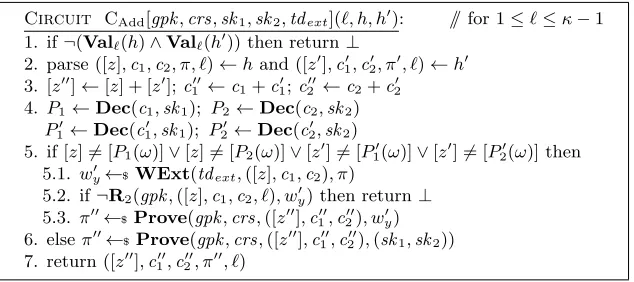
We now provide a procedure for adding two level-`encodingsh= ([z],c1,c2, π, `) andh0= ([z0],c01,c20, π0, `)
in S`. Conceptually, our addition circuit operates similarly to that of AFHLP. The main difference is that
encodings contain polynomials and the levels. We exploit the structure of the base group as well as the homomorphic properties of the encryption scheme to “add together” the first and second components of the inputs. We then use (sk1,sk2) as a witness to generate a proofπ00 that the new tuple is well formed. For
Circuit CAdd[gpk,crs,sk1,sk2,tdext](`, h, h0): // for 1≤`≤κ−1
1. if¬(Val`(h)∧Val`(h0)) then return⊥
2. parse ([z],c1,c2, π, `)←hand ([z0],c10,c
0
2, π
0
, `)←h0 3. [z00]←[z] + [z0];c100←c1+c10;c200←c2+c02
4. P1←Dec(c1,sk1); P2←Dec(c2,sk2) P10←Dec(c01,sk1); P20←Dec(c02,sk2)
5. if [z]6= [P1(ω)]∨[z]6= [P2(ω)]∨[z0]6= [P10(ω)]∨[z
0
]6= [P20(ω)] then 5.1. w0y←$WExt(tdext,([z],c1,c2), π)
5.2. if¬R2(gpk,([z],c1,c2, `), wy0) then return⊥
5.3. π00←$Prove(gpk,crs,([z00],c001,c
00
2), w
0
y)
6. else π00←$Prove(gpk,crs,([z00],c100,c002),(sk1,sk2)) 7. return ([z00],c001,c
00
2, π
00
, `)
Figure 2: The probabilistic circuit used to add encodings for levels 1≤`≤κ−1. The checks at 5 are never passed in an honest execution of the protocol. We emphasize that the test in step 5 is implemented using the values [ωi]. The random coins needed for randomized operations are internally generated after obfuscating
withPIO.
Figure 2 details the operation of the addition circuit CAdd. A PIO of this circuit will be made public
via the parameterspp. We emphasize that step 5, that is, the explicit consistency check, is never reached under a binding crs0 (due to the perfect soundness of the proof system), but they may be reached with a hidingcrs0 later in the security analysis. Let us expand on this.
In the analysis, we need to specify how CAddbehaves if it encounters valid inputs (in the sense the proofs
pass NIZK verification), but nevertheless are inconsistent in the sense that at least one of encodings does not decrypt to a valid representation. Let us call such inputsbad.
With the knowledge of secret keys, such bad inputs can be recognized, and the natural choice would be to define CAdd to abort when this is the case. With this choice, however, we run into the following problem.
During the security proof we will set the addition circuit to answer all valid inputs (including bad ones) with simulated proofs. On the other hand, the original addition circuit rejects such inputs. (Furthermore, it cannot even simulate proofs for wrong statements, and hence cannot answer bad inputs with valid-looking proofs.)
On a high level, we would like to modify how CAddreacts on bad inputs so that it uses a NIZK simulation
trapdoor on bad inputs. The difficulty with this strategy is that no such simulation trapdoor exists when the NIZK CRS is binding. Hence, we create our own NIZK trapdoor through an extra “OR branch” in the proved statement (akin to the Feige–Lapidot–Shamir transform). This gives us a little more flexibility in defining and using that trapdoor.
More specifically, recall that our CRS is of the form crs = (crs0, y) wherecrs0 is a binding CRS for the dual-mode NIZK proof system, andy is a no-instance ofLlk. However our actual means to fake proofs will
be to switchy to a yes-instance and use a witnesswy to produce proofs. Specifically, in the security proof,
we will eventually let CAdd use a simulation trapdoorwy (instead of a simulation trapdoor for the NIZK).
The benefit of this is that CAddwill know an extraction trapdoortd0ext(that of course only exists if the CRS crs0is in the binding mode) which it can use to extract a witness from a given proofπ. Thus, whenever CAdd
encounters a bad input, it can extract a witnesswy0, whichmust at that point be a simulation trapdoorwy.
This simulation trapdoorwycan then immediately be used to produce a fake proofπ00even upon bad inputs.
In other words, CAddknows no simulation trapdoor a priori, but it can extract one from any simulated proof
for a false statement.
Circuit CMult[gpk,crs, ω,sk1,sk2,tdext](`, `0, h, h0): // for 1≤`, `0≤κ−1
1. if¬(Val`(h)∧Val`0(h0))∨`+`0> κthen return⊥ 2. parse ([z],c1,c2, π, `)←hand ([z0],c10,c
0
2, π
0
, `0)←h0 3. c001 ←c1∗c10;c200←c2∗c02
4. P1←Dec(c1,sk1); P2←Dec(c2,sk2) P10 ←Dec(c01,sk1); P20←Dec(c02,sk2) 5. z00←(P1∗P10)(ω)
6. if [z]6= [P1(ω)]∨[z]6= [P2(ω)]∨[z0]6= [P10(ω)]∨[z
0
]6= [P20(ω)] then 6.1. w0y←$WExt(tdext,([z],c1,c2), π)
6.2. if¬R2(gpk,([z],c1,c2), w0y) then return⊥
6.3. π00←$Prove(gpk,crs,([z00],c100,c200), wy0)
7. elseπ00←$Prove(gpk,crs,([z00],c100,c002),(sk1,sk2))
8. If (`+`0=κ) then return [z00] else return ([z00],c100,c002, π00, `+`0)
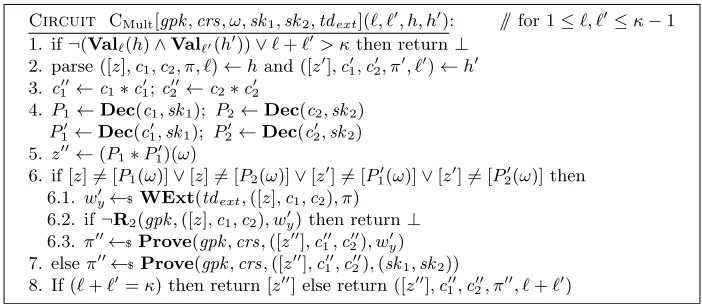
Figure 3: Circuit used for multiplying encodings for levels 1≤`, `0≤κ−1. Step 6 is never reached in an
honest execution of the protocol with a binding crs. The random coins needed for randomized operations are internally generated after obfuscating withPIO.
longer be established. (See also remark on validity on page 15.) Note that full compactness ensures that the ciphertexts output byAdd`are in the range of encryption, and hence they can be further operated on with
Eval.
5.4
Multiplication
Given two encodings h = ([z],c1,c2, π, `) and h0 = ([z0],c10,c20, π0, `0) at levels ` and `0 respectively, the
multiplication algorithms operates analogously to addition as follows. The corresponding circuit CMult has
both decryption keys and now also ω ∈ Zp hardwired in. After validity checks and decrypting the input
ciphertexts, it performs the multiplication of the polynomials encrypted under ci and ci0 homomorphically using a convolution operation on the coefficient vectors. However, it cannot obviously compute the element [zz0] in the base group G. Suppose c1 and c10 encrypt polynomials P and P0 of degrees at most ` and
`0 respectively and such that [z] = [P(ω)] and [z0] = [P0(ω)]. The multiplication circuit uses the explicit knowledge of ω and polynomials P and P0 to compute [zz0] = [(P ∗P0)(ω)].9 Circuit C
Mult is shown in
Figure 3. Note that similarly to addition, step 6 performs explicit checks of consistency of encodings that will only be used in the analysis under a hidingcrs0.
The correctness of these maps follows from the correctness of Π andPIO, and the completeness of Σ.
Enabling graded multiplication. The main difference between our circuit CMult and that of [AFH+16]
is that here we need to output auxiliary information (c1,c2, π) for multiplied encodings at output levels
belowκ. This information allows the multiplication algorithm to operate in a graded fashion as any output encoding by CMult can be fed back into CMultas long as it lies at a level` < κ.10 In order to enable CMult to
generate this auxiliary information, we use an encryption scheme that is also homomorphic with respect to multiplication in the plaintext ring. In contrast, AFHLP only rely on an additively homomorphic encryption scheme.
9Observe that with the explicit knowledge ofP∗P0and the powers ([ωi])
1≤i≤κit is also possible to compute [zz0] as long
asP∗P0is of degree≤κ; this will be exploited in the security analysis in Section 7.
κ-SwitchAΓ(λ):
(pp;ω)←$Setup(1λ,1κ) //ωgenerated withinSetup
((P0,1, P0,2),(P1,1, P1,2), `, st)←$A1(pp, ω) b←${0,1};r1,r2←${0,1}rl(λ)
c1←Enc(Pb,1,pk1;r1);c2←Enc(Pb,2,pk2;r2)
π←$Prove(gpk,crs,([Pb,1(ω)],c1,c2, `),(Pb,1, Pb,2,r1,r2)) hb←([Pb,1(ω)],c1,c2, π, `)
b0←$A2(hb, st)
Return (b=b0)
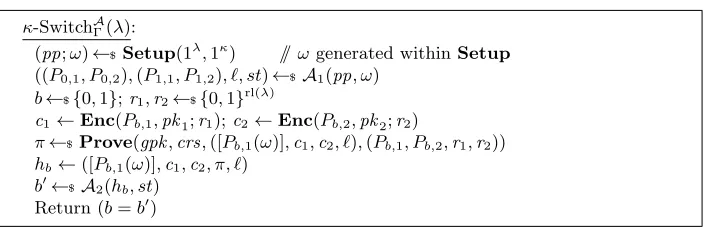
Figure 4: Game formalizing the indistinguishability of encodings. (This game is specific to our construction Γ from Section 5.) An adversary is legitimate if it outputs polynomials such that P0,1(ω) = P0,2(ω) =
P1,1(ω) =P1,2(ω) of degree at most`. We note thatAgets explicit access to secret exponentωgenerated at
setup. Here rl(λ) is a polynomial indicating the length of the random coins used by the encryption algorithm.
5.5
Sampling
Given polynomials P1 and P2 of degree at most ` and satisfying P1(ω) = P2(ω) = z we can generate an
encoding fromS`(z)by computing
h← [z],c1=Enc(P1,pk1;r1),c2=Enc(P2,pk2;r2),
π=Prove(gpk,crs,([z]i,c1,c2, `),(P1, P2,r1,r2);r), `
. (2)
Hence, our sampling algorithmSam`(z) sets P1(X) =P2(X) =z∈Zp and computes an encoding through
(2). We call these the canonical encodings of z, independently of `. We note that this procedure is that in [AFH+16] adapted to the generalized notion of polynomial representations.
5.6
Extraction
Since at each level`the first component [z] is unique for each setS`(z), we may extract a uniform string from
h= ([z],c1,c2, π, `) for a uniformz by applying a randomness extractor seeded withhk to [z].
6
Indistinguishability of Encodings
We show that a key property used by AFHLP in the analysis of their multilinear map [AFH+16, Theorem 5.3] is also exhibited by our graded scheme. Roughly speaking, this property states that for any given level
`, any two valid encodings of the same Zp-element are computationally indistinguishable. This claim is
formalized via theκ-Switch game shown in Figure 4. Note that in this game, we allow the adversary to not only choose the representation polynomials, but also let him see part of the private information not available through the public parameters, namely the exponentω.
Theorem 6.1 (Encoding switch). Let Γ be the GES constructed in Section 5 with respect to an X-IND -secure probabilistic obfuscator PIO, an IND-CPA-secure encryption scheme Π, a dual-mode NIZK proof systemΣ, and a language familyΛ. Then, encodings of the same ring elementz∈Zp are indistinguishable at all levels. More precisely, for any legitimateppt adversaryAthere are pptadversariesB1,B2,B3 and
B4 of essentially the same complexity asA such that for all λ∈N
AdvκΓ-switch,A (λ)≤3· AdvmemΛ,B1(λ) + 6·AdvindPIO,B2(λ) +AdvcrsΣ,B3(λ)
+ 2·Advind-cpaΠ,B
4 (λ).
Outline. We proceed via a sequence of 5 games, starting with κ-Switch and ending in a game where the challenge encoding is independent of the bitb. Figure 5 shows the steps used in the proof of the theorem. We use helper Lemma 6.2 for changing the addition and multiplication circuits to “forget” (one or both) the secret keys and the extraction trapdoor. We now justify each of these steps in more detail below. See Appendix B for the full proof.
CAdd CMult c1 c2
Gm. crs0 y knows knows contains contains Remark 0 binding 6∈ Llk sk1,sk2,tdext sk1,sk2,tdext Pb,1 Pb,2
1 hiding ∈ Llk wy sk1, wy Pb,1 Pb,2 Lemma 6.2 (i= 1)
2 hiding ∈ Llk wy sk1, wy Pb,1 P1,2 IND-CPA wrt.pk2
3 binding 6∈ Llk sk1,sk2,tdext sk1,sk2,tdext Pb,1 P1,2 Lemma 6.2 (reverse,i= 1)
4 hiding ∈ Llk wy sk2, wy Pb,1 P1,2 Lemma 6.2 (i= 2)
5 hiding ∈ Llk wy sk2, wy P1,1 P1,2 IND-CPA wrt.pk1
Encoding indep. ofb
Figure 5: Outline of the proof steps of Theorem 6.1. The underlined secret key in the “CMult knows”
column indicates the key that is used in decryption to construct [z00]. For instance, in Game0, key sk1 is
used to obtainP1 andP10, which are then used to compute [z00] = [(P1∗P10)(ω)] within CMult.
Game0: This is theκ-Switch game with a bindingcrs0 andy6∈ Llk. The addition and multiplication circuits
are defined in Figures 2 and 3, respectively.
Game1: We change the public parameters so that they include ahiding crs0, a yes instanceyviaYesSamL(lk)
and obfuscations of circuits CbAdd andCb
(1)
Mult (see Figure 6). Thus, the second circuit usessk1 to
de-crypt the first ciphertexts given as inputs. Observe that these circuits use the witnesswytoy∈ Llk to
produce the output proofs π00, and therefore the simultaneous knowledge of decryption keyssk
1,sk2
is no longer needed. The difference with the previous game can be bounded by our helper Lemma 6.2 withi= 1, where we rely on PIO security, CRS indistinguishability, and the membership problem.
Game2: This game generates the second challenge ciphertext c2 by encrypting polynomialP1,2 even when
b = 0. We bound this transition via the IND-CPA security of Π with respect to pk2. The reduction
will choose a first decryption key sk1 and a witness wy so as to be able to construct Cb
(1)
Mult. It will
also generate a NIZK simulation trapdoor tdzk (recall the CRS is in the hiding mode) to construct
simulated proofs π for the (inconsistent) challenge encoding hb. Note that the perfect ZK property
guarantees that these proofs are identically distributed to the real ones in Game1.
Game3: The public parameters are changed back to include a bindingcrs0, a no-instancey /∈ Llkand a (PIO)
obfuscation of the original circuits CAdd, CMult with both decryption keys hardwired. The difference
with the previous game is bounded again via Lemma 6.2 (in the reverse direction and with i= 1).
Game4: This transitions is defined analogously to that introduced in Game1except that this time we invoke
Lemma 6.2 with i = 2 and switch to circuits CbAdd and Cb
(2)
Mult. Observe that knowledge ofsk1 is no
longer needed.
Game5: This transitions is defined analogously to that introduced in Game2. The only difference is that
this game generates thefirst challenge ciphertext c1 by encryptingP1,1 even whenb= 0.
Finally, note that the challenge encoding in Game5is independent of the random bitband the advantage
of any (even unbounded) adversaryAis 0.
Circuit CbAdd[gpk,crs, wy](`, h, h0):
1. if¬(Val`(h)∧Val`(h0)) then return⊥
2. parse ([z],c1,c2, π, `)←h, and ([z0],c01,c20, π0, `)←h0 3. [z00]←[z] + [z0];c100←c1+c01;c
00
2 ←c2+c20 4. // omitted: depends onsk1 andsk2 5. π00←$Prove(gpk,crs,([z00],c100,c200, `), wy)
6. // omitted: depends onsk1 andsk2 7. return ([z00],c100,c
00
2, π
00
, `)
Circuit Cb (i)
Mult[gpk,crs, ω,ski, wy](`, `0, h, h0):
1. if¬(Val`(h)∧Val`0(h0))∨`+`0> κthen return⊥ 2. parse ([z],c1,c2, π, `)←hand ([z0],c10,c20, π0, `0)←h0 3. c100←c1·c01;c
00
2 ←c2·c20
4. Pi←Dec(ci,ski);Pi0←Dec(c0i,ski) // depends onski only
5. z00←(Pi∗Pi0)(ω)
6. π00←$Prove(gpk,crs,([z00],c100,c200, `+`0), wy)
7. // omitted: depends onsk1 andsk2
8. If (`+`0=κ) then return [z00] else return ([z00],c100,c
00
2, π
00
, `+`0)
Figure 6: Top: CircuitCbAdd where witnesswy toy∈ Llk is used to produceπ00. Note that the secret keys
(sk1,sk2) or the extraction trapdoortdextare no longer used by this circuit. Bottom: CircuitsCb
(i) Mult were
only one key ski is used to decrypt Pi and Pi0 and witnesswy to y∈ Llk is used to produceπ00. The secret
keysk3−i and the extraction trapdoortdext are not used by this circuit.
Lemma 6.2 (Forgetting secret keys). Let Γ be the GES from Section 5 with respect to an X-IND-secure probabilistic obfuscatorPIO, anIND-CPA-secure encryption schemeΠ, a dual-mode NIZK proof systemΣ, and a language family Λ. For i= 1,2, consider the modified parameter generation algorithm Setup(i) that samples a yes-instance y∈ Llk and outputs obfuscations of the circuits CbAdd andCb
(i)
Mult shown in Figure 6.
Let
AdvκΓ-forget,i,A (λ) := 2·Prpp0←$Setup(1λ,1κ); pp1←$Setup (i)
(1λ,1κ);
b←${0,1};b0←$A(ppb) : b=b0
−1 .
Then, for any i ∈ {1,2} and any pptadversary A there are ppt adversaries B1,B2 and B3 of essentially
the same complexity asA such that for all λ∈N
AdvκΓ-forget,i,A (λ)≤AdvmemΛ,B1(λ) + 6·AdvindPIO,B2(λ) +AdvcrsΣ,B3(λ).
7
Hardness of
MDDH
We are now ready to show that MDDH is hard for our GES. We improve [AFH+16] by providing a simpler
and tighter proof of security. One corollary of our result is that there are no “zeroizing” attacks on our scheme as such attacks immediately lead to the break of MDDH [CHL+15, CGH+15, GGH13a]. We start
by providing formal definition of MDDH as well as the strong DDH problem whose hardness we assume in our analyses.
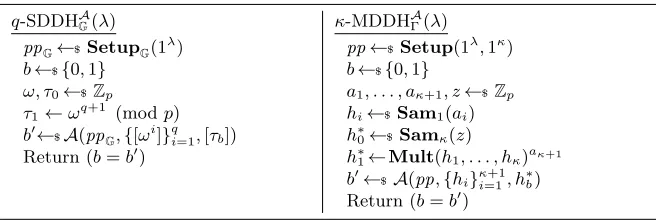
The q-SDDH problem [BB04, ZSS04]. Forq∈Nwe say that theq-SDDH problem is hard for a group Gif
AdvqG-sddh,A (λ) := 2·Prq-SDDHAG(λ)−1∈Negl,
where game q-SDDHAG(λ) is shown in Figure 7 (left). We note that this assumption can only hold in

![Figure 5:Outline of the proof steps of Theorem 6.1. The underlined secret key in the “CMult knows”column indicates the key that is used in decryption to construct [z′′]](https://thumb-us.123doks.com/thumbv2/123dok_us/7988665.1325763/19.612.84.529.142.257/figure-outline-theorem-underlined-column-indicates-decryption-construct.webp)

![Figure 9: Outline of the proof of Lemma 6.2. The underlined element in the “CMultPC knows” column indicateswhich secret key is used to decrypt information used to construct [z′′]](https://thumb-us.123doks.com/thumbv2/123dok_us/7988665.1325763/29.612.113.502.245.351/figure-outline-underlined-cmultpc-indicateswhich-decrypt-information-construct.webp)
