ISSN(Online): 2320-9801 ISSN (Print): 2320-9798
I
nternational
J
ournal of
I
nnovative
R
esearch in
C
omputer
and
C
ommunication
E
ngineering
(An ISO 3297: 2007 Certified Organization)
Vol. 3, Issue 5, May 2015
Efficiently Tolerating Peer To Peer Fault
Internet Based Video Streaming
Sumathi S
1, Kannan Subramanian
*21 Assistant Professor, Dept. of Master of Computer Application, Jerusalem College of Engineering, Chennai,
Tamil Nadu, India
2Assistant Professor, Dept. of Master of Computer Application, Bharath University, Chennai, Tamil Nadu, India
*
Corresponding Author
ABSTRACT: Peer-to-peer live streaming systems allow a bandwidth constrained source to broadcast a video feed to a large number of users. The main goal of live streaming is to deliver stream data to all clients before their playback deadline. Design efficiency is essentially characterized by the streaming rate that can be sustained, and by the delay it takes for data to reach clients from the source. In addition, a design with high link utilization can achieve high stream rates, supporting high quality video. Until now, only tree-based designs have been shown to achieve close-to-optimal rates in real-life conditions, leaving the question open as to the attainable efficiency of completely unstructured mesh-based approaches. Specifically, we implement and evaluate a design mesh-based on a mesh-mesh-based algorithm called DP/LU. Contrary to tree-based designs, DP/LU uses an unstructured overlay, which is easier to construct and is highly resistant to churn. In addition, we identify several design optimizations which help improve the rate and delay performance of mesh-based systems. Our experimental evaluation shows that our design achieves 95% of the maximum achievable stream rate in a static environment, and 90%under high churn. This demonstrates that mesh-based designs are an excellent choice for scalable and robust high-quality peer-to-peer live streaming. Live video streaming services are spreading quickly over the Internet.
I. INTRODUCTION
Live video streaming services are spreading quickly over the Internet. Video sharing websites such as YouTube attract millions of users per day, and a large number of TV channels are already available on the Internet or through IPTV services provided by ISPs. However, centralized systems require costly high-bandwidth links at the server. For instance, YouTube spends $1 million a day for the huge bandwidth needed by its servers. Peer-to-peer live video streaming greatly reduces the bandwidth requirements of the source by making users serve part of the stream to other peers downloading the same content. However, many existing P2PTV systems provide limited video quality (poor resolution, image freezes, etc.), while others require high bandwidth proxies to achieve a high QoS. In fact, many systems employ simple streaming protocols which underutilize the clients‟ uplinks, wasting available bandwidth. This problem will become more serious as users will soon demand high definition video, increasing the required stream bitrate. Motivated by these issues, recent research has focused on designing systems that achieve close-to-optimal rates. However, most efforts have been directed towards tree-based approaches, while mesh-based ones have received less attention. Indeed, trees can result in highly efficient designs. Their main advantage is that multiple consecutive packets are pushed down the tree along the same paths, resulting in predictable traffic flows and low control traffic. Conversely, in a mesh-based system peers typically make different scheduling decisions for each packet.
II. ANALYSIS MODEL
ISSN(Online): 2320-9801 ISSN (Print): 2320-9798
I
nternational
J
ournal of
I
nnovative
R
esearch in
C
omputer
and
C
ommunication
E
ngineering
(An ISO 3297: 2007 Certified Organization)
Vol. 3, Issue 5, May 2015
The design starts after the requirement analysis is complete and the coding begins after the design is complete. Once the programming is completed, the testing is done [2]. In this model the sequence of activities performed in a software development project are: -
Requirement Analysis
Project Planning
System design
Detail design
Coding
Unit testing
Here the linear ordering of these activities is critical. End of the phase and the output of one phase is the input of other phase. The output of each phase is to be consistent with the overall requirement of the system [3].
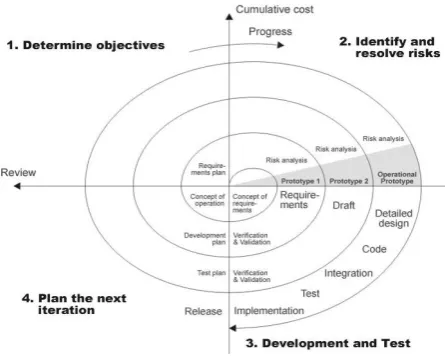
SPIRAL MODEL was defined by Barry Boehm in his 1988 article, “A spiral Model of Software Development and Enhancement. This model was not the first model to discuss iterative development, but it was the first model to explain why the iteration models [4].
As originally envisioned, the iterations were typically 6 months to 2 years long. Each phase starts with a design goal and ends with a client reviewing the progress thus far. Analysis and engineering efforts are applied at each phase of the project, with an eye toward the end goal of the project [5].
Figure 1.1 shows how a spiral model acts like:
III. FEASIBILITY REPORT
Preliminary investigation examine project feasibility, the likelihood the system will be useful to the organization. The main objective of the feasibility study is to test the Technical, Operational and Economical feasibility for adding new modules and debugging old running system [6]. All system is feasible if they are unlimited resources and infinite time. There are aspects in the feasibility study portion of the preliminary investigation:
Technical Feasibility
Operational Feasibility
Economic Feasibility
3.1 Technical Feasibility
The technical issue usually raised during the feasibility stage of the investigation includes the following:
ISSN(Online): 2320-9801 ISSN (Print): 2320-9798
I
nternational
J
ournal of
I
nnovative
R
esearch in
C
omputer
and
C
ommunication
E
ngineering
(An ISO 3297: 2007 Certified Organization)
Vol. 3, Issue 5, May 2015
Can the system be upgraded if developed?
Are there technical guarantees of accuracy, reliability, ease of access and data security?
Earlier no system existed to cater to the needs of „Secure Infrastructure Implementation System‟. The current system developed is technically feasible. It is a browser based user interface for audit workflow. Thus it provides an easy access to the users [9].
The database‟s purpose is to create, establish and maintain a workflow among various entities in order to facilitate all concerned users in their various capacities or roles. Permission to the users would be granted based on the roles specified.
Therefore, it provides the technical guarantee of accuracy, reliability and security. The software and hard requirements for the development of this project are not many and are already available or are available as free as open source [10]. The work using the system.
3.2 Operational Feasibility
The analyst considers the extent the proposed system will fulfill his departments. That is whether the proposed system covers all aspects of the working system and whether it has considerable improvements [7]. We have found that the proposed “Secure transaction” will certainly have considerable improvements over the existing system.
3.3 Economic Feasibility
The proposed system is economically feasible because the cost involved in purchasing the hardware and the software are within approachable. Working in this system need not required a highly qualified professional [8]. The operating-environment costs are marginal. The less time involved also helped in its economic feasibility.
IV. SYSTEM ARCHITECTURE
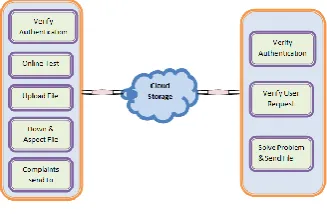
The Fig 4.1 explain how the entire system constructed and activity taken place around system are shown in the system architecture.
Fig 4.1: System Architecture
V. MODULES DESCRIPTION
After careful analysis the system has been identified to have the following modules:
a.ENROLLING THE ACTIVE PEERS.
b.LUGGING THE KNOWLEDGE TEST.
c.UPLOAD FILES. d.VIEW FILE LIST.
e.COMPLAINTS HANDOVER.
ISSN(Online): 2320-9801 ISSN (Print): 2320-9798
I
nternational
J
ournal of
I
nnovative
R
esearch in
C
omputer
and
C
ommunication
E
ngineering
(An ISO 3297: 2007 Certified Organization)
Vol. 3, Issue 5, May 2015
a.ENROLLING THE ACTIVE PEERS:
Activate users who are wishing to participate in sharing the files over the host so that these files can be used by the other. Activation should be done by the administration. All process is monitored by the Main Node. After authentication process any user can involve into the process of sharing. Authentication process is monitored by the administrator. If the user failed to load his personal details then he can retrieve his details with the help of admin.
b.LUGGING THE KNOWLEDGE TEST:
After Authentication process every user take up a knowledge text. Knowledge test will be carried up by the authenticated user. He can view the details of the knowledge test. After completing the knowledge test the report will be send to the administrator. The Administrator will announce the result to the respective peer. Based on the score the further process can be carried out with the help of admin.
c.UPLOAD FILES:
After taking up knowledge test, based on the score the further process can be carried out with the help of admin. If the score is good then they can have the rights to upload files. File Size will be automatically calculated when uploading the files. File size can also be reported to the Admin. Uploaded files will be maintained by the admin. He can view all users files.
d.VIEW FILE LIST:
After uploading the various Files, the authenticated and knowledgeable user has the rights to view the files uploaded by the other authenticated user. Admin has all rights throughout the process and the admin maintain complaints form. The user can select the other user to view the list of files uploaded by him. Then he views the uploaded files as well as downloads the files which were uploaded by other users.
e.COMPLAINTS HANDOVER:
After viewing the files uploaded by the user. Uploaded files can be viewed by the third party user. If the user viewed video is corrupted or damaged then he can make complaint to the administrator as the files uploaded will be maintained by the administrator. The Complaints provided will be automatically received by the admin and he can view the complaint provided.
g.UNSCRAMBLINGTHE COMPLAINTS OF USER.
After viewing the complaints by the admin provided by the admin. He can unscramble the complaints by providing the needed files. The user complaints can be resolved by uploading the needed file to them personally so that the problem can be solved completely. The user provided complaint details will be maintained by the admin to verify the process in future.
VI. CONCLUSION
Recent work on peer-to-peer streaming has focused on designing systems which maximize the achievable streaming rate. Moreover, recent experimental studies have shown that tree-based designs can reach close-to-optimal rates in real-life conditions. However, until now, efficient mesh based designs have only been evaluated analytically or through simulations. We have presented the first experimental study which demonstrates that pure mesh architecture can deliver near-optimal rates with low diffusion delays. In addition, we have identified several optimizations which help increase the efficiency of mesh-based designs. In particular, both analytical and experimental evidence suggests that giving preference to fast nodes can increase the performance of a system.
VII.FUTURE ENHANCEMENT
ISSN(Online): 2320-9801 ISSN (Print): 2320-9798
I
nternational
J
ournal of
I
nnovative
R
esearch in
C
omputer
and
C
ommunication
E
ngineering
(An ISO 3297: 2007 Certified Organization)
Vol. 3, Issue 5, May 2015
System could enable high-bandwidth helper nodes (independent from the source) when capacity shortage is detected. Finally, we will study how we can modify algorithms such as DP/LU to further increase their delay performance, by favoring high capacity nodes not only at the source, but also at the peers.
REFERENCES
1. “Delay Bounds of Chunk-Based Peer-to-Peer Video Streaming” ,IEEE/ACM TRANSACTIONS ON NETWORKING, VOL. 18, NO. 4, AUGUST 2010.
2. Anbuselvi S., Jeyanthi Rebecca L., Sathish Kumar M., Senthilvelan T., "GC-MS study of phytochemicals in black gram using two different organic manures", Journal of Chemical and Pharmaceutical Research, ISSN : 0975 – 7384, 4(2) (2012) PP. 1246-1250.
3. “A Measurement Study of a Large-Scale P2P IPTV System”, IEEE TRANSACTIONS ON MULTMEDIA, VOL. 9, NO. 8, DECEMBER 2007.
4. Lydia Caroline M., Vasudevan S.,"Growth and characterization of l-phenylalanine nitric acid, a new organic nonlinear optical material", Materials Letters, ISSN : 0167-577X, 63(1) (2009) pp. 41-44.
5. Z. Liu, C. Wu, B. Li, and S. Zhao, “Distilling Superior Peers in Large-Scale P2P Streaming Systems,” Proc. IEEE INFOCOM, 2009
6. Langeswaran K., Gowthamkumar S., Vijayaprakash S., Revathy R., Balasubramanian M.P., "Influence of limonin on Wnt signalling molecule in HepG2 cell lines", Journal of Natural Science, Biology and Medicine, ISSN : 0976-9668, 4(1) (2013) PP. 126-133
7. D. Ren, Y.H. Li, and S.G. Chan, “On Reducing Mesh Delay for Peer-to-Peer Live Streaming,” Proc. IEEE INFOCOM, 2008.
8. Jebaraj S., Iniyan S., "Renewable energy programmes in India", International Journal of Global Energy Issues, ISSN : 0954-7118, 26(4Mar) (2006) PP.232-257.
9. M. Piatek, A. Krishnamurthy, A. Venkataramani, R. Yang, D.Zhang, and A. Jaffe, “Contracts: Practical Contribution Incentivesfor P2P Live Streaming,” Proc. Seventh USENIX Conf. Networked Systems Design and Implementation (NSDI), 2011
10. Jayalakshmi T., Krishnamoorthy P., Ramesh Kumar G., Sivamani P., "Optimization of culture conditions for keratinase production in Streptomyces sp. JRS19 for chick feather wastes degradation", Journal of Chemical and Pharmaceutical Research, ISSN : 0975 – 7384, 3(4) (2011) PP.498-503.
11. [11]B Karthik, TVU Kirankumar, MS Raj, E BharathKumaran,Simulation and Implementation of Speech Compression Algorithm in VLSI, Middle-East Journal of Scientific Research 20 (9), PP 1091-1092, 2013
12. M.Sundararajan & R.Pugazhanthi,” Human finger print recognition based biometric security using wavelet analysis”, Publication of International Journal of Artificial Intelligent and Computational Research, Vol.2. No.2. pp.97-100(July-Dec 2010).
13. .M.Sundararajan & E.Kanniga,” Modeling and Characterization of DCO using Pass Transistor”, proceeding of Springer – Lecturer Notes in Electrical Engineering-2011 Vol. 86, pp. 451-457(2011). ISSN 1876-1100.( Ref. Jor- Anne-II)
14. .M.Sundararajan & C.Lakshmi, “Wavelet based finger print identification for effective biometric security”, Publication of Elixir Advanced Engineering Informatics-35(2011)-pp.2830-2832.
15. .M.Sundararajan, ”Optical Instrument for correlative analysis of human ECG and Breathing Signal” Publications of International Journal of Biomedical Engineering and Technology- Vol. 6, No.4, pp. 350-362 (2011). ISSN 1752-6418.(Ref. Jor-Anne-I