Attribute-Based Encryption with White-Box
Traceability and Public Auditing in the Cloud
Jianting Ning1, Xiaolei Dong2, Zhenfu Cao2 and Lifei Wei3 1
Department of Computer Science and Engineering, Shanghai Jiao Tong University, Shanghai 200240, China
2
Shanghai Key Lab for Trustworthy Computing, East China Normal University, Shanghai 200062, China
{zfcao,dongxiaolei}@sei.ecnu.edu.cn
3 College of Information Technology, Shanghai Ocean University, Shanghai 201306, China
Abstract. As a sophisticated mechanism for secure fine-grained ac-cess control, ciphertext-policy attribute-based encryption (CP-ABE) is a highly promising solution for commercial applications such as cloud com-puting. However, there still exists one major issue awaiting to be solved, that is, the prevention of key abuse. Most of the existing CP-ABE sys-tems missed this critical functionality, hindering the wide utilization and commercial application of CP-ABE systems to date. In this paper, we address two practical problems about the key abuse of CP-ABE: (1) The key escrow problem of the semi-trusted authority; and, (2) The malicious key delegation problem of the users. For the semi-trusted authority, it-s miit-sbehavior (i.e., illegal key (re-)diit-stribution) it-should be caught and prosecuted. And for a user, his/her malicious behavior (i.e., illegal key sharing) need be traced. We affirmatively solve these two key abuse prob-lems by proposing the first accountable authority CP-ABE with white-box traceability that supports policies expressed in any monotone access structures. Moreover, we provide an auditor to judge publicly whether a suspected user is guilty or is framed by the authority.
Keywords: Attribute-Based Encryption, Ciphertext-Policy, Key Abuse, White-box Traceablity, Public Auditing.
1
Introduction
anywhere and anytime [1]. Despite lots of benefits provided by cloud computing, the concerns on data security are probably the main obstacles hindering the wide usage of cloud services. To address the data security concerns, encryption has been applied on the data of enterprises and individuals before outsourcing. Nevertheless, in some practical applications of cloud computing, data is often shared with some potential users without knowing who will receive it, thus a fine-grained access control over data is desired. Attribute-Based Encryption (ABE, [13]) is a promising approach to protect the confidentiality of sensitive data and express fine-grained access control for cloud computing. In a CP-ABE system, enterprises and individuals can specify access policies over attributes that the potential users possess. And the data customers whose attributes satisfy the specified access policy can decrypt successfully and get access to the outsourced data.
A Motivating Story. Consider a company employs a cloud storage sys-tem to outsource its data after encrypting the data under some access policies. Each employee is assigned with several attributes (such as “manager”,“engineer”, etc.). And those whose attributes satisfy the access policy over the outsourced data could decrypt the ciphertext and get access to the sensitive data stored in the cloud. As a versatile one-to-many encryption mechanism, CP-ABE system is quite suitable in this cloud storage scenario. If it happens to exist an employee from the company’s competitor who is not authorized but could get access to the sensitive data stored in the cloud, as such, the company will suffer severe financial loss. Then, who leaks the decryption key to him? In addition, if an employee from the company named Bob is traced as the traitor (who leaks the decryption key) but claims to be innocent and framed by the system, then how to judge whether Bob is indeed innocent or not? Does Bob have an opportunity to argue for himself?
the decryption key) but claims to be innocent and framed by the system, it is necessary to enable an auditor to judge whether the user is indeed innocent or is framed by the system.
1.1 Our Contribution
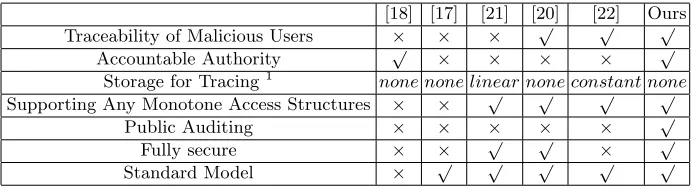
In this paper, we address the key abuse and the auditing problems of CP-ABE and affirmatively solve these by proposing an accountable authority CP-ABE system with white-box traceability and public auditing. To the best of our knowledge, this is the first CP-ABE scheme that supports the following prop-erties: traceability of malicious users, accountable authority, almost no storage for tracing, public auditing and high expressiveness (i.e. supporting access poli-cies expressed in any monotone access structures). Also, we prove that our new system is fully secure in the standard model.
We solve the obstacles of CP-ABE implementation in cloud storage scenario as follows:
1. Traceability of malicious users. Anyone who may leak their decryption keys to others for profits can be traced.
2. Accountable authority. The semi-trusted authority could be caught if it ille-gally generates and distributes legitimate keys to any unauthorized users. 3. Public auditing. We provide an auditor to judge whether a suspected user
(for leaking his/her decryption key) is guilty or is framed by the authority. In addition, the auditability of our system is public, that is, anyone can run theAuditalgorithm to make a judgement with no additional secret needed. 4. Almost no storage for tracing. We use a Paillier-style encryption as an ex-tractable commitment in tracing the malicious users. And we do not need to maintain an identity table of users for tracing as used in [21]. As a result, we need almost no storage for tracing.
Table 1 gives the comparison between our work and some other related work.
Table 1.Comparison with other related work
[18] [17] [21] [20] [22] Ours
Traceability of Malicious Users × × × √ √ √
Accountable Authority √ × × × × √
Storage for Tracing1 none none linear none constant none
Supporting Any Monotone Access Structures × × √ √ √ √
Public Auditing × × × × × √
Fully secure × × √ √ × √
Standard Model × √ √ √ √ √
1
1.2 Our Technique
In this subsection, we briefly introduce the main idea we utilize to realize the properties of traceability of malicious users, accountable authority and public auditing before giving the full details in Section 4.
To trace malicious users who may leak their decryption keys to others for profits, we use a Paillier-style encryption as an extractable commitment to achieve white-box traceability. Specifically, we use a Paillier-style extractable commitment to make a commitment to a user’s identity when the user queries for his decryption key. The commitment is further inserted into the user’s de-cryption key as a necessary part for successful dede-cryption. Due to the hiding and binding properties of the Paillier-style extractable commitment, the user does not know what is inserted into his decryption key and even cannot change the identity insert into his decryption key. When it comes to the Trace algorithm, the algorithm uses a trapdoor for the commitment to recover the identity of the user from his decryption key. Note that the decryption key needs to take a
key sanity check algorithm to see whether it is well-formed or not prior to the tracing step. Take the advantage of the Paillier-style extractable commitment, we do not have to maintain the identity table as used in [21], as a result, we need almost no storage for tracing.
To achieve accountable authority, the main idea is to let the user’s decryption key be jointly determined by both of the authority and the user himself, hence the authority does not have complete control over the decryption key. We let a user get his decryption key sk corresponding to his attributes and identity from the authority using a secure key generation protocol. The protocol allows the user to obtain a decryption key sk for his attributes and identity without letting the authority know which key he obtained. Now if the authority (re-)distribute a decryption key ˜sk(corresponding to a user’s attributes and identity) for malicious usage, with all but negligible probability, it will be different from the keyskwhich the user obtained. Hence the key pair (sk,sk˜) is a cryptographic proof of malicious behavior of the authority.
Furthermore, the difference between the user’s decryption key sk and the decryption key ˜sk (re-)distributed by the authority allows the auditor to judge publicly whether the malicious user is guilty or is framed by the system. And note that the auditor is assumed to be fair and credible.
1.3 Related Work
and every user’s decryption key is associated with an access policy. ABE (es-pecially CP-ABE) is envisioned as a highly promising public key primitive for implementing scalable and fine-grained access control over encrypted data, and has attracted much attention in the research community. A series of ABE (in-cluding CP-ABE and KP-ABE) systems have been proposed [4, 25, 11, 14, 29, 24, 15, 26, 21, 20, 22], aiming at better efficiency, expressiveness or security.
Li et al. first introduced the notion of accountable CP-ABE [18] to pre-vent illegal key sharing among colluding users. Then a user accountable multi-authority CP-ABE scheme was proposed in [17] which only supported AND gates with wildcard. White-box [21] and black-box [20] traceability CP-ABE systems which supported policies expressed in any monotone access structures were later proposed by Liu et al. Recently, Ning et al. [22] proposed a practical large universe CP-ABE system with white-box traceability. Deng et al. [9] pro-vided a tracing mechanism of CP-ABE to find the leaked access credentials in cloud storage systems. Unfortunately, the above work either only support less expressive access policy, or do not consider the misbehavior of the authority, or do not address the auditing issue.
1.4 Organization
Section 3 gives the formal definition of accountable authority CP-ABE with white-box traceability and public auditing (AAT-CP-ABE) and its security mod-el. Section 2 introduces the background, including the notation, the access pol-icy, the linear secret sharing scheme, the composite order bilinear groups, the assumptions and the zero-knowledge proof of knowledge of discrete log. Section 4 presents the construction of our AAT-CP-ABE system as well as the security proof. Finally, Section 5 presents a brief conclusion and foresees our future work.
2
Background
2.1 Notation
We define [l] ={1,2, ..., l}forl∈N. We denote bys←R Sthe fact thatsis picked uniformly at random from the finite set S. By PPT we denote probabilistic polynomial-time. We denote (v1, v2, ..., vn) be a row vector and (v1, v2, ..., vn)⊥ be a column vector. Byviwe denote thei-th element in a vectorv. And byMv we denote the product of matrixM with vectorv. We denoteZl×np be the set of matrices of size l×nwith elements inZN. The set of column vectors of length
n(i.e. Zn×N 1) are the two special subsets and the set of row vectors of lengthn
(i.e.Z1N×n) .
2.2 Access Policy
an access structure (respectively, monotone access structure) on S. A collection
A⊆2S is called monotone if ∀B, C ∈A: if B ∈A andB ⊆C, then C ∈ A.
The sets inAare called the authorized sets, and the sets not inAare called the unauthorized sets.
For CP-ABE, if a user of the system possess an authorized set of attributes then he can decrypt the ciphertext. Otherwise, the set he possed is unauthorized and he can’t get any information from ciphertext. In our construction, we restrict our attention to monotone access structure.
2.3 Linear Secret-Sharing Schemes
Definition 2. (Linear Secret-Sharing Schemes (LSSS) [2, 22]). Let S denote the attribute universe and p denote a prime. A secret-sharing scheme Q
with domain of secretsZp realizing access structure onS in called linear (overZp) if
1. The shares of a secrets∈Zp for each attribute form a vector overZp.
2. For each access structureAonS, there exists a matrixM withlrows and
n columns called the share-generating matrix for Q
. For i = 1, ..., l, we define a function ρ labels row i of M with attribute ρ(i) from the attribute universe S. When we consider the column vector v = (s, r2, ..., rn), where s∈Zp is the
secret to be shared and r2, ..., rn∈Zp are randomly chosen. ThenMv∈Zl×p 1 is
the vector ofl shares of the secretsaccording toQ. The share (Mv)
j “belongs”
to attribute ρ(j), wherej∈[l].
As shown in [2], every linear secret-sharing scheme according to the above definition also enjoys the linear reconstruction property, defined as follows: we suppose thatQ is an LSSS for the access structure
A, S0 ∈Ais an authorized set and let I ⊂ {1,2, ..., l} be defined asI ={i∈ [l]∧ρ(i)∈S0}. Then, there exist constants{ωi∈Zp}i∈I such that for any valid shares{λi= (Mv)i}i∈I of a secrets according to Q, thenP
i∈Iωiλi =s. Additionally, it is shown in [2] that these constants{ωi}i∈I can be found in time polynomial in the size of the share-generating matrixM. On the other hand, for any unauthorized setS00, no such constants{ωi}exist.
Note that if we encode the access structure as a monotonic Boolean formula over attributes, there exists a generic algorithm by which we can generate the corresponding access policy in polynomial time [2].
In our construction, an LSSS matrix (M, ρ) will be used to express an access policy associated to a ciphertext.
2.4 Composite Order Bilinear Groups
1. Bilinearity:∀u, v∈Ganda, b∈Zp, we havee(ua, vb) =e(u, v)ab. 2. Non-degeneracy:∃g∈Gsuch thate(g, g) has orderN in GT.
We assume that group operations inGand GT as well as the bilinear map
e are computable in polynomial time with respect to λ. We refer to G as the
source group and GT as the target group, and assume the group descriptions of Gand GT include a generator of each group. LetGp1, Gp2, andGp3 be the
subgroups of orderp1,p2, and p3 inG, respectively. Note that these subgroups are ”orthogonal” to each other under the bilinear map e: for anyui∈Gpi and
uj ∈ Gpj where i 6=j, e(ui, uj) = 1. Any element EN ∈ G can (uniquely) be expressed as gr1
1 g r2
2 g r3
3 for some values r1, r2, r3 ∈ ZN, where g1, g2, g3 are the generators of Gp1, Gp2, Gp3 respectively. And we will refer tog
r1
1 , g r2
2 , g r3
3 as the ”Gp1part ofEN”,”Gp2 part ofEN” and ”Gp3part ofEN”, respectively. Assume Gp1p2 be the subgroups of orderp1p2inG. Similarly, any elementEp1p2 ∈Gp1p2
can be expressed as the product of an element from Gp1 and an element from Gp2.
2.5 Complexity Assumptions
Assumption 1 (Subgroup Decision Problem for 3 Primes): [14] Given a group generator G, define the following distribution:
G= (N =p1p2p3, G, GT, e) R
← G, g←R Gp1, X3
R
←Gp3, D= (G, g, X3),
T1 R
←Gp1p2, T2
R
←Gp1.
The advantage of an algorithmA in breaking this assumption is defined to be:Adv1G,A(λ) =|P r[A(D, T1) = 1]−P r[A(D, T2) = 1]|.
Definition 3. We say thatGsatisfies Assumption 1 ifAdv1G,A(λ)is a negligible
function of λfor any polynomial time algorithmA.
Assumption 2 [14] Given a group generator G, define the following distribu-tion:
G= (N =p1p2p3, G, GT, e) R
← G, g, X1
R
←Gp1, X2, Y2
R
←Gp2, X3, Y3
R
←Gp3 D= (G, g, X1X2, X3, Y2Y3),
T1 R
←G, T2 R
←Gp1p3.
The advantage of an algorithmA in breaking this assumption is defined to be:Adv2G,A(λ) =|P r[A(D, T1) = 1]−P r[A(D, T2) = 1]|.
Definition 4. We say thatGsatisfies Assumption 2 ifAdv2G,A(λ)is a negligible
Assumption 3 [14] Given a group generator G, define the following distribu-tion:
G= (N =p1p2p3, G, GT, e) R
← G, α, s←R ZN,
g←R Gp1, X2, Y2, Z2
R
←Gp2, X3
R
←Gp3 D= (G, g, gαX
2, X3, gsY2, Z2),
T1=e(g, g)αs, T2 R
←GT.
The advantage of an algorithmA in breaking this assumption is defined to be:Adv3G,A(λ) =|P r[A(D, T1) = 1]−P r[A(D, T2) = 1]|.
Definition 5. We say thatGsatisfies Assumption 3 ifAdv3G,A(λ)is a negligible
function of λfor any polynomial time algorithmA.
Assumption 4 (l-SDH assumption [5, 10]) : LetGbe a bilinear group of prime
orderpandg be a generator ofG, thel-Strong Diffie-Hellman (l-SDH) problem
inGis defined as follows: given a(l+1)-tuple(g, gx, gx2, ..., gxl)as inputs, output
a pair (c, g1/(c+x))∈
Zp×G. An algorithmAhas advantage in solvingl-SDH
in GifP r[A(g, gx, gx2, ..., gxl) = (c, g1/(c+x))]≥, where the probability is over
the random choice ofxinZ∗p and the random bits consumed by A.
Definition 6. We say that the (l, t, )-SDH assumption holds inGif no t-time
algorithm has advantage at least in solving the l-SDH problem in G.
2.6 Zero-knowledge Proof of Knowledge of Discrete Log
Informally, a zero-knowledge proof of knowledge (ZK-POK) of discrete log pro-tocol enables a prover to prove that it possesses the discrete log t of a given group elementT in question to a verifier.
A ZK-POK protocol has two distinct properties: the zero-knowledge property and the proof of knowledge property. The property of zero-knowledge implies that there exists a simulatorSwhich is able to simulate the view of a verifier in the protocol without being given the witness as input. The proof of knowledge property implies there exists a knowledge-extractor Ext which interacts with the prover and extracts the witness using rewinding techniques [10]. We refer the reader to [3] for more details about ZK-POK.
3
Accountable Authority CP-ABE with White-Box
Traceability and Public Auditing
3.1 Definition
– Setup(1λ,U)→(pp, msk) : The algorithm takes as input a security param-eter λ ∈ N encoded in unary and the attribute universe description U. It outputs the public parametersppand the master secret key msk.
– KeyGen(pp, msk, id, S)→skid,S: This is an interactive protocol between the authorityAT and a userU. The public parametersppand a set of attributes
S for a user with identityid are the common input to theAT and U. The master secret keymskis the private input to theAT. Additionally, theAT
and U may use a sequence of random coin tosses as private input. At the end of the protocol,U is issued a secret keyskid,S corresponding toS. – Encrypt(pp, m,A)→ct: The encryption algorithm takes as input the public
parameters pp, a plaintext messagem, and an access structure Aover the universe of attributes. It outputs the ciphertextct4.
– Decrypt(pp, skid,S, ct)→mor⊥: The decryption algorithm takes as input the public parameterspp, a secret keyskid,S, and a ciphertextct. If the set of attributes of the private key satisfies the access structure of the ciphertext, the algorithm outputs the plaintextm. Otherwise, it outputs⊥.
– KeySanityCheck(pp, sk) → 1 or 0 : The key sanity check algorithm takes as input the public parametersppand a secret keysk. If sk passes the key sanity check, it outputs 1. Otherwise, it outputs 0. The key sanity check is a deterministic algorithm [10, 12], which is used to guarantee the secret key to be well-formed in the decryption process.
– Trace(pp, msk, sk) → id or | : The tracing algorithm takes as input the public parameterspp, the master secret key msk and a secret keysk. The algorithm first checks whethersk is well-formed or not so as to determine whether sk needs to be traced. A secret key sk is defined as well-formed
which means that KeySanityCheck(pp, sk) → 1. If sk is well-formed, the system extracts the identityidfromsk. Then it outputs an identityidwith which theskassociates. Otherwise, it outputs a special symbol | indicates thatskdoes not need to be traced.
– Audit(pp, skid, sk∗id) → guilty or innocent. This is an interactive protocol between a userUand a public auditorP A. It judges whether a user isguilty
orinnocent.
3.2 Security
An AAT-CP-ABE system is deemed secure if the following three requirements are satisfied. First, it must satisfy the standard semantic security notion for CP-ABE system: ciphertext indistinguishability under chosen plaintext attacks (IND-CPA). Second, it is intractable for the authority to create a decryption key such that theTracealgorithm outputs a user and theAuditalgorithm outputs the user is guilty. Finally, it is infeasible for a user to create a decryption key such that theAuditalgorithm implicates the user is innocent. To define security for AAT-CP-ABE system satisfies the above three requirements, we define the following three games, respectively.
4
The IND-CPA game. The IND-CPA game for AAT-CP-ABE system is similar to that of the CP-ABE system [15], excepting every key query is com-panied with an explicit identity. The game proceeds as follows:
– Setup: The challenger runs theSetup(1λ,U) algorithm and sends the public parametersppto the attacker.
– Query Phase 1 : In this phase the attacker can adaptively query the chal-lenger for secret keys corresponding to sets of attributes (id1, S1),(id2, S2), ..., (idQ1, SQ1). For each (idi, Si) the challenger callsKeyGen(pp, msk, id, Si)→ skid,Si and sendsskid,Si to the attacker.
– Challenge: The attacker declares two equal length messagesm0andm1and an access structureA∗. Note that this access structure cannot be satisfied by any of the queried attributes sets (id1, S1),(id2, S2), ...,(idQ1, SQ1). The
challenge flips a random coinδ∈ {0,1} and callsEncrypt(pp, mδ,A∗)→ct. It sendsctto the attacker.
– Query Phase 2 : The attacker adaptively queries the challenger for the secret keys corresponding to sets of attributes (idQ1+1, SQ1+1), ...,(idQ, SQ)
with the added restriction that none of these satisfy A∗. For each (idi, Si) the challenger calls KeyGen(pp, msk, id, Si) → skid,Si and sends skid,Si to the attacker.
– Guess: The attacker outputs a guessδ0 ∈ {0,1}forδ.
An attacker’s advantage in this game is defined to beAdv=|Pr[δ0=δ]−1/2|. Definition 7. An AAT-CP-ABE system is fully secure if all probabilistic poly-nomial time (PPT) attackers have at most a negligible advantage in the above game.
The DishonestAuthority game. The DishonestAuthority game for the AAT-CP-ABE system is defined as follows. The intuition behind this game is that an adversarial authority attempts to create a decryption key which will frame a user. It is described by a game between a challenger and an attacker.
– Setup : The attacker (acting as a malicious authority) generates public parameterspp, and sendspp, a user’s (id, S) to the challenger. The challenger runs a sanity check onppand (id, S) aborts if the check fails.
– Key Generation: The attacker and the challenger engage in the key gen-eration protocolKeyGento generate a decryption keyskid∗ corresponding to the user’s id and S. The challenger gets the decryption key sk∗id as input and runs a sanity check on it to ensure that it is well-formed. It aborts if the check fails.
– Output: The attacker outputs a decryption keyskid∗ and succeeds ifTrace(pp, msk, skid∗)→id, andAudit(pp, skid, sk∗id)→guilty.
The attacker’s advantage in this game is defined to beAdv=|Pr[Asucceeds]|
Definition 8. An AAT-CP-ABE system is DishonestAuthority secure if all PP-T attackers have at most a negligible advantage in the above security game.
The DishonestUser game. The DishonestUser game for the AAT-CP-ABE system is defined as follows. The intuition behind this game is that a malicious user attempts to create new decryption key which will frame the authority. It is described by a game between a challenger and an attacker.
– Setup: The challenger runs theSetup(1λ,U) algorithm and sends the public parametersppto the attacker.
– Key Query: The attacker submits the sets of attributes (id1, S1), ...,(idq, Sq) to request the corresponding decryption keys. The challenger callsKeyGen(pp, msk, id, Si)→skid,Si and returnsskid,Si to the attacker.
– Key Forgery: The attacker will output a decryption keysk∗. If{Trace(pp,
msk, sk∗)6=|andTrace(pp, msk, sk∗)∈ {/ id1, ..., idq}}or {Trace(pp, msk,
sk∗) = id and Audit(pp, skid, skid∗) → innocent}, the attacker wins the game.
An attacker’s advantage in this game is defined to beAdv=|Pr[Asucceeds]|
where the probability is taken over the random coins of Trace, Audit, the at-tacker and the challenger.
Definition 9. An AAT-CP-ABE system is fully traceable if if all PPT attackers have at most a negligible advantage in the above security game.
The Key Sanity Check game. According to [23], the Key Sanity Check game for the AAT-CP-ABE system is defined as follows. It is described by the following game between an attacker and a simulator. On input a security param-eter 1λ (λ∈N), a simulator invokes an attacker Aon 1λ.Areturns the public parameters pp, a ciphertext ct and two different secret keys skid,S and ˜skid,S corresponding to the same set of attributesSfor a user with identityid.Awins the game if
(1) KeySanityCheck(pp, skid,S)→1. (2) KeySanityCheck(pp,sk˜id,S)→1. (3) Decrypt(pp, skid,S, ct)6=⊥. (4) Decrypt(pp,sk˜id,S, ct)6=⊥.
(5) Decrypt(pp, skid,S, ct)=6 Decrypt(pp,sk˜id,S, ct).
A’s advantage in the above game is defined as Pr[Awins]. And it is easy to see that the intuition of “Key Sanity Check” is captured combining the notion captured in the above game and the related algorithms (KeySanityCheck and
Decrypt) defined in this section [23].
4
Our System
4.1 Construction
– Setup(λ,U)→(pp, msk) : The algorithm calls the group generatorGwithλ
Gpi the subgroup of order pi in G, andg, g3 the generator of the subgroup
Gp1, Gp3 respectively. It then chooses exponentsα, a, κ, µ∈ZN and a group
elementv∈Gp1 randomly. For each attributei∈ U, the algorithm chooses a
random valueui∈ZN. Also, the algorithm chooses two random primespand
qfor which it holdsp6=q,|p|=|q|andgcd(pq,(p−1)(q−1)) = 1, and then letn=pq,π=lcm(p−1, q−1),Q=π−1mod nandg
1= (1+n). The public parameters are set topp= (N, n, g1, v, g, ga, gκ, gµ, e(g, g)α,{Ui =gui}i∈U). And the master secret keymskis set tomsk= (p, q, α, g3).
– KeyGen(pp, msk, id, S)→skid,S : The authority AT and a user U (with the identityid5) interact in the key generation protocol as follows.
1. U first choosest∈ZN randomly and computesRU =gt. Next, it sends
gt, the identity id and a set of attributes S to AT. Then, it runs an interactive ZK-POK of the discrete log of RU with respect to g with
AT.
2. AT first checks whether the ZK-POK is valid or not. If the check fails,
AT aborts the interaction. Otherwise, it chooses a random c ∈ ZN, a random r∈ Z∗
n and random elements R, R0, R00,{Ri}i∈S ∈Gp3. Then,
it computes the primary secret keyskpri as follows:
hS, K=ga+αT(gt) κ
a+TvcR, T =gid 1 r
n mod n2,
L=gcR0, L0=gacR00, {Ki=U (a+T)c
i Ri}i∈Si. And it sends (c, skpri) toU.
3. U checks whether the following equalities hold or not: (1) e(L0, g) =e(L, ga) =e(ga,(g)c).
(2) e(K, gagT) =e(g, g)αe(L0(L)T, v)e(R U, gκ). (3) ∃x∈S s.t. e(Ux, L0(L)T) =e(Kx, g).
If no,U aborts the interaction. Otherwise,U computestid= ct and sets his decryption keyskid,S as follows:
hS, K=K(gµ)tid, T =T , L=L, L0=L0, R
U, tid, {Ki=Ki}i∈Si. – Encrypt(pp, m,(A, ρ))→ct : The algorithm takes the access structure
en-coded in an LSSS policy6, the public parametersppand a plaintext message
m. The algorithm chooses−→y = (s, y2, ..., yn)⊥ ∈Zn×N 1randomly, where sis the random secret to be shared among the shares according to Subsection 2.3. Then it choosesrj∈ZN for each rowAjofArandomly. The ciphertext
ctis set as follows:
hC=m·e(g, g)αs, C0=gs, C1= (ga)s, C2= (gκ)s, C3= (gµ)s,
{Cj,1=vAj − →y
U−rj
ρ(j), Cj,2=g rj}
j∈[l],(A, ρ)i. 5 We assume that the identityidis an element in
Zn. One can extend the construction to arbitrary identities in {0,1}∗
easily by adopting a collision-resistant hash H : {0,1}∗→
Zn. 6
where Ais anl×nmatrix andρ is a map from each rowAj of Ato an attribute
– Decrypt(pp, skid,S, ct)→m or⊥ : The algorithm first parses the skid,S to (S, K, T, L, L0, RU, tid,{Ki}i∈S) andctto (C, C0, C1, C2, C3,{Cj,1, Cj,2}j∈[l], (A, ρ)). The algorithm will output ⊥ if the attribute set S cannot satisfy the access structure (A, ρ) of ct. Otherwise, the algorithm first computes constantsωj∈ZN such thatPρ(j)∈SωjAj= (1,0, ...,0). It then computes:
D=e((C0)TC1, K)(e(C2, Ru)e(C3,(gTga)tid))−1
E=Πρ(j)∈S(e(Cj,1,(L)TL0)e(Cj,2, Kρ(j)))ωj
F =D/E=e(g, g)αs, m=C/F
– KeySanityCheck(pp, sk)→1 or 0 : The algorithm takes as input the public parametersppand a secret keysk. The secret keyskpasses the key sanity check if
(1) skis in the form of (S, K, T, L, L0, RU, tid,{Ki}i∈S) andT ∈Z∗n2, K, L, L0, RU,{Ki}i∈S ∈G.
(2) e(L0, g) =e(L, ga).
(3) e(K, gagT) =e(g, g)αe(L0(L)T, v)e(RU, gκ)e((gagT)tid, gµ). (4) ∃x∈S s.t. e(Ux, L0(L)T) =e(Kx, g).
If sk passes the key sanity check, the algorithm outputs 1. Otherwise, it outputs 0.
– Trace(pp, msk, sk) → id or | : If KeySanityCheck(pp, sk) → 0, the algo-rithm outputs|. Otherwise, it is a well-formed decryption key 7, and the algorithm will extract the identityid from T =gid
1 rn mod n2 in sk as fol-lows: note thatQ =π−1 mod n and observe thatTπQ = gid·πQ
1 ·rn·πQ =
gid
1 = 1 +id·n mod n2. Thus, it recoversid=
((T)πQ mod n2)−1
n mod n and
outputs the identityid.
– Audit(pp, skid, sk∗id)→guiltyorinnocent: Suppose a userU (with identity
idand decryption key skid) is identified as a malicious user by the system (through the traced keysk∗id), but claims to be innocent and framed by the system.U will interact with the public auditorP Ain the following protocol. (1) U sends its decryption keyskid toP A. IfKeySanityCheck(pp, sk)→0,
P Aaborts. Otherwise, go to (2).
(2) P A tests whether the equality tid = t∗id hold or not. If no, it outputs
innocentindicates thatU is innocent and is framed by the system. Oth-erwise, it outputsguiltyindicates thatU is malicious andsk∗idis leaked byU.
4.2 IND-CPA Security
Since our construction of accountable authority traceable CP-ABE system is based on the CP-ABE system in [14], for simplicity, we will reduce the IND-CPA security proof of our construction to that of the system in [14]. We denote byΣcpabe,Σaatcpabe the CP-ABE system in [14] and our system respectively.
7
i.e. the decryption privilege of the key is described by attribute set Sτ ={x|x ∈
The security model ofΣcpabe in [14] is almost the same with the IND-CPA security model of our systemΣaatcpabe in Subsection in 3.2, excepting every key query is companied with an identity and the decryption key is jointly determined by a user and the authority.
Lemma 1. [14] If Assumptions 1,2,3 hold, then the CP-ABE systemΣcpabe in
[14] is secure.
2) IND-CPA Security of our AAT-CP-ABE system:
Lemma 2. [14] If the CP-ABE systemΣcpabein [14] is secure, then our
AAT-CP-ABE system Σaatcpabe in is secure in the IND-CPA security game of
Sub-section 3.2.
Proof. Suppose there exists a PPT attackerAthat has advantageAdvAΣaatcpabe in breaking Σaatcpabe. We construct a PPT algorithm B that has advantage
AdvBΣcpabein breaking the underlying CP-ABE systemΣcpabe, which equals to
AdvAΣaatcpabe.
– Setup:ΣcpabegivesBthe public parametersppcpabe= (N, g, gβ, e(g, g)α,{Ui=
gui}
i∈U).Brandomly choosesa, κ∈ZN, it also chooses two random primes
pandqfor which it holdsp6=q,|p|=|q|andgcd(pq,(p−1)(q−1)) = 1, and then letn=pq,π=lcm(p−1, q−1),Q=π−1 mod nandg
1= (1 +n).B givesAthe public parameters (N, n, g1, v =gβ, g, ga, gκ, gµ, e(g, g)α,{Ui =
gui} i∈U).
– Query Phase 1: The attackerAwill submit (id, S) toBto query a decryp-tion key, thenBsubmitsS toΣcpabe and gets the corresponding decryption key in the form of ˜sk = hK˜ =gαgβ˜cR,L˜ =g˜cR
0,{K˜i =Ui˜cRi}i∈Si. Note that in the proof of [14], the authority is free to choose a decryption key on its own and passes it on to the user. In our setting, however, the authority and the user engage in a key generation protocol where the decryption key is jointly determined by both of them (via the choice of numberst andc). Hence the authority does not have complete control over the decryption key. The problem can be solved as follows. The authority generates a primary secret keyskpri on its own and then “forces” the output of a user during key generation. Recall that during the key generation protocol, a user first chooses a random t ∈ ZN and sends RU = gt to the authority. The user gives to the authority a zero-knowledge proof of knowledge of the discrete log of RU. The proof of knowledge property of the proof system implies the existence of aknowledge extractor Extr (see Section 2.6). Using Extr on the user during the proof of knowledge protocol, the authority can ex-tract the discrete log t (by rewinding the user during protocol execution) with all but negligible probability. Thus, in the IND-CPA security game,B
could extract the discrete log t ofRU (which was sent by the attacker A). Then B chooses a random r ∈ Z∗
( ˜K)a+1T(gt) κ
a+T = (gαgβ˜cR)
1
a+Tg κt a+T = g
α a+Tvcg
κt a+TR
1
a+T, K = ¯K(gµ)tid, ¯
L= ( ˜L)a+1T = (g˜cR0)
1
a+T =gcR
1
a+T
0 , L= ¯L,L¯0 = ( ˜L) a
a+T = (g˜cR0) a a+T =
gacRa+aT
0 R00, L0 = ¯L0,{K¯i = ˜Ki =Ui˜cRi =U (a+T)c
i Ri}i∈S,{Ki = ˜Ki}i∈S. B givesAthe decryption keyskid,S =hS, K, T, L, L0, RU, tid,{Ki}i∈Si.8 – Challenge: The attackerAsubmits toBtwo equal length messages (m0, m1)
and an LSSS matrix (A∗, ρ). ThenBsubmits (m0, m1) and (A∗, ρ) toΣcpabe, and obtains the challenge ciphertext as follows: ˜ct=hC˜ =mδ·e(g, g)αs,C˜0=
gs,{C˜j,1=gβAj−→yU−rj
ρ(j),C˜j,2=g rj}
j∈[l],(A∗, ρ)i.BsetsC= ˜C, C0= ˜C0, C1= ( ˜C0)a=gas, C2= ( ˜C0)κ=gκs, C3= ( ˜C0)µ=gµs, Cj,1=C˜j,1=vAj
− →y
U−rj ρ(j),
Cj,2=C˜j,2. Then,B gives the challenge ciphertextct=hC, C0, C1, C2, C3,
{Cj,1, Cj,2}j∈[l],(A∗, ρ)ito A.
– Query Phase 2: This phase is the same with Phase 1.
– Guess:Aoutputs and gives his guessδ0 toB. ThenBgivesδ0 to Σcpabe. Since the distributions of the public parameters, decryption keys and chal-lenge ciphertext in the above game are the same as that in the real system, we haveAdvBΣcpabe=AdvAΣaatcpabe.
Theorem 1. If Assumptions 1,2,3 hold, then our AAT-CP-ABE systemΣaatcpabe
is secure.
Proof.It follows directly from Lemma 1 and Lemma 2.
4.3 DishonestAuthority Security
Theorem 2. If computing discrete log is hard inGp1, the advantage of an adver-sary in the DishonestAuthority game is negligible for our AAT-CP-ABE system.
Proof. Suppose there exists a PPT attackerAthat has non-negligible advantage in winning the DishonestAuthority game for our AAT-CP-ABE system. We con-struct a PPT algorithmB that has non-negligible advantage in solving discrete log inGp1.
Bproceeds as follows.Bruns the algorithmAand gets the public parameters
pp = (N, n, g1, v, g, ga, gκ, gµ, e(g, g)α,{Ui = gui}i∈U) and a user’s (id, S) from
A. It then invokes the challenger and passes on g to it, and gets a challenge
RU =gt. The goal ofBis to makes use ofAto get the discrete logtofRU with respect to g.
Bwill engage in the key generation protocol withAto get a decryption key for the user with (id, S) as follows. It sendsRU to the attackerAand has to give a zero-knowledge proof of knowledge of the discrete log ofRU. The zero-knowledge property of the proof system implies the existence of a simulatorS which is able to successfully simulate the view ofAin the protocol (by rewindingA) with all but negligible probability. B will use the simulator S to simulate the required
8
Note thatR00 makes theGp3 part ofL
0
uncorrelated to theGp3 part ofL, this is
proof even without of knowledge oft. AndBreceivescand the primary secret key
skpri as follows:hS, K =g α a+Tg
κt
a+TvcR, T =gid
1 rn mod n2, L =gcR0, L0 =
gacR0
0, {Ki = U (a+T)c
i Ri}i∈Si. As before, B checks whether the following e-qualities hold or not: (1)e(L0, g) = e(L, ga) = e(ga,(g)c); (2) e(K, gagT) =
e(g, g)αe(L0(L)T, v)e(R
U, gκ); (3)∃x∈S s.t. e(Ux, L0(L)T) =e(Kx, g).
If any of these checks fail, B aborts as would an honest user in the key generation protocol.
Now with non-negligible advantage, the attackerAoutputs a decryption key
sk∗id such thatTrace(pp, msk, sk∗id)→id,Audit(pp, skid, skid∗)→guiltyandt ∗ id equals tid (which is unknown toB). The decryption keyskid∗ is set as follows:
hS, K =K(gµ)tid, T =T , L=L, L0 =L0, R
U, t∗id, {Ki =Ki}i∈Si.Then B computest=c/t∗id and outputs t as the discrete log (with respect to g) of the challengeRU and halts.
4.4 DishonestUser Security
In this subsection, we prove the DishonestUser secure of our AAT-CP-ABE system based on q-SDH assumption and Assumption 2. We adopt a similar method from [5] and [21].
Theorem 3. Ifq-SDH assumption and Assumption 2 hold, then our AAT-CP-ABE system is DishonestUser secure provided that q0 < q.
Proof. Suppose there exists a PPT attackerAthat has non-negligible advantage
in winning the traceability game after makingq0 key queries, w.l.o.g., assuming
q=q0+ 1, we construct a PPT algorithm that has non-negligible advantage in breaking q-SDH assumption or Assumption 2.B is given an instance ofq-SDH problem and an instance of Assumption 2 problem as follows9.
– B is given an instance of q-SDH problem: Let G be a bilinear group of order N = p1p2p3 (three distinct primes), Gi be the subgroup of order
pi in G (where 1 ≤ i ≤ 3), e : G×G → GT be a bilinear map, a ∈ Z∗p1 and ˜g ∈ Gp1. B is given an instance of q-SDH problem IN SSDH =
(G, GT, N, e,˜g,˜ga, ...,˜ga q
, p1, p2, p3).
– Bis given an instance of Assumption 2 problem: LetGbe a bilinear group of orderN =p1p2p3(three distinct primes),Gi be the subgroup of orderpi in G(where 1 ≤i≤3), e: G×G→GT be a bilinear map, ˜g, X1 ∈Gp1, X2, Y2 ∈ Gp2, X3, Y3 ∈ Gp3, δ ∈ {0,1} and if δ = 0, T
0 ∈ G, if δ = 1,
T0 ∈ Gp1p3. B is given an instance of Assumption 2 problem IN SAss2 =
(G, GT, N, e,˜g, X1X2, X3, Y2Y3, T0).
The goal ofBis to output a bitδ0∈ {0,1}to determineT0∈GorT0∈Gp1p3 for
solving the Assumption 2 problem, and a tuple (Ti, wi)∈Zp1×Gp1 satisfying wi= ˜g1/(a+Ti)for solving theq-SDH problem.Bwill make use ofAto break at least one of the above assumptions.
9
Before starting the DishonestUser game withA, B flips a random coinφ∈ {0,1}. Ifφ= 0,BtakesIN SAss2as input, then it chooses ˜a∈Z∗p1 and computes Bi = ˜ga˜
i
where i= 0,1, ..., q0. It chooses a= (˜a mod p1) ∈Z∗p1 randomly and
sets Bi = ˜ga˜ i
= ˜gai implicitly, where i= 0,1, ..., q0. If φ= 1, Btakes IN SSDH as input, setsBi= ˜ga
i
(wherei= 0,1, ..., q0) and chooses a generatorX
3ofGp3.
Btakes G, GT, N, e, X3,{Bi}i=0,1,...,q0 as input, and interacts withAin the
DishonestUser game as follows:
– Setup :Bchooses q0 distinct valuesT1, T2, ..., Tq0 ∈Z∗N randomly. Letf(y)
be the polynomial f(y) = Qqi=10 (y+Ti). Expand f(y) and write f(y) = Pq0
i=0αiy
i where α
0, α1, ..., αq0 ∈ ZN are the coefficients of the
polynomi-al f(y). Then B computes g ← Qqi=00 (Bi)αi = ˜gf(a) ∈ G
p1 and g
a ← Qq0+1
i=1 (Bi)αi−1 = ˜gf(a)·a. B chooses exponents α, κ, µ ∈ ZN and a group elementv∈Gp1 randomly. For each attributei∈ U, the algorithm chooses
a random valueui ∈ZN. The algorithm also two random primespandqfor which it holdsp6=q,|p|=|q|andgcd(pq,(p−1)(q−1)) = 1, and then let
n=pq,π=lcm(p−1, q−1),Q=π−1 mod nandg
1= (1 +n).BgivesA the public parameters (N, n, g1, v=gβ, g, ga, gκ, gµ, e(g, g)α,{Ui=gui}i∈U). – Key Query : A submits (idi, Si) to B (acting as honest authority) to re-quest a decryption key. Note that in our setting, the authority and the user engage in a key generation protocol to produce a decryption key.Bwill use a knowledge extractor to extract the discrete logt of RU and to complete control over the decryption key as showed in the proof of IND-CPA Secu-rity. Assume it is thei-th query where i≤q0. Letfi(y) be the polynomial
fi(y) =f(y)/(y+Ti) =Qqj=10 ,j6=i(y+Tj). Expandfi(y) and write fi(y) = Pq0−1
j=0 βjyj. B computes σi ← Qq0−1
j=0(Bj)βj = ˜gfi(a) = ˜gf(a)/(a+Ti) =
g1/(a+Ti). Brandomly chooses c∈
ZN,r ∈Z∗N andR, R0, R00,{Ri} ∈Gp3.
BrespondsAthe decryption keyskidi,Si as follows:K= (σi) α(σ
i)tκvcR=
gα/(a+T)gtκ/(a+T)vcR, T =g1idrnmod n2, L=gcR0, L0=gacR00, RU =gt,tid=
c/t,{Kx= (ga·gTi)uxc =U(a+Ti)cRx}x∈S.
– Key Forgery :Asubmits a decryption keysk∗ toB. Note that the distri-butions of public parameters and decryption keys in the above game are the same as that in the real system. Let A denote the event that A wins the game, i.e. sk∗ is in the form of sk = (S, K, T, L, L0, RU, tid,{Ki}i∈S), sat-isfies the key sanity check and T /∈ {T1, T2, ..., Tq0}. IfA does not happen,
B chooses a random tuple (Ti, wi) ∈ Zp1 ×Gp1 as its solution for q-SDH
problem. IfA happens, using long division B writes the polynomial f as
f(y) =γ(y)(y+T) +γ−1for some polynomial γ(y) =Pq
0−1
i=0 γiy
i and some
γ−1 ∈ Zp. Note that γ−1 6= 0, since f(y) = Qq
0
i=1(y +Ti), Ti ∈ Z ∗ N and
T /∈ {T1, T2, ..., Tq0}, as thus y+T does not divide f(y). B computes the
value ofgcd(γ−1, N) and two cases happen: Case 1:gcd(γ−1, N) = 1.
Ifφ= 0, it implies thatB make use of IN SAss2 to interact withA. Since
random pair (Tr, wr)∈Zp1×Gp1 and a randomδ
0 ∈ {0,1} as its outputs for theq-SDH problem and Assumption 2 problem respectively. Ifφ= 1, it implies thatBmake use ofIN SSDHto interact withA.Brandomly chooses
δ0 ∈ {0,1} as its outputs for Assumption 2 problem, and computes a pair (Tr, wr)∈Zp1×Gp1 as follows:
AssumingL=gcL
2L3 wherec∈ZN,L2∈Gp2,L3∈Gp3 are unknown, we
haveL0=gacL0
2L03from (2) (of Key Sanity Check),K=g α
a+Tgatκ+TvcgµtidK 2K3 from (2) and (3) (of Key Sanity Check), whereL02, K2∈Gp2 andL
0 3, K3 ∈
Gp3.Bcomputes 1/γ−1 mod N and computes:
σ←((K/(Lβgatκ+Tgµtid))p2p3)(p2p3α)−1 mod p1 =ga+1T = ˜gγ(a)˜g γ−1
a+T,
wr←(σ· Qq0−1
i=0 B −γi i )
1/γ−1 = ˜ga+1T ∈Gp
1,Tr←T mod p1∈Zp1.
Note that since e(˜ga ·g˜Tr, wr) = e(˜ga·g˜T,˜ga+1T) = e(˜g,g˜), (Tr, wr) is a solution for theq-SDH problem.
Case 2:gcd(γ−1, N)6= 1.
Ifφ= 1, it implies thatB make use ofIN SSDH to interact withA. Since
B cannot get any useful information form gcd(γ−1, N) 6= 1, it chooses a random pair (Tr, wr)∈Zp1×Gp1 and a randomδ
0 ∈ {0,1} as its outputs for theq-SDH problem and Assumption 2 problem respectively. Ifφ= 0, it implies thatBmake use ofIN SAss2to interact withA.Brandomly chooses a pair (Tr, wr)∈Zp1×Gp1as its outputs forq-SDH problem, and determines
the value ofδ0 as follows: use the value of gcd(γ−1, N)6= 1, B obtains two non-trivial factors n1, n2 ∈ ZN such that n1n2 = N. And we have that (n1, n2)∈ {(p1, p2p3),(p2p3, p1),(p2, p1p3),(p1p3, p2),(p3, p1p2),(p1p2, p3)}.
• If ˜gn1 = 1 and (Y
2Y3)n2 = 1, B knows that n1 = p1 and n2 = p2p3. Otherwise, if ˜gn2 = 1 and (Y
2Y3)n1 = 1, B knows that n2 = p1 and
n1 = p2p3. That is, B obtains the value of p1. B then computes E =
e((T0)p1, X
1X2). IfE= 1,Bsets δ0= 1, otherwise setsδ0= 0.
• Otherwise, ifXn1
3 = 1 and (X1X2)n2 = 1, B knows that n1 = p3 and
n2 = p1p2. Otherwise, if X3n2 = 1 and (X1X2)n1 = 1, B knows that
n2 = p3 and n1 = p1p2. That is, B obtains the value of p3. B then computesE = e((T0)p3, Y
2Y3). If E = 1, B sets δ0 = 1, otherwise sets
δ0 = 0.
• Otherwise, ifXn1
3 = 1,Bknows thatn1=p1p3andn2=p2. Otherwise, if Xn2
3 = 1, B knows that n2 = p1p3 and n1 =p2. That is, B obtains the value ofp2.B then computesE= (T0)p1p3. IfE = 1,B setsδ0 = 1, otherwise setsδ0= 0.
Now we evaluate the advantage of B in breaking q-SDH problem and As-sumption 3.
LetSDH(Tr, wr) denote the event that (Tr, wr) is a solution for theq-SDH problem, which can be verified by checking whether e(˜ga ·˜gTr, w
SoB solves theq-SDH problem with probability
P r[SDH(Tr, wr)]
=P r[SDH(Tr, wr)|Awin]·P r[Awin]
+P r[SDH(Tr, wr)|(Awin∧gcd(γ−1, N)6= 1∧φ= 0)]
· P r[Awin∧gcd(γ−1, N)6= 1∧φ= 0]
+P r[SDH(Tr, wr)|(Awin∧gcd(γ−1, N)6= 1∧φ= 1)]
· P r[Awin∧gcd(γ−1, N)6= 1∧φ= 1]
+P r[SDH(Tr, wr)|(Awin∧gcd(γ−1, N) = 1∧φ= 0)]
· P r[Awin∧gcd(γ−1, N) = 1∧φ= 0]
+P r[SDH(Tr, wr)|(Awin∧gcd(γ−1, N) = 1∧φ= 1)]
· P r[Awin∧gcd(γ−1, N) = 1∧φ= 1]
= 0 + 0 + 0 + 0 + 1·P r[Awin∧gcd(γ−1, N) = 1∧φ= 1] =P r[Awin∧gcd(γ−1, N) = 1]·P r[φ= 1]
=12P r[Awin∧gcd(γ−1, N) = 1]
Note that the probability is 1/2 when B randomly chooses δ0 ∈ {0,1} and
δ0 =δ. Also note that the probability is 1 whenBrandomly choosesδ0∈ {0,1}
andδ0 =δin the case of (Awin ∧ gcd(γ−1, N)6= 1 ∧ φ= 0). SoB solves the Assumption 2 with probability
P r[δ0 =δ]
=P r[δ0 =δ|Awin]·P r[Awin] +P r[δ0=δ|(Awin∧gcd(γ
−1, N)6= 1∧φ= 0)]
· P r[Awin∧gcd(γ−1, N)6= 1∧φ= 0]
+P r[δ0=δ|(Awin∧gcd(γ−1, N)6= 1∧φ= 1)]
· P r[Awin∧gcd(γ−1, N)6= 1∧φ= 1]
+P r[δ0=δ|(Awin∧gcd(γ−1, N) = 1∧φ= 0)]
· P r[Awin∧gcd(γ−1, N) = 1∧φ= 0]
+P r[δ0=δ|(Awin∧gcd(γ−1, N) = 1∧φ= 1)]
· P r[Awin∧gcd(γ−1, N) = 1∧φ= 1]
= 12(1−) + 1·P r[Awin∧gcd(γ−1, N)6= 1∧φ= 0] + 1·P r[Awin∧gcd(γ−1, N)6= 1∧φ= 1]
+ 1·P r[Awin∧gcd(γ−1, N) = 1∧φ= 0] + 1·P r[Awin∧gcd(γ−1, N) = 1∧φ= 1]
= 12(1−) +12P r[Awin∧gcd(γ−1, N)6= 1∧φ= 0] + 12P r[Awin] = 12(1−) +12P r[Awin∧gcd(γ−1, N)6= 1∧]·P r[φ= 0] +12 = 12+14P r[Awin∧gcd(γ−1, N)6= 1]
So the advantage ofBin breakingq-SDH assumption is
AdvSDH,B=P r[SDH(Tr, wr)] =21P r[Awin∧gcd(γ−1, N) = 1]. And the advantage ofBin breakingq-SDH assumption is
AdvSDH,B+AdvAss3,B
=12P r[Awin∧gcd(γ−1, N) = 1] + 14P r[Awin∧gcd(γ−1, N)6= 1] =14P r[Awin∧gcd(γ−1, N) = 1] + 14P r[Awin]
= 4+
1
4P r[Awin∧gcd(γ−1, N) = 1]
≥ 4
We have that at least one ofAdvSDH,BandAdvAss2,B is≥/8 according to the Dirichlet’s drawer principle. That is, the advantage ofBin breaking q-SDH assumption or Assumption 2 is at least/8.
4.5 Key Sanity Check Proof
In this subsection, we will give the key sanity check proof of our AAT-CP-ABE system. We use the proof method from [23].
Theorem 4. The advantage of an attacker in the key sanity check game (in Subsection 3.2) is negligible for our AAT-CP-ABE system.
Proof. Let the output of an attackerAbe the public parameterspp, two different secret keysskid,S =hS, K, T, L, L0, RU, tid,{Ki}i∈Siand ˜skid,S =hS,K,˜ T ,˜ L,˜ L˜0,
˜
RU,˜tid,{K˜i}i∈Si, and a ciphertextct=hC, C0, C1, C2, C3,{Cj,1, Cj,2}j∈[l],(A, ρ)i.
Awins implies that the following conditions (as defined in the key sanity check game in Subsection 3.2) are all fulfilled.
Conditions (1)−(5):
(1)KeySanityCheck(pp, skid,S)→1; (2)KeySanityCheck(pp,sk˜id,S)→1; (3)Decrypt(pp, skid,S, ct)6=⊥; (4)Decrypt(pp,sk˜id,S, ct)6=⊥;
(5)Decrypt(pp, skid,S, ct)=6 Decrypt(pp,sk˜id,S, ct). Condition (1) implies
(1) skis in the form of (S, K, T, L, L0, RU, tid,{Ki}i∈S) andT ∈Z∗n2, K, L, L0, RU,{Ki}i∈S ∈G.
(2) e(L0, g) =e(L, ga).
(3) e(K, gagT) =e(g, g)αe(L0(L)T, v)e(RU, gκ)e((gagT)tid, gµ). (4) ∃x∈S s.t. e(Ux, L0(L)T) =e(Kx, g).
Similarly, condition (2) implies
(1) skis in the form of (S,K,˜ T ,˜ L,˜ L˜0,R˜U,˜tid,{K˜i}i∈S) and ˜T ∈
Z∗n2,K,˜ L,˜ L˜0, ˜
RU,{K˜i}i∈S ∈G. (2) e( ˜L0, g) =e( ˜L, ga).
(3) e( ˜K, gagT˜) =e(g, g)αe( ˜L0( ˜L)T˜, v)e( ˜R
U, gκ)e((gag ˜
T)t˜id, gµ). (4) ∃x∈S s.t. e(Ux,L˜0( ˜L)
˜
T) =e( ˜K x, g).
From conditions (1) and (3), we haveD=e((C0)TC1, K)(e(C2, Ru)e(C3,(gTga)tid))−1,
E =Πρ(j)∈S(e(Cj,1,(L)TL0)e(Cj,2, Kρ(j)))ωj,F =D/E =e(g, g)αs, m=C/F. And from conditions (2) and (4), we have ˜D=e((C0)
˜ TC
(gT˜ga)t˜id))−1, ˜E=Π
ρ(j)∈S(e(Cj,1,( ˜L) ˜ TL˜0)e(C
j,2,K˜ρ(j)))ωj,F˜ = ˜D/E˜ =e(g, g)αs,
m=C/F˜.
From conditions (1)−(4), we have F = D/E = e(g, g)αs = ˜F = ˜D/E, m˜ =
C/F = C/F˜ (∗). However, condition (5) implies that C/F 6= C/F˜, where
F =D/E,F˜= ˜D/E˜, which contradicts to (∗). ThusAwins the game only with negligible probability.
5
Conclusion and Future Work
In this work, we addressed two practical problems about the key abuse of CP-ABE in the cloud, and have presented an accountable authority CP-CP-ABE system supporting white-box traceability and public auditing. Specifically, the proposed system could trace the malicious users for illegal key sharing. And for the semi-trusted authority, its illegal key (re-)distributing misbehavior could be caught and prosecuted. Furthermore, we have provided an auditor to judge whether a malicious user is innocent or framed by the authority. As far as we known, this is the first CP-ABE system that simultaneously supports white-box traceability, accountable authority and public auditing. We have also proved that the new system is fully secure in the standard model.
Note that there exists a stronger notion for traceability called black-box traceability. In black-box scenario, the malicious user could hide the decryption algorithm by tweaking it, as well as the decryption key. And in this case, the proposed system with white-box traceability in this paper will fail since both the decryption key and decryption algorithm are not well-formed. In our future work, we will focus on constructing an accountable authority CP-ABE system which is black-box traceability and public auditing.
Acknowledgements.We are grateful to the anonymous reviewers for their invaluable suggestions. This work is supported in part by the National Natural Science Foundation of China under Grant 61321064, Grant 61371083, Grant 61373154, Grant 61402282, and Grant 61411146001, in part by the Specialized Research Fund for the Doctoral Program of Higher Education of China through the Prioritized Development Projects under Grant 20130073130004, and in part by the Natural Science Foundation of Shanghai of Yang-Fan Plan under Grant 14YF1410400.
References
1. Michael Armbrust, Armando Fox, Rean Griffith, Anthony D Joseph, Randy Katz, Andy Konwinski, Gunho Lee, David Patterson, Ariel Rabkin, Ion Stoica, et al. A view of cloud computing. Communications of the ACM, 53(4):50–58, 2010. 2. Amos Beimel. Secure schemes for secret sharing and key distribution. PhD thesis,
PhD thesis, Israel Institute of Technology, Technion, Haifa, Israel, 1996.
4. John Bethencourt, Amit Sahai, and Brent Waters. Ciphertext-policy attribute-based encryption. In Security and Privacy, 2007. SP’07. IEEE Symposium on, pages 321–334. IEEE, 2007.
5. Dan Boneh and Xavier Boyen. Short signatures without random oracles. In EU-ROCRYPT, pages 56–73, 2004.
6. Dan Boneh and Matthew K. Franklin. Identity-based encryption from the weil pairing. In Advances in Cryptology - CRYPTO 2001, 21st Annual Internation-al Cryptology Conference, Santa Barbara, CInternation-alifornia, USA, August 19-23, 2001, Proceedings, pages 213–229, 2001.
7. Dan Boneh, Eu-Jin Goh, and Kobbi Nissim. Evaluating 2-dnf formulas on cipher-texts. InTheory of cryptography, pages 325–341. Springer, 2005.
8. Melissa Chase. Multi-authority attribute based encryption. In Theory of Cryp-tography, 4th Theory of Cryptography Conference, TCC 2007, Amsterdam, The Netherlands, February 21-24, 2007, Proceedings, pages 515–534, 2007.
9. Hua Deng, Qianhong Wu, Bo Qin, Jian Mao, Xiao Liu, Lei Zhang, and Wenchang Shi. Who is touching my cloud. In Computer Security-ESORICS 2014, pages 362–379. Springer, 2014.
10. Vipul Goyal. Reducing trust in the pkg in identity based cryptosystems. In Ad-vances in Cryptology-CRYPTO 2007, pages 430–447. Springer, 2007.
11. Vipul Goyal, Abhishek Jain, Omkant Pandey, and Amit Sahai. Bounded ciphertext policy attribute based encryption. In Automata, Languages and Programming, pages 579–591. Springer, 2008.
12. Vipul Goyal, Steve Lu, Amit Sahai, and Brent Waters. Black-box accountable authority identity-based encryption. In Proceedings of the 15th ACM conference on Computer and communications security, pages 427–436. ACM, 2008.
13. Vipul Goyal, Omkant Pandey, Amit Sahai, and Brent Waters. Attribute-based encryption for fine-grained access control of encrypted data. InProceedings of the 13th ACM conference on Computer and communications security, pages 89–98. ACM, 2006.
14. Allison Lewko, Tatsuaki Okamoto, Amit Sahai, Katsuyuki Takashima, and Brent Waters. Fully secure functional encryption: Attribute-based encryption and (hi-erarchical) inner product encryption. In Advances in Cryptology–EUROCRYPT 2010, pages 62–91. Springer, 2010.
15. Allison Lewko and Brent Waters. New proof methods for attribute-based en-cryption: Achieving full security through selective techniques. In Advances in Cryptology–CRYPTO 2012, pages 180–198. Springer, 2012.
16. Allison B. Lewko and Brent Waters. Decentralizing attribute-based encryption. In Advances in Cryptology - EUROCRYPT 2011 - 30th Annual International Con-ference on the Theory and Applications of Cryptographic Techniques, Tallinn, Es-tonia, May 15-19, 2011. Proceedings, pages 568–588, 2011.
17. Jin Li, Qiong Huang, Xiaofeng Chen, Sherman SM Chow, Duncan S Wong, and Dongqing Xie. Multi-authority ciphertext-policy attribute-based encryption with accountability. InProceedings of the 6th ACM Symposium on Information, Com-puter and Communications Security, pages 386–390. ACM, 2011.
18. Jin Li, Kui Ren, and Kwangjo Kim. A2be: Accountable attribute-based encryption for abuse free access control. IACR Cryptology ePrint Archive, 2009:118, 2009. 19. Zhen Liu, Zhenfu Cao, Qiong Huang, Duncan S. Wong, and Tsz Hon Yuen. Fully
20. Zhen Liu, Zhenfu Cao, and Duncan S Wong. Blackbox traceable cp-abe: how to catch people leaking their keys by selling decryption devices on ebay. InProceedings of the 2013 ACM SIGSAC conference on Computer & communications security, pages 475–486. ACM, 2013.
21. Zhen Liu, Zhenfu Cao, and Duncan S Wong. White-box traceable ciphertext-policy attribute-based encryption supporting any monotone access structures. Informa-tion Forensics and Security, IEEE TransacInforma-tions on, 8(1):76–88, 2013.
22. Jianting Ning, Zhenfu Cao, Xiaolei Dong, Lifei Wei, and Xiaodong Lin. Large universe ciphertext-policy attribute-based encryption with white-box traceability. InComputer Security-ESORICS 2014, pages 55–72. Springer, 2014.
23. Jianting Ning, Xiaolei Dong, Zhenfu Cao, Lifei Wei, and Xiaodong Lin. White-box traceable ciphertext-policy attribute-based encryption supporting flexible at-tributes. IEEE Transactions on Information Forensics and Security, 10(6):1274– 1288, 2015.
24. Tatsuaki Okamoto and Katsuyuki Takashima. Fully secure functional encryp-tion with general relaencryp-tions from the decisional linear assumpencryp-tion. InAdvances in Cryptology–CRYPTO 2010, pages 191–208. Springer, 2010.
25. Rafail Ostrovsky, Amit Sahai, and Brent Waters. Attribute-based encryption with non-monotonic access structures. InProceedings of the 14th ACM conference on Computer and communications security, pages 195–203. ACM, 2007.
26. Amit Sahai, Hakan Seyalioglu, and Brent Waters. Dynamic credentials and ci-phertext delegation for attribute-based encryption. In Advances in Cryptology– CRYPTO 2012, pages 199–217. Springer, 2012.
27. Amit Sahai and Brent Waters. Fuzzy identity-based encryption. In Advances in Cryptology–EUROCRYPT 2005, pages 457–473. Springer, 2005.
28. Adi Shamir. Identity-based cryptosystems and signature schemes. InAdvances in Cryptology, Proceedings of CRYPTO ’84, Santa Barbara, California, USA, August 19-22, 1984, Proceedings, pages 47–53, 1984.