IN THIS
ISSUE
Response of Deer and Livestock to Controlled Grazing in
Central Texas..._... Craig A. McMahan and Charles W. Ramsey
Effects of Fertilization on a Mixed Stand of Cheafgrass
and Intermediate Wheafgrass..._...Burgess L. Kay and Raymond Evans
Effects of Manure, Straw and Inorganic Fertilizers on
Northern Great Plain,s Ranges..._________.__...___________~. Smoliak
Mechanical and Chemical Control of Silverberry (Elaea,gnus commufafa Bernh.) on Native Grassland...WilZiam G. Corns and R. J. Schraa
Pattern of Retrogression of Native Vegetation in North
Central Oklahoma...________ Phillip L. Sims and Don D. Dwyer
Technical Reports:
Soil Moisture Response fo Range Improvement in fhe
Northern Great Plains...__ __._ ____ __._ ____ Walter R. Houston
Roof Development of Plains Brisflegrass as Measured by Soil Placement of RadioPhosphorus
Gary W. Mathis, Chester C. Jaynes, Gerald W. Thomas
Adaptable, Transportable Ufilizaiion Cages
Neil C. Frischknecht and Paul W. Conrad
Aspen Snag Yields Record Bitterbrush Seed Cache--Edward R. Schneegas
Chromatographic Technique in the Differenfiafion of
Sagebrush Taxa..._______.___.AZvin L. Young
Management Notes:
The Resource Conservation Area Conc~pf...Richard E. Eckert, Jr. 36 Coastal Bermuda-Grass Pellets, Supplemented and Unsupplemented,
and Whole-Grain PelleLs for Growing Beef Heifers
E. R. Beaty, Edward E. Worley and D. D. Hayes
Book Reviews:
37
Ariciiiy and, Man iDavici G. ‘~iison); rn.~ ~ ~.~~ ‘~..
rne rrmciples and Praciice of Agricultural Research (Donald F. Hervey); Federal Support of Basic Research in Insiitutionz of Higher Learning (Charles E. PouZton)...
1
7
11
15
20
25
30 33 34 35
39 Current Liferafure...__ ____ ____ ____._ _ __.______ ____ _____ _ ._.__. __.________..__ .____._ __________________ 42
News and Nofes...________________________._________._.____.______________._______._______~___.____ 44 With The Secfions.... ____ ____________________ ____ _________ ____._._____________________._.____. _.____.____________ ____ ____________ 45
Letters io the E~~or...___________._______~__.__________.________.__.____.._____________________________.____~______ 46 Society Business:
Program Eighteenth Annual Convenfion... ______ ____ ___.____._______ _ ._.._ ________._.___________._ 47
Annual Report of Refiring President for 1964...Way~e Kessler 51
COVER PHOTO-The Horse and Cattle Camp Resource Conservation Area
Journal of
Volume 18, Number 2 January, 1965RANGE MANAGEMENT
Response of Deer and Livestock to Controlled
Grazing in Central Texas
CRAIG A. McMAHAN AND CHARLES W. RAMSEY1
Wildlife biologists, Texas Parks and Wildlife Depart- ment, Kerr Wildlife Management Area, Hunt, Texas. Highlight
White-failed deer welfare and pro- duction under various intensifies of continuous-use grazing by combined cattle, sheep, and angora goafs was studied in fhe Edwards Plateau region of Texas. Under poor range conditions continuous grazing by combined classes of livestock ad- versely effected deer production through competition for food. Live- stock were more efficient compefi- iors for native forage than deer.
The effect of livestock grazing on deer production is a question that has gained increasing im- portance in the Edwards Plateau Region of west-central Texas. This ecologic region of some 26,- 000 square miles supports high densities of white-tailed deer (Odocoileus virginianus) along with combined classes of cattle, sheep, and goats.
Since the introduction of live- stock in the 1800’s range vegeta- tion has changed. Under heavy domestic stocking rates, ranges have deteriorated until “the number of livestock which can be grazed on most Texas range- lands today is less than half the number carried in 1900” (Merrill, 1959). The change in vegetation from grassland to woodland has favored deer. As late as 1875 deer were still regarded as scarce in the northern sector of the
Plateau, and their increase was slow until the 1940’s (Hahn, 1945). Today a deer to 3 acres (or 213 per section) is not un- common.
Competition between deer and livestock in the Edwards Plateau is critical, brought about by the remarkably similar diets of sheep, goats, and deer in combi- nation with a relatively gentle topography that allows deer and livestock to occupy the same range (McMahan, 1961) .2
The influence of livestock grazing practices on deer was formerly based mainly on gener- al observations. Low fawn crops,
1 The authors wish to recognize those most responsible for the planning of the experimental grazing pro- gram: E. A. Walker, T. A. Booker, and Leslie R. Hereford, Jr. Statis- tical analysis of data was per- formed by Dr. R. B. Davis, Texas A. and M. University. This paper
is a contribution of the Pittman- Robertson Federal Aid in Wildlife Restoration program, the United States Bureau of Sports Fisheries and Wildlife, and the Texas Parks and Wildlife Department cooperat- ing.
2 McMahan, C. A. 1961. A food habit study of three classes of livestock and deer. Texas Game and Fish Commission, Austin. Project W-76- R, Job 8 Completion Report (mul- tilithed), 156 pp.
1
poor quality carcasses and heavy death losses have been noted where deer occupy heavily grazed or poor ranges in the western and northeastern states (Julander, et al. 1961; French, et al. 1955) but objective informa- tion on deer welfare and produc- tion as influenced by combined classes of livestock was lacking in this region. To begin research on these relationships, the Texas Parks and Wildlife Department in 1955 constructed a series of experimental pastures for the purpose of studying deer re- sponse to different intensities of grazing by livestock.
Study Area and Methods
The Kerr Wildlife Management Area is located at Hunt, Kerr Coun- ty and is basically ‘representative of the surrounding region of the Ed- wards Plateau. Mean annuai_precipi- tation on the study area is 29 inches, mostly rainfall in the late spring and summer months. Rainfall fluctuates greatly between years and droughts are common. Experimental pastures are on stony soils of limestone origin. Typically, the woody overstory is composed of a liveoak (Quercus vir- giniana) - shinoak (Quercus brevi- Zoba) Savannah aspect in which re- growth ashe juniper (Juniperus ashei) shrubs are conspicious. Texas wintergrass (Stipa Zeucotricha), cur- ly mesquite (Hilaria belangeri) and various three-awn species (Aristida
I
PAtSlUREI
PASTURE II
mw HEAVY
PAsllJmP MODERATE
PASTURE 5 MmRATE
PASTURE 3
LIGHT
PAS'NR!Z 6 LIGW
PASmE7 DIBX MANAGED MKWOODUND
PASTURE9 NO LIVESTOCK OR DEER
DEER UWNAG!ZLl DEER UNMANAGED MK WOODUND JUNIPER TYPE
FIGURE 1. Schematic diagram of experi-
mental pastures on the Kerr Wildlife Management Area.
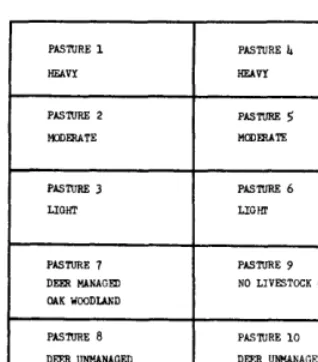
fence to confine ten deer (Fig. 1).
Each pasture was rectangular; pas- tures 1 through 3 were 3,880 feet long and 1,077 feet wide, and the re- maining pastures were 5,280 feet long and 792 feet wide.
The objective of pastures 1 through 6 was to determine the influence of various domestic stocking rates on deer production. Pastures 7, 8, and 10 served as a comparison of deer productivity between two vege- tative types and between two inten- sities of harvest. Pasture 9 was a control with no livestock or deer.
Since continuous yearlong grazing was the common management prac- tice in the Edwards Plateau at the time the experiment was initiated, a yearlong grazing system was used in all livestock pastures, but stock- ing rates were varied. Heavy, mod- erate, and light stocking rates were begun in paired pastures. Rambouil- let sheep, Angora goats, and Hereford
cows were grazed in combination, in as nearly the same proportions be- tween different stocking rates as possible. Heavily stocked pastures, each contained 23 sheep, 22 goats, and 3 cows; moderately stocked pas- tures, 10 sheep, 10 goats, and 2 cows; and lightly stocked pastures 8 sheep, 7 goats, and 1 cow. Heavy stocking was defined as an animal unit 3 to 8 acres; moderate as an animal unit to 16 acres; and light as an animal unit to 24 acres. The beginning num- ber of ten deer per livestock-stocked
3 One animal unit was considered equivalent to 1 cow, 5 sheep, or 5 goats, deer not considered. Female brood stock was used in all pas-
tures.
McMAHAN AND RAMSEY
pasture was to have been constant, but it varied some from the start of the study due to unexpected death losses. In 1961, the program was modified. Pastures 4, 5, and 6 were discontinued as replicates of the con- tinuous grazing system and com- bined as a three-pasture deferred- rotation unit.
The pastures stocked with deer only have furnished information for two comparisons. Pasture number 7 was stocked with 10 deer and the population increase was removed annually during an either sex hunt. In pasture number 8 the herd was allowed to increase “unmanaged” with only occasional buck deer being harvested. Pasture 10 was designed to operate identically to pasture 8 but under different vegetative con- ditions. Pasture 10 was typified by an ashe juniper aspect and pasture 8 was an open oak woodland.
Herbaceous vegetation response to treatment in all pastures was meas- ured by the line intercept method (Canfield 1941). Ten 50-foot line transects per pasture were read an- nually during the summer.
Browse composition was obtained by two lo-foot-wide belts running the length of each pasture. Woody species were recorded by the square feet of canopy. Condition and trend of woody species was a descriptive measure of available browse (that below 5 feet). Since the size and growth form of individual browse plants within a species group was the same, an inference can be made about comparative volumes between treatments within a species group.
To determine the monetary values associated with different stocking rates, detailed records were main- tained on all expenditures and sales of livestock products. Individual weights of lambs, goat kids, wool
and mohair were obtained in a man- ner to facilitate a statistical analysis of the data.
Findings
Influence of Grazing on Deer Production-A summary of deer production in the experimental pastures (Table 1) indicate a low carrying capacity for deer in all the livestock-stocked, con- tinuously grazed pastures. Even in the lightly grazed pasture the average number of deer surviv- ing was only one to 24 acres. Deer production - defined as fawns surviving to yearling age -decreased with an increase in the domestic stocking rate. This is especially evident in the heavi- ly grazed pastures where no fawns have ever survived to yearling age. The difference in the average number of deer sur- viving (about 4 adult deer) be- tween moderate and light graz- ing is small; but the heavily grazed pasture supported only about half as many adult deer as the moderate or light.
In contrast to poor deer pro- duction in the livestock-stocked pastures, the deer-only, managed population showed a good meas- ure of success. No fawn produc- tion data in terms of a doe to fawn ratio are available because of the difficulty in differentiat- ing between sexes, but pasture 7 averaged an annual 37 percent herd increment. Production in the stocked pastures on the other hand was well below this. No production was obtained under
Table 1. Deer performance in experimental grazing pastures, averages
for 8 years, 1956 fo 1963.
Pasture Starting Adult Fawn
Treatments Population Death Loss Survival _--- Number - - - -
Heavily Stocked 4.5 2.5 0.0
Moderately Stocked 5.7 1.5 1.1
Lightly Stocked 5.6 1.8 1.1
Deer Only, Managed
Oak Type 11.3 0.6 4.9
Deer Only, Unmanaged
Oak Type 13.9 0.9 4.3
Deer Only, Unmanaged
DEER AND LIVESTOCK 3
heavy grazing, and under moder- ate and light grazing an average of only 38 percent of the fawns survived. The study did not re- veal differences in breeding per- formance of individuals between grazing intensities because deer had to be trapped and introduced into the pastures from the out- side to replace death losses each year. These introductions nor- mally came after the rut, when most does were already bred.
Deer production in pasture 10, with dense ashe-juniper and no livestock, was almost nil. By March, 1964, this pasture sup- ported a total of only 3 deer, as compared with a total of 24 deer in pasture 8, containing oak woodland. The juniper type in- directly deters deer production by suppressing the growth of staple and preferred deer foods
(Ramsey, 1963) .4 Also, ashe-ju- niper itself is a low-value emer- gency deer food. (McMahan, 1961, op. cit.)
Differences in the performance of deer between managed and unmanaged pastures became ap- parent in 1962 and 1963 when the unmanaged herd showed 19 and 4 percent increment. The man- aged herd had 31 and 38 percent increments respectively. During this two-year interval a total of 7 deer were found dead in the unmanaged pasture while only 2 deer died in the managed pas- ture. Before the last two years of study little difference was noted in deer mortality and pro- duction between the two pas- tures. Since the degree of forage availability became more acute during this period in the unman- aged pasture, food was consid- ered to be the probable limiting factor.
Deer mortality in the live-
4 Ramsey, C. W. 1963. The value of cedar in deer and livestock produc- tion on the Kerr Wildlife Manage- ment Area. Texas Parks and Wild- life Dept. Austin. Project W-76-R, Job 4 Special Report (25 pp. mul- tilithed).
stocked pastures was most pro- nounced in the fawns. Within a given year, they were the first to die. Among adults, however, there was no discernible pattern of death losses between age classes or length of time individ- uals were in the enclosure. Adult bucks did better than does in the enclosures, as indicated by their lower death losses. Over the 9 year period in the heavy grazed pasture bucks showed a 50 percent death loss as com- pared to 58 percent for adult does. In the moderately and lightly stocked pastures the death losses in adults of both sexes decreased. Bucks showed a death loss of 9 and 11 percent respectively and does a loss of 37 percent under both treat- ments.
Vegetative Response to Treat- ment. - Range conditions were poor at the beginning of the ex- periment due to long heavy use. After the experiment started, conditions improved in the deer- only and control pastures; re- mained static to slightly im- proved in the moderate and light continuous-use pastures and de-
teriorated under heavy continu- ous-use. Range deterioration as evidenced by erosion was curbed under all treatments except heavy use where there are active gullies and pediceled plants everywhere.
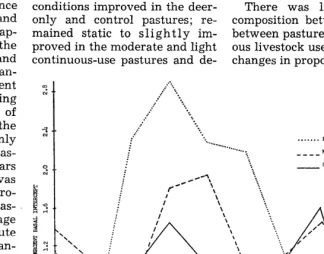
The total amount of grass as measured by basal intercept fluctuated greatly with years. The fluctuations generally fol- lowed the trends in available moisture as measured by annual rainfall (Fig. 2). The moderately grazed pasture is representative of the combined effect of live- stock and rainfall, while the con- trol pasture is representative of the effect of rainfall in the ab- sence of livestock use.
The reserve of grass remaining on the ground and the resulting litter varied with intensity of livestock grazing. As an exam- ple, average grass height meas- urements during 1963 were: Heavy, 0.9 inch; Moderate, 2.3 inch; Light, 3.2 inch.
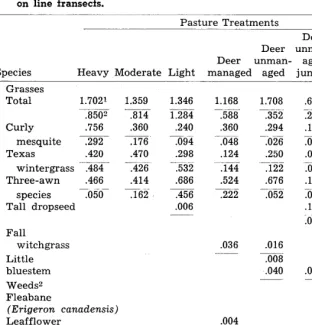
There was little change in composition between years and between pastures under continu- ous livestock use (Table 2). Any changes in proportions apparent-
.’
s
” x *... RAINFALL
i -*..*..,. ‘.‘Q. .*...*__
: ____ HODEIUTELY STOCKFD -.
i :
CON'IROL :
: ,,-?
;
f
*H \ Z_
\ -.
;
1'
\ :
\ :
I
1'
\ \
\ \ \
\ \
\ \
\ _ b'
\
55 56 57 58 59 60 61 62 b3
YFARS
FIGURE 2. Correlation of annual percent basal intercept.
4 McMAHAN AND RAMSEY
Table 2. Basal intercept percentage of selected grass and weed species on line transects.
Species
Pasture Treatments
Deer Deer unman- Deer unman- aged Con- Heavy Moderate Light managed aged juniper trol Grasses
Total 1.7021 1.359 ___ ~
.8502 .814 Curly .756 .360 mesquite .292 .176 Texas .420 -- .470 wintergrass .484 .426 Three-awn .466 .414
- ~.. species To50 .162 Tall dropseed
Fall
witchgrass Little bluestem Weeds2 Fleabane
(Erigeron canadensis) Leafflower
(Phyllanthus polygonoides) Velvet bundleflower
(Desmanthus velutinus) Woollywhite
(Hymenopappus tenuifolius)
1.346 1.284 .240 __-
.094 .298 ___-
.532 .686 .456 .006
1.168 .588 .360 --
.048 .124 .144 .524 ~__
.222
.036
.004 .012
1.708 .352 .294 .026 .250 .122 .676 .052
.016 __..
.008 .040
.698 .224 .158 .024 .060 .032 .112 .044 .116 .030
1.094 .310 .290 --
.020 .206 -.066
.392 .082 .019 .034 .006 .086 .OlO .060 .034 .088 .020 .092 1 1954 readings
2 1963 readings
ly are more related to distribu- tion and amount of rainfall than to animal treatment. An excep- tion is Texas wintergrass which increased in all pastures. Peren- nial bunch grasses increased in the deer-only and control pas- tures. After an initial increase, species such as little bluestem (Andropogon scoparius), tall dropseed (Sporobolus aspek), and fall witchgrass (Leptoloma cognatum) had either remained static or decreased in the deer- only and control pastures, pre- sumably from lack of use.
Forb composition in the
stocked pastures was much the same, with only a few additional species showing in the deer-only pastures. Only in the control pasture was the weed composi- tion greatly different from those pastures containing animals
(Table 2).
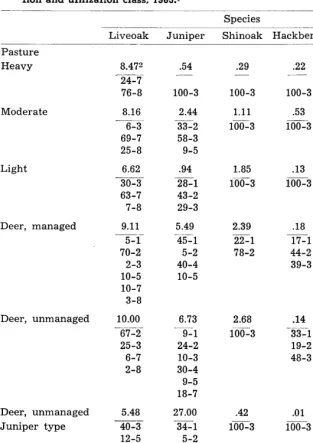
Woody plant composition as measured by square feet of cano- py remained the same through- out the pastures containing live- stock (Table 3) . A few additional palatable species occur in the deer-only, oak woodland type. The only large increase in avail- able preferred browse occurred in the control pasture. Species such as woolybucket bumelia (Bumelia Zanuginosa), and hack- berry (Celtis spp.), which are highly palatable to both goats and deer were unable to repro- duce or to furnish more than a token amount of forage in the livestock pastures. Staple browse species such as liveoak and shin- oak remained about the same within a pasture between years, and between pastures containing livestock. Although browse com- position as measured by canopy was very similar between all
treatments there was a wide dif- ference in available forage. Table 3 gives a descriptive measure of the relative availability to browsing animals of leafage be- low five feet. An additional measure, the presence and height of a “browse line,” is indicative of the relative availability of browse. Table 4 illustrates the increase in browse in the absence of livestock as measured by browse line height.
These vegetative measure- ments indicate that continuous grazing provides little or no dif- ferences in plant composition re- gardless of the stocking rate in effect. Differences in stocking rates as reflected in range vege- tation are seen mainly as quanti- tative ones, with few decreaser grass species, preferred forbs, or browse plants becoming estab- lished. In effect this system may be described as a vegetal com- plex composed of plant species that are adapted to the limiting factors of the area-the grazing animals. The main difference be- tween this complex and the deer-only pastures is the greater abundance of staple browse in pastures 7 and 8. Apparently continuous use by deer alone may restrict forage composition to species tolerant of continuous use by those animals.
DEER AND LIVESTOCK
Table 3. Composition and percentage of selected browse plants per condi- tion and utilization class, 1963.1
Species
Liveoak Juniper Shinoak Hackberry Bumelia Pasture
Heavy
Moderate
Light
Deer, managed
Deer, unmanaged
Deer, unmanaged Juniper type
No livestock or deer 8.472 24-7 76-8 8.16 6-3 69-7 25-8 6.62 30-3 63-7 7-8 9.11 5-l 70-2 2-3 10-5 10-7 3-8 10.00 67-2 25-3 6-7 2-8 5.48 -- 40-3 12-5 8-7 40-8 100-3 2.44 33-2 58-3 9-5 .94 28-l 43-2 29-3 5.49 45-l 5-2 40-4 10-5 6.73 9-l 24-2 10-3 30-4 9-5 18-7 27.00 34-l 5-2 3-4 45-7 13-8 6.34 1.85 100-3 2.39 22-l 78-2 2.68 100-3 .42 100-3 .22 100-3 53 __- 100-3 .13 100-3 .18 17-1 44-2 39-3 .14 33-l 19-2 48-3 .Ol 100-3 .64 Trace 100-3 .03 100-3 Trace _- 100-3 .12 100-3 .03 ____ 100-3 .Ol 100-3 .26 1 Legend to condition and utilization classes: 1, all available light use;
2, all available, moderate use; 3, all available, heavy use; 4, mostly avail- able, light use; 5, mostly available, moderate use; 6, mostly available, heavy use; 7, mostly unavailable; 8, unavailable.
2 Percent composition.
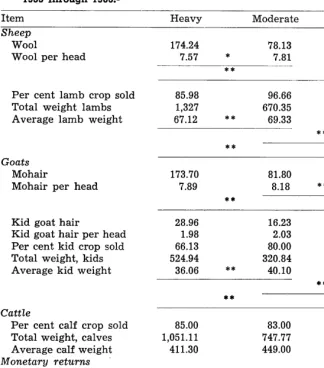
the moderate and light pastures. Mohair production on the other hand showed the opposite effect. Significant differences are seen in production per head between the moderate and light, and be- tween the heavy and light pas- tures, but not between the heavy and moderate pastures. We can- not explain this occurrence.
The moderately grazed pasture averaged the most dollars per acre, while the lightly stocked
pasture returned the most money per animal unit. The large ex- pense of supplemental feeding in the heavy-use pasture during dry years was the main reason it produced less per acre than the moderately grazed pasture over the ten-year period. Net re- turn per animal unit increased as the stocking rate decreased.
Discussion
Continuous grazing by com-
5
Table 4. Average browse line height in inches on oaks in the experi- mental pastures.
Pasture
treatment Liveoak Shinoak Heavy
Moderate Light
Deer, managed Deer, unmanaged Deer, unmanaged Juniper type
60 64 58 62 58 60 None None None 58
57 62 bined classes of livestock ad- versely effects deer production through competition for food. Yearlong use by animals tends to remove the most palatable and some of the staple forage species, and concentrates competition be- tween domestic animals and deer on fewer, less palatable species. This phenomenon becomes more apparent as the domestic stock- ing rate increases, as evidenced by a decrease in deer production from light to heavy livestock grazing.
Deer are clearly the losers in this type of direct competition for food. Even under starvation conditions they cannot be forced to utilize dry grass which will maintain domestic stock. A re- view of other research indicates that food supply, as influenced by grazing system, intensity of grazing, and by classes of ani- mals grazed, governs positive or negative effects on deer. Most range food plants in our region grow and reproduce better when afforded some rest from grazing. Merrill et. al. (1957) in studies at the Agricultural Experiment Station, Sonora, Texas, found higher densities of deer on pas- tures grazed on a deferred rota- tion system with combined cat- tle, sheep, and goats, than on combined class continuous-use pastures.
6 McMAHAN AND RAMSEY
Table 5. Average livestock production in the experimental grazing pasfures, 1955 through 1963.1
Item Heavy Moderate Light
Sheep
Wool
Wool per head
Per cent lamb crop sold Total weight lambs Average lamb weight
Goats
Mohair
Mohair per head
Kid goat hair
Kid goat hair per head Per cent kid crop sold Total weight, kids Average kid weight
Catt Ze
Per cent calf crop sold Total weight, calves Average calf weight
Monetary returns
Total net average Average net return per
animal unit
174.24 78.13 62.74
7.57 * 7.81 7.84
**
85.98 96.66 94.37
1,327 670.35 531.22
67.12 ** 69.33 70.30
*** **
173.70 81.80 63.22
7.89 8.18 ** 9.03
**
-
28.96 16.23 11.19
1.98 2.03 1.90
66.13 80.00 58.88
524.94 320.84 254.00
36.06 ** 40.10 43.15
** **
85.00 83.00 88.88
1,051.11 747.77 485.55
411.30 449.00 546.25
$154.64 $175.21 $143.46
$ 12.89 $ 29.20 $ 35.87 1 Except where noted, all production is in pounds.
* Indicates significance at 80-90 per cent confidence interval. ** Indicates significance at the .05 level.
*** Indicates significance at 60-80 per cent confidence interval. rate. The economic implications
in this finding are exemplified in the heavy-grazed treatment where the least net dollar return per domestic animal unit was ob- tained.
The combined bad effects of heavy continuous grazing ‘by livestock in the Edwards Plateau region are cumulative and do not become readily apparent until the organic litter cover has been materially reduced and food plant reproduction has been cur- tailed.
Summary
Continuous grazing by live- stock adversely effects deer pro- duction through competition for food. Yearlong use by animals tends to remove the most palat- able forage species and concen-
trates competition between do- mestic animals and deer on few- er, less palatable species. This competition becomes more ap- parent as the domestic stocking rate increases. Under these cir- cumstances livestock are ob- served to be more efficient com- petitors for food than deer. Deer may also be adversely affected in the absence of livestock, again through decreased food supply by (1 building to populations above the range carrying capaci- ty, with no harvest controls, and
(2 being restricted to a home range exclusively within an ashe-juniper vegetative type, where other browse and ground cover is scarce.
Under the continuous use sys- tem in our region, deer mortality
is most pronounced in fawns. Among adult deer, does exhibit a higher mortality rate than do bucks, with most death losses coming during the critical sum- mer season.
Vegetative measurements show that more efficient use of the range may be obtained by running one or several clasess of livestock with deer in order to harvest the forage that deer do not utilize. Deer alone made in- efficient use of the grass cover in their pastures.
No major difference was found in vegetative composition in the 3 continuous use pastures. The key grass plants in this system are Texas wintergrass, three- awn species, and curly mesquite. In the heavy-grazed pasture the volume of forage was less than in the other two lighter-stocked pastures, and the composition showed a procumbent growth form. Because of the lack of veg- etative cover and protective lit- ter, severe erosion was every- where apparent on the heavy treatment, but was largely curbed in the two other stocked pastures. Only a few of the more desirable livestock and deer food plants were able to grow and re- produce under the continuous- use system. These findings reit- erate the importance of giving plants periodic rest periods so that they may reproduce.
Livestock production per ani- mal, and the net return per ani- mal unit, increased as the stock- ing rate decreased. The moder- ately-grazed pasture averaged the most returns per acre, fol- lowed in sequence by the heavy and lightly grazed pastures.
LITERATURE CITED
CANFIELD, R. H. 1941. Application of the line interception method in sampling range forage. Jour. For- estry 39: 388-394.
DEER AND LIVESTOCK 7
HAHN, HENRY C. 1945. The white- NETTE, AND DALE A. JONES. 1961.
tailed deer in the Edwards Plateau Relation of summer range condi- populations to grazing practices. Region of Texas. Texas Game, tion to mule deer herd produc- Reprint from Sept.-Oct. 1957 Texas Fish and Oyster Commission, Aus- tivity. Jour. Wildlife Mangt. 25: 54- Agr. Progress 3 (5) : 10-12.
tin. 52 pp. 60. MERRILL, LEO B. 1959. Heavy grazing
JULANDER, ODELL, W. LESLIE ROBI-
MERRILL, L. B., J. G. TEER, AND 0. C. lowers range carrying capacity.
WALLMO. 1957. Reaction of deer Texas Agr. Progress 5 (2) : 18.
Effects of Fertilization on a Mixed Stand of
Cheatgrass and Intermediate Wheatgrass
BURGESS L. KAY AND RAYMOND A. EVANS Associate Specialist, Department of Agronomy, Univer- sity of California, Davis, California; and Research Range Conservationist, Crops Research Division, Agricultural Research Service, USDA, University of Nevada, Reno, Nevada.
Highlight
Applied nifrogen increased calm- petition between cheafgrass and intermediate wheaigrass for soil moisture and resulfed in death of
wheaigrass. Grazing further in-
creased this effect. Forage increases occurred in iwo of four years but did nof justify cost.
Fertilization of seeded peren- nial grasses in sagebrush areas of the West is mostly experi- mental. Previous studies by Eck- ert et al. (1961)) Kilcher (1958)) and Sneva et al. (1958) indicate fertilizers will increase yield and quality of forage in areas having an average precipitation of 10 inches or more. Kay et al. (1957, 1958) reported yield increases of annuals, particularly cheatgrass (Bromus tectorum L.), in re- sponse to nitrogen application. Such increased growth of annual species would offer greater com- petition to seeded perennial grasses.
The study presented here was established: (1) to determine the responses of a mixed stand of intermediate wheatgrass (Ag- ropyron intermedium (Host) Beauv.) and cheatgrass to vari- ous rates and combinations of fertilizers; (2) to ascertain the competitive effects of each species under various fertility regimes; (3) to determine the
effects of environmental factors, especially precipitation, on re- sponses of both species to fer- tilizer, and (4) to determine the practicability of fertilizing es- tablished stands of intermediate wheatgrass and cheatgrass under semi-arid conditions.
Methods
The study was conducted on the University of California Demonstration Range, 2 miles northeast of the town of Likely in the extreme northeast corner of the state? The area is com- monly referred to as tableland, and usually grows big sagebrush (Artemisia tridentata Nutt.), cheatgrass, squirrel tail (Sitanion hystrix (Nutt.) J. G. Smith), Sandberg bluegrass (Poa se- cunda Presl), and red-stem fila- ree (Erodium cicutarium (L.) L’Her.). Annual precipitation averages 10 inches, with seasonal totals varying widely. The ele- vation is 4,500 feet, and the growing season is short and vari- able. Cheatgrass may germinate as early as October or as late as March, but seldom is tall enough to graze before May. In a warm wet season, growth may start as
-
1 The cooperation of rancher Warren Fluornoy on whose land this study was conducted is gratefully ac- knowledged.
early as February. The annual grass matures about the first week of June and is dry by the end of June. Winter tempera- tures commonly fall below zero; summer temperatures may ex- ceed 100” F. The soil is gravelly loam over clay superimposed over a cemented layer on basal- tic bedrock (Yancy series). To- tal soil depth averages 10 to 20 inches. Livestock use generally is from April 15 to June 15.
Two adjacent fertilizer trials were established in the fall of 1958 on a l-year-old seeding of Greenar intermediate wheat - grass. One trial was fenced to exclude cattle, deer, antelope, and rabbits; and the small ro- dents were poisoned as recom- mended by Howard et al. (1957). The second trial was identical in design, but left open to grazing by all animals. Nine fertilizer treatments were replicated four times in each trial in a random- ized block design. Nitrogen was applied as ammonium nitrate at rates of 30, 60, or 120 lb actual nitrogen per acre. Each of these nitrogen rates also was applied in combination with 40 lb/A sul- fur applied as gypsum. The re- maining treatments were 40 lb/A sulfur alone, 60 lb/A nitrogen as ammonium sulphate, and an un- fertilized check plot. Each treat- ment plot was 15 x 15 ft. All ni- trogen (N) and nitrogen plus sul- fur (NS) treatments in the fenced trial were split in half at the end of the first growing sea- son (1959) and the nitrogen ap- plication repeated on one-half
DEER AND LIVESTOCK 7
HAHN, HENRY C. 1945. The white- NETTE, AND DALE A. JONES. 1961.
tailed deer in the Edwards Plateau Relation of summer range condi- populations to grazing practices. Region of Texas. Texas Game, tion to mule deer herd produc- Reprint from Sept.-Oct. 1957 Texas Fish and Oyster Commission, Aus- tivity. Jour. Wildlife Mangt. 25: 54- Agr. Progress 3 (5) : 10-12.
tin. 52 pp. 60. MERRILL, LEO B. 1959. Heavy grazing
JULANDER, ODELL, W. LESLIE ROBI-
MERRILL, L. B., J. G. TEER, AND 0. C. lowers range carrying capacity.
WALLMO. 1957. Reaction of deer Texas Agr. Progress 5 (2) : 18.
Effects of Fertilization on a Mixed Stand of
Cheatgrass and Intermediate Wheatgrass
BURGESS L. KAY AND RAYMOND A. EVANS Associate Specialist, Department of Agronomy, Univer- sity of California, Davis, California; and Research Range Conservationist, Crops Research Division, Agricultural Research Service, USDA, University of Nevada, Reno, Nevada.
Highlight
Applied nifrogen increased calm- petition between cheafgrass and intermediate wheaigrass for soil moisture and resulfed in death of
wheaigrass. Grazing further in-
creased this effect. Forage increases occurred in iwo of four years but did nof justify cost.
Fertilization of seeded peren- nial grasses in sagebrush areas of the West is mostly experi- mental. Previous studies by Eck- ert et al. (1961)) Kilcher (1958)) and Sneva et al. (1958) indicate fertilizers will increase yield and quality of forage in areas having an average precipitation of 10 inches or more. Kay et al. (1957, 1958) reported yield increases of annuals, particularly cheatgrass (Bromus tectorum L.), in re- sponse to nitrogen application. Such increased growth of annual species would offer greater com- petition to seeded perennial grasses.
The study presented here was established: (1) to determine the responses of a mixed stand of intermediate wheatgrass (Ag- ropyron intermedium (Host) Beauv.) and cheatgrass to vari- ous rates and combinations of fertilizers; (2) to ascertain the competitive effects of each species under various fertility regimes; (3) to determine the
effects of environmental factors, especially precipitation, on re- sponses of both species to fer- tilizer, and (4) to determine the practicability of fertilizing es- tablished stands of intermediate wheatgrass and cheatgrass under semi-arid conditions.
Methods
The study was conducted on the University of California Demonstration Range, 2 miles northeast of the town of Likely in the extreme northeast corner of the state? The area is com- monly referred to as tableland, and usually grows big sagebrush (Artemisia tridentata Nutt.), cheatgrass, squirrel tail (Sitanion hystrix (Nutt.) J. G. Smith), Sandberg bluegrass (Poa se- cunda Presl), and red-stem fila- ree (Erodium cicutarium (L.) L’Her.). Annual precipitation averages 10 inches, with seasonal totals varying widely. The ele- vation is 4,500 feet, and the growing season is short and vari- able. Cheatgrass may germinate as early as October or as late as March, but seldom is tall enough to graze before May. In a warm wet season, growth may start as
-
1 The cooperation of rancher Warren Fluornoy on whose land this study was conducted is gratefully ac- knowledged.
early as February. The annual grass matures about the first week of June and is dry by the end of June. Winter tempera- tures commonly fall below zero; summer temperatures may ex- ceed 100” F. The soil is gravelly loam over clay superimposed over a cemented layer on basal- tic bedrock (Yancy series). To- tal soil depth averages 10 to 20 inches. Livestock use generally is from April 15 to June 15.
Two adjacent fertilizer trials were established in the fall of 1958 on a l-year-old seeding of Greenar intermediate wheat - grass. One trial was fenced to exclude cattle, deer, antelope, and rabbits; and the small ro- dents were poisoned as recom- mended by Howard et al. (1957). The second trial was identical in design, but left open to grazing by all animals. Nine fertilizer treatments were replicated four times in each trial in a random- ized block design. Nitrogen was applied as ammonium nitrate at rates of 30, 60, or 120 lb actual nitrogen per acre. Each of these nitrogen rates also was applied in combination with 40 lb/A sul- fur applied as gypsum. The re- maining treatments were 40 lb/A sulfur alone, 60 lb/A nitrogen as ammonium sulphate, and an un- fertilized check plot. Each treat- ment plot was 15 x 15 ft. All ni- trogen (N) and nitrogen plus sul- fur (NS) treatments in the fenced trial were split in half at the end of the first growing sea- son (1959) and the nitrogen ap- plication repeated on one-half
8
maining half received only the
initial application of
nitrogen.Sulfur application was not re-
peated.
Yield data were taken on
fenced plots only. The entire plot
area was harvested
to a 2-inchstubble height, using a rotary
lawn mower with bag attach-
ment. Original plans included
harvesting periodically during
the growing season to simulate
grazing, with the number of clip-
ping depending on the amount of
growth produced and length of
growing season. Because of the
low-rainfall years encountered,
the actual numbers of clippings
were none in 1959, two in 1960,
and one each in 1961 and 1962.
Botanical composition in terms
of percent ground cover was de-
termined by the step-point meth-
od described by Evans and Love
(1957) in both the fenced and
unfenced plots. Thirty points and
five squarefoot cover estimates
were taken per plot (a total of
120 points and 20 cover estimates
per treatment) each year.
Results and Discussion
Precipitation during the 4 years
of this study was considerably
below normal - 4.92 inches in
1958-59; 7.28 inches in 1959-60;
5.37 inches in 1960-61, and 9.75
inches in 1961-62. In addition to
the extremely low total rainfall
in 1958-59 and 1960-61 there was
an almost complete lack of rain
during the spring months in
those same years - the period
when nearly all plant growth
normally occurs. The drought
was reflected in the differential
responses of the species as well
as in total herbage yield.
Effects cm Ground Cover
Fenced plot.
-The
first year
after treatment (1959)) ground
cover of cheatgrass was increased
over four times by the high nu-
trient treatment (from 5% to
21%). Ground cover of wheat-
grass was doubled by the same
treatment (from 6% to 12%),
while total ground cover tripled
(from 13% to 38%). Earlier
KAY AND EVANS
Table 1. Effects of fertilizer on percent ground cover-fenced plots.
Cheat- Wheat- 1960
Treatment1 grass grass Total None (check)
P-P
10.0 3.0 13.0
N30 15.5 4.8 22.8
NaoR 17.8 7.3 25.3
Neo 23.8 4.0 28.0
N6oR 27.8 5.0 33.3
N120 27.8 4.5 33.8
m12oR 29.0 3.5 34.0
s40 10.0 6.0 16.0
AS-300 25.8 5.0 31.3
AS-300R 31.3 5.0 36.5
N30S40 16.5 4.0 20.8
N3oS4oR 20.5 4.8 25.5
NSOS40 23.8 3.5 28.3
NBoS~OR 23.5 4.8 39.8
N120S40 32.5 3.8 37.0
N12oS4oR 34.3 4.5 41.5
LSD .05 8.2 NS 8.3
.Ol 11.0 - 11.0
Cheat- Wheat- grass grass Total
1961
-
2.0 3.8 6.0
6.3 3.7 10.0
4.5 4.8 9.8
9.0 4.0 13.0
6.3 3.0 10.0
9.0 1.8 11.0
5.0 1.8 7.0
3.0 5.3 8.3
11.5 4.3 15.8
6.5 4.5 11.0
5.5 4.0 9.8
7.3 5.3 12.8
12.5 3.3 16.0
8.3 1.8 10.5
7.0 1.5 8.8
4.3 1.7 6.0
4.8 2.0 4.6
6.5 2.7 6.1
Cheat- Wheat- grass grass Total
5.3
1962
22.8 30.0
24.5 16.3 42.5
32.5 15.8 52.5
30.5 13.8 47.5
54.0 13.0 67.5
49.0 14.0 70.0
54.3 6.0 67.5
7.0 22.0 30.0
40.5 15.8 57.5
65.3 7.3 77.5
16.3 17.5 35.0
27.8 13.5 42.5
30.3 16.8 52.5
52.8 5.3 65.0
54.8 6.0 65.0
71.8 6.5 85.0
16.3 8.6 13.4
21.7 11.5 17.9
IRates of nitrogen (N) and sulfur (S) are given in lb/A, R refers to annual
reapplication of nitrogen. AS refers to ammonium sulfate and lb/A of
this material.
growth of cheatgrass was noted
on the N plots than on the check
plots.
The ground cover of wheat-
grass was reduced considerably
in all plots the second year, 1960
(Table 1). This probably was the
result of the extremely low rain-
fall the previous year. Cheat-
grass increased proportionately,
and total ground cover remained
unchanged even though total
precipitation was increased con-
siderably over the preceding
year.
Total ground cover on all plots
was considerably lower the third
year (1961) than the second as
the result of another dry year.
Wheatgrass showed a slight in-
crease on the check, probably the
result of the improved rainfall
the previous year. However, fer-
tilized wheatgrass continued to
decline in ground cover, ap-
parently because of the mortality
suffered in this series of dry sea-
sons, combined with the com-
petitive effects of an increased
amount of cheatgrass resulting
from fertilizer treatments. Cheat-
grass was much less on all plots
in the third year than the second.
The fourth year (1962) had
about average rainfall, but was
unusually productive
because
much of the rain fell during the
spring growing period. Ground
cover was increased considerably
for both species over the third
year on both the checks and on
the fertilized plots. However, the
fertilized plots again produced
an excessive amount of cheat-
grass; and, although wheatgrass
was able to recover somewhat
from the previous year, the
amount of recovery was con-
siderably less than that on the
unfertilized checks.
WHEATGRASS FERTILIZATION
9
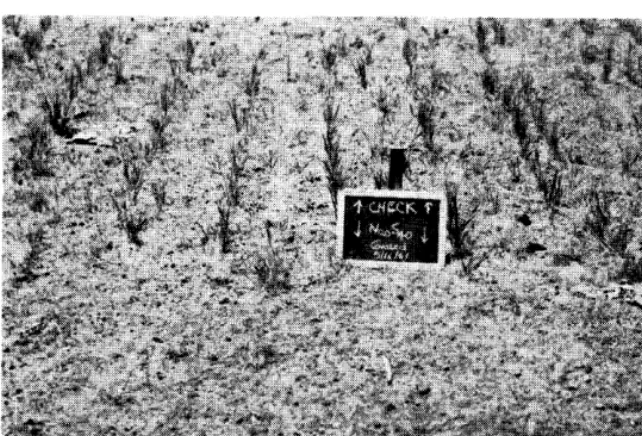
FIGURE 1. Grazed study-N12&o in foreground and check in rear. Photographed in
third year of study, May 16, 1961.
Table 2. Effects of fertilizer on percent ground cover-grazed plots. 1961 ~___ 1962
Treatment1
Cheat- Wheat-
grass grass Total None (check)
N30
N60
N120
s40
N30S40
N60S40
N120S40
AS-300 LSD .05
.Ol
1.9 2.4 1.2 1.0 1.4 2.0 1.7 0.7 2.4 0.7 1.0
3.3 1.3 0.6 0.3 4.1 2.2 0.9 0.1 1.9 1.6 2.2
5.2 3.8 1.9 1.3 5.6 4.2 2.6 0.9 4.7 2.2 3.0
Cheat- Wheat-
grass grass Total 17.3 18.3 36.3 39.5 7.5 47.5 53.5 1.0 55.0 45.2 2.3 47.5 9.3 26.8 36.3 38.3 10.0 50.0 51.0 2.5 55.0 40.0 2.5 46.0 49.0 4.0 55.0 14.3 5.7 11.5 19.4 7.7 15.6 IRates of nitrogen (N) and sulfur (S) are given in lb/A. AS refers to
ammonium sulfate and lb/A of this material.
Wheatgrass recovered some in
check plots in 1961 as the result
of the better growing year of’
1960, but recovery was not as
much as in the fenced plots
(Table 2). Total ground cover of
check plots was reduced sharply
over the previous year, with
cheatgrass reduction accounting
for the decreases.
Wheatgrass
was almost completely killed out
in the high-nutrient plots, the
mortality being much higher
than in the fenced plots (0.1%
ground cover on grazed plots
compared to 1.5% on fenced
plots, Figure 1).
Excellent growing conditions
in the fourth year (1962) were
reflected in an increase in both
species and in total ground
cover. Increase of wheatgrass
was greatest on the check and
least on the highest nutrient
rates, but always less than in
plots of the same treatment
under fence.
Grazing was both early and
heavy in all years. Deer, ante-
lope, and rabbits grazed continu-
ously from the time the first
growth started at the end of
winter; and in addition, livestock
grazed from April 15 to June 20.
Grazing by all classes of animals
(wild and domestic) was heaviest
where nitrogen fertilizers had
been applied. The checks were
also grazed harder than the gen-
eral pasture because of their
close proximity to the fertilized
treatments. These factors may
explain the differences in re-
sponse between
the fenced
(mowed) experiment and the
grazed experiment.
Effects on Forage Producfion
Forage yields varied more from
year to year than they did be-
tween fertilizer applications
(Table 3). The check varied from
an estimated 25 lb/A in 1959 to
920 lb/A in 1962, a 36-fold differ-
ence which compares with only
doubled yields by fertilizing even
in the best year (920 lb/A on
check compared to 2290 lb/A on
the
NuoS~OR) .There was no increase in for-
age resulting from fertilization
Table 3. Effects of fertilizer on oven-dry forage yield&.
Yields - lb/A Treatment2 19603 1962 ~-
None (check) 350 920
N30 360 1150
NsoR 410 1450
N60 430 1400
NsoR 400 1770
N120 390 1600
NmoR 420 1770
s40 290 1040
N30S40 260 980
N3oSoR 440 1800
N60S40 360 1280
N6o%oR 450 1820
N120S40 410 1670
N12oS4oR 520 2290
AS-300 - 1200
AS-300R - 2060
LSD .05 30 280
.Ol 40 390
-___ __
1 Yields for 1959 were not taken, yield on check plots was estimated at 25 lb/A; yields for 1961 averaged 35 lb/A, no significant differences occurred among treatments. 2 Rates of nitrogen (N) and sulfur
(S) are given in lb/A. R refers to annual reapplication of nitrogen. AS refers to ammonium sulfate and lb/A of this material.
10
KAY AND EVANS
in either of the two drier years,
1959 and 1961. Yields were in-
creased significantly by many of
the treatments in 1960, but not
enough to justify the expense of
the fertilizer. Growth responses
were much better in 1962, a year
when the extra feed produced by
fertilization was not needed.
The single application of 60
lb/A nitrogen at the beginning
of the experiment continued to
produce forage increases in the
fourth growing season. The 30
lb/A treatment failed to pro-
duce a yield response
in any
year unless repeated.
Table 4. Effecfs of fertilizer on pro- fein contents (percent) of wheaf- grass and cheafgrass: 1960 growing season.
April 27, June 2, 1960 1960 Cheat- Wheat- Both Treatment1 grass grass species ___ None (check) 11.9
N30 -
N3oR -
Nso -
NsoR -
N120 -
Nl2oR -
s40 -
N30S40 14.0
&O&OR 17.4
N60S40 17.6
N6oS4oR 20.5
N120S40 17.9
NlsoS4oR 23.3
AS-300 -
AS-300R - LSD among means of fer- tilizer treat-
ments .05 3.9 for the same
species. .Ol 5.8 LSD between
means for species for the same or differ- ent fertilizer
treatments. .05 4.8
13.3 11.4 - 13.2 - 14.8 - 14.1 - 19.1 - 19.4 - 21.1 - 12.1 18.0 11.9 19.6 14.8 20.8 15.2 26.7 19.4 26.5 18.1 29.7 23.4 - 14.6 - 16.5
2.2 2.9
1 Rates of nitrogen (N) and sulfur (S) are given in lb/A. R refers to annual reapplication of nitrogen. AS refers to ammonium sulfate and lb/A of this material.
Supplementary Studies Forage quality. -
The protein
content of cheatgrass and wheat-
grass were determined separate-
ly in the first clipping of 1960
and together in the second. The
protein contents of both species
generally were increased by ni-
trogen fertilization (Table 4).
Wheatgrass was significantly
higher in protein than was cheat-
grass when both were heavily
fertilized.
An analysis also was made for
sulfate-sulfur. Again there was
a significant difference between
the species when heavily fer-
tilized, wheatgrass being higher
in sulfur (0.464%) than was
cheatgrass (0.176%). Sulfur was
also higher in the wheatgrass in
the NCJO&O
plot (0.464%) than in
the
N120S40R plot (0.350%))
in-dicating
that the increased
growth from repeated nitrogen
applications had depleted the
sulfur. This analysis also shows
that sulfur carries over well in
this soil and is not readily
leached.
Soil
moisture. -Soil moisture
was measured gravimetrically at
two depths-6-10 inches and 12-
16 inches-on May 17 and again
on June 2, 1960. There were no
differences in moisture attribut-
able to fertilizer treatment on
the first sampling date, but dif-
ferences were apparent on the
second date. Differences in use
of moisture by cheatgrass and by
wheatgrass were negligible.
However, both species removed
more moisture when fertilized
than when not fertilized. Soil
moisture on June 2, 1960 at 6-10
inches was 12.1% on the check
and 9.4% on the
N120S40R plot.
At the 12-16-inch depth moisture
was 21.4% and 15.6%, respective-
lY*
Soil nitrogen.-Total soil nitro-
gen was measured at two depths
(O-3 in. and 3-6 in.) at the end
of the growing season in 1961 in
the check,
N120,and
N120R plots
to determine if nitrogen had ac-
cumulated from the repeated ap-
plications. Total nitrogen in the
soil samples averaged 0.085%. No
statistically signif icant differ-
ences were found. However the
increases in yield the following
year indicate that probably con-
siderable nitrogen remained in
the nitrogen plots.
Soil @.-Soil
pH was mea-
sured at two depths in the check
and N120S4oR
plots at the end of
the third growing
season to
check on the possible effects of
a lowered pH on the mortality
of the wheatgrass. The pH in the
treated plots was significantly
reduced at both depths, but not
sufficiently to contribute to the
mortality. At the O-3 inch depth,
pH was 7.2 on the checks and 6.9
on the N120S40
R plots; at the 3-6
inch depth it was 7.4 and 7.0 re-
spectively.
Conclusion
Results of the 4-year fertiliza-
tion study on cheatgrass and in-
termediate wheatgrass indicate
that applied nitrogen, especially
at the higher rates, favored
cheatgrass at the expense of
wheatgrass. Grazing increased
the detrimental effects of high
nitrogen fertilization on inter-
mediate wheatgrass.
Increased growth of cheatgrass
with high nitrogen, coupled with
extremely dry years, is con-
cluded to be the principal cause
of the marked reduction of in-
termediate wheatgrass.
Under the soil and moisture
conditions of this experiment,
fertilization of intermediate
wheatgrass and cheatgrass is not
economical, and also may cause
serious damage to the wheat-
grass.
Summary
WHEATGRASS FERTILIZATION
11
rates, with and without sulfur.
Increases in forage yield oc-
research. Jour. Range Mangt. 10:Initial application of nitrogen
curred only in the better forage
208-212.was compared with annual re- years. In the poorer years no for-
HOWARD, W. E., AND B. L. KAY. 1957. application. Plots were sampled age increase resulted from fer- Protecting range forage plots from for yield and botanical composi- tilization.In no instance did the
rodents. Jour. Range Mangt. 10: 178-180. tion by ground cover. forage response justify the costResults indicated that applied of the fertilizer.
KAY, BURGESS L., C. F. WALKER, J. E. STREET AND J. L. MYLER. 1958. nitrogen, especially at the higher
rates, favored cheatgrass at the expense of the wheatgrass under the dry conditions of this study. Grazing increased the detrimen- tal effects of high nitrogen fer- tilization on intermediate wheat- grass. Rapid depletion of soil- moisture, the result of increased growth of cheatgrass under high nitrogen in a period of below- normal precipitation, was postu- lated to be the principal cause of reduction of intermediate wheat- grass.
LITERATURE CITED
ECKERT, RICHARD E., A. T. BLEAK, AND Jos. H. ROBERTSON. 1961. Effects of macro- and micronutrients on the yield of crested wheatgrass. Jour. Range Mangt. 14: 149-155. ECKERT, RICHARD E., AND RAYMOND A.
EVANS. 1963. Responses of downy brome (Bromus tectorum) and crested wheatgrass (Agropyron desertorum) to nitrogen and phos- phorus in nutrient solution. Weeds 11: 170-174.
EVANS, R. A., AND R. M. LOVE. 1957. The step-point method of sam- pling - a practical tool in range
Range demonstration 1958 - prog- ress report - University of Cali- fornia, Davis.
KAY, BURGESS L., J. E. STREET AND C. W. RIMBEY. 1957. Nitrogen car- ryover on range. Cal. Agr. ll(l0) : 5 & 10.
KILCHER, MARK R. 1958. Fertilizer ef- fects on hay production of three cultivated grasses in Southern Saskatchewan. Jour. Range Mangt. 11: 231-234.
SNEVA, FORREST A., DONALD N. HYDER, AND C. S. COOPER. 1958. The influ- ence of ammonium nitrate on the growth and yield of crested wheat- grass on the Oregon high desert. Agron. Jour. 50: 40-44.
Effects of Manure, Straw and Inorganic
Fertilizers on Northern Great Plains Ranges
S. SMOLIAKl
Range Specialist, Canada Agriculture Research Station, Lethbridge, Alberta.
Highlight
One applicafion of manure, straw and straw - plus- fertilizer increased forage producfion significantly up fo eight years after freafmenf. Forage on these plots generally contained greater amounts of nutrients fhan on control plots and fhe species compo- sition was changed. Ferfilizafion is a valuable range management fech- nique for increasing livestock pro- duction.
One method of increasing
range forage production is by the
use of barnyard manure and in-
organic fertilizers. Substantial
forage yield increases from ap-
plications of barnyard manure
and inorganic fertilizers
on
Northern Great Plains have been
shown in recent literature. The
1 Formerly at Canada Experimental Farm, Manyberries, Alberta.