A Review on Face Recognition in various
Illuminations
Saurabh D. Parmar , Vaishali j. kalariya
CE/IT Department-School of Engineering,R.K. University,Rajkot
Abstract:- face recognition is the most important challenging in the research area of computer vision.
Different type of illumination takes place from dim light condition to dark light condition. Two types of condition are there. a) Controlled condition b) uncontrolled condition. In this paper we are presenting a detail survey on image based face recognition under such uncontrolled condition. Here we explore different technique proposed for illumination problem and in addition with the classifier that we have been successfully used for the face recognition in general.
1. INTRODUCTION
Face recognition is the very simple term; it is a process of recognizing the face of the person by a system. It is very difficult to use across the surveillance system. And also difficult to acquire the faces in controlled environment. So there is system which can capable to recognize the faces captured even in the poor lighting condition as against the faces taken in controlled environment. Many approaches have been proposed during the last 30 years of decade. However the real world scenario is the remains the challenge. And moreover all the technique are greatly affected and there accuracy affected by variation of illumination. Illumination problem arise when the same face appear differently due to the changing in light.
During the last decade different approaches towards the face recognition system that have been proposed can be classified into four main categories. a) Model based method which can employ texture of the face and shape. Along with the 3D depth information. b) Technique using the neural network c) Holistic methods which can use whole face as a region) template based face recognition where face template has been extracted and used for face recognition. Many problem has been solved and many problem is still remain in the field of research. We are presenting the survey paper that comprises as much literature study for the reader to understand that what exactly the variousation can be caused by variation in illumination ,what approaches had been done up till now to make continues improvement in existing system and their drawbacks.
The paper is differentiate as follows in section 2 , overview of face recognition system, basic steps which are involved in the face recognition system in section 3 will discuss about the challenges in face recognition. in section 4. Referred methods and section 5.classifiers that have been used in face recognition and finally summery and conclusion are given.
2.FACE RECOGNITION SYSTEM
There are lots of application where a person’s identification is important as well as there are many different identification technologies are available and many of those are also in commercially use for years. Most common person identification and verification is PIN (Personal Identify Number)[4][5]. In this method the problem is person can be forget his PIN or it can be stolen for misuse. This problem can be solved using “biometrics” identification systems. This can use pattern recognition technique to identify the person using their characteristics. Those are fingerprints, iris recognition and retina recognition voice recognition, face recognition etc
Face recognition is an important sub domain of the object recognition in which research community has shown their interest. Face recognition is very popular because of commercialism of technological achievements. Face recognition application is crucial areas such as security, face finding system, banking transaction, login by face recognition, AFRS. AFRS track the person movement and behavior who entered I the captured region. Face finding system is a system that can automatically find the images of person from the database. Recent studies show that Kenya government is planning to use face recognition at ATMs to replace person’s credentials.
The advantage of face detection is that verification of person can be easy from the crowed. In current research most exiting face recognition is only work with the frontal or nearly frontal image of faces under controlled environment to contain much information.
2.1 Face recognition basic steps.
First an image of the face is required ether by capture from camera or input stored images.
Second, software is employed to detect the location of any face in the image. third step will be feature extraction and it is very important for classification task in fourth step face database has been added to the step three ,in the fifth step feature extraction data and face database has been matched . Feature matching is match the data from the generated face and check with the decision maker and gives the appropriate output.
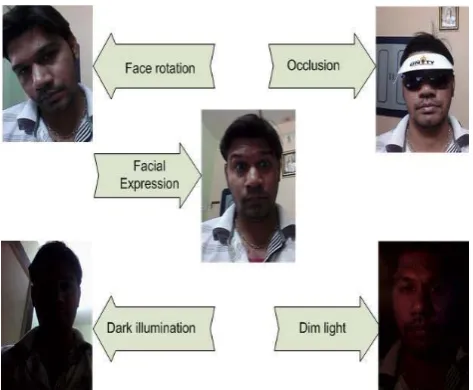
3. CHALLENGING IN THE FACE RECOGNITION SYSTEM Face recognition is an well known research area and still remain many problem which does not work such as various illumination condition like dim light condition to dark light condition, illumination expression, occlusion, face rotation etc. result reveal in all face recognition techniques successful in well control environments. But their performance becomes low due to variation in illumination. These are major problems in face recognition.
Figure 2. Challenging in the face recognition system
Since we are presenting a review paper on face recognition in various illuminations so it is necessary to head in the direction of the knowing that what basic approach had been adopted to deal with the face recognition in various illuminations. First we will deal with the preprocessing which is specifically deal with the illumination problem.
3.1 Preprocessing
At the first stage the image or captured image has to go with preprocessing method which reduces the effect of illumination variation in the image. For illumination normalization the preprocess chain mainly categorized in five different steps. RGB to Gray Scale Image, Gamma Correction, Difference of Gaussian, Masking and Equalization of Normalization. In this preprocess steps the darkness of images has been removed. But still need
necessary to get the information from the input image from feature extraction.
Figure 3. Illustrate the sequential steps of preprocessing chain.
The input image of the face recognition has been downloaded from various internet databases. Eg.Yale B database. Which can be either in dark illumination or other situation. All input images have a proper dimension of particular database.
1. RGB to Gray Scale
Humans perceive color through wavelength-sensitive sensory cells called cones. There are three different types of cones, each with a different sensitivity to electromagnetic radiation (light) of different wavelength. One type of cone is mainly sensitive to red light, one to green light, and one to blue light. By emitting a controlled combination of these three basic colors (red, green and blue), and hence stimulate the three types of cones at will, we are able to generate almost any perceivable color. This is the reasoning behind why color images are often stored as three separate image matrices; one storing the amount of red (R) in each pixel, one the amount of green (G) and one the amount of blue (B). We call such color images as stored in an RGB format.
In grayscale images, however, we do not differentiate how much we emit of the different colors, we emit the same amount in each channel. What we can differentiate is the total amount of emitted light for each pixel; little light gives dark pixels and much light is perceived as bright pixels.
When converting an RGB image to grayscale, we have to take the RGB values for each pixel and make as output a single value reflecting the brightness of that pixel. One such approach is to take the average of the contribution from each channel: (R+B+C)/3. However, since the perceived brightness is often dominated by the green component, a different, more "human-oriented", method is to take a weighted average, e.g.: 0.3R + 0.59G + 0.11B.
selected image to make a grayscale image that has the most variance.
2. Gamma Correction
Gamma Correction is nonlinear gray-level transformation used to correct the power-law transformation phenomena which perform the transformation of an input image to its original appearance. This transformed gamma-corrected image is free from the darkness by compressing all the dark regions into bright regions. It replaces the original gray-level I with IT by considering Y> 0, but lies between 0 and 1 (i.e., Y £[0, 1]). Here, the obtained image after gamma correction should be an illumination free image. Hence the value of T can be range from [0, 0.5] and by default the value of Y= 0.2 is to be considered.
3. Difference of Gaussian
Gamma Correction does not remove the complete darkness. Their remains the local shadings such as the shadow below the eye contacts, nose shadow, etc., and those can be removed by applying the high-pass filtering thus by simplifying the recognition problem. The high-pass filter is the one which attenuates low frequencies while passing high frequencies so that the edges of the image become sharper. Hence by implementing the filters using explicit convolution, boundary effects can be minimized. Gaussian filters are the special analysis tools which are easy to manipulate. Utilizing the characteristics of Gaussian function, the gamma-corrected image generates the informative image using the difference between the two Gaussian filters according to the local contrast information of the images [5]. The two Gaussian filters with the variances o1 =1.0 and a2 = 2.0 by default (always o1 < o2) can be considered. Though gamma correction produces an informative image, still without DoG filtering, the resulting images suffer from reduced local contrast in shadowed regions [Xiaoyang et al 2010].
4. Masking facial regions such as hair style, beard, etc., that are felt to be irrelevant, then masking can be applied, which simply has a face-shaped region. Also the background change can be minimized by using a mask.
5.Equalization of normalization:
The final stage of the preprocessing chain rescales the image intensities. It is important to use a robust estimator because the signal typically contains extreme values produced by highlights, small dark regions such as nostrils, garbage at the image borders, etc. One could use (for example) the median of the absolute value of the signal for this, but here a simple and rapid approximation is preferred based on a two stage process as follows:
Here, a isa strongly compressive exponent that reduces the influence of large values, T is a threshold used to truncate large values after the first phase of normalization, and the
mean is over the whole (unmasked part of the) image. By default we use a = 0:1 T = 10[Tan and Triggs, 2010].
6. Histogram and Computation Time
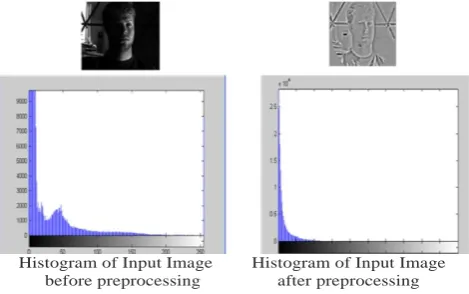
The difference between the input face image's histogram before and after the proposed preprocessing stage is given in the figure 4. This illustrates clearly how important the preprocessing to be done in order to reduce the unwanted noise or the highly variable lighting differences from the images to get the fruitful information for extracting of the features for the agent. Run time is considered to be very important. The computational time taken by the Matlab is only about 60ms for 150 x 130 dimension image.
Figure 4 Difference between the histograms before and after preprocessing of the image
4. REFERRED METHODS
1.Local Binary Pattern (LBP)
Local Binary Pattern (LBP)[7] (Ojala et al., 2002 it is characterize between a pixel and its neighbor. The face image can be divided into some small facets from which LBP features can be extracted. these feature joined into feature histogram and efficiently representing the face image. LBP is unaffected by any monotonic grayscale transformation in that the pixel intensity order is not changed after such a transformation. [5]
2.Local Ternary Pattern (LTP)
A local ternary pattern (LTP)[8], another important extension of original LBP is proposed. The most important difference between the LTP and LBP is that the LTP use 3- valued codes instead 2-valued codes in the LBP. Because of the extension, the LTP is more discriminate and less sensitive to noise. To apply the uniform pattern in the LTP, a coding scheme that split each ternary pattern into its positive and negative halves is also proposed in (Tan & Triggs, 2010). The resulted halves can be treated as two separated LBPs and used for further recognition task. The local directional pattern is more robust against noise and non-monotonic illumination changes.[5]
3.Block-based Histogram Equalization (BHE)
This method is also called local histogram equalization or region based histogram equalization. The
Histogram of Input Image Histogram of Input Image
face image can be divided into several small blocks according to the positions of eyebrows, eyes, nose and mouth. Each block is processed by HE[6]. they are overlapped by half with each other to avoid the discontinuity between the adjacent block. BHE is simple so that the computation required of BHE is much lower than that of AHE. The noise produced by BHE is also very little. 4. Principle Component Analysis (PCA)
The illumination may greatly influence the success rate of the recognition stages. In these days face normalization is frequently used in face recognition. Wand et.al.[4]recommended a bit-plane generalized PCA algorithm that can improve the robustness of illumination. Principle component analysis is a standard technique used in signal processing and statistical pattern reorganization for feature extraction and data reduction. PCA is also known as eigenface method.
5. CLASSIFIER 1. kNN classifier
Classification (generalization) using an instance-based classifier can be a simple matter of locating the nearest neighbor in instance space and labeling the unknown instance with the same class label as that of the located (known) neighbor. This approach is often referred to as a nearest neighbor classifier. The downside of this simple approach is the lack of robustness that characterizes the resulting classifiers. More robust models can be achieved by locating k, where k > 1, neighbors and letting the majority vote decide the outcome of the class labeling. The nearest neighbor classifier can be regarded as a special case of the more general k-nearest neighbors classifier, hereafter referred to as a kNN classifier.[10] The drawback of increasing the value of k is of course that as k approaches n, where n is the size of the instance base, the performance of the classifier will approach that of the most straightforward statistical baseline, the assumption that all unknown instances belong to the class most frequently represented in the training data.
This problem can be avoided by limiting the influence of distant instances. One way of doing so is to assign a weight to each vote, where the weight is a function of the distance between the unknown and the known instance. By letting each weight be defined by the inversed squared distance between the known and unknown instances votes cast by distant instances will have very little influence on the decision process compared to instances in the near neighborhood. Distance weighted voting usually serves as a good middle ground as far as local sensitivity is concerned. 2. Neural networks (NN)
Neural networks are well known classifiers which have been used widely in face detection [11, 12, 13, 14.15, 16] when detection rate is in focus. Rowley et al. [12] presented a neural network-based upright frontal face detection system. When neural network scans the entire image for finding possible faces without any prior knowledge [12, 15], it needs high computation. To sum up, the limitations of NN include
high computations between the layers of the neural networks and also problems in adjusting the topology of the network. Neural network is used for training data set and also for testing purpose.
6. SUMMARY
As we have gone through the literature and reviewed most of the recent developments in face recognition none of the techniques is able to provide best performances under all uncontrolled circumstances. Although, face recognition has been claimed to be an almost solved problem, however recognition under uncontrolled conditions remained a field of research. Most of the strategies that have been analyzed claim satisfactory recognition rates only when tested on standard databases or some part of them. As per database is concerned, CMU-PIE and Yale-B has been widely used for pose and illumination problem. Another important issue is the classifiers that are used for face recognition. Some of the widely used classifiers have been discussed in classifier section. The recognition rate claimed by each of them depends on the database used and the number of subjects on which classification task has been performed. Face recognition from video and multimodal recognition is going to have an important role in next generation smart environments. We have tried our best to provide researchers a comprehensive review in the field of illumination and pose invariant face recognition along with the recognizers/classifiers that have been used.
7. REFFEREANCE
[1]A. F. Andera, and N. Michele, 2007, “2D and 3D face recognition: A survey,” Pattern Recognition Letters,Vol. 28, pp.1885-1906.
[2] W. Zhao, R. Chellappa, P. J. Phillips and A. Rosenfeld, 2003, “Face Recognition: A Literature Survey,” ACM Computing Surveys, Vol.35, No-4, pp.399-458.
[3] W.Y. Zhao, and R. Chellappa, 2002, “Image based Face Recognition: Issues and Methods,” In B. Javidi, M. Dekker (Eds.), Image recognition and Classification, pp.375-402
[4] A.K. Jain, A. Ross,and S. Pankanti, 2006, “Boimetrics: A Tool for Information Security,” IEEE Transactions on Information Forensics and Security, Vol.1, No.2. pp. 125-143.
[5] A. K. Jain, S. Pankanti, S. Prabhakar, L. Hong, and A. Ross, 2004, “Biometrics: A Grand Challenge,” In Proceedings of ICPR’04, vol. 2, pp.935-942.
[6]Xie, X. & Lam, K.M. (2005). Face Recognition under Varying Illumination based on a 2D Face Shape Model, Pattern Recognition, 38(2), pp. 221-230.
[7]J. Solar, and J. Quinteros, 2008, “Illumination Compensation and Normalization in Eigenspace-based Face recognition: a Comparative study of different preprocessing approaches,” Elsevier Science Inc, vol.29, no. 14, pp. 1966-1979.
[8]S. Ci, R. Chu, S. Liao, and L. Zhang, 2007, “Illumination Invariant Face Recognition using Near-Infrared Images,” In proc. On IEEE Tranc. On Pattern Analysis and Machine Intelligence, vol. 29, no. 4, pp. 627-639. [10]Padraig Cunnigham and Sarah Jane Dilany, "k - NearestNeighbour
Classifier", Technical Report UCD-CSI-2007-4, March 2007
[11]H. Rowley, S. Baluja, and T. Kanade, 1998, “Neural Network-Based Face Detection,” IEEE Trans. Pattern Analysis and Machine Intelligence, vol. 20, no.1, pp.23–38.
[13]S. H. Lin, S. Y. Kung, and L. J. Lin, 1997, “Face Recognition/Detection by Probabilistic Decision- Based Neural Network,” IEEE Trans.Neural Networks, vol. 8, no.1, pp.114–132.
[14] P. Juell, and R. Marsh, 1996,“A Hierarchical Neural Network for Human Face Detection. Pattern Recognition,” vol. 29.no.5, pp. 781– 787.
[15] R. Feraud, O. J. Bernier, J. E. Villet, and M. Collobert, 2001, “A Fast and Accurate Face Detector Based on Neural Networks,” IEEE Trans. Pattern Analysis and Machine Intelligence, vol. 22, no.1, pp.42–53. [16] B. Moghaddam, 1999, “Principal manifolds and bayesian subspaces for