A Study On “Customer Preference Towards Four Wheelers”
Maruti Suzuki
B. Vijay1, K. C. Venkatesh2
1,2
P.G. Scholar
1,2
M.B.A., (Marketing)
1,2
Gates Institute of Technology
Email: [email protected], 2 [email protected],
Abstract
Customer preference varies from person to person. Thus, success of a business depends on how efficiently they identify their
customers taste and preference and
manufacture goods in accordance with their customer’s expectations. Thus, in this study an attempt has been made to identify the factors considered by a customer before choosing a car. The result of the study disclose that majority of customers are prefer four wheeler considering mileage
offered by the car, transmission,
availability of spares etc.
Keywords: car preference, customers, fuel consumption, automobile industry.
Introduction
As organizations become increasingly customer focused and driven by demand, the need to gain customer loyalty and retain their loyalty is critical. Customer preference is the most effective way to achieve customer loyalty. Customer preference and customer loyalty share many similar traits. Customer value is the customer‘s perception of the ratio of benefits to what he or she gives to obtain those benefits. The customer value triad is a framework used to understand what it is that customers want. The framework consists of three parts: (1) perceived product quality, (2) value-based pricing, and (3) perceived service quality.
Customers are satisfied, when value meets or exceeds expectations. If their expectations of value are not met, there is no chance of satisfying them. Figuring out what the customers want, however, is a difficult and complex process. To be able to create and deliver customer value
is important to understand its
components. On the most basic level, value from a customer‘s perspective is the ratio of benefits to the risks being taken while buying the product.
Customer preference
According to harolde Edmondson ― customer preference seems to appear in print more frequently than any other catch phrase used to describe a new found magic for industrial success. Before we proceed in to the study of the dynamics of customer preference it is important to know about, who a customer is and what preference really means.
Who really is a customer?
The question of defining who your
customers are seems fairly easy
or group who physically uses the product or is the direct recipient of a service.
What does preference really mean?
As in defining customer above, defining preference also appears simple. However as with customer there is a subtlety that needs addressing. Preference by most definitions simply means meeting the customer‘s requirement.
Customer preference is a concept that more and more companies are putting at the heart of their strategy, but for this to be successful they‘re needs to be clarity about, what customer preference means and what needs to happen to drive improvement. Without this, there is a risk that customer preference becomes little more than a good intention, with confused objectives failing to address the real issues for customers, one helpful way to look at the problem is to rephrase the objectives: set the sights on helping the customers meet their goals. Research methodology
Research in common refers to a search for knowledge. Research methodology is a way to systematically solve the research problem. It may be understood as science of studying how research is done scientifically.
Sample design:
The sample design which is used in the study is convenience sampling.
Respondents from Hyderabad were
selected on the basis of convenience. Sample size:
Sample size taken for the study is 100 respondents.
Sources of data:
The data is collected through in two ways: Primary data:-the primary data was collected freshly and thus it was original in character. It has been collected through questionnaire. The questionnaires were given to the respondents when they visited respective show rooms and customers.
Secondary data: - secondary data are data which have already been collected by someone.
Its main sources are journals, newspapers,
magazines, and internet etc.
1.Area of analysis:
The study was conducted in
coimbatore city.
Tools used for analysis:
Percentage analysis
Chi square test
Data analysis
Table no1 table showing age of the maruti suzuki’s customer
Interpretation –
years, 30% in 35-44 years and 2% customers above 45 years.
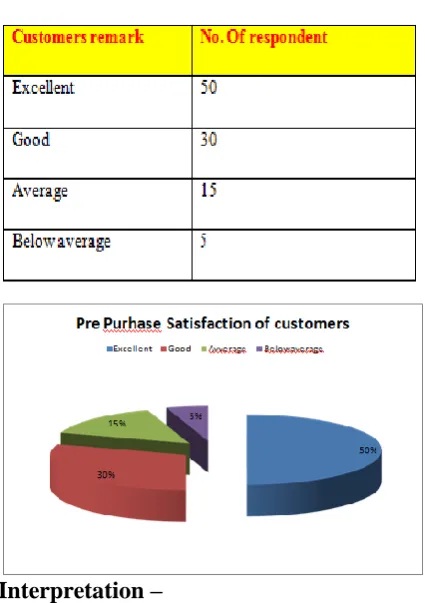
Table no.-2 table showing pre-purchase preference level of the customer.
Interpretation –
It is observed that, 50% of the customers are highly satisfied with the pre- purchase services and 5% are dissatisfied with the pre purchase services.
Table no.-3 table showing customers opinion about the Maruti’s vehicles for value for money
Interpretation –
42% of the respondents are of opinion
that vehicles are as per expectation & 20%
are of the opinion that the vehicle are
below expectation.
Table no.-4 table showing post-purchase preference level of the customer.
Interpretation –
It is observed that, 45% of the customers
are highly satisfied with the post- purchase
services And 5% are dissatisfied with the
post purchase services.
Interpretation –
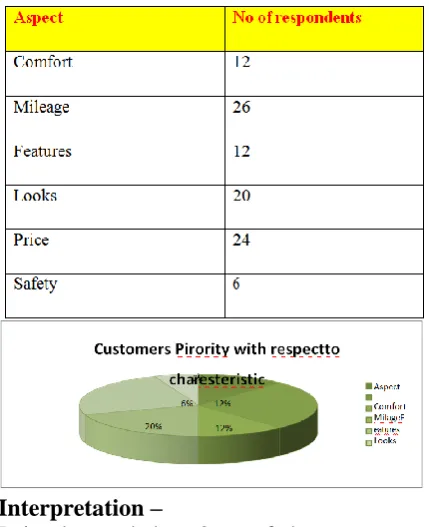
It is observed that, 26% of the customers preferred mileages as first preference and 6% preferred safety.
Table no.-6 table showing customer remark about services.
Interpretation –
It is observed that, 55% of the customers are satisfied with the services, and 3% are not satisfied.
Table no.-7 table showing customer expectation for improvement in marutisuzuki.
Interpretation –
46% of the customers are of opinion that maruti should improve in quality.
Table no.-8 table showing customer’s repurchase intention.
Interpretation –
maruti’s car, 26% are not ready to purchase the car .
Table no.-9 table showing customer’s recommendation intention
Interpretation –
It is observed that, 72% of the customers are ready to recommend the car to the friends and relative, 28% are not ready to recommend the car to the friends and relatives.
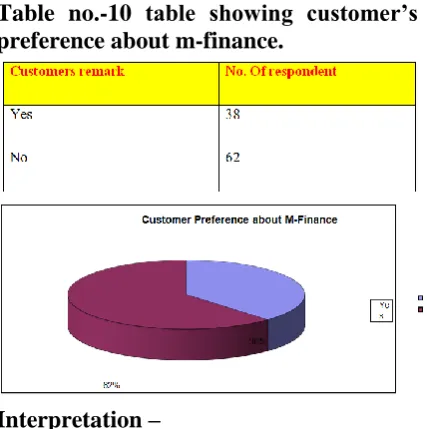
Table no.-10 table showing customer’s preference about m-finance.
Interpretation –
It is observed that, 62% of the customers are ready to prefer m- finance, 28% are not ready to prefer m-finance.
Table no.-11 table showing customer’s preference about m- insurance.
Interpretation –
It is observed that, 86% of the customers are ready to prefer m- insurance, 14% are not ready to prefer m-insurance.
Findings & suggestions, Conclusions Findings
1. The prospective segment is from the
business and self-employed class.
2. The company should concentrate on
the age group26-34.
3. Maruti should continue to maintain the
standard of the service.
4. It is observed that, 42% of the
respondent are of opinion that vehicles are as per expectation, and 20% are saying its below expectation.
5. Company should improve its post sales
service.
6. The customer highest priority is for
themileage.
7. Marutisuzuki needs to improve its
awareness about add-on-services like any time maruti, mewetc.
8. Customer are highly satisfied with the
service which help in customer retention
9. It is observed that, 46% of the
10. Customers are highly satisfied which help in customer retention.
11. Company has created goodwill among
the customers which will help them to
recommend car to friends and
relatives.
12. Maruti suzuki needs to educate the
customers about the benefits of m- finance. They can motivate the cash customers to of term-finance.
13. It is observed that, 86% of the
customers are ready to prefer m- insurance, 14% are not ready to preferm-insurance.
Suggestions
After conducting the survey and knowing the market, i realized that:
The company should keep in mind the
need of young generation.
Company should improve the
promotion strategy of product.
Company should improve the
promotion strategy of add-on services.
It will be beneficial for the company to
make the warehouse near to the showroom and there should be roof facility, adequate security facility in the warehouse.
The company should know its
customers preference level throughout
doing periodic surveys. Periodic
surveys can treat customer preference directly.
Company should improve/upgrades its
employee‘s product knowledge, market
situation, and its competitor‘s
knowledge by giving proper training to employee.
Company should upgrade or innovate
its new product.
The company should not only
concentrate on the customer preference but also the company led to monitor their competitor‘s performance in their areas of operations.
The company should make changes
according to the other competitors &
according to the customer’s
expectations.
Conclusion
It has been observed that most customers are satisfied with pre sales services similarly most of these customers are dissatisfied with the post sales service which is the matter of concern for the company. Maruti suzuki needs to improve some parts of products specifically the interiors. High customer preference level helps the company to retain its existing customer as well as generate new customer through word to mouth publicity. Customer preference index is a good tool to make improvements in the products and services of the company. And therefore should utilize carefully & kept as confidential as possible.
Customer preference provides a leading indicator of customer purchase
intentions and loyalty." "customer
preference data are among the most frequently collected indicators of market perceptions. Their principal use is twofold"
"Within organizations, the collection,
analysis and dissemination of these data send a message about the importance of tending to customers and ensuring that they have a positive experience with the company‘s goods and services."
Reference:-
Books:
1. Kotler, p (2002),‖marketing
management‖, millennium edition, tenth edition, prentice hall, inc, a pearson education company, upper saddle river, new jersey,pp.
2. Hair, joseph, f., anderson, rolph, e. And
tathamronald, l. (1987),multivariate data analysis, new 'fork: macmillan publishing company.
3. Helen woodniffe(1997), "financial
sewices marketing", services
marketing,macmillion,delhi.
customerpreference measurement, gower press, aldershot,uk.
5. Jayaram, n. And sandhog, r.s. (1998),
housing in india - problems, policy
andperspectives, b.r. Publishing
corporation,delhi.
6. Jeffrey gitomer(1998),
customerpreference is worthless:
customer loyalty is priceless: how to make customers love you, keep them coming back and tell everyone they know, austintx: boardpress.
Websites