Designing A Drip / Trickle Irrigation System by Using Irripro SoftwareImran Arshad ; Muhammed Muneer Babar ; Muhammed Irfan ; Paolo
Savona; Wajiha Ali & Omair Farooqui P a g e | 165
Designing A Drip / Trickle Irrigation System By
Using Irripro Software
1Imran Arshad ; 2Muhammed Muneer Babar ; 3Muhammed Irfan ; 4Paolo Savona; 5Wajiha Ali & 6Omair Farooqui
1
Agriculture Engineer, Abu Dhabi Farmers’ Services Centre (ADFSC), Abu Dhabi – Western Region, UAE.
2
Professor, Institute of Water Resources Engineering and Management (IWREM), Mehran University of Engineering and Technology (MUET), Sindh – Pakistan.
3
Agriculture Engineer, Barari Forest Management, Abu Dhabi – Western Region (Ghayathi), UAE.
4Managing Director, Irriworks LTD. Incubatore d’imprese Arca. Viale delle Scienze Edificio
16, 90128 Palermo, Italy. (www.irriworks.com)
5
Horticulturist, Agriculture Department, SGS Pakistan Pvt. Ltd, Karachi, Sindh – Pakistan.
6
Horticulturist, Agriculture Department, SGS Pakistan Pvt. Ltd, Karachi, Sindh – Pakistan. 1Corresponding author’s e-mail: [email protected]
Abstract
The Indus plain soils are seriously affected by high watertable and salinity. In addition to this shortage of canal water is one of the major limitations. As the supplies of good water quality are declining day by day it is therefore, necessary to find the methods to improve water use efficiency in agriculture. These problems can be minimized with judicious use of water. The drip irrigation is one of the most efficient irrigation methods that are used in agriculture. With drip irrigation field application losses can be checked and rise in watertable can be controlled properly. The present research work has been conducted in an arid region of Gharo, Sindh Pakistan for Chickoo
(Sapodilla) orchard. By using the existing conditions of the farm a proposed trickle /
drip irrigation system was manually
designed and counter checked by IrriPro software to analyze the reliability, efficiency, dependability and harmony of the proposed drip irrigation system and the software accordingly.
The comparative study revealed that the proposed drip irrigation achieved high uniformity coefficients (WU) and (Keller e
Karmeli) i.e. 99.971% and 99.835%
Designing A Drip / Trickle Irrigation System by Using Irripro SoftwareImran Arshad ; Muhammed Muneer Babar ; Muhammed Irfan ; Paolo
Savona; Wajiha Ali & Omair Farooqui P a g e | 166
system was designed on the basis of proper scaling and dimensions. Thus, the design of the proposed drip irrigation network was found to be acceptable. The uncertainty in results was found less than 10% which indicates its accuracy. The values of irrigation uniformities and flowrate are within range and by keeping very low the computational time. Hence, it can be concluded that IrriPro is a very helpful tool for water resource engineers to use it in testing and analyzing any alternative design hydraulically and economically.
Keywords:
Design parameters; Gharo Model Farm; emitters; drip irrigation; uniformity coefficient; IRRIPRO Software
INTRODUCTION
The problems of waterlogging and salinity are wide spread in arid and semi-arid areas of the Pakistan. The Indus Plain soils are seriously affected by high watertables and salinity. Pakistan is no exception to these problems. The major cause to the occurrence of these problems is attributed to the seepage of water from earthen leaky canals and watercourses in addition to field application losses. Moreover, the arid and semi-arid climatic conditions provide ideal conditions to development of salinity problem (PWP, 1999). Vast areas of fertile lands are falling victim to the problems of waterlogging and salinity at alarming rates. These problems can be minimized with judicious use of water. In flood and furrow irrigation methods percolation losses cause addition to groundwater and rise in watertable. Therefore, water management practices through innovative irrigation techniques can
prevent the problems of waterlogging and salinity in the root zone. With drip / trickle irrigation field application losses can be checked and rise in watertable can be controlled properly.
Designing A Drip / Trickle Irrigation System by Using Irripro SoftwareImran Arshad ; Muhammed Muneer Babar ; Muhammed Irfan ; Paolo
Savona; Wajiha Ali & Omair Farooqui P a g e | 167
and optimal development of plant (Rareş, 2009).
A well designed drip irrigation system can increase the crop yield accordingly to the farmers desired needs. Although trickle irrigation systems have reached a level that farmers are adopting them yet their performances under field condition has to be tested and standardized. By keeping in view these facts the present study in the agro-ecological conditions of Gharo Sindh, Pakistan was thus designed to check the effectivity of the proposed trickle irrigation system for Chickoo (Sapodilla) orchards by using a sophisticated Irrigation System Planning and Designing Software i.e. IrriPro Software.
OBJECTIVES
The objective of this research work is to evaluate the performance of the proposed trickle irrigation system for Chickoo (Sapodilla) orchards by using IrriPro Simulations.
MATERIALS AND METHODS Location and Size of the Study Area
The study was undertaken in the month of October, 2012 at a private farmhouse located at south-east of Gharo, Sindh – Pakistan. This farm is located 65 KM away from Karachi on National Highway (Karachi - Hyderabad). The model farm was in developing stage therefore the subject study was only conducted for Chickoo patch which comprises of 3.12 acres and the remaining portion of the farm is fallow.
Background and Topographic Conditions
of the Study Area
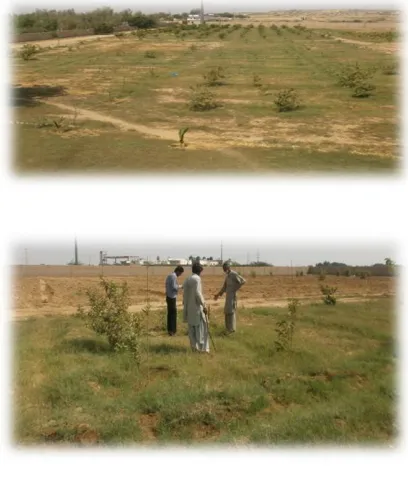
The subject farm was facing a serious problem of water scarcity as there was no canal water available the only source for irrigation was groundwater. During initial survey it had been observed that the topographic condition of the farmhouse is varying due to uneven slopes. The soil condition is somehow acceptable and good for Chickoo plants but due to less water retention in the soil, uneven slopes, and poor land leveling some plants are suffering very much. A lot of extra grass and weeds were grown throughout the land. And due to nutrients deficiency in the soil and plants Chickoo fruits are either dropping or giving small size fruits. Fig: 1(a) and Fig: 1(b) describes the topographic conditions of the farm.
Designing A Drip / Trickle Irrigation System by Using Irripro SoftwareImran Arshad ; Muhammed Muneer Babar ; Muhammed Irfan ; Paolo
Savona; Wajiha Ali & Omair Farooqui P a g e | 168
water samples had been collected for the conductance of different water tests. It had also been observed that the region where the outlet of the bore pump is given (head of main irrigation channel) is having some salts on the top soil which indicates that the water is slightly saline. The samples of the soil were collected from three different zones at 6 inch and 12 inch depth for different laboratory tests purposes on composite basis.
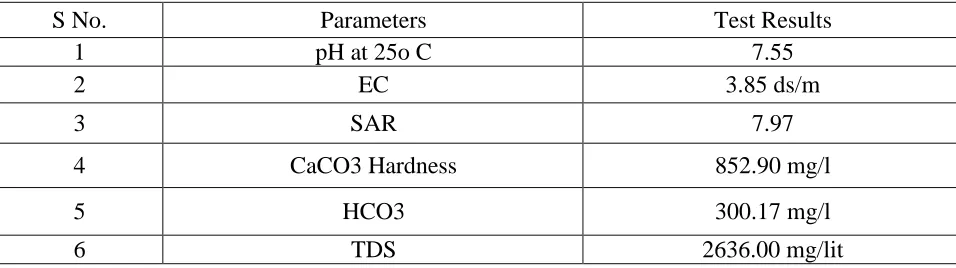
On the discussion with farmhouse staff it had been noticed that there is no proper pest control and fertilizing schedule followed by the staff. All the farm operational work in the land is going on manually. As the soil is sandy the organic matter in the soil is very much less due to excessive leaching. The results of the soil and water samples are given in table 1 and table 2 respectively.
Table – 1: Analysis Results of Soil (at 6 and 12 inch depth on composite basis)
S No. Parameters Test Results
Sample 01 (Normal Zone)
Sample 02 (Saline Zone)
1 pH at 25o C 9.84 8.07
2 EC 0.192 ds/m 1.8175 ds/m
3 Nitrogen 83.3 kg/ha 107.76 kg/ha
4 Phosphorus 30.75 kg/ha 54.234 kg/ha
5 Potassium 355.5 kg/ha 983.25 kg/ha
6 SAR 0.422 1.41
Table – 2: Analysis Results of Water
S No. Parameters Test Results
1 pH at 25o C 7.55
2 EC 3.85 ds/m
3 SAR 7.97
4 CaCO3 Hardness 852.90 mg/l
5 HCO3 300.17 mg/l
6 TDS 2636.00 mg/lit
On the basis of results obtained it had been decided by the experts and owner that by using the available resources in the model farm the rehabilitation of the model farm
Designing A Drip / Trickle Irrigation System by Using Irripro SoftwareImran Arshad ; Muhammed Muneer Babar ; Muhammed Irfan ; Paolo
Savona; Wajiha Ali & Omair Farooqui P a g e | 169
will be useless. Therefore, execution for rehabilitation of the orchard was started in the month of December 2012 in order to save water and get maximum yield.
Cultural Practices during Execution of Agricultural Work
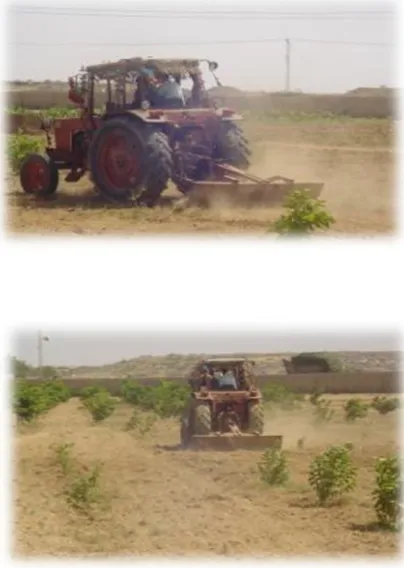
Initially weed and extra grass removal operation on Chickoo Patch had been started. Tractor with cultivator implement had been used for the weed and extra grass removal operation. The average depth of cultivator was about 1 – 1.5 ft and the weeds and extra grass removal work had been completed in total 4 operations on each patches. After the completion of operation the grass and weeds left on the land for natural sun drying. Fig: 1(c) – 1(j) describes the overall farming operations during rehabilitation of the model farm for Chickoo orchard.
Fig 1 (c) Weeds Removal Fig 1 (d) Extra Grass Removal
Two days later the weeds and extra grass were
fully sun dried and had been cleaned
(hand-picked) manually by labor. After the cleaning
operation land was leveled by a tractor with rear
blade throughout the Chickoo patches. After the
completion of land leveling, water channeling
operation had been done by the help of tractor
with channel maker implement and basins of
plants has been made manually by local labor
accordingly. At this point the land preparation
work has been completed.
Designing A Drip / Trickle Irrigation System by Using Irripro SoftwareImran Arshad ; Muhammed Muneer Babar ; Muhammed Irfan ; Paolo
Savona; Wajiha Ali & Omair Farooqui P a g e | 170
Fig 1 (g) Water Channeling Operation Fig 1 (h) Water Channeling Operation
After the completion of all farming operations it had been observed that due to cultural practices and land leveling operation a uniform look among plantation had been developed. It had also been observed as there is no canal water available and soil is slightly saline therefore, care should always be taken keep pH in control limits. On focusing the current scenario it has been fixed that water application to the plants must be quick and uniform that is why water channel in these patches was designed accordingly.
Fig 1 (g) Before Rehabilitation Fig 1 (h) After Rehabilitation
Due to proper water channeling development time to fill the irrigation water in to the basins also decreased up to some extent. As the extra grass grown on the Chickoo patches belongs to self growing grass family therefore we cannot completely remove it and cultural practices must be continued to overcome the grass growth.
Need of Modern Technology (Drip / Trickle Irrigation Method)
Designing A Drip / Trickle Irrigation System by Using Irripro SoftwareImran Arshad ; Muhammed Muneer Babar ; Muhammed Irfan ; Paolo
Savona; Wajiha Ali & Omair Farooqui P a g e | 171
the farm had spend a lot of expanses on land leveling and water channeling in order to provide the Chickoo trees a good amount of water but still due to high infiltration rate this problem is still the same. It is, therefore, necessary to find the method to improve water use efficiency in the subject farm.
Drip irrigation method is capable to save handsome amount of water over the current irrigation method for growing Chickoo. As in drip irrigation, water application is restricted to the plant root zone and surrounding area remains dry, accordingly. Moreover, in drip irrigation, salts did not accumulate at dripping point or within wetted zone. On the basis of above discussed facts the proposed trickle irrigation system for Chickoo (Sapodilla) orchard was designed and it had been counter checked by IrriPro software in order to idealize the authenticity and harmony of the proposed drip irrigation design and planning.
Proposed Orchard Size and Layout Design of Trickle Irrigation System
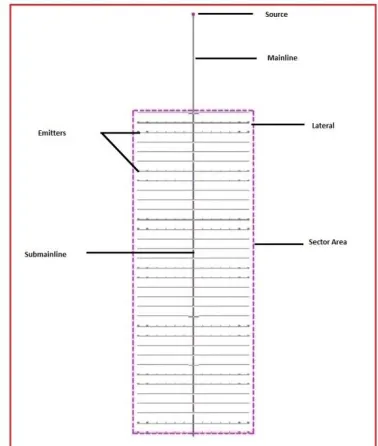
The proposed trickle irrigation System was designed on a 3.12 acres for Chickoo farm as shown in Fig: 1(i). The system consists of 1 mainline having length 203ft and 1 submain line having length 660ft. 34 laterals (68 branches) having 6 emitters per branch is
used. The diameter of the mainline, submain line and laterals are 4 inch, 15/8 inch and ¾ inch respectively. 408 pressure compensating emitters i.e. single emitter per plant with a discharge capacity of 20 lph is used in this proposed design. The row to row and plant to plant distance of the orchards was 20 x 20 ft each. There are 408 Chickoo trees, and on each trees a single pressure compensating 20 lph emitter is required. The source discharge and pressure of the system were 36 gpm and 14.18 psi, respectively. An electric motor of 2hp had been used as a prime mover. The details of the design of trickle system are presented in table-3.
Designing A Drip / Trickle Irrigation System by Using Irripro SoftwareImran Arshad ; Muhammed Muneer Babar ; Muhammed Irfan ; Paolo
Savona; Wajiha Ali & Omair Farooqui P a g e | 172
Table-3 Details of proposed design parameters of trickle irrigation system
General information
Area (acres) 3.12
Plant spacing(ft*ft) 20x20
Number of plants 408
Design Peak water requirements (liters/day/plant) 75
Discharge of emitter(lph) 20
Number of emitter per plant 1
Peak Operating Time(Hour) 3.75
Design
Length of main line (ft) 203
Length of submain line (ft) 660
Number of Plants 408
Discharge of Mainline (lps) 2.27
Mainline Diameter (inch) 4
Friction Head Loss (ft) 32.8
Lateral Length (ft) 240
Discharge of Lateral (lps) 0.067
Number of Plants per Lateral 12
Diameter of Lateral (inch) 3/4
Frictional Head loss (ft) 4.92
Design of Pumping System
Suction Head (ft) 7.216
Frictional Head loss (ft)
Manifold Lateral Connections/Bends
32.8 4.92 16.4
Total Frictional Head Loss (ft) 65.6
Total Head Loss (ft) 72.82
Working Head (ft) 39.36
Total Head Required (ft) 112.176
Efficiency of the Prime mover (%) 30
Power Requirement (hp) 2
IrriPro Software
IrriPro irrigation system planning software is designed to help the user to define the parameters of an irrigation system. The user will be able to run the program with any
Designing A Drip / Trickle Irrigation System by Using Irripro SoftwareImran Arshad ; Muhammed Muneer Babar ; Muhammed Irfan ; Paolo
Savona; Wajiha Ali & Omair Farooqui P a g e | 173
whereas other is entered by the user according to their own needs so they do not conflict with the program’s limitations.
Governing Equations
In this research work, step by step (SBS) procedure is used to design a proposed drip irrigation network in order to determine the behavior of the proposed drip irrigation network and for this purpose the IrriPro software is used. IrriPro is a powerful product in the international context and it is based on an innovative algorithm allowing designing, managing and analyzing even complex irrigation systems; the proposed algorithm assures the correct and fast design of the irrigation systems, maintaining the necessary scientific accuracy with a sensible reduction of the computation time. The resolution algorithm, by means of an iterative calculation procedure, solves the continuity and motion equations managing the movement of water in pressure pipes (Savona et al, 2008).
The drip irrigation systems should be designed to attain relatively high values of the field emission uniformity coefficients (EU), which are affected by the variation of pressure head due to the elevation changes and to the head losses along the lines, as well as by manufacturer’s variation, grouping of emitters, clogging, variability in soil hydraulic characteristic and emitter spacing (Wu, 1997). For a certain emitter model for which is known the manufacturer's coefficient of variation, CV, once established the number of emitters per plant and the emitter spacing, limitation of the pressure
head along the laterals in a pre-fixed range of variability, can contribute to obtain high EU values, that can be expressed as Christiansen’s uniformity coefficient (CU) or lower quarter distribution uniformity coefficient (DU) calculated as:
N i av i av q q Nq CU 1 1 1 (2a)
/4
1 4 N i i low av q Nq DU (2b)
Where; qi, qav, qlow, are the generic, the average and the lowest flow rate of the emitters installed in a submain and N is the number of emitters. DU measures the consistency of water application across a field during irrigation, expressed as a percentage. DU of less than 70% is considered poor, between 70 - 90% is good, whereas DU greater than 90% is excellent. In short, poor DU means that either too much water is applied, costing unnecessary expense, or too little water is applied, causing stress to crops.
Steps for Developing Proposed Drip Irrigation Network by Using IrriPro Software
Designing A Drip / Trickle Irrigation System by Using Irripro SoftwareImran Arshad ; Muhammed Muneer Babar ; Muhammed Irfan ; Paolo
Savona; Wajiha Ali & Omair Farooqui P a g e | 174
entered accordingly. After entering all the required values for the development of complete model, it is then verified by the IrriPro software and computation for different scenarios can be launched by the “Calculate” application. The parameters which are going to be calculated are: Total Emitters, Total Length, Total Pressure Loss, Pressure Loss, Head Pressure, Average Emitter Flow Rate, Inlet Lateral Flow Rate, Flow Rate and Velocity per segment etc. The simulation results are given on the left side of the main window and the additional results report can be reviewed by pressing the “Results Window” button. This report contains the following results: Uniformity coefficient (WU) and (Keller e Karmeli) and Pressure range of the proposed irrigation system. Finally simulated results obtained from the IrriPro software are compared with the manual design parameters and results for the acceptance of proposed irrigation design.
RESULTS AND DISCUSSION
The present research study was carried out to evaluate the performance of the proposed trickle irrigation system for Chickoo (Sapodilla) orchards by using IrriPro Simulations. In this research work, step by step (SBS) procedure is used to design a drip irrigation network in order to determine the behavior of the proposed drip irrigation network. Data pertaining to design parameters and drip irrigation geometry are provided to the software to compute the unknown parameters. As it follows the SBS procedure so it will first verified the length of mainline, submain line, laterals, inside diameter KD and emitters provided to the
software as an input parameters. Then the software itself computes the flowrate and pressure range of the system accordingly.
IrriPro Simulations
IrriPro compute the hydraulic calculations of each parameter in concordance with the data provided to the software. On the basis of data provided to the software initially the “Emitter Line Length” was verified and calculated for the entire designated length. The computation result also verified the maximum lateral length under the designated conditions. Then a “Pressure range”, was then verified and calculated which will be executed in a way that makes sure the maximal pressure variation between maximum emitter’s pressure to minimum emitter’s pressure does not exceed the pressure range which was introduced by the user. Then “Flow Rate Variation” was computed which can be executed to achieve the requested flow variation and will generate the maximum lateral length under these conditions. The last computation was “Emission Uniformity” which is similar to “flow rate variation”, and will be executed to achieve the maximum lateral length. Emission uniformity units are given in percentage and its value was above 90% during computation. The following problems are to be considered for analysis and computation:
Designing A Drip / Trickle Irrigation System by Using Irripro SoftwareImran Arshad ; Muhammed Muneer Babar ; Muhammed Irfan ; Paolo
Savona; Wajiha Ali & Omair Farooqui P a g e | 175
acceptability) and Red (not acceptable),
Computation of emitter flowrate and pressure by using IrriPro software, and
Acceptability of the input data and results according to software analysis.
Simulation Results
The detail analysis and simulation results obtained by the software are depicted as under:
Input Parameters
Emitter type: Online Network type: Symmetric
Working source discharge = 36.0 [gpm] User source discharge = 35.9274 [gpm] Working source pressure = 14.37 [PSI] User source pressure = 14.18 [PSI] Water temperature = 68.0 [F]
Secondary pipe
Secondary pipe length = 203.0 [ft] Secondary pipe diameter = 4 [in] Model: Generic
Submain
Submain Length = 660.0 [ft] Submain diameter = 1 5/8 [in] Model: Generic
Submain nodes number = 33
Lateral
Lateral diameter = 3/4 [in] Laterals average slope = 0.0 [%] Model: Generic
Laterals number = 34 (Lateral Branches = 68)
Emitter/Supply point
Total no. of emitters = 408
No of maximum of emitters per lateral = 12 (6 per branch)
No of maximum of emitters per lateral = 12 (6 per branch)
Model: Generic
C.V. (Pressure head variation coeff.) = 0.0
Crop arrangement
Emitters spacing = 20.0 [ft] Row spacing = 20.0 [ft]
SIMULATED RESULTS
Uniformity coefficient (WU) = 99.971 [%] Uniformity coefficient (Keller e Karmeli) = 99.835 [%]
Emitter Flowrate and Pressure
Maximum flow rate = 5.283 [gph] (20.000 [lph])
Minimum flow rate = 5.283 [gph] (20.000 [lph])
Average flow rate = 5.283 [gph] (20.000 [lph])
Maximum pressure head = 32.753 [ft] (14.185 [PSI])
Minimum pressure head = 32.719 [ft] (14.17 [PSI])
Average pressure head = 32.728 [ft] (14.174 [PSI])
Sector surface = 3.12 [acre] (136000.0 [ft²])
Designing A Drip / Trickle Irrigation System by Using Irripro SoftwareImran Arshad ; Muhammed Muneer Babar ; Muhammed Irfan ; Paolo
Savona; Wajiha Ali & Omair Farooqui P a g e | 176
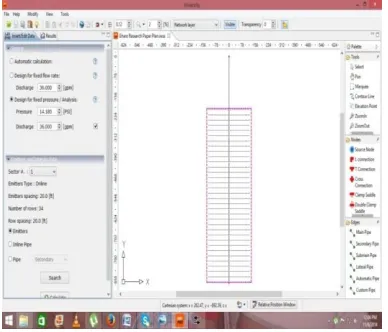
regarding the verification of the design of proposed drip irrigation network. The software analyzed the data by using hydraulic principles and reported that the design is acceptable. In Fig 2 (b) the software simulated the picture with Green Legendary color which describes that the input data and designing of a proposed drip irrigation network is acceptable. And the Fig 2 (c) describes the uniformity coefficients (WU) and (Keller e Karmeli) results given by software. In addition to this Fig 2 (d) and Fig 2 (e) describes the comparison of emitter flowrate and pressure range among different branches.
Fig 2 (a) Main screen showing the design of a proposed drip irrigation network
Fig 2 (b) Simulation screen showing that the design parameters are within range
Fig 2 (c) Results screen showing that hydraulic data (input) is acceptable
Designing A Drip / Trickle Irrigation System by Using Irripro SoftwareImran Arshad ; Muhammed Muneer Babar ; Muhammed Irfan ; Paolo
Savona; Wajiha Ali & Omair Farooqui P a g e | 177
Fig 2 (e): Comparison of emitter pressure for laterals (branch 2 vs branch 5)
Conclusions
An irrigation system with uniform water application means each tree will receives nearly the same amount of water during irrigation. Drip irrigation is an efficient method of water application in agriculture to enhance good crop growth. As the drip irrigation can irrigate directly to the crop root zone, it is a popular irrigation method in arid and semi-arid area. The drip irrigation system allows a constant application of water by drippers at specific locations on the lateral lines it allows favorable conditions for soil moisture in the root zone and optimal development of plant. A well designed drip irrigation system can increase the crop yield due to: efficient use of water, improved microclimate around the root zone, pest control, and weed control, agronomic and economic benefits.
Results of the study revealed that the proposed drip irrigation achieved high uniformity coefficients (WU) and (Keller e Karmeli) i.e. 99.971% and 99.835% respectively. The average simulated emitter flowrate and pressure for the proposed irrigation system was found to be 5.283 gph and 14.174 psi respectively. Hence the simulated results describes that the proposed irrigation system was designed on the basis of proper scaling and dimensions. The design of the proposed drip irrigation network was checked by the interactive computer software i.e. IrriPro which was found acceptable. The uncertainty in results
was found less than 10% which indicates its accuracy. The values of irrigation uniformities and flowrate are within range and very close to each other by keeping very low the computational time.
Hence, from this research work it can be concluded that in order to avoid any huge investment and delay in orchard planning especially in arid regions of the world, where the shortage of water is one of the limitations, drip irrigation is an efficient method of water application in agriculture. IrriPro, by its characteristics, represents a reliable tool in designing a drip irrigation system for water resources engineers. It can help the user to use it in testing and analyzing any alternative design hydraulically and economically. As IrriPro is providing the ideal results for the existing drip irrigation system it will be more as compared to the field results.
Suggestions
Designing A Drip / Trickle Irrigation System by Using Irripro SoftwareImran Arshad ; Muhammed Muneer Babar ; Muhammed Irfan ; Paolo
Savona; Wajiha Ali & Omair Farooqui P a g e | 178
infiltration rate of the soil is not easy to determine; it changes during an irrigation and may change across the season. Therefore, it is suggested that while designing a drip irrigation system, it is preferable to choose the correct application rate at the design stage. Due to multiple advantages of IrriPro software, it must be introduced in universities and research centres for a better understanding by students of the problems regarding drip irrigation.
For the case of Gharo Model Farm since, no canal water is available therefore it is recommended that a reservoir must be constructed near the command area. Due to high EC, TDS, HCO3 and CaCO3 groundwater application for the irrigation purpose is not suitable. If any fresh water source is available the ground water in ratio 2:1 with fresh water may be used for better and quick results. In order to save water the irrigation operation must be done through drip irrigation. Due to high soil pH and soil salinity activity of DAP fertigation should to be immediately stopped and fertilizer with low pH values should to be used.
ACKNOWLEDGEMENTS
The authors wish to express their gratitude to Mr. Farukh Mazhar the owner of the Gharo model farm for allowing this research to be carried out on his farm, to the staff of the farm especially to Mr. Allah Bakhsh the farm supervisor, Mr. Mazhar Iqbal Sheikh for his kind assistance throughout the study, and all other individuals who have been source of help throughout the research period.
REFERENCES
1. Ella, V. B., M. R. Reyesand R. Yoder. (2009), “Effect Of Hydraulic Head and Slope on Water Distribution Uniformity of A Low-Cost Drip Irrigation System”. App. Eng. in Agric. 25(3):349-356. 2. Bağdatlı, M. C. and B. Acar. (2009).
“Evaluation of Trickle Irrigation Systems for Some Vegetable Crops in Konya-Turkey”. J. of Int. Env. App. and Sci. 4(1):79-85.
3. P.T Dio, G. Provenzano, C. Provenzano, P. Savona (2008), “Irripro: A Powerful Software to Graphic and Hydraulic Design of Irrigation Plants” Agricultural and biosystems engineering for a sustainable world. International Conference on Agricultural Engineering, Hersonissos, Crete, Greece, 23-25 June, 2008.
4. Narayanamoorthy, A. (2004), “Impact Assessment Of Drip Irrigation In India: The Case of Sugarcane”. Development Policy Review, Vol. 22(4): 443-462. 5. Bhatnagar, P. R. and R.C. Srivastava.
(2003), “Gravity-Fed Drip Irrigation System for Hilly Terraces of the Northwest Himalayas”. Irr. Sci., 21:151-157.
6. Ismail S.M, E.R. EL-Ashry, G.A. Sharaf, M.N. EL- Nesr (2001), “Computer Aided Design of Trickle Irrigation System” Misr J. Ag. Eng., 18(2): 243 – 260.
7. 'PWP. 1999. Pakistan country report; water vision for the 21” century. Pakistan Water Partnership 158 ( PWP ), Global Water Partnership.