More
Daode Zhang1,2, Kai Zhang3,( ), Bao Li1,2, Xianhui Lu1,2, Haiyang Xue1,2, and Jie Li1,2
1 School of Cyber Security, University of Chinese Academy of Sciences. 2 Data Assurances and Communications Security, Institute of Information
Engineering, Chinese Academy of Sciences, Beijing, China.
3 Department of Information Security, Shanghai University of Electric Power, Shanghai, China.
[email protected], [email protected], {libao, luxianhui, xuehaiyang,lijie}@iie.ac.cn
Abstract. Dual receiver encryption (DRE), proposed by Diament et al. at ACM CCS 2004, is a special extension notion of public-key en-cryption, which enables two independent receivers to decrypt a cipher-text into a same plaincipher-text. This primitive is quite useful in designing combined public key cryptosystems and denial of service attack-resilient protocols. Up till now, a series of DRE schemes are constructed from bilinear pairing groups and lattices. In this work, we introduce a con-struction of lattice-based DRE. Our scheme is indistinguishable against chosen-ciphertext attacks (IND-CCA) from the standard Learning with Errors (LWE) assumption with a public key of bit-size about 2nmlogq, where mand q are small polynomials inn. Additionally, for the DRE notion in the identity-based setting, identity-based DRE (IB-DRE), we also give a lattice-based IB-DRE scheme that achieves chosen-plaintext and adaptively chosen identity security based on the LWE assumption with public parameter size about (2`+ 1)nmlogq, where`is the bit-size of the identity in the scheme.
Keywords: Lattices, Dual Receiver Encryption, Identity-Based Dual Receiver Encryption, Learning with Errors, Provable Security.
1
Introduction
[8]. A decade later, in CT-RSA 2014, Chow, Franklin, and Zhang [6] refined the syntax of DRE and appended some appealing features for DRE. Recently, to simplify the difficulty of certificate management in traditional certificate-based DRE schemes, Zhang et al. [24] extended the DRE concept into the identity-based setting by introducing the identity-identity-based dual receiver encryption (IB-DRE) notion.
There exist many DRE and IB-DRE constructions from pairings and lattices, which are described as follows.
• From pairings.In [8], Diament et al. presented the first DRE scheme by transforming the three-party one-round Diffie-Hellman key exchange scheme by Joux [12], and also proved that it is indistinguishable secure against cho-sen ciphertext attacks (IND-CCA). However, their scheme relied on the ex-istence of random oracle heuristic, where a DRE that proven to be secure in the random oracle model (ROM) may turn into insecure one when the RO is instantiated by an actual hash function in practice. Hence, Youn and Smith [23] began with attempting to give a provably secure DRE scheme in the standard model by combining an adaptively CCA secure encryption scheme and a non-interactive zero-knowledge protocol, while suffered low efficien-cy due to the prohibitively huge proof size. Later on, Chow, Franklin, and Zhang [6] proposed a CCA secure DRE scheme via combining a selective-tag weakly CCA-secure selective-tag-based DRE (based on the selective-tag-based encryption scheme in [14]) and a strong one-time signature scheme, as well as other DRE instantiations for non-malleable and other properties1. Recently, Zhang et al. [24] constructed two provably secure IB-DRE schemes against adaptive-ly chosen plaintext or ciphertext and chosen identity attacks based on an identity-based encryption scheme in [22].
• From lattices.As studied in [6, 24], the DRE or IB-DRE can be viewed as a special instance of a broadcast encryption (BE, for short) or identity-based broadcast encryption (IBBE, for short) primitive which supports multiple recipients in an encryption system. So a construction of BE or IBBE implies a construction of DRE or IB-DRE. Georgescu [10] constructed a tag-based anonymous hint system [15] under the ring learning with errors (RLWE) assumption. Combining an IND-CCA secure public key encryption (PKE) scheme and a strongly unforgeable one-time signature (OTS), we can get an IND-CCA secure BE scheme which is a conclusion in [15]. Wang et al. [20] presented a construction of BE which is indistinguishable against adaptively chosen plaintext attacks (IND-CPA), based on the LWE problem. As for IBBE constructions, Wang and Bi [21] proposed an adaptively secure IBBE scheme in the ROM, under the LWE assumption.
1
Fig. 1.Comparison of DRE Schemes from Lattices.
Schemes
# of # of # of Other
Zqn×mmatrixZqm×m matrixZmq vector Assumptions Security primitives
|pk|∗ |sk|∗ |c|∗ needed
Geo013†[10] − − − RLWE IND-CCA PKE, OTS
WWW’15 [20] 1 1 1 LWE IND-CPA
Ours:
Section 3 1 1 4 LWE IND-CCA OTS
∗,|pk|,|sk|and|c|show the size of public key, secret key and ciphertext, respectively. †, Because of the usage of an IND-CCA secure PKE scheme from lattices, we do not konw how to show the detail of|pk|,|sk|and|c|about Geo’13 scheme.
Fig. 2.Comparison of IB-DRE Schemes from Lattices.
Schemes
# of # of # of Standard
Znq×mmatrix Zm
×m
q matrixZmq vector Assumptions Security model
|PP|∗ |Msk|∗ |c|∗ ?
WB’10 [21] 1 1 3 LWE IND-ID-CPA ROM
Ours:
Section 4 2n+ 1 1 3 LWE IND-ID-CPA X
Section 4.3 2n/logn+ 1 1 3 LWE IND-ID-CPA X
Section 4.3 2n/log2n+ 1 1 3 LWE IND-ID-CPA
X ∗, |PP|,|Msk| and |c| show the size of public parameters, master secret key and ciphertext, respectively.
1.1 Our Contributions
In this paper, we pay attention to the construction of DRE and IB-DRE from lattices. Our two schemes are constructed in the standard model and satisfy chosen-ciphertext or chosen-plaintext security, which are based on the hardness of the Learning With Errors (LWE) problem. Specifically, based on the beautiful work of Agrawal, Boneh and Boyen [1], our works are stated as follows.
• We construct a secure DRE scheme against chosen-ciphertext attacks from the standard Learning with Errors assumption with a public key of bit-size about 2nmlogq, where m and q are small polynomials in n. In order to encrypt a n-bit message, the ciphertext consists of two parts: one is a (n+ 4m) logq-bit ciphertext which is an encryption of the message, the other is a one-time signature of the first part. Please see more details in Figure 1.
the bit-size of ciphertext will become (n+ 3m) logq. Note that one can still get two IB-DRE schemes with more compact public parameters via relying on other lattice-based IBE works that achieved short public parameter sizes, which is formally discussed in Section 4.3. We also present the comparison of IB-DRE schemes from lattices in Figure 2.
Remarks.This work has been accepted at the conference of ACISP’2018.
Organization. The rest of this paper is organized as follows. In Appendix A and Section 2, we recall some lattice background, dual-receiver encryption and identity-based dual-receiver encryption. Our DRE construction and its proof are presented in Section 3, and IB-DRE construction along with its proof are described in Section 4. In Section 5, we give a conclusion.
2
Preliminaries
Notations. Let λ be the security parameter, and all other quantities are im-plicitly dependent on λ. Let negl(λ) denote a negligible function and poly(λ) denote unspecified function f(λ) =O(λc) for a constant c. For n∈ N, we use [n] to denote a set {1,· · · , n}. And for integer q≥ 2,Zq denotes the quotient ring of integer modulo q. We use bold capital letters to denote matrices, such asA,B, and bold lowercase letters to denote column vectors, such asx,y. The notationsA>and [A|B] denote the transpose of the matrixAand the matrix of concatenating Aand B, respectively. Additionally, we use (a)i, (A)i to denote thei-th element, column ofa,A.Indenotes then×nidentity matrix andInvn denotes the set of invertible matrices inZn×n
q .
2.1 Encoding Vectors into Matrices
In [7], Cramer et al. described an encoding function Ht,F that maps a domain Ft to matrices in Ft×t with certain, strongly injective properties, where F is a field. For a polynomial g ∈F[X] of degree less than t−1, coeff(g)∈Ft is the t-vector of coefficients ofg. Let f be a polynomial of degree t in F[X] that is irreducible. Then for g ∈ F[X], the polynomial g modf has degree at most t−1, so coeff(g modf)∈Ft. Now, for an inputh= (h0, h1,· · ·, ht−1)> ∈Ft define the polynomialgh(X) =P
t−1
i=0hixi∈F[X]. DefineHt,F(h) as
Ht,F(h) :=
coeff(gh modf)> coeff(x·gh modf)>
.. .
coeff(xt−1·g
h modf)>
∈Ft×t.
From here on, we takeF:=Zq for a primeq. As stated in [4], it is easy to verify that Ht,q:Ztq →Ztq×tobeys the following properties:
• For any vectorh6=0,Ht,q(h) is invertible, andHt,q(0) =0.
In [1], according to functionHt,q, Agrawal et al. defined the following equa-tionHABB:Z`q →Zn×n: Forx= (x1,· · · , x`)>∈Z`q,
HABB(x) =In+ `
X
i=1
xi· Ht,q(hi)⊗In/t,
where hi $
←Zt
q fori ∈ {1,· · ·, `}, and assume that n is a multiple of t. Then, they implicitly presented the following lemma. However, they did not give a complete proof.
Lemma 1. For any integers`, t, n, and a primeq, letHABBbe the hash function
family defined as above. Then for any fixed set S ⊆ Z`q,|S| ≤Q, and anyx ∈ Z`q\S, we have
Pr [HABB(x) =0∧(∀x0∈ S,HABB(x0)∈Invn)]∈
1
qt(1− Q qt),
1 qt
.
Proof. For a vector e1 = (1,0,· · · ,0)> ∈Ztq, we have Ht,q(e1) = It. For x = (x1,· · ·, x`)>∈Zq`, letS0be the set of functions inHABBsuch thatHABB(x) =
0. It is straightforward to verify that the following equation holds:
HABB(x) =In+ `
X
i=1
xi· Ht,q(hi)⊗In/t= It+ `
X
i=1
xi· Ht,q(hi)
!
⊗In/t
= Ht,q(e1) + `
X
i=1
xi· Ht,q(hi)
!
⊗In/t=Ht,q e1+ `
X
i=1 xihi
!
⊗In/t.
By a simple observation, we haveHABB(x) =0if and only ifP `
i=1xihi=−e1. As a result, we can get|S0|=q(`−1)t. In the same way, we can get|Si0|=q(`−1)t, where S0
i is the set of functions HABB such that HABB(x0i) = 0for x0i ∈ S =
{x01,· · ·,x0|S|}. Moreover, |S0 ∩ Si0| ≤ q(`−2)t for i ∈ {1,· · ·,|S|}. The set of functions in HABB such that HABB(x) = 0and ∀x0 ∈ S,HABB(x0) ∈ Invn is exactly Se=S0\ {S10 ∪ · · · ∪ S|S|0 }. Now, we have
Se
=
S0\ {S
0
1∪ · · · ∪ S 0 |S|}
≥ |S0| −
|S|
X
i=1
|S0∩ Si0| ≥q
(`−1)t−Qq(`−2)t.
Therefore the above probability holds with|S|e/qt`is at leastq1t(1−
Q
qt). And the
probability is at most 1
2.2 (Identity-Based) Dual Receiver Encryption
Dual Receiver Encryption [8]. A DRE scheme consists of the following four algorithms:
• CGenDRE(1λ) →crs: The randomized common reference string (CRS)
gen-eration algorithm takes as input a security parameterλand outputs a CRS
crs.
• GenDRE(crs)→(pk, sk): The randomized key generation algorithm takes as
inputcrsand outputs a public/secret key pair (pk, sk). We regard (pk1, sk1) and (pk2, sk2) as the key pairs of two independent users. Without loss of generality, we assumepk1<dpk2, where<dis a “less-than” operator based on lexicographic order throughout this paper.
• EncDRE(crs, pk1, pk2, M)→c: The randomized encryption algorithm takes as
inputcrs, two public keyspk1andpk2(such thatpk1<dpk2) and a message M, and outputs a ciphertextc.
• DecDRE(crs, pk1, pk2, skj, c) → M: The deterministic decryption algorithm
takes two public keyspk1 andpk2 (such thatpk1<dpk2), one of the secret keysskj (j∈ {1,2}), and a ciphertext cas input, and outputs a messageM (which may be the special symbol⊥).
Correctness.For consistency, we require that, ifcrs←CGenDRE(1λ), (pk1, sk1)←
GenDRE(crs) and (pk2, sk2) ← GenDRE(crs), and c ← EncDRE(crs, pk1, pk2, M), then we have the probability
Pr [DecDRE(crs, pk1, pk2, sk1, c) =DecDRE(crs, pk1, pk2, sk2, c) =M] = 1−negl(λ). Security.A DRE scheme is said to be indistinguishable against chosen-ciphertext attacks (IND-CCA) if for any PPT adversaryA,
AdvindDRE−cca,A(1λ) =
PrhExpindDRE−cca,A(1λ) = 1i−1
2
is negligible inλ.
Identity-Based Dual Receiver Encryption [24]. An IB-DRE scheme con-sists of the following four algorithms:
• SetupID(1λ)→(P P, M sk). The setup algorithm takes in a security param-eter 1λ as input. It outputs public parameters P P and a master secret key M sk.
• KeyGenID(P P, M sk, id1st, id2nd∈ID)→skid1st, skid2nd. The key generation algorithm takes public parameters P P, master secret key M sk, and two identities id1st, id2nd as input. It outputs skid1st as the secret key for the first receiverid1st, andskid2nd for the second receiverid2nd.
• EncID(P P, id1st, id2nd, M) → c. The encryption algorithm takes in public
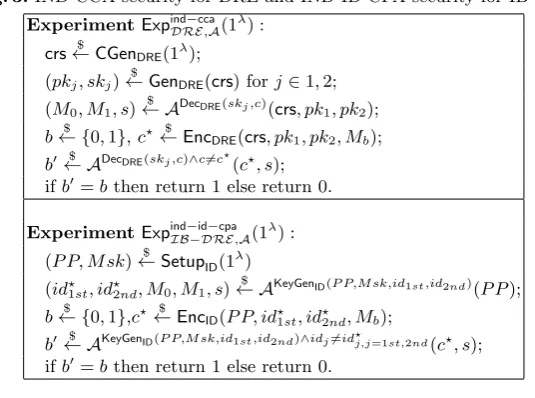
Fig. 3.IND-CCA security for DRE and IND-ID-CPA security for IB-DRE
ExperimentExpind−cca
DRE,A(1
λ) :
crs←$ CGenDRE(1λ);
(pkj, skj)
$
←GenDRE(crs) forj∈1,2;
(M0, M1, s)← A$ DecDRE(skj,c)(crs, pk1, pk2);
b← {0$ ,1},c? $
←EncDRE(crs, pk1, pk2, Mb);
b0← A$ DecDRE(skj,c)∧c6=c?(c?, s); ifb0=bthen return 1 else return 0.
ExperimentExpindIB−DRE−id−cpa,A(1λ) :
(P P, M sk)←$ SetupID(1
λ )
(id?1st, id?2nd, M0, M1, s)
$
← AKeyGenID(P P,M sk,id1st,id2nd)(P P);
b← {0$ ,1},c? $
←EncID(P P, id?
1st, id?2nd, Mb);
b0← A$ KeyGenID(P P,M sk,id1st,id2nd)∧idj6=id?j,j=1st,2nd(c?, s); ifb0=bthen return 1 else return 0.
• DecID(P P, c, skidj) → M. The decryption algorithm takes in public
pa-rameters P P, a ciphertext c, and one secret key skidj as input, where j∈ {1st,2nd}. It outputs a messageM.
Correctness. For all (P P, M sk)←$ SetupID(1λ), all identitiesidj ∈ID, all mes-sagesM, allskidj ←KeyGenID(P P, M sk, idj), allc←EncID(P P, id1st, id2nd, M),
we have
Pr[DecID(P P, skid1st, c) =DecID(P P, skid2nd, c) =M] = 1−negl(λ). Security. An IB-DRE scheme is said to be indistinguishable against chosen-plaintext and adaptively chosen-identity attacks (IND-ID-CPA) if for any PPT adversaryA,
AdvindIB−DRE−id−cpa,A(1λ) =
PrhExpIB−DREind−id−cpa,A(1λ) = 1i−1
2
is negligible inλ.
3
Dual Receiver Encryption Construction
Our scheme relies upon a strongly unforgeable one-time signature schemeOT S = (GenOTS,SigOTS,VrfOTS) whose verification key is exactly λ bits long. The
de-scription of our DRE schemeDRE is as follows.
• CGenDRE(1λ). On input a security parameterλ, algorithmCGenDREsets the
• GenDRE(crs). For user j ∈ {1,2}, this algorithm generates a pair matrices
(Aj,TAj) ∈ Z
n×m q ×Z
m×m
q by running TrapGen(1
n,1m, q) and selects a random matrixBj
$
←Znq×m. Finally, it outputs
pkj= (Aj,Bj) and skj=TAj.
• EncDRE(crs, pk1, pk2,m∈ {0,1}n). It first obtains a pair (vk,sk) by running GenOTS(1λ) and computes C1 = [A1|B1 +Hn,q(vk)·G] ∈ Znq×2m,C2 = [A2|B2+Hn,q(vk)·G]∈Znq×2m. Then, it picks s
$
←Znq,ee0
$
← DZn,αq, and e1,1,e2,1,e1,2,e2,2
$
← DZm,α0q. Finally, it computes and returns the
cipher-textc= (vk,c0,c1,c2, δ), whereδ=SigOTS(sk,(c0,c1,c2)) and
c0=U>s+ee0+ lq
2
m
·m∈Znq,
c1=C>1s+
e1,1
e1,2
∈Z2mq ,c2=C>2s+
e2,1
e2,2
∈Z2mq .
• DecDRE(crs, pk1, pk2, sk1,c). To decrypt a ciphertext c = (vk,c0,c1,c2, δ) with a private keysk1 =TA1, the algorithmDecDRE performs each of the
following steps:
(1) it runsVrfOTS(vk,(c0,c1,c2), δ), outputs⊥ifVrfOTS rejects;
(2) fori∈ {1,· · ·, n}, it runsSampleLeft(A1,B1+Hn,q(vk)·G,(U)i,TA1, σ)
to obtain (E1)i, i.e., it obtainsE1∈Zq2m×n such thatC1·E1=U; (3) it computesb=c0−E>1c1and treats each element ofb= [(b)1,· · ·,(b)n]>
as an integer inZ, and sets (m)i= 1 if
(b)i− dq2e
<dq4e, else (m)i= 0, wherei∈ {1,· · · , n}.
(4) finally, it returns the plaintextm= [(m)1,· · · ,(m)n]>.
3.1 Correctness and Parameter Selection
In order to satisfy the correctness requirement and make the security proof work, we need that
◦ fori∈ {1,· · · , n}, the error term is bounded by
(ee0)i−(E)>i
e1,1
e1,2
≤αq√m+ (σ√2m)·(α0q√2m)< q/4.
◦ TrapGenin Lemma 12 (Item 1) can work (m≥6ndlogqe), and it returnsTA
satisfyingkgTAk ≥ O(
√
nlogq).
◦ the Leftover Hash Lemma in Lemma 12 (Item 4) can be applied to the security proof (m >(n+ 1) logq+ω(logn)).
◦ SampleLeft in Lemma 12 (Item 2) can operate (σ ≥ kTgAk ·ω(
√
logm) =
O(√nlogq)·ω(√logm)).
◦ SampleRightin Lemma 12 (Item 3) can operate (σ≥ kTgGk·s1(Rj)·ω(
√
◦ ReRand (Lemma 13) in the security proof can operate (αq > ω(√logm), andα0q/(2αq)> s1([Im|Rj]>), where s1([Im|Rj]>)≤(1 +s1(Rj))≤(1 + 12√2m), forj = 1,2.
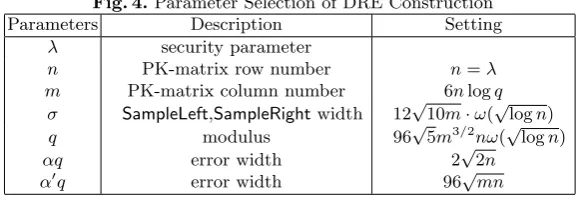
To satisfy the above requirements, we set the parameters in Figure 4.
Fig. 4.Parameter Selection of DRE Construction
Parameters Description Setting
λ security parameter
n PK-matrix row number n=λ
m PK-matrix column number 6nlogq
σ SampleLeft,SampleRightwidth 12√10m·ω(√logn)
q modulus 96√5m3/2nω(√logn)
αq error width 2√2n
α0q error width 96√mn
3.2 Security Proof
Theorem 1. If OT S is a strongly existential unforgeable one-time signature scheme and theDLWEq,n,n+2m,αassumption holds, then the above schemeDRE
is a secure DRE against chosen-ciphertext attacks.
Proof (of Theorem 1). AssumeAis a probabilistic polonomial time (PPT) ad-versary attacksDRE in a chosen-ciphertext attack. IfVrfOTS(vk,(c0,c1,c2), δ) = 1, we say the ciphertext c= (vk,(c0,c1,c2), δ) is valid. Letc? denote the chal-lenge ciphertext (vk?,(c?0,c1?,c?2), δ?) received by A during a particular run of the experiment, and let Forge denote the event that Asubmits a valid cipher-text (vk?,(c0,c1,c2), δ) to the decryption oracle (we assume thatvk? is chosen at the outer of the experiment so this well-defined even before A is givenc?.) According to the security of OT S, Pr [Forge] is negligible. We then prove the following lemma:
Lemma 2. Pr
h
ExpindDRE−cca,A(1λ) = 1∧Forgei+1
2Pr [Forge]− 1 2
is negligible, if
assuming that the DLWEq,n,n+2m,α assumption holds. To see that this implies the theorem, note that
AdvindDRE−cca,A(1λ) =
PrhExpindDRE−cca,A(1λ) = 1i−1
2
≤
PrhExpindDRE−cca,A(1λ) = 1∧Forgei−1
2Pr [Forge]
+
PrhExpindDRE−cca,A(1λ) = 1∧Forgei+1
2Pr [Forge]− 1 2
≤1
2Pr [Forge] +
PrhExpindDRE−cca,A(1λ) = 1∧Forgei+1
2Pr [Forge]− 1 2
Proof (of Lemma 2). We sketch the proof via a sequence of games. The games involve the challenger and an adversaryA. In the following, we defineXκas the event that the challenger outputs 1 inGameκ, forκ∈ {1,2,3,4,5}.
Game1: This game is the original experimentExpindDRE−cca,A(1λ) except that when the adversaryAsubmits a valid ciphertext (vk?,(c0,c1,c2), δ) to the decryp-tion oracle, the challenger outputs a random bit. It is easy to see that
Pr [X1]−1
2 =
PrhExpindDRE−cca,A(1λ) = 1∧Forgei+1
2Pr [Forge]− 1 2 .
Game2: This game is identical toGame1 except that the challenger changes
(1) the generation of public keys pk1, pk2: the challenger selects random matrices A1,A2 ∈ Znq×m instead of running TrapGen, and random matri-ces R1,R2 ∈ {−1,1}m×m; then, the challenger computes B1 = A1R1−
Hn,q(vk?)G,B2=A2R2− Hn,q(vk?)G∈Znq×m. (2) the decryption oracle: whenA submits a valid ciphertext (vk 6=vk?,(c0,c1,c2), δ), the challenger can generateE1by running the algorithmSampleRight(A1,G,R1,Hn,q(vk−
vk?),(U)i,TG, σ) (In the similar way, the challenger obtainsE2 by running
SampleRight(A1,G,R2,Hn,q(vk−vk?),(U)i,TG, σ) ) instead ofSampleLeft,
fori∈ {1,· · · , n}. Note that the following equation holds:
c?0=U>s+ee0+
lq
2
m
·mb,
c?1=
(A1)>s+e1,1 (R1)>(A1)>s+e1,2
,c?2=
(A2)>s+e2,1 (R2)>(A2)>s+e2,2
,
whereee0 $
← DZn,αq ande1,1,e1,2,e2,1,e2,2
$
← DZm,α0q.
Game3: In this game, the challenger changes the way that the challenge
cipher-textc?is created: the challenger first pickss←$ Znq,ee0
$
← DZn,αq,
e
e1,1,ee2,1
$
← DZm,αq and sets w =U>s+ee0,b1 = (A1)>s+ee1,1,b2 = (A2)>s+ee2,1. Then, it computes
c?0=w+lq 2
m
·mb,
c?1=ReRand
Im (R1)>
,b1, αq,α 0q 2αq
,c?2=ReRand
Im (R2)>
,b2, αq,α 0q 2αq
.
Game4: In this game, the challenger changes the way that the challenge
cipher-textc? is created: the challenger first picks random vectorsw ←$ Znq,be1
$
←
Zmq ,eb2 $
←Zmq ,ee1,1,ee2,1
$
← DZm,αq and sets b1 =eb1+ee1,1,b2 =be2+ee2,1.
Then, it computes
c?0=w+lq 2
m
·mb,
c?1=ReRand
Im (R1)>
,b1, αq, α0q 2αq
,c?2=ReRand
Im (R2)>
,b2, αq, α0q 2αq
Game5: In this game, the challenger changes the way that the challenge
ci-phertext c? is created: the challenger first picks w ←$ Znq,eb1
$
←Zmq ,be2 $
←
Zmq ,e1,1,e1,2,e2,1,e2,2 $
← DZm,α0q and computes
c?0=w+lq 2
m
·mb,
c?1=
" e
b1+e1,1 (R1)>be1+e1,2
#
,c?2=
" e
b2+e2,1 (R2)>be2+e2,2
#
.
Analysis of Games. We use the following lemmas to give a analysis between each adjacent games.
Lemma 3. Game1 andGame2 are statistically indistinguishable.
Proof Sketch.We can prove that Game2 is statistically close toGame1 using
Leftover Hash Lemma (Lemma 12, item 4) and the properties of the algorithms
SampleRight,TrapGen. ut
Lemma 4. Game2 and Game3 are identically distributed, and Game4 and
Game5 are identically distributed.
Proof. This lemma can be proved just according to the property ofRand. ut
Lemma 5. Assume theDLWEq,n,n+2m,αassumption holds,Game3andGame4 are computationally indistinguishable.
Proof. Suppose there exists an adversaryAwho has a non-negligible advantage in distinguishing Game3 and Game4, then we can construct an adversary B
who can break the LWE assumption as follows.
Instance. Based on the given LWE instance (U,A1,A2,w,b1,b2)∈ Znq×n× Znq×m×Zqn×m×Znq ×Zmq ×Zmq and assumew =we +ee0 and b1 =be1+ ee1,1,b2=eb2+ee2,1where ee0
$
← DZn,αq,
e
e1,1,ee2,1 $
← DZm,αq. ThenBshould distinguish whether we = U>s,be1 = A>1s,be2 = A>2s for some s ∈ Znq or
e
w←$ Znq,eb1,be2 $
←Zmq . We note this subtle change from the standard LWE problem is done only for the convenience of the proof.
Setup. TheB constructs{B1,B2} fori∈ {1,· · · , `}as inGame3.
Decryption Queries. TheBanswers decryption oracle as inGame3.
Challenge ciphertext. WhenAsends two message (m0, m1), the reductionB
computes the challenge ciphertext as follows
c?0=w+lq 2
m
·mb∈Znq,
c?1=ReRand
Im (R1)>
,b1, αq, α0q 2αq
,c?2=ReRand
Im (R2)>
,b2, αq, α0q 2αq
.
It can be easily seen that if (U,A,w,b) is a valid LWE sample, the view of A corresponds to Game3; otherwise, the view of A corresponds to that of
Game4. We complete the proof of this lemma. ut
Complete the Proof of Theorem 1. It is obvious that Pr[X5] = 12, this is because the challenge bit b is independent of the A’s view. From Lemma 3 to Lemma 5, we know that
Pr[X1]≈Pr[X2],Pr[X2] = Pr[X3],Pr[X4] = Pr[X5]. From Lemma 5, we know that
|Pr[X3]−Pr[X4]|=
Pr[X4]−1
2
≤DLWEq,n,n+2m,α,
which implies Pr [X1]−12
≤DLWEq,n,n+2m,α−negl(λ). utut
4
Identity-Based Dual Receiver Encryption Construction
Assume an identity spaceID={−1,1}` (In general, IB-DRE needs to support n-bit length identity, i.e.,`=n) and a message spaceM={0,1}n, our IB-DRE schemeIB-DRE consists of the following four algorithms:
• SetupID(1λ) → (P P, M sk) : On input a security parameter λ, it sets the parametersn, m, q as specified in Figure 5. Then it obtains a pair matrices (A,TA)∈Znq×m×Zmq×m by runningTrapGen(1n,1m, q) and selects a uni-formly random matrixU ∈ Znq×n,A1i,Ai2 ∈ Znq×m, where i ∈ {1,· · · , n}. Finally it outputsP P = (n, m, q,A,A1
i,A2i,U) andM sk=TA.
• KeyGenID(P P, M sk,id1st,id2nd ∈ ID) →skid1st, skid2nd : On input public
parametersP P, a master key M sk, and identitiesid1st,id2nd, it first com-putesAid1 =
Pn
i=1(id1st)i·A1i +G,Aid2 =
Pn
i=1(id2nd)i·A2i +G. Then fori∈ {1,· · · , n}, it runsSampleLeft(A,Aid1,(U)i,TA, σ) to obtain (Eid1)i and setsskid1st =Eid1∈Z
2m×n
q . Similarly, it can obtainskid2nd =Eid2such
that [A|Aid2]·Eid2=U.
• EncID(P P,id1st,id2nd,m) → c. It computes Aid1,Aid2 as above. Then, it
picks s ←$ Znq, ee0
$
← DZn,αq, and e1,1,e2,1,e1,2,e2,2
$
← DZm,α0q. Finally, it
computes and returns the ciphertextc= (c0,c1), where
c0=U>s+e0+
lq
2
m
·m∈Znq,
c1=
c1,1
c1,2
c1,3
=
A>
(Aid1)
>
(Aid2)
>
s+
e1,1
e1,2
e1,3
∈Z3mq ,
• DecID(P P, skidj,c)→m. To decrypt a ciphertextc= (c0,c1) with a private
key skid1st = Eid1, it computes b = c0−E
>
id1 ·
c1,1
c1,2
and regards each coordinate ofb= [(b)1,· · ·,(b)n]> as an integer in Z, and sets (m)i = 1 if
(b)i− dq2e
<d
q
4.1 Correctness and Parameter Selection
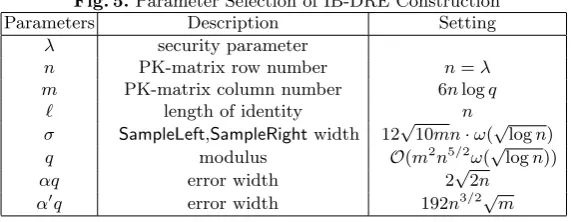
In order to satisfy the correctness requirement and make the security proof work (which is very similar to Subsection 3.1), we set the parameters in Figure 5.
Fig. 5.Parameter Selection of IB-DRE Construction
Parameters Description Setting
λ security parameter
n PK-matrix row number n=λ
m PK-matrix column number 6nlogq
` length of identity n
σ SampleLeft,SampleRightwidth 12√10mn·ω(√logn)
q modulus O(m2n5/2ω(√logn))
αq error width 2√2n
α0q error width 192n3/2√m
4.2 Security Proof
Theorem 2. If the DLWEq,n,n+m,α assumption holds, then the above scheme
IB-DRE is a secure IB-DRE scheme against chosen-plaintext and adaptively chosen-identity attacks.
Proof (of Theorem 2). We prove the theorem with showing that if a PP-T adversary A can break our IB-DRE scheme with a non-negligible advan-tage (i.e., success probability 12 +), then there exists a reduction that can break the DLWEq,n,n+m,α assumption with an advantage poly()−negl(1λ). LetQ=Q(λ) be the upper bound of the number ofKeyGenID queries and I∗=
{(id∗1st,id∗2nd),(id1st,id2nd)∈[Q]} be the challenge ID along with the queried ID’s.
We formally give the proof via a sequence of games and define Xκ as the event that the challenger outputs 1 inGameκ, forκ∈ {0,1,2,3,4,5,6}.
Game0: This game is the original experimentExpindIB−DRE−id−cpa,A(1λ) in Figure 3. It
is easy to see that
=
Pr [X0]− 1 2
=
PrhExpIB−DREind−id−cpa,A(1λ) = 1i−1
2
.
Game1: This game is as same asGame0except that we add an abort event that
vectorsh1
i,h2i ∈Ztq and defines two functionsHABB1 ,H2ABB:ID →Znq×n as follows:∀id∈ ID,
H1
ABB(id) =In+ n
X
i=1
(id)i·H(h1i)⊗In/t,H2ABB(id) =In+ n
X
i=1
(id)i·H(h2i)⊗In/t.
We then describe how the challenger behaves inGame1 as follows:
• Setup: The same asGame0except that the challenger keeps the hash
functionsH1
ABBandH2ABBpassed from the experiment.
• Secret key and ciphertext query:The challenger responds to secret key queries for identities and challenge ciphertext query (with a random bitb∈ {0,1}) as same as that inGame0.
• Gauss:When the adversary returns a bitb0, the challenger checks if
H2ABB(id ?
1st) =0,H 2 ABB(id
1st)∈Invn
H2 ABB(id
?
2nd) =0,H 2 ABB(id
2nd)∈Invn
for∈ {1,· · · , Q}whereInvndenotes invertible matrices inZnq×n. If the condition does not hold, the challenger outputs a random bitb∈ {0,1}, namely we say the challenger aborts the game.
Note thatAnever sees the random hash functionsH1
ABBandH 2
ABB, and has no idea if an abort event took place. While it is convenient to describe the abort action at the end of the game, nothing would change if the challenger aborts the game as soon as the abort condition becomes true.
Game2: This game is as same as Game1 except that we slightly change the
way that the challenger generates the matrices A1
i,A1i for i ∈ {1,· · · , n}. Takingt as t =dlogq2Q/e, we thus haveqt ≥2Q/≥qt−1. Assume n is a multiple oft. Fori= 1,· · ·, n, the challenger chooses 2nrandom integer vectors h1
i,h2i ∈ Ztq and random matrices R1i,R2i ∈ {−1,1}m×m. Then it setsA1i =AR1i + (Ht,q(hi1)⊗In/t)·G,A2i =AR
2
i + (Ht,q(h2i)⊗In/t)·G.
Game3: This game is identical toGame2except that the challenger chooses a random matrixA instead of runningTrapGen and responds to private key queries by involving the algorithm SampleRight instead of SampleLeft. To respond to a private key query forid1st,id2nd, the challenger needs short vectors (Eid1)i∈ ∧
(U)i
q ([A|Aid1]) and (Eid2)i∈ ∧
(U)i
q ([A|Aid2]), where
Aid1=
n
X
i=1
(id1st)i·A 1
i +G=A n
X
i=1
(id1st)i·R1i
!
+H1
ABB(id1st)·G;
Aid2=
n
X
i=1
(id2nd)i·A2i +G=A n
X
i=1
(id2nd)i·R2i
!
+H2
ABB(id2nd)·G.
IfH1
pri-vate key query by running
SampleRight(A,G, n
X
i=1
(id1st)iR 1 i,H
1
ABB(id1st),(U)i,TG, σ), to getEid1,
SampleRight(A,G, n
X
i=1
(id2nd)iR 2 i,H
2
ABB(id2nd),(U)i,TG, σ), to getEid2,
fori∈ {1,· · · , n}. SinceH1 ABB(id
?
1st) =0,H2ABB(id ?
2nd) =0, it holds:
c?0=U>s+ee0+
lq
2
m
·mb,c?1=
A>s+e1,1
Pn
i=1(id ?
1st)i·R1i
>
A>s+e1,2
Pn
i=1(id ?
2nd)i·R2i
>
A>s+e
1,2
,
whereee0 $
← DZn,αq,e1,1,e1,2,e1,3
$
← DZm,α0q.
Game4: In this game, the challenge ciphertext is generated as follows: it chooses
s←$ Znq,ee0
$
← DZn,αq,
e
e1 $
← DZm,αq and setsw=U>s+
e
e0,b=A>s+ee1.
Then, it computes
c?0=w+lq 2
m
·mb,c?1=ReRand
Im Pn
i=1(id ?
1st)i·R1i
> Pn
i=1(id ?
2nd)i·R2i
> ,b, αq,
α0q 2αq
.
Game5: In this game, the challenge ciphertext is generated as follows: it first
picks random vectorsw ←$ Znq,be
$
←Zmq ,ee1
$
← DZm,αq and setsb=be+ee1. Then, it computes
c?0=w+lq 2
m
·mb,c?1=ReRand
Im Pn
i=1(id ?
1st)i·R1i
> Pn
i=1(id ?
2nd)i·R2i
> ,b, αq,
α0q 2αq
.
Game6: In this game, the challenge ciphertext is generated as follows: it first
picksw←$ Znq,eb
$
←Zmq ande1,1,e1,2,e1,3 $
← DZm,α0q and computes
c?0=w+lq 2
m
·mb,c?1=
e
b+e1,1 (Pn
i=1(id ?
1st)i·R1i)>be+e1,2 (Pn
i=1(id ?
2nd)i·R2i)>eb+e1,3
.
Analysis of Games. We use the following lemmas to give a analysis between each adjacent games.
The only difference betweenGame1andGame0is the abort event. We use
Lemma 6 ([1]). Let I∗ be a (Q+ 1)-ID tuple {id∗,{idj}j∈[Q]} denoted the
challenge ID along with the queried ID’s, and η(I∗) be the probability that an abort event does not happen in Game1. Let ηmax = max η(I∗) and ηmin = min η(I∗). For i= 0,1, we let Xi be the event that the challenger returns 1 as the output ofGamei. Then, we have
Pr[X1]− 1 2
≥ηmin
Pr[X0]− 1 2 −1
2(ηmax−ηmin).
Lemma 7. Let =
Pr [X0]−12
, then
Pr[X1]−12
≥
3
64q2Q2. Proof. As the selections ofh1
i,h2i are independent, then according to Lemma 1 we have
PrH1ABB(id ?
1) =0,H 1
ABB(idi)∈Invn∧ HABB2 (id ?
2) =0,H 2
ABB(idi)∈Invn
= PrH1 ABB(id
?
1) =0,H 1
ABB(idi)∈Invn
·PrH2 ABB(id
?
2) =0,H 2
ABB(idi)∈Invn
∈
1
q2t(1− Q qt)
2, 1 q2t
.
Since t =dlogq2Q/e, we have qt ≥2Q/ ≥ qt−1, 1 qt ≥
2qQ and Q < 0.5q t. According to Lemma 6, we hence have
Pr[X1]−1
2 ≥ηmin
Pr[X0]−1
2 −1
2(ηmax−ηmin) = 1
q2t(1−0.5) 2− 1
2q2t(−0.25 2)
≥ 9
16q2t− 2q2t ≥
16q2t ≥
3 64q2Q2.
(1)
u t
Lemma 8. Game1 andGame2 are statistically indistinguishable.
Proof. We show that Game2 is statistically close to Game1 using Leftover
Hash Lemma (Lemma 12, item 4). Note that the only difference between the two games is how the matrices A1i,A2i were generated. According to Leftover Hash Lemma,
A,{A1i},{A2i}
≈ A,{AR1i},{AR2i}
,
whereA1i,A2i ←$ Znq×m. Then, we have
A,
A1i ,
A2i ≈ A,
AR1i +Ht,q(h1i)⊗In/t·G ,
AR2i +Ht,q(h2i)⊗In/t·G . Therefore,Game1 andGame2are statistically indistinguishable. ut
Proof. We prove thatGame2andGame3are statistically indistinguishable by
using Lemma 12, items 1,2,3. Note that in Game2, the matrix A is
generat-ed by using algorithm TrapGen, and secret key queries are answered by using
SampleLeft. While inGame3, the matrixAis generated by uniformly selecting
fromZnq×m, and secret key queries are answered by usingSampleRgiht.
According to Lemma 12, item 1,Ais statistically close to an uniform distribu-tion overZn×m
q as inGame3. As we set Gaussian parameterσin subsection 4.1,
the output ofSampleRgihtis identically distributed to the output ofSampleLeft
according to Lemma 12, items 2 and 3. Therefore, Game2 and Game3 are
statistically indistinguishable. ut
Lemma 10. Game3 andGame4 are identically distributed, andGame5 and
Game6 are identically distributed.
Proof. This lemma can be proved just according to the property ofRand. ut
Lemma 11. Assume theDLWEq,n,n+m,αassumption holds,Game4andGame5 are computationally indistinguishable.
Proof. Suppose there exists an adversaryAwho has a non-negligible advantage in distinguishing Game4 and Game5, then we can construct an adversary B
who can break the LWE assumption as follows.
Instance. Based on the given LWE instance (U,A,w,b)∈Zn×n
q ×Znq×m×Znq× Zmq and assumew=we+ee0andb=eb+ee1whereee0
$
← DZn,αq,
ee1
$
← DZm,αq.
Then B should distinguish whether we = U>s,be = A>s for some s ∈ Znq
or we ←$ Zn q,eb
$
←Zm
q . We note this subtle change from the standard LWE problem is done only for the convenience of the proof.
Setup. TheBconstructs{A1
i,A2i}fori∈ {1,· · ·, `}as inGame3. Then it sets P P = (A,A1
i,A2i,U).
Queries. TheB answers identity queries as in Game3 including aborting the simulation if needed.
Challenge ciphertext. WhenAsends identities (id?
1, id?2) and message (m0, m1), the reductionBcomputes the challenge ciphertext as follows
c?0=w+lq 2
m
·m∈Zq,c?1=ReRand
Im (P`
i=1(id ? 1)iR1i)> (P`
i=1(id ? 2)iR2i)>
,b, αq,
α0q 2αq
∈Z
3m q .
Guess. After being allowed to make additional queries,Aguesses if it interacts with a challenger ofGame4 orGame5 .
It can be easily seen that if (U,A,w,b) is a valid LWE sample, the view of A corresponds to Game4; otherwise, the view of A corresponds to that of
Complete the Proof of Theorem 2. It is obvious that Pr[X6] = 12, this is because the challenge bit b is independent of the A’s view. From Lemma 7 to Lemma 10, we know that
Pr[X1]≈Pr[X2],Pr[X2]≈Pr[X3],Pr[X3] = Pr[X4],Pr[X5] = Pr[X6]. (2)
From Lemma 11, we know that
|Pr[X4]−Pr[X5]|=
Pr[X4]−1
2
≤DLWEq,n,n+m,α,
which implies DLWEq,n,n+m,α≥
3
64q2Q2−negl(λ), according to Equations 1 and
2. utut
4.3 Extension: IB-DRE with More Compact Parameters.
As mentioned above, our IB-DRE scheme is based on the beautiful work of A-grawal, Boneh and Boyen [1], i.e., an adaptively secure identity-based encryption (IBE) scheme. However, one drawback of Agarwal et al.’s adaptive secure IBE scheme [1] is the large public parameter sizes: namely, the public parameters contain`+ 1 matrices composed ofn×melements, where`is the size of the bit-string representing identities. As a result, the public parameters in our IB-DRE scheme contain 2·`+ 1 matrices composed ofn×melements.
In [19], Singh, Pandurangan and Banerjee considered identities as one chunk rather than bit-by-bit. In fact, the maximum of the above chunk is a number in Zq, so that they can reduce the number of the matrices in the scheme by a factor at most logq, while encryption and decryption are almost as efficient as that in [1]. Applying their technique (they called ”Blocking Technique”) to our construction, we can get an IB-DRE scheme with more compact public parameter sizes. More precisely, we can get a more efficient IB-DRE scheme in which there exist only 2· `
logq+ 1 matrices composed ofn×melements, or about
O(lognn) matrices (sincel=nand qis a polynomial ofn).
Based the IBE schemes in [1, 19], Apon, Fan and Liu [4] proposed an identity-based encryption scheme which only needsO(logn2n) public matrices to support
n-bit length identity. The reason why the number of the matrices in their scheme is less about logn times than that of the IBE scheme in [19] is that they used a different gadget matrix Gb and flattening functionGb−1 in logarithmic (logn)
base instead of the usual gadget matrix G and flattening function G−1 in 2 base. Note that the encryption and decryption of the IBE scheme in [4] are less efficient than that in [1, 19], this is because the flattening functionGb−1is much
slower than G−1. Applying their technique to our construction, we can get a more efficient IB-DRE scheme in which there exist aboutO(logn2n) matrices.
5
Conclusion
The learning with errors (LWE) problem is a promising cryptographic primitive that is believed to be resistant to attacks by quantum computers. Under this assumption, we construct a dual-receiver encryption scheme with a CCA security. Additionally, for the DRE notion in the identity-based setting, namely IB-DRE, we also give a lattice-based IB-DRE scheme that achieves IND-ID-CPA security.
6
Acknowledgments
We thank the anonymous ACISP’2018 reviewers for their helpful comments. This work is supported by the National Natural Science Foundation of China (No.61772515, No.61602473, No.61571191), the National Basic Research Pro-gram of China (973 project, No.2014CB340603), the National Cryptography Development Fund (No. MMJJ20170116), the Dawn Program of Shanghai Ed-ucation Commission (No. 16SG21) and the Open Foundation of Co-Innovation Center for Information Supply & Assurance Technology (No. ADXXBZ201701).
References
1. S. Agrawal, D. Boneh, and X. Boyen. Efficient lattice (H)IBE in the standard model. InEUROCRYPT 2010, pages 553–572, 2010.
2. M. Ajtai. Generating hard instances of the short basis problem. InICALP 1999, pages 1–9, 1999.
3. J. Alwen and C. Peikert. Generating shorter bases for hard random lattices. In
STACS 2009, pages 75–86, 2009.
4. D. Apon, X. Fan, and F. Liu. Compact identity based encryption from lwe. IACR Cryptology ePrint Archive, 2016:125, 2016.
5. D. Cash, D. Hofheinz, E. Kiltz, and C. Peikert. Bonsai trees, or how to delegate a lattice basis. InEUROCRYPT 2010, pages 523–552, 2010.
6. S. S. M. Chow, M. K. Franklin, and H. Zhang. Practical dual-receiver encryption - soundness, complete non-malleability, and applications. InCT-RSA 2014, pages 85–105, 2014.
7. R. Cramer and I. Damg˚ard. On the amortized complexity of zero-knowledge pro-tocols. In Advances in Cryptology - CRYPTO 2009, 29th Annual International Cryptology Conference, Santa Barbara, CA, USA, August 16-20, 2009. Proceed-ings, pages 177–191, 2009.
8. T. Diament, H. K. Lee, A. D. Keromytis, and M. Yung. The dual receiver cryp-tosystem and its applications. InCCS 2004, pages 330–343, 2004.
9. Y. Dodis, R. Ostrovsky, L. Reyzin, and A. D. Smith. Fuzzy extractors: How to generate strong keys from biometrics and other noisy data. SIAM J. Comput., 38(1):97–139, 2008.
10. A. Georgescu. Anonymous lattice-based broadcast encryption. In Information and Communicatiaon Technology - International Conference, ICT-EurAsia 2013, pages 353–362, 2013.
12. A. Joux. A one round protocol for tripartite diffie-hellman. InAlgorithmic Number Theory, 4th International Symposium, ANTS-IV, Leiden, The Netherlands, July 2-7, 2000, Proceedings, pages 385–394, 2000.
13. S. Katsumata and S. Yamada. Partitioning via non-linear polynomial functions: More compact ibes from ideal lattices and bilinear maps. In ASIACRYPT 2016, pages 682–712, 2016.
14. E. Kiltz. Chosen-ciphertext security from tag-based encryption. In TCC 2006, pages 581–600, 2006.
15. B. Libert, K. G. Paterson, and E. A. Quaglia. Anonymous broadcast encryption: Adaptive security and efficient constructions in the standard model. InPublic Key Cryptography - PKC 2012 - 15th International Conference on Practice and Theory in Public Key Cryptography, Darmstadt, Germany, May 21-23, 2012. Proceedings, pages 206–224, 2012.
16. M. Naor and M. Yung. Public-key cryptosystems provably secure against chosen ciphertext attacks. InSTOC 1990, pages 427–437, 1990.
17. C. Peikert and B. Waters. Lossy trapdoor functions and their applications. In
STOC 2008, pages 187–196, 2008.
18. O. Regev. On lattices, learning with errors, random linear codes, and cryptography. InSTOC 2005, pages 84–93, 2005.
19. K. Singh, C. P. Rangan, and A. K. Banerjee. Adaptively secure efficient lattice (H)IBE in standard model with short public parameters. InSPACE 2012, pages 153–172, 2012.
20. F. Wang, X. A. Wang, and C. Wang. Lattice-based dynamical and anonymous broadcast encryption scheme for wireless ad hoc networks.Journal of Interconnec-tion Networks, 15(3-4):1–14, 2015.
21. J. Wang and J. Bi. Lattice-based identity-based broadcast encryption scheme.
IACR Cryptology ePrint Archive, 2010:288, 2010.
22. B. Waters. Efficient identity-based encryption without random oracles. In EURO-CRYPT 2005, pages 114–127, 2005.
23. Y. Youn and A. Smith. An efficient construction of dual-receiver encryption. un-published, 2008.
24. K. Zhang, W. Chen, X. Li, J. Chen, and H. Qian. New application of partitioning methodology: identity-based dual receiver encryption. Security and Communica-tion Networks, 9(18):5789–5802, 2016.
Appendix A: Lattice Background
For positive integersq, n, m, and a matrixA∈Zn×m
q , them-dimensional integer lattices are defined as: Λq(A) ={y:y=A>sfor somes∈Zn} and Λ⊥q(A) =
{y:Ay=0 modq}.
LetSbe a set of vectorsS={s1,· · ·,sn} in Rm. We useeS={es1,· · · ,esn} to denote the Gram-Schmidt orthogonalization of the vectorss1,· · · ,sn in that order, andkSkto denote the length of the longest vector inS. For a real-valued matrixR, let s1(R) = maxkuk=1kRuk (respectively, kRk∞ = maxkrik∞) de-note the operator norm (respectively, infinity norm) ofR.
For x ∈ Λ, define the Gaussian function ρs,c(x) over Λ ⊆Zm centered at
c∈Rm with parameter s >0 asρs,c(x) = exp(−π||x−c||/s2). Let ρs,c(Λ) =
P
ρs,c(x)
ρs,c(Λ), wherex∈Λ. For simplicity,ρs,0 and DΛ,s,0 are abbreviated as ρs and
DΛ,s, respectively.
Learning with Errors Assumption. The learning with errors problem, denot-ed by LWEq,n,m,α, was first proposed by Regev [18]. For integern, m=m(n), a prime integerq >2, an error rateα∈(0,1), the LWE problem LWEq,n,m,αis to distinguish the following pairs of distributions:{A,A>s+e}and{A,u}, where
A←$ Znq×m,s $
←Znq,u $
←Zmq and e $
← DZm,αq. Regev [18] showed that solving
decisional LWEq,n,m,α(denoted by DLWEq,n,m,α) forαq >2
√
2nis (quantumly) as hard as approximating the SIVP and GapSVP problems to within Oe(n/α)
factors in the worst case.
Lemma 12. Let p, q, n, m be positive integers with q ≥ p ≥ 2 and q prime. There exists PPT algorithms such that
• ([2, 3]):TrapGen(1n,1m, q)a randomized algorithm that, whenm≥6ndlogqe,
outputs a pair(A,TA)∈Zqn×m×Zm×msuch thatAis statistically close to
uniform inZnq×mandTAis a basis ofΛ⊥q(A), satisfyingkTgAk ≤ O(
√
nlogq)
with overwhelming probability.
• ([5]):SampleLeft(A,B,u,TA, σ) a randomized algorithm that, given a full rank matrixA∈Znq×m, a matrixB∈Zqn×m, a basisTA ofΛ⊥q(A), a vector
u∈Znq andσ≥ kTgAk·ω(
√
logm), then outputs a vectorr∈Z2mq distributed
statistically close toDΛu
q(F),σ where F= [A|B].
• ([1]):SampleRight(A,G,R,S,u,TG, σ)a randomized algorithm that, given a full rank matrix A ∈ Znq×m, a matrix R ∈ Z
m×m
q , an invertible matrix
S∈Znq×n, a vectoru∈Znq andσ≥ kgTGk·s1(R)·ω(
√
logm), then it outputs a vectorr∈Z2mq statistically close toDΛu
q(F),σ whereF= [A|AR+SG].
• (Generalized Leftover Hash Lemma [1, 9]): Form >(n+ 1) logq+ω(logn)
and prime q > 2, let R ← {−$ 1,1}m×k and A ←$
Znq×m,B $
← Znq×k be
uniformly random matrices. Then the distribution(A,AR,R>w)isnegl(n) -close to the distribution (A,B,R>w) for all vector w ∈ Zmq . When w is
always0, this lemma is called Leftover Hash Lemma.
In [13], Katsuamta and Yamada introduced the “Noise Rerandomization” lemma which plays an important role in the security proof because of creating a well distributed challenge ciphertext.
Lemma 13 (Noise Rerandomization [13]). Let q, w, m be positive integers andra positive real number withr >max{ω(√logm), ω(√logw)}. For arbitrary column vectorb∈Zmq , vector echosen fromDZm,r, any matrixV∈Zw×mand
positive real number σ > s1(V), there exists a PPT algorithm ReRand(V,b+
e, r, σ)that outputsb0 =Vb+e0∈Zw where e0 is distributed statistically close
Appendix B: Signature
Definition 1 (Signature Scheme). A signature scheme is a triple of proba-bilistic polynomial-time algorithms as follows:
• Gen(1λ)outputs a verification key vkand a signing key sk.
• Sign(sk, µ), given sk and a message µ ∈ {0,1}?, outputs a signature σ ∈
{0,1}?.
• Ver(vk, µ, σ)either accepts or rejects the signature σfor messageµ.
The correctness requirement is: for any message µ ∈ M, and for (vk, sk) ←$
Gen(1λ),σ←$ Sign(sk;µ),Ver(vk, µ, σ) should accept with overwhelming proba-bility (over all the randomness of the experiment).
The notion of security that we require for our IND-CCA DRE construction is strong existential unforgeability under a one-time chosen-message attack. The attack is defined as follows: generate (vk, sk) ←$ Gen(1λ) and give vk to the adversaryA, thenAoutputs a messageµ. Generateσ←$ Sign(sk, µ) and giveσ to A. The advantage ofAin the attack is the probability that it outputs some (µ?, σ?) 6= (µ, σ) such that Ver(vk, µ?, σ?) accepts. We say that the signature scheme is secure if for every PPT adversary A, its advantage in the attack is