Effects on Parallel Relational
Query Processing
This thesis is presented in fulfilment of
the requirements of the degree of
Doctor of Philosophy
Department of Computer and Mathematical Sciences
Faculty of Science
Victoria University of Technology
ABSTRACT
As queries grow increasingly complex and large data sets are becoming prevalent, database sizes grow dramatically particularly in Decision Support Systems (DSS), and On-Line Analytic Processing Systems ( OIAP) which have recently emerged as important database applications. In these systems, performance is a critical issue and speeding up the system has always been an objective but the processing power of individual processors can only handle a small fraction of current applications. As a result, parallel processing is exploited to improve database systems performance. In the thesis we focus on relational database systems and study skew characteristics and their effects on parallel query processing.
A unique problem of parallelism is load imbalance that occurs when the processors have different workloads resulted from data partitioning. The main cause of load imbalance is the problem of data skew that takes place when the appearance of some attribute values is more frequent than others in the raw input relation. The study of skewness can be classified into empirical skew handling and theoretical skew prediction. The latter has been largely neglected in comparison with the former. This thesis establishes a systematic skew foundation which we believe provides for the first time an in depth theoretical investigation of skewness in parallel database systems. It consists of a skew taxonomy which furnishes a fundamental framework for studying the skew problem, and skew prediction models which are able to reinforce and unify the different elements of the skew taxonomy. Skew prediction of range partitioning is quantitatively described. A complete skew prediction model of hash partitioning is also provided to predict the load and operation skew, where the degree of data skew is represented by the Uniform Distribution, Zipf Distribution, and Normal Distribution families. The relationship between the various kinds of skewness is expressed in a closed form. The mean, maximum, and minimum load skew as well as the standard deviation of the mean load and their distribution functions are provided. The skew models are evaluated by both a detailed simulation study and an experimental implementation on a parallel client-server system, and the results exhibit close agreement with the predicted values. In addition, an analysis of the relationship among data skew, load skew, and operation skew of hash partitioning is provided, and the applications of the skew models are indicated.
query execution. Although techniques of skew handling have received considerable attention in recent years, most of them are devoted to solving or avoiding data skew for single binary relational operation such as join (intra-operation level only). Here, we study the effect of data skew on the parallel execution of queries (intra-query and inter-query levels) that may involve a number of queries requiring multiple operations. Since allocating a large number of processors to a single relational operation does not always improve the overall execution time significantly in the presence of data skew, our approach is to identify the skewed operations and group them with other operations in each execution phase, so that the performance degradation caused by the skewness is kept to a minimal level. Both unary and binary operations cost models are provided with the data skew factor modelled by the Zipf Distribution. Three processor allocation strategies are presented and their performances are evaluated and compared.
Parallelising aggregate functions often involves queries of more than one relation, so that performance improvement can be achieved in both the intra-operation and inter-operation parallelism level. Carrying out join before aggregation is the conventional way for processing aggregate functions in uniprocessor systems, and parallel processing of aggregate functions has received little attention. In this thesis, the effects of the sequence of aggregation and join operations are identified in a parallel processing environment. Three parallel methods of processing aggregate functions for general queries are presented which differ in their selection of partitioning attribute; JPM partitions on join attribute, APM fragments on group-by attribute, and HPM adaptively partitions on both join and group-by attribute with a logical hybrid architecture. Their cost models are provided which incorporate the effect of data skew.
ACKNOWLEDGMENTS
My deep gratitude first goes to my research supervisor, Prof. Clement Leung, for supporting my work and for his excellent technical and professional guidance. He has allowed me to pursue my own interests while also giving me the opportunity to participate in group projects. He has contributed immeasurably to both my professional and personal development.
I would like to thank Dr. Yi Jiang for his proofreading the early draft of this thesis and for his invaluable technical advice on query processing in distributed database systems. I have enjoyed working with all other members of the Department of Computer and Mathematical Sciences, and special thanks go to Prof. Peter Cereone, Ted Alwast, and Dr. Audrey Tam. Many thanks are also due to the members of Terabyte Database Research Group, and a special memory is given to Jane Shou who passed away after a seven-year battle with leukaemia.
I would like to thank all my fellow students, particularly, David Taniar, Ivan Justrisa, Simon So, Philip Tse, Refyul Ray Fatri, Savitri Bevinakoppa, Dwi Sutanto, and Pak-Fai Tang for their valuable help. I also would like to thank Wai-Foong Hong and He-Pu Deng for being special friends and making my life more pleasurable and interesting. Many thanks go to my college friend, Guo-Hua Sheng, and our continuous communications have always been an inspiring source in my life.
I would like to thank my parents and my sister for their constant love and encouragement. Special thanks go to my mum for her impatiently urging me to finish, for sharing my anxiety, and for never having doubted me.
The material in the thesis is the product of the author's own independent research carried out at the Department of Computer and Mathematical Sciences of Victoria University of Technology under the supervision of Professor Clement Leung.
The thesis consists of eleven chapters and three appendixes. The first two chapters contain introductory and background material, while the last chapter contains the conclusions. Appendix A presents a mathematical derivation relating to Chapter 5; Appendix B introduces the Terabyte Database Simulation Model also in Chapter 5; Appendix C explains the simulation model for intra-query processor allocation relating to Chapter 9. Some of the materials presented in Chapters 3, 4, 5, 6, 7, 8, 9, and 10 of this thesis have been published before in various refereed conference proceedings and journals (see next page) and technical reports. The thesis is less than 100,000 words in length.
Kevin Hao Liu
List of External Refereed Publications
1. Liu K. H. and C. H. C. Leung, "Multiple queries execution using critical path scheduling in parallel databases", to appear, Proceedings of the IEEE 3rd Intemational Conference on Algorithms and Architectures for Parallel Processing (ICA3PP'97), World Scientific Press, Melbourne, Australia, 1997
2. Liu K. H., Y. Jiang, and C. H. C. Leung, "An intelligent agent for adaptive processor allocation in parallel databases", to appear, Proceedings of the IEEE 1st International Conference on Intelligent Processing Systems (ICIPS'97), Beijing, China, 1997
3. Liu K. H., Y. Jiang, and C.H. C. Leung, "Parallel processing of aggregate functions in the presence of partition skew", to appear, The Computer Journal, 1997 (accepted for publication)
4. Liu K. H., "Design and evaluation of optimal processor assignment on parallel relational query processing", to appear, Proceedings of the 11th ACM SIGARCH International Conference on Supercomputing (ICS'97), Vienna, Austria, 1997
5. Liu K. H., "Performance evaluation of processor allocation algorithms for parallel query execution", to appear, Proceedings of the 12th Annual ACM Symposium on Applied Computing (SAC'97), San Jose, California, USA, 1997
Australasian Conference on Parallel and Real-Time Systems (PART'96), Brisbane, Australia, pp 51-59, 1996
8. Liu K. H. and D. Taniar, "Efficient processor allocation in parallel Object-Oriented databases", Proceedings of the 3rd Australasian Conference on Parallel and Real-Time Systems (PART'96), Brisbane, Australia, pp 164-172, 1996
9. Liu K. H., "Load balancing algorithms for hash partitioned unary relational operations", Proceedings of the International Conference on Parallel and Distributed Processing Techniques and Applications (PDPT A'96), Sunnyvale, California, USA, pp 671-675, 1996
10. Liu K. H., Y. Jiang, and C. H. C. Leung, "Query execution in the presence of data skew in parallel databases", Australian Computer Science Communications, Vol. 18, No. 2, pp 157-166, 1996
11. Liu K. H., C. H. C. Leung, and Y. Jiang, "Analysis and taxonomy of skew in parallel databases", Proceedings of the International High Performance Computing Symposium (HPCS'95), Montreal, Canada, pp 304-315, 1995
12. Taniar D., K. H. Liu and C.H. C. Leung, "Factors affecting performance speed-up of parallel Object-Oriented systems'', to appear, Proceedings of the 4th Australasian Conference on Parallel and Real-Time Systems (PART' 97), Springer-Verlag, Newcastle, NSW, Australia, 1997
TABLE OF CONTENTS
Abstract
Acknowledgments . .... .... .. .. .. .. .. .. .. .. .... .. .. .. .. .... .. .. .. .. .. .. .. .. .. .. .... .. .. .. .. .. .. .. .. .. .. .. .. .. .. .. .. .. .. .. .. iii Declaration .. .. .. . . .. .. .... .. .... .. .... .. .. .. .... .. .. .. .... .. .. .. .. .. .. .. .. .. .. .. .... .. . . .. .. .. .. .. .... .. .. .. .. .. .. .. .. . . iv List of External Refereed Publications . . . v
Table of Contents ... ... ... ... .. .. ... .... ... ... vii List of Figures . . . .. . . .. .. . . .. .. . . .. . . .. . . .. . . .. . . .. . . .. . . xii List of Tables .. .. .. .. .. .. .. .. .. .. .. .. .. .. .. .. .. .. . . .. .. .. .. .... .. .. .. .. .. .. .. .. .. .. .. .. .. .. .. .. .. .. .. .. .. .. .. .... .. .. .. .. .. .. xvii
Chapter 1. 1.1 1.2 1.3 Chapter 2. 2.1
2.2 2.3
2.4
2.5
Introduction
Statement of the Problem ... . Summary of Main Results ... . Outline of the Thesis ... .
Relationship with Other Work
Parallel Relational Database ... . 2.1.1 Motivation ... . 2.1.2 Relational databases ... . 2.1. 3 Forms of parallelism ... . 2.1.4 Parallel database system architecture ... . 2.1.5 Parallel vs distributed DBMS ... . Pyramid of Parallel Relational Query Processing ... . Data Partitioning and Data Skew ... . 2.3.1 Data partitioning methods ... . 2.3.2 Data skew and load balancing ... . Data Processing and Skew Handling ... . 2.4. 1 Skew handling ... . 2.4.2 Parallel join ... . 2.4.3 Parallel query processing ... . Parallel Performance Modelling ... . 2.5. 1 Parallel computation model ... .
2.6 Chapter 3. 3.1 3.2 3.3 3.4 3.5 Chapter 4. 4.1 4.2 4.3 4.4 4.5 4.6 4.7 4.8 Chapter 5. 5.1 5.2 5.3 5.4 5.5
Summary... 33
Skew Taxonomy and Analysis 35 Introduction... 35
Conceptual Framework of Skew... 36
Different Types of Skew... 37
3.3.1 Data skew... 39
3.3.2 Load skew... 40
3.3.3 Operation skew ... 46
Performance Degradation... 48
Summary and Concluding Remarks... 50
Skew Prediction and Modelling 52 Introduction... 52
Partitioning Methods... 54
A Case Study of Using Range Partitioning for Parallel Processing ... 56
Skewness Analysis of Range Partitioning... 58
4.4.1 Unimodel distribution... 60
4.4.2 Multimodel distribution... 60
4.4.3 Erlang distribution... 61
Problem Description and Urn Model for Hash Partitioning... 63
Load Skew Foundation Model of Hash Partitioning . . . .. . . 65
4.6.1 Mean of maximum and minimum load... 66
4.6.2 Standard deviation of maximum and minimum load... 70
4.6.3 Distribution function of maximum and minimum load... 72
4.6.4 Model simplification... 77
Operation Skew Foundation Model of Hash Partitioning... 78
4. 7 .1 Parallel hash based join... 79
4.7.2 Parallel nested loops join... 80
4.7.3 Parallel sort merge join... 80
Summary... 81
Skew Prediction of Hash Partitioning with Data Skew 82 Introduction... 82
Problem Description and Urn Model of Hash Partitioning with Data Skew .. .. .. .. .... .. .... .. .. .. .. .. .. .. .. .. . . .. .. .. .. .. .. .. .. .. . . .. .. .. .. .. .. . . .. .. .. .. .. . . .. .. .. .. .. 83
Load Skew Extension Model . .. . . .. . . .. . . 84
5.3.1 Representing data skew with Zipf Distribution... 85
5.3.2 Representing data skew with Normal Distribution... 87
Operation Skew Extension Model... 94
5.4.1 Operation skew with single data skew... 94
5.4.2 Operation skew with double data skew... 96
Simulation Experimentation... 98
5 .5 .1 Simulation model... 98
5.6 5.7 Chapter 6. 6.1 6.2 6.3 6.4 6.5 6.6 Chapter 7. 7.1 7.2 7.3 7.4
7.5
Chapter 8.
8.1 8.2
5 .5 .4 Load skew and operation skew generation . . . .. . . .. . . 109
5 .5 .5 Validation ofload skew extension model . . . .. . . .. . . 112
5.5.6 Validation of operation skew extension model... 115
Data Skew, Load Skew and Operation Skew... 117
Concluding Remarks on Skew Modelling and Prediction... 122
Minimising the Skew Effect on Parallel Query Processing 125 Introduction... 125
System Architecture for Parallel Query Processing... 126
Parallel Query Execution Model... 129
6.3.1 Skewed data partitioning... 130
6.3.2 Parallel execution of selection/projection... 132
6.3.3 Parallel execution of joins... 133
Processor Allocation for Parallel Query Processing . . . .. . . 135
6.4.1 Intra-parallel processor allocation... 135
6.4.2 Phase-based processor allocation... 136
6.4.3 Modified phase-based processor allocation... 137
Performance Evaluation... 141
6.5.1 Query execution time vs. number of processors... 142
6.5.2 Query execution time vs. data skew factor... 143
6.5.3 Effect of increasing communication time... 144
6.5.4 Non data replication vs. full data replication... 144
6.5 .5 Hash partitioned join vs. simple range partitioned join... 145
Summary .. . . .. .. . . .. . . .. .. . . .. . . .. . . .. . . .. . . .. . . 146
Parallel Processing of Aggregate Functions in the Presence of Skew 147 Introduction... 14 7 Parallelising Aggregate Functions . . . .. . . .. . . .. . . .. . . .. . . .. . . 149
7 .2.1 Selection of partition attribute . ... .. .. .. .. .. .. .. .. .. .. .... .. .. .. .. .. .. .. .. . . .. .. 150
7.2.2 Sequence of aggregation and join operation... 150
Three Parallel Processing Methods . . . 15 2 7.3.1 Join partitioning method... 153
7.3.2 Aggregation partitioning method... 154
7.3.3 Hybrid partitioning method... 155
Sensitivity Analysis... 158
7.4.1 Varying the aggregation factor ... 158
7.4.2 Varying the relation cardinality... 159
7.4.3 Varying the ratio of ~omm I Tproc............................. 161
7.4.4 Varying the join selectivity factor... 161
7.4.5 Varying the degree of skewness... 162
7.4. 6 Varying the number of processors . . . 16 3 Summary... 163
Optimal Processor Allocation for Parallel Query Execution 164 Introduction... 165
8.3 8.4
8.5 8.6
8.7 8.8
8.9
8.10
Chapter 9. 9.1 9.2 9.3 9.4 9.5
9.6
9.7 9.8
Chapter 10. 10.1 10.2 10.3
8.2.3 Query cost model with overheads... 169
8. 2.4 Optimal degree of parallelism for one operation . .. . . .. . . .. .. . . . .. . .. 171
Processor Allocation Policy Classification... 173
Two Intra-query Processor Allocation Algorithms... 174
8.4.1 Dynamic processor allocation algorithm (DPAA) ...... 174
8.4.2 Merge-point phase partitioning algorithm (MPPPA) ... 176
Time Equalisation Technique .. .. .. . .. .. . .. .. . . .. ... ... .. .. .. .. .. . .. ... .. .. .. .. .. .. .. . . .. .. . . 177
Optimal Processor Allocation of A Single Query... 178
8.6.1 Optimal time... 178
8.6.2 Processor bounds... 180
8.6.3 Optimised processor allocation algorithm ( OPA) ....... 182
Examples oflntra-query Parallelisation... 183
Multiple Queries Execution... 187
8.8.1 No query dependency... 187
8.8.2 Query dependency... 189
Multiple Queries Execution with Query Dependency... 191
8.9.1 Problem description with CPS... 192
8.9.2 Activity analysis and critical path... 192
8.9.3 Resource leveling and resource scheduling... 192
8.9.4 Decompression algorithm... 194
8.9 .5 Multiple dependent queries examples... 196
Summary .. .. .. .. .. .. .. .. .. .. .. .. .. .. .. .. .. .. .. .. .. .. .. .. .. .. .. .. .. .. .. .. .. .. . . .. .. .. .. .. .. .. .. .. .. .. .. .. 197
Performance Study of Processor Allocation Algorithms 199 Introduction .. .. .. .. .. .. .. .. .. .. .. .. . .. . .. .. .. .. .. .. .. .. .. .. .. .. .. .. .. .. .. .. .. .. .. .. .. .. .. .. .. .. .. .. .. .. 199
Simulation Model... 200
Intra-query Processor Allocation Algorithms Overview... 204
Intra-query Experimentation Design... 204
Sufficient Number of Processors . .. .. .. .. . . .. .. .. .. .. .. .. .. .. .. .. .. .. .. .. . . .. .. .. .. .. .. . . .. 206
9 .5 .1 Different query groups ... .. .. .. .. .. .... .. .... .. .... .. .. .. .. .. .... .. .. . .. .. .. . .. . .. .. 206
9 .5. 2 Communication time... 207
9.5.3 Degree of data skew... 207
9 .5 .4 Selectivity factor .. .. .. .. .. .. .. .. .. .. .. .. .. .. .. .. .. .. .. .. .. .. .. .. .. .. .. .. .. .. . . .. .. .. .. .. .. 208
Insufficient Number of Processors... 208
9.6.1 Different query groups... 208
9.6.2 Effect of number of processors... 209
9.6.3 Selectivity factor... 210
9.6.4 Communication time... 210
9.6.5 Degree of data skew... 211
Multiple Dependent Queries .. .. .. .. .. .. .. . .. . .. .. .. .. .. .. . .. .. . .. .. .. .. .. .. .. .. .. .. .. .. .. .. .. 212
Summary... 217
Empirical Study of Skew Model on Parallel System 218 Introduction... 218
Parallel System Experimentation Environment
..
...
..
..
..
..
21910.4 10.5
10.6
Chapter 11.
11.1 11.2
10.3.3 Database processing procedure... 226
Synthetic Database Generation... 228
Performance Analysis of Skew Model... 230
10.5.1 Load skew prediction without data skew... 231
10.5.2 Load skew prediction with Zipf data skew... 233
10.5.3 Load skew prediction with Normal Distribution data skew... 235
10.5 .4 Operation skew prediction in parallel hash join .. .... .... ... ... 238
Conclusion .. . .. .. .. .. .. .. .. .. .. .. .. .. .. .. .. .. .. .. .. .. .. .. .. .. .. .. .. .. .. .. .. .. .. .. .. .. .. .. .. .. . . .. .. .. . . 245
Conclusions 246 Summary of the Thesis... 246
Future Work and Limitations... 248
Bibliography .. .. .... .. .. .. .. .. .. .. .. .. .... .. .. .. .. .... .. .. .. .. .. .. .. .. .. .. .. .. .. .... .. .. .. .. .. .... .. .. .. .. .. .. .. .. .. .. .. .. .. 251
Appendix A
Appendix B
B.1 B.2 B.3 B.4
Appendix C
Terabyte Database Simulation Model.. ... ..
Simulation model overview ... .. Source file names listing ... .. An example of data representation -- data skew ... .. Source codes of main programs ... ..
Simulation Model for Intra-query Processing Allocation ... .
265
266
266 267 268 272
1.1 2.1 2.2 2.3 2.4 2.5 3.1 3.2 3.3 3.4
3.5 3.6
4.1 4.2 4.3 4.4 4.5 4.6 4.7
4.8
4.9 4.10
4.11
4.12
4.13
Thesis overview ... .
Shared nothing, shared disk, and shared everything architectures ... .
Pyramid of parallel relational query processing ... . The study of skew ... . Query tree representation ... . Parallel query processing ... .
Statistical skew vs load skew ... . Three different types of load skew ... . Load skew with maximum partition selectivity ... . Load skew with writing cost ... . Data skew, load skew, and operation skew ... . The usage of skew taxonomy ... .
Comparison of three partitioning methods ... . Hash partitioning ... . Range partitioning ... . Partitioning the second relation using range partitioning ... . A special case ... . Multimodel distribution ... . Data skew vs load skew ... . Load skew vs operation skew ... . Maximum avg load when k is in [2, 105] and xis in [105, 109] ... .
Minimum avg load whenk is in [2, 105] and xis in [105, 109] ... ..
Standard deviations when k is in [2, 105] and xis in [105, 109] ... .
Maximum load distribution when k is in [16, 19],
tis in [600, 720] and x=lOOOO ... .
Maximum load distribution when xis in [90000, 110000],
4.14 Minimum load distribution when xis in [90000, 110000],
tis in [300, 380] and k=256 ... ... 76
4.15 Minimum load distribution when xis in [16, 19], tis in [500, 620] and k= 10000 ... .. .. .. .. .. .. .. .. .. .... .. .. .. .. ... .. . . .... .. .... .. .. .. .. . . 77
5 .1 Um models with different probabilities... 84
5.2 Density of discrete uniform distribution with 10 processors... 86
5.3 Density of Zipf distribution with 10 processors... 87
5.4 Density of normal distribution (a) 11 processors . .. . . .. .. . . .. . . .. . . .. . . .. . . .. . . .. . . 91
(b) 10 processors . . . 91
5.5 Parallel database architecture ... 98
5.6 Algorithm for uniform skewness generation... 99
5. 7 The first run of the experiment with 20 processors and 1000 tuples... 100
5.8 Skew distribution of the experiment with 100 runs where each run consists of 25 processors and 56789 tuples... 101
5.9 Validation of the mean of maximum load of skew foundation model (a) 4-64 processors... 104
(b) 128-1024 processors . . . 104
5 .10 Validation of the mean of minimum load of skew foundation model (a) 4-64 processors . . .. . . .. . . .. . . 105
(b) 128-1024 processors... 105
5 .11 Validation of the maximum load distribution of skew foundation model (a) 16 processors and 10000 tuples... 106
(b) 256 processors and 100000 tuples... 106
5 .12 Validation of the minimum load distribution of skew foundation model (a) 16 processors and 10000 tuples . . . .. . . .. . . .. . . 106
(b) 256 processors and 100000 tuples... 106
5 .13 Validation of operation skew of parallel hash join (a) maximum load prediction... 107
(b) minimum load prediction . . . .. . . .. . . 107
5 .14 Validation of operation skew of parallel nested loops join (a) maximum load prediction... 108
(b) minimum load prediction . . . 108
5.15 Validation of operation skew of parallel sort merge join (a) maximum load prediction... 109
(b) minimum load prediction . . .. . . .. . . .. . . .. . . 109
5 .16 Algorithm for Zipf skewness generation . . . .. .. . . .. .. . . .. . . .. . . 110
5.17 Algorithm for Normal Distribution skewness generation... 110
5.18 Algorithm for Uniform Distribution operation skewness generation... 111
5 .19 Generating operating skew with Zipf distributed relations . . . .. . . 112
5.20 Algorithm for random merging on operation skewness generation... 112
5.21 Generating operation skew with Normal distributed relations... 113
5.22 Load skew prediction with high data skew (pure Zipf distribution) (a) maximum load skew... 114
(b) minimum load skew... 114
5.23 Validation of the load skew prediction with data skew modelled by Normal Distribution (a) maximum load skew... 115
5.25(a) 5.25(b) 5.26(a) 5.26(b) 5.27 5.28 5.29 5.30 6.1 6.2 6.3 6.4 6.5 6.6 6.7
6.8
6.9 7.1 7.2 7.3 7.4 7.5 7.6
7.7
(b) minimum load prediction .. .. .. .. .. .. .. . .. .. .. .. . . .. . . . .. . .. .. .. . . .. . . . .. .. .. .. . .. .. .. . .. 116
Maximum load skew with 256 processors... 117
Minimum load skew with 8 processors ... .. .. .. .. ... .. ... .... 117
Maximum load with 10000 tuples .. .. .. .. .. .. .. . ... .. ... .. .. .. .. .. .. . . .. .. . . .. .. .. .. . . .. .. . . . .. . 118
Minimum load with 20000 tuples... 118
Varying the number of tuples with 16 processors . .. .. .. .. ... .. . .. . . .. .. .. .. .. . .. . .. .. .. .. 119
Load skew and operation skew in hash join without data skew . . .. .. .. . . .. . . .. . 120
Load skew and operation skew in hash join with single Zipf data skew... 121
Load skew and operation skew in hash join with double Zipf data skew... 121
A parallel database architecture... 127
An example of parallel query execution plan... 130
Influence of skew on maximum processor load .. .. .. . .. . .. .. .. .. . .. . .. . . .. .. .. .. .. .. .. .. . . 131
An example of query tree in the presence of skew... 138
Query execution time vs number of processors (a)
e
=0.5 ... 142Cb)
e
=1 ... 142Query execution time vs data skew factor (a) 10 processors... 142
(b) 24 processors... 142
Effect of increasing communication time (a) 16 processors... 143
(b) 3 2 processors . .. .. . . .. .. .. .. . . .. .. .. .. .. .. .. .. .. .. . . .. .. .. .. .. .. .. . . .. . . .. . . .. .. .. .. .. .. .. .. .. 14 3 Query execution time with no database replication (a)
e
=0.5 ... 144Cb)
e
=1... 144Comparison of hash partitioned join method and simple range partitioned method (a) Non replication of database... 145
(b) Full replication of database... 145
Join-partition method... 151
Aggregation-partition method... 151
Aggregation before join... 152
Logical architecture for HPM....................... 156
Cost vs No. of clusters in HPM (a) 8 processors... 158
(b) 16 processors . . . .. .. .. .. .. .. .. .. .. .. . . .. .. .. .. .. . . .. .. .. .. . . .. .. .. .. .. . . .. .. . . .. . . .. .. . . .. 15 8 Varying aggregation factor (a) 16processors ... 160
(b) 3 2 processors . .. .. .. . . .. .. .. .. .. .. .. .. .. .. .. .. .. .. . . .. . . .. .. . . .. .. .. .. .. .. .. .. . . .. . . .. .. .. . . 160
Varying the cardinality of relation S (a) 16 processors .. . .. .. .. .. .. .. .. . . .. .. .. .. .. .. .. .. .. .. .. .. .. .. .. .. .. .. . . .. .. . . .. .. .. .. . . .. .. .. .. 160
7.8 7.9 7.10 7.11 8.1 8.2 8.3 8.4 8.5 8.6 8.7 8.8 8.9 8.10 8.11 8.12 8.13 8.14 8.15 8.16 8.17 8.18 8.19
8.20(a) 8.20(b) 8.21
9.1 9.2 9.3 9.4 9.5 9.6 9.7
9.8
9.9Varying the ratio of Tcomm1Tproc
(a) 16 processors... 160
(b) 32 processors... 160
Varying the selectivity factor (a) 16 processors . . . .. .. . . .. .. . . .. .. . . .. . . .. . . .. . . .. . . .. .. . . .. . . .. . . .. . . .. . . .. 161
(b) 3 2 processors . . . 161
Varying the skewness with 16 processors (a) Data partition skew... 162
(b) Data processing skew... 162
Varying the number of processors (a) Agg(i)=0.5, Sel(i)=5(Nlr)................................ 162
(b) Agg(i)=0.6, Sel(i)=lO(Nlr)................. 162
Data communication... 167
Optimal number of processors and optimal time... 171
Optimal degree of parallelism r=s=lOOO tuples, Tdara=0.003 time unit, Thash=W1=W2=W3=0.01 time unit and TiniF0.2 time unit... 172
Optimal time for each operation (a) without data skew
e
=0... 172(b) with data skew
e
=1 ... 172Algorithm looking for optimal time... 173
Dynamic processor allocation algorithm... 175
Merge-point phase partitioning algorithm... 176
Time equalisation method... 177
An example of optimal time T0p and number of processors
n
0P... .. . . .. . . 179Searching the number of processors in one simple unit .. . . .. . . .. . . .. . . .. . . .. . . 181
Algorithm on searching the number of processors in one simple unit . . . 181
Optimised processor allocation algorithm (OPA)... 182
A query example with sufficient number of processors . . . . .. . . .. . . .. . . 185
A query example with insufficient number of processors . .. . . .. .. . . .. .. .. .. .. .. .. .. . . 185
Multiple queries without query dependency... 187
An example of three queries without data dependency . . . 188
Traditional database approach . .. .. . . .. . . .. . . 189
Data warehouse approach . . . 190
Examples of multiple dependent queries (a) Example I with 6 queries... 190
(b) Example II with 9 queries... 190
Activity-oriented representation of example!... 191
Activity-oriented representation of example II... 191
First level decompression algorithm... 196
Simulation model for intra-query processor allocation... 201
Simulation model for inter-query processor allocation . .. .. .. .. .. .. .. .. . . .. .. .. .. .. .. .. 203
Examples of data sets... 205
The selectivity factor in a query tree . .. . . .. . . .. . . 205
An example of skewed query... 206
Different query groups... 206
Effect of communication time . . . .. .. . . .. . . 206
Degree of data skew... 207
9.11 9.12 9.13 9.14 9.15 9.16 9.17 9.18 10.1 10.2 10.3 10.4 10.5 10.6 10.7 10.8 10.9 10.10 10.11 10.12 10.13 10.14 10.15 10.16 10.17 10.18 10.19 10.20
(b) 64 processors . . . 209
Effect of number of processors . . . 210
Selectivity factor... 210
Query execution time vs communication time (a) 4 processors... 211
(b) 64 processors . .. .. .. . . .. .. . . .. .. .. .. .. .. .. .. .. .. .. .. .. .. .. .. .. . . .. .. .. .. .. .. . . .. .. .. . . .. .. .. .. .. 211
Query execution time vs degree of data skew (a) 4 processors... 211
(b) 64 processors .. . .. .. . . .. . . .. . .. .. . .. .. .. .. . .. . .. . .. . .. .. . .. . . .. . . .. . .. .. .. .. . . .. .. .. . .. .. .. .. 211
Dynamic files linking... 212
Multiple queries for experimentation .. . . .. .. .. .. . .. . .. . .... .. .. . .. . . .. .. . .. . .. .. .. .. .. .. .. .. .. .. 213
Sufficient number of processors .. .. .. .. . .. . .... . .. .. ... .. ... 216
Varying number of processors... 216
Client server parallel system... 219
Alpha system architecture... 220
Parallel processing on multiple processors... 222
IPC file Main_pipe.c.. .. .. . . .. .. .. .. .. .. .. .. .. .. .. .. .. .. .. .. .. .. .. .. .. .. .. .. .. .. .. .. .. .. . . .. .. .. .. .. .. .. .. 223
IPC file Childp.c ... 224
Algorithm for mutual exclusion... 225
Processing procedures on DEC Alpha... 226
Using processes stacks to simulate 16 processors with 4 CPUs... 229
Maximum load prediction without data skew... 231
Minimum load prediction without data skew .. .. . . .. .. . .. . .. .. .. .. .. .. .. .. .. .. .. .. .. .. .. .. .. 231
Maximum load prediction with Zipf data skew... 235
Minimum load prediction with Zipf data skew ... .. .. .... .. .. .. .. ... ... ... 235
Maximum load prediction with Normal Distribution data skew... 236
Minimum load prediction with Normal Distribution data skew... 236
Maximum operation skew prediction without data skew... 239
Minimum operation skew prediction without data skew... 239
Maximum operation skew prediction with single data skew... 242
Minimum operation skew prediction with single data skew... 242
Maximum operation skew prediction with double data skew ... .. ... ... .. . 243
List of Tables
3.1 Records listing of relation Customer... 38
3.2 Records listing of relation Sales_ Order... 38
3.3 Join result distribution... 38
5. 1 Parameters listing for evaluation .. .. ... .... .. . .. . .. .. .. .. .. .. .. .. .. .. . 99
5. 2 Skew foundation model evaluation of maximum load with 16 processors . . . 101
5. 3 Skew foundation model evaluation of minimum load with 16 processors.... 102
5 .4 Skew foundation model evaluation of standard deviation of mean maximum load and mean minimum load with 16 processors .. . .. .. . . . .. ... . 103
6.1 Notations... 132
6.2 Execution time for IPA.......................... 138
6.3 Execution time for PPA ... 139
6.4 Execution time for MPA ...... 140
6.5 Default parameters settings... 141
7.1 Parameters listing of parallel processing of aggregate functions ... 152
7 .2 Default values listing of parallel processing of aggregate functions... 159
8.1 Parameters listing of optimal processor allocation... 168
8.2 An example of query execution time with a sufficient no. of processors (256)... 184
8.3 An example of query execution time with an insufficient no. of processors (8) ... ... .. .. ... ... 186
8.4 Notations of activity analysis... 193
8.5 Activity analysis of example I... 193
8.6 Activity analysis of example II... 193
9.3
9.4 9.5 9.6
10.1 10.2 10.3 10.4 10.5 10.6 10.7
10.8
10.9
10.10
Experimentation result of example II with sufficient number
of processors .. .. .. .. .. .. .. .. .. .. .. .. .. .. .. .. .. .. .. .. .. .. .. .. .. .. .. .. .. .. .. .. .. .. .. .. .. .. .. .. .. .. .. .. .. 214 Activity analysis ... 215 The first level decompression... 215 The second level decompression . .. .. .. .. .. .. .. . . .. .. .. .. .. .. .. .. .. .. .. .. .. .. .. .. .. . . .. .. .. .. .. .. 216
Reading and writing time comparisons (time units)... 227 Processing time comparisons (time units)... 228 A synthetic database with 7 relations .. ... .. .. .. ... .. .. .. .. .. .. .. .. .. ... . .. .. .. .. ... ... .. .. . 230 Attributes listing of relation TenK .. .. .. .. .. .. .. .. .. .. .. .. .. .. .. .. .. .. .. .. .. ... .... .... .... .. . .. .. 230 Load skew prediction without data skew on 4 processors... 232 Load skew prediction with Zipf data skew on 4 processors .. .. . . .. .. . . .. .. .. . . . .. . .. 234 Load skew prediction with Normal Distribution data skew
on 4 processors... 237 Operation skew prediction of binary hash join without
data skew on 4 processors... 240 Operation skew prediction of binary hash join with single
data skew on 4 processors .. .. .. .. .. .. .. .. .. .. . .. . .. .. .. .. .. .. .. .. .. .. . .. .. .. .. .. .. . .. . .. .. .. .. . 241 Operation skew prediction of binary hash join with double
Introduction
CHAPTER
1
INTRODUCTION
1.1 Statement of the Problem 1.2 Summary of Main Results 1. 3 Outline of the Thesis
1.1 Statement of the Problem
Parallelism has been proved to be effective in improving system performance in relational databases. The push comes from both application and technology. From the application points of view, queries are growing large and complex; large data sets are common, and more importantly, many relational operations are naturally independent. From the technology points of view, processors are achieving rapid improvement while the hardware, software and communication network are continually being enhanced. Therefore, the inexpensive processors may be connected to form a network in order to share the huge workload of incoming queries. As a result, we have a parallel database system where a high performance and high availability database server running on a multiple processors architecture is available at a low price [DeWi92a, Moha94, Vald93,
Pira90, Hasa95].
playing an important role in such systems. Ideally, load balancing is done by evenly
distributing the load into the available processors, and thus if it is perfectly done, the
system throughput will improve by a factor equal to the number of parallel processors. However, this is hard to achieve because of extra overheads induced by adding processors, and more importantly the presence of skew [Laks90, Walt91, Hua91, Kell91, DeWi92b, Wolf93a, Wolf93b] which resulted from workload partitioning. In real databases, certain values (normally, non-primary key values) for a given attribute occur more frequently than
others. The above non-uniformity distribution of tuples and key values gives rise to skew. In the presence of skew, an unbiased partitioning strategy (range partitioning or hash partitioning) will result in load imbalance. This worsens the response time of the algorithms since other processors have to wait for the heavily loaded processor(s) to complete. In extreme cases, one processor is doing all the work, while other processors are waiting idle with wasted CPU cycles. Hence, the system performance is even worse than that of uniprocessor because of communication overheads or network contentions
associated with initiating and terminating a query on multiple processors.
In uniprocessor database systems, query processing has been an active research area for sometime since multiple queries with multiple operations introduce a number of optimisation options [Ioan95, Ioan91, Cope88, Jark84, Kim82J; in parallel database systems, the situation on query processing has been further complicated by multiple processors [Hasa95, Hasa94, Hong92, Hong93]. The unique problem in a parallel system
is resource allocation because there are resources privately owned by each processing unit. Public resources do not have problem on allocation, but they do give rise to contention problem. There are three basic system architectures for parallel databases, namely, shared everything, shared nothing, and shared disk systems. In this thesis, a shared nothing architecture is adopted for query processing because of its scalability and cost efficiency. In such a system, resources such as processor, memory, and disk are all distributed over the network. When queries come in, how to allocate resources efficiently and effectively in particular in the presence of data skew so that the query can be finished in less time, is a crucial problem.
1.2 Summary of Main Results
Introduction
objective on load balancing, avoiding skew and allocating resource1 must be carried out carefully. With the task of skew avoidance, all existing works are concerned with practical skew handling algorithms. In this thesis, we investigate the skew characteristics and
establish a skew foundation formed by a skew taxonomy and a complete skew model.
With the task of processor allocation in query processing, we focus on the situation in the presence of data skew. Several processor allocation algorithms are developed to achieve
global optimised query execution time and to minimise the skew effect. Parallel
processing methods of aggregate functions are also developed.
Skew Prediction
(
Skew Prediction(
I I with Data Skew of Hash \of Range Partitioning
)
Partitioning
)
(Ch apt 4)(Chap! 5) ~
"'
I Skew Taxonomy
Skew Prediction
l
& Analysis(
without Data Skew of~
(Chapt 3)Hash Partitioning
Skew (Chapt4)
Prediction &
-
~
Modelling
---
---~
----
111-<'.
/ Characteristics Skew/
~
Algorithm ---(Liu96b]
(
...
/Minimising
)
Skew the Skew Effect
Avoidance (Chapter 6)
Resource ( Parallel Processing of
)
Allocation Aggregate Functions\
(Chapter 7) \
/~
'--./
I
Query QueryOptimisation of
I Processing
)
ProcessingI
~
Processor Allocation without data with data I(Chapter 8)
skew
I
skew I II
Figure 1.1: Thesis Overview
To sum up, the contributions of this thesis are as follows:
1
• Provides for the first time a theoretical study of skewness in parallel database systems in depth; a conceptual framework of skew is presented and a skew taxonomy is developed with three kinds of skewness, namely, data skew, load skew, and operation skew identified; load skew is further distinguished into 110 load skew, operation load skew, and result load skew; all skewness are quantitatively analysed and their expressions are provided; performance bounds on best and worst case behaviour are also presented.
• Provides a skew prediction model based on range partitioning.
• Provides a systematic skew foundation analytical model of hash partitioning based on extreme value distribution properties; the relationship between data skew and load skew is expressed in a closed form; the mean, maximum, minimum load skew as well as the standard deviation of the mean load and their distribution functions are provided.
• Applies the skew foundation analytical model of hash partitioning to study the degree of data skew represented by the Zipf Distribution and Normal Distribution families; provides an analysis of the relationship among data skew, load skew, and operation skew.
• Using skew taxonomy and analysis, provides a unified framework for studying the skew problem in load balancing, i.e. it establishes a relationship among the different elements of the skew taxonomy; allowing different skew handling algorithms to be compared, and also provides a theoretical background of the entire load balancing problem.
• Investigates the parallel processing of aggregate functions which is increasingly important in data warehousing and mining for decision support applications, and studies the important issues associated with it such as selection of partition attribute, sequence of aggregation and join operation.
Introduction
methods are studied.
• Develops a new processor allocation algorithm aiming at minimising
the skew effect exploiting not only inter-operator parallelism but also
intra-operator parallelism; quantifies the Skew Principle whereby allocating a large
number of processors to a single operation does not improve its execution
time.
• Provides a complete parallel query execution model incorporating the
parallel processing overheads and the load imbalance in massive parallel
systems; the concepts of optimal degree of parallelism and optimal time for
operations, and time equalisation are introduced; the optimal query time and
processor bounds are presented.
• Develops new intra-query processor allocation algorithms:
phase-based, non phase-phase-based, and the hybrid methods; the hybrid method
guarantees to provide a global optimal solution with a large number of
processors, and provides a local phase optimal solution where the number of
processors is insufficient.
• Develops a new inter-query processor allocation algorithm aiming at
enhancing the performance of multiple dependent queries by making use of
activity analysis, resource scheduling, resource leveling, and decompression
techniques.
• Presents a comprehensive performance study of processor allocation
algorithms in both intra-query and inter-query parallelism levels. In the simulation at intra-query level, five algorithms are implemented; in the
simulation at inter-query level, three algorithms and two kinds of queries
dependency logic are implemented.
• Implements the parallel relational database processing and the skew
models on a parallel client-server shared everything system; the server is a
DEC Alpha 2100 system and the operating system is Digital UNIX with Sl\1P
methods and is stored in RAID; the inter-processor communication is
implemented as the piped data channel by the writer and reader process; to
achieve mutual exclusion, spin locks of master-slave style are selected and
implemented as the multiple processor concurrency control mechanism.
1.3 Outline of the Thesis
Figure 1.1 shows an overview on thesis which can be grouped into two areas, skew
characteristics, and skew effects on parallel relational query processing. The rest of this
thesis is organised as follows.
Chapter 2 presents a survey on background information and topics which include parallel
relational database, parallel vs. distributed DBMS, pyramid of parallel database
processing, data partitioning, data processing, and parallel performance modelling.
Chapter 3 presents the skew taxonomy and analysis, and it also discusses performance
degradation caused by skew. Chapters 4 and 5 provide the skew model. Using range
partitioning, the prediction on the degree of load imbalance is provided in Chapter 4.
Then, the chapter introduces the foundation model of hash partitioning and an urn model
description. Chapter 5 describes the extension model of hash partitioning and it also
presents an analysis on data skew, load skew, and operation skew. Finally, we conclude
the skew modelling with a discussion of its usage.
Chapter 6 describes the system architecture for parallel query processing, the parallel
query execution model, and processor allocation method to reduce skew effect. Chapter 7
introduces issues on the parallel processing of aggregate functions and presents three
parallel methods followed by a sensitivity analysis. Chapter 8 introduces a complete
model of parallelism with parallel processing overheads, communication delay, and
optimal degree of parallelism. It presents three intra-query processor allocation algorithms
together with query examples. Furthermore, the inter-query processing issues are
discussed and a new decompression algorithm is presented for handling multiple
dependent queries.
Introduction
experimental results, and the chapter is concluded with a discussion on processor
allocation. Chapter 10 describes the implementation on a shared memory parallel system,
DEC Alpha 2100, and the associated results.
Chapter 11 contains the thesis conclusions where a summary of the thesis and its
CHAPTER2
BACKGROUND AND RELATIONSHIP WITH
OTHER WORK
2. 1 Parallel Relational Database 2.1.1 Motivation
2.1. 2 Relational databases 2.1.3 Forms of parallelism
2.1.4 Parallel database system architecture 2.1.5 Parallel vs. Distributed DBMS
2. 2 Pyramid of Parallel Relational Query Processing 2.3 Data Partitioning and Data Skew
2.3.1 Data partitioning methods 2. 3. 2 Data skew and load balancing 2.4 Data Processing and Skew Handling
2.4.1 Skew handling 2.4.2 Parallel join
2.4.3 Parallel query processing 2.5 Parallel Performance Modelling
2.5.1 Parallel computation model 2.5.2 Parallel join and load balancing 2.5.3 Skewed distributions
2.6 Summary
2.1 Parallel Relational Databases
Background and Relationship with Other Work
thesis are intended to work in an environment where a high performance and high
availability relational database server is available at a low price with a multiple processors
architecture, i.e. parallel relational database systems [Vald93]. The main focus is on the
skewness and we shall emphasise skew characteristics and skew effects throughout this
thesis. In the first part of this Chapter, we discuss why parallelism is chosen to improve the
performance of relational database, and then present the relationship between parallel and
distributed database systems. To clarify parallel relational query processing, we introduce a
database processing pyramid in Section 2.2 which shows the boundary and the position of
the thesis in the overall picture of parallel relational query processing.
There are two main categories associated with the related work on parallel relational query
processing: data partitioning and data processing. As we are also interested in the analytical
modelling for skew prediction, a separate section on performance modelling is also
presented and reviews the theoretical treatment of parallelism in the literature.
2.1.1 Motivation
The parallel wave of computing has emerged since not only the applications are getting
complex as in Decision Support Systems, Image Database Systems and Multi-media
applications, but also both the processors and the network technology have improved
dramatically. Parallelism has been used in both the hardware and the software levels
[Lewi92, Alma94, Casa96, DeWi92a, Vald93, Kuma94]. The former development is more
mature than that of the latter, and in the software level parallelisation may be applied to
either data or programs. It is generally considered that the parallelisation of data offers
much greater scope for concurrent operation than the parallelisation of control, since for a
large data file, the degree of parallelism through horizontal table fragmentation can be
orders of magnitude higher than that for control parallelisation. In addition, the codes for
control parallelisation can be significantly more complex than the corresponding serial
codes [Thin93]. Due to the relative ease and benefits of data parallelisation, database
systems have become important targets for parallel processing. In addition, the demand for
increasingly complex and flexible queries contributes to the adoption of high-performance
2.1.2 Relational Databases
The most commercialised and widely accepted database up to now is the relational database
where data is stored in tables containing rows and columns. The relationship between these
tables is implicitly defined via the relationship between the common attributes in both
tables. A common way to construct the relationship between tables is to use the primary key
of one table as a foreign key of another table. Only when we want to assess the data in
multiple tables according to the query, we use SQL to create the relationship between tables
and establish the navigation of the database for that relationship. [Codd70, Codd90]
discussed a set of relational rules for a database to be considered as truly relational.
Although there are a number of relational database products such as DB2 and SQL/DS
from IBM, PDQ from Honeywell, INGRES from Relational Technology, dBASE from
Ashton-Tate (now owned by Borland), R:BASE from MicroRIM, INFORMIX from
Relational Database Systems, ORACLE from ORACLE running on different hardware
platforms, none of the existing relational databases meets all of Codd' s criteria.
Being the most widely used database, relational database has its strengths. It offers data
independence so that modifying relational tables does not require changing application
programs and the addition of new data to the data model rarely demands restructuring of the
tables; it offers simplicity and flexibility since the relational database is easy to describe
and both users and designers are familiar with the concept of tables; it offers constraints
specification so that business rules can be interpreted into constraints and implemented into
the system, e.g. entity integrity and referential integrity; it is equipped with 4GL, i.e. SQL
so that database navigation is hidden from the programmers and the details of the access
paths are taken care of by the SQL optimiser; it has a solid mathematical foundation
because the concept of relation is borrowed from mathematics and some of the mathematical
optimisation theories may be applied in the query optimiser to improve performance2 [Date95, Elma94, Codd90].
Relational database is set-oriented and relational operators are independent, and thus data
may be partitioned over multiple processors and processed in parallel. Ideally, the
partitioning could be done in such a way that the workloads of the processors are balanced,
Background and Relationship with Other Work
i.e., the processors are allocated equal sized data fragments, in which case the speed-up of query execution can be made to be approximately linearly proportional to the number of
processors.
2.1.3 Forms of Parallelism
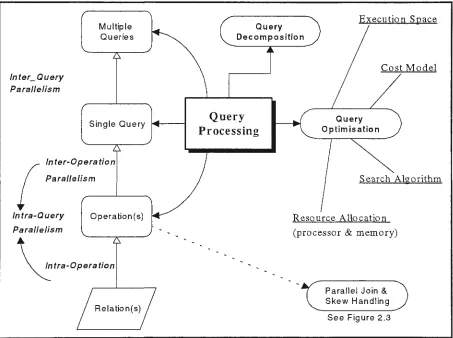
The parallelisation of a single query processing can be conducted at intra-operation level,
inter-operation level or a way that combines both. The intra-operation parallelism attempts
to, one at a time, distribute the load of each single relational operation involved in the query
onto all processors and thus perform the operation in parallel; by comparison, the inter-operation parallelism aims at parallelising the operations of the query and allocating them
to different processors for execution [DeWi92]. In addition, an important issue is how to schedule the multiple queries in processor allocation with each of the queries consisting of
multiple relational operations. The result of exploiting parallelism in this upper level is
inter-query parallelism.
2.1.4 Parallel Database System Architecture
Memory, disk and processor are the three most important resources in parallel database
systems and thus the way in which they interact critically affects parallel processing. Up to now, the architecture can be classified into four categories, shared nothing, shared everything, shared disk and the hybrid approach.
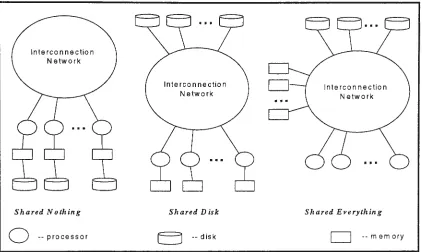
Figure 2.1 shows three common architectures of parallel systems. In a shared nothing
system (SN), none of the three resources is shared among the processing elements. Each processor has its own dedicated disk and private memory, and processors communicate through an interconnection network. Examples of this architecture are Volcano [Grae90], Gamma [DeWi90], Bubba [Bora90], EDS ESPRIT project: EDBS, TANDEM: NONSTOP SQL (Englert, 1989), Teradata DBC/1012 (Teradata 83, 85) [Page92]. In a shared everything system (SE), all disks and memory are public properties and shared by all
candidate processors. The stored data are equally accessible from all tightly-coupled processors. Examples of this architecture are DB2 or ORACLE ported on classical
directly access any disks, but each processor has its own private memory (data sharing).
Examples of this architecture are ORACLE on NCUBE, ORACLE on VAX CLUS1ER,
and IMSNS data sharing product.
Interconnection Network
Shared Nothing
0 --
processorInterconnection Network
Shared Disk
E=:J --
diskInterconnection Network
Shared Everythillg
D
--
memoryFigure 2.1: Shared Nothing, Shared Disk, and Shared Everything Architectures
A hybrid architecture can be a mixture of the above mentioned architecture types. One of
the Hybrid architectures used in the Super Database Computer (SDC) under development at
University of Tokyo is hybrid of tightly coupled multiprocessor (SE) and the
message-passing architecture (SN) [Kits90, Kits92]. The SDC consists of several processing modules connected to each other through the message-passing interconnection network. In
order to realise on the fly processing of the data stream from disk, each processing module
itself is designed as a tightly coupled multiprocessor system which has considerable
computational power. Another hybrid architecture is to have several SE systems as nodes of a SD system. The disks may be shared logically and distributed physically or they may be physically shared [Berg93, Rahm93, Hua90].
To summarise the fundamental features of the above architectures in parallel database
systems, SE provides the low communication overheads and less load imbalance effect, SD
Background and Relationship with Other Work
2.1.5 Parallel vs Distributed DBMS
A database management system (DBMS) is a software package developed to access,
manipulate, and manage the data in a database efficiently. A distributed database is a
collection of multiple, logically interrelated databases distributed over networks [Ozsu91].
A parallel computer is a distributed system consisting of a number of nodes connected by a
high speed network within a cabinet and each node comprises several components such as
processor, memory and disk. The difference between a loosely coupled parallel system and
a distributed system is conceptually small, but there are still a number of identifying
characteristics.
The communication time in two systems are different. In distributed systems, it may involve
a wide area network so that the time of data transmission becomes a dominant factor of the
total time. In comparison, parallel systems mainly use local area networks where the ratio
of data communication time to processing time is low.
There are only a small number of processors in a distributed system and the database is
fragmented or replicated over the sites. The heterogeneity of both the software and
hardware are obvious among the sites, e.g. one site may use ORACLE on UNIX and the
other site uses DB2 on VMS. In contrast, parallel system mainly consists of homogeneous
processors and there is one operating system.
There is always a host coordinating the parallel processing such as starting and terminating
processes in parallel systems. Therefore, the query always comes to the host first and then
data is partitioned and sent to different processors for processing. Results will be
consolidated at the host before they are presented to the user. In contrast, every site in
distributed systems is a stand alone system and hence the system reliability, availability and
transparency are ensured.
The difference between the two systems also lies in the software support and transparency.
Most of the parallel systems have their own parallel programming languages, so that they
can provide better processor utilisation and a complete network transparency.
Transparency is one of the utmost important issues in distributed systems since one of the
is not visible to the external users. There are several forms of transparency in distributed
systems such as network transparency, fragmentation transparency, replication transparency
and data transparency.
The current trend is that both parallel and distributed DBMS have started to become the
dominant database technology in data intensive applications. These two systems combine
and integrate together so that the parallel processing technique can be easily implemented in
any distributed systems to improve performance. Taking an example of a distributed system
of workstations3, where application programs are running on the workstations and database
systems are managed by the dedicated computers, i.e. the former introduces the concept of
application servers and the latter results in database servers. When the query comes in, a
certain number of processors in the system are activated to process it in parallel.
2.2 Pyramid of Parallel Relational Query Processing
Relational database processing on parallel systems can be carried out in several steps,
namely, data placement, data loading, data processing, and data consolidation (see Figure
2.2). At the bottom of the pyramid is the data placement where database is fragmented and
stored at each site possibly with replication. Both logical and physical design issues are
considered so that the index files are established, local and global directory information are
written for each site, and relations are fragmented and replicated over sites. This step may
be treated as off-line operation.
When the query comes in, the processing starts with the data loading. At this step, query is
examined and the relevant data are extracted through the directory files. The relevant
relations may be loaded into memory at each site if they are on secondary storage and thus
the main cost is due to data transmission. Data processing then takes place. Data is
partitioned over multiple processors and local processing starts with the relation fragments.
Here, the cost consists of local processing and data transmission among processors.
Finally, each worker processor will send its processing result to the host where the data will
be consolidated before presenting to the external user. The cost involves a simple unifying
Background and Relationship with Other Work
Database Implementation
This Thesis
Database Design
Data Consolidation
Data Processing
Data Loading
Incoming Query
Data Placement
Data Partitionin
Figure 2.2: Pyramid of Parallel Relational Query Processing
A confusion may arise between data partitioning and relation declustering. The aim of data
partitioning is to distribute tuples to multiple processors as evenly as possible so that linear
performance speed-up can be achieved. It is an on-line operation and happens after
receiving the query. The objective of relation declustering is to store the entire database over
different sites and thus to increase the resource limitation at the host and to upgrade the
performance by providing higher availability. This thesis only considers database
implementation and we shall concentrate on the data processing of the pyramid.
2.3 Data Partitioning and Data Skew
We review the related work on data partitioning in this Section and data processing in next
Section. In addition, we survey the recent parallel performance modelling work in Section
2.3.1 Data Partitioning Methods
There are three common data partitioning methods, namely Round-Robin, Range
Partitioning, and Hashing in parallel relational database and a detailed comparison of them
is provided in Chapter 4. Round-Robin partitions the tuples of one relation in a round robin
fashion; Range Partitioning distributes tuples to processors according to ranges (boundary
values) specified by users; Hashing transfers tuples to various processors by employing a
hash function that determines the tuple's destination [DeWi92a]. A mixture of the three
common methods of partitioning, Hybrid-Range partitioning, is proposed in [Ghan90]. The
algorithm sorts the relation, and divides the relation into fragments based on the processing
capability of the system and the resource requirements of the queries that access the relation
instead of the number of processors. The fragments are distributed in a round-robin fashion among the processors. The Hybrid-Range method is implemented on the Gamma database
machine [Ghan90].
A multiple dimensional partitioning strategy (MAGIC) is proposed in [Ghan94]. The
strategy declusters the relation according to several attributes to localise the execution of a
greater variety of queries with selection operation. The Grid file is employed and both range
and exact match selection can be dealt with. Another multiple dimensional strategy is
developed by Copeland [Cope88] where relations are partitioned equally based on balanced
heat (the access frequency of an object over some period of time) rather than size (the
number of bytes in the object).
2.3.2 Data Skew and Load Balancing
a. Data Skew
Traditionally, parallelisation of relational operations has been investigated using the
uniformity assumption [Chri83] which is originally employed to model the distribution of
values of a single attribute in its domain. Based on the assumption, the occurrence of each
attribute follows the uniform probability distribution. However, in most circumstances, it is highly likely that some attribute values appear more often than others, and the
non-unifonnity of the attribute values is the primary cause of data skew [Laks90]. In [Lync88] a

![Figure 4.13: Maximum Load Distribution when x is in [90000, 110000],](https://thumb-us.123doks.com/thumbv2/123dok_us/7925568.1315944/95.615.63.587.64.689/figure-maximum-load-distribution-when-x-is-in.webp)
![Figure 4.14: Minimum Load Distribution when xis in (90000, 110000],](https://thumb-us.123doks.com/thumbv2/123dok_us/7925568.1315944/96.615.80.552.260.575/figure-minimum-load-distribution-when-xis-in.webp)
![Figure 4.15: Minimum Load Distribution when k is in [ 16, 19],](https://thumb-us.123doks.com/thumbv2/123dok_us/7925568.1315944/97.615.81.536.66.349/figure-minimum-load-distribution-k.webp)