IN THIS
ISSUE
Sulfur Fertilization of an Annual-Range Soil During Years of Below-Normal Rainfall
William A. Williams, Cyrus M. McKeZZ and Jack N. Reppert Effects of Early Spring Burning on Yields of Native Vegetation
J. L. Launchbaugh Development and Use of the Esophageal Fisfula: A Review
George M. Van Dyne and D. T. ToreZZ A Comparison of Two Sweefclover Strains and Ladak Alfalfa Alone and
in Mixtures with Crested Wheafgrass for Range and Dryland Seeding F. B. Gomm A Comparative Study of Soils of Selected Creosofebush Sites in
Southern New Mexico... ____ _ ____ ____ __ ____ ___ _____ K. A. Valentine and J. J. Norris Emergence of Cheaigrass and Three Wheafgrasses from Four Seeding
Depths ____ ____ ___________._ ______________ ______ _____________ __________ ____ _.___ ________ .______ ________A. C. Hull, Jr. The Influence of Grazing on the Roofs and Rhizomes of Seacoast
Bluesfem _____________ ___ _______.__ _.______ __________ James E. Bowns, Jr. and Thadis Design Criteria for Rainfall Cafchmenf Areas for Watering Wildlife
and Livestock .______ _____ ___.___________ .___ _._________ ____ _.___________ ___. ___ ____ _______ _____ Joel E. Zonafion of Undersfory Vegetation Around a Juniper Tree
Joseph F. Technical Notes:
A Core Sampler for Excavating Grass Roofs
W. Box
Verner
Arnold
James E.Bowns, Jr. and Thadis W. Box Book Reviews: Careers in Conservation (D. G. Wilson); Approved Practices in Pasture Management (Kling L. Anderson) ; Pasture Economy and Meadow Cultivation (Jack R. Harlan); The Last Horizon (A. L. Hafen- richter); Fertilizer Technology and Usage (J. L. Launchbaugh); Land
and Wafer Use (R. R. Humphrey)___._ ________ _________________________________________~ ______ _ .__..____ _ Current Literature ____ ________-- _-_.._ ____. __ ______ __ _________ _______________ _____ ______.______________._..~ ______ ____ ____ ____
News and Notes __.-- . . . ___________._______ _ .___ _ ________ ____ ____ __ _______ ____ ______ _____ ____ ________________________ ____ ____ Wifh fhe Sections ____. __.__ ___-- _ __._ _ ___._____ _______ _______ _ _______ ____________________ ____ ____________ ____ ________ _____ _ _.__
Society Business: Program Seventeenth Annual Meeting ______ _ ._____________ _______________
Cover Photo- Watering Out
1
5
7
19
23
32
36
39
41
43
45 49 52 57 60
Journal of
Volume 17, Number 1 January, 1964RANGE MANAGEMENT
Sulfur Fertilization of an Annual-Range Soil
During Years of Below-Normal Rainf all1
WILLIAM A. WILLIAMS, CYRUS M. McKELL, and JACK N. REPPERT
Associate Professor of Agronomy and Associate Agron- omist, University of California, Davis and Riverside, and Range Conservationist, Pacific Southwest Forest and Range Experiment Station, Forest Service, USDA, Susanville, California.
Sulfur is a major limiting fac-
tor in forage production on many
range soils in California (Martin,
1958). Leaching loss of available
sulfur in the form of sulfate
from slightly acid, coarse tex-
tured soils has been recognized
as a problem in fertility manage-
ment. Gypsum (calcium sulfate)
is a source of sulfur readily
available to plants, but is highly
susceptible to leaching
loss
(McKell and Williams, 1960).
Elemental sulfur is more slowly
available since it must be oxi-
dized, usually microbially, to sul-
fate before becoming usable by
plants. Elemental sulfur also is
less susceptible to leaching.
A series of lysimeter studies
was started at the San Joaquin
Experimental range in the Sierra
Nevada foothills 25 miles north
of Fresno, California, in 1957. In
the first year of study, various
rates of gypsum labeled with sul-
fur-35 were applied, and the
subsequent distribution of na-
tural and applied sulfur was de-
termined in the plants, soil, air,
1Contribution of the Department of Agronomy, University of California, Davis and Riverside, with the co- operation of the Pacific Southwest Forest and Range Experiment Sta- tion, Forest Service, USDA.
rain and percolate during a sea-
son of above-normal rainfall.
Percolating water carried 77 per-
cent of the applied sulfur out
of the root zone by the end of
the season (McKell and Wil-
liams, 1960)) most of it being lost
before rising temperatures per-
mitted appreciable growth of the
seeded clover (McKell and Wil-
son, 1963).
Lobb and Bennetts (1957) have
recommended the use of elemen-
tal sulfur in preference to gyp-
sum in sulfur-deficient soils of
New Zealand in which excessive
leaching occurs. Hence, an ex-
periment was initiated to com-
pare elemental sulfur and gyp-
sum as sources of sulfur on an
annual-range soil in an environ-
ment typical of much of Califor-
nia’s foothill range country. Sul-
fur-35 was used to distinguish
the applied sulfur from naturally
occurring sulfur.
Methods
The lysimeters, soil, and gen-
eral procedures used in this
study were the same as those
described in detail for the first
experiment (McKell and Wil-
liams, 1960)
.In brief, the experi-
ment was conducted on Vista
sandy loam soil in lysimeters six
1
feet in diameter and two feet
deep. Major soil characteristics
were pH 6.2, cation exchange
capacity 4.16 me./lOOg., and or-
ganic matter 0.6 percent. At the
conclusion of the first experi-
ment the lysimeters were di-
vided into three stratified groups
based on their residual sulfur
content, with each replication of
the treatments assigned to a
group of lysimeters and the
treatments randomly assigned
within the replicate. The treat-
ments comprised control, finely
ground elemental sulfur applied
at the rate of 60 pounds per acre
and gypsum at 300 pounds per
acre to obtain equivalent sulfur2.
The treatments were applied,
and the lysimeters seeded to rose
clover (Trifolium hirtum All.),
in October 1958. Yield, percolate,
and precipitation were sampled
over a three-year period.
Results Clover Response
During the series of relatively
dry years in which this study
was conducted, clover produc-
tion was influenced greatly by
the amount and distribution of
rainfall. No yield response to sul-
fur or gypsum application was
detectable in 1959 or 1961 when
rainfall was very limited (10.42
and 12.36 inches in the respective
seasons, Figure 1). Dry-matter
production was 1,000 pounds per
acre or less regardless of treat-
2
WILLIAMS, McKELL, AND REPPERT
Table 1. Yield and sulfur content of rose clover following application of elemental sulfur and gypsum in autumn 1958.
Treatment 1959 1960 1961
Control Elemental S Gypsum Control Elemental S Gypsum Control Elemental S Gypsum
---_ (Pounds per Acre) - - - -
340 3,120’ 620
410 4,490 990
580 4,240 1,040
---_ (Total sulfur percent) - - - -
0.09 0.05” 0.06”
.lO .lO .ll
.26* .lO .ll
- - (Sulfur from fertilizer percent) - -
0 0 0
40 51 26
55” 56 26
*Value significantly different (five percent level) from other treatment means in the same year (zero values were excluded from the analysis of variance).
ment (Table 1). In 1960, the sec-
ond year after application of the
fertilizer, both the elemental sul-
fur and gypsum increased yield
by approximately 1,000 pounds
per acre over the control yield of
3,100 pounds per acre. Substan-
tial rain the previous September,
along with adequate
rain in
March and April 1960 (seasonal
total 15.54 inches, Figure
l),
made moisture conditions more
favorable than in 1959 and 1961,
thus permitting the expression of
a sulfur response.
During each year of the ex-
periment, the sulfur percentage
in the rose clover at harvest time
(bloom stage) was influenced by
treatment.
In 1959 the clover
grown on the gypsum-treated ly-
simeters contained almost three
times as much sulfur as either
the control or elemental sulfur
treatments (Table 1). In the re-
spective treatments the propor-
tion of total sulfur derived from
gypsum was significantly greater
than the sulfur obtained from
the elemental sulfur applied. In
1960 and 1961 the sulfur per-
centage in the clover produced
on lysimeters treated either with
gypsum or elemental sulfur was
nearly double the sulfur percent-
age in the controls. The propor-
tion of sulfur in the plants from
the two sources was not signifi-
cantly differ en
t ,but declined
from a range of 48 to 56 percent
in 1960 to 24 to 26 percent in 1961.
Loss of Sulfur by Percolation
Percolation
of rain water
through
the soil columns
amounted
to 2.5, 2.4, and 1.7
inches in the first, second, and
third seasons, respectively. The
only major loss of sulfur during
this period occurred in the first
year when 16.0 pounds per acre
appeared in the percolate of the
gypsum treatment (Figure 2). Of
this loss 65 percent came from the
gypsum, but this amounted to
only 17 percent of the total of 61.1
pounds of sulfur per acre applied
in the gypsum. The loss from the
elemental sulfur treatment due
to leaching
in the first year
amounted to only 3.9 pounds of
sulfur per acre, of which less
than one pound was from the ap-
plied total of 59.7 pounds per
acre. The loss of sulfur from the
controls amounted to 3.5 pounds
per acre for the same interval of
time.
Sulfur Balance Sheet
A sulfur balance sheet was
constructed for each treatment
using the data collected for addi-
tions to and losses from the soil
columns (Table 2). Additions
considered were from the fer-
tilizer treatments and from rain.
Previously it has been shown
that additions of sulfur from air
contact and seed are negligible
(McKell and Williams,
1960).
Losses were from clover
re-
moved and deep percolation.
Total sulfur addition
from
rainfall over the three-year pe-
riod was 8.7 pounds per acre.
Sulfur removal in the clover for-
age amounted to: control 2.3, ele-
mental sulfur treatment 5.1, and
gypsum treatment 6.0 pounds per
acre. Sulfur lost in percolating
water amounted to: control 4.7,
elemental sulfur treatment 9.5,
and gypsum
treatment
22.0
pounds per acre. It was calcu-
lated by difference that sulfur
was retained by the soil in the
amount of: control 1.8, elemental
sulfur treatment 53.3, and gyp-
sum 40.9 pounds per acre.
The absorbed sulfate in sam-
ples from the soil columns was
extracted with sodium acetate at
pH 4.8 at the beginning and end
of the experiment. The sulfate-
sulfur content of the soil de-
clined in all treatments in the
following amounts: control 28,
10.42 IN.
15.54 IN.
12.36
IN.
'ASONOJFMAMJ
II958
1
1959 19601
1961)
SULFUR FERTILIZATION
SULFUR SOURCE
Cl
NATURAL
n
lBzi
APPLIED-
n
59 60 61
CONlROl
m
60
WM. S
EEL
60
GYPSUM
FIGURE 2. Amount and source of sulfur in percolating water from soil columns treatedwith elemental sulfur and gypsum.
elemental sulfur 17, and gypsum
18 pounds per acre (Table 3).
The sum of the respective values
and the calculated sulfur-reten-
tion value for the treatment is
the amount of sulfur “apparently
immobilized” in the soil. These
amounts are control
30, ele-
mental sulfur 71, and gypsum 58
pounds per acre.
Discussion
During the first growing sea-
son (1958-59)) a drier one than
normal, some sulfur from the ele-
mental sulfur application was
taken up by the clover plants.
However, the amount was not
sufficient to increase their total
sulfur content relative to the
controls. Neither did appreciable
amounts of sulfate ion percolate
through the soil columns. The en-
vironment
(mainly
low soil
moisture) was not conducive to
microbiological oxidation of ele-
mental sulfur to sulfate, the
form most readily taken up by
plants (Starkey, 1950). However,
clover took up a sizeable amount
of sulfate from the gypsum, as
indicated both by higher total
sulfur content and by the sub-
stantial fraction of labeled sul-
fur present. Also an appreciable
amount of labeled sulfur ap-
peared in the percolate.
Al-
though the initial response to
elemental sulfur was markedly
slower than to gypsum, the mois-
ture limitation was so extreme
that no yield response was ob-
tained from either treatment in
1959.
At another location with more
favorable precipitation Walker
and Williams (1963) observed
that elemental sulfur caused in-
creases in forage yield equal to
that produced by gypsum on an-
nual-type range during the sea-
son the application was made.
Presumably moisture conditions
favorable to microbiological oxi-
3
dation of elemental sulfur are
concomitant with moisture con-
ditions favorable to vigorous an-
nual-range plant growth and vice
versa.
In the second season (1959-60)
the rainfall total, although again
subnormal, was more favorable,
especially as regards distribu-
tion. Clover production improved
greatly. Significant and approxi-
mately equal yield responses
were obtained
from the ele-
mental sulfur and gypsum treat-
ments. Thus the sulfur not lost
nor removed in plant tissue in
the first season was effective in
the second season. Uptake of sul-
fur, both labeled and natural,
was about the same where either
source of sulfur was used, but
much enhanced relative to the
control. Walker (1958) also ob-
served a carry-over effect of gyp-
sum after a dry year, although
with substantially smaller appli-
cations (rates equivalent to five
and 15 pounds of sulfur per
acre).
Unfortunately
in the third
growing season (1960-61) rain-
fall shortage again imposed a
Table 2. Sulfur balance sheet for Vista sandy loam freafed wiih elemental sulfur and gypsum.
Sulfur disposition Elemental
Source Control Sulfur Gypsum
--- (Pounds per acre) - - - Sulfur added from:
Fertilizer 1958 0 59.7 61.1
Rain 1958-59 3.2 3.2 3.2
1959-60 4.1 4.1 4.1
1960-61 1.4 1.4 1.4
Total sulfur added 8.7 68.4 69.8
Sulfur removed in:
Clover 1959 0.3 0.4 1.5
1960 1.6 4.2 4.3
1961 0.3 1.0 1.1
Clover total 2.2 5.6 6.9
Percolate 1959 3.5 3.9 16.0
1960 .8 1.3 1.6
1961 .4 4.3 4.4
Percolate total 4.7 9.5 22.0
Total sulfur removed 6.9 15.1 28.9
Calculated sulfur retention by soil: ~~
4
WILLIAMS, McKELL, AND REPPERT
Table 3. Extractable sulfur confenf
of Vista sandy loam ireafed withelemental sulfur and gypsum, and apparent immobilizafion of sulfur.
Extractable sulfur Calculated retention Apparent immobilization Treatment 1958 1961 Decrease (from balance sheet) (decrease -I- retention) --- (Pounds per acre) - - - -
Control 47 19 28 1.8 30
Elemental S 41 23 18 53.3 71
Gypsum 41 24 17 40.9 58
very low ceiling on clover pro-
duction, but sulfur uptake con-
tinued at an enhanced level from
both sulfur sources, indicating
that the applied materials were
at least somewhat available to
the plants at that time.
The approximate equivalence
of uptake of sulfur from the two
sources in the second and third
seasons after application is at
variance with the observations of
Jordan and Baker (1959) in a
field experiment
with alfalfa.
Their results showed
an in-
creased uptake of sulfur from
gypsum relative to elemental sul-
fur persisting over a three-year
period after application.
The
mean uptake of fertilizer-sulfur
as a percent of total plant uptake
was 15 percent from gypsum and
4 percent from elemental sulfur.
The peak uptake from both ma-
terials occurred in the second
year of their experiment.
The inference
that can be
made concerning the fate of the
applied sulfur remaining in the
soil at the conclusion of the pres-
ent experiment is worthy of note.
The sulfur balance sheet calcu-
lations show that a very high
proportion of the applied ele-
mental sulfur and a somewhat
lesser, yet substantial, amount of
gypsum-sulfur was retained by
the soil at the end of the three-
year period. Extraction by so-
dium acetate at pH 4.8 (Ens-
minger, 1954 and 1958; Kamprath
et al., 1956 and 1957; and Bards-
ley and Jordan, 1957) demon-
strated that the adsorbed sulfur
content of the soil columns was
low, even lower than at the be-
ginning of the experiment. It is
hypothesized,
therefore, that
either immobilization through
biological activities, reduction to
metallic sulfides, or reduction to
hydrogen sulfide occurred. The
two reduction processes seem to
be unlikely possibilities in view
of the limited rainfall of the pe-
riod, the well-drained character
of the soil profile, and the con-
sequent low probability of the
existence of reducing conditions
during the experiment.
Immobilization appears to be
a more likely possibility. Walker
(1957) has pointed out that sul-
fur may be immobilized through
the activities of microorganisms
in a manner similar to the im-
mobilization
of nitrogen and
phosphorus. Some sulfur might
have been immobilized
during
decomposition of root tissue re-
maining in the soil from the 1957
experiment and from the size-
able clover crop produced in the
second season of the experiment
reported here. The supposition
that substantial immobilization
occurred in the second season is
supported by leaching evidence
of the gypsum treatment. Very
little of the applied sulfate ap-
peared in the percolate in the
second season, although about as
much percolation occurred in the
season as in the first, and about
80 percent of the applied gypsum
remained in the soil at the be-
ginning of the season.
Since (1) only small amounts
of sulfur were removed in the
clover, (2) relatively
small
amounts occurred in the perco-
late, and (3) adsorbed sulfate
sulfur in the soil declined in the
course of the experiment, it was
deduced that substantial immo-
bilization occurred in all treat-
ments. The apparent immobiliza-
tion was greatest for the ele-
mental sulfur treatment, inter-
mediate for the gypsum treat-
ment, and least for the control.
It is evident that sulfur immo-
bilization is a factor requiring
further study, especially as it is
influenced by rate and frequen-
cy of application of various sul-
fur sources under various cli-
matic and soil conditions.
Applicafion of Results
Under excessively
deficient
moisture conditions response of
clover to sulfur fertilization on
a sulfur deficient soil may be nil.
Even so, some sulfate from gyp-
sum may be lost through deep
percolation, as demonstrated by
the results in 1959 in this experi-
ment. However, in contrast to
the great loss of gypsum in a
high rainfall season shown pre-
viously (McKell and Williams,
1960,) loss in percolating water
in a series of dry years was low.
Percolation loss from elemental
sulfur was inconsequential.
Sulfur carried over to the sec-
ond year either as the elemental
form or as sulfate may be util-
ized in the event of more favor-
able moisture conditions for the
enhancement of forage produc-
tion as was illustrated by the
1960 results.
No significant difference
in
yield response to the two forms
of sulfur was detected in this ex-
periment.
LITERATURE CITED
BARDSLEY, C. E., JR. AND H. V. JORDAN. 1957. Sulfur availability in seven southeastern soils as measured by growth and composition of white clover. Agron. Jour. 49: 310-312.
ENSMINGER, L. E. 1954. Some factors
affecting the adsorption of sulfate by Alabama soils. Soil Sci. Sot. Amer. Proc. 18: 259-264.
ENSMINGER, L. E. 1958. Sulfur in re- lation to soil fertility. Ala. Agr. Exp. Sta. Bull. 312.
SULFUR FERTILIZATION 5
KAMPRATH, E. J., W. L. NELSON, AND J. W. FITTS. 1956. The effect of pH, sulfate and phosphate concen- trations on the adsorption of sul- fate by soils. Soil Sci. Sot. Amer. Proc. 20: 463-466.
KAMPRATH, E. J., W. L. NELSON AND J. W. FITTS. 1957. Sulfur removed from soils by field crops. Agron. Jour. 49: 289-293.
LOBB, W. R. AND R. L. BENNETTS. 1957. Improvement of tussock grassland in Canterbury. New Zeal. Jour. Agr. 96: 537-549.
MARTIN, W. E. 1958. Sulfur defici- ency widespread. Calif. Agric. 12
(11) : 10-12.
MCKELL, C. M. AND A. M. WILSON. 1963. Effects of temperature on S35 uptake and translocation by rose and subterranean clovers. Agron. Jour. 55: 134-137.
MCKELL, C. M. AND W. A. WILLIAMS. 1960. A lysimeter study of sulfur fertilization of an annual-range soil. Jour. Range Mangt. 13: 113- 117.
STARKEY, R. L. 1950. Relations of microorganisms to transformations
Part of a lightly grazed native pasture located on the Fort Hays Branch of the Kansas Agricul-
tural Experiment Station at
Hays, Kansas, was burned by
wildfire March 18, 1959. The
heavy accumulation of dormant
vegetation as well as the soil
surface were extremely dry,
and the fire consumed the plant material to ground level. A ra- vine running at right angles to
the wind direction caused the
fire to divide into two fronts, re- sulting in an unburned area be- tween two burned strips on up- land with two to three percent
slope. The arrangement of un-
burned areas in relation to the burned afforded an opportunity to make a replicated study of the effects of the fire on herbage yields on a clay upland range
site supporting a mixture of
shortgrasses, buffalograss (Buch-
Zoe dactyloides [Nutt.] Engelm.)
and blue grama (Bouteloua gra-
cilis [H.B.K.] Lag. ex Steud.) with frequent stands of western
wheatgrass (Agropyron smithii
Rydb.) in the shortgrass matrix. The site is part of the shortgrass
Contribution No. 182, Fort Hays Branch, Kansas Agricultural Experi-
ment Station, Hays, Kansas.
of sulfur in soils. Soil Sci. 70: 55- 65.
WALKER, T. W. 1957. The sulfur cycle in grassland soils. Jour. Brit. Grassl. Sot. 12: 10-18.
WALKER, T. W. AND A. F. R. ADAMS. 1958. Competition for sulfur in a grass-clover association. Plant and Soil 9: 353-366.
WALKER, C. F. AND W. A. WILLIAMS. 1963. Responses of annual-type range vegetation to sulfur fertil- ization. Jour. Range Mangt. 16: 64- 69.
Effects of Early Spring Burning
on Yields of Native Vegetation’
J. L. LAUNCHBAUGH
Pasture Management Specialist, Fort Hays Branch, Kansas Agricultural Experiment Station, Hays, Kansas.
habitat described by Albertson
(1937). The physical character- istics of the area and vegetative
composition under light grazing
are discussed in a previous re-
port (Launchbaugh, 1957).
Burned and unburned vegeta- tion were protected from grazing
and yield measurements were
made in late summer each year during 1959, 1960, and 1961 us-
ing ten 3.1 square-foot, clipped
BUFFALOGRASS-BLUE GRAMA MIXTURE
1960 1961-
BUFFALOGRASS WESTERN AND BLUE GRAMA WHEATGRASS
subsamples per treatment in
each of the two grass mixtures. The central unburned strip and nearby burned area made up one
replication. The nearest un-
burned margin and adjacent
burned area were considered an-
other replication. Yields were
measured separately in the
shortgrass alone and in the west-
ern wheatgrass-shortgrass mix-
ture. Weeds were separated from
the subsample clippings and
composition estimates were made
of the remaining plot material
into categories of buffalograss
and blue grama combined, west- ern wheatgrass, and old growth.
The harvested material was
oven-dried at 170 O F. for 72 hours
prior to being weighed. Plant
WESTERN WHEATGRASS-SHORTGRASS MIXTURE
WEEDS
EJ
OLO GROWTHFIGURE 1. Vegetation yields in two native grass mixtures on a clay upland range site dur- ing three growing seasons following a March 18, 1959, wildfire. U-unburned;
SULFUR FERTILIZATION 5
KAMPRATH, E. J., W. L. NELSON, AND J. W. FITTS. 1956. The effect of pH, sulfate and phosphate concen- trations on the adsorption of sul- fate by soils. Soil Sci. Sot. Amer. Proc. 20: 463-466.
KAMPRATH, E. J., W. L. NELSON AND J. W. FITTS. 1957. Sulfur removed from soils by field crops. Agron. Jour. 49: 289-293.
LOBB, W. R. AND R. L. BENNETTS. 1957. Improvement of tussock grassland in Canterbury. New Zeal. Jour. Agr. 96: 537-549.
MARTIN, W. E. 1958. Sulfur defici- ency widespread. Calif. Agric. 12
(11) : 10-12.
MCKELL, C. M. AND A. M. WILSON. 1963. Effects of temperature on S35 uptake and translocation by rose and subterranean clovers. Agron. Jour. 55: 134-137.
MCKELL, C. M. AND W. A. WILLIAMS. 1960. A lysimeter study of sulfur fertilization of an annual-range soil. Jour. Range Mangt. 13: 113- 117.
STARKEY, R. L. 1950. Relations of microorganisms to transformations
Part of a lightly grazed native pasture located on the Fort Hays Branch of the Kansas Agricul-
tural Experiment Station at
Hays, Kansas, was burned by
wildfire March 18, 1959. The
heavy accumulation of dormant
vegetation as well as the soil
surface were extremely dry,
and the fire consumed the plant material to ground level. A ra- vine running at right angles to
the wind direction caused the
fire to divide into two fronts, re- sulting in an unburned area be- tween two burned strips on up- land with two to three percent
slope. The arrangement of un-
burned areas in relation to the burned afforded an opportunity to make a replicated study of the effects of the fire on herbage yields on a clay upland range
site supporting a mixture of
shortgrasses, buffalograss (Buch-
Zoe dactyloides [Nutt.] Engelm.)
and blue grama (Bouteloua gra-
cilis [H.B.K.] Lag. ex Steud.) with frequent stands of western
wheatgrass (Agropyron smithii
Rydb.) in the shortgrass matrix. The site is part of the shortgrass
Contribution No. 182, Fort Hays Branch, Kansas Agricultural Experi-
ment Station, Hays, Kansas.
of sulfur in soils. Soil Sci. 70: 55- 65.
WALKER, T. W. 1957. The sulfur cycle in grassland soils. Jour. Brit. Grassl. Sot. 12: 10-18.
WALKER, T. W. AND A. F. R. ADAMS. 1958. Competition for sulfur in a grass-clover association. Plant and Soil 9: 353-366.
WALKER, C. F. AND W. A. WILLIAMS. 1963. Responses of annual-type range vegetation to sulfur fertil- ization. Jour. Range Mangt. 16: 64- 69.
Effects of Early Spring Burning
on Yields of Native Vegetation’
J. L. LAUNCHBAUGH
Pasture Management Specialist, Fort Hays Branch, Kansas Agricultural Experiment Station, Hays, Kansas.
habitat described by Albertson
(1937). The physical character- istics of the area and vegetative
composition under light grazing
are discussed in a previous re-
port (Launchbaugh, 1957).
Burned and unburned vegeta- tion were protected from grazing
and yield measurements were
made in late summer each year during 1959, 1960, and 1961 us-
ing ten 3.1 square-foot, clipped
BUFFALOGRASS-BLUE GRAMA MIXTURE
1960 1961-
BUFFALOGRASS WESTERN AND BLUE GRAMA WHEATGRASS
subsamples per treatment in
each of the two grass mixtures. The central unburned strip and nearby burned area made up one
replication. The nearest un-
burned margin and adjacent
burned area were considered an-
other replication. Yields were
measured separately in the
shortgrass alone and in the west-
ern wheatgrass-shortgrass mix-
ture. Weeds were separated from
the subsample clippings and
composition estimates were made
of the remaining plot material
into categories of buffalograss
and blue grama combined, west- ern wheatgrass, and old growth.
The harvested material was
oven-dried at 170 O F. for 72 hours
prior to being weighed. Plant
WESTERN WHEATGRASS-SHORTGRASS MIXTURE
WEEDS
EJ
OLO GROWTHFIGURE 1. Vegetation yields in two native grass mixtures on a clay upland range site dur- ing three growing seasons following a March 18, 1959, wildfire. U-unburned;
6
LAUNCHBAUGH
Table 1. Average heights of important plant species af fhe end of the first growing season on early-spring burned and unburned plots in shorf- grass and western wheatgrass-shorfgrass mixtures combined.
Treatment Species
Western wheatgrass Blue grama
Buffalograss Western ragweed Horseweed -
Burned 3-18-59 Unburned _---- (Inches) - - - - -
11.0 17.0
6.7 11.9
4.1 6.9
6.1 9.7
10.3 14.2
heights and number of weeds
were recorded with the first-sea-
son sampling. Subsample plots
were relocated each year.
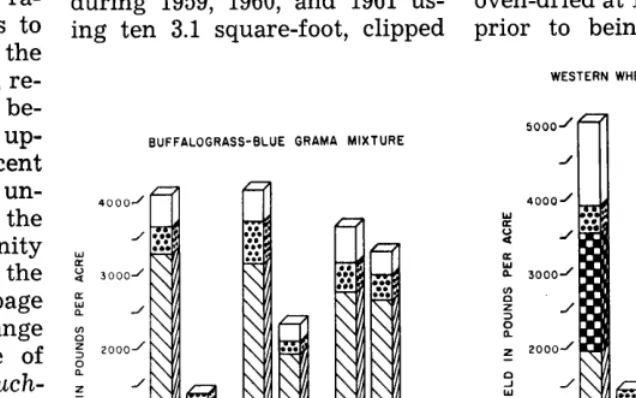
Figure 1 shows mean yields
from burned and unburned plots.
The 1959 grass yields in the
buffalograss-blue grama mixture
were reduced 65 percent by the
fire. First-season yields of west-
ern wheatgrass and shortgrass
were reduced 82 and 48 percent,
respectively. Second-season grass
yields were 39 percent below the
check plot yields in the short-
grass alone and 73 and 19 percent
lower respectively for western
wheatgrass and shortgrass
in
combination. Third-season herb-
age production
on the previ-
ously burned areas was not sig-
nificantly different from that on
unburned sites.
Weeds consisted primarily of
western
ragweed
(Ambrosia pdostachyaDC.) on both the
burned and unburned areas, and
yields were relatively low each
year regardless
of treatment.
Lowest yields, however, were on
the burned areas. First-season
weed numbers averaged 9.9 west-
ern ragweed and 0.7 horseweed
(Conyxa canadensis
[L.] Cron.)
per square foot in the burned
plots compared with 8.5 western
ragweed and 1.9 horseweed per
square foot in the unburned
plots. The differences in weed
numbers between treatments
were not significant. Old growth
increased annually on the burned
areas, but did not equal amounts
present on the unburned areas
by the end of the third growing
season.
The reductions in vegetation
yields during the first and second
growing seasons following the
fire were significant at the one
percent level and apparently
were caused by two main effects
of burning. First, there were ob-
viously fewer first-year grass
tillers compared with numbers
of dead remnants,
indicating
partial killing of plants. Second,
plant heights recorded at the
close of the first growing season
(Table 1) indicated stunting of
growth in the burned
areas,
which might be attributed to
lower vigor of the perennials
brought about directly by fire
damage-or to lower amounts of
moisture entering the soil in the
burned areas.
Previous studies by Hopkins
et
al.(1948) on the effects of
late fall and early spring burn-
ing on a similar upland short-
grass site showed that where
litter accumulations were heavy
at the time of burning, ground
cover of living vegetation and
subsequent yields were greatly
reduced. Also western ragweed
plant numbers and yields were
increased considerably by early
spring burning. Such weed in-
creases were not observed in the
present study.
That horseweed,
an annual,
was reduced in stature on the
burned areas suggests that soil
moisture conditions were not so
favorable in the burned as in the
unburned plots. Several studies
have shown that a cover of vege-
tation both living and dead en-
hanced moisture intake in grass-
land soils, and removal of the
cover reduced soil moisture in-
filtration (Duley and Domingo,
1949; Hopkins, 1954; and Rauzi,
1960). Thus when yields of pe-
rennial vegetation are reduced
by burning, it appears that re-
covery is brought about jointly
by revegetation
to reclaim
ground cover losses and accumu-
lation of a protective cover to
increase soil moisture intake.
LITERATURE CITED ALBERTSON, F. W. 1937. Ecology of
mixed prairie in west-central Kansas. Ecol. Monog. 7: 481-547. DTJLEY, F. L. AND C. E. DOMINGO.
1949. Effect of grass on intake of water. Nebr. Agr. Exp. Sta. Res. Bul. 159.
HOPKINS, HAROLD H. 1954. Effects of mulch upon certain factors of the grassland environment. Jour. Range Mangt. 7: 255-258.
HOPKINS, HAROLD, F. W. ALBERTSON, AND ANDREW RIEGEL. 1948. Some effects of burning upon a prairie in west-central Kansas. Trans. Kan. Acad. Sci. 51: 131-141. LAUNCHBAUGH, J. L. 1957. The effect
of stocking rate on cattle gains and on native shortgrass vegeta- tion in west-central Kansas. Kan. Agr. Exp. Sta. Bul. 394.
Development and Use of the Esophageal Fistula:
A Review
GEORGE M. VAN DYNE AND D. T. TORELLl Research Nutritionist and Specialist, Animal Husbandry Department, University of California, Davis, California
One of the foremost problems in range and pasture nutrition is making an accurate assessment
of the chemical and botanical
composition of the diet of graz-
ing livestock. In recent years the esophageal fistula has been used to obtain samples of the forage
grazed by ruminants. These
studies have been conducted
under a wide variety of condi- tions in at least six countries on four continents.
The purpose of this article
is
to review the development and
use of the esophageal fistula and to discuss present problems and practices. The medical literature is replete with references to hu- man and animal esophageal fis-
tulas due to congenital abnor-
malities, disease, and accidental
injury. However, this article is
restricted to experimental stud-
ies with domestic animals and
reviews the literature through
mid-1963.
Historical Development
The esophageal fistula tech-
nique is not new. It was reported
early by the famous French
physiologist, Claude Bernard
(1855). In fact, it was used by
his teacher, Magendie, several
years earlier in the horse (Ma- gendie and Ryer, 1847). Pavlov’s classic studies involving esopha-
geal-fistulated dogs were initi-
ated in 1889 (Pavlov, 1897).
Some of his dogs lived for many years on food fed directly into the stomach. However, it is only in the last decade that the tech-
1The following are acknowledged for their review or suggestions: Drs. G. P. Lojgreen, J. H. Meyer, and W. C. Weir (California), C. W. Cook (Utah), and V. R. Bohman (Nevada).
nique has been used widely in
ruminants. A review of some
early uses of the esophageal fis- tula in various species is out- lined in Table 1. Most studies
have been physiological or psy-
chological rather than nutri-
tional in nature.
Surgical Techniques
At best, surgery of the esopha- gus is difficult; this accounts for numerous losses and for skepti-
cism regarding the technique.
Saint (1929) pointed out the fol-
lowing as major reasons why
surgery of the esophagus is dif- ficult: (1) the esophagus lacks a serosa, (2) in order to expose the esophagus in surgery it is neces- sary to open the mediastinal structures and fascial planes, (3) there is a very poor blood supply to the esophagus, (4) the esopha-
gus cannot be restricted from
movement, (5) there is an ab-
sence of the greater omentum.
Further details concerning
esophageal surgery are given by Saint and Mann (1929).
Early physiologists often con-
sidered it necessary to accom-
plish fistulation in a two-step
operation because of these diffi- culties (Markowitz, 1954). Drag-
stedt and Mullenix (1931) re-
ported over 50 percent mortality in making a one-stage fistula of the esophagus in dogs. In the two-stage operation the esopha-
gus is first exteriorized in the
neck; later, the esophagus may be sectioned without danger of
mediastinitis. A two-stage pro-
cedure recently has been used in ruminants in establishing saliva
collection cannulae (Whitmore
et al., 1963 unpublished manu-
script).
Descriptions of surgical tech-
niques for large animals have been published by Tore11 (1954)) Cook et al. (1958)) Hamilton et
al. (1960)) McManus (1960)2,
McManus et al. (1962b), Chap-
man and Hamilton (1962) and
Cook et al. (1963). The following
is a brief description of an un-
2McManus, W. R. 1960. The develop- ment and use of oesophageal jis- tulae in sheep. Ph.D. Diss., U. New South Wales (Australia) 338 pp. Table 1. Early uses of the esophageal fisfula in domestic animals.
Worker (s) Year SDecies
Bernard 1855
Colin 1856
Lobasov 1896
Pavlov 1897
Best and Cohnheim 1910
Nikovlina 1919
Karpov 1919
Collip 1922
Haberland 1926
Komarov 1926
Dragstedt and Mullenix 1931
Wilder and Stokes 1931
Bellows and Van Wagenen 1938
Heyenga 1938
Adolph 1939
Bellows 1939
Goldman 1939
Wise et al. 1940
Janowitz and Grossman 1949
Tore11 1954
Mook 1962
8 VAN DYNE AND TORELL
FIGURE 1. An animal positioned and restrained for esophageal fistulation. The stipuled area is clipped and disinfected. A steel rod with a hard rubber ball on the end
is passed down the esophagus and used to position the esophsgus in surgx-y.
published technique used suc-
cessfully in both cattle and
sheep3. The animal is adjusted to pelleted feed or green herbage for several weeks prior to sur- gery, but feed and water are withheld for 24 hours immediate- ly prior to surgery. After the ani- mal is anesthesized “to effect” by means of a general anesthetic, it is placed in a right lateral re- cumbancy and the rear legs are
extended and tied (Figure 1).
The forelegs are doubled back
under the body and tied by
means of a butterfly (or “tom-
fool”) knot. The surgical area is
disinfected and clipped. The
head is slightly elevated and
held by means of a halter rope. A steel rod with a hard rubber ball on the end is passed down the esophagus and manipulated to aid in making the incision and blunt dissection through the tis- sues (Figure 1). After the rod is
passed, the supporting block
(Figure 1) is moved back under the neck so that fluids will drain from the nose and mouth. The fistula should be located as near as possible to the ventral midline of the neck and about midway between the jaw and the brisket. After removal of an oval-shaped piece of skin (the size of the fistula), the tissues and muscles are separated and the esophagus is exposed. A short longitudinal incision is made in the esophagus and the sides of the incision are
sutured. Sutures pass through
the esophagus, submucosa, and
inner layers of the skin. Incision
3A detailed outline of surgical pro-
cedure and care of animals is avail- able on request.
and suturing is continued until the entire perimeter of the fis- tula is sutured. The cannula or plug is then inserted and the area disinfected and treated with fly repellant. The animal is kept off coarse feed and water for 24
hours postoperative, or is re-
turned to grass. Antibiotics are
given until the incision is healed. The sutures may be removed in seven to ten days. An experi- enced surgeon and two assistants
can complete a fistula
in a steer
in about one hour.
McManus (1962b) suggested
putting animals on green grass as soon as possible after surgery. Cook et al. (1958) recommended
continuation of pellet feeding.
However, care must be taken to prevent fistulated animals being
fed pellets from consuming
straw bedding or wood shavings which may become lodged and
compacted in the esophagus
(Goldman, 1939; Van Dyne,
1960). Tribe and Peel (1963)
allow lambs to resume grazing
and nursing immediately after
surgery.
FisNfulafion Success
Success with large animals
varies widely. In early develop- mental stages losses were great. Tore11 (1954) first reported suc- cess in only one out of four sheep. Later, he established an esophageal fistula in a heifer but she died of a digestive disorder before use. Cook et al. (1958) re-
ported on fistulation of four
sheep, all of which survived sur- gery. However, one lost its can- nula due to necrosis within two
months after installation. Four
other sheep were fistulated but
did not survive for various rea-
sons. Lesperance (1959) 4 fistu-
lated four steers, but none of
these animals survived a year
and some survived only a few weeks. McManus (1962a, 1962b) reported on esophageal fistula- tion of 35 sheep; he found 14 per- cent suitable for field studies. Some sheep were suitable for
pen studies although not for
field use. More than half of the fistulated sheep were not suit-
able for either pen or field
studies. Nelson (1962) estab-
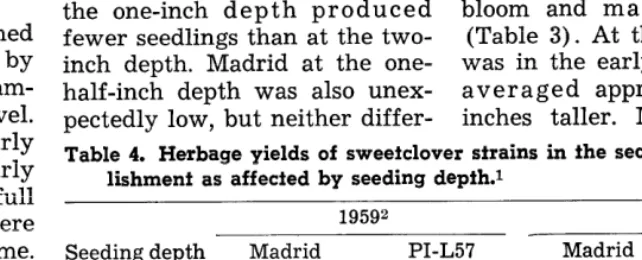
lished stainless steel cannulae in four steers, but all were unsatis- factory over any extended pe- riod. He lists the following com- plications: 1) loss of cannula due to pressure necrosis; 2) recur- rent lack of appetite; and 3) ul- ceration of the rumen and retic- ulum.
Recently, greater success due
to development of more efficient
closure devices has been re-
ported. Van Dyne (1962) used five steers and seven sheep fis-
tulated by the techniques de-
scribed above. All the steers sur- vived surgery and field use; all sheep survived surgery, but two were killed after several months
use. Tore11 and Bredon (1961)
established fistulas in 18 Ankole and Zebu cattle which survived a six-month study in good condi- tion and at last report were still
usable. Cook et al. (1961, 1962)
have reported on use of fistu- lated sheep under range condi-
tions. Several of their sheep
have been used in more than one season with some now collecting in their fifth year. Wethers and calves have been fistulated suc-
cessfully at the Grassland Re-
search Institute in England
(Lambourne, 1963, and personal
correspondence), lambs and
wethers in Australian and New Zealand studies (McManus et al. 1962b; Tribe and Peel, 1963; Ar-
-
THE ESOPHAGEAL FISTULA
FIGUR’E 2. Examples of long term esophageal fistulated animals: The esophageal fistula was installed in the steer over two and a half years prior to the photograph and the rumen fistula for about two years; the ewe was fistulated in 1960 and has since been used in grazing studies.
nold et al. 1963; and W. H.
Bishop, personal correspon-
dence), and dairy cattle in the southern United States (G. H. Rollins and L. L. Rusoff, per- sonal correspondence).
Greater surgical success has
been obtained with young ani- mals than with mature animals and fistulation is probably more successful in cattle than in, sheep. Still, probably about ten percent
of the animals fistulated by cur- rent techniques will not be use- ful over a long period of time,
due to various operative and
post-operative losses. Yet, some
animals are serviceable for sev-
eral years. Heady and Tore11
(1959) reported on an esopha- geal-fistulated wether which had been in use four years at the time of their study. Rusoff and
Foote (1961b) reported using
9
esophageal-fistulated dairy cows
for two years. The bifistulated steer in Figure 2 has both an esophageal and a ruminal fistula. The esophageal fistula had been
established about 2% years at
the time of the photograph, and the ruminal fistula for about two
years. Fistulated ewes which
raised lambs have been used
(Van Dyne, unpublished data;
Arnold et al., 1963).
Types of Closure Devices
Various devices have been
used for closing the esophageal fistula. Tore11 (1954) described the use of two stainless steel pins
inserted into imbedded poly-
ethylene tubing. The exposed
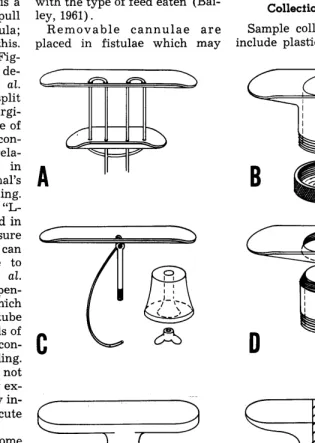
end of the pins was held together by a cord or rubber bands. More recent closure devices are sche- matically illustrated in Figure 3. Type A represents a device used by Tore11 (1954) and by Van
Dyne (unpublished). Two plas-
tic plates are drawn together by nylon cord. Usually, a piece of cork or foam rubber is placed between the two plates of this completely removable plug. Les- perance (1959) 4 illustrates a sim-
ilar device wherein the inner
plate was wired to a metal outer plate. The outer plate was held in place by a strap around the animal’s neck.
The nonremovable type of can-
nula (Figure 3B) has been used
by various workers; it is con-
structed of lucite or acrylic plas- tic or stainless steel (Cook et al., 1958; Van Dyne and Van Horn,
1959; Lesperance et al., 1959,
1960a; Rusoff and Foote, 1961a, b; and others). The cannula in Fig- ure 3D (Van Dyne, unpublished) has three important advantages over that in Figure 3B: 1) less esophagus need be incised to in- stall the cannula; 2) it can be removed completely if necessary; and 3) when the plug is in place, the plate of the cannula does not have a hole in which forage may become lodged.
10
has been in use for several years
under a wide variety of condi-
tions (Van Dyne, 1962; Tore11
and Bredon, 1961; and Tribe and
Peel, 1963). Various size plugs
can be interchanged to accom-
modate changes in the fistula. In
use, both closure devices C and
D are made so that the plug
portion is “off center.” This
allows periodic switching of the
long and short ends of the plate
and aids in mainteance of a
healthy fistula. Often there is a
tendency for a “pouch” to pull
down anterior to the fistula;
periodic switching prevents this.
The molded latex plug in Fig-
ure 3E is one of several types de-
scribed by McManus
et al.
(1962b). They also describe split
plug stoppers made from surgi-
cal rubber. One disadvantage of
this type plug under range con-
ditions is that it pulls out rela-
tively easily when caught in
fences, brush, or in the animal’s
rear hooves when scratching.
Nelson (1962) has used two “L-
shaped” pieces of plastic held in
place by two bolts for a closure
device (Figure 3F). Spacers can
be used in such a device to
adjust its length. Wise et al.
(1940) described a double-open-
ing fistula in a dairy calf which
was fitted with a rubber tube
inserted into the exposed ends of
the esophagus to serve as a con-
duit for normal milk feeding.
The type of closure device is not
well described in many early ex-
periments. Many of the early in-
vestigations were probably acute
studies.
A removable cannula has some
advantages over a permanently
fixed cannula. The permanently
fixed lucite or stainless steel can-
nula eventually may cause the
development of a pocket or blind
pouch anterior to the fistula and
eventually may be expelled. All
the plugs or cannulae in Figure
3 can be removed, interchanged,
and modified except B. The lu-
cite cannula has some advantage
in cold-weather sampling be-
VAN DYNE AND TORELL
cause it can be used while the
operator is wearing gloves.
Inside openings in cannulae
are usually about three cm in
diameter in sheep and four cm
or more in cattle. Openings
smaller than this may permit
plugging of the cannula
and
compaction of the feed within
the esophagus, or may limit the
percent of forage collected. The
size of the opening is important
because the size of bolus varies
with the type of feed eaten (Bai-
ley, 1961).
Removable
cannulae
are
placed in Bistulae which may
vary considerably in length and
width. In the author’s studies
the cattle fistulae are oval and
four to five cm long and about
three cm wide. The sheep fistu-
lae are correspondingly smaller.
It is desirable to establish a uni-
form size and shape of cannula
or plug which may be inter-
changed among animals, thus
eliminating the necessity
of
maintaining individual animal
equipment.
Collecfion Apparatus
Sample collection apparatus
include plastic bags (McManus,
B
II
FIGURE 3. Schematic illustration of various types geal fistulae in cattle and sheep (see text).
THE ESOPHAGEAL FISTULA
bag used on cattle (see also Figure 2 for sheep forage collection bag).
1962a; Lusk et al., 1961)) canvas bags (Torell, 1954; Cook et al., 1958; Cook et al., 1961)) rubber-
ized canvas (Lesperance, 1959) 4
and screen bottom bags (Van Dyne and Van Horn, 1959). The plastic bag without canvas pro- tection is not suitable for most
range investigations. The water-
proof canvas bag can be a disad- vantage under range conditions because a considerable weight of saliva and forage may accumu- late and thus affect the grazing
performance of the animal. The
screen bottom bag allows saliva to drip off the sample (see Fig- ure 4D). Thus, samples collected with screen bottom bags are less
affected by salivary contamina-
tion than samples collected in
plastic bags. This would be dis-
advantageous if nutrients were
leached from the sample by sa- liva. However, McManus (1961b)
has demonstrated by in vitro
studies there is no significant leaching of nitrogen from suc-
culent or roughage plant ma-
terial.
The type of collection bag in
Figures 4D and 2B can be rapidly attached to either cattle or sheep. Two adjustable straps with “D” rings are snapped over the neck. A small snap on the front of the bag attaches to the back of the halter. A strap on the back of
11
the bag passes along the brisket
and between the forelegs,
through a “D” ring in a sur- tingle, and returns to snap to the bag on the other side. These bags are not displaced whether
full or empty or whether the
animal is browsing on high
shrubs or grazing on low grass. A wire screen bottom is prefer- able to a nylon screen one be- cause it holds the bag open and does not rip as easily in brush.
Similar sheep collection bags
may not require the straps at the front and back of the bag be- cause the wool prevents slippage
(see Cook et al., 1961) .
Length of Sampling
Sample volumes from one pint to one quart for sheep and half to one gallon for cattle are col-
lected easily. McManus (1960) 2
reported 86 per cent of his sheep samples were s 20 g dry matter. Collection time depends upon the species, size of the fistula, rate of grazing, and type of forage. Bath et al. (1956) suggested a 30-min-
ute maximum for collecting
samples on irrigated pasture.
Cook et al. (1958) reported two to four hours were required to collect an adequate sample un- der winter desert range forage
conditions. Two-hour collection
periods either in morning or
evening grazing were adequate for sampling open foothill winter range (Van Dyne and Van Horn,
1959). Van Dyne (1963)) in
studying grazing of esophageal- fistulated steers and wethers on a common dry annual foothill
range, used collection times of
1.4 to 2.4 hours. Sampling dura- tion as short as ten to 15 minutes
has been reported in forage
studies with esophageal-fistu-
lated sheep on small fenced
plots (Lusk et al., 1961) and
with steers fed roughages or con-
centrates (Nelson, 1962) . Collec-
tion periods up to one-hour dura- tion resulted in 30-200 g samples from sheep (Arnold et al., 1963).
12 VAN DYNE AND TORELL
his data that probably collection time should not exceed one hour in order to maintain normal con- ditions in the rumen. Extended loss of saliva may cause changes
in digestive activity by allow-
ing the accumulation of rela-
tively large concentrations of
volatile fatty acids in the rumen.
If this accumulation leads to ab-
normally low pH levels, ruminal stasis could result. Whether this
occurs under extended range
sampling has not been demon- strated.
Chemical Analyses
Forage samples taken from
esophageal-fistulated animals
have been subjected to a wide
variety of analyses. Various
workers have analyzed samples for the proximate components-
crude protein, ether extract,
total ash, crude fiber, and nitro-
gen free extract (by difference).
Other commonly determined
constituents are lignin, cellulose,
other carbohydrates (by differ-
ence) , silica, phosphorus, cal-
cium, and gross energy. Potas-
sium (Rusoff and Foote, 1961b)
and plant chromogens (Van
Dyne, unpublished, 1959) also
have been determined. Renet
coagulation time. surface and
body curd tension, pH, and lipo- lytic activity have been deter- mined in milk samples from a
sham-fed esophageal-fistulated
calf (Wise et al., 1940) . No spe-
cial changes in laboratory pro-
cedures have been reported for analyzing esophageal fistula for- age samples. However, salivary
contamination has been consid-
ered in some investigations (see
next section).
MacDougall and DeLong
(1942) and ‘?Jan Soest (1962)
have reported on effect of heat drying on lignin content in for- ages and in cattle and sheep
feces. This heat drying effect
may be important in drying fis-
tula forage samples. Bohman
(1958) found hay samples col- lected by the rumen evacuation
technique had greater lignin
content than the hay had before feeding. However, Sharp (1962) 5 found crude fiber in the forage sample to be greater than crude
fiber in the rumen-collected
sample. Ensalivation of the
s amp 1 e and high-temperature drying may bias lignin values.
MacDougall’s and DeLong’s
(1942) and Van Soest’s work (1962) show water and high drying temperature cause a non- enzymatic browning reaction in
which carbohydrate degradation
products condense with protein. This dark colored polymeric ma- terial is insoluble in 72 percent H2SG4 and thus would cause a positive bias in the lignin deter- mination. Recent work has indi- cated this material may be modi-
fied xylans (Gaillard, 1962).
Therefore, it may be desirable to keep the forage sample as dry as possible by use of screen bottom
collection bags and to dry the
samples at relatively low tem-
peratures. More work is needed
to establish the importance of
drying conditions on lignin de-
terminations in fistula forage
samples.
Salivary Contamination
Fistula forage samples contain
differential amounts of salivary
contaminants, depending upon
the type of collection bag. Bath
et al. (1956) indicated salivary
contamination increased the ash
content of the sample while not
appreciably affecting other con-
stituents. McDougall (1948) re-
ported sheep saliva contains
about 0.8 percent ash, Lesper- ante et al. (1960a) found bovine
saliva to contain 0.85 percent
ash, and Bailey and Balch (1961) found bovine saliva dry matter
and ash to be respectively 1.02
percent and 0.89 percent. The
calculations of Lesperance et al. (1960a) indicate that ash, phos- phorus, or calcium contamina- tion from saliva would increase significantly the content of those
components in the forage sam-
ple. They considered it doubtful that regression equations could be established to relate salivary contamination and feed composi-
tion when comparing samples
from stall-fed animals and sam- ples from animals grazing on pasture. Cook et al. (1961,1962), however, have attempted to cor- rect fistula forage sample com- position for added nitrogen, ash,
and phosphorus from salivary
contamination. This procedure
is as follows (C. Wayne Cook,
1963, personal correspondence) :
simulate grazing by hand col- lecting samples, determine mois- ture in these; collect saliva sam-
ples and analyze for moisture
and chemical constituents; sub-
tract plant moisture from the total moisture in the fistula sam- ple to determine amount of sal-
ivary contamination; deduct
amount of various constituents added by the saliva. However, this procedure is subject to crit-
icism because of the assump-
tions: 1) that forage grazed can be sampled adequately by hand;
2) that saliva composition or
secretion rate is invariable; and 3) that the fistula samples are completely saturated with either
plant or salivary moisture, or
both (screen bottom collection bags are used).
McManus (1961b) reported on collection of roughage feedstuffs from small fistulas and found recoveries generally exceeded 35 percent of the material fed. He stated that chemical composition
of the extruded material was
similar to that fed except for an increase in ash content. He sug- gested that results always should
be expressed on an ash-free
basis and similar results were obtained by Nelson (1962). Be- cause trampled forage or seeds
picked from the ground may
BSharp, G. D. 1962. An evaluation of the rumen klearance technique for measuring the nutritive value
.