Zexe: Enabling Decentralized Private Computation
Sean Bowe [email protected]
Zcash
Alessandro Chiesa [email protected]
UC Berkeley
Matthew Green [email protected]
Johns Hopkins University
Ian Miers [email protected]
Cornell Tech
Pratyush Mishra [email protected]
UC Berkeley
Howard Wu [email protected]
UC Berkeley
February 21, 2019
Abstract
Ledger-based systems that support rich applications often suffer from two limitations. First, validating a transaction requires re-executing the state transition that it attests to. Second, transactions not only reveal which application had a state transition but also reveal the application’s internal state.
We design, implement, and evaluate Zexe, a ledger-based system where users can execute offline computations and subsequently produce transactions, attesting to the correctness of these computations, that satisfy two main properties. First, transactionshide all informationabout the offline computations. Second, transactions can bevalidated in constant timeby anyone, regardless of the offline computation.
The core of Zexe is a construction for a new cryptographic primitive that we introduce,decentralized private computation(DPC) schemes. In order to achieve an efficient implementation of our construction, we leverage tools in the area of cryptographic proofs, including succinct zero knowledge proofs and recursive proof composition. Overall, transactions in Zexe are968bytesregardless of the offline computation, and generating them takes less than a minute plus a time that grows with the offline computation.
We demonstrate how to use Zexe to realize privacy-preserving analogues of popular applications: private decentralized exchanges for user-defined fungible assets and regulation-friendly private stablecoins.
Keywords: decentralized computation; zero knowledge proofs; succinct arguments
Contents
1 Introduction 3
1.1 Our contributions . . . 4
1.2 Related work . . . 5
2 Techniques 7 2.1 Achieving privacy for a single arbitrary function . . . 7
2.2 Difficulties with achieving privacy for user-defined functions . . . 8
2.3 The records nano-kernel: a minimalist shared execution environment . . . 8
2.4 Decentralized private computation . . . 10
2.5 Achieving an efficient implementation . . . 12
2.6 Deployment considerations . . . 14
3 Definition of decentralized private computation schemes 15 3.1 Data structures . . . 15
3.2 Algorithms . . . 16
3.3 Security . . . 17
4 Construction of decentralized private computation schemes 21 4.1 Building blocks . . . 21
4.2 Algorithms . . . 21
5 Delegating zero knowledge execution 25 5.1 Approach . . . 25
5.2 Additional building block: randomizable signatures . . . 25
5.3 A delegable DPC scheme . . . 26
5.4 Threshold transactions and blind transactions . . . 28
6 Applications 29 6.1 User-defined assets . . . 29
6.2 Decentralized exchanges . . . 30
6.3 Stablecoins and centrally-managed assets . . . 33
7 Implementation strategy 35 8 System implementation 40 9 System evaluation 42 9.1 Cryptographic building blocks . . . 42
9.2 The execute NP relation . . . 42
9.3 DPC algorithms . . . 42
9.4 DPC data structures . . . 43
A Proof of security for our DPC scheme 45 A.1 Building blocks for the simulator . . . 45
A.2 The ideal-world simulator . . . 46
A.3 Proof of security by hybrid argument . . . 49
B Construction of a delegable DPC scheme 51 B.1 Definition and construction of a randomizable signature scheme . . . 51
B.2 Construction of a delegable DPC scheme . . . 52
C Extensions in functionality and in security 55
Acknowledgments 57
1
Introduction
Distributed ledgers are a mechanism that maintains data across a distributed system while ensuring that every party has the same view of the data, even in the presence of corrupted parties. Ledgers can provide an indisputable history of all “events” logged in a system, thereby offering a mechanism for multiple parties to collaborate with minimal trust (any party can ensure the system’s integrity by auditing history). Interest in distributed ledgers has soared recently, catalyzed by their use in cryptocurrencies (peer-to-peer payment systems) and by their potential as a foundation for new forms of financial systems, governance, and data sharing. In this work we study two limitations of ledgers, one aboutprivacyand the other aboutscalability.
The privacy problem. The main strength of distributed ledgers is also their main weakness:the history of all events is available for anyone to read. This severely limits a direct application of distributed ledgers.
For example, in ledger-based payment systems such as Bitcoin [Nak09], every payment transaction reveals the payment’s sender, receiver, and amount. This not only reveals private financial details of individuals and businesses using the system,1but also violates fungibility, a fundamental economic property of money. This
lack of privacy becomes more severe in smart contract systems like Ethereum [Woo17], wherein transactions not only contain payment details, but also embed function calls to specific applications. In these systems, every application’s internal state is public, and so is the history of function calls associated to it.
This problem has motivated prior work to find ways to achieve meaningful privacy guarantees on ledgers. For example, the Zerocash protocol [BCG+14] provides privacy-preserving payments, and Hawk [KMS+16]
enables general state transitions with data privacy, that is, an application’s data is hidden from third parties. However, all prior work is limited to hiding the inputs and outputs of a state transition but not which
transition function is being executed. That is, prior work achievesdata privacybut not alsofunction privacy. In systems with a single transition function this is not a concern.2 In systems with multiple transition
functions, however, this leakage is problematic. For example, Ethereum currently supports thousands of separate ERC-20 “token” contracts [Eth18], each representing a distinct currency on the Ethereum ledger; even if these contracts each individually adopted a protocol such as Zerocash to hide details about token payments, the corresponding transactions would still revealwhichtoken was being exchanged. Moreover, the leakage of this information would substantially reduce the anonymity set of those payments.
The re-execution problem. Public auditability in the aforementioned systems (and many others) is achieved
via direct verification of state transitions. This creates two problems. First, validating a transaction involves re-executing the associated computation and so, to discourage denial-of-service attacks whereby users send transactions that take a long time to validate, current systems introduce mechanisms such asgasto make users pay more for longer computations. Second, even with such mechanisms, validating an expensive transaction may simply not be economically profitable, a problem known as the “Verifier’s Dilemma” [LTKS15]. These problems have resulted in Bitcoin forks [Bit15] and Ethereum attacks [Eth16].
In sum, there is a dire need for techniques that facilitate the use of distributed ledgers for rich applications, without compromising privacy (of data or functions) or relying on unnecessary re-executions. Prior works only partially address this need, as discussed in Section 1.2 below.
1Even if payments merely containaddressesrather than, say, social security numbers, much information about individuals and
businesses can be gleaned by analyzing the flow of money over time between addresses [RH11, RS13, AKR+
13, MPJ+
13, SMZ14, KGC+17]. There are even companies that offer analytics services on the information stored on ledgers [Ell13, Cha14].
2For example, in Zerocash the single transition function is the one governing cash flow of a single currency.
1.1 Our contributions
We design, implement, and evaluate Zexe (Zero knowledge EXEcution), a ledger-based system that enables users to execute offline computations and subsequently produce publicly-verifiable transactions that attest to the correctness of these offline executions. Zexe simultaneously provides two main security properties. • Privacy: a transaction reveals no information about the offline computation, except (an upper bound on)
the number of consumed inputs and created outputs.3 One cannot link together multiple transactions by the same user or involving related computations, nor selectively censor transactions based on such information. • Succinctness: a transaction can be validated in time that is independent of the cost of the offline
computation whose correctness it attests to.Since all transactions are equally cheap to validate (they are all indistinguishable), there is no “Verifier’s Dilemma” nor a need for mechanisms such asgas.
Zexe also offers rich functionality, as offline computations in Zexe can be used to realize state transitions of multiple applications (such as tokens, elections, markets) simultaneously running atop thesameledger. The users participating in applications to do not have to trust, or even know of, one another. Zexe supports this functionality by exposing a simple, yet powerful,shared execution environmentwith the following properties. • Extensibility: users may execute arbitrary functions of their choice, without seeking anyone’s permission.
• Isolation: functions of malicious users cannot interfere with the computations and data of honest users.
• Inter-process communication: functions may exchange data with one another.
DPC schemes. The technical core of Zexe is a protocol for a new cryptographic primitive that we introduce, decentralized private computation(DPC), a new approach to performing computations on a ledger. Informally, DPC supports a simple, yet expressive, programming model in which units of data, which we callrecords, contain within them scripts (arbitrary programs) that determine under what conditions they can be first created and then consumed. The rules that dictate how these programs interact can be viewed as a “nano-kernel” that provides a shared execution environment upon which to build applications. From a technical perspective, DPC can be viewed as extending Zerocash [BCG+14] to the foregoing programming model, while still providing
strong privacy guarantees, not only within a single application (which is a straightforward extension) but also across multiple co-existing applications (which requires new ideas that we discuss later on). The security guarantees of DPC are captured via an ideal functionality, which our protocol provably achieves.
Applications. We demonstrate how to use DPC schemes to achieve privacy-preserving analogues of popular
applications: private user-defined assets, private DEXs, and private stablecoins. Our privacy guarantees in particular protect against vulnerabilities of current DEX designs such as front-running [BDJT17, BBD+17].
See Section 6 for details.
Techniques for efficient implementation. We devise a set of techniques to achieve an efficient
implementa-tion of our DPC protocol, by drawing upon recent advances in zero knowledge succinct cryptographic proofs (namely, zkSNARKs) and in recursive proof composition (proofs attesting to the validity of other proofs).
Overall, transactions in Zexe with two input records and two output records are968bytes and can be
verified in tens of milliseconds,regardless of the offline computation; generating these transactions takes less than a minute plus a time that grows with the offline computation (inevitably so). This implementation is achieved in a modular fashion via a collection of Rust libraries (see Fig. 15), in which the top-level one
3One can fix the number of inputs and outputs (say, fix both to2), or carefully consider side channels that could arise from
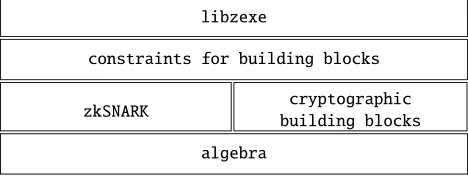
islibzexe. Our implementation also supports transactions withanynumbermof input records andnof output records; transactions size in this case is32m+ 32n+ 840 bytes (the transaction stores the serial
number of each input record and the commitment of each output record).
Delegating transactions. While verifying succinct cryptographic proofs is cheap, producing them can be
expensive. As the offline computation grows, the (time and space) cost of producing a cryptographic proof of its correctness also grows, which could become infeasible for a user.
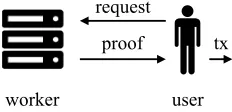
To address this problem, we further obtaindelegable DPC. The user communicates to an untrusted worker worker details about the desired transaction, then the worker produces the transaction, and finally the user authorizes it via a cheap computation (and in a way that does not violate indistinguishability of transactions). This feature is particularly relevant for prospective real-world deployments, because it enables support for weak devices, such as mobile phones or hardware tokens.
In fact, our delegable DPC protocol also extends to supportthreshold transactions, which can be used to improve operational security, and also to supportblind transactions, which can be used to realize lottery tickets for applications such as micropayments.
All of these extensions are also part of our Rust librarylibzexe.
A perspective on costs. Zexe provides tolerable efficiency but is by no means a lightweight construction.
We have, after all, set ambitious goals: data/function privacy and succinctness, for a rich functionality, in a threat model that requires security against all efficient adversaries. Relaxing any of these goals (assuming rational adversaries or hardware enclaves, or compromising on privacy) will lead to more efficient approaches.
In light of the foregoing ambitious goals, we have, in our opinion, managed to achieve excellent transaction sizes (less than a kilobyte) and transaction verification times (tens of milliseconds).
The primary cost in our system is, unsurprisingly, the cost of generating the cryptographic proofs that are included in transactions. We have managed to keep this cost to roughly a minute plus a cost that grows with the offline computation. For the applications mentioned above, these additional costs are negligible. Our system thus supports applications of real-world interest today (e.g., private DEXs) with reasonable costs.
1.2 Related work
Avoiding naive re-execution. TrueBit [TR17], Plasma [PB17], and Arbitrum [KGC+18] avoid naive
re-execution by having users report the results of their computationswithoutany cryptographic proofs, and instead putting in place incentive mechanisms wherein others can challenge reported results. The user and challenger engage in a so-calledrefereed game[FK97, CRR11, CRR13, JSST16, Rei16], mediated by a smart contract acting as the referee, that efficiently determines which of the two was “telling the truth”. In contrast, in this work correctness of computation is ensured by cryptography, regardless of any economic motives; we thus protect against all efficient adversaries rather than merely all rational and efficient ones. Also, unlike our DPC scheme, the above works do not provide formal guarantees of strong privacy (challengers must be able to re-execute the computation leading to a result and in particular must know its potentially private inputs).
Private payments. Zerocash [BCG+14], building on earlier work [MGGR13], showed how to use distributed
ledgers to achieve payment systems with strong privacy guarantees. Informally, users encrypt payment details and prove their validity, without disclosing what the payment details are. The Zerocash protocol, with some modifications, is now commercially deployed in several currencies, including Zcash [ZCa15]. In Zerocash, however, there is no support for scripting, that is, specifying small programs that dictate how funds can be spent. Even more so, in Zerocash there is no support for complex financial logic, and more generally for programming arbitrary state transitions like in smart contract systems such as Ethereum.
Privacy beyond payments. Hawk [KMS+16], combining ideas from Zerocash and the notion of an
evaluator-prover for multi-party computation, enables parties to conduct offline computations and then report their results via cryptographic proofs. The privacy guarantee that Hawk achieves, known as transactional privacy, protects the private inputs used in a computation (directly so from the proofs’ zero knowledge property) but does not protect the information ofwhichcomputation was carried out. That said, we view Hawk as complementary to our work: a user in our system could in particular be a semi-trusted manager that administers a multi-party computation and generates a transaction about its output. The privacy guarantees provided in this work would hidewhichcomputation was carried out offline. Zether [BAZB19] is a system that enablespublicly knownsmart contracts to reason about homomorphic commitments in zero knowledge, and in particular enables these to transact in a manner that hides transaction amounts; it does not hide the identities of parties involved in the transaction, beyond a small anonymity set.
MPC with ledgers. Several works [ADMM14b, ADMM14a, KMB15, KB16, BKM17] have applied ledgers
to obtain secure multi-party protocols that have security properties that are difficult to achieve otherwise, such asfairness. These approaches are complementary to our work, as any set of parties wishing to jointly compute a certain function via one of these protocols could run the protocol “under” our DPC scheme in such a way that third parties would not learn any information that such a multi-party computation is happening.
Hardware enclaves. Ekiden [CZK+18] is a ledger-based system that uses hardware enclaves, such as Intel
Software Guard Extensions [MAB+13], to achieve various integrity and privacy goals for smart contracts.
Beyond ledgers, several systems explore privacy goals in distributed systems by leveraging hardware enclaves; see for example M2R [DSC+15], VC3 [SCF+15], and Opaque [ZDB+17]. All of these works are able to
2
Techniques
We summarize the main ideas behind our contributions. Our goal is to design a ledger-based system in which transactions attest to offline computations while simultaneously providingprivacyandsuccinctness.
We begin by noting that privacy is the “harder” of the two goals, since there is a straightforward folklore approach that provides succinctness alone: each user accompanies the result reported in a transaction with a succinct cryptographic proof (i.e., a SNARK) attesting to the result’s correctness. Others who validate the transaction can then simply verify the cryptographic proof, and do not have to re-execute the computation. In light of this, we shall first discuss how to achieve privacy, and then how to additionally achieve succinctness.
The rest of this section is organized as follows. In Sections 2.1 and 2.2 we explain why achieving privacy in our setting is challenging. In Section 2.3 we introduce the shared execution environment that we consider, and in Section 2.4 we introducedecentralized private computation(DPC), a cryptographic primitive that securely realizes it. In Section 2.5 we describe how we turn our ideas into an efficient implementation.
2.1 Achieving privacy for a single arbitrary function
Zerocash [BCG+14] is a protocol that achieves privacy for a specific functionality, namely,value transfers
within a single currency. Therefore, it is natural to consider what happens if we extend Zerocash from this special case to the general case of asingle arbitrary functionthat is known in advance to everybody.
Sketch of Zerocash. Money in Zerocash is represented viacoins. The commitment of a coin is published
on the ledger when the coin is created, and its serial number is published when the coin is consumed. Each transaction on the ledger attests that some “old” coins were consumed in order to create some “new” coins: it contains the serial numbers of the consumed coins, commitments of the created coins, and a zero knowledge proof attesting that the serial numbers belong to coins created in the past (without identifying which ones), and that the commitments contain new coins of the same total value. A transaction is private because it only reveals how many coins were consumed and how many were created, but no other information (each coin’s value and owner address remain hidden). Also, revealing a coin’s serial number ensures that a coin cannot be consumed more than once (the same serial number would appear twice). In sum, data in Zerocash corresponds to coin values, and state transitions are the single invariant that monetary value is preserved.
Extending to an arbitrary function. One way to extend Zerocash to a single arbitrary functionΦ(known
in advance to everybody) is to think of a coin as arecordthat stores some arbitrary datapayload, rather than just some integer value. The commitment of a record would then be published on the ledger when the record is created, and its unique serial number would be published when the record is consumed. A transaction would then contain serial numbers of consumed records, commitments of created records, and a proof attesting that invoking the functionΦon (the payload of) the old records produces (the payload of) the new records.
Data privacy holds because the ledger merely stores each record’s commitment (and its serial number once consumed), and transactions only reveal that some number of old records were consumed in order to create some number of new records in a way that is consistent withΦ. Function privacy also holds but for
trivial reasons: Φis known in advance to everybody, and every transaction is about computations ofΦ.
Note that Zerocash is indeed a special case of the above: it corresponds to fixingΦto the particular (and
publicly known) choice of a functionΦ$that governs value transfers within a single currency.
However the foregoing protocol supports only a single hard-coded functionΦ, while instead we want to
enable users to select their own functions, as we discuss next.
2.2 Difficulties with achieving privacy for user-defined functions
We want to enable users to execute functions of their choice concurrently on the same ledger, while maintaining function privacy and without seeking prior permission from anyone. That is, when preparing a transaction, a user may pickanyfunctionΦof his choice for creating new records by consuming some old records.
This alonecanbe achieved via the approach sketched in Section 2.1 by fixing a single function that is
universal, and then interpreting data payloads as user-defined functions that are provided as inputs. Indeed, zero knowledge would ensure function privacy in this case. However merely allowing users to define their own functions doesnotby itself yield meaningful functionality, as we explain next.
The problem: malicious functions. Users could devise functions to attack or disrupt other users’ functions
and data, so that a particular user would not know whether to trust records created by other users; indeed, due to function privacy, he would not know what functions were used to create those records. For example, suppose that we wanted to realize the special case of value transfers within a single currency (i.e., Zerocash). One may believe that it would suffice to instruct users to pick the functionΦ$(or similar). But this doesnot
work: a user receiving a record claiming to contain, say,1unit of currency does not know if this record was
created via the functionΦ$from other such records and so on. A malicious user could have used a different
function to create that record, for example, one that illegally “mints” records that appear valid toΦ$. More
generally, the lack of any enforced rules about how user-defined functions can interact precludes productive cooperation between users that do not trust one another. We stress that this challenge arises specifically due to function privacy, because if the function that created (the commitment of) a record was public knowledge, users could decide for themselves if records they receive were generated by “good” functions.
One way to address the foregoing problem would be to augment records with an attribute thatmustequal the identity of the function that created them, and then impose the restriction that in a valid transaction only records created by the same function may participate. This new attribute is never revealed on the ledger (just like a record’s payload), and the zero knowledge proof is tasked with ensuring that records participating in the same transaction are all of the same “type”. This approach nowdoessuffice to realize value transfers within a single currency, by letting users select the functionΦ$. More generally, this approach generalizes that in
Section 2.1, and can be viewed as running multiple segregated “virtual ledgers” each with a fixed function. Function privacy holds because one cannot tell if a transaction belongs to one virtual ledger or another.
The problem: limited functionality. The foregoing forbids any inter-process communication, and so one
cannot realize even simple functionalities like transferring value between different currencies on the same ledger. This crude time sharing of the ledger is too limiting.
2.3 The records nano-kernel: a minimalist shared execution environment
The approaches in Section 2.2 lie at opposite extremes: unrestricted inter-process interactions cannot realize even basic applications such as a single currency, while complete process segregation is too limiting.
Balancing these extremes requires a shared execution environment, namely anoperating system, that manages user-defined functions: it provides process isolation, determines data ownership, handles inter-process communication, and so on. Overall, inter-processes must be able to concurrently share a ledger, without violating the integrity or confidentiality of one another.
In light of the above, we choose to take the following approach: we formulate a minimalist shared execution environment that imposes simple, yet expressive, rules on how records may interact. This execution environment can be viewed as a “nano-kernel” that manages records, and can be summarized as follows.
The records nano-kernel (RNK):In addition to a data payload, a recordrwill now contain two
user-defined functions, or more precisely two user-definedpredicates(boolean functions). These are abirthpredicateΦb, which is executed whenris created, and adeathpredicateΦd, which is
executed whenris consumed. By suitably programmingr’s birth and death predicates, a user
fully dictates the conditions under whichrcan be first created and later consumed.
As before, a transaction in the ledger attests that some old records were consumed in order to create new records. However, now it also attests that the old records’ death predicates and the new records’ birth predicates were all simultaneously satisfied when given a certain common input. This input is the transaction’s
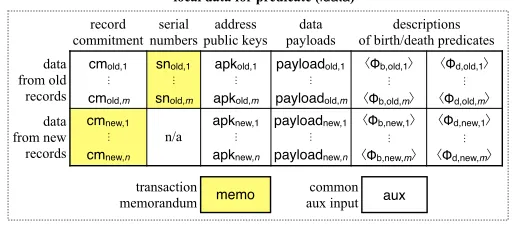
local data, which includes: (a) every record’s contents (such as its payload and the identity of its predicates); (b) a piece of shared memory that is publicly revealed, calledtransaction memorandum; (c) a piece of shared memory that is kept hidden, calledauxiliary input; and (d) other construction specifics. See Fig. 3.
In this way,each predicate can individually decide if the local data is valid according to its own logic. For example, a record can protect itself from other records that contain “bad” birth or death predicates, because the record’s predicates could refuse to accept when they detect (from reading the local data) that they are in a transaction with records having bad predicates. At the same time, a record can interact with other records in the same transaction when its predicates decide to accept, providing the flexibility that we seek. We briefly illustrate this via an example,user-defined assets, whereby one can use birth predicates to define and transact with their own assets, and also use death predicates to enforce custom access control policies over these assets.
Example 2.1(user-defined assets). Consider records whose payloads encode an asset identifierid, the initial
asset supplyv, and a valuev. Fix the birth predicate in all such records to be amint-or-conservefunction
MoCthat is responsible for creating the initial supply of a new asset, and then subsequently conserving the
value of the asset across all transactions. In more detail,MoCcan be invoked in one of two modes. Inmint
mode, given as input a desired initial supplyv,MoCdeterministically derives a fresh unique identifieridfor
a new asset and stores(id,v, v=v)in agenesis record. Inconserve mode,MoCinspects all records in a
transaction whose birth predicates equal toMoCand whose asset identifiers equal the identifier of the current
record, and ensures that among these records, the asset values are conserved.
Users can program death predicates of records to enforce conditions on how assets can be consumed, e.g., by realizingconditional exchangeswith other counter-parties. Suppose that Alice wishes to exchange
100units of an assetid1for50units of another assetid2, but does not have a counter-party for the exchange.
She creates a recordrwith100units ofid1 whose death predicate enforces that any transaction consumingr
must also create another record, consumable by Alice, with50units ofid1. She then publishes out of band
information aboutr, and anyone can subsequently claim it by creating a transaction doing the exchange.
Since death predicates can bearbitrary, many different access policies can also be realized, e.g., to enforce that a transaction redeeming a record (a) must be authorized by two of three public keys, or (b) becomes valid only after a given amount of time, or (c) must reveal the pre-image of a hash function.
We discuss in more detail several applications in Section 6, including how to realizeprivate decentralized asset exchangesandregulation-friendly private stablecoins. We stress that the records nano-kernel is not
a scripting mechanism like Bitcoin’s but, is instead a framework that supports general computations. These computations can be conducted within a single transaction, or across multiple transactions, by storing suitable intermediate state/message data in record payloads, or by publishing that data in transaction memoranda (as
plaintext or ciphertext as needed). In this way, transactions can realizeany state transition, with consumed records being data loaded from memory, and created records being data stored back to memory.
2.4 Decentralized private computation
A new cryptographic primitive. We introduce a new cryptographic primitive calleddecentralized private computation(DPC) schemes, which capture the notion of a ledger-based system where privacy-preserving transactions attest to offline computations that follow the records nano-kernel. See Section 3 for the definition of DPC schemes, including the ideal functionality that we use to express security.
We construct a DPC scheme in Section 4, and prove it secure in Appendix A. We take Zerocash [BCG+14]
as a starting point, and then extend the protocol to support the records nano-kernel and also to facilitate proving security in the simulation paradigm relative to an ideal functionality (rather than via a collection of separate game-based definitions as in [BCG+14]). Below we sketch the construction.
Construction sketch. Each transaction in the ledger consumes some old records and creates new records in
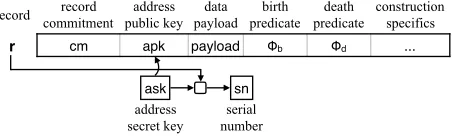
a manner that is consistent with the records nano-kernel. To ensure privacy, a transaction only contains serial numbers of the consumed records, commitments of the created records, and a zero knowledge proof attesting that there exist records consistent with this information (and with the records nano-kernel). All commitments on the ledger are collected in a Merkle tree, which facilitates efficiently proving that a commitment appears on the ledger (by proving in zero knowledge the knowledge of a suitable authentication path). All serial numbers on the ledger are collected in a list that cannot contain duplicates. This implies that a record cannot be consumed twice because the same serial number is revealed each time a record is consumed. See Fig. 1. The record data structure is summarized in Fig. 2. Each record is associated to anaddress public key, which is a commitment to a seed for a pseudorandom function acting as the correspondingaddress secret key; addresses determine ownership of records, and in particular consuming a record requires knowing its secret key. Arecordconsists of an address public key, a data payload, a birth predicate, a death predicate, and a serial number nonce; arecord commitmentis a commitment to all of these attributes. Theserial numberof a record is the evaluation of a pseudorandom function, whose seed is the secret key for the record’s address public key, evaluated at the record’s serial number nonce. A record’s commitment and serial number, which appear on the ledger when the record is created and consumed, revealnoinformation about the record attributes. This follows from the hiding properties of the commitment, and the pseudorandom properties of the serial number. The derivation of a record’s serial number ensures that a user can create a record for another in such a way that its serial number is fully determined and yet cannot be predicted without knowing the other user’s secret key.
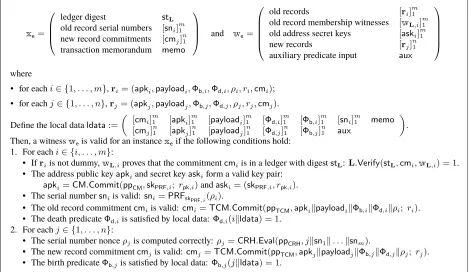
In order to produce a transaction, a user selects some previously-created records to consume, assembles some new records to create (including their payloads and predicates), and decides on other aspects of the local data such as the transaction memorandum (shared memory seen by all predicates and published on the ledger) and the auxiliary input (shared memory seen by all predicates but not published on the ledger); see Fig. 3. If the user knows the secret keys of the records to consume and if all relevant predicates are satisfied (death predicates of old records and birth predicates of new predicates), then the user can produce a zero knowledge proof to append to the transaction. See Fig. 4 for a summary of the NP statement being proved.
In sum, a transaction only reveals the number of consumed records and number of created records, as well as any data that was deliberately revealed in the transaction memorandum (possibly nothing).4
Achieving succinctness. Our discussions so far have focused on achieving (data and function) privacy.
However, we also want to achieve succinctness, namely, that a transaction can be validated in “constant time”. This follows from a straightforward modification: we take the protocol that we have designed so far and use a
L
ledger tx1 tx2 ... tx ... txt all record commitments all serial numbers
sn1,...,snm cm1,...,cmn memo stL 𝛑 serial numbers
of old records
commitments of new records
transaction memorandum ledger digest zkSNARK ... ledger digest ...
Figure 1:Construction of a transaction.
Commit
cm
apk payload Φb Φd 𝝆
Commit skPRF
PRF
sn
record commitment
birth & death predicates serial number nonce address public key data payload record r
serial number
address secret key ask
PRF secret key
CRH
unique info from
tx that created r Figure 2:Construction of a record.
record commitment
s
serial
numberspublic keysaddress payloadsdata of birth/death predicatesdescriptions data
from old records
cmold,1
⋮ cmold,m
snold,1
⋮ snold,m
apkold,1
⋮ apkold,m
payloadold,1
⋮ payloadold,m
Φb,old,1
⋮
Φb,old,m
Φd,old,1
⋮
Φd,old,m
data from new records
cmnew,1
⋮ cmnew,n
n/a apk⋮new,1
apknew,n
payloadnew,1
⋮ payloadnew,n
Φb,new,1
⋮
Φb,new,m
Φd,new,1
⋮
Φd,new,m
transaction
memorandum memo aux inputcommon aux
local data for predicate (ldata)
Φd,old,1(ldata) = ꔇ = Φd,old,m(ldata) = 1
Φb,new,1(ldata) = ꔇ = Φb,new,n(ldata) = 1
old death predicates new birth predicates
Figure 3:Predicates receive local data.
serial numbers of old records
commitments of new records
transaction memorandum
ledger
digest zkSNARK sn1,...,snm cm1,...,cmn memo stL 𝛑
old records (rold,1, ..., rold,m)
old secret keys (askold,1, ..., askold,m)
new records (rnew,1, ..., rnew,n)
auxiliary input aux
each old record rold,i
- has a commitment that is in a ledger with digest stL - is owned by secret key askold,i
- has serial number sni
each new record rnew,j has commitment cmj
each old death predicate Φold,d,i (in rold,i) is satisfied by local data each new birth predicate Φnew,b,j (in rnew,j) is satisfied by local data ∃
such that
Figure 4:The execute statement.
zero knowledgesuccinctargument rather than just any zero knowledge proof. Indeed, the NP statement being proved (summarized in Fig. 4) involves attesting the satisfiability of all (old) death and (new) birth predicates, and thus we need to ensure that verifying the corresponding proof can be done in time that does not depend on the complexity of these predicates. While turning this idea into an efficient implementation requires more ideas (as we discuss in Section 2.5), the foregoing modification suffices from a theoretical point of view.
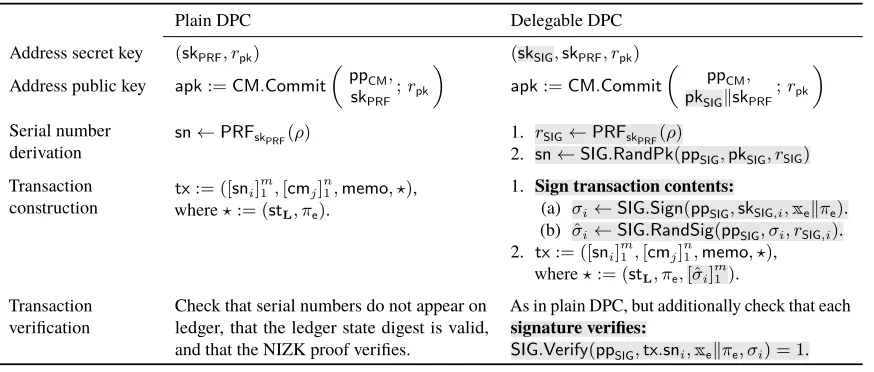
Delegation to an untrusted worker. In our DPC scheme, a user must produce, and include in the transaction,
a zero knowledge succinct argument that, among other things, attests that death predicates of consumed records are satisfied and, similarly, that birth predicates of created records are satisfied. This implies that the cost of creating a transaction grows with the complexity (and number of) predicates involved in the transaction. Such a cost can quickly become infeasible for weak devices such as mobile phones or hardware tokens.
We address this problem by enabling a user todelegateto an untrusted worker, such as a remote server, the computation that produces a transaction. This notion, which we call adelegable DPC scheme, empowers weak devices to produce transactions that they otherwise could not have produced on their own.
The basic idea is to augment address keys in such a way that the secret information needed to produce the cryptographic proof is separate from the secret information needed to authorize a transaction containing that proof. Thus, the user can communicate to the worker the secrets necessary to generate a cryptographic proof, while retaining the remaining secrets for authorizing this (and future) transactions. In particular, the worker has no way to produce valid transactions that have not been authorized by the user.
We use randomizable signatures to achieve the foregoing functionality, without violating either privacy or succinctness. Informally, we modify a record’s serial number to be an unlinkable randomization of (part of) the record’s address public key, and a user’s authorization of a transaction consists of signing the instance and proof relative to every randomized key (i.e., serial number) in that transaction. See Section 5 for details.
2.5 Achieving an efficient implementation
Our system Zexe (Zero knowledge EXEcution) provides an implementation of two constructions: our “plain” DPC protocol, and its extension to a delegable DPC protocol. Achieving efficiency in our system required overcoming several challenges. Below we highlight some of these challenges, and explain how we addressed them; see Sections 7 and 8 for details. The discussions below equally apply to both types of DPC protocols.
Avoiding the cost of universality. The NP statement that we need to prove involves checking user-defined
predicates, so it must support arbitrary computations that are not fixed in advance. However, state-of-the-art zkSNARKs for universal computations rely on expensive tools [BCG+13, BCTV14, WSR+15, BCTV17].
We address this problem by relying on one layer ofrecursive proof composition[Val08, BCCT13]. Instead of tasking the NP statement with directly checking user-defined predicates, we only task it with checking
succinct proofsattesting to this. Checking theseinnersuccinct proofs is a (relatively) inexpensive computation that is fixed forallpredicates, which can be “hardcoded” in the statement. Since the singleoutersuccinct proof produced does not reveal information about the inner succinct proofs attesting to predicates’ satisfiability (thanks to zero knowledge), the inner succinct proofs donothave to hide what predicate was checked, so they can be for NP statementstailoredto the computations of particular user-defined predicates.
A bespoke recursion. Recursive proof composition has been empirically demonstrated for pairing-based
SNARKs [BCTV17]. We thus focus our attention on these, and explain the challenges that arise in our setting. Recall that if we instantiate a SNARK’s pairing via an elliptic curveEdefined over a prime fieldFq and
having a subgroup of prime orderr, then (a) the SNARK supports NP statements expressed as arithmetic circuits overFr, while (b) proof verification involves arithmetic operations overFq. Being part of the NP
because the verifier’s “native” operations are overFq. SimulatingFqoperations viaFroperations is expensive,
and pickingEsuch thatq=ris impossible [BCTV17]. Prior work thus usesmultiplecurves [BCTV17]: a two-cycle of pairing-friendly elliptic curves, that is, two prime-order curvesE1andE2such that the prime
size of one’s base field is the prime order of the other’s group, and orchestrating SNARKs based on these so that fields “match up”. However, known cycles are inefficient at 128 bits of security [BCTV17, CCW18].
We address this problem by noting that we merely need “a proof of a proof”, and thus, instead of relying on a cycle, we can use the Cocks–Pinch method [FST10] to set up a bounded recursion [BCTV17]. First we pick a pairing-friendly elliptic curve that not only is suitable for 128 bits of security according to standard considerations but, moreover, is compatible with efficient SNARK provers inbothlevels of the recursion. Namely, letting pbe the prime order of the base field andr the prime order of the group, we need that
bothFr andFp have multiplicative subgroups whose orders are large powers of2. The condition onFr
ensures efficient proving for SNARKs over this curve, while the condition onFp ensures efficient proving
for SNARKs that verify proofs over this curve. In light of the above, we select a curve EBLS from the Barreto–Lynn–Scott (BLS) family [BLS02, CLN11] with embedding degree12. This family not only enables
parameters that conservatively achieve 128 bits of security, but also enjoys properties that facilitate very efficient implementation [AFK+12]. We ensure that both
FrandFphave multiplicative subgroups of order
2αforα≥40, by a suitable condition on the parameter of the BLS family.
Next we use the Cocks–Pinch method to pick a pairing-friendly elliptic curveECPover a fieldFqsuch
that the curve groupECP(Fq)contains a subgroup of prime orderp(the size ofEBLS’s base field). Since the
method outputs a primeqthat has about2×more bits than the desiredp, and in turnphas about1.5×more
bits thanr(due to properties of the BLS family), we only needECPto have embedding degree of6in order
to achieve 128 bits of security (as determined from the guidelines in [FST10]).
In sum, a SNARK overEBLSis used to generate proofs of predicates’ satisfiability; after that a zkSNARK overECPis used to generate proofs that these prior proofs are valid along with the remaining NP statement’s
checks. The matching fields between the two curves ensure that the former proofs can be efficiently verified.
Minimizing operations overECP. While the curveECPfacilitates efficient checking of SNARK proofs
overEBLS, operations on it are at least2×more costly (in time and space) than operations overEBLS, simply becauseECP’s base field is twice the size ofEBLS’s base field. This makes checks in the NP relationRethat
are not related to proof checking unnecessarily expensive.
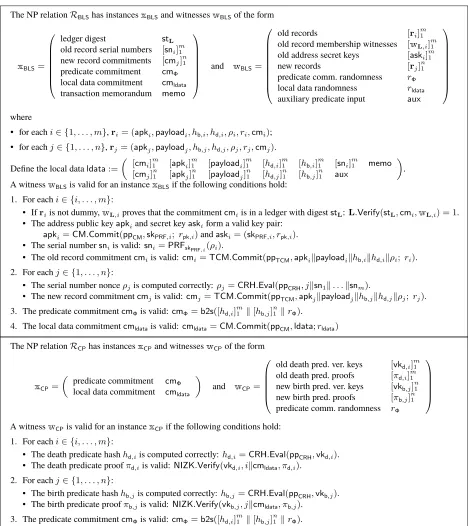
To avoid this, we split Re into two NP relations,RBLS and RCP. The latter is responsible only for
verifying proofs of predicates’ satisfaction, while the former is responsible for all other checks. We minimize the number ofECP operations by proving satisfaction ofRBLS andRCP with zkSNARKs overEBLS and
ECPrespectively. A transaction now includes both proofs.
Optimizing the NP statement. We note that the remaining NP statement’s checks can themselves be quite
expensive, as they range from verifying authentication paths in a Merkle tree to verifying commitment openings, and from evaluating pseudorandom functions to evaluating collision resistant functions. Prior work realizing similar collections of checks required upwards offour million gates[BCG+14] to express such
checks. This not only resulted in high latencies for producing transactions (several minutes) but also resulted in large public parameters for the system (hundreds of megabytes).
Commitments and collision-resistant hashing can be expressed as very efficient arithmetic circuits if one opts for Pedersen-type constructions over suitable Edwards elliptic curves (and techniques derived from these ideas are now part of deployed systems [HBHW18]). To achieve this, we pick two Edwards curves,EEd/BLS over the fieldFr(thereby matching the group order ofEBLS), andEEd/CPover the fieldFp(thereby matching
the group order ofECP). This allows to realise very efficient circuits for various primitives used in our NP relations, including commitments, collision-resistant hashing, and randomizable signatures. Overall, we
obtain highly optimized realizations of all checks in Fig. 4.
2.6 Deployment considerations
DPC schemes include a setup algorithm that specifies how to sample public parameters, which are used to produce transactions and to verify transactions. The setup algorithm in our DPC construction (see Section 4) simply consists of running the setup algorithms for the various cryptographic building blocks that we rely on: commitment schemes, collision-resistant hash functions, and zero knowledge proofs.
In practice, deploying cryptography that relies on setup algorithms (such as DPC schemes) can be challenging because the entity running the setup algorithm may be able to break certain security properties of the scheme, by abusing knowledge of the randomness used to produce the public parameters. On the other hand,somesetup algorithm is typically inevitable. For example, non-interactive zero knowledge proofs without any setup exist only for languages decidable in polynomial time [GO94]. Nevertheless, one could still aim for atransparent setup, one that consists of public randomness, because in practice it is cheaper to realize.
Our construction of a DPC scheme has a transparent setup algorithm whenever the setup algorithms for the underlying cryptographic building blocks also have transparent setups. For example, this would hold if we instantiated our construction via Pedersen commitments, Pedersen hash functions, and transparent zkSNARKs (as obtained from probabilistic checking tools in the random oracle model [Mic00, BCS16]).
However, due to efficiency considerations described in Section 2.5, our implemented system relies on pairing-based zkSNARKs whose setup isnottransparent. (We use the simulation-extractable zkSNARK of Groth and Maller [GM17].) We should thus discuss how one may deploy our implemented system.
Recall that prior zkSNARK deployments have used secure multiparty computation [BCG+15, ZCa16,
BGM17, BGG18], so that the sampled public parameters are guaranteed to be secure as long as even a single participating party is honest. One could leverage these same ideas to sample “master” parameters for proving/verifying the two NP relationsRBLSandRCP(over the two elliptic curvesEBLSandECP) mentioned
in Section 2.5. Note that these public parameters donotdepend on any user-defined functions (birth or death predicates), and can thus be sampled once and for all regardless of which applications will run over the system. Note also that these public parameters must be trusted byeveryone, because if they were compromised then the security ofallapplications running over the system would be compromised as well.
The foregoing public parameters are not the only ones that need to be sampled in order to use our implemented system. Every (birth or death) predicate requires its own public parameters, because (the verification key contained in) these public parameters is part of the record that contains it, and is ultimately used to recursively check a proof of the predicate’s satisfiability. Since an application relies only on the public parameters of certain predicates, we call such parameters as “application” parameters.
Unlike “master” parameters, “application” parameters do not have to be sampled at the start of the system’s lifetime, and also do not have to be trusted by every user in the system. Indeed, interactions across records are overseen by the NP relationsRBLS andRCP(which rely on the “master” parameters) and thus
compromised parameters for one application will not affect an application that does not rely on them. This means that a user only needs to trust the parameters that are relied upon by the applications that the user cares about. In turn this means that the sampling of application parameters can be viewed as an organic process, which occurs as applications are developed and deployed, and each application can be in charge of deciding whichever method is most suitable for securely sampling its own parameters.
3
Definition of decentralized private computation schemes
We definedecentralized private computation(DPC) schemes, a cryptographic primitive in which parties with access to an ideal append-only ledger execute computations offline and subsequently post privacy-preserving, publicly-verifiable transactions that attest to the correctness of these offline executions. This primitive generalizes prior notions [BCG+14] that were limited to proving correctness of simple financial invariants.
Below we introduce the data structures, interface, and security requirements for a DPC scheme: Section 3.1 describes the main data structures of a DPC scheme, Section 3.2 defines the syntax of the DPC algorithms, and finally in Section 3.3 we describe the security requirements for DPC schemes via an ideal functionality. We note that our definition of DPC schemes focuses on (correctness and) privacy, because we leave succinctness as a separate efficiency goal that easily follows from suitable building blocks (see Remark 4.1).
3.1 Data structures
In a DPC scheme there are three main data structures: records,transactions, and theledger.
Records. Arecord, denoted by the symbolr, is a data structure representing a unit of data. Records can
be created or consumed, and these events denote state changes in the system. For example, in a currency application, records store units of the currency, and state changes represent the flow of units in that currency.
In more detail, a recordrhas the following attributes (see Fig. 5): (a) acommitmentcm, which binds
together all other attributes ofrwhile hiding all information about them; (b) anaddress public keyapk, which
specifies the record’s owner; (c) apayloadpayloadcontaining arbitrary application-dependent information;
(d) a birth predicate Φbthat must be satisfied whenris created; (e) a death predicateΦd that must be
satisfied whenris consumed; and (f) other construction-specific information. BothΦbandΦdare arbitrary
non-deterministic boolean-valued functions. The payloadpayloadcontains a designated subfieldisDummy
which denotes whetherris dummy or not.
Informally, the “life” of a (non-dummy) recordris marked by two events: birthanddeath. The recordr
isborn(or iscreated) when its commitmentcmis posted to the ledger as part of a transaction. Then the
recordrdies(or isconsumed) when its serial numbersnappears on the ledger as part of a later transaction.
At each of these times (birth or death) the corresponding predicate (ΦborΦd) must be satisfied. Dummy
records, on the other hand, can be created freely, but consuming them requires satisfaction of their death predicates. The purpose of dummy records is solely to enable the creation of new non-dummy records.
To consumer, one must also know the address secret keyaskcorresponding tor’s address public keyapk
because the serial numbersnto be revealed can only be computed fromrandask. The ledger forbids the
same serial number to appear more than once, so that: (a) a record cannot be consumed twice because it is associated to exactly one serial number; (b) others cannot prevent one from consuming a record because it is computationally infeasible to create two distinct records that share the same serial numbersnbut have distinct
commitmentscmandcm0.
record commitmentrecord public keyaddress payloaddata predicatebirth predicatedeath construction specifics
r cm apk payload Φb Φd ...
transaction serial numbers of old records of new recordscommitments memorandumtransaction construction specifics
tx sn1,...,snm cm1,...,cmn memo ...
ask
address secret key
sn
serial number
Figure 5:Diagram of a record. record record
commitment public keyaddress payloaddata predicatebirth predicatedeath construction specifics r cm apk payload Φb Φd ... transaction serial numbers of old records of new recordscommitments memorandumtransaction construction specifics
tx sn1,...,snm cm1,...,cmn memo ...
ask address secret key
sn serial number
Figure 6:Diagram of a transaction.
Transactions. A transaction, denoted by the symboltx, is a data structure representing a state change that
involves the consumption and creation of records (see Fig. 6). It is a tuple([sni]m1,[cmj]n1,memo, ?)where
(a)[sni]m1 is the list of serial numbers of themold records, (b)[cmj]n1 is the list of commitments of thennew
records, (c)memois an arbitrary string associated with the transaction, and (d)?is other construction-specific information. The transactiontxreveals only the following information about old and new records: (i) the old
records’ serial numbers; (ii) the new records’ commitments; and (iii) the fact that the death predicates of all consumed records and birth predicates of all new records were satisfied.
Anyone can assemble a transaction and append it to the ledger, provided that it is “valid” in the sense that (all records are well-formed and) the death predicates of any consumed records and the birth predicates of any created records are satisfied. Note that all transactions reveal the number of old records (m) and the number of new records (n), but not how many of these were dummy or not.
Ledger. We consider a model where all parties have access to an append-only ledger, denotedL, that stores
all published transactions. Our definitions (and constructions) areagnosticto how this ledger is realized (e.g., the ledger may be centrally managed or a distributed protocol). When an algorithm needs to interact with the ledger, we specifyLin the algorithm’s superscript. The ledger exposes the following interface.
• L.Len: Return the number of transactions currently on the ledger.
• L.Push(tx): Append a (valid) transactiontxto the ledger.
• L.Digest→stL: Return a (short) digest of the current state of the ledger.
• L.ValidateDigest(stL)→b: Check thatstLis a valid digest for some (past) ledger state.
• L.Contains(tx)→b: Determine iftx(or a subcomponent thereof) appears on the ledger or not.
• L.Prove(tx)→wL: If a transactiontx(or a subcomponent thereof) appears on the ledger, return a proof
of membershipwLfor it. If there are duplicates, return a proof for the lexicographically first one.
• L.Verify(stL,tx,wL)→b: Check thatwLcertifies thattx(or a subcomponent thereof) is in a ledger with
digeststL.
We stress that only “valid” transactions can be appended to the ledger. While the full definition of a valid transaction is implementation dependent, in all cases it must be that the commitments and serial numbers in a transaction (including any appearing in the?field of a transaction) do not already appear on the ledger.
3.2 Algorithms
A DPC scheme is a tuple of algorithms (some of which may read information fromL):
DPC= (Setup,GenAddress,ExecuteL,VerifyL) .
The syntax and semantics of these algorithms are informally described below.
Setup: DPC.Setup(1λ)→pp.
On input a security parameter1λ,DPC.Setupoutputs public parametersppfor the system. A trusted party
runs this algorithm once and then publishes its output; afterwards the trusted party is not needed anymore. For some constructions, the trusted party can be replaced by an efficient multiparty computation that securely realizes theDPC.Setupalgorithm (see [BCG+15, ZCa16, BGM17, BGG18] for how this has been done in
Create address: DPC.GenAddress(pp)→(apk,ask).
On input public parameterspp,DPC.GenAddressoutputs an address key pair(apk,ask). Any user may
run this algorithm to create an address key pair. Each record is bound to an address public key, and the corresponding secret key is used to consume it.
Execute: Any user may invokeDPC.Executeto consume records and create new ones.
DPC.ExecuteL
public parameters pp
old records [ri] m
1 old address secret keys [aski]
m
1 new address public keys [apkj] n
1 new record payloads [payloadj]
n
1 new record birth predicates [Φb,j]
n
1 new record death predicates [Φd,j]
n
1 auxiliary predicate input aux
transaction memorandum memo
→
new records [rj] n
1 transaction tx
.
Given as input a list of old records[ri]m1 with corresponding secret keys[aski]m1 , attributes for new records,
private auxiliary input aux to birth and death predicates of new and old records respectively,5 and an
arbitrary transaction memorandummemo,DPC.Executeproduces new records[rj]n1 and a transactiontx.
The transaction attests that the input records’ death predicates and the output records’ birth predicates are all satisfied. The user subsequently pushestxto the ledger by invokingL.Push(tx).
Verify: DPC.VerifyL(pp,tx)→b.
On input public parametersppand a transactiontx, and given oracle access to the ledgerL,DPC.Verify
outputs a bitbdenoting whether the transactiontxis valid relative to the ledgerL.
3.3 Security
Informally, a DPC scheme achieves the following security goals.
• Execution correctness. Malicious parties cannot create valid transactions if the death predicate of some consumed record or the birth predicate of some created record is not satisfied.
• Execution privacy. Transactions reveal only the information revealed in the memorandum field, a bound on the number of consumed records, and a bound on the number of created records.6 All other information
is hidden, including the payloads and predicates of all involved records. For example, putting aside the information revealed in the memorandum (which is arbitrary), one cannot link a transaction that consumes a record with the prior transaction that created it.
• Consumability. Every record can be consumed at least once and at most once by parties that know its secrets. Thus, a malicious party cannot create two valid records for another party such that only one of them can be consumed. (This captures security against “faerie-gold” attacks [HBHW18].)
• Transaction non-malleability. Malicious parties cannot modify a transaction “in flight” to the ledger. Formally, we provestandalonesecurity againststatic corruptions, in a model where every party has private anonymous channels to all other parties [IKOS06].7 (In Appendix C we discuss how to prove security under
5In addition to the “global” auxiliary inputaux, each predicate may also take as input a “local” auxiliary input that is not
(necessarily) shared with other predicates. For simplicity, we make these local inputs implicit.
6And any information implied by knowing that the birth (resp., death) predicates of consumed (resp., created) records are satisfied. 7Parties can, e.g., use these channels to communicate the contents of newly created records to other parties.
composition and against adaptive corruptions.) In more detail, we capture security of a DPC scheme via a
simulation-basedsecurity definition that is akin to UC security [Can01], but restricted to a single execution.
Definition 3.1. A DPC schemeDPCissecureif for every efficient real-world adversaryAthere exists an efficient ideal-world simulatorSAsuch that for every efficient environmentEthe following are computationally indistinguishable:
• the output ofEwhen interacting with the adversaryAin a real-world execution ofDPCin a model where
parties can communicate with other parties via private anonymous channels; and
• the output ofEwhen interacting with the simulatorSAin an ideal-world execution with the ideal functionality FDPCspecified in Fig. 7 (and further described below).
We describe the data structures used by the ideal functionalityFDPC, the internal state ofFDPC, and the
interface offered byFDPCto parties in the ideal-world execution.
Ideal data structures. The ideal functionalityFDPCuses ideal counterparts of a DPC scheme’s data structures. Anaddress public keyapkdenotes the owner of anideal recordr, which is a tuple(cm,apk,payload,Φb,Φd),
wherecmis its commitment,apkis its address public key,payloadis its payload, andΦbandΦdare its birth
and death predicates. The record is also associated with a unique identifier (orserial number)sn. We require
thatapk,cm, andsnare “globally unique”; this means that there cannot be two different ideal recordsrand
r0having the same commitments or serial numbers.
The distribution of these components is specified by the simulatorSas follows. Before the ideal execution
begins,Sspecifies three functions(SampleAddrPk,SampleCm,SampleSn)that, on input a random string,
sample (apk,cm,sn) respectively. WhenFDPC needs to sample one of these, it invokes the respective
functions. (Note thatFDPCcannot directly askS to sample these because that would reveal toS when an honest party was invokingFDPC.GenAddressorFDPC.Execute, and we cannot afford this leakage.)
Internal state. The ideal functionalityFDPCmaintains several internal tables. • Addr, which stores address public keys.
• AddrUsers, which maps an address public key to the set of parties that are authorized to use it.
• Records, which maps a record’s commitment to that record’s information (address public key, payload,
birth predicate, and death predicates).
• RecUsers, which maps a record’s commitment to the set of parties that are authorized to consume it. Note
that, for a recordr, the setRecUsers[r.cm]can be different from the set inAddrUsers[r.apk], but a partyP
has to be in both sets to consumer.
• SerialNumbers, which maps a record’s commitment to that record’s (unique) serial number.
• State, which maps a record’s commitment to that record’s state, eitheraliveordead.
Ideal algorithms. The ideal functionalityFDPCprovides the following interface to parties. • Address generation:FDPC.GenAddressoutputs a new address public keyapk.
• Execution: FDPC.Execute performs an execution that consumes old records and creates new records.
All parties are notified that an execution has occurred, and learn the serial numbers of input records, commitments of output records, and the transaction memorandummemo. ConcurrentFDPC.Executecalls
are serialized arbitrarily.
• Record consumption authorization:FDPC.ShareRecordallows a partyP to authorize another partyP0to
consume a recordr(provided thatP0is also authorized to user’s address public key).
Operation of honest parties. In both the real and ideal executions, the environmentEcan send instructions
to honest parties. These instructions can be one ofGenAddress,Execute, orShareRecord. In the real world
honest parties translate these instructions into corresponding invocations ofDPCalgorithms (or messages
them into corresponding invocations ofFDPC algorithms. In both worlds, honest parties immediately invoke
ShareRecordon records obtained from anExecuteinstruction. Finally, in the ideal world, when invoking
FDPC, honest parties do not provide any inputs marked as optional; instead, they letFDPCsample these.
Intuition. We explain howFDPCenforces the informal security notions described at this section’s beginning.
• Execution correctness. FDPC.Executeensures that the death predicates of consumed records and birth
predicates of created records are satisfied by the local data. Note that each predicate receives its own position as input so that it knows to which record in the local data it belongs.
• Execution privacy.Transactions contain serial numbers[sni]m1 of consumed records, commitments[cmj]n1
of created records, and a memorandummemo. Serial numbers and commitments are sampled viaSampleSn
andSampleCm, so they are independent of the contents of any record, and thus reveal no information about
them. Transactions thus reveal no information (beyond what is contained inmemo).
• Consumability. From the point of view ofFDPC, two records are different if and only if they have different
commitments. In such a case, both records can be consumed as long as their death predicates are satisfied. If a DPC scheme realizesFDPC, then it must satisfy this same requirement: if two valid records have distinct
commitments, then they must both be consumable.
• Transaction non-malleability. The adversary has no power to modify the inputs to, or output of, an honest party’s invocation ofFDPC.Execute.
FDPC.GenAddress[P] (optional) address public keyapk
1. Sample randomnessrfor generating address public key.
2. Ifapk=⊥thenapk←SampleAddrPk(r).
3. Check thatapkisunique:Addr[apk] =⊥.
4. SetAddr[apk] :=r.
5. IfPis corrupted: setSto be the set of corrupted parties.
6. IfPis honest: setS:={P}.
7. SetAddrUsers[apk] :=AddrUsers[apk]∪S.
8.Send toP: address public keyapk.
FDPC.ShareRecord[P]
record r
recipient party P0
1. IfRecords[r.cm]6=⊥:
(a) Check thatP ∈RecUsers[r.cm].
(b) Retrieve((cm,apk,payload,Φb,Φd), r) :=Records[r.cm].
2. IfP0is corrupted: setSto be the set of corrupted parties.
3. IfP0is honest: setS:=
P0 .
4. SetRecUsers[r.cm] :=RecUsers[r.cm]∪S.
5. IfPis honest andP0isn’t,Send toP0: (RecordAuth,(r, r)).
6. Else,Send toP0:(RecordAuth,r).
FDPC.Execute[P]
old records [ri]
m
1 (optional) old serial numbers [sni] m
1 (optional) new record commitments [cmj] n
1 new address public keys [apkj]n1 new record payloads [payloadj]
n
1 new record birth predicates [Φb,j]
n
1 new record death predicates [Φd,j]
n
1 auxiliary predicate input aux
transaction memorandum memo
1. For eachi∈ {1, . . . , m}:
(a) Sample randomnessri.
(b) Ifsni=⊥then generateserial number:sni←SampleSn(ri).
(c) Check thatsniisunique:SerialNumbers[sni] =⊥.
2. For eachj∈ {1, . . . , n}: (a) Sample randomnessrj.
(b) Ifcmj=⊥then generatecommitment:cmj←SampleCm(rj).
(c) Check thatcmjisunique:Records[cmj] =⊥.
(d)Construct record:rj:= (cmj,apkj,payloadj,Φb,j,Φd,j).
3. Define the local dataldata:= ([ri] m
1 ,[sni] m
1,[rj] n
1,aux,memo). 4. For eachi∈ {1, . . . , m}:
(a) Parserias(cmi,apki,payloadi,Φb,i,Φd,i).
(b) Check that, for some randomnessri,old recordriexists:((apki,payloadi,Φb,i,Φd,i), ri) =Records[cmi].
(c) Check thatPis authorized to useapki:P ∈AddrUsers[apki].
(d) Ifpayloadi.isDummy= 0:
i. Check thatrecord is unconsumed:State[ri] =alive.
ii. Check thatPis authorized to consumeri:P ∈RecUsers[cmi].
iii. Check thatPis authorized to useapki:P ∈AddrUsers[apki].
(e) Check thatdeath predicate is satisfied:Φd,i(ikldata) = 1.
(f)Mark it as consumed:State[cmi] :=dead.
5. For eachj∈ {1, . . . , n}:
(a) Check thatbirth predicate is satisfied:Φb,j(jkldata) = 1.
(b)Insert new recordrj:Records[cmj] := ((apkj,payloadj,Φb,j,Φd,j), rj).
(c)Mark new record as unconsumed:State[cmj] :=alive.
6.Send toP: ([rj] n
1).
7.Send to all parties:(Execute,[sni] m
1,[cmj] n
1,memo).