Generating
finite
element
method
in
constructing complex-shaped multigrid finite
elements
Aleksandr Matveev1,*
1ICM SB RAS, 50, bil. 44, Akademgorodok, Krasnoyarsk, Russia, 660036
Abstract. The calculations of three-dimensional composite bodies based on the finite element method with allowance for their structure and complex shape come down to constructing high-dimension discrete models. The dimension of discrete models can be effectively reduced by means of multigrid finite elements (MgFE). This paper proposes a generating finite element method for constructing two types of three-dimensional complex-shaped composite MgFE, which can be briefly described as follows. An MgFE domain of the first type is obtained by rotating a specified complex-shaped plane generating single-grid finite element (FE) around a specified axis at a given angle, and an MgFE domain of the second type is obtained by the parallel displacement of a generating FE in a specified direction at a given distance. This method allows designing MgFE with one characteristic dimension significantly larger (smaller) than the other two. The MgFE of the first type are applied to calculate composite shells of revolution and complex-shaped rings, and the MgFE of the second type are used to calculate composite cylindrical shells, complex-shaped plates and beams. The proposed MgFE are advantageous because they account for the inhomogeneous structure and complex shape of bodies and generate low-dimension discrete models and solutions with a small error.
1 Introduction
The finite element method (FEM) [1, 2] is widely used to study the stress-strain state (SSS) of complex-shaped elastic composite bodies. In order to simplify calculations, the deformation of bodies of a certain type (for example, beams, plates, shells) is described using engineering theories based on hypotheses [3–9]. However, engineering solutions do not always meet modern requirements. Calculating composite bodies on the basis of the FEM in the formulation of a three-dimensional problem of the elasticity theory [10] with account for their structure can be reduced to constructing high-dimension discrete models, of the order of 1091012. For such discrete models, it is difficult to use computational software such as ANSYS, NASTRAN, etc. [2]. The dimension of discrete models can be effectively reduced by means of the MgFE [11–18], which also serve as a basis for the multigrid finite element method (MFEM) [13–17], based on the FEM
algorithms. The main advantages and features distinguishing the MFEM from the FEM are as follows.
1. In the MFEM (without increasing the dimension of MgFE), one can use arbitrarily small basic partitions of bodies, i.e., MgFE, which allows one to arbitrarily accurately account for their complex shape and inhomogeneous structure, as well as the complex nature of fixing and loading bodies. In the FEM, it is impossible to use arbitrarily small basic partitions because the PC resources are limited, which means that the MFEM is more effective than the FEM.
2. Application the MFEM (based on the basic models of bodies) requires a significantly smaller amount of RAM (103106 times) and time compared to the FEM used for basic models, i.e., the MFEM is more economical than FEM.
3. The MFEM uses homogeneous and composite MgFE constructed using nested grids, which expands the field of application of this method. The FEM uses single-grid homogeneous finite elements (FE). It is noteworthy that boundary-value problems can always be solved using the MFEM instead of the FEM because MgFE can always be used instead of single-grid FE. As mgFE are constructed using m nested grids instead of one (m>1), the MFEM can be regarded as the generalization of the FEM, i.e., the FEM is a special case of the MFEM. Hence, if the FEM-based calculations of bodies are carried out using MgFE, then this case is essentially the implementation of the MFEM.
In this paper, the two types of complex-shaped three-dimensional composite MgFE are designed using the generating FEM. According to this method, the MgFE domain is obtained using the specified displacement of a given complex-shaped plane single-grid FE (below referred to as a generating FE) in a three-dimensional space. The MgFE domain of the first type is obtained by rotating the generating FE around a specified axis at a specified (small) angle, and the MgFE domain of the second type is obtained by the parallel displacement of the generating FE along a specified straight line at a given distance. The nodes of the generating FE are the nodes of a coarse grid of the MgFE, and the nodes of any cross section of the coarse grid of the MgFE are the nodes of the generating FE. This approach simplifies the construction of approximating displacement functions on the coarse grids of the complex-shaped MgFE, where the basis functions of the generating FE are used, and Lagrange polynomials are applied along the direction of the generating FE. The MgFE of the first type are used to calculate the composite shells of revolution, and the MgFE of the second type are used to calculate the composite cylindrical shells of revolution (with a variable curvature radius) and complex-shaped plates and beams. It is assumed that there are ideal bonds between the components of the inhomogeneous structure of the MgFE. The calculation of composite shells of double curvature using the MgFE of the first type is described in [16], and the application of the MgFE of the first and second types for determining the power elements of standard designs is demonstrated in [18].
2 Multigrid FE of the first type. Complex-shaped composite
shells of revolution
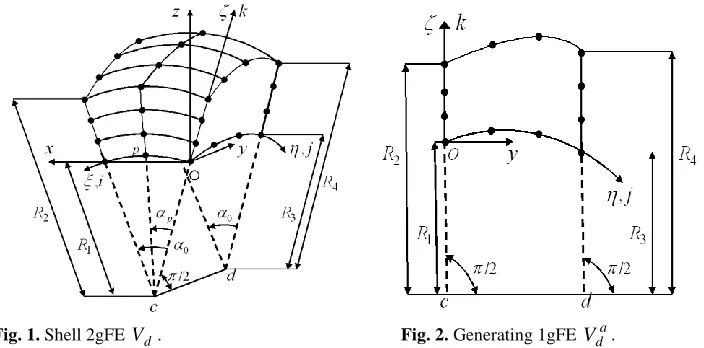
The fundamental principles of constructing the MgFE of the first type, applied to analyze a three-dimensional SSS of composite shells of revolution, are considered on the example of a complex-shaped shell two-grid FE (2gFE), Fig. 1. For the Vd 2gFE, the following local coordinate systems are introduced: Cartesian
Oxyz
, curvilinear O
, and integerijk
for the nodes of the coarse grid Hd of the 2gFE. The nodes of the Hd grid for the 2gFE are 36 in number and marked by dots in Fig. 1, withcd
denoting the shell axis. The generating single-grid FE (1gFE) ad
V for the Vd 2gFE has 12 nodes of the coarse grid Hd, denoted by dots in Fig. 2. The lateral sides of the a
d
intersection with the
cd
axis. The Vd 2gFE domain is obtained by rotating the generating complex-shaped 1gFE ad
V around the
cd
axis at the specified angle 0 (corresponding to partitioning the shell into 2gFE), and
0 is theapex angle of the Vd 2gFE. The basic partitiond
R of the Vd 2gFE comprises three homogeneous Ve 1gFE of the first order (described in detail in [12]), e1,...,M, and Mis the overall number of the Ve FE. The partition Rd accounts for the inhomogeneous structure and shape of the 2gFE and forms a fine grid hd, where Hd hd. It is noteworthy that some nodes of the coarse grids of the MgFE can
generally fail to match the nodes of the fine grids. We construct the Ve 1gFE by using the equations of the three-dimensional problem of the elasticity theory [10], written in the local Cartesian coordinate system of the Ve FE[12]. Thus, a three-dimensional SSS is implemented in the 2gFE. Radii R1 and R3 (R2 and R4) describe the bottom (top) boundaries of the lateral
edges of the 2gFE. In the Hd grid, the displacements functions ud, vd, and wd, used to reduce the dimension of the basic partition Rd, are calculated.
Fig. 1. Shell 2gFE Vd. Fig. 2. Generating 1gFE Vda.
The basis function
ijk for the i,j,k node of the coarse grid Hd of the Vd 2gFE issought in the form
) ( ) , ( ) , , (
ijk y Njk y Li , (1)where Njk(y,) denotes the basis functions of the j,k node of the Vda 1gFE,
corresponding to the polynomial Pd(y,) of the form [2] 2 8 2 7 2 6 2 5 4 3 2
1 a y a
a y
a y a
a y
a y
a Pd 3 11 3 10 3
9y a y a y
a
a12
3, j,k1,...,4, Li() is the second-order Lagrangepolynomial,
3 , 1 ) ( i p
p i p
p i L
, where
p (i) is the apex angle of thep
node(
i
node), i1,...,3, Fig. 1, and is the apex angle of the M point lying in the Vd 2gFE domain.Thus, the basis functions
ijk of the Vd 2gFE of the first type are represented by powerDenotations N
ijk, where i1,...,3; j,k1,...,4;
1,...,36. Then, using (1), wewrite the displacement functions
u
d,v
d, andw
d as
36 1 u Nud ,
36 1 v N
vd ,
36 1 w N
wd , (2)
where N, u, v, and w denote the basis function and displacements of the
-th node of the Hd grid.The functional of the total potential energy Пd of the base partition
R
d of the 2gFE iswritten in the form
) ] [ 2 1 ( 1 e T e M e e e T e d K
П
δ δ δ P
, (3)
where [Ke], Pe, and
δ
e denote the stiffness matrix, nodal force vectors, anddisplacement vectors of the Ve1gFE, corresponding to the coordinate system Oxyz of the
d V 2gFE.
Equations (2) are used to express the nodal displacement vector δe of the base 1gFE
e
V through the nodal displacement vector δd of the coarse grid Hd
(δd {u,v,w}T), i.e.
d d e e A δ
δ [ ] , (4)
where [Aed] denotes the rectangular matrix, e1,...,M .
Equation (4) is substituted into Eq. (3) and the condition Пd(δd)/δd 0 yields the
relationship [Kd]δd Fd, where
M e d e e T d ed A K A
K 1 ] ][ [ ] [ ] [ ,
M e e T d e d A 1 ] [ PF . (5)
Here [Kd] is the stiffness matrix, and Fdis the nodal force vector of the 2gFE Vd. Let the vector δd be determined. Equation (4) is used to calculate vector δe of the
nodal displacements of the Ve 1gFE in the coordinate system Oxyz of the Vd 2gFE. The
displacement vector δ*e of the Ve 1gFE (corresponding to the local Cartesian coordinate
system of the Ve 1gFE) is sought for by the expression δe*[Me]δe, where [Me] is the
rotation matrix [2]. The vector δ*e and the known algorithms of the FEM [1, 2] are used to
calculate the equivalent stress at the center of the Ve 1gFE domain.
The calculations of the elastic composite round cylindrical shells and panels, carried out using MgFE, are described in [12]. The base functions of the coarse grids of the 2gFE of these shells are determined in the form of Lagrange polynomials and using the power polynomials P(x,y,z) of the first, second, and third orders [12], written in the local
Cartesian coordinate systems. The MgFE of the shells of revolution are verified using the known numerical method [2, 12].
d
V 2gFE domain. Consequently, it is possible to use arbitrarily small basic partitions Rd, allowing one to arbitrarily exactly account for the complex shape and inhomogeneous (microinhomogeneous) structure of the 2gFE Vd and its complex fixing and loading, as
well as to arbitrarily exactly describe a three-dimensional SSS in the Vd 2gFE domain
(with no increase in the dimension of the Vd 2gFE, which is noteworthy).
As shown by the calculations, as the basic partitions of the MgFE become finer, the solution errors decrease. Similarly, the procedures described in Sec. 2 are used to design the composite 2gFE for calculating complex-shaped composite rings and shafts with central circular holes. Three-grid FE (3gFE) of the first type are designed using the 2gFE of the first type with the help of procedures similar to those in Sec. 2
You are free to use colour illustrations for the online version of the proceedings but any print version will be printed in black and white unless special arrangements have been made with the conference organiser. Please check whether or not this is the case. If the print version will be black and white only, you should check your figure captions carefully and remove any reference to colour in the illustration and text. In addition, some colour figures will degrade or suffer loss of information when converted to black and white, and this should be taken into account when preparing them.
3 Multigrid FE of the second type
3.1 Multigrid FE for calculating complex-shaped composite beams
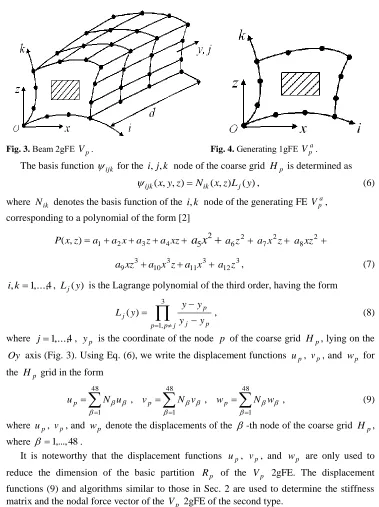
The main provisions of the construction procedure for the MgFE of the second type used to analyze the three-dimensional SSS of composite beams are considered on the example of the Vp 2gFE (Fig. 3), which is a complex-shaped rectilinear composite beam with a hole, with the hole section hatched in the figure. The domain of the Vp 2gFE is obtained by the parallel displacement of the generating complex-shaped 1gFE a
p
V (Fig. 4) with a hole
(hatched) along the Oy axis at the specific distance d. The basic partition Rp of the Vp 2gFE consists of the homogeneous 1gFE Ve of the first order, e1,...,M. The partition
p
R accounts for the inhomogeneous structure and complex shape of the Vp 2gFE and forms a fine grid hp, in which the coarse grid Hp of the 2gFE is nested, and the nodes of
the
H
p grid are marked by points (48 nodes, Fig. 3). The stress state in the Ve 1gFE is described by the equations of the three-dimensional problem of the elasticity theory [10], written in the local Cartesian coordinate system of the Ve FE. Consequently, a three-dimensional SSS is implemented in the Vp 2gFE domain. The nodes of the Vpa 1gFE ofFig. 3.Beam 2gFE Vp. Fig. 4.Generating 1gFE Vpa.
The basis function
ijk for the i,j,k node of the coarse grid Hp is determined as) ( ) , ( ) , ,
(x y z Nik x z Lj y
ijk
, (6)where Nik denotes the basis function of the i,k node of the generating FE Vpa,
corresponding to a polynomial of the form [2]
a a x a z a xz
z x
P( , ) 1 2 3 4
2 5
x
a
26z
a a7x2z a8xz2
3 11 3 10 3
9xz a x z a x
a a12z3, (7)
4 ,..., 1 ,k
i , Lj(y) is the Lagrange polynomial of the third order, having the form
3 , 1 ) ( j pp j p
p j y y y y y
L , (8)
where j1,...,4, yp is the coordinate of the node p of the coarse grid Hp, lying on the
Oy axis (Fig. 3). Using Eq. (6), we write the displacement functions up, vp, and wp for
the Hp grid in the form
48 1 u Nup ,
48 1 v N
vp ,
48 1 w N
wp , (9)
where up, vp, and wp denote the displacements of the
-th node of the coarse grid Hp,where 1,...,48.
It is noteworthy that the displacement functions up, vp, and wp are only used to
reduce the dimension of the basic partition Rp of the Vp 2gFE. The displacement
functions (9) and algorithms similar to those in Sec. 2 are used to determine the stiffness matrix and the nodal force vector of the Vp 2gFE of the second type.
Note 2. The proposed method allows designing 2gFE whose one characteristic dimension is significantly larger or smaller than all the others. In the Oy directionof the
large dimension of the Vp 2gFE, it is reasonable to use the high order of displacement
approximation (i.e., the high order of the Lagrange polynomials Lj(y)), which allows
3.2 Multigrid FE for calculating complex-shaped composite cylindrical shells
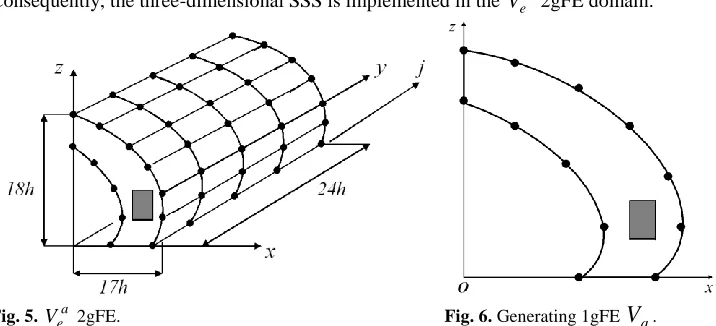
The construction procedure of the 2gFE of the second type, used to analyze the three-dimensional SSS of cylindrical shells of an inhomogeneous structure and complex shape, is considered on the example of the Vea 2gFE with characteristic dimensions of
h h
h 24 18
17 (Fig. 5), which has a hole and the section of which is hatched in the figure.
The generatrix (straight line) of the median surface of the Vea 2gFE is parallel to the Oy
axis (Fig. 5). The Vea 2gFE domain is obtained by the parallel displacement of the
generating complex-shaped 1gFE Va (Fig. 6) (the hole section is hatched) along the Oy
axis at a specified distance d24h. The basic partition Ra of the Vea 2gFE consists of cube-shaped homogeneous 1gFE Ve of the first order with side h, e1,...,M, where
Mdenotes the total number of the Ve FE. The partition Ra accounts for the
inhomogeneous structure and complex shape of the Vea 2gFE and forms a fine grid ha, in
which the coarse grid Ha of the 2gFE is nested (Ha ha). The nodes of the coarse grid
a
H are marked in Fig. 5 by points (60 nodes). The nodes of the Va 1gFE of the third order are the nodes of the coarse grid Ha, marked by points (12 nodes, Fig. 6). A stress state in
the Ve 1gFE is described by the equations of the three-dimensional problem of the
elasticity theory [10] (written in the local Cartesian coordinate system of the Ve FE).
Consequently, the three-dimensional SSS is implemented in the Vea 2gFE domain.
Fig. 5.Vea 2gFE. Fig. 6. Generating 1gFE
V
a.For the pair of numbers i,j, where i1,...,12, j1,...,5, we determine an integer
1
,
1,...,60. The basis function (x,y,z) for the
-th node in the coarse grid of the Vea 2gFE is sought in the form) ( ) , ( ) , ,
(x y z Ni x z Lj y
, (10)where 1,60, Ni(x,z) is the shape function of the
i
th node of the generating 1gFE Va,12 ,..., 1
i , corresponding to the polynomial P(x,z), presented in the local Cartesian coordinate system Oxz (Fig. 6), of the form (7), Lj(y) is the fourth-order Lagrange
polynomial (Eq. (8)), where j1,...,5, yp is the coordinate of the p node of the coarse
In Eq. (10), the basis functions 2gFE Vea of the second type are represented by power polynomials, i.e., functions of the form Ni(x,z) of the generating FE Va, and by
the Lagrange polynomials Lj(y) in the direction of the generating FE (along the Oyaxis).
Using Eq. (10), we write the displacement functions ua, va, and wa for the coarse grid
a H as
60
1
u N
ua ,
60
1
v N
va ,
60
1
w N
wa , (11)
where N, u, v, and w denote the basis function and displacements of the
-th node of the Ha grid.It is noteworthy that the displacement functions ua, va, and wa are only used to
reduce the dimension of the basic partition Ra of the 2gFE Vea. We use the displacement functions (11) and the algorithms similar to those in Sec. 2 to determine the stiffness matrix
and the nodal force vector of the Vea 2gFE of the second type.
3.3 Multigrid FE for calculating complex-shaped composite plates
We consider the construction procedure for the 2gFE of the second type in order to analyze the three-dimensional SSS of plates with an inhomogeneous structure on the example of the
complex-shaped composite laminated 2gFE Vgb (Fig. 7), where Oxyzis the Cartesian
coordinate system. The characteristic dimensions B and Hof the Vgb 2gFE significantly
exceed the dimension of h, with h being the thickness of the 2gFE. The Vgb 2gFE domain
is obtained by the parallel displacement of the generating 1gFE Vg (Fig. 8) along the Oy
axis at the given distance h. The coarse grid of the Vgb 2gFE has 27 nodes marked by
points in Fig. 7. The basic partition of the Vgb 2gFE consists of cube-shaped homogeneous
FE of the first order (rectangular parallelepiped [2]), in which a three-dimensional SSS is implemented. It is noteworthy that the basic partitions of the 2gFE can be arbitrarily small, i.e., can arbitrarily exactly account for the inhomogeneous structure and complex shape of
the 2gFE. The base function (x,y,z) for the
-th node in the coarse grid of the Vgb 2gFE is sought in the form (6), where
1,...,27, Ni(x,z) is the shape function of thei-th node of the generating 1gFE Vg, i1,...,9, corresponding to a polynomial of the
form 9 2 2
2 8 2 7 2 6 2 5 4 3 2 1
) ,
(x z a a x a z a xz a x a z a x z a xz a x z
Pg , presented
in the local Cartesian coordinate system Oxz, Fig. 8, and Lj(y) denotes the Lagrange
Fig. 7. Laminated 2gFE Vgb. Fig. 8. Generating 1gFE Vg.
The stiffness matrix and nodal force vector of the laminated 2gFE Vgb are determined
using procedures similar to those in Secs. 3.1 and 3.2. The discrete models of the plates are
generally comprised of complex-shaped 2gFE (such as curvilinear 2gFE Vgb) and 2gFE
shaped as a rectangular parallelepiped, constructed with the help of power polynomials [2], and Lagrange polynomials [12]. It is noteworthy that the proposed MgFE of the first and second types can be used in analyzing the three-dimensional SSS of corrugated plates, panels, and floors [19, 20] (corrugation can be shaped as a trapezium, rectangle, triangle, a part of a circular arc, etc.). Three-grid FE (3gFE) of the second type are designed using the 2gFE of the second type with the help of procedures similar to those in Secs. 2, 3.2, and 3.3.
3.4 Multigrid FE for calculating curvilinear composite beams
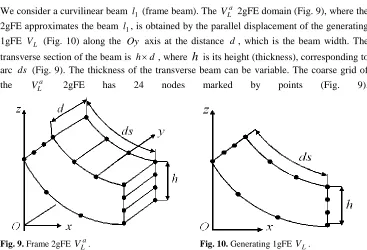
We consider a curvilinear beam l1 (frame beam). The VLa 2gFE domain (Fig. 9), where the
2gFE approximates the beam l1, is obtained by the parallel displacement of the generating
1gFE VL (Fig. 10) along the Oy axis at the distance d, which is the beam width. The
transverse section of the beam is hd , where
h
is its height (thickness), corresponding to arc ds (Fig. 9). The thickness of the transverse beam can be variable. The coarse grid of the VLa 2gFE has 24 nodes marked by points (Fig. 9).
The basis function (x,y,z) for the
-th node of the coarse grid of the VLa 2gFE is determined in the form (10), where
1,...,24, Ni(x,z) denotes the shape function of thei-th node of the generating 1gFE VL (Fig. 10), i1,...,12, corresponding to a polynomial of the form (7), written in the local Cartesian coordinate system Oxz (Fig. 10), and Lj(y)
denotes the Lagrange polynomials of the first order. i1,...,12. The stiffness matrix and
nodal force vector of the VLa 2gFE are determined in procedures similar to those in Secs. 3.2 and 3.3.
4 Conclusion
In this paper, three-dimensional composite and homogeneous MgFE of two types of complex shapes are considered, which are designed with the use of forming FE. The procedures for the construction of type 1 and type 2 MgFE are described, which are used for the calculation of composite (homogeneous) shells of rotation, cylindrical shells (with a variable radius of curvature), plates and beams of complex shape. The main advantages of the proposed MgFE are that they take into account the inhomogeneous, micro-inhomogeneous structure and complex shape of bodies, describe three-dimensional behavior in composite (homogeneous) bodies, form discrete models of small dimension and generate approximate solutions with a small error.
References
1. O.C. Zienkiewicz. The Finite Element Method in Engineering Science (McGraw-Hill, London, 1971)
2. D.H. Norrie and G. de Vries. An Introduction to Finite Element Analysis (Academic Press, New York, San Francisco, London, 1978)
3. A.P. Kiselev, N.A. Gureeva, R.Z. Kiselyova, Izv. Vuzov. Stroitel’stvo, 1, 106-112 (2010)
4. S.K. Golushko, Yu.V. Nemirovskii. Direct and Inverse Problems of the Mechanics of Elastic Composite Plates and Shells of Revolution (Fizmatlit, Moscow, 2008)
5. A. Ahmed A, S. Kapuria, Composite Structures, 158, 112–127 (2016)
6. E. Carrera, A. Pagani, S. Valvano, Composites Part B: Engineering, 111, 294 –314 (2017)
7. M.Y. Yasin, S. Kapuria, Composite Structures, 98, 202–214 (2013) 8. M. Cinefra, E. Carrera, Int. J. Num. Meth. Eng. 93, 2, 160-182 (2013)
9. M.F. Сaliri, A. J.M. Ferreira, V. Tita, Composite Structures, 156, 63–77 (2016)
10. V.I. Samul’. Fundamentals of the Theory of Elasticity and Plasticity (Vysshaya Shkola, Moscow, 1982)
11. A.D. Matveev, Vestnik Krasnoyarskogo Gosudarstvennogo Agrarnogo Universiteta, 3, 44-47 (2014)
13. A. D. Matveev. The Multigrid Finite Element Method in Calculating Three-Dimensional Homogeneous and Composite Solids. Uchen. Zap. Kazan. Univ. Ser.: Fiz.-Matem. Nauki, 158, No. 4, 530-543 (2016)
14. A.D. Matveev, Vestnik KrasGAU, 11, 131-140 (2017) 15. A.D. Matveev, Vestnik KrasGAU, 2, 90-103 (2018)
16. A.D. Matveev, Vestnik KrasGAU, 3, 126-137 (2018)
17. A.D. Matveev, IOP Conf. Ser.: Mater. Sci. Eng. 158, 1, 012067, 1-9 (2016)
18. A.D. Matveev, Vestnik KrasGAU, 6, 141-154 (2018)
19. Y Xia, M.I. Friswell, E.I Saavedra Flores, Itern. J. Solids Structures 49, 14, 1453-1462 (2012)