How to Construct UC-Secure Searchable Symmetric
Encryption Scheme
Kaoru Kurosawa Yasuhiro Ohtaki Ibaraki University, Japan
E-mail. {kurosawa, y.ohtaki}@mx.ibaraki.ac.jp
Abstract
A searchable symmetric encryption (SSE) scheme allows a client to store a set of encrypted files on an untrusted server in such a way that he can efficiently retrieve some of the encrypted files containing (or indexed by) specific keywords keeping the keywords and the files secret. In this paper, we first extend the model of SSE schemes to that of verifiable SSE schemes, and formulate the UC security. We then prove its weak equivalence with privacy and reliability. Finally we show an efficient verifiable SSE scheme which is UC-secure.
Keywords: searchable symmetric encryption, UC-security, symmetric-key encryption
1
Introduction
In the model of searchable symmetric encryption (SSE) schemes, a client stores a set of encrypted files Cj on an untrusted server in the store phase.
Later in the search phase, he can efficiently retrieve some of the encrypted files containing (or indexed by) specific keywords, keeping the keywords and the files secret (ideally without leaking any information to the server).
The first SSE scheme was proposed by Song, Wagner, Perrig [18]. Since then, single keyword search SSE schemes [6, 9, 11, 14], dynamic SSE schemes [15, 16, 17], multiple keyword search SSE schemes [3, 4, 8, 12, 13, 19] and more [10] have been studied extensively by many researchers.
In particular, for single keyword search SSE schemes, Curtmola, Garay, Kamara and Ostrovsky [6, 7] showed a rigorous definition of privacy of the
client1 after a series of works [1, 9, 11, 18]. They also constructed SSE-2, and claimed that it satisfies their definition of privacy.
However, privacy is not sufficient. A malicious server may return incor-rect search results to the client. Chang and Mitzenmacher showed how to detect such cheating by assuming that the client can always tell whether a file Dj is associated with a given keyword wi or not by checking Dj [9,
Sec.5].
On the other hand, even if a protocol Π is secure in a “stand-alone” setting where only a single protocol instance runs in isolation, it may not be secure in a more complex setting. To this problem, Canetti introduced a notion of universal composability (UC), and proved the UC composition theorem which states that if a protocol Π is UC secure, then its security is preserved under a general protocol composition operation [5].
In this paper,
• We first extend the model of SSE schemes to that of verifiable SSE schemes, and define the reliability without assuming the assumption that Chang and Mitzenmacher made in [9, Sec.5].
Note that their assumption does not hold if the files are pictures or videos, for example. Also if a malicious server replaces (Ci,MAC(Ci))
with some (Cj,MAC(Cj)) in the search phase, then their method cannot
detect such cheating.
• We next formulate the UC security of verifiable SSE schemes, and prove its weak equivalence with privacy and reliability.
• Finally we show an efficient verifiable SSE scheme, and prove that it is UC-secure.
We also point out a flaw of SSE-2, and show how to fix the flaw.
2
Preliminaries
2.1 Notation
IfX is a string, then|X|denotes the bit length ofX. IfX is a set, then|X|
denotes the cardinality ofX. Letx←$ X denote sampling an element from X at random and assigning it to x. PPT means probabilistic polynomial time.
Letλbe the security parameter. We say that a functionϵ(λ) is negligible if it vanishes faster than the inverse of any polynomial inλ.
2.2 Pseudorandom Permutation and Function
LetPerm(X) be the set of all permutations on a setX. We say that a poly-nomial time computable function f :{0,1}λ × X → X is a pseudorandom permutaton iff(k,·) is a permutation onX for anyk∈ {0,1}λ and
|Pr(Bf(k,·)= 1 :k← {$ 0,1}λ)−Pr(Bπ = 1 :π ←$ Perm(X))|
is negligible for any PPT distinguisher B. We also say thatπ is a random permutation ifπ ←$ Perm(X).
We say that a polynomial time computable functionf :{0,1}λ×{0,1}ℓ1 →
{0,1}ℓ2 is a pseudorandom function if
|Pr(Bf(k,·)= 1 :k← {$ 0,1}λ)−Pr(BRO= 1)|
is negligible for any PPT distinguisherB, whereRO:{0,1}ℓ1 → {0,1}ℓ2 is the random oracle.
We sometimes writefk(·) instead of f(k,·), where kis a key.
2.3 Symmetric-Key Encryption
Let SKE= (G, E, E−1) be a symmetric-key encryption scheme, where G is a key generation algorithm, E is an encryption algorithm and E−1 is the decryption algorithm. Let left(m0, m1) = m0 and right(m0, m1) = m1.
We say that SKEis Left-or-Right (LOR) secure [2] if
|Pr(AEk(left(·,·))= 1)−Pr(AEk(right(·,·)) = 1)|
is negligible for any PPT adversaryAwho queries (m0, m1) such that|m0|=
|m1|to the oracle, wherek $
←G(1λ).
It is known that the counter mode is LOR secure if the underlying block cipher (say, AES) is a pseudorandom permutation [2].
3
Verifiable Searchable Symmetric Encryption
In this section, we extend the model of searchable symmetric encryption (SSE) schemes to that ofverifiableSSE schemes. We also define itsreliability
Let D={D1,· · ·, Dn} be a set of files, and W ={w1,· · ·, wm}be a set
of keywords. LetIndex= (ei,j) be an m×n binary matrix such that
ei,j =
{
1 if a keywordwi is contained in a fileDj
0 otherwise . (1)
LetD(w) be the set of files Dj which contain a keywordw, and C(w) be
the set of ciphertextsCj ofDj ∈D(w), andList(w) be the set of indexes j
ofDj ∈D(w). Namely
List(wi) = {j|ei,j = 1},
D(wi) = {Dj |j ∈List(wi)},
C(wi) = {Cj |j∈List(wi)}. Example 3.1 Let D={D1,· · ·, D5}, W ={w1, w2} and
Index= (
1 0 1 0 1 0 1 0 1 0
)
. (2)
Then
List(w1) = {1,3,5},
D(w1) = {D1, D3, D5},
C(w1) = {C1, C3, C5}
and
List(w2) = {2,4},
D(w2) = {D2, D4},
C(w2) = {C2, C4}.
3.1 Verifiable SSE
A verifiable SSE scheme consists of six polynomial time algorithms
vSSE= (Gen,Enc,Trpdr,Search,Dec,Verify) such that
• (C,I)←Enc(K,D,W,Index): is a probabilistic encryption algorithm which outputs an encrypted index I and the set of ciphertexts C = (C1,· · ·, Cn), whereD= (D1,· · ·, Dn) andCj is a ciphertext ofDj for
j= 1, . . . , n.
We assume thatIincludes an authenticatorT agi related to a keyword
wi fori= 1, . . . , m.
• t(w) ← Trpdr(K, w): is a deterministic algorithm which outputs a trapdoort(w) for a keywordw.
• (C(w), T ag ) ← Search(I,C, t(w)): is a deterministic search algo-rithm.
•
accept/reject←Verify(K, t(w),C′(w), T ag′): is a deterministic verification algorithm which checks the validity of (C′(w), T ag′).
• Dj ←Dec(K, Cj): is a deterministic decryption algorithm.
(Correctness) Suppose that
K←Gen(1λ), (C,I)←Enc(K,D,W,Index),
t(w)←Trpdr(K, w), (C(w), T ag)←Search(I,C, t(w)). Then it must be that
accept←Verify(K, t(w),C(w), T ag)
and
D(w) ={Dj |Dj =Dec(K, Cj), Cj ∈C(w)}.
The definition and the correctness of SSE schemes [6, 7] are obtained by deleting the boxed parts.
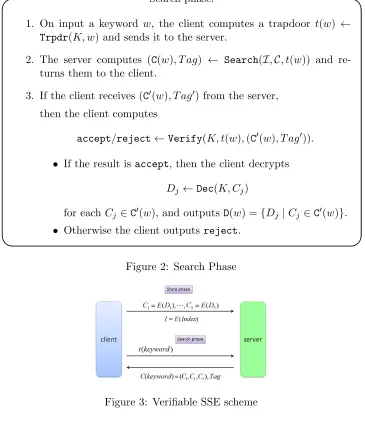
Store phase:
1. On input (D,W,Index), the client generates a key K←Gen(1λ). He computes
(C,I)←Enc(K,D,W,Index) and sends them to the server.
2. The server receives (C,I) and then stores them.
Figure 1: Store Phase
3.2 Privacy
In this subsection, we formulate privacy based on the work of Curtmola, Garay, Kamara and Ostrovsky [6, 7].
In the store phase of any (verifiable) SSE scheme, the number of keywords m, the number of files nand |Dj| for j = 1, . . . , n are leaked to the server
from (C,I). In each search phase,List(w) is leaked to the server, where w is the search keyword, because otherwise the server cannot returnC(w) to the client.
Further suppose that the client sends t(w1) to the server in the first
search phase and the tenth search phase. Then the server sees that the keywords the client searched in the first search phase and in the tenth search phase are the same.
We call these leaked information the minimum leakage. The notion of
privacyrequires that the server should not be able to learn any more
infor-mation.
Formally, we consider a real gameGamerealand a simulation gameGamesim.
The real gameGamereal is played by two PPT players, a distinguisherB and
a challenger, as follows.
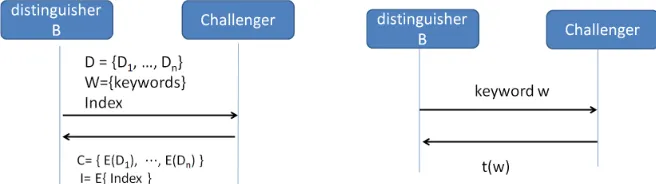
(Gamereal: Store phase)
1. A distinguisherB chooses (D,W,Index) and sends them to the chal-lenger.
Search phase:
1. On input a keyword w, the client computes a trapdoor t(w) ← Trpdr(K, w) and sends it to the server.
2. The server computes (C(w), T ag) ← Search(I,C, t(w)) and re-turns them to the client.
3. If the client receives (C′(w), T ag′) from the server, then the client computes
accept/reject←Verify(K, t(w),(C′(w), T ag′)).
• If the result is accept, then the client decrypts
Dj ←Dec(K, Cj)
for each Cj ∈C′(w), and outputsD(w) ={Dj |Cj ∈C′(w)}. • Otherwise the client outputs reject.
Figure 2: Search Phase
Figure 3: Verifiable SSE scheme
(Gamereal: Search phase)Fori= 1,· · ·, q, do:
1. B chooses a keyword ˜wi and sends it to the challenger.
2. The challenger sends a trapdoort( ˜wi)←TrpdrK( ˜wi) to B.
Figure 4: Gamereal: Store phase Figure 5: Gamereal: Search phase
The simulation game Gamesim is played by three PPT players, a
distin-guisherB and a challenger and a simulatorSim, as described below.
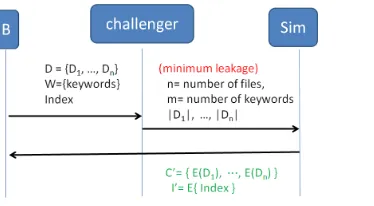
(Gamesim: Store phase)
1. B chooses (D,W,Index) and sends them to the challenger. 2. The challenger sendsm, n,|D1|,· · ·,|Dn|toSim.
He setsc0←0 and J ← ∅.
3. Simcomputes (C′,I′) fromm, n and |D1|,· · ·,|Dn|,
and sends them to the challenger.
4. The challenger returns (C′,I′) to B.
(Gamesim: Search phase)Fori= 1,· · ·, q, do:
1. B chooses a keyword ˜wi and sends it to the challenger.
2. If ( ˜wi, c)∈J for somec, then the challenger sendsc toSim.
Otherwise he sends List( ˜wi) to Sim. He then sets c0 ← c0+ 1 and
J ←J∪ {( ˜wi, c0)}.
3. Simreturns t′( ˜wi) to the challenger.
4. The challenger returns t′( ˜wi) to B.
Finally B outputs a bit b. (See Fig.6 and Fig.7.)
Then we define the advantage of privacy as
AdvprivSim(B) =|Pr(b= 1 inGamereal)−Pr(b= 1 inGamesim)|. (3)
Further let
AdvprivSim = max
Figure 6: Gamesim: Store phase
Figure 7: Gamesim: Search phase
Definition 3.1 We say that a (verifiable) SSE scheme satisfies privacy if
there exists a PPT simulatorSim such that AdvprivSim is negligible.
“Adaptive semantic security” of Curtmola et al. [7, Definition 4.11] requires that for any PPT distinguisher B, there exists a PPT Sim such that eq.(3) is negligible. On the other hand, our definition requires that there exists a PPT Sim such that for any PPT distinguisher B, eq.(3) is negligible. Hence our definition is slightly stronger. This small change is important when we prove the relationship with UC-security.
3.3 Reliability
In this subsection, we formulate reliability of verifiable SSE schemes. Sup-pose that a malicious server returned an incorrect search result. Then the
reliabilityrequires that the client can detect this cheating.
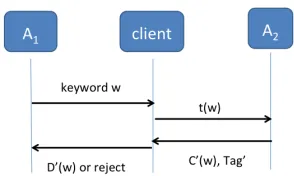
Consider the following attack game among three PPT algorithms, the client, A1 and A2, where A = (A1, A2) is an adversary. (See Fig.8.) We
assume thatA1 andA2 can communicate freely.
(Store phase)
1. A1 chooses (D,W,Index) and sends them to the client.
2. The client generatesK ←Gen(1λ), and then
sends (C,I)←Enc(K,D,W,Index) to A2.
(Search phase)For i= 1,· · ·, q, do:
1. A1 chooses a keyword ˜wi and sends it to the client.
Figure 8: Attack game on reliability
3. A2 returns (C′( ˜wi), T agi′) to the client.
4. The client returnsD′( ˜wi) or rejecttoA1 according to Fig.2.
We say that the adversary (A1, A2) succeeds if A1 receives D′( ˜wi) such
thatD′( ˜wi)̸=D( ˜wi) for some ˜wi. In this case, we letA1 output 1. Otherwise
A1 outputs 0.
Then we define the advantage of reliability by
Advauth(A1, A2) = Pr((A1, A2) succeeds ).
Further let
Advauth= max
(A1,A2)Adv
auth(A
1, A2).
Definition 3.2 We say that a verifiable SSE scheme satisfies reliability if
Advauth is negligible.
Further we say that the adversary (A1, A2) strongly succeeds if the client
accepts (C′( ˜wi), T ag′i) such that (C′( ˜wi), T ag′i) ̸= (C( ˜wi), T agi) for some ˜wi,
where
(C( ˜wi), T agi)←Search(I,C, t( ˜wi)).
In this case, we let A1 output 1. Otherwise A1 outputs 0. Then we define
the advantage of strong reliability by
Advsauth(A1, A2) = Pr((A1, A2) strongly succeeds ).
Further let
Advsauth= max
(A1,A2)Adv
sauth(A
1, A2).
Definition 3.3 We say that a verifiable SSE scheme satisfies strong
relia-bility if Advsauth is negligible.
4
UC Secure Verifiable SSE Scheme
In this section, we define the universally composable (UC) security [5] of verifiable SSE schemes. More precisely, we define the ideal functionality of verifiable SSE schemes.
4.1 UC Framework
In general, even if a protocol Π is secure in a“stand-alone” setting where only a single protocol instance runs in isolation, it may not be secure in a more complex setting. To this problem, Canetti introduced a notion of universal composability (UC), and proved the UC composition theorem which states that if a protocol Π is UC secure, then its security is preserved under a general protocol composition operation [5].
In the UC framework of a given protocol Π, the real world and the ideal world of Π are defined. In the ideal world, a real world adversary A can corrupt some of the parties who run the protocol Π. In the ideal world, each party is replaced with a dummy party, and the run of Π is replaced with an ideal functionalityF. Also an ideal world adversary Scan corrupt some dummy parties.
Then the protocol Π is called UC-secure if no environment Z can dis-tinguish the real world and the ideal world, whereZ generates the input to all parties, receives all their outputs, and in addition interacts withA or S
in an arbitrary way.
More precisely, Π is said to securely realize the ideal functionality F if for any adversary A, there exists an ideal world adversary S such that no environmentZ can tell whether it is interacting with A and the parties running the protocol, or with S and the dummy parties that interact with
F in the ideal world.
4.2 Real World
In this subsection, we describe the real world of a verifiable SSE scheme in the UC framework. For simplicity, we ignore session id.
(Store phase)
1. An environmentZchooses (D,W,Index) and sends them to the client. 2. The client generates a keyK ←Gen(1λ).
He computes
and sends them to the server.
3. The server receives (C,I) and then stores them.
(Search phase)
1. Z chooses a keyword w, and sends it to the client.
2. The client computes a trapdoor t(w) ← Trpdr(K, w) and sends it to the server.
3. The server returns (C′(w), T ag′) to the client. 4. The client computes
accept/reject←Verify(K, t(w),C′(w), T ag′).
• If the result isaccept, then the client decrypts
Dj ←Dec(K, Cj)
for eachCj ∈C(w), and sendsD(w) ={Dj |Cj ∈C(w)}toZ. • Otherwise the client sendsrejecttoZ.
An adversaryA can control the server arbitrarily. (We assume that the client is honest.) Z can communicate with A in an arbitrary way. Finally
Z outputs 1 or 0. (See Fig.9.)
4.3 Ideal World
In this subsection, we introduce the ideal functionality FSSE, and describe
the ideal world of a verifiable SSE scheme. For simplicity, we ignore session id.
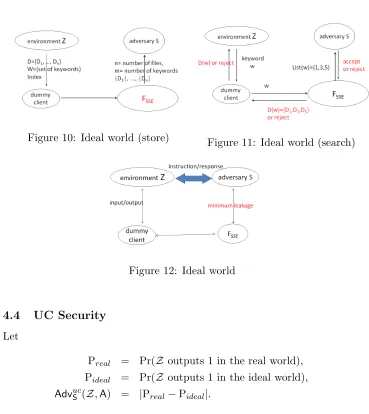
(Store phase)(See Fig.10.)
1. Z chooses (D,W,Index) and sends them to the dummy client. 2. The dummy client relays (D,W,Index) to FSSE.
3. FSSE records (D,W,Index). It then sends m, n,|D1|,· · ·,|Dn| to the
ideal adversaryS.
It setsc0 ←0 andJ ← ∅.
(Search phase)(See Fig.11.)
1. Z chooses a keyword w, and sends it to the dummy client.
2. The dummy client relaysw toFSSE.
3. If (w, c)∈J for somec, then FSSE sends c toS.
Otherwise it sends List(w) to S. It then sets c0 ← c0 + 1 and J ←
J∪ {(w, c0)}.
4. Sreturns acceptorrejecttoFSSE.
5. FSSE sends
X= {
D(w) ifFSSE received acceptfromS
reject ifFSSE received rejectfromS
to the dummy client.
6. The dummy client relaysX toZ.
Z can communicate withSin an arbitrary way. (See Fig.12.) Finally Z outputs 1 or 0.
Note that
• The ideal world adversaryS learns only the minimum leakage (which is shown in Sec.3.2).
• The dummy client receives D(w) or reject. It means that he never receivesD′(w) such thatD′(w)̸=D(w).
Figure 10: Ideal world (store) Figure 11: Ideal world (search)
Figure 12: Ideal world
4.4 UC Security
Let
Preal = Pr(Z outputs 1 in the real world),
Pideal = Pr(Z outputs 1 in the ideal world),
AdvucS (Z,A) = |Preal−Pideal|.
Then we say that a verifiable SSE scheme securely realizes the ideal functionality FSSE if for any real world adversary A, there exists an ideal
world adversary S such that AdvucS (Z,A) is negligible for any environment
Z.
Now we have the following from the UC composition theorem [5]. Let Σ be a larger protocol which uses a verifiable SSE scheme Π as a sub-protocol. Let Σ′ be a variant of Σ such that Π is replaced with the ideal functionality
FSSE. Then Σ is as secure as Σ′ if Π securely realizes FSSE.
Namely for any adversary A against Σ, there exists an adversary S
5
Weak Equivalence
In this section, we prove the following Theorems.
Theorem 5.1 If a verifiable SSE scheme Π securely realizes FSSE, thenΠ
satisfies privacy and reliability.
Theorem 5.2 If a verifiable SSE scheme Π satisfies privacy and strongly
reliability, thenΠ securely realizes FSSE.
5.1 Proof of Theorem 5.1
(Proof of privacy)In the real world (see Fig.9), consider an adversaryA0
such thatA0 sends each messageY that the server received from the client
toZ. (Namely Y = (C,I) in the store phase, and Y = t(w) in the search phase.) Look atZ as a distinguisher and (client, server,A) as a challenger as shown in Fig.13. Then this real world can be seen as the real game of privacy.
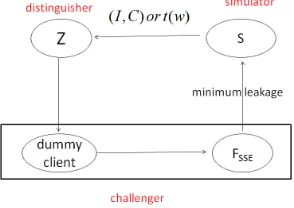
On the other hand, in the ideal world, there exists an adversarySwhich sends almost the same Y to Z because Z cannot distinguish between the real world and the ideal world from our assumption. Now look at Z as a distinguisher, S as a simulator and (dummy-client, FSSE) as a challenger
as shown in Fig.14. Then this real world can be seen as the ideal game of privacy.
Figure 13: Real world (privacy) Figure 14: Ideal world (privacy)
This means that
Therefore we have
AdvprivS = max Z Adv
priv S (Z)
= max Z Adv
uc
S(Z, A0)
= negligible
from our assumption. Hence Π satisfies privacy.
(Proof of reliability)For an adversary (A1, A2) on reliability (see Sec.3.3),
consider an environmentZ and a real world adversaryAsuch that (Z,A) = (A1, A2). Then there exists an ideal world adversaryS such that
AdvucS (Z, A) =|Preal−Psim|=negligible
from our assumption.
In the ideal world, Z never receives D′(w) such that D′(w) ̸= D(w) for any search keywordw(see Fig.11). Therefore
Pideal = Pr(Z outputs 1)
= Pr(A1 outputs 1)
= 0.
Hence Preal=negligible. This means that
Advauth(A1, A2) = Preal=negligible.
Therefore Π satisfies reliability.
5.2 Proof of Theorem 5.2
We say that (C′(w), T ag′) is invalid if (C′(w), T ag′)̸= (C(w), T ag), where (C(w), T ag)←Search(I,C, t(w)). (4) Fix a real world adversaryA arbitrarily. In the following, we consider a series of gamesGame0,· · ·,Game3, whereGame0 is the real world. Let
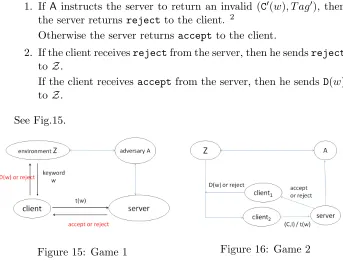
pi= Pr(Z outputs 1 in Gamei). (Game1) In this game, we modify Game0 as follows.
In the store phase, the client records (D,W,Index).
1. If A instructs the server to return an invalid (C′(w), T ag′), then the server returnsrejectto the client. 2
Otherwise the server returnsacceptto the client.
2. If the client receivesrejectfrom the server, then he sendsreject toZ.
If the client receivesacceptfrom the server, then he sends D(w) toZ.
See Fig.15.
Figure 15: Game 1 Figure 16: Game 2
LetBAD be the event that the client accepts an invalid (C′(w), T ag′) inGame0. Then it holds that
|p0−p1| ≤Pr(BAD)
Now consider an adversary (A1, A2) on the reliability such that (A1, A2) =
(Z,(A, server)) inGame0. Then we can see that
Pr(BAD) =Advsauth(A1, A2)
Therefore we have
|p0−p1| ≤Advsauth.
(Game2) In this game, we modifyGame1as follows. We replace the client with
(client1, client2) such that the server receives a message from client2,
and sendsacceptorrejecttoclient1. (See Fig.16.) Namely;
• Both ofclient1 and client2 receive the (same) input from Z.
• In each phase, if the client sendsY to the server,client2 sends Y
to the server.
• In the search phase,client1 receivesacceptor rejectfrom the
server, and sendsD(w) or rejecttoZ. This change is conceptual only. Thereforep2=p1.
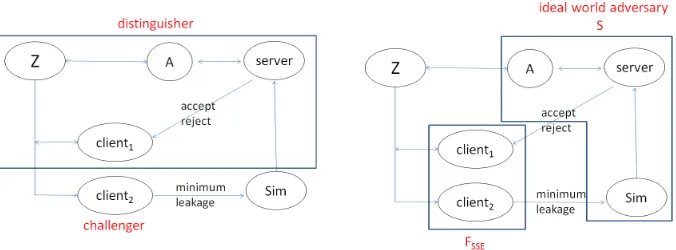
(Game3) In this game, we modifyGame2 as follows. Since Π satisfies privacy
from our assumption, there exists a simulatorSimsuch thatAdvprivSim = negligible.
Now inGame3,client2plays the role of the challenger in the simulation
game of privacy. Namely he sends the minimum leakage to Sim. Sim
then sends its outputs (the simulated message) to the server.
Further look at (Z, client1, server,A) as a distinguisher of the privacy
game (see Fig.17). Then Game3 is the simulation game and Game2 is
the real game. Therefore it holds that
|p3−p2| ≤AdvprivSim.
InGame3, (client1, client2) behaves exactly in the same way as the ideal
functionality FSSE. Further look at (A, server,Sim) as the ideal world
ad-versaryS(see Fig.18). ThenGame3 can be seen as the ideal world of the UC
framework.
Therefore we have
AdvucS (Z, A) = |p0−p3|
≤ Advsauth+AdvprivSim
for anyZ. FinallyAdvsauthandAdvprivSim are negligible from our assumption. Hence Π securely realizesFSSE.
6
On SSE-2 of Curtmola et al.
In [6, 7], Curtmola et al. presented an SSE scheme called SSE-2, and claimed that it satisfies privacy.
In this section, we first point out a flaw of SSE-2. We next show how to fix the flaw. Then we prove the privacy of the modified SSE-2.
6.1 Flaw of SSE-2
Figure 17: Game 3
Figure 18: Game 3 = ideal world
(Store phase:) Letπk=π(k,·) be a pseudorandom permutation, wherek
is a key. Then the client constructs an arrayI as follows. Initially, let
I(x) = 0 for all x. Next
• SinceList(w1) = (1,3,5), set
I(πk(w1,1)) = 1, I(πk(w1,2)) = 3, I(πk(w1,3)) = 5, (5)
• SinceList(w2) = (2,4), set
I(πk(w2,1)) = 2, I(πk(w2,2)) = 4 (6)
The client storesI and C={C1,· · ·, C5} to the server, whereCj is a
ciphertext ofDj.
(Search phase:) Suppose that the client wants to retrieve the files which containw1. Then the client sends
t(w1) = (πk(w1,1), . . . , πk(w1,5))
to the server.
From eq.(5), the server sees thatList(w1) = (1,3,5). The server then
returnsC(w1) ={C1, C3, C5} to the client.
The client finally decrypts them to obtainD(w1) ={D1, D3, D5}.
The above scheme, however, does not satisfy privacy. The server sees that each file contains just one keyword because each file indexj∈ {1, . . . ,5} appears once in I.
(a) Letcbe the number of entries in I that already containj.
(This means thatj appears ctimes in I.)
(b) For 1≤h≤m−c, setI[πk(0ℓ, n+h)] =j,
whereℓis the bit length of each keyword.
In the above example, n= 5, m= 2, and c= 1 for j= 1, . . . ,5. There-fore the above procedure says that forj = 1, . . . ,5, set I[πk(0ℓ,5 + 1)] =j.
This means that the client sets
I[πk(0ℓ,6)] ← 1
.. .
I[πk(0ℓ,6)] ← 5
At the end, we have I[πk(0ℓ,6)] = 5 only ! Namely only 5 appears twice,
but each j∈ {1, . . . ,4} appears once in I.
Therefore the above scheme (which is SSE-2) still does not satisfy pri-vacy.
6.2 Modified SSE-2
In this subsection, we show how to fix the flaw of SSE-2.
We assume that W = {0,1}ℓ for some ℓ = O(log2λ), where λ is the security parameter. Hencem= 2ℓ. LetSKE= (G, E, E−1) be a symmetric-key encryption scheme.
(Store phase:) The client takes (D,W,Index) as an input, where W =
{0,1}ℓ and Index = (ei,j) is defined by eq.(1). Let πk =π(k,·) be a
pseudorandom permutation on
X ={0,1} × {0,1}ℓ× {1, . . . , n}. (7)
1. The client generateske←G(1λ) and computesCj =Eke(Dj) for
j= 1, . . . , n. Let C= (C1, . . . , Cn).
2. The client chooses a keykof π randomly, and sets
I(πk(1, wi, j)) ← ei,j (8)
I(πk(0, wi, j)) ← 1−ei,j (9)
The client stores (C,I) to the server.
(Search phase:) The client takes a keyword w∈ W as an input.
1. Letaj =πk(1, w, j) for j= 1, . . . , n. Then the client sends
t(w) = (a1, . . . , an)
to the server.
2. From t(w) = (a1, . . . , an), the server sets
List(w) ={j| I(aj) = 1}.
(Remember eq.(8).) She then returnsC(w) ={Cj |j∈List(w)}
to the client.
3. For each Cj ∈ C(w), the client computes Dj = E−1(Cj) and
outputsD(w) ={Dj |Cj ∈C(w)}.
Consider Example 3.1. Then the client sets
I(π(1, w1,1)) = 1, I(π(0, w1,1)) = 0
I(π(1, w1,2)) = 0, I(π(0, w1,2)) = 1
I(π(1, w1,3)) = 1, I(π(0, w1,3)) = 0
I(π(1, w1,4)) = 0, I(π(0, w1,4)) = 1
I(π(1, w1,5)) = 1, I(π(0, w1,5)) = 0
For a search keywordw1, the client sends
t(w1) = (a1, a2, a3, a4, a5)
= (π(1, w1,1), π(1, w1,2), π(1, w1,3), π(1, w1,4), π(1, w1,5)).
to the server. The server sees that
I(π(1, w1,1)) =I(π(1, w1,3)) =I(π(1, w1,5)) = 1.
Hence the server returns C(w1) ={C1, C3, C5}to the client.
6.3 Privacy of Modified SSE-2
(Proof) We construct a simulatorSimin the simulation gameGamesimof the
privacy game as follows.
(Store phase:) 1. Sim is given n, m(= 2ℓ) and |D1|,· · ·,|Dn| from the
challenger.
2. Sim generates ke ← G(1λ) and computes Cj′ = Eke(0|
Dj|) for
j= 1, . . . , n. Let C′ = (C1′, . . . , Cn′).
3. Sim chooses a key kof psuedorandom permutation π on X ran-domly, whereX is given by eq.(7).
Fori= 1, . . . , mand j= 1, . . . , n,Sim sets
I′(πk(1, wi, j)) ← 1, (10) I′(πk(0, wi, j)) ← 0. (11)
Simreturns (C′,I′) to the challenger.
(Search phase:) Sim setsc1 ←0 and L← ∅.
Fori= 1, . . . , q, do:
• Suppose thatSim is givenList(w) for some w∈ W by the chal-lenger. Then let c1←c1+ 1. For j= 1, . . . , n, set
aj =
{
πk(1, c1, j) if j∈List(w)
πk(0, c1, j) if j̸∈List(w)
Let
t′(w) ← (a1, . . . , an)
L ← L∪ {(c1, t′(w))}
Simreturns t′(w) to the challenger.
• Suppose thatSim is givenc∈ {1,2, . . .} by the challenger. Then
Simfinds (c, t)∈L, and returns tto the challenger.
We will prove that no distinguisherB can distinguish between Gamereal
and Gamesim by using a series of games Game0,· · ·,Game4, where Game0 =
Gamereal. Let
• Game1 is the same as Game0 except for that Cj is replaced with Cj′ =
Eke(0|
Dj|) for j= 1, . . . , n. Then|p
1−p0|is negligible becauseSKE is
LOR secure.
• Game2is the same asGame1except for thatπkis replaced with a random
permutation ¯π on X. Then |p2 −p1| is negligible because πk is a
pseudorandom permutation.
• Game3is the same asGame2except for the following. In the store phase,
the client recordsIndex= (ei,j), and sets
I(¯π(1, wi, j)) ← 1, (12)
I(¯π(0, wi, j)) ← 0. (13)
fori= 1, . . . , mand j = 1, . . . , n. In the search phase, the client set
aj =
{ ¯
π(1, w, j) if j∈List(w) ¯
π(0, w, j) if j̸∈List(w)
for j = 1, . . . , n. Then it is easy to see that p3 = p2 because ¯π is a
random permutation.
• Game4 is the same as Game3 except for that ¯π is replaced with a
pseu-dorandom permutationπk. Then|p4−p3|is negligible.
It is easy to see thatp4 = Pr(b= 1 inGamesim). Therefore
AdvprivSim(B) = |Pr(b= 1 inGamereal)−Pr(b= 1 inGamesim)|
= |p0−p4|
≤ |p0−p1|+|p1−p2|+|p2−p3|+|p3−p4|
= negligible
for any distinguisherB. Therefore the SSE scheme satisfies privacy.
Q.E.D.
6.4 Efficiency of Modified SSE-2
In the modified SSE-2 scheme,
|I| = 2mn
7
More Efficient (Verifiable) SSE Scheme
In this section, we first show a more efficient SSE scheme than the modified SSE-2. We next extend it to a verifiable SSE scheme.
Then we prove the privacy and the strong reliability of the verifiable SSE scheme. This means that the verifiable SSE scheme securely realizes the ideal functionalityFSSE from Theorem 5.2.
7.1 More Efficient SSE Scheme
In this subsection, we show a more efficient SSE scheme than the modified SSE-2.
Similarly to (the modified) SSE-2, we assume thatW ={0,1}ℓ for some ℓ = O(log2λ), where λ is the security parameter. Hence m = 2ℓ. Let SKE= (G, E, E−1) be a symmetric-key encryption scheme.
(Store phase:) The client takes (D,W,Index) as an input, where W =
{0,1}ℓ and Index = (ei,j) is defined by eq.(1). Let πk =π(k,·) be a
pseudorandom permutation onW ={0,1}ℓ, and
g : {0,1}λ× {0,1}ℓ→ {0,1}n
be a psuedorandom function.
1. The client generateske←G(1λ) and computesCj =Eke(Dj) for
j= 1, . . . , n. Let C= (C1, . . . , Cn).
2. The client choosesk and k′ randomly, where k is a key of π and k′ is a key of g. The client sets
I(πk(wi)) = (ei,1, . . . , ei,n)⊕gk′(wi) (14)
for i = 1, . . . , m, where m = 2ℓ, wi ∈ W and ⊕ denotes the
bitwise XOR.
The client stores (C,I) to the server.
(Search phase:) The client takes a keyword w∈ W as an input.
1. The client sends
t(w) = (πk(w), gk′(w)) (15)
2. The server computes
(e1, . . . , en) =I(πk(w))⊕gk′(w). (16)
She then returnsC(w) ={Cj |ej = 1} to the client.
3. For each Cj ∈ C(w), the client computes Dj = E−1(Cj) and
outputsD(w) ={Dj |Cj ∈C(w)}.
Consider Example 3.1. Letw1 = 0 and w2 = 1. Then the client sets
I(πk(0)) = (10101)⊕gk′(0) I(πk(1)) = (01010)⊕gk′(1).
If the search keyword isw1 = 0, then the client sends
t(0) = (πk(0), gk′(0))
to the server. The server computes
I(πk(0))⊕gk′(0) = (10101)
and returnsC(w1) ={C1, C3, C5} to the client.
The privacy will be proved by Corollary 7.1.
(Remark) Our SSE scheme can be viewed as a variant ofScheme1 of Chang and Mitzenmacher [9]. Let
F : {0,1}λ× {0,1}ℓ → {0,1}λ
G : {0,1}λ× {1, . . . , n} → {0,1}
be two psuedorandom functions. LetFk =F(k,·) andGk =G(k,·). Then
inScheme1, eq.(14) is replaced with
I(πk(wi)) = (ei,1, . . . , ei,n)⊕(Gri(1), . . . , Gri(n))
whereri =Fk′(wi). Eq.(15) is replaced with
t(w) = (p=πk(w), r=Fk′(p))
and eq.(16) is replaced with
(e1, . . . , en) =I(p)⊕(Gr(1), . . . , Gr(n)). (17)
However, we cannot prove the privacy ofScheme1. The reason is as follows. In the store phase, the simulator Sim sends I(p) to the challenger. In the search phase,Simis given (e1, . . . , en) by the challenger. ThenSim must be
7.2 Extension to Verifiable SSE Scheme
In this subsection, we extend the above SSE scheme to a verifiable SSE scheme.
As before, we assume that W ={0,1}ℓ for some ℓ =O(log2λ), where λ is the security parameter. Hence m = 2ℓ. Let SKE = (G, E, E−1) be a symmetric-key encryption scheme.
(Store phase:) The client takes (D,W,Index) as an input, where W =
{0,1}ℓ. Let πk = π(k,·) be a pseudorandom permutation on W = {0,1}ℓ, and
g : {0,1}λ× {0,1}ℓ→ {0,1}n
MAC : {0,1}λ× {0,1}∗ → {0,1}λ be two psuedorandom functions.
1. The client generateske←G(1λ) and computesCj =Eke(Dj) for
j= 1, . . . , n. Let C= (C1, . . . , Cn).
2. The client choosesk, k′ and km randomly, where k is a key ofπ,
k′ is a key of gand km is a key ofMAC.
3. The client first computes
t(wi) = (πk(wi), gk′(wi))
C(wi) = {Cj |ei,j = 1}
T agi = MACkm((t(wi),C(wi))
fori= 1, . . . , m, wherem= 2ℓ and wi∈ W.
4. He next sets
I(πk(wi)) = ((ei,1, . . . , ei,n)⊕gk′(wi), T agi)
fori= 1, . . . , m.
The client stores (C,I) to the server.
(Search phase:) The client takes a keyword w∈ W as an input.
1. The client sends
t(w) = (πk(w), gk′(w))
2. Let
I(πk(w)) = (X, T ag).
The server computes
(e1, . . . , en) =X⊕gk′(w).
She then returnsC(w) ={Cj |ej = 1} andT ag to the client.
3. The client receives (C′(w), T ag′). He checks if
T ag′ =MACkm((t(w),C′(w))). (18)
If eq.(18) does not hold, then he outputs reject. Otherwise he computes Dj = E−1(Cj) for each Cj ∈ C′(w), and outputs
D(w) ={Dj |Cj ∈C′(w)}.
7.3 Privacy of Our Verifiable SSE Scheme
Theorem 7.1 The above verifiable SSE scheme satisfies privacy if SKE is LOR secure.
(Proof) We construct a simulator Sim in the simulation game Gamesim of
privacy as follows.
(Store phase:) 1. Sim is given m, n and |D1|,· · ·,|Dn| from the
chal-lenger.
2. Sim generates ke
$
← G(1λ) and computes C′
j = Eke(0|
Dj|) for
j= 1, . . . , n. Let C′ = (C1′, . . . , Cn′). 3. Simchooses
indexi ← {$ 0,1}n
T agi
$
← {0,1}λ
fori= 1, . . . , m.
4. Simsets
I′(i) = (indexi, T agi)
fori= 1, . . . , m.
(Search phase:) Sim sets c1 ← 0 and L ← ∅. It chooses a key k of the
pseudorandom permutation π randomly.
Fori= 1, . . . , q, do:
• Suppose thatSim is givenList(w) for some w∈ W by the chal-lenger. Then let c1←c1+ 1. For j= 1, . . . , n, set
ej =
{
1 if j∈List(w) 0 if j̸∈List(w)
Suppose thatI′(πk(c1)) = (X, T ag∗). Then let
Y ← (e1, . . . , en)⊕X
t′(w) ← (πk(c1), Y)
L ← L∪ {(c1, t′(w), T ag∗)}
Simreturns (t′(w), T ag∗) to the challenger.
• Suppose thatSim is givenc∈ {1,2, . . .} by the challenger. Then
Simfinds (c, t, T ag)∈L, and returns (t, T ag) to the challenger.
We will prove that no distinguisherB can distinguish between Gamereal
and Gamesim by using a series of games Game0,· · ·,Game4, where Game0 =
Gamereal. Let
pi = Pr(B outputsb= 1 inGamei).
• Game1 is the same as Game0 except for that Cj is replaced with Cj′ =
Eke(0|
Dj|) for j= 1, . . . , n. Then|p
1−p0|is negligible becauseSKE is
LOR secure.
• Game2 is the same asGame1 except for that each πk is replaced with a
random permutation ¯π. Then |p2−p1|is negligible.
• Game3 is the same as Game2 except for that each indexi is replaced
with a random string of lengthn. Then |p3−p2|is negligible because
gis a pseudorandom function.
• Game4 is the same asGame3 except for that eachT agi is replaced with
a random string of length λ. Then |p4−p3|is negligible because MAC
It is easy to see that
|p4−Pr(b= 1 inGamesim)|
is negligible. Therefore
AdvprivSim(B) = |Pr(b= 1 inGamereal)−Pr(b= 1 inGamesim)|
= |p0−Pr(b= 1 inGamesim)|
≤ |p0−p1|+|p1−p2|+|p2−p3|+|p3−p4|
+|p4−Pr(b= 1 inGamesim)|
= negligible
for any distinguisher B. Therefore the verifiable SSE scheme satisfies pri-vacy.
Q.E.D.
Corollary 7.1 The SSE scheme of Sec.7.1 satisfies privacy.
The proof is almost the same as that of Theorem 7.1.
7.4 Strong Reliability of Our Verifiable SSE Scheme
Theorem 7.2 The above verifiable SSE scheme satisfies strong reliability.
(Proof) Suppose that there exists an adversary (A1, A2) who strongly
suc-ceeds in the attack game of reliability with nonnegligible probability. We will construct a distinguisherB which can distinguish betweenMACand the random oracleRO:{0,1}∗ → {0,1}λ.
Let O denote the oracle MACkm(·) orRO(·). B runs (A1, A2) by playing
the role of the client except for the following.
(Store phase) Fori= 1, . . . , m,Bqueries (t(wi),C(wi)) toO, and receives
T agi.
(Search phase) Suppose that B sends t(w) to A2 (as the client), and A2
returns (C′(w), T ag′). B queries (t(w),C′(w)) toO, and receivesT ag∗. B then checks if
FinallyB outputs 1 if the adversary (A1, A2) strongly succeeds, and 0
oth-erwise. Recall that the adversary strongly succeeds if the client accepts (C′( ˜wi),T agg
′
i) such that (C′( ˜wi),T agg
′
i)̸= (C( ˜wi),T aggi) for some ˜wi, where
(C( ˜wi),T aggi)←Search(I,C, t( ˜wi)).
Suppose that O(·) =MACkm(·). Then
p0 = Pr(B outputs 1)
= Pr((A1, A2) strongly succeeds)
= nonnegligible
from our assumption.
On the other hand, suppose that O = RO. The client never accepts (C′( ˜wi),T agg
′
i) such that C′( ˜wi) =C( ˜wi) and T agg
′
i ̸= T aggi. Therefore if the
adversary (A1, A2) strongly succeeds, then the client accepts (C′( ˜wi),T agg
′
i)
such thatC′( ˜wi)≠ C( ˜wi) for some ˜wi.
Note that B never queries (t(w),C′(w)) such that C′(w)̸=C(w) toO in the store phase. Therefore
Pr(eq.(19) holds) = 1/2λ
for (t(w),C′(w)) such that C′(w)̸=C(w). Hence p1 = Pr(B outputs 1)
= Pr((A1, A2) strongly succeeds)
≤ q/2λ,
whereq is the number of keywords whichA1 sends to the client. Sinceq is
bounded by some polynomial inλ,q/2λ is negligible.
Consequently |p0 −p1| is nonnegligible. This is against that MAC is a
pseudorandom function. Q.E.D.
7.5 UC Security
Corollary 7.2 Our verifiable SSE scheme securely realizes the ideal
func-tionality FSSE.
(Proof) This corollary is obtained from Theorem 5.2, Theorem 7.1 and The-orem 7.2.
Table 1: Comparison of Efficiency
scheme privacy reliability UC |I| |t(w)|
Modified SSE-2 ⃝ × × 2mn n(log2m+ log2n+ 1)
Sec.7.1 ⃝ × × mn n+ log2m
Sec.7.2 ⃝ ⃝ ⃝ m(n+λ) n+ log2m
8
Comparison
We show a comparison of the modified SSE-2, our SSE scheme of Sec.7.1 and our verifiable SSE scheme of Sec.7.2 in Table 1. As can be seen, our SSE scheme has shorter|I|and|t(w)|than the modified SSE-2, and our verifiable SSE scheme has slightly larger|I| and |t(w)|than our SSE scheme.
9
Summary
In this paper, we first extended the model of SSE schemes to that ofverifiable
SSE schemes, and define the (strong) reliability. We next formulated the UC security of verifiable SSE schemes, and proved its weak equivalence with both privacy and reliability. Finally we showed an efficient verifiable SSE scheme, and proved that it is UC-secure. We also pointed out a flaw of SSE-2, and showed how to fix the flaw.
In our verifiable SSE scheme, the communication overhead of the search phase isn+log2m=n+O(logλ), wherenis the number of stored encrypted files andλis the security parameter. It will be an open problem to construct a UC-secure scheme such that the communication overhead of the search phase is sublinear innin the standard model.
References
[1] S.Bellovin and W.Cheswick: Privacy-Enhanced Searches Using En-crypted Bloom Filters, Cryptology ePrint Archive, Report 2006/210, http://eprint.iacr.org/ (2006)
[3] Lucas Ballard, Seny Kamara, Fabian Monrose: Achieving Efficient Con-junctive Keyword Searches over Encrypted Data. ICICS 2005, pp.414– 426 (2005)
[4] J. W. Byun, D. H. Lee, and J. Lim: Efficient conjunctive keyword search on encrypted data storage system. EuroPKI, pp.184–196 (2006)
[5] Ran Canetti, Universally Composable Security: A New Paradigm for Cryptographic Protocols, Cryptology ePrint Archive, Report 2000/067 http://eprint.iacr.org/ (2005)
[6] R.Curtmola, J.A. Garay, S.Kamara, R.Ostrovsky: Searchable symmet-ric encryption: improved definitions and efficient constructions. ACM Conference on Computer and Communications Security 2006: pp.79–88 (2006)
[7] Full version of the above: Cryptology ePrint Archive, Report 2006/210, http://eprint.iacr.org/ (2006)
[8] David Cash, Stanislaw Jarecki, Charanjit S. Jutla, Hugo Krawczyk, Marcel Rosu, Michael Steiner: Highly-Scalable Searchable Symmetric Encryption with Support for Boolean Queries. CRYPTO 2013.
[9] Y.Chang and M.Mitzenmacher: Privacy Preserving Keyword Searches on Remote Encrypted Data. ACNS 2005: pp.442–455 (2005)
[10] David Cash, Stefano Tessaro: The Locality of Searchable Symmetric Encryption. EUROCRYPT 2014: pp.351-368
[11] Eu-Jin Goh: Secure Indexes. Cryptology ePrint Archive, Report 2003/216, http://eprint.iacr.org/ (2003)
[12] Philippe Golle, Jessica Staddon, Brent R. Waters: Secure Conjunctive Keyword Search over Encrypted Data. ACNS 2004, pp.31–45 (2004)
[13] Kaoru Kurosawa: Garbled Searchable Symmetric Encryption. Finan-cial Cryptography 2014: pp.234–251
[14] Kaoru Kurosawa, Yasuhiro Ohtaki: UC-Secure Searchable Symmetric Encryption. Financial Cryptography 2012: pp.285–298
[16] Seny Kamara and Charalampos Papamanthou: Parallel and Dynamic Searchable Symmetric Encryption. FC 2013
[17] Kaoru Kurosawa, Yasuhiro Ohtaki: How to Update Documents Verifi-ably in Searchable Symmetric Encryption. CANS 2013: pp.309–328
[18] D.Song, D.Wagner, A.Perrig: Practical Techniques for Searches on En-crypted Data. IEEE Symposium on Security and Privacy 2000: pp.44– 55 (2000)