Authenticated Key Exchange over Bitcoin
Patrick McCorry, Siamak F. Shahandashti, Dylan Clarke and Feng Hao School of Computing Science, Newcastle University UK
(patrick.mccorry, siamak.shahandashti, dylan.clarke, feng.hao)@ncl.ac.uk
Abstract. Bitcoin is designed to protect user anonymity (or pseudonymity) in a financial transaction, and has been increasingly adopted by major e-commerce websites such as Dell, PayPal and Expedia. While the anonymity of Bitcoin transactions has been extensively studied, little attention has been paid to the security of post-transaction correspondence. In a commercial ap-plication, the merchant and the user often need to engage in follow-up corre-spondence after a Bitcoin transaction is completed, e.g., to acknowledge the receipt of payment, to confirm the billing address, to arrange the product de-livery, to discuss refund and so on. Currently, such follow-up correspondence is typically done in plaintext via email with no guarantee on confidentiality. Obviously, leakage of sensitive data from the correspondence (e.g., billing ad-dress) can trivially compromise the anonymity of Bitcoin users. In this paper, we initiate the first study on how to realise end-to-end secure communica-tion between Bitcoin users in a post-transaccommunica-tion scenario without requiring any trusted third party or additional authentication credentials. This is an important new area that has not been covered by any IEEE or ISO/IEC se-curity standard, as none of the existing PKI-based or password-based AKE schemes are suitable for the purpose. Instead, our idea is to leverage the Bit-coin’s append-only ledger as an additional layer of authentication between previously confirmed transactions. This naturally leads to a new category of AKE protocols that bootstrap trust entirely from the block chain. We call this new category “Bitcoin-based AKE” and present two concrete protocols: one is non-interactive with no forward secrecy, while the other is interactive with additional guarantee of forward secrecy. Finally, we present proof-of-concept prototypes for both protocols with experimental results to demonstrate their practical feasibility.
Keywords.Authenticated Key Exchange, Bitcoin, Diffie-Hellman, YAK
1
Introduction
theory 51% of the networks computational resources to be successful1. Several central
banks have evaluated the value of digital currencies and their potential impact on society [15, 29, 25].
Bitcoin is increasingly being accepted by many e-commerce websites as a form of payment. For example, Dell, one of the largest computer retailers in the world, now allows customers to use Bitcoin to pay for online purchases on the Dell website [9]. Recently, PayPal [5] and Expedia [24] have also endorsed support for using Bitcoin. Similarly, many community-driven organisations allow anonymous donations using Bitcoin. Examples include the TOR project [27], Mozilla Foundation [21] and the Calyx Institute [18],
While Bitcoin is designed to support anonymity (or pseudonymity) in a transac-tion, little attention has been paid to the anonymity in the post-payment scenario. As with any on-line payment system, the payer and the payee may need to engage in follow-up correspondence after the payment has been made, e.g., to acknowledge the receipt, to confirm billing information, to amend discrepancies in the order if there are any and to agree on the product delivery or pick-up. Such correspondence can involve privacy-sensitive information, which, if leaked to a third party, may trivially reveal the identity of the user involved in the earlier transaction (e.g., information about product delivery may contain the home address).
Currently, the primary mechanism to support follow-up correspondence after a Bitcoin transaction is through email. The Dell website requires shoppers to pro-vide their email address when making a Bitcoin payment to facilitate post-payment correspondence. The Calyx Institute, a non-profit research organization dedicated to providing “privacy by design for everyone”, also recommends using e-mails for follow-up correspondence after a donation is made in Bitcoin. On its website, the instruction is given as the following [18]:
“Note that if you make a donation by Bitcoin, we have no way to connect the donation with your email address. If you would like us to confirm receipt of the donation (and send a thank you email!), you’ll need to send an email with the details of the transaction. Otherwise, you have our thanks for your support in advance.”
However, emails are merely a communication medium and have no built-in guar-antees of security. First of all, there is no guarantee that the sender of the email must be the same person who made the Bitcoin payment. The details of the transaction cannot serve as a means of authentication, since they are publicly available on the Bitcoin network. Furthermore, today’s emails are usually not encrypted. The content of an email can be easily read by third parties (e.g., ISPs) during the transit over the Internet. The leakage of privacy-sensitive information in email can seriously threaten the anonymity of the user who has made an “anonymous” payment in Bitcoin pre-viously.
So far the importance of protecting post-payment communication has been largely neglected in both the Bitcoin and the security research communities. To the best of
1
our knowledge, no solution is available to address this practical problem in the real world. This is a gap in the field, which we aim to bridge in our work.
One trivial solution is to apply existing Authenticated Key Exchange (AKE) pro-tocols to establish a secure end-to-end (E2E) communication channel between Bitcoin users. Two general approaches for realising secure E2E communication in cryptog-raphy include using 1) PKI-based AKE (e.g., HMQV), and 2) Password-based AKE (e.g., EKE and SPEKE). The former approach would require Bitcoin users to be part of a global PKI system, with each user holding a public key certificate. This is not realistic in current Bitcoin applications. The second approach requires Bit-coin users to have a pre-shared secret password. However, securely distributing pair-wise shared passwords over the internet is not an easy task. Furthermore, passwords are a weak form of authentication and they may be easily guessed or stolen (e.g. by shoulder-surfing). A solution that can provide a stronger form of authentication without involving any passwords will be desirable.
Following the decentralised and anonymity-driven nature of the Bitcoin network [17], we propose new AKE protocols to support secure post-payment communication between Bitcoin users, without requiring any PKI or pre-shared passwords. Our so-lutions leverage the transaction-specific secrets in the confirmed Bitcoin payments published on the public blockchain to bootstrap trust in establishing an end-to-end secure communication channel. Given each party’s transaction history and our AKE protocols, both parties are guaranteed to be speaking to the other party who was involved in the transactions, without revealing their real identities.
Contributions. Our contributions in this paper are summarised below.
– We propose two authenticated key exchange protocols – one interactive and the other non-interactive – using transaction-specific secrets and without the support of a trusted third party to establish end-to-end secure communication. These are new types of AKE protocols, since they bootstrap trust from Bitcoin’s public ledger instead of a PKI or shared passwords.
– We provide proof-of-concept implementations for both protocols in the Bitcoin Core client with performance measurements. Our experiments suggest that these protocols are feasible for practical use in real-world Bitcoin applications. Organization. The rest of the paper is organised as follows. Section 2 explains the background of Bitcoin and the ECDSA signature that is used for authenticating Bitcoin transactions. Section 3 proposes two protocols to allow post-payment secure communication between users based on their transaction history. One protocol is non-interactive with no forward secrecy, while the other is interactive with the addi-tional guarantee of forward secrecy. Security proofs for both protocols are provided in Section 4. Section 5 describes the proof-of-concept implementations for both pro-tocols and reports the performance measurements. Finally, Section 6 concludes the paper.
2
Background
bitcoins
Block 1 Block 2 … Block n
Transaction ID
To Alice…. 50 BTC Signature from Alice
Output Input
Input
Transaction ID
Input
Input
Output
Fig. 1.Transactions stored on the Blockchain based on [19]
Algorithm (ECDSA). This information will be needed for understanding the two protocols presented in this paper.
2.1 Bitcoin
Bitcoin is a digital currency that allows a network of nodes to access a public ledger and to agree upon append-only changes periodically. We will outline the three main mechanisms in the Bitcoin protocol which include Bitcoin addresses, transactions and the Blockchain. Together, they allow users to identify each other pseudonymously, transfer bitcoins and record the transaction in the public ledger.
Each user is responsible for generating their Bitcoin address, which is simply the hash of an ECDSA public key. The corresponding private key is required to spend bitcoins. This approach for user identification is considered appropriate as the probability that two users generate the same public key is negligible due to the high number of possible ECDSA public keys.
A common belief in the community is that Bitcoin offerspseudonymity that can help disguise their real-world identity due to the random nature of ECDSA public keys. This belief is bolstered as users are recommended to create a new Bitcoin ad-dress per transaction to increase the difficulty of tracking their transactions. However, it should be noted that Bitcoin was not designed with anonymity in mind [23] and studies have shown with limited success that it is possible to link Bitcoin addresses to real-world identities [26, 3, 23].
Algorithm 1ECDSA Signature Generation algorithm [11]
Input:Domain parametersD= (q, P, n,Curve), private keyd, messagem. Output:Signature (r, s).
1: Selectk∈R[1, n−1].
2: ComputekP = (x1, y1) wherex1∈R[0, q−1] 3: Computer=x1modn. Ifr= 0, then go to Step 1. 4: Computee=H(m).
5: Computes=k−1(e+dr) modn. Ifs= 0, then go to Step 1. 6: Return (r, s).
A special ‘miner’ will collect the most recent set of transactions from the network to form a ‘block’. This block is appended to the longest chain of blocks (Blockchain) approximately every ten minutes by solving a computationally difficult problem (proof of work) in return for a subsidy of bitcoins. This append-only ledger has become a relatively secure time stamp server [7], since reversing transactions that are committed on the Blockchain is considered infeasible. Figure 1 demonstrates how transactions are stored aperiodically on the Blockchain.
2.2 Transaction Signature
Figure 1 presented earlier demonstrates that the signature is stored in the input of a transaction. This signature must be from the Bitcoin address mentioned in the previous transaction’s output. Briefly, it is important to highlight that the user will create the transaction, specify the inputs and outputs, hash this transaction and then sign it using their private key. This prevents an adversary from modifying the contents of a transaction or claiming ownership of the bitcoins before it is accepted into the Blockchain.
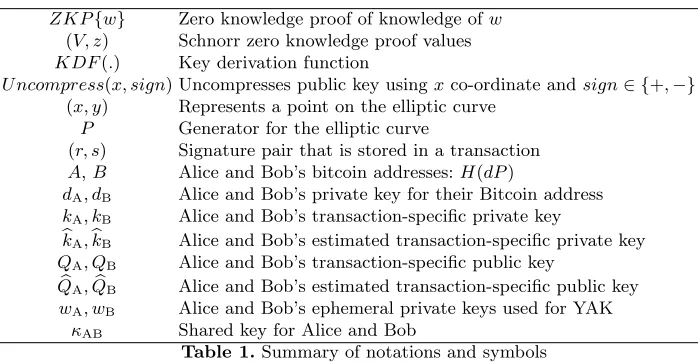
Bitcoin incorporates the OpenSSL suite to execute the ECDSA algorithm. The NIST-P256 curve is used and all domain parameters over the finite field including group order n, generator P and modulus q can be found in [6]. An outline of the signature generation algorithm is presented in Algorithm 1 to highlight the usage ofk as this will be required for the authenticated key exchange protocols. The verification algorithm follows what is defined in [13]. The notations and symbols used in our paper are summarised in Table 1.
3
Key exchange protocols
ZKP{w} Zero knowledge proof of knowledge ofw
(V, z) Schnorr zero knowledge proof values
KDF(.) Key derivation function
U ncompress(x, sign) Uncompresses public key usingxco-ordinate andsign∈ {+,−} (x, y) Represents a point on the elliptic curve
P Generator for the elliptic curve
(r, s) Signature pair that is stored in a transaction
A,B Alice and Bob’s bitcoin addresses:H(dP)
dA, dB Alice and Bob’s private key for their Bitcoin address kA, kB Alice and Bob’s transaction-specific private key b
kA,bkB Alice and Bob’s estimated transaction-specific private key QA, QB Alice and Bob’s transaction-specific public key
b
QA,QbB Alice and Bob’s estimated transaction-specific public key wA, wB Alice and Bob’s ephemeral private keys used for YAK
κAB Shared key for Alice and Bob
Table 1.Summary of notations and symbols
Both of these protocols will use k as a transaction-specific private key andQ= kP as a transaction-specific public key. Diffie-Hellman-over-Bitcoin will be a non-interactive protocol without forward secrecy and YAK-over-Bitcoin will be an inter-active protocol with forward secrecy. All domain parameters D for both protocols are the same as the ECDSA algorithm.
3.1 Setting the stage
We will have two actors, Alice and Bob. A single transaction TA is used by Alice to send her payment (anonymously or not) to Bob. For our protocols, we will as-sume that Bob has created a second transaction Tb using his ECDSA private key, so the Blockchain contains both Alice and Bob’s ECDSA signature. This is a re-alistic assumption as Bob naturally needs to spend the money or re-organise his bitcoins to protect against theft. In one possible implementation, upon receiving Al-ice’s payment, Bob can send back to Alice a tiny portion of the received amount as acknowledgement, so his ECDSA signature is published on the blockchain (the signature serves to prove that Bob knows the ECDSA private key). This is just one way to ensure that the Blockchain contains both actors’ signatures, and there may be many other methods to achieve the same.
The owner of a transaction will be required to derive the transaction-specific private key (random nonce) k from their signature before taking part in the key exchange protocols. For both protocols, we assume the transactionsTA, TB between
Alice and Bob have been sent to the network and accepted to the Blockchain with a depth of at least six blocks, which is considered the standard depth to rule-out the possibility of a double-spend attack [14].
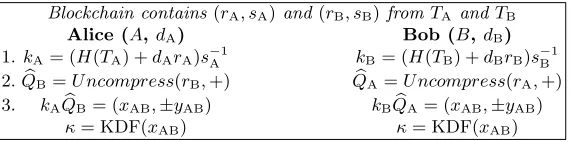
Blockchain contains(rA, sA)and(rB, sB)fromTA andTB Alice (A,dA) Bob (B, dB) 1.kA= (H(TA) +dArA)sA−1 kB= (H(TB) +dBrB)s−1B 2.QbB=U ncompress(rB,+) QbA=U ncompress(rA,+) 3. kAQbB= (xAB,±yAB) kBQbA= (xAB,±yAB)
κ= KDF(xAB) κ= KDF(xAB)
Fig. 2.The Diffie-Hellman-over-Bitcoin Protocol
protocols as we will explain in detail in Section 5.2). However, they co-ordinate ofQ is not stored in the transaction, and it can be either of the two values (above/below thexaxis).
We define the uncompression function asU ncompress(x, sign) by using thex co-ordinate from their partner’s signature and they co-ordinate’ssign∈ {+,−}. Using point uncompression and assuming one of the two possible signs for theyco-ordinate, Alice or Bob will be able to derive a valueQbwhich we call the estimated transaction-specific public key for their partner. ThisQbcould be eitherQ= (x, y) or its additive inverse−Q= (x,−y). ThisQb will correspond to the estimated transaction-specific private keybk, which could be either kor−k.
3.2 Authentication
Our definition of authentication will refer to data origin authentication and we will use the Blockchain as a trusted platform for storing digital signatures. Knowledge of the private keydfor a bitcoin address or the random noncekin a signature will prove the identities of pseudonymous parties. We will define two concepts for authentication using Bitcoin:
1. Bitcoin address authentication. Knowledge of the discrete logdfor a Bitcoin address.
2. Transaction authentication. Knowledge of the discrete log k from a single digital signature in a transaction.
Bitcoin address authentication is well-known in the community and has been used for other protocols. However, transaction authentication is a special case that our protocols will exploit. Althoughkanddare equivalent in proving ownership of a Bitcoin address or transaction,kis randomly generated for every ECDSA signature and is unique for each new transaction.
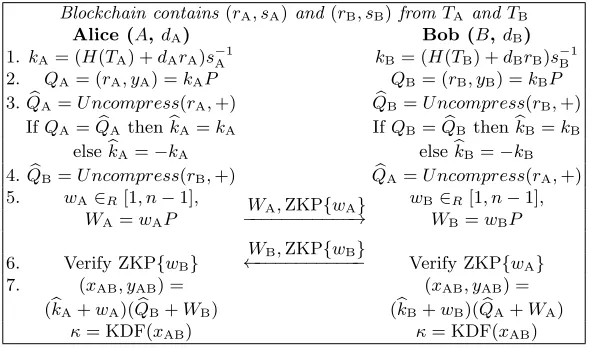
Blockchain contains(rA, sA)and(rB, sB)fromTA andTB Alice (A,dA) Bob (B, dB) 1. kA= (H(TA) +dArA)sA−1 kB= (H(TB) +dBrB)s−1B 2. QA= (rA, yA) =kAP QB= (rB, yB) =kBP 3.QbA=U ncompress(rA,+) QbB=U ncompress(rB,+)
IfQA=QbAthenbkA=kA IfQB=QbBthenbkB=kB elsebkA=−kA elsebkB=−kB 4.QbB=U ncompress(rB,+) QbA=U ncompress(rA,+) 5. wA∈R[1, n−1], W
A,ZKP{wA} −−−−−−−−−−−→
wB∈R[1, n−1],
WA=wAP WB=wBP
WB,ZKP{wB} ←−−−−−−−−−−−
6. Verify ZKP{wB} Verify ZKP{wA}
7. (xAB, yAB) = (xAB, yAB) = (bkA+wA)(QbB+WB) (bkB+wB)(QbA+WA)
κ= KDF(xAB) κ= KDF(xAB)
Fig. 3.YAK-over-Bitcoin Protocol
3.3 Diffie-Hellman-over-Bitcoin Protocol
Based on the concept of transaction authentication, the first protocol that we present is ‘Diffie-Hellman-over-Bitcoin’. The protocol is non-interactive; the shared secret is generated using the signatures from two transactions and no additional information from the participants is required. However, forward secrecy is not provided, as we will illustrate in the security analysis.
Figure 2 presents an outline of the protocol. Initially, each user will derive the random nonce k from their own signatures and fetch their partner’s transaction from the Blockchain. Each user will gain an estimation of their partner’s public keyQb before using their own transaction-specific private keykto derive the shared secret (xAB,±yAB). Regardless of whether QbA =±QA (or QbB =±QB), the x
co-ordinate of kBQbA will be the same as that of kAQbB. Following the Elliptic Curve
Diffie Hellman (ECDH) [20] approach, thexABco-ordinate will be used to derive the
keyKDF(xAB) =κ.
3.4 YAK-over-Bitcoin Protocol
Algorithm 2Schnorr Zero Knowledge Proof Generation Algorithm
Input: Domain parameters D = (q, P, n,Curve), signer identity ID, secret value w and public valueW.
Output:(V, z)
1: Selectv∈R[1, n−1], ComputeV =vP 2: Computeh=H(D, W, V, ID)
3: Computez=v−wh modn
4: Return (V, z)
An outline of our protocol is presented in Figure 3. Initially, each user will follow the same steps as seen in the previous ‘Diffie-Hellman-over-Bitcoin’ protocol to derive their secretkand their partner’s estimated public keyQ. However, a subtle differenceb requires each user to compare their real public key Qwith the estimation of their own keyQb to determine if they are equal. If these public keys are different, then the user will use the additive inverse ofk as their estimated transaction-specific private key and we will denote this choice between the two keys as bk. This subtle change will allow both parties to derive the same shared secret (xAB, yAB) which would be
expected in an interactive protocol without exchanging their realy co-ordinates. Each user generates an ephemeral private keywand computes the corresponding public key W = wP. As required in the original YAK paper [12], each user must also construct a zero knowledge proof to prove possession of the ephemeral private
key w. These zero knowledge proofs can be sent over an insecure communication
channel to their partners. Here, we will use the same Schnorr signature as in [12] to realise the ZKP. Details of the Schnorr ZKP are summarised in Algorithm 2 and 3. The definition of the Schnorr ZKP includes a unique signer identity ID, which prevents an attacker replaying the ZKP back to the signer herself [12]. In our case, we can simply use the uniquervalue from the user’s ECDSA signature (r, s) in the associated Bitcoin transactionT as the user’s identity.
Once the ZKPs have been verified, each user will derive (xAB, yAB) using their
secretw,bk, public valueW and their partners’ estimated transaction-specific public
keyQ. It should be easy to verify that although the shared secret has four differentb
combinations (±bkA+wA)(±bkB+wB)P, the secret key derived between Alice and
Bob will always be identical (due to each participant predicting the estimated public keyQbthat their partner will choose).
4
Security Analysis
Our protocols are based on reusing the signature-specific random valuekin ECDSA as the transaction-specific secret on which the authenticated key exchange protocol is based. Hence, the security of both the ECDSA signature and the key exchange protocols needs to be analysed to make sure the reusing of k is sound in terms of security.
Algorithm 3Schnorr Zero Knowledge Proof Verification Algorithm
Input: Domain parameters D = (q, P, n,Curve), signer identity ID, public value W, Schnorr zero knowledge proof values (V, z)
Output:Valid or invalid
1: Perform public key validation forW [13] 2: Compute partnersh=H(D, W, V, ID) 3: ReturnV =? zP+hW modn
– Private key security:The adversary is unable to gain anyextra2 information about the private key of an honest party by eavesdropping her communication with other parties, changing messages sent to her, or even participating in an AKE protocol with her.
– Full forward secrecy:The adversary is unable to determine the shared secret of an eavesdropped AKE session in the past between a pair of honest parties, even if their private keys are leaked subsequently.
– Session key security: The adversary is unable to determine the shared secret between two honest parties by eavesdropping their communication or changing their messages.
Note that in our security arguments we consider the security of shared secrets (xAB in Fig’s 2 and 3), as opposed to that of the subsequently calculated shared
session keys (κin the same figures). We henceforth denote the shared secret byK, i.e., κ = KDF(K). We require the shared secret to be hard to determine for the adversary in the full forward secrecy and session key security requirements. A good key derivation function (KDF) derives from such a shared secret a session key which is indistinguishable from random. Our security proofs can be easily adapted to prove indistinguishability based on the decisional rather than computational Diffie-Hellman assumption.
For ECDSA signature, we require that it remains unforgeable against chosen-message attacks despite the randomnesskbeing reused in subsequent AKE protocols. Although ECDSA has withstood major cryptanalysis, the security of ECDSA has only been proven under non-standard assumptions or assuming modifications (see [28] for a survey of these results). In our analysis, we consider extra information available to an attacker as a result of k being reused in AKE protocols, and show that it does not degrade the security of ECDSA.
We assume ECDSA to be a (non-interactive honest-verifier) zero-knowledge proof of knowledge of the private key d. This is a reasonable assumption in the random oracle model which follows the work of Malone-Lee and Smart [16]3. In practice,
2
By “extra” information, we mean information other than what is derivable from the honest party’s already available public key.
3
people accept bitcoin transactions only when the ECDSA signatures are verified suc-cessfully4. Verifying the ECDSA signature is tantamount to verifying the knowledge
of the ECDSA private keydthat should only be held by the legitimate bitcoin user. We also note that given an ECDSA message-signature pair,m,(r, s), knowledge of the private keydis equivalent to knowledge of the randomnessksince given either the other can be calculated fromsk=H(m) +dr modn.
4.1 Security of Diffie-Hellman-over-Bitcoin
This protocol is an Elliptic Curve Diffie-Hellman key exchange and the public values are bound to two transactions in the Blockchain. Private key security considers a malicious active adversary “Mallory”, and session key security considers an eaves-dropper adversary “Eve”. The protocol does not provide full forward secrecy. We will provide a sketch of the proof of security for each property in the following. In each proof, we follow the same approach as in [12] to assume an extreme adversary, who has all the powers except those that would allow the attacker to trivially break any key exchange protocol.
Theorem 1 (Private Key Security). Diffie-Hellman-over-Bitcoin provides pri-vate key security under the assumption that ECDSA signature is a zero knowledge proof of knowledge of the ECDSA secret key.
Proof (sketch).The goal of an adversary Mallory is to be able to gain someextra in-formation on Alice’s transaction-specific private keykAthrough the following attack.
Mallory is given the public parameters of the system and access to the Blockchain which includes Alice’s transactionTA, then she provides a transactionTM which is
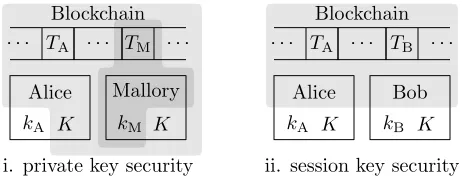
included in the Blockchain, then she carries out a Diffie-Hellman-over-Bitcoin pro-tocol with Alice (which is non-interactive), and eventually is able to calculate the shared secretK. The attack is depicted in Fig. 4(i). Alice’s ECDSA signature inTA
is assumed to be zero knowledge and hence does not reveal any information about her private key. Furthermore, since Mallory’s transaction TM includes an ECDSA
signature by her, and ECDSA signature is a proof of knowledge of Mallory’s ECDSA secret keydM, Mallory must knowdM, and hencekM. Hence, Mallory does not gain
any extra knowledge from calculatingK, since knowledge of kM and Alice’s public
key enables her to simulateKon her own. ut
Theorem 2 (Session Key Security). Diffie-Hellman-over-Bitcoin provides ses-sion key security based on the computational Diffie-Hellman assumption under the
Bitcoin community is considering including Schnorr signature [2], which is proven to be a zero-knowledge proof of knowledge of the private key.
4
TA · · · TM · · ·
· · ·
Alice kA
Mallory kM
K K
Bob kB
Blockchain
i. private key security ii. session key security TA · · · TB · · ·
· · ·
Alice
kA K K
Blockchain
Fig. 4.Security of Diffie-Hellman-over-Bitcoin. Light grey denotes what the adversary (Mal-lory in (i), Eve in (ii))knows. Dark grey denotes what the adversary (Mallory)chooses.
assumption that ECDSA signature is a zero knowledge proof of knowledge of the ECDSA secret key.
Proof (sketch). Assume there is a successful adversary Eve that is able to calculate the shared secretK for a key exchange between two honest parties Alice and Bob, without knowing either Alice or Bob’s transaction-specific secret keys,kAorkB. The
attack is depicted in Fig. 4(ii). Note that since the protocol is non-interactive, the adversary is reduced to a passive adversary. A successful attack would contradict the computational Diffie-Hellman (CDH) assumption since given an instance of the CDH problem (P, αP, βP), one is able to leverage Eve and solve the CDH problem by setting up Alice and Bob’s transaction-specific secrets askA=αandkB=β, which
results inK=αβP. A successful Eve implies that CDH can be solved efficiently. ut
4.2 Security of YAK-over-Bitcoin
This protocol is an Elliptic Curve YAK key exchange and the public values are bound to two transactions in the Blockchain. Private key security and session key security consider a malicious active adversary “Mallory”, and full forward secrecy considers an eavesdropper adversary “Eve”. Similar as before, we assume an extreme adversary who has all the powers except those that would trivially allow the attacker to break any key exchange protocol. Under this assumption, we provide a sketch of the proof of security for each property in the following.
Theorem 3 (Private Key Security).YAK-over-Bitcoin provides private key se-curity under the assumption that ECDSA signature is a zero knowledge proof of knowledge of the ECDSA secret key.
Proof (sketch).The goal of an adversary Mallory is to be able to gain someextra in-formation on Alice’s transaction-specific private keykAthrough the following attack.
Mallory is given the public parameters of the system and access to the Blockchain which includes Alice’s transactionTA, then she provides a transactionTMwhich is
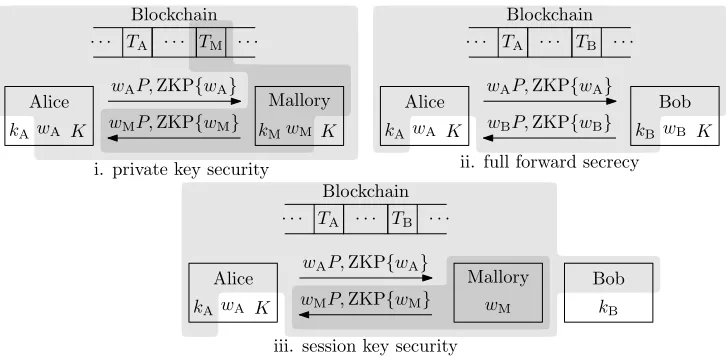
in-cluded in the Blockchain, then she carries out a YAK-over-Bitcoin protocol with Alice, in which Alice sends the message (wAP,ZKP{wA}) and Mallory sends the message
(wMP,ZKP{wM}). Alice’s ephemeral secretwAis also assumed to be leaked to
wAP,ZKP{wA}
wMP,ZKP{wM}
TA · · · TM · · · · · ·
Alice
wA
kA
Mallory
wM
kM
wAP,ZKP{wA}
wBP,ZKP{wB}
TA · · · TB · · · · · ·
wAP,ZKP{wA}
wMP,ZKP{wM}
TA · · · TB · · · · · ·
Mallory
wM
Bob
kB
K K
Alice
wA
kA K
Bob
wB
kB K
Blockchain Blockchain
Blockchain
Alice
wA
kA K
i. private key security ii. full forward secrecy
iii. session key security
Fig. 5.Security of YAK-over-Bitcoin. Light grey denotes what the adversary (Mallory in (i) and (iii), Eve in (ii))knows. Dark grey denotes what the adversary (Mallory)chooses.
be zero knowledge and hence does not reveal any information about her private key. Furthermore, since the ECDSA signature in Mallory’s transaction and her message in the protocol are proofs of knowledge ofdM(equivalentlykM) andwM, respectively,
Mallory must know bothkM andwM. Note that she receives (wAP,ZKP{wA}) and
wAand hence will be able to calculateK= (kM+wM)(kAP+wAP). Hence, Mallory
does not gain any extra knowledge from the values she receives, sincewAis
indepen-dent ofkA and knowledge of wA, kM, and wM enables Mallory to simulate all the
values she receives. ut
Theorem 4 (Full Forward Secrecy).YAK-over-Bitcoin provides full forward se-crecy based on the computational Diffie-Hellman assumption.
Proof (sketch). Assume there is a successful adversary Eve that is able to calculate the shared secretK for a previous key exchange between two honest parties Alice and Bob through the following attack. Both Alice and Bob’s transaction-specific secret keyskA andkBare assumed to be leaked to Eve. Eve is also assumed to have
access to all the protocol messages exchanged between Alice and Bob, as well as the Blockchain of course. The attack is depicted in Fig. 5(ii). Given an instance of the CDH problem (P, αP, βP) one is able to leverage Eve and solve the problem as follows. The protocol is set up with the ephemeral secret valueswA=αandwB=β
and all other parameters as per the protocol description. When Eve calculatesK, the valueS=K−kAkBP−kA(βP)−kB(αP) is calculated and returned as the solution
to the CDH problem. Note that sinceK= (kA+wA)(kB+wB)P, we haveS=αβP.
A successful Eve implies that CDH can be solved efficiently. ut
that ECDSA signature is a zero knowledge proof of knowledge of the ECDSA secret key.
Proof (sketch). Assume there is a successful adversary Mallory that is able to cal-culate the shared secretK for a key exchange between two honest parties Alice and Bob through the following attack by impersonating Bob to Alice. Alice believes she is interacting with Bob, whereas in reality she is interacting with an impersonator Mallory who replaces Bob’s message in the protocol with her own (wMP,ZKP{wM}).
Alice’s transaction-specific secret keykA is assumed to be leaked to Mallory as well.
However, Mallory does not know Bob’s transaction-specific secret keykB. The attack
is depicted in Fig. 5(iii). Given an instance of the CDH problem (P, αP, βP) one is able to leverage Mallory and solve the problem as follows. The protocol is set up with Alice’s ephemeral secret wA =αand Bob’s transaction-specific secretkB =β
and all other parameters as per the protocol description. When Mallory calculates
K, the valueS =K−kAwBP−wA(βP)−wB(αP) is calculated and returned as the
solution to the CDH problem. Note that sinceK= (kA+wA)(kB+wB)P, we have
S=αβP. A successful Mallory implies that CDH can be solved efficiently. ut
4.3 Security of ECDSA Signatures
Diffie-Hellman-over-Bitcoin is a non-interactive protocol and the protocol partici-pants do not send any messages to each other that would potentially have an impact on the security of ECDSA signatures.
In ‘YAK-over-Bitcoin’, the messages that the protocol participants send each other include information about their ephemeral keys wA and wB only, which are
chosen independently of all the secret values related to the ECDSA signatures inTA
and TB. As shown in Theorem 3 in Section 4.2, the protocol does not reveal any
information about the static private key (i.e., k), and hence not any information about the ECDSA private key (i.e.,d) since the two values are linearly related. One can computedfromk, or vice versa. The key element in the proof of Theorem 3 is that each party is required to demonstrate knowledge of both the static and ephemeral keys. This also explains our choice of the YAK protocol, as YAK is the only PKI-based AKE protocol that has the requirement that each party must demonstrate the proof of knowledge for both the static and ephemeral keys (the former is realized by the Proof of Possession at the Certificate Authority registration while the later is achieved by Schnorr Non-interactive ZKP).
5
Implementation
Step Description Time Diffie-Hellman-over-Bitcoin
1-2 ComputekAandQbB 0.08 ms
3 Compute shared secretKABand keyκAB 0.51 ms
Total: 0.59 ms
YAK-over-Bitcoin
1-4 ComputekA, QA,QbAandQbB 0.53 ms 5 ComputewA, WAand ZKP{wA} 0.90 ms
6 Verify Bob’s ZKP{wB} 0.69 ms
7 Compute shared secretKABand keyκAB 0.43 ms
Total: 2.55 ms
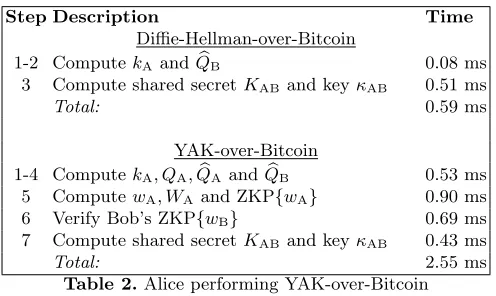
Table 2.Alice performing YAK-over-Bitcoin
Two transactions were created using a non-modified implementation on the 10th December, 2013 to allow us to test our key exchange on the real network. All tests were carried out a MacBook Pro mid-2012 running OS X 10.9.1 with 2.3GHz Intel Core i7 and 4 cores and 16 GB DDR3 RAM. Each protocol is executed 100 times from Alice’s perspective and the average times are reported.
5.1 Time analysis
Preliminary steps for both protocols involve fetching the transactions from the Blockchain 0.04 ms and retrieving the signatures (r, s) stored in the transaction 0.08 ms. Overall, these steps on average require 0.12 ms.
This ‘Diffie-Hellman-over-Bitcoin’ protocol is non-interactive as participants are not required to exchange information before deriving the shared secret. Table 2 demonstrates an average time of 0.08 ms to derive Alice’s transaction-specific private keykA and Bob’s estimated public keyQbB and 0.051 ms to compute the shared key
κAB. Overall, on average the protocol executes in 0.59 ms which is reasonable for
real-life use.
The ‘YAK-over-Bitcoin’ protocol is interactive as it requires each party to send an ephemeral public key together with a non-interactive Schnorr ZKP to prove the knowledge of the ephemeral private key. Table 2 shows that computing and verify-ing zero knowledge proofs is the most time-consumverify-ing operation. However, a total execution time of 2.55 ms is still reasonable for practical applications.
5.2 Note about domain parameters
Our investigation highlighted that q > n as seen in [6] which could obscure the relationship betweenkandr as thexco-ordinate can wrap aroundn. However, the probability that this may occur can be calculated as (q−n)/q ≈ 4×10−39 and
is unlikely to occur in practice. However, in the rare chance that this does happen then it is easily resolved byr0 = r+n. This does not require any modification to
the underlying signature code as it is simply an addition of the publicly availabler with the modulusn. Once resolved, both parties can continue with the protocol. For reference,qandnare defined below:
6
Conclusion
In this paper, we have demonstrated transaction authentication by using the digital signatures stored in Bitcoin transactions to bootstrap key exchange. We proposed two protocols to allow for interactive and non-interactive key exchange, the latter offering an additional property of forward-secrecy. We encourage the community to try our proof-of-concept implementation and to take advantage of this new form of authentication to enable end-to-end secure communication between Bitcoin users.
7
Acknowledgements
The second, third and fourth authors are supported by the European Research Coun-cil (ERC) Starting Grant (No. 306994). We also thank Greg Maxwell for bringing the SIGHASH SINGLE implementation bug to our attention.
References
1. ISO/IEC 14888: Information technology – Security techniques – Digital signatures with appendix, 2008.
2. G. Andersen. Conversation about OP SCHNORRVERIFY. Freenode IRC bitcoin-wizards, Oct. 2014. https://botbot.me/freenode/bitcoin-wizards/.
3. E. Androulaki, G. Karame, M. Roeschlin, T. Scherer, and S. ˇCapkun. Evaluating user privacy in bitcoin. InFinancial Cryptography and Data Security, pages 34–51. Springer, 2013.
4. S. Barber, X. Boyen, E. Shi, and E. Uzun. Bitter To Better: How To Make Bitcoin a Bet-ter Currency. InFinancial Cryptography and Data Security, pages 399–414. Springer, 2012.
5. BBC. New Paypal partnership enables limited Bitcoin payments. 2015. http://www.bbc.co.uk/news/technology-29341886, Accessed on 2015-01-06.
6. Certicom Research. SEC 2: Recommended Elliptic Curve Domain Parameters. Stan-dards for Efficient Cryptography Group, Sept. 2000.
7. J. Clark and A. Essex. CommitCoin: Carbon Dating Commitments with Bitcoin. In
Financial Cryptography and Data Security, pages 390–398. Springer, 2012.
8. M. Corallo. [Bitcoin-development] Warning to rawtx creators: bug in SIGHASH SINGLE. 2012. http://sourceforge.net/p/bitcoin/mailman/message/29699385/, Accessed on 2015-09-16.
9. Dell. Were Now Accepting Bitcoin on Dell.com. 2015. http://en.community.dell.com/dell-blogs/direct2dell/b/direct2dell/archive/2014/ 07/18/we-re-now-accepting-bitcoin-on-dell-com, Accessed on 2015-01-06.
10. I. Eyal and E. G. Sirer. Majority is not enough: Bitcoin mining is vulnerable. arXiv preprint arXiv:1311.0243, 2013.
11. D. Hankerson, S. Vanstone, and A. Menezes. Guide to Elliptic Curve Cryptography. Springer Professional Computing. Springer, 2004.
12. F. Hao. On robust key agreement based on public key authentication. InFinancial Cryptography and Data Security, pages 383–390. Springer, 2010.
14. G. O. Karame, E. Androulaki, and S. Capkun. Double-spending fast payments in bitcoin. InProceedings of the 2012 ACM conference on Computer and communications security, pages 906–917. ACM, 2012.
15. S. Lo and J. Wang. Bitcoin as Money? Current Policy and Perspectives. September 2014.
16. J. Malone-Lee and N. P. Smart. Modifications of ECDSA. In K. Nyberg and H. Heys, editors, Selected Areas in Cryptography, volume 2595 of Lecture Notes in Computer Science, pages 1–12. Springer Berlin Heidelberg, 2003.
17. B. Maurer, T. Nelms, and L. Swartz. When perhaps the real problem is money itself!: the practical materiality of Bitcoin.Social Semiotics, 23(2):261–277, 2013.
18. N. Merrill. The Calyx Institute: Privacy by design for everyone. 2015. https://www.calyxinstitute.org/support-us/donate-via-bitcoin, Accessed on 2015-01-06.
19. I. Miers, C. Garman, M. Green, and A. Rubin. Zerocoin: Anonymous Distributed E-cash from Bitcoin. In Security and Privacy (SP), 2013 IEEE Symposium on, pages 397–411. IEEE, 2013.
20. V. Miller. Use of Elliptic Curves in Cryptography. In Advances in Cryptology-CRYPTO85 Proceedings, pages 417–426. Springer, 1986.
21. Mozilla. Help protect the open Web. 2015.
https://sendto.mozilla.org/page/content/give-bitcoin/, Accessed on 2015-01-06. 22. S. Nakamoto. Bitcoin: A Peer-to-Peer Electronic Cash System. 2008.
23. F. Reid and M. Harrigan. An analysis of anonymity in the bitcoin system. InPrivacy, security, risk and trust (passat), 2011 IEEE Third International Conference on and 2011 ieee third international conference on social computing (socialcom), pages 1318–1326, Oct 2011.
24. P. Rizzo. Expedia Exec Says Bitcoin Spending Has Exceeded Estimates. 2015. http://www.coindesk.com/expedia-exec-bitcoin-payments-have-exceeded-estimates/, Accessed on 2015-01-06.
25. A. Robleh, J. Barrdear, R. Clews, and J. Southgate.The Economics of Digital Curren-cies, volume 54 ofQuarterly Bulletin 2014 Q3. 2014.
26. D. Ron and A. Shamir. Quantitative Analysis of the Full Bitcoin Transaction Graph. InFinancial Cryptography and Data Security, pages 6–24. Springer, 2013.
27. Tor. Make A Donation. 2015. https://www.torproject.org/donate/donate.html.en, Accessed on 2015-01-06.
28. S. Vaudenay. The Security of DSA and ECDSA. InPublic Key Cryptography — PKC 2003, volume 2567 ofLecture Notes in Computer Science, pages 309–323. Springer Berlin Heidelberg, 2002.
![Fig. 1. Transactions stored on the Blockchain based on [19]](https://thumb-us.123doks.com/thumbv2/123dok_us/7939989.1318139/4.612.171.444.123.262/fig-transactions-stored-blockchain-based.webp)