Security Analysis of Re-Encryption RPC Mix Nets
Ralf K¨usters and Tomasz Truderung
University of Trier, Germany {kuesters,truderung}@uni-trier.de
Abstract. Re-Encryption randomized partial checking (RPC) mix nets were intro-duced by Jakobsson, Juels, and Rivest in 2002 and since then have been employed in prominent modern e-voting systems and in politically binding elections in order to provide verifiable elections in a simple and efficient way. Being one of or even the most used mix nets in practice so far, these mix nets are an interesting and valuable target for rigorous security analysis.
In this paper, we carry out the first formal cryptographic analysis of re-encryption RPC mix nets. We show that these mix nets, with fixes recently proposed by Khazaei and Wikstr¨om, provide a good level of verifiability, and more precisely, accountability: cheating mix servers, who try to manipulate the election outcome, are caught with high probability. Moreover, we show that all attacks that would break the privacy of voters’ inputs are caught with a probability of at least 1/4. In many cases, for example, when penalties are severe or reputation can be lost, adversaries might not be willing to take this risk, and hence, would behave in a way that avoids this risk. Now, for such a class of “risk-avoiding” adversaries, we show that re-encryption RPC mix nets provide a good level of privacy, even if only one mix server is honest.
1
Introduction
Mix nets often play a central role in modern e-voting systems. In such systems, voters’ ballots, which typically include the voters’ choices in an encrypted form, are posted on a bulletin board. Then, the ballots are shuffled by a mix net, which consists of several mix servers, before they are decrypted. This is supposed to hide the link between a voter’s ballot and her (plaintext) choice, and hence, guarantee the voter’s privacy. In the context of e-voting, besides privacy, it is also crucial that potential manipulations are detected. That is, if ballots have been dropped or manipulated by a mix server, this should be detected. This property is called verifiability.
employed in an election of the Australian state of Victoria [5]. Some systems, such as Scantegrity [3], which has also been employed in real political elections, have used a similar technique. Hence, it is important to understand and analyze the security of re-encryption RPC mix nets.
Re-encryption RPC mix nets were proposed in 2002 by Jakobsson, Juels, and Rivest [10], as particularly simple and efficient mix nets. Such mix nets consist of several mix servers, where the mix servers use a public key encryption scheme with distributed decryption, with ElGamal being a common choice. Roughly speaking, these mix nets work as follows. The input to a re-encryption RPC mix net is a list of ciphertexts (e.g., encrypted votes), where each ciphertext is obtained by encrypting a plaintext under a common public key. Now, the first mix server shuffles the ciphertexts and re-encrypts them.1The resulting ciphertexts form the output of this mix server and the input to the next one, which again shuffles and re-encrypts the ciphertexts, and so on, until the last mix server has done this. Then, the mix servers together, in a distributed way, decrypt each ciphertext in the list output by the last mix server. In order to check whether a mix server cheated, i.e., manipulated/replaced a ciphertext so that it carries a different plaintext, so-called random partial checking is performed for each mix server. For this purpose, every mix server is supposed to reveal some partial information (chosen by auditors) about the input/output relation. Jumping ahead, our results show that this does not require zero-knowledge proofs.
We note that in the same paper, Jakobsson, Juels, and Rivest also proposed Chaumian RPC mix nets, where the input ciphertexts are obtained by nested encryption (using different public keys for each layer of encryption) and every mix server, instead of performing re-encryption, peels off one layer of encryption. However, to the best of our knowledge, this construction has not been used in practice so far.
From the design of RPC mix nets it is clear that they do not provide perfect security: there is some non-negligible probability that cheating goes undetected and some partial information about the input/output relation is revealed. As already argued by Jakobsson, Juels, and Rivest, in the context of e-voting the penalties for cheating would be so severe that being caught with some (even small) probability should deter a mix server from cheating.
Only very recently, Chaumian RPC mix nets have undergone first formal crypto-graphic analysis [16], after Khazaei and Wikstr¨om discovered attacks on the verifiability and privacy of Chaumian RPC mix nets and proposed fixes [12].
Despite their use in practice, so far no formal security analysis ofre-encryptionRPC mix nets has been carried out. In [12], Khazaei and Wikstr¨om pointed out attacks on re-encryption RPC mix nets as well, one of which generalizes an attack by Pfitzmann [20], and proposed fixes, but they did not carry out any formal analysis. In particular, it was left as an open question whether these fixes are sufficient for verifiability. In this paper, we prove that with the fixes, one obtains a good level of verifiability (see below). As for privacy, it was clear that the proposed fixes do not prevent the attacks. However,
1Re-encryption is an operation that can be performed without knowledge of the private key or
we can observe that in these attacks on privacy malicious mix servers risk to be caught with significant probability. In this paper, we formally prove that in factallattacks that would break privacy will be caught with high probability and that cheating mix servers can be blamed individually, which should deter them from cheating, e.g., because of severe penalties they would face. We further prove that if mix servers want to avoid being caught (we call them risk-avoiding, see below), then re-encryption RPC mix nets provide a high level of privacy. More precisely, the contributions of this paper are as follows.
Contributions of this paper. We provide the very first formal security analysis of re-encryption RPC mix nets. As mentioned, RPC mix nets by design can provide only restricted forms of verifiability and privacy. Therefore, we need security notions that allow us to measure the level of security re-encryption RPC mix nets provide. For this purpose, we use a definition of privacy which has been used in the context of e-voting before (see, e.g., [15]) and which has also been employed for the analysis of Chaumian RPC mix nets in [16]. This definition focuses on the level of privacy for individual senders/voters and basically requires that for every pair of messages an adversary should not be able to tell which of the two messages a sender has sent. As for verifiability, we study a stronger notion, namely accountability. While verifiability requires merely that misbehavior should be detectable, accountability, in addition, ensures that specific misbehaving parties can be blamed. This is crucial in order to deter parties from misbe-having. Our definition of accountability for re-encryption RPC mix nets follows the one proposed in [16], which in turn is based on a general, domain independent definition of accountability proposed in [14].
We show that re-encryption RPC mix nets, with the fixes proposed by Khazaei and Wikstr¨om, enjoy a reasonable level of accountability. Essentially, our accountability definition requires that the multiset of plaintexts in the input ciphertexts should be the same as the multiset of plaintexts in the output. We show that, if in the outputkor more plaintexts have been modified (compared to the input), then this remains undetected with a probability of at most(34)k. Conversely, if manipulation is detected (which happens with a probability of at least 1−(34)k), then at least one mix server can (rightly) be blamed for misbehaving.
As for privacy, in this paper we make the following key observation, which is re-lated to our result of accountability. If an adversary does not follow the protocol in an essentially semi-honest way, e.g., he does not perform re-encryption of the ciphertexts, then he will be caught with a probability of at least 1/4. Hence, whenever an adversary decides to deviate from this semi-honest behavior, he knows that he takes a relatively high risk of being caught. So, as mentioned, when penalties are severe and/or reputation can be lost, this risk will in many cases be sufficiently high to deter adversaries from deviating from this semi-honest behavior. Therefore, arisk-avoidingadversary, that is an adversary who wants to avoid being caught, but otherwise might be willing to cheat if this goes unnoticed, must behave semi-honestly. (Conversely, semi-honest adversaries are clearly also risk-avoiding.) Now, for such adversaries, we show that re-encryption RPC mix nets provide a reasonable level of privacy, which, in fact, is quite close to the ideal case, where the adversary only learns the final output of the mix net.
re-encryption RPC mixnets is analyzed in Section 4, with the definition presented in Section3. In Section5, we introduce and discuss the notions of semi-honest and risk-avoiding adversaries mentioned above. We then define and analyze privacy for re-encryption RPC mixnets in Sections6and7. We conclude in Section8. Full details and proofs are provided in the appendix.
2
Re-encryption RPC Mix Net
In this section, we first recall the definition of a re-encryption RPC mix net [10] with improvements suggested in [12] and then provide a formal model of this protocol.
2.1 Description of the Protocol
Cryptographic primitives. The protocol uses a commitment scheme, which we assume to be computationally binding and perfectly hiding, with Pedersen commitments being an example [19] (but a computationally binding and computationally hiding scheme would do as well) and an IND-CPA secure, distributed public-key encryption scheme S, where a set of parties (in our case the mix servers) independently generate their public and private key shares and the public key shares are then combined to obtain the public key. Ciphertexts obtained using this public key can only be decrypted when all the above parties participate in the decryption process (all private key shares are necessary for decryption). We assume that given a public key and a ciphertext, it can be decided efficiently whether the ciphertext in fact belongs to the space of possible ciphertexts (this typically means that one has to be able to decide whether certain group elements in fact belong to a given group). As usual for re-encryption mix nets, the encryption scheme S is also assumed to allow for re-encryption (with the appropriate hiding property, i.e. semantic security under re-encryption) and the following standard non-interactive proofs, where for some we require merely the soundness and completeness property, for others we in addition require the zero-knowledge property (NIZKPs) or also the knowledge extraction property:
– a NIZKP of knowledge of the private key share (for a given public key share), – a NIZKP of knowledge of the plaintext (for a given ciphertext and a public key), – a non-interactive proof of correct re-encryption (such a proof would typically simply
reveal the random coins used for re-encryption),2
– a NIZKP of correct decryption (more precisely, for distributed decryption, one needs to prove that a given decryption share is correct).
Additionally, for the privacy result, we require that the used distributed encryption scheme allows for decryption share extractability;3this is straightforward for example in the case of ElGamal and, in fact, was used in the privacy proof of the Helios voting
2Note that here the zero-knowledge property and knowledge extraction are not necessary. 3This property, roughly, states that, given a plaintextm, its encryptionc, and all the private key
system [2]. Precise security definitions for the used cryptographic primitives are provided in AppendixA.
Set of participants. The set of participants of the protocol consists of a public, append-onlybulletin boardB,n sendersS1, . . .Sn,m mix serversM0, . . . ,Mm−1, and some number
ofauditors. In the variant we consider here, we follow the most common practice to let mix servers play also the role of decryption servers. Alternatively, we could consider separate entities in the role of the decryption servers, which would not change the results provided in this paper.
The role of the auditors is to provide randomness for the auditing phase. Each auditor outputs a random bit string (more precisely, he first commits to his random bit string and later opens the commitment). An honest auditor outputs a bit string chosen uniformly at random. The bit strings produced by the auditors are combined to one bit string, say by the XOR operation. So, if at least one auditor is honest, the resulting bit string is chosen uniformly at random. We will indeed assume, both for verifiability/accountability and for privacy, that at least one auditor is honest. We note that sometimes heuristics are implemented by which this assumption can be dropped (see [10]). However, as pointed out in [12], this may lead to some problems.
Typically, pairs of mix servers are audited. For the sake of presentation, it is therefore convenient to assume that one mix server performs two mixing steps. We will consider such mix servers in this paper.
Now, a re-encryption RPC mix net works in the following phases: setup, submit, input validation, mixing, and auditing, where the auditing may be carried out either before or after the decryption phase. It turns out that for the results presented in this paper, it does not matter which variant (with audit before or after decryption) we consider. Note, however, that in general it might matter; it is the case, for instance, for Chaumian mix nets [16].
Setup phase. In this phase, every mix serverMiruns the key generation algorithm of S to generate its private/public key pair(ski,pki). The public key pkiis then posted on the bulletin board along with NIZKP of knowledge of the corresponding private key. The public keys pk1, . . . ,pkm of all the mix servers are then combined to obtain the encryption keypkto be used by the senders.
Submit phase. In this phase, every (honest) senderSichooses her input plaintextmi and encrypts it using the public key pkto obtain her encrypted input. The sender also produces a NIZKP of knowledge of the plaintext. The ciphertext along with the zero-knowledge proof is posted by the sender on the bulletin board.
Input validation. It is checked whether the NIZKP of knowledge of the public keys are checked (otherwise, the protocol is aborted). It is also checked whether the ciphertexts are valid and whether their NIZKPs of knowledge of plaintexts are; invalid entries are eliminated (such entries might have been produced by dishonest senders). Moreover, for every set of entries with the same ciphertext, only one entry in this set is kept (the remaining ones are dropped). Note that input validation can be performed by any party.
All the ciphertext submitted by the senders and not rejected in the input validation phase constitute the inputC0to the mixing phase, described below. Letlbe the number of
x1
x2
x3
x4
y1
y2
y3
y4
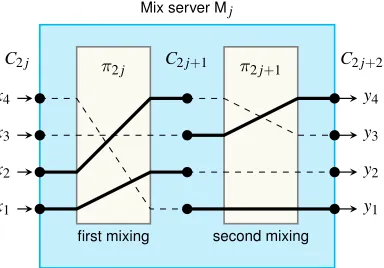
Mix server Mj
first mixing second mixing
C2j π C2j+1 C2j+2
2j π2j+1
Fig. 1.Mixing byMj. Solid bold lines represent audited links and dashed lines represent not
audited links.
Mixing phase. In what follows, we refer byC0[i]to thei-th element of the sequence
C0; similarly for other sequences. As mentioned above, the sequence of ciphertextsC0is
the input to the first mix serverM0which processes it, as described below, and posts its
output (which, again, is a sequence of ciphertexts) on the bulletin boardB. This output becomes the input to the next mix serverM1, and so on. We will denote the input to the
j-th mix server byC2jand its output byC2j+2, reservingC2j+1for intermediate output
(see Figure1). Recall that one mix server performs two mixing steps.
The outputC2mof the last mix serverMm−1is the output of the mixing stage. It is
supposed to contain re-encryptions of the inputC0(in random order).
The steps taken by every mix serverMjare as follows (see also Figure1):
1. Validation.Mj checks whether its inputC2j contains exactly l entries and, if so, whether all these entries are valid ciphertexts (recall that we assume that this is possible). If this is not the case, the server stops without producing any output and the whole protocol is aborted (except for the judging procedure; see Section2.2). 2. First mixing.Mj uniformly at random chooses a permutationπ2j of{1, . . . ,l}and
posts the sequenceC2j+1of lengthlonB, where, for everyi∈ {1, . . . ,l},C2j+1[i]is
the result of the re-encryption ofC2j[π2j(i)].
3. Second mixing. Mj, again, uniformly at random chooses a permutation π2j+1 of
{1, . . . ,l}and posts the sequenceC2j+2of lengthlonB, whereC2j+2[i]is the result
of the re-encryption ofC2j+1[π2j+1(i)]. The sequenceC2j+2is posted byMjonB. 4. Posting commitments.Mjposts two sequences of commitments onB: commitments
to the valuesπ2j(1), . . . , π2j(l)and commitments to the valuesπ2−j1+1(1), . . . , π −1 2j+1(l)
(in this order).
before the decryption phase. In either case, if auditing is done before decryption and misbehavior is detected, the decryption phase is not executed. As already noted, our results do not depend on which variant is chosen.
Independently of which variant is chosen, the steps taken in the audit for every individual mix serverMj are the same. First, using the randomness produced by the auditors, for an initial empty setIjand for everyi∈ {1, . . . ,l}it is randomly decided, independently of other elements, whetheriis added toIj⊆ {1, . . . ,l}or not. Provided that the random bit strings jointly produced by the auditors are distributed uniformly at random, the probably thatibelongs toIjis 12. Now, for everyi∈ {1, . . . ,l}the mix serverMjdoes the following, depending on whetheribelongs toIjor not:
Ifi∈Ij, then the mix serverMjis supposed to open (by posting appropriate informa-tion onB) the left link fori, i.e.,Mjis supposed to open itsi-th commitment from its first sequence of commitments, which should be a commitment on the valueπ2j(i). The mix server also has to post a non-interactive proof of correct re-encryption demonstrating that indeedC2j+1[i]is obtained by re-encryptingC2j[π2j(i)]. (As mentioned before, this proof does not have to be zero-knowledge; it could simply reveal the random coins used to perform the re-encryption.)
Ifi∈/Ij, then, symmetrically, the mix server is supposed to open the right link fori, i.e., Mj is supposed to open itsi-th commitment from its second sequence of commitments, which should be a commitment on the valueπ−2j1+1(i). As before, the mix server also has to post a non-interactive proof of correct re-encryption demonstrating that indeedC2j+2[π−2j1+1(i)]is obtained by re-encryptingC2j+1[i].
An observer (or a judge) can now verify correctness of the data output byMjin the audit phase. Firstly, the observer verifies that commitments are opened correctly. Sec-ondly, one verifies that the opened indices (both from the first and the second sequence) do not contain duplicates (if they do, this means that the mix server has not committed to a permutation, but to some other, non-bijective function). Finally, one verifies the proofs of correct re-encryption. As pointed out in [12], the second step, which often has been omitted in implementations and is not mentioned in [10], is crucial for accountability and privacy.
The auditing described above guarantees that for a message from the sequence C2j+1either the connection to some message fromC2jor to some message fromC2j+2
is revealed, but never both. Otherwise, an observer could follow the path of an input message to the corresponding output message (see also Figure1for an illustration). Nevertheless, some information about the link between the input and the output is revealed. For example, in Figure1an observer knows that the input valuesx1,x2map to
y2,y3in some way and thatx3,x4map toy1,y4in some way, and hence, for instance, she
learns thatx4does not map toy2ory3.
Decryption phase. In this phase, the mix servers jointly decrypt every ciphertext from the output of the mixing phase (that is fromC2m) and provide NIZKP of correct decryp-tion (see AppendixAfor the details of the distributed encryption scheme).
2.2 Modeling Re-encryption RPC Mix Nets
in [14,15], which we briefly recall before presenting our model of re-encryption RPC mix nets and which in turn is based on the IITM model [13,17].
Because, as we have mentioned, it does not matter for the results presented in this paper if the audit is done before or after decryption, we will focus here on the first variant (where auditing is carried out directly before the decryption phase).
The Computational Model Aprocessis a set of probabilistic polynomial-time inter-active Turing machines (ITMs, also calledprograms), which are connected via named tapes (also called channels). Two programs with channels of the same name but opposite directions (input/output) are connected by such channels. A process may have external input/output channels, those that are not connected internally. In a run of a process, at any time only one program is active. The active program may send a message to another program via a channel. This program then become active and after some computation can send a message to another program, and so on. A process contains a master program, which is the first program to be activated and which is activated if the active program did not produce output (and hence, did not activate another program). If the master program is active but does not produce output, a run stops.
We write a processπasπ=p1k · · · kpl, wherep1, . . . ,plare programs. Ifπ1and
π2are processes, thenπ1kπ2is a process, provided that the processes are connectible: two processes areconnectibleif common external channels, i.e., channels with the same name, have opposite directions (input/output).
A processπwhere all programs are given the security parameter`is denoted by
π(`). The processes we consider are such that the length of a run is always polynomially bounded in`. Clearly, a run is uniquely determined by the random coins used by the programs inπ.
Based on these notions of programs and processes, protocols and instances of proto-cols are defined as follows.
Aprotocol Pspecifies a set of agents (also called parties or protocol participants) and the channels these agents can communicate over. Moreover,Pspecifies, for every agenta, a setΠaof all programs the agentamay run and a program ˆπa∈Πa,the honest program of a, i.e., the program thataruns ifafollows the protocol.
LetPbe a protocol with agentsa1, . . . ,an. Aninstance of Pis a process of the form
π= (πa1k. . .kπan)withπai∈Πai. An agentaiishonestin the instanceπ, ifπai=πˆai. Arun of P(with security parameter`) is a run of some instance ofP(with security parameter`). An agentaiis honest in a runr, ifris a run of an instance ofPwith honest
ai.
Aproperty γ of P is a subset of the set of all runs of P. By¬γ we denote the complement ofγ.
As usual, a function f from the natural numbers to the interval[0,1]isnegligible if, for everyc>0, there exists`0such that f(`)≤`1c, for all` > `0. The functionf is
overwhelmingif the function 1−f is negligible. A functionf isλ-boundedif, for every c>0 there exists`0such thatf(`)≤λ+`1c, for all` > `0.
as introduced in Section2.1plus two additional agents, thejudgeJand the scheduler
Sch.
The programs of all agents are defined to have channels between each pair of agents. While not all channels are necessarily used by honest agents, they may be used by dishonest agents.
Scheduler. The honest program ˆπSch of the scheduler will be the master program. It triggers all agents in the appropriate order, according to the phases. It is part of every instance of the protocol and we assume that it is given information about which agents are honest and which are dishonest in order to schedule the agents in the appropriate way. In particular, the scheduler can schedule agents in a way advantageous for the adversary (dishonest agents) so that we obtain stronger security guarantees. For example, the scheduler first schedules honest senders to post their inputs on the bulletin board and then schedules dishonest senders. By this, the input of dishonest senders (the adversary) may depend on the input of honest senders. Also, the scheduler triggers the judge after each protocol phase, to allow this agent to blame parties in the case of misbehavior. We also let ˆπSchcreate common reference strings (CRSs) for all the required NIZK proofs, by calling the setup algorithms of the non-interactive zero-knowledge proof systems used in the protocol, and provide them to all parties.
The bulletin board. The honest program of the bulletin boardBaccepts messages from all agents. A message received from an agent is stored in a list along with the identifier of the agent who posted the message. On request,Bsends this list to an agent.
Auditors. For simplicity of presentation, we will simply assume one honest auditor
A. The honest program ˆπAofA, whenever triggered by the scheduler posts its random output on the bulletin board, as described in Section2.1.
Sender. The honest program ˆπS of a sender S implements the procedure described in Section2.1: when triggered by the scheduler it first randomly picks a plaintext p according to some fixed probability distributionµand then encryptspas described and posts the resulting ciphertext along with an appropriate NIZKP on the bulletin board.4 The honest program that is executed oncephas been chosen is denoted by ˆπS(p). As we will see,µdoes not play any role for accountability, in which case we could simply assume the input to be provided by the adversary; this distribution, however, matters for our privacy result. It models prior knowledge of the adversary about the distribution of messages that honest senders send. In reality, in the context of e-voting, the adversary might not know this distribution precisely (only estimates according to election forecasts, for example). But assuming that the adversary knows this distribution precisely only makes the security guarantees that we prove stronger.
Mix server. The honest program ˆπMj of a mix serverMj implements the procedure describe in Section2.1. It is triggered by the scheduler for the different phases (setup, mixing, auditing, decryption).
Judge. The honest program of the judge ˆπJwhenever triggered by the scheduler, reads data from the bulletin board and verifies it as described in Section2.1. If a mix serverMi provides wrong output or if it simply declines to output the required data, the judge posts
4We will always assume that all plaintexts chosen by (honest) senders have the same length. This
a messagedis(Mi), asserting thatMimisbehaved, i.e.,Mihas not followed the prescribed protocol. More precisely,Mjis blamed in the following cases:
(a) the output produced byMjhas a wrong format (i.e. wrong number of entries, missing commitments or proofs, etc.),
(b) Mjhas not output proper ciphertexts,
(c) Mjdoes not produce the required openings (which includes checking that the open-ings that come from one sequence of commitments have different values) or the proofs provided in the audit phase are invalid (i.e., do not verify),
(d) the proofs provided byMjin the decryption or setup phase are invalid.
Trust assumptions. We assume that the scheduler, the bulletin board, the auditor, and the judge are honest. Formally, this means that the setΠaof each such agentaconsists of only the honest program ˆπa of that agent. All the other agents can (possibly) be dishonest. For a dishonest agenta, the set of its programsΠacontains all probabilistic polynomially-bounded programs.
We denote re-encryption RPC mix nets modeled as above withmmix servers andn senders that use a probability distributionµto determine their choices byPmix(n,m, µ). To study privacy, byPmixj (n,m, µ)we denote the variant of the protocol, where the j-th mix server is assumed to be honest (which, again, formally means that the set of all programs ofMjcontains its honest program only).
3
Defining Accountability of RPC Mix Nets
As mentioned in the introduction, our definition of accountability for re-encryption RPC mix nets follows the one proposed in [16], which in turn is based on a general domain independent definition of accountability proposed in [14]. As demonstrated in [14], accountability implies verifiability. Therefore, we mostly focus here on accountability, providing only a short discussion on verifiability.
The (general) definition of accountability of a protocol from [14] is stated with respect to a propertyγof the protocol (recall the definition of a property from Section2.2), called thegoal, a parameterλ∈[0,1], and an agentJof the protocol who is supposed to blame protocol participants in the case of misbehavior (resulting in the violation of the goalγ). The agentJ, sometimes referred to as ajudge, can be a “regular” protocol participant or an (external) judge. It is worth noting that our results demonstrate that, for re-encryption RPC mix nets, every party (also external observers) can play the role of the judge, who needs to examine publicly available information only.
Informally speaking, accountability requires two conditions to be satisfied (see below for the formal definition):
(i) (fairness)J(almost) never blames protocol participants who are honest, i.e., run their honest program.
This general definition of accountability is instantiated in [16] for Chaumian RPC mix nets, by fixing the specific goalγ and the parties who should be blamed if γis not achieved. We now provide a similar instantiation for re-encryption RPC mix nets.
The goal. As far as accountability (also verifiability) is concerned, we expect from an re-encryption RPC mix net that the output corresponds to the input, i.e., the plaintexts in the input ciphertexts and the plaintexts in the output of the mix net should be the same (as multisets). This, however, can be guaranteed only for input coming from honest senders. Dishonest senders, for example, might provide invalid NIZKPs of knowledge of the plaintexts, and hence, such input would be dropped during input validation. Below, we formally describe this goal as a set of runsγ0. Moreover, we generalize this goal by
considering a family of goalsγk, fork≥0, whereγkis achieved if the output corresponds to the input up tokchanged entries. In other words, for the goalγkwe tolerate up tok changes. This is useful for the study of re-encryption RPC mix nets because, due to the nature of random partial checking, changing a small number of entries can go unnoticed with some probability. However, this probability should decrease very quickly with an increasing numberkof manipulated entries.
To formally specify the goalγk, we consider a runrof an instanceπofPmix(n,m, µ) (withnsenders). Let s1, . . . ,sl (forl ≤n) be those senders that are honest inr,x= x1, . . . ,xlbe the plaintext input of these senders inr, andy=y1, . . . ,yp(withp≤n) be the output of the mix net inr(if any), i.e., the sequence of plaintexts output by the mix net after the decryption phase. We definerto belong toγk(in other words,γkis achieved inr), if there exists a subsequencex0of the honest inputsxof sizel−ksuch thatx0, treated as a multiset, is contained iny(again, treated as a multiset), i.e., for each element aofx0, the number ofa’s inx0is less than or equal to the number ofa’s iny. Hence, we require the output to containl−kelements from the honest input, while the remaining plaintexts, up ton−(l−k), can be provided by the adversary. If inrno final output was produced (because, for example, the process was stopped as a mix server refused to produce output), thenrdoes not belong toγk, i.e.,rdoes not achieveγk.5
Parties to be blamed. We require that if the goalγkis not achieved, then the judge should blame at least one mix server, i.e., postdis(Mi)for at least onei. By the fairness property for accountability, it follows that at least this mix server definitely misbehaved. By this, every mix server risks to be blamed in the case it misbehaves, i.e., does not follow the prescribed protocol. Note that we do not require the judge to blameallmisbehaving servers. This requirement would be too strong, because not all kinds of misbehavior (i.e., deviations from the prescribed protocol) can be detected by the judge. However, the above guarantees that at least one mix server is (rightly) blamed in the case thatγk is not achieved. The above requirement also implies that a sender cannot break the goal
γk: ifγkis not achieved, this must be due to a misbehaving mix server. This is important for the robustness of the mix net: otherwise, dishonest senders could spoil the mixing process.
5Our proof of accountability shows that accountability holds true even for a slightly stronger
In the following formal definition of accountability for mix nets, we say that, if the judge postsdis(a), for some agenta, then the judge stated theverdictdis(a). Moreover, given an instanceπof a protocolP, we say that a verdictdis(a)is true inπif and only ifais not honest inπ(in the sense of Section2.2). We writePr[π(`)7→J:dis(a)]to denote the probability that in a run ofπ(`)the judgeJstates the verdictdis(a). We write
Pr[π(`)7→ ¬γk∧ ¬(J:dis(Mi)for somei)]to denote the probability that in a run ofπ(`) the goalγkis not satisfied, i.e., the run does not belong toγk, and neverthelessJdoes not state a verdictdis(Mi)for anyi. Both probabilities are taken over the runs ofπ(`), i.e., the random coins used by the agents inπ.
Definition 1. (Accountability for RPC mix nets)Let P=Pmix(n,m, µ)be a re-encryption RPC mix net protocol with an agent J (the judge),λ∈[0,1], and k≥0. We say that P providesλ-accountability with tolerancek(and w.r.t.J), if the following two conditions are satisfied.
(i) (Fairness) For all instancesπof P and all verdictsdis(a)which are not true inπ, the probabilityPr[π(`)7→J:dis(a)]is a negligible function in`.
(ii) (Completeness) For every instanceπof P, the probabilityPr[π(`)7→ ¬γ
k∧ ¬(J:
dis(Mi)for some i)]is aλ-bounded function in`.
The above definition requires that the judge never (more precisely, only with negligible probability) blames mix servers that behave honestly, i.e., run their honest program. It also requires that the probability that the goalγkis not satisfied, and hence, more than kinputs of honest senders have been manipulated or no output was produced by the mix net, but the judge nevertheless does not blame any single mix server, is bounded byλ. We will see that for re-encryption RPC mix nets (the optimal/minimal)λwill be bigger than 0. This is unavoidable because of the nature of random partial checking, some misbehavior might go unnoticed with some non-negligible probability. One of the important contributions of this work is to determine the optimalλ, and hence, precisely measure the level of accountability re-encryption RPC mix nets provide.
Verifiability. Accountability and verifiability are tightly related as shown in [14]. Ac-countability is a stronger property than verifiability and subsumes it. While for verifia-bility one only requires protocol participants to be able to see whether something went wrong or not, accountability additionally demands that, if something went wrong, it is possible to blame specific misbehaving parties. Accountability therefore provides a strong incentive for parties (mix servers in our case) to carry out correct computations, which is of high practical importance. This cannot be said for verifiability alone. Ac-countability, as we will see, is a fundamental requirement that justifies the notion of risk-avoiding adversaries (see Section5).
We start, in Section4.1, with a description of some attacks on the accountabil-ity/verifiability of re-encryption RPC mix nets. We then present our formal results, which show that these mix nets have a good level of accountability/verifiability. In particular, they show that there are no worse attacks than those described in Section4.1.
4.1 Attacks
C2j C2j+1 C2j+2
Fig. 2.Example attack on account-ability.
The most obvious way in which a mix server can cheat is when it replaces an input ciphertext by an arbitrary other ciphertext, without actually performing re-encryption, and hence, possibly without preserving the plaintext. This kind of cheating is (not) detected with probability12, and if the mix server cheats in this way fork+1 input ciphertexts of honest senders at the same time (and hence, violatesγk), its probability of not being caught is(12)k+1.
There are, however, more subtle ways of cheating which result in dishonest mix servers being caught less likely (see [12]). For example, in the attack illus-trated in Figure2a dishonest mix serverMj, for two positionspandqin its intermediate sequenceC2j+1
of ciphertexts, sets bothC2j+1[p]andC2j+1[q]to be
re-encryptions of the same entryC2j[π2j(p)](an
hon-estMj would setC2j+1[q]to be a re-encryption ofC2j[π2j(q)]). Moreover, in its first sequence of commitments, both at positionspandqit commits to the valueπ2j(p)(an honestMjwould at positionqcommit toπ2j(q)). As a result of this manipulation, one of the entries fromC2j is dropped (the black node in the example) and substituted by another one (the gray entry).
This attack can be detected only with probability14, because detection requires that bothpandqare audited to the left (bothpandqbelong toIj). Furthermore, one mix server can apply this attack for multiple pairs of positions and it can also be performed by many mix servers in order to manipulate/replace many honest input ciphertexts. Performing the attack onk+1 different pairs of ciphertexts (by the same mix server or different mix servers) results in the violation ofγkand this remains undetected with probability 34k+1.
4.2 Formal Analysis of Accountability
We now state and prove the precise level of accountability/verifiability re-encryption RPC mix nets have. While from the above it is clear that the probability of more than kmanipulations of honest entries (violation ofγk) going unnoticed may be as high as
(3
4)
k+1, we prove that this probability is not higher, and hence, there are no worse attacks.
re-encryption RPC mix nets have already been summarized in Section2.1. However, for accountability, weaker assumptions are sufficient. It suffices if the commitment scheme is computationally binding. The distributed public-key encryption does not have to be IND-CPA secure, but has to guarantee that encrypting the same message twice yields different ciphertexts with overwhelming probability (this is implied by IND-CPA security). The non-interactive proofs do not have to be zero-knowledge. (Of course, privacy will require stronger properties, in fact the ones stated in Section2.1.)
Now, the following theorem holds true for re-encryption RPC mix nets as modeled in Section2.2, independently of whether auditing is done before and after decryption.
Theorem 1. Let P=Pmix(n,m, µ)be a re-encryption RPC mix net. Then, under the above security assumptions, P providesλk-accountability with tolerance k, whereλk= 34k+1
; P does not provideλ-accountability for anyλ < λk, i.e.,λkis optimal.
This theorem implies that even if all mix servers are dishonest, the probability that more thankinputs of honest voters have been manipulated, but the judge nevertheless does not blame any mix server, is bounded by 34k+1. For example, the probability that more than 10 manipulations go undetected is less than 4.5%. Moreover, if manipulation is detected, at least one mix server is blamed (and rightly so) for its misbehavior.
The proof of Theorem1follows a similar line of reasoning as the one for Chaumian RPC mix nets [16]. However, due to the different structures and cryptographic primitives used, the proofs of course differ in the details. Below we provide a sketch of the proof of Theorem1; a complete proof can be found in AppendixB.
Proof (Proof sketch).Proving fairness (the first condition of the definition of account-ability which in this context means that a mix server that runs the honest program is never blamed), is straightforward. Also, as we have already explained, the strategy of the adversary that drops exactlyk+1 honest entries as described above breaks the goalγk. The probability that using this strategy the adversary successfully removesk+1 honest entries without this fact being noticed isλk. This shows that the constant in the theorem is optimal.
The main part of the proof is to show that no other strategy of the adversary is better than the aforementioned strategy. To this end, we first define the set (event)Gof, so called, good runs of the system. Intuitively,Gcontains those runs where cryptography is not broken: no non-interactive proof of a false statement is accepted by the judge (soundness property of proofs) and no commitment is opened in more than one way (computational binding property of commitment schemes); the latter property, at first, does not seem to be a property of just one run, but by rewinding the adversary we can look at various behaviors of the adversary when mix servers are challenged in different ways during the audit. In fact, even for the non-interactive proofs different challenges are taken into account. Based on the assumptions for the cryptographic primitives, it is not hard to see that the setGhas overwhelming probability. Hence, in what follows, it suffices to restrict our attention to runs inGonly.
a b
b0 c
c0
C2j C2j+1 C2j+2 Fig. 3.An example configuration induces byωj. Dashed red lines
represent unsafe links, while solid black lines represent safe links. Note that a safe (black) link indicates the correct re-encryption rela-tion. Thus, for instance,a,b,b0,c, andc0must be all encryptions of the same plaintext. Assuming that all the entries in the left column are honest, the right column might contain only two distinct honest entries. In this case, the mix server is nevertheless not blamed if no red link is audited and, moreover, if the two links pointing toaare not audited at the same time.
used inr, except for those used to audit the j-th mix server (these coins determine which linksMj has to open when Mj is audited). Alternatively,ωjcan be seen as the event containing all thoseω0that coincide withω, except for the coins used to auditMj. We show that ifωj∩G6=/0, thenωj⊆G. (This follows quite easily by the definition ofG.) We show that the proof of the theorem boils down to proving the following statement, for allωj⊆G: Under the condition that runs are inωj, the probabilitypj,kj that the j-th mix server dropskjhonest entries (i.e., the number of honest entries in its output is bykj smaller than the number of such entries in its input) and this mix server is nevertheless
not blamed by the judge is not bigger than 34kj.
The key observations for proving the above statement are the following. First, because the considered runs (that is runs inωj) are good, the commitments produced byMj determine functionsπ2j andπ2j+1(the commitments are consistently opened to the
values of these functions, which do not have to be permutations, though, as the adversary might not have committed to permutations). This determines some fixed links between the ciphertexts ofC2j(the input toMj) andC2j+1as well as some fixed links between the
ciphertexts ofC2j+1andC2j+2(the output ofMj). Second, if such a link is not correct (the two ciphertext are not re-encryptions of each other), and this link is audited, thenMj is blamed by the judge (as for runs inG,Mjdoes not produce a proof of a false statement that nevertheless is accepted by the judge). We call such linksunsafe.
By the above observations, everyωj(more specifically the output ofMjinωjbefore the audit) determines a unique configuration, like, for example, the one presented in Figure5. Now, the evaluation of the probabilitypj,kj is purely a matter of combinatorial, but still non-trivial reasoning, as the probability space is just the space of possible audit challenges forMj. This mainly requires to calculate the probability of the adversary being (not) blamed in the audit, which depends on whether or not unsafe links or collisions (i.e., links pointing to the same entry) are discovered (see also the explanation in Figure5, which illustrates the reasoning for the concrete example). ut
5
Privacy and Risk-avoiding Adversaries
collisions (links that point to the same entry) as illustrated in Figure2. In all these attacks, the adversary, however, risks to be caught cheating with a probability of at least 1/4. As mentioned before, this risk of being caught should deter mix servers from dishonest behavior in many real-life applications (elections), as mix servers that are caught cheating would face severe penalties and, maybe just as deterrent, lose reputation.
As already mentioned in the introduction, this motivates us to study the class of “risk-avoiding” adversaries. In this section, we formally define and discuss this class. We also prove that risk-avoiding adversaries are tightly connected with semi-honest adversaries, which we also formally introduce in the context of re-encryption RPC mix nets. In Section7, we then prove that re-encryption RPC mix nets provide a reasonable level of privacy for risk-avoiding adversaries.
One key observation is that if an adversary does not follow the protocol in an (es-sentially) semi-honest way, then he will always be caught with a probability of at least 1/4. We now first formalize what we mean by semi-honest behavior in our context and show that it is always risky in a run to deviate from this behavior. We later show that risk-avoiding adversaries are forced to behave in a semi-honest way.
Semi-honest behavior. In a nutshell, semi-honest behavior is a behavior which does not deviate from the protocol in important aspects.
Letπ be an instance of the protocol Pmix(n,m, µ). Let us recall that an instance is a combination of programs of all parties, including potentially dishonest ones (the adversary). Letrbe a run ofπ.
Now, we say that thej-th mix server behavessemi-honestlyin the runr, if this mix server produces correct output in the setup phase, the mixing phase, and the decryption phase, that is:
(a) Mj outputs its public key share along with a valid NIZK proof of knowledge of the private key shere, where “valid proof” (here and below) means that the proof is accepted by the judge inr.
(b) IfMj obtains a valid inputC2j (consisting of valid ciphertexts), thenMj outputs C2j+1andC2j+2such that the sequencesC2j,C2j+1, andC2j+2all have the same
lengthl. Moreover,Mj outputs two sequences of commitments tol values each. IfMjis auditedMj provides valid non-interactive proofs of correct re-encryption and provides valid openings to the commitments that need to be opened without collisions. In other words, in the mixing phase in runr,Mjproduces output that the judge approves.
(c) IfMjobtains a valid input sequenceC2jof lengthl(consisting of valid ciphertexts), thenMj outputsC2j+1andC2j+2such that there exist permutationsπ2jandπ2j+1
on the set{1, . . . ,l}such thatC2j+1[i]is a re-encryption ofC2j[π2j(i)]andC2j+2[i]
is a re-encryption ofC2j+1[π2j+1(i)].
(d) In the decryption phase, for every ciphertextmto be decrypted,Mj outputs a de-cryption sharehfor this ciphertext and the (common) public key, along with a valid NIZKP of correctness of the decryption share.
Intuitively, semi-honest behavior means (i) that a mix servers provides output in such a way that it is approved by the judge (Conditions (a), (b), and (d)). By the assumptions on the cryptographic primitives (see Section2.1), this will imply that in an overwhelming set of runs the statements provided by the mix server are in fact true and knowledge can in fact be extracted from the mix server. Most importantly, (ii) that means the mix server in fact shuffles and re-encrypts the input ciphertexts (Condition (c)).
Now, the following lemma shows that under any circumstances not being semi-honest is always risky. LetBjdenote the event thatMjis blamed by the judge and letωandωj be like in the proof of Theorem1.
Lemma 1. For allω(and hence, for all runs), such thatMjviolates Conditions (a), (b), or (d) in the run determined byω, we have that
Pr[Bj|ω] =1. (1)
Furthermore, for allω, except for negligibly many, such thatMjviolates Condition (c) in the run determined byω, we have that
Pr[Bj|ωj]≥ 1
4. (2)
Proof. The first statement of the lemma, by the judgment procedure, is trivial, so we will focus on the second one. We prove it using very similar reasoning as the one used in the proof of using Theorem1(see Section4.2).
We proceed by showing that (2) holds true for allω∈Gsuch that, in the run induced byω,Mjviolates condition (c) of semi-honest runs, whereGis the set of good runs defined in the proof of Theorem1. Recall that this set has an overwhelming probability. For each suchω, we can follow the reasoning of the proof of Theorem1to conclude that
ωjinduces a configuration such as the one presented in Figure5.
Now, because we have assumed thatMjviolates condition (2), one can quite easily conclude that there must be some unsafe links or some collisions in this configuration (see for the definitions of unsafe links and collisions in the proof Theorem1). But this is caught with a probability of at least 1/4: an unsafe link is detected with a probability of 1/2 (this is the probability that such a link is audited, i.e., asked to be opened) and a collision is detected with a probability of at least 1/4 (this is the probability that at list two of the links pointing to the same entry are asked to be opened). ut
The interpretation of Lemma1is as follows: in (almost) any run if the adversaryMj decided to not shuffle and re-encrypt the ciphertexts in the expected way in this run, then (he knows that) in the audit phase he will be caught with a probability of at least 1/4. In other words, in no such run there is a way forMjto outsmart the system by not performing the expected task (namely shuffling and re-encrypting the input) but getting caught with only small(<1/4)probability.
decide whether to behave semi-honestly or not in certain stages of the run. This would bring the overall risk of being caught down, but only in a very artificial way. Indeed, for an adversary that decided not to take the (high) risk of being caught in the first place, such a behavior appears very unreasonable. If the coin flip made him behave in a non semi-honest way, he knows that he then will be caught with high probability, a risk the adversary wanted to avoid. Hence, it seems reasonable to assume that an adversary for whom the risk of being caught once it deviates from semi-honest behavior is too high (and this risk is always at least 1/4), should never decide to deviate from the semi-honest behavior. Thus, it is reasonable to expect that such an adversary behaves semi-honestly with overwhelming probability. We will now see that this class of adversaries coincides with the class of risk-avoiding adversaries.
Risk-avoiding adversaries. Risk-avoiding adversaries are adversaries that behave in such a way that the probably of their being caught is negligible. This class of adversaries was introduced in [16]. We now first recall this definition and then link this notion to semi-honest behavior. (This was not done in [16], but is crucial for our reasoning and result.)
Letπbe an instance ofPmix(n,m, µ). We say that the adversary inπ(who subsumes all dishonest parties inπ) isrisk-avoidingin this instance, if the probability thatπproduces a run where the judge states a verdictdis(a)for some dishonest partyais negligible as a function in the security parameter`.
Note that, in general, risk-avoiding adversaries do not need to behave semi-honestly: if in a protocol misbehavior goes unnoticed (because there are no, or insufficient, detec-tion mechanisms), then an adversary can freely depart from the protocol and still never get blamed. In our case, however, by Lemma1, risk-avoiding adversaries are forced to behave semi-honestly:
Lemma 2. Letπbe an instance ofPmix(n,m, µ). Then, the adversary inπis risk-avoiding if and only if he behaves semi-honestly with overwhelming probability.
Proof. Lemma1implies that a risk-avoiding adversary must behave semi-honestly with overwhelming probability. Otherwise, if the adversary does not behave semi-honestly with non-negligible probabilityp, he will be caught (according to the judging procedure) with probability at least p/4 (up to some negligible factor). Conversely, it is easy to see that if in a run the adversary behaves semi-honestly, then in this run he will not be
blamed by the judge. ut
In the proof of the privacy result (see Section7), we will also use the following, technical result which takes the statement of Lemma2one step further: while Lemma2 guarantees that a risk-avoiding adversary is semi-honest, and hence, shuffles and re-encrypts in every mixing step, the following result states in addition that, when such a system is simulated, suitable permutations can be extracted, by means of rewinding, by the simulator.
Lemma 3. Letπbe an instance ofPmix(n,m, µ)such that the adversary inπ is risk-avoiding. There exists a simulator T which faithfully6 simulatesπ and additionally
6i.e., the simulated runs ofπare exactly the same as the runs of the original systemπ; note that
outputs (on some distinct tape) permutationsπ00, . . . π20msuch that in an overwhelming set of runs, for each mix serverMj, the permutationsπ02j, π20j+1satisfy Condition (c) of semi-honest runs, by which we mean that the properties stated forπ2jandπ2j+1in
Condition (c) are satisfied forπ20jandπ02j+1, respectively.
Proof. The simulatorT simulates honest parties, and in particular, honest mix servers directly itself, and hence,T just knows their permutations. We now show howT extracts permutations from the dishonest mix serverMjin such a way that, for an overwhelming set of runs, Condition (c) of semi-honest runs is satisfied forMjwith these permutations. The same method can be applied independently to all dishonest mix servers.
The simulator is defined in such a way that it faithfully simulates the system, and performs additional steps explicitly described below, to extract the permutations forMj. That means, in particular, that the simulator keeps complete (simulated) state of the sytem it simulates and the simulated runs, when restricted to this simulated state, strictly correspond to the runs of the original system.
For a sequence of random coinsω, we define by ¯ωjthe sequence of random coins that coincide withω, except for the random coins used by auditors to challengeMj. These random coins are complementary in ¯ωj in that, whenever inω the j-th mix server is requested to open thei-th index to the left, then in ¯ωjthe j-th mix server is requested to open this index to the right, and vice versa. Note that ¯ωjis inωj(as isω).
Let us consider a simulated run for someω∈ωj⊆G, whereGare defined just as in Lemma1(Theorem1). The set of suchω’s has an overwhelming probability, as stated in the proof of Theorem1. Further, let us consider only thoseωfor whichωjinduces a good configuration—i.e. a configuration without unsafe links and collisions—and, moreover, whereMjcorrectly opens commitments and provides valid proofs for all audited links, both inωand ¯ωj. This is still an overwhelming set of runs. Indeed, the probability that a run induces a bad configuration must be negligible for a risk-avoiding adversary (if the set of such runs had some non-negligible probabilityp, then the mix server would be blamed with a probability of at least p/4). Similarly, the probability that eitherω
or ¯ωjdoes not correctly open a commitment or does not provide a valid proof must be negligible as well (if the set of suchωhas probabilityq, then the mix server is blamed with probability at leastq/2).
For allωas above (and hence, for allωexcept for some negligible set), the extraction procedure detailed below is well defined. This procudere allows the simulator to extract the configuration forMjinduced by the run (i.e., all links of this configuration). Since for the considered runs, the configurations are good, it follows that extracted links form permutations (no collisions). Also, the ciphertexts connected by a link are re-encryptions of each other (links are safe). Hence, Condition (c) of semi-honest runs is satisfied for
Mjwith for these extracted permutations, which completes the proof.
the configuration (that is, all the links). The simulator then rewinds the simulation again to the point where it has been halted and resumes the simulation. ut
6
Definition of Privacy for RPC Mix Nets
As already mentioned in the introduction, we use a definition of privacy which has been used in the context of e-voting before (see, e.g., [15]) and which has also been employed for the analysis of Chaumian RPC mix nets in [16].
As opposed to (very strong) simulation-based definitions, see, for instance, [11] and a related game-based definition in [2], the above mentioned definition allows one to measure the level of privacy a protocol provides. The ability to measure the level of privacy is absolutely essential in the context of RPC mix nets, because such protocols do not achieve perfect privacy: it is in the very nature of these protocols that the adversary can learnsomeinformation from a protocol run. Therefore, it is essential to be able to precisely tellhow muchhe can actually learn. (See also [16] for more discussion on this topic).
More specifically, in the context of e-voting, the privacy definition we adopt formal-izes the inability of an observer to distinguish whether some voterv(called the voter under observation) voted for candidate jor candidate j0, when running herhonestvoting program (as specified by the voting protocol). Analogously, here we formalize privacy for RPC mix nets as the inability of an adversary to distinguish whether some sender under observation submitted plaintextsporp0, when running her honest program.
As already mentioned in Section2.2, for studying privacy, we consider the protocol
Pmixj (n,m, µ), where thej-th mix server is assumed to be honest, all other mix servers may be dishonest. Among thensenders, we consider one sendersto be under observation. (The task of the adversary is to figure out whether this sender sent plaintextporp0.)
Now, given a sendersand a plaintextp, the protocolPmixj (n,m, µ)induces a set of instances of the form(πˆs(p)kπ∗)where ˆπs(p)is the honest program of the senders
under observation that takespas its unencrypted input (as defined in Section2.2) and
π∗is the composition of programs of the remaining parties (scheduler, auditor, judge, senders, mix servers), one program π∈Πa for each party a. Recall that according to the definition of Pmixj (n,m, µ), ifa is the scheduler, the auditor, the judge, or the j-th mix server, thenΠa contains only the honest program of that party, as they are assumed to be honest. All other parties are potentially dishonest and may run arbitrary (adversarial) probabilistic polynomial-time programs. Since these adversaries might not try to avoid accusations by the judge, this most general class of adversaries has been calledventuresomein [16]. The attacks by Khazaei and Wikstr¨om demonstrate that for venturesome adversaries privacy of re-encryption RPC mix nets cannot be guaranteed. In order to define privacy w.r.t. risk-avoiding adversaries, we simply restrict the set of programsπ∗to those that are risk-avoiding (see Section5). In a system(πˆs(p)kπ∗)
with a sendersunder observation,π∗is required to be risk avoiding for all choices of the plaintextspin the considered space of plaintexts.
Privacy for re-encryption RPC mix nets (w.r.t. venturesome or risk-avoiding adver-saries) is now defined as follows, where we use the following notation:Pr[(πˆs(p)k
the output 1 on some dedicated channel in a run of ˆπs(p)kπ∗with security parameter
`and some plaintextp. The probability is over the random coins used by the agents in ˆ
πs(p)kπ∗.
Definition 2. For Pmixj (n,m, µ)as before let sbe the sender under observation, l<
n−1, andδ∈[0,1]. We say thatPmixj (n,m, µ)withlhonest senders achievesδ-privacy (w.r.t. risk-avoiding adversaries), if
Pr[(πˆs(p)kπ∗)(`)7→1]−Pr[(πˆs(p0)kπ∗)(`)7→1] (3)
isδ-bounded as a function of the security parameter`, for all valid input plaintexts7 p,p0and all (risk-avoiding) programsπ∗of the remaining parties such that (at least) l senders are honest inπ∗.
Sinceδ typically depends on the numberl of honest senders, privacy is formulated w.r.t. this number. Note that a smallerδmeans a higher level of privacy. However,δ
cannot be 0, not even in an ideal protocol, as detailed in the following subsection: there is, for example, a non-negligible chance that all honest senders sent the same message. In this case, the adversary knows the message sendershas sent, and hence, can easily distinguish betweenshaving sent porp0.
Privacy for the Ideal Mix Net Protocol. Before, we provide the analysis of the level of privacy provided by re-encrypted RPC mix nets, we first recall results for the ideal ideal mix net from [16], where the optimalδid
l,µis determined in this case. The level of
privacy for re-encryption RPC mix nets can be expressed in terms of this value. In the ideal mix net, the senders submit their input plaintexts on a direct channel to the ideal mix net. The ideal mix net then outputs the submitted messages after having applied a random permutation. Honest senders choose their inputs according to the distributionµ.
The level of privacy provided by the ideal mix net depends on the numberlof honest senders and the probability distributionµon valid input plaintexts.
To defineδid
l,µ, we need the following terminology. Let{p1, . . . ,pk}be the set of valid
plaintexts. Since the adversary knows the input plaintexts of the dishonest senders, he can simply filter out these plaintexts from the final output and obtain the so-calledpure output r= (r1, . . . ,rk)of the protocol, whereri,i∈ {1, . . . ,k}, is the number of times the plaintextpioccurs in the output after having filtered out the dishonest inputs. Note that, iflis the number of honest senders, thenr1+· · ·+rk=l+1 (lhonest senders plus the sender under observation).
We denote byOutthe set of all pure outputs. LetAi
rdenote the probability that the choices made by the honest senders yield the pure outputr, given that the sender under observation submits pi. Further, letMj,j0 ={r∈Out:Arj≤Aj
0
r}. Now, the intuition behind the definition ofδidl,µis as follows: If the observer, given a pure outputr, wants to decide whether the observed sender submittedpjorpj0, the best strategy of the observer is to opt forpj0 ifr∈Mj,j0, i.e., the pure output is more likely if the sender submitted pj0.
This leads to the following level of privacy provided by the ideal mix net protocol withlhonest senders and the probability distributionµ:
δlid,µ= max j,j0∈{1,...,k}r∈
∑
Mj,j0
(Arj0−Arj),
with example values depicted in Figure4. (Note thatAj 0
r -Arjdepend onlandµ.)
7
Analysis of Privacy Re-encryption RPC Mix Nets
We now provide the formal analysis of the level of privacy re-encryption RPC mix nets provide in the case of a risk-avoiding adversary.
We note that in our analysis of privacy, we assume merely that one of the mix servers is honest; clearly, if all mix servers are dishonest there cannot be any privacy.
As already illustrated in Section2.1, it is in the very nature of re-encryption RPC mix nets that some information about the input to a mix server is mapped to its output. Consequently, even a risk-avoiding adversary obtains some partial information about how the input of the honest mix server is mapped to its output. Hence, even in this case privacy cannot be as in the ideal case. Note that for the other mix servers (controlled by the adversary), the adversary has full knowledge about the mapping from the input to the output.
7.1 Privacy for Risk-Avoiding Adversaries
For the following result, our cryptographic assumptions are as described in Section2.1. The results hold true independently of whether auditing of the mix servers is done before or after the decryption phase.
Theorem 2. The protocolPmixj (n,m, µ)with l honest senders achievesδl,µ-privacy w.r.t. risk-avoiding adversaries, where
δl,µ=
1 2l·
l
∑
i=0
l i
δidi,µ .
Moreover,δl,µis optimal, i.e., this protocol does not achieveδ-privacy w.r.t. risk-avoiding adversaries for anyδ < δl,µ.
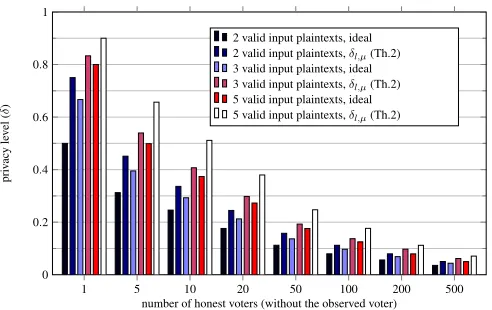
Example values for δl,µ are depicted in Figure4. As can be seen, for risk-avoiding
adversaries, the level of privacy provided by re-encryption RPC mix nets is only slightly worse than the level of privacy in the ideal mix net. Recall that our result holds true under the pessimistic assumption that among all mix servers, there is one honest mix server only.
0 0.2 0.4 0.6 0.8 1
1 5 10 20 50 100 200 500 number of honest voters (without the observed voter)
pri
v
ac
y
le
v
el
(
δ
)
2 valid input plaintexts, ideal 2 valid input plaintexts,δl,µ(Th.2) 3 valid input plaintexts, ideal 3 valid input plaintexts,δl,µ(Th.2) 5 valid input plaintexts, ideal 5 valid input plaintexts,δl,µ(Th.2)
Fig. 4.Level of privacy (δl,µ) forPmixj (n,m,µ)w.r.t. risk-avoiding adversaries and in the ideal case
δid
l,µ, uniform distribution of input plaintexts. These figures have been obtained by straightforward
calculations using theδ-formulas as provided in the theorems. For non-uniform distributions,δl,µ
is close to ideal as well.
parties are represented byA, the risk-avoiding adversary. We have to show that for all valid input plaintextspandp0, we have that
|Pr[(AkP(p))(`)7→1]−Pr[(AkP(p0))(`)7→1]|
is aδl,µ-bounded function in the security parameter`, whereP(p)means that the sender
under observation usespas its plaintext. We denote this function byAdvprivA,P,p,p0(`)and
call it the advantage ofA.
We first define what we call audit groups for an overwhelming set of runs.
Consider a run of the instanceAkPwhich is semi-honest and for which the extractor from Lemma3can extract correct permutations, namely permutations that satisfy (c) in the definition of semi-honest behavior. This set of runs has overwhelming probability.
For such a run, we can split the input entries into two groups: those for which
Mj opens the left link and those for which Mj opens the right link. More precisely, each input entryC0[i]is linked toC2j+1[i0](an entry in the middle column ofMj) with i= (π2j◦π2j−1◦ · · · ◦π0)(i0), whereπkare permutations extracted from the run,8(and thus satisfying condition (c) of semi-honest runs) and◦denotes function composition ((f◦g)(x) =g(f(x))). Note that, by the definition (c) of semi-honest runs,C2j+1[i0]is a
re-encryption ofC0[i]. Now, if the auditors requestMjto open the left link for the index i0, then we say thatibelongs to the left audit groupIL; otherwise we say thatibelongs to the right audit groupIR.
We further say thatILis the audit group of the sender under observation if the (index of the) entry of this sender belongs toIL. Similarly forIR.
8Formally, to determine these permutations, one needs to consider the corresponding run of the
From the programA, we derive a programA∗in the following way:A∗simulates Aand also runs the extractor from Lemma3in order to extract permutations for the mix servers subsumed byA(as just mentioned, by Lemma3, this can be in such a way that, with overwhelming probability, for the extracted permutations, Condition (c) in the definition of semi-honest behavior is true). This allowsA∗to determine the audit group of the sender under observation and learn which (encrypted and then later decrypted) output entries are linked to this group (without knowing specifically which output entry is linked to which sender in this group). LetQdenotes the multi-set of all the plaintexts (decrypted entries) linked to this group. For example, ifx3in Figure1is the (re-encrypted) entry of
the server under observation (A∗, knowing the extracted permutations, knows at which position the entry of the sender under observation is delivered), then{y1,y4}are entries
of the senders from the audit group of the sender under observation. This group of entries, given the extracted permutations, can be easily linked to the output of the mix net, when they get decrypted and the multi-setQis given.
Now,A∗accepts the run (outputs 1) if and only if the following is true: the prob-ability that the choices of|Q| −1 honest senders (made according to the probability distributionµ) yieldQ, given that the sender under observation choosesp, is bigger than the probability that the choices of|Q| −1 honest senders yieldQ, given that the sender under observation choosesp0.
In the following lemma, we write f ≤neg f0, if there exists a negligible functionν(`) such that f(`)≤f0(`) +ν(`)for all`. Later we also use f =neg f0to mean f ≤neg f0 and f0 ≤neg f. The lemma says that the advantage ofAis not bigger than the advantage ofA∗.
Lemma 4. For a risk-avoiding adversary A and for all valid p and p0, we have that
AdvApriv,P,p,p0≤negAdvApriv∗,P,p,p0 .
The proof of this lemma is postponed to Section7.2.
Now, the proof of Theorem2proceeds as follows. By Lemma4, it suffices to prove that
AdvApriv∗,P,p,p0≤negδl,µ.
By Lemmas2and3, there is an overwhelming setSHPof runs ofA∗kPsuch that these runs are semi-honest and such that the permutationsA∗extracts from the dishonest mix servers satisfy Condition (c) of semi-honest behavior. For these runs, the mixing runs through successfully (as the runs are semi-honest) and the multi-setQcontains the plaintexts chosen by the senders in the audit group of the sender under observation (as the permutations satisfy (c)).
By the above, it is easy to see that, the computations carried out byA∗yield the constant from the theorem, i.e.,AdvApriv∗,P,p,p0 =negδl,µ. Indeed,iin the definition ofδl,µ
represents the number of entries of honest senders that are, in a given run of the system, in the same audit group as the entry of the sender under observation. We consider all the possible cases, fromi=0 (the entry of the sender under observation is alone in its audit group, and hence, the adversary can easily see her choice) toi=l(all the honest entries are in the same group as the entry of the sender under observation; in this case, privacy of the sender under observation is maximally protected). The probability thati honest senders belong to the same audit group as the sender under observation is li1