An extended abstract of this paper appears at Crypto’19.
Subvector Commitments
with Application to Succinct Arguments
(Full Version)
Russell W. F. Lai1and Giulio Malavolta2?
1
Friedrich-Alexander-Universit¨at Erlangen-N¨urnberg
2
Carnegie Mellon University
Abstract. We put forward the notion of subvector commitments (SVC): An SVC allows one to open a committed vector at a set of positions, where the opening size is independent of length of the committed vector and the number of positions to be opened. We propose two constructions under variants of the root assumption and the CubeDH assumption, respectively. We further generalize SVC to a notion called linear map commitments (LMC), which allows one to open a committed vector to its images under linear maps with a single short message, and propose a construction over pairing groups.
Equipped with these newly developed tools, we revisit the “CS proofs” paradigm [Micali, FOCS 1994] which turns any arguments with public-coin verifiers into non-interactive arguments using the Fiat-Shamir transform in the random oracle model. We propose a compiler that turns any (linear, resp.) PCP into a non-interactive argument, using exclusively SVCs (LMCs, resp.). For an approximate80bits of soundness, we highlight the following new implications:
1. There exists a succinct non-interactive argument of knowledge (SNARK) with public-coin setup with proofs of size 5360 bits, under the adaptive root assumption over class groups of imaginary quadratic orders against adversaries with runtime2128. At the time of writing, this is the shortest SNARK with public-coin setup. 2. There exists a non-interactive argument with private-coin setup, where proofs consist of 2 group elements and 3
field elements, in the generic bilinear group model.
1
Introduction
Commitment schemes are one of the fundamental building blocks and one of the most well-studied primitives in cryp-tography. Due to their pivotal importance in the design of cryptographic protocols, even small efficiency improvements have magnified repercussions in the field. In a recent work, Catalano and Fiore [26] put forth the notion of Vector Commitments (VC): A VC allows a prover to commit to a vectorxof`messages, such that it can later open the commitment at any positioni∈[`]of the vector,i.e., reveal a message and show that it equals to thei-th committed message. The distinguishing feature of VCs is that the size of the commitments and openings is independent of`. A VC scheme is required to be position binding, meaning that no efficient algorithm can open a commitment at some position
ito two distinct messagesxi6=x0i. Catalano and Fiore [26] constructed two VC schemes based on the CDH assumption over pairing groups and the RSA assumption, respectively. In both schemes, a commitment and an opening both consist of a single group element (in the respective groups). Furthermore, the scheme based on the RSA assumption has public parameters whose size is independent of the length of the vectors to be committed.
This concept was later generalized by Libertet al.[47], who formalized the notion of functional commitment (FC). Intuitively, an FC allows the prover to commit to a vectorx, and to open the commitment to function-value tuples
(f, y)such thaty =f(x). Libertet al.[47] proposed a construction forlinear forms3based on the Diffie-Hellman exponent assumption over pairing groups, where a commitment and an opening both consist of a single group element. VCs and FCs for linear forms are very versatile tools and turned out to be useful for a variety of applications, such a zero-knowledge sets [53], polynomial commitments [44], accumulators, and credentials, to mention a few.
?
Part of the work done while at Friedrich-Alexander-Universit¨at Erlangen-N¨urnberg. 3
While a short commitment is certainly an appealing feature, there are contexts where there is still a lot to be desired. For example, in case the prover wants to reveal multiple locations of the committed vector (resp. multiple function outputs) the best known solution is to repeat the above protocol in parallel. This means that the size of the openings grows linearly with the amount of revealed locations (resp. function outputs).
1.1 Commitments with Even Shorter Openings
We introduce the notion ofsubvector commitments(SVCs). An SVC allows one to commit to a vectorxof length`and later open to asubvectorof an arbitrary length≤`. Given anorderedindex setI⊆[`], we define theI-subvector ofx as the vector formed by collecting thei-th component ofxfor alli∈I. While a VC is required to be succinct, namely the commitment size and the size of the proof of the opening are independent of the length of the committed vector, an SVC has a stronger compactness4property which additionally requires that these sizes do not depend on the length of the subvector to be opened. This difference is going to be critical for our applications (explained later). Improving upon the VC constructions of Catalano and Fiore [26], we propose two constructions of SVCs based on the CubeDH assumption over pairing groups and the RSA assumption, respectively. We further generalize the RSA-based scheme to work over modules over Euclidean rings [50], where variants of the root assumption are conjectured to hold. Loosely speaking, the root assumption states that it is hard to find thee-th root of a random ring element, for any non-triviale. In these settings we obtain public-coin-setup instantiations of SVCs using class groups of imaginary quadratic orders.
We then generalize the notion of SVCs to allow the prover to reveal arbitrarylinear mapsf :F`→
Fq computed over the committed vector. We call such class of schemeslinear map commitments(LMC). As in SVC, it is important to require an LMC to be compact, meaning that both the commitment and the proofs are of size independent of`and
q, whereas succinctness only requires their size to be independent of`. Note that an SVC can be viewed as an LMC restricted to the class of linear maps whose matrix representation has exactly one 1 in each row and 0 everywhere else.
Naively, one may attempt to generalize position binding for LMC by requiring that the prover cannot open a commitment to(f,y)and(f,y0)withy =6 y0, wheref is a linear map andy,y0 ∈Fk are now vectors. This turns out to be insufficient for our applications: This is because the prover may be able to open to(f,y)and(f0,y0)where
f 6=f0andy6=y0such that they form an inconsistent system of linear equations, yet the attack is not captured by the definition. We tackle this issue by defining a more generalfunction bindingnotion which requires that no efficient algorithm can produce openings forQfunction-value tuples{(fk,yk)}k∈[Q]for anyQ∈poly(λ), such that there does not existxwithfk(x) =ykfor allk∈[Q].
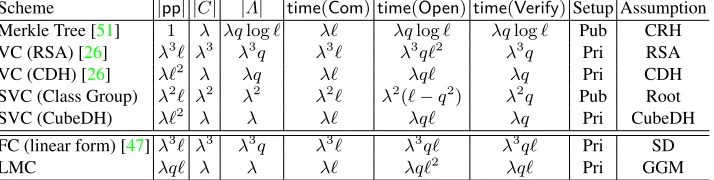
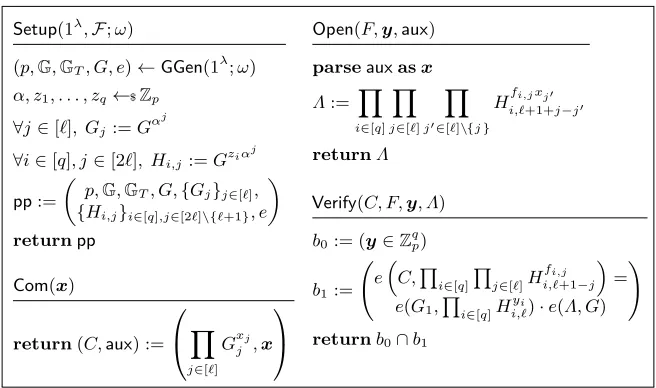
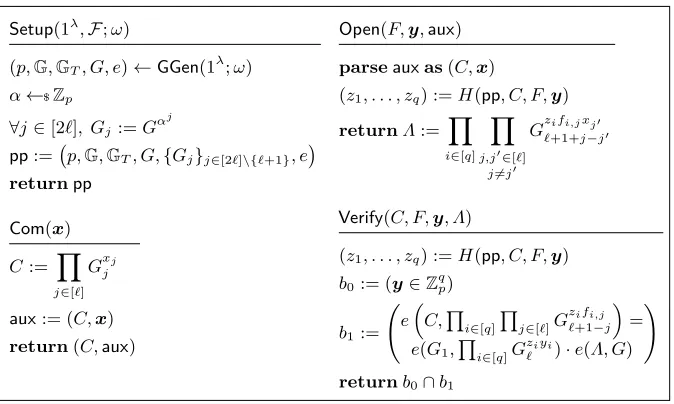
We then modify the construction of Libertet al.[47] to support batch openings to linear forms or, equivalently opening to a linear map. Since the verification equation of their construction is linear, a natural way to support batch openings is to define the new verification equation as a random linear combination of previous ones. With this observation, we embed a secret linear combination in the public parameters, and show that the resulting construction is function binding in the generic bilinear group model. In Table1we compare our SVC and LMC constructions with existing schemes.
1.2 The Quest of Constructing Ever Shorter Arguments
In addition to enabling batching in the original applications of VCs and FCs for linear forms mentioned above, the compactness of SVCs and LMCs opens the new possibilities of application in constructing succinct argument systems.
Background. An argument system for an NP languageLallows a prover, with a witnessw, to convince a verifier that a certain statementxis inL. In contrast with proof systems, argument systems are only required to be computationally sound. Due to this relaxation, it is possible that the interaction between the prover and the verifier is succinct,i.e., the communication complexity is bounded by some polynomialpoly(λ)in the security parameter and is independent of the size ofw. Other desirable properties of an argument system are:
4
Scheme |pp| |C| |Λ| time(Com)time(Open)time(Verify) Setup Assumption Merkle Tree [51] 1 λ λqlog` λ` λqlog` λqlog` Pub CRH VC (RSA) [26] λ3` λ3 λ3q λ3` λ3q`2 λ3q Pri RSA
VC (CDH) [26] λ`2 λ λq λ` λq` λq Pri CDH
SVC (Class Group) λ2` λ2 λ2 λ2` λ2(`−q2) λ2q Pub Root
SVC (CubeDH) λ`2 λ λ λ` λq` λq Pri CubeDH
FC (linear form) [47] λ3` λ3 λ3q λ3` λ3q` λ3q` Pri SD
LMC λq` λ λ λ` λq`2 λq` Pri GGM
Table 1: Comparison of subvector and linear map commitments for messages of length`, with binding against adversaries of runtime2λ. All constants are omitted.pp: public parameters,C: commitment,Λ: proof, Pub: public-coin, Pri: private-coin, CRH: collision-resistant hash, Root: strong or adaptive root, SD: subgroup decision, GGM: generic bilinear group model.
– “of knowledge”: a successful prover implies an extractor that can recover the witness;
– non-interactive: the protocol consists of a single message from the prover;
– (verifier) public-coin: messages from the verifier are sampled from public domains.
Recently, much progress has been made both in theory and practice to construct succinct non-interactive arguments of knowledge (SNARK) for general NP languages. We distinguish between SNARKs in the public-coin-setup model and the pre-processing model. In the public-coin-setup model, the prover and the verifier do not share any input other than the statementxto be proven. In the pre-processing model, they share a common reference string, generated by a trusted third party, which may depend on the languageLand the statementx. In general, existing SNARKs in the pre-processing model are more efficient, in terms of both communication and computation, than those in the public-coin-setup model. This reflects the intuition that pushing the majority of the verifier’s workload to the offline pre-processing phase reduces its workload in the online phase. On the other hand, in some applications, such as cryptocurrencies, it is crucial to have a public-coin setup, which can be publicly initialized via,e.g., a random oracle [7].
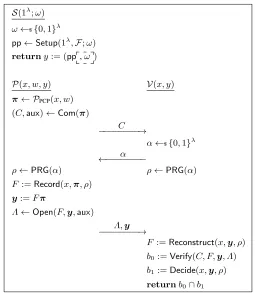
Public-Coin-Setup SNARKs. While it is known that public-coin-setup non-interactive arguments for NP do not exists in the standard model [14], one can circumvent this impossibility by working in the random oracle model [7]. A common way to obtain public-coin-setup SNARKs is through the “CS proofs” paradigm [45,52] based on probabilistically checkable proofs (PCP) [3]. To recall, aq-query2−σ-soundness PCP scheme allows the prover to efficiently compute a PCP string which encodes the witness of the statement to be proven. The verifier can then decide whether the statement is true with probability close to1−2−σby inspectingqentries of the PCP string. Given a PCP, a SNARK under the CS proofs paradigm are constructed in two steps. First, the PCP is turned into an interactive argument system: The prover first commits to the PCP string, typically using a Merkle-tree commitment. The verifier then sends the indices of the entries to be inspected. Next, the prover opens the commitment at these entries. Finally, by inspecting the revealed entries, the verifier can decide whether the statement is valid. Typically, an argument system constructed this way has a public-coin verifier and can be made non-interactive using the Fiat-Shamir transform [34].
Under the CS proofs paradigm, a proof (e.g., in the scheme by Micali [52]) consists of a λ-bit Merkle-tree commitment of a`-bit PCP string,qbits of the PCP string, andqopenings of the commitment, each of sizeλlog`
bits. For concreteness, assuming a 3-query PCP and`= 230, for2−80-soundness against a2128-time adversary, the proof size is around 113 KB. Despite having linear verification time (hence not being a SNARK) Bulletproof [20,25] is arguably the most practically efficient non-interactive argument to date. A proof in [25] consists of2 logn+ 13
(group and field) elements, wherenis the number of multiplication gates in the arithmetic circuit representation of the verification algorithm ofL. In their instantiation over the curve secp256k1, each of the group elements and integers can be represented by∼256 bits, thus a proof consists of roughly512 logn+ 3328bits.
with overwhelming probability by making onlyqqueries. SNARK constructions in this category typically have a computationally expensive stetement-dependent pre-processing phase, meaning that one set of public parameters has to be generated per statement to be proven.
In this setting, the scheme with the shortest proofs (4 group elements) in the standard model is due to Danezis
et al.[31]. In the generic bilinear group model, Groth [39] proposed a scheme [59] with only 3 group elements, and showed that proofs constructed from LIP must consist of at least 2 group elements. These schemes can be instantiated over pairing-friendly elliptic curves. A popular choice is the 256-bit Barreto-Naehrig curve [6], in which a group element can be represented using 256 bits.
Our Approach. Equipped with our newly developed tools, we revisit the CS proofs paradigm. In previous schemes following this paradigm, the proof size is dominated by the factorqlog`due to theqMerkle-tree commitment openings. Moreover, due to the lack of structure of a Merkle-tree commitment, prior schemes do not work with linear PCPs. The main idea is thus to replace the Merkle-tree commitment with an SVC / LMC, so that theqopenings can be compressed into a single one which has size independent of`andq. By doing so, we obtain a compiler which compiles any (resp. linear) PCP into an interactive argument using an SVC (resp. LMC).
We highlight two interesting instantiations of our construction. The first instantiation is with classical PCPs and our public-coin-setup SVC based onCl(∆), the class group of imaginary quadratic order with discriminant∆.
Instantiation 1 If the adaptive root assumption holds inCl(∆), then there exist public-coin-setup SNARKs for NP with soundness error2−σin which a proof consists of 2Cl(∆)elements andqbits in the random oracle model, using
anyq-query2−σ-soundness PCP.
If one aims for an extremely short proof and is willing to accept expensive prover computation, then a 3-query2−1 -soundness PCP can be amplified into a3σ-query2−σ-soundness PCP and gives the shortest SNARK. Based on the best known attacks on the root problem in class groups [40], for a soundness error of2−80against a2128-time adversary, we obtain a proof size of5360bits, which is shorter than that of Bulletproof [25] forn >16,i.e., the verification circuit has more than16multiplication gates. We view this instantiation as a feasibility for extremely succinct proofs and a step forward towards optimal (O(λ)-sized) public-coin-setup SNARKs. Next we turn our attention to the instantiation with linear PCPs and our pairing-based LMCs.
Instantiation 2 In the generic blinear group and random oracle model, there exist pre-processing non-interactive arguments for NP in which a proof consists of 2Gelements andqfield elements, usinganyq-query linear PCP.
Using a3-query linear PCP (e.g.[16]) and instantiating the pairing group over the 256-bit Barreto-Naehrig curve yields a proof consisting of5elements or1280bits. Compared to other pairing-based compilers from linear PCPs to preprocessing SNARKs (e.g., [39]), our compiler has the advantages that it supportsanylinear PCPs, but not only those where the verifier is restricted to only evaluate quadratic polynomials. Moreover the setup phase is independent of the statements to be proven, and thus the same public parameters can be reused for proving many statements.
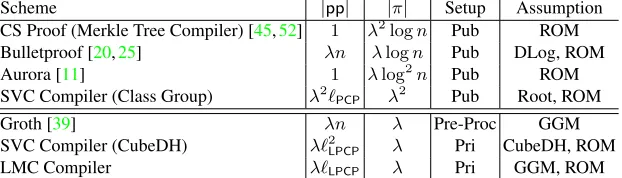
A comparison with the shortest succicnt arguments from the literature is given in Table2. To summarize, our approach yields extremely short proofs in exchange for a higher prover complexity and the usage of public-key cryptography. We also stress that our compiler is compatible with a broader class of PCPs, when compared with schemes under the CS proofs paradigm and pairing-based schemes. Being a very active area of research, we expect significant advancements in the design of more efficient PCPs, which are going to benefit from the generality of our approach.
Other Applications. Catalano and Fiore [26] suggested a number of applications of VC, including verifiable databases with efficient updates, updatable zero-knowledge elementary databases, and universal dynamic accumulators. In all of these applications, one can gain efficiency by replacing the VC scheme with an SVC scheme which allows for batch opening and updating. When instantiated with our first construction of SVC, one can further avoid the private-coin setup, which is especially beneficial to database applications as trusted third parties are no longer required.
Scheme |pp| |π| Setup Assumption CS Proof (Merkle Tree Compiler) [45,52] 1 λ2logn Pub ROM
Bulletproof [20,25] λn λlogn Pub DLog, ROM
Aurora [11] 1 λlog2n Pub ROM
SVC Compiler (Class Group) λ2`PCP λ2 Pub Root, ROM
Groth [39] λn λ Pre-Proc GGM
SVC Compiler (CubeDH) λ`2LPCP λ Pri CubeDH, ROM
LMC Compiler λ`LPCP λ Pri GGM, ROM
Table 2: Comparison of SNARKs with2−λ-soundness against adversaries of runtime2128. All constants are omitted. pp: public parameters,π: proof,n: size of circuit,`PCP: length of PCP proof,`LPCP: length of linear PCP proof, Pub:
public-coin, Pri: private-coin, Pre-Proc: pre-processing, Root: strong or adaptive root assumption, GGM: generic group model.
(r+ 1)group elements andrintegers, whereris the number of iterations of the underlying IOP. They also propose a technique to improve the efficiency of the verification algorithm and they estimate a decrease in verification time of ∼80%. Finally, they discuss how to use SVCs to improve the current design of blockchain-based transaction ledger in such a way that no user has to store the entire state of the ledger in memory.
1.3 Related Work
Succinct arguments were introduced by Kilian [45,46] and later improved, in terms of round complexity, by Lipmaa and Di Crescenzo [33]. Succinct non-interactive arguments, or computationally sound proofs, were first proposed by Micali [52]. These early approaches rely on PCP and have been recently extended [8] to handle interactive oracle proofs [12] (also known as probabilistic checkable interactive proofs [56]), largely improving the efficiency of the prover. A recent manuscript by Ben-Sassonet al.[9] improves the concrete efficiency of interactive oracle proofs. The first usage of knowledge assumptions to construct SNARKs appeared in the work of Mie [54]. Later, Groth [38] and Lipmaa [49] upgraded this approach to non-interactive proofs.
Ishai, Kushilevitz, and Ostrovsky [42] observed that linear PCPs can be combined with a linearly homomorphic encryption to construct more efficient arguments, with pre-processing. The also introduced a new (interactive) commit-ment scheme with private-coin verifier for linear functions. However, in contrast with LMC, their binding definition does not esure that the committed function is actually linear. Gennaroet al.[36] presented a very elegant linear PCP that gave rise to a large body of work to improve the practical efficiency of non-interactive arguments [5,10,13,27,28,32]. All of these constructions assume a highly structured and honestly generated common reference string (of size proportional to the circuit to be evaluated) and rely on some variant of the knowledge of exponent assumption. Recently, Ames
et al.[2] proposed an argument based on the MPC-in-the-head [43] paradigm to prove satisfiability of a circuitC
with proofs of sizeO(λp|C|). Zhanget al.[63] show how to combine interactive proofs and verifiable polynomial delegation schemes to construct succinct interactive arguments. The scheme requires a private-coin pre-processing and the communication complexity isO(λlog|w|). A recent result by Whabyet al.[61] introduces a prover-efficient construction with proofs of sizeO(λp|w|). Recent works [1,35] investigate on the resilience of SNARKs against a subverted setup. Libert, Ramanna, and Yung [47] constructed an accumulator for subset queries. Although similar in spirit to SVC, the critical difference is that accumulators are not position binding, which is crucial for the soundness of our argument system.
2
Preliminaries
Throughout this work we denote byλ∈Nthe security parameter, and bypoly(λ)andnegl(λ)the sets of polynomials and negligible functions inλ, respectively. We say that a Turing machine is probabilistic polynomial time (PPT) if its running time is bounded by some polynomial functionpoly(λ). An interactive protocolΠ between two machinesA
of an algorithmAon inputxis written asz←A(x). Let`∈N, the set[`]is defined as[`] :={1, . . . , `}. Vectors are written vertically.
2.1 Subvectors
We define the notion of subvectors. Roughly speaking, a subvector(xi1, . . . , xi|I|)
T is an ordered subset (indexed byI)
of the entries of a given vector(x1, . . . , x`)T.
Definition 1 (Subvectors).Let`∈N,X be a set, and(x1, . . . , x`)T ∈ X`be a vector. LetI= (i1, . . . , i|I|)⊆[q]be
an ordered index set. TheI-subvector ofxis defined asxI := (xi1, . . . , xi|I|)
T.
2.2 Arguments of Knowledge
LetR:{0,1}∗× {0,1}∗→ {0,1}be an NP-relation with corresponding NP-languageL:={x:∃ws.t.R(x, w) =
1}. We define arguments of knowledge [21] for interactive Turing machines [37]. To be as general as possible, we define an additional setup algorithmS, which is executed once and for all by a possibly trusted party. If the argument is secure without a setup, then such an algorithm can be omitted.
Definition 2 (Arguments of knowledge).A tuple(S,(P,V)Π)is a2−σ-sound (succinct) argument of knowledge for Rif the following conditions hold.
(Completeness) IfR(x, w) = 1then Pr
y←S(1λ)[(P(x, w, y),V(x, y))Π = 1] = 1.
(Soundness) For anyPPTadversaryA, allx /∈ L, and allz∈ {0,1}∗, Pr
y←S(1λ)[(A(x, z, y),V(x, y))Π = 1]<2 −σ.
(Argument of Knowledge) For anyPPTadversaryA, there exists a PPT extractorE, such that for allx, z∈ {0,1}∗, Pr
y←S(1λ)[(A(x, z, y),V(x, y))Π = 1]>negl(λ), thenPr[R(x, w) = 1|w← E
A(x)]>negl(λ).
(Succinctness) The communication betweenPandVis at mostpoly(λ,log|x|).
2.3 Probabilistically Checkable Proofs
One of the principal tools in the construction of argument systems is probabilistic checkable proofs (PCP) [3]. It is known that any witnesswfor an NP-statement can be encoded into a PCP of lengthpoly(|w|)bits such that it is sufficient to probabilistically testO(1)bits of the encoded witness.
Definition 3 (Probabilistically Checkable Proofs). A pair of machines(PPCP,VPCP)is a`-longq-query2−σ-sound
PCP for an NP-relationRif the following hold. (Completeness) IfR(x, w) = 1, thenPr[Vπ
PCP(x) = 1|π← PPCP(x, w)] = 1.
(Soundness) For allx /∈ L,Pr[Vπ
PCP(x) = 1|π← PPCP(x, w)]<2−σ.
(Proof Length) IfR(x, w) = 1, then for allπ∈ PPCP(x, w),|π| ≤`. (Query Complexity) For allx,π∈ {0,1}∗,Vπ
PCP(x)queries at mostqlocations ofπ. The notationVπ
PCP(x)means thatVPCPdoes not read the entire stringπdirectly, but is given oracle access to the string. On input a positioni∈[|π|], the oracle returns the valueπi. It is well known that one can diminish the soundness error to a negligible function by repetition. We additionally require that the witness can be efficiently recovered from the encoding of the witnessπ[60].
Definition 4 (Proof of Knowledge). A PCP is of knowledge if there exists a PPT algorithmEPCPsuch that, given any stringsxandπwithPr[Vπ
PCP(x) = 1]>negl(λ),E π
Linear PCPs. Ishai et al. [42] considered the notion oflinearPCP, where the stringπis instead a vector inF`for some finite fieldF(or in general a ring) and positive integer`. The oracle given to the verifier is modified, such that on inputf ∈F`, it returns the inner producthf,πi. Note that this generalizes the classical notion of PCP as one can recover the original definition by restricting the queriesf to be unit vectors. In this paper we are interested in the notion of linear PCP where soundness is only guaranteed to hold against linear functions (same as considered in [16]).
3
Mathematical Background and Assumptions
To capture the minimal mathematical structure required for one of our constructions, we follow the module-based cryptography framework of Lipmaa [50].
Background. A (left) R-moduleRD over the ringR(with identity) consists of an Abelian group(D,+)and an operation◦:R×D→D, denotedr◦Aforr∈RandA∈D, such that for allr, s∈RandA, B∈D, we have
– r◦(A+B) =r◦A+r◦B,
– (r+s)◦A=r◦A+s◦A,
– (r·s)◦A=r◦(s◦A), and
– 1R◦r=r, where1Ris the multiplicative identity ofR.
LetS = (s1, . . . , s`) ⊆ Nbe an ordered set, andr = (rs1, . . . , rs`)
T ∈ R`andA = (A
s1, . . . , As`)
T ∈ D` be vectors of ring and group elements respectively. For notational convenience, we denoteP
i∈Sri◦Aibyhr,Ai. A commutative ringRwith identity is called anintegral domainif for allr, s∈R,rs= 0Rimpliesr= 0Ror
s= 0R, where0Ris the additive identity ofR. A ringRisEuclideanif it is an integral domain and there exists a functiondeg :R →Z+, called the Euclidean degree, such that i) ifr, s ∈ R, then there existq, k ∈ Rsuch that
r=qs+kwith eitherk = 0R,k6= 0Randdeg(k)<deg(q), and ii) ifr, s∈Rwithrs 6= 0Randr 6= 0R, then
deg(r)<deg(rs). The set of unitsU(R) :={u∈R:∃vs.t. uv=vu= 1R}contains all invertible elements inR. An elementr∈R\({0R} ∪U(R))is said to beirreducibleif there are no elementss, t∈R\ {1R}such thatr=st. The set of all irreducible elements ofRis denoted byIRR(R). An elementr∈R\({0R} ∪U(R))is said to beprime if for alls, t∈R, wheneverrdividesst, thenrdividessorrdividest. IfRis Euclidean, then an element is irreducible if and only if it is prime.
Adaptive Root. The adaptive root assumption (over unknown order groups, and in particular over class groups of imaginary quadratic orders) was introduced by Wesolowski [62] and re-formulated by Bonehet al.[19] to establish the security of the verifiable delay function scheme of Wesolowski [62]. Here we state the same assumption over modules in two variants – with private and public coins. Note that Wesolowski [62] and Boneh et al. [19] implicitly considered thepublic-coin-setupvariant.
Definition 5 ((Public-Coin) Adaptive Root). LetI be some ordered set. LetRD = ((Ri)Di)i∈I be a family of
modules. LetMGen(1λ;ω)be a deterministic algorithm which picks somei∈I(hence someRD = (Ri)Di ∈ RD)
and some elementA∈D. For a ringR, letIRRλ(R)⊆IRR(R)be some set of prime elements inRof size2λ. The
adaptive root assumption is said to hold over the family of modulesRDwith respect toIRRλ, if for anyPPTadversary A= (A1,A2)there exists(λ)∈negl(λ)such that
Pr
e◦Y =X
ω←${0,1}λ; (R
D, A) :=MGen(1λ;ω)
X ← A1(RD, A , ω);e←$IRRλ(R);Y ← A2(e)
≤(λ),
Strong Distinct-Prime-Product (Divisible) Root. We define the following variant of the “strong root assumption” [29] over modules over Euclidean rings, which is a generalizations of the strong RSA assumption. LetRDbe a module over some Euclidean ringR, andAbe an element ofD. The strong distinct-prime-product divisible root problem with respect toAasks to a set of distinct prime elements{ei}i∈S inR, an elementeinR, and an elementY inDsuch that
e Q
i∈Sei
◦Y =e◦A. The strong distinct-prime-product root problem (without divisible) with respect toAis the same except that it requirese= 1R. We define the assumption in two variants depending on whetherRDandAare sampled with public coins.
Definition 6 ((Public-Coin) Strong Distinct-Prime-Product (Divisible) Root). LetI be an ordered set,RD =
((Ri)Di)i∈I be a family of modules, andMGen(1λ;ω)be a deterministic algorithm which picks somei∈I(hence
someRD= (Ri)Di ∈ RD) and some elementA∈D. The strong distinct-prime-product divisible root assumption is
said to hold over the familyRD, if for anyPPTadversaryAthere exists(λ)∈negl(λ)such that
Pr
e Q
i∈Sei
◦Y =e◦A
∀i∈S, ei∈IRR(R) ∀i6=j∈S, ei 6=ej
ω←${0,1}λ
(RD, A) :=MGen(1λ;ω)
(e,{ei}i∈S, Y)← A(RD, A , ω )
≤(λ),
whereAisnotgivenω(highlighted by the dashed box). If the inequality holds even ifAis givenω, then we say that the assumption ispublic-coin. We say that the strong distinct-prime-product root assumption (not divisible) holds over the familyRD, ifAis restricted to sete= 1R.
Lipmaa [50] defined several variants of the (strong) root assumption with respect to a random element inDsampled withprivate coin, given the description of the moduleRDsampled withpublic coin. Note that the (resp. public-coin) strong distinct-prime-product root assumption is weaker than the (resp. public-coin) strong root assumption, where the latter requires the adversary to simply output(e, Y)such thate6= 1Rande◦Y =A. It is apparent that the strong distinct-prime-product root assumption over RSA groups is implied by the strong RSA assumption.
4
Subvector Commitments
In the following we define the main object of interest for our work. Subvector commitments are a generalization of vector commitments [26], where the opening is performed with respect to subvectors.
Definition 7 (Subvector Commitments (SVC)).A subvector commitment schemeSVCoverXconsists of the follow-ingPPTalgorithms(Setup,Com,Open,Verify):
Setup(1λ,1`;ω): Thedeterministicsetup algorithm inputs the security parameter1λ, the vector size1`, and a random
tapeω. It outputs a public parameterpp. We assume that all other algorithms inputppwhich we omit.
Com(x): The committing algorithm inputs a vectorx∈ X`. It outputs a commitment stringCand some auxiliary
informationaux.
Open(I,x0I,aux): The opening algorithm inputs an index setI, anI-subvectorx0I, and some auxiliary information
aux. It outputs a proofΛI thatx0Iis theI-subvector of the committed vector.
Verify(C, I,x0I, ΛI): The verification algorithm inputs a commitment stringC, an index setI, anI-subvectorx0I, and
a proofΛI. It accepts (i.e., it outputs1) if and only ifCis a commitment toxandx0I is theI-subvector ofx.
The definition of correctness is given as follows.
Definition 8 (Correctness).A subvector commotmentSVCoverX is said to be correct if, for any security parameter
λ, `∈N, random tapeω∈ {0,1}λ, public parameterspp∈Setup(1λ,1`;ω),x∈ X`, index setI∈[`],(C,aux)∈ Com(x),ΛI ∈Open(I,xI,aux), there exists(λ)∈negl(λ)such that
Pr[Verify(C, I,xI, ΛI) = 1]≥1−(λ).
The distinguishing property for SVCs is compactness. Loosely speaking it says that the size of the commitment strings
Definition 9 (Compactness).A subvector commitmentSVCoverXis compact if there exists a universal polynomial
p∈poly(λ)such that for any`∈poly(λ), random tapeω∈ {0,1}λ, public parameterspp∈Setup(1λ,1`;ω), vector x∈ X`, index setI∈[`],(C,aux)∈Com(x),Λ
I ∈Open(I,xI,aux), it holds that|C| ≤p(λ)and|ΛI| ≤p(λ). We consider the notion of position binding for subvector commitments with public-coin setup. Recall that position binding for vector commitments requires that it is infeasible to open a commitment with respect to some positionito two distinct messagesxiandx0i. We extend this notion to subvector commitments, by requiring that it is infeasible to open a commitment with respect to some index setsIandJ to subvectorsxIandx0J, respectively, such that there exists an indexi∈I∩Jwherexi 6=x0i. Furthermore, we require this property to hold even if the setup algorithm is public coin.
Definition 10 ((Public-Coin) Position Binding).A subvector commitmentSVCoverX is position binding if for any
PPTadversaryA, there exists a negligible function(λ)∈negl(λ)such that
Pr
Verify(C, I,xI, ΛI) = 1 Verify(C, J,x0
J, Λ0J) = 1 ∃i∈I∩Js.t. xi6=x0i
ω←${0,1}λ pp←Setup(1λ,1`;ω)
(C, I, J,xI,x0J, ΛI, Λ0J)← A(pp , ω)
≤(λ)
whereAisnotgivenω(highlighted by the dashed box). If the inequality holds even ifAis givenω, then we say that
SVCis function binding withpublic coins.
We do not define hiding as it is not needed for our purpose. However, as discussed in [26], one can construct a hiding VC generically by committing to (normal) commitments using VC. This naturally extends to SVC as well.
4.1 Linear Map Commitments
Functional commitments for linear functions, specifically for linear formsf :F`→Ffor some fieldF, were introduced by Libert, Ramanna and Yung [47] and is a generalization of vector commitments (VC) introduced by Catalano and Fiore [26]. Here we refine the notion to capture a more general class of function families, which allows the prover to open a commitment to the output ofmultiplelinear forms or, equivalently, to the output of alinear mapf :F`→Fq. Note that any linear map fromF`toFqcan be represented by a matrixF ∈Fq×`.
Definition 11 (Linear Map Commitments (LMC)).A linear map commitment schemeLMCoverFconsists of the
followingPPTalgorithms(Setup,Com,Open,Verify):
Setup(1λ,F;ω): Let`, q∈poly(λ)be positive integers, andF ⊆ {f :
F`→Fq}be a family of linear maps. The deterministicsetup algorithm inputs the security parameter1λ, the description of the familyF, and a random tapeω. It outputs a public parameterpp. We assume that all other algorithms inputppwhich we omit.
Com(x): The committing algorithm inputs a vectorx∈F`. It outputs a commitment stringCand some auxiliary
informationaux.
Open(f,y,aux): The opening algorithm inputs anf ∈ F, an imagey∈Fq, and some auxiliary informationaux. It
outputs a proofΛthaty=f(x).
Verify(C, f,y, Λ): The verification algorithm inputs a commitment stringC, anf ∈ F, an imagey, and a proofΛ. It accepts (i.e., it outputs1) if and only ifCis a commitment toxandy=f(x).
In the following we define correctness and compactness for LMCs.
Definition 12 (Correctness).A linear map commitment schemeLMCoverFis said to be correct if, for any security
parameter and lengthλ, `, q∈N, random tapeω∈ {0,1}λ, linear map familyF ⊆f :F`→Fq , public parameters pp ∈ Setup(1λ,F;ω),x ∈
F`, linear map f ∈ F,(C,aux) ∈ Com(x),Λ ∈ Open(f, f(x),aux), there exists
(λ)∈negl(λ)such that
Setup(1λ,1`;ω)
(RD, X)←$MGen(1λ, ω)
(e1, . . . , e`)←H(RD, X)
∀i∈[`], Si:=
Q
j∈[`]\{i}ej
◦X
S:= (S1, . . . , S`)T,e:= (e1, . . . , e`)T
returnpp:= (RD, X,S,e)
Com(x)
return(C,aux) := (hx,Si,x)
Open(I,x0I,aux)
parseauxasx
ΛI:= Qi∈Iei
−1
◦ hx[`]\I,S[`]\Ii
returnΛI
Verify(C, I,x0I, ΛI)
b0:= (x0I∈ M |I|
)
b1:= (C=hx0I,SIi+ Qi∈Iei
◦ΛI)
returnb0∩b1
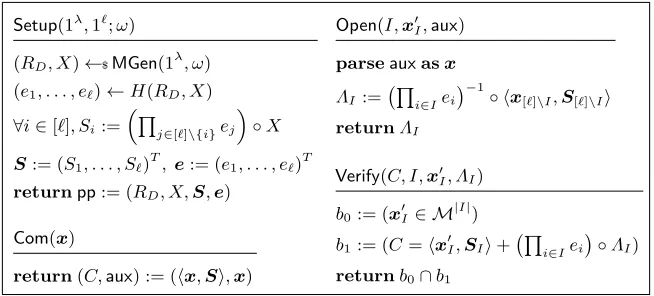
Fig. 1: SVC from the Root Assumption.
Definition 13 (Compactness).A linear map commitmentLMCoverFis compact if there exists a universal polynomial
p ∈ poly(λ), such that for any`, q ∈ poly(λ), family of linear mapsF ⊆ {f : F` → Fq}, random tapeω ∈ {0,1}λ, public parameterspp ∈ Setup(1λ,F;ω), vector x ∈
F`, linear mapf ∈ F,(C,aux) ∈ Com(x),Λ ∈ Open(f, f(x),aux), it holds that|C| ≤p(λ)and|Λ| ≤p(λ).
We next generalize the notion of function binding for linear maps. The original definition, as considered by Libert, Ramanna and Yung [47], requires that it is hard to open a commitment to(f, y)and(f, y0)wherey 6= y0. When considering broader classes of functions, such as linear maps where the target space is multidimensional, each opening defines a system of equations. Note that in this case one might be able to generate an inconsistent system with just a single opening, or generate openings to(f, y)and(f0, y0)withf 6=f0but the systems defined by the tuples are inconsistent. Therefore, our definition explicitly forbids the adversary to generate inconsistent equations.
Definition 14 ((Public-Coin) Function Binding).A linear map commitmentLMCoverFis function binding if for
anyPPTadversaryA, positive integersQ, `, q∈poly(λ), and family of linear mapsF ⊆ {f :F`→
Fq}, there exists
a negligible function(λ)∈negl(λ)such that
Pr
∀k∈[Q], fk∈ F ∧yk∈F
q∧ Verify(C, fk,yk, Λk) = 1 @x∈ X`s.t.∀k∈[Q], fk(x) =yk
ω←${0,1}λ pp←Setup(1λ,F;ω)
(C,{(fk,yk, Λk)}k∈[Q])← A(pp, ω )
≤(λ)
whereAisnotgivenω(highlighted by the dashed box). If the inequality holds even ifAis givenω, then we say that
LMCis function binding withpublic coins.
As for SVC, we omit the hiding definition as it is not needed for our purpose.
5
Constructions for SVCs
5.1 SVC from Modules over Euclidean Rings
Our first SVC scheme relies on modules over Euclidean rings where some variants of the root problem (the natural generalization of the RSA problem) is hard. Let`∈poly(λ)be a positive integer. LetMGenbe an efficient module sampling algorithm as defined inSection 3and letRbe an Euclidean ring sampled byMGen. LetIRRλ(R)be a set of prime elements inRof size2λ. LetH:{0,1}∗→IRR
λ(R)`be a prime-valued function which maps finite bit strings to tuples of`distinct elements inIRRλ(R). That is, for all strings∈ {0,1}∗, if(e1, . . . , e`) =H(s), thenei6=ejfor alli, j∈[q]wherei6=j. LetX :={0R,1R}5where0Rand1Rare the additive and multiplicative identity elements ofRrespectively. We construct our first subvector commitment scheme inFigure 1. Note that in the opening algorithm, it is required to compute
ΛI :=
Y
i∈I
ei
!−1
◦ hx[`]\I,S[`]\Ii.
Although multiplicative inverses of ring elements do not exist in general, and if so, they may be hard to compute, the above are efficiently computable because, for alli∈[`]\Iand hence for alli∈J\I, we have
Si:=
Y
j∈[`]\{i}
ej
◦X =
Y
j∈I
ej
Y
j∈[`]\(I∪{i})
ej
◦X.
The correctness of the construction follows straightforwardly by inspection. Depending on the instantiation ofH, we can prove our scheme secure against different assumptions:
– H is a (non-cryptographic) hash: Our construction is secure if the strong distinct-prime-product root assumption (introduced inSection 3) holds over the module familyRD. This is shown inTheorem 1.
– H is a random oracle: Our construction is secure if the adaptive root problem (introduced in [19]) is hard over the module family. This is shown inTheorem 2.
Theorem 1. If the (resp. public-coin) strong distinct-prime-product divisible root assumption holds over the module familyRD, or if the (resp. public-coin) adaptive root assumption and the (resp. public-coin) strong
distinct-prime-product root assumption holds over the module familyRD, then the scheme inFigure 1is (resp. public-coin) position
binding.
Proof. Suppose not, letAbe aPPTadversary such that
Pr
Verify(C, I,xI, ΛI) = 1 Verify(C, J,x0J, Λ0J) = 1
∃i∈I∩Js.t. xi 6=x0i
ω←${0,1}λ pp←Setup(1λ,1`;ω) (C, I, J,xI,x0J, ΛI, Λ0J)← A(1
λ,pp, ω )
>
1
f(λ)
for some polynomialf(λ)∈poly(λ), whereAgetsωas input (highlighted by the dashed box) only in the public-coin variant. We construct an algorithmCas follows, whose existence contracts the fact thatRDis a (public-coin) strong distinct-prime-product (divisible) root modules family.
In the pivate-coin setting,C receives as input(RD, A)generated by MGen(1λ;ω)for some ω←${0,1}λ. It setsX := A, and computes(e1, . . . , e`) ← H(RD, X). It then setsSi :=
Q
j∈[`]\{i}ej
◦ X for alli ∈ [`], S := (S1, . . . , Sq)T, ande:= (e1, . . . , e`). It setspp:= (RD, X,S,e)and runsAon input(1λ,pp). In the public-coin setting,Creceives additionallyωand runsAon(1λ,pp, ω)instead. In any case, it is clear thatppandωobtained above distribute identically as
{(pp, ω) :ω←${0,1}λ;pp←Setup(1λ,1`;ω)} λ.
Hence, with probability at least1/f(λ),Cobtains(C, I, J,xI,x0J, ΛI, Λ0J)such that
hxI,SIi+ Y
i∈I
ei
!
◦ΛI =hx0J,SJi+
Y
i∈J
ei
!
◦Λ0J
5
which implies
hxI\J,SI\Ji − hx0J\I,SJ\Ii+hxI∩J−x0I∩J,SI∩Ji
= Y i∈I∩J ei ! Y i∈J\I ei
◦Λ0J−
Y i∈I\J ei
◦ΛI
.
Recall thatSi=
Q
j∈[`]\{i}ej
◦A. Defineδi:=
xi i∈I\J
−x0
i i∈J\I
xi−x0i i∈I∩J and
Λ:=Q
i∈J\Iei
◦Λ0J−Q
i∈I\Jei
◦ΛI
.Cobtains
X i∈I∪J δi Y j∈[`]\{i} ej
◦A=
Y
i∈I∩J
ei
!
◦Λ.
Let K0 := {i ∈ I ∩ J : δi = 0R} and K1 := {i ∈ I ∪ J : δi 6= 0R}. Next, we show that d :=
gcdP
i∈I∪JδiQj∈[`]\{i}ej,Qi∈I∩Jei
= Q
j∈K0ej. Furthermore, suppose that this is the case, we have
(I∩J)\K06=∅since there existsi∈I∩Jsuch thatδi=xi−x0i6= 0R. To prove the above, we first note that
X
i∈I∪J
δi
Y
j∈[`]\{i}
ej=
X
i∈K1
δi
Y
j∈[`]\{i}
ej =
Y j∈[`]\(I∪J) ej X i∈K1 δi Y j∈(I∪J)\{i} ej . Hence
d= gcd
X i∈K1 δi Y j∈(I∪J)\{i}
ej,
Y i∈I∩J ei = Y j∈K0
ej·gcd
X i∈K1 δi Y
j∈(I∪J)\(K0∪{i})
ej,
Y
i∈(I∩J)\K0
ei
.
It remains to show thatd0 := gcdP
i∈K1δi
Q
j∈(I∪J)\(K0∪{i})ej,
Q
i∈(I∩J)\K0ei
= 1R. Suppose not, letd0 =
Q
i∈Leifor someL⊆(I∩J)\K0. Suppose`∈L6=∅. This meansδ`6= 0Rand hence`∈K1. Then there exists
r∈Rsuch that
e`·r=
X
i∈K1
δi
Y
j∈(I∪J)\(K0∪{i})
ej
=δ`
Y
j∈(I∪J)\(K0∪{`})
ej+e`
X
i∈K1\{`}
δi
Y
j∈(I∪J)\(K0∪{i})
ej.
Letr0:=r−P
i∈K1\{`}δi
Q
j∈(I∪J)\(K0∪{i})ej. We have
e`·r0 =δ`
Y
j∈(I∪J)\(K0∪{`})
ej.
Sinceδ` 6= 0R,i.e.,δ` ∈ {−1R,1R}, the above contradicts the fact thate`is a prime element. Thus we must have
Now that we have concludedd= gcdP
i∈I∪JδiQj∈[`]\{i}ej,Qi∈I∩Jei
=Q
j∈K0ej,Ccan use the extended Euclidean algorithm to finda, b∈Rsuch that
a X
i∈I∪J
δi
Y
j∈[`]\{i}
ej+b
Y
i∈I∩J
ei=
Y
j∈K0
ej.
Multiplying this toA, it gets
Y j∈K0 ej
◦A=
a X i∈I∪J δi Y j∈[`]\{i}
ej+b
Y
i∈I∩J
ei=
Y
j∈K0
ej
◦A
= a Y
i∈I∩J
ei
!
◦Λ+ b Y
i∈I∩J ei ! ◦A = Y i∈I∩J ei !
◦(a◦Λ+b◦A).
Since(I∩J)\K06=∅,Ccan setS:= (I∩J)\K0andY := (a◦Λ+b◦A), and obtain the relation
Y j∈K0 ej
◦A=
Y j∈K0 ej Y j∈S ej
◦Y.
Here, an option forCis to directly outputQ
j∈K0ej
,{ei}i∈S, Y
as a solution to the strong distinct-prime-product divisible root problem.
Alternatively, if the adaptive root assumption holds, we show that
A= Y j∈S ej
◦Y (1)
except with negligible probability. The argument is essentially identical to the one in [19] for showing that the adaptive root assumption implies the low order assumption. Suppose Equation (1) does not hold. We construct an adversary against the adaptive root problem as follows. By runningC, we have
Y j∈K0 ej
◦X = 0D
whereX := A−Q
j∈Sej
◦Y 6= 0D. Our adversary outputsX and receivese←$IRRλ(R). With probability
1− |K0|/2λ= 1−negl(λ), we havegcd
e,Q
j∈K0ej
= 1. We can therefore writeae+bQ
j∈K0ej
= 1R
for somea, b∈R. Observe that
X =1R◦X
=
ae+b
Y j∈K0 ej
◦X
=e◦(a◦X) +b◦
Y j∈K0 ej
◦X
Setup(1λ,1`;ω)
(p,G,GT, G, e)←GGen(1λ;ω)
∀i∈[`], zi←$Zp
∀i, i0∈[`], Gi:=Gzi, Hi,i0:=Gzizi0
pp:=
p,G,GT, G,{Gi}i∈[`],
{Hi,i0}i,i0∈[`],i6=i0, e
returnpp
Com(x)
return(C,aux) :=
Y
i∈[`] Gxi
i ,x
Open(I,x0I,aux)
parseauxasx
returnΛI :=
Y
i∈I
Y
i0∈/I Hxi0
i,i0
Verify(C, I,x0I, ΛI)
b0:= (x0I∈ X |I|
)
b1:= e Q C i∈IG
xi i
,Y
i∈I Gi
!
=e(ΛI, G)
!
returnb0∩b1
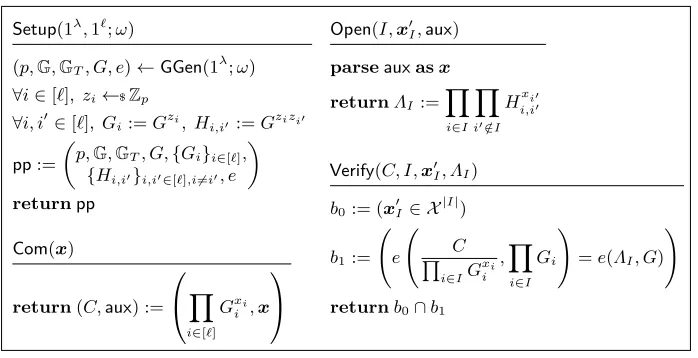
Fig. 2: SVC from CubeDH.
Our adversary therefore outputsa◦Xas a solution to the adaptive root problem.
To conclude, Equation (1) holds except with negligible probability.Ccan therefore output({ei}i∈S, Y)as a solution
to the strong distinct-prime-product root problem. ut
Theorem 2. If the (resp. public-coin) adaptive root assumption holds over the module familyRDwith respect toIRRλ,
then the scheme inFigure 1is (resp. public-coin) position binding in the random oracle model.
We refer to AppendixC.1for a full proof.
Efficiency and Optimizations. Our construction admits two complementary instantiations, discussed in the following.
– Efficient Verifier (assuming random access to public parameters): The vectorsSandeare explicitly included in the public parameters (as it is currently described). In this case, and suppose the verifier has random access to eachei andSi, the computational effort of the verifier is only proportional to|I|, the size of the subvector. The shortcoming of this scheme is that the size of the public parameters is linear in`, which can be very large depending on the application.
– Short Public Parameters: One can reduce the size of the public parameters to a constant by including only the module description(RD, X)and letting each algorithm recompute the terms ofSneeded for the computations. This however increases the computational complexity of the verifier, since the computation needed for each element ofSis linear in the vector length`. This can be partiallly amortized by observing that the values(S1, . . . , S`)do not depend on the committed vector and can be precomputed by both parties.
Another possible tradeoff is given by the assumption that one is willing to rely on: Note that the main workload for the verifier (in the verifier-optimized variant) is to compute the term Q
i∈Iei
◦ΛI. AssumingR =Zand the term is computed by repeated squaring, the complexity of the computation depends on the bit-length of the primes
ei. In the adaptive root assumption, the primes(e1, . . . , e`)are sampled randomly from a set of primes of size2λ, therefore representing each prime requires at leastλbits. On the other hand, under the strong distinct-prime-product root assumption we can set(e1, . . . , e`)to be the smallest`primes. Since`∈poly(λ), each prime can be represented byO(logλ)bits. This greatly reduces the computational effort of the verifier.
5.2 SVC from the Cube Diffie-Hellman Assumption
to work over the more efficient asymmetric (type III) bilinear groups without affecting computational efficiency nor opening size by, e.g., replicating all public parameters in both source groups.
The public parameters consist of a set of random elements{Gi=Gzi}i∈[q]and their pairwise “Diffie-Hellman products”Hi,i0 =Gzizi0 withi6=i0. To commit to a vectorxone computesC:=Q
iG xi
i . The opening of a subvector xI is thenQ
i∈I
Q
i0∈I/ H
xi0
i,i0. Note that sincei∈Iandi0 ∈/ I, it is always true thati6=i0. Therefore the product is
efficiently computable for an honest prover. Assuming that the verifier has random access to eachGi in the public parameters, it can check the relation by accessing|I|entries in the public parameters, and computing2· |I|group operations and2pairings (which are independent of`). Since the public parameters are highly structured, this scheme does not admit an instantiation with short public parameters, which grow quadratically with the vector size`.
LetGGenbe an efficient bilinear group sampling algorithm. Let(p,G,GT, G, e)be a group description output by GGen. LetX :=Zp. Our second subvector commitment scheme is shown inFigure 2. In the following we show that our SVC scheme is position binding with a private-coin setup.
Theorem 3. If the Cube Diffie-Hellman (CubeDH) assumption holds with respect toGGen, then the scheme inFigure 2
is position binding.
Proof. Suppose not, letAbe aPPTadversary such that
Pr
Verify(C, I,xI, ΛI) = 1 Verify(C, J,x0J, Λ0J) = 1
∃i∈I∩Js.t. xi6=x0i
ω←${0,1}λ pp←Setup(1λ,1`;ω)
(C, I, J,xI,x0J, ΛI, Λ0J)← A(1λ,pp)
>
1
f(λ)
for somef(λ)∈poly(λ). We construct a CubeDH solver as follows.
C receives as input(p,G,GT, G, H, e), where(p,G,GT, G, e) ← GGen(1λ)andH = Gz for some random
z←$Zp, and must outputGz2. It picks an indexi∗←$[`]and setG
i∗:=H. Symbolically, letzi∗:=z, which is not
known byC. For the other indicesi, i0 ∈[`]\ {i∗}, it sampleszi←$Zpand setsGi :=Gzi andHi,i0 :=Gzizi0. It
also setsHi∗,i=Hi,i∗=Gzzifor eachi∈[`]\ {i∗}. It then setspp= (p,G,GT, G,{Gi}i∈[`],{Hi,i0}i,i0∈[`],i6=i0, e),
which is identically distributed asppoutput bySetup.CrunsAon input(1λ,pp). With probability at least1/f(λ), it obtains(C, I, J,xI,x0J, ΛI, Λ0J)such thatVerify(C, I,xI, ΛI) = 1,Verify(C, J,x0J, Λ0J) = 1, and∃i∈I∩Js.t. xi6=
x0i. Conditioning on the above, with probability1/`, it holds thati∗∈I∩Jandxi∗6=x0i∗. By examining the verification
equations, we have
e Q C
i∈IG xi i ,Y i∈I Gi
!Pi∈Jzi
·e ΛI,
Y
i∈J
Gi
!
=e C
Q i∈JG x0 i i ,Y i∈J Gi
!Pi∈Izi
·e ΛJ,
Y i∈I Gi ! e Y i∈I
Gxi i ,
Y
i∈I
Gi
!Pi∈Jzi
·e ΛI,
Y
i∈J
Gi
!
=e Y
i∈J Gx 0 i i , Y i∈J Gi
!Pi∈Izi
·e ΛJ,
Y
i∈I
Gi
!
using the fact that
e C,Y
i∈I
Gi
!P
i∈Jzi
=e C,Y
i∈J
Gi
!P
i∈Izi
.
Substituting we obtain
e Y
i∈I
Gxi i ,
Y
i∈I
Gi
!Pi∈Jzi
·e ΛI,
Y
i∈J
Gi
!
=e Y
i∈J Gx 0 i i , Y i∈J Gi
!Pi∈Izi
·e ΛJ,
Y
i∈I
Gi
!
e(g, g)
P
i∈Izixi
P
i∈Izi
P
i∈Jzi
·e ΛI,
Y
i∈J
Gi
!
=e(g, g)
P
i∈Jzix
0
i
P
i∈Jzi
P
i∈Izi
·e ΛJ,
Y
i∈I
Gi
!
Let us denote
X
i∈I
zixi
! X i∈I zi ! X i∈J zi !
=xi∗zi3∗+xi∗z2i∗
X
i∈J\{i∗} zi
+xi∗zi∗
X
i∈I\{i∗} zi X i∈J zi ! + X
i∈I\{i∗} zixi
X i∈I zi ! X i∈J zi !
=xi∗zi3∗+α
and
X
i∈J
zix0i
! X i∈J zi ! X i∈I zi !
=x0i∗z3i∗+x0i∗zi2∗
X
i∈I\{i∗} zi
+xi∗zi∗
X
i∈J\{i∗} zi X i∈I zi ! + X
i∈J\{i∗} zix0i
X i∈J zi ! X i∈I zi !
=x0i∗z3i∗+β
and observe thatαandβare at most quadratic in the variablezi∗. Now we can rewrite
e(g, g)
P
i∈Izixi
P
i∈Izi
P
i∈Jzi
·e ΛI,
Y
i∈J
Gi
!
=e(g, g)
P
i∈Jzix
0
i
P
i∈Jzi
P
i∈Izi
·e ΛJ,
Y
i∈I
Gi
!
e(g, g)xi∗z3
i∗+α·e ΛI,Y i∈J
Gi
!
=e(g, g)x0i∗z 3
i∗+β·e ΛJ,Y i∈I
Gi
!
e(g, g)(xi∗−xi0∗)zi3∗ =e Λ
J,
Y
i∈I
Gi
!
·e ΛI,
Y
i∈J
Gi
!−1
·Hβ−α.
Note that we have thatxi∗6=x0i∗which implies that the LHS of the equation is non-zero. Furthermore, the RHS of the
equation is efficiently computable by the reduction. It follows thatCcan extract a solution to the CubeDH instance with non-negligible probability. This concludes our proof.
6
Construction for LMC
Our LMC construction is inspired by the scheme presented in [47] and it is based upon the following observations. First, when the vectorsx,f ∈F`for some fieldFare encoded as the polynomialspf(α) :=Pj∈[`]fjα`+1−j and
px(α) := Pj∈[`]xjαj with variableαrespectively, their inner product is the coefficient of the monomialα`+1in the polynomial productpf(α)px(α). Second, due to linearity of polynomial multiplication, if a matrixF ∈Fq×`is encoded in the polynomialpF(α) :=Pi∈[q],j∈[`]fi,jziα`+1−jwith variables(α, z1, . . . , zq), then the matrix-vector productFxis given in the coefficients of the monomialsziα`+1fori∈[q]in the polynomialpF(α)px(α).
With the above observations, we give an overview of our construction. We let the commitmentCtoxbeGpx(α),
which is computable by combining elements of the formGαj given in the public parameters. Given(F,y), to verify that
Fx=y, the verifier computes via pairinge(GpF(α,z1,...,zq), Gpx(α)), where the left-input is computable by combining
elements of the formGziαj given in the public parameters. If the relationFx=yindeed holds, then the coefficients of ymust be encoded as the coefficients of the (lifted) monomialsGziα`+1. To convince the verifier that this is the case, it suffices for the prover to provide the remaining terms of the product polynomial.
LetGGenbe an efficient bilinear group sampling algorithm. Let(p,G,GT, G, e)be a group description output by GGen. LetF=Zp,`, q∈N, andFbe the set of all linear maps fromZ`ptoZ
q