ISSN 2348 - 7968
Feasibility Testing of Biodiesel Blends in Agricultural
Tractor for Conservation of Fuel and Reduction of
Environmental Pollution
Beerge Ramesh 1, Vijayakumar Palled 2*, M. Veerangouda 3 , Sushilendra 4, Udaykumar Nidoni 5 , M. Anantachar 6 and Sunil Shirwal 4
Departmentof Farm Machinery and Power Engineering, College of Agricultural Engineering, University of Agricultural Sciences, Raichur - 584 104 (Karnataka State)
Abstract
This paper reveals the feasibility of Karanja biodiesel blends as fuel in agricultural tractor for tillage operations in order to conserve petroleum based fuels and reduce the environmental pollution. The drawbar power, fuel consumption and fuel efficiency of the tractor at three selected forward
speeds viz., 2.5, 3.5 and 4.5 km h-1 were assessed
during tillage operations. The levels of carbon
monoxide (CO) and carbon dioxide (CO2)
emissions were analysed using exhaust gas analyzer. Results showed that the drawbar power of tractor was not affected by the blends but significantly affected by the forward speed. The blends and forward speed of operation affected both the fuel consumption and fuel efficiency significantly. The rate of increase in the levels of
CO and CO2 emission were the direct function of
forward speed while, the CO and CO2 emission
levels decreased with the increase in the blends of biodiesel in the tractor. B20 biodiesel blend performed comparably with the petro-diesel in terms of fuel consumption and fuel efficiency but resulted in reduction of emission levels.
Keywords: Agricultural tractor, Drawbar power, Emission level, Fuel efficiency and Karanja biodiesel blends
1. Ph. D. Scholar, Dept. of Farm Machinery and
Power Engineering
2. Research Engineer, AICRP on Renewable Energy Sources, Dept. of FMPE
3. Professor and University Head, Dept. of Farm
Machinery and Power Engineering
4. Assistant Professor, Dept. of Farm Machinery
and Power Engineering
5. Head, Dept. of Processing and Food Engineering
6. Professor and Head, Dept. of Farm Machinery
and Power Engineering
1. Introduction
Biodiesel is an attractive alternative fuel to petro-diesel mainly because it is renewable, biodegradable and environmental friendly. Also this can be produced from common feed stocks, such as vegetable oils and animal fats. In most parts of the world it is being produced from the feedstocks that are essentially edible. Therefore, in the developing countries, including India, it is potential to produce
biodiesel from non-edible oils that can be
extensively grown in the waste lands (Baiju et al,
2009).
In most of the previous studies, biodiesel was usually tested on single-cylinder stationary engines. The use of B5, B10, B15, and B20 blends did not affect the engine torque and power, but did cause a reduction in the fuel consumption. While; the use of B40, B60, B80 and B100 reduced the torque and power output of the engine and increased the fuel consumption (Stalin and Prabhu,
2007). The dynamic performance of 74.56 kW
agricultural tractor using spent oil biodiesel blends
revealed that the specific fuel consumption of
tractor operated on 100 per cent biodiesel was increased on average by 18 per cent in comparison
to the petro-diesel (Soranso et al, 2008). The
application of different methyl ester blends in proportion of B10, B20, B30, B50, B75 and B100 obtained from mixture of 75 per cent sunflower oil and 25 per cent cooking oil used in agricultural tractor (Kubota) of 19.7 kW rated horsepower showed no significant reduction in power output and torque with blends below 50 per cent, however fuel consumption with biodiesel were higher than that of diesel except the blends up to 30 per cent
(Milan et al, 2010). The analysis of exhaust gas
emission of the tractor using B0, B20 and B100 blends during ploughing and rotary tilling in the paddy fields indicated that the diesel fuel combustion discharged the maximum amount of
CO2 (8.7 per cent), followed by B20 (8 per cent),
and B100 (7.8 per cent). The NOX concentration
was maximum (815.1 ppm) for B100 while it was
775.8 ppm for diesel (Kim et al, 2010).
and forestry tractors, that’s to be in real field conditions.
Keeping the above points in view, a study was undertaken to investigate the feasibility of biodiesel blends as fuel in an agricultural tractor for tillage operations for conservation of petroleum fuel and reduction of environment pollution.
2. Materials and Methods
Karanja biodiesel was procured from Indus Biodiesel Plant in Shimoga District, Karnataka, India. The blends of biodiesel were selected with an increment of 20 per cent of value up to 60 percent blends and designated as B20, B40 and B60 respectively. The petro-diesel is designated as B0. The blends were prepared on volume basis in the proportion of 20:80, 40:60 and 60:40 per cent of biodiesel and petro-diesel.
2.1 Fuel properties
The overall flammability and quality of selected blends were analysed by determining various physical and chemical properties as per ASTM standard procedures. The density of the fuel was determined by pycnometer. The kinematic viscosity of the test fuels was determined by using a constant temperature bath Redwood viscometer. An adiabatic oxygen bomb calorimeter was used to determine the calorific value of the fuels. The Pensky Marten’s open cup flash and fire point apparatus was used to the determine flash and fire points of the selected blends of biodiesel and petro-diesel. The fuel sample was titrated against 0.25 N sodium hydroxide and 2 ml of phenolphthalein indicator to determine free fatty acid content of test fuels. All the tests were repeated thrice for all the blends and their average values were reported. 2.2 Tractor and equipments
A 50 hp agricultural tractor (2WD Mahindra 585DI) with rated engine speed of 2600 rpm and nominal PTO output of 42 hp was selected for evaluation. Tillage operations (ploughing and harrowing) were carried out to assess the performance of tractor at various forward speeds.
The matching equipments viz., a two bottom mould
board plough of 0.9 m width and off set disc harrow of 1.66 m width were selected for tillage operations to suite local soil conditions.
2.3 Field experimentation
The complete experiment was conducted in single plot to avoid much variation in the field conditions. Tillage operations were conducted at three selected speeds of 2.5 (S1), 3.5 (S2) and 4.5
(S3) km h-1. The forward speed of tractor was
calibrated to the desired speed for individual blends of biodiesel by adjusting engine throttle position and gear setting. The depths of ploughing and harrowing operations were maintained at 0.20 m and 0.15 m respectively, throughout the field by a hydraulic lever at constant position, to avoid much variation on the engine loading. Each treatment was
tested on an area of 0.09 hectares (10×90 m2) laid
randomly in the field and it was divided into three main blocks for the experiment. A 3*4 asymmetric factorial complete randomized block design was used for field layout.
The tractor performance was evaluated for specific draft, drawbar power, fuel consumption and fuel efficiency for both primary and secondary tillage operations by following standard procedures given in RNAM technical series 12 (Anon, 1983). Draft of the implements was measured by rolling method as per RNAM standard test codes by using digital dynamometer (Syscon Instrumentation Pvt. Ltd. Banglore, India) with an accuracy of 1kg. The average values were used for computing the specific draft and drawbar power of tractor for selected blends at different speeds. The measured quantity of fuel was filled in the auxiliary fuel tank that was mounted on the tractor with a set of valves that control the flow of fuel to the filter. A pulse type flow meter (DMF 50) was installed in fuel line of tractor between the auxiliary fuel tank and fuel pump, this measures the volumetric flow rate of
fuel consumption (Ali et al, 2011). After each
experiment, the auxiliary fuel tank was made empty by switching bypass value and then the tank was filled with new blend. The tractor was then operated at high idle for about 15 minutes which ensured to replace the older one with new blend in fuel line. The fuel efficiency was determined as the drawbar power produced per unit volume of the
fuel consumed and expressed in MJ l-1 (Li et al,
2006). The performance parameters were statistical analysed using design expert – 7 version software. 2.4 Emission characteristics
Emission characteristics of the tractor were analyzed during primary and secondary tillage operations for all the blends tested by using a gas analyser (KM900 Plus analyser, M/s Nevco Engineers Pvt. Ltd., New Dehli, India). The probe (sensor) of the gas analyzer was directly inserted in to the exhaust gas outlet of the tractor, which detects carbon monoxide (CO) and carbon dioxide
(CO2) present in the exhaust gas.
3. Results and Discussion 3.1 Fuel properties
The physico-chemical properties of
selected blends of biodiesel are presented in Table 1. The kinematic viscosity of all the blends tested were found to be higher than that of petro-diesel that was maximum for B60 (4.2 cSt) among the selected blends. Similarly, the specific gravity of
petro-diesel was 0.824 g cc-1 while it was 0.892 g
cc-1 for B60. It increased as the per cent of
biodiesel increased in petro-diesel. The calorific
value of B60 blend was found to be 37.42 MJ Kg-1
that was 11.08 per cent lesser than the calorific
value of petro-diesel (42.43 MJ Kg-1). As the
percentage of biodiesel in the blends increased, the calorific value decreased which may be due the
ISSN 2348 - 7968
and fire point of selected blends of biodiesel varied from 65 to 104 ºC and were increased as the per cent of biodiesel increased in petro-diesel, that is safe for storage and handling as compared to diesel
alone (Sahoo et al, 2009). The free fatty acids of
blends tested varied from 0.266 to 0.566 per cent and it was absent in petro-diesel. The addition of biodiesel increased the free fatty acid content of the fuel.
3.2 Soil conditions
The selected experimental plot comprised of clay loam soil and its moisture content at 20 cm depth was 11 per cent. The bulk density of soil
varied from 1.62 to 1.65 g cm-3. The cone index at a
depth of 0-10 cm was 1.8 to 2.1 kg cm-2 while it
was in the range of 3.5 to 3.7 kg cm-2 at a depth of
10-20 cm.
3.4 Drawbar power
The maximum drawbar power of 12.14 kW was obtained for B0S3 while it was minimum (4.05 kW) for B20S1 for ploughing operation. Similarly, the maximum drawbar power of 10.35 kW was recorded for B40S3 while it was minimum (3.42 kW) for B60S1 during harrowing operation.
The drawbar power of tractor was affected
by forward speed of operation that may be due to
the variation in the draft of the implement for different speeds (Table 3). However, it was not affected by fuel type. The similar results were reported for power and energy requirement of tillage implements (Singh, 2011).
3.5 Fuel consumption
The fuel consumption of agricultural
tractor varied from 3.06 to 4.45 l h-1 during
ploughing operation. While in case of harrowing
operation, it varied between 2.47 to 4.43 l h-1 (Table
4). The maximum and minimum fuel consumption was recorded for B60S3 and B0S1 respectively for both the field operations. The fuel consumption for B60S3 was increased by 32.18 and 44.24 per cent as compared to B0S1 during ploughing and harrowing operation respectively.
The analysis of the results showed that the fuel consumption of tractor was significantly affected by both the forward speed and fuel type at 5 per cent level of significance (Table 4). The fuel consumption of tractor increased with the increase in per cent of biodiesel in petro-diesel that may be due to the lower calorific value of biodiesel blends
as compared to petro-diesel (Li et al, 2006).
3.6 Fuel efficiency
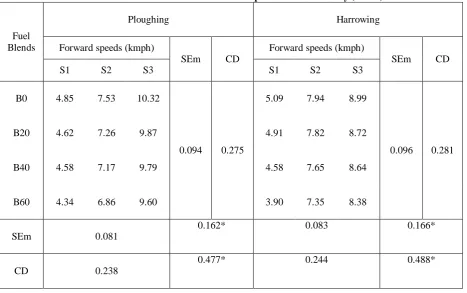
The maximum fuel efficiency of 10.32 MJ
l-1 was obtained for B0S3, while it was minimum
(4.34 MJ l-1) for B60S1 during ploughing operation.
Similar results were found for harrowing operation (Table 5).
The fuel efficiency was affected significantly by all the blends of biodiesel tested at all forward speeds, whereas, their combined effect was not significant at 5 per cent level of
significance. As the blends of biodiesel increased, fuel efficiency decreased that was due to the lower calorific value of higher blends. It increased with the increase in forward speeds of tractor, which was due to the higher drawbar power produced by
tractor at higher speeds (Kheiralla et al, 2004).
Among the blends tested, B20 performed comparable with petro-diesel at all the speeds. 3.7 Emission characteristics
The emission levels of tractor during the tillage operations were analyzed and are depicted in figures 1 and 2.
The highest CO emission (1499 ppm) was recorded for B0S3 during ploughing, while it was lowest (823 ppm) for B60S1 (Fig. 1 a). The CO emission of all the blends tested increased as forward speed increased. The increase in the per cent of biodiesel decreased the CO emission that may be due to the more number of oxygen molecules present in biodiesel as compared to petro-diesel that helps in complete combustion of
biodiesel as compared to petro-diesel fuel (Sahoo et
al, 2009). Similarly, CO emission characteristics of
tractor during harrowing operation were analysed and showed similar trend as that of ploughing operation but its emission rate was less as compared to ploughing operation for all the speeds irrespective of blends (Fig. 1 b). This may be due to variation in the draft and power generated for both the operations. The similar trend was reported for emission characteristics of Jatropha, Karanja and Polanga based biodiesel as fuel in tractor engine
(Sahoo et al, 2009).
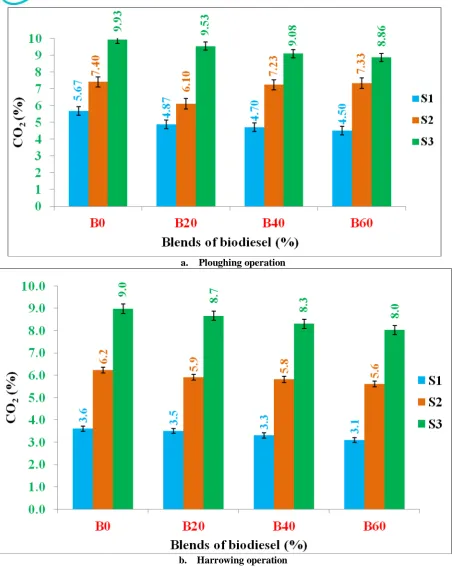
The CO2 emission from the tractor at
different forward speeds using selected blends of
biodiesel are shown in Fig. 2. The CO2 emission
increased with increase in forward speed of tractor whereas it decreased as blend increased and same trend was seen in both tillage operations. The
similar results were reported by Sahoo et al.,(2009)
for emission characteristics of Jatropha, Karanja and Polanga based biodiesel as fuel in tractor engine.
4. Conclusion:
The feasibility of karanja biodiesel blends in an agricultural tractor (2WD Mahindra 585DI) was evaluated as alternate fuel at forward speeds of
2.5, 3.5 and 4.5 km h-1 during ploughing and
harrowing operations. The effects of biodiesel blending with diesel on performance and emission characteristics of the tractor at different speeds have been investigated and the following specific conclusions were drawn.
• The fuel properties of B20 blend were
found to be comparable with the diesel fuel.
• The drawbar power of tractor during
significantly affected by the forward speed of the tractor.
• The CO emission decreased as the per cent
of biodiesel increased in petro-diesel which may be due to the complete combustion of biodiesel blended fuel, but NOx emission increased.
• The CO2 emission during tillage operations
decreased as the blends of biodiesel increased while it increased as the forward speed increased.
• B20 biodiesel blend performed
comparably with the petro-diesel in terms of fuel consumption and fuel efficiency but resulted in reduction of emission levels.
5. References:
Ali, A., Emrullah, B., Selcuk, A. and Mustafa, C. 2011. Determination of the effect of biodiesel use on power take-off performance characteristics of an agricultural tractor in a
test laboratory. Turk J Agric, 35: 103-113.
Anonymous. 1983. Regional network for agricultural machinery test codes and procedures for farm machinery, Technical Series No.12.
Anonymous. 2002. A comprehensive analysis of biodiesel impacts on exhaust emissions. United States Environmental Protection Agency, 1-118.
Baiju B., Naik M. K. and Das L. M. 2009. A comparative evaluation of compression ignition engine characteristics using methyl
and ethyl esters of karanja oil. Renewable
Energy, 34: 1616–1621.
Kheiralla, A. F., Azmi, Y., Zohadie, M. and Ishak, W. 2004. Modelling of power and energy requirements for tillage implements operating in Serdang sandy clay loam,
Malaysia. Soil and Tillage Research, 78:
21-34.
Kim, Y., Park, S. H., Kim, C. K., Im, D. H., Kim, H. J., Chung, S. C. and Kim, S. S. 2010. Characteristics of paddy operations with
biodiesel fuelled tractor, CIGR XVIIth World
Congress, Canada.
Li, Y. X., McLaughlin, N. B., Patterson, B. S. and Burtt, S. D. 2006. Fuel efficiency and exhaust emissions for biodiesel blends in an
agricultural tractor. Canadian Biosystems
Engineering, 48: 215-220.
Milan, I., Camps, M., Ponce De Leon, J. L. and Sanchez, G. V. 2010. Performance and emissions of an agricultural diesel engine fuelled with different diesel and methyl ester
blends. Spanish Journal of Agricultural
Research, 8 (2): 299-307.
Sahoo, P. K., Das, L. M., Babu, M. K. G., Arora, P., Singh, V. P., Kumar, N. R. and Varyani, T. S. 2009. Comparative evaluation of performance and emission characteristics of jatropha, karanja and polanga based
biodiesel as fuel in a tractor engine. Fuel,
88: 994–999.
Singh, S. 2011. Farm machinery principles and
applications, Indian Council of Agricultural Research, New Delhi. pp. 33-86.
Soranso, A. M., Antonio, G. F., Afonso, L. E., Miguel, S. J., Carlos, D. E., Felipe, T. D. C.
2008. Dynamic performance of an
agricultural tractor utilizing distilled
biodiesel from spent oil. Journal of
Agricultural and Environmental Engineering, 12 (5): 553-559.
Stalin, N. and Prabhu, H. J. 2007. Performance test of IC engine using karanja biodiesel
blending with diesel. APRN Journal of
Engineering and Applied Sciences, 2 (50): 32-34.
6. Acknowledgements
The authors would like to acknowledge with thanks the help extended by Dr. Prakash, K.V., Er. R.S. Yaranal and Dr. Devanand Maski, Assistant Professors of Department of Farm Machinery and Power Engineering, College of Agricultural Engineering, UAS, Raichur, Karnataka (India) during the research work.
Table 1 Physico-chemical properties of petro-diesel and selected blends of biodiesel
Types of blends
Calorific value
(MJ kg-1)
Kinematic viscosity (cSt)
Specific gravity (g cc-1)
Flash point
(ºC)
Fire Point
(ºC)
Free fatty acids
(%)
B0 42.43 1.97 0.824 65 70 --
B20 38.65 2.44 0.847 71 73 0.266
B40 37.98 3.17 0.868 88 95 0.433
ISSN 2348 - 7968
Table 2 Effect of selected blends of biodiesel and forward speed on drawbar power (kW)
Fuel Blends
Ploughing Harrowing
Forward speeds (kmph)
SEm CD Forward speeds (kmph) SEm CD
S1 S2 S3 S1 S2 S3
B0 4.12 7.43 12.14
0.107 0.314
3.49 7.44 10.10
0.094 0.276
B20 4.05 7.29 11.93 3.51 7.55 10.23
B40 4.11 7.50 12.07 3.54 7.66 10.35
B60 4.08 7.33 12.12 3.42 7.49 10.31
SEm 0.092 0.185* 0.081 0.163*
CD 0.272 0.544* 0.239 0.478*
* SEm and CD values of B*S
Table 3 Effect of selected blends of biodiesel and forward speed on fuel consumption (l h-1)
Fuel Blends
Ploughing Harrowing
Forward speeds (kmph)
SEm CD Forward speeds (kmph) SEm CD
S1 S2 S3 S1 S2 S3
B0 3.06 3.55 4.24
0.003 0.010
2.47 3.37 4.05
0.009 0.027
B20 3.15 3.62 4.36 2.58 3.48 4.22
B40 3.23 3.77 4.45 2.78 3.60 4.31
B60 3.39 3.85 4.54 3.15 3.67 4.43
SEm 0.003 0.006* 0.007 0.015*
CD 0.009 0.018* 0.023 0.046*
* SEm and CD values of B*S
Table 4 Effect of selected blends of biodiesel and forward speed on fuel efficiency (MJ l-1)
Fuel Blends
Ploughing Harrowing
Forward speeds (kmph)
SEm CD
Forward speeds (kmph)
SEm CD
S1 S2 S3 S1 S2 S3
B0 4.85 7.53 10.32
0.094 0.275
5.09 7.94 8.99
0.096 0.281
B20 4.62 7.26 9.87 4.91 7.82 8.72
B40 4.58 7.17 9.79 4.58 7.65 8.64
B60 4.34 6.86 9.60 3.90 7.35 8.38
SEm 0.081
0.162* 0.083 0.166*
CD 0.238
0.477* 0.244 0.488*
a. Ploughing operation
b. Harrowing operation
ISSN 2348 - 7968
a. Ploughing operation
b. Harrowing operation