A faster way to the CSIDH
Michael Meyer1,2 and Steffen Reith1 1
Department of Computer Science, University of Applied Sciences Wiesbaden, Germany
2
Department of Mathematics, University of W¨urzburg, Germany {Michael.Meyer, Steffen.Reith}@hs-rm.de
Abstract. Recently Castryck, Lange, Martindale, Panny, and Renes published CSIDH, a new key exchange scheme using supersingular el-liptic curve isogenies. Due to its small key sizes, and the possibility of a non-interactive and a static-static key exchange, CSIDH seems very in-teresting for practical applications. However, the performance is rather slow. Therefore, we employ some techniques to speed up the algorithms, mainly by restructuring the elliptic curve point multiplications and by using twisted Edwards curves in the isogeny image curve computations, yielding a speed-up factor of 1.33 in comparison to the implementation of Castryck et al. Furthermore, we suggest techniques for constant-time implementations.
1
Introduction
Isogeny-based cryptography. Isogeny-based cryptography is one of the cur-rent proposals for post-quantum cryptography. Already proposed in a talk (but not published) by Couveignes in 1997 [11] and independently rediscovered by Rostovtsev and Stolbunov in 2004 [22], a Diffie-Hellman-style key exchange based on isogenies between ordinary elliptic curves was designed (called CRS in the following). In 2010, Childs, Jao and Soukharev [8] showed, that this scheme can be attacked by solving an abelian hidden shift problem, for which subexponen-tial quantum algorithms are known to exist.
smallest public keys. However, the price for this is a rather bad performance. In comparison to the other competition entries, the running time of SIKE is slow3.
Recently, De Feo, Kieffer, and Smith [14] published some new ideas for the optimization of the CRS scheme. Due to its commutative and non-interactive structure, it is still an interesting alternative to SIDH and SIKE. However, the performance is far from being practical. Therefore, Castryck, Lange, Martindale, Panny, and Renes [7] found that the optimizations, that De Feo, Kieffer, and Smith wanted to employ, work even better when adapting CRS to supersingular elliptic curves, i.e. working with supersingular elliptic curves overFprather than
Fp2 like in SIDH. They obtain a non-interactive key exchange scheme with even smaller key sizes than in SIDH, called CSIDH (commutative SIDH, pronounced like ”seaside”), that also allows static keys, since public keys can be validated, to detect active attacks. The performance is rather slow in comparison to SIDH and SIKE4, which explains why it is an interesting and important task to opti-mize the running time of the scheme. However, we note that the security of the scheme and hence also the choice of parameters is still an open problem, which we will only briefly address in the next section.
Organization. In the following section, we give an introduction to CSIDH, mainly focusing on the implementer’s point of view, and recall some aspects about Montgomery and twisted Edwards curves. We then introduce a way to re-structure elliptic curve point multiplications in CSIDH, that allows a reduction of the computational effort. Thereafter, we review some methods to compute iso-genies, i.e. point evaluations and computations of the image curves. In the first case, we employ an observation of Costello and Hisil [9] for a speed-up to the implementation of [7], whereas in the latter case, we exploit the well-known cor-respondence between Montgomery and twisted Edwards curves, to compute the image curves more efficiently. We give some implementation results according to our contributions, and give some remarks about constant-time implementations and bounds for their running time.
2
Preliminaries
2.1 CSIDH
Since our aim is to focus on implementations of CSIDH, we only give a very brief description of the mathematical background based on [7]. We recommend the lecture of [7] for a more detailed overview. We refer to [12] for additional information about isogenies and their cryptographic applications.
3
In [15] it is stated that the best performance for SIKEp503 and SIKEp751 on a 3.4 GHz processor is 10.1 ms and 30.5 ms, respectively.
4
Mathematical background. First consider a quadratic number field k and an orderO ⊂k. The ideal class group ofO is defined as
cl(O) =I(O)/P(O),
where I(O) denotes the set of invertible fractional ideals and P(O) the set of principal fractional ideals.
In the context of CRS and CSIDH, we use the group action of the ideal class group of an imaginary quadratic orderOon ordinary and supersingular elliptic curves, respectively. In both cases the ideal class group cl(O) acts on E``p(O) via isogenies, where E``p(O) is the set of elliptic curves E defined overFp with Endp(E) ∼=O. By Endp(E) we denote the subring of the endomorphism ring End(E), that consists of endomorphisms defined overFp.
In CSIDH, a prime p = 4·`1 ·...·`n −1 is chosen, where the `i are small distinct odd primes, and the elliptic curve E0 :y2 =x3+xover Fp, which is supersingular because p ≡ 3 (mod 4). The supersingularity of E0 (and of all curves that are isogenous to E0) now guarantees the existence of elliptic curve points of order`i for alli∈ {1, ..., n}.
The ideals `iO split as `iO = lili, where li = (`i, π−1) and li = (`i, π+ 1) with the Frobenius endomorphism π. The kernel of the isogenyϕli then is the
intersection of the kernels of the point multiplication [`i] and the endomorphism π−1, i.e. a subgroup generated by a pointP of order`i defined over Fp. Anal-ogously, the kernel of the isogeny ϕl
i is a subgroup generated by an order-`i
point P defined over Fp2\Fp. Hence, the computation of the action of an ideal class Qlei
i by computing the action of the li resp. li can be done by efficient isogeny formulae: We have to find order-`i points defined over Fp resp. Fp2\Fp and can apply efficient formulae such as V´elu-isogenies [24] or isogeny formulae for Montgomery curves like in [9] or [21]. By construction such points always exist. Ideal classesQ
lei
i can simply be represented by vectors (e1, ..., en).
Key exchange. As already observed by Couveignes in [11], the commutativity of the class group action allows for a Diffie-Hellman-style key exchange in the following way:
Alice chooses a secret ideal class [a], represented by a vector (e1, ..., en), com-putesEA= [a]·E0via isogenies, and sends the result to Bob as her public key in terms of a curve parameter. Bob proceeds in the same way, chooses a secret [b] and computes his public keyEB= [b]·E0. Then, because of the commutativity, both parties can compute the shared secret [a]·[b]·E0= [a]·EB= [b]·EA.
et al. give some estimations for parameter sets for different security levels [7]. More recently, shortly after CSIDH was published, more analysis of this attack has been done [3,4]. Since we are only focusing on efficient implementations throughout this work, we will not discuss these attacks here, and we only note that the appropriate choice of parameters is still an open problem, that requires further analysis. However, our improvements don’t rely on a special choice of parameters, and are thus independent of the selected parameters.
2.2 Implementation
We follow the implementation accompanying [7] here5.
Algorithm 1: Evaluating the class group action. Input :A∈Fpand a list of integers (e1, ..., en).
Output:A0such that [le1 1 · · ·l
en
n ]EA=EA0.
1 whilesomeei6= 0do
2 Sample a randomx∈Fp.
3 Sets←+1 ifx3+Ax2+xis a square inFp, elses← −1.
4 LetS={i|sign(ei) =s}.
5 if S=∅then
6 Go to line 2.
7 P= (x: 1),k←Q
i∈S`i,P ←[(p+ 1)/k]P.
8 foreachi∈S do
9 K←[k/`i]P.
10 if K6=∞then
11 Compute a degree-`iisogenyϕ:EA→EA0 withker(ϕ) =hKi.
12 A←A0,P ←ϕ(P),k←k/`i,ei←ei−s.
First, we define a prime number p= 4·`1·...·`n−1 as above, where `1, ..., `n are small distinct odd primes. Then we choose a supersingular curveE0overFp. Therefore we have #E0=p+ 1, which means that there are points of order`i fori= 1, ..., nonE0. Note that the factor 4 is needed to ensure that we can use Montgomery curves.
The private key contains n integers sampled from an interval [−m, m], i.e. has the form (e1, ..., en). For each i the absolute value |ei| determines how many isogenies of degree`i are to be computed, while the sign ofei states if we have to use points defined overFp orFp2\Fp to generate their kernels.
For the computation of isogenies, we choose a random point P by sampling 5
a randomx∈Fp, and check in which of the cases above this leads us by check-ing the minimal field of definition of the correspondcheck-ingy-coordinate by a square root check. We then eliminate the possible unwanted factors in the order of P by multiplying it by 4·Q
j /∈S`j, whereS is defined as in algorithm 1.
After that, we iterate over the `i for i ∈ S, removing all remaining possible factors of the order except for `i of our point by multiplications, and check whether the resulting pointKcan be used as kernel generator for computing an `i-isogeny, i.e. if K 6=∞. If so, we compute the isogeny and push P through. Then we go to the next prime and proceed in the same way. However, we don’t have to consider the previous`i in the multiplication, since the isogeny evalua-tions ofP already eliminate the respective factors from its order, or in the other case, the order ofP did not contain the previous`i as factors in the first place.
We proceed in the same way, and sample new random points, until all of the required isogenies are computed. The resulting curve then forms the public key, or the shared secret, respectively. Note that the computational effort in algo-rithm 1 highly depends on the private key. Therefore, for the practical usage of CSIDH, it is important to transform this into a constant-time scheme without adding too much computational overhead.
Public keys can also be validated by checking for supersingularity: We can sim-ply sample a random pointP on the curve corresponding to the received public key. For each `i we compute Qi = [(p+ 1)/`i]P. For all i with Qi 6= ∞, we compute [`i]Qi and d = Q`i. If any of these [`i]Qi 6= ∞, the curve cannot be supersingular, since #E(Fp) - p+ 1. If this is not the case, and d >4√p,
the curve must be supersingular, as can be seen from the Hasse interval and Lagrange’s theorem (see [7]). Otherwise, the procedure can be repeated with a different pointP. Following this approach, it is not possible to wrongly classify an ordinary curve as supersingular. Therefore, we can check if a public key has been honestly generated, and thus can prevent certain kinds of active attacks.
Choice of parameters. The following discussions and implementation results refer to the parameter set proposed in [7] for NIST’s post-quantum security category I. They choosep= 4·`1·...·`74−1, where`1, ...`73are the 73 smallest distinct odd primes and`74= 587. The elements of the private keys (e1, ..., e74) are chosen from the interval [−5,5]. This parameter set leads to public key lengths of 64 bytes. As mentioned before, the appropriate choice of parameters is still an open problem, so the analysis of the actual security level of this parameter set is left for future work.
2.3 Montgomery curves
Montgomery curves are given by an equation over a fieldk with char(k)>2 of the form
where a∈k\{−2,2}and b∈k\{0}. To avoid inversions during point additions and doublings, projective coordinates can be used. Furthermore, the efficient arithmetic given by Montgomery in [19] allows for dropping the Y-coordinate and still performing XZ-only point doublings and differential additions, that require the knowledge of the XZ-coordinates of P, Q, and P −Q in order to computeP+Q.
In [10], Costello et al. propose to projectivize not only the point coordinates, but also the curve parameters. Instead of a Montgomery curve of the form given above, we work with an equation of the form
E(A:B:C):By2=Cx3+Ax2+Cx,
where (A : B : C) ∈ P2(k), such that a = A/C and b = B/C for the cor-responding curve Ea,b. However, in isogeny-based schemes it suffices to work with (A : C) ∈ P1(k) in the projective model, since neither the Montgomery curve arithmetic, nor the isogeny computations require the coefficients b or B, respectively. In general a doubling then costs 4M+ 2S+ 8a, while a differential addition costs 4M+ 2S+ 6a. As usual, we denote field multiplications byM, field squarings byS, and field additions or subtractions bya.
2.4 Twisted Edwards curves
Introduced by Bernstein et al. in [1], twisted Edwards curves overkwith char(k)> 2 are given by equations of the form
Ea,d :aX2+Y2= 1 +dX2Y2,
withad6= 0,d6= 1, anda=6 d. Fora= 1 the twisted Edwards curveE1,d=Ed is called Edwards curve, originally proposed by Edwards in [13]. As in the Mont-gomery case, projective coordinates can be used in order to avoid inversions during additions and doublings. Note that in the Edwards case there are differ-ent models for doing this, as described in [2].
Similar to theXZ-only Montgomery curve arithmetic, Castryck, Galbraith, and Farashahi introduced a Y Z-only doubling formula for twisted Edwards curves in [6] with a cost of 4M+ 5S. A formula forY Z-only differential addition of twisted Edwards curve points of odd order is derived in [17], using 6M+ 3Sin the projective case. Due to the fact that these operations are in general more ex-pensive than the respective operations on the Montgomery curve, isogeny-based schemes usually use Montgomery curves (see [5,18] for a comparison to twisted Edwards curve point arithmetic in SIDH). However, in the following twisted Edwards curves are shown to be advantageous for the computation of isogenies.
3
Elliptic curve point multiplications
case later on. The algorithm used by Castryck et al. then samples a random point P on the current curve E0, checks if its y-coordinate is defined over the corresponding fieldFporFp2\Fp, and if so, setsP0= [4]P in order to remove the possible factor 4 from its order. Then they compute K0 = [`α
1]P0. If K0 =∞, the order ofP does not contain the factor `1. We cannot use it to compute an isogeny of degree`1and setP1=P0andE1=E0. If howeverK06=∞, thenK0 must have order `1 and can be used as generator of the kernel of an isogeny of degree`1, mapping to a curve E1. In this case, we pull P0 through the isogeny and obtain a point P1 ∈E1. Note that this implies, that the order of P1 does not contain the factor `1. Therefore, for checking if we can useP1 to compute an isogeny of degree `2, it suffices to compute K1 = [`1α·`2]P1 and proceed as before. Following this approach, the required factor for the scalar multiplication of Pj reduces at each step, until only the factor`n remains at the last step of the loop.
Castryck et al. go through the primes in ascending order in their implemen-tation, starting with small degree isogenies. However, we found it advantageous to change the direction of the loop, i.e. go through the primes in descending order. By doing this, we can eliminate the larger factors ofp+ 1 first, and there-fore end up with multiplications by significantly smaller factors as we proceed through the loop. Note that as soon as one isogeny degree is done, i.e. |ei| iso-genies of degree `i were already computed, we include this factor in the first multiplication to compute P0, making sure that the order of P0 is not divided by `i. We can then ignore the factor `i in the loop, which slightly reduces the advantage of our approach every time this occurs. However, we note that our approach is still faster, as long as at least two factors are left in the loop.
Figure 1 shows the effect of our approach, compared to the implementation of [7]. Note that per bit of the factor of an elliptic curve point multiplication one step in the Montgomery ladder is carried out, i.e. one combined doubling and addition. Therefore, in the first loop, at each multiplication the computational effort is reduced byδi times the cost of a ladder step, whereδi is the difference between the two plots for a given i < n, and hence δi ·(8M+ 4S+ 8a). As discussed before, the number of saved operations reduces in the following loops.
Fig. 1.Bitlengths of factors during the first loop, when alleihave the same sign. The
red line follows the algorithm of [7], the blue line follows our described approach.
4
Isogeny Computations
The algorithm of [7] uses isogeny formulae for Montgomery curves by Costello and Hisil [9] and Renes [21]. We will treat point evaluations and computations of coefficients of image curves separately. First, we will state the isogeny formulae of [9], which can be used for the computation of isogenies in CSIDH.
LetKbe a point of order`= 2d+1 on a Montgomery curveE:y2=x3+ax2+x. Then we can compute the coordinate map of the unique (up to compositions by isomorphisms)`-isogeny ϕ:E→E0 withker(ϕ) =hKiby
ϕ: (x, y)7→(f(x), y·f0(x)), where
f(x) =x· d Y
i=1 x·x
[i]K−1 x−x[i]K
2 ,
and f0(x) is its derivative. The curve parametersa0 and b0 of E0 can be com-puted bya0 = (6σ−6˜σ+a)·π2andb0=b·π2, where we defineσ=Pd
i=1x[i]K, ˜
σ=Pdi=11/x[i]K, andπ= Qd
i=1x[i]K.
Note that the representation off(x) makes use of the fact thatx[i]K =x[`−i]K for allk∈ {1, ...,(`−1)/2}.
4.1 Point evaluations
fori= 1, ..., d, (X :Z) = (xP : 1) for the pointP, at which the isogeny should be evaluated, and (X0:Z0) for the result. Then
X0 =X·
d
Y
i=1
(X·Xi−Zi·Z) 2
, and
Z0=Z·
d
Y
i=1
(X·Zi−Xi·Z) 2
.
In the implementation of [7], this is used directly by going through the (Xi :Zi) fori= 1, ..., dand computing the pairs (X·Xi−Zi·Z) and (X·Zi−Xi·Z) at a cost of 4M+ 2aper step. However, we can also use the observation by Costello and Hisil in [9] to reduce the cost to 2M+ 4aper step by
X0=X·
d
Y
i=1 h
(X−Z)(Xi+Zi) + (X+Z)(Xi−Zi) i2
, and
Z0=Z·
d
Y
i=1 h
(X−Z)(Xi+Zi)−(X+Z)(Xi−Zi) i2
,
assuming thatX+Z andX−Z are precomputed, and hence saved·(2M−2a) per isogeny evaluation.
4.2 Computing the image curve
An efficient computation of the image curve parameters is not as straightforward as for the point evaluations. This is due to the fact that the required parame-tersσand ˜σconsist of sums of fractions. Therefore, Costello and Hisil give two different approaches to compute the isogenous curve [9].
The first approach uses the fact that the projective parameters (a0 : 1) = (A0 : C0) of the isogenous curveE0 can be recovered from the knowledge of the three 2-torsion points ofE0. Therefore, it is possible to recover the required curve pa-rameters ofE0 by computing the 2-torsion points ofE and pushing one of these points through the odd-degree isogeny, which preserves its order on the image curve. However, in contrast to SIDH, we only work over the field Fp instead of
Fp2, while the required points of order 2 are not defined over Fp in the CSIDH setting.
In [7], Castryck et al. compute the image curve by definingcj∈Fpsuch that `−1
Y
i=1
(Ziw+Xi) = `−1 X
j=0 cjwj
as polynomials inw. Then they observe that
(A0:C0) = (ˆπ(a−3ˆσ) : 1) = (ac0c`−1−3(c0c`−2−c1c`−1) :c2`−1), following the formulae and notation from Renes [21], where
ˆ π=
`−1 Y
i=0
x[i]K, and ˆσ= `−1 X
i=0
x[i]K− 1 x[i]K
.
In their implementation, this is computed iteratively, going through the (Xi :Zi) fori= 2, ..., d, updating the required values at a cost of 6M+ 2aper step. The final computations after that take further 8M+ 3S+ 6ato compute the curve parameters (A0:C0).
Using twisted Edwards curves for the image curve computation. Our idea to speed up this computation exploits the known correspondence between Montgomery and twisted Edwards curves. Given a Montgomery curve EA,B : Bv2=u3+Au2+u, we can switch to a birationally equivalent twisted Edwards curveEa,d:ax2+y2= 1 +dx2y2, where
A= 2(a+d)
a−d and B= 4 a−d,
by the coordinate map
(u, v)7→(x, y) = u
v, u−1 u+ 1
.
and back by its inverse
(x, y)7→(u, v) = 1 +y
1−y, 1 +y (1−y)x
In [18] it is shown how to switch to and from twisted Edwards curves in the SIDH setting, which also applies to CSIDH, where MontgomeryXZ-only coordinates and projective curve parameters (A : C) are used, ignoring the Montgomery parameter b. Following this and [6], a Montgomery point (XM : ZM) can be transformed to the corresponding Edwards Y Z-coordinates (YE : ZE) by the map
(XM :ZM)7→(YE:ZE) = (XM −ZM :XM +ZM),
and the Montgomery parameters (A:C) to the corresponding twisted Edwards parameters (aE, dE) by
As this allows us to switch efficiently between Montgomery and twisted Ed-wards curves in CSIDH at a cost of 3afor the curve parameters and 2afor point coordinates, we may as well use isogeny formulae for twisted Edwards curves. Therefore, we state the formulae given by Moody and Shumow in [20].
LetKbe a point of order`= 2d+ 1 on a twisted Edwards curveE:aEx2+y2= 1 +dEx2y2. Then we can compute the coordinate map of the unique (up to com-positions by isomorphisms)`-isogenyϕ:E→E0 withker(ϕ) =hKiby
ϕ(P) = Y Q∈hKi
xP+Q yQ
, Y Q∈hKi
yP+Q yQ
! .
The curve E0 is defined by the parameters a0E = a`
E and d0E = π8yd`E, where πy=Qdi=1y[i]K.
Since the coordinate map is not as simple to compute as for Montgomery curves, we are only interested in the computation of the image curve parameters. Writ-ing (YiE : ZiE) for the projective coordinates of [i]K for i = 1, ..., d, we can transform the formulae from above to the projective case by
a0E=a`E·πZ8, and d0E =d`E·πY8,
whereπY = Qd
i=1Y E
i , andπZ= Qd
i=1Z E i .
We can therefore use these formulae to compute the curve parameters of the im-age curves in CSIDH, by switching to twisted Edwards coordinates and points, and switch back after the computations by (A0 :C0) = (2(a0E+d0E) :a0E−d0E), again at a cost of 3a.
Note that the parameters a0E and d0E can be computed efficiently: While go-ing through the (Xi : Zi) on the Montgomery curve for i = 1, ..., d, we can compute the corresponding Edwards coordinates (YE
i : ZiE) at a cost of 2a. However, the required sums and differences already occur at the point evalu-ation part, and hence do not add any computevalu-ational cost at all. We can then computeπY andπZ iteratively by 1Meach per step. Compared to the algorithm of [7], this saves 4M+ 2aper step. Furthermore, we have to computeπ8Y andπZ8 by three squarings each, and a`E andd`E, which can be done efficiently, e.g. by a square-and-multiply approach. We further note that the latter computation does not require any values generated during the loop through the (Xi : Zi). This means that especially hardware architectures that allow for parallel com-putations would benefit from this, since the computation ofa`
E andd `
E can be done in parallel to the loop through the (Xi:Zi).
Fig. 2.Cost of different prime-degree isogeny computations. The red line uses Mont-gomery point evaluations from [9] and image curve computations from [7], while the blue line uses the same Montgomery point evaluations and twisted Edwards image curve computations.
blue line from using our approach utilizing twisted Edwards curves to compute the isogenous curve. The cost is measured in field multiplications, assuming that S= 0.8Mand 20a=M. In this case, we computationally derive a reduction of the costs by approximately 25% for the largest primes in the current parameter set. We note that different choices for the field operation ratios don’t make a big difference, since the main difference between the approaches lies in the number of multiplications. To obtain the cost of the computations ofa`
Eandd`E, we used a square-and-multiply approach. Since the exponents`iare small fixed numbers, it is also possible to precompute the optimal addition chains, and therefore save some computational effort compared to square-and-multiply. However, we found that even for the biggest `i from the current parameter set, this saves at most four multiplications. Hence, the benefit of this is rather small compared to the increased length of the code and the more complicated implementation.
Note that for ` ≤ 5, our approach is slightly more expensive than the Mont-gomery approach. Therefore, in this case, the MontMont-gomery approach can be used. However, the benefit of this is rather small compared to the total compu-tational effort, so it might be better to stick with our approach for all`iin order to keep the implementation simple.
However, every required isogeny degree would have to be implemented sepa-rately, resulting in a much longer code.
5
Implementation results
As a proof of concept and for measuring the efficiency of our work, we took the mentioned implementation of Castryck et al. accompanying [7] as reference, and added our optimizations. The implementation is written in C and usesFp -arithmetic in assembly. The parameters in use are the ones described in section 2.2. The validation of keys is not included in the following discussion.
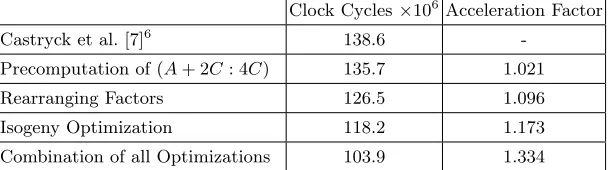
The first optimization is the precomputation of the curve parameters (A+ 2C: 4C) each time before entering the Montgomery ladder, as also done in SIDH [10]. This only saves a few additions per ladder step, but in total leads to a reduction of the computational effort by approximately 2%.
The other optimizations are as described above: One comes from rearranging the factors in the class group action evaluation algorithm, and the other one from more efficient isogeny computations by using the point evaluation from [9] and our twisted Edwards approach for the image curve computations.
Table 1.Performance comparison of the class group action evaluation in CSIDH with different optimizations applied. All timings are given in 106clock cycles and were
mea-sured on an Intel Core i7-6500 Skylake processor running Ubuntu 16.04 LTS, averaged over 10 000 runs.
Clock Cycles×106
Acceleration Factor
Castryck et al. [7]6 138.6
-Precomputation of (A+ 2C: 4C) 135.7 1.021
Rearranging Factors 126.5 1.096
Isogeny Optimization 118.2 1.173
Combination of all Optimizations 103.9 1.334
6
On constant-time implementations
As mentioned in the sections before, the discussed implementations do not in-clude any protection from side-channel attacks. In particular, the running time depends on the private key, which corresponds to the number of isogenies, that have to be computed. Therefore, the first step to prevent simple timing attacks is a constant-time implementation.
One possibility to reach this is to fix the number of isogenies to the maximum for each degree, and use only as many of them as specified in the private key. However, in addition to lots of useless computational effort, this means that af-ter each dummy isogeny, another multiplication by its degree`i is necessary for the point P, since the algorithm uses the fact, that by pushing P through the `i-isogeny, the order of the resulting point will not include the factor`i. The addi-tionally required multiplications would then allow for a new timing attack, since many extra multiplications mean that many dummy isogenies were computed. This could be prevented by using constant-time ladders for the preparation of each kernel point. This however is undesirable, since it would further blow up the running time.
A possible tool for the design of a more optimized constant-time implemen-tation could be specially tailored dummy isogenies, that, instead of computing an`i-isogeny and pushing the pointPthrough, simply compute [`i]P and leaves the curve parameters unchanged. This is especially easy, since the`i-isogeny al-gorithm requires to compute all [j]K for j ∈ {2, ...,(`i−1)/2}. Therefore, by replacing K with P and by two further differential additions, we can compute [`i]P, and hence don’t have to perform more multiplications to compensate for the dummy isogenies. Furthermore, the dummy isogenies can be designed to have the exact same number of field operations as the real isogeny computations.
Running time. First, we note that this discussion refers to the case, that an implementation that follows algorithm 1 shall be transformed to a constant running-time. If the structure of algorithm 1 is changed, the results may vary accordingly.
It is obvious that the running time of a constant-time implementation must be at least as high as the highest possible running time of the fastest non-constant implementation. At first glance, this seems to be twice the average running time of the non-constant implementation, when we fix all elements of the private key to have the maximum absolute value. For a closer investigation, we consider the parameter set from above, and the private keys e= (5,−5,5,−5, ...,5,−5) and e0= (5,5, ...,5).
the computational cost for isogenies doubles, while the factor for point multipli-cations is slightly higher. One reason for this is that if we have to compute more isogenies, on average there will be more cases in which our randomly chosen points cannot be used to compute isogenies of certain degrees. Therefore, more points have to be chosen and their order checked by multiplications.
Now we want to compare the performance for the keys e and e0. For the sake of simplicity, assume that we can choose full order points, that allow for the computation of isogenies of all required degrees. Consider that we first want to compute one isogeny of each degree. Fore0, the bitlengths of the factors for the point multiplications are the ones shown in figure 1. After one loop, we have com-puted one isogeny of each required degree. For the keye, we have to perform one loop each for positive and negative key elements. When doing this and counting the bitlengths of the factors for the point multiplications, after computing one isogeny of each degree, we end up with only 0.54 times the sum of the bitlengths for e0, already including the additional required multiplications from line 7 of algorithm 1. Therefore, since we simply perform five such rounds foreande0, the total computational effort for point multiplications for e0 is 1.86 times as high as for e. When considering also isogeny computations, our experiments suggest that the total running time for the key e0 is 1.49 times the running time fore. Therefore, we conclude that the running time of a constant-time implementation must be at least 2.98 times the running time of average-case measurements of non-constant implementations such as in section 5. In practice, our experiments again suggest a higher factor for the running time for the key e0, namely 3.07, for the same reasons as explained above7.
However, we note that more careful analysis is required for an optimized constant-time implementation, and our proposal of dummy isogenies is merely a tool, that could possibly be used to design such an implementation, which we leave for fu-ture work.
7
Conclusion and future work
Although we gained a speed-up factor of 1.33 in our CSIDH implementation, it is still considerably slower than e.g. SIDH. Therefore, further research in that direction is necessary, to make the practical deployment of the scheme more attractive. In particular, side-channel protection, such as constant-time imple-mentations, is required for that aim.
As mentioned before, also the security of CSIDH still requires some more detailed analysis on the implication of new attacks for specific parameter choices.
7
We measured 318.9 ×10⁶
Acknowledgements. This work was partially supported by Elektrobit Auto-motive, Erlangen, Germany. We thank Fabio Campos, Marc St¨ottinger, and the anonymous reviewers for their helpful and valuable comments.
References
1. Bernstein, D.J., Birkner, P., Joye, M., Lange, T., Peters, C.: Twisted Edwards Curves. In: Vaudenay, S. (ed.) Progress in Cryptology - AFRICACRYPT 2008, pp. 389–405. Lecture Notes in Computer Science, 5023, Springer (2008)
2. Bernstein, D.J., Birkner, P., Lange, T., Peters, C.: ECM Using Edwards Curves. Mathematics of Computation82(282), 1139–1179 (2013)
3. Biasse, J.F., Jacobson Jr, M.J., Iezzi, A.: A note on the security of CSIDH. arXiv preprint arXiv:1806.03656 (2018),https://arxiv.org/abs/1806.03656
4. Bonnetain, X., Schrottenloher, A.: Quantum Security Analysis of CSIDH and Ordi-nary Isogeny-based Schemes. Cryptology ePrint Archive, Report 2018/537 (2018),
https://eprint.iacr.org/2018/537
5. Bos, J.W., Friedberger, S.: Arithmetic Considerations for Isogeny Based Cryp-tography. Cryptology ePrint Archive, Report 2018/376 (2018), https://eprint. iacr.org/2018/376
6. Castryck, W., Galbraith, S., Farashahi, R.R.: Efficient arithmetic on elliptic curves using a mixed Edwards-Montgomery representation. Cryptology ePrint Archive, Report 2008/218 (2008),http://eprint.iacr.org/2008/218
7. Castryck, W., Lange, T., Martindale, C., Panny, L., Renes, J.: CSIDH: An ef-ficient post-quantum commutative group action (2018), https://eprint.iacr. org/2018/383.pdf
8. Childs, A., Jao, D., Soukharev, V.: Constructing elliptic curve isogenies in quantum subexponential time. Journal of Mathematical Cryptology8(1), 1–29 (2014) 9. Costello, C., Hisil, H.: A simple and compact algorithm for SIDH with
arbi-trary degree isogenies. In: Takagi, T., Peyrin, T. (eds.) Advances in Cryptology ASIACRYPT 2017. Lecture Notes in Computer Science, vol 10624, pp. 303–329. Springer, Cham (2017)
10. Costello, C., Longa, P., Naehrig, M.: Efficient algorithms for supersingular isogeny DiffieHellman. In: Robshaw, M., Katz, J. (eds.) Advances in Cryptology -CRYPTO 2016, pp. 572–601. Lecture Notes in Computer Science, 9814, Springer (2016)
11. Couveignes, J.M.: Hard homogeneous spaces. Cryptology ePrint Archive, Report 2006/291 (2006),https://eprint.iacr.org/2006/291
12. De Feo, L.: Mathematics of Isogeny Based Cryptography. Notes from a summer school on Mathematics for Post-quantum cryptography (2017),http://defeo.lu/ ema2017/poly.pdf
13. Edwards, H.M.: A normal form for elliptic curves. Bulletin of the American Math-ematical Society44, 393–422 (2007)
14. Feo, L.D., Kieffer, J., Smith, B.: Towards practical key exchange from ordinary isogeny graphs. Cryptology ePrint Archive, Report 2018/485 (2018), https:// eprint.iacr.org/2018/485
15. Jao, D., et al.: Supersingular isogeny key encapsulation, Round 1 submission, NIST Post-Quantum Cryptography Standardization (2017)
17. Marin, L.: Differential Elliptic Point Addition in Twisted Edwards Curves. In: 2013 27th International Conference on Advanced Information Networking and Applica-tions Workshops, pp. 1337–1342 (2013)
18. Meyer, M., Reith, S., Campos, F.: On hybrid SIDH schemes using Edwards and Montgomery curve arithmetic. Cryptology ePrint Archive, Report 2017/1213 (2017),https://eprint.iacr.org/2017/1213
19. Montgomery, P.L.: Speeding the Pollard and Elliptic Curve Methods of Factoriza-tion. Mathematics of Computation48(177), 243–264 (1987)
20. Moody, D., Shumow, D.: Analogues of V´elu’s Formulas for Isogenies on Alternate Models of Elliptic Curves. Math. Comput.85(300), 1929–1951 (2016)
21. Renes, J.: Computing isogenies between Montgomery curves using the action of (0, 0). In: Lange, T., Steinwandt, R. (eds.) PQCrypto 2018, 9th International Conference on Post-Quantum Cryptography. pp. 229–247. Springer (2018) 22. Rostovtsev, A., Stolbunov, A.: Public-key cryptosystem based on isogenies.
Cryp-tology ePrint Archive, Report 2006/145 (2006),http://eprint.iacr.org/2006/ 145
23. The National Institute of Standards and Technology (NIST): Submission require-ments and evaluation criteria for the post-quantum cryptography standardization process (2016)
![Fig. 1. Bitlengths of factors during the first loop, when all ei have the same sign. Thered line follows the algorithm of [7], the blue line follows our described approach.](https://thumb-us.123doks.com/thumbv2/123dok_us/7976242.1322672/8.612.193.427.118.293/bitlengths-factors-thered-follows-algorithm-follows-described-approach.webp)
![Fig. 2. Cost of different prime-degree isogeny computations. The red line uses Mont-gomery point evaluations from [9] and image curve computations from [7], while theblue line uses the same Montgomery point evaluations and twisted Edwards imagecurve computations.](https://thumb-us.123doks.com/thumbv2/123dok_us/7976242.1322672/12.612.193.427.115.299/dierent-computations-evaluations-computations-montgomery-evaluations-imagecurve-computations.webp)