Authenticated key exchange for SIDH
Steven D. Galbraith
Mathematics Department, University of Auckland, [email protected]
March 13, 2018
Abstract. We survey authenticated key exchange (AKE) in the context of supersingular isogeny Diffie-Hellman key exchange (SIDH). We discuss different approaches to achieve authenticated key exchange, and survey the literature. We explain some challenges that arise in the SIDH setting if one wants to do a “Diffie-Hellman-like” AKE, and present several candidate authenticated key exchange protocols suitable for SIDH. We also discuss some open problems.
1
Introduction
A fundamental operation in many security systems is to establish an ephemeral shared key between two parties. This can be done using trusted third parties, using symmetric crypto, using an interactive protocol like Diffie-Hellman key exchange, or using public key encryption as key transport. In this paper we are interested in schemes that are based on computational assumptions in mathematics and so are in the public key crypto setting. Basic Diffie-Hellman key exchange is vulnerable to man-in-the-middle attacks, and so it is necessary to provide some form of authentication in most applications.
Supersingular isogeny Diffie-Hellman key exchange (SIDH) allows two parties to generate a shared random key. The security relies on computational problems regarding the computation of isogenies between elliptic curves, and these problems are believed to be hard for quantum computers. Hence SIDH is a candidate for post-quantum crypto.
The basic SIDH scheme is an analogue of the Diffie-Hellman key exchange concept and so is vulnerable to man-in-the-middle attacks. A natural problem is to design an authenticated key exchange (AKE) scheme from the basic SIDH primitive.
To our knowledge there are few papers in the literature that discuss AKE based on supersingular isogeny problems1.
The thesis of LeGrow [28] is the most extensive document that we are aware of. We also mention the work of Kirkwood et al [23]. They give a scheme where Bob has a public key that enables Alice to share a key with Bob. Alice is certain that only Bob can complete the protocol and compute the key, and Bob is certain that his partner Alice is behaving honestly. But Bob has no assurance about the identity of his partner and so this does not satisfy the definition of AKE. Similarly, using public key encryption for key transport (or a KEM) only provides authentication in one direction.
A standard solution to authenticated key exchange is to use digital signatures (i.e., both players sign their protocol messages with respect to their long-term public keys) or MACs.2 One can get a secure AKE scheme by
combin-ing SIDH with a post-quantum secure signature scheme. Unfortunately, there is no practical digital signature scheme whose security relies on computing isogenies [14, 37]. Hence, if we wish to have an efficient system whose security relies entirely on isogeny problems, it is necessary to consider key exchange schemes that provide implicit authentica-tion.
Another approach is to build authenticated key exchange from public key encryption. There are a large number of papers on this topic and we survey them in Section 4 and discuss isogeny variants in Section 5.
As we discuss in Section 3, there are a number of direct constructions of AKE schemes in the literature in the case of discrete logarithms. However there are several challenges that arise in the SIDH context that do not arise in the discrete logarithms context:
1
The two papers [17, 18] are based on ordinary isogeny graphs and, despite their titles, neither of the papers provides an authen-ticated protocol.
2
1. Discrete logarithms provide a richer algebraic structure that allows more sophisticated protocols.
2. There are adaptive attacks in the SIDH setting that make certain operations involving long-term private keys dangerous.
3. There are gap assumptions in the discrete logarithm setting that are useful for security proofs, but these assump-tions do not hold in the SIDH setting (because the decisional variant of the main problem is equivalent to the computational variant).
Hence many existing AKE schemes and their security proofs cannot be adapted to the SIDH case. Luckily, an AKE scheme (and its security proof in the random oracle model) due to Jeong, Katz and Lee [21] are adaptable to this setting. We give the details in Section 7.
The aims of this paper are to highlight some of the challenges in authenticated key exchange for SIDH and to present some basic schemes (together with security analysis) as a starting point for future research. We emphasise that the goal is to obtain practical and efficient AKE schemes based on isogeny problems, withclassicalsecurity proofs in the random oracle model (ROM). We argue in Section 3.2 that classical security proofs are sufficient for post-quantum cryptography using classical devices.
Acknowledgements
The seeds of this project were sown during a summer research project by Alex Coombs supervised by the author in 2017. The author thanks Jonathan Katz for answering questions about his work [21]. The author is especially grateful to the reviewers of PQCrypto 2018 for their many helpful suggestions and pointers to relevant literature.
2
Background on SIDH
For general background on elliptic curves and isogenies we refer to [10, 12, 15, 32, 36]. For background on SIDH we refer to the original papers [9, 19].
The SIDH scheme of Jao and De Feo [19] (also see De Feo, Jao and Plˆut [9]) has a very special set-up. First choose distinct small primes`1, `2(typically`1 = 2and`2 = 3) and choosee1, e2 ∈ Nsuch that`e11 ≈ `
e2
2 ≈2λwhere
λis some security parameter (typically,λ = 256). Next choose a small integerf ∈ Nsuch thatp = `e11`
e2
2 f ±1
is prime. ChooseEto be a supersingular elliptic curve overFp2 such thatE(Fp2)has group structure a product of
two cyclic groups of order`e1
1 `
e2
2 f. Fix pointsPA, QA ∈E[`1e1]such that the group generated byPAandQAis the whole groupE[`e1
1 ]. Similarly, choose PB, QB such thathPB, QBi = E[`e22]. TheSIDH system parameters are
(E, PA, QA, PB, QB).
TheSIDH key exchange protocolworks as follows: Alice chooses a secret subgroup ofE[`e1
1 ]by choosing an
integer0≤a < `e1
1 and settingSA=PA+ [a]QA. Alice computes an isogenyφA:E→EAwith kernel generated bySAand publishes(EA, φA(PB), φA(QB)). Similarly, Bob chooses0 ≤b < `e22, computesφB : E → EBwith kernel generated bySB = PB+ [b]QB and publishes(EB, φB(PA), φB(QA)). To compute the shared key, Alice computes
SA0 =φB(PA) + [a]φB(QA) =φB(PA+ [a]QA) =φB(SA)
and then computes an isogenyφ0A:EB→EABwith kernel generated bySA0 . The compositionφ0A◦φB:E→EAB has kernelhSA, SBi. Similarly, Bob computes an isogenyφ0B :EA→EAB0 with kernelhφA(PB) + [b]φA(QB)i. The shared key is thej-invariantj(EAB) =j(EAB0 ).
We will use the notation GA = hSAi and EA = E/GA. So we can write EAB as (E/GB)/φB(GA) ∼= E/hGA, GBi.
For more discussion of the protocol and its implementation and security we refer to [19, 9, 7]. In particular, there are compression methods [8] to minimise the bandwidth when sending triples like(EA, φA(PB), φA(QB)).
The security of the SIDH key exchange protocol relies on the hardness of the following computational problem.
Problem 1. SIDH problem: Let(E, PA, QA, PB, QB)be SIDH system parameters. LetEAbe such that there is an isogenyφA:E→EAof degree`e11with kernelGA. LetPB0 =φA(PB), Q0B =φA(QB). LetEBbe such that there is an isogenyφB :E→EBof degree`e22with kernelGB. LetPA0 =φB(PA), Q0A=φB(QA).
Problem 1 is believed to be hard for quantum computers. We refer to [15] for a survey of algorithmic results. It is obvious that the SIDH protocol is not secure against a man-in-the-middle attack. Hence, in reality, there is a need to provide some kind of authentication to users of the protocol.
We mention here an issue with using this scheme in a multi-user setting. Suppose Alice engages in the SIDH protocol with Bob and also with Carol. Then, for example, Alice may use points of order`e1
1 while Bob and Carol
use points of order`e2
2 . What if now Bob wants to agree a key with Carol? One of them will use points of order`
e1
1
while the other will use points of order`e2
2 . This is fine when all elements of the protocol are ephemeral, but it creates
a problem when we move to the authenticated setting. We call it thethree body problem.
As observed in several papers [15, 34], decisional variants of problem 1 are equivalent to the computational prob-lem. Hence there is no chance to get a “gap problem” in this setting (i.e., a situation where the computational problem can be hard even in the presence of a decisional oracle). This prevents us from adapting certain security arguments from the discrete logarithm setting to the SIDH setting.
Finally, we mention the adaptive attacks due to Galbraith, Petit, Shani and Ti [13] on the case where one party uses a static key. Hence, if we build an authenticated key exchange using static and ephemeral components then we will need to keep these attacks in mind.
3
Authenticated encryption in the discrete logarithm setting
LetGbe a group with generatorg. The Diffie-Hellman scheme involves Alice sendinggxto Bob and Bob sendinggy to Alice and then both parties computinggxy. As is well known, this is not secure against a man-in-the-middle attack. A general solution is to sign all protocol messages using digital signatures (this is folklore and is analysed in [6]; we refer to [1] for a recent application of the idea). The security of the resulting protocol then depends on the Diffie-Hellman assumption and whatever assumptions are necessary for the security of the digital signature scheme.
There are a huge number of papers that provide a higher level of security by including long-term public keys as well as ephemeral messages. Such schemes all fall under the heading of authenticated key exchange (AKE).
Throughout the paper we use the following notation:H :{0,1}∗→ {0,1}lis a cryptographic hash function. For a1, . . . , at∈ {0,1}∗we writeH(a1, . . . , at)for the hash of the concatenation of the strings. When writing things like H(gxy)we assume a well-defined specification for how group elements are encoded as binary strings.
3.1 Brief summary of popular AKE schemes
We do not give an exhaustive survey here, but start our historical summary with a survey paper by Blake-Wilson and Menezes [2]. Their notation is for Alice to have static keyYA = ga and ephemeral (one-time) protocol messages TA=gx. Similarly Bob has public keyYB=gband protocol messagesTB =gy. The paper recalls theKEAscheme: Alice sendsgxand Bob sendsgyand the shared key isgay+gbx. Next this isunifiedto a scheme (protocol 5 in their paper) with shared keyH(gab, gxy)whereH is a cryptographic hash function. Next they discussMQV, which has a complex shared key of the formg(x+aU)(y+bV)for some valuesUandV that are derived from the protocol messages and are “short” to provide efficiency. Protocol 8 of their paper is a more complex scheme that also computes a shared key of the formH(gab, gxy). We also refer to Okamoto [31] for a similar protocol.
Krawczyk [24] proposed the HMQV protocol and gave a proof of security in the Canetti-Krawczyk model. Menezes [30] pointed out that certain validation steps are still necessary with HMQV. The NAXOS protocol of LaMacchia, Lauter and Mityagin [26] (also see [27, 35]) is a protocol that allows Alice and Bob to share the key H(A, B, gay, gbx, gxy)where the ephemeral values are themselves generated using a hash function (modelled as a random oracle).
We stress that these schemes provide what is known asimplicit authentication, which means that Alice knows that the only other person who could compute the same key as her is Bob (and vice versa). In practice this means that if Alice later receives a message together with, say, a MAC tag that verifies with respect to the key generated from the session, then Alice is assured that the MAC tag must have been generated by Bob.
Note that most AKE schemes require a strong public key validation stage during registration with the public key infrastructure. This is a process that requires a user, during registration of their public key, to prove that they know the private key. It prevents certain attacks that involve Eve registering a public key that is in some algebraic way related to the public key of another user. Most protocols also require players to check validity of values sent during the protocol (e.g., checking that bitstrings correspond to group elements of the correct order). We refer to Menezes [30] for an overview of such attacks in the context of MQV and HMQV, and we refer to Boyd et al [5] for a broader discussion of how to model certification authorities.
We now recall the Kaliski attack [22] on MQV (an unknown key share attack): Suppose Alice sendsTA = gx and this is intercepted by Eve. Eve chooses a randomr, computesTE = TAYAUg−r =gx+U a−rand computes the correspondingU0by the MQV process. Then Eve setse =U0−1rand registers public keyY
E =ge. Note that Eve knows the private key for this public key, and so can perform the key validation process. Then Eve sendsTE to Bob, as coming from her public keyYE. Bob then sendsTB =gbto Eve and computes key
(TEYU 0 E )
(y+V b)= (T
AYAUg−
r(gU0−1r
)U0)(y+V b)=g(x+U a)(y+V b).
Eve then forwardsTBto Alice and she computes the same key. It means that Alice and Bob share a key. Alice thinks she shares the key with Bob, but Bob thinks he shares the key with Eve. Hence Eve is enabled to “take credit” for information coming from Alice.
3.2 Security models for AKE
Everything in this section is classical; we do not consider quantum adversaries or quantum-secure models for AKE. LeGrow [28] has considered a quantum-secure model for AKE (similar to the work of Soukharev, Jao and Se-shadri [33]) but this is not our concern. We are concerned with classical devices and classical communication channels. The adversary may have access to a quantum computer in order to solve some computational problem, but currently deployed devices and communication channels do not provide quantum access to adversaries.
Our security proof is in the random oracle model, but this is just a proof technique to model attacks. The real cryptosystem uses a fixed hash function. Hence we believe it is not necessary to consider that the attacker has quantum acccess to a random oracle. While we appreciate that research on the quantum random oracle model is of value, we believe the quantum random oracle model is not necessary for understanding the security of AKE protocols that use fixed hash functions and work with classical devices over classical channels.
Formal security analysis typically proceeds in the model of Canetti and Krawczyk [6]. We also follow the formu-lation from Jeong, Katz and Lee [21].
The model considers a collection ofnplayers, each with a public key. Each player engages in a number of sessions (indexed byj). Sessionjof playerihas an associated session identifiersidi,j. We denote byΠijthe instance of player irunning in sessionj. Sessionj of playeriand sessionj0 of playeri0 are said to bematchingorpartnersif player ibelieves sessionjhas partneri0 and session idsidi,j and playeri0 believes sessionj0 has partneriand session id
sidi0,j0 =sidi,j.
An instanceΠijiscompletedif eitheriinitiates a protocol instance in sessionjand receives a valid response from its partner, or if sessionjofireceives a valid initial protocol message and responds to it. The correctness condition is that completed partners should compute the same session key.
The adversary in the model controls all communication between players, and may modify or replace any message from playerito playeri0. This is formalised by giving the adversary access to a number of oracles.
Initiate(i, i0): Triggers player ito initiate a protocol session with playeri0. This returns a protocol message (that includes a session identifier).
also allows to model active attacks where the value sent to a player is not the true value that was sent by another player.
Execute(i, i0): Starts a fresh protocol interaction between playersiandi0, initiated byiand completed byi’, that is conducted in a correct and undisrupted way. This models passive eavesdropping.
Corrupt: The adversary learns the long-term private key of playeri, and all session keys agreed so far, and any other local state information. The adversary can then create a new public key for that user (possibly depending on other user’s public keys and/or protocol messages).
Session-Key: (Also called Reveal or Session-key reveal.) When a player completes a key exchange protocol instance this query provides the adversary with the resulting session key.
Session-State: (Also called Session-state reveal.) During a key exchange protocol, before the protocol completes, this query provides the adversary with any values that are stored by the player that are necessary for completion of the protocol.3
After interacting with the players the adversary eventually makes aTestquery(i, j)on a completed sessionj of playeri. Leti0be playeri’s partner in sessionj(so that sessionj0of playeri0is a matching session with sessionjof playeri). It is required that playersiandi0have not been corrupted, and that sessionjof playeriand sessionj0 of playeri0 have not been the victim of state reveal or key reveal queries. In response to the test query, an unbiased coin bis flipped. Ifb = 0the adversary is given the session key computed byΠij, and ifb = 1then a random string is returned to the adversary. The adversary is required to guess the bitbwith noticeable advantage.
Note that Jeong, Katz and Lee [21] extend this model to include forward security, but for simplicity in this paper we restrict to the “key independence” model (which is essentially the Cannett-Krawczyk formulation). The proof techniques also hold in the forward security model, but the probability calculations in the security proof are more complex.
One issue with the Canetti-Krawczyk model is an ambiguity with the meaning of state reveal queries. Do these queries just yield the ephemeral secret xstored by Alice? Or do they give access to values that are temporarily stored by Alice during the computation of the secret key? For example, suppose we are discussing the unified scheme H(gab, gxy)where Alice has keygaand sendsgxto Bob. Clearly Alice needs to store the ephemeral valuexso that she can computeTx
Bin the second phase of the protocol. So it is natural that a state reveal query to Alice, between the first and second stage of the protocol, will revealx. But the adversary can also make a state reveal query during the second part of Alice’s computation, so does this mean the adversary can also obtain the intermediate valuegab that Alice must compute before she computes the hash value? The literature seems to be ambiguous about this. Essentially, the issue is to what extent state reveal queries are modelling side-channel attacks. Criticisms like these have been made in [30, 26].
3.3 Comments on discrete logarithm based AKE protocols
We now give some remarks and examples to clarify certain issues that will be of concern later in the paper.
Remark 1. Consider a basic protocol with shared keyH(gab, gxy): If a state reveal query at the appropriate time can leakgabthen Eve can now intercept any key exchange session betweenAandBand create a shared keykwithAand a shared keyk0withB, whileAandBbelieve they share the key with each other.
On the other hand, if the key isH(gay, gbx)then an attacker who replaces the messagesgxandgywill still not be able to compute the value computed by Alice or Bob. For example, Alice will computegbxand the attacker does not knowborx.
Remark 2. Consider a protocol with shared keyH(gay, gbx). Alice computes this key by taking Bob’s public keyYB and Bob’s messageTBand computingH(TBa, Y
x
B). It is well-known that this is vulnerable to a small subgroup attack by Bob: Bob may send a valueTBof small order`. Bob knowsband so can computegbx. Hence, by doing a session key reveal query on Alice, Bob can test a guessufora (mod`)by seeing ifH(Tu
B, g
bx)is equal to the claimed value.
As we explain in Section 6.1, a variant of this attack that is hard to detect can be mounted in the SIDH setting, and so we need to pay close attention to it.
3
Remark 3. A typical way to prove security is explained in general terms by Kudla and Paterson [25]. This involves a reduction to the gap-CDH problem (i.e., the CDH problem in the setting where the solver has access to a DDH oracle). The reduction inserts a CDH instance(g, gb, gx)into the protocol as follows: Set up a userBand set their public key to begb; choose public keys for all other users so that the private keys are known to the reduction; putgxinto one of the protocol sessions betweenAandB; hope thatBis not corrupted by the user and that the protocol session withgx is the subject of the test query. The problem is how can the reduction answer the key reveal queries made to B, since the private key is not known to the reduction. This is done by using the fact that there should be a random oracle query of the formH(gay, gbx). One can use a decision oracle to search the list of random oracle queries and identify any suitable choice as a response to the reveal query. Similar ideas are used in [26, 35]. Such a proof methodology cannot be used in our case since the decisional variant of the SIDH assumption is equivalent to the computational variant.
There is no security proof known for the MQV protocol. Krawczyk [24] gave a proof of security for HMQV in the Canetti-Krawczyk model. His security proof relies on the computational Diffie-Hellman problem (the security proof is complex and leverages the security of a certain digital signature scheme).
The NAXOS protocol is proved secure based on a gap assumption. Lee and Park [27] give a variant of the NAXOS protocol that does not require a gap assumption. They use a standard “trapdoor test” idea in their proof, but this exploits algebraic structures that are not available in the isogeny setting.
4
Generic constructions of AKE from IND-CCA KEMs or public key encryption
There are a number of papers that discuss generic constructions of secure authenticated key exchange from basic primitives like IND-CCA encryption/KEMs and MACs, PRFs etc. We very briefly summarise some of these papers.
The first main result is due to Bellare, Canetti and Krawczyk [3]. They show how to add “authenticators” to a non-authenticated key exchange protocol like Diffie-Hellman. The drawback is that the number of rounds increases.
There are a substantial number of papers following on from this work, and we will simply mention four of them. We do not give full details, and for simplicity blur the distinction between KEMs and public key encryption. We will use the notationpkA as the public key for a userAandEncpkA(r)for either IND-CCA public key encryption of a
random bitstringrtoA, or else the IND-CCA encapsulation of a random keyrtoA.
In 2009, Boyd, Cliff, Gonzlez Nieto and Paterson [4] gave a simple scheme with two message passes. Alice sends to Bob(A, CA =EncpkB(rA))and Bob sends to Alice(B, CB = EncpkA(rB)). Alice and Bob derive a key from
the shared data(A, CA, B, CB, rA, rB). This scheme (Protocol 1 in their paper) does not provide forward security. A second scheme (Protocol 2 in [4]) provides “(weak) forward secrecy”. The second scheme runs an additional unau-thenticated key exchange protocol in parallel. Both protocols provide KCI resistance.
In 2014, Li, Sch¨age, Yang, Bader and Schwenk [29] gave a scheme that uses Encryption and MACs and requires 5 rounds of communication. We do not describe it here.
In 2015, Fujioka, Suzuki, Xagawa and Yoneyama [11] gave a variant of the Boyd et al scheme that still only requires two rounds but now also features a “one-time” public key generated by Alice (much of the paper is about identity-based KEMs, but it seems the methods also work in the public key setting). So the protocol is: Alice sends to Bob(A, CA =EncpkB(rA), pkT)and Bob sends to Alice(B, CB = EncpkA(rB), CT =EncpkT(rT)). Alice and
Bob derive a key from the shared data(A, CA, B, CB, CT, rA, rB, rT).
In 2017, Guilhem, Smart and Warinschi [16] gave a three round scheme. They start with an unauthenticated key exchange protocol (such as Diffie-Hellman) that involves a messagem1 from Alice to Bob and a messagem2from
Bob to Alice. (This is similar to Protocol 2 in [4], which also includes an unauthenticated key exchange protocol.) Rather than exchangingm1andm2, these values are now encrypted using an IND-CCA secure public key encryption
scheme. So Alice sends to BobCA=EncpkB(m1)and Bob sends to AliceCB=EncpkA(m2). After decrypting they
computed the shared keykresulting from the unauthenticated key exchange protocol. This keykis used to derive a MAC keyk1and a session keyk2=H(k, Alice, Bob). Finally, Alice sends to Bob a MAC valueMac(k1, AlicekBob)
which is checked by Bob.
5
Adapting generic constructions to the SIDH case
5.1 IND-CCA KEM based on SIDH
One can take any of the schemes from the previous section and insert an IND-CCA secure KEM based on SIDH. The details of an IND-CCA KEM are given in the SIKE submission to the NIST PQCrypto competition (see Section 4.3.3 of [20]), and we briefly sketch it now.
The system parameters, as usual, are (E, PA, QA, PB, QB) and also the description of three hash functions F, G, H. The public key ispkB = (EB, φB(PA), φB(QA))whereφB : E → EB is the secret isogeny of degree `e2
2 . The secret key is an integerβsuch thatker(φB) =hPB+ [β]QBi. Theencapsulation algorithmis:
– Chooses a random stringm∈ {0,1}nand computer=G(m, pkB)whereGis a hash function and0≤r < `e1
1 .
– ComputeφA:E→EAsuch thatker(φA) =hPA+ [r]QAi.
– ComputeφAB:EB→EABsuch thatker(φAB) =hφB(PA) + [r]φB(QA)i. – Computec1=F(j(EAB))⊕mwhereFis a hash function to{0,1}n. – Output the ciphertextc= (EA, φA(PB), φA(QB), c1).
– Output the keyK=H(m, c).
Thedecapsulation algorithmof ciphertextc= (EA, φA(PB), φA(QB), c1)is:
– ComputeφBA:EA→EBAsuch thatker(φBA) =hφA(PB) + [β]φA(QB)i. – Computem0=F(j(EBA))⊕c1.
– Computer0=G(m0, pkB). – Computeφ0
A:E→EA0 such thatker(φ0A) =hPA+ [r0]QAi.
– If (j(EA0 ) =j(EA)andφA(PB) = φ0A(PB)andφA(QB) = φ0A(QB)) then outputK =H(m0, c); otherwise choose randoms∈ {0,1}nand outputH(s, c).
Note that encapsulation requires two isogeny computations (both of degree`e1
1 ) and decapsulation also requires
two isogeny computations (the first of degree`e2
2 and the second of degree`
e1
1 ).
5.2 The transforms
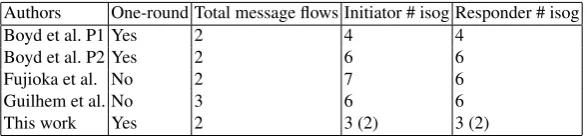
Adapting the schemes by Boyd, Cliff, Gonzlez Nieto and Paterson [4] is immediate. For Protocol 1 in [4], Alice and Bob exchange random encapsulations and use the results to derive their session key. Both players perform one encapsulation and one decapsulation, so perform 4 isogeny computations in total. For Protocol 2 in [4] there is an additional SIDH key exchange protocol: Each player performs one isogeny computation to produce the message and a second isogeny computation to compute the shared key, giving 2 additional isogeny computations for each player.
Adapting the Fujioka, Suzuki, Xagawa and Yoneyama [11] scheme is relatively straightforward. The initiator Alice performs one encapsulation and also needs to generate a new SIDH public keypkT, which involves one isogeny computation. Bob responds by performing two encapsulations. Bob also needs to decapsulate the message from Alice, while Alice needs to decap both messages from Bob. Overall, Alice performs key generation, one encapsulation and two decapsulations, which is 7 isogeny computations. Bob performs two encapsulations and one decapsulation, which is 6 isogeny computations.
The Guilhem, Smart and Warinschi [16] scheme starts with unauthenticated SIDH (so each player performs one isogeny computation to produce the message and a second isogeny computation to compute the shared key). The encryption and decryption operations add an extra 4 isogeny computations for each player. Plus there is the additional round of sending a MAC value.
Authors One-round Total message flows Initiator # isog Responder # isog
Boyd et al. P1 Yes 2 4 4
Boyd et al. P2 Yes 2 6 6
Fujioka et al. No 2 7 6
Guilhem et al. No 3 6 6
This work Yes 2 3 (2) 3 (2)
Table 1.Comparison of generic AKE protocols from public key encryption or KEMS, and our proposal from Section 7.1. Recall that “one-round” means that Alice and Bob can send their messages simultaneously. The table lists the number of isogeny computations. The final row is for our scheme in Section 7, which requires 3 isogeny computations by each player, unless the long-term secret valuej(EAB)is stored locally, in which case only 2 isogeny computations are required by each player.
6
Adapting non-generic constructions to the SIDH case
The most immediate problem, if one wants to adapt previous work to the SIDH case, is the lack of a ring structure “in the exponent”. A protocol like MQV involves computations likeTAYAU, which evaluate tog
x+aU. With isogenies we
do not have such a rich suite of operations (this, by the way, is also the primary obstacle to having an efficient public key signature scheme based on isogenies). Hence, we have to ignore complex protocols like MQV and study simpler ones like the “unified” scheme [2], Jeong, Katz and Lee [21], and NAXOS [26].
Further issues arise in the security proofs. The constrained algebraic structure prohibits random-self-reductions, self-correctors, trapdoor tests and other tools that are often used in security proofs for AKE schemes. There is no gap assumption available, since there is a reduction from the search variant of SIDH to the decisional variant. Hence, most of the proof techniques in previous work go out the window.
Even worse, as we explain in the next subsection, there are schemes that would be secure in the discrete logarithm setting but whose SIDH variants are insecure!
6.1 Adaptive attack
One of the most serious issues with SIDH using static keys is the adaptive attack from Galbraith, Petit, Shani and Ti [13]. Suppose a protocol involves Bob computing a curveEBX whereEB =E/GB is a fixed public key andEX is an ephemeral value sent by Alice. It is shown in [13] how a malicious Alice can send(EX, R0, S0), whereR0and S0are specially chosen points that differ from the protocol specification, in such a way that Alice can gradually learn Bob’s long-term secret. The attack is undetectable by Bob (there is no way for Bob to tell whether the pointsR0and S0are the correct points to be sent by Alice) without performing an additional round of computation (as mentioned by Kirkwood et al [23]). The attack is symmetric: Bob can also mount a similar attack on Alice if she is computing a key of the formEAY.
For future reference we recall the details of the attack in the context where Bob has a long term public key EB = E/hPB+βQBi, where PB, QB are points of order`e22 and0 ≤ β < `
e2
2 LetφX : E → EX be Alice’s isogeny and letR=φX(PB)andS =φX(QB). Bob computes his kernel by computing the pointR+ [β]S. Alice’s attack learns Bob’s key “bit-by-bit” (really “coefficient by coefficient” in the base`2representation). Suppose, for step
iof the attack, that Alice knows an integerKiwith0 ≤Ki < `i2such thatβ =Ki+`i2zfor some unknownz. Let
z0 ∈ {0,1, . . . , `2−1}be a guess forz (mod`2). The attack allows to determine whether the guessz0is correct.
The attack is to chooseR0 =R+ [−`2m−1−iKi−`m2−1z0]S andS0 = [1 +`m2−i−1]Sand to send(EX, R0, S0)to Bob. Bob computes
R0+ [β]S0 = (R+ [β]S) + [−`m2−1−iKi−`m2−1z0+`2m−i−1(Ki+`i2z)]S
= (R+ [β]S) + [(z−z0)`m2−1]S
which generates the correct kernel ifz ≡ z0 (mod`2)and generates a different kernel otherwise. Note that Alice
two cases occurs. It follows that after at most(`2−1)e2 malicious interactions with Bob, Alice has learned Bob’s
long-term key.
The actual attack uses a further scaling of the points, to prevent the attack from being detected by using the Weil pairing. We refer to [13] for the details. The issue is that there is no way for Bob to know that he is the victim of this attack, apart from an additional round of communication and verification of Alice’s ephemeral key.
In the classical discrete logarithm setting then it is perfectly reasonable to have a key exchange protocol that allows Alice and Bob to compute a shared keyH(gay, gbx). But this attack shows that for a SIDH protocol with shared a keyH(j(EAY), j(EBX))then a malicious Bob (who knows the private key forEB) would be able to learn Alice’s long-term key.
One of our contributions is to explain a new way to secure against such an attack (see Section A.3).
7
SIDH variant of the Jeong-Katz-Lee protocol
One problem with SIDH in the multi-user setting, already mentioned earlier, is the requirement to have public keys to both initiate and respond to key exchange sessions (the “three body problem”). Similar issues arise in the work of LeGrow [28]. Hence we are going to be encumbered with a larger public key than considered in most other works on SIDH.
Set system parameters (E, P1, Q1, P2, Q2)as in Section 2, so thatPi andQi have order`eii fori = 1,2and `e1
1 ≈`
e2
2 ≈2λwhereλis the security parameter.
A user A generates a public key as follows: Choose a secret a1 such that 0 ≤ a1 < `e11 and generate kernel
GA,1of order`e11from pointP1+ [a1]Q1. Similarly choose a secreta2such that0≤a2 < `e22 and generate kernel
GA,2 of order`e22 from point P2+ [a2]Q2. The user’s key is a tuple (EA,1, PA,1, QA,1, EA,2, PA,2, QA,2)where
EA,1=E/GA,1andPA,1=φA,1(P2),QA,1=φA,1(Q2)etc.
Essentially,EA,1is used when initiating a key exchange session andEA,2is used when responding to a session.
7.1 SIDH-AKE Protocol
This protocol is based on the Jeong, Katz and Lee [21] scheme TS2.
WhenAlice initiatesa session of the protocol she performs these operations:
– Chooses0≤x < `e1
1 and setsSX =P1+ [x]Q1, setsGX =hSXiand computesφX :E→EX =E/GX. – Chooses session identifiersid. To be able to apply the Jeong, Katz and Lee proof we must definesidto be the
triple(EX, φX(P2), φX(Q2))(which is already being sent by Alice and sosidis implicit at this stage).
– Sends(Alice,Bob,sid, EX, P20=φX(P2), Q02=φX(Q2))to Bob.
– Savesx, j(EX)in protected temporary storage.
On receipt of(Alice,Bob,sid= (EX, P20, Q02))Bob does:
– Checks thatEXis a supersingular elliptic curve overFp2 and thatP20, Q02are independent points onEXof order `e2
2 .
(These checks require significant overhead, though are less costly than actually computing an `e2
2 -isogeny. We
refer to Section 9 of Costello, Longa and Naehrig [7] and also [13] for details about validation.) – Chooses0≤y < `e2
2 and setsSY =P2+ [y]Q2, setsGY =hSYiand computesφY :E→EY =E/GY. – Sends(Alice,Bob,sid, EY, P10=φY(P1), Q01=φY(Q1))to Alice.
Note that sincesid= (EX, φX(P2), φX(Q2))this means Bob’s communication to Alice is roughly twice as long
as Alice’s communication to Bob.
– ComputesGXY =hP20+ [y]Q02iandEXY =EX/GXY.
– Looks up Alice’s public key(EA,1, PA,1, QA,1), verifies her certificate, looks up his long-term private keyb2from
secure storage and computesGAB =hPA,1+ [b2]QA,1iandEAB=EA,1/GAB. – Computes the session key
k=H(Alice,Bob, j(EX), P20, Q
0
2, j(EY), P10, Q
0
– Flushes his working storage.
On receipt of(Alice,Bob,sid, EY, P10, Q01)Alice completes the protocol as follows:
– Checks thatEY is a supersingular elliptic curve overFp2 and thatP10, Q01are independent points onEY of order
`e1
1 .
– Retrievesx, j(EX)from temporary storage associated withsidand computesGXY =hP10+ [x]P20iandEXY = EY/GXY.
– Looks up Bob’s public key(EB,2, PB,2, QB,2), verifies his certificate, looks up her long-term private keya1from
secure storage and computesGAB =hPB,2+ [a1]QB,2iandEAB =EB,2/GAB.
– Computes the session key
k=H(Alice,Bob, j(EX), P20, Q02, j(EY), P10, Q01, j(EXY), j(EAB)).
– Flushes her working storage.
The correctness of the protocol is easily verified, based on the correctness of the Jao-De Feo SIDH concept. Note that compression techniques can be used to reduce the bandwidth of triples such as(EX, P20, Q02), and the
input to the hash computation should also use the compressed representation.
The computation costs are easily estimated. Alice and Bob need one isogeny each to create their protocol message, and two isogenies each to compute the curvesEXY andEAB. If Alice and Bob are in regular contact thenj(EAB) could be cached, in which case the “online” cost is just two isogenies (though we need to take into account the risk of leakage of this long-term secret, as discussed in Remark 1). This explains the numbers given in Table 1 earlier.
One of the features of the design is to include the termj(EXY). This provides forward security: if a player’s long-term private key is obtained by an attacker, previous session keys are still secure since an attacker cannot compute EXY when givenEXandEY.
7.2 Key validation
The security of our scheme depends on public keys being correctly and honestly formed. Hence Alice needs to prove to the PKI that her key is correctly formed. In this section we provide two simple ways to do this.
Alice’s key is a tuple(EA,1, PA,1, QA,1, EA,2, PA,2, QA,2). HereEA,1=E/GA,1for a groupGA,1of order`e11
andPB,1 =φA,1(P1)etc. AlsoEA,2 =E/GA,2for a groupGA,2of order`e22 andPA,2 =φA,2(P2)etc. The PKI
needs to verify that everything is correctly constructed. So it must be the case that each curve is correctly formed as the image of an isogeny of the correct degree, and it must be the case that the pointsPA,1, QA,1, PA,2, QA,2are the
correct images of the points on the base curve.
The first solution, which is too inefficient, is using a “cut and choose” protocol: Alice runs her key generation algorithmktimes (say,k = 220) to generate tuples(EA,(i)1, PA,(i)1, Q(A,i)1, EA,(i)2, PA,(i)2, QA,(i)2)for1 ≤i ≤k. She then uploads all tuples to the PKI. The PKI then chooses one of them to be Alice’s public key and then asks Alice to reveal the private key for allk−1remaining tuples. The PKI then checks that all k−1 keys are correctly formed. The probability that Alice can successfully cheat this protocol is1/k.
The second, and much more efficient, solution is to use an interactive protocol similar to the zero-knowledge proof of identity in Section 3.1 of [9]: To prove knowledge of an isogenyφ:E →EAof degreedsuch thatφ(Pi) =Ri for1 ≤ i ≤ t, the prover chooses a subgroupG ⊆E of orderd0 coprime todand the order of the pointsPi. The prover constructs isogeniesρ:E → E andψ: EA → EAwithker(ρ) =Gandker(ψ) =φ(G). The prover sends (E,EA)andρ(Pi)andψ(Ri)to the verifier. The verifier sends a bitb. Ifb= 0the prover responds withGandφ(G), while ifb = 1 the prover responds withρ(ker(φ)). The verifier checks the consistency of the prover’s responses. The probability Alice can cheat one round of this protocol is1/2. By repeating this argument the verifier becomes convinced of the validity of the prover’s key (one needs to be careful to chooseGfrom a fixed subgroupE[n]to prevent leaking too much information).
7.3 Formal Security analysis
We closely follow the security proof of Section 4.2 of Jeong, Katz and Lee [21]. A key property of their approach is that the session identifiersidincludes the valuesEX andEY so that by definition a matching session must involve the correct valuesEX andEY selected by the players during their protocol execution, and so has not been tampered with. This aspect of the protocol design basically implies that there can be no man-in-the-middle attack, since any change to the protocol messages does not lead to a matching session. The proof in [21] exploits random-self-reduction of CDH tuples, which is not available in our setting, and so the reduction in the SIDH case is even less tight than the result in [21]. We specify that the session state reveal query only returns the ephemeral valuesxory, and not other intermediate values such asj(EAB), hence the issue of Remark 1 is avoided in the security proof.
Theorem 1. Suppose Problem 1 is hard. Then, in the random oracle model, the SIDH-AKE Protocol is a secure authenticated key exchange protocol in the Canetti-Krawczyk model.
Proof. LetAbe an adversary to the SIDH-AKE protocol in the Canetti-Krawczyk model that succeeds with noticeable advantage. Let there benusers in the system. Letmbe an upper bound for the number of sessions participated in by each playeri. Note thatnandmare polynomial in the security parameter.
The proof proceeds in two stages. The first stage is to show that any successful adversary must make a random oracle query of a certain form with noticeable probability. The second stage is to give a simulation of the protocol such that when the adversary makes the specific query then a challenge SIDH instance is solved.
Stage one:The adversary chooses some player(i, j)as the object of theTestquery. This means that this player is not the object of aCorruptorSession-StateorSession-Keyquery and that it has completed the protocol and has a matching partner session that is also not the object of aCorruptor Session-State or Session-Keyquery. Let
sid= (j(EX), P20, Q02, j(EY), P10, Q01)be the session identifier for this matching session and letEAandEBbe the public keys for playersiandjrespectively. We define two events:
q1 is the event that there are two non-partnered protocol instancesΠ
j i andΠ
l
kwith the same session identifier. q2 is the event that there is a query to the random oracle of the formH(A, B,sid, j(EXY), j(EAB)).
Since each player generates a fresh ephemeral key, the probability in any given instance that the player generates any specific curveEthat has been already used by another player is at most1/2λ(whereλis the security parameter). Since there are at most nmsessions in total there are at most (mn)2 possible pairs of conflicts to avoid, and so
Pr(q1)≤(nm)2/2λ.
We now prove that ifAsucceeds in theTestquery with noticeable advantage thenPr(q2)is noticeable. Letbbe
the hidden bit in the security game played byA, andb0 the bit output byA. The probability distribution is over the choices made byAand the simulation. The advantage Adv(A)ofAis
Pr(b=b0)−12
=
Pr(b=b0∧q1) + Pr(b=b0∧q¯1)−12
=
Pr(b=b
0|q
1) Pr(q1) + Pr(b=b0∧q¯1∧q2)
+ Pr(b=b0∧q¯1∧q¯2)−12
=
Pr(b=b
0|q
1) Pr(q1) + Pr(b=b0|q¯1∧q2) Pr( ¯q1∧q2)
+ Pr(b=b0|q¯1∧q¯2) Pr( ¯q1∧q¯2)−12
.
Now,Pr(b =b0|q¯1∧q¯2) = 12 since ifH is never queried on the value of the test query, and if there is no way to get
access to the corresponding key via a session key reveal query, then there is no information about the hidden bitb. For brevity defineα= Pr(q1)andβ= Pr( ¯q1∧q2). Then
Pr( ¯q1∧q¯2) = 1−α−β.
Hence, the advantage can be written as
Pr(b=b0|q1)α+ Pr(b=b0|q¯1∧q2)β+21(1−α−β)−12
=Pr(b=b0|q1)α+ Pr(b=b0|q¯1∧q2)β−12(α+β)
≤ 1
It follows thatPr(q2)≥β ≥2Adv(A)−α≥2Adv(A)−(nm)2/2λand so is noticeable.
Stage two:Let(E, P1, Q1, P2, Q2, EX, P20, Q02, EY, P10, Q01)be a challenge instance of Problem 1. We will construct
a simulator that uses Ato solve this problem instance (in other words, computesj(EXY) whereEX = E/GX, EY =E/GY andEXY =∼E/hGX, GYi).
The simulation begins with the simulator creatingnusersifor1≤i≤nand public keys for them. The simulator generates public keys correctly and knows the corresponding private keys. The simulator randomly chooses two users i0 andi00. The simulator randomly chooses session1 ≤ j0 ≤mfor useri0, and session1 ≤ j00 ≤mfor useri00.
The simulator is hoping that sessionj0of playeri0will match sessionj00 of playeri00, and that the test query will be
applied to either thej0-th session of playeri0or thej00-th session of playeri00.
The simulation handles random oracle queries in the usual way: On inpututhe simulation checks whetherH(u) has already been queried and, if not, uniformly chooses a binary stringh∈ {0,1}land returnshand adds(u, h)to the table of random oracle values.
We now explain how to handle the queries required in the Canetti-Krawczyk model.
Initiate(i, i0): Letj be the next available session for playeri. If(i, j) = (i0, j0)then the output is(EX, P20, Q02),
coming from the challenge SIDH instance. If(i, j)6= (i0, j0)then a fresh value0≤x < `e11is chosen (and stored)
andφXandEX=E/hP1+ [x]Q1iare constructed and the output is the correctly formed triple(EX, P20, Q02)as
in the protocol.
Send(i, j, M): If(i, j) = (i00, j00)then the output is(EY, P10, Q01)from the challenge SIDH instance and no
com-putation is performed (a key is not computed). If(i, j) = (i0, j0)then do nothing (again, no key is computed).
Otherwise, execute the protocol appropriately, using the private key and ephemeral keys that are known to the player in this protocol instance (in particular, do not perform any further computations ifM is not a bitstring that satisfies the validity checks of the protocol).
Execute(i, i0): Determine the next available sessionsjandj0 for playersiandi0respectively. Then run theInitiate
andSendalgorithms as just explained. In particular, if(i, j) = (i0, j0)and(i0, j0) = (i00, j00)then the protocol
messages come from the challenge SIDH instance.
Corrupt(i): Output the long-term private key of useri, together with all session keys for completed sessions up to this point in the game. Note that the private keys can always be output by the simulation. The session keys are handled as in the next item.
Session-Key(i, j) If(i, j) 6= (i0, j0),(i00, j00)then the simulator knows all the relevant ephemeral information of
playeriand so can compute the relevant elliptic curves and perform a hash query and hence return the correct key
H(A, B, j(EX), P20, Q
0
2, j(EY), P10, Q
0
1, j(EXY), j(EAB)).
Note that this is true even if the values sent to playeriby theSendquery have been maliciously chosen.
We are assuming theSession-Keyquery is not made on the values(i0, j0)or(i00, j00). If it is then we just respond
with a randomly chosen binary string in{0,1}l.
Session-State(i, j) If(i, j)6= (i0, j0),(i00, j00)then returns the ephemeral valuexused to generateEX(respectively yto generateEY). We are assuming theSession-Statequery is not made on the values(i0, j0)or(i00, j00).
We are hoping that the Test query will be made on the instanceΠj0
i0 or Π
j00 i0
0
in the correct matching session, and that the adversary makes a random oracle query of the formH(A, B,sid, j(EX), j(EY), j(EXY), j(EAB)). The simulator looks up in the random oracle table all values of the form(A, B, j(EX),∗, j(EY),∗, u, j(EAB)), chooses one of them at random, and outputs the valueu. This completes the description of the simulator.
We now discuss the correctness of the simulation in the random oracle model. All functions are correctly computed except for those involvingΠijwith(i, j) = (i0, j0)or(i00, j00). The only way the simulation cannot be perfect is if there
is a conflict in the responses to the random oracle queries. This can happen in two ways. Either the ephemeral values EXandEY are repeated (so asidis repeated), or a query is made of the formH(A, B,sid, j(EX), j(EY), j(EXY), j(EAB)) where these are the specific values arising in theTest query as above. The former event isq1 and we have already
shown it is negligible. The latter event isq2, and we have shown in stage one of the proof it is noticeable if the
Finally, we discuss the success probability of the simulator to solve the SIDH instance. With probability at least 1/(mn)theTestquery is made on either the instanceΠj0
i0 orΠ
j00 i0
0
. With probability at least1/(mn)the partner of this
instance is the other one desired by the simulation. Hence, with probability at least1/(mn)2we are in the setting that
the simulator is hoping for.4Now the adversary plays the game and, as already noted, makes the desired hash query
with noticeable probability. The simulation outputs one of the values from the list of hash inputs of the correct form (there are only polynomially many such entries). Hence, the simulation succeeds with noticeable probability.
8
Other SIDH-AKE Protocols
As already discussed, one can get post-quantum secure AKE from SIDH by signing the protocol messages with a post-quantum secure digital signature scheme, such as a hash-based signature scheme. We leave the analysis of such protocols for future work.
One can also consider the TS3 scheme from Section 4.3 of Jeong, Katz and Lee [21].5 In this scheme Alice has
SIDH public key(EA,1, PA,1, QA,1, EA,2, PA,2, QA,2)and Bob has a public key(EB,1, PB,1, QB,1, EB,2, PB,2, QB,2).
Knowing each other’s public keys, Alice and Bob can agree on a static shared session keyEAB(where Alice, as ini-tiator, usesEA,1and Bob as responder usesEB,2). From this they derive a MAC keykby applying a hash function or
strong extractor. The protocol is then for Alice to send to Bob(EX, P20, Q02, τA=Mack(EX, P20, Q02))and for Bob to
check the MAC and respond with(EY, P10, Q01, τA=Mack(EY, P10, Q01)). The shared key isj(EXY).
The security proof of the TS3 protocol is long and complex (see the full version of [21] for the corrected version). It also relies on random-self-reduction of DDH tuples, which we do not have. Once again, we leave for future work a full analysis of this protocol in the SIDH setting.
In Appendix A we give another SIDH-AKE protocol. The shared key for this protocol is of the formH(j(EAY), j(EBX), j(EXY)). This protocol has some features that may make it preferable in practice to the Jeong-Katz-Lee protocols (though it is computationally less efficient). We believe that a variant of the protocol can be proved secure using the same proof methodology as in Section 7.3.
9
Open problems and conclusions
We have surveyed the problem of authenticated key exchange in the context of supersingular isogeny Diffie-Hellman. We have highlighted a number of technical issues that explain why it is non-trivial to adapt results from the discrete logarithms setting to this new context. We have presented an SIDH variant of a protocol due to Jeong, Katz and Lee, and proved its security in the same model as [21]. We have also sketched several other SIDH-AKE protocols.
There are many open problems in this area. Foremost is the need to find new techniques to design and tightly prove security of AKE protocols in the SIDH setting. It is also necessary to give a full security analysis of these protocols that includes the widest possible variety of adversarial goals (because, as is known, not every possible security issue in AKE is captured by the formal models in [6, 21]). The following problems are also worth investigation.
1. Thoroughly review the literature to precisely compare the existing solutions from the point of view of security (e.g., forward security) and tightness of the security reduction.
2. Determine which protocols are most efficient (in terms of bandwidth and computation) for practical applications. For example, is it really necessary to includej(EX)andj(EY)and the respective points as inputs to the hash function for the protocol in Section 7? These values are critical to the security proof, since they form the session identifiersid, and the strong condition on matching session identifiers allows us to eliminate certain attacks as outside the model.
3. Give more efficient solutions to public key validation for SIDH keys. (This is probably equivalent to more efficient isogeny signatures.)
4
In the Jeong-Katz-Lee case they use a random-self-reduction to ensure that the challenge instance is inserted into all sessions, and so this loss of tightness does not appear in their security result.
5
4. Study post-quantum signature schemes and MAC schemes that can be used most effectively in practice to obtain good AKE schemes.
The aim of this paper is not to make a recommendation about which scheme is most suitable for isogeny crypto. We leave this as an open problem.
References
1. Christoph Bader, Dennis Hofheinz, Tibor Jager, Eike Kiltz and Yong Li. Tightly-Secure Authenticated Key Exchange. In Y. Dodis and J. B. Nielsen (eds.) TCC, Springer LNCS 9014 (2015) 629–658.
2. Simon Blake-Wilson and Alfred Menezes. Authenticated Diffie-Hellman Key Agreement Protocols. In S. E. Tavares and H. Meijer (eds.), Selected Areas in Cryptography ’98, Springer LNCS 1556 (1998) 339-361.
3. M. Bellare, R. Canetti and H. Krawczyk. A modular approach to the design and analysis of authentication and key exchange protocols. Proceedings of 30th Annual Symposium on the Theory of Computing, ACM, 1998.
4. Colin Boyd, Yvonne Cliff, Juan Manuel Gonzlez Nieto, Kenneth G. Paterson: One-round key exchange in the standard model. IJACT 1(3): 181-199 (2009)
5. Colin Boyd, Cas Cremers, Mich`ele Feltz, Kenneth G. Paterson, Bertram Poettering and Douglas Stebila. ASICS: Authenticated Key Exchange Security Incorporating Certification Systems. In J. Crampton, S. Jajodia and K. Mayes (eds.) ESORICS 2013, Springer (2013) 381–399.
6. Ran Canetti and Hugo Krawczyk. Analysis of Key-Exchange Protocols and Their Use for Building Secure Channels. In B. Pfitzmann (ed.) EUROCRYPT 2001. Springer LNCS 2045 (2001) 453–474.
7. Craig Costello, Patrick Longa and Michael Naehrig. Efficient algorithms for supersingular isogeny Diffie-Hellman. In M. Robshaw and J. Katz (eds.), CRYPTO 2016, Part I, Springer LNCS 9814 (2016) 572–601.
8. Craig Costello, David Jao, Patrick Longa, Michael Naehrig, Joost Renes and David Urbanik. Efficient Compression of SIDH Public Keys. In J.-S. Coron and J. B. Nielsen (eds.), EUROCRYPT 2017, Part 1, Springer LNCS 10210 (2017) 679–706. 9. Luca De Feo, David Jao and J´erˆome Plˆut. Towards quantum-resistant cryptosystems from supersingular elliptic curve isogenies.
J. Mathematical Cryptology, 8(3) (2014) 209–247.
10. Luca De Feo. Mathematics of Isogeny Based Cryptography. Notes from a summer school on Mathematics for Post-quantum cryptography.http://defeo.lu/ema2017/poly.pdf
11. Atsushi Fujioka, Koutarou Suzuki, Keita Xagawa, Kazuki Yoneyama. Strongly secure authenticated key exchange from factor-ing, codes, and lattices. Des. Codes Cryptography 76(3): 469–504 (2015)
12. Steven D. Galbraith. Mathematics of Public Key Cryptography. Cambridge University Press, 2012.
13. Steven D. Galbraith, Christophe Petit, Barak Shani and Yan Bo Ti. On the security of supersingular isogeny cryptosystems. In J.-H. Cheon and T. Takagi (eds.), ASIACRYPT 2016, Springer LNCS 10031 (2016) 63–91.
14. Steven D. Galbraith, Christophe Petit and Javier Silva. Signature Schemes Based On Supersingular Isogeny Problems. In T. Takagi and T. Peyrin (eds), ASIACRYPT 2017, Springer LNCS 10624 (2017) 3–33.
15. Steven D. Galbraith and Frederik Vercauteren. Computational problems in supersingular elliptic curve isogenies. eprint 2017/774.
16. Cyprien de Saint Guilhem, Nigel P. Smart, Bogdan Warinschi. Generic Forward-Secure Key Agreement Without Signatures. in P. Q. Nguyen and K. Zhou (eds.) ISC 2017, Springer LNCS 10599 (2017) 114–133.
17. Han Weiwei, He Debiao. An Authenticated Key Agreement Protocol Using Isogenies Between Elliptic Curves. Second Inter-national Workshop on Education Technology and Computer Science (ETCS) (2010) 366–369.
18. Debiao He, Jianhua Chen, Jin Hu. An Authenticated Key Agreement Protocol Using Isogenies Between Elliptic Curves. Inter-national Journal of Computers Communications & Control, Vol 6, No 2 (2011) 258–265.
19. David Jao and Luca De Feo. Towards quantum-resistant cryptosystems from supersingular elliptic curve isogenies. In B.-Y. Yang (ed.), PQCrypto 2011, Springer LNCS 7071 (2011) 19–34.
20. David Jao (Principal submitter). Supersingular Isogeny Key Encapsulation. Submission to NIST, November 30, 2017. 21. Ik Rae Jeong, Jonathan Katz and Dong Hoon Lee. One-Round Protocols for Two-Party Authenticated Key Exchange. In M.
Jakobsson, M. Yung and J. Zhou (eds.), ACNS 2004, Springer LNCS 3089 (2004) 220–232.
22. Burton S. Kaliski Jr., An unknown key-share attack on the MQV key agreement protocol, ACM Trans. Inf. Syst. Secur., vol. 4, no. 3 (2001) 275–288.
23. Daniel Kirkwood, Bradley C. Lackey, John McVey, Mark Motley, Jerome A. Solinas, and David Tuller, Failure is not an option: Standardization issues for post-quantum key agreement, 2015, Workshop on Cybersecurity in a Post-Quantum World. 24. Hugo Krawczyk. HMQV: A High-Performance Secure Diffie-Hellman Protocol. In V. Shoup (ed.), CRYPTO 2005. Springer
25. Caroline Kudla and Kenneth G. Paterson. Modular Security Proofs for Key Agreement Protocols. In B. K. Roy (ed.), ASI-ACRYPT 2005, Springer LNCS 3788 (2005) 549–565.
26. Brian A. LaMacchia, Kristin E. Lauter and Anton Mityagin. Stronger Security of Authenticated Key Exchange. In W. Susilo, J. K. Liu and Y. Mu (eds.), ProvSec 2007, Springer LNCS 4784 (2007) 1–16.
27. Jooyoung Lee and Je Hong Park. Efficient and Secure Authenticated Key Exchange Protocols in the eCK Model. IEICE Transactions, Vol. 94-A, no. 1 (2011) 129–138.
28. Jason LeGrow. Post-Quantum Security of Authenticated Key Establishment Protocols. University of Waterloo Masters Thesis (2016)http://hdl.handle.net/10012/10386
29. Yong Li, Sven Sch¨age, Zheng Yang, Christoph Bader, J¨org Schwenk. New Modular Compilers for Authenticated Key Ex-change. In I. Boureanu, P. Owesarski and S. Vaudenay (eds.), ACNS 2014, Springer LNCS 8479 (2014) 1–18.
30. Alfred Menezes. Another look at HMQV. J. Mathematical Cryptology, Vol. 1, No. 1 (2007) 47–64.
31. Tatsuaki Okamoto. Authenticated Key Exchange and Key Encapsulation in the Standard Model. In K. Kurosawa (ed.), ASI-ACRYPT 2007, Springer LNCS 4833 (2007) 474–484.
32. Joseph H. Silverman. The arithmetic of elliptic curves. Springer GTM 106, Springer, 1986.
33. Vladimir Soukharev, David Jao and Srinath Seshadri. Post-Quantum Security Models for Authenticated Encryption. In T. Takagi (ed.) PQCrypto 2016, Springer LNCS 9606 (2016) 64–78.
34. Erik Thormarker. Post-Quantum Cryptography: Supersingular Isogeny Diffie-Hellman Key Exchange. Thesis, Stockholm Uni-versity, 2017.
35. Berkant Ustaoglu. Obtaining a secure and efficient key agreement protocol from (H)MQV and NAXOS. Des. Codes Cryptog-raphy, 46, no. 3 (2008) 329–342.
36. Lawrence C. Washington. Elliptic curves: Number theory and cryptography, 2nd ed., CRC Press, 2008.
37. Youngho Yoo, Reza Azarderakhsh, Amir Jalali, David Jao and Vladimir Soukharev. A Post-Quantum Digital Signature Scheme Based on Supersingular Isogenies. In A. Kiayias (ed.) Financial Cryptography and Data Security FC 2017, Springer LNCS 10322 (2017) 163–181.
A
Variant of the NAXOS scheme
This section presents a scheme that may be attractive in some practical applications, though it is less efficient than our SIDH variant of the Jeong-Katz-Lee schemes. It is closely related to other schemes in the discrete logarithm setting, such as the NAXOS scheme [26] by LaMacchia, Lauter and Mityagin. This scheme deliberately does not usej(EAB), due to the issues mentioned in Remark 1.
A.1 Protocol
As in Section 7 the system parameters are(E, P1, Q1, P2, Q2). User Alice has public key(EA,1, PA,1, QA,1, EA,2, PA,2, QA,2),
such that there is a`e1
1 -isogenyφA,1:E →EA,1with kernelhP1+a1Q1iandPA,1 =φA,1(P2), QA,1=φA,1(Q2)
are points of order`e2
2 etc. Recall that`
e1
1 ≈`
e2
2 ≈2λwhereλis the security parameter.
WhenAlice initiatesa session of the protocol she performs these operations:
– Chooses0≤x < `e1
1 and setsSX =P1+ [x]Q1, setsGX =hSXiand computesφX :E→EX =E/GX. – Chooses session IDsid. This could be a random binary string, or one could avoid an explicitsidand instead define
it to be the triple(EX, φX(P2), φX(Q2))that is already being sent.
– Sends(Alice,Bob,sid, EX, φX(P2), φX(Q2))to Bob (compression is used here).
– Savesxin protected temporary storage.
On receipt of(Alice,Bob,sid, EX, P20, Q02)Bob does:
– Checks thatEXis a supersingular elliptic curve overFp2 and thatP20, Q02are independent points onEXof order
`e2
2 .
– Chooses0≤y < `e2
2 and setsSY =P2+ [y]Q2, setsGY =hSYiand computesφY :E→EY =E/GY. – Sends(Alice,Bob,sid, EY, P10=φY(P1), Q01=φY(Q1))to Alice (compressed).
– ComputesGXY =hP20+ [y]Q02iandEXY =EX/GXY.
– Looks up Alice’s public key, verifies her certificate, and computes GAY = hPA,12 + [y]QA,1iand EAY = EA,1/GAY.
– Computes the session keyk=H(Alice,Bob,sid, j(EAY), j(EBX), j(EXY)). – Flushes his working storage.
On receipt of(Alice,Bob,sid, EY, P10, Q01)Alice completes the protocol as follows:
– Checks thatEY is a supersingular elliptic curve overFp2 and thatP10, Q01are independent points onEY of order
`e1
1 .
– Retrievesxfrom temporary storage and computesGXY =hP10+ [x]Q01iandEXY =EY/GXY.
– Looks up Bob’s public key, verifies his certificate, and computes GBX = hPB,2 + [x]QB,2i and EBX = EB,2/GBX.
– Retrieves her long-term private keya1 from secure storage and computesGAY =hP10 + [a1]Q01iandEAY = EY/GAY.
– Computes the session keyk=H(Alice,Bob,sid, j(EAY), j(EBX), j(EXY)). – Flushes her working storage.
The correctness of the protocol is easily verified. Note that both players perform 4 isogeny computations in total, so this is less efficient than our earlier scheme.
A.2 Informal Security Analysis
We now give an informal analysis of the security of the protocol. For this analysis we assume that Problem 1 is hard, thatH is a preimage-resistant hash function, that there is a public key infrastructure (PKI) that ensures authenticity and integrity of public keys, and that the PKI enforces public key validation for all users.
Consider an attacker Eve who tries to interfere with the protocol messages sent between Alice and Bob. Eve can replace Alice’s message(Alice,Bob,sid, EX, P20, Q02)with a message(Alice,Bob,sid, EX0, P200, Q002)of her choos-ing. She can also replace Bob’s message(Alice,Bob,sid, EY, P10, Q01)with(Alice,Bob,sid, EY0, P100, Q001). However, without knowing the long-term secret keys of Alice and Bob, she cannot compute either key. For example, to compute Alice’s session keyH(· · · , j(EAY0), j(EBX), j(EXY0))it is necessary to compute the curve EBX which cannot be done by Eve unless she knows Bob’s private key or can determine Alice’s ephemeral secret. Similarly, to com-pute Bob’s session keyH(· · · , j(EAY), j(EBX0), j(EX0Y))Eve would need to compute EAY. Hence, the use of the long-term public keysEAandEB is expected to provideimplicit key confirmation. This means that Alice is convinced that Bob is the only other person who could computek, and vice versa. So if Alice receives a message encrypted/MAC’d with the keykthen Alice can be sure it comes from Bob.
There seems to be no way to mount an attack like the Kaliski attack (see Section 3.1), that “eliminates” part of the public key by choosing an appropriate protocol message. This is due to the lack of algebraic structure in the SIDH system: there seems to be no way to “combine” an isogeny with domainEAand an isogeny with domain Einto a single object.
The above informal arguments suggest that there is no simple algebraic way for Eve to learn or manipulate the keys agreed by users of the protocol. Adaptive attacks to learn a user’s secret key are discussed in Section A.3 below. Forward security is provided by the valuej(EXY).
Note that we could have includedEABin the session key as well. The choice to ignore this is because it feels less secure to rely on a single fixed shared long-term keyEAB. This is also the sort of shape one wants to have for future security proofs, and at least allows a proof in a weaker model that does not include session key reveal queries.
A.3 Resistance to adaptive attack
We now consider the attack from Section 6.1 and explain why it cannot be mounted on this protocol.
Ki+`i2z for some unknownz. Let z0 ∈ {0,1, . . . , `2−1} be a guess forz (mod `2). The attack is to choose
R0 =R+ [−`2m−1−iKi−`m2−1z0]SandS0 = [1 +`2m−i−1]S. As we explained in Section 6.1, if the guessz0is
correct thenEX/hR0+ [b]S0iwill be isomorphic to the curve that Alice can compute.
However, this protocol has keyH(j(EAY), j(EBX), j(EXY))and so Alice cannot test a guess for the key without computingj(EXY)(the pre-image resistance ofHis necessary here). Bob computesEXY by computing the quotient ofEXbyhR0+ [y]S0i. The problem for Alice is that
R0+ [y]S0 = (R+ [y]S) + [`2m−1−i(−Ki+y−`i2z0)]S
whereyis a freshly chosen random integer with0≤y < `m
2. Hence, Alice has no knowledge of this point, or how to
compute the corresponding points onEY that would allow her to computeEXY. To conclude, Alice cannot produce a candidate for the keyH(j(EAY), j(EBX), j(EXY))and so has no way to verify whether her guessz0is correct.
This idea gives an alternative to the Kirkwood et al [23] approach to preventing the adaptive attack.
A.4 Formal Security analysis
By including the protocol messages(EX, P20, Q02EY, P10, Q01)in the session identifier (and hence including them in
the hash inputs for generating the key), one can apply the proof technique of Jeong-Katz-Lee and prove the security of the scheme. The security reduction is not tight. We omit the details due to lack of enthusiasm. However, it is also interesting to discuss whether security can be proved using similar techniques to those used by LaMacchia et al [26] (potentially obtaining a tighter reduction).
We now discuss what would be required to get a rigorous security proof for the scheme in the random oracle model. The natural approach would be to develop a simulator that takes as input an instance(E, EX, PA0, QA0 , EB, PB0, Q0B) of the SIDH problem and sets up(EB, PB0, Q0B)as the public key of some user Bob and(EX, PA0, Q0A)as the initial message in sessionj between Alice to Bob. The hope is that Bob is never corrupted by the adversary and that the sessionjis the object of the test query.
The problem, as already mentioned, is how to handle session key reveal queries to Bob. Consider a user Alice (controlled by the adversary) who sends a valueEXto Bob and then receives Bob’s answerEY. Alice, knowing the ephemeral secret forEXand also her long-term private key, can computej(EAY),j(EBX), andj(EXY). Adversarial Alice can therefore make a number of hash queries of the formH(j(EAY), u, j(EXY))for different valuesu, one of them being the correct valuey =j(EBX). If a session key reveal query is made to Bob, how is the simulator to respond (even though the simulator controls the random oracle)? Knowing the secret key forEY, the simulator can computej(EAY)andj(EXY), so can look up all random oracle queries of the formH(j(EAY), u, j(EXY)). But it cannot determine which of these values is the correct one to output as the session key. In the Jeong-Katz-Lee proof this is not a problem (the eventq2has taken place), but this leads to a lack of tightness. This issue is resolved in the