J. B. CAMPBELL
Oficer-in-Charge, Pasture Division, Experimental Station, Swift Current, Sask., Canada (A talk presented at l’he International Live-
stock Farmers’ Meeting, Williston, North Dakota, November 2, 1951.)
I
T is always a pleasant assignment for me to talk about pasture and grazing. It is an exceptionally happy event when the audience is international, because pasture is an international crop. Although we may associate the production of tea with China, dates with Arabia, and coffee with Brazil, nevertheless pasture is an important crop in these countries also. In New Zealand, Australia, Argentina, as well as in many other lands, pasture is the principal source of agricultural wealth. Not only is pasture of universal interest, but it is one of the world’s largest crops.
The title of this talk is “Farming Range Pastures.” It was chosen because the basic principles of good farming apply to range pastures as much as to any other crop: good land management returns high yields and reduces soil erosion ; crops adapted to a climate produce higher returns; careful decisions about dates of harvesting ensure high quality crops; and reserves of moisture, fertility, and feed assure continuity of production. These are the principles which the title considers; these are the points I hope to develop as my talk progresses.
PASTURES OF THE NORTHERN GREAT PLAINS
Pastures throughout the Great Plains of North America, and particularly within its northern section, consist largely of native grasslands. In the Province of Saskatchewan, over 90 percent of our
grazing comes from this source, as well as over 60 percent of all fodder consumed by livestock. The land which produces this wealth is largely nonarable, being either arid, stony, steeply rolling, or saline. In all probability, this land will remain as an unimproved resource for many generations, and the care we give it now will determine its productivity in the future.
Let us examine the characteristics of our native grasslands. It will be appre- ciated by all that they vary in composi- tion from district to district. In the shortgrass country blue grama grass is the most abundant. Speargrasses and wheatgrasses dominate the cover in the mixed grass prairie area, while fescues and oatgrasses are the principal species in the foothills of the Rocky Mountains. But, despite the fact that different grasses occur from region to region, the vegeta- tion has certain characteristics in com- mon-some of which are valuable and must be preserved, others are weak and thus need care and help.
Strong points of native grasses Our native grasses have five valuable or strong characters:
.
They recover rapidly from drought. Production is maintained when good management is practised.
Many grasses cure on the stem, thus retaining a relatively high total digestible nutrient content for many months after growth ceases.
young leafy fodder available during a fairly long growing season. 5. Nearly all have high nutritive and
palata,bility ratings.
Recovery from drought-This is a re- markable quality possessed by native grasses. Many of us will remember the dry years of 1937 and 1949 when native grass production was only about 10 per cent of average. During those years, the grasses and the weeds appeared to be dead, and the covers were reduced greatly. Yet many stockmen cut hay on those same fields in 1938 and 1950, and not only was the yield satisfactory, but the cover was back to average. The ability of our native grasses to recover rapidly from drought is a blessing we often forget when native grasslands are discussed.
Good management-Although range pas-
tures recover rapidly from drought, they do not recover quickly from overgrazing. Overgrazing accompanied by drought,, or overgrazing alone, depletes stands and reduces yields. Overgrazing can be pre- vented by knowing the carrying capacity of a pasture and stocking it accordingly. Although we usually state carrying ca- pacity as so many acres per animal, my definition of carrying capacity is as fol- lows: “The amount of grass required to produce a gain of at least 325 pounds of beef on a 2-year-old steer between April 1st and November 1st.” Good manage- ment of range pastures will maintain this yield year after year, as well as the com- position and stand of the grass cover.
Curing on the stem-There have been
many words spoken and written about the ability of range grasses to cure on the stem. Curing is hard to define, but there are two points which help to describe this phenomenon. Firstly, curing is a process which prepares the grasses for the long winter dormancy; secondly, the process seals nutrients within the
plant cells so that the food supply is not lost by leaching. From the viewpoint of the plant, it is growing its winter coat; from the viewpoint of the animal, the cured forage is a source of palat,able feed which has a high T.D.N. rating-although low in protein and phosphorus. When we consider that most grasses dry up or even disintegrate when growth ceases, the curing character must be considered another blessing.
Growth seasons and nutritive value- Figure 1 illustrates the association be- tween the growth periods of selected grasses and the approximate rate of gain of 2-year-old steers on mixed grass prairie. The spearheads represent the spring growth season of six grasses-five native and one cultivated. The wide part of each blade indicates their seasons of rapid growth, the points the beginning and end of their growth periods. In certain favourable years, growth con- tinues to a later date and, in any year, it may recommence in the autumn. However, it is the spring growth which provides the seasonal forage and the carryover; autumn production is variable and uncertain.
It will be noticed that different grasses commence and end growth at different dates. The majority mature in about 100 days, but because some start early and others later in the season, the period of growth is extended to nearly 120 days.
Throughout their growth periods, the grasses are palatable and nutritious, and livestock will make rapid gains while pasturing them. Two-year-old steers will gain from 1.5 to 2.5 pounds daily during this season. By September, the rate of gain will be less and, by mid-November, the daily gains are small. However, gains will still be made at this late date, whereas on many other grass associations, live- stock will lose weight after mid-October.
under good management, the curing 325 pounds each summer. This is the character, and high nutritive ratings driest part of the province, and fewer during the growing season are the strong acres will produce the same gain in more properties of native grasses. These must favoured districts. However, even under be preserved to maintain livestock pro- our best conditions, it will require at duction throughout the northern Great least 8 acres to grow enough feed for one Plains.
Western uheatgrass
Common speargrass
Junegrass
Blue gramagrass
Rough fescue
Crested wheatgrass
steer.
Gain - lbs. per day for %-year- old steers
* Western wheatgrass (Anromn Smithii Rydb.) Crested wheatgrass (4. cristatum (L.) Beam.) Common speargrass (St&a comata Trin. 3( Rupr.) Junegrass (Koeleria criotata (L.) Pers.) Blue gramagrass (Bouteloua ,zracilis (H.B.K.) Lsg.) Rough fescue (Festuca scabrella Torr.)
FIGURE 1. Growth periods of selected grasses, and gains of two-year-old steers on mixed grass prairie.
Weak points of native grasses Unfortunately, few things are perfect, and our native grasses have weaknesses which we must pamper:
1.
2.
3.
4.
Their yields are relatively low, thus large acreages are needed to produce a summer gain of 325 pounds on a 2-year-old steer.
A “carryover” of the current sea- son’s growth is required to maintain a productive stand.
Growth is slow for 4 to 5 weeks after the leaves emerge in the spring. Protein and phosphorus contents drop as the summer progresses.
Carryover-Even this low rate of graz- ing cannot be practised unless a carry- over is maintained. I define carryover as the amount of grass which should not be grazed. During years of a.verage growth from 40 to 50 percent of the season’s total production should be left at the end of the grazing period. None may re- main during poor years, while most of a good season’s growth may not be eaten. Carryover holds snow, reduces erosion, and provides a bite for the animal the following spring. Carryover is a pasture reserve as much as a full stockyard is a hay reserve.
Relatively rapid growth commences in late May and continues until mid-July, after which very little growth occurs. Reference again to Figure 1 will indicate the growth curve of certain species-slow at first, relatively rapid during late May and June, and ending sharply at maturity.
Heavy use during the period of slow growth reduces production later in the season as well as the total yield for the year. However, if protection is practised until date of range readiness, greater mid-season growth is secured as well as a much higher yield. Our investigations show that heavy spring use is as responsi- ble for overgrazing as is heavy stocking throughout the year.
Loss of nutrients-The fourth weak
point exhibited by the native grasses is the loss of protein and phosphorus. Their percentage contents decline rapidly from early June until late August. The loss continues after curing is completed, but at a considerably slower rate. Reference to Figure 2 will indicate the average percentage contents of both nutrients throughout the summer.
0.21
0.20
FIGURE 2. Average crude protein and phos- phorus contents of mixed grass prairie from May through November.
How CAN WE MANAGE THESE WEAK CHARACTERS?
So far, I have said little about “Farm- ing Range Pastures”. Instead, I have attempted to show that grasses have characters as has every other crop. If all characters were strong, we would
have few grass problems, but because a few weak ones occur it is necessary to manage our rangelands. Thus, the ques- tion before us can be stated as follows: “How can we manage or improve the weak grass characters so that full use will be made of those which are strong?”
The first weak point is low yield, and overgrazing may reduce it to even lower levels. Attempts to increase yields by rotations have not been encouraging, although small improvements in the grass cover have been demonstrated in three field rotations. Thus, on fields con- taining native pasture only, we recom- mend that they be grazed continuously throughout the summer at a moderate rate.
I Deferred until July 1st - Deferred until June 1st 1 Ho deferment
500 I . 2 400
g: s 300
k o] 200
3 & 100
April by June JOY Aug.
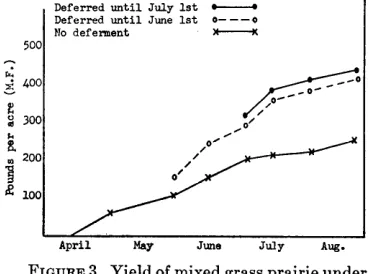
FIGURE 3. Yield of mixed grass prairie under deferred clipping at Swift Current, Sask. @our- year average 1948-51 inclusive.)
However, increased production is pos- sible as reference to Figure 3 will indi- cate. The results presented are selected from a clipping experiment which de- ferred harvesting of mixed grass prairie by two-week intervals. Plots protected until early June produced 65 percent more forage than those clipped from late April through September. A further small increase resulted from protection until July.
tives-graze early and accept a lower yield, or provide supplementary pasture for the spring season. Fortunately, we have a grass which grows rapidly during the spring a#nd which can be grazed at that time, namely, crested wheatgrass. Crested wheatgrass used as spring pas- ture in a two-crop (spring-summer) rotation with native range, can nearly double the grazing capacity of mixed grass prairie in southwestern Saskatche- wan. Increases of 60 to 90 percent have been obtained, the highest being on land with sandy soils.
early in the season, there is little increase in carrying capacity; if made too late there is a marked reduction in the amount of both forage and protein available. In order to practise the number 3 rotation, it is necessary to provide from two to three acres of crested wheatgrass per animal unit.
In a Community Pasture of 18,000 acres near Swift Current, Sask., where cattle follow naturally the rotation recom- mended, the grazing capacity is 12 acres per animal unit for a six-month grazing season. On adjacent range where no
TABLE 1
Possible rotations of crested wheatgrass and mixed grass prairie based on clipped plot yields 1948 to 1961 inclusive
POSSIBLE ROTATIONS
No. Grazing dates
Crested wheatgrass
Apr. 15-May 16
Apr. 15-June 5
Apr. G-June 20
Apr. 15-July 5
Apr. 15-July 20
Mixed grass prairie
May 16-Sept. 1
June 5-Sept. 1
June 20-Sept. 1
July 5-Sept. 1
July 20-Sept. 1 -
I
Forage (M.F.) Crude Protein
270
395
430
455
460
240
385
410
440
360
44
64
69
71
70
58
64
73
55
36
The results of a second clipping experi- ment are summarized in Table 1, and demonstrate some practical aspects of a two-crop rotation. Five possible com- binations are presented. We recommend the one listed as number 3 as being the most satisfactory. These data show there is very little increase in the yield of crested wheat,grass after mid-June, and that the stand is not adding protein. Mixed grass prairie adds to its annual production until early July, but protec- tion after that date adds little to pasture reserves. If the change from crested wheatgrass to native range is made t,oo
supplementary pasture is provided, some 22 acres are needed to produce the feed required for the same period.
will have to look to other seasons and other plants to achieve a three-fold or greater increase in pasture production.
Another weak character suggests a possibility for increasing grazing capacity, namely, the loss of protein during the summer. As pointed out previously, the loss of protein is associated with smaller livestock gains and thus a lower carrying capacity. Supplementing range pastures with high protein feeds during this period has increased the yield of beef per acre at a reasonable cost. Unfortunately, this practice does not improve pastures nor does it provide a permanent protein
SUPPlY-
A permanent protein supply has to be grown. Grasses and legumes are needed for this purpose. From the multi- tude of plants tested in Saskatchewan, four new grasses establish satisfactory stands and have characters which are useful for range regrassing. Streambank wheatgrass (Agropyron riparium Scribn. and Smith) develops an excellent bottom and is drought tolerant. Intermediate wheatgrass (A. intermedium (Host) Beauv.) produces well, but is insuffi- ciently drought tolerant and winter hardy for the drier sections. Green stipa grass (f&pa viridula Trin.) retains its protein content later in the summer than mixed grass prairie. Russian wild ryegrass (Elymus junceus Fisch.) retains a rela- tively high protein content into late fall and is hardy and palatable; it is recommended for late summer and au- tumn grazing throughout the mixed grass prairie area in Western Canada.
But even more than the need for grasses is the need for legumes. Our native grasslands contain few palatable legumes, in fact many contain poison- ous properties. Our ambition is to obtain an alfalfa or other legume which will persist under grazing, which will live in our environment, and which will add
protein and other nutrients to summer pasture. Plant breeders are making excellent progress to secure such a plant. Thus, I forecast that the carrying capacity of range pastures will be in- creased beyond the 60 to 90 percent level which we can achieve today. I do not expect that a single crop or even half a dozen will meet our needs. But the in- telligent use of those we have and those we obtain soon will repay our industry. The group of plants we select must possess the following characters:
1. Provide greater yields of forage and nutrients.
2. Retain a high protein content throughout the summer.
3. Possess the ability to cure on the stem so that pasture reserves can be maintained.
4. Be able to recover rapidly when good growth years follow periods of drought.
SUMMARY
The native grasses form the base of the grazing resource in the northern portion of the Great Plains. They have certain strong characters as well as a few which are weak. Unless it is possible to supple- ment native ranges with seasonal pas- tures, it is better to graze continuously at moderate rates than to practise rota- tions. A summer gain of at least 325 pounds on a two-year-old steer should be maintained year after year, while a 40 to 50 percent carryover is not too much during an average growth season.
carrying capacity of native range by 60 to 90 percent.
Further increases of carrying capacity will be secured when crops are available to provide protein supplements for au- tumn pasture. Russian wild ryegrass is the best grass available at present for this purpose. Progress is being made to obtain improved alfalfa strains, suitable for late season grazing.
Finally, and most important, “Farm- ing Range Pastures” in the Northern Great Plains is most successful when substantial reserves are provided. Re- serves of pasture for all seasons of the year are essential, while reserves of hay for at least two winters are not too much. Rudyard Kipling describes the luckless life of the rice farmer of India with the following words :
“His speech is mortgaged bedding, On his kine he borrows yet,
At his heart is his daughter’s wedding,
In his eye foreknowledge of debt. He eats and he has indigestion, He toils and he may not stop, His life is a long drawn question Between a crop and a crop.”
Undoubtedly, Kipling never knew about “Farming Range Pastures.” Had he been acquainted with that phase of agriculture, I am certain that his poem would have been a happier one. With apologies to Kipling, I present my parody of his serious composition, and attempt to describe the more fortunate position of those who are “Farming Range Pas- tures” :
“His land is not eroded, His cattle he fattens yet
On soils which are fertile and stable, His worries are not of debt.
His crops are safely garnered, He fears neither cold nor rain, He farms for pasture and profit With reserves of fodder and grain.”
RANGE MANAGEMENT FOR HUMAN WELFARE
The ultimate objective of range management, as of forestry or crop agriculture, is of course human welfare. Conditions in thousands of communities and even great metropolitan centers reflect adversity or prosperity on the range. All too frequently; improper management or abuse of the range has resulted in reduced livestock production; in far-reaching damage from floods, erosion, and siltation, in impoverishment of peoples and weakening of nations. Production from the range land can be increased, the lot of peoples dependent upon the range resources can be improved, and the economy of communities and nations strengthened and stabilized when im- proved range management is applied.- Lyle F. Watts, Chief, U. S. Forest Service, In Unasylva,