Working knowledge of academic practice:
Implications for professional development
Rhonda Hallett
B. A., (Hons), Dip. Education, Dip. Community Education, M. Education
School of Education, Victoria University
Abstract
This study sought to investigate the working knowledge of academics in a ‘new’ university in Australia. Working knowledge, or knowledge ‘put to use’ in day-to-day work, describes what academics actually do. What knowledge academics use day to day is vital for those concerned in the development of academic staff. Academic development has of late focused on supporting academics to respond to the changing demands of new forms of work, and has been accused of lacking an epistemological base or a clearly articulated position. The findings of this study make suggestions concerning a philosophical and practical way forward for the development of academic staff.
This study adopts and develops phenomenographic method. It explores interviews with 20 academics to identify differences concerning what is necessary and valuable to know in order to work day-to-day as a practising academic. From the perspective of
academics, this analysis identified three domains of working knowledge within daily academic practice. Unsurprisingly two of these domains are the relatively
well-explored fields of teaching and research. The third, previously unidentified as a specific field, was institutional administration. Understanding of and practice in this third new field was not only pivotal to the constitution of academic practice, but it appeared to mediate the ways in which the other two domains of teaching and research were brought together. Of further significance, working knowledge of institutional administration was implicated in academic identity and also signalled academics’ more fundamental
understandings of what constituted knowledge.
Doctor of Philosophy declaration
I, Rhonda Hallett, declare that the PhD thesis entitled Working knowledge of academic practice: Implications for professional development is no more than
100,000 words in length including quotes and exclusive of tables, figures, appendices, bibliography, references and footnotes. This thesis contains no material that has been submitted previously, in whole or in part, for the award of any other academic degree or diploma. Except where otherwise indicated, this thesis is my own work.
Acknowledgements
Undertaking study for a PhD study while working full time is challenging. I was fortunate enough to have much goodwill and cooperation from many people.
I am grateful to the study participants for their generosity in sharing their working knowledge; the School of Education for its support of my candidature; my work supervisors for providing leave and other resources when needed; the Office for Postgraduate Studies for advice about the process, and work colleagues for discussing issues and giving me encouragement.
Without diminishing the value of these colleagues’ contributions, I would acknowledge the special support of the following people:
I received invaluable support from my supervisor, Elaine Martin, who was always ’in my corner’, helping with the thesis methodology and giving valuable insights critical to my development as a researcher. Elaine’s empathy, practical skills and focus provided me with a paradigm of good supervision.
Co-supervisorRoger Gabb,my ‘boss’ when I began the study, was a perfect foil for Elaine, consistently focusing on the ‘main message’ and always seeking clarity of thought and process. He gave practical help in developing tables and the statistical analysis would not have occurred without his contribution. I also acknowledge that without his encouragement I would not have started this study.
Ron Adamsworked with me to develop my writing. His enthusiasm for writing and research is infectious as well as inspirational. Ron helped me frame the Introduction to the thesis, and think about it in its entirety.
Jenny Cameron assisted with compiling the bibliography and offered advice about how to use EndNote, while Roger Mitchell edited the manuscript and formatted the
document. I acknowledge the expertise both brought to these tasks, which are neither small nor peripheral.
List of publications and awards
Hallett, R 2012, ‘Still fitting the glass slipper: Work Integrated Learning’, World Association for Cooperative Education (WACE), Istanbul, Turkey (June) – accepted as a referred paper.
Hallett, R 2011, ‘Some thoughts on the working knowledge of academics’, paper presented at Special Interest Group, WERC Victoria University (August).
Hallett, R 2011, ‘The methodological implications of a phenomenographic study
investigating the working knowledge of academics’, in Proceedings of the International Conference of Education Research and Innovation 2011, Madrid Spain
Hallett, R 2008, ‘Academic practice: Conceptualising professional development for pedagogical innovation’, ConferenceProceedings, World Association for Cooperative Education (WACE), Sydney, Australia (September).
Hallett, R 2008, ‘Exploring the working knowledge of teachers in a dual sector institution’ Proceedings, VET in Context, AVETRA Conference, Adelaide, Australia (April).
Hallett, R & Martin, E 2006, ‘The working knowledge of academics: A phenomenographic study’, Proceedings, EARLI Special Interest Group (Phenomenography), Hong Kong, China (Dec).
Hallett, R 2005, ‘Working knowledge and academics at Victoria University’, paper presented at Research in Tertiary Education (RITE) Conference, Victoria University (Dec).
Hallett, R 2004, ‘Working Knowledge of academics: what do we know?’ paper presented at Research in Tertiary Education (RITE) Conference, Victoria University (Dec),
Hallett, R & Gabb, R (2004), ‘Making teaching portfolios work in a dual-sector
Hallett, R, & Woodley, C 2004, ‘Conceptions of Teaching in a dual sector institution: implications for staff development’, Proceedings, Learner & Practitioner — the Heart of the Matter, AETRA Conference, Canberra, (March).
Hallett, R 2003, ‘Assessing reflection: Classroom-based research and professional development processes and practices’, Proceedings, Assessment and Evaluations Conference, Adelaide, (November).
Hallett R, Selig S, Tyler J & Gabb R, 2003, ‘Conceptualising strategies for Work-Based Learning’, Proceedings, International Symposium on Work-Integrated Learning,
Pensacola, Florida, USA (November).
Table of contents
Abstract ... ii
Doctor of Philosophy declaration... iii
Acknowledgements ... iv
List of publications and awards ... v
Table of contents ... vii
List of tables ... x
Prologue ... 1
Chapter 1 Introduction: Working knowledge and the academic development discourse ... 3
Chapter 2 Literature review: Perspectives on working knowledge in academic work ... 6
Introduction ... 6
Part 1: Working knowledge literature ... 7
The changing nature of knowledge ... 9
Mode 2 work behaviours ... 11
Organisational learning ... 13
Summary ... 16
Part 2: Academic practice literature ... 16
Knowledge and practice ... 18
Multiple practices ... 19
Institutional influences on practice ... 22
Academic development ... 25
Summary ... 27
Part 3: Conceptions of teaching literature ... 27
Introduction ... 27
Background to Selected studies ... 29
Selected studies ... 34
Summary ... 46
Contribution of this thesis ... 46
Chapter 3 Methodology: The challenge of working knowledge ... 51
Introduction ... 51
Phenomenography as an epistemological framework ... 52
Phenomenography as method for this study ... 56
Context of the study ... 58
Interview questions ... 63
Transcripts ... 66
Analysis ... 69
First level ... 70
Second level ... 72
Conclusion ... 79
Chapter 4 Findings: The domains of working knowledge ... 81
Introduction ... 81
Working knowledge of teaching ... 82
Categories of description ... 83
Descriptions with illustrations ... 83
Complexity of understandings ... 90
Comparative findings ... 91
Working knowledge of research ... 93
Categories of description ... 94
Descriptions with illustrations ... 96
Complexity of understandings ... 103
Comparative findings ... 104
Working knowledge of institutional administration ... 105
Categories of description ... 106
Descriptions with illustrations ... 107
Complexity of understandings ... 113
Comparative findings ... 115
Conclusion ... 116
Chapter 5 Findings: Relationships between the domains of working knowledge ... 118
Introduction ... 118
Results... 119
Mapping categories of description in the domains ... 119
Measuring the strength of the relationships between pairs of domains ... 121
Patterns of relationships between all domains ... 124
Descriptions of variation in working knowledge of academic practice ... 131
Outcome space... 142
Conclusion ... 144
Chapter 6 Findings: Being an academic with working knowledge ... 147
Introduction ... 147
Being an academic in each of the five categories of working knowledge ... 149
Themes associated with being an academic in the working knowledge groups ... 157
Conclusions ... 164
Chapter 7 Discussion: Emerging perspectives on working knowledge ... 168
Introduction ... 168
Variation in domains of working knowledge ... 169
Summary ... 169
Variation in working knowledge of teaching ... 171
Variation in working knowledge of research ... 172
Variation in working knowledge of institutional administration ... 172
Variation in structural relationships between the domains ... 174
Summary of findings ... 174
Variation in relationship of institutional administration to the other domains ... 176
Variation in the relationship of the teaching to the other domains ... 178
Variation in the relationship of research to the other domains ... 181
Variation in understandings of knowledge ... 185
Variation in being an academic with working knowledge ... 188
Expanding awareness of agency ... 190
Expanding awareness of development ... 193
Conclusion ... 195
Chapter 8 Implications for phenomenography and academic development ... 202
Phenomenography ... 202
Academic development ... 204
The idea of ‘working’ approaches to teaching, research and institutional administration ... 205
The idea of institutional knowledge ... 206
The idea of mode 3 learning ... 207
Conclusion ... 208
Epilogue ... 209
List of tables
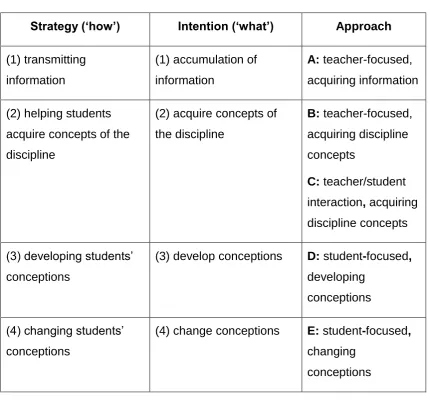
Table 2.1 Teacher-focused and teacher/student interaction approaches... 33
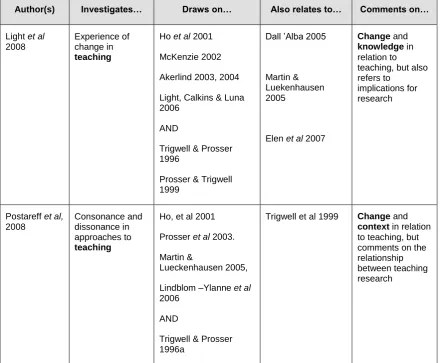
Table 2.2 Selected studies and the themes of knowledge, change and context ... 49
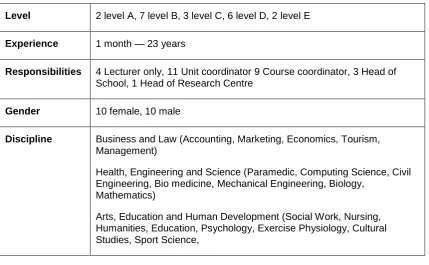
Table 3.1 Participant profile ... 62
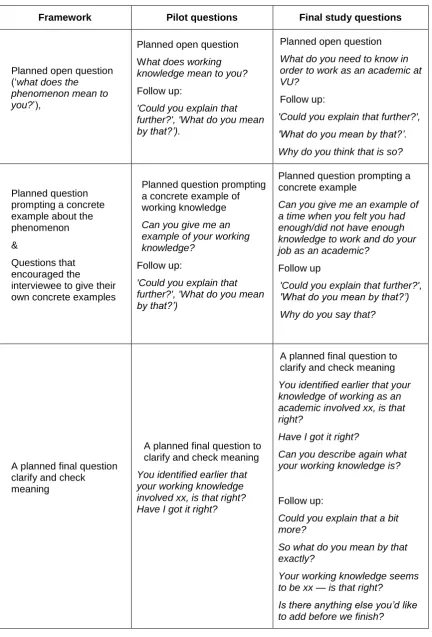
Table 3. 2 Modifications to interview schedule ... 64
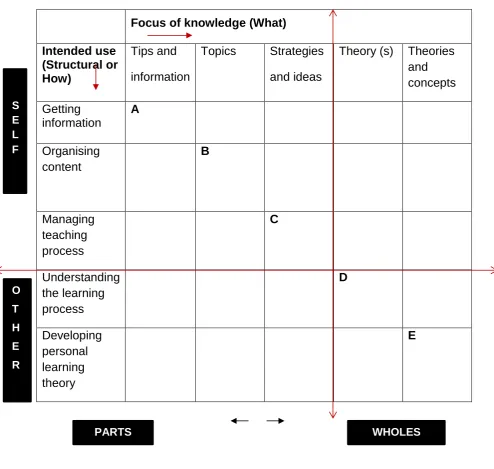
Table 4.1 The what and how aspects of working knowledge of teaching ... 90
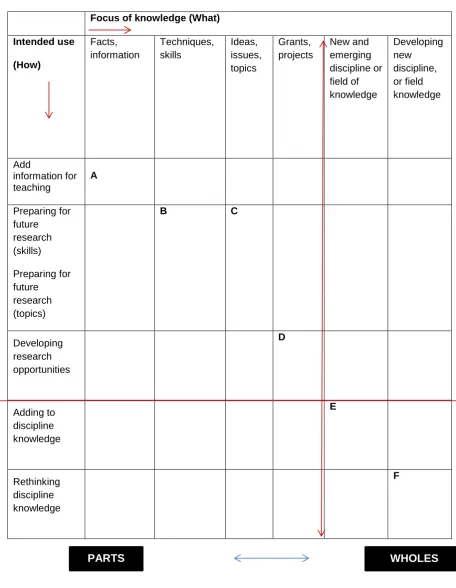
Table 4.2 The what and how aspects of experiencing knowing about research ... 102
Table 4.3 The what and how of working knowledge of institutional administration ... 107
Table 5.1 Parts-and-wholes analysis of working knowledge in each domain ... 121
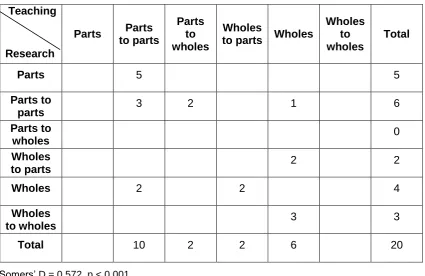
Table 5.2 Structural relationship between teaching and research ... 122
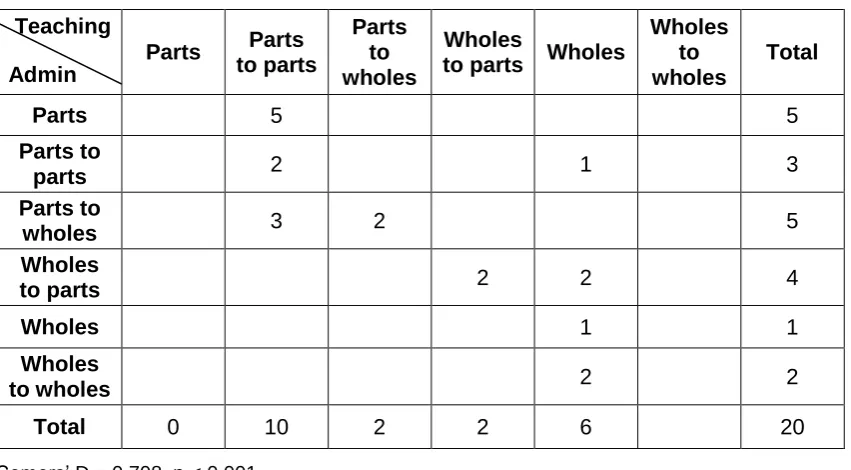
Table 5.3 Structural relationship between teaching and administration ... 123
Table 5.4 Structural relationship between research and administration ... 123
Table 5.5 Parts-and-wholes patterns across domains ... 126
Table 5.6 Parts-and-wholes elements across domains ... 129
Table 5.7 Outcome space showing referential and structural aspects of working knowledge... 144
Table 6.1 ‘Being’ in descriptions of working knowledge ... 156
Table 6.2 Relationships between working knowledge categories, being an academic and associated themes ... 163
Prologue
This study evolved from my work in academic development at Victoria University (VU) over the last 15 years. A consistent theme in my professional practice as an academic developer is the dissonance between what academics are required to do in response to institutional policies and strategies, and what they actually do in their day-to-day work in response to realities ‘on the ground’. Academic development is a practice in my experience that walks a line between institutional demands to help academics to know about and respond to institutional requirements and academics’ demands for support that reflects the ‘real’ needs that evolve in day-to-day work. Sometimes these perspectives align. In the course of my practice I observed different ways that academics reconcile competing demands in their day-to-day work.
The study’s origins were in observations I made as a range of institutional policies and strategies were introduced during the last 10 years. These required increased
accountability from academics and mandated particular practices, such as Work
Integrated Learning in teaching, that, in short, were perceived by many academics as out of kilter with what academics did and knew would work on the ground. I observed different responses to these demands that stimulated my interest in the knowledge academics needed to know about in their day-to-day work.
My work as an academic developer in two sets of circumstances led me to conduct an analysis of the knowledge academics use in their day-to-day work — their working knowledge — and its role in experiences of academic work.
what academics knew about how to work and ‘get things done’ with regard to their teaching. This knowledge was often not strictly about teaching, but clearly related to it. I observed also that this knowledge was often couched in terms of what they thought academics should do; ‘That’s what academia is about’ or ‘It’s not my job to do that’ were part of these discussions. On reflection, it was clear to me that knowledge of the ‘realities’ of work was tied up with what academics thought they should do. This idea increasingly preoccupied me and focused my attention on practical knowledge and its role in day-to-day work.
The second set of circumstances was in my role as head of a unit of academic developers where, from time to time, newly appointed educational developers were inducted to the organisation. I observed that no matter how experienced developers were, they required knowledge about ‘how things worked’ so that they could be most effective in working with academics. Over time, and in parallel with the adoption of the approach described above, I refocused the induction to ask ‘What do you need to know to work as an educational developer here?’
My passion for understanding knowledge used in everyday work by academics emerged from the observations above and sustained me through this study. Describing
Chapter 1 Introduction: Working knowledge and the academic
development discourse
The discourse about academic development is about academic work and learning. While it overlaps with disciplinary and education discourses, it occupies a space that is
uniquely focused on academic practice and the ways academics come to understand their work (Taylor 2010, Sutherland & Taylor 2010, Peseta 2011a 2011b). The boundaries around this space are defined by the ways academics and their work as teachers and researchers are represented and described. This discourse is characterised by its treatment of teaching and research as discrete activities, despite acknowledgement of the holistic nature of academic work and the need for a holistic focus reflecting the conditions of work in academic development (for example, Brew 1996, Akerlind 2005, Ahlberg 2008, Mathieson 2011). This representation of academic work simultaneously reflects and contributes to its fragmentation (Rowland 2002) while also highlighting the need for a clearer articulation of the knowledge base of academic development (Peseta 2011). My objective in being part of this discourse is to contribute to the discussion about the ways academics and their work are represented and described.
Academic development is also a discourse about knowledge production and its management. Its object, broadly, is to support critique about the purposes of higher education itself (Rowland 2007), though the ‘forms of knowing’ are still being developed and described (Clegg 2009). Disciplinary knowledge is privileged in this discourse over practical or everyday knowledge and understood as the key to understanding the epistemological foundation of academic practice. The role of
practical or working knowledge of the discipline and the institutional context in which it is practised is acknowledged but not explored in detail, despite acknowledgement that this way of knowing is sophisticated and complex (Symes and McIntrye 2000). The importance of ‘everyday knowledge’ and the everyday experience of academic work is now the focus of some interest because of what it can tell us about the actual conditions of contemporary academic work and how academics are responding to its demands (Archer 2009, Clegg 2008).
core tasks associated with institutional accountability and quality systems and their impact on the time available to undertake teaching and research (for example, McInness 1996, 2000). Academic practice from these accounts is remarkable for the ways that academics are responding to demands for other kinds of work in addition to teaching and research and what is left out of day-to-day work. I am interested in this variation.
To speak of academic work and academics themselves as a homogenous group is misleading. It is now almost a truism that there are many academic tribes and territories (Becher 1989), but in addition, within these there are also orientations towards teaching or research and emergent ‘hybridised’ forms of practice arising from demands for new modes of knowledge production and new ways of working (Usher 2000). This is a complex and, despite multiple and diverse studies, an incoherent and confusing picture of contemporary academic work that does not offer many accounts of the experiences of academics from their perspective of academics. My aim is to examine how this
knowledge is constituted by academics: what it is in relation to academic work (‘Perspectives on working knowledge in academic work’, chapter 2), how to identify and describe it (‘The challenge of working knowledge’, chapter 3), what it comprises (‘The domains of working knowledge’, chapter 4), ‘Relationships between the domains of working knowledge’, chapter 5), and ‘Being an academic with working knowledge’, chapter 6), what this means (‘Emerging perspectives on working knowledge’, chapter 7) and why this is significant to academic development (‘Implications for
phenomenography and academic development’, chapter 8).
In intend to focus my analysis on academics in a ‘new generation’ university in
Australia, where I have worked in academic development roles for the past 15 years. It is important to stress that academics in the context for this study are representative of academics’ experiences in contemporary universities. My conclusions, if valid, should apply as much to academics in research-intensive institutions where work is less exposed to the influences of trends on academic work as academics in non-traditional institutions such as the site for the study where the effects are felt first and often more intensely (Archer 2008). My research moved from an analysis of what academics said they knew in order to do their work to an analysis of what lay beneath these
the day-to-day work of academics. Working with the idea that what we know informs who we are and how we see ourselves, I realised that the working knowledge of
academics offers representations of the ways academics see themselves as academics as they are in day-to-day work — not what they are in an abstract or theorised sense. I take the view that academic development discourses rest on abstract and idealised
representations of academics and academic work which do not take full account of the realities of day-to-day work and the compromises that academics make in order to work. I am arguing for consideration of practical or working knowledge as the ‘content’ of academic development and a component of any ‘curriculum’ for this area of academic work (Peseta 2011), and a more critically orientated practice in academic development that examines its assumptions about academic work and academics.
In offering a critique of academic development, I am seeking to strengthen the discourse rather than undermine it. I see this thesis as a contribution to the discourse. My
argument is that by considering the everyday knowledge of academics we can also critique our own practice as academic developers and respond to calls for a
Chapter 2 Literature review: Perspectives on working knowledge in
academic work
Introduction
The key question underpinning the present study is: What is the working knowledge of academics?
The study draws on the concept of working knowledge and explores what it means in the everyday work of academics. The primary focus of the study is the knowledge that underpins the work of academics. It is concerned with understanding academics’ perceptions of what academics need to know to work as academics. The study is not concerned with describing and analysing influences on academic work at the systems or process levels, rather, it is concerned with understanding the plurality and complexities of practices to which current research about academic practice points.
Because of its focus on knowledge underpinning the plurality and complexity of academic practice, the study centres on the relationship that academics have with knowledge itself. It acknowledges the changing nature of knowledge and seeks to explore the impact of these changes on academic work and the ways that academics see their work. It attends to how new knowledge forms challenge thinking about the ways that universities are being reshaped and how academic work is changing. By asking ‘What is the working knowledge of academics?’ the study is exploring a critical issue for the key occupational grouping that is at the centre of dramatic and unprecedented change in the ways that we think about knowledge itself. The answers to the key question asked by the study offer ways of understanding the ways in which academics experience their relationship with knowledge.
Questions about the nature of academics’ relationship with knowledge emerge from the working knowledge literature and are the starting point in the literature review that follows. The key question asked in the first part of the review is: ‘What does the
literature about working knowledge tell us about the working knowledge of academics?’ The answers to this question are then explored in relation to the literature about
key themes in the literature about working knowledge and academic practice that can inform the critical reading of selected phenomenographic studies that follow in the third part of the review, in which I ask: ‘What can the literature on phenomenographic
approaches tell us about how academics experience academic work?’
Part 1: Working knowledge literature
In part 1 of the review, I examine a diverse literature that focuses on defining and describing the concept of working knowledge. The key question asked in this study is:
‘What is the working knowledge of academics?
In this section I ask:
‘What does the literature about working knowledge tell us about the working knowledge of academics?’
A major category of literature relevant to this study is that which focuses on the changing nature of knowledge in a contemporary society. The literature identified for this part of the review is associated with a conceptualisation of knowledge that brings the interface between work, learning and knowledge into sharp focus (Barnett 2000, p ix). This is a diverse literature that sees the term ‘working knowledge’ as
encapsulating ambiguities inherent in emerging definitions of knowledge in response to the rise of the so called ‘knowledge society’ (ibid). A key premise underpinning
discussions about new knowledge is the understanding that working knowledge is produced through learning at work — through work-based learning (WBL), broadly defined. An important focus of this literature is how universities, as the traditional sites for knowledge production and dissemination, can respond to new definitions of
knowledge that include the notion of WBL. The implications of WBL for universities are an important aspect of this literature.
associated with implementation of WBL as an approach to supporting student learning in the university context (the latter). These collections consider the impact of WBL on academic work practices and processes. The interest in WBL as a curriculum initiative in universities continues to grow (Nixon et al 2006, Lester & Costley 2010), and the issues identified in these collections continue to be explored (for example, Boud & Costley 2007, Costley 2007, Costley & Armsby 2008).
A critical aspect in the WBL literature relevant to this review relates to the definition of working knowledge that underpins discussions about its introduction in universities. There is agreement that the term ‘working knowledge’ is tied to the notion of expertise, and through this, to the concept of professionalism-; the argument is that working knowledge is acquired in work and through practice. Expert knowledge is also acquired in practice, so working knowledge is more than knowledge sufficient to ‘get things done’ (Symes & McIntyre p3). Working knowledge comprises both tacit and explicit knowledges (plural), the critical elements of expertise itself (Barnett 2000, p ix). The role and nature of tacit knowledge in relation to explicit knowledge in building expertise are broadly known: it is ‘situated’ in the immediate context of work, has high use value, but is short term and often context specific (ibid). In contrast with explicit knowledge, which is traditionally acquired through the formal educational process and is well codified in relation to different occupational groupings, tacit knowledge is
problematised in this literature in terms of how universities can support profession knowledge formation and development through WBL programs (Caley 2001, p114). In this argument, the acquisition of professional expertise is linked to learning processes that acknowledge and accommodate tacit knowledge.
identities are shaped by the socio-political cultures of the organisational context (Tennant 2000, p126). In this argument, the knowledge produced by workers in their everyday work is a product of the ways that the organisational context defines what counts as knowledge. In the process of generating knowledge, workers ‘construct and reconstruct their identities from the discursive resources available to them.’ (Chappell et al 2000, p135). These new discourses, it is argued ‘are working to change the identities of learners as workers and educators’ (ibid p136) because the emphasis in these
discourses is on positioning all workers as learner/workers in the organisational context. Nevertheless, multiple discourses and multiple identities can exist simultaneously within organisations. These identities signify competing understandings about what counts as knowledge for workers in organisations (Tennant 2000, Hager 2000, Chappell et al 2000, Boud, McIntyre & Solomon 2000).
The changing nature of knowledge
The major argument made in the literature about knowledge in contemporary society is that understandings about knowledge are changing and that this has significant
implications for academic work. Gibbon’s Mode 1/Mode 2 dichotomy of knowledges, it is argued, offers a way into understanding the different knowledge codes that academics need to work with and understand (Boud & Solomon 2001, Symes & McIntyre 2000, Usher 2000, Tennant 2000). These discussions inevitably encompass the role of universities in knowledge production and the challenge that Mode 2 knowledge poses for universities. It is argued that universities are no longer the only sites where
knowledge is produced and distributed: ‘what counts as legitimate knowledge and what is a legitimate site of learning and knowledge production’ is in question (Boud & Solomon 2000, p226). New discourses that support corporatisation, commercialisation, commodification, internationalisation, and performativity on work in general within universities reflect the changing nature of knowledge and the influence of new policy frameworks that support it (McIntyre & Solomon 2000).
The influence of new policy frameworks in universities that support changing
different forms of knowledge production and redefine what counts as knowledge. These new discourses support Mode 2 knowledge production and are therefore in competition with existing discourses that support the production of Mode 1 knowledge. The
appearance of these new discourses has caused ‘friction and conflict within the academy’ (Usher 2000, p100). Hager for example, identifies that academics now face different knowledge ‘scenarios’ in their day-to-day work: a traditional ‘academic knowledge scenario’ that encapsulates Mode 1 ways of knowing and an alternative and competing Mode 2 scenario which forces academics to rethink current conceptions of knowledge (Hager 2000). These new ways of knowing, it is argued, bring the core aspects of academic work into new relationships with each other. A key conclusion is that academics need to come to terms with new definitions of knowledge and
understand the implications that this has for teaching and research (Carrick & Clegg 2000, Usher 2000, Boud et al 2001, Boud & Solomon 2001).
The implications, it is argued, are far reaching for academics with respect to teaching and research practices. The argument is that universities have little choice but to acknowledge and adopt approaches to teaching and research that generate Mode 2 knowledge (Symes & McIntyre 2000; Boud & Solomon 2001). The key way that universities can do this is through the introduction of WBL approaches, as WBL repositions universities in relation to work in powerful ways (Boud et al 2000, p3). WBL, it is argued, is ‘one of the very few innovations related to the teaching and learning aspects of post-secondary education that is attempting to engage seriously with economic, social and educational demands of our era’ (ibid). However, WBL blurs the boundaries between teaching and research and this process, it is argued, redefines what counts as knowledge for academics (Usher 2000, Chappell et al 2000). Academics must come to understand research as co-produced by universities and workplaces and socially distributed through the WBL process (Solomon & McIntyre 2000). It is acknowledged, that once attained, this understanding will require considerable adjustments by
academics to the ways they approach teaching and research and a new set of skills to achieve it (Boud & Symes 2000, Boud 2001, Boud & Solomon 2001). These
Mode 2 work behaviours
The second and related argument made in this literature is that, as a consequence of changing modes of knowledge production and dissemination inherent in Mode 2 ways of knowing, work itself is changing. The argument about the impact of changing modes of knowledge production and dissemination focus on performativity — the need to demonstrate that work has impact in socially useful ways. In this argument, the model for knowledge production based on social distribution and collaboration ‘is in effect a performative discourse’ (Usher 2000, p102). This discourse encourages the
measurement, recording and judging of knowledge for its use value (Garrick & Clegg 2000). The argument as it applies to academic work is that university policy discourses define desirable work behaviours and therefore regulate behaviours that support how academic performativity is understood and measured at the institutional level (McIntyre & Solomon 2000). The academic workplace is thus a ‘performative university’ in which academic work is defined and regulated according to the broad parameters set by
discourses that support the generation of new knowledge (Usher & Solomon 1999). Academic teaching and research practices are therefore the products of performance cultures that are supported by institutional policies.
It is argued that WBL policy discourses challenge existing academic practices because they support the performative measurement of teaching and research (McIntyre & Solomon 2000). It is argued that in WBL policies, teaching and research practices have a public dimension and are therefore subject to measurement and evaluation in ways that current practices are not. Boud and Solomon (2001) for example, argue that such policies challenge academics to acquire expertise based on knowledge of practice rather than disciplinary knowledge. In the case of teaching practices associated with WBL, this requires skills ‘that make the visible and sayable what was previously invisible and unsaid’ (ibid, p28). The consequence of this, they argue, is that performance goals in the curriculum, traditionally accountable to disciplinary and professional bodies of
knowledge, have shifted to other forces that include consideration of ‘the organisation, the learner and the community’ (ibid, p28). The use value of learning — for the
constitutes worthwhile knowledge and this has had an effect on academic research, academic texts and subjects.’ (Chappell et al 2000, p140). WBL policies for example, entail the inclusion of other collaborators in the production of knowledge and thus challenge academics to move outside of expert knowledge based on discipline and professional knowledge (Boud & Solomon 2000, p224). The conclusion of these arguments is that monitoring and evaluation of teaching and research practices in response to new epistemological formations of knowledge are accentuated by WBL policies (ibid). The implication of this analysis is that academic teaching and research practices will increasingly reflect responses to demands for measurement and evaluation of knowledge for its use value.
Discussions about the implications of performative measurement of academic work point to variable academic teaching and research practices in response to new
epistemological formations of knowledge.The argument is that academics will resist WBL or other pressures to change teaching and research practices as these practices encapsulate academic identity and professional practice definitions (McIntyre & Solomon 2000). Role reconstruction required of academics in response to new
understandings about knowledge is anticipated largely as a process of adjustment and adaptation instead of adoption. For example, in the case of research, diversifying roles could theoretically include practices that support three possible ‘research games’, only one of which resembles existing discipline-bound practices (Stronach and McClure 1997, quoted by Chappell et al 2000). The first ‘game’ is ‘traditional’ and includes the generation of knowledge within discipline boundaries; the second is an adaptation of discipline-based research; the third most resembles ‘new’ knowledge production. Similarly, it is anticipated that teaching practices reflecting varying levels of resistance to or adoption of change will also co-exist in the academy — especially if WBL gains traction as a pedagological innovation (Mcintyre & Solomon 2000). The potential for resistance is high as ‘academic work offers scope for resistance’ (ibid, p96). Thus, although it is argued that some academics will adopt new research and teaching
Resistance to the adoption of new research and teaching practices is linked in these arguments to discussions about academic professionalism and the defence of the expertise base that currently underpins academic work.The argument is that the professionalism of academics, like other professionals, is under ‘assault’ as a result of new knowledge codes that determine knowledge generation and dissemination (Beck et al 2005). It is argued that this restructuring of knowledge codes and the inclusion of others in the process of generating knowledge implicit in Mode 2 knowledge codes undermines definitions of professionalism identified by theorists such as Oakeshott (1962), Ryle (1949), Polanyi (1967) and Eraut (1994). According to these theorists, a profession is defined by a specific and specialised knowledge base to which a particular occupational grouping lays claim and which defines their expertise. Expertise is
understood to comprise knowledge that is focused on the ‘what’ and the ‘how’ of practice, with the ‘how’ identified as critical to development of professional expertise (Polyani 1967, Argyris & Schon 1974, Schon 1983, 1987, Eraut 1994). On the basis of these theories of professionalism, it is argued that the expertise of academics is subject to extreme restructuring in this context because of their intense relationship with knowledge generation and dissemination (Beck et al 2005, Brew 2003). Furthermore, it is argued that the professionalism of academics as a professional grouping is being redefined because of its changing knowledge base (Nixon 1998, Marginson 2000, McWilliam 2004). Discussions about the impact of WBL on teaching and research practices point to its potential to further challenge definitions of academic expertise (Boud & Solomon 2001, p25). These practices, it is argued, have potential to displace academic knowledge in favour of practice-based, distributed (Mode 2) knowledge. The effect of this is that what counts as knowledge in academic work is brought into
question when academics consider and engage with new knowledge forms (ibid). The implications of this argument for the working knowledge of academics is that the knowledge base underpinning academic expertise is changing and will continue to change; what counts as knowledge that informs professional practice is increasingly subject to contestation.
Organisational learning
and identities.The argument is that the globalised economy requires the production of knowledge with high use value. In this literature, organisations including universities are positioned as the sites of ‘new’ knowledge production and work is the process by which it is achieved. Workers generate knowledge, but they are also understood as learners (Senge 1992, Castells 1996, Gibbons 1994, Luke 1996, Gee 1996, Billett 2000). Concepts such as the ‘learning organisation’, (Senge 1994), ‘learning in the workplace’ (Marsick and Watkins 1990), ‘work based learning’ (Boud 1997) and ‘informal learning’ (Garrick 1997) support the idea of working knowledge as generated in organisations. These concepts utilise situated learning theory (for example, Brown and Duguid 1991, Lave and Wenger 1991), which reflects ‘a view of knowledge as social construction, putting knowledge back into the contexts in which it has meaning’ (Brown and Duguid 1991, p175). In this framework, the socio-political context of the organisation rather than factors controlled by the individual is understood as shaping work behaviours and thus identities (Hall 1996). This, it is argued, can have
consequences for workers as the focus on the production of knowledge to meet the needs of the organisation rather than its workers (Usher 2000). The implication of the discourse/identity connection identified in this literature is that what counts as
knowledge for academics arises from new definitions of knowledge.
What counts as knowledge for academics is linked in these arguments to institutional discourses that support universities to respond to external demands for accountability and productivity. It is argued that because performance and productivity are linked to funding, academics are increasingly subject to discourses that support reporting and accountability (Boud & Solomon 2001). Audit and quality assurance discourses are held to support the demands for productivity and performance, with the result that ‘much practice in the academy is subject to more accountability and audit’ (Power 1997) — ‘much of it conducted under the rubric of quality assurance.’(Symes 2000, p209). New practices associated with WBL are understood as the product of these discourses; this is because WBL ‘requires an articulation of exactly what knowledge universities produce and how well they produce it.’ (Boud & Solomon 2001, p27). Although the
Stephenson 2001, Symes 2000). The argument is that the quality discourse can be reworked by academics in the university context to accommodate existing academic discourses. Winter, for example, argues that systems for monitoring learning outcomes and assessment protocols can be absorbed into academic practice — especially practices associated with innovations such as WBL (Winter 2001, p163). The link between these discourses, the adoption of new practices and academic identities is identified and problematised in this literature.
The key issue posing a problem in relation to academic identities and discourses that drive the adoption of new practices is identity confusion and its link to understanding and adopting different knowledge codes.The WBL literature identifies a link between knowledge and practice. The argument is that academic identities are traditionally ‘constructed by disciplinary practices associated with expertise in knowledge and curriculum structures’ whereas WBL processes construct identities with expertise in Mode 2 knowledge and curriculum processes (Boud & Solomon 2001, p30). WBL therefore challenges academics because the adoption of new practices requires them to put discipline knowledge aside (if not to abandon it) in favour of new ways of
implication of this argument is that the knowledge underpinning the everyday work of academics is challenged irrespective of the institutional context of work.
Summary
The changing epistemological foundations of knowledge are identified in this literature as the driver for changing work in contemporary academic practice. Academic practice is located within this literature as subject to change and redefinition as new knowledge forms, defined by their use-value, are established in the academy. The working
knowledge of academics — knowledge that academics put to work — emerges from this literature as a touchstone to understanding how these new forms are being understood in the academy. Adoption of these, it is suggested, will be uneven.
Part 2: Academic practice literature
In this part of the review, I examine what is known about contemporary academic practice in light of the work identified above.The literature dealing with the new epistemological foundations of knowledge aboveis largely theoretical and
propositional, while the literature about academic practice examined in this section has a narrower focus and is often empirically based. This is diverse literature that addresses a range of topics including academic roles, careers, workloads, professionalism,
development and female academics (Tight 2003, p157–161).
The term ‘academic practice’ is typically understood in this literature as involving teaching, research and a third area of activity commonly described as ‘service’. This third area can include a range of other activities and it is often described as what is left over after teaching and research are undertaken. These three areas of activity are commonly described as ‘core’ to academic work, with a strong emphasis on teaching and research as the main ‘core’ activities. Teaching and research are understood as the focus of work, but the disciplines are the context in which these core activities are conducted (Becher & Kogan 1992, Becher 1989, Cuthbert 1996). These definitions also include understandings about the role of universities in the production and
changing due to the effects of multiple forces on the modes and conditions of academic work.
There is growing interest in the concept of academic practice in response to external factors influencing the conduct of academic work. A recent and influential focus for investigations into the concept of academic work is a Centre of Excellence for Preparing for Academic Practice (CEPAP) funded through the Higher Education Funding Council (HEFC) in the United Kingdom. Academic practice is seen by this group as the
framework in which institutional policies and processes that support professional development of staff can be enacted (Hopwood & McAlpine 2007). Hopwood and McAlpine argued that there are ‘multiple representations of academic practice’ and that there are many ‘socio historical traditions — ways of working’ (ibid, p1).
Academic practice ‘can be understood as nested context: at the centre becoming and established academics are nested within a departmental/disciplinary context, itself nested in an institutional context which is in turn nested within a societal /international context’ (ibid). These contexts, Hopwood and McAlpine claimed, influence the three aspects of practice — which they define as forms of inquiry, forms of teaching and forms of service — in different ways. They go on to argue that, at its core, academic practice is about the ways that these three aspects of work are undertaken and that it has two broad dimensions: ‘consisting of:
day-to-day engagement in inquiry, teaching and service, as well as
(ii) more strategic planning and decision making related to these’ (Hopwood &
McAlpine, 2007, p3).
Hopwood & McAlpine argued that there is variation in the ways that the inquiry, teaching and service aspects are engaged across these dimensions. This variation is the result of a range of factors including individual experiences, histories and
Knowledge and practice
The first and most prevalent argument made in relation to academic practice is that it has changed dramatically over the past 15-20 years and that the changes have resulted in a shift of focus in daily work from teaching and research to administration.It is argued that as a result of the corporatisation of universities in response to external pressures arising from globalisation, universities are now subject to external audit and
accountability measures (Henkel 1997, Houston et al 2006). This development
produced managerialist cultures in universities that are at odds with academic cultures and which have increasingly displaced teaching and research as the focus of academic work in universities (Coldrake & Stedman 1999, Barnett 2000). The argument is that academic work since the mid-1990s has intensified because of growth in work associated with institutional administration and governance arising from increasing pressure on universities to respond to quality assurance issues and manage risk (Henkel 1997, Houston et al 2006). These authors claimed that the core aspects of teaching and research were being displaced by rapidly increasing non-core work. This trend towards the expansion of non-core work is found in the work of many Australian academics (McInnis 1996, 2000a, 2000b,Taylor et al 1999, Harman 2001, 2002, 2003 and
Churchman 2006). For example, longitudinal studies of academic activities in Australia from the early 1970s (McInnis 1996) found that, although teaching and research were still the main foci of work, they were seen as increasingly undermined by intrusions from the non-core and moreover, that these intrusions were expected to continue and accelerate (McInnis 2000). The intrusion of non-core work is identified in these arguments as a critical factor in the diversification of academic roles, fragmentation of academic workloads and role stress (Henkel 1997; McInnis 2000; Harman 2003, Houston et al 2006). The implication of this argument is that non-core work associated with institutional administration is a permanent feature of academic work and influences academic practice.
knowledge is understood as a fundamental shift in ‘ideas about the nature of
knowledge’ (Brew 1999, p291), which affects the ways that the relationship between teaching and research are experienced by academics in their daily work (Brew 1999, p291). In these arguments administration knowledge is linked to the notion of performativity in teaching and research (Castel 1991, McWilliam 1999, 2004,
Marginson 2000); therefore academics need more than discipline knowledge to work as academics: ‘what really counts in the self-auditing university is the degree of intimacy an academic has with the record’ (McWilliam 2004, p159). Churchman (2006) found that academics experience their work as a ‘compromise’ between corporate and
traditional values and understandings of knowledge and academic work itself (ibid, p8). She found ‘differences in the levels and nature of compromise.’ representing different ways that academics incorporated administrative functions into their day-to-day work practices. Churchman concluded that the academic workforce should be understood as heterogeneous, and there are ‘many ways of being an academic’ (ibid, p14). The heterogeneous nature of the academic work force — identified as a consequence of the inclusion of non-core work in daily practice — can be interpreted as representing multiple practices.
Multiple practices
There is agreement that new roles emerging to accommodate institutional systems and processes are accelerating the polarisation of work practices around either teaching or research (Blaxter et al 1998a, 1988b, Taylor 1998, Young 2006). The argument made is that teaching and research practices are heavily influenced by funding and other factors at the systems and institutional levels (Young 2006, Jenkins et al 2004). In these systems, there are many disincentives to engage in teaching practices, with the result that there is now a differential between teaching and research in favour of research (Young 2006, Jenkins et al 2004). For example, Young (2006) found in an investigation of academics’ perceptions of the status of teaching, that it was ‘accorded low status, with rewards of tenure and promotion accruing to research or administration’ because of funding incentives that support research practices (ibid, p191). Time allocated to
teaching and research practices are therefore significantly different in the day-to-day work of academics (Henkel 1997, Gottlieb and Keith 1997, Henkel 1997, Harman 2000, Houston et al2006).
Multiple studies show that research-orientated academics make time for research because they see the connection between it and teaching, whilst teaching-orientated academics find it hard to make time for research because the connection between teaching and research is not recognised (Gottlieb & Keith 1997, Henkel 1997, Harman 2000, 2001, McInnis 2000a). An Australian study in 1999, found that 28 per cent of surveyed academics were research-orientated, 26 per cent teaching-orientated with no interest in research, and the rest (46 per cent) teaching-orientated, with some research-orientation because it was required (McInnis 2000). Research and teaching are therefore understood differently and emphasised in different ways by academics (Gottlieb & Keith 1997, Henkel 1997, Harman 2000, 2001). The studies also show that irrespective of orientation, academics experience stress in their day-to-day work because of
competing demands for their time and energies. This work-related stress is connected to the creation of new roles arising from the polarisation of teaching and research
The idea of role stress is linked in these arguments to growing debate about the
professional status of academics.The emergence of multiple roles and hence new ways of working has raised questions about whether academics are one profession, multiple professions or not a profession at all (Nixon et al 2001, Gould 2006). The key argument is that the creation of specialised roles brings the idea of academic practice as
comprising the integration of teaching and research into contestation (Halsey 1992, Winter 1995, Rowland 2002, Nixon 2006). In this argument, teaching and research are ‘fragmented’: ‘The perception of teaching and research as separate functions, driven by separate reward structures, undermines the coherence of academic practice’ (Rowland 2002, p59). This fragmentation has led to the construction of the academic workforce as ‘a plurality of occupational groups divided by task, influence and seniority’ (Nixon et al 2001, p232). It is argued that the preconditions for a shared set of values and
expectations that underpin professional practice do not exist or are disintegrating (ibid, Beck et al 2005).
Shared values and expectation are linked in these arguments to new concepts of knowledge and their impact on academics and their work. Beck argues that market forces and government regulation, have ‘genericised’ the knowledge structures underpinning all professional work, including the work of academics, and brought the idea of professional autonomy and authority into question (Beck et al 2005). In this argument, the structure of disciplinary knowledge is fundamentally changed in favour of ‘generic’ knowledge modes that undermine existing discipline knowledge structures (ibid). In addition, it is claimed that discipline knowledge is increasingly shaped through institutional organisational models that support the production of knowledge that is useful to institutional needs (Marginson 1997, Nixon et al 2001, Gould 2006). The conditions of work in the institutional context are therefore understood as the key mechanism by which ‘marketable’ knowledge is produced. The argument is that these conditions have resulted in shifting relationships between teaching, research and service, with a growing emphasis on the service aspect of work (Greenbank 2006, Hodgson 2007, Karlsson 2007).
Karlsson 2007). As early as 1998, Blaxter et alargued for the addition of ‘writing and networking’ to the ‘triumvirate of teaching, research and service’ because of expanding demands for different work outputs (Blaxter et al 1998). As a consequence of the realignment of teaching and research it is argued that ‘academics are struggling to hold on to values and conceptions of professional practice that are traditionally held to depend on pre-modern forms of governance and organisation’ (Henkel 1997, p134). Arguments for new conceptualisations of professionalism therefore include
consideration of varying academic roles and functions that are emerging as a consequence of factors influencing work in the institutional context (Henkel 1997, Marginson 2000, Nixon 2001, Gould 2006, Greenbank 2006, Churchman 2006, Hodgson 2007, Karlsson 2007). Institutional administrative systems and processes are increasingly acknowledged as influencing the conduct of work — especially teaching — and how academic performance in teaching and research can be measured (Hodgson & Whalley 2007). The implication of these arguments is that the context of academic work can be understood in terms of institutional and disciplinary frameworks, with the institutional context influential in shaping academic practice.
Institutional influences on practice
The influence of institutional factors on academic practice is the final argument
examined here.A key assertion is that institutional policies define, organise and reward teaching and research outputs, and thus influence decisions academics make about these core activities in their work (Harley 2002, Stella &Woodhouse 2007). Institutional policies, it is claimed, are shaped by system and national-level policies that reward teaching and research activities. These policies aim to meet national standards and agendas and therefore influence academic work by defining what is to be measured and audited (Henkel 1997, 2005, Harris 2005). In this argument, institutional organisational cultures are understood as reactive to external pressures. Thus, emergent bureaucratic, corporate, enterprise and collegial cultures (McNay 1995), rather than ‘traditional’ hierarchical, collegial, anarchical and political institutional cultures (Becher 1989), explain new priorities and practices related to teaching and research (Sawbridge 1996).
domination of usually one culture over others at the institutional level (ibid); however, local leadership and disciplinary cultures, it is argued, account for different
organisational cultures within broader institutional cultures. Thus, although the long-term impact of external policy requirements is a realignment of power from the department as the traditional site of disciplinary culture to the institution, disciplinary cultures within departments continue to mediate institutional influences (Henkel 2005). Different organisational cultures within departments are therefore seen to account for different research cultures and pedagogical approaches within institutions (Jenkins 2003, Durning & Jenkins 2005). These cultures are understood as highly influential in shaping how teaching and research practices are organised and prioritised in response to institutional policies (Becher 1989, McNay 1996, Sawbridge 1996). Indeed,
departments are identified in several discussions as the sites of professional formation and development (Knight et al 2006) and the most influential factor in identity
formation for academics (Boud 1999) because of their impact on how teaching and research are understood and integrated in everyday practice.
argument as the principal site of contestation about ‘what constitutes academic work and what it means (or what it should mean) to be an academic’ (Archer 2008, p401).
Institutional discourses are therefore highly influential in shaping identities. Archer for example found that institutional discourses shape ‘who can “be” authentic/successful’ as an academic, with younger and culturally diverse groups often refused ‘successful’ and ‘authentic’ identities through these processes (Archer 2008, p401). Nevertheless, there is strong evidence that discipline cultures continue to shape academic identities, and emerging identities in particular (Kogan 2000, Harris 2005, Churchman 2006, Clegg 2008, Archer 2008, Remmik et al 2011). These emerging academic identities are, it is claimed, to be an expression of discipline-based values underpinned by the concept of academic autonomy. Clegg (2008) found that ‘despite all the pressure of
perfomativity, individuals have created spaces for the exercise of principled personal autonomy and agency’ (Clegg 2008, p343). These identities it is argued, ‘cannot be read off from descriptions of teaching, research, or management roles’ (ibid, p343). Thus the disciplines, as ‘the key communities in which individual academics have built their identities’, are recognised as a continuing site for identity formation and maintenance despite the rise of institutional discourses (Henkel 2005, p158).
The proliferation of multiple identities in institutions is therefore increasingly viewed as a positive development because it signals a reinterpretation of traditional values
(Churchman 2006, Archer 2008, Clegg 2008, Kligyte 2011). This variability of identities and experiences in their construction within the institutional context are perceived as evidence of a reinvigoration of academia in response to new institutional conditions of work (Archer 2008, Clegg 2008). Thus, although it is recognised that identity construction is experienced as a process of ‘compromise’ (Churchman 2006) and conflict (Archer 2008), it is also increasingly interpreted as evidence of how academic values are being reasserted (Archer 2008, Clegg 2008).
Despite broad agreement that emergent identities represent a reinterpretation of
values and were least aligned to traditional values. She argues that future research must be premised on ‘recognition of the variable internal factors in universities’ and their impact on how academics negotiate new identities (Churchman 2005, p14). From a different perspective, Clegg suggests that ‘less traditional universities and areas of course provision and research might be important sites to investigate in relation to academic identity’ (Clegg 2008, p341) on the basis of data collected in an institution with a strong corporatised organisational culture that supported new teaching and research practices. In this institution, Clegg reported the emergence of alternative identities that were a response to institutional demands, yet were also underpinned by ‘traditional’ values of autonomy and criticality. Further, work in this direction ‘is an important element in theorising what is happening inside the university sector’ (Clegg 2008, p343). These arguments point to a link between organisational cultures and structures, the ways that academics work with or against them, and academic identities.
Academic development
Understanding the connections between organisational cultures and structures and how academic identities are built by working within them is identified as a critical aspect of contemporary educational development practice.It is argued thateducational developers require strong knowledge of institutional organisational cultures so that they can work effectively (Land 2001, 2004, Rowland 2002, Knight 2006, Blackmore & Blackwell 2006, Brew 2007,Laksov 2008, Kligyte 2011, Mathieson 2011). This is because educational development is increasingly positioned as ‘strategic’ to the achievement of institutional objectives within the increasingly performative environment of higher education (Gosling 2001, Blackmore & Blackwell 2006, Brew 2007, Taylor 2010).
Educational development practice is understood as a field ‘experiencing a complex shift from a non-formal and minimally codified space of craft practice into a policy and practice mainstream’ that is fraught with tensions and contradiction (Lee & McWilliam 2008). It is a ‘hybrid activity’ in which educational developers ‘are neither faculty academics nor academic managers, but occupy the middle ground’ (Brew 2008).
‘elastic practice’ (Carew et al 2008), that now has ‘many paths’ (Brand 2007) and practice requires the capacity to ‘work with contradiction’ (Peseta & Grant, 2011). Because of multiple demands, it is itself in danger of fragmentation as a field without anything to ‘profess’ (Peseta 2011).
It is argued that to balance competing demands, educational developers need to
understand the organisational cultures in which they work as well as their own identities and orientations to practise in relation to these cultures (Land 2001, Manathunga 2006, 2007, Peseta 2005, 2007, Healy 2012, Bamber & Anderson 2012). A recent argument stresses the importance of knowing about the influence of organisational cultures on identity construction and of the diversity of identities within any institutional context (Laksov 2007; Delanty 2008, Khan 2009, Crawford 2010, Sutherland & Taylor 2011). Thus, more sophisticated approaches based on understandings about the construction of discursive environments through institutional cultures, their impact on identity
construction, the nature of work in the organisation, and understandings about knowledge itself are increasingly advocated for educational development practice (Rowland 2002, Gray & Radloff 2006, McAlpine, Blackmore 2006, Knight 2000, 2006, Brand 2007, Lee 2008, Grant 2009, Taylor 2010). For example, as early as 2002,
McWilliam argued from within a Foucauldian framework that ‘a theoretical understanding of the nature of knowledge, power and subjectivity’ is essential for educational development because this work contributes to what counts as knowledge in the institutional setting and is thus ‘neither innocent nor neutral’ (McWilliam 2002 p290). This argument, in different forms, continues to be put (see for example, Gray & Radloff 2008, Brew & Peseta 2008, Taylor 2010, Mathieson 2011).
Consequently, arguments for work-based learning approaches to educational and academic development point to a growing interest in understanding how academics interact with the institutional context in their day-to-day work (Hodkinson 2005, Trowler & Bamber 2005, Knight 2006, Knight et al 2006, Warhurst 2008, Boyd 2010). For example, Warhurst (Warhurst 2008) used situated learning theory to explore how learning about practice occurs for new lecturers, while Knight (2006) and Knight et al (2006) apply Engestrom’s (2001) Activity Systems Theory and Eraut’s (2004)
The implications of these arguments are that educational development can be understood as an institutional factor influencing academic practice.
Summary
The key issues identified in the literature investigating academic practice are related to the interaction between teaching and research and the increasing influence of
institutional administration in these activities. These studies identify that there are multiple experiences of work for academics and there are many ways that academics are adapting to changing conditions of work in the institutional context. The key aspects of academic work — teaching, research and administration — are recognised as in a state of flux a result of these changes. The institutional context, and factors including institutional educational development, is understood as influential in shaping what academics know and how they use it.
Part 3: Conceptions of teaching literature
Introduction
Whilst the working knowledge and academic practice literatures focus on social, economic and political systems to describe and explain the organisation of academic work, another body of work concentrates on the lived experiences of academics and thus offers a different perspective on their working knowledge.This body of work focuses on human experiences of systems and processes rather than the systems and processes themselves. These are therefore ‘second order’ perspectives of systems and processes. The literatures reviewed above offer many ‘first order’ perspectives on social, economic and political systems influencing the organisation of work, including academic work. From these, it is possible to gain good understandings about key trends, conditions and processes influencing the structure contemporary work and how it is theorised. ‘Second order’ perspectives from these literatures are however, almost non-existent.
using discourse analysis or ethnographic approaches to theorise academic identities. They are from the same tradition of studies — cited in the earlier review of the working knowledge literature — that frame experience of work in terms of the embodied self and discursive work that organisations do on shaping identities. Thus the work of Chappell et al (2000), Billett (2000) and Hager (2000) theorised how learning and work are connected by focusing on the relationship between the discursive environment, work behaviours and identity.
Despite this focus on the discourse/identity nexus in both literatures, there is recognition that more works needs to be done to understand how this nexus is experienced in
specific contexts. In the case of academics, the discussion is often framed in terms of the relationship between teaching and research and how these are brought together in day-to-day work (Gottlieb et al 1997, McInnis 1999, 2000, Winter et al 2000, Harman 2003, Henkel 2005, Houston 2006, Taylor 2007). The recent works by Clegg, Archer, Churchman and McWilliam cited above, which focus in various ways on the lived experiences of academics in specific institutional contexts, argue for more detailed and descriptive investigations of academics’ experiences of their work. In this argument, dominant accounts of the academy currently exclude consideration of the affective embodied self and thus do not give a full picture of what is happening inside the sector. Thus, second order studies that pay attention to how changes are experienced can, it is contended, support efforts to theorise what is happening in the sector as well as guarding against ‘over simple derivations that might be seen as global trends.’ (Clegg 2008, p343).
The body of work arising from this literature investigates the meanings given to phenomena as experienced by a given population in a given context. S
variations in meanings of the phenomenon of teaching and learning and research experienced by academics. Thus unlike the first order perspectives offered by the literatures surveyed above, the broad conceptions literature pays attention to how key aspects of academic work are experienced by academics in ways similar to those suggested by Clegg and other quoted above. The implication of this is argument is that the conceptions literature focused on academics’ experiences of aspects of their work should be the subject of intensive analysis in this review.
In the next section I undertake an intensive analysis of selected recent studies that describe academics’ conceptions of the teaching, learning and research. These studies:
are recent, (dating from 2006);
reflect current directions in research into academics’ experiences of aspects of
work;
are capable of commenting on a number of facets simultaneously;
comment directly and indirectly on issues related to the everyday experiences of academics; and
draw on seminal conceptions research that is well cited in the
phenomenographic and broader conceptions literature.
Background to Selected studies
Academics’ conceptions of teaching and learning
Seminal studies investigating academics’ conceptions of teaching and learning were undertaken by researchers from the early 1980s following the work of Marton & Saljo (1984) investigating students’ conceptions of learning. In this work, Saljo reported five qualitatively different ways that students understood learning, these being, learning as;
1) a qualitative increase in knowledge;
2) memorising;
3) the acquisition of facts, methods and strategies;