R E S E A R C H
Open Access
Texture classification using rotation invariant
models on integrated local binary pattern and
Zernike moments
Yu Wang
1*, Yongsheng Zhao
2and Yi Chen
1Abstract
More and more attention has been paid to the invariant texture analysis, because the training and testing samples generally have not identical or similar orientations, or are not acquired from the same viewpoint in many practical applications, which often has negative influences on texture analysis. Local binary pattern (LBP) has been widely applied to texture classification due to its simplicity, efficiency, and rotation invariant property. In this paper, an integrated local binary pattern (ILBP) scheme including original rotation invariant LBP, improved contrast rotation invariant LBP, and direction rotation invariant LBP is proposed which can effectively overcome the deficiency of original LBP that is ignoring contrast and direction information. In addition, for surmounting another major drawback of LBP such as locality which can result in the lack of shape and space expression of the holistic texture image, Zernike moment features are fused into the improved LBP texture features in the proposed method because they comprise orthogonal and rotation invariant property and can be easily and rapidly calculated to an arbitrary high order. Experimental results show that the proposed method can be remarkably superior to the other state-of-the-art methods when rotation invariant texture features are extracted and classified.
Keywords:Local binary pattern; Texture classification; Zernike moments; Rotation invariance
1 Introduction
Texture analysis is an attractive topic in image processing and pattern recognition. It plays a vital role in many im-portant applications such as object tracking or recogni-tion, remote sensing, image retrieval based on similarity, and so on [1-4]. Guo et al. [5] summarized four primary problems about texture analysis which are respectively image classification based on texture content, image seg-mentation of homogeneous texture regions, texture syn-thesis for graphics applications, and shape information acquisition from texture cue.
It is a very difficult problem to analyze existing texture in the real world mainly because of some uncertain fac-tors such as inhomogeneity, illumination changes, and variability of texture appearance, etc. In the early stage, researchers focus on using statistical features to classify texture images. Haralick et al. [6] firstly proposed to use
cooccurrence statistics to describe texture features. In the nineties, the Gabor filtering method of Manjunath and Ma [7] is credited as the current excellent technique in texture analysis. Although these methods obtained good perform-ance, generally they need be made an explicit or implicit as-sumption that the training and testing samples have identical or similar orientations or are acquired from the same viewpoint [8]. In many practical applications, how-ever, this assumption often cannot be guaranteed. Based on the practical experience, this phenomenon can be found that no matter how to rotate the texture images, these tex-ture images always can be exactly classified from human vi-sion point of view. Therefore, invariant texture analysis is highly demanded in both theoretical research and practical application.
More and more attention has been paid to the invari-ant texture analysis. An excellent review is summarized by Zhang and Tan [8]. Among these methods, Kashyap and Khotanzad [9] firstly researched rotation invariant texture classification by using a circular autoregressive model whose parameters are invariant to image rotation. * Correspondence:[email protected]
1
Department of Computer and Information engineering, Beijing Technology and Business University, Beijing, China
Full list of author information is available at the end of the article
Choe and Kashyap [10] proposed an autoregressive frac-tional difference model to possess rotation invariant pa-rameters. Hidden Markov model [11] also was used to explore rotation invariant texture classification. In addition, wavelet analysis is an excellent tool to obtain rotation invariant texture feature. For example, Jafari-Khouzani and Soltanian-Zadeh [12] proposed to extract wavelet energy features containing the texture orien-tation information to classify the texture images. In addition, a polar, analytic form of a two-dimensional Gabor wavelet [13] was used to deduce rotation invariant texture feature. Recently, some methods based on statis-tical learning was proposed by Varma and Zisserman [14,15], in which a rotation invariant texton library is first built using a training set, and then a testing texture image is classified according to its texton distribution. Crosier and Griffin [16] use basic image features (BIF) for texture classification and obtain excellent results. Furthermore, some pioneering work on scale and affine invariant texture classification has been done by using fractal analysis [17] and affine adaptation [18].
Local binary pattern (LBP) has been being reputable due to its effectiveness, speed, and rotation invariant property since it was mentioned by Harwood et al. [19]. Later it was introduced to the public by Ojala et al. [20]. Many researchers developed LBP methods based on Ojala’s idea. For example, Zhao et al. [21], Maani et al. [22], and Ahonen et al. [23] respectively improved the LBP method using frequency domain analysis methods. Mäenpää [24] pointed out that texture can be regarded as a two-dimensional phenomenon characterized by two orthogonal properties: patterns and the strength of the patterns, and these two measures are supplementary to each other in a very useful way. However, it is ‘the strength of the pattern’that the original LBP ignores be-sides direction information. Guo et al. [5] proposed an adaptive LBP method including the directional statistical information of texture for rotation invariant texture classi-fication. Motivated by their work, original rotation invari-ant LBP, improved contrast rotation invariinvari-ant LBP, and direction rotation invariant LBP are combined, called inte-grated LBP (ILBP) shown using the dashed line and box in Figure 1, to represent the texture information of the image, which can effectively overcome the inherent defi-ciency of original LBP that is ignoring contrast and direc-tion informadirec-tion.
Although an LBP descriptor can get an excellent per-formance, it only describes the difference of local gray level and lacks the shape and space expression of the holistic texture image. Furthermore, compared to homo-geneous textures such as bricks or sands which have the uniform statistical features, inhomogeneous textures like clouds or flowers generally cannot be extracted robust texture features using conventional algorithms focusing
on homogeneous textures [25]. In effectively making up the missed shape and space information of the holistic texture image when LBP texture features are extracted, Zernike moment is a desirable choice.
Moments and functions of moments have been suc-cessfully utilized as pattern features in many applications such as image recognition [26] and image retrieval [25] which can capture global information of the image. Zernike moments are deduced based on the theory of orthogonal polynomials. Khotanzad and Hong [26] have suggested that orthogonal moments like Zernike moments are better than other types of moments in terms of information redundancy and image represen-tation. Compared to other orthogonal moments, Zernike moments are possessed of rotation invariant property and can be easily and rapidly calculated to an arbitrary high order.
Therefore, a promising rotation invariant texture clas-sification method is proposed which combines ILBP fea-tures with Zernike moment rotation invariant feafea-tures. These two features respectively describe local and holis-tic information of texture images. Using the fusion strat-egy effectively, excellent performances are obtained by means of elaborate experiments and comprehensive tex-ture databases including the Columbia-Utrecht Reflec-tion and Texture (CUReT) database [27], the Outex database [28], and the KTH-TIPS database [29]. The framework of the proposed method is shown using a solid line and box in Figure 1.
The rest of the paper is organized as follows. Section 2 explains the original LBP. Section 3 presents the proposed method in which contrast and direction information of LBP are considered, and shape and space information of the holistic image obtained by Zernike moments are fused during the course of feature extraction. The ex-perimental results of the proposed method and the other compared methods are shown in Section 4. Fi-nally, a conclusion is drawn.
2 Original LBP texture model
2.1 Basic LBP model
Ojala et al. [20] used LBP as a texture descriptor of the image as shown in Figure 2, which is composed by cen-tral pixel and neighborhoods. Considering the cencen-tral pixel as the threshold of texton, LBP code can be de-scribed using the following equation:
the central pixel, gp is the pixel value of neighborhood, Pis the number of the neighbors.
By making statistics about the frequencies of the oc-curred LBP codes at all allowable positions in the image, the texture spectrum histogramS[h] (h= 0, 1,…, 2P) can be obtained using the following equation:
S½ ¼h
Xu−1
xc¼0
Xv−1
yc¼0
f xc;yc
uv ð2Þ
where f xc;yc
¼ 10 LBP xc;yc
¼h otherwise ;uv
is the
size of image.
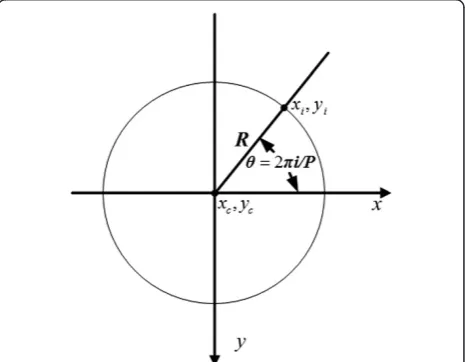
Subsequently, Ojala et al. [1] improved the square LBP to be a circular form with discretionary radius R and neighborhoods P. Supposing that the coordinate of cen-tral pixelgc is (xc,yc), then the coordinate of the neigh-bor gp is (xc+Rcos(2πi/P), yc−Rsin(2πi/P)). The pixel values of the neighbors which are not in the image grids can be calculated using an interpolation method. The relative position of central pixel and neighbors is shown in the Figure 3.
2.2 Uniform and rotation invariant LBP
A hidden trouble exists in the abovementioned LBP. As the number of neighbors increases, the dimension of the histogram grows rapidly. For example, ifPis 16, then the dimension of the histogram is 216= 65,536. Therefore, the
texture spectrum is so long that it is inconvenient to be applied in practice.
In the LBP code, the number of spatial transitions (bit-wise 0/1 changes) can be described as:
U LBPP;R
¼s g P − gc − s g 1 − gc
þXP i¼2
s g i − gc − s g i‐1 − gc
ð3Þ
WhenU(LBPP,R)≤2, the LBP pattern is defined as uni-form patterns LBPu2
P;R which hasP(P−1) + 2 discrimina-tive patterns [1]. Although the histogram spectrum feature can be simplified using the uniform pattern, this processing way is feasible. By experiments and observa-tion, uniform LBPs are fundamental properties of tex-ture, providing the vast majority of patterns, sometimes over 90%. Detailed experimental results are listed in Section 4.
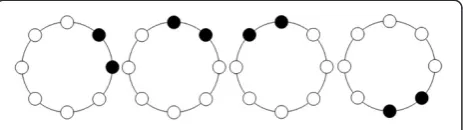
Furthermore, by observing, it is not difficult to find that no matter how to rotate the LBP, its structure is identical, which means that the original LBP and the ro-tated LBP have the same order and bitwise 0/1 changes as shown in Figure 4. For obtaining the rotation
Figure 2An example of the pattern and LBP. Figure 3The relative position of central pixel and neighbors.
invariant texture description, Ojala et al. [1] gave the
where ri means the rotation invariance, ROR(x, p) represents that the LBP codexis rotatedptimes around the center pixel. That is to say, using the LBP with the minimal decimal value stands for other LBPs belonging to the same family. Figure 4 shows some LBPs pertain-ing to the same family. The rotation invariant uniform LBP LBPriu2
P;R can be calculated using the following equation:
where riu2 means rotation invariant uniform pattern which hasP+ 2 discriminative patterns. Thus the dimen-sion of texture spectrum histogram is greatly simplified. By making statistics about the frequencies of the oc-curred LBPriu2P;R at all allowable pixel positions in the image, the texture spectrum histogram Soriginal can be
obtained.
3 Integrated LBP and Zernike moments model As mentioned above, attention is paid to the detailed in-formation when texture features are extracted by LBP. But the major drawback of LBP texture analysis is its lo-cality. Zernike moment features are just opposite. That is to say, Zernike moments emphasize holistic and shape information of images but lack specific information. Therefore, LBP and Zernike moments complement each other in terms of information description of images. What is more, these two measure ways can be both de-scribed as a histogram spectrum, so it is very convenient to fuse them.
3.1 Integrated rotation invariant LBP model
Other two kinds of rotation invariant LBPs are proposed besides the original rotation invariant pattern LBPriu2
P;R . They are respectively contrast rotation invariant LBPs
represented by CLBPriu2
P;R and direction rotation invariant LBP represented byOLBPriP;R. These three kinds of rotation invariant LBPs are collectively referred to as an ILBP model.
3.1.1 Contrast rotation invariant LBP
Although rotation invariant pattern LBPriu2P;R can obtain an excellent performance, this kind of LBP texture represen-tation only describes the change between the central pixel and neighbors. As to how much change occurs between them on earth, LBPriu2P;R cannot give an explicit description. For example, both of the central pixels are 50 in two local textons whose neighbors are respectively {82,90,30,75,124, 69,39,104} and {79,68,24,82,136,73,45,233}. Although their LBP codes are both {1,1,0,1,1,1,0,1}, the absolute values of their contrast change between the central pixel and neigh-bors are different which are respectively {32,40,20,25,74, 19,11,54} and {29,18,26,32,86,23,5,183}. For supplementing these missed information, contrast rotation invariant LBP is added to describe the texture images besides the original LBPriu2
P;R. UsingCprepresents the absolute value of contrast change between the central pixel and neighbors in every texton, i.e.,Cp= |gp−gc|; LBP ofCpcan be obtained by the trast change between the central pixel and neighbors in
every texton, and μC¼1 trast rotation invariant CLBPriu2P;R can be obtained. By making statistics about the frequencies of the occurring CLBPriu2
P;R at all allowable pixel positions in the image, the texture spectrum histogramSCcan be obtained.
3.1.2 Direction rotation invariant LBP
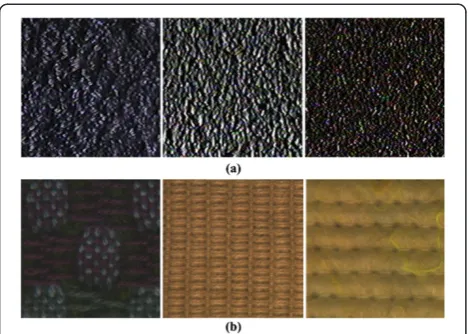
For the stochastic texture images as shown in Figure 5a, the direction information is not apparent. But for the periodic or partly periodic texture images as shown in Figure 5b, the direction information is obvious. In the real world, most of the texture images contain the direc-tional cue, so supplementing direction information in the discriminative features is worth trying.
The meanμOpand varianceσOpofCpin whole texture image are used to describe the direction information along the orientation 2πp/P. The specific equations are shown below.
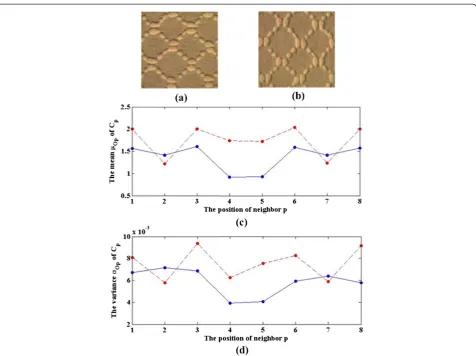
μOp¼ be obtained. Figure 6 shows an example of directional in-formationμOandσOabout one texture image and corre-sponding rotated image with a 90° angle, respectively. By the observation, it can be found thatμO and σO contain strong directional information and can be used to revise the histogram spectrum feature of the images so that more similarities between the image and its rotated images are mined.μOandσOcan be respectively converted into rota-tion invariant LBP using the means of μO and σO as the thresholds. Direction rotation invariant informationOμLB PriP;RandOσLBPriP;Rof the holistic texture image can be ob-tained using the following equations:
Oμ LBPriP;R¼ min ROR
Oσ LBPriP;R are used to together represent direction rotation invariantOLBPriP;Rof the whole texture image. As to how to revise the histogram spectrum feature of the image using
direction rotation invariantOLBPri
P;R, the processing method will be detailedly introduced in the following section.
3.2 Rotation invariant Zernike moments model
Although LBP is an excellent method in both perform-ance and efficiency, it ignores the shape and space infor-mation of the holistic texture image. For supplementing the missed information, Zernike moment rotation invari-ant features are used and fused. Because the basis set of ordinary moments is not orthogonal, Zernike [30] intro-duced a set of complex polynomials which makes a complete orthogonal set denoted by {Vnm(x,y)} over the interior of the unit circle, i.e., x2+y2= 1. The form of these polynomials is described as:
Vnmðx;yÞ ¼Vnmðρ;θÞ ¼Rnmð Þρ expðjmθÞ ð11Þ
where n is positive integer or zero, m is positive and negative integers subject to constraints that n−|m| is even, and |m|≤n. ρ is the length of vector from origin to (x,y) pixel, andθis the angle between vectorρand x axis in counterclockwise direction, and Rnm(ρ) is radial polynomial shown as the following equation:
Rnmð Þ ¼ρ X nomials are orthogonal and satisfy:
∬
projection of the image function onto these orthogonal basis functions. So Zernike moment of nth order with the repetitionmfor a texture imagef(x,y) is:
Anm¼
nþ1
π x2þ∬y2≤1
Vnmðρ;θÞf xð ;yÞdxdy ð14Þ
For a digital image, the above equation can be changed into the following form:
When calculating the Zernike moments of a given image, the center of the image is taken as the origin and pixel coordinates are mapped into the unit circle. The pixels falling outside the circle are not used, and Anm= An,− m. By theoretical testifying, Zernike moments have the rotation invariant property, that is to say, if the Zernike moments of an image and its rotated image with Figure 5Some examples of (a) stochastic texture images and
an angle θare respectively denoted usingAnm andA′nm, they have the following relation:
A′nm¼Anmexpð−jmθÞ ð16Þ
If the image is preprocessed using some simple methods [26], Zernike moments are also invariant to translation and scale besides rotation. Using (15), the Zernike moments of different orders can be obtained such as A00, A11, A20, A22, and so on. The vector SZ composed of Zernike moments of different orders is used as the histogram spectrum feature to describe the image information, and the specific form is:
SZ¼½A00;A11;A20;A22; ::::;Anm ð17Þ
3.3 Construction and revise of fusion feature
After the ILBP and Zernike moment features of the image are respectively obtained through the above
description, the fusion feature is constructed and re-vised, then a final classification decision is made.
3.3.1 Construction of fusion feature
Because the features of LBP and Zernike moments are both histogram spectrum form, it is very convenient to fuse them. In fact, a lot of experiments are made includ-ing serial, parallel, and jointly methods. However, the serial method can obtain more stable and excellent per-formance. The serial method is very simple and can be described as:
F¼ Soriginal SC SZ
ð18Þ
whereFdenotes the fused histogram spectrum feature. Actually, the histogram spectrumSoriginal of original
ro-tation invariant LBPriu2P;R and the histogram spectrum SC of contrast rotation invariant CLBPriu2P;R can also be seri-ally fused. The related experimental results will be given in Section 4.
3.3.2 Revise of fusion feature
In the preceding section, a method for acquiring direc-tional information of the image is proposed. Here the re-vise method of fused histogram spectrum feature using the direction rotation invariant OLBPri
P;R including OμLB
whereF′is the revised fusion histogram spectrum fea-ture.μ(Oμ) andσ(Oμ) are respectively the mean and
vari-ance of the direction rotation invariant OμLBP ri P;R training images; μ(Oσ) and σ(Oσ) are respectively the mean and standard of the direction rotation invariant OσLBPriP;Rof all training images.c1andc2are positive
pa-rameters. In fact, besides fusion histogram spectrum fea-tureF, OLBPriP;R can also revise other histogram spectrum features such asSoriginalgenerated by original rotation
in-variant LBPriu2
P;R,SCgenerated by contrast rotation invariant CLBPriu2P;R, evenSZcalculated by rotation invariant Zernike moments.
3.4 Classifier and multiscale fusion idea
Nearest neighbor is a kind of effective and simple classi-fication criterion. There are many good measures to esti-mate the difference and similarity between two histograms such as log-likelihood ratio and chi-square statistic [1]. The chi-square distance function in the ex-periments is chosen due to its excellent performance in terms of both speed and good recognition rates which is described as:
where dis the chi-square distance between the revised fusion histogram F′train of the training image and the re-vised fusion histogramF′testof the testing image. Subscript iis the corresponding bin, andNis the number of bins.
In fact, multiscale fusion idea could be used to improve the classification accuracy in the proposed method, i.e., multiple descriptors of various (P, R) are used simultan-eously. Because different scale operators support different structure space of the image, multiple scale descriptors can capture richer and completer texture information.
4 Experimental results
Many experiments have been elaborately designed and executed with the aim of demonstrating the effectiveness of the proposed method.
4.1 The database
Two large and comprehensive texture databases in the study are chosen which are respectively the CUReT database [27], the Outex database [28], and the KTH-TIPS database [29]. The CUReT database includes 61 classes of real-world tex-tures, and each corresponds to different combinations of illumination and viewing angle. The same as the litera-ture proposed by Guo [5], 92 sufficiently large images in each class with a viewing angle less than 60° are selected in the experiments. Among them, the first 23 images in each class were used as training images. Therefore, there are 1,403 (61 × 23 = 1,403) training models and 4,209 (61 × 69 = 4,209) testing samples. This design may be regarded as an analog about the situation with a small number of and less comprehensive training images.
In the Outex database, each texture is captured using six spatial resolutions (100, 120, 300, 360, 500, and 600 dpi), nine rotation angles (0°, 5°, 10°, 15°, 30°, 45°, 60°, 75°, and 90°), and three different simulated illuminants (‘horizon’,‘inca’, and‘TL84’). The experimental images in-clude canvas (46 classes), cardboard (1 classes), carpet (12 classes), chips (12 classes), and wallpaper (17 clas-ses), i.e., 99 classes texture images all together in the Outex database. Each class texture images contains 27 images (3 illuminants, 9 angles, and spatial resolution of 600 dpi). The first 9 images (‘horizon’illuminant, 9 an-gles, and spatial resolution of 600 dpi) in each class are chosen as training images. Therefore, there are 891 (99 × 9 = 891) training models and 1,782 (99 × 18 = 1,782) testing samples.
The KTH-TIPS database contains 10 texture classes such as crumpled aluminum foil, sponge, brown bread, etc. Each texture is captured under 9 scales, 3 different illumination directions, and 3 different poses. Therefore, there are 81 images per material. The first 21 images in each class are chosen as training images. Therefore, there are 210 (10 × 21 = 210) training models and 600 (10 × 60 = 600) testing samples.
The proposed method are compared with the state of the art LBP methods including LBPriu2
P;R [1], variance method (VARP,R) [1], LBPriu2P;R=VARP;R [1], adaptive LBP
method ALBPFriu2 P;R
[5] and LBP histogram Fourier
texture image was normalized to have an average inten-sity 128 and a standard deviation 20 [1].
4.2 The feasibility of uniform LBP
For showing the effectiveness on dimensionality reduction using LBPu2P;R, the proportions of frequencies of LBPu2P;Rare calculated. Some statistic results are shown in Table 1, and the images are selected from the Outex database.
As can be seen from the Table 1, the uniform LBP occu-pies the vast majority of a local binary pattern, sometimes over 90%. Therefore, it is feasible to use the uniform LBP to reduce the dimensionality of histogram spectrum.
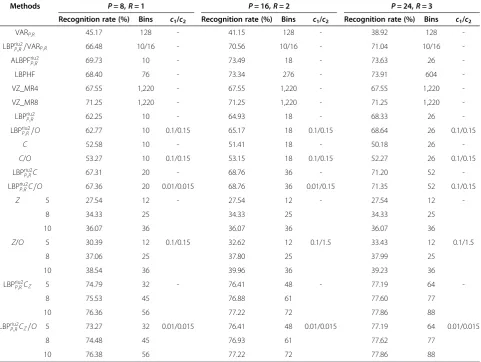
4.3 Experimental results on CUReT database
In the experiments, different combination on three kinds of rotation invariant LBP operators and rotation invari-ant Zernike moments are compared. ‘/O’ denotes revis-ing the histogram spectrum by direction rotation invariant LBP. ‘C’ represents capturing the histogram spectrum features by contrast rotation invariant LBP.‘Z’ is Zernike moments method. And‘_’denotes connecting two or three kinds of histogram spectrum features in series. For example, LBPriu2P;RCZ represents serially con-necting original rotation invariant LBPriu2P;R, contrast rota-tion invariant CLBPriu2P;R and Zernike moments rotation invariant Anm. LBPriu2P;RCZ=O represents revising the fu-sion feature LBPriu2P;RCZ by direction rotation invariantOL BPriP;R. The number 5, 8, or 10 denotes the order of Zernike moments. VZ_MR4 and VZ_MR8 respectively denote MR4 and MR8 of MR filter banks method. Table 2 lists experimental results on CUReT database using different methods.
As can be seen from the Table 2, firstly, the recognition rate of contrast rotation invariant CLBPriu2P;R (represented by‘C’in the Table 2) alone is worse than that of original rotation invariant LBPriu2
P;R . For example, the recognition rates of LBPriu2P;R can respectively reach at 62.25%, 64.93%, and 68.33% when P and R are respectively (8,1), (16,2), and (24,3). Whereas the results of CLBPriu2P;R are respect-ively 52.58%, 51.41%, and 50.18% in the same case. It shows that the information which is contained by LBPriu2 P;R is richer than that contained byCLBPriu2
P;R.
Secondly, the role of contrast information, not only VARP,R but alsoCLBPriu2
P;R decreases as the number of neighbors and the size of texton increase. It states that the reliability of dif-ference value between the central pixel and the neighbors re-duces as the size of texton augments. But the recognition rate of original rotation invariant LBPriu2P;R grows as the num-ber of the neighbors and the size of texton increase.
Thirdly, among the compared methods with respect to LBP, LBPHF and adaptive LBP method obtain better re-sults. And for non-LBP method, the results of MR8 method are better than ones of MR4 because of the richer feature representation.
Fourthly, for Zernike moment features, the recognition rate grows as the order increases. The reason for this phenomenon is that the higher the order is, the richer the detailed information contained by the Zernike mo-ment histogram spectrum is. Fourthly, directional infor-mation can improve the recognition results of different features including LBP, Zernike moments, and fusion histogram spectrum.
Finally, fusion modes can effectively boost the recogni-tion results. For example, whenP= 8 and R= 1, the rec-ognition rates are respectively 62.25%, 52.58%, and 36.07% obtained alone by LBPriu2P;R, CLBPriu2P;R and Zernike moments (10 order). However, when fusion features LB Priu2
P;RC and LBPriu2P;RCZ are used, the recognition rates can reach at 67.31% and 76.36%, respectively.
By applying the multiscale idea mentioned above in Section 3, better results can be obtained. For example, recognition rates respectively reach at 77.33% and 81.94% when different radius and different neighbors fu-sion features LBPriu2
P;RC8;1þ16;2þ24;3 and LBPriu2P;RCZ8;1þ16;2þ24;3
are used. And recognition rates respectively reach at 81.84% and 78.33% when different radius and same neighbors fusion features LBPriu2
P;RC16;1þ16;2þ16;3 and same radius and different neighbors fusion features LBPriu2 P;R
CZ8;2þ16;2þ24;2 are used. Here, Zernike moment features are
gotten using 10 order moments, and different scale fu-sion features are obtained by simply connecting the histogram features of different scales. Better perform-ance can be expected if more ingenious fusion strategies are used [31]. Because the results on LBPHF method are more stable among these compared methods, we also calculated the recognition rate of different radius and different neighbors fusion features LBPHF8,1 + 16,2 + 24,3
which reaches at 71.77%.
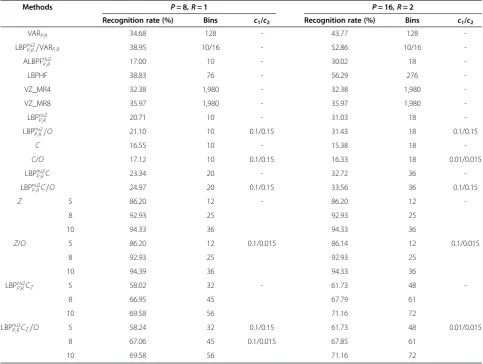
4.4 Experimental results on Outex database
In this section, all the experiments are done using the same methods, and the results are listed in Table 3. Because the images in the Outex database are larger than those in the Table 1 The proportions of frequencies ofLBPu2
P;R(P= 8,R= 1)
Images LBPu2
P;R(%)
Canvas 006 87.06
Cardboard 001 81.32
Carpet 005 83.05
Chips 007 87.90
CURet database, the results of many methods show‘out of memory’ besides those of VARP,R and LBPPriu2;R=VARP;R, when the number of neighborsP is 24 and radius Ris 3. Therefore, the results on the scale of P= 24 andR= 3 are not listed in Table 3.
As can be seen from the Table 3, firstly, the results of original rotation invariant LBPriu2P;R are better than those of contrast rotation invariantCLBPriu2P;R. Secondly, the re-sults of LBPriu2P;R improve as the number of neighbors and the size of texton increase; however, the results of CLB Priu2P;R are the opposite.
Thirdly, for the Zernike moment method, the recognition rate grows as the order increases. The change trend is the same as that of the CUReT database. In addition, it can be found that the results of Zernike moments are very excel-lent mainly because of two factors. On the one hand, angle changes are highly emphasized for the images in the Outex database. On the other hand, Zernike moment features are possessed of a rotation invariant property and can well de-scribe shape and space information of the image, so they
are very suitable to be used to recognize the images with different rotation angles. It is the direction information of the image that has been fully mined by Zernike moments; therefore, the proposed direction rotation invariant LBP can hardly affect the original feature histogram.
Finally, the fusion method can remarkably improve the results. For example, when P and R are respectively 16 and 2, LBPriu2P;R and CLBPriu2P;R respectively obtain the rec-ognition rate of 31.03% and 15.38%, but fusion features LBPriu2P;RC and LBPriu2P;RCZ can respectively reach at 32.72% and 71.16%. Here, Zernike moments are calculated using a 10-order parameter. However, it can be found that the fusion results are worse than the results of Zernike mo-ments. It is not difficult to explain this phenomenon from the signal processing point of view. When the quality difference between two signal sources is too big, then the fusion result would be bad because the rela-tively worse signal may disturb the relarela-tively better sig-nal resembling the noise. Therefore, the recognition rates of fusion feature LBPriu2P;RCZ are worse than those of
Table 2 Recognition rates of different methods
Methods P= 8,R= 1 P= 16,R= 2 P= 24,R= 3
Recognition rate (%) Bins c1/c2 Recognition rate (%) Bins c1/c2 Recognition rate (%) Bins c1/c2
VARP,R 45.17 128 - 41.15 128 - 38.92 128
-LBPriu2
P;R=VARP;R 66.48 10/16 - 70.56 10/16 - 71.04 10/16
-ALBPFriu2
P;R 69.73 10 - 73.49 18 - 73.63 26
-LBPHF 68.40 76 - 73.34 276 - 73.91 604
-VZ_MR4 67.55 1,220 - 67.55 1,220 - 67.55 1,220
-VZ_MR8 71.25 1,220 - 71.25 1,220 - 71.25 1,220
-LBPriu2
P;R 62.25 10 - 64.93 18 - 68.33 26
-LBPriu2
P;R=O 62.77 10 0.1/0.15 65.17 18 0.1/0.15 68.64 26 0.1/0.15
C 52.58 10 - 51.41 18 - 50.18 26
-C/O 53.27 10 0.1/0.15 53.15 18 0.1/0.15 52.27 26 0.1/0.15
LBPriu2
P;RC 67.31 20 - 68.76 36 - 71.20 52
-LBPriu2
P;RC=O 67.36 20 0.01/0.015 68.76 36 0.01/0.15 71.35 52 0.1/0.15
Z 5 27.54 12 - 27.54 12 - 27.54 12
-8 34.33 25 34.33 25 34.33 25
10 36.07 36 36.07 36 36.07 36
Z/O 5 30.39 12 0.1/0.15 32.62 12 0.1/1.5 33.43 12 0.1/1.5
8 37.06 25 37.80 25 37.99 25
10 38.54 36 39.96 36 39.23 36
LBPriu2
P;RCZ 5 74.79 32 - 76.41 48 - 77.19 64
-8 75.53 45 76.88 61 77.60 77
10 76.36 56 77.22 72 77.86 88
LBPriu2
P;RCZ=O 5 73.27 32 0.01/0.015 76.41 48 0.01/0.015 77.19 64 0.01/0.015
8 74.48 45 76.93 61 77.62 77
alone Zernike moments but greatly better than those of alone texture feature such as LBPriu2
P;R or contrast LBP and even the fusion feature LBPriu2
P;RC.
Multiscale method in the Outex database is also tried, and an excellent performance is obtained. For example, the recognition rates can respectively reach at 72.17%, 68.86%, and 74.41% when different radius and different neighbors fusion feature LBPriu2P;RCZ8;1 þ 16;2, different radius
and same neighbors fusion features LBPriu2
P;RCZ16;1 þ 16;2 and
same radius and different neighbors fusion features LB Priu2P;RCZ8;2 þ 16;2 are used. Here, Zernike moments are
cal-culated using a 10-order parameter. Furthermore, we also calculated the recognition rate of the LBPHF method with different radius and different neighbors fusion features LBPHF8,1 + 16,2which reaches at 56.73%.
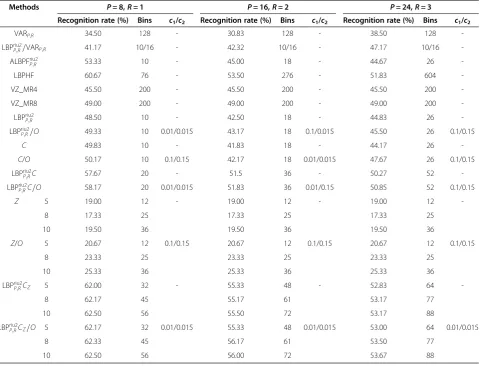
4.5 Experimental results on KTH-TIPS database
In this section, all the experiments are done using the same methods, and the results are listed in Table 4. Be-cause the trends of most of the results are similar to
those of the CURet and Outex databases, here, only some different phenomena are given. Firstly, the recog-nition rates of ALBPFriu2P;R and LBPHF methods decrease as the number of the neighbors and the size of texton increase. Secondly, compared with the results on the CURet and Outex databases, the role of contrast infor-mation is very obvious, sometimes even better than the ones of LBPriu2P;R. The reason may be that the images in the KTH-TIPS database contain sharp scale changes.
In addition, the multiscale method can further im-prove the results. For example, the recognition rates can respectively reach at 64.50%, 62.33%, and 63.83% when different radius and different neighbors fusion features LBPriu2
P;R C8;1þ16;2þ24;3; different radius and same
neighbors fusion features LBPriu2P;R C16;1þ16;2þ16;3; and same
radius and different neighbors fusion features LBPriu2 P;R C
Z8;2þ16;2þ24;2 are used. Here, Zernike moments are calcu-lated using a 10-order parameter. Furthermore, we also calculated the recognition rate of the LBPHF method with different radius and different neighbors fusion features LBPHF8,1 + 16,2 + 24,3which reaches at 55.83%.
Table 3 Recognition rates of different methods
Methods P= 8,R= 1 P= 16,R= 2
Recognition rate (%) Bins c1/c2 Recognition rate (%) Bins c1/c2
VARP,R 34.68 128 - 43.77 128
-LBPriu2
P;R=VARP;R 38.95 10/16 - 52.86 10/16
-ALBPFriu2
P;R 17.00 10 - 30.02 18
-LBPHF 38.83 76 - 56.29 276
-VZ_MR4 32.38 1,980 - 32.38 1,980
-VZ_MR8 35.97 1,980 - 35.97 1,980
-LBPriu2
P;R 20.71 10 - 31.03 18
-LBPriu2
P;R=O 21.10 10 0.1/0.15 31.43 18 0.1/0.15
C 16.55 10 - 15.38 18
-C/O 17.12 10 0.1/0.15 16.33 18 0.01/0.015
LBPriu2
P;RC 23.34 20 - 32.72 36
-LBPriu2
P;RC=O 24.97 20 0.1/0.15 33.56 36 0.1/0.15
Z 5 86.20 12 - 86.20 12
-8 92.93 25 92.93 25
10 94.33 36 94.33 36
Z/O 5 86.20 12 0.1/0.015 86.14 12 0.1/0.015
8 92.93 25 92.93 25
10 94.39 36 94.33 36
LBPriu2
P;RCZ 5 58.02 32 - 61.73 48
-8 66.95 45 67.79 61
10 69.58 56 71.16 72
LBPriu2
P;RCZ=O 5 58.24 32 0.1/0.15 61.73 48 0.01/0.015
8 67.06 45 0.1/0.015 67.85 61
In a word, the proposed method in this paper ob-tained more exact, stable, and robust results compared with other methods including LBPriu2
P;R;VARP;R;LBPriu2P;R= VARP;R;ALBPFriu2P;R; LBPHF and MR methods. Although the results of alone Zernike moment features in the Outex database are very outstanding, they are not stable compared with the proposed method because the re-sults in the CUReT and KTH-TIPS databases are very bad. In addition, multiscale idea can further notably im-prove the recognition results.
5 Conclusions
LBP is an excellent tool for texture classification because of its simplicity, efficiency, and rotation invariant prop-erty. However, two mainly adverse factors weaken its performance, which are respectively ignoring contrast and direction information and lacking the shape and space expression of the holistic texture image. To effect-ively make up for the missed information, the rotation invariant contrast and direction information are added
to the original rotation invariant LBP texture feature, which is called ILBP. In addition, Zernike moments are fused into the improved LBP texture features when representing images because they can effectively describe shape and space information of the holistic image, are possessed of orthogonal and rotation invariant proper-ties, and can be easily and rapidly calculated to an arbi-trary high order. Experimental results show that the proposed method can obtain a superior performance in terms of the large and comprehensive CUReT, Outex, and KTH-TIPS texture databases compared with other classic LBP and non-LBP methods, and multiscale idea can further remarkably improve the recognition results.
Competing interests
Pattern recognition, image processing and computer vision.
Acknowledgements
The authors sincerely thank Postdoctor Zhenhua Guo from Tinghua University and Professor Guoying Zhao from University of Oulu for sharing the source codes on adaptive LBP method and LBP histogram Fourier method. This work was supported by the national natural science foundation of China (NSFC) under Grant No. 61171068.
Table 4 Recognition rates of different methods
Methods P= 8,R= 1 P= 16,R= 2 P= 24,R= 3
Recognition rate (%) Bins c1/c2 Recognition rate (%) Bins c1/c2 Recognition rate (%) Bins c1/c2
VARP,R 34.50 128 - 30.83 128 - 38.50 128
-LBPriu2
P;R=VARP;R 41.17 10/16 - 42.32 10/16 - 47.17 10/16
-ALBPFriu2
P;R 53.33 10 - 45.00 18 - 44.67 26
-LBPHF 60.67 76 - 53.50 276 - 51.83 604
-VZ_MR4 45.50 200 - 45.50 200 - 45.50 200
-VZ_MR8 49.00 200 - 49.00 200 - 49.00 200
-LBPriu2
P;R 48.50 10 - 42.50 18 - 44.83 26
-LBPriu2
P;R=O 49.33 10 0.01/0.015 43.17 18 0.1/0.015 45.50 26 0.1/0.15
C 49.83 10 - 41.83 18 - 44.17 26
-C/O 50.17 10 0.1/0.15 42.17 18 0.01/0.015 47.67 26 0.1/0.15
LBPriu2
P;RC 57.67 20 - 51.5 36 - 50.27 52
-LBPriu2
P;RC=O 58.17 20 0.01/0.015 51.83 36 0.01/0.15 50.85 52 0.1/0.15
Z 5 19.00 12 - 19.00 12 - 19.00 12
-8 17.33 25 17.33 25 17.33 25
10 19.50 36 19.50 36 19.50 36
Z/O 5 20.67 12 0.1/0.15 20.67 12 0.1/0.15 20.67 12 0.1/0.15
8 23.33 25 23.33 25 23.33 25
10 25.33 36 25.33 36 25.33 36
LBPriu2
P;RCZ 5 62.00 32 - 55.33 48 - 52.83 64
-8 62.17 45 55.17 61 53.17 77
10 62.50 56 55.50 72 53.17 88
LBPriu2
P;RCZ=O 5 62.17 32 0.01/0.015 55.33 48 0.01/0.015 53.00 64 0.01/0.015
8 62.33 45 56.17 61 53.50 77
Author details 1
Department of Computer and Information engineering, Beijing Technology and Business University, Beijing, China.2Department of Mechanical Engineering, Yanshan University, Qinhuangdao City, Hebei Province, China.
Received: 1 September 2014 Accepted: 2 December 2014 Published: 20 December 2014
References
1. T. Ojala, M. Pietikainen, T. Mäenpää, Multiresolution gray-scale and rotation invariant texture classification with local binary patterns. IEEE Trans. Pattern Anal. Machine Intell.24, 971–987 (2002)
2. L. Zhang, B. Zou, J. Zhang, Y. Zhang, Classification of Polarimetric SAR Image based on Support Vector Machine using Multiple-Component Scattering Model and Texture Features. EURASIP J. Adv. Signal Proc.3, 1–10 (2010) 3. L. Sajn, I. Kononenko, Multiresolution image parameterization for improving
texture classification. EURASIP J. Adv. Signal Proc.2, 1–13 (2008) 4. Y. Wang, D.J. He, C.C. Yu, T.Q. Jiang, Z.W. Liu, Multimodal biometrics
approach using face and ear recognition to overcome adverse effects of pose changes. J. Electron. Imaging21, 043026-1–043026-11 (2012) 5. Z.H. Guo, L. Zhang, D. Zhang, S. Zhang, Rotation invariant texture
classification using adaptive LBP with directional statistical features, in
Proceedings of the 7th IEEE International Conference on Image Processing
(IEEE, Hong Kong, China, 2010), pp. 285–288
6. R.M. Haralick, K. Shanmngam, I. Dinstein, Texture feature for image classification. IEEE Trans. Syst. Man Cy.3, 610–621 (1973)
7. B. Manjunath, W. Ma, Texture features for browsing and retrieval of image data. IEEE Trans. Pattern Anal. Machine Intell.18, 837–842 (1996) 8. J.G. Zhang, T.N. Tan, Brief review of invariant texture analysis methods.
Pattern Recogn.35, 735–747 (2002)
9. R.L. Kashyap, A. Khotanzed, A model-based method for rotation invariant texture classification. IEEE Trans. Pattern Anal. Machine Intell.8, 472–481 (1986) 10. Y. Choe, R.L. Kashyap, 3-D shape from a shaded and textural surface image.
IEEE Trans. Pattern Anal. Machine Intell.13, 907–918 (1991)
11. W.R. Wu, S.C. Wei, I.E.E.E. Trans, Rotation and gray-scale transform invariant texture classification using spiral resampling, subband decomposition, and hidden Markov model. Image Process.5, 1423–1434 (1996)
12. K. Jafari-Khouzani, H. Soltanian-Zadeh, Radon transform orientation estimation for rotation invariant texture analysis. IEEE Trans. Pattern Anal. Machine Intell.27, 1004–1008 (2005)
13. G.M. Haley, B.S. Manjunath, Rotation-invariant texture classification using a complete space-frequency model. IEEE Trans. Image Process.8, 255–269 (1999) 14. M. Varma, A. Zisserman, Texture classification: Are filter banks necessary? in
Proceedings of IEEE Computer Society Conference on Computer Vision and Pattern Recognition(IEEE, Madison, USA, 2003), pp. 691–698
15. M. Varma, A. Zisserman, A statistical approach to texture classification from single images. Int. J. Comput. Vision62, 61–81 (2005)
16. M. Crosier, L.D. Griffin, Using Basic Image Features for Texture Classification. Int. J. Comput. Vision88, 447–460 (2010)
17. Y. Xu, H. Ji, C. Fermuller, Viewpoint invariant texture description using fractal analysis. Int. J. Comput. Vision38, 85–100 (2005)
18. S. Lazebnik, C. Schmid, J. Ponce, A sparse texture representation using local affine regions. IEEE Trans. Pattern Anal. Machine Intell.27, 1265–1278 (2005) 19. D. Harwood, T. Ojala, M. Pietikäinen, S. Kelman, L. Davis, Texture classification
by center-symmetric auto-correlation, using Kullback discrimination of distributions. Pattern Recogn. Lett.16, 1–10 (1995)
20. T. Ojala, M. Pietikäinen, D. Harwood, A comparative study of texture measures with classification based on featured distributions. Pattern Recogn.29, 51–59 (1996)
21. G.Y. Zhao, T. Ahonen, J. Matas, M. Pietikäinen, Rotation-invariant image and video description with local binary pattern features. IEEE Trans. Image Process.21, 1465–1477 (2012)
22. R. Maani, S. Kalra, Y.H. Yang, Rotation invariant local frequency descriptors for texture classification. IEEE Trans. Image Process.22, 2409–2419 (2013) 23. T. Ahonen, J. Matas, C. He, M. Pietikäinen, Rotation invariant image
description with local binary pattern histogram fourier features, inImage Analysis(Springer, Berlin Heidelberg, 2009), pp. 61–70
24. T. Mäenpää,The local binary pattern approach to texture analysis-extensions and applications. Ph.D. dissertation(Dept. Elect. Inf. Eng., University of Oulu, Oulu, Finland, 2003)
25. C.Y. Kim, O.J. Kwon, S. Choi, A practical system for detecting obscene videos. IEEE Trans. Consum. Electr.57, 646–650 (2011)
26. A. Khotanzad, Y.H. Hong, Invariant image recognition by Zernike moments. IEEE Trans. Pattern Anal. Machine Intell.12, 489–497 (1990)
27. K.J. Dana, B. van Ginneken, S.K. Nayar, J.J. Koenderink, Reflectance and texture of real world surfaces. ACM Trans. Graphic.18, 1–34 (1999) 28. T. Ojala, T. Mäenpää, M. Pietikäinen, J. Viertola, J. Kyllönen, S. Huovinen,
Outex-new framework for empirical evaluation of texture analysis algorithm, inProceedings of the International Conference on Pattern Recognition
(IEEE, Quebec, Canada, 2002), pp. 701–706
29. B. Caputo, E. Hayman, M. Fritz, J.O. Eklundh, Classifying materials in the real world. Image Vis. Comput.28(1), 150–163 (2010)
30. F. Zernike, Diffraction theory of the cut procedure and its improved form, the phase contrast method. Physica1, 689–704 (1934)
31. K. Woods, W.P. Kegelmeyer Jr., K. Bowyer, Combination of multiple classifiers using local accuracy estimates. IEEE Trans. Pattern Anal. Machine Intell. 19, 405–410 (1997)
doi:10.1186/1687-6180-2014-182
Cite this article as:Wanget al.:Texture classification using rotation invariant models on integrated local binary pattern and Zernike moments.EURASIP Journal on Advances in Signal Processing20142014:182.
Submit your manuscript to a
journal and benefi t from:
7Convenient online submission
7Rigorous peer review
7Immediate publication on acceptance
7Open access: articles freely available online
7High visibility within the fi eld
7Retaining the copyright to your article