Interaction between High-Level and Low-Level Image
Analysis for Semantic Video Object Extraction
Andrea Cavallaro
Multimedia and Vision Laboratory, Queen Mary University of London (QMUL), London E1 4NS, UK Email:[email protected]
Touradj Ebrahimi
Signal Processing Institute, Swiss Federal Institute of Technology (EPFL), 1015 Lausanne, Switzerland Email:[email protected]
Received 21 December 2002; Revised 6 September 2003
The task of extracting a semantic video object is split into two subproblems, namely, object segmentation and region segmentation. Object segmentation relies ona prioriassumptions, whereas region segmentation is data-driven and can be solved in an automatic manner. These two subproblems are not mutually independent, and they can benefit from interactions with each other. In this paper, a framework for such interaction is formulated. This representation scheme based on region segmentation and semantic segmentation is compatible with the view that image analysis and scene understanding problems can be decomposed into low-level and high-low-level tasks. Low-low-level tasks pertain to region-oriented processing, whereas the high-low-level tasks are closely related to object-level processing. This approach emulates the human visual system: what one “sees” in a scene depends on the scene itself (region segmentation) as well as on the cognitive task (semantic segmentation) at hand. The higher-level segmentation results in a partition corresponding to semantic video objects. Semantic video objects do not usually have invariant physical properties and the definition depends on the application. Hence, the definition incorporates complex domain-specific knowledge and is not easy to generalize. For the specific implementation used in this paper, motion is used as a clue to semantic information. In this framework, an automatic algorithm is presented for computing the semantic partition based on color change detection. The change detection strategy is designed to be immune to the sensor noise and local illumination variations. The lower-level segmentation identifies the partition corresponding to perceptually uniform regions. These regions are derived by clustering in anN-dimensional feature space, composed of static as well as dynamic image attributes. We propose an interaction mechanism between the semantic and the region partitions which allows to cope with multiple simultaneous objects. Experimental results show that the proposed method extracts semantic video objects with high spatial accuracy and temporal coherence.
Keywords and phrases:image analysis, video object, segmentation, change detection.
1. INTRODUCTION
One of the goals of image analysis is to extract meaningful entities from visual data. A meaningful entity in an image or an image sequence that corresponds to an object in the real world, such as a tree, a building, or a person. The ability to manipulate such entities in a video as if they were phys-ical objects is a shift in the paradigm from pixel-based to content-based management of visual information [1,2,3]. In the old paradigm, a video sequence is characterized by a set of frames. In the new paradigm, the video sequence is com-posed of a set of meaningful entities. A wide variety of appli-cations, ranging from video coding to video surveillance, and from virtual reality to video editing, benefit from this shift.
The new paradigm allows us to increase the interac-tion capability between the user and the visual data. In the
pixel-based paradigm, only simple forms of interaction, such as fast forward and reverse, slow motion, are possible. The entity-oriented paradigm allows the interaction at object level, by manipulating entities in a video as if they were phys-ical objects. For example, it becomes possible to copy an ob-ject from one video into another.
example shows that defining semantic video objects is a com-plex and sometimes delicate task.
The process of identifying and tracking the collections of image pixels corresponding to meaningful entities is referred to assemantic video object extraction. The main requirement of this extraction process isspatial accuracy, that is, precise definition of the object boundary [4,5]. The goal of the ex-traction process is to provide pixelwise accuracy. Another ba-sic requirement for semantic video object extraction is tem-poral coherence. Temporal coherence can be seen as the prop-erty of maintaining the spatial accuracy in time [6,7]. This property allows us to adapt the extraction to the temporal evolution of the projection of the object in successive images. The paper is organized as follows. In Section 2, the need of an effective visual data representation is discussed.
Section 3describes how the semantic and region partitions are computed and introduces the interaction mechanism be-tween low-level and high-level image analysis results. Exper-imental results are presented inSection 4, and inSection 5, we draw the conclusions.
2. VISUAL DATA REPRESENTATION
Digital images are traditionally represented by a set of un-related pixels. Valuable information is often buried in such unstructured data. To make better use of images and im-age sequences, the visual information should be represented in a more structured form. This would facilitate operations such as browsing, manipulation, interaction, and analysis on visual data. Although the conversion into structured form is possible by manual processing, the high cost associated with this operation allows only a very small portion of the large collections of image data to be processed in this fash-ion. One intuitive solution to the problem of visual informa-tion management is content-based representainforma-tion. Content-based representations encapsulate the visually meaningful portions of the image data. Such a representation is easier to understand and to manipulate both by computers and by humans than the traditional unstructured representation.
The visual data representation we use in this work mim-ics the human visual system and finds its origins in active vision [8,9,10,11]. The principle of active vision states that humans do not just seea scene butlookat it. Humans and primates do not scan a scene in raster fashion. Our visual attention tends to jump from one point to another. These jumps are calledsaccades. Yarbus [12] demonstrated that the saccadic pattern depends on the visual scene as well as on the cognitive task to be performed. We focus our visual at-tention according to the task at hand and the scene con-tent. In order to attempt to emulate the human visual system to structure the visual data, we decompose the problem of extracting video objects into two stages: content-dependent and application-dependent. Thecontent-dependent(or data-driven) stage exploits the redundancy of the video signal by identifying spatio-temporally homogeneous regions. The
application-dependentstage implements the semantic model of a specific cognitive task. This semantic model corresponds
to a specific human abstraction, which need not necessarily be characterized by perceptual uniformity.
We implement this decomposition by modeling an im-age or a video in terms of partitions. This partitional repre-sentation results in spatio-temporal structures in the iconic domain, as discussed in the next sections.
The application-dependent and the content-dependent stages are represented by two different partitions of the vi-sual data, referred to assemantic andregionpartitions, re-spectively. This representation in the iconic domain allows us not only to organize the data in a more structured fash-ion, but also to describe the visual content efficiently.
3. PROPOSED METHOD
To maximize the benefits of the object-oriented paradigm described inSection 1, the semantic video objects need to be extracted in an automatic manner. To this end, a clear char-acterization of semantic video objects is required. Unfortu-nately, since semantic video objects arehuman abstractions, a unique definition does not exist. In addition, since semantic video objects cannot generally be characterized by simple ho-mogeneity criteria1(e.g., uniform color or uniform motion),
their extraction is a difficult and sometimes loose task. For the specific implementation used in this paper, mo-tion is used as a clue to semantic informamo-tion. In this frame-work, an automatic algorithm is presented for computing the semantic partition based on color change detection. Two major noise components may be identified: the sensor noise and illumination variations. The change detection strategy is designed to be immune to these two components. The ef-fect of sensor noise is mitigated by employing a probability-based test that adapts the change detection threshold lo-cally. To handle local illumination variations, a knowledge-based postprocessing stage is added to regularize the re-sults of the classification. The idea proposed is to exploit invariant color models to detect shadows. Then homoge-neous regions are detected using a multifeature clustering approach. The feature space used here is composed of spa-tial and temporal features. Spaspa-tial features are color features from the perceptually uniform color space CIELab, and a measure of local texturedness based on variance. The tem-poral features used here are the displacement vectors from the dense optical flow computed via a differential technique. The selected clustering approach is based on fuzzy C-means, where a specific functional is minimized based on local and global feature reliability. Local reliability of both spatial and temporal features is estimated using the local spatial gra-dient. The estimation is based on the observation that the considered spatial features are more uncertain near edges, whereas the considered temporal features are more uncer-tain on uniform areas. Global reliability is estimated by considering the variance of the features in the entire im-age compared to the variance of the features in a region.
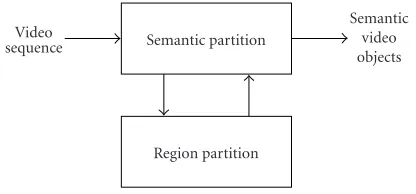
The grouping of regions into objects is driven by a seman-tic interpretation of the scene, which depends on the spe-cific application at hand. Region segmentation is automatic, generic, and application independent. In addition, the re-sults can be improved by exploiting domain dependent infor-mation. Such use of domain dependent information is im-plemented through interactions with the semantic partition (Figure 1).
The details of the computation of the two partitions and their interactions are given in the following.
3.1. Semantic partition
The semantic partition takes the cognitive task into account when modeling the video signal. The semantic (i.e., the meaning) is defined through a human abstraction. Conse-quently, the definition of the semantic partition depends on the task to be performed. The partition is then derived throughsemantic segmentation. In general, human interven-tion is needed to identify this partiinterven-tion because the defini-tion of semantic objects depends on the applicadefini-tion. How-ever, for the classes of applications where meaningful ob-jects are the moving obob-jects, the semantic partition can be automatically computed. This is possible through color change detection. A change detection algorithm is ideally expected to extract the precise contours of objects moving in a video sequence (spatial accuracy). An accurate extrac-tion is especially desired for applicaextrac-tions such as video edit-ing, where objects from one scene can be used to construct other artificial scenes, or computational visual surveillance, where the objects are analyzed to derive statistics about the scene.
The temporal changes identified by the color change de-tection process are here used to compute the semantic par-tition. However, temporal changes may be generated not only by moving objects, but also by noise components. The main sources of noise are illumination variations, cam-era noise, uncovered background, and texture similarity be-tween objects and background. Since uncovered background is originated by applying change detector on consecutive frames, a frame representing the background is used instead (Figure 2). Such a frame is either a frame of the sequence without foreground objects or a reconstructed frame if the former is not available [13]. Camera noise and local illumi-nation variations are then tackled by a change detector or-ganized in two stages. First, sensor noise is eliminated in a classification stage. Then, local illumination variations (i.e., shadows) are eliminated in a postprocessing stage.
3.1.1. Classification
The classification stage takes into account the noise statis-tics in order to adapt the detection threshold to local infor-mation. A method that models the noise statistics based on a statistical decision rule is adopted. According to a model proposed by Aach [14], it is possible to assess the proba-bility that the value at a given position in the image dif-ference is due to noise instead of other causes. This proce-dure is based on the hypothesis that the additive noise aff
ect-Video
sequence Semantic partition
Semantic video objects
Region partition
Figure1: The interaction between low-level (region partition) and high-level (semantic partition) image analysis results is at the basis of the proposed method for semantic video object extraction.
(a) (b)
Figure2: (a) Sample frame from the test sequence Hall Monitor and (b) frame representing the background of the scene.
ing each image of the sequence respects a Gaussian distribu-tion. It is also assumed that there is no correlation between the noise affecting successive frames of the sequence. These hypotheses are sufficiently realistic and extensively used in literature [15, 16,17,18]. The classification is performed according to a significance test after windowing the diff er-ence image. The dimension of the window can be chosen according to the application. In Figure 3, the influence of window size on the results of the classification by compar-ing the sizes of the window 3×3, 5×5, and 7×7 is presented. For the visualization of the results, a sample frame from the test sequence Hall Monitor is considered. The choice cor-responding to Figure 3b, a window of 25 pixels, is a good compromise between the presence of halo artifacts, the cor-rect detection of the object, and the extent of the win-dow. This is the window size maximising the spatial accu-racy and is therefore used in our experiments. The results of the probability-based classification with the selected win-dow size are compared inFigure 4with state-of-the-art clas-sification methods so as to evaluate the difference in accu-racy. The comparison is performed between the probability-based classification, the technique probability-based on image ratio-ing presented in [19], and the edge-based classification pre-sented in [20]. Among the three methods, the probability-based classification (Figure 4a) provides the most accurate results. A further discussion on the results is presented in
(a) (b) (c)
Figure3: Influence of the window size on the classification results. The dimensions of the window used in the analysis are (a) 3×3, (b) 5×5, and (c) 7×7.
(a) (b) (c)
Figure4: Comparative results of change detection for frame 67 of the test sequence Hall Monitor: (a) probability-based classification, (b) image ratioing, and (c) edge-based classification.
3.1.2. Postprocessing
The postprocessing stage is based on the evaluation of heuris-tic rules which derive from the domain-specific knowledge of the problem. The physical knowledge about the spectral and geometrical properties of shadows can be used to define explicit criteria which are encoded in the form of rules. A bottom-up analysis organized in three levels is performed as described below.
Hypothesis generation
The presence of a shadow is first hypothesized based on some initial evidence. A candidate shadow region is assumed to correspond to a darker region than the corresponding illu-minated region (the same area without the shadow). The color intensity of each pixel is compared to the color inten-sity of the corresponding pixel in the reference image. A pixel becomes a candidate shadow pixel if all color components are smaller than the corresponding pixel in the reference frame.
Accumulation of evidence
The hypothesized shadow region is then verified by checking its consistency with other additional hypotheses. The pres-ence of a shadow does not alter the value of invariant color features. However, a material change is highly likely to mod-ify their value. For this reason, the changes in the invariant color featuresc1c2c3[21] are analyzed to detect the presence
of shadows. A second additional evidence about the exis-tence of a shadow is derived from geometrical properties. This analysis is based on the position of the hypothesized shadows with respect to objects. The existence of the line sep-arating the shadow pixels from the background pixels (the
shadow line) is checked when the shadow is not detached, that is, an object is not floating, or the shadow is not pro-jected on a wall. If a shadow is completely detached, the sec-ond hypothesis is not tested. In case a hypothesized shadow is fully included in an object, the shadow line is not present, and the hypothesis is then discarded.
Information integration
Finally, all the pieces of information are integrated to deter-mine whether to reject the initial hypothesis.
The postprocessing step results in a spatio-temporal reg-ularization of the classification results. The sample result pre-sented in Figure 5 shows a comparison between the result after the classification and the result after the postprocess-ing. To improve the visualization, the binary change detec-tion mask is superimposed on the original image.
3.2. Region partition
(a) (b)
Figure5: Comparison of results from the test sequence Hall Moni-tor. The binary change detection mask is superimposed on the orig-inal image. The results of the classification (a) is refined by the post-processing (b) to eliminate the effects of shadows.
homogeneous regions. Each object is processed separately and is decomposed in a set of nonoverlapping regions. The region partition Πr is composed of homogeneous regions corresponding to perceptually uniform areas. The computa-tion of this particomputa-tion, referred to as region segmentation, is a low-level process that leads to a signal dependent (data-driven) partition.
The region partition identifies portions of the visual data characterized by significant homogeneity. These homoge-neousregionsare identified through segmentation. It is well known that segmentation is an ill-posed problem [9]: eff ec-tive clustering of elements of the selected feature space is a challenging task that years of research have not succeeded in completely solving. To overcome the difficulties in achieving a robust segmentation, heuristics such as size of a region and maximum number of regions may be used. Such heuristics limit the generality of the approach.
To obtain an adaptive strategy based on perceptual sim-ilarity, we avoid imposing the above mentioned constraints but rather seeking an over-segmented result. This is followed by a region merging step.
Region segmentation operates on a decision space com-posed of multiple features, which are derived from transfor-mations of the raw image data. We represent the feature space as
g(x,y,n)=g1(x,y,n),g2(x,y,n),. . .,gK(x,y,n), (1)
whereKis the dimensionality of the feature space. The im-portance of a feature depends on its value with respect to other feature values at the same location, as well as to the values of the same feature at other locations in the image. Here we refer to these two phenomena as interfeatures re-liabilityandintrafeature reliability, respectively. In addition to the feature space, we define areliability mapassociated to each feature:
r(x,y,n)=r1(x,y,n),r2(x,y,n),. . .,rK(x,y,n)
. (2) The reliability map allows the clustering algorithm to dy-namically weight the features according to the visual content. The details of the proposed region segmentation algorithm are given in the following sections.
(a)
(b)
Figure6: The reliability of the motion features is evaluated through the spatial gradient in the image: (a) test sequence Hall Monitor; (b) test sequence Highway. Dark pixels correspond to high values of reliability.
3.2.1. Spatial features
To characterize intraframe homogeneity, we consider color information and a texture measure. A perceptually linear color space Lab is appropriate, since it allows us to use a simple distance function. The reliability of color information is not uniform over the entire image. In fact, color values are unreliable at edges. On the other hand, color informa-tion is very useful in identifying uniform surfaces. Therefore, we use gradient information to determine the reliability of features. We first normalize the spatial gradient value to the range [0, 1]. Ifng(x,y,n) is the normalized gradient, the reli-ability of color informationrc(x,y,n) is given by thesigmoid function:
rc(x,y,n)= 1
1 +e−βng(x,y,n), (3)
where β is the slope parameter. Low values correspond to shallow slopes, while higher values produce steeper slopes. Weighting color information with its reliability in the cluster-ing algorithm improves the performance of the classification process.
do not evaluate this feature at edges. Thus, the reliability of the texture feature is zero at edges, and uniform elsewhere.
3.2.2. Temporal features
To characterize interframe homogeneity, we consider the horizontal and vertical components of the displacement vec-tor at each pixel and their reliability. According to [22], the best performance for optical flow computation in terms of reliability can be obtained by the differential technique pro-posed in [23], and by the phase-based technique of [24]. We select the differential technique (see [23]) since it is gradient-based and therefore allows us to reuse the spatial gradient al-ready computed for color reliability.
The results of motion estimation are noisy due to appar-ent motion. We mitigate the influence of this noise in two successive steps. First, we introduce a postprocessing (me-dian filter) which reduces the noise in the dense optical flow field. Second, we associate a reliability measure to the motion feature, based on its spatial context. The reliability value de-rives from the fact that motion estimation performs poorly (i.e., it is not reliable) in uniform areas, whereas it shows bet-ter results in textured areas. Methods based on optical flow do not produce accurate contours (regions with homoge-neous motion). For this reason, the reliability is given by the complement of the sigmoid function defined in (3). The mo-tion reliabilityrm(x,y,n) is defined as follows:
rm(x,y,n)=1−rc(x,y,n). (4) Equation (4) allows the clustering algorithm to assign a lower weight to the motion feature in uniform areas than in those characterized by high contrast (edgeness). An example of motion reliability is reported inFigure 6.
3.2.3. Decision algorithm
The decision algorithm operates in two steps. First, a par-titional algorithm provides over-segmented results, then a region merging step identifies the perceptually uniform re-gions. The partitional algorithm is a modified version of the fuzzy C-means algorithm described in [25]. Such modified version is spatially unconstrained so that to allow an im-proved flexibility when dealing with deformable objects.
The spatially unconstrained fuzzy C-means algorithm is an iterative process that operates as follows. After initialisa-tion, the algorithm assigns each pixel to the closest cluster in the feature space (classification). For the computation of the distance, each cluster is represented by its centroid. The classification step results in a set of partitions in the image plane. The difference between two partitions is calculated as a point-to-point distance between the centroids of the respec-tive partitions. This difference controls the number of itera-tions of the algorithm: the iterative process stops when the difference between the two consecutive partitions is smaller than a certain threshold (cluster validation).
The feature space includes information from different sources that are encoded with varying number of features. For example, three features are used for color and two for
motion. We refer to such groups of similar features asfeature categories. To avoid masking important information when computing the distance, we use separate distance measures
Df for each feature category. Since the results of the
sepa-rate proximity measures will be fused together, it is desirable thatDf returns a normalized result, especially in the case of
poorly scaled or highly correlated features. For this reason, we choose the Mahalanobis metric. To compute the prox-imity of the feature pointgjand the centroidvi, the
Maha-lanobis distance can be expressed as follows:
Dfgj,vi=
s is the variance of the sth feature over the entire
feature space. The complete point-to-point similarity mea-sure between thegjandviis obtained by fusing the distances
computed within each category:
where F is the number of feature categories and wf the
weight which accounts for the reliability of each feature cat-egory. The value ofFmay change from frame to frame and from cluster to cluster.
By projecting the result of the unconstrained partitional clustering back into the data space, we obtain a set of regions which may be composed of unconnected areas. Since this re-sult depends on the predetermined number of clustersC, we adapt the result to the visual content as follows. Disjoint re-gions are identified byconnected component analysisso as to form an over-segmented partition. This over-segmented re-sult undergoes aregion mergingstep which optimizes the par-tition by merging together the regions which present percep-tually similar characteristics.
Each disjoint regionRi(n) is represented by its own
re-gion descriptorΦi(n). The region descriptor is composed of
the same features used in clustering plus the position of the region. The position and the other values stored in the re-gion descriptors are the mean values of the features in the homogeneous regions. We can represent the regions and the region descriptors by a region adjacency graph, where each node corresponds to a region, and edges joining nodes repre-sent adjacency of regions. In our case, we explicitly reprerepre-sent the nodes with region descriptors.
(a)
(b)
Figure7: Example of region segmentation driven by the results of semantic segmentation: (a) area of interest defined by the semantic segmentation and (b) regions defined by the feature-based segmen-tation.
3.2.4. Region descriptors
A region defines the topology of pixels that are homogeneous according to a specific criterion. The homogeneity criterion is defined with respect to one or more features in the dense feature space. The values of the features characterizing the re-gion are distinctive of the rere-gion itself. We summarize these feature values in a vector, henceforth referred to asregion de-scriptor. Region descriptors are the simplest way of represent-ing the characteristics of regions. A region descriptorΦi(n)
can be represented as follows:
Φi(n)= whereKinis the number of features used to describe region
Ri(n). Φi(n) is an element of the region feature space. The
number and the kind of features may change from region to region. Examples of features contributing to the region de-scriptor are the motion vector, the color, and so on. The se-lection of the features and their representation is dynamically adapted, based on low-level analysis and on the interaction between the region and semantic partitions.
3.3. Visual content description
The region and semantic partitions are organized in a parti-tion tree. Such tree divides a set of objects into mutually ex-clusive and jointly exhaustive subsets. The coarsest partition level is the image itself (upper bound); at the finest partition level, every pixel is a distinct partition (lower bound).
The description is the result of a transformation from the iconic domain, constituted by pixels, regions, and objects, to the symbolic domain, consisting of text. This transformation allows us to compact and abstract the meaning buried in the visual information. The description encodes the values of the
St
Figure8: Different levels of visual content description.
features extracted at the different stages of the hierarchical representation.
The hierarchy in the iconic domain leads naturally to sev-eral levels of abstraction of the description. The different lev-els of visual content description are depicted inFigure 8. The graphical comparison presented emphasizes the structural organization in the iconic domain as well as the abstraction in the symbolic domain. For the sake of simplicity, here we divide the description into two levels: low-level descriptors and high-level descriptors. The low-level descriptors are de-rived from the dense and the region feature spaces. The high-level descriptors are derived from the semantic and the image feature spaces.
The two main levels of image data representation defined by segmentation can be used to extract quantitative infor-mation from visual data. This corresponds to the transition from information to knowledge and represents a useful fil-tering operation not only for interpreting the visual informa-tion, but also as a form of data compression. The transition fromiconic domain(pixels) tosymbolic domain(objects) al-lows us to represent the information contained in the visual data very compactly.
3.4. Semantic and region partition interaction
The region and the semantic partitions can be improved through interaction with one another. The interaction is re-alized by allowing information to flow both ways between the two partitional representations so that the semantic in-formation is used to improve the region segmentation result and vice versa.
corresponds to projecting the information about the region partition onto the semantic partition.
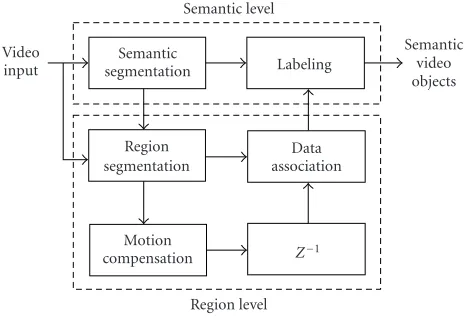
We use both strategies to obtain a coherent temporal de-scription of moving objects. Semantic video objects evolve in both shape and position as the video sequence progresses. Therefore, the semantic partition is updated over time by linking the visual information from frame to frame through tracking. The proposed approach is designed so as to con-sider first the object as an entity (semantic segmentation re-sults) and then by tracking its parts (region segmentation results). The tracking mechanism is based on feedbacks be-tween the semantic and the region partitions described in the previous sections. These interactions allow the tracking to cope with multiple simultaneous objects, motion of non-rigid objects, partial occlusions, and appearance and dispearance of objects. The block diagram of the proposed ap-proach is depicted inFigure 9.
The correspondence of semantic objects in successive frames is achieved through the correspondence of objects’ regions. Defining the tracking based on the parts of objects, that are identified by region segmentation, leads to a flexi-ble technique that exploits the characteristics of the seman-tic video object tracking problem. Once the semanseman-tic parti-tion is available for an image, it is automatically extended to the following image [26]. Given the semantic partition in the new frame and the region partition in the current frame, the proposed tracking procedure performs two different tasks. First, it defines a correspondence between the semantic ob-jects in the current frame nand the semantic partition in the new frame n+ 1. Second, it provides an effective ini-tialization for the segmentation procedure of each object in the new framen+ 1. This initialization implicitly defines a preliminary correspondence between the regions in framen and the regions in framen+ 1. This mechanism is described inFigure 10and the results of its applications are shown in
Section 4.
4. RESULTS
In this section, the results of the proposed algorithm for se-mantic video object extraction are discussed. The proposed algorithm receives as input a video, then extracts and fol-lows each single video object over time. The results are or-ganized as follows. Semantic video object extraction results are shown first. Then the behaviour of the algorithm for track management issues, such as splitting and merging, is discussed. Finally, the use of the proposed algorithm for content-based multimedia applications is discussed.
In Figures11and12, the sequences Hall Monitor, from the MPEG-4 data set, and Group, from the European project art.live data set, are considered. The sequences are in CIF for-mat (288×352 pixels) and the frame rate is 25 Hz. The re-sults of the semantic segmentation are visualized by super-posing the resulting change detection mask over the original sequence.
The method correctly identifies the contours of the ex-tracted objects. InFigure 12b, it is possible to notice that an
Semantic
Figure9: Flow diagram of the proposed semantic video object ex-traction mechanism based on interactions between the semantic and the region partitions. These interactions help the tracking pro-cess to cope with multiple simultaneous objects, partial occlusions, as well as appearance and disappearance of objects.
error occurred: a part of the trousers of the men are detected as background region. This is due to the fact that the color of the trousers and the color of the corresponding background region are similar. To overcome this problem, a model of each object could be introduced and updated over time. At each time, the extracted object can be compared to its model. This would allow to detect instances of a semantic video object which do not present time coherence, as in the case of part of background and moving objects presenting similar color characteristics.
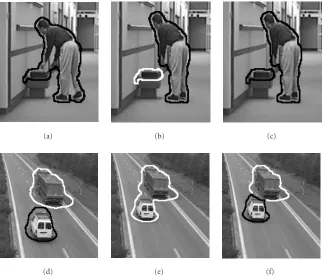
Figure 13shows examples of track management issues. In the first row, a splitting is reported.Figure 13ashows a zoom on frame 131 of the sequence Hall Monitor. The black line represents the contour of the semantic object detected by the change detector. The man and its case belong to the same se-mantic object. Figures13band13cshow a zoom on frame 135. In this frame, the man and the case belong to two dif-ferent connected sets of pixels. The goal of tracking is to rec-ognize that the case is coming from the same partition of the man (splitting). In case the splitting is not detected, the iden-tificator for a new object label (coded with the white contour) is generated for the case (Figure 13b). Therefore, the history of the object is lost.Figure 13cshow the successful tracking of the case: the case left by the man is detected as coming from the partition of the man in the previous frame. This is possible thanks to the semantic partition validation step. Re-gion descriptors projection allows the tracking algorithm to detect that in two disconnected sets of pixels in the semantic partition, the same label appears.
Semantic level
Region level
Framen Framen+ 1 Framen+ 2
Projection Segmentation Projection Segmentation
Figure10: Semantic-region partition interaction in the case of one semantic video object. The semantic level provides the focus of attention and it is improved by the feedback from the region level.
(a) (b) (c) (d)
Figure11: Semantic video object extraction results for sample frames of the test sequence Hall Monitor.
(a) (b) (c) (d)
Figure12: Semantic video object extraction results for sample frames of the test sequence Group.
merging is not detected, the track of one of the two object is lost, thus invalidating the temporal representation and de-scription of the semantic objects. InFigure 13e, the track of the van is lost and the two objects are identified by the same label, that of the truck (color-coded in black). As for the split-ting described above, in the case of a merging as well, the semantic partition validation step generates a tentative cor-respondence that detects such an event. The connected set of pixels of the semantic partition receives from the region descriptors projection mechanism the labels of the two dif-ferent objects. This condition allows to detect the merging. The semantic partition is therefore divided according to the
information of the projection and the segmentation is per-formed separately in the two partitions. Therefore, the two objects can be isolated, thus allowing to access them sepa-rately over time.
(a) (b) (c)
(d) (e) (f)
Figure13: Example of track management issues: splitting of one object into two objects (first row) an merging of two objects into one semantic partition (second row). (a) Zoom on frame 131 of the sequence Hall Monitor, (b) zoom on frame 135, and (c) zoom on frame 135; (d) zoom on frame 110 of the sequenceHighway, (e) zoom on frame 115, and (f) zoom on frame 115. The contour of the semantic object partition is shown before ((b) and (e)) and after ((c) and (f)) interaction with low-level regions in the proposed semantic video object extraction strategy.
example, the video object corresponding to the background may be transmitted to the decoder only once. Then the video object corresponding to the foreground (moving objects) may be transmitted and added on top of it so as to up-date the scene. One advantage of this approach is the pos-sibility of controlling the sequencing of objects: the video objects may be encoded with different degree of compres-sion, thus allowing a better granularity for the areas in the video that are of more interest to the viewer. Moreover, ob-jects may be decoded in their order of priority, and the rel-evant content can be viewed without having to reconstruct the entire image. Another advantage is the possibility of us-ing a simplified background so as to enhance the movus-ing ob-jects (Figure 14a). Finally, the background can be selectively blurred during the encoding process in order to achieve an overall reduction of the required bit rate (Figure 14b). This corresponds to the use of the semantic object as region of interest.
5. CONCLUSIONS
The shift from frame-based to object-based image analysis has led to an important challenge: the extraction of semantic video objects. This paper has discussed the problem of seg-menting, tracking, and describing such video objects. A
gen-eral representation for modeling video based on semantics has been proposed, and its validity has been demonstrated through specific implementations. This representation of vi-sual information can be used in a wide range of applications such as object-based video coding, computer vision, scene understanding, and content-based indexing and retrieval.
(a)
(b)
Figure14: Example of use of the proposed semantic video object extraction algorithm. (a) The extraction of moving objects allows one to reconstruct a scene with a simplified background, thus en-hancing the visibility of the moving objects. (b) Example of use of semantic video object extraction for preprocessed frame before coding: the background information is blurred thus requiring less bandwidth while still retaining essential contextual information.
segmentation. Each kind of segmentation exploits the spe-cific nature of the problem to obtain a partition that groups similar data elements together in the selected feature space.
While the advantages of the proposed video object ex-traction algorithm are evident by the results shown in
Section 4, there are several interesting questions that remain to be investigated. Of primary interest is a change detection mechanism which could provide high spatial accuracy in case of global illumination variations. We are currently evaluat-ing the use of edges and photometric invariant color fea-tures to this end. Moreover, even if the visual data represen-tation ofSection 2is generic and can deal with static as well as moving cameras, in the implementation ofSection 3, we have assumed that the camera is fixed. This scenario is valid for many surveillance type applications. One natural exten-sion is to deal with moving camera sequences by integrating the global motion information. Furthermore, depending on the constraints of the application, such as acceptable levels of delay and complexity, each specific component of the archi-tecture may be replaced with a more adequate one without changing the general approach so as to optimize such mod-ules for each specific application. Finally, the modularity of the system allows us to add other features. This flexibility also allows us to integrate information derived from different sen-sors, such as an infrared camera, by simply adding the appro-priate modules to the same existing structure and other data fusion modules.
ACKNOWLEDGMENTS
This work was supported in part by the European projects ACTS, MODEST, and IST art.live. The authors would like to thank Eduard Solanas Vilar, Elena Salvador, and Olivier Steiger for their contribution to the development of the soft-ware.
REFERENCES
[1] M. Kunt, A. Ikonomopoulos, and M. Kocher, “Second-generation image coding techniques,”Proceedings of the IEEE, vol. 73, no. 4, pp. 549–574, 1985.
[2] H. G. Musmann, M. H¨otter, and J. Ostermann, “Object-oriented analysis-synthesis coding of moving images,”Signal Processing: Image Communication, vol. 1, no. 2, pp. 117–138, 1989.
[3] P. Correia and F. Pereira, “The role of analysis in content-based video coding and indexing,” Signal Processing, vol. 66, no. 2, pp. 125–142, 1998.
[4] S.-Y. Chien, S.-Y. Ma, and L.-G. Chen, “Efficient moving object segmentation algorithm using background registration technique,” IEEE Trans. Circuits and Systems for Video Tech-nology, vol. 12, no. 7, pp. 577–586, 2002.
[5] Y. Tsaig and A. Averbuch, “Automatic segmentation of mov-ing objects in video sequences: a region labelmov-ing approach,” IEEE Trans. Circuits and Systems for Video Technology, vol. 12, no. 7, pp. 597–612, 2002.
[6] H. Tao, H. S. Sawhney, and R. Kumar, “Object tracking with Bayesian estimation of dynamic layer representations,” IEEE Trans. on Pattern Analysis and Machine Intelligence, vol. 24, no. 1, pp. 75–89, 2002.
[7] C. Kim and J.-N. Hwang, “Fast and automatic video object segmentation and tracking for content-based applications,” IEEE Trans. Circuits and Systems for Video Technology, vol. 12, no. 2, pp. 122–129, 2002.
[8] R. Bajcsy, “Active perception,”Proceedings of the IEEE, vol. 76, no. 8, pp. 966–1005, 1988.
[9] D. Marr, Vision, W. H. Freeman, San Francisco, Calif, USA, 1982.
[10] S. Edelman, Representation and Recognition in Vision, M.I.T. Press, Cambridge, Mass, USA, 1999.
[11] D. H. Hubel, Eye, Brain and Vision, W. H. Freeman, New York, NY, USA, 1995.
[12] A. L. Yarbus,Eye Movements and Vision, Plenum Press, New York, NY, USA, 1967.
[13] A. Cavallaro and T. Ebrahimi, “Video object extraction based on adaptive background and statistical change detection,” in Visual Communications and Image Processing 2001, vol. 4310 ofProceedings of SPIE, pp. 465–475, San Jose, Calif, USA, Jan-uary 2001.
[14] T. Aach, A. Kaup, and R. Mester, “Statistical model-based change detection in moving video,”Signal Processing, vol. 31, no. 2, pp. 165–180, 1993.
[15] M. H¨otter, R. Mester, and F. M¨uller, “Detection and descrip-tion of moving objects by stochastic modelling and analysis of complex scenes,”Signal Processing: Image Communication, vol. 8, no. 4, pp. 281–293, 1996.
[16] R. Mech and M. Wollborn, “A noise robust method for 2D shape estimation of moving objects in video sequences con-sidering a moving camera,” Signal Processing, vol. 66, no. 2, pp. 203–217, 1998.
[18] M. Kim, J. G. Choi, D. Kim, et al., “A VOP generation tool: au-tomatic segmentation of moving objects in image sequences based on spatio-temporal information,” IEEE Trans. Circuits and Systems for Video Technology, vol. 9, no. 8, pp. 1216–1226, 1999.
[19] E. Durucan and T. Ebrahimi, “Robust and illumination invariant change detection based on linear dependence for surveillance applications,” inProc. 10th European Signal Pro-cessing Conference, pp. 1041–1044, Tampere, Finland, Septem-ber 2000.
[20] A. Cavallaro and T. Ebrahimi, “Change detection based on color edges,” inProc. IEEE Int. Symp. Circuits and Systems, Sydney, Australia, May 2001.
[21] T. Gevers and A. W. M. Smeulders, “Color-based object recog-nition,”Pattern Recognition, vol. 32, no. 3, pp. 453–464, 1999. [22] J. L. Barron, D. J. Fleet, and S. S. Beauchemin, “Performance of optical flow techniques,”International Journal of Computer Vision, vol. 12, no. 1, pp. 43–77, 1994.
[23] B. D. Lucas and T. Kanade, “An iterative image registra-tion technique with an applicaregistra-tion to stereo vision,” inProc. DARPA Image Understanding Workshop, pp. 121–130, Van-couver, April 1981.
[24] D. J. Fleet, A. D. Jepson, and M. R. M. Jenkin, “Phase-based disparity measurement,” Computer Vision, Graphics and Im-age Processing: ImIm-age Understanding, vol. 53, no. 2, pp. 198– 210, 1991.
[25] R. Castagno, A. Cavallaro, F. Ziliani, and T. Ebrahimi, “Au-tomatic and interactive segmentation of video sequences,” in Non Linear Model-based Image/Video Processing and Analysis, I. Pitas and C. Kotropoulos, Eds., John Wiley & Sons, New York, NY, USA, April 2001.
[26] A. Cavallaro, O. Steiger, and T. Ebrahimi, “Multiple video ob-ject tracking in complex scenes,” inProc. 10th ACM Interna-tional Conference on Multimedia, pp. 523–532, Juan les Pins, France, December 2002.
Andrea Cavallaroreceived his M.S. (Hon-ors) in electrical engineering from the Uni-versity of Trieste, Italy, in 1996, and his Ph.D. in electrical engineering from the Swiss Federal Institute of Technology, Lau-sanne, Switzerland, in 2002. In 1996 and 1998, he served as a Research Consultant at the Image Processing Laboratory, Univer-sity of Trieste, Italy, working on compres-sion algorithms for very low bitrate video
coding and on digital image sequence de-interlacing. In 1997 he served in the Italian Army as a Lieutenant at the 33rd Electronic Warfare Battalion in Treviso, Italy. From 1998 to 2003 he was a Re-search Assistant at the Signal Processing Laboratory of the Swiss Federal Institute of Technology (EPFL). Since 2003, he is a Lecturer at Queen Mary University of London (QMUL). His main research interests are image analysis, video compression, and visual infor-mation description. Dr. Cavallaro was a Member of the organizing committee of the 2002 IEEE Conference on Multimedia and Expo, Member of the Technical Committee of the 2003 SPIE VCIP con-ference, 2004 IEEE ICME, and 2004 IEEE ICIP. He organized the special session on object-based video at the 2003 Visual Commu-nication and Image Processing Conference. He is author of more than 25 papers, including 3 book chapters.
Touradj Ebrahimi received his M.S. and Ph.D., both in electrical engineering, from the Swiss Federal Institute of Technology (EPFL), Lausanne, Switzerland, in 1989 and 1992 respectively. In 1993, he was a Research Engineer at the Corporate Research Labo-ratories, Sony Corporation, Tokyo. In 1994, he served as a Research Consultant at AT&T Bell Laboratories. He is currently Professor at EPFL, where besides teaching, he is