Review of the recent controlled experiments for study of local reconnection physics
Masaaki Yamada
Princeton Plasma Physics Laboratory, P.O. Box 451, Princeton, NJ 08543, U.S.A. (Received June 26, 2000; Revised January 25, 2001; Accepted February 28, 2001)
The present paper reviews the recent laboratory experiments on magnetic reconnection focussing on the local features of the reconnection region. It is very important to recognize that magnetohydrodynamics (MHD) often breaks down locally in the thin reconnection layer, while globally, the reconnecting plasma has large Lundquist number and is well approximated by MHD equations. Precise measurements of the neutral sheet profile can provide important clues to help understand the non-MHD physics mechanisms of reconnection. Thanks to significant progress in data acquisition technology, the detailed magnetic field structure of the neutral sheet has been measured in laboratory plasmas. Extensive data have been accumulated in highly conductive MHD plasmas with large Lundquist numbers
S = 10–1000. In this review we primarily focus on the physics data of the neutral sheet from the most recent laboratory experiments.
1.
Introduction
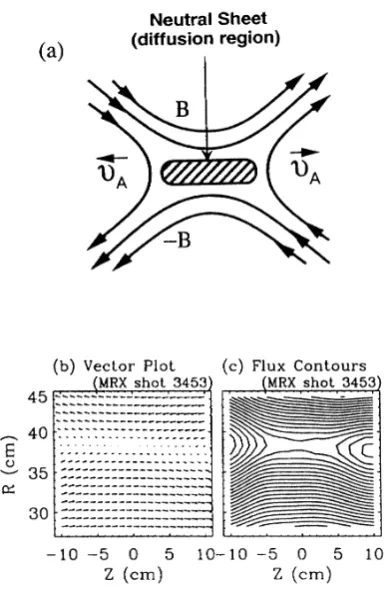
Magnetic reconnection occurs where two conductive plas-mas of different magnetic configuration meet. The recon-nection region, which is often called a diffusion region or neutral sheet, is a focal point of MHD plasma phenomena. Figure 1 depicts a two-dimensional (2-D) schematic of the diffusion region together with actually measured magnetic field profiles in a laboratory plasma (Yamadaet al., 1997a,b; Jiet al., 1998). Its treatment fundamentally invokes issues of non-linear MHD theories and often non-MHD physics on globally conductive plasmas with large Lundquist numberS
[which is defined as the ratio of the magnetic diffusion time to the Alfven transit time]. This paper reviews results from the most recent experiments in which the magnetic recon-nection region has been generated and studied in controlled laboratory settings.
In the past decades, research on the fundamental physics of the reconnection process and its hydromagnetic conse-quences has been largely theoretical (Priest and Forbes, 2000) and has been primarily based on steady-state 2-D magneto-hydrodynamic (MHD) models. In the collisionless regime (λm f p Neutral sheet width), these theories are expected to break down or require a significant modification. Although the Sweet-Parker (1958, 1957) and Petschek (1964) models are well known, the extensive literature describing these 2-D theoretical models thus remains to be verified in laboratory experiments or by space observations.
Laboratory experiments are very useful for understand-ing the fundamental physics of magnetic reconnection since they can provide well-correlated plasma parameters at multi-ple plasma locations simultaneously while satellites can only provide information from a single location at a given time in a space plasma. During the past decades, a significant
Copy right cThe Society of Geomagnetism and Earth, Planetary and Space Sciences (SGEPSS); The Seismological Society of Japan; The Volcanological Society of Japan; The Geodetic Society of Japan; The Japanese Society for Planetary Sciences.
progress in data processing technology has made it possible to acquire s large amount of data from the plasma interior within a short time. This has enabled us to measure the time evolution of the 2-D fine structure of the reconnecting region (neutral sheet) during the merging of two plasmas. Another important development is that in modern experiments the ef-fects of the third vector component of merging field lines have been studied.
The fundamental physics of magnetic reconnection is stud-ied through two different perspectives, (1) local and (2) global views. In local analysis it is assumed that reconnection mechanisms are determined primarily by local plasma pa-rameters in the reconnecting region; the Sweet-Parker model and Petschek model use such an assumption. In this analy-sis, boundaries are not specified and external conditions are often translated to the plasma flow into the reconnection re-gion. It has been observed, however, that reconnection is often influenced and determined by external boundary con-ditions and the initial 3-D global configuration or topology. It has been found that a large MHD instability caused by ex-ternal conditions can invoke magnetic reconnection and can determine its rate. In actual reconnection phenomena the reconnection process is in general determined both by local plasma properties and global plasma characteristics.
It is very important to note that MHD often breaks down locally in the reconnection layer, while globally, the plasma has a large Lundquist number and is well approximated by MHD equations. This is true particularly when the thickness of the neutral sheet is comparable to the ion gyro-radius. Precise measurements of the neutral sheet profile can provide important clues to help understand the non-MHD physics mechanisms of reconnection. Recently the magnetic field structure of the neutral sheet has been measured in detail in laboratory plasmas. Extensive data have been accumulated in highly conductive MHD plasmas with large Lundquist numbers S = 10–1000. In this review we put a primary
Fig. 1. 2-D view of mergingfield lines; schematic of the diffusion re-gion together with actually measured magneticfield profiles in the MRX plasma (Yamadaet al., 1997a,b; Jiet al., 1998). In the neutral sheet, conventional picture of MHD breaks down.
focus on the local studies of the reconnection region through data from the recent laboratory experiments.
2.
Recent Theoretical Development: From MHD
to non-MHD Theories
2.1 Resistive MHD theories
In the one-fluid MHD formulation, the motion of mag-neticfield lines in a plasma, can be described by an equation for magneticfieldBby combining Maxwell equations and Ohm’s law,
where E is the electric field, B the magnetic field, v the particle velocity.
The magnitudes of thefirst and the second terms in the right hand side of Eq. (2) represent the inverse of the Alfven transit time, τA = L/vA and the magnetic diffusion time, τD = μ0L
2
η . The ratio τDτA is called Lundquist number, S. For MHD plasmas,S is much larger than 1 and the second term is very small. Whenη=0, magneticfield lines move with thefluid as seen in Eq. (2). In resistive MHD plasmas, hydromagneticflows can lead to neutral sheets where the plasmaflow is reduced to near zero and the electricfieldE
is balanced withηjin Eq. (1).
In this diffusion region, the resistivity becomes sufficiently large so that a magneticfield line can lose its original identity
and reconnect to anotherfield line. The topology of the mag-netic configuration changes and largej×Bhydromagnetic forces moves the plasma. Sweet and Parker developed a 2-D incompressible MHD model assuming that a local recon-nection rate can be described by a steady state formulation
∂B ∂t =0, ∂
v
∂t =0. Utilizing the continuity equation and pres-sure balance between the upstream p 2Bμ2
0 and the down
stream p ρv22 regions, they derived a very simple formula for reconnection speed;
Petschek proposed an alternative model (Petschek, 1964) which consists of a much smaller diffusion region and stand-ing wave shock structure. The smaller size of the diffusion re-gion allows a faster reconnection rate and this Petschek model has been favored over the Sweet-Parker model, because its faster predicted reconnection rate agrees better with space observations. However, the shock structure, an outcome of his model, has not been conclusively identified to date in lab-oratory experiments or space observations. In general most MHD theories of magnetic reconnection, which are based on steady-state 2-D models with uniform resistivity and laminar flows, do not predict the shock structure. But with the en-hanced resistivity in the neutral region, some MHD theories lead to the Petschek type shock region (Sato and Hayashi, 1979). The effects of the axial component of magneticfield have been studied by many researchers.
2.2 Non-MHD effects
It has been known for decades that simple MHD theories do not properly describe magnetic reconnection phenomena. For example, it is well known that reconnection proceeds at a much faster rate than the classical rate in laboratory plasmas without the presence of shock structures. It has been conjec-tured that the cause of fast reconnection can be attributed to the so-called anomalous resistivity, whenfluctuations are in-duced in the neutral sheet region. It has also been observed in MRX (Magnetic Reconnection Experiment, Yamada, 1997b) that the width of the reconnection region is on the order of ion skin depth as well as the ion gyro-radius and a simple MHD formulation is expected to break down in this regime. Resolution of this dilemma can come from looking beyond the singlefluid (MHD) approximation of plasmas, because the phenomena involved have shorter time scales than the collision time and havefiner spatial scales than the mean free path. The relevant scales fall beyond the regime of validity of conventional MHD models. Recently much thought has been given to the‘generalized’Ohm’s law where electrons and ions are separately treated to satisfy the equations of motion in the neutral sheet plasma. In this“E-MHD”region electrons but not ions are considered to be magnetized. The generalized Ohm’s law describes force balance of an electron flow, namely,
components ofve×B,ve·∇ve, and∇enPecan make a significant contribution to the electrons’force balance and the energy dissipation rate, thus affecting the magnetic reconnection speed. If Eq. (4) is expressed asE=ηsj+ηanomj=ηeffj,
the crucialfluctuation termsme e (
∂ve
∂t +ve·∇ve)−
∇Pe
en −ve×B, are expected to be (non-linearly) proportional to the driving term, the electron current density, j, and they can be alto-gether expressed byηanomj. It is therefore very important to investigate the nature of plasmafluctuations in the neutral sheet and many recent studies have been focussed on this issue.
A new type of realistic simulations using powerful com-putational resources are currently in progress (Drakeet al., 1997; Biskampet al., 1995; Horiuchi and Sato, 1997; Shay
et al., 1998). Many of the recent simulations have shown that fast reconnection can occur in the collisionless neutral sheet. At present, there is no consensus as to the physics of the observed enhanced resistivity since there are so many different levels of approximations in the numerical models (i.e., single-fluid, two-fluid,fluid-particle hybrid, full particle simulations and 2-D or 3-D geometries) and so many can-didate phenomena (ion acoustic waves, lower-hybrid waves, whistler waves etc.) to explain the observed enhanced resis-tivity. Thus it is very important to study reconnection in a laboratory setting in which important characteristics can be measured in situ and compared with numerical simulation results as well as with analytical theories.
3.
Neutral Sheet Profiles Measured in Early
Lab-oratory Experiments
The majority of early laboratory experiments on mag-netic reconnection were carried out in‘pinch’plasmas, fast high-density pulsed plasma discharges of short duration of a few micro-seconds (Baum and Bratenahl, 1980; Syrovatskii, 1981; Ohyabuet al., 1974; Syrovatskiiet al., 1973; Franket al., 1974). In these experiments it was difficult to diagnose the reconnection region with good spatial and temporal res-olution. In addition, the low Lundquist numbers (S=1–10) attained in these transient experiments (∂B/∂t =0) made it difficult to compare the results with MHD theories which require S 1 to be globally satisfied in the plasma. De-spite these difficulties, the current density profiles of the neutral sheet were deduced from local magnetic probe mea-surements and density profiles were measured with a short time scale on the order of an Alfven transit time (τA < 1 μsec) by Syrovatskii (1981) and Franket al.(1974). Fig-ure 2(a) presents their experimental set up, where forma-tion of aflat current sheet was made by az-pinch discharge in which current was induced along the axis (z axis) of a straight cylinder. A linear pinch plasma was created by the breakdown of a neutral gas. The sheet was formed by an inductive pulsed electricfield of 50–300 V applied between two electrodes separated by 40–60 cm. Figure 2(b) shows the time evolution of reconnecting magneticfield profiles in the y axis (based on their coordinate system which is not a conventional one), across the sheet. After magnetosonic waves converged a current sheet began to form in the vicinity of the null line being pinched along theyaxis and elongated along the xaxis. Figure 2(c) presents the electron density profile of the neutral sheet measured by laser
interferome-Fig. 2. A Set-up ofz-pinch reconnection experiment by Syrovatskiii (1973), 1. Conductors, 2. Glass vacuum chamber, 3. current sheet; Vacuumfiled lines are shown by arrows. b, Evolution of profile of reconnectiingfield
Bxversusyaxis. 1 is for intial vacuumfield, 2–5 fort=0.2, 0.3, 0.4,
0.5μsec. Gasfill pressure∼0.06 torr. c, Profile of elecron density in the neutral sheet measured by interferometry.
try. According to their conclusion thefinal thickness of the sheet appeared to be determined by the pressure balance be-tween the reconnecting magneticfield and the plasma kinetic pressure (Syrovatskii, 1981). This force balance seemed to cause the sheet thickness to become almost the size of the ion gyro-radius. Their experimental analysis, however, was solely based on MHD physics and the non-MHD physics mechanisms were not discussed.
Fig. 3. Results from Stenzel and Gekelman’s experiments. (a) Cross sectional view of LPD. (b) Reconnectingfield line contours att =50
μsec. (c) and (d) Measured ion velocity vectors at an axial position
z=87 cm fort=60 and 80μsec.
in the parallel sheet conductors shown in Fig. 3(a), and a detailed local study of magnetic reconnection was performed in the non-MHD regime in which ions were not magnetized. There was sizable axial magnetic field superposed on the reconnectingfields. The experiments were carried out in a cylindrical vacuum chamber (1.5 m-diameter, 2 m length) in which a low pressure (p <10−4 torr, Ar, H2) discharge is
produced with a one-meter diameter oxide coated cathode. The base plasma parameters arene ∼ 1012cm−3,Te ∼10 eV, electron mean free path∼200 cm for electron and ion Coulomb collisions, axial magneticfield 12–100 G, andβ∼ 1 for discharges ofI p∼1500 A.
This linear plasma experiment was very useful for study-ing non-MHD mechanisms; only electrons were magnetized (ρe L ρi) and this regime is called the electron MHD (E-MHD) regime. Detailed measurements were made to identify local microscopic physics issues associated with
neutral sheet formation. In particular ionflows were mon-itored and the characteristics of turbulence were measured. A neutral current sheet was seen to develop in less than two Alfven transit times (τA ∼20μsec). The neutral sheet be-came narrower as it was measured further from the cathode. Figure 3(b) showsfield lines through constant vector poten-tial Ay aty=137 cm from the cathode and att=50μsec; in their experiment y denotes the axial distance from the cathode andt =0 is the start time of the discharge. After a few Alfven times, the plasma was observed to develop the classicflow pattern, jetting from the neutral sheet with velocities close to the Alfven speed. In particular, the typical 2-D features of particle acceleration were verified (Gekelman and Sten-zel, 1982). Figures 3(c) and (d) depict typical 2-D ionflows drifting from diffusion region to outside in perpendicular to the neutral line att =60 and 80μsec. It is important to note that this classical MHDflow pattern is generated by unmag-netized ions. It should be noted that the magunmag-netized electrons are expected to experience the j×bforce and the ions are coupled to the electrons via space charge forces. Spatial and temporal measurements of plasma pressure nkTe, magnetic force density (j×B) and ion velocities were performed.
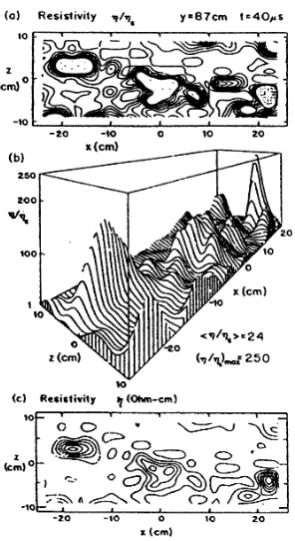
Among the numerous observations from this experiments, the following results were concluded to be important: (1) formation of a long flat neutral sheet stable against tear-ing modes; (2) buildup of hot dense plasma region near the edge of the neutral sheet; (3) anomalous scattering of ions by waves during the reconnection process; and (4) anoma-lous resistivity deduced from generalized Ohm’s law with all fields and currents measured. Figure 4 shows spatial profiles
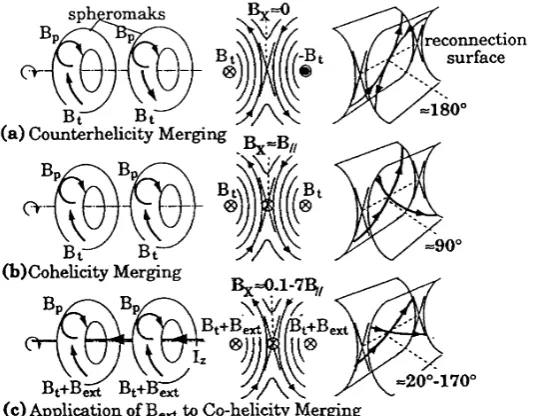
Fig. 5. Structures of reconnection region with bias magneticfieldBx. (a) Counter-helicity merging, (b) and (c) co-helicity merging with and without
external toroidalfield.
of measured resistivity together with the normalized one by the classical resistivity. The resistivity was often found to be peaked at the edge of the neutral sheet. The ion waves in the neutral sheet region were identified as ion acoustic waves and/or the oblique whistler waves. The polarization and propagation characteristics of these waves were mea-sured in detail. It was concluded that the observed anomalous resistivity was in large part due to ion acoustic turbulence, al-though higher frequency waves were present. But it was not determined whether the whistlers were responsible for the observed large ion scattering rate or the enhanced resistivity. It was found that the evolution of the neutral current sheet depended on the strength of the axial magneticfield super-posed on the plasma as well. While a classic double-Y shaped neutral sheet was found for low axialfields of less than 40 Gauss, the development of the O-shaped magnetic island was observed when the axialfield was raised substantially to 100 gauss, much larger than reconnectingfield values (co-helicity reconnection). The stability of the current sheet was also in-vestigated: when the current density in the center of the sheet exceeded a critical value, spontaneous local current disrup-tions were observed. This experiment was later extended to a 3-D study (Gekelman and Pfister, 1988), in which tearing of the current sheet was observed.
The LPD experiment was instructive to study the turbulent features of non-MHD reconnection region and in particular to identify the characteristics of the wave turbulence in the neutral sheet. However, one of the most important questions on reconnection, how the diffusive neutral sheet is related to the reconnection characteristic of an MHD plasma, was not answered because the conditions for an MHD plasma were not globally satisfied (L < ρi,1<S<10). For example the Harris sheet profiles, which would be expected from the pres-sure balance of slowly reconnecting MHD plasma, were not supported by measurements of the neutral sheet. This may suggest that the plasma was not in a global MHD equilibrium and the non-MHD phenomena observed in the diffusion
re-gion could be related only partially to the reconnection of magneticfield lines. Besides, the plasma properties seemed to be influenced by the end effects: the observed positively peaked plasma potential profile at the neutral sheet appears to be determined by the supply of electrons from the end plates. This research nonetheless made a significant contribution to the understanding of the physics of plasma turbulence in the neutral sheet.
5.
Results from Plasma Merging Experiment
In the TS-3 device at the Univ. Tokyo, a controlled recon-nection experiment was carried out in MHD plasmas where the Lundquist number exceeds 100 and both electrons and ions are magnetized. Three vector component effects of mag-netic reconnection were investigated by use of axially merg-ing two toroidal plasmas (Yamadaet al., 1990; Onoet al., 1993). In the TS-3 experiments, two spheromak-type plasma toroids merged together by controlling external coil currents. The two spheromaks, which were generated with opposite helicities, carry identical toroidal current with the same or the opposite toroidalfield. They are called co-helicity merging or counter-helicity merging, respectively. Figure 5(a) shows the set up of the experiment in which two spheromaks of toroidal shape are created and allowed to merge together. To document the internal magnetic structure, a two-dimensional magnetic probe array is placed on anr−zplane or toroidal cut-off plane as shown in thefigure. Plasma parameters are;
dif-Fig. 6. Profile of merging angle of reconnecting field lines for (a) counter-helicity merging spheromaks, (b) co-helicity merging sphero-maks, and (c) co-helicity t merging of spheromaks with external toroidal
field.
fusion region. Counter-helicity merging generates a sharp neutral sheet while co-helicity merging with additional ex-ternal toroidalfield creates a much broader neutral sheet. The thickness of this neutral sheet was found to strongly depend on the merging angle as well as the external driving force. In a strongly driven case, the thickness was found to be shorter than the ion gyro-radius (Onoet al., 1997) for a short period. It was found that counter-helicity merging proceeds much faster than the co-helicity. Violent plasma acceleration was observed as a sling shot effect in the toroidal direction when field lines contracted after the merging of two toroidal plas-mas of the opposite helicities (Yamadaet al., 1990). This acceleration mechanism and direction is different from that conjectured in the typical 2-D models. The Doppler shift of
Hβ and CII lines were monitored to measure radial profile of plasma acceleration andTi. The measured radial profiles of the global plasma (ion) velocity in the toroidal direction demonstrated a sling shot type shear acceleration (Onoet al., 1996). Strong ion heating up toTi =200 eV was mea-sured during reconnection. This observed strong ion heating and the 3-D sling shot acceleration are clear demonstration of conversion of magnetic energy to plasma kinetic energy. The SSX group (Kornacket al., 1998) recently obtained a similar result by reporting that‘the super Alfvenic ionflow appears to be predominantly in the plane containing recon-nectingfield’. In TS-3, the global characteristics of merging plasmas are primarily being studied, generating many sig-nificant findings on merging rate, ion heating and plasma acceleration.
6.
MRX (Magnetic Reconnection Experiment)
Re-search
The MRX device was built to investigate the fundamental physics of magnetic reconnection in MHD plasmas (Yamada
et al., 1997a, b). On MRX the local features of the recon-nection layer have been extensively studied while both the local and global physics issues and their interrelationship continue to be addressed. The overall initial geometry is ax-isymmetric (and hence two-dimensional), but can be made nonaxisymmetric to study 3-D characteristics of merging. These plasmas have a high conductivity (S∼103) with the
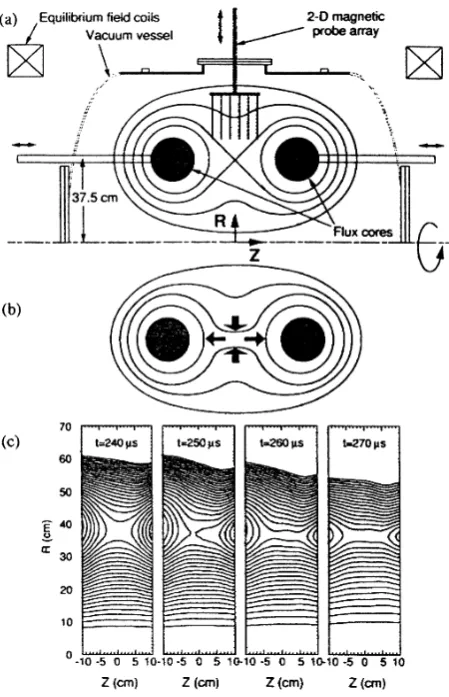
ion gyro-radius being much smaller than the plasma size. Thefirst goal of this experiment was to measure the pre-cise local features of the reconnection layer. Experiments have been carried out in the double annular plasma set-up in which two toroidal plasmas with annular cross section are formed independently around twoflux cores and mag-netic reconnection is driven in the quadrupolefield shown in Fig. 7. Eachflux core (Darkened section in Fig. 7) contains a toroidalfield (TF) coil and a poloidalfield (PF) coil. Atfirst a quadrupole poloidal magneticfield is established by the PF coil currents(which flow in the toroidal direction), plasma discharges are created around each flux core by induction of pulsing currents in the TF coils (Yamadaet al., 1997b). After the annular plasmas are created, the PF coil current can be increased or decreased. In the case of rising PF current, the poloidalflux in each plasma increases and is“pushed” toward the x-point (push mode). In the case of decreasing PF current, the poloidalflux in the common plasma is“pulled”
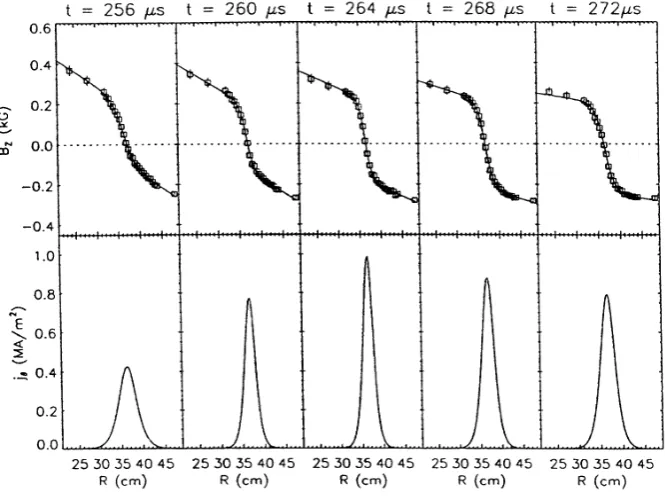
Fig. 8. Time evolution of radial profile of reconnecting field (top) and neutral sheet current taken in a single discharge. Bzare fit to the Harris profile with
a background quadrupole profile superposed.
back toward the x-point (pull mode). For standard conditions (ne∼0.1−1×1014cm−3,Te∼10–20 eV,B∼0.5–1.0 kG,
S∼500), MRX creates strongly magnetized MHD plasmas. Both the electron and ion gyro-frequencies are above the re-spective collision frequencies (ωceτe>400, ωciτe∼10) for typical Hydrogen discharges of 3–6 mtorr. The mean-free-path for electron-ion Coulomb collisions is approximately 2–10 cm. To measure the internal magnetic structure of the reconnection on a single shot, a two-dimensional magnetic probe array is placed in the R-z plane or toroidal cut-off plane, as shown in Fig. 7;zis in the axis of the vacuum ves-sel. The profile of the neutral sheet was carefully measured and two distinctively different shapes of neutral sheet current layers were identified, depending on the third [axial] vector component of the reconnecting magnetic fields. When no magnetic reconnection is induced, a typical X-shape sepa-ratrix region is observed. As poloidal flux is driven toward the diffusion region, a neutral sheet is formed. Without the third component (null-helicity reconnection), a thin double-Y shaped diffusion region is clearly identified as shown in Fig. 7(c). With a significant third component (co-helicity reconnection), an O-shaped sheet current appears (Yamada
et al., 1997a). The neutral current sheet in the null-helicity merging case is much narrower than in the co-helicity merg-ing case.
It is found that reconnection of null-helicity plasmas oc-curs much faster than that of co-helicity plasmas, which con-firms the earlier data obtained in the merging experiments on TS-3 (Yamadaet al., 1990; Onoet al., 1993). A cause of the observed slower reconnection for co-helicity merging has been attributed to the effects of toroidal magnetic field pressure which generate a strong back pressure at the down stream side of reconnection channel.
The current density obtained from magnetic probe data
provides the profile of the neutral sheet current for a given sequence of shots. A nearly symmetric profile of the neu-tral sheet current was observed during null-helicity recon-nection. The width of the neutral sheet during null-helicity reconnection is always much narrower than the width dur-ing co-helicity mergdur-ing. It is natural to question whether the welknown Harris equilibrium, which was derived as a 1-D equilibrium between a confining magnetic field and plasma pressure, could be observed and whether the magnetic recon-nection process would affect the neutral sheet profiles given in the Harris equilibrium. Precise magnetic field profiles of the MRX neutral sheet have been measured by a high-resolution 1-D magnetic probe array, which contains mag-netic pickup coils every 5 mm (∼1/4ρi) and is inserted across the neutral sheet.
The evolution of the reconnecting field component Bz gives the radial profile evolution of the neutral sheet cur-rent based on the relationship of jt = Curl B. Figure 8 presents the radial profiles of reconnecting field Bz and de-duced current density profile jt(r)together with fitted Harris profiles.
BZ(R)= −B0tanh2[(R−R0)/δ]+b1R+b2, (5)
from which the current density jtis derived,
jt(R)=
B0 μ0δ
sech2[(R−R0)/δ]. (6)
The current sheet thicknessδis given by
δ =ωc pi
√
2(Te+Ti)/mi
Vi−Ve
=ωc pi
√ 2Vs
Vdrift ,
(7)
whereVs≡ √
are determined by background quadrupole and equilibrium fields. It was shown that the 1-D Harris solution satisfies MHD force balance, j ×B = −d p/dr. Radial profiles of magneticfield and plasma pressure in MRX have been measured to verify this force balance.
It is found that the static force balance is maintained be-tween incoming magneticfield and the neutral sheet plasma pressure during the quasi-steady state phase of reconnection. Deviation from pressure balance occurs in the beginning and ending phases without changing the magnetic profile shape from that of the Harris solution.
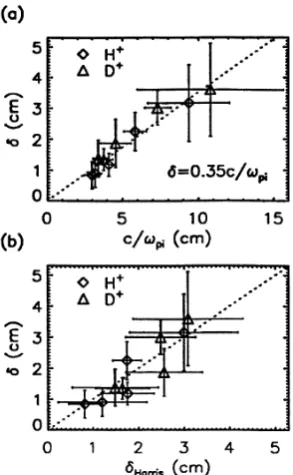
The neutral sheet thicknessδ was experimentally deter-mined accurately from thefit and compared with Eq. (7). By varying the discharge voltage and using both hydrogen and deuteriumfill gas (to change the density and mass, respec-tively), a range ofδ andc/ωpi values were measured ex-perimentally and an excellent agreement with a generalized Harris theory was found (Yamadaet al., 2000) as shown. Fig-ure 9 shows that the data match well withδ ∼0.35(c/ωpi), the data scales withc/ωpi. Since 1996, it has been repeat-edly observed on MRX (Yamadaet al., 1997a, b) and other devices (Kornack et al., 1998; Ono et al., 1997) that the neutral sheet thickness scales roughly in equal with the ion gyro-radius as well as with the ion skin depth. This is the most detailed and conclusive analysis so far on the profile of the neutral sheet.
The excellentfit of MRX magnetic data points to the Harris profile and the agreement between measured and predicted thickness are remarkable since the MRX plasma is under-going reconnection while Harris did not take into account reconnection. However, based on the discussions in the re-cent paper (Yamada et al., 2000) regarding the effects of dissipation, the excellent agreement indicates that the Harris profile is the most natural one for a quasi-steady-state
re-Fig. 9. Measured neutral sheet thickness vs (a) ion skin depthc/ωpiand
(b) Harris value given by Eq. (7).
connecting plasma sheet. Even in the collisionfree regime, fluctuations are expected to create frictional forces between particles and one expects that the quasi-static equilibrium can be maintained during the reconnection process.
One of the most important local physics issues for mag-netic reconnection is how magmag-netic energy is converted into plasma thermal energy. It was found that a significant amount of magnetic energy is converted to thermal energy of the neutral sheet plasma during reconnection and that the en-ergy conversion rate is much larger than the value expected from classical dissipation mechanisms. Recently, local ion heating due to reconnection has been measured (Hsuet al., 1999) in MRX using a novel Ion Dynamic spectroscopy probe placed inside the neutral sheet. The results are re-ported in more detail by another paper in this conference (Ji
et al., 2000). The ion heating rate was found to be much larger than the values predicted by classical dissipation. Re-cently built Swarthmore Spheromak Experiment (SSX) was also utilized to study magnetic reconnection (Kornacket al., 1998). While their results are consistent with the results from TS-3 and MRX, a burst of plasmaflow at the Alfven speed was observed in the reconnection plane.
Another importantfinding to date is that the enhancement factor of the measured resistivity over its classical values (or“the anomaly factor”) is strongly dependent on the col-lisionality (Jiet al., 1998). In the collisional regime where the mean-free-path is comparable to the current sheet thick-ness, the anomaly factor is near unity, i.e., almost no resis-tivity enhancement is found. However, in the collisionless regime where the mean-free-path is much longer than cur-rent sheet thickness, the anomaly factor is increased to the order of 10. In earlier studies, it was found that a gener-alized Sweet-Parker model, which incorporates compress-ibility, downstream pressure and the effective resistivity, can explain the reconnection rate in MRX (Jiet al., 1998; Jiet al., 1999). In the MRX plasma, the lower hybrid waves are expected to play an important role in determining friction of electronflow against ions, a definitive study is needed tofind a relationship between the observed enhanced resistivity and the amplitude of specific waves.
A significant implication of the MRX results to date is that a stable 2-D reconnection neutral sheet with axisymmetric geometry is consistent with both the Sweet-Parker and the Harris models with generalizations. The relationship δ ∼
c/ωpi also suggests that the electron drift velocity (relative to ions) is limited to a value equal to a constant on the order of 3 or 4 times the ion thermal speed (Jiet al., 1999). These results have led us to suspect that a current-driven instability might be excited to limit the current. The present efforts on MRX are devoted to identifying the cause of the enhanced resistivity, including macro- and micro-instabilities.
7.
Progress in Measuring Turbulence in the
Neu-tral Sheet
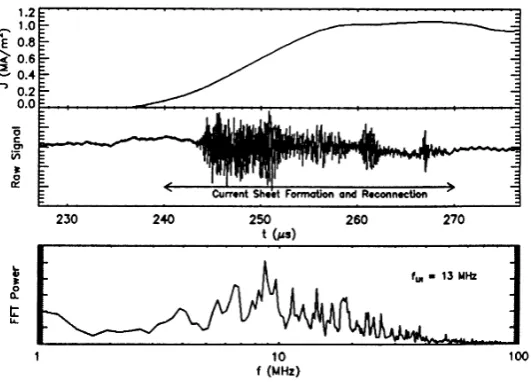
Fig. 10. Time evolution of neutral sheet current,fluctuation signal at the neutral sheet andfluctuation spectrum. The waves are identified as lower hybrid drift waves.
transducer installed in the probe shaft right after the probe tips, and (2) reduction of high-frequency background noises (by a factor of aboutfive) by proper impedance matching of power cables from the capacitor banks to the MRXflux core coils. Initial data indicate that electrostaticfluctuations peak at the edge of current sheet while the electromagnetic fluctuations peak at the center of current sheet. The mea-sured frequency spectra also show that mostfluctuations are in the frequency range between the ion cyclotron and lower hybrid frequencies, qualitatively consistent with our theo-retical model (Carter et al., 2000). Figure 10 shows the time evolution of the neutral sheet current and the fluctua-tion signal picked up by a double Langmuir probe immersed in the neutral sheet together with the frequency spectrum. In the most recent campaign of MRX experiments, detailed characteristics of the electro-static turbulence, dispersion re-lations, spatial profile, frequency spectrum etc., have been documented (Jiet al., 2001). The dispersion relations of the fluctuations have been determined by measuring their wave number spectra and phase velocities. The waves agree with the propagation characteristics of the lower hybrid drift waves. The immediate next step is to measure correlations of thesefluctuations with the observed resistivity enhancement and ion heating.
8.
Summary Discussions
We have reviewed the recent series of magnetic reconnec-tion experiments carried out in the past two decades putting a special focus on the profile of the neutral sheet or diffu-sion region. Recently it has been clearly recognized that the neutral sheet thickness is often of the order of the ion gyro-radius and the standard one-fluid MHD theory does not properly describe the physics properties of the sheet.
In the modern experiments, the familiar 2-D feature, a double-Y shaped diffusion region, was identified when there is no or very little axial magneticfield (third vector com-ponent). In co-helicity merging with a sizable third field component, an O-shaped diffusion region often appears and the reconnection rate decreases substantially, which is
at-tributed to the axialfield pressure and the incompressibility of plasma. When the axial field component is near zero (the reconnecting angle is near 180 degrees), the reconnec-tion speed is maximized. This observareconnec-tion is consistent with the well known observation in the dayside magnetosphere in which southward (antiparallel) interplanetary wind (IMF) reconnects much faster with the earth dipolefield than north-ward IMF (0◦–45◦merging angle).
Inside the current sheet layer, the standard one-fluid MHD formulation breaks down. Syrovatskiiet al.(1981) realized that the thickness of the sheet appeared to be determined by the pressure balance of the reconnecting magneticfield and the plasma kinetic pressure which makes the sheet thick-ness almost the size of ion gyro-radius. Their experimental analysis, however, was solely based on MHD physics and the implication of the sheet thickness for non-MHD physics mechanisms was not discussed. The LPD experiment made significant measurements of the characteristics of non-MHD turbulence in the diffusion region. There were many impor-tantfindings including: (1) observation of longflat neutral sheets which were stable against tearing modes; (2) ions scattered off waves during the reconnection process; and (3) anomalous resistivity which was deduced from the general-ized Ohm’s law when allfields and currents were measured. However, an important question, how the diffusive neutral sheet is formed in an MHD equilibrium plasma, was not ad-dressed because the conditions for an MHD plasma were not satisfied globally. The Harris equilibrium was not ob-served in the current sheet of LPD. The TS-3 and MRX reconnection experiments were carried out in plasmas which globally satisfy the MHD criteria where the Lunquist num-bers exceeds 100 with both magnetized electrons and ions (ρeρi L). And the thickness of this thin current layer is found to be on the order of the ion gyro-radius in these devices.
reconnection and associated dissipation. The measured neu-tral sheet thickness is seen to scale with the ion skin depth,
c/ωpi over a wide range of discharge conditions. These re-sults imply that one can include the effects of quasi-steady state reconnection within the basic formulation of the Harris sheet. Because the Harris-theory’s shifted Maxwellian ve-locity distribution function satisfies the full Fokker-Planck equation, it appears to be the natural state for a reconnecting plasma.
In the case of anti-parallel reconnection (null-helicity case), the ion gyro-radius is on the order of the ion skin depth, which indicates that the magnetic pressure in the up-stream is balancing with the plasma kinetic pressure at the reconnection region, sinceB2/2μ0∼nTe+nTiwould lead toc/ωpi ∼ρi. This result is in very good agreement with numerical simulations carried out independently by Drake
et al.(1997) and Horiuchi and Sato (1997) as well as with space observations. Both in the geotail region and the magne-topause, it has been often observed that the neutral thickness is of the order of the ion gyro-radius (∼a few hundred km) (Kivelson and Russell, 1995).
Collisionless reconnection (where the collision mean-free-path is much longer than the scale length of the neutral sheet or wave lengths of turbulence) will be the subject of inten-sive investigations in both laboratory experiments and nu-merical simulations in the future. It should be noted that the physics of collisionless reconnection has great relevance to solarflare and magnetospheric phenomena, which occur mostly in the collisionless regime. In MRX experiments with collisional conditions where the mean-free-path is compara-ble to the current sheet thickness, the reconnection resistivity is found to be classical, i.e., almost no resistivity enhance-ment is found. However, in the collisionless regime where the mean-free-path is much longer than the current sheet thickness and the wavelengths, the resistivity enhancement factor is increased to the order of 10. An enhancement factor of more than 100 was measured in the LPD device. Although this is suspected to be due to wave-particle interactions, con-clusive work is yet to be carried out. In the electron MHD regime in the LPD experiments whistler waves were sus-pected to be the cause of the observed anomalous resistivity but it was concluded that the enhanced resistivity was in large part due to the current driven ion acoustic turbulence in the neutral sheet and the role of whistler waves on the anoma-lous resistivity was not verified in LPD. A new experiments have been initiated at MIT to address the physics magnetic reconnection in a collisionless regime (Egedal and Fasoli, 2001).
In searching for physical mechanisms responsible for the observed fast reconnection or “enhanced resistivity” in MRX, electrostatic and electromagnetic high-frequency fluc-tuations have been just recently identified and their popaga-tion chracteristics have been measured. Initial data indicate that electrostaticfluctuations peak at the edge of current sheet while the electromagneticfluctuations peak at the center of current sheet. The measured frequency spectra also show that mostfluctuations are in the frequency range between the ion cyclotron and lower hybrid frequencies. The measured wavelengths are found to be smaller than the collision mean-free-path lengths in the low density regime. Experiments are
being carried out to measure the correlation of these fluc-tuations with the observed resistivity enhancement and ion heating, which is crucial to understand the mechanisms of fast collisionless reconnection.
Acknowledgments. The author appreciates many useful inputs
from Russell Kulsrud, Hantao Ji, Troy Carter and MRX staff. Dis-cussions with Reiner Stenzel and Yasushi Ono were very valuable. Work jointly supported by DoE, NASA, and NSF.
References
Baum, P. J. and A. Bratenahl, Magnetic reconnection experiments, Adv. Electron Phys.,54, 1–67, 1980, reference there in.
Biskamp, D. E., Schwarz, and J. F. Drake, Ion controlled magnetic recon-nection,Phys. Rev. Lett.,75, 3850–3853, 1995.
Brown, M. R., Experimental studies of Magnetic reconnection,Phys. Plas-mas,6, 1717–1724, 1999.
Carter, T.et al., AGU 2000 Spring Meeting EOS, Supplement, S360, 2000. Drake, J. F., R. G. Kleva, and M. E. Mandt, Structure of thin current layers: Implication for magnetic reconnection,Phys. Rev. Lett.,73, 1251–1254, 1994.
Drake, J. F.et al.,Geophys. Res. Lett.,24, 2921–2924, 1997. Egedal, J. and A. Fasoli, to be published, 2001.
Frank, A. G., Proc. Lebedev Phys. Inst. 74: 108, 1974.
Gekelman, W. and R. L. Stenzel, Magneticfield line reconnection experi-ments,J. Geophys. Res.,86, 659–666, 1981,JGR,87, 101–110, 1982,
JGR,89, 2715–2733, 1984.
Gekelman, W. and H. Pfister, Experimental observations of the tearing of an electron current sheet,Phys. Fluids,31, 2017, 1988.
Harris, E. G.,Nuovo Cimento,23, 115, 1962.
Horiuch, H. and T. Sato, Particle simulation study of collisionless driven reconnection in a sheared magneticfield,Phys. Plasmas,4, 277, 1997. Hsu, S.et al., Local measurement of non-classical ion heating during
mag-netic reconnection,Phys. Rev. Lett.,84, 3859–3862, 2000.
Ji, H.et al., Experimental test of the Sweet-Parker model of magnetic re-connection,Phys. Rev. Lett.,80, 3256–3259, 1998.
Ji, H.et al., Magnetic reconnection with Sweet-Parker characteristics in 2-D laboratory plasmas,Phys. Plasmas,6, 1743–1749, 1999.
Ji, H., T. Carter, S. Hsu, and M. Yamada, Study of local reconnection physics in a laboratory plasma,Earth Planets Space,53, this issue, 539–545, 2001.
Kivelson, G. and C. T. Russell, Introduction to Space Physics, Cambridge University Press, London, 1995.
Kornack, T. W.et al., Experimental observation of correlated magnetic reconnection and Alfvenic ion jet,Phys. Rev. E,58, R36–R39, 1998. Kulsrud, R., Magnetic reconnection in an MHD plasma,Phys. Plasmas,5,
1599–1606, 1998.
Ohyabu, N.et al., Strong ion heating in a magnetic neutral point discharge,
Phys. Fluids,17, 2009–2013, 1974.
Ono, Y.et al., Experimental investigation of three-dimensional magnetic reconnection by use of two colliding spheromaks,Phys. Fluids B,5, 3691–3701, 1993.
Ono, Y.et al., Experimental investigation of three-component magnetic re-connection by use of merging spheromaks and tokamaks,Phys. Plasmas,
4, 1953–1963, 1997.
Ono, Y.et al., Ion acceleration and direct ion heating in three component magnetic reconnection,Phys. Rev. Lett.,76, 3328–3331, 1996. Parker, E. N., Sweet’s mechanism for merging magneticfields in conducting
fluids,J. Geophys. Res.,62, 509, 1957.
Parker, E. N., Cosmical Magnetic Fields, Oxford, Claredon Press, 1979. Parker, E. N., The reconnection rate of magneticfields,Astrophys. J.,180,
247–252, 1973.
Petschek, H. E., Magneticfield annihilation, NASA Spec. Pub. SP-50, 425, 1964.
Priest, E. R. and T. Forbes, Magnetic reconnection, Cambridge Univ. Press, Cambridge, U.K., 2000.
Sato, T. and T. Hayashi, Externally driven magnetic reconnection and pow-erful magnetic energy converter,Phys. Fluids,22, 1189–1202, 1979. Shay, M. A.et al., Structure of dissipation region during magnetic
recon-nection,J. Geophys. Res.,103, 9165–9176, 1998.
Stenzel, R. L. and W. Gekelman, Magneticfield line reconnection experi-ments I. Field topologies,J. Geophys. Res.,86, 649–658, 1981. Stenzel, R. L.et al., Magneticfield line reconnection experiments 4, J.
Stenzel, R. L., W. Gekelman, and N. Wild, Magneticfield line reconnection experiments 5. Current disruptions and double layers,J. Geophys. Res.,
88, 4793–4804, 1983.
Sweet, P. A., The neutral point theory of solarflares, inElectromagnetic Phenomena in Cosmical Physics, edited by B. Lehnert, p. 123, Cambridge Press, New York, 1958.
Syrovatskii, S. I.et al., Current distribution near the null line of magnetic
field and turbulent plasma resistance,Sov. Phys. Tech. Phys. Engl. Tran.,
18, 580, 1973.
Syrovatskii, S. I., Pinch sheets and reconnection in astrophysics,Ann. Rev. Astron. Astrophys.,19, 163, 1981, and references there in.
Yamada, M.et al., Magnetic reconnection of plasma toroids with co- and
counter-helicity,Phys. Rev. Lett.,65, 721–724, 1990.
Yamada, M.et al., Identification of Y-shaped and O-shaped diffusion regions during magnetic reconnection in a laboratory plasma,Phys. Rev. Lett.,78, 3117–3120, 1997a.
Yamada, M.et al., Study of driven magnetic reconnection in a laboratory plasma,Phys. Plasmas,4, 1936–1944, 1997b.
Yamada, M.et al., Experimental investigation of the neutral sheet profile during magnetic reconnection,Phys. Plasmas,7, 1781–1787, 2000.