Designing BEE: A Hardware Emulation Engine
for Signal Processing in Low-Power
Wireless Applications
Kimmo Kuusilinna
Tampere University of Technology, Korkeakoulunkatu 1, P.O. Box. 553, FIN-33101, Tampere, Finland
University of California, Berkeley, Berkeley Wireless Research Center, 2108 Allston Way, Berkeley, CA 94704, USA Email:[email protected]
Chen Chang
University of California, Berkeley, Berkeley Wireless Research Center, 2108 Allston Way, Berkeley, CA 94704, USA Email:[email protected]
M. Josephine Ammer
University of California, Berkeley, Berkeley Wireless Research Center, 2108 Allston Way, Berkeley, CA 94704, USA Email:[email protected]
Brian C. Richards
University of California, Berkeley, Berkeley Wireless Research Center, 2108 Allston Way, Berkeley, CA 94704, USA Email:[email protected]
Robert W. Brodersen
University of California, Berkeley, Berkeley Wireless Research Center, 2108 Allston Way, Berkeley, CA 94704, USA Email:[email protected]
Received 28 February 2002 and in revised form 10 October 2002
This paper describes the design of a large-scale emulation engine and an application example from the field of low-power wire-less devices. The primary goal of the emulator is to support design space exploration of real-time algorithms. The emulator is customized for dataflow dominant architectures, especially focusing on telecommunication-related applications. Due to its novel routing architecture and application-specific nature, the emulator is capable of real-time execution of a class of algorithms in its application space. Moreover, the dataflow structure facilitates the development of a highly abstracted design flow for the emula-tor. Simulations and practical measurements on commercial development boards are used to verify that real-time emulation of a low-power TDMA receiver is feasible at a clock speed of 25 MHz.
Keywords and phrases:rapid prototyping, FPGA, hardware emulation, low power, design flow.
1. INTRODUCTION
Hardware emulation is one of the most promising ap-proaches to address the problem of constantly growing sim-ulation execution times while simultaneously retaining high confidence on the results. Accurate simulations of large sys-tems can be extremely slow and the reduced reliability of faster, more abstract simulation models cannot always be tol-erated [1]. Especially logic-level development and verifica-tion of systems-on-a-chip (SoC) designs require advanced methods. The purpose of the Berkeley Emulation Engine
(BEE) project is to be able to emulate in real-time the digi-tal portion of low-power communication chips and systems, while providing a robust and flexible interface to analog ra-dio front-ends.
Analog front-end
Figure1: BEE HW infrastructure.
server is also responsible for controlling BEE configuration and data read back from the BPUs. Moreover, each BPU has 2400 external I/O signals, which can be connected to expan-sion modules like a processor or other computation acceler-ation cards.Figure 1depicts a cable connection to theanalog front-end. Analog radios cannot be emulated on BPUs and, therefore, the reusability of BEE is supported by the utiliza-tion of external analog components.
Every BPU contains twenty FPGAs (field programma-ble gate arrays), each with a capacity of 518,400 ASIC (application-specific integrated circuit) gate equivalents (2,541,952 FPGA gates),www.xilinx.com. The primary rea-sons for such coarse grain granularity are maximizing appli-cation speed, I/O resource utilization between functional el-ements, and performance headroom within a unified config-urable fabric that provides easy place and route for even large designs. The configurable logic itself, being lookup table and register-based, is relatively fine grain. Although approaches that time-multiplex area [2] or interconnections [3] could be utilized with BEE, the loss of performance associated with these methods is deemed too great. Especially, when the real-time operation of the algorithms is critical, slowing down the whole system under test may cause unexpected integration problems.
Specifically, BEE enables real-time emulation of a class of wireless communication applications [4,5,6], hence provid-ing real-time feedback of algorithm optimizations, includ-ing bit length and quantization selection. Once the algorithm has been defined, the same description can be used in an ASIC design flow, while maintaining cycle-to-cycle and bit-true equivalence.
This paper is organized as follows. Section 2 discusses the basics of hardware emulation and rapid prototyping fo-cusing on the emulation methodology. Section 3describes the BEE hardware architecture in detail focusing on the multi-FPGA board routing architecture, which is one of the primary distinguishing features in any multi-FPGA sys-tem. The BEE-specific software flow, based on high-level Simulink (www.mathworks.com) descriptions is explained inSection 4.Section 5is an application example of a base-band TDMA receiver. Finally,Section 6concludes the paper.
System design Behavior
Logic synthesis Gate-level Netlist
Technology
mapping Bit stream
Emulation run Emulation results
Hi
Figure2: Generic HW emulator design flow.
2. HARDWARE EMULATION AND RAPID
PROTOTYPING
Rapid prototypingis defined here as developing a physical sys-tem that can implement the algorithm in a timely fashion. Rapid prototyping leverages high-level design entry and an automatic tool flow [7]. In the ideal case, the prototype oper-ates at the same speed as the final product.Hardware emula-tionis a method for achieving this goal using synthesis-based design and configurable logic.
Hardware (HW) emulation addresses many of the most crucial problems in prototype development. Namely, it is possible to get working prototypes before the work is obso-lete due to rapid technology changes or architectures becom-ing outdated. In addition, HW emulators typically aid with debugging, allowing more internal nodes to be observable. However, typical HW emulators are not tools for detailed gate-level timing analysis.
2.1. Design flow for HW emulation
HW emulators tend to follow the generic design flow de-picted inFigure 2[4,7,8,9]. A typical design begins with behavioral and algorithmic descriptions in addition to other system specifications, which are converted to an RTL (regis-ter transfer-level) representation. This conversion can be au-tomatic, but often requires designer intervention.
Partitioning of heterogeneous resources is known to be a hard problem. FPGA-centric approaches for this problem are described, for example, in [10,11]. The system-level routing architecture has a heavy influence on this design phase, as discussed in more detail inSection 3.
The resulting configuration data is then downloaded to the emulator.
Finally, anemulation runproduces the emulation results. These results can take a variety of forms as described in Section 2.2. Typically, these results are the responses to test vectors or an ASIC replacement in a larger system under test. One of the important questions within the emulation flow is what to do with critical paths. The basic approach is to slow down the emulation speed to meet the timing require-ments. However, during the various levels of synthesis and HW mapping, it should be possible to optimize the back-annotated critical paths. For those signals with high fanouts and especially for signals crossing physical chip and PCB boundaries, detailed and optional manual optimization can become necessary to obtain the best results.
2.2. Classification of prototyping and HW emulation Using the abstraction level of the design as the distinguish-ing factor, three main classes of prototypdistinguish-ing can be identi-fied.Concept-orientedprototyping explores the design space of requirements, specification, and feasibility. Architecture-oriented prototyping deals with system design, subsystem specifications, test development, and system-level verifica-tion. Implementation-orientedprototyping involves module design, in addition to RTL and even gate-level test and veri-fication [13].
Concept-oriented prototyping typically means HW-accelerated simulation or computation. Many of the current signal processing algorithms are computationally expensive but parallel in nature. The speedup from HW acceleration can be crucial for the usability of these algorithms. An alter-native to the simple dataflow paradigm for the implementa-tion of these systems is described in [14], where FPGA lo-cal memory is exploited as caches. This allows an efficient construction of a DSP (digital signal processor) like com-puting paradigm with multiple small processing units. Sim-ulations can be accelerated with synthesizable test benches and, of course, mapping the design itself onto the emulator HW. Emulators usually have relatively large system memo-ries which can store a large number of test vectors and the corresponding responses. An alternative to this approach is to map the simulation algorithm itself on the hardware, as described in [15].
Rapid prototyping also facilitates the use of the proto-type in the software development sense, enabling the demon-stration of proposed product features and user interfaces. The prototype can already have correct peripherals, execu-tion speed, and system memory.
One of the most important applications for architecture-oriented prototyping is to support hardware/software (HW/SW) partitioning and cosimulation. Codevelopment of SW can usually begin earlier if a logic emulator is available. Simulations of complex composite HW/SW systems are of-ten insufficient due to synchronization and performance is-sues. If only small time intervals can be simulated, correcting a detected error during the simulated period can cause other undetected errors. The new errors are only uncovered after the first error is corrected and the system run for a longer
time. The goals of the simulation and the simulation mod-els themselves are often not described with precise mathe-matical formulations, thus making simulations poorly suited for design validation. In addition, finding the actual partition between HW and SW is facilitated with the use of HW/SW coemulation due to architecture exploration. Furthermore, developing real physical test vectors without the prototype may prove to be a problematic task. Retime prototypes al-low the designer to test and optimize more design parameters in shorter time and in an environment resembling the target system very closely [16].
Many HW emulators also allow cosimulation with VHDL (VHSIC hardware description language) or Verilog simulators running on workstations. This enables the use of C-language models within the emulation, for example, through the foreign language interfaces of the simulators (see www.ikos.com,www.mentor.com,www.quickturn.com).
Implementation-oriented prototyping has several possi-ble subtasks. Design changes during product development favors configurable logic and other programmable elements (processors) in the prototype. In addition, it is possible to mix traditional prototyping and emulation by adding phys-ical components from the target design to the emulation system. This is sometimes calledin-circuit verification. Real-time tests for the HW are important for integration pur-poses. For many multimedia applications, the operating fre-quency affects the perceived quality of the product such as video encoders and decoders. Some prototyping plat-forms are built on top ofprogrammable interconnections[4] with the idea that the actual HW, utilized for the emula-tion run, can be changed from prototype to prototype. Due to the additional components in the emulator, this strat-egy requires substantial I/O bandwidth and flexible clocking options.
In the HW sense, a simpler option is to accelerate RTL or gate-level designs. This is the primary model for testing de-signs intended for ASIC implementation. Usually no exotic accessories are required and the strategy is fully supported by the emulator software. One of the advantages of this test-ing method over testtest-ing the ASIC implementation itself is the visibility of internal nodes.
A related activity is developing new IP (intellectual prerty) blocks and smaller library elements. Verifying the op-eration of these macros is typically a convenient opop-eration for HW emulation platforms [17]. Particularly important is the need to verify the interfaces to other design components, all the more critical if the IP cores are offered in binary or encrypted form.
Some emulators offer special fault analysis capabilities enabling the emulation of stuck-at faults at the pin and net level (www.mentor.com). Moreover, an emulator can act as a substitute system offering a temporary replacement for a unique system or allowing testing on an otherwise unavail-able environment.
3. BEE HARDWARE ARCHITECTURE
project is to provide a large, unified, real-time emulation platform for low-power dataflow designs. Plentiful resources are required in a unified fabric to facilitate design with par-allel structures, to ease the partitioning, and to avoid slow off-board connections that can also result in system inte-gration problems. These requirements support coarse board-level granularity.
A driving requirement of the BEE project is the need to thoroughly test analog RF (radio frequency) front-ends in real time. This is feasible for a number of target applications because many low-power designs use only moderate clock speeds and have large I/O requirements. For example, an ul-tra wideband (UWB) receiver, under development in a sepa-rate project, requires approximately 150 relatively high-speed (160 MHz) signals to be connected to BEE. This suggests that the external I/O should allow modular expansion of BEE.
In addition, real-time operation means that the system needs to be able to optimize local routing on the board-level to control the delay in the data flow. This requirement ex-cludes the use of purely hierarchical networks due to the in-serted latency. To this end, the number ofhops, chip-to-chip connections, to neighboring FPGAs must be minimized.
Low-power designs often encourage parallelism and con-tain multiple clock domains and, therefore, BEE needs to support this design style. Furthermore, to support the emu-lation of run-time reconfiguration, each of the system FPGAs is required to be individually configurable.
Each processing FPGA should have an external SRAM (static random access memory) attached to it to allow ta-ble lookup and data buffering. In addition, this memory can function as a system memory and cache for processors if needed. This memory should also provide a nonvolatile stor-age during FPGA reconfigurations. In addition, HW emula-tor design goals are discussed in [18,19,20].
3.1. Routing architecture basics
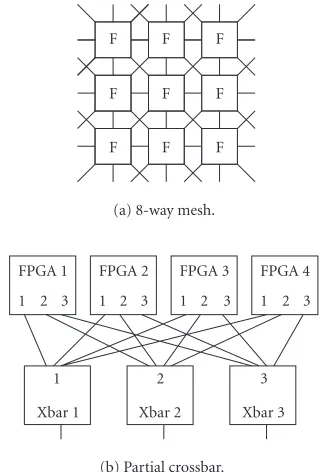
One of the key aspects of any multi-FPGA system is its rout-ing architecture and this is especially true for HW emulators. The basic architectures analyzed in the literature are mesh [21,22,23], depicted inFigure 3a, and folded Clos network, also called partial crossbar (Figure 3b) [9,24,25]. The per-formances of these networks are compared in [26].
In the folded Clos network, all connections between FP-GAs are made through crossbars. The FPGA device pins are divided into subsets. The number of subsets equals the num-ber of crossbars on that hierarchy level. In a hierarchical sys-tem, the crossbars themselves are connected to other cross-bars, which complete the interconnection. Traditionally, the connections in a Clos network are point-to-point with dedi-cated input and output switches. However, FPGA pads can be configured to be inputs, outputs, or bidirectional, which can be used to reduce the amount of required interconnection resources. A more detailed discussion on FPGA implemen-tation of Clos networks is given in [25].
A combination of complete-graph network and partial crossbar, called hybrid complete graph and partial cross-bar (HCGP), was introduced in [27,28], and corroborating
F F F
F F F
F F F
(a) 8-way mesh.
FPGA 1
1 2 3
FPGA 2
1 2 3
FPGA 3
1 2 3
FPGA 4
1 2 3
1
Xbar 1
2
Xbar 2
3
Xbar 3
(b) Partial crossbar.
Figure3: (a) 6-FPGA 8-way mesh, (b) 4-FPGA partial crossbar.
F F F F F F F F Level 0
X X X X X X Level 1
X X X Level 2
Figure4: 8-FPGA HCGP.
performance results for this interconnection strategy were given in [29]. A hierarchical HCGP (HHCGP) is depicted in Figure 4.
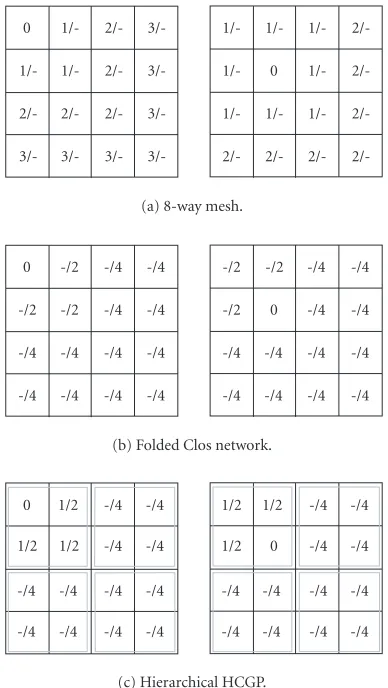
Figure 5depicts four-by-four matrices of FPGAs, where each square represents a single FPGA. Each lattice also has an underlying communication architecture, namely, an 8-way mesh, a folded Clos network, or a hierarchical HCGP as indicated in the figure. The numbers indicate the num-ber of hops necessary to reach other FPGAs in the lattice be-ginning from the FPGA marked with 0. A number before a slash indicates the hop distance using the mesh interconnect or the complete graph. A number after the slash is the hop distance traversing the partial crossbar. A dash “-” indicates that the connection cannot be formed using that commu-nication architecture. AnalyzingFigure 5and the discussion in [28,29] indicate that the HCGP has the superior routing performance from these networks.
3.2. Designing the BEE routing architecture
0 1/- 2/-
3/-1/- 1/- 2/-
3/-2/- 2/- 2/-
3/-3/- 3/- 3/-
3/-1/- 1/- 1/-
2/-1/- 0 1/-
2/-1/- 1/- 1/-
2/-2/- 2/- 2/-
2/-(a) 8-way mesh.
0 -/2 -/4 -/4
-/2 -/2 -/4 -/4
-/4 -/4 -/4 -/4
-/4 -/4 -/4 -/4
-/2 -/2 -/4 -/4
-/2 0 -/4 -/4
-/4 -/4 -/4 -/4
-/4 -/4 -/4 -/4
(b) Folded Clos network.
0 1/2 -/4 -/4
1/2 1/2 -/4 -/4
-/4 -/4 -/4 -/4
-/4 -/4 -/4 -/4
1/2 1/2 -/4 -/4
1/2 0 -/4 -/4
-/4 -/4 -/4 -/4
-/4 -/4 -/4 -/4
(c) Hierarchical HCGP.
Figure5: Hop matrices for various networks.
reported in the references above, and the following practical assumptions. All the functional elements in the design are FPGAs, that is, there are no chips dedicated solely for inter-connects. This is because we want to support designs that have computation as an integral part of their mapping to the HW. Typical examples are the tree structures in certain neu-ral network applications. In addition, it may be convenient to place control structures in the routing components.
All devices have 512 available I/Os, which is consistent with the Xilinx VirtexE 2000-FG680 (www.xilinx.com) chips that are available for this design. Moreover, the minimum useful connection width between elements is 36 signals since that breaks down to three 12-bit buses. Needless to say, this results in a large printed circuit board (PCB) which must be routable in a reasonable number of layers. The practical size requirement on the PCB also places a hard constraint on the number of FPGAs on one board. Hence, we estimated that one PCB could contain 16 processing FPGAs and their pro-grammable interconnections.
Using the HHCGP as a starting point, several problems are immediately evident. HHCGP offers low-latency inter-connects, that is, the complete graph within a hierarchy seg-ment, but all connections from one segment to another are
X
XX
5 3 3 5
5 3 3 5
F F F F F F F F
X X
X X
F · · · F
Level 0
Level 1
Level 1
Level 0
Figure6: BEE two-layer mesh routing architecture. Only half of the FPGAs and the 8-way mesh are shown.
0 1/2 2/3 3/3
1/2 1/2 2/3 3/3
2/3 2/3 2/3 3/3
3/3 3/3 3/3 3/3
1/2 1/2 1/3 2/3
1/2 0 1/3 2/3
1/3 1/3 1/3 2/3
2/3 2/3 2/3 2/3
Figure7: BEE TLM network hop matrices.
through the partial crossbar network. Using nonhierarchical HCGP would solve this problem, but this is not very practi-cal. The PCB could have routing problems and only a small number of signals are available for each interconnection due to the large number of arcs in the graph. Therefore, the 8-way mesh was selected as the local interconnection.
A large number of crossbar circuits are not desirable due to PCB component spacing constraints. However, the bars on each segment can be collapsed into one big cross-bar, thus leaving four crossbars on hierarchy level 1 and one crossbar on level 2. Furthermore, the remaining crossbar on level 2 is problematic. It adds a two-hop latency to the net-work and the logical place for this component is in the mid-dle of the PCB where routing is expected to be congested any-way. Therefore, we decided to connect level 1 with a mesh structure, effectively eliminating level 2. The advantage of this arrangement is that the crossbar-to-crossbar latency is only one hop. However, some routing generality was sacri-ficed limiting the number of long-haul interconnections and direct routing expansion through the level 2 crossbar. The re-sulting routing architecture is depicted inFigure 6and called atwo-layer mesh(TLM) network. Since only half the mesh and the FPGAs are shown, the numbers on the connection arcs indicate the number of links traversing off-network to the other half of the mesh or to BEE external I/Os. The struc-ture is relatively regular and maps well to a PCB, as seen later in this section.
Fan
MPB Riser
I/O cards
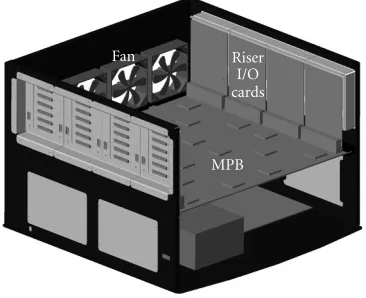
Figure8: The BEE processing unit and its chassis.
To keep the number of pins in the crossbars manageable, the minimum number of signals (36) is assigned to pass be-tween each of the FPGAs and the crossbars. Therefore, the inter-crossbar links can be 96-bits wide.
For the FPGAs, 62 signal lines are required to connect the SRAMs to each FPGA and 13 pins are reserved for the configuration and read-back bus, leaving 512−(36 + 62 + 13) = 401 FPGA pins. Dividing 401 by 8 indicates that 50 signal lines for each connection are available to form the 8-way mesh. However, using 48 signals for this purpose, (4×12-bit bus) leaves a few signals for user I/O and HW debugging. This arrangement fulfills the original requirement of no less than 36 signal lines per connection. In addition, it slightly favors the fast local interconnects, which is consistent with the dataflow paradigm.
Moreover, the emphasis on local interconnects supports our methodology for designing low-power circuits. Local wiring dominates when designing with direct-mapped com-ponents and highly parallel structures. These properties al-low designs to be run at al-lower clock frequencies, and subde-signs to have long inactive periods, which can be exploited for power optimization.
3.3. System overview
Most HW emulators are designed to maximize reusability by using modular components that each individually possesses limited design capacity, while the integrated system cumu-latively has the desired large design capacity. However, each BEE processing unit (BPU) is individually large enough to emulate systems up to 10 million ASIC equivalent gates. This is sufficient to emulate many of the contemporary DSP and communication applications.
Depicted inFigure 8, the core component of a BPU is the main processing board(MPB) which provides the basic em-ulation and computation capabilities for the system. Eight riser I/O cards (RICs) are vertically mounted to allow 2400 external connections offthe BPU. A Strong ARM-based sin-gle board computer (SBC) is utilized to establish a connec-tion between the BPU and the host server through a 10 base-T Ethernet link. A separate power board (PB), not shown in
In
te
r-boar
d
connect
ors
FPGA FPGA
FPGA
Xbar Xbar
Xbar Xbar
0th level local mesh-48-bit buses
1st level mesh-96-bit inter-Xbar buses
Legend Inter-board connectors SRAM
FPGA Xbar
Figure9: MPB interconnect structure.
the figure, along with two modular AC/DC converters, is ca-pable of supplying the MPB and the SBC with up to 600 W.
3.4. Main processing board
Utilizing the described architecture, the MPB is a 26-layer PCB, with 20 Xilinx VirtexE 2000 chips, 16 ZBT (zero bus turnaround) SRAMs, and 8 VHDM-HSD (very high-density modular high-speed differential) I/O connectors. The con-ceptual layout of this board is shown inFigure 9.
The effectiveness of the external interconnects directly af-fects the system clock speed and the algorithm mapping ca-pability of the emulator. The FPGAs on the periphery of the board have either 3 or 5 neighboring FPGAs, thus the rest of the links in the 8-way mesh are routed to the nearby off -board connectors (see alsoFigure 6).
Although using low-voltage TTL (LVTTL) signaling stan-dard is adequate for on board interconnects, off-board con-nections have much higher speed and reliability require-ments. The connection between the analog front-end and the BPU can require high data rates over several meters of cable. Therefore, low-voltage differential signaling (LVDS) is used for BPU external links. The targeted external link speed is 160 Mbps per LVDS pair over 6 feet of twisted-pair cable. LVDS is not without its own problems. Mainly, LVDS sig-nals are inherently asymmetrical. The driver has no termi-nation, while the receiver requires a 100Ωdifferential termi-nation. This means that the direction of a link is directly re-lated to the physical characteristics of the signal traces. Both LVDS and LVTTL signaling standards can be used on the riser cards, but the links are physically dedicated to imple-ment one standard at a time.
Figure10: MPB PCB layout image, seen from the top.
Table1: MPB PCB statistics.
Component count 3,400 Total pin count 28,611 Layout area (in2) 427
Number of nets 8,493 Number of connections 19,877 Manhattan distance (in) 45,950 Etch length (in) 51,804 Number of vias 32,334
practically achieved with LVTTL. This was verified through simulations with trace parameters extracted from the PCB layout. External LVTTL signaling and LVDS were tested us-ing a commercial demonstration board.
3.5. Control flow and debugging
The use of an integrated single-board computer from In-trinsic in each BPU removes the requirement of an exter-nal controlling workstation. Control and configurations are provided through the SBC Ethernet interface. The SBC con-sists of a 206-MHz Intel Strong ARM processor, 32 Mbytes of SDRAM, 16 Mbytes of Flash ROM, 10 base-T Ethernet controller, and a compact flash slot for expansion. The SBC runs a Linux, kernel 2.4.9, operating system, an Apache web server, and other servicing programs. With the compact flash slot, additional storage, such as a microdrive or compact flash memory, can further expand the capabilities of the SBC.
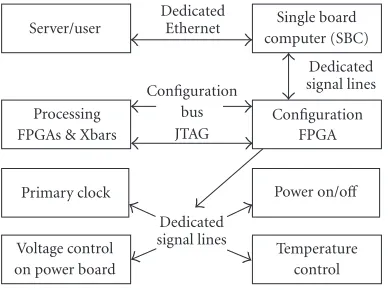
Figure 11depicts the information flow between the host server and the BEE system. First, the user generates the nec-essary design files using the BEE design flow. Second, the design files are sent to each BPU through the Ethernet and stored in memory or the hard disk of the SBC. Finally, the user issues commands to the SBC, instructing it to either configure the MPB or read back information. The Apache web server interface is used for common operations and sta-tus displays for additional convenience, while more complex operations are conducted through server daemons and shell commands.
The SBC is connected to the 20 FPGAs on an MPB through a configuration FPGA, which mainly serves as a
Server/user
Dedicated
Ethernet Single board computer (SBC)
Dedicated signal lines
Processing FPGAs & Xbars
Configuration bus JTAG
Configuration FPGA
Primary clock
Voltage control on power board
Dedicated signal lines
Power on/off
Temperature control
Figure11: BEE configuration diagram.
bidirectional signal multiplexer between the 16 general-purpose I/O lines from the SBC to over 100 control signals on an MPB. In addition, the off-board main power supply system is controllable through this link. All control functions on a BPU can be controlled from the SBC. The functions are divided into the following categories: programming of the processing FPGAs, data read back from the processing FP-GAs, clock domain control, power management, and thermal management.
Processing FPGAs can be programmed by the SBC using either the Xilinx select-map mode or the JTAG (joint test ac-tion group) mode. The JTAG daisy chain originates from the configuration FPGA, it loops through all 20 processing FP-GAs and back to the configuration FPGA. Although the JTAG interface is necessary for configuring the FPGAs and the read back, the speed through this connection is very limited. Pro-gramming the entire board through the JTAG cable can take up to 10 minutes. Therefore, the select map mode is used for fast programming. The 12-bit configuration bus originates from the configuration FPGA and snakes through all 20 FP-GAs. According to simulations, it can be driven by the SBC at 2 MHz. Hence, the programming time for the whole board is reduced to 20 seconds. Read back of the FPGA signal states can be achieved using both the JTAG interface and the user bus mode.
seconds and the quadrant clocks can deliver additional clocks to the board facilitating designs with multiple clock domains. The internal delay-locked loops (DLLs) in the FPGAs provide further clocking options.
At run time, each FPGA can consume up to 20 W and even unconfigured FPGAs draw some power. Therefore, to save energy, the main 600-W power supply is turned offby the SBC when the BPU is not in use. A separate 150-W power supply provides the always on power for the SBC and the configuration FPGA as well as the chassis fan system. In addi-tion, the I/O voltages delivered to the MPB can be configured by the SBC to be either 3.3 V for LVTTL or 2.5 V for LVDS standard.
Although high-quality passive heat sinks and high air-flow chassis fans are used to cool the BPU, all FPGAs are continuously monitored by the configuration FPGA for ther-mal problems. A total of five remote sensor chips are utilized, each monitoring four FPGAs. The sensors are programmed at boot time to alert the configuration FPGA when junc-tion temperature in any of the FPGAs exceeds 80◦C. If nec-essary, the configuration FPGA automatically shuts offthe main power and alerts the user through the SBC.
On the MPB, less than 2% of the total signals on the board are directly accessible through probing headers. Us-ing FPGA programmUs-ing, internal signals could be routed to these headers for direct probing with a logic analyzer. How-ever, this is not enough for practical HW debugging. There-fore, a software-based digital logic analyzer solution is used as the primary debugging tools for the MPBs.
Using Xilinx ChipScope Integrated Logic Analyzer (ILA), www.xilinx.com, small synchronous logic analyzer cores can be inserted into the design, acting as tiny logic analyzers at run time. The ILA records the values of the monitored sig-nals and transmits these through the JTAG interface back to the host workstation. The ChipScope software collects data from different ILA cores, which can reside on different FP-GAs, and combines them onto a signal waveform display. However, due to the long JTAG chain on the MPB, the JTAG interface can only read-back signals with a data rate of less than 56 kbits per second.
In addition to the ILA cores, which use the on-chip block RAM as data storage, the external SRAM could be used for synchronous signal recording. Since the SRAM has a capacity of 1 Mbyte and supports 32-bit wide accesses at 133 MHz, high bandwidth data can be stored in the SRAM. The read back can occur at the end of the emulation run.
From the application perspective, the control flow allows the reprogramming of any FPGA at runtime. This property could be used, for example, to emulate multistandard sys-tems that time-multiplex HW.
4. BEE SW TOOL FLOW
The primary requirement for the BEE design flow is to en-hance designer productivity. It should not be necessary to re-enter designs when the designer proceeds from one abstrac-tion level to another. This means a streamlined flow through high-level synthesis, logic synthesis, partitioning,
technol-Simulink
BEE FPGA bit files
Parameterized blocks
Figure12: BEE rapid prototyping design flow.
ogy mapping, and finally the emulation run. In addition, the model should expose the typical designer as little as possible to the actual HW. Moreover, the flow should support the use of commercial SW where adequate tools are available. How-ever, the flow must be flexible enough to allow point tools to be developed wherever the performance of commercial tools is deemed unacceptable.
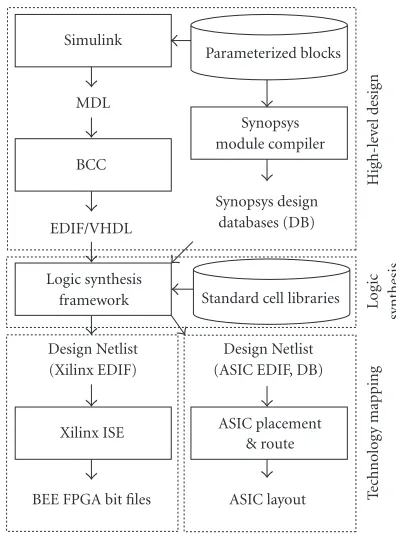
Figure 12depicts the rapid prototyping flow for BEE de-signs. Another very similar flow, based on Xilinx System Generator software, is used for designs intended solely for emulation. This “design for emulation” flow attempts to achieve the maximum performance from BEE in terms of area and operation speed. However, the rapid prototyping flow described in this paper approximates the target ASIC architecture as closely as possible. Hence, the emulation per-formance may be compromised to favor a greater confidence in gate-level verification results. In accordance with the rapid prototyping paradigm, the flow supports high abstraction level design entry from Simulink (www.mathworks.com). The flow facilitates early verification through cycle-accurate Simulink simulations, thus speeding up the normal proto-type development process.
8∗14
Frequency offset estimation and fine
Figure13: Low-power TDMA receiver.
storage format (MDL). This phase may also contain user specified implementation hints like partition information. A program called BCC (Berkeley Cross Compiler) interprets the design and outputs EDIF (electronic design interchange format). Finite state machines are translated into VHDL de-scriptions.
For ASIC design, the logic synthesis framework (Synop-sys synthesis tools) is primarily used for scan-chain insertion and synthesizing the control. For emulation, the tools allow the translation of gate-level ASIC designs to the FPGA tech-nology. Moreover, synthesis can be used to optimize designs. Since the flow does not currently offer automatic partition-ing to BEE, this design phase is carried out uspartition-ing scriptpartition-ing in Synopsys Design Compiler.
The resulting netlist is fed to a technology-dependent backend tool flow. The ASIC backend flow is typically heav-ily dependent on silicon vendor specific files and operations. However, the BEE side of the flow proceeds through the Xil-inx ISE (integrated synthesis environment) flow and pro-duces separate bitstreams for each of the FPGAs actually in use. The BEE Configurator Program is responsible for pro-gramming the FPGAs on the BPUs.
There are several goals for the emulation system tool-flow. One goal is to minimize the number of required FP-GAs, which also tends to minimize the inter-FPGA signals lines. This is important to avoid a possible design bottleneck. Another goal is to define the interfaces between FPGAs, a task that requires special care. In particular, the timing character-istics of these signals are important and good design practices like pipelining, registered outputs, and restricting the logic depth are typically necessary for off-chip signals [4].
5. BEE APPLICATION EXAMPLE
To illustrate HW utilization and the details of the design flow, a baseband TDMA (time division multiple access) re-ceiver is used as an application example. The rere-ceiver, docu-mented in [31], was developed using SSHAFT. A block
dia-gram of the low-power, spread-spectrum receiver is depicted in Figure 13. The design is intended to be a part of an ex-tremely low-power wireless sensor network.
The receiver uses a direct-sequence code with a length of 31 bits to spread the spectrum and to provide resistance to narrowband fading. The symbol rate is 806 kHz, which translates to 1.6 Mb/s data rate with QPSK (quadrature phase shift keying) modulation. In-phase and quadrature (I and Q) samples from an A/D converter are fed into the design as 8-bit streams of 100 MHz (64 pins). They are interpolated on-chip to produce 7-bit streams at 200 MHz, corresponding to 8 samples per chip, each offset by 1/8 of a chip. The primary function of the receiver is to provide coherent timing recov-ery for the input stream.
The coarse timing acquisition block uses a feedforward, non-data-aided algorithm based on a matched filter to es-timate timing within 3/8 of a chip. Three of the eight streams are correlated with the known spreading code un-til one of them passes a threshold. The frequency estima-tion and fine-timing block utilizes this stream and its two nearest neighbors to estimate the frequency and to further estimate the timing to the best of the three streams. The method utilized is a joint estimation feedforward, data-aided algorithm synthesized directly from maximum likelihood equations.
70
77
Out
In
42
42
2
7 3
5 20
20
10
3 FPGA 1 Controller, coarse timing,
MUX
FPGA 2
Frequency estimation
Xbar 1
FPGA 3
Rotate and correlate, PLL
FPGA 4
Figure14: A TDMA receiver mapped to a BEE quadrant.
then uses a decision-directed algorithm to track phase offset error throughout the remainder of the packet.
The ASIC implementation of this design has approxi-mately 700,000 transistors covering an area of 2.4 mm2.
Alto-gether the design has 147 external I/O signals. The same de-sign maps to several FPGAs in a BEE quadrant, as shown in Figure 14, which also depicts the external I/Os and the num-ber of signals between the chips.
The control logic is located in FPGA 1 since it shares pilot codes (64 bits) with the coarse timing function. In terms of routing, it would be expensive to separate these two blocks. The logical position for the control would have been in the Xbar 1 because it needs to access and control all the blocks in the design. However, this partitioning does not affect the functionality or the real-time performance of the design. Aside from the controller, FPGA 1 is basically a large multi-plexer. FPGA 1 feeds the selected three streams to frequency estimation (FPGA 2) and to rotate and correlate (FPGA 3). Moreover, FPGA 3 encompasses the digital PLL block and produces the outputs. To facilitate testing of the target ASIC, the symbol outputs in the ASIC design are routed off-chip along the test outputs. These test outputs happen to reside on FPGA 1 and, therefore, the symbol outputs are routed off -BEE from FPGA 1 as well.
The design was manually partitioned in Synopsys Design Compiler using a synthesis script. The unmodified gate-level descriptions of the subsystems from the ASIC design were utilized in this mapping. The high-level design in Simulink provided the necessary structural information to connect these subdesigns. In addition, this phase was used to auto-matically translate the design into a Xilinx FPGA specific netlist.
Each of the partitioned designs was then fed to the Xil-inx ISE flow, which produced the bitstreams. As mentioned earlier, this design flow produces an emulation that is a very close match to the ASIC implementation and the design for emulation requires little effort. However, it does not fully
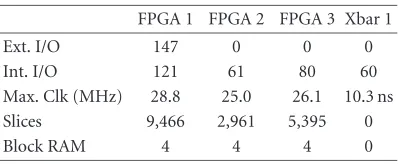
Table2: Key statistics for the BEE implementation of the receiver.
FPGA 1 FPGA 2 FPGA 3 Xbar 1
Ext. I/O 147 0 0 0
Int. I/O 121 61 80 60
Max. Clk (MHz) 28.8 25.0 26.1 10.3 ns Slices 9,466 2,961 5,395 0
Block RAM 4 4 4 0
exploit FPGA specific features, therefore making the emu-lation slow. A method for speeding up the emuemu-lation run through substituting critical blocks with FPGA specific de-signs and discussion on the advantages and disadvantages of the respective methods are documented in [5].
Despite the apparent disadvantages of the FPGA and ASIC technology mismatch, the emulator architecture com-bined with the tool flow overcomes these limitations for the target applications. For example, the real-time opera-tion requirement for the ASIC design is a clock frequency of 25 MHz. The synthesis tools, after placement and route to the FPGAs, indicate a maximum operating frequency of 25.0 MHz for the BEE implementation. Therefore, the real-time requirement is satisfied. The primary statistics for the FPGAs are tabulated in Table 2. The external I/Os are off -BEE connections and the internal I/Os connect with other components inside the BEE.
The slices in Table 2 indicate the utilized area on the FPGA chip. Each of the FPGAs contains 19,200 slices mak-ing FPGA 1 the most populated chip with 49% area utiliza-tion. The slice counts include the overhead induced by the Xilinx ChipScope architecture and the ChipScope exclusively utilizes the block rams in this design.
The slowest chip is FPGA 2 with a maximum clock fre-quency of 25.0 MHz. FPGA 3 had an approximately 100 nanoseconds combinatorial path from its registered outputs to an internal cordic block. However, this is a multicycle path that can afford to take 31 clock cycles to complete. Therefore, the maximum clock frequency for this chip was obtained with the multicycle path designated as a false path.
Since Xbar 1 does not contain any sequential logic, its op-erating speed is characterized as the maximum routing delay through the chip (10.3 ns). Based on simulations using trace models extracted from the PCB and IBIS driver models for the FPGAs, the maximum delay introduced by a hop is below 5 ns. Therefore, the worst-case estimate for 2-hop inter-chip critical routing is 2×5 + 10.3 =20.3 ns. This is well below the 40-ns cycle time imposed by the real-time requirement.
6. CONCLUSIONS
nature of the BEE emulator. The architecture is also shown to be practically implementable on a PCB.
Mapping an existing design to BEE, in this case, a low-power TDMA receiver verifies in part that the architecture is suitable for emulating data flow centric designs and that BEE emulations are compatible with the existing hierarchical and automated design flow. Simulations suggest that the design can be emulated in real time using a primary clock frequency of 25 MHz.
Physically, a BEE processing board is a 26-layer PCB con-taining 3400 components. The system was designed to han-dle signaling speeds of 50 MHz between any two chips on the board. Overall, a BPU has the emulation capability of approximately 10 million ASIC gate equivalents. Thus, we see BEE as an excellent specification and architecture explo-ration environment for full DSP systems. BEE offers real-time HW, and secondarily software prototyping and emula-tion, the possibility to prototype during all levels in the de-sign trajectory, and a transparent SW flow.
The future work in this project involves the finaliza-tion of the HW infrastructure and building addifinaliza-tional ana-log front-ends for ultra wideband (UWB) and multicarrier multiantenna (MCMA) applications. Moreover, we intend to streamline the SW flow and include multichip support while primarily using the Xilinx System Generator tool flow. Espe-cially, the critical path back annotation problem, mentioned inSection 2.1, must be studied further.
ACKNOWLEDGMENTS
Dr. Kuusilinna’s work was supported by the Technology De-velopment Center of Finland (TEKES), Jenny and Antti Wi-huri Foundation, and the Finnish Cultural Foundation. This work was funded by DARPA (under the PAC/C program; SIA GSRC), the US Army Research Office, and the Berkeley Wire-less Research Center supporting companies. In addition, we would like to thank Xilinx for donating the FPGA chips and the software tools.
REFERENCES
[1] R. Turner, “System-level verification—a comparison of ap-proaches,” inProc. 10th International Workshop on Rapid Sys-tem Prototyping (RSP ’99), pp. 154–159, Clearwater, Fla, USA, June 1999.
[2] K. M. G. Purna and D. Bhatia, “Emulating large designs on small reconfigurable hardware,” inProc. 9th International Workshop on Rapid System Prototyping (RSP ’98), pp. 58–63, Leuven, Belgium, June 1998.
[3] J. Babb, R. Tessier, and A. Agarwal, “Virtual wires: Overcom-ing pin limitations in FPGA-based logic emulators,” inProc. 1st IEEE Workshop on FPGAs for Custom Computing Machines (FCCM ’93), pp. 142–151, Napa, Calif, USA, April 1993. [4] M. Courtoy, “Rapid prototyping for communications design
validation,” inSouthcon Conference Record, pp. 49–54, Or-lando, Fla, USA, June 1996.
[5] H. Krupnova, D. D. A. Vu, G. Saucier, and M. Boubal, “Real time prototyping method and a case study,” inProc. 9th Inter-national Workshop on Rapid System Prototyping (RSP ’98), pp. 13–18, Leuven, Belgium, June 1998.
[6] M. Vasilko, L. Machacek, M. Matej, P. Stepien, and S. Hol-loway, “A rapid prototyping methodology and platform for seamless communication systems,” inProc. 12th International Workshop on Rapid System Prototyping (RSP ’01), pp. 70–76, Monterey, Calif, USA, June 2001.
[7] G. Doncev, M. Leeser, and S. Tarafdar, “Truly rapid prototyp-ing requires high level synthesis,” inProc. 9th International Workshop on Rapid System Prototyping (RSP ’98), pp. 101– 106, Leuven, Belgium, June 1998.
[8] F. Slomka, M. Dorfel, R. Munzenberger, and R. Hofmann, “Hardware/software codesign and rapid prototyping of em-bedded systems,” IEEE Design & Test of Computers, vol. 17, no. 2, pp. 28–38, 2000.
[9] J. Varghese, M. Butts, and J. Batcheller, “An efficient logic em-ulation system,”IEEE Transactions Very Large Scale Integration (VLSI) Systems, vol. 1, no. 2, pp. 171–174, 1993.
[10] H. Krupnova, C. Rabedaoro, and G. Saucier, “FPGA parti-tioning for rapid prototyping: A 1 million gate design case study,” inProc. International Workshop on Rapid System Pro-totyping (RSP ’99), pp. 128–133, Clearwater, Fla, USA, June 1999.
[11] W. Y. Lo, C. S. Choy, and C. F. Chan, “Hardware emulation board based on FPGAs and programmable interconnections,” inProc. 5th International Workshop on Rapid System Prototyp-ing (RSP ’94), ShortenPrototyp-ing the Path from Specification to Pro-totype, pp. 126–130, The Chinese University of Hong Kong, Shatin, N.T., Hong Kong, June 1994.
[12] J. Madrenas, J. M. Moreno, E. Canto, et al., “Rapid proto-typing of electronic systems using FIPSOC,” inProc. 7th IEEE International Conference on Emerging Technologies and Factory Automation (ETFA ’99), pp. 287–296, Barcelona, Spain, Octo-ber 1999.
[13] B. Spitzer, M. K¨uhl, and K. D. M¨uller-Glaser, “A methodology for architecture-oriented rapid prototyping,” inProc. 12th In-ternational Workshop on Rapid System Prototyping (RSP ’01), pp. 200–205, Monterey, Calif, USA, June 2001.
[14] J.-P. David and J.-D. Legat, “A data-flow oriented co-design for reconfigurable systems,” inProc. 9th International Work-shop on Rapid System Prototyping (RSP ’98), pp. 207–211, Leu-ven, Belgium, June 1998.
[15] P. Sabet and L. Vuillemin, “An approach to mapping the tim-ing behavior of VLSI circuits on emulators,” inProc. 12th In-ternational Workshop on Rapid System Prototyping (RSP ’01), pp. 168–173, Monterey, Calif, USA, June 2001.
[16] S. Cardelli, M. Chiodo, P. Giusto, A. Jurecska, L. Lavagno, and A. Sangiovanni-Vincentelli, “Rapid-prototyping of embed-ded systems via reprogrammable devices,” inProc. 7th Inter-national Workshop on Rapid System Prototyping (RSP ’96), pp. 133–138, Porto Carras, Thessaloniki, Greece, June 1996. [17] H. Hakkarainen and J. Isoaho, “VHDL macro library testing
using BOAR emulation tool,” inProc. 8th Annual IEEE In-ternational ASIC Conference and Exhibit (ASIC ’95), pp. 105– 108, Tampere University of Technology, Finland, September 1995.
[18] D. M. Lewis, D. R. Galloway, M. Van Ierssel, J. Rose, and P. Chow, “The transmogrifier-2: A 1 million gate rapid proto-typing system,”IEEE Transactions Very Large Scale Integration (VLSI) Systems, vol. 6, no. 2, pp. 188–198, 1998.
[19] S. Note, P. van Lierop, and J. van Ginderdeuren, “Rapid proto-typing of DSP systems: requirements and solutions,” inProc. 6th International Workshop on Rapid System Prototyping (RSP ’95), pp. 88–96, Chapel Hill, NC, USA, June 1995.
[21] S. Hauck, G. Borriello, and C. Ebeling, “Mesh routing topolo-gies for multi-FPGA systems,” IEEE Transactions Very Large Scale Integration (VLSI) Systems, vol. 6, no. 3, pp. 400–408, 1998.
[22] C. Kim and H. Shin, “A performance-driven logic emulation system: FPGA network design and performance-driven parti-tioning,”IEEE Transactions on Computer-Aided Design of Inte-grated Circuits and Systems, vol. 15, no. 5, pp. 560–568, 1996. [23] S. Walters, “Computer-aided prototyping for ASIC-based
sys-tems,”IEEE Design & Test of Computers, vol. 8, no. 2, pp. 4–10, 1991.
[24] M. Butts, J. Batcheller, and J. Varghese, “An efficient logic em-ulation system,” inIEEE International Conference on Com-puter Design: VLSI in ComCom-puter & Processors (ICCD-92), pp. 138–141, Cambridge, Mass, USA, October 1992.
[25] P. K. Chan and M. D. F. Schlag, “Architectural tradeoffs in field-programmable-device-based computing systems,” in Proc. IEEE Workshop on FPGAs for Custom Computing Ma-chines (FCCM ’93), pp. 152–161, Napa, Calif, USA, April 1993.
[26] M. A. S. Khalid and J. Rose, “Experimental evaluation of mesh and partial crossbar routing architectures for multi-FPGA sys-tems,” inProc. 6th IFIP International Workshop on Logic and Architecture Synthesis (IWLAS ’97), pp. 119–127, Grenoble, France, December 1997.
[27] M. A. S. Khalid and J. Rose, “A hybrid complete-graph partial-crossbar routing architecture for multi-FPGA systems,” in Proc. ACM/SIGDA International Symposium on Field Pro-grammable Gate Arrays (FPGA ’98), pp. 45–54, Monterey, Calif, USA, February 1998.
[28] M. A. S. Khalid and J. Rose, “A novel and efficient routing architecture for multi-FPGA systems,”IEEE Transactions Very Large Scale Integration (VLSI) Systems, vol. 8, no. 1, pp. 30–39, 2000.
[29] S. C. Jain, S. Kumar, and A. Kumar, “Evaluation of various routing architectures for multi-FPGA boards,” inProc. 13th CSI/IEEE International Conference on VLSI Design, pp. 262– 267, Calcutta, India, January 2000.
[30] W. R. Davis, N. Zhang, K. Camera, et al., “A design environ-ment for high-throughput, low-power dedicated signal pro-cessing systems,” IEEE Journal of Solid-State Circuits, vol. 37, no. 3, pp. 420–431, 2002.
[31] W. R. Davis, N. Zhang, K. Camera, et al., “An automated design flow for low-power, high-throughput, dedicated sig-nal processing systems,” inProc. 35th Asilomar Conference on Signals, Systems and Computers (Asilomar ’01), pp. 475–480, Pacific Grove, Calif, USA, November 2001.
Kimmo Kuusilinnareceived his Ph.D.
de-gree from the Department of Information Technology at Tampere University of Tech-nology (TUT), Finland, in 2001. His main research interests include hardware emula-tion, computer networks, system-on-a-chip design, and parallel memories. Currently, he is working as a Senior Research Scien-tist in the Institute of Digital and Computer Systems at TUT. He was a Visiting
Postdoc-toral Researcher at the University of California, Berkeley, Berkeley Wireless Research Center.
Chen Chang received the B.S. degree in
electrical engineering and computer sci-ence, B.A. degree in physics, and M.S. de-gree in electrical engineering and com-puter science from the University of Cali-fornia, Berkeley, in 2000 and 2002, respec-tively. He is currently working toward the Ph.D. degree at the University of Califor-nia at Berkeley studying with Professor R. W. Brodersen. His research interests include
very large-scale digital system design automation and FPGA-based reconfigurable computing.
M. Josephine Ammerreceived the B.S. and
M.E. degrees in electrical engineering and computer science from the Massachusetts Institute of Technology (MIT), Cambridge, in 1997 and 1999, respectively. She is cur-rently working toward the Ph.D. degree at the University of California at Berkeley, studying with Professor J. Rabaey. Her re-search interests include low-power digital integrated circuits for wireless
communica-tion. She received the Robert M. Fano UROP (Undergraduate Re-search) Award in 1997 and the Ernst A. Guillemin Masters Thesis Award, First Prize, in 1999, while she was at MIT.
Brian C. Richards was born in Seattle,
Washington on August 20, 1961. He re-ceived the B.S. degree in electrical engineer-ing from the California Institute of Tech-nology in 1983, and the M.S. degree in electrical engineering and computer science from the University of California, Berkeley, in 1986. From 1986, he joined the research staffat the University of California, Berke-ley. He is maintaining and continuing the
development of several ASIC and FPGA system design CAD tools. Current projects include supporting various research efforts related to prototyping and implementing wireless systems at the Berkeley Wireless Research Center.
Robert W. Brodersenis a Scientific
Codi-rector of the Berkeley Wireless Research Center and John R. Whinnery Chair Profes-sor at the Electrical Engineering and Com-puter Science Department. A pioneer in the field of analog MOS circuit design and implementation of signal processing sys-tems. He received his Ph.D. degree from MIT in 1976, and was associated with the Central Research Laboratory, Texas