The ETAPE speech processing evaluation
Olivier Galibert
1, Jeremy Leixa
2, Gilles Adda
3, Khalid Choukri
4, Guillaume Gravier
51[email protected], LNE, France 2[email protected], ELDA, France 3[email protected], LIMSI, CNRS, France
4[email protected], ELDA, France 5[email protected], IRISA, France
Abstract
The ETAPE evaluation is the third evaluation in automatic speech recognition and associated technologies in a series which started with ESTER. This evaluation proposed some new challenges, by proposing TV and radio shows with prepared and spontaneous speech, annotation and evaluation of overlapping speech, a cross-show condition in speaker diarization, and new, complex but very informative named entities in the information extraction task. This paper presents the whole campaign, including the data annotated, the metrics used and the anonymized system results. All the data created in the evaluation, hopefully including system outputs, will be distributed through the ELRA catalogue in the future.
Keywords:ETAPE; evaluation campaign; overlapping speech; speaker diarization; ASR; named entities detection
1.
Introduction
Starting in 2003, a number of evaluations have been con-ducted to assess the state-of-the-art of speech processing in French. The first two evaluations, called ESTER (Gravier et al., 2004; Galliano et al., 2009) put the emphasis on the handling of broadcast news, with an added twist of accents in the second one. This paper presents the third evaluation, ETAPE, which proposed some new challenges:
• TV and radio shows with prepared and spontaneous speech
• Handling of overlapping speech (detection, speaker segmentation and transcription)
• Cross-show condition in speaker diarization
• Complex named entities detection
2.
The ETAPE evaluation
2.1.
Overlapping speech detection
The first proposed task was to ask the systems to detect overlapping speech. They simply had to give time intervals in which overlapping speech happened.
Two metrics were proposed. The first one is a simple error metric, compute the false alarm and miss time amount and divide by the reference speech time:
OSDER= miss + false alarm total reference time
An alternative metric, built to compensate for the diffi-culty for human to position precise frontiers for overlap-ping speech, is an event detection quality metric. For every overlapping speech interval of the hypothesis, compute the temporal position of its middle and check whether that time is noted as overlapping in the reference. That gives a pre-cision. The same calculation the other way around gives a recall. The final metric is the F-measure of the two.
2.2.
Cross-show Speech diarization
Speaker Diarization, also called "who spoke when", is the process of identifying, for each speaker of an input audio recording, all the regions where he/she is talking. Each temporal region containing speech should be labeled with at least one speaker-tag and segments from the same speaker shall be labeled with the same tag. Speaker tags are not identities but abstract labels. Systems were also required to collapse together interventions of the same speaker in mul-tiple shows, hence the name of the task.
The main metric for diarization performance measurement is the Diarization Error Rate. It has been introduced by the NIST in 2000 within the Speaker Recognition evalua-tion (NIST, 2000) for their then-new speaker segmentaevalua-tion task. The metric is computed in two steps: the first step is to establish a mapping between the speaker tags provided by the system and the speaker identities found in the refer-ence. The second step then computes the error rate using that mapping. Computing an error rate requires defining what the errors can be. Three error types are defined in the diarization context:
• The confusion error, when the system-provided speaker tag and the reference do not match through the mapping.
• Themisserror, when speech is present in the reference but no speaker is present in the hypothesis.
• The false alarm error when speech has incorrectly been detected by the system.
These errors happen on segments of speech, of which the durations are summed together. Adding these durations gives us a time in error. This time in error is finally di-vided by the total reference speech time for normalization purposes. That gives us the final DER definition as:
DER= confusion + miss + false alarm
The mapping establishment methodology and other sub-tleties due to the overlapping speech are described in (Gal-ibert, 2013).
2.3.
Speech transcription
Speech transcription is a task were the systems are required to tell what words were spoken and when. The Word Er-ror Rate (WER) is the usual primary evaluation metric for this evaluation. That metric basically counts the number of word deletions, insertions and substitutions in the output of the automatic transcription system compared to a reference transcription produced by humans.
More precisely, the word error rate can be computed as shown in Equation 2.3.:
W ER= S+D+I
N
where:
• S is the number of substitutions,
• D is the number of the deletions,
• I is the number of the insertions,
• N is the number of words in the reference transcrip-tion.
Due to the presence of overlapping speech we tried multiple ways of evaluating the system outputs:
• Dispatch the words in overlapping zones optimally to the different speakers (Optimally speaker-attributed word error rate)
• Ask the systems to add a speaker identity to the words, use that as a hard constraint (Speaker-attributed)
• Ask the systems to add a speaker identity to the words, add a confusion error type (Speaker-attributed with confusion)
As for the previous metric a complete description is avail-able in (Galibert, 2013).
In addition the Normalized Cross-Entropy (NCE) metric has been used to evaluate the quality of the confidence val-ues when provided. The cross-entropy between the confi-dence values and a perfect prediction (e.g. 0 for incorrect words and 1 for correct words) is computed and normalized with the maximum possible value, yielding a result in the interval]−∞,1]. Noting for each wordwof the hypothesis its associated confidencec(w), and notingnthe number of correct words out of theNwords of the hypothesis:
N CE =
Hmax+Pw
log2c(w) ifwcorrect
log2(1−c(w)) otherwise
Hmax
Hmax=−nlog2
n
N −(N−n) log2
N−n N
A well tuned system usually produces a result of over 0.2.
2.4.
Named entities detection
The Named Entities detection task aims at detecting and classifying multi-word expressions useful for building fact databases from news data. The annotations followed a com-plex but powerful schema introduced within the Quaero project (Grouin et al., 2011). In that annotation schema the entities are both hierarchical, e.g. their types are structured in a tree-like fashion, and compositional, dividing them in typed sub-spans called components. That structuration al-lows for a better coverage of the interesting entities from an information retrieval point of view while avoiding an explo-sion in the number of different possible entities classes. The evaluation follows the method described in (Galibert et al., 2011). It is done through a variant of the Slot Error Rate (SER) done in two steps:
• Associate annotations of the hypothesis and the refer-ence
• Compute an error rate using these associations
All annotations are considered independently, ignoring the structure. The error rate is computed by counting the er-rors in classification, boundaries or both, plus insertions and deletions, and giving a weight for each error type. And, as usual, dividing by the number of annotations to find:
SER= I+D+ 0.5Ec+ 0.5Eb+Ebc
R
where:
• Iis the number of inserted annotations
• Dis the number of missed annotations
• Ecis the number of classification only errors
• Ebis the number of boundaries only errors
• Ebc is the number of both classification and
bound-aries errors
• Ris the number of annotations in the reference
The evaluation is also done on the output of the ASR sys-tems. The references on the manual transcription are pro-jected on the automatic one with a tolerance on the anno-tation frontiers. That allows to use the same metric and hence have comparable results for the detection in manual and automatic transcriptions.
3.
The Data
A pre-version of the corpus was presented in (Gravier et al., 2012), we will present here the final state.
Source Show Train Dev Test Total Overlap Total Overlap Total Overlap BFM TV BFM Story 4:01:47 0:17:28 0:44:30 0:05:55 0:44:38 0:05:19 LCP Ca Vous Regarde 2:18:35 0:09:42 0:53:53 0:07:46 0:55:52 0:10:44 Entre les Lignes 2:39:38 0:14:36 0:52:52 0:10:26 0:53:31 0:08:02 Pile et Face 3:30:59 0:46:23 0:26:44 0:01:38 0:26:34 0:05:37 Top Questions 1:19:50 0:00:30 0:28:38 0:00:19 0:28:23 0:00:19 TV8 Mont Blanc La place du village - - 0:47:21 0:01:53 0:50:19 0:06:26
France Inter Le Fou du Roi 1:17:57 0:06:02 - - -
-Un Temps de Pauchon 1:00:08 0:01:32 0:20:44 0:00:39 0:23:10 0:00:16 Comme on nous parle 1:29:03 0:01:49 0:31:23 0:00:44 0:25:35 0:00:24 Le Masque et la Plume 3:05:41 0:13:57 0:54:14 0:04:32 0:54:06 0:07:10
La Tête au Carré 0:55:11 0:02:49 - - -
-Service Public - - 0:52:58 0:02:05 0:55:04 0:03:01 Total 21:38:49 1:54:48 6:53:17 0:35:57 6:57:12 0:47:18
Table 1: Amount of speech present in the ETAPE corpus
Train Dev Test
Speech segments 23,017 7,189 8,581 Words 335,387 109,646 115,803
Entities 19,270 5,913 5,933
[image:3.595.62.281.301.365.2]Components 27,656 8,410 8,609
Table 2: Some statistics for the ETAPE corpus
Lab. Run Time error F-measure
A all64m p0 46.3% 13.8%
no64ms128m p0 40.4% 10.9% no64ms128m p10 40.0% 13.5%
no64ms256m p0 39.5% 7.4%
B primary 36.9% 15.2%
C primary 37.7% 31.6%
[image:3.595.302.547.302.668.2]cms 34.8% 33.5%
Table 3: Overlapping speech detection results
4.
Evaluation results
4.1.
Overlapping speech detection
The overlapping speech detection results are available in table 3. We can notice that the time error is similar for all systems while the F-measure, which tries to evaluate the presence detection, varies a lot more. Looking at the data we can’t help but notice that annotating overlapping speech is not an easy task for humans. Segements annotated as overlapping in the transcription are often overestimated, in particular in the case of short backchannels. Further exper-iments in that area will require the use of systems to re-fine the boundaries, but what systems is unclear in the first place. In particular the usual method of forced alignement on the reference on the acoustic signal may not be reliable on overlapping speech.
4.2.
Speaker diarization
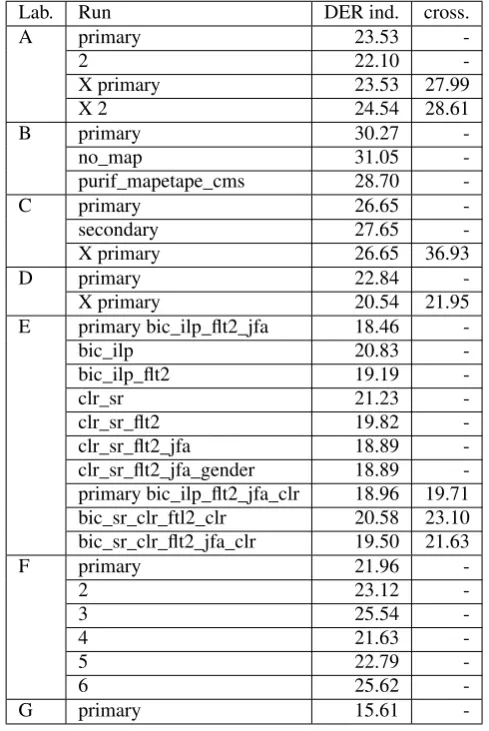
The speech diarizarion results are available in table 4. We can see that numerous experiments were done by the
partic-Lab. Run DER ind. cross.
A primary 23.53
-2 22.10
-X primary 23.53 27.99
X 2 24.54 28.61
B primary 30.27
-no_map 31.05
-purif_mapetape_cms 28.70
-C primary 26.65
-secondary 27.65
-X primary 26.65 36.93
D primary 22.84
-X primary 20.54 21.95
E primary bic_ilp_flt2_jfa 18.46
-bic_ilp 20.83
-bic_ilp_flt2 19.19
-clr_sr 21.23
-clr_sr_flt2 19.82
-clr_sr_flt2_jfa 18.89
-clr_sr_flt2_jfa_gender 18.89 -primary bic_ilp_flt2_jfa_clr 18.96 19.71 bic_sr_clr_ftl2_clr 20.58 23.10 bic_sr_clr_flt2_jfa_clr 19.50 21.63
F primary 21.96
-2 23.12
-3 25.54
-4 21.63
-5 22.79
-6 25.62
-G primary 15.61
-Table 4: Speech diarization results
No overlap Optimal Speaker conf. Speaker att.
WER NCE WER NCE WER NCE WER NCE
A p1_rasr 32.66 - 39.11 - - - -
-p1_speer 38.86 - 44.60 - - - -
-bong 32.13 - 38.66 - - - -
-rov_bong 29.95 - 36.72 - - - -
-B primary 26.40 -0.527 33.06 -0.527 39.11 -0.717 57.62 -0.705 2 27.24 0.230 33.89 0.226 39.99 0.031 56.70 0.024 3 27.00 0.184 33.73 0.175 39.73 -0.016 56.77 -0.024 4 25.27 0.240 32.03 0.236 38.07 0.039 55.77 0.032
C primary 37.50 - 43.25 - 50.35 - 70.66
-2 36.28 - 42.22 - 57.52 - 93.89
-3 38.43 - 44.19 - 59.03 - 94.64
-D primary 21.83 −∞ 28.84 −∞ 33.80 −∞ 50.33 −∞
contraste 23.16 −∞ 30.06 −∞ 35.12 −∞ 51.98 −∞
E primary 26.23 - 32.71 - 43.17 - 74.06
-contraste1 32.62 - 38.84 - 49.44 - 80.95
-contraste2 31.10 - 37.12 - 57.25 - 107.33
-All rover 28.68 - 35.63 - - - -
-oracle 10.95 - - -
-Table 5: Speech transcription results
4.3.
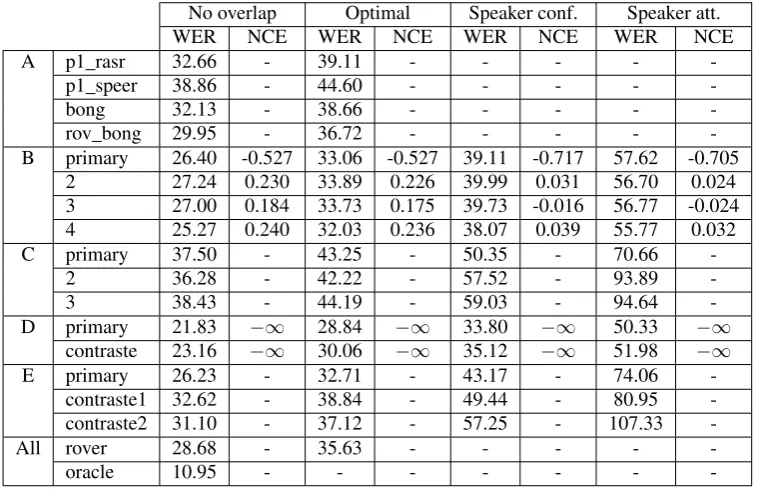
Speech transcription
The speech transcription results are available in table 5. The transcriptions were corrected through checking the results of an oracle rover, where all the system outputs are merged together and the best solution is chosen given the refer-ence. The error rates of the oracle rover go from 1.63% (Top Questions) up to 39.55% (Un Temps de Pauchon). The standard rover results are not very good, due to a poor choice of system order when adding them together.
[image:4.595.107.486.68.313.2]0 10 20 30 40 50 60 70 80 90 To p Q u es tio n s 2 0 1 1 -0 5 -1 8 To p Q u es tio n s 2 0 1 1 -0 5 -2 5 Pil e et F ac e 2 0 1 1 -0 5 -2 6 B FM S to ry 2 0 1 1 -0 5 -3 1 E n tre le s L ig n es _2 0 1 1 -0 5 -1 3 E n tre le s L ig n es _2 0 1 1 -0 5 -0 6 C a Vo u s R eg ar d e 2 0 1 1 -0 5 -1 2 S er vic e Pu b lic 2 0 1 0 -0 2 -0 8 Le M as q u e et la P lu m e 2 0 1 0 -1 0 -2 4 C om m e on n ou s p ar le 2 0 1 0 -1 0 -1 8 U n Te m p s d e Pa u ch on 2 0 1 0 -1 0 -1 4 U n Te m p s d e Pa u ch on 2 0 1 0 -0 2 -0 8 La p la ce d u v illa g e 2 0 1 1 -0 5 -1 2 La p la ce d u v illa g e 2 0 1 1 -0 5 -0 3 U n Te m p s d e Pa u ch on 2 0 1 0 -1 0 -0 7 W E R
Figure 1: Per-system WER depending on the file. The low-est line is the oracle rover.
Figure 1 shows the results obtained by every system on each show after sorting them by oracle rover score. We can see a clear difference between Un temps de Pauchon andLa place du villagetogether and all the other shows. Those two shows are built around field reporting, interviewing
run-of-the-mill people in often difficult sound conditions, on subjects such as a culinary metting or naturalization oath proceedings for Un temps de Pauchon, or the history of a remote village for La place du village. The accents are heavy, the vocabulary and topics unusual, and the speakers not trained. That accumultes difficulties for the systems. The difference between the no-overlap and the optimal mapping scores, which is within the range of the overlap-ping speech ratio, shows that the systems have been ex-tremely bad on the overlapping speech. Hopefully having both transcribed data and the evaluation tools available will make deeper work in that area possible in the future. It is, in any case, definitively not a solved problem.
4.4.
Named Entities Detection
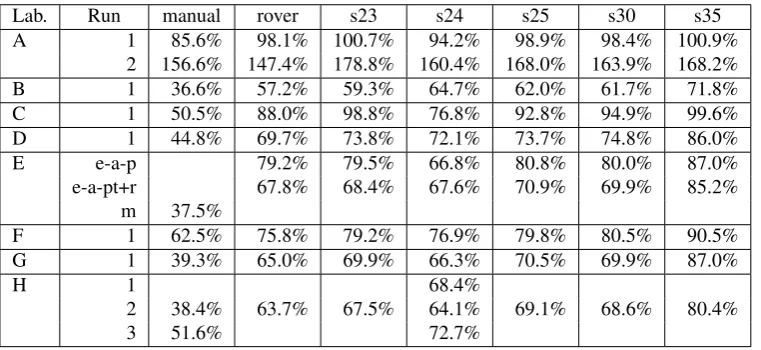
The named entities detection results are available in table 6. The complexity of the Quaero named entities require a large amount of work in the adjudication phase of the evaluation, which, in addition to individual remarks, ended up defining a dozen rules to detect possible problems and have humans judge and fix them. Still, some problems were not fixable due to a lack of foresight: defining entities boundaries in the presence of overlapping speech requires taking the speaker into account. Extracting the text and annotating it doesn’t work well due to intermixed speech turns. Retrying such an exercise will require some experiments to define the best annotation approach.
[image:4.595.55.284.486.660.2]Lab. Run manual rover s23 s24 s25 s30 s35
A 1 85.6% 98.1% 100.7% 94.2% 98.9% 98.4% 100.9%
2 156.6% 147.4% 178.8% 160.4% 168.0% 163.9% 168.2%
B 1 36.6% 57.2% 59.3% 64.7% 62.0% 61.7% 71.8%
C 1 50.5% 88.0% 98.8% 76.8% 92.8% 94.9% 99.6%
D 1 44.8% 69.7% 73.8% 72.1% 73.7% 74.8% 86.0%
E e-a-p 79.2% 79.5% 66.8% 80.8% 80.0% 87.0%
e-a-pt+r 67.8% 68.4% 67.6% 70.9% 69.9% 85.2%
m 37.5%
F 1 62.5% 75.8% 79.2% 76.9% 79.8% 80.5% 90.5%
G 1 39.3% 65.0% 69.9% 66.3% 70.5% 69.9% 87.0%
H 1 68.4%
2 38.4% 63.7% 67.5% 64.1% 69.1% 68.6% 80.4%
[image:5.595.108.489.67.242.2]3 51.6% 72.7%
Table 6: Named entities detection results
We were not fully satisfied with the SER metric and are developing a new one for future evaluations which gives better insights on the system qualities, see (Ben Jannet et al., 2014) for details.
5.
Conclusion
This paper presented the ETAPE evaluation, including data, metrics and anonymized results. Some encountered diffi-culties were described and solutions will have to be devised if overlapping speech-handling systems are to be evaluated further.
The overlapping speech detection are promising, especially given the difficulty in establishing the references. Speaker diarization worked rather well, and the cross-show condi-tion was well handled, validating from a feasability stand-point this very useful condition from an applicative stand-point of view.
Speech transcription worked reasonably well on news and debates data, and rather badly on very spontaneous field speech, as expected. In addition, overlapped speech was very badly handled. Hopefully the availability of the data will make progress possible.
Finally the named entitities detection task was the first time the new Quaero named entities were open to the scien-tific community. They are complex and their new struc-ture requires new approaches to handle them, giving not so impressive results which can only get better in the future. The community answer to these entities was rather positive though, which gives good hope for the creation of powerful systems handling them.
6.
References
Ben Jannet, M. A., Adda-Decker, M., Galibert, O., Kahn, J., and Rosset, S. (2014). Eter : a new metric for the evaluation of hierarchical named entity recognition. In Proc of LREC, Reykjavik, Iceland. ELRA.
Galibert, O., Rosset, S., Grouin, C., Zweigenbaum, P., and Quintard, L. (2011). Structured and extended named entity evaluation in automatic speech transcriptions. In Proc of IJCNLP, Chiang Mai, Thailand.
Galibert, O. (2013). Methodologies for the evaluation of Speaker Diarization and Automatic Speech Recognition
in the presence of overlapping speech. InProceedings of the 14th Annual Conference of the International Speech Communication Association (Interspeech 2013), Lyon, France.
Galliano, S., Gravier, G., and Chaubard, L. (2009). The ESTER 2 evaluation campaign for the rich transcription of French radio broadcasts. InProc. of InterSpeech. Gravier, G., Bonastre, J., Geoffrois, E., Galliano, S.,
Mc-Tait, K., and Choukri, K. (2004). Ester, une cam-pagne d’évaluation des systèmes d’indexation automa-tique d’émissions radiophoniques en français. In Pro-ceedings of JEP’04, Fèz, Maroc.
Gravier, G., Adda, G., Paulsson, N., Carré, M., Giraudel, A., and Galibert, O. (2012). The etape corpus for the evaluation of speech-based tv content processing in the french language. In Chair), N. C. C., Choukri, K., De-clerck, T., ur Do an, M. U., Maegaard, B., Mariani, J., Odijk, J., and Piperidis, S., editors, Proceedings of the Eight International Conference on Language Resources and Evaluation (LREC’12), Istanbul, Turkey, may. Euro-pean Language Resources Association (ELRA). Grouin, C., Rosset, S., Zweigenbaum, P., Fort, K., Galibert,
O., and Quintard, L. (2011). Proposal for an extension of traditional named entities: From guidelines to evalua-tion, an overview. InProc. of the Fifth Linguistic Anno-tation Workshop (LAW-V), Portland, OR, june. Associa-tion for ComputaAssocia-tional Linguistics.