The Interplay Between Lexical and Syntactic Resources in Incremental
Parsebanking
Victoria Rosén
1, Petter Haugereid
2, Martha Thunes
3, Gyri Smørdal Losnegaard
4,
Helge Dyvik
5, Paul Meurer
6University of Bergen1,2,3,4,5, Uni Research Computing1,5,6 Bergen, Norway
[email protected], [email protected], [email protected], [email protected] [email protected], [email protected]6
Abstract
Automatic syntactic analysis of a corpus requires detailed lexical and morphological information that cannot always be harvested from traditional dictionaries. In building the INESS Norwegian treebank, it is often the case that necessary lexical information is missing in the morphology or lexicon. The approach used to build the treebank is incremental parsebanking; a corpus is parsed with an existing grammar, and the analyses are efficiently disambiguated by annotators. When the intended analysis is unavailable after parsing, the reason is often that necessary information is not available in the lexicon. INESS has therefore implemented a text preprocessing interface where annotators can enter unrecognized words before parsing. This may concern words that are unknown to the morphology and/or lexicon, and also words that are known, but for which important information is missing. When this information is added, either during text preprocessing or during disambiguation, the result is that after reparsing the intended analysis can be chosen and stored in the treebank. The lexical information added to the lexicon in this way may be of great interest both to lexicographers and to other language technology efforts, and the enriched lexical resource being developed will be made available at the end of the project.
Keywords:treebanking, INESS, lexicon
1.
Introduction
Incremental parsebanking presents a unique opportunity for enrichment of the lexicon. It provides a useful context for supplementing the information provided in lexical re-sources derived from traditional dictionaries, thus helping to overcome their limitations.
The INESS project (Infrastructure for the Exploration of Syntax and Semantics) is developing a large parsebank for Norwegian.1In the process, an existing grammar and
lexi-con for Norwegian are further developed in tandem. Since the grammar requires quite detailed morphosyntactic infor-mation in order to provide an analysis, the lexicon must be syntactically well informed; feedback from the parsebank-ing process results in a considerable enrichment of the orig-inal lexical resource.
In the following, we will first discuss how the syntax and lexicon mutually inform each other in our approach. In section 3. the interface for preprocessing texts will be de-scribed. The treatment of unknown words will be illustrated in section 4. In section 5. the incremental parsebanking ap-proach in INESS is briefly described. Finally, in section 6., we will present various kinds of missing or incorrect infor-mation in lexical resources and show how this may be reme-died.
2.
The interplay between syntax and lexicon
NorGram is a hand-written computational grammar for Norwegian (Dyvik, 2000; Butt et al., 2002). It is written in the Lexical Functional Grammar (LFG) framework (Bres-nan, 2001; Dalrymple, 2001). The Xerox Linguistics Envi-ronment (XLE) is used for grammar development and pars-ing (Maxwell and Kaplan, 1993). NorGram has been used in
1
http://clarino.uib.no/iness
several language technology projects, and its main lexicon has been the NorKompLeks electronic lexicon (Nordgård, 2000). This lexicon is an adapted version of Bokmålsord-boka, a dictionary of Norwegian Bokmål (Landrø and Wan-gensteen, 1993), andNynorskordboka, a dictionary of Nor-wegian Nynorsk (Hovdenak et al., 1986).
NorGram provides deep syntactic analysis on two levels: constituent structure (c-structure) and functional structure (f-structure). The c-structure is a phrase structure tree show-ing the linear and hierarchical organization of the phrasal constituents in the sentence. The f-structure is an attribute– value matrix showing grammatical functions and features. In LFG, the syntax and the lexicon have an important in-teraction with each other especially in the treatment of predicate–argument structure. The lexical entry for each verb must specify which arguments a verb requires. If the sentence lacks syntactic arguments which the verb speci-fies, or if the sentence contains syntactic arguments which the verb does not specify, no grammatical analysis will be produced. For example, in a transitive sentence, the lexical entry for the verb must specify that the verb can take an ob-ject.
3.
Text preprocessing
in-terface which facilitates efficient text cleanup and the treat-ment of unknown word forms (Rosén et al., 2012b). Text cleanup involves for example removing superfluous material that does not belong to the text, joining parts of sen-tences that have erroneously been split, and adding punctu-ation where it is missing. The interface offers practical edit-ing functions for these operations.
After text cleanup, the annotators process word forms that have not been automatically recognized. The preprocessing interface presents a list of unknown words. Some of these are the result of OCR errors, and some are simply typos. Other frequent types of unrecognized word forms are pro-ductive compounds, multiword expressions, named entities, foreign words, neologisms, interjections, dialect words, and systematic, or intended, misspellings. It is important that the annotator observes the difference between typos, or unin-tentional misspellings, which must be corrected along with OCR errors, and nonstandard word forms, which are not to be changed.
We distinguish between three main classes of nonstandard word forms. These are systematic misspellings, archaic word forms, and nonstandard forms that can be ascribed to a particular dialect, technolect, sociolect, or other language variety. Systematic misspellings are, typically, not just in-cidental typos, but forms produced regularly by an author. During preprocessing unrecognized forms of these types are left unchanged because correcting them would be to inter-fere with actual language use.
The important common denominator of all types of unrec-ognized words which are not to be corrected is that while these forms fall outside standard dictionaries, it is a prereq-uisite for successful parsing that they are included in our lexicon. Since one unknown word may result in the parser not returning an analysis, it is important to recognize and properly treat as many such words as possible.
4.
The recognition of unknown words
during preprocessing
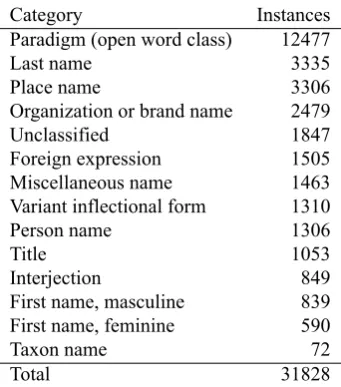
The preprocessing interface allows the annotators to add un-recognized words to the lexicon so that they will not cause parsing failures. Noninflecting words like named entities and interjections are entered as simple paradigms, with a given category assigned to each entry. Inflecting words be-longing to the open lexical classes are entered as complex paradigms, and the annotator must specify an inflectional pattern for each new entry. Verbs must also be assigned sub-categorization frames necessary for parsing. When a word is unrecognized because of nonstandard spelling, the an-notator must consider whether the spelling deviation con-cerns the stem or an inflection. Variant stems are entered as paradigms associated with an existing standard paradigm, and variant inflectional forms are registered as deviations of individual, standard inflectional forms. In order to add unrecognized words to the lexicon in an efficient way, the annotator makes use of a set of predefined options in the preprocessing interface. Each option corresponds to a cer-tain type of entry. Most of these types can be entered by a single mouse click, while the recording of paradigms and variant inflectional forms requires a few more steps. Table 1 presents an overview of the number of unrecognized words
Category Instances
Paradigm (open word class) 12477
Last name 3335
Place name 3306
Organization or brand name 2479
Unclassified 1847
Foreign expression 1505 Miscellaneous name 1463 Variant inflectional form 1310
Person name 1306
Title 1053
Interjection 849
First name, masculine 839 First name, feminine 590
Taxon name 72
Total 31828
Table 1: Overview of the various types of unrecognized words added through preprocessing.
Compound type Example Instances noun+noun appelsin+te‘orange-tea’ 3110 noun+adj avis+grå‘newspaper-gray’ 1284 adj+adj blå+brun‘blue-brown’ 444 adj+noun fin+kåpe‘nice-coat’ 230 prep+noun av+knapp‘off-button’ 160 adj+verb blek+pudre‘pale-powder’ 140 prep+verb av+beite‘off-graze’ 137 verb+noun ete+fest‘eat-party’ 116
Others 1196
[image:2.595.306.477.67.261.2]Total 6595
Table 2: Overview of some of the most common compound types added through preprocessing.
that have been extracted through preprocessing of a corpus of about 29 million words. Among these words, members of the open lexical classes (nouns, verbs, adjectives, and ad-verbs) are the most frequent type of words added through preprocessing (39,2% of all entries). These are given as the category paradigmin table 1, and within the class of paradigms, more than half of them were compounds (6,595 entries). Table 2 lists some of the most frequent compound types added through preprocessing in this study. Prior to preprocessing, an automatic compound analyzer is run on the text in order to identify compounds that are not already in the lexicon. The analyzer checks for a certain set of pat-terns, and compounds that are not recognized are presented to the annotator as unrecognized words.
in, the annotator must specify an inflectional paradigm for the new lemma, either by typing in the base form of an existing lemma with matching inflection (in this case the adjectiveblank), or by selecting one from a set of poten-tially matching lemmas proposed by the interface. An in-flectional paradigm must be specified for all paradigm en-tries, whether they are compounds or not.
The motivation for analyzing unrecognized compounds in this way (by registering the part of speech also of the first part) is to be able to discover frequent compound elements and compound types that are not already accounted for by the compound analyzer. The noun+noun type is very fre-quent, and is normally handled by the analyzer. The exam-ple of this type in table 2,appelsin-te, was not recognized because the second element is a two-letter word. Allowing compound consituents of three letters or less is generally considered a risk in automatic compound analysis; if such short constituents are allowed in general, practically any typo or misspelled word could be erroneously analyzed as a compound.
Of the types included in table 2, the following are currently handled by the compound analyzer: noun+noun, noun+adj, adj+noun, adj+verb and verb+noun. Some of these com-binations have certain constraints imposed on them. For noun+adj compounds, only a few nouns that occur fre-quently as the first element in compounds are allowed; ex-amples are døds ‘death’, kjempe ‘giant’, drit ‘shit’, and
rekord ‘record’. For adj+verb compounds, the verb may only be a past participle. These constraints explain why the compounds avisgrå ‘newspaper-gray’ and blekpudre
‘pale-powder’ were not recognized. The types adj+adj, prep+noun, and prep+verb are currently not allowed at all. Studying the individual examples in the different categories will help to determine if new types should be added to the compound analyzer, or whether some particularly frequent elements should be allowed.
Table 1 also shows that the second most frequent type of unrecognized words in this study is named entities. Among these, last names, place names, and organization or brand names are very common.
The next category listed in table 1 isunclassified. This is a residual class used for unrecognized words that fall out-side the set of predefined options available in the prepro-cessing interface, typically because they have some kind of morphological or morphosyntactic property which does not match any of the available categories. This is the case for certain word forms involving clitics, like n’Oscar, which is a contraction of the pronounhan‘he’ and the name Os-car. Such forms are entered as unclassified, pending further treatment by the grammar developer. Another type of word that must be entered as unclassified is compounds which can be regarded as products of syntactic processes, such as
gamlebilen‘the old car’. The first element,gamle, is an ad-jective inflected in the singular definite form, and the sec-ond element,bilen, is a noun, also with a singular definite inflection. This compound does not have a normal inflec-tional paradigm; it will not occur in the plural, or in the in-definite, because it is a contracted form of a syntactic phrase
den gamle bilen‘the old car’.
Foreign words are often used in Norwegian sentences.
Sometimes they are spontaneous uses of a word from an-other language, most often English. Other times they are well-established in Norwegian, but have not yet made their way into standard dictionaries. An example of a sponta-neously used English word is shown in (1).
(1) «Jeg
I
skulle
should
ikke
not
være
be
noen
some
alien
alien
for
for
deg,»
you
sa
said
Auguste.
Auguste
‘ “I’m not really an alien for you,” said Auguste.’
Example (2) contains both the English loanair conditioning
and the named entityAmerican Bar.
(2) Han
he
gikk
went
inn
in
på
on
American
American
Bar,
Bar
som
which
reklamerte
advertised
med
with
air
air
conditioning.
conditioning
‘He entered the American Bar, which boasted air conditioning.’
Missing lexical entries like this are easily added to the lex-icon when they are identified in the preprocessing step. In this case,American Barwas entered as a named entity of the category organization name, andalienandair conditioning
were entered as loans.
A particularly productive part of speech is interjections; es-pecially writers of fiction are very creative in the way in which they write interjections.Bokmålsordbokahas an en-try for the interjectionhysj‘hush’ which includes also the alternative spellinghyss. There are several occurrences of this interjection in the fiction texts of the INESS treebank, and many of them do not have either of the two standard spellings. The following eight variants of hysj/hyss have been registered until now: hysjjj, hyssj, hysssj, hyssssjjj,
hysssssj,hysssssjjj,hysst,hyyyysssjjj. This shows that the spelling of this interjection is unpredictable and to a large extent determined by the way in which an author chooses to express it in a given context. For parsebanking purposes, the challenge is that each time a new spelling is encountered, it is displayed in the preprocessing interface as an unknown word. The INESS interface makes it possible for annotators to add new variant spellings to a single lemma in the lex-icon. In this way each extracted variant can eventually be recognized during parsing.
It can often be justified to add misspellings to the lexicon and/or morphological analyzer. An author can for instance use a creative spelling to imitate a certain dialect or pronun-ciation. An example from the INESS parsebank ismordern
‘the murderer’, instead of the standard formmorderen. The elided vowel is imitative of a certain accent. The annotator enters the form as a new inflectional variant by indicating in the preprocessing interface that it shares the same lemma and the same inflectional features asmorderen.
Figure 1: Interface for adding unknown words during preprocessing
5.
Incremental parsebanking in INESS
In our parsebanking approach, the output of the parser is semi-automatically disambiguated by annotators. Thus an-notators never manually edit an analysis, but they verify if the analysis produced by the parser is correct, or they choose the correct analysis if several possible analyses are produced. The parsebanking system automatically detects discriminants which help the annotators to efficiently dis-tinguish between possibly many proposed analyses (Rosén et al., 2012a; Rosén et al., 2009; Rosén et al., 2007). The advantage of our parsebanking approach is that the grammar will always be fully compatible with the treebank. Thus, treebanks constructed in this way achieve a very high level of consistency. Also, the approach is scalable by us-ing stochastic disambiguation to parse new texts fully auto-matically. However, only sentences that are grammatical— according to the current grammar—will be fully analyzed, while others may receive a fragment parse or may fail to parse.
To the extent that coverage of the grammar needs to be im-proved, the approach is therefore an incremental one. An-notators signal shortcomings which are followed up by ex-tensions or other changes in the grammar and lexicon, after which the treebank can be reparsed (with cached discrimi-nants to speed up the process).
In INESS we have carried out a detailed study of a small subcorpus in order to find out what the main causes of failed analyses are. We found that 29% of the failed anal-yses were caused by syntactic problems, while 71% were caused by lexical problems. Of the lexical problems, 41% were caused by missing multiword expressions, whereas 31% were caused by incorrect lexical categories (Losne-gaard et al., 2012). This shows that correct lexical infor-mation is essential for successful syntactic analysis.
6.
Known words with missing or incorrect
information
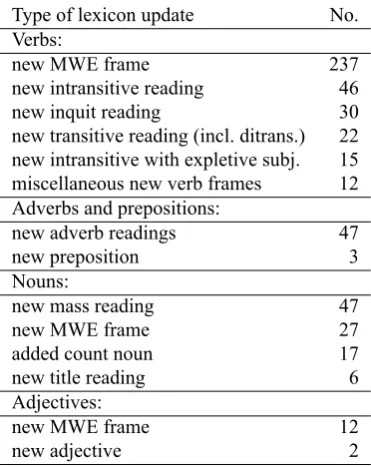
Even though the NorKompLeks lexicon is a rich resource, in parsing we still often find that it lacks lexical information that we need in order to analyze even quite common words. We need, inter alia, lexical category, inflection, subcatego-rization, countability, compound structure, and multiword expressions. Table 3 gives an overview of the types of
lex-Type of lexicon update No. Verbs:
new MWE frame 237
new intransitive reading 46 new inquit reading 30 new transitive reading (incl. ditrans.) 22 new intransitive with expletive subj. 15 miscellaneous new verb frames 12 Adverbs and prepositions:
new adverb readings 47
new preposition 3
Nouns:
new mass reading 47
new MWE frame 27
added count noun 17
new title reading 6
Adjectives:
new MWE frame 12
new adjective 2
Table 3: Overview of lexicon updates made by annotators.
icon updates made by three annotators while doing parse-banking over a period of about five months.
The NorKompLeks lexicon added subcategorization frames for the verbs inBokmålsordboka. There are, however, many quite common frames that are not included. As shown by ta-ble 3, the most frequent type of lexicon update in this study concerns subcategorization frames for verbs, and new verb frames involving multiword expressions (MWEs) account for almost two thirds of these cases.
The effect of updating a verb entry with a new subcatego-rization frame can be illustrated by example (3) from the INESS treebank. The sentence involves the particle verb
flate ut‘flatten out’.
(3) Fjellet
mountain.the
flater
flatten
ut.
out ‘The mountain flattens out.’
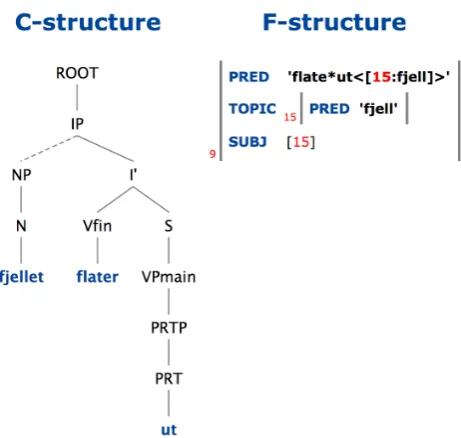
[image:4.595.305.491.264.498.2]Figure 2: Analysis offered before lexical update
Figure 3: Analysis offered after lexical update
it can be either a verb or a noun. Initially, the lexicon entry for the verbflate‘flatten’ contained no subcategorization frame covering the MWE flate ut; the only verbal frame available required a reflexive element, which does not oc-cur in this sentence. Therefore, the only analysis found by the parser for (3) was that of a noun phrase, where the word formflaterwas analyzed as the plural indefinite of the noun
flate‘surface’ functioning as an apposition to the noun fjel-let ‘the mountain’. Figure 2 shows the c- and f-structures for this analysis of (3). After the annotator added the miss-ing subcategorization frame to the lexicon, the sentence was reparsed. As the c-structure in figure 3 shows,flateris now analyzed as a present tense verb (with the lexical category Vfin), andutas a particle (PRT).
Adding this argument frame involves making an addition to a lexical entry, in which an existing template specifying the features of an intransitive verb with a selected particle is called. Figure 4 shows the lexical entry offlatewith this addition in the second line. The notation {...|...} is a disjunc-tion specifying alternative readings.
The template V-SUBJ-PRT is defined as in figure 5. The
Figure 4: Lexical entry after the addition of the intransitive frame with particle
Figure 5: The template for intransitive particle verbs
first line builds the predicate name ‘flate*ut’ by concate-nation. The following disjunction in the template specifies three alternatives: regular active (Fjellet flater ut), imper-sonal passive (Det flates ut‘There is flattening out’), and active presentative (Det flater ut en fugleflokk‘There is a flock of birds flattening out’).
As table 3 shows, several other types of lexicon updates for verbs are also relatively frequent in this study. We found that new intransitive verb readings were needed in 46 cases, whereas 18 verb frame updates involved adding transitive readings. This is interesting because it may indicate that with respect to verb subcategorization frames, the informa-tion available from standard dicinforma-tionaries does not capture the extent to which verbs with variable argument frames are used intransitively. The sentence in (4) was initially re-turned by the parser with no analysis, and parsing had failed because the lexicon contained no intransitive reading for
avslå‘decline’. After this reading was added, the sentence was successfully reparsed.
(4) Men
but
bestefar
grandfather
avslo.
declined ‘But grandfather declined.’
Adding an inquit reading is another frequent type of up-date in lexical entries for verbs (30 instances). Inquit verbs are verbs of saying and related verbs that may occur in this function, and in the analyzed texts a large variety of verbs are used in inquit clauses. This is not surprising, since the text material is fiction, containing numerous passages of di-alogue, as well as inner monologue. The addition of an in-quit reading in the lexical entry for a verb involves adding a subcategorization frame specifying that the verb takes a sentence complement as one of its arguments as well as a feature allowing it to occur in the syntactic position typical of inquit verbs.
(5) Hva
what
mener
mean
du
you
med
with
det?
that
stotret
stammered
hun.
‘What do you mean by that? she stammered.’
The sentence in example (5) was initially given a partial analysis by the parser. That is, the word sequences Hva mener du med detandstotret hunwere respectively identi-fied as sentence units, but no complete analysis was found, because the lexicon entry for the verbstotre‘stammer’ con-tained only an intransitive reading. An inquit reading was added to the entry, and after reparse the sentenceHva mener du med det?was successfully analyzed as a sentential com-plement to the inquit verb.
Table 3 also shows that lexicon updates involving new read-ings of adverbs constitute another frequent type in this study (47 occurrences). This illustrates that the lexical category of a given word must often be more fine-grained than what is provided by the lexicon. In the case of adverbs, there is only one large class with the part of speech ADV in the origi-nal lexicon. However, different types of adverbs differ con-siderably in their syntactic distribution, and it is therefore necessary to classify them into subcategories in order to ac-count for this distribution. Our parsing lexicon distinguishes between 22 categories of adverbs based on syntactic posi-tion, usually named according to their typical semantic con-tribution. Thus, between the finite verb and the object there are positions for ADVatt (‘attitude adverbs’ likedessverre
‘unfortunately’), ADVprt (‘particle adverbs’ likevel‘I sup-pose’, ADVcmt (‘commitment adverbs’ likeegentlig ‘ac-tually’), ADVneg (‘negation adverbs’ likeikke‘not’), and others, where there are ordering constraints. Thus, particle adverbs occur before commitment adverbs, which occur be-fore negation adverbs, cf. example (6).
(6) Jeg I har have vel I-suppose egentlig actually ikke not noe something å to legge lay til. to
‘I actually have nothing to add, I suppose.’
Different classes of degree adverbs are also distinguished, for example ADVdeg (‘degree adverbs’ likeganske‘quite’, which modify adjectives) and ADVdegloc (‘locational de-gree adverbs’ like langt‘far’, modifying locative adjuncts), cf. example (7).
(7) ganske quite langt far fra from vannet lake.the ‘quite far from the lake’
The category ADV is used for the large class of adverbs which only occur in the VP domain, mostly manner ad-verbs. When annotators find that the analysis provided by the parser is inadequate, the situation can often be remedied by changing the part of speech from the default category ADV used in NorKompLeks to one of the more fine-grained adverb categories.
With respect to lexicon updates concerning nouns and adjectives, table 3 shows that the most frequent type in this study involves correcting morphological properties of nouns concerning the distinction between mass terms and countables. Further, the data indicate that also for nouns and
adjectives there is a considerable need for adding subcate-gorization frames involving MWEs.
Multiword expressions (MWEs) present a great challenge for parsing because they exceed word boundaries, have un-predictable morphosyntactic properties and are sometimes discontiguous (i.e., other words and constituents may come between their component words in a sentence). Treating them as simplex words will thus often result in incorrect or missing analyses. The most immediate problem with MWEs simply concerns knowing about them (Losnegaard et al., 2012), and although there are a considerable number of MWE entries in NorKompLeks (more than 2500 prepo-sitional verbs, 1800 particle verbs and almost 400 fixed expressions), these are not sufficient to account for all of the MWEs in our corpus. For instance, both verbs, nouns and adjectives may take prepositional arguments, while NorKompLeks only provides this kind of subcategorization frame for verbs.
Such frames are added to the lexicon by augmenting the rel-evant predicates with a preposition or an adverb. Examples of such additions arelegge ut‘pay’,mening med‘point of’, andopptatt med‘concerned with’ (examples 8, 9 and 10), where new predicates have been added to the entries for the verblegge, the nounmening, and the adjectiveopptatt, re-spectively. (8) Jeg I måtte must.pret legge lay ut out for for deg, you, for since jeg I regnet counted med with at that du you ville would gi give ham him tips, tip.pl, ikke not sant? true?
‘I had to pay for you since I reckoned you wanted to tip him, right?’
(9) Hva What var was da then meningen meaning.def med with å to sette put meg me i in slik such forlegenhet? embarrassment?
‘What was the point of embarrassing me like that?’
(10) Hun she ble became veldig very opptatt busy med with å to børste brush kakesmuler cake crumbs av off kåpa coat.the si. refl
‘She became very concerned with brushing cake crumbs off of her coat.’
Other types of MWE frames that have been added to the lexicon during parsebanking are fixed expressions and ver-bal idioms. Fixed MWEs are invariable expressions that do not have a normal syntactic buildup. It is thus the expres-sion as a whole, and not the individual words, that must be assigned a lexical category. An example of afixedMWE is
The addition of words-with-spaces to the lexicon during parsebanking results in a coherently classified inventory of fixed MWEs. In the present study, there were twelve fixed MWEs added; ten updates involved new adverbs, and the other two produced a new adjective entry and a new prepo-sition entry.
While adding lexical entries for hitherto unanalyzed MWEs is an important factor for increasing parsing coverage, there are other and perhaps more general problems asso-ciated with the automatic analysis of multiword units. Con-ventional dictionaries usually provide limited information about MWEs, and their treatment is sometimes incomplete or incoherent. One problem is that the expressions are often not given lexical entries, but only used as examples in the definitions of single-word entries. This information is diffi-cult to extract when constructing an electronic lexicon. For example, inBokmålsordboka,på tå hevoccurs as an exam-ple both under the entry fortå‘toe’ and under the entry for
heve‘(to) raise’, but it does not occur as an entry of its own. Similarly, the prepositional verbtenke på‘think about’ is listed as one of two senses under the verbtenke, but is not explicitly marked as an idiomatic construction. The same MWE is also found under the entries forandakt‘piety’, an-nen‘other’,fordel‘advantage’, the lexicalized compound
giftetanker‘marriage plans’, and several other semantically unrelated entries.
The perhaps biggest challenge in parsing MWEs is posed by MWEs with internal syntactic structure, such as verbal id-ioms. These are variable in the sense that they may undergo inflection and syntactic transformations, but idiosyncratic because they may undergo some, but not all kinds of trans-formations. Although we have identified them as MWEs, it is therefore not straightforward how they should be treated in the lexicon.
An example of a verbal idiom with metaphorical meaning and a regular syntax isfeie under teppet‘sweep under the carpet’; the verbfeierequires both a subject and an object in addition to the obligatory PP under teppet ‘under car-pet.the’. However, many MWEs are irregular: the idiom
komme (noen) i møte ‘come (someone) in meeting’ (‘ap-proach’) is idiosyncratic because the verbkomme‘come’ is normally intransitive. Others MWEs form ‘families’ of ap-parently similar surface structures.
(11) ta/ha/få
take/have/get
…
…
tak/grep
hold/grip
(i/på)
(in/on)
‘take a hold of/get a hold of/get a (good) grip on, etc.’
Although these constructions seem similar, a closer investi-gation shows that they have several different (although of-ten related) meanings and that they also differ in their pos-sible syntactic variations.
We cannot expect to find this kind of detail of linguistic de-scription of MWEs in a regular dictionary, and the treatment of MWEs in computational dictionaries varies greatly de-pending on the type of dictionary, the language in question, and the theoretical framework used. In this respect, parse-banking provides a unique method for detecting problem-atic constructions such as MWEs, and for acquiring more knowledge about them.
7.
Conclusion
Correct lexical information is essential for successful syn-tactic analysis, but lexical resources derived from dictionar-ies lack much necessary information, because they are typ-ically not tested in parsing. In our experience, parsebank-ing is therefore a useful and necessary context not only for grammar development, but also for lexicon develop-ment. The INESS project is building up a richer lexical resource for Norwegian and will continue to do so during the remainder of the project. The resulting reusable lexi-cal resource will be made available upon completion of the INESS project in 2016.
8.
Acknowledgments
The work reported on here has been supported by the Re-search Council of Norway and the University of Bergen.
9.
References
Bresnan, Joan. (2001). Lexical-Functional Syntax. Black-well, Malden, MA.
Butt, Miriam, Dyvik, Helge, King, Tracy Holloway, Ma-suichi, Hiroshi, and Rohrer, Christian. (2002). The Parallel Grammar project. In Carroll, John, Oostdijk, Nelleke, and Sutcliffe, Richard, editors,Proceedings of the Workshop on Grammar Engineering and Evalua-tion at the 19th InternaEvalua-tional Conference on Computa-tional Linguistics (COLING), Taipei, Taiwan, pages 1– 7, Stroudsburg, PA, USA. Association for Computational Linguistics.
Dalrymple, Mary. (2001). Lexical Functional Grammar, volume 34 of Syntax and Semantics. Academic Press, San Diego, CA.
Dyvik, Helge. (2000). Nødvendige noder i norsk: Grun-ntrekk i en leksikalsk-funksjonell beskrivelse av norsk syntaks [Necessary nodes in Norwegian: Basic properties of a lexical-functional description of Norwegian syntax]. In Andersen, Øivin, Fløttum, Kjersti, and Kinn, Torodd, editors,Menneske, språk og felleskap. Novus forlag. Hovdenak, Marit, Killingbergtrø, Laurits, Lauvhjell, Arne,
Nordlie, Sigurd, Rommetveit, Magne, and Worren, Dagfinn, editors. (1986). Nynorskordboka : definisjons-og rettskrivingsordbok. Det norske samlaget, Oslo. Landrø, Marit Ingebjørg and Wangensteen, Boye, editors.
(1993).Bokmålsordboka: definisjons- og rettskrivnings-ordbok. Universitetsforlaget, Oslo.
Losnegaard, Gyri Smørdal, Lyse, Gunn Inger, Thunes, Martha, Rosén, Victoria, De Smedt, Koenraad, Dyvik, Helge, and Meurer, Paul. (2012). What we have learned from Sofie: Extending lexical and grammatical cover-age in an LFG parsebank. In Hajič, Jan, De Smedt, Koenraad, Tadić, Marko, and Branco, António, editors,
META-RESEARCH Workshop on Advanced Treebanking at LREC2012, pages 69–76, Istanbul, Turkey.
Maxwell, John and Kaplan, Ronald M. (1993). The inter-face between phrasal and functional constraints. Compu-tational Linguistics, 19(4):571–589.
Dictionaries, pages 89–92, Patras, Greece. University of Patras.
Rosén, Victoria, Meurer, Paul, and De Smedt, Koenraad. (2007). Designing and implementing discriminants for LFG grammars. In King, Tracy Holloway and Butt, Miriam, editors,The Proceedings of the LFG ’07 Con-ference, pages 397–417. CSLI Publications, Stanford. Rosén, Victoria, Meurer, Paul, and De Smedt, Koenraad.
(2009). LFG Parsebanker: A toolkit for building and searching a treebank as a parsed corpus. In Van Eynde, Frank, Frank, Anette, van Noord, Gertjan, and De Smedt, Koenraad, editors,Proceedings of the Seventh Interna-tional Workshop on Treebanks and Linguistic Theories (TLT7), pages 127–133, Utrecht. LOT.
Rosén, Victoria, De Smedt, Koenraad, Meurer, Paul, and Dyvik, Helge. (2012a). An open infrastructure for ad-vanced treebanking. In Hajič, Jan, De Smedt, Koen-raad, Tadić, Marko, and Branco, António, editors, META-RESEARCH Workshop on Advanced Treebanking at LREC2012, pages 22–29, Istanbul, Turkey.