M
OM
R
ESP
: A Bayesian Model for Multi-Annotator Document Labeling
Paul Felt
∗, Robbie Haertel
∗, Eric K. Ringger, Kevin D. Seppi
Department of Computer ScienceBrigham Young University Provo, Utah 84602 USA
paul [email protected], [email protected],{ringger, kseppi}@cs.byu.edu
Abstract
Data annotation in modern practice often involves multiple, imperfect human annotators. Multiple annotations can be used to infer estimates of the ground-truth labels and to estimate individual annotator error characteristics (or reliability). We introduce MOMRESP, a model that improves upon item response models to incorporate information from both natural data clusters as well as annotations from multiple annotators to infer ground-truth labels for the document classification task. We implement this model and show that MOMRESP can use unlabeled data to improve estimates of the ground-truth labels over a majority vote baseline dramatically in situations where both annotations are scarce and annotation quality is low as well as in situations where annotators disagree consistently. Correspondingly, in those same situations, estimates of annotator reliability are also stronger than the majority vote baseline. Because MOMRESPpredictions are subject to label switching, we introduce a solution that finds nearly optimal predicted class reassignments in a variety of settings using only information available to the model at inference time. Although MOMRESP does not perform well in annotation-rich situations, we show evidence suggesting how this shortcoming may be overcome in future work.
Keywords:Bayesian models, corpus annotation, crowd-sourcing, identifiability
1.
Introduction
To build labeled corpora and to train NLP models using supervised learning methods we rely heavily on imperfect annotators, ranging from nearly perfect experts to very im-perfect workers in crowd-sourcing settings. Often we rely on multiple annotators providing redundant annotations to improve the quality of the resulting labeled data. Although annotations produced by fallible annotators are not individ-ually trustworthy, they can be used collectively to infer the correct labels for data and also to estimate annotator error characteristics. To be clear, in this paper, we use the term annotationto refer to human input andlabelto refer either to gold-standard reference labels or to model-predicted la-bels.
In the machine learning literature, annotations are use-ful first and foremost as a means of inducing a model that can be used to predict the labels of new data. In other fields, corpus labels are interesting in their own right because they facilitate meaningful data analysis. For example, corpus linguists employ corpora labeled with linguistic categories to aid in the analysis of diachronic trends and patterns in language (Kucera and Francis, 1967; Gardner and Davies, 2007). Estimating ground-truth labels is closely related to the task of learning individual annotator error characteris-tics, since these can be used to upweight trustworthy an-notations and downweight others. Annotator error profiles can also be used to elucidate opportunities to retain, train, and advise annotators.
In this paper we introduce, implement, and evaluate a model for the inference of ground-truth labels and anno-tator reliability that utilizes features of the data as well as annotations from multiple annotators; the two sources of in-formation reinforce one another and make possible ground truth inference that is superior to the available baselines.
∗The first and second authors contributed equally to this work.
The second author is now affiliated with Google.
2.
Previous Work
Dawid and Skene (1979) laid the groundwork for in-ferring ground-truth labels and estimating individual anno-tator accuracy by proposing a statistical model known as the “item-response” model. Carpenter (2008) and Paster-nack and Roth (2013) describe models that are essentially Bayesian versions of the same model. There is a grow-ing body of variations and extensions to this simple item-response model to account for correlations among annota-tors or item difficulty (Carpenter, 2008; Hovy et al., 2013; Lin et al., 2012; Raykar and Yu, 2012; Smyth et al., 1995; Weld et al., 2011; Whitehill et al., 2009; Zhou et al., 2012). Only human annotations are leveraged in the previously de-scribed approaches. However, Lam and Stork (2005), in ef-fect, extend the item-response model such that the inferred label of a data item depends not only on annotations, but also on the features of the data instance itself. Carroll et al. (2007) propose a model that similarly takes advantage of data features. However, neither of these proposed models is implemented or evaluated in previous work.
Inferring labels and estimating annotator trustworthi-ness can be seen as special cases of the fact-finding task (Han, 2009; Pasternack and Roth, 2010) in which the an-notators are sources of information and their annotations are claims. However, the general task of fact-finding is far more complex than the special case of data annotation.
ma-bθ
bγj
bφ
θ
γjk
φk yi
xi ai j
i=1. . .N
k=1. . .K
j=1. . .J
j=1. . .J
k=1. . .K
J:=number of annotators
K:=number of labels
N:=number of instances
F:=number of features(word types)
θ∼SymDir(bθ), dim(θ) =K ∀k: φk∼SymDir(bφ), dim(φk) =F ∀j,k: γjk∼Dir(bγjk), dim(γjk) =K dim(γj) =K×K
∀i: yi|θ∼Cat(θ), yi∈ {1. . .K}
∀i: xi|yi,φ∼Multinom(|xi|1,φyi), dim(xi) =F ∀i,j: ai j|yi,γj∼Multinom(|ai j|1,γj,yi), dim(ai j) =K
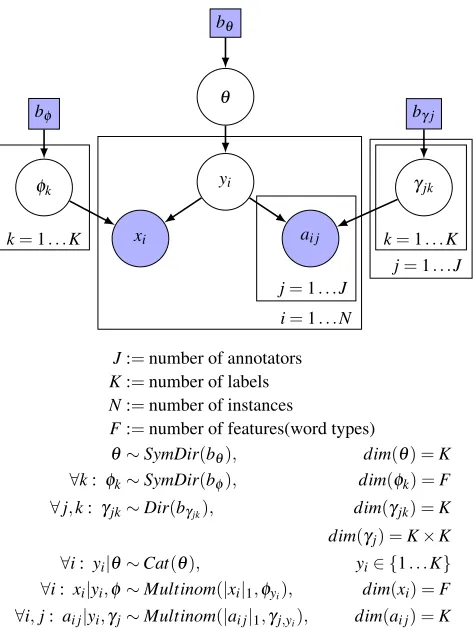
Figure 1: MOMRESP: a generative Bayesian model for in-ferring ground-truth labelsyfrom the annotationsaof mul-tiple annotators and from dataxwhile modeling individual annotator accuraciesγ. (| · |1denotes theL1-norm.)
chine learning algorithm in order to train the desired model in the traditional batch manner. Sheng et al. (2008) con-struct training corpora in which each instance, annotatedn times, is replicated with each annotation and weighted by
1
n. Models trained from this ‘soft’ labeling are shown to
al-ways be at least as good as, and usually better than, those trained by majority vote. Jurgens (2013) experiments with constructing similar weighted datasets using explicit anno-tator input.
3.
Methods
To take advantage of the opportunities presented by nat-ural data clusters and multiple, potentially sparse annota-tions, we now present MOMRESP, a generative Bayesian model that can infer ground-truth labels from multiple, noisy annotators and simultaneously estimate the error char-acteristics of each annotator. We also present an MCMC inference algorithm for the model.
3.1.
Model
MOMRESP is inspired by Bayesian models described, but not implemented or evaluated, in previous work (Car-roll et al., 2007; Car(Car-roll, 2010; Haertel, 2013). It is called MOMRESP because it adds a mixture-of-multinomials (MOM) data component to a Bayesian item-response model. The model is based on three main principles:
1. Ground-truth labelsyare unobservable.
2. All annotationsamay carry useful information, even when incorrect.
3. A document’s wordsxcan help in determining a doc-ument’s labely.
Figure 1 presents the model as a directed graphical model. The model assigns probability to variables as though they were generated according to the following pro-cess. First, label class proportionsθand word proportions φk for each label class k∈ {1. . .K} are drawn. (K is the number of label classes.) For each annotator j∈ {1. . .J}, a probability vectorγjk is drawn specifying the
probabili-ties of the annotations annotator j is likely to produce in the presence of the label classk. (J is the number of an-notators.) Thus,γj can be seen as an annotator j-specific
confusion matrix (alternatively: a contingency table or er-ror matrix), where each row sums to 1. For each of the N documents, theith annotated document is generated by drawing a document labelyi from the categorical
distribu-tionCat(θ)and then drawing wordsxifrom a multinomial
distribution with parameters φyi and drawing annotations ai jfrom a multinomial distribution with parametersγjyi.
Notice that in the absence of annotationsa, this model reduces to a mixture-of-multinomials document clustering model. In the absence of any datax, this model becomes a multinomial item-response model—a Bayesian version of the approach of Dawid and Skene (1979).
3.2.
Inference
Having formulated a generative model and specified a distribution over every variable in the model means that we can apply standard Bayesian statistical machinery such as Markov Chain Monte Carlo inference to the task of infer-ring the values of hidden labelsyand annotator error char-acteristicsγ given some observed set of documentsxand annotationsa, however incomplete the annotations may be. We derive an efficient collapsed Gibbs sampler fory. Then the per-annotator confusion matrix γ is constructed from these samples after-the-fact, as described below.
Liu (1994) provides empirical and theoretical evidence that analytically integrating out parameters where possible (i.e., ‘collapsing’ the model) improves Gibbs sampling. Ac-cordingly, we derive a collapsed sampler by analytically in-tegrating out the parameters of the model (θ,φ,γ).
Let p(yi =c|yi′6=i)be the full conditional distribution foryi. It represents the conditional distribution over
possi-ble valuescforyigiven the data and annotations and
(in-dicated by sums overi′6=i):
That is,n(kθ) is the number of instances currently labeled k;n(jkkγ)′ is the number of times that annotator jchose
anno-tationk′on instances labeledk; andn(k fφ) is the number of times word (or feature) f occurs with instances having an inferred label value ofk.
Using these count variables, the full conditional distri-bution for the MOMRESPmodel has the following form:
p(yi=c|yi′6=i)∝(bθ+n(cθ)) where the notationxn¯represents the rising factorial defined asxn¯:=x(x+1)(x+2). . .(x+n−1)andx
−n¯:= 1
xn¯ . Gibbs sampling yields samples that consist of label val-ues for eachyi. In our sampling experiments, we use the
label valuesyin the single last sample of the Markov chain as the predicted corpus labels. Walker (2012)’s experiments with a sampler for the mixtuof-multinomials model re-veals that taking the last sample is an efficient way to sum-marize the Markov chain without sacrificing the quality of the samples. In order to estimate the accuracy vector γjk
for annotator j on label k, we compute the mean of the Dirichlet distribution for γjk using the sufficient statistics
n(jkkγ)′. The mean values ofθ andφ are similarly estimated
using n(kθ) andn(k fφ), respectively. In order encourage our sampler to explore effectively, we anneal our sampler with 250 samples at each temperature of the following schedule: 1000,500,200,100,50,20,10,5,2,1. This is followed by an additional 500 samples without annealing.
3.3.
Class Correspondence Correction
The problem of class correspondence, or label switch-ing, arises in unsupervised and semi-supervised mixture models (Stephens, 2000). The model described in Section 3.1. assigns the same probability to any permutation of the inferred class label types assignable toy. That is, we could relabel everyywhose value is class A to class B and vice versa as long as we also swapped the rows inγandφ that correspond to class A and class B. The model has no reason (aside from weak prior preferences) to prefer one of these solutions over the other. However, inferred labelsyare only useful when they align with true gold-standard labels; there-fore, we must solve the class correspondence problem.
Stephens (2000) points out that the problem of finding an optimal (with respect to some loss function) reassign-ment of inferred label classes can be posed and efficiently solved as an instance of the well-known assignment prob-lem. In this formulation, we haveK‘source’ classes as a result of sampling, and each source class will be assigned to one ofK‘destination’ classes. LetL(c′,c
′′)be some loss
function that defines the cost of (re-)assigning source class c′ to destination classc′′. Each possible assignment from c′toc′′is represented with a boolean variableπc′c′′, where πc′c′′=1 indicates the presence of an assignment in the
fi-nal solution, andπc′c′′=0 indicates absence. Our objective
is to discover the solutionπthat minimizes
K
subject to the following constraints
∀c′∈ {1. . .K}:
The first set of constraints ensures that each source class is assigned once. The second set ensures that each desti-nation class receives a single assignment. The final con-straints ensure non-negativity. Although this formulation allows for fractional assignments, the optimal solution is guaranteed to have integer values because the constraint ma-trix is totally unimodular (Burkard et al., 2009).
3.4.
Loss Functions
The problem remains of choosing a loss functionL. In-tuitively,L’s purpose is to penalize decisions that assign in-ferred label classes to the wrong gold-standard label classes. We experiment with three loss functions. The first relies on gold-standard labels; the second two do not.
CorrectCount
magnitude of the diagonal entry of the moved column in its destination position:
LCC(c′,c
′′) =−E c′′c′
This loss function favors column assignments with strong diagonal entries (i.e., good label accuracy) in a given error matrixE. It is implicitly parameterized by the number of gold-standard labels used to generate E. Were this num-ber to equal the size of the corpus (an untenable situation), using the resulting CORRECTCOUNTloss function in con-junction with the LP solver would yield the highest possible label accuracy achievable with any solution to the class cor-respondence problem.
BestAnnotator
Assembling gold-standard labels is cumbersome, and it begs the question which MOMRESPaims to address in the first place. The BESTANNOTATOR loss function instead only uses parameter estimates found in the model. Recall that inference yields estimates of error characteristicsγjfor
each annotator j, and each γj matrix can be viewed as a
normalized confusion matrix. When inferred label classes are permuted, the rows of matrixγjare permuted. Suppose
there is an annotator ˆjwhose annotations we believe to be mostly in accord with the truth; i.e., for no classkis she more likely to choose some other class k′. Unfortunately, the model’s predictedγjˆis subject to label switching, man-ifested as permutations of the rows of ˆj’s true confusion matrix. Then our belief is that with the correct row order-ing,γjˆis strongly diagonal. Thus, the intuition underlying the BESTANNOTATORloss function is that the overall di-vergence of a givenγjfrom the identity matrix — assuming γj’s rows are in the proper order — should be small.
Conse-quently, we define this loss function using KL Divergence from the indicated row of the identity matrixI:
LBA(c′,c
′′) =KL(I c′′||γˆjc′)
AggregateAnnotator
Rather than relying on a single annotator, we might try aggregating across annotators. AGGREGATEANNassumes that for no classkare all annotators more likely to choose some other class k′. Thus, we aggregate the error charac-teristicsγ of all annotators. Summed rows would not con-stitute probability vectors, so rather than normalizing the summed probability vectors and employing KL divergence, this loss function measures the aggregated diagonal entry of the row in its proposed destinationc′′:
LAA(c′,c
′′) =−
∑
J j=1γjc′c′′
4.
Experiments
Models dealing with multiple error-prone annotations can be challenging to evaluate in a controlled way because multiply-annotated benchmark datasets for classification have not been established. Sheng et al. (2008) simulate annotations for an annotator by corrupting the ground-truth labels according to an accuracy parameter associated with that annotator. They use a strategy they term Generalized
A1 A2 A3 A4 A5
HIGH 90 85 80 75 70
MED 70 65 60 55 50
LOW 50 40 30 20 10
CONFLICT 50† 40† 30† 20† 10†
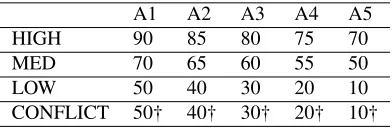
Table 1: Annotator (A1-A5) accuracies for each quality level (HIGH, MED, LOW, CONFLICT). † indicates that errors are systematic (see text for details).
Round Robin (GRR) for determining which data instances are annotated and with how many annotations. In GRR, an instance is selected at random (without replacement) to be annotateddseparate times by annotators selected randomly with replacement. After all instances have been annotated, the process is repeated. Thus, an instance can be annotated more than d times if revisited. GRR simulation has two parameters of interest: the numberdof annotations per in-stance per round and annotator quality.
We use GRR with annotators from the quality pools (one named pool per row) in Table 1. Each pool lists the ac-curacy of five annotators, A1-A5 (five is an arbitrary choice for the experiments). In the quality settings HIGH, MED, and LOW, annotator errors are distributed uniformly across the incorrect classes. Because there are no patterns among errors, these settings approximate situations in which anno-tators are ultimately in agreement about the task they are doing, although some are better at it than others.
LOW
0.60 0.65 0.70 0.75 0.80
d = 1
0 4 8 12
Number of simulated annotations x 10,000
Accur
acy algorithm
LP Greedy
Figure 2: Linear Programming (LP) versus Greedy search (Greedy) for class correspondence correction. Both ap-proaches use the same CorrectCount loss function.
CONFLICT LOW
0.3 0.4 0.5 0.6 0.7 0.8
d = 1
0 4 8 12 0 4 8 12
Number of simulated annotations x 10,000
Accur
acy
algorithm
CorrectCountAll
CorrectCount200
CorrectCount100
CorrectCount50
CorrectCount20
Figure 3: Correcting the class correspondence problem using the CORRECTCOUNTloss function with various amounts of manually labeled data to create its error matrix. Notice that performance does not plateau until about 200 items have been manually labeled, or 10 per class.
CONFLICT LOW
0.0 0.2 0.4 0.6 0.8
d = 1
0 4 8 12 0 4 8 12
Number of simulated annotations x 10,000
Accur
acy
algorithm
None
CorrectCountAll
BestAnnotator
AggregateAnn
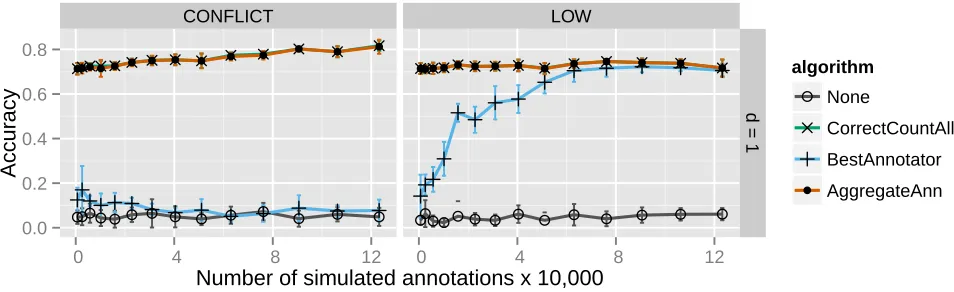
Figure 4: Class correspondence correction strategies. NONEtakes the raw sampling results in which classes are essentially randomly permuted. CORRECTCOUNTuses information from gold-standard labels for all the data and is an upper bound on what is possible. BESTANNOTATOR uses theγj of an arbitrarily selected annotator j. AGGREGATEANN uses the
aggregatedγmatrices of all annotators, and performs at nearly the level of the upper bound in all settings tested (including those not shown).
We use GRR to simulate the annotators in Table 1 an-notating the 20 Newsgroups data set (Joachims, 1997), which consists of approximately 20,000 documents evenly divided among 20 classes. For each experiment, we ran-domly select a subset of 17,000 documents to serve as our corpus. 20 Newsgroups is an appropriate dataset be-cause it is a well-known text classification benchmark and has been used by previous work in evaluating related semi-supervised mixture-of-multinomials models (Nigam et al., 2006). In all plots, all graphed lines represent at least 20 randomized runs on different simulations (the corpus and annotations change in every simulation), with error bars— too small to see in most cases—representing one standard deviation.
4.1.
Class Correspondence Correction
In Section 3.3. we explained that label switching among predicted label classes could be rectified by defining a loss function over potential label class reassignments and using linear programming to find the label class permutation in-curring the smallest possible loss overall. To confirm that linear programming is worth the time required to
imple-ment, Figure 2 demonstrates that in practice, using linear programming to find the optimal alignment solution yields gains over a simple greedy solution. Figure 2 graphs the model’s inferred label accuracy after sampling andpost hoc class correspondence correction. Greedy and LP both use the CORRECTCOUNT loss function with access to a full confusion matrix, and both are given the same set of sam-pled model parameters to correct. Greedy assembles a so-lution by iteratively selecting the source classk correspond-ing to the error matrix column with the largest value, and then assigning it to the unclaimed destination classk′that will result in the largest value along the diagonal of the error matrix. The optimal linear programming search, although slower in practice, yields answers with a higher mean and less variance than the greedy search.
in-CONFLICT LOW
0.25 0.50 0.75 1.00
0.25 0.50 0.75 1.00
0.25 0.50 0.75 1.00
0.25 0.50 0.75 1.00
d = 1
d = 2
d = 3
d = 5
0 4 8 12 0 4 8 12
Number of simulated annotations x 10,000
Accur
acy
algorithmmajority
momresp
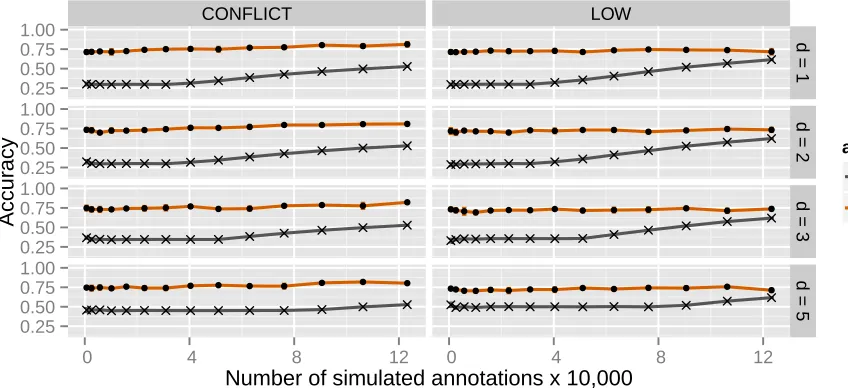
Figure 5: Inferred label accuracy on the 20 Newsgroups dataset
ferred label classes. Notice that once approximately 200 gold-standard labels are available then CORRECTCOUNT’s performance reaches its peak. That is roughly 10 labels per class, and represents a non-negligible amount of work.
So as not to be dependent on any gold-standard la-bels, the loss functions BESTANNOTATOR and
AGGRE-GATEANNuse only inferred model parametersγ. Figure 4
compares their behavior with the upper bound CORRECT-COUNT and ‘None,’ which indicates the performance of samples whose latent class correspondence has not been corrected. BESTANNOTATORstruggles badly in the CON-FLICT setting in which annotators make systematic errors. This is unsurprising, since CONFLICT violates the assump-tion made by BESTANNOTATOR that an annotator exists who is basically aligned with the truth. BESTANNOTATOR does better in LOW where errors are made uniformly ran-domly, however it still takes some time to overcome data sparsity. AGGREGATEANNis robust to the systematic er-rors in CONFLICT because the patterns in the erer-rors are washed out in aggregate. AGGREGATEANNis also more ro-bust to data sparsity since it does not limit itself to drawing on information from a single individual’s annotations.
AG-GREGATEANNfollows the upper bound CORRECTCOUNT
so closely that we use it for all subsequent experiments. Although because of space constraints we have focused on select experimental conditions, the patterns seen in Fig-ures 2, 3, and 4 hold for all other unshown experimental settings, including for the MED and HIGH annotation set-tings.
4.2.
Inferred Label Accuracy
We now compare MOMRESP with majority vote, dubbed MAJORITY. We run simulations that sweep the annotator quality pools from Table 1 and annotationsd ∈ {1,2,3,5,10} per instance per round. Accuracy is com-puted by comparing the withheld gold-standard labels to the label inferred by the model with corrected class correspon-dences. In order to examine the question of inferred label quality, this section examines accuracy over all items in the
dataset with one or more annotations. In Figure 5 we chart accuracy as a function of the number of simulated annota-tions. Because there may be multiple annotations per doc-ument, these learning curves extend beyond the length of the corpus. Curves end when every document has roughly 7 annotations.
Majority vote (MAJORITY) suffers from a number of shortcomings. Because it shares no information among instances, accuracy is constant until every item in the dataset has been selected for annotation at least once (at x-coordinate 17,000·d) and instances begin to be re-annotated. Not surprisingly, when annotation quality is high and there are enough annotations per instance, major-ity vote is sufficient to always select the correct label; e.g., whend =10 and annotator quality is HIGH (not shown). However, when annotations are sparse or of low quality, there is significant room for improvement above the base-line. Also notice that because majority vote implicitly as-sumes that annotation errors are uniform random, MAJOR-ITYparticularly struggles to deal with the systematic errors encountered in CONFLICT.
MOMRESPis superior to MAJORITYin the annotation settings considered in Figures 5 and 6. MOMRESPallows information from the features (word counts) to be used when selecting a label; in effect, the features get a vote alongside the annotations. Furthermore, class-conditional word probabilitiesφare shared among both annotated and unannotated instances. Thus, MOMRESP is able to lever-age information from all instances when inferring labels for instances with annotations. This gives MOMRESP a tremendous advantage in the early stages of corpus anno-tation when annoanno-tations are too sparse or uncertain to trust, such as whered=1 and annotator quality is LOW.
4.3.
Annotator Error Estimation
accord-CONFLICT LOW
0.0 0.2 0.4 0.6 0.8
0.0 0.2 0.4 0.6 0.8
0.0 0.2 0.4 0.6 0.8
0.0 0.2 0.4 0.6 0.8
d = 1
d = 2
d = 3
d = 5
0 4 8 12 0 4 8 12
Number of simulated annotations x 10,000
Annotator RMSE
algorithm
majority
momresp
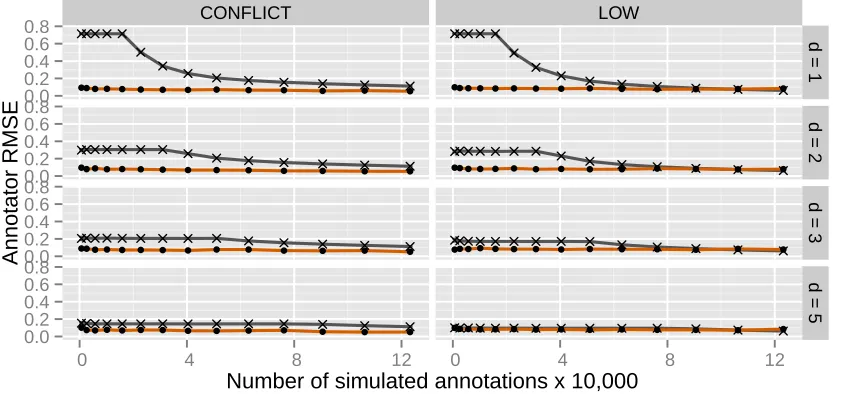
Figure 6: Root mean squared error (RMSE) between true and estimated annotator accuracy.
ing to each model and compare those predictions with the simulation parameters used to generate the dataset. These differences are aggregated across all annotators using root mesquared error. When RMSE is high, estimates of an-notator accuracy are poor; when it is low, estimates are good. For MOMRESP, expected annotator accuracy is com-puted by inspecting the diagonals of theγ matrices. We compare with a baseline approach (MAJORITY) defined to be the percentage of times that each annotator agreed with the majority vote label.
Figure 6 shows that a model’s ability to accurately learn annotator error characteristics is closely related to its abil-ity to infer correct corpus labels. MOMRESPenjoys an ad-vantage in settings stages when it can use data evidence to assess the likely quality of sparse annotations. MAJORITY overtakes MOMRESPas redundant annotations accumulate. MAJORITYprovides poor estimates when faced with sys-tematic annotator error in CONFLICT.
4.4.
Failure Cases
The modeling assumptions made in MOMRESPcause it to perform very poorly in settings where annotations are far more informative than the natural data clusters. MOM-RESPassumes that documents were generated by selecting a class yand subsequently selecting words xand annota-tions a based on class y. Accordingly, during inference words and annotations are given equal consideration. How-ever, when annotations are highly accurate and sufficiently abundant, they contain far more information than the aver-age word. For example, in Figure 7 annotators are highly accurate, and each document has at least 3 annotations at all times.
To test our hypothesized explanation of MOMRESP’s bad behavior in these situations, we tried removing the model’s data component, effectively turning it into a Bayesian item-response model. This data-insensitive model is called ITEMRESPin Figure 7. Notice that ITEM-RESPperforms as well as MAJORITYin annotation-rich set-tings, but lacks the advantages ofMOMRESPin annotation-poor settings such as at the beginning of the MED
col-MED HIGH
0.4 0.6 0.8 1.0
d = 3
0 4 8 12 0 4 8 12
Accur
acy
algorithm
majority itemresp momresp
MED HIGH
0.0 0.1 0.2 0.3 0.4 0.5
d = 3
0 4 8 12 0 4 8 12 Number of simulated annotations x 10,000
Annotator RMSE
algorithm
majority itemresp momresp
Figure 7: Label accuracy (top) and RMSE between true and estimated annotator accuracy (bottom). d=3 indicates that each document is labeled 3 times before moving to the next document, and MED and HIGH indicate that annotations are highly reliable. MOMRESP’s data component becomes a liability in these situations.
umn. These complementary strengths and weaknesses sug-gest that were a model able to give appropriate weight to the evidence coming from document words, it could en-joy the complementary strengths of MOMRESPand ITEM-RESP. Preliminary tests using ad-hoc weighting methods are promising. A better solution will build the data compo-nent weighting into the model in a principled way.
5.
Conclusions and Future Work
Corre-spondingly, in those same situations, estimates of annota-tor reliability are also stronger than the baseline. Because MOMRESP predictions are subject to label switching, we identified a solution that found nearly optimal predicted class reassignments in a variety of settings using only in-formation available to the model at inference time. MOM-RESPdoes not perform well in cases where annotations are more informative than natural data clusters. We showed that when the data component is removed from the model — turning it into a Bayesian item-response model — it
forms well in annotation-rich settings at the expense of per-formance in annotation-poor settings. Future work will fo-cus on combining the complementary strengths of MOM-RESP and data-ignorant item-response models by refining the structure of the model to weight the information from the model’s data component in a principled way.
Acknowledgments
We express our appreciation to the BYU Foulton Su-percomputing Lab for computing resources that made this work possible, and also to Kristian Heal, Deryle Lonsdale, and Kevin Black for valuable input and feedback.
6.
References
Burkard, R. E., Dell’Amico, M., and Martello, S. (2009). Assignment Problems, Revised Reprint. Siam.
Carpenter, B. (2008). Multilevel bayesian models of cate-gorical data annotation.Unpublished manuscript. Carroll, J., Haertel, R., McClanahan, P., Ringger, E., and
Seppi, K. (2007). Modeling the annotation process for ancient corpus creation. InProceedings of ECAL 2007, pages 25–42. Charles University.
Carroll, J. (2010). A Bayesian decision theoretical ap-proach to supervised learning, selective sampling, and empirical function optimization. Ph.D. thesis, Brigham Young University.
Dawid, A. and Skene, A. (1979). Maximum likelihood es-timation of observer error-rates using the EM algorithm. Applied Statistics, pages 20–28.
Gardner, D. and Davies, M. (2007). Pointing out frequent phrasal verbs: A corpus-based analysis.Tesol Quarterly, 41(2):339–359.
Haertel, R. A. (2013). Practical Cost-Conscious Active Learning for Data Annotation in Annotator-Initiated En-vironments. Ph.D. thesis, Brigham Young University. Han, J. (2009). Mining heterogeneous information
net-works by exploring the power of links. InDiscovery Sci-ence, pages 13–30. Springer.
Hovy, D., Berg-Kirkpatrick, T., Vaswani, A., and Hovy, E. (2013). Learning whom to trust with mace. In Proceed-ings of HLT-NAACL 2013, pages 1120–1130.
Joachims, T. (1997). A probabilistic analysis of the roc-chio algorithm with TFIDF for text categorization. In Proceedings of the 14th International Conference on ML, pages 143–151. Morgan Kaufmann Publishers Inc. Jurgens, D. (2013). Embracing ambiguity: A comparison
of annotation methodologies for crowdsourcing word sense labels. InProceedings of NAACL-HLT, pages 556– 562.
Kucera, H. and Francis, W. N. (1967). Computational Analysis of Present-day American English. Brown Uni-versity Press, Providence, RI.
Lam, C. P. and Stork, D. G. (2005). Toward optimal label-ing strategy under multiple unreliable labelers. InAAAI Spring Symposium: Knowledge Collection from Volun-teer Contributors, pages 42–47.
Lin, C., Mausam, and Weld, D. (2012). Dynamically switching between synergistic workflows for crowd-sourcing. In Workshops at the Twenty-Sixth AAAI Con-ference on Artificial Intelligence.
Liu, J. S. (1994). The collapsed gibbs sampler in bayesian computations with applications to a gene regulation prob-lem. Journal of the American Statistical Association, 89(427):pp. 958–966.
Nigam, K., McCallum, A., and Mitchell, T. (2006). Semi-supervised text classification using EM. Semi-Supervised Learning, pages 33–56.
Pasternack, J. and Roth, D. (2010). Knowing what to be-lieve (when you already know something). InCOLING, Beijing, China, 8.
Pasternack, J. and Roth, D. (2013). Latent credibility anal-ysis. InProceedings of the 22nd International Confer-ence on World Wide Web, pages 1009–1020.
Raykar, V. C. and Yu, S. (2012). Eliminating spammers and ranking annotators for crowdsourced labeling tasks. The Journal of Machine Learning Research, 13:491–518. Sheng, V., Provost, F., and Ipeirotis, P. (2008). Get an-other label? Improving data quality and data mining us-ing multiple, noisy labelers. InProceeding of the 14th ACM SIGKDD, pages 614–622. ACM.
Smyth, P., Fayyad, U., Burl, M., Perona, P., and Baldi, P. (1995). Inferring ground truth from subjective labelling of venus images. Advances in Neural Information Pro-cessing Systems, pages 1085–1092.
Snow, R., O’Connor, B., Jurafsky, D., and Ng, A. Y. (2008). Cheap and fast—but is it good?: Evaluating non-expert annotations for natural language tasks. InProceedings of EMNLP, pages 254–263. Association for Computational Linguistics.
Stephens, M. (2000). Dealing with label switching in mix-ture models.Journal of the Royal Statistical Society: Se-ries B (Statistical Methodology), 62(4):795–809. Walker, D. D. (2012). Bayesian Text Analytics for
Docu-ment Collections. Ph.D. thesis, Brigham Young Univer-sity.
Weld, D., Mausam, and Dai, P. (2011). Human intelligence needs artificial intelligence. InWorkshops at the Twenty-Fifth AAAI Conference on Artificial Intelligence. Whitehill, J., Ruvolo, P., Wu, T., Bergsma, J., and
Movel-lan, J. (2009). Whose vote should count more: Opti-mal integration of labels from labelers of unknown ex-pertise.Advances in Neural Information Processing Sys-tems, 22:2035–2043.