Volume 2007, Article ID 48984,10pages doi:10.1155/2007/48984
Research Article
An Energy-Efficient Framework for Multirate Query
in Wireless Sensor Networks
Yingwen Chen,1Ming Xu,1Huai-min Wang,1Hong Va Leong,2Jiannong Cao,2
Keith C. C. Chan,2and Alvin T. S. Chan2
1School of Computer, National University of Defense Technology, Changsha 410073, Hunan, China 2Department of Computing, The Hong Kong Polytechnic University, Hung Hom, Hong Kong
Received 30 September 2006; Revised 14 March 2007; Accepted 6 April 2007
Recommended by Mischa Dohler
Minimizing the communication overhead is always a hot topic in wireless sensor networks. In a multirate query system, data sources disseminate the data streams to users at the frequency they request. However, sending data in different frequencies to individual users is very costly. We address this problem by broadcasting a single consolidated data stream, aiming at reducing the amount of transmitted data. Taking into account the data correlation, we can reconstruct the data streams at lower frequencies from the consolidated stream at a higher frequency. In this paper, we propose an energy-efficient framework to process multirate queries and investigate the path-sharing routing tree construction method together with the rate conversion mechanism. We evaluate both the accuracy and energy efficiency by simulation. Simulation results indicate that with a reasonable level of tolerance, the performance gain is significant. As far as we know, this is the first energy-efficient solution for multirate query in wireless sensor networks.
Copyright © 2007 Yingwen Chen et al. This is an open access article distributed under the Creative Commons Attribution License, which permits unrestricted use, distribution, and reproduction in any medium, provided the original work is properly cited.
1. INTRODUCTION
A wireless sensor network consists of a collection of com-municating nodes, each incorporated with sensors collecting real-time data to the sink node. Sensor nodes are battery-powered and energy is the most crucial resource. Many existing research works address the problem of minimiz-ing energy consumption by minimizminimiz-ing the communication overhead, such as adopting data aggregation to reduce data transmission, using data replicas to shorten the data delivery path.
In a multirate query system, a data source serving mul-tiple sink nodes with queries demanding varying data rates needs to send data in different frequencies to individual nodes. This is costly, since the sink nodes in general con-sume data at different moments and most of the data sent by the data source could not be shared across the sink nodes. This new problem is different from the one addressed in data aggregation and data replication. Observing the correlation among data streams from the same data source to diff er-ent sinks, it is possible to construct a consolidated stream to represent those multiple data streams. We address this interesting problem by broadcasting the single consolidated
streaming data series, aiming at reducing the amount of transmitted data, and hence energy consumption.
The contribution of the paper is threefold. First, we de-scribe the multirate query problem in WSNs. Second, we propose an energy-efficient framework to process multi-rate queries and investigate multi-rate conversion mechanism be-tween arbitrary frequencies. Third, we analyze analytically the performance on communication cost with our energy-efficient strategy and conduct simulation studies to evaluate the energy efficiency and accuracy of our strategy. Our sim-ulation results indicate that we can achieve an average saving of up to 50% ∼55% of communication cost, at an average relative error below 5%.
2. RELATED WORK
Because of the energy constraint of wireless sensor networks and relatively expensive communication cost, two types of methods have been proposed to reduce the transmitted data: one is in-network data processing and data aggregation, the other is data replication. This section briefly reviews these methods and provides the motivation for our work.
2.1. In-network data processing and data aggregation
Measurements suggest that sending one bit is equivalent to executing approximately 1000 CPU instructions [1]. Thus, part of the computation can be off-loaded from the sink node and performed inside the network, such as eliminat-ing irrelevant records and aggregateliminat-ing raw data, which is re-ferred to as in-network data processing and data aggrega-tion. Since the placement of the data processing function and operators dominate the energy consumption of in-network data processing, literature [2–4] discussed operator place-ment strategies for hierarchical and nonhierarchical cases. Literature [5] proved that finding the optimal routing tree to support data aggregation can be shown to be equivalent to finding the minimum Steiner tree, an NP-hard problem. Greedy Incremental tree was employed to improve path shar-ing so as to reduce transmission energy. Considershar-ing the data correlations of different source nodes, literature [6] proposed some efficient, scalable, and distributed heuristic approxima-tion algorithms for solving the new NP-hard problem.
All these in-network data processing and data aggrega-tion research works only deal with the case that there is only one sink node. However, in a real system there might be mul-tiple users. This is the reason we take mulmul-tiple sink nodes into consideration.
2.2. Data replication
In distributed environments that collect or monitor data, useful data might be spread to multiple users. One of the most useful ways to reduce data transmission is to main-tain copies of data objects of interest using replication, which can help to reduce the average length of the routing path. Literature [7] discussed data dissemination in a scenario of multiple mobile sink nodes. In order to feed the sink nodes with minimal energy consumption, aGateReplicaSearch al-gorithm together with aReplicaPlacementalgorithm are pro-posed. Literature [8] considered the problem of optimizing the number of replicas for event information in wireless sen-sor networks, when queries are disseminated using expand-ing rexpand-ings. The authors also derived the replication strategies that minimize the expected total energy cost consisting of search and replication costs.
Current data replication deals with the case that the queries issued by multiple sink nodes are the same. However, if multiple sink nodes issue the queries with different fre-quencies, how can they share the bandwidth, leading to sav-ings of the transmission energy consumption? This is the main purpose of our work.
Common node Source node Sink node
s1(fr1) s2(fr2)
u v w
g k
l r
p q
Overlapped region
Figure1: Multirate query example in WSN.
3. MULTIRATE QUERY IN WSNS
In WSNs, the sink nodes may query the data at different fre-quencies according to different requirements. Thus, a sim-plest two-rate querying system can be illustrated inFigure 1. Sink nodes1requests the data from all the nodes in the grey region at the frequency of fr1. At the same time, sink node
s2requests the data from all the nodes in the grey region at the frequency offr2. Without loss of generality, we can always find an appropriate time unit such that all frequencies can be represented as integers unless the frequencies are irrational numbers.
Example 1. If the WSN is used for collecting the tempera-ture of the environment, sink nodes1might need the newest temperature every 2 minutes, and sink nodes2might need the newest temperature every 3 minutes, supposing these two queries are issued at time 0, this will result in multirate queries in WSN, for which there are two queries, demanding data at times 2, 3, 4, 6, 8, 9, 10, 12, and so on. Selecting the time unit as 6 minutes, we have fr1=3,fr2=2.
Generally, the sink node initiates the data query by send-ing out a query request to the data sources. The transmission of the query request may naively be flooding or it may fol-low some logic that the intermediate sensor nodes apply [9]. Finally, when the query request is routed to proper source nodes (i.e., sensors within the queried regions or satisfying some query conditions), the source nodes will start sending data back to the sink node along the corresponding routing tree.
Example 2. In Figure 1, all the source nodes in the over-lapped region are covered by the routing tree rooted at sink nodes1(solid line) and the routing tree rooted at sink node
s2 (dashed line). Therefore, reducing the total communica-tion cost of the multirate query system asymptotically equals reducing the redundant data forwarding among intermedi-ate nodes from each overlapped source node to all known sink nodes. For this reason, in the following part, we will de-scribe in details how to minimize the transmission cost for an individual source node to report the data periodically to multiple sink nodes according to the path overlapping.
Suppose a multirate querying system in which there are
msink nodessi(i=1· · ·m) requesting the streaming data
series from the same source nodedat different frequencies
fri(i=1· · ·m). Intuitively, the source nodeddisseminates
the data along the routing trees to each sink node at the cor-responding frequency separately. We call this kind of data dissemination strategy the native strategy (or N-strategy). Theorems1to3present some properties of the N-strategy. The proofs of these theorems are listed in the appendix.
Theorem 1. Using N-strategy, the upper bound of the con-solidated data dissemination frequency fup of source node is
m
i=1fri, where fri(i=1· · ·m) are the requested frequencies of all the sink nodes. This upper bound is attained if and only if for any pair of data series in the request, there is no point of intersection along their time axes.
Example 3. If all the two queries inExample 1are issued at times 0, 0.5 separately, that is, the data are demanded at times 2, 3.5, 4, 6, 6.5, 8, 9.5, 10, 12, 12.5, and so on, as a result, the upper bound of the consolidated data dissemination fre-quency fupis achieved as 2 + 3=5.
Theorem 2. Using N-strategy, the lower bound of the consoli-dated data dissemination frequency flowof the source node can be calculated by quencies selected in allmfrequencies. This holds if and only if for any pair of data series in the request, they have points of intersection along their time axes.Example 1satisfies the lower bound condition, as a result flow=2 + 3−gcd(2, 3)=4.
Theorem 3. Givenmfrequencies fr1 ≤ fr2≤ · · · ≤ frm, the lower bound of the consolidated data dissemination frequency
flowof source node in N-strategy satisfies flow ≥max{fri}mi=1. The equation is achieved if and only if for all j ≥i, fri | fri,
1 ≤ i ≤ j ≤ m, notation “a | b” means thatb is exactly divided bya.
Example 4. suppose three queries, by which sink node 1 needs the newest temperature every 8 minutes, and sink node 2 needs the newest temperature every 4 minutes, and sink node 3 needs the newest temperature every 2 minutes. All
these three queries are issued at time 0, and data are de-manded at times 2, 4, 6, 8, 10, 12, 14, 16, and so on. Select-ing the time unit as 8 minutes, we have fr1 = 1, fr2 = 2, and fr3 = 4. Because fr1 | fr2, and fr2 | fr3, we have
flow=max(fr1,fr2,fr3)=4.
From Theorems1to3, we can conclude that N-strategy can reduce the consolidated data dissemination frequency when the requested data series have points of intersection along their time axes, and when the requested frequencies are mutually multiple and submultiple. But in a real application, it is hard to fulfill this kind of requirement. We need an en-hanced strategy to reduce the consolidated data dissemina-tion frequency, so as to reduce the summadissemina-tion of the energy consumption.
From the basic rule of information theory, the total amount of information is proportional to the number of samples and the number of bits coding the sample [10] . Un-der the same coding system, a data series at higher frequency (with smaller intervals) contains more information than the one at lower frequency. Taking advantage of the data corre-lation between data series at different frequencies, data series at lower frequency could be constructed from data series at higher frequency. It is obvious that N-strategy is inefficient because the source node propagates the data series regardless of the data correlation between them. Since wireless commu-nication in WSNs is of a broadcast nature, transmitting data at a consolidated frequency can potentially cut down the to-tal amount of transmitted data, leading to savings in energy consumption. TakingFigure 1as an example, if data series at frequency fr2can be reconstructed from data series at fre-quency fr1within acceptable error, source nodelonly needs to disseminate the data tos1 at frequency fr1. When node 1 forwards the data tovat frequency fr1, nodes2 can also receive the data at frequency fr1. Nodes2 can then recon-struct the data series at frequency fr2from the received data series. As a result, the transmission overhead of source node
lis reduced by avoiding sending the data series individually tos1ands2. Likewise, in a multirate query system, the total amount of data transmitted across intermediate nodes can also be reduced. We call our strategy theE-strategyin con-trast to the intuitiveN-strategy. In E-strategy, if data streams with different frequencies share the same path, only the data stream with the highest frequency needs to be transmitted, and other data streams can be reconstructed from it. This leads to reduction of the transmission energy consumption.
4. ENERGY-EFFICIENT FRAMEWORK
Our energy-efficient framework for multirate query in WSNs is built upon a number of components, including query fre-quency registration, path-sharing routing tree construction, data stream consolidated dissemination, and data stream fre-quency conversion. Query frefre-quency registration allows data sinks to pose their querying requirement to the data source. With the historical path information of the query requests from sink nodes to source node, the source node can con-struct a path-sharing routing tree, which shares the band-width for data transmission. From the query frequencies reg-istered along the route, every intermediate node determines the frequency on which the data stream should be generated and then disseminated. By adopting the data dissemination process, the data streams are transmitted to their designated destination. Staying in the core is the frequency conversion mechanism, which allows data streams to be converted from one frequency to another. In the midst of data dissemination, forwarding nodes may need to perform frequency conversion when necessarily in order to make use of the path-sharing property.
4.1. Query frequency registration
N-strategy is inefficient because it does not take advantage of the data correlation between data series, even though the data series are transmitted along the same path. In order to make use of the data correlation between data series, we need the information about the query frequencies on the interme-diate node along the path from the source node to the sink nodes. We maintain a list, calledRequestList, on every node in the network. The list contains the frequencies of all requests passing through that particular node.
When the sink node generates a query at a certain fre-quency, as it is explained inSection 3, it adopts the directed diffusion routing algorithm [9] to deliver the query request to the corresponding source nodes. The details about the process can be described as follows. (1) The sink broadcasts a query request for the source to its neighbors. (2) After re-ceiving the request message for the first time, a nodenadds the frequency of the request in theRequestList and decides whether to forward the message. If the message comes from its only neighbor, it would not forward the message; other-wise, it broadcasts the message to other neighbors. If it is not the first time fornto receive the request message,nwill re-frain from doing anything. This process is repeated until the query request finally reaches all the source nodes.
In the query frequency registration process, every node in the network forwards the query request at most once. Sup-posing each bypassing node is added in the payload of the query request, every node can learn the path from the sink to itself. Assuming that the time to transmit packets between neighboring nodes is approximately the same, the query fre-quency registration process becomes similar to a breadth-first search, and the paths from each sink node to every sen-sor node would be those with minimal number of hops. Since every sink node delivers the query request by adopting
directed diffusion routing algorithm, all sensor nodes can buffer the minimal-hop path to each sink node in a short time interval. We will explain the details about how to con-struct the routing tree with maximal path sharing in the fol-lowing part.
4.2. Path-sharing routing tree construction
The basic idea of our E-strategy is to make full use of the potential bandwidth sharing of all the routes from an indi-vidual source to multiple sinks. As a result, maximizing the path-sharing property leads to lowest energy consumption by adopting the E-strategy. On the other hand, maximizing the path sharing equals to finding theminimal Steiner tree problem, which can be defined as follows.
Given an undirected graphG = V,Eand a node set,
U ⊆ V aminimal Steiner tree forU in Gis a minimum-size subsetT ⊆Ewith the least number of edges such that
V(T),Tcontains a path fromstotfor alls,t∈U, where
V(T) denotes the set of nodes incident to an edge inT. Since theminimal Steiner treeproblem is known to be NP-hard, we propose a heuristic method to get an approx-imation, in which all the sink nodes are incrementally con-nected to the routing tree by minimal-hop path. In order to shorten the path for disseminating the data stream with larger frequency, the sink node with larger query frequency has higher priority to be added to the existing routing tree. Since there is no global information, we need a decentralized greedy process to implement this kind of heuristic method.
The source node orders all the sink nodes by their request data frequencies descendingly. InSection 4.1, we explain that each node has buffered the minimal-hop paths from all the sink nodes to itself. So the source node can select the short-est path to the first sink node as the original routing treeT1. In order to connect the ith (i > 1) sink node to the exist-ing routexist-ing treeTi−1by minimal-hop path, the source node needs to send an (i−1)thexplorer messagealong the existing routing tree to find the jointu, which has shorter minimal-hop path to theith (i >1) sink node than its neighbors. This process is similar as the decentralized neighbor exploration strategy discussed in [3], in which the cost is defined as the hop count to the sink node. Note that in the neighbor ex-ploration strategy, the explorer messageis always unicast to the neighbor node that has the minimal hop count to the sink node. Therefore, the forwarding times of eachexplorer messageare no greater than the diameter of the WSNs. In an-other word, the transmission consumption of eachexplorer messageis small and tolerable.
For nodeu, if its minimal-hop path to theith sink node is noted asP(u,si),1we haveTi=Ti−1∪P(u,s). Because the (i−1)thexplorer messagemust be sent along the treeTi−1, we should insert a time slot ΔT between any two explorer messages. In fact, allexplorer messagesare initially sent by the source node. The (i−1)thexplorer messageis always in front of theith one. So the time slotΔTis no need to be very large.
In this manner, we can reduce the latency induced by the lo-calized and decentralized greedy processes, which is just like a pipelining.
4.3. Data stream consolidation and dissemination
Since all the frequencies of the requested queries are regis-tered inRequestListof each intermediate node along the rout-ing path, it is easy for the intermediate node to determine whether there is bandwidth sharing. In fact, bandwidth shar-ing happens in those nodes with RequestList containing at least two frequencies. As a result, each node can cut down the communication cost by choosing the largest frequency from RequestListas the frequency of its consolidated data stream.
Algorithm 1describes the algorithm for data
consolida-tion and disseminaconsolida-tion. We can see that the source node simply broadcasts the data at thelargest frequencyof all the queries. However, for other nodes, there may be the case that the frequency of the data series received,ReceivedF, is larger than the largest frequency inRequestList,RequestF, meaning that the incoming data is more than enough. The frequency conversion function is invoked to reconstruct the data series at frequencyRequestFfrom the data series at frequency Re-ceivedF. The frequency conversion mechanism is discussed next.
4.4. Frequency conversion
Frequency conversion is concerned with the problem that given a data series X at frequency f1, how to determine the value of an unknown data series Y at frequency f2? The frequency conversion problem is similar in nature with the interpolation problem, which is constructing new data points from a discrete set of known data points.
We adopt interpolation techniques to achieve simple fre-quency conversion. There are many interpolation algorithms such as linear interpolation, quadratic interpolation, cubic-spline interpolation. We choose linear interpolation based on two reasons: first, it is the simplest interpolation method, with the least computation overhead and the smallest win-dow size; second, our preliminary simulation results show that its accuracy is acceptable, and that the advantage of a few other interpolation mechanisms is not very significant.
In linear interpolation, the values interpolated between two consecutive data samples lie on a straight line connecting them and we can estimate the valuesYof data seriesYby
the largest integer no larger thanz.
If we know the true value ofY, we can use the aver-age relative error (ARE) metric to evaluate the accuracy of interpolation. For a series of length len, ARE is defined as
ARE(Y,Y)= valueofX to estimate the current value of Y. This is only possible in a historical system, but not in a real-time system like most sensor network applications. Fortunately, we can still attempt to predict the required future value ofX from the historical information of data seriesX. In particular, we employ the following prediction method for a future value of
X:
Using the frequency conversion mechanism, we can con-vert the data series between arbitrary frequencies. How-ever, converting data series at lower frequency to higher fre-quency brings in a relatively large ARE than the more natural downsampling operation. That is the reason why we choose the largest frequency to be the frequency of the consolidated broadcasting stream in E-strategy, in order to reduce the ARE when the intermediate and sink nodes reconstruct the data series at lower frequency.
5. PERFORMANCE ANALYSIS
We first give the analytical bound on the energy consump-tion of N-strategy and E-strategy, and then conduct the sim-ulation studies to make further evaluations. The greatest per-formance gain from E-strategy is due to the ability of sharing the bandwidth as much as possible along the path when dis-seminating the data series, thereby reducing the energy con-sumed.
5.1. Analytical result
Theorem 4. In the case that all the nodes except the source node in the WSNs query the same data source. The upper bound of the total communication overhead in one time unit for N-strategy isO(D·(N−1)), while that of E-strategy isO(N−1), where Dis the diameter of the sensor network and N is the number of sensor nodes.
Proof. By applying Theorem 1, in N-strategy, the upper bound of the total communication cost isNi=−11fidi, where
diis the number of hops from the sink nodes to source node.
Sincedi≤D, the expression can be simplified as N−1
DataDissemination(MyID)
begin
RequestF←−FindMax (RequestList); if (MyID=SourceID) then
broadcast (Data, RequestF); // broadcast at the requested frequency else
receive(Data);
ReceivedF←−GetFrequency (Data); if (RequestF<ReceivedF) then
convertFrequency (Data, ReceivedF, RequestF); // do downsampling
SendF←−RequestF; elseSendF←−ReceivedF; if (myID=SinkID) then
toApplication (Data); else broadcast (Data, SendF); end if;
Algorithm1: Data consolidation and dissemination.
Table1: Parameters of query and sensor network.
Parameter Symbol Default value Coverage of sensor network δ 300 by 300 Number of sensor nodes N 420
Transmission range ρ 30
Number of sink nodes m 6
Frequency of the query f 1–20
Query distance H 6 hops
It is obvious that E-strategy always outperforms N-strategy in terms of communication cost. If the multi-rate queries in the network share more paths, there is a greater savings in communication overhead using E-strategy.
Theorem 4specifies an extreme case that E-strategy can take
full advantage of path sharing, yielding a theoretically perfect performance over N-strategy.
5.2. Simulation studies
In this section, we present the results of our simulation stud-ies. We evaluated the communication cost and accuracy of E-strategy and made a comparison with N-strategy. We also investigated the effects of the sensor network and query pa-rameters on the performance of E-strategy.
In our simulation, the sensor nodes are distributed in a regionδ, according to the uniform distribution. A commu-nication graph is generated under the assumption that all the nodes have the same transmission rangeρ. A summary of the query and sensor network parameters and their default val-ues is presented inTable 1.
In order to ensure that the simulation experiments are repeatable, we use synthetic data. We generate the data source
time series with a function of the random-walk series, de-fined as [11]
x[i]=100∗
sin0.1∗RandomWalk[i]+ 1 + i
R
,
(6)
where i = 0,. . .,R −1; RandomWalk [0· · ·R−1] is a random-walk series; andRis the range of the walk, with a value of 100 000. The time unit is chosen as the least com-mon multiplier of all frequencies of the queries launched by the sink nodes, so as to keep the time intervals of all sampled data series integers.
The sink nodes and source node are chosen randomly. Each sink node launches a query to the same source node with an integer frequency. We use both direct diffusion [9] routing protocol to find the shortest-path routing tree (SPT) and our heuristic method to find the path-sharing routing tree (PST) for data dissemination. The communication cost is evaluated by the number of data packets sent per time unit including the packets amount for constructing the routing tree, and the accuracy is evaluated by the mean of the ARE of all sink nodes.
We generate 100 connected network instances for each simulation and spawn multirate queries in each network instance for 100 times. The average performance for the queries in each network topology is measured and the over-all performance is obtained as an average over over-all the 100 topologies. The confidence level is chosen as 95%.
5.2.1. Impact of query distance
N-strategy E-strategy-SPT E-strategy-PST
1 2 3 4 5 6 7 8 9 10
Number of hops 0
100 200 300 400 500 600
P
ac
kets
d
eli
ve
red
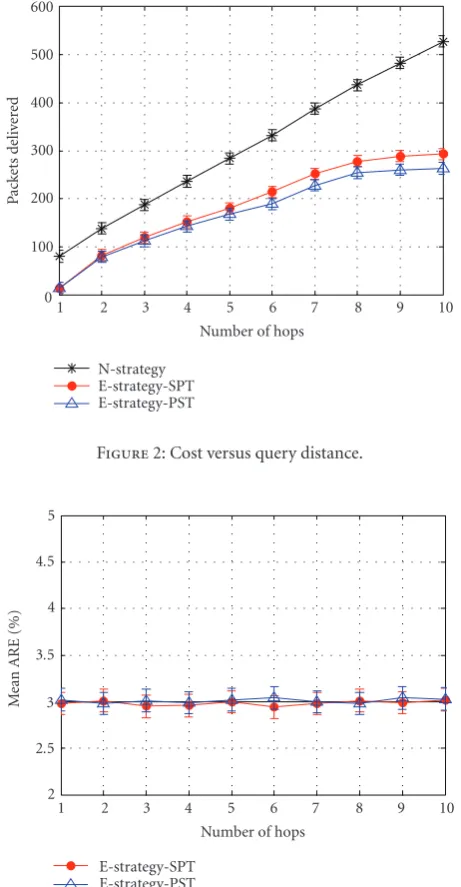
Figure2: Cost versus query distance.
E-strategy-SPT E-strategy-PST
1 2 3 4 5 6 7 8 9 10
Number of hops 2
2.5 3 3.5 4 4.5 5
Me
an
A
R
E
(%
)
Figure3: Accuracy versus query distance.
FromFigure 2, it is obvious that we can benefit a lot in
communication cost by adopting E-strategy, especially by us-ing the path-sharus-ing routus-ing tree. As the query distanceH
increases, the cost of N-strategy grows almost linearly with
H, faster than that of E-strategy. That is because the cost of N-strategy reflects the cumulative overhead of all queries, while the cost of E-strategy is only a part of that, owing to its bandwidth sharing property. E-strategy with PST outper-forms E-strategy with SPT, because the bandwidth is only shared by chance in the latter one. When the average hop of the query distance is getting to 10, E-strategy with PST leads to a saving of about 50% of communication cost over N-strategy.
Figure 3indicates the tradeoffin accuracy. We can see
that using the linear interpolation to convert the frequency
N-strategy E-strategy-SPT E-strategy-PST
300 360 420 480 540 600
Number of nodes 0
100 200 300 400 500 600
P
ac
kets
d
eli
ve
red
Figure4: Cost versus node density.
generates a very tolerable mean ARE, which is only about 3% of the actual sensor data value. Furthermore, this impreci-sion is relatively independent of the query distance.
5.2.2. Impact of node density
Since the topology of the sensor network is affected greatly by the node density, we investigate how the node density will affect the performance of the query strategies. In this experi-ment, we fix the number of hops of the queryHto 6 and vary the number of nodesN, and hence node density. The results are depicted in Figures4and5.
FromFigure 4, it is obvious that E-strategy outperforms
N-strategy in terms of communication cost. Both the com-munication costs of N-strategy and E-strategy with PST decrease slightly as the node density increases. This is be-cause when there are more sensor nodes, each node may have more neighbors, which help to further shorten the short-est paths from the sink nodes to the source node, leading to reduction of the communication cost. However, we can see that the communication cost of E-strategy with SPT in-creases slightly as the node density inin-creases. That is because even though more neighbors of each node might shorten the shortest paths from the sink nodes to the source node, they also reduce the chance for different sink nodes to share the same path. This phenomenon shows that the path-sharing property is more important than the short-path property ac-cording to the E-strategy.
When accuracy is concerned,Figure 5indicates that the mean ARE is again maintained at a comfortable level of about 3%, and is relatively independent of node density.
5.2.3. Impact of number of sink nodes
E-strategy-SPT E-strategy-PST
300 360 420 480 540 600
Number of nodes 2
2.5 3 3.5 4 4.5 5
Me
an
A
R
E
(%
)
Figure5: Accuracy versus node density.
N-strategy E-strategy-SPT E-strategy-PST
1 2 3 4 5 6 7 8 9 10
Number of sink nodes 0
100 200 300 400 500 600
P
ac
kets
d
eli
ve
red
Figure6: Cost versus number of sink nodes.
measure the performance of N-strategy and E-strategy with respect to number of sink nodes. In this set of experiments, we fix the number of sensorsNto 420 and the query distance
Hto 6, and we vary the number of sink nodes from 1 to 10. The results are depicted in Figures6and7.
FromFigure 6, it is obvious that we can again benefit
a lot in communication cost by adopting E-strategy. As the number of sink nodesmincreases, the cost of N-strategy in-creases almost linearly and much faster than strategy. E-strategy with SPT increases faster than E-E-strategy with PST. That is because more sink nodes intuitively arouse more queries, hence higher communication overhead. By apply-ing E-strategy with PST, the communication overhead can be greatly reduced via bandwidth sharing. When the number
E-strategy-SPT E-strategy-PST
1 2 3 4 5 6 7 8 9 10
Number of sink nodes 0
1 2 3 4 5
Me
an
A
R
E
(%
)
Figure7: Accuracy versus number of sink nodes.
of sink nodes gets to 10, E-strategy with PST leads to a saving of 55% of communication cost over N-strategy.
Unlike the query distance and node density, the number of sink nodes does pose an impact on the accuracy of the reconstructed data series. As evidenced from Figure 7, the mean ARE increases with increasing number of sink nodes. This is because more sink nodes imply more varying fre-quencies, as well as the number of times that frequency con-version needs to be performed. Both factors result in larger mean ARE. However, even when the number of sink nodes becomes 10, the mean ARE is still no more than 5%. In other words, even for a good amount of sink nodes, the mean ARE is still tolerable.
6. CONCLUSION
Energy consumption is a crucial factor affecting the appli-cation and effectiveness of a wireless sensor network. In this paper, we proposed an energy-efficient framework in coping with multirate queries in WSNs. To the best of our knowl-edge, this is the first study that leverages existing research work and addresses the issues in this aspect. In summary, our technologies include the following: (1) an energy-efficient framework to process multirate queries; (2) an effective path-sharing routing tree construction method to make full use of the potential bandwidth sharing of all the data streams; and (3) a novel rate conversion mechanism to reconstruct the data stream at the desired frequency from the data stream at a different frequency. Both analytical and simulation results reveal that by tolerating a small degree of imprecision, our E-strategy can lead to a significant amount of communica-tion cost savings, thereby extending the effective lifetime of WSNs.
There are several directions to extend our study. First, in the original model, we implicitly assume that the underly-ing architecture is based on the directed diffusion [9] routing mechanism. Extending our approach so that it can support other routing protocols would be one direction. Second, the rate conversion mechanism is feasible only if the requested sensor values are smoothly changing and can be well fitted by the applied linear interpolation. More accurate and better methodologies need to be explored. Finally, we wish to in-vestigate the functionality of our system in a more dynamic situation, where nodes can join and leave the network fre-quently.
APPENDIX
Proof ofTheorem 1.(1) If there is no point of intersection along the time axes of any pair of data series in the request, then every point of the data series should be collected. As a result, the dissemination frequency fupachieves the upper bound asmi=1 fri.
(2) On the other hand, if the dissemination frequency fd
achieves the upper bound asmi=1fri, we can make the proof
by contradiction. Assuming at least two data series at fre-quencies fr1andfr2, respectively, have points of intersection, then the dissemination frequencyfdshould be no more than
m
i=1fri−gcd(fr1,fr2), where function gcd(·) means calcu-lating the greatest common division. This contradicts with the precondition.
Proof ofTheorem 2.We can use the similar process to prove that the lower bound of the dissemination frequency flowof each node can be achieved if and only if for any pair of data series in the request, they have points of intersection along their time axes. Next, we usemathematical inductionto prove that the lower bound of the dissemination frequency flowof each node can be calculated by expression (1).
(1) Whenm=1, it is obvious that the lower bound of the dissemination frequencyflow=fr1. At the same time, expres-sion (1) can be simplified as (−1)1−1·gcdf
r1
=fr1. That is to say, the proposition holds true whenm=1. Furthermore, we can make the assumption that the conclusion holds true whenm = N, where Nis a positive integer. We will prove that the conclusion also holds true whenm=N+ 1 in the following part.
(2) Whenm=N+ 1, then the lower bound of the dis-semination frequency should be calculated as
flow+fr(N+1)−gcd
where flowis the lower bound of the dissemination frequency
of the formerNrequested frequencies, which can be calcu-lated as
By adopting (A.2), expression (A.1) can be simplified as
N+1
That is to say, the proposition also holds true whenm=
N+ 1.
As a result,Theorem 2always holds true whenmis a pos-itive integer.
Proof ofTheorem 3.(1) First, we prove flow≥max{fri}mi=1. Supposing flow <max{fri}mi=1, this conflicts with the N-strategy that the source node will disseminate the data at all the requested frequencies separately, including max{fri}mi=1. As a result, we have flow≥max{fri}mi=1.
(2) Now we use mathematical induction to prove
flowmax{fri}mi=1 if and only if for all j ≥ i, fri | fr j, 1 ≤
i≤j≤m.
(a) Ifm=1, the proposition holds true.
(b) Ifm = 2, and fromTheorem 2, we have flowfr1+
fr2−gcd(fr1,fr2). It is obvious thatflowmax(fr1,fr2)=
fr2if and only iffr1| fr2. That is to say, the proposition holds true whenm=N, whereNis a positive integer. We need to prove that the proposition also holds true
whenm=N+ 1.
ACKNOWLEDGMENTS
This research is partially supported by a research grant from the Department of Computing, the Hong Kong Polytech-nic University, the Doctoral Foundation of National Edu-cation Ministry of China under Grant no.20059998022 and the National High-Tech R&D Program of China under Grant no.2006AA01Z198. The authors would like to express great appreciation to the reviewers of the paper for their valuable comments on improving the quality of this paper.
REFERENCES
[1] I. F. Akyildiz, W. Su, Y. Sankarasubramaniam, and E. Cayirci, “A survey on sensor networks,”IEEE Communications Maga-zine, vol. 40, no. 8, pp. 102–114, 2002.
[2] U. Srivastaya, K. Munagala, and J. Widom, “Operator place-ment for in-network stream query processing,” inProceedings of the 24th ACM SIGACT-SIGMOD-SIGART Symposium on Principles of Database Systems (PODS ’05), pp. 250–258, Bal-timore, Md, USA, June 2005.
[3] B. J. Bonfils and P. Bonnet, “Adaptive and decentralized oper-ator placement for in-network query processing,” Telecommu-nication Systems, vol. 26, no. 2–4, pp. 389–409, 2004.
[4] Y. Chen, H. V. Leong, M. Xu, J. Cao, K. C. C. Chan, and A. T. S. Chan, “In-network data processing for wireless sensor net-works,” inProceedings of the 7th International Conference on Mobile Data Management (MDM ’06), p. 26, Nara, Japan, May 2006.
[5] B. Krishnamachari, D. Estrin, and S. Wicker, “Modelling data-centric routing in wireless sensor networks,” inProceedings of the 21st Annual Joint Conference of the IEEE Computer and Communications Societies (INFOCOM ’02), pp. 2–14, New York, NY, USA, June 2002.
[6] R. Cristescu, B. Beferull-Lozano, M. Vetterli, and R. Watten-hofer, “Network correlated data gathering with explicit com-munication: NP-completeness and algorithms,” IEEE/ACM Transactions on Networking, vol. 14, no. 1, pp. 41–54, 2006. [7] H. S. Kim, T. F. Abdelzaher, and W. H. Kwon,
“Minimum-energy asynchronous dissemination to mobile sinks in wireless sensor networks,” inProceedings of the 1st International Confer-ence on Embedded Networked Sensor Systems (SenSys ’03), pp. 193–204, Los Angeles, Calif, USA, November 2003.
[8] B. Krishnamachari and J. Ahn, “Optimizing data replication for expanding ring-based queries in wireless sensor networks,” inProceedings of the 4th International Symposium on Model-ing and Optimization in Mobile, Ad Hoc, and Wireless Networks (WiOpt ’06), pp. 361–370, Boston, Mass, USA, April 2006. [9] C. Intanagonwiwat, R. Govindan, and D. Estrin, “Directed
diffusion: a scalable and robust communication paradigm for sensor networks,” in Proceedings of the 6th Annual In-ternational Conference on Mobile Computing and Network-ing (MOBICOM ’00), pp. 56–67, Boston, Mass, USA, August 2000.
[10] J. Lesurf,Information and Measurement, Institute of Physics, London, UK, 2002.