R E S E A R C H
Open Access
A user-centric economic-driven paradigm
for rate allocation in non-orthogonal
multiple access wireless systems
Panagiotis Vamvakas
1, Eirini Eleni Tsiropoulou
2and Symeon Papavassiliou
1*Abstract
In this paper, a novel approach towards optimizing users’rate allocation and price customization in a
non-orthogonal multiple access (NOMA) wireless network under quality of service (QoS)-differentiated requested services is proposed and studied. A multi-service wireless system is considered, where each user’s QoS requirements are reflected through a utility function, alongside his willingness to pay for the corresponding service. Within this setting, in order to jointly allocate the customized price and rate, a two-variable optimization problem arises. Based on the principles of S-modular theory, the above two-variable (rate and price) optimization problem is modeled and solved as a distributed non-cooperative game. The existence and convergence to the Nash equilibrium point with reference to both user’s uplink transmission rate and price is proven. The proposed approach, allowing for decision-making at the user side, is well aligned with the self-optimization and self-adaptation objectives of future emerging 5G wireless networks. The performance evaluation of the devised framework is conducted via modeling and simulation under various scenarios, and the numerical results clearly demonstrate its superiority against other existing approaches.
Keywords:Customized pricing, Rate allocation, Heterogeneous services, User-centric management, Non-orthogonal multiple access, S-modular theory
1 Introduction
Next-generation communication technologies, the diversifi-cation of mobile services, and the users’demand for higher quality of service (QoS) performance have posed quite stringent and demanding challenges to wireless Internet service providers (WISPs). 5G wireless networks require highly spectral-efficient multiple access techniques that play a significant role in optimizing the resource allocation process and improving the performance of the mobile com-munication system. Given the physical constraints associ-ated with radio resource management, quite often high importance and priority is given at reducing interference and/or power consumption, towards improving energy effi-ciency. This happens however at the cost/trade-off of achieving lower data rates for the users, depriving them from fully exploiting system’s capabilities. Non-orthogonal
multiple access (NOMA) technique has been acknowledged as an effective technique for providing high data rates in 5G systems, especially in the uplink communication [1]. Nevertheless, in order to further improve user satisfaction from the provided services, while getting aligned with the vision of subscriber self-optimization and self-adaptation in future wireless networks, sophisticated user-centric re-source management approaches are required.
1.1 Related work
The problem of efficient resource management in wireless networks has been broadly addressed in the literature, es-pecially via utilizing game theoretic approaches, which support the autonomous behavior of the mobile user [2]. Power control problems have been extensively studied mainly from the aspect of reducing battery drain and en-hancing energy efficiency [3–5]. By adding more degrees of freedom alongside power control, data rate allocation becomes feasible with the authors in [6–8] to convert a two-variable problem to a single parameter optimization * Correspondence:[email protected]
1School of Electrical & Computer Engineering, National Technical University
of Athens, Zografou, 15773 Athens, Greece
Full list of author information is available at the end of the article
expressed as the ratio of rate to the respective power. Fol-lowing the same paradigm, the authors in [9] propose a spectrum allocation framework in cognitive radios follow-ing the load balancfollow-ing concept in distributed computer systems. Furthermore, in [10], the joint allocation of power and rate is examined as an actual two variable non-cooperative game via centrally imposed usage-based pricing, while in [11], a similar approach is extended to two-tier femtocell architectures. Also, centralized ap-proaches targeting at maximizing the secrecy sum rate in a NOMA system have been proposed [12]. Although sub-stantial improvements are achieved, in these works, rate allocation is suppressed due to the priority of minimizing
power consumption [13,14].
Considering the class of problems concentrating mainly on rate allocation, in [15], a constrained throughput maximization problem is examined including stochastic control parameters towards safeguarding fairness condi-tions among the users. In [16], a sum rate optimization problem for multiple-input multiple-output (MIMO) NOMA systems is studied with constraints considering the total transmission power and the minimum rate.
At the same time, several attempts have been pro-moted to studying the problem of resources’pricing. In [17,18], the nature of prices is fixed, with the users be-ing charged a flat rate or different classes of static prices are applied to users based on their traffic requirements, respectively. The alternative of day-ahead pricing is ex-amined in [19], with the WISP announcing the time-dependent prices 1 day in advance. In [20], Zheng et al. study a secondary data market, in which users can buy and sell left over data caps from one another. The
authors derive users’ optimal behavior and propose an
algorithm for the Internet service providers (ISPs) to match the buyers and the sellers. Considering a similar trading model, in [21], users’decisions about their usage at different times of the billing cycle are discussed. In [22], the authors address mobile users’data usage behav-ior, through the study of network effects as they emerge by the joint consideration of elements both from social domain (e.g., relationships) and the physical domain (e.g., congestion). The joint pricing and data usage man-agement problem is formulated as a Stackelberg game, where the WISP acts as leader announcing the price to the users, who follow by determining their data usage. In [23, 24], a comprehensive literature review on appli-cations of economic and pricing models for resource management in cloud networking and the Internet of Things, respectively, is provided.
The majority of all the relevant works regarding the radio resource management have concentrated on power control and/or sum rate maximization via centrally im-posed pricing for interference mitigation, thus failing to provide satisfactory data rates for each individual user
and to recognize the high variability among the users’
service requirements. Furthermore, even though that the resource management based on game theoretic ap-proaches is a very well-established research field in the literature, very few research works deal with the com-bined problem of resource management and price customization, especially when the decision-making is performed at the user side in a distributed manner.
1.2 Contributions
The main contributions of this article lie in the area of enabling users to actively correlate resource allocation, QoS differentiation, and price customization, towards improving their overall satisfaction under a user-centric paradigm. To the best of our knowledge, this is the first time that an intelligent mobile user is able to determine in a distributed manner his optimal rate and the corre-sponding price that he is willing to pay in order to achieve it. The proposed rate control and customized pricing framework has been developed aiming 5G multi-service non-orthogonal multiple access wireless networks. It should be clarified that the proposed frame-work is not just another frame-work in the field of resource management which adopts game theory, but provides a novel framework dealing simultaneously with rate con-trol and customized pricing from an autonomous user behavior point of view, in a 5G multi-service NOMA wireless environment.
Specifically, in this paper, a different philosophy is followed where the users, depending on
prespecified/tar-geted signal-to-interference-plus-noise ratio (SINR)
Following this consideration and motivation, and in order to jointly allocate the customized price and rate, an optimization problem of two variables arises, which is modeled and solved as a distributed non-cooperative game. The corresponding problem is tackled by optimiz-ing each user’s net utility function and capitalizing on the principles of multi-variable S-modular theory. In the following, we refer to this problem (and corresponding game) as joint non-cooperative utility-based uplink transmission rate and customized price control (RP) problem. The concluding point of the two-variable RP game is a Nash equilibrium (NE) point that jointly
deter-mines the optimal price and users’ rates, in the sense
that there is no user that would opt to deviate from this point, since his perceived satisfaction cannot be further enhanced by making any change to his strategy individu-ally. It should be also highlighted that in the majority of the literature, which deals with resource manage-ment based on S-modular theory, single-variable optimization problems have been primarily considered [25–27]. In this paper, the S-modular theory is ap-plied to a multi-variable optimization problem, i.e., transmission rate and customized price control, while the extension and proper adaptation of the theory from single-variable to multi-variable optimization problems is not trivial [26].
In contrast to [4], where the uplink transmission power control problem was treated while considering customized pricing, in this work the nature of resource is different, i.e., uplink transmission data rate, which re-sults in completely different users’competition behavior pattern. Specifically, in [4], a higher price is concluded for a specific user as a consequence of an increase in his uplink transmission power. This behavior incentivizes the rest of the group to intelligently choose their uplink power towards reaching a price reduction. This type of
users’ behavior was captured in [4] by the submodular
games. These types of games are associated with the strategic substitutes, meaning that if one player increases his action, this would stimulate the other players to fol-low an opposite action. In contrast, in the current re-search work where the users have control over their transmission data rate, a higher data rate claim from some users concludes to higher prices for themselves. Thus, the rest of the users in order to withstand band-width competition also accept to be charged with higher prices, so as to maintain their achieved data rates. Therefore, if some users agree to pay more in order to increase their data rates, the other competing users fol-low the same strategy. This competition behavior pattern is captured through the supermodular games, where the actions of one player lead to similar actions from the other players and not to the opposite actions, as in sub-modular games adopted in [4].
The performance evaluation of the proposed approach is conducted via modeling and simulation under different pricing alternatives and various scenarios with respect to the number of users. Extensive numerical results indicate the superior performance of the proposed approach when compared to alternative state of the art resource allocation approaches, in terms of achieved data rate and energy ciency. Our results further confirm that the energy effi-ciency that can be achieved as outcome of the resource allocation process is significantly enhanced by increasing the degrees of freedom the user is offered. For practical and implementation mainly purposes, we also evaluated and compared several alternatives to show the realistic ap-plication of the proposed framework, which essentially targets at the computational complexity reduction. Such alternatives mainly reflect a blend of business and tech-nical differentiation characteristics through the introduc-tion of different user partiintroduc-tioning strategies mainly from the pricing point of view.
1.3 Outline
The organization of the remaining of the paper is as
fol-lows. Section2presents the system model and the
asso-ciated proposed net utility functions. In Section 3, we
provide a fundamental introduction to S-modular games
and their main properties, while in Section 4 the
com-bined optimization problem is formally described and addressed as a two-variable S-modular game. In Section 5, the convergence of the RP game to the NE point with reference to both variables (i.e., price and data rate) is studied, and a distributed and iterative algorithm that identifies this point is introduced. In Section 6, a com-parative performance evaluation is presented illustrating the strategic and practical advantages of this approach against other existing works, while finally Section7 pre-sents some concluding remarks.
2 System model and utility functions
2.1 System model
In the following, the uplink of a NOMA-based wireless network, including disparate user types exchanging data under the system’s physical limitations, is considered. To preserve simplicity in the presentation without harming the validity of our analysis and results, in this paper, the notion of time slottis omitted.
We assume |N| continuously backlogged users placed
around a base station (BS) with coverage radius ℜ,
their demand by accounting for the respective price. On the contrary, the inelastic services are constrained by
“hard” short-term data demand that needs to be
achieved within a specific time frame. In turn, these re-quirements are translated into a specific user behavior, where the user is reluctant to consume the service when QoS drops below a pre-determined threshold.
Given the physical, technical, and economical con-straints associated with both the users and the WISP, the involved resources, i.e., power, rate, and price are upper bounded PMini ≤Pi≤PMaxi , rMini ≤ri≤rMaxi , and cMini ≤ci≤
cMaxi , with the maximum feasible rate values being differ-entiated by each service type. In this work, we consider the price to be a dimensionless unit adjustable by the users; however, it can be translated into actual monetary units, thus reflecting the realistic economical dimension of this approach. The channel gain between theith user and the base station is denoted byGi, andGi¼Kdai
i, where
Ki denotes the Rayleigh fading channel gain, a is the
path loss factor anddidenotes the distance from theith user to the base station.
Employing the NOMA scheme in the uplink commu-nication of a wireless network, its basic characteristic is that the users with improved channel gain sense the interference caused by the users with worse channel conditions, while the reverse does not hold true due to the successive interference cancelation (SIC) technique. Without loss of generality, the channel gains are sorted as G1≤…≤G|N|. Following the NOMA protocol, SIC is
performed at the users. Consequently, the nth user
de-tects the signal from the ith user, where n < i and then removes the included message from his observation in a successive manner. The signal from thenthuser,i > n, is considered as noise at theith user. Thus, it is observed that the users with worse channel gain can exclude the signals stemming from users with better channel gain in a successive manner (i.e., SIC technique) from their sensed interference. As a result, each user defines his transmission characteristics through his SINR, noted as:
γi¼
where W [Hz] represents the spread spectrum band-width, Gi is the channel gain from user i to the BS, I0 [W] is the Additive White Gaussian Noise, andPjrefers to the power of each user j, j > i + 1, [25]. The formula-tion of the SINR follows the corresponding formulaformula-tion in the seminal paper [25]. As it will be explained in de-tail in Section 4, the two-variables that are determined by the user are the data rateriand his willingness to pay for the received service, which is expressed through the
priceci. Moreover, his uplink transmissionPiis a param-eter that is implicitly dparam-etermined given the optimal data rate ri and price ci, while considering a target SINR valueγtargeti , as well as the physical constraints, i.e.,PMin
i ≤
Pi≤PMaxi .
Cornerstone towards solving the above problem under a user-centric approach has been the adoption of pure utility functions which represent in a holistic manner user’s degree of satisfaction upon receiving his requested service, while also taking into account user’s QoS pre-requisites (e.g., target rate) and the respective energy consumption (e.g., transmission power). Additionally, a pricing function with respect to both pricing factor ci
and SINR γi matches the level of the price imposed by
the WISP and the user’s individual willingness to pay for the desired rate based on the relevant service type. It should be noted that we strategically have chosen to ex-press pricing function with respect to SINR, since it bet-ter captures and represents user’s behavior with respect to the allocation of the system’s resources, due to the fact that SINR contains both the physical resources of the uplink transmission power and rate. Therefore, if the user wants to achieve high SINR which is translated into more reliable communication, the price increases repre-senting the fee he should pay in order to enjoy this benefit.
2.2 Utility function
In the following, we assume that at every timeslot each user utilizes one type of service, either elastic or inelas-tic. Towards treating a multi-service wireless networking environment under a unified and common optimization framework, we assume that a net utility function is coupled with each user to reflect his behavior and satis-faction in terms of QoS. To achieve this objective, the introduced function maps the obtained degree of satis-faction to the expected trade-off among the parameters that depict his QoS-related performance, i.e., uplink transmission rate and eagerness to pay the price of re-source usage. Hence, each user’s net utility function is classified according to the type of service as follows:
UNETi ðri;ciÞ ¼
1. fiis an increasing function ofγi.
2. fiis a continuous, twice differentiable sigmoidal function with respect toγi.
3. fi(0) = 0. 4. fi(∞) = 1.
In the remaining of the paper for demonstration rea-sons mainly and without loss of generality, we assume that the efficiency function is of the following form (e.g., [10,11,25]).
f γi ¼1−e−AγiM ð3Þ
where parameter M indicates the number of bits of transmitted packets andAis a parameter influencing the slope of the corresponding curve. For presentation sim-plicity, in the following, the same modulation scheme is adopted by all users in the cell, which essentially corre-sponds to the use of a common form of efficiency func-tion by all users.
With reference to the pure utility of users with inelas-tic services, the numerator ri⋅fi(γi) is a sigmoidal func-tion of SINR γi, with its inflection point being mapped at the target SINR,γtargeti at which his QoS prerequisites are fulfilled. Therefore, if that user’s achievable data rate is below inflection point, then a rapid reduction in his utility occurs, a fact that indicates his desire in obtaining and consuming additional system’s resources. It should be highlighted that both for the elastic and inelastic ser-vices, the numerator of the pure utility function is expressed as a function of the actual transmission rateri and the efficiency function f(γi), instead of only the ac-tual transmission data rate that has been adopted so far in the literature. This formulation is proposed in order to better capture users’ services’ QoS prerequisites, as explained above. The aforementioned formulation of the utility function enables a user to properly regulate his uplink transmission rate and inclination to pay, so as to obtain an SINR level that satisfies his QoS prerequisites.
Now, with reference to the users requesting elastic ser-vices, the main characteristic of the latter is their delay-tolerant and high-throughput nature. Hence, the users’goal that request elastic (i.e., non-real time) services is to achieve high throughput, thus increasing their per-ceived satisfaction, i.e., utility. Based on this observation, users’ pure utility function is strictly increasing with re-spect to the achievable data rate. Specifically, the rere-spect- respect-ive numerator in their pure utility function represents the achievable data rate and is reflected via a log-based strictly increasing function of the user’s efficiency functionfi(γi). This formulation is well aligned with the above mentioned high throughput expectations of users requesting elastic services, due to their greedy behavior, essentially aiming at exploiting the network’s available spectrum to its full
extent, in line however with the physical limitations of the system. In principle, the selected utility function for elastic services has been designed following the Shannon like log-based function paradigm, indicating the maximum data rate under which a transmission can successfully take place for a network’s spectral capacity under interference conditions. Consequently, an increase in their obtained data rate results in higher SINR values as a consequence of the nature of functionri⋅log(1 +fi(γi)) which is strictly increasing with respect to γi, and therefore, the overall resulting satisfaction as perceived by the users, i.e.,UNET
i , increases as well.
3 S-modular games
Aiming at providing a generic and stable solution for rate allocation alongside price customization, the theory of multi-variable S-modular games emerges as a con-crete tool towards showing the trade-off between the in-volved parameters. Topkis [28] and Vives [26] have introduced the S-modular games, which include the supermodular and submodular game subclasses. The two types of games have exactly opposite characteristics
and players’ behavior. Regarding supermodular games,
an increase in one’s player’s action for given strategies of the rest of the players reinforces the desire of all the players to increase their actions due to the strategic complementarity. On the opposite side, the strategic substitutes characterize the submodular games, i.e., an increase in one’s player’s action incentivizes the rest of
the players to decrease their actions [29, 30].
Multi-variable supermodular games as studied in [26] re-flect the interrelation between the actions of one user with the rest of the players with whom he competes for
the network’s scarce resources. Supermodular games
and/or learning rules. In such games, the actions of one player (i.e., higher data rate claim) lead to similar actions from the other users, due to their monotonically increas-ing best responses (BR) on this player’s strategy. The above framework corresponds to the problem of our interest, since a user paying higher prices in order to in-crease his data rate is followed by a similar trend from the rest of the users, who in order to withstand band-width competition will also accept to be charged at higher prices so as to maintain their achieved data rates. Subsequently, we discuss the fundamental properties of a supermodular game, which stands for a two-variable (i.e.,!a;!b) optimization problem.
Definition 1 Given a gameG¼ ½N;fA;Bg;fUð!a;!bÞg, a smooth functionU:A×B→ℝis supermodular in (ai,bi) if and only if, [26]:
∂2U a!;!b
∂ai∂bi ≥
0;∀i ð4Þ
Definition 2 A smooth function U:A×B→ℝ (i.e., a
function that has derivatives of all orders everywhere in its spaceA×B) has non-decreasing differences in (ai,bi),
ð!a−i;!b−iÞ, if [26]:
∂2U a!;!b
∂ai∂aj ≥
0;∀j≠i ð5Þ
given that:
∂2
U a!;!b
∂ai∂bj
¼0;∀j≠i ð6Þ
wherea!−i andb!−i are the strategies of all players except foriin the domainsAandB, respectively.
Theorem 1 A gameGis supermodular if the following
conditions are satisfied:
i. i∈N,Si=Ai×Biis a compact subset of the Euclidean space
ii. Uis supermodular in (ai,bi),
iii. Uhas non-decreasing differences in (ai,bi),
If the game is supermodular, then it has at least one Nash equilibrium.
The proof of this theorem can be found in [26,31,32].
4 Problem formulation and solution
4.1 Rate and price control game
Game theory has been promoted as a natural and power-ful choice when dealing with users that exhibit selfish and greedy behavior. When operating in a competitive envir-onment, the wireless network users act as players that
contend against each other and select a strategy space of data rate and willingness to pay, i.e., price, and as a result of their choices achieve a payoff expressed by their utility. In this section, we model our problem as a two-variable (rate (ri) and price (ci))—RP game, assuming a wireless network consisting of|N|users.
Given that the objective of each user is to maximize his utility, the RP game can be formulated as a distrib-uted utility maximization problem. We denote the RP gameGRP¼ ½N;fRi;Cig;fUNeti ð!r;!Þgc as:
max
ri∈Ri;ci∈Ci
UNeti !r;!c;∀i∈N ð7Þ
s:t:rMini ≤ri≤rMaxi andcMini ≤ci≤cMaxi
where! ¼ ðr r1;…;ri;…;rjNjÞand! ¼ ðc c1;…;ci;…;cjNjÞ
are the vectors of users’ uplink transmission rate and
prices, respectively, andRi,Cidenote theithuser’s strategy spaces in uplink transmission rate and price, respectively. The power consumption of the users considering their
op-timal uplink transmission data rate !r and customized
price!c will be discussed in detail in Section4.2. The RP game should conclude to a solution that determines the optimal equilibrium (Nash equilibrium) for the system, based on the individual decisions of each user, given the decisions made by the rest of the users. At the Nash equi-librium, no user has the motivation to alter his choice, for the reason that he cannot unilaterally enhance his own utility by applying changes to his personal strategy, given the selections already made by the rest of the users.
Definition 3 The strategy vectorð!r;!cÞ ¼ ðr1;…;ri;…; rjNj;c
1;…;c
i;…;c
jNjÞin the strategy setsri∈Riandci∈Ci is a Nash equilibrium of the RP game if for every user∀i,
i∈N, the following condition is satisfied: UiNet ri;ci;r−i!;c−i!
≥UNeti ri;ci;r−i!;c−i!
for allri∈Riandci∈Ci.
Moreover, it should be noted that the existence of Nash equilibrium point guarantees a stable outcome of the RP game while, on the other hand, the nonexistence of such an equilibrium is interpreted as an unstable state of the system. The proof of the existence of at least one Nash equilibrium of RP game is mainly based on the use of supermodular games properties.
Theorem 2: The RP game GRPis supermodular in (ri,
ci), if∀i,i∈N:
γi≥0 ð8Þ
i. Si=Ri×Ciis a compact subset of the Euclidean
In a supermodular game, there always exists external equilibria. A largest element ðri;ciÞ ¼ supfðri;ciÞ∈Si :BRðri;ciÞ≥ðri;ciÞg and a smallest elementðri;ciÞ ¼ inf fðri;ciÞ∈Si:BRðri;ciÞ≤ðri;ciÞg, with BR(ri,ci) denoting the best response strategy of a player given the strategies of the rest of the involved players. According to [27],BR
is standard, thus guaranteeing the convergence of the RP game to its Nash Equilibrium, assuming any feasible ini-tial solution. Combining relations (9)–(11) and request-ing to hold true together, we derive the set of values of SINR, under which RP game is supermodular.
Considering the users requesting elastic services and examining the aforementioned two conditions, we have
∂2UNet
ri. Also, considering the users requesting
inelastic services, based on Eq. (2) and regarding the two conditions mentioned above, we have
∂2UNet
Thus, we conclude that the RP game is supermodular in (ri,ci) if∀i∈N, the following condition holds true:
γi≥0 ■
Based on condition (8), we practically conclude that the RP game is supermodular in the whole strategy space, i.e., RiCi¼ ½rMini ;rMaxi ½cMini ;cMaxi . Since the game is confirmed to be supermodular, we conclude that a non-empty set of Nash Equilibria exists as follows:
Theorem 3 There exists a strategy vector ð!r;!cÞ
crease his utility taking as granted the choices of the other users, i.e.,
ri;ci
¼ arg maxUNeti !r;!c;∀ri∈Riand ci∈Ci
ð12Þ
The proof of Theorem 3 follows the same basic steps as in Theorem 1, [26,31,32].
4.2 Power consumption
Based on Theorem 3, the users determine their optimal
data rates!r and their optimal customized prices!c in a distributed manner, while considering the existing phys-ical and external constraints, i.e.,rMin
i ≤ri≤rMaxi and cMini
≤ci≤cMaxi , respectively. In our proposed approach, each user has control over the variables of the data rateriand
the customized price ci, which determine his
corre-sponding perceived satisfaction that is appropriately expressed via the adopted net utility function. However, each user has an extra constraint considering his energy-availability, which is appropriately presented via the feasible transmission power interval, i.e., PMin
i ≤Pi≤
PMax
i . The lower boundPMini expresses the minimum
ne-cessary transmission power in order user’s signal to be
demodulated by the receiver. The upper bound PMax
i stems from mobile user’s available energy.
In our proposed framework, the power consumption
Pi of each user results from his optimal uplink transmis-sion data rate ri and his target SINR valueγtargeti based on Eq. (1). It is noted that the power consumption is not constant, but dynamically determined via the control pa-rameters of the system, i.e., optimal data rateri and cus-tomized price ci. Thus, the power consumption for each user is determined as follows:
Pi ¼ min max γ
It should be clarified that the RP game may have mul-tiple NEs. However, each mobile user selects the NE
corresponding power consumption, as determined in (13), in order to improve his achieved energy efficiency.
5 Convergence and RP algorithm
5.1 Convergence
In this section, we study and prove the convergence of the RP game to a Nash equilibrium point, which consti-tutes a stable solution. The proof is based on the use and properties of best response dynamics, by concluding that users’ net utility function is a standard one. User’s best response strategy in the Euclidean spaceRiCi¼ ½
rMin
i ;rMaxi ½cMini ;cMaxi is expressed as follows:
BRiðri;ciÞ ¼ðri;ciÞ
¼ arg max
ri∈Ri ci∈Ci
UNETi !r;!c ð14Þ
Theorem 4 The RP game GRP converges to its Nash
equilibrium point starting from any initial feasible solu-tion, (i.e., ðrði0Þ;cði0ÞÞ); rMin
i ≤ri≤rMaxi and cMini ≤c
ð0Þ
i ≤cMaxi , provided that user’s best response strategy is a standard function.
Proof: The basic step to prove that RP game converges
to its Nash equilibriumð!r;!cÞ ¼!BRð!r;!Þc is to show that user’s best response strategy belongs to the family of standard functions [27]. A function f is indicated as standard, if the following properties hold:
i. Positivity:f(x) > 0;
ii. Monotonicity: if x≥x′, thenf(x)≥f(x′) and iii. Scalability: for alla> 1,af(x)≥f(ax),
for all x≥0, where x = (x1,x2,…,xN) is a Nash equilib-rium point. With reference to our RP game, we readily observe that all the above properties hold true, as shown below:
i. ð!r;!Þc >0, thusBR!ð!r;!Þc >0, via Eq. (14), ii. ifð!r;!Þc >ð!r0;!c0Þ, then via (14), we conclude
thatBR!ð!r;!Þc >BR!ð!r0;!c0Þ,
iii. for alla> 1, sinceBR!ð!r;!Þc is a strictly increasing function with respect toð!r;!Þc , then it follows thata BR!ð!r;!Þc >BR!ða r!;a c!Þ. ■
5.2 RP algorithm
In the following, we present a low complexity algorithm associated with the convergence to the Nash equilibrium of the RP game, which operates in an iterative and dis-tributed manner. Besides providing a stable and univer-sally applicable solution, the RP algorithm integrates within the same scheme both the rate allocation as well as the price setting for each user at the moment of
receiving the required service. The algorithm is referred to as RP algorithm. The descriptive/pseudo-code steps of the RP algorithm are defined as follows.
5.2.1 RP algorithm
Step 1:The feasible pricing factor sets½cMin
i ;cMaxi are
disclosed by the WISP to the users. Each user selects a random initial feasible uplink
transmission powerPðiite¼0Þ∈½PMini ;PMaxi for the initialization of the transmission. Setite= 0, whereiterepresents the number of iterations. Step 2:The users, given the network’s physical
constraints, define their optimal data rateri∈½ rMin
i ;rMaxi and their willingness to pay, i.e., price ci∈½cMini ;cMaxi , as in Eq. (14). Setite ite+ 1. Step 3:The WISP broadcasts the imposed interference to
all usersPNj¼1GjPjand each useridefines his
sensed interference, as described in the NOMA technique.
Step 4:The users compute their respective transmission powerPiteþ1
i ∈½PMini ;PMaxi given their
pre-determined/target SINR values and the optimal data rateri based on Eq. (13).
Step 5:If the pure utilities of each one of the users do not improveUiðritei ;citei Þ>Uiðritei þ1;cite
þ1
i Þ,
terminate; else go to Step 2.
A key property of the RP algorithm is its distributed op-eration, owing to the fact that the final decisions are con-cluded by each mobile user individually. Each mobile user takes the decision about his best response strategy based on his own available personal information, i.e., channel gainGi, and a global information broadcasted by the base station, i.e., overall interference PNj¼1GjPj. Therefore, in the RP algorithm, the message exchange overhead is ra-ther limited. It should be clarified that, at Step 3, the base station simply announces the total interference to the users. The task of deciding the uplink transmission data rate and price is performed by the users themselves. Thus, the only message exchange overhead from the base station to the mobile users is the broadcasting of the valuescMini ;
cMax
i at the beginning of the RP algorithm’s execution and the total interference at each iteration of the algorithm. Also, it is highlighted that the base station broadcasts the aforementioned information, thus the users are not bur-dened with additional signaling exchange. Therefore, the complexity of the algorithm is not impacted by an in-crease on the number of the users served by the cell. Add-itional results regarding the computational time and complexity of various implementations of the proposed
6 Performance evaluation
In this section, the performance evaluation of the pro-posed framework is conducted through modeling and simulation. Indicative numerical results are presented to gain some insight about and demonstrate the key prop-erties and advantages of the introduced framework and the RP algorithm. In order to better appreciate and com-prehend the benefits and overall operational efficiency of the proposed approach, its performance achievements and improvements are demonstrated via a comparative evaluation study against relevant state of the art research works existing in the literature.
Initially, in order to adapt the RP framework into differ-ent resource allocation scenarios and obtain insightful, comparative results and show how the adopted pricing scheme may influence the equilibrium point, four different pricing policies have been considered:
(a) Customized pricing, where each user separately declares the price he would accept in order to achieve the desired QoS upon receiving the required service,
(b) Central pricing, where the WISP charges all users with a common price for their transmission, (c) Service pricing, where the users are priced
according to their requested service type, and lastly, (d) Zone pricing, where several non-overlapping rings
(zones) are created within each cell, while within each zone homogeneous pricing, is applied to all users belonging to that zone.
One of the advantages of introducing price
customization is the ability to segment the users into groups according to specific criteria (e.g., service, location). Hence, the selected pricing mechanisms serve different purposes depending on the priorities of the users and/or the WISP regarding complexity and computational re-source consumption reduction, interference mitigation, or the utilization of network’s capacity.
Furthermore, the aforementioned different versions of the RP algorithm are compared against [10], where data rates are jointly allocated among the users alongside trans-mission powers, and [15], where the system is designed to-wards maximizing its uplink sum rate. For fairness in the
comparison, the approaches proposed in [10, 15] have
properly been adopted to the NOMA access scheme.
6.1 Model and assumptions
Throughout our evaluation analysis, the uplink of a single cell system is considered where users place requests for elastic and inelastic services. To study the behavior of the proposed RP framework under different network sizes, we varied the number of users|N(t)|from10to40, while they were assumed to be randomly placed within the cell of
radius R = 1000 m for each simulation scenario. For any
considered network topology, the order of requested ser-vices was alternating among the users, in the sense that the closest to the base station user requests inelastic ser-vice, the second closest requests elastic serser-vice, and so on. Such a setting allows for a balanced distribution, both physical (location) and logical (type of service), of the ser-vices and users in the system. Users requesting inelastic services are assumed to have service rate target of 96 Kbps (e.g., simple video upload). For statistical purposes, a Monte Carlo simulation was adopted, where for all the presented results we studied 10,000 random topologies considering randomly generated users’ positions. Users’ path gains are modeled through the simplified path loss model Gi¼Ki=dai , where distands for the distance be-tween useriand the serving base station,aexpresses the distance loss exponent (e.g.,a = 4), andKiis a log-normal
distributed random variable with mean 0 and variance
σ2
= 8db, representing shadow effect. For simplicity in the presentation and without loss of generality, all users are
assumed to adopt the same efficiency function fðγiÞ
¼ ð1−e−1:15γiÞM, M = 80, simply reflecting the use of the
same modulation and coding scheme by all users.
For practical purposes, we assume that every user im-poses a strict constraint on his maximum uplink transmis-sion power, i.e., PMaxi ¼0:1 Watt , and the WISP has specific pricing boundaries that announces ranging between
a maximum and minimum price, i.e., cMax
i ¼2106, cMini ¼0. Throughout our numerical evaluation all the relevant parameters, including A, M parameters of f(γi) and the boundscMax
i ;cMini have been appropriately chosen and con-figured, so as to be realistic on one hand, while on the other hand to ensure almost the same order of magnitude for both terms of user’s net utility functionUNETi .
6.2 Numerical results and discussions
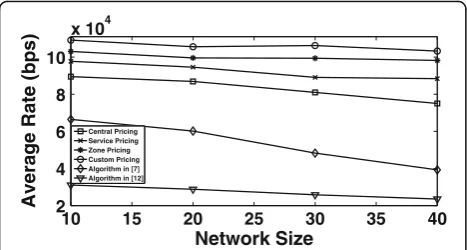
Figures 1 and 2 present the performance of the
consid-ered six approaches (i.e., the four alternatives of the RP
framework, and the approaches in [10, 15]), in terms of
users’ average uplink transmission rate achieved and
energy efficiency represents in a combined metric the objective of simultaneously achieving lower transmission power and higher data rate. Moreover, based on the pre-sented numerical results, it becomes evident that the RP framework performs well as the network grows in size, while the rest of the considered frameworks, e.g., [10, 15], present significantly lower data rate and energy effi-ciency, and in some cases even collapse due to the ab-sence of control over the corresponding price that the end user is penalized by the WISP. The customized pri-cing policy proposed in our framework outperforms the rest of the implementation alternatives, i.e., zone, ser-vice, and central pricing, in terms of increased data rate and energy efficiency awards, due to its attribute to adapt well to each user’s QoS prerequisites and willing-ness to pay in order to fulfill them. The results with ref-erence to the rest of the pricing alternatives of our framework present a trade-off among the achievable data rate, energy efficiency, and computational complexity when compared to the customized pricing policy. Specif-ically, zone-based pricing policy presents a well-balanced alternative implementation both in terms of efficiency and effectiveness, as it achieves an improvement in the computational time efficiency of approximately 28% when compared to the custom pricing implementation
without paying any significant cost as far as the achieved data rate and energy efficiency is concerned. On the other hand, the rest of the implementation alternatives, i.e., central and service pricing, achieve to further im-prove the computational time efficiency by 98 and 90% compared to the custom pricing implementation, paying the penalty however of increased losses in the obtained data rate (i.e., 28.08 and 14.85%, respectively) and energy efficiency (i.e., 20.91 and 16.14%, respectively). Compre-hensive comparative results with respect to the metric of computation time efficiency of all the considered ap-proaches, as compared to the baseline scenario of
cus-tom pricing implementation, are presented in Table 1.
Based on these results, it is highlighted that a practical potential limitation of the custom pricing policy is its in-creased computational time compared to the alternative heuristic approaches (i.e., central, service and zone pri-cing), as well as compared to [10, 15]. Additionally, we have extended our study to the computational complex-ity per iteration of each of the comparative approaches, which is quantified via the average computational time per iteration per user, given the distributed nature of the algorithms. The results are presented in the last column
of Table 1as well. We observe that the average
compu-tational time per iteration per user for the custom pri-cing implementation is quite low; however, given the two-variables optimization problem that is solved, we need more iterations to converge to the optimal solu-tion. This is the reason that the overall computational time of the custom pricing framework is increased com-pared to the other approaches, as discussed above.
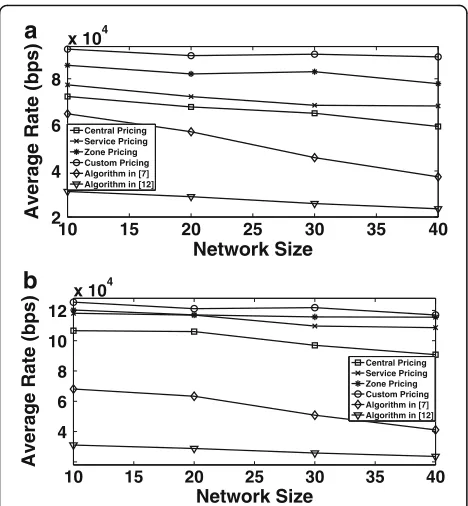
Figures 3a, b and 4a, b present similar results as in
Figs. 1 and 2—reflecting average uplink transmission
rate (Fig.3a, b) and energy efficiency (Fig.4a, b)— separ-ately for the users that request inelastic and elastic services, respectively, in order to gain insightful informa-tion about the influence of the type of requested service on the equilibrium values of data rate and pricing. It is noted that for each simulated scenario considering in-creasing number of users from 10 to 40, half of them
10 15 20 25 30 35 40
Fig. 1Users’average uplink transmission data rate versus the number of users considering RP framework and comparative scenarios
Fig. 2Users’average energy efficiency versus the number of users considering RP framework and comparative scenarios
Table 1Comparative results for computation time efficiency
and average time per iteration per user
Scenario Increase in average
RP: central price 97.56% 0.001800
RP: service price 90.81% 0.000792
RP: zone price 21.81% 0.000699
request inelastic services and the rest of them elastic ser-vices. Observing the results of Figs. 3a, b and4a, b, we conclude that the custom pricing implementation of RP algorithm outperforms both the rest of the implementa-tion alternatives of RP algorithm (i.e., zone, central, ser-vice pricing), as well as the alternatives in the literature (i.e., [10, 15]), in terms of increased achieved data rate and energy efficiency for any type of user, i.e., irrespect-ive of the requested service type (i.e., inelastic or elastic).
In Table 2, we summarize the average percentage
in-crease in terms of achievable data rate and energy
effi-ciency for each algorithm, considering the six
comparative scenarios. Based on these results, we ob-serve that the different implementations of the RP algo-rithm considerably improve the attainable rates and energy efficiency, achieving approximately up to 292% increase of data rate and 203% increase of energy effi-ciency when compared to [15].
As mentioned before, the performance improvement of the RP implementation with customized pricing is achieved at the cost of increased computational com-plexity. The convergence time of the RP algorithm can be further improved via adopting several operational considerations and enhancements as discussed below. Initially, in order to derive the presented results, we exe-cute the RP algorithm per timeslot. Towards improving the convergence performance, we can execute the RP
al-gorithm considering as initial value of users’
transmission data rate and price the ones that were cal-culated in the previous timeslot, i.e., “educated” imple-mentation of RP algorithm. Taking into consideration that in reality the examined wireless communication en-vironment is not expected to undergo significant changes within the duration of few timeslots, for all practical purposes, the users’ uplink transmission rate and price values as obtained by the RP framework could be applicable to several consecutive timeslots, thus
fur-ther reducing the corresponding implementation
overhead.
Fig. 3Average uplink transmission data rate versus the number of users requestingainelastic andbelastic services considering the RP framework and comparative scenarios
Fig. 4Average energy efficiency versus the number of users requestingainelastic andbelastic services considering the RP framework and comparative scenarios
Table 2Comparative results for average sum rate and energy
efficiency of various comparative scenarios against [15]
Scenario Increase in average sum rate Increase in average energy efficiency
[15] – –
[10] 94% 33.15%
RP: central price 205.29% 163.83%
RP: service price 240.61% 171.76%
RP: zone price 269.58% 180.10%
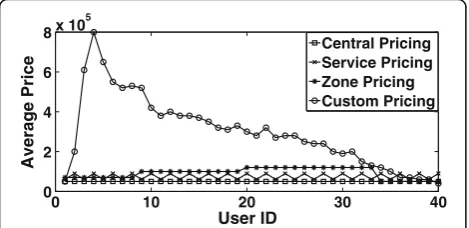
Figure 5 represents the actual values of price ci im-posed to the users as a function of user’s ID considering the four pricing alternatives of RP framework, i.e., (i) custom, (ii) zone, (iii) service, and (iv) central pricing. It should be noted that for demonstration purposes only, the priceciis a dimensionless quantity. However, in a practical
implementation of RP framework, the price ci could be
mapped to real monetary units. The prices that are pre-sented in Fig.5are the Nash equilibrium values of RP al-gorithm for each user. Considering the service pricing implementation, the results reveal that the users who re-quest elastic service conclude to higher prices due to their need to achieve higher uplink transmission rates. On the other hand, in the zone pricing implementation, it is noted that the less distant users, i.e., first zone, are penalized less due to their good channel gain conditions that conclude to high transmission data rate with lower cost. Addition-ally, in order to account for the disadvantage of the more distant users due to their deteriorated channel conditions, these users are assigned lower prices as their distance in-creases. The custom pricing also follows the same concept (i.e., relation of pricing and users’channels’ conditions/dis-tance from the base station). Finally, the central pricing implementation alternative of RP algorithm is the less“
ag-gressive” one with respect to the imposed price to the
users, due to the fact that it should consider the heteroge-neous characteristics (i.e., requested service, channel con-ditions) of all the users.
Towards examining the behavior of the RP algorithm under the scenario of users’mobility within the cell, we study the impact of user’s mobility on his transmission characteristics, i.e., data rate and power, and on his will-ingness to pay for the requested service, i.e., price. It is highlighted that the duration of a timeslot is 0.5 msec [33]; thus, user’s intracell mobility can be considered ra-ther limited per timeslot. As a result, the users can re-adjust their position coordinates within the cell per timeslot without significantly distorting the resource al-location process. For demonstration purposes, we study the impact of user’s mobility to his transmission charac-teristics for a time-window where the user can move up
to 10 m. The results reveal that the change in the rate and price allocation process is minor (approximately 0%), whereas a slight increase in the transmission power is observed (less than 0.1%). This implies that the RP al-gorithm maintains steady outcomes concerning the power and rate allocation, since the users constantly aim to achieve the data rates as close as possible to the
feas-ible upper bounds. Hence, a change in user’s location
will not affect his data rates requirements, besides a small adjustment to the transmission power levels, so as to claim the same data rate levels. Moreover, the adop-tion of the NOMA SIC technique maintains the intracell interference to low levels; hence, user’s mobility impact within the duration of a timeslot cannot have amplifying impact on the main transmission characteristics of the users. Additionally, by considering stochastic user’s mo-bility, a high degree of offset among new users’positions can take place, with a number of users slightly improv-ing their transmission (e.g., slightly better channel gain conditions) and counterbalance any negative transmis-sion impact from the users who deteriorate their trans-mission capabilities in the new positions.
7 Conclusions
In this article, we tackled the problem of joint rate allo-cation and customized price setting in NOMA wireless networks supporting users with heterogeneous QoS re-quirements, following a user-centric paradigm. Through the use of a net utility function with two variables, the satisfaction of each user is highlighted as the trade-off between his desired data rates and the price he is charged in order to receive the respective service. The above optimization problem has been properly formu-lated as a non-cooperative supermodular game, its solu-tion was obtained, and its convergence to its Nash equilibrium point was shown, while an iterative algo-rithm is devised to obtain it in a distributed manner.
The performance of this framework was in depth exam-ined through a series of simulation experiments including different pricing policies, whereas the superiority of the proposed approach was clearly demonstrated by comparing it with other research works in the literature. Specifically, it has been shown that the different implementations of the RP algorithm succeed in providing considerably higher data rates in all different user classes while at the same time maintaining transmission power at low levels. This was achieved by applying customized pricing schemes to each user/user groups, thus precisely extracting consumer sur-plus regarding the QoS prerequisites. Also, due to the flex-ible and generic two parameter utility-based design of the described work, the proposed problem solution can be ap-plied in various allocation problems for different resources, network topologies, access technologies, etc.
0 10 20 30 40
0 2 4 6
8x 10
5
User ID
Average Price
Central Pricing Service Pricing Zone Pricing Custom Pricing
7.1 Method
This paper studies the combined problem of rate allocation and customized price setting, in NOMA wireless networks supporting users with heterogeneous QoS requirements, following a user-centric paradigm. The performance of the proposed framework was in depth examined through a series of simulation experiments including different pricing policies, whereas the superiority of the proposed approach was clearly demonstrated by comparing it with other re-search works in the literature. Specifically, it has been shown that the different implementations of the proposed algorithm succeed in providing considerably higher data rates in all different user classes while at the same time maintaining transmission power at low levels. The simula-tion code was written in Matlab.
Abbreviations
BR:Best response; BS: Base station; ISPs: Internet service providers; NOMA: Non-orthogonal multiple access; QoS: Quality of service; RP: Rate and price; SIC: Successive interference cancelation; SINR: Signal-to-interference-plus-noise ratio; WISPs: Wireless Internet service providers
Acknowledgements
The research of Dr. Eirini Eleni Tsiropoulou was partially supported by the UNM Research Allocation Committee award.
Availability of data and materials
The source code and generated data are the authors’intellectual property.
Authors’contributions
All authors contributed significantly to the research work presented in this paper. PV had a leading role in the formulation and solution of the considered optimization problem, while performing a detailed evaluation and analysis of the developed algorithms, through conducting an extensive set of simulations. EET mainly contributed to the use of a game theoretic framework towards solving the optimization problem under consideration, while devoting significant efforts to the comparative performance evaluation, and had key leading role in the article editing and presentation. SP introduced the original concept on which our current work was based, orchestrated the overall development of the performance evaluation work, and had the coordination in the writing of the article. All authors read and approved the final manuscript.
Competing interests
The authors declare that they have no competing interests.
Publisher’s Note
Springer Nature remains neutral with regard to jurisdictional claims in published maps and institutional affiliations.
Author details
1School of Electrical & Computer Engineering, National Technical University
of Athens, Zografou, 15773 Athens, Greece.2Department of Electrical &
Computer Engineering, University of New Mexico, Albuquerque, NM 87131, USA.
Received: 25 January 2018 Accepted: 15 May 2018
References
1. M Al-Imari, P Xiao, MA Imran, Receiver and resource allocation optimization for uplink NOMA in 5G wireless networks. Int. Symp. Wirel. Commun. Sys. 2015, 151–155 (2015)
2. Q Song, L Nuaymi, X Lagrange, Survey of radio resource management issues and proposals for energy-efficient cellular networks that will cover
billions of machines. EURASIP J. Wirel. Commun. Netw.2016, 140 (2016). https://doi.org/10.1186/s13638-016-0636-y
3. J Choi, On the power allocation for a practical multiuser superposition scheme in NOMA systems. IEEE Commun. Lett.20(3), 438–441 (2016) 4. EE Tsiropoulou, P Vamvakas, S Papavassiliou, Joint customized price and
power control for energy-efficient multi-service wireless networks via S-modular theory. IEEE Trans. Green Commun. Netw.1(1), 17–28 (2017) 5. M Rasti, AR Sharafat, B Seyfe, Pareto-efficient and goal-driven power control
in wireless networks: a game-theoretic approach with a novel pricing scheme. IEEE/ACM Trans. Netw.17(2), 556–569 (2009)
6. MR Musku, AT Chronopoulos, DC Popescu, Joint rate and power control using game theory. IEEE Cons. Commun. Netw. Conf.(2), 1258–1262 (2006) 7. MR Musku, AT Chronopoulos, DC Popescu, Joint rate and power control
with pricing. GLOBECOM '05. IEEE Glob. Tel. Conf. (6), 5–3470 (2005) 8. MR Musku, AT Chronopoulos, DC Popescu, A Stefanescu, A game-theoretic
approach to joint rate and power control for uplink CDMA communications. IEEE Trans. Commun.58(3), 923–932 (2010) 9. AT Chronopoulos, MR Musku, S Penmatsa, DC Popescu, Spectrum load
balancing for medium access in cognitive radio systems. IEEE Commun. Lett.12(5), 353–355 (2008)
10. EE Tsiropoulou, P Vamvakas, S Papavassiliou, Joint utility-based uplink power and rate allocation in wireless networks: a non-cooperative game theoretic framework. Elsevier Phys. Commun. J.9, 299–307 (2012)
11. EE Tsiropoulou, P Vamvakas, S Papavassiliou, Supermodular game-based distributed joint uplink power & rate allocation in two-tier SC-FDMA femtocell networks. IEEE Trans. Mob. Comp.16(9), 2656–2667 (2016). https://doi.org/10.1109/TMC.2016.2622263
12. Y Zhang, HM Wang, Q Yang, Z Ding, Secrecy sum rate maximization in non-orthogonal multiple access. IEEE Commun. Lett.20(5), 930–933 (2016) 13. Z Na, X Li, X Liu, Z Deng, Subcarrier allocation based simultaneous wireless
information and power transfer for multiuser OFDM systems. EURASIP J. Wirel. Commun. Netw.2017, 148 (2017).https://doi.org/10.1186/s13638-017-0932-1 14. C Yang, S Jordan, Power and rate allocation for video conferencing in cellular networks. EURASIP J. Wirel. Commun. Netw.2013, 31 (2013). https://doi.org/10.1186/1687-1499-2013-31
15. S Papavassiliou, C Li, Joint throughput maximization and fair uplink transmission scheduling in CDMA systems. EURASIP J. Wirel. Commun. Netw.2009(1), 1–15 (2009)
16. Q Sun, S Han, Z Xu, S Wang, I Chih-Lin, Z Pan, Sum rate optimization for MIMO non-orthogonal multiple access systems. IEEE Wirel. Commun. Netw. Conf.2015, 747–752 (2015)
17. S Shakkotai, R Srikant, A Ozdaglar, D Acemoglu, The price of simplicity. IEEE J. Sel. Areas Commun.26(7), 1269–1276 (2008)
18. CK Chau, Q Wang, DM Chiou, On the viability of Paris metro pricing for communication and service networks. IEEE INFOCOM.2010, 1–9 (2010) 19. S Ha, S Sen, C Joe-Wong, Y Im, M Chiang, TUBE: time-dependent pricing for
mobile data. ACM SIGCOMM.42(4), 247–258 (2012)
20. L Zheng, C Joe-Wong, CW Tan, S Ha, M Chiang, Customized data plans for mobile users: feasibility and benefits of data trading. IEEE J. Sel. Areas Commun.35(4), 949–963 (2017)
21. M Andrews, Understanding the effects of quota trading on mobile usage dynamics. IEEE WiOpt.2016, 1–8 (2016)
22. X Gong, L Duan, X Chen, J Zhang, When social network effect meets congestion effect in wireless networks: data usage equilibrium and optimal pricing. IEEE J. Sel. Areas Commun.35(2), 449–462 (2017)
23. NC Luong, P Wang, D Niyato, Y Wen, Z Han, Resource management in cloud networking using economic analysis and pricing models: a survey. IEEE Commun. Surv. Tutorials19(2), 954–1001 (2017)
24. NC Luong, DT Hoang, P Wang, D Niyato, DI Kim, Z Han, Data collection and wireless communication in internet of things (IoT) using economic analysis and pricing models: a survey. IEEE Commun. Surv. Tutorials 18(4), 2546–2590 (2016)
25. L Gao, G Iosifidis, J Huang, L Tassiulas, Hybrid data pricing for network-assisted user-provided connectivity. IEEE INFOCOM.2014, 682–690 (2014) 26. X Vives, Complementarities and games: new developments. J. Econ. Lit.
XLIII, 437–479 (2005)
27. RD Yates, A framework for uplink power control in cellular radio systems. IEEE J. Sel. Areas Commun.13, 1341–1347 (1995)
28. DM Topkis, Equilibrium points in nonzero-sum n-person submodular games. SIAM J. Control. Optim.17(6), 773–787 (1979)
30. S Lasaulce, H Tembine,Game Theory and Learning for Wireless Networks: Fundamentals and Applications(Elsevier, Amsterdam, 2011)
31. CU Saraydar, NB Mandayam, DJ Goodman, Efficient power control via pricing in wireless data networks. IEEE Trans. Commun.50, 291–303 (2002) 32. E Altman, Z Altman, S-modular games and power control in wireless
networks. IEEE Trans. Autom. Control48, 839–842 (2003)