Akkadian Word Segmentation
Timo Homburg M.Sc., Dr. Christian Chiarcos
Institute for Computer ScienceGoethe University, Robert-Mayer-Str. 10, 60325 Frankfurt am Main, Germany [email protected], [email protected]
Abstract
We present experiments on word segmentation for Akkadian cuneiform, an ancient writing system and a language used for about 3 millennia in the ancient Near East. To our best knowledge, this is the first study of this kind applied to either the Akkadian language or the cuneiform writing system. As a logosyllabic writing system, cuneiform structurally resembles Eastern Asian writing systems, so, we employ word segmentation algorithms originally developed for Chinese and Japanese. We describe results of rule-based algorithms, dictionary-based algorithms, statistical and machine learning approaches. Our results may indicate possible promising steps in cuneiform word segmentation that can create and improve natural language processing in this area.
Keywords:Assyriology, Cuneiform, Akkadian, Chinese, Word Segmentation, Machine Learning
1.
Introduction
Word segmentation is the most elementary task in natural language processing of written language. In most alpha-betical writing systems, this task is commonly referred to as tokenization and can be easily solved through the inter-pretation of orthographical markers for word and sentence boundaries, e.g., white spaces. Where these are lacking, however, word segmentation is a challenging task, a classi-cal – and successfully addressed – problem in logographic writing systems like Chinese and logosyllabic writing sys-tems like Japanese.
Here, we describe experiments on cuneiform, a writing sys-tem developed in the 4th m. BCE in Mesopotamia sub-sequently applied to various Semitic, Indo-European and isolate languages in the region. As a logosyllabic writing system, it shares important structural characteristics with Chinese and Japanese (Ikeda, 2007), so that we evaluate word segmentation methods successfully applied to these languages. However, these languages are unrelated to those of the Ancient Near East, so that future research will focus on developing aspects specific to languages with cuneiform writing.
As a writing system, cuneiform poses a number of unique challenges:
• The same character, e.g., , can be read as a logo-graph or as a syllable, as the logologo-graphGURU‘young man’ or with its phonological reading as a syllabic sign.
• As a syllabic sign, a single character can have multi-ple different readings, e.g., grounded in the possible Sumerian pronounciation(s) of the logograph, or the pronounciation of their Akkadian translations, may be read asdan/tan (from Akk. dannu‘strong, power-ful’), kal (from Sum. kal ‘rare, valuable’ andkalag ‘strong’), rib (from Sum. rib ‘outstanding, strong’), etc. (Tinney and others, 2006; Lauffenburger, nd; Borger, 2004).
• CVC syllables (e.g.,dan) can be as a pair of CV-VC characters ( da-an) or with a single CVC character
( dan) (Gelb, 1957, p.8,Da-an--rivs.Dan-r-ri).
We primarily consider the Akkadian language, the domi-nant language of the Ancient Near East from the 3rd to the 1st millennium BCE. Originally spoken in Mesopotamia, it became the lingua franca in the Near East during the 2nd m. BCE, with an extensive body of material comparable only to corpus languages such as Classical Latin or An-cient Greek. With a considerable amount of cuneiform clay tablets not yet deciphered, and new ones being continu-ously excavated, the automated processing of the Akkadian language is thus of tremendous importance. Previous re-search on automated digitization focused on producing 3D scans of tablets (Sect. 2.), with Optical Character Recog-nition (OCR) being a logical next step in the development. Successful cuneiform OCR, however, needs to be accom-plished by knowledge-rich NLP methods for the contex-tual disambiguation of characters: One of the key charac-teristics of cuneiform is that a character can be read as an logograph, as a determinative, or as a syllabic sign (with different phonemic values). The contextual distribution of characters is thus heavily dependent on its context. Word segmentation approaches may thus be a key component to any approach on cuneiform OCR.
2.
State Of the Art
We distinguish three types of word segmentation algo-rithms:
rule-based segmentation rules derived from grammar
dictionary-based segmentation by lookup in a (statically enhanced) dictionary
statistical/machine learning data-driven segmentation as learnt from segmented corpora
As shown in several SIGHAN BakeOffs in the last decade (Sproat and Emerson, 2003), in Chinese machine learn-ing and dictionary-based approaches like MaxMatch (Chen and Liu, 1992) produce reasonable results while rule-based methods are commonly used as a Baseline (Palmer and Burger, 1997). In Japanese, however, rule-based algorithms like Tango (Ando and Lee, 2000) proved to be more suc-cessful. This is partially due to the morphological richness of Japanese as compared to Chinese.
As a point of orientation for subsequent studies on cuneiform, we evaluate selected approaches from these classes in their performance on Akkadian. Neither the Akkadian language nor cuneiform as a writing system have been addressed in this respect before.
Along with other cuneiform languages, Akkadian has a considerable research history in NLP. For the greatest part, existing approaches are concerned with rule-based mor-phological analyzers, e.g., Kataja and Koskenniemi (1988), Barthlemy (1998), Macks (2002), Barthlemy (2009), Khait (accepted) for Akkadian, or Valentin Tablan Wim Peters (2006) for Sumerian. As for data-driven morphological tools, the state of the art in the field is represented by the Lemmatizer of the Open Richly Annotated Cuneiform Cor-pus (ORACC),1which supports manual morphological an-notation for Akkadian, Sumerian and (to a limited degree) Hittite with a lookup-functionality in the annotated corpus. Such example-based approaches can be extended to auto-matically transfer morphological rules through phonologi-cal equivalences, as demonstrated by Snyder et al. (2010) for the projection of Hebrew morphology and lexicon to Ugaritic, another Semitic cuneiform language. As for higher levels of linguistic analysis, we are not aware of any tools for syntactic or semantic annotation for Akkadian, however, the latter has been considered for administrative texts from the Sumerian period, whose highly convention-alized structure can be exploited for concept classification (Jaworski, 2008).
Aside from linguistic analysis, another aspect of cuneiform languages that recently aroused interest are approaches fo-cusing on the material side of cuneiform writing, i.e., scan-ning and digitizing clay tablets (Subodh et al., 2003; Co-hen et al., 2004), reconstructing tablets and tales by au-tomatically combining their fragments (Collins et al., ac-cepted; Tyndall, 2012), and recently, initial steps towards cuneiform OCR have been undertaken (Mara et al., 2010). As this line of research is flourishing mostly in the field of
1
http://oracc.museum.upenn.edu/doc/ builder/linganno/
computer graphics, the obvious gap between both lines of research lies in the absence of any studies concerned with the transition from the (identified) sign and its linguistic in-terpretation, a challenging task, as mentioned before. With our paper, we describe the first experiments in this direction, with a specific focus on segmenting character sequences into words as a core component for future ap-proaches on transliteration.
3.
Experimental Setup
3.1.
Corpus Data
We use corpora from three different periods and dialects, namely Old Babylonian, Middle Babylonian and Neo-Assyrian, from the Cuneiform Digital Library Initiative (CDLI)2, representing most of the available texts (clay tablets) of the given periods of time. The corpora were ran-domly split in a 80:20 ratio for training and testing purposes (on a per-tablet, not a per-line basis). For the experiments, we trained our segmentation algorithms on each of these language stages, and performed evaluations on each lan-guage stage respectively. For reasons of space, we only report results for the Middle Babylonian training corpus and evaluation against the Middle Babylonian test corpus in detail. Further experiments showing robust performance across different language stages will be represented in a graphical way. Additionally we will present results of clas-sifications using corpora data of one epoch applied on other epochs of the same language to get an impression of the performance of the algorithms on related data.
The CDLI ATF format contains metadata, a (word-segmented) transliteration, and (optionally) a translation. CDLI data always represents cuneiform in lines as found on the clay tablets. To minimize ambiguity, Akkadian writ-ers tried to avoid incomplete words at the end of a line, so the tablets themselves provide initial data on word seg-mentation. From the transliteration, we restored the orig-inal UTF-8 characters on the basis of a sign list that we compiled from various resources. Non-restorable charac-ters were ignored and thus are not represented in the result-ing texts. This data represents our gold standard. It should be noted that the mapping to UTF-8 can not be trivially re-versed because of the highly ambiguous phonological and ideographic meaning of characters.
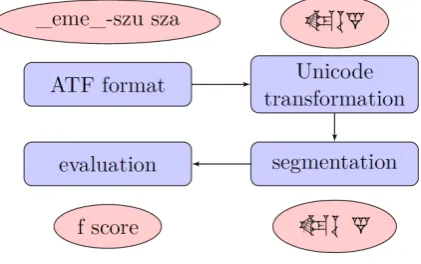
After conversion and the removal of whitespaces, segmen-tation algorithms of three categories have been applied. Figure 1 shows the segmentation process.
3.2.
Baseline
As our baseline we adopted theCharacter-As-Word algo-rithm (Palmer and Burger, 1997, p.1) common as a Baseline in Chinese, in the form of anAverage-Word-Length(AVG) algorithm. The average word lengthLwas determined em-pirically by analyzing the training corpora as follows:
L=
⌊∑#(text)
i=1 len(wi)
#(text)
⌋
withtextbeing the entire corpus,len(wi)being the length
of a word and#(text)representing the number of words
2
Figure 1: Classification process
in the entire corpus. Accordingly, a sequence of characters will be split after everyLth character.
3.3.
Rule-based Algorithms
A first simplebigrammethod inserts a word break between two charactersc1andc2, if a word break betweenc1andc2
is more frequent than a non-break in the training corpus. Similarly, aunigramsegmentation between two characters can be achieved by classifying every individual character according to the I(0)BES scheme – (preferred) intermedi-ate (I), beginning (B), end (E) and single (S) characters – in the training corpus. Theprefix/suffixalgorithm collects us-ages for every characters in every word found in an already segmented training corpus. For every character found in a word classification in the I(0)BES scheme will be collected and frequencies will be counted for I,B,E and S respec-tively. For each pair of characters the algorithm will test if the probability of being E or S exceeds the probability of being I or B, therefore indicating a separation. Therefore theprefix/suffixalgorithm includes information on a word basis to achieve the segmentation.
Furthermore, we apply theTangoalgorithm (Ando and Lee, 2000) which uses a scoring system to determine possible segmentations in a sliding window mechanism. The thresh-old parameter and the window size have been empirically chosen to fit the needs of the Akkadian language.
Finally, we compare these methods with a random segmen-tation function which decides for every character whether a segmentation should occur after it. The randomized func-tion is initialized with a random seed of the size of the corresponding charcount of each line respectively. Though substantially worse than the average-length baseline, it out-performs the bigram method.
3.4.
Dictionary-based Algorithms
As dictionary-based approaches can despite their simplic-ity gain considerable segmentation efforts in languages like Chinese or Japanese, we apply the commonly used Mini-mum WordCount MatchingAlgorithm, a modified version of theLCU Matchingalgorithm (Pengyu et al., 2014), and theMaxMatchalgorithm (Chen and Liu, 1992), and a mod-ified version of the MaxMatch Algorithm (Islam et al., 2007).3 Dictionaries used in those approaches have been
3
We employ the basic version of (Chen and Liu, 1992). No additional neighbor checking performed.
generated from the provided training data used as a basis for the other approaches as well. Externa dictionary resources have not been considered. It is important to notice that we did not apply any new word detection which can be used to extend the dictionary using data from the test corpus. This may be a topic for further refinement and could be achieved by applying one of many statistical approaches.
3.5.
Statistics & ML
The commonly used Maximum Probability Matching al-gorithm trivially maximizes the occurrence probability of a word sequence (here, a line on a tablet) by matching words against a frequency-tagged dictionary and returning the most probable word segmentation ⃗s ∈ {(i|1 < i < n) ∈ Nx|x < n} for a character sequence (i.e., line)
c1, .., cn:
SegM axP rob(c1, ..., cn) =
arg max⃗s
|⃗s∏|−1
j=1
Pdict(cj, ..., cj+1)
We normalize the dictionary probability Pdict to values
greater than 0 to account for out-of-vocabulary words. More advanced approaches we studied here include clus-tering algorithms (kNN, kMeans), decision trees (C4.5),
NaiveBayesandMaxEnt, sequence labelling models (Hid-den Markov Models, HMM and Conditional Random Fields, CRF), as well as Support Vector Machines (SVM) and Multi-Layer Perceptrons (MLP). For most algorithms, we relied on the implementation provided by WEKA 3.74, for HMMs the HMMWeka extension5, for CRFs the MAL-LET6CRF SimpleTagger, for SVMs libsvm7with polyno-mial kernel.
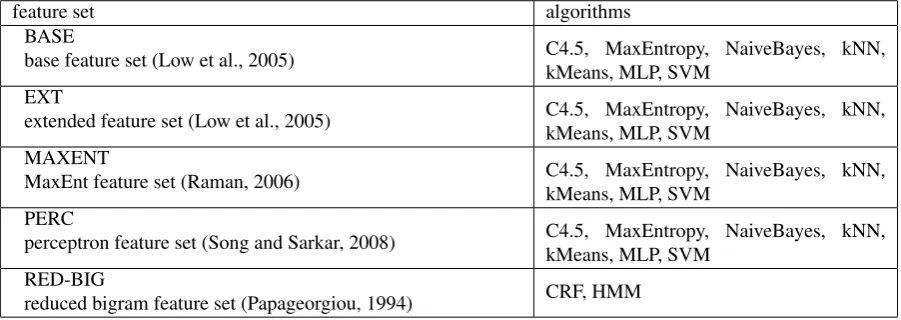
Table 1 enumerates the feature sets we used in the exper-iments. For the purpose of our experiments, these were adopted without modification from the literature on Far Eastern languages and writing systems (see references for details) anddirectlyapplied to Akkadian cuneiform. The motivation is to establish a sound basis for the future de-velopment of cuneiform-specific algorithms, for which we expect substantial refinements if language-specific features for Akkadian are explicitly taken into account in statistical approaches.
For all data-driven classifiers, we simplified the target clas-sification of the I(O)BES scheme to a binary distinction of Class 0 (i.e., IB: no segmentation after the current char-acter) and Class 1 (i.e., ES: segmentation after the cur-rent character). All classifiers were trained on data sets of 10.000 instances in order to assess their performance under resource-poor circumstances. In addition, training against the full training set of 100.000 instances was performed successfully for most algorithms (and is reported below), with the exception of HMM and CRF whose training timed out.
4
http://www.cs.waikato.ac.nz/ml/weka/ 5
http://doc.gold.ac.uk/˜mas02mg/software/ hmmweka/
6
http://mallet.cs.umass.edu/ 7
feature set algorithms BASE
base feature set (Low et al., 2005) C4.5, MaxEntropy, NaiveBayes, kNN, kMeans, MLP, SVM
EXT
extended feature set (Low et al., 2005) C4.5, MaxEntropy, NaiveBayes, kNN, kMeans, MLP, SVM
MAXENT
MaxEnt feature set (Raman, 2006) C4.5, MaxEntropy, NaiveBayes, kNN,
kMeans, MLP, SVM PERC
perceptron feature set (Song and Sarkar, 2008) C4.5, MaxEntropy, NaiveBayes, kNN, kMeans, MLP, SVM
RED-BIG
[image:4.595.52.503.69.229.2]reduced bigram feature set (Papageorgiou, 1994) CRF, HMM
Table 1: Feature sets
3.6.
Ensemble Combination
Finally, we implemented simple ensemble combination ar-chitectures as ametaclassifier, using
(a) a simple (unweighted) majority vote, tested for all pos-sible combinations of individual segmentation algo-rithms described above,
(b) C4.5 meta classification, resp.
(c) SVM meta classification
Remarkably, the more elaborate C4.5 and SVM versions of the meta classifier did not outperform the best majority configuration (i.e., all classifiers except SVM), whose re-sults are reported in Tab. 2.
3.7.
Evaluation Metrics
We primarily evaluate against the following conventional metrics:
Boundary evaluation addresses character-based segmen-tation per boundary (Palmer and Burger, 1997, p.176), i.e., precision and recall of predicted and observed boundaries following a given character:
recb=
#correctly predicted boundary
#gold boundaries
precb= #correctly predicted boundary #predicted boundaries
Word boundary evaluation evaluates completely seg-mented words (Palmer and Burger, 1997, p.176), a metric especially relevant for any future practical ap-plication by Assyriologists or philologists:
recw=
#correctly predicted words
#gold words
precw=#correctly predicted words #predicted words
As these metrics are not differenciating between near and far misses of boundaries at all, we also employ sliding-window-based metrics:
WindowDiff aims to avoid penalizing near-matching boundaries too restrictively, with window size k =
N
2∗#segments, reference segmentationR, a total number of N content units and C computed boundaries the correctness of a segmentation as follows:
W Dif f = 1
N−k
N∑−k
i=0
(|Ri,i+k−Ci,i+k|>0)
WinPR is an established metric in the word segmentation community, it calculates precision and recall building on the basis of WindowDiff by defining precwp =
tpwp
tpwp+f pwp andrecwp =
tpwp
tpwp+f nwp with the
follow-ing definitions (Scaiano and Inkpen, 2012):
tpwp= k
∑
i=1−k
min(Ri,i+k, Ci,i+k)
tnwp=−k(k−1) + N
∑
i=1−k
(k−max(Ri,i+k, Ci,i+k))
f pwp= N
∑
i=1−k
max(0, Ci,i+k−Ri,i+k)
f nwp= N
∑
i=1−k
max(0, Ri,i+k−Ci,i+k)
4.
Results
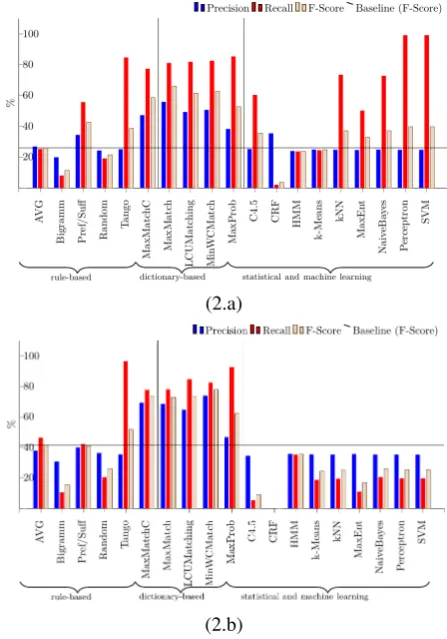
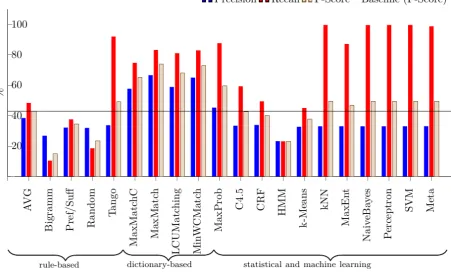
Table 2 and Fig. 3 provide results which are representative for the experiments conducted. For reasons of space, only the best-performing combinations of features and data-driven (statistical/ML) methods are reported. Also, while all combinations of cuneiform corpora have been tested, we report only results obtained by training the tools on the (training section of the) Middle Babylonian corpus and tested on the (test section of the) Middle Babylonian cor-pus. The general pattern, however, remains the same for all cuneiform corpora considered, both within a language stage (training and test corpus for the same language stage, Fig. 2), but also across language stages (e.g., Old Babylonian tools tested on Middle Babylonian corpus).
For the example of the Middle Babylonian tools, the scores of the best-performing configurations obtained on the Old Babylonian and Neo-Assyrian test set are reported in Tab. 3. Unsurprisingly, the scores are generally worse than for Middle Babylonian, yet, they still outperform the base-line. Remarkably, Neo-Assyrian boundary F-scores actu-ally seem to improve over Middle Babylonian. This may be due to the fact that the Neo-Assyrian corpus is more ho-mogenuous than the Middle Babylonian corpus, as the lat-ter contains much malat-terial written by non-native speakers.
Method Bound Word PK WinPR F-Score F-Score Score F-Score baseline (AVG length[2]) 42.77 21.19 13.77 42.92
Bigram 14.90 7.22 47.72 20.84 Pref/Suff 34.59 10.17 23.08 34.86 Random 23.43 13.64 45.04 22.31 Tango 49.22 14.88 13.93 35.32 MaxMatch 65.02 65.05 9.03 57.47 MaxMatchCombined 73.91 58.48 8.69 60.80
LCUMatching 68.14 44.78 8.92 51.30 MinWCMatch 72.82 59.76 8.17 59.63 MaxProb 59.67 37.26 10.24 49.58 C4.5 (EXT 10K) 42.66 15.33 23.12 34.01 CRF (EXT 10K) 40.13 15.31 13.06 27.10 HMM (RED-BIG 10K) 23.10 12.98 21.64 35.55 kMeans (BASE 10K) 37.79 14.17 24.11 33.77 kNN (EXT 100K) 49.48 14.51 13.59 37.53 MaxEnt (EXT 10K) 46.91 14.97 15.82 36.59 NBayes (EXT 100K) 49.49 14.52 13.60 37.56 Percep (MAXENT 10K) 49.51 14.51 13.59 37.51 SVM (EXT 10K) 49.51 14.51 13.59 37.51 META (w/o SVM, 49.42 14.31 13.59 37.47
majority vote)
Table 2: Middle Babylonian tools on Middle Babylonian test set
As for rule-based methods, only Tango (Ando and Lee, 2000) outperformed the baseline, whereas dictionary-based algorithms performed clearly better. Dictionary-based ap-proaches produced the best-performing classification, de-pending on the metric between 60% and nearly 80%. Machine Learning algorithms as applied here seem to face problems in Akkadian cuneiform: The feature sets used for segmenting Chinese seem to provide a significantly worse result in Akkadian, and even the best-performing
algo-(2.a)
[image:5.595.64.274.379.641.2](2.b)
Figure 2: Within-language test error for (a) Old Babylo-nian tools on Old BabyloBabylo-nian test set, and (b) Neo-Assyrian tools on Neo-Assyrian test set (boundary evaluation)
rithms hardly outperform the baseline. This indicates that a feature set specific to Akkadian needs to be developed in future research.
It should be noted that this picture did not drastically change when different training and test corpora for Akka-dian language stages were employed.
Method Bound Word PK WinPR language F-Score F-Score Score F-Score (alg.) baseline (AVG length[2]) 39.25 17.45 21.37 39.81 OBab
41.63 17.06 11.12 36.13 NAss
rule-based 33.80 9.11 28.23 31.53 OBab (Prefix/Suffix) 51.93 16.65 11.14 36.44 NAss (Tango) dictionary-based 62.73 53.12 2.43 56.10 OBab (MinWCMatch)
52.95 24.51 10.97 38.46 NAss (MinWCMatch) statistical/ML 39.56 9.56 21.26 31.91 OBab (NaiveBayes, EXT 10k)
[image:6.595.112.476.67.192.2]52.31 16.64 10.95 36.47 NAss (NaiveBayes, PERC 10K)
Table 3: Across-language test error: Middle Babylonian tools on O(ld )Bab(ylonian) and N(eo-)Ass(yrian) test sets
Figure 3: Middle Babylonian tools (80%) on Middle Babylonian test set(20%) (boundary evaluation)
5.
Summary and Outlook
Our paper is the first experiment on word segmentation on Akkadian or cuneiform. It provides insights in what to ex-pect by applying established word segmentation algorithms on the Akkadian language, and we showed that for Akka-dian corpora of the dimensions available, dictionary-based approaches produce the best results in segmenting Akka-dian texts.
In general, our results for Akkadian are substantially worse than those for Chinese and Japanese, and currently do not live up to the needs of philologists. However, given the high degree of ambiguity in the writing system, this result is unsurprising, and calls for intensified research efforts in this regard. Our experiments stipulate directions for future research and provide a point of orientation for any future approach in this direction.
A key result is that further research on linguistic charac-teristics of Akkadian and other cuneiform languages is required, and – likely – only this will improve results to
production-ready quality.
Strategies to improve segmentation performance include
(1) extending dictionary-based algorithms with a new word detection component – yet, this is methodolog-ically problematic if the test corpus is used to improve segmentation –,
(2) combining dictionary-based and rule-based approaches and extending the latter with a morphological compo-nent, and
(3) combining morphology-oriented rule-based systems with statistical and machine learning algorithms to ben-efit from both the context-awareness of data-driven methods and the high precision of rule-based morpho-logical analysis.
[image:6.595.58.510.240.513.2]in this regard is the development of an integrated sys-tem that providesuniform handlingfor word segmentation, transliteration and morphosyntactic annotation. Akkadian is a morphologically complex language with a highly am-biguous writing system. Unlike Chinese, it shows heavy interference between morphology and word segmentation, and unlike Japanese, it does not have a 1:1 correspon-dence between syllabic signs and phonemic values. In this regard, any future word segmentation algorithm for cuneiform will have to be anintegrated approach, and thus be very different from existing approaches for either Chi-nese or JapaChi-nese.
Remark to reviewers
Upon acceptance of this paper, code and data will be pub-lished under open licenses (Apache license and CC-BY). In addition to the algorithms described here, this includes an interactive GUI for visualizing and analyzing segmen-tation results, a cuneiform Input Method Engine, and a near-exhaustive list of UTF8 cuneiform characters and their readings. Providing a link would reveal author identity.
6.
Bibliographical References
Ando, R. K. and Lee, L. (2000). Mostly-unsupervised sta-tistical segmentation of japanese: Applications to kanji. InProceedings of the 1st North American Chapter of the Association for Computational Linguistics Conference, NAACL 2000, pages 241–248, Stroudsburg, PA, USA. Association for Computational Linguistics.
Barthlemy, F. (1998). A morphological analyzer for Akka-dian verbal forms with a model of phonetic transfor-mations. InProceedings of the ACL-1998 Workshop on Computational Approaches to Semitic Languages, Mon-tral.
Barthlemy, F. (2009). The Karamel System and Semitic languages: Structured multi-tiered morphology. In Pro-ceedings of the EACL 2009 Workshop on Computational Approaches to Semitic Languages, page 1018, Athens, Greece.
Borger, R. (2004). Mesopotamisches Zeichenlexikon. Ugarit-Verlag.
Chen, K.-J. and Liu, S.-H. (1992). Word identification for mandarin chinese sentences. InProceedings of the 14th Conference on Computational Linguistics - Volume 1, COLING ’92, pages 101–107, Stroudsburg, PA, USA. Association for Computational Linguistics.
Cohen, J. D., Duncan, D., Snyder, D., Cooper, J., Ku-mar, S., Hahn, D., Chen, Y., Purnomo, B., and Graet-tinger, J. (2004). iClay: Digitizing Cuneiform. In Pro-ceedings of the 5th International Conference on Virtual Reality, Archaeology and Intelligent Cultural Heritage (VAST-2004), pages 135–143, Aire-la-Ville, Switzer-land, Switzerland. Eurographics Association.
Collins, T., Woolley, S., Gehlken, E., Lewis, A., Munoz, L. H., and Ch’ng, E. (accepted). Automated reconstruc-tion of virtual fragmented cuneiform tablets.Electronics Letters (IET).
Gelb, I. (1957). Glossary of Old Akkadian. University of Chicago Press, Chicago, Illinois.
Ikeda, J. (2007). Early Japanese and early Akkadian writ-ing systems. a contrastive survey of Kunogenesis. In
Proceedings of Origins of Early Writing Systems, Peking University, Beijing.
Islam, M. A., Inkpen, D., and Kiringa, I. (2007). A gen-eralized approach to word segmentation using maximum length descending frequency and entropy rate. In Com-putational Linguistics and Intelligent Text Processing, pages 175–185. Springer.
Jaworski, W. (2008). Contents modelling of neo-sumerian ur III economic text corpus. InProceedings of the 22nd International Conference on Computational Linguistics (Coling 2008), pages 369–376, Manchester, UK, August. Coling 2008 Organizing Committee.
Kataja, L. and Koskenniemi, K. (1988). Finite-state de-scription of Semitic morphology: A case study of An-cient Akkadian. InProceedings of COLING 1988. Khait, I. (accepted). Cuneiform Labs: Annotating
Akka-dian corpora. In Rencontre Assyriologique Interna-tionale (RAI-2015), Geneva and Bern, Switzerland, June 22-26, 2015.
Lauffenburger, O. (n.d.). Akkadian dictionary. www. assyrianlanguages.org/akkadian.
Low, J. K., Ng, H. T., and Guo, W. (2005). A maximum entropy approach to chinese word segmentation. In Pro-ceedings of the Fourth SIGHAN Workshop on Chinese Language Processing, volume 1612164.
Macks, A. (2002). Parsing Akkadian Verbs with Prolog. In Proceedings of the ACL-02 Workshop on Computa-tional Approaches to Semitic Languages, Philadelphia, Pennsylvania.
Mara, H., Krmker, S., Jakob, S., and Breuckmann, B. (2010). GigaMesh and Gilgamesh 3D Multiscale In-tegral Invariant Cuneiform Character Extraction. In Alessandro Artusi, et al., editors, VAST: International Symposium on Virtual Reality, Archaeology and Intelli-gent Cultural Heritage. The Eurographics Association. Palmer, D. and Burger, J. (1997). Chinese word
segmen-tation and information retrieval. In AAAI Spring Sym-posium on Cross-Language Text and Speech Retrieval, pages 175–178.
Papageorgiou, C. P. (1994). Japanese word segmentation by hidden markov model. InProceedings of the work-shop on Human Language Technology, pages 283–288. Association for Computational Linguistics.
Pengyu, L., Jingchuan, P., Du Mingming, L. X., and Lijun, J. (2014). A lexicon-corpus-based unsupervised chinese word segmentation approach. International Journal On Smart Sensing And Intelligent Systems, 7(1).
Pevzner, L. and Hearst, M. A. (2002). A critique and im-provement of an evaluation metric for text segmentation.
Computational Linguistics, 28(1):19–36.
Raman, A. (2006). A dictionary-augmented maximum en-tropy tagging approach to chinese word segmentation. Scaiano, M. and Inkpen, D. (2012). Getting more from
Associ-ation for ComputAssoci-ational Linguistics: Human Language Technologies, pages 362–366. Association for Computa-tional Linguistics.
Snyder, B., Barzilay, R., and Knight, K. (2010). A statis-tical model for lost language decipherment. In Proceed-ings of ACL-2010, Upsala, Sweden.
Song, D. and Sarkar, A. (2008). Training a perceptron with global and local features for chinese word segmentation. InIJCNLP, pages 143–146. Citeseer.
Sproat, R. and Emerson, T. (2003). The first interna-tional chinese word segmentation bakeoff. In Proceed-ings of the second SIGHAN workshop on Chinese lan-guage processing-Volume 17, pages 133–143. Associa-tion for ComputaAssocia-tional Linguistics.
Subodh, K., Snyder, D., Duncan, D., Cohen, J., and Cooper, J. (2003). Digital preservation of ancient cuneiform tablets using 3D-scanning. In Proceedings of the 4th International Conference on 3-D Digital Imaging and Modeling (3DIM-2003), pages 326–333. IEEE.
Tinney, S. et al. (2006). The Pennsylvania Sume-rian dictionary. http://psd.museum.upenn. edu/epsd1/.
Tyndall, S. (2012). Toward automatically assembling Hittite-language cuneiform tablet fragments into larger texts. InProceedings of the 50th Annual Meeting of the Association for Computational Linguistics, pages 243– 247. Association for Computational Linguistics. Valentin Tablan Wim Peters, Diana Maynard, H. C. (2006).