Capturing Chat: Annotation and Tools for Multiparty Casual Conversation.
Emer Gilmartin, Nick Campbell
Speech Communication LabTrinity College Dublin [email protected], [email protected]
Abstract
Casual multiparty conversation is an understudied but very common genre of spoken interaction, whose analysis presents a number of challenges in terms of data scarcity and annotation. We describe the annotation process used on the d64 and DANS multimodal corpora of multiparty casual talk, which have been manually segmented, transcribed, annotated for laughter and disfluencies, and aligned using the Penn Aligner. We also describe a visualization tool, STAVE, developed during the annotation process, which allows long stretches of talk or indeed entire conversations to be viewed, aiding preliminary identification of features and patterns worthy of analysis. It is hoped that this tool will be of use to other researchers working in this field.
Keywords:multimodal corpora, casual conversation, annotation
1.
Introduction
Casual conversation is a fundamental feature of human so-cial life, seemingly present in most situations where peo-ple congregate. In order to better understand the workings of casual conversation, suitable data are needed to inform studies of the various aspects of this most common of hu-man activities. Although there are increasing numbers of high quality annotated multimodal corpora of spoken in-teraction available, there remain very few collections of longer stretches of casual talk among multiple participants. While it is tempting to use some of the rich resources cur-rently available, it is unclear that results obtained from them would apply to structurally different casual talk. Therefore, we have undertaken a programme of collection, annotation, and analysis of multiparty casual talk data. In this paper, we outline the annotation process and tools developed dur-ing our ongodur-ing programme of research into multiparty ca-sual conversation, which aims to deepen understanding of this very common modality of spoken interaction, and in-form the design of human-machine interaction. We briefly discuss models of social or casual conversation from the literature, provide an overview of corpora currently avail-able and their limitations for our requirements, describe the annotation procedures we have developed in our work on two corpora of long (one hour or more) multiparty conver-sations, and introduce a visualisation tool developed to aid in preliminary examination and analysis of these conversa-tions.
2.
Social Talk
Casual social conversation is described as ‘talking just for the sake of talking’(Eggins and Slade, 2004), and its sub-genres include smalltalk, gossip, and conversational narra-tive. Aimless social talk or ‘phatic communion’ has been described as an emergent activity of congregating people, and viewed as the most basic use of speech (Malinowski, 1923). Researchers in fields including anthropology, evo-lutionary psychology, and communication have theorized that the such talk functions to build social bonds and avoid unfriendly or threatening silence, rather than simply to ex-change information or express thought, as postulated in
high-lighted the divide between the structure and characteristics of written and spoken language and have cited a possible text bias in linguistics as a retarding factor on the analysis of spoken interaction (Ong, 1982; Chafe and Danielewicz, 1987; Halliday, 1989). Syntactical, lexical, and discourse differences between (casual) conversation and more for-mal spoken and written genres are described in Biber and Leech’s work on the Longman Corpus of Spoken and Writ-ten English (LSWE), and particularly in their chapter on the grammar of conversation (Biber et al., 1999). In terms of function, Slade and Eggins view casual conversation as the space in which people form and refine their social real-ity (Eggins and Slade, 2004) citing gossip between work-mates, where participants reaffirm their solidarity, and ex-amples of conversation between friends at a dinner party where greater intimacy allows differences of opinion. They identify story-telling as frequent in conversation and high-light segments of ‘chat’ (interactive exchanges involving short turns by all participants) and ‘chunks’ (longer unin-terrupted contributions). They also report that casual con-versation tends to involve multiple participants rather than the dyads normally found in instrumental interactions or ex-amples from conversation analysis. Instrumental and inter-actional exchanges differ in duration; task-based conversa-tions are bounded by task completion and tend to be short, while casual conversation can go on indefinitely. Several researchers on casual conversation have noted that their analyses were limited as they were based on transcripts and thus lacked vital timing and multimodal information.
3.
Conversational Data
Much earlier work in conversation and discourse analysis was based on transcripts of audio recordings or indeed on written records of conversations heard, and thus timing in-formation has not always been considered in great depth. Earlier data sources were audio only, and thus could not ac-cess the complete bundle of audio and video information now regarded as contributing to spoken interaction. With greater availability of recording equipment for modes in-cluding video, motion capture and indeed biosignals, re-searchers have been producing multimodal corpora which allow the full spectrum of signals in face to face communi-cation to be analysed. Many of the multimodal corpora and indeed several earlier audio corpora created in laboratory and ‘real-world’ conditions have been collections of per-formances of the same spoken task by different subjects, or of interactions specific to particular domains. Corpora such as the HCRC MapTask corpus of dyadic information gap task-based conversations (Anderson et al., 1991), ICSI and AMI multiparty meeting corpora (Janin et al., 2003; McCowan et al., 2005), and resources such as recordings of televised political interviews (Beattie, 1983) have con-tributed greatly to our understanding of different facets of spoken interaction such as timing, turntaking, and dialogue architecture. However, the speech in these resources, while spontaneous and conversational, cannot be considered ca-sual talk, and the results obtained from their analysis may not transfer to the less studied ‘unmarked’ case of casual conversation. There have been audio collections made of casual talk, including telephonic corpora such as
SWITCH-BOARD (Godfrey et al., 1992) and the ESP-C collection of Japanese telephone conversations (Campbell, 2007), and corpora comprising recordings of face-to-face talk as in the Santa Barbara Corpus (DuBois et al., 2000), and sections of the ICE corpora (Greenbaum, 1991) and of the British National Corpus (BNC-Consortium, 2000). The Gothen-burg Corpus of recordings of different types of human ac-tivity contains both audio and video recordings including casual or small talk (Allwood et al., 2000). Recently, mul-timodal corpora of spontaneous talk have been appearing in several languages. These include collections of free-talk meetings, or ‘first encounters’ between strangers as in the Swedish Spontal, and the NOMCO and MOMCO Dan-ish and Maltese corpora (Edlund et al., 2010; Paggio et al., 2010). These corpora are very valuable for the study of dyadic interaction, particularly at the opening and early stages of interaction.For a fuller review of available corpora and the challenges of genre in conversation, see (Gilmartin et al., 2015a))
Our focus is on longer stretches of face to face multiparty social talk, for which there are very few data collections available. In order to analyse social talk and ultimately create systems capable of performing or understanding this type of interaction, we have collected a number of record-ings of casual multiparty speech. The multiparty nature of these interactions has created several challenges for annota-tion and analysis. Below we describe the workflow we have been developing for annotation and tools and resources we have generated.
4.
Data and Annotation
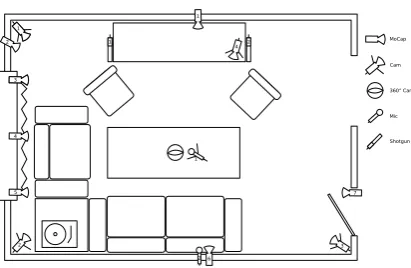
The d64 corpus is a multimodal corpus of over 8 hours of informal conversational English recorded in Dublin in 2009 in an apartment living room , as shown in Fig. 1. Sev-eral streams of video, audio, and motion capture data were recorded for the corpus. There were between 2 and 5 peo-ple on camera at all times. There were no instructions to participants about what to talk about and care was taken to ensure that all participants understood that they were free to talk or not as the mood took them. Design and collec-tion of the corpus is fully described in(Oertel et al., 2010). The DANS corpus contains multimodal recordings of hour-long conversations between several participants recorded in a living-room setup in the Speech Communication Lab in Dublin in 2012. There are three participants on camera at all times. Again participants were encouraged to talk or not as the mood took them. The data include biosignal recorded using Affectiva Q-Sensors and heart-rate monitors. The de-sign and collection of the corpus is described in (Hennig et al., 2014).
manu-Figure 1: Setup for Session 1 of d64 Recordings.
ally into speech and silence intervals using Praat (Boersma and Weenink, 2010) on 10 and 4-second or smaller win-dows as necessary. The process was then repeated for the sound files recorded at the same time for each of the other speakers, resulting in annotations checked across several different sound files. Any remaining speech intervals or stretches of laughter or other vocalisations not assigned to a particular speaker were resolved using Elan (Wittenburg et al., 2006) to refer to the video recordings taken at the same time. There are valid concerns about manual segmentation into speech and silence, as human hearing and comprehen-sion is a filter rather than a simple sensor. Thus, humans lis-tening to speech can miss or imagine the existence of objec-tively measured silences of short duration, especially when there is elongation of previous or following syllables (Mar-tin, 1970), and are known to have difficulty recalling dis-fluencies from audio they have heard (Deese, 1980). How-ever, in the current work, speech can be slowed down and replayed and, by zooming in on the waveform and spectro-gram, annotators can clearly see silences and differences in amplitude on the speech waveform and spectrogram. It is hoped that this need to match the heard linguistic and non-linguistic content to the viewed waveform and spectrogram means that it was much more likely that pauses and disflu-encies would be noticed and correctly marked.
After segmentation the data were manually transcribed and annotated, using a scheme largely derived from the TRAINS transcription scheme (Heeman and Allen, 1995). Words, hesitations, filled and unfilled pauses, unfinished words, laughs and coughs were transcribed and marked. The transcription was carried out at the intonational phrase (IP) level rather than the more commonly used interpausal unit (IPU) as IPs are a basic unit for intonation study and can easily be concatentated to the interpausal unit (IPU) and turn level as required. The transcriptions were then text-processed for automatic word and phoneme alignment with the Penn Aligner (Yuan and Liberman, 2008). The preparatory text-processing stage was accomplished using custom Praat and Python scripts to normalise the transcrip-tions and create an extension to the CMU dictionary used in alignment. The Penn Aligner was then run over a sound file and accompanying transcription for each intonational phrase annotated. Sections which could not be
automati-cally aligned, where there was significant overlap or cut off words, were manually aligned. The word transcription was then corrected using Praat scripts to remove extra spaces added by the aligner. The segmentation, transcription, and alignment phases were performed on both d64 and DANS.
Symbol Note
. interruption point
- unfinished word
tilde unfinished utterance caret contracted word
r repeated word
s substituted word
d deleted word
f filled pause
x pause
o overlap
Table 1: The annotation code used for disfluencies.
The word level transcription was then used with the sound files to annotate disfluencies in Session 1 of the d64 coprus using Praat. The scheme and procedures used were based on those outlined in Shriberg’s and Eklund’s respective the-ses (Shriberg, 1994) (Eklund, 2004), and in Lickley’s anno-tation manual for the MapTask corpus (Lickley, 1998), with extra labels and conventions for recycled turn beginnings (Schegloff, 1987), disfluencies in the presence of overlap-ping speech from another participant, and unfinished and abandoned utterances. The symbols used are outlined in Table. 1. Complex, or nested, disfluencies were labelled following Shriberg’s method (Shriberg, 1994), and no in-dexing was used for substitutions or repetitions. Pauses within utterances were annotated with ‘x’ when they oc-curred within a larger disfluency or with ‘[.x]’ when they occurred alone. The fully annotated Session 1 of d64 com-prised 15,545 words across 6164 intonational phrase units, with 1505 annotated disfluencies. There were 653 lone pauses. Of the remaining 853 disfluencies, 117 were com-plex. Just over 15%, 128 disfluencies, occurred in the pres-ence of overlap by another speaker.
In order to more fully investigate the subgenres within ca-sual talk, conversation in the first session of d64 was la-beled as discussion, dominated, or idling. Idling, as de-fined by Schneider as discussed above, was labelled or-thogonally to discussion and dominated as it could occur within either modality. Discussion referred to stretches of talk shared more or less evenly among two or more par-ticipants throughout the bout, while dominated referred to bouts largely dominated by one participant. Thus, discus-sion and dominated correspond to Slade and Eggins’ con-cepts of chat and chunk as discussed above. Dominated stretches often took the form of narratives or recounts of personal experiences, extended explanations or opinions. A total of 142 ‘bouts’ were annotated, of which 14 were la-belled as ’discussion’ while the remaining 128 were classed as dominated.
5.
Visualisation Tool - STAVE
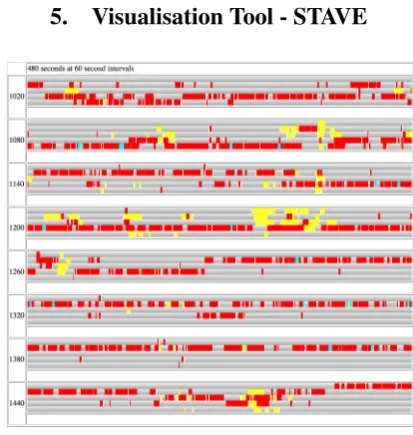
Figure 2: STAVE visualisation of speech (red), silence (grey), and laughter (yellow) in eight minutes from a five-party conversation.
For preliminary examination and analysis of possible trends in conversation data, we created a visualization tool, STAVE, which creates a visual HTML display represent-ing a dialogue over time in the form of timelines for each speaker marked for speech, silence, laughter, disfluencies, or any other annotations desired. These are generated from a a comma-separated-variables (csv) file which can easily be obtained from any of the popular annotation software suites. The software, written in Python, can represent any time interval of conversation and colour codes can be as-signed by the user. The software also generates colour-coded transcripts in Conversation Analysis format from a simple transcription file. It is possible to assign any com-bination of colours to different features of the annotation, including different colours per speaker tier.Sample STAVE output for eight minutes of the d64 corpus can be seen in Fig. 2. Data are arranged on a multi-tier timeline, in in-tervals chosen by the user (60 seconds in this case). Each grey line holds data for one speaker, showing speech (red), silence (grey), and laughter (yellow). This stretch is typical of the centre or ‘steady-state’ stage of conversation, with longer turns taken by each participant.
6.
Conclusions and Future Work
We have described the segmentation, transcription and an-notation of the d64 and DANS corpora of multiparty ca-sual talk, and further subgenre and disfluency annotation of the first session of d64. The resulting annotations have al-ready provided the basis for fruitful investigations into the architecture and features of this omnipresent but somewhat understudied form of spoken interaction - including exper-iments on laughter and disfluency (Gilmartin et al., 2013; Gilmartin et al., 2015b). We are currently studying the tim-ing of speech and global silences in bouts of talk, and hope to use this knowledge to inform a novel timing module fora spoken dialogue system. Dialogue act annotation con-forming to the ISO 24617-2 standard is underway on both corpora, using the ANVIL annotation tool and the DIAML annotation scheme, and the methodology outlined in (Bunt et al., 2012). These annotations will be included with future distributions of these corpora. We have also described vi-sualisation tools designed for use with multispeaker record-ings. All of these resources are being made available on the web, and it is hoped that they will be useful for other re-searchers.
7.
Acknowledgements
This work is supported by the European Coordinated Re-search on Long-term Challenges in Information and Com-munication Sciences Technologies ERA-NET (CHIS-TERA) JOKER project, JOKe and Empathy of a Robot/ECA: Towards social and affective relations with a robot, and by the Speech Communication Lab, Trinity Col-lege Dublin.
8.
Bibliographical References
Abercrombie, D. (1956). Problems and principles: Studies in the Teaching of English as a Second Language. Long-mans, Green.
Allwood, J., Björnberg, M., Grönqvist, L., Ahlsén, E., and Ottesjö, C. (2000). The spoken language corpus at the department of linguistics, Göteborg University. In FQS–Forum Qualitative Social Research, volume 1. Anderson, A., Bader, M., Bard, E., Boyle, E., Doherty, G.,
Garrod, S., Isard, S., Kowtko, J., McAllister, J., Miller, J., et al. (1991). The HCRC map task corpus.Language and speech, 34(4):351–366.
Beattie, G. (1983). Talk: An analysis of speech and non-verbal behaviour in conversation. Open University Press.
Biber, D., Johansson, S., Leech, G., Conrad, S., Finegan, E., and Quirk, R. (1999). Longman grammar of spoken and written English, volume 2. Longman London. BNC-Consortium. (2000). British national corpus. URL
http://www. hcu. ox. ac. uk/BNC.
Boersma, P. and Weenink, D. (2010). Praat: doing phonet-ics by computer [Computer program], Version 5.1. 44. Brown, G. and Yule, G. (1983). Teaching the spoken
lan-guage, volume 2. Cambridge University Press.
Bunt, H., Kipp, M., and Petukhova, V. (2012). Using Di-AML and ANVIL for multimodal dialogue annotations. InLREC, pages 1301–1308.
Campbell, N. (2007). Approaches to conversational speech rhythm: Speech activity in two-person telephone dialogues. InProc XVIth International Congress of the Phonetic Sciences, Saarbrucken, Germany, pages 343– 348.
Chafe, W. and Danielewicz, J. (1987). Properties of spo-ken and written language. Academic Press.
Deese, J. (1980). Pauses, prosody, and the demands of pro-duction in language. Mouton Publishers.
Dunbar, R. (1998). Grooming, gossip, and the evolution of language. Harvard Univ Press.
Edlund, J., Beskow, J., Elenius, K., Hellmer, K., Ström-bergsson, S., and House, D. (2010). Spontal: A Swedish Spontaneous Dialogue Corpus of Audio, Video and Mo-tion Capture. InLREC.
Eggins, S. and Slade, D. (2004). Analysing casual conver-sation. Equinox Publishing Ltd.
Eklund, R. (2004). Disfluency in Swedish human–human and human–machine travel booking dialogues.
Gilmartin, E., Hennig, S., Chellali, R., and Campbell, N. (2013). Exploring sounded and silent laughter in multi-party social interaction - audio, video and biometric sig-nals. Valetta, Malta, October.
Gilmartin, E., Bonin, F., Cerrato, L., Vogel, C., and Camp-bell, N. (2015a). What’s the Game and Who’s Holding the Ball: Genre in Conversation. Palo Alto, California. Gilmartin, E., Vogel, C., and Campbell, N. (2015b).
Dis-fluency in Multiparty Social Talk. In Proceedings of DISS 2015, Edinburgh.
Godfrey, J. J., Holliman, E. C., and McDaniel, J. (1992). SWITCHBOARD: Telephone speech corpus for research and development. InAcoustics, Speech, and Signal Pro-cessing, 1992. ICASSP-92., 1992 IEEE International Conference on, volume 1, pages 517–520.
Greenbaum, S. (1991). ICE: The international corpus of English. English Today, 28(7.4):3–7.
Halliday, M. A. (1989). Spoken and written language. Hayakawa, S. I. (1990). Language in thought and action.
Houghton Mifflin Harcourt.
Heeman, P. A. and Allen, J. F. (1995). The TRAINS 93 Dialogues. Technical report, DTIC Document.
Hennig, S., Chellali, R., and Campbell, N. (2014). The D-ANS corpus: the Dublin-Autonomous Nervous System corpus of biosignal and multimodal recordings of con-versational speech. Reykjavik, Iceland.
Jakobson, R. (1960). Closing statement: Linguistics and poetics. Style in language, 350:377.
Janin, A., Baron, D., Edwards, J., Ellis, D., Gelbart, D., Morgan, N., Peskin, B., Pfau, T., Shriberg, E., and Stol-cke, A. (2003). The ICSI meeting corpus. In Acous-tics, Speech, and Signal Processing, 2003. Proceed-ings.(ICASSP’03). 2003 IEEE International Conference on, volume 1, pages I–364.
Laver, J. (1975). Communicative functions of phatic com-munion. Organization of behavior in face-to-face inter-action, pages 215–238.
Lickley, R. J. (1998). HCRC disfluency coding manual. Human Communication Research Centre, University of Edinburgh.
Malinowski, B. (1923). The problem of meaning in primi-tive languages. Supplementary in the Meaning of Mean-ing, pages 1–84.
Martin, J. G. (1970). On judging pauses in spontaneous speech. Journal of Verbal Learning and Verbal Behav-ior, 9(1):75–78.
McCowan, I., Carletta, J., Kraaij, W., Ashby, S., Bourban, S., Flynn, M., Guillemot, M., Hain, T., Kadlec, J., and Karaiskos, V. (2005). The AMI meeting corpus. In
Pro-ceedings of the 5th International Conference on Methods and Techniques in Behavioral Research, volume 88. Oertel, C., Cummins, F., Edlund, J., Wagner, P., and
Camp-bell, N. (2010). D64: A corpus of richly recorded con-versational interaction. Journal on Multimodal User In-terfaces, pages 1–10.
Ong, W. J. (1982). Orality and literacy: The technology of the word. New York: Methuen.
Paggio, P., Allwood, J., Ahlsén, E., and Jokinen, K. (2010). The NOMCO multimodal Nordic resource–goals and characteristics.
Schegloff, E. A. (1987). Recycled turn beginnings: A pre-cise repair mechanism in conversation’s turn-taking or-ganization.Talk and social organization, pages 70–85. Schneider, K. P. (1988). Small talk: Analysing phatic
dis-course, volume 1. Hitzeroth Marburg.
Shriberg, E. E. (1994). Preliminaries to a theory of speech disfluencies. Ph.D. thesis, University of California. Ventola, E. (1979). The structure of casual conversation in
English. Journal of pragmatics, 3(3):267–298.
Wittenburg, P., Brugman, H., Russel, A., Klassmann, A., and Sloetjes, H. (2006). Elan: a professional framework for multimodality research. In Proceedings of LREC, volume 2006.