Parallel Sentence Extraction from Comparable Corpora
with Neural Network Features
Chenhui Chu
1, Raj Dabre
2, Sadao Kurohashi
2 1Japan Science and Technology Agency2Graduate School of Informatics, Kyoto University
E-mail: [email protected], [email protected], [email protected]
Abstract
Parallel corpora are crucial for machine translation (MT), however they are quite scarce for most language pairs and domains. As com-parable corpora are far more available, many studies have been conducted to extract parallel sentences from them for MT. In this paper, we exploit the neural network features acquired from neural MT for parallel sentence extraction. We observe significant improvements for both accuracy in sentence extraction and MT performance.
Keywords:Parallel Sentence Extraction, Comparable Corpora, Neural Network
1.
Introduction
Neural machine translation (NMT) has achieved impres-sive results recently (Bahdanau et al., 2014). As the neural translation models can also be viewed as bilingual language models, they can be used to generate scores for candidate translations as neural network (NN) features for reranking the n-best lists produced by a statistical machine transla-tion (SMT) system, whose quality rivals the state of the art (Sutskever et al., 2014).
Comparable corpora are a set of monolingual corpora that describe roughly the same topic in different languages. Al-though they are not exact translation equivalents of each other, there are a large amount of parallel sentences con-tained in the comparable texts. The task of parallel sen-tence extraction (Munteanu and Marcu, 2005) is to identify truly parallel sentences from the erroneous ones from com-parable corpora. Intuitively, because the NN features give a measure of the bilingual similarity of a sentence pair, they could be helpful for this task. However, this assumption has not been verified previously.
In this paper, we incorporate the NN features into a ro-bust parallel sentence extraction system (Chu et al., 2014), which consists of a parallel sentence candidate filter and a binary classifier for parallel sentence identification. The NN features are naturally used as additional features for the classifier. Experiments conducted on Wikipedia data show that the NN features improve the strong baseline system significantly for both accuracy in sentence extraction and SMT performance.
2.
Parallel Sentence Extraction System
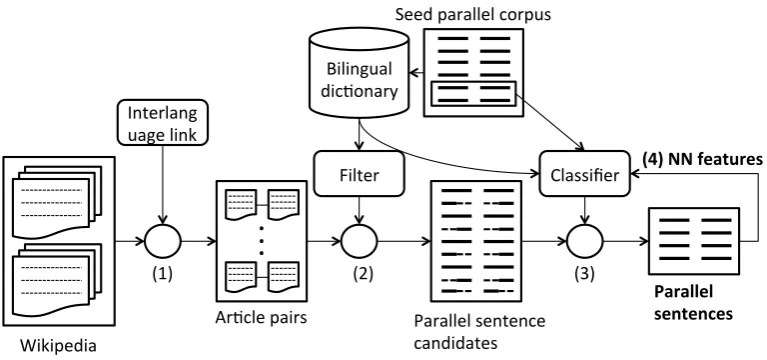
The overview of our parallel sentence extraction system is presented in Figure 1. We first align articles on the same topic in Wikipedia via the interlanguage links ((1) in Fig-ure 1). Then we generate all possible sentence pairs by the Cartesian product from the aligned articles, and discard the pairs that do not fulfill the conditions of a filter to reduce the candidates keeping more reliable sentences ((2) in Fig-ure 1). Next, we use a classifier trained on a small number of parallel sentences from a seed parallel corpus to identify the parallel sentences from the candidates ((3) in Figure 1). Finally, we train a NMT model on the extracted parallelsentences, and use it to obtain the NN features for the clas-sifier to further improve the performance ((4) in Figure 1). The strategy of the filter and the features used for the clas-sifier will be described in Section 2.1. and Section 2.2. in detail.
2.1.
Parallel Sentence Candidate Filtering
A parallel sentence candidate filter is necessary, because it can remove most of the noise introduced by the simple Cartesian product sentence generator, and reduce compu-tational cost for parallel sentence identification. Following (Chu et al., 2014), we use a filter with sentence length ratio and dictionary-based word overlap conditions.2.2.
Parallel Sentence Identification by Binary
Classification
As the quality of the extracted sentences is determined by the accuracy of the classifier, the classifier becomes the core component of the extraction system. In this section, we first describe the training and testing process, and then introduce the features we use for the classifier.
2.2.1. Training and Testing
We use a support vector machine (SVM) classifier. Training and testing instances for the classifier are created follow-ing the method of (Munteanu and Marcu, 2005). We use a small number of parallel sentences from a seed parallel cor-pus as positive instances. Negative instances are generated by the Cartesian product of the positive instances exclud-ing the original positive instances, and they are filtered by the same filtering method used in Section 2.1.. Moreover, we randomly discard some negative instances for training when necessary,1 to guarantee that the ratio of negative to positive instances is less than five for the performance of the classifier.
2.2.2. Features Baseline Features.
• Percentage of words on each side that have a transla-tion on the other side (according to the bilingual dic-tionary), i.e.,word overlap.
1
!"#$$%&'()
*#(#""'")$'+,'+-') -#+.%.#,'$)) /%0%1'.%#!
2%",'()
3(4-"')1#%($!
5+,'("#+6) 7#6')"%+0))
8''.)1#(#""'")-9(17$)
:;<! :=<! :><!
?
!
?
!
?
!
@%"%+67#") .%-49+#(A))
!"#$%%$&'()*+',!
[image:2.595.102.486.73.253.2]-(+(..'.$$ ,'/)'/0',$
Figure 1: Parallel sentence extraction system.
• Percentage of words that are content words on each side.
• Percentage of content words on each side that have a translation on the other side (according to the bilingual dictionary).
• Sentence length, length difference, and length ratio.2
• Alignment features:
– Percentage and number of words that have no connection on each side.
– Top three largest fertilities.3
– Length of the longest contiguous connected span.
– Length of the longest unconnected substring.
• Same word features. Parallel sentences often contain same words, such as abbreviations and numbers. Same words can be helpful clues to identify parallel sen-tences. We use the following features:
– Percentage and number of words that are the same on each side.
We determine a word as a content or function word using predefined part-of-speech (POS) tag sets of function words. The alignment features are extracted from the alignment re-sults of the parallel and non-parallel sentences used as in-stances for the classifier. Note that alignment features may be unreliable when the quantity of non-parallel sentences is greatly larger than that of the parallel sentences.
NN Features. Using a parallel corpus, we train 4 neural translation models. For each translation direction, we train character and word based models using the corpus (2 direc-tions and 2 types of model lead to 4 models). We use the freely available toolkit GroundHog4 for NMT, which
con-tains an implementation of the work by (Bahdanau et al.,
2In our experiments, sentence length was calculated based on
the number of words in a sentence.
3Fertility defines the the number of words that a word is
con-nected to in an alignment (1993). 4
https://github.com/lisa-groundhog/GroundHog
2014). After training a neural translation model, it can be used to produce a score for a sentence pair, where the neu-ral translation model can be viewed as a bilingual language model. These 4 scores are used as the NN features for the classifier.
We trained two types of models, one on the seed parallel corpus, and the other on the parallel sentences extracted by the baseline system. The models trained on the seed parallel corpus are used for producing the NN features for training and testing the classifier. We tried the use of both the two types of models to score the parallel sentence candidates for extraction.
3.
Experiments
We evaluated classification accuracy, and conducted extrac-tion and translaextrac-tion experiments on Chinese-Japanese data to verify the effectiveness of our proposed NN features. In all our experiments, we preprocessed the data by segment-ing Chinese and Japanese sentences ussegment-ing a segmenter pro-posed by Chu et al. (2012) and JUMAN (Kurohashi et al., 1994) respectively.
3.1.
Data
The seed parallel corpus we used is the Chinese-Japanese section of the Asian Scientific Paper Excerpt Corpus (AS-PEC),5 containing 680k sentences pairs (18.2M Chinese
and21.8M Japanese tokens, respectively).
Also, we downloaded Chinese6 (20120921) and Japanese7
(20120916) Wikipedia database dumps. We used an open-source Python script8to extract and clean the text from the
dumps. Since the Chinese dump is mixed of Traditional and Simplified Chinese, we converted all Traditional Chinese to Simplified Chinese using a conversion table published by Wikipedia9. We aligned the articles on the same topic in
5
http://lotus.kuee.kyoto-u.ac.jp/ASPEC 6
http://dumps.wikimedia.org/zhwiki 7http://dumps.wikimedia.org/jawiki 8
http://code.google.com/p/recommend-2011/source/browse/Ass4/WikiExtractor.py
9
Chinese and Japanese via the interlanguage links, obtain-ing 162k article pairs (2.1M Chinese and 3.5M Japanese sentences respectively).
3.2.
Classification Accuracy Evaluation
We evaluated classification accuracy using two distinct sets of 5k parallel sentences from the seed parallel corpus for training and testing respectively.
3.2.1. Settings
We followed the settings used in (Chu et al., 2014).
• Word alignment tool: GIZA++.10
• Dictionary: Top 5 translations with translation prob-ability larger than 0.1 created from the seed parallel corpus.
• Classifier: LIBSVM11 with 5-fold cross-validation
and radial basis function (RBF) kernel.
• Sentence length ratio threshold: 2. • Word overlap threshold: 0.25. • Classifier probability threshold: 0.9.
3.2.2. Evaluation
We evaluated the performance of classification by comput-ing precision, recall and F-measure, defined as:
precision= 100× classif ied well
classif ied parallel, (1)
recall= 100×classif ied well
true parallel , (2)
F−measure= 2×precision×recall
precision+recall. (3)
Whereclassif ied wellis the number of pairs that the clas-sifier correctly identified as parallel,classif ied parallelis the number of pairs that the classifier identified as parallel,
true parallel is the number of truly parallel pairs in the test set.
3.2.3. Results
We compared the following two methods that use different features:
• Baseline: Only using the baseline features. • +NN: Further using the proposed 4 NN features.
Results are shown in Table 1. We can see that our pro-posed NN features significantly improve the F-measure, by improving the recall and keeping the precision.
To understand why our proposed method contributed to the recall but not the precision, we analyzed the classification results. We found that our proposed NN features are espe-cially helpful for the instances that the baseline features are ambiguous to make a correct decision. An analysis of sev-eral feature values for the following truly parallel sentence pair improved of the NN features is shown in Table 2.
10
http://code.google.com/p/giza-pp 11
http://www.csie.ntu.edu.tw/˜cjlin/libsvm
Method Precision Recall F-measure
Baseline 98.58 94.66 96.58
(4733/4801) (4733/5000)
+NN 98.58 97.38 97.98
(4869/4939) (4869/5000)
Table 1: Classification results.
Zh:为此,可以考虑到目前为止的教育专业没有时间在
这一方面进行教学,并教材的开发也在迟延。
Ja:そのためこれまでの教育分野ではこのような側面か
ら教える時間もなく教材開発の遅れに繋がったと考えら れる。
Ref: Therefore, it is considered that until now in the field of education there is no time to teach from this aspect and the development of teaching materials is also being delayed. We can see that the word overlap feature values of the sen-tence pair are between the average values of the positive and negative instances in the training data. Together with the other features, “Baseline” judges this sentence pair as non-parallel. The proposed NN feature values are greatly lower than the average values of both the positive instances and those of the negative instances, which are very determinis-tic to judge this sentence pair as parallel. Most of the in-creasedclassif ied wellsentence pairs (4733→4869) be-long to this type, which significantly improved the recall. On the other hand, low NN feature values also could be harmful. This happens for non-parallel pairs that are short sentences. As the proposed NN features are bilingual lan-guage model scores, they are lower for short sentence pairs. These low NN features could lead non-parallel sentence pairs to be judged as parallel, which has badly affect the precision and make it unchanged.
3.3.
Extraction and Translation Experiments
We extracted parallel sentences from Wikipedia and eval-uated Chinese-to-Japanese MT performance using the ex-tracted sentences as training data.3.3.1. Settings
• Tuning and testing: We used two distinct sets of
198 parallel sentences with 1 reference in (Chu et al., 2014).12 These sentences were randomly se-lected from the sentence pairs extracted from the same Chinese-Japanese Wikipedia data using different methods proposed in (Chu et al., 2014),13 and the er-roneous parallel sentences were manually discarded. Note that for training, we kept all the sentences ex-tracted by different methods except for the sentences duplicated in the tuning and testing sets.
• Decoder: Moses (Koehn et al., 2007) with default op-tions, except for the distortion limit (6→20).
• Language model: 5-gram LM trained on the Japanese Wikipedia (12.5M sentences) using SRILM toolkit.14
12
http://lotus.kuee.kyoto-u.ac.jp/˜chu/resource/wiki zh ja.tgz 13For more details of the different methods, we recommend the
interested readers to refer to the original paper. 14
Method Feature Value Avg value (positive) Avg value (negative)
Baseline Word overlap Zh 35% 55% 18%
Ja 38% 48% 18%
+NN
char NN score Zh-Ja 97.76 143.66 290.42
Ja-Zh 89.01 111.60 391.50
word NN score Zh-Ja 59.03 111.65 542.28
Ja-Zh 53.06 104.48 640.81
Table 2: Analysis of feature values for an improved truly parallel sentence pair. Value denotes the feature value of the sentence pair. Avg value (positive)/(negative) denote the average feature value of the positive/negative instances used for training the classifier. Note that the higher values of the word overlap, and the lower NN values indicate the higher parallelism of a sentence pair.
Method # sentences BLEU-4
Baseline 126,811 36.31
+NN-ASPEC 110,648 37.18
+NN-WIKI 136,013 36.83
Table 3: Parallel sentence extraction and Chinese-to-Japanese translation results.
The other settings are the same as the ones used in the clas-sification experiments.
3.3.2. Results
Parallel sentence extraction and translation results using different methods are shown in Table 3. “Baseline” and “+NN” denote the different methods described in Section 3.2.3.. We compared two types of NN features for extrac-tion, where “+NN-ASPEC” denotes the NN features ob-tained with the seed parallel corpus, and “+NN-WIKI” de-notes the NN features obtained with the parallel sentences extracted by the baseline system.
Although “+NN” improved the recall in the classifica-tion experiments, “+NN-ASPEC” actually decreased the number of extracted sentences. We believe that the rea-son for this is the domain difference between ASPEC and Wikipedia. Actually, we observed that many feature scores for the candidate sentences of “+NN-ASPEC” are infin-ity,15 because of too many out-of-vocabulary words. The second line of Table 4 shows the percentage of infinite scores of “+NN-ASPEC” for the character and word based NN features, respectively. In Table 4, we also can see that there are also some infinite scores of “+NN-WIKI”. The reason for this is the small size of training (126k) data for “+NN-WIKI”. However, because “+NN-WIKI” was ob-tained with the sentences from Wikipedia, it does not have the domain problem. This led to the lower percentage com-pared to that of “+NN-ASPEC”, and thus the increase of the number of extracted sentences by “+NN-WIKI”. Regarding to the MT performance, we can see that both “+NN-ASPEC” and “+NN-WIKI” outperforms “Base-line”, which shows the effectiveness of my proposed NN features for parallel sentence extraction. In addition, “+NN-ASPEC” performs better than “+NN-WIKI”. We be-lieve the reason for this is the quality of the NN models.
15
We replaced the infinity scores to1,000in our experiments.
Method char NN score word NN score
[image:4.595.83.256.241.295.2]+NN-ASPEC 8.44% (351k) 20.69% (861k) +NN-WIKI 6.73% (280k) 14.58% (607k)
Table 4: Percentage of infinite scores (4.16M in total).
“+NN-ASPEC” was obtained with the NN models trained on the ASPEC corpus, where the parallel sentences are highly accurate. In contrast, “+NN-WIKI” was obtained with the sentences extracted by the baseline system, which are noisy. In addition, the sizes of the training data for ob-taining “+NN-ASPEC” and “+NN-WIKI” are also greatly different (680k versus 126k). As NMT is sensitive to the quality and quantity of the training data (Bahdanau et al., 2014), “+NN-ASPEC” outperformed “+NN-WIKI”.
4.
Related Work
Several studies have exploited the NN features for SMT. (Sutskever et al., 2014) used the NN features to rerank the N-best list of a SMT system, which achieved a BLEU score that is close to the previous state of the art. (Cho et al., 2014) scored the phrase pairs of a SMT system with a neu-ral translation model, and used the scores as additional NN features for decoding. (Dabre et al., 2015) used the NN features for a pivot-based SMT system for dictionary con-struction. In contrast, we score the sentence pairs of with a neural translation model, and use the scores as NN features for parallel sentence extraction from comparable corpora.
5.
Conclusion
In this paper, we incorporated the NN features for parallel sentence extraction from comparable corpora for the first time. Experimental results verified the effectiveness of NN features for this task.
6.
Bibliographical References
Bahdanau, D., Cho, K., and Bengio, Y. (2014). Neural ma-chine translation by jointly learning to align and trans-late. CoRR, abs/1409.0473.
Brown, P. F., Della Pietra, S. A., Della Pietra, V. J., and Mercer, R. L. (1993). The mathematics of statistical ma-chine translation: Parameter estimation. Computational Linguistics, 19(2):263–312.
Cho, K., van Merrienboer, B., G¨ulc¸ehre, C¸ ., Bougares, F., Schwenk, H., and Bengio, Y. (2014). Learning phrase representations using RNN encoder-decoder for statisti-cal machine translation. CoRR, abs/1406.1078.
Chu, C., Nakazawa, T., Kawahara, D., and Kurohashi, S. (2012). Exploiting shared Chinese characters in Chinese word segmentation optimization for Chinese-Japanese machine translation. InProceedings of the 16th Annual Conference of the European Association for Machine Translation (EAMT 2012), pages 35–42, Trento, Italy, May.
Chu, C., Nakazawa, T., and Kurohashi, S. (2014). Constructing a Chinese-Japanese parallel corpus from wikipedia. In Proceedings of the Ninth Conference on International Language Resources and Evaluation (LREC 2014), pages 642–647, Reykjavik, Iceland, May. Dabre, R., Chu, C., Cromieres, F., Nakazawa, T., and Kuro-hashi, S. (2015). Large-scale dictionary construction via pivot-based statistical machine translation with signifi-cance pruning and neural network features. In Proceed-ings of the 29th Pacific Asia Conference on Language, Information, and Computation, Shanghai, China, Octo-ber.
Koehn, P., Hoang, H., Birch, A., Callison-Burch, C., Fed-erico, M., Bertoldi, N., Cowan, B., Shen, W., Moran, C., Zens, R., Dyer, C., Bojar, O., Constantin, A., and Herbst, E. (2007). Moses: Open source toolkit for statistical machine translation. InProceedings of the 45th Annual Meeting of the Association for Computational Linguis-tics Companion Volume Proceedings of the Demo and Poster Sessions, pages 177–180, Prague, Czech Repub-lic, June. Association for Computational Linguistics. Kurohashi, S., Nakamura, T., Matsumoto, Y., and Nagao,
M. (1994). Improvements of Japanese morphological analyzer JUMAN. In Proceedings of the International Workshop on Sharable Natural Language, pages 22–28. Munteanu, D. S. and Marcu, D. (2005). Improving ma-chine translation performance by exploiting non-parallel corpora. Computational Linguistics, 31(4):477–504, December.