Analysis of a Combined Antenna Arrays and
Reverse-Link Synchronous DS-CDMA System
over Multipath Rician Fading Channels
Yong-Seok Kim
Communication Systems Lab, School of Electrical and Electronics Engineering, Yonsei University, 134 Sinchon-Dong, Seodaemun-Gu, Seoul 120-749, Korea
Email:[email protected]
System Development Team, Telecommunication Systems Division, Telecommunication Network, Samsung Electronics, 416 Moetan-3Dong, Yeongtong-Gu, Suwon-City, Gyeonggi-do 442-600, Korea
Keum-Chan Whang
Communication Systems Lab, School of Electrical and Electronics Engineering, Yonsei University, 134 Sinchon-Dong, Seodaemun-Gu, Seoul 120-749, Korea
Email:[email protected]
Received 19 May 2004; Revised 6 December 2004; Recommended for Publication by Arumugam Nallanathan
We present the BER analysis of antenna array (AA) receiver in reverse-link asynchronous multipath Rician channels and analyze the performance of an improved AA system which applies a reverse-link synchronous transmission technique (RLSTT) in order to effectively make a better estimation of covariance matrices at a beamformer-RAKE receiver. In this work, we provide a compre-hensive analysis of user capacity which reflects several important factors such as the ratio of the specular component power to the Rayleigh fading power, the shape of multipath intensity profile, and the number of antennas. Theoretical analysis demonstrates that for the case of a strong specular path’s power or for a high decay factor, the employment of RLSTT along with AA has the potential of improving the achievable capacity by an order of magnitude.
Keywords and phrases:antenna arrays, reverse-link synchronous DS-CDMA, multipath Rician fading channel.
1. INTRODUCTION
CDMA systems have been considered as attractive multiple-access schemes in wireless communication. But these schemes have capacity limitation caused by cochannel inter-ference (CCI) which includes both multiple access interfer-ence (MAI) between the multiusers, and intersymbol inter-ference (ISI) arising from the existence of different transmis-sion paths. A promising approach to increase the system ca-pacity through combating the effects of the CCI is the use of spatial processing with an AA at base station (BS), which is also used as a means to harness diversity from the spatial domain [1,2,3]. Generally, the AA system consists of spa-tially distributed antennas and a beamformer which gener-ates a weight vector to combine the array output. Several al-gorithms have been proposed in the spatial signal processing
This is an open access article distributed under the Creative Commons Attribution License, which permits unrestricted use, distribution, and reproduction in any medium, provided the original work is properly cited.
to design the weights in the beamformer. The application of AA to CDMA has received some attention [4,5,6]. For exam-ple, a new space-time processing framework for the beam-forming with AA in DS-CDMA has been proposed in [4], where a code-filtering approach was used in each receiving antenna in order to estimate the optimum weights in the beamformer.
signal transmitted from each MS, and then transmits timing control bits, which order MSs to “advance” or “delay” their transmission times. The considered DS-CDMA system uses orthogonal reverse-link spreading sequences and the timing control algorithm that allows the mainpaths to be synchro-nized. This can be readily achieved by state-of-the-art syn-chronization techniques [9].
However, previous studies [8,13] have assumed the pres-ence of Rayleigh fading and have neglected the performance benefit of having a specular component in Rician fading channel, which is often characterized in microcellular envi-ronments [14,15]. Even if [16] presents the analysis of the scenario of a direct line-of-sight (LOS) path, it has not con-sidered the use of spatial processing at cell site (CS). There-fore this paper presents the BER analysis of AA receiver in reverse-link asynchronous multipath Rician channels, and analyzes the performance of an improved AA, in which RL-STT is incorporated to effectively make better an estima-tion of covariance matrices at a beamformer-RAKE receiver through the analysis of the scenario of a direct LOS path, which results in Rician multipath fading. While RLSTT is ef-fective in the first finger at the RAKE receiver in order to re-ject MAI, the beamformer estimates the desired user’s com-plex weights, enhancing its signal and reducing CCI from the other directions. In this work, we attempted to provide a comprehensive analysis of user capacity which reflects several important factors such as the ratios of the specular compo-nent power to the Rayleigh fading power, the shape of multi-path intensity profile (MIP), and the number of antennas.
The paper is organized as follows. In Section 2, system and channel models are described. Section 3 contains the main theoretical results quantifying the probability of bit er-rors for asynchronous and synchronous transmission scenar-ios.Section 4shows numerical results mainly focusing on the system bit error rate (BER) performance. Finally, a conclud-ing remark is given inSection 5.
2. SYSTEM AND CHANNEL MODEL
2.1. Transmitter
We consider a single-cell scenario, and both asynchronous and synchronous DS-CDMA reverse link where the CS has theM-element AA, whereM is the number of elements in antenna array. The received signals are assumed to undergo multipath Rician fading channels. AssumingK active users (k=1, 2,. . .,K), the equivalent signal transmitted by userk
is presented as
s(k)(t)=2p
kb(k)(t)υ(k)(t) cos
ωct+φ(k)
, (1)
where b(k)(t) is the user k’s data waveform, and υ(k)(t) is a random signature sequence for the user k. It is noted that a random signature sequence is composed of two se-quences in the reverse-link synchronous transmission case, that is,υ(k)(t)=a(t)·g(k)(t).a(t)=∞
j=−∞ajPTc(t−jTc) is a pseudonoise (PN) randomization sequence which is
common to all users in a cell to maintain the CDMA orthog-onality andg(k)(t)=∞
j=−∞g(jk)PTg(t−jTg) is an orthogo-nal channelization sequence [7], where we havePτ(t)=1 for
0 ≤ t ≤ τ andPτ(t) = 0 otherwise. On the other hand,
we assume that there is one constituent sequence of ran-dom signature sequence in the asynchronous case, that is,
υ(k)(t) = a(k)(t), wherea(k)(t)= ∞
j=−∞a(jk)PTc(t−jTc) is a PN randomization sequence which is used to differentiate all the reverse-link users. In (1),Pkis the average transmitted
power of thekth user,ωc is the common carrier frequency,
andφ(k)is the phase angle of thekth modulator to be uni-formly distributed in [0, 2π). The orthogonal chip duration
Tgand the PN chip intervalTcis related to data bit intervalT
through processing gainN=T/Tc. We assume, for
simplic-ity, thatTg is equal toTc. 2.2. Channel model
From the propagation measurements of the microcellular environments, the multipath Rician fading channel consists of a specular component plus several Rayleigh fading com-ponents [14]. The multipath Rician radio channel can be modeled as a modified Rayleigh fading channel by adding a known and constant specular component to the initial tap of the tapped-delay-line representation of the multipath Rayleigh fading channel [15, 16]. Therefore, the complex low-pass impulse response of the multipath Rician fading vector channel associated withkth user may be written as
h(k)(τ)=A(k)expjϕ(k) 0
vθ(0k)
δτ−τ0(k)
+
L(k)−1
l=1
βl(k)expjϕl(k)vθl(k)δτ−τ(lk), (2)
withA(k) = (α(k))2+ (β(k)
0 )2, whereα(k) is the gain of the specular component, and β(lk) refers to the Rayleigh dis-tributed envelope of the lth faded path of the kth user. In (2), ϕ(lk), θ
(k)
l , and τ
(k)
l are phase shift, mean angle of
arrival (AOA), and the propagation delay, respectively, of thelth faded path of thekth user. Assuming Rayleigh fad-ing, the probability density function (pdf) of signal strength associated with the kth user’s lth propagation path, l =
0,1,. . .,L(k)−1, is presented as
pβ(lk)=2β
(k)
l
Ω(k)
l
exp
−
β(lk) 2
Ω(k)
l
, (3)
whereΩ(lk)is the second moment ofβl(k), that is,E[(β
(k)
l )2]=
Ω(k)
l , and we assume it is related to the second moment of the
initial path strengthΩ(0k)for decaying MIP as
Ω(k)
l =
Ω(k)
0 exp(−lδ), for 0≤l≤L(k)−1,
δ >0 (exponential MIP), 1
L(k), for 0≤l≤L (k)−1,
δ=0 (uniform MIP),
whereδreflects the rate at which the decay of average path strength as a function of path delay occurs. In this paper, we consider uniform and exponential delay power profiles. Note that a more realistic profile model may be the exponential MIP [17,18]. An important parameter that characterizes a Rician fading channel is defined as the ratio of the specular component power to the average power for the initial
scat-tered Rayleigh path, that is,Kr(k)=(α(k))2/Ω(0k), and note that atKr(k) = −∞dB, the specular path is absent and the
chan-nel is a multipath Rayleigh fading environment [16]. Here, it is assumed that multipath Rician fading channel gain is nor-malized, that is, (α(k))2+L(k)−1
l=0 Ω(lk)=1. Thekth user’slth
path array response vector is expressed as
vθ(lk)
=
1 exp
−j2πdcosθl(k)
λ
· · ·exp
−j2(M−1)πdcosθ(lk)
λ
T
, (5)
whereθl(k)is the mean angle of arrival.
Throughout this paper, we consider that the array geom-etry, which is the parameter of the antenna aperture gain, is a uniform linear array (ULA) ofMidentical sensors. All sig-nals from MS arrive at the BS AA with mean AOAθl(k), which
are uniformly distributed in [0,π).
2.3. Receiver with CS AA
A coherent BPSK modulated RAKE receiver with AA is con-sidered. Perfect power control and perfect channel estima-tion are assumed, that is,Pk=P,A(k)=A(k), andβ(lk)=β
(k)
l
for alllandk. The complex received signal is expressed as
r(t)=2p
K
k=1
A(k)Vθ0(k)
b(k)t−τ0(k)
υ(k)t−τ0(k)
×cosωct+ψ0(k)
+
L(k)−1
l=1
β(lk)V
θl(k)
b(k)t−τ(k)
l
υ(k)t−τ(k)
l
×cosωct+ψl(k)
+n(t),
(6)
where P and ψl(k) are the average received power and the
phase, respectively, of thelth path associated of thekth user.
n(t) is anM×1 spatially and temporally white Gaussian noise vector with a zero mean and covariance which is given by
E{n(t)nH(t)} =σ2
nIM, whereIM is theM×Midentity
ma-trix,n(t) is the Gaussian noise vector,σ2
nis the antenna noise
variance withη0/2, and superscriptHdenotes the Hermitian transpose operator. When the received signal is matched to the reference user’s code, thelth path’s matched filter output for the user of interest,k=1, can be expressed as
y(1)l =
τ(1)l +T
τl(1)
r(t)·υ(1)t−τ(1)
l
cosωct+ψl(1)
dt
=S(1)l +I(1)l,mai+I(1)l,si+I(1)l,ni.
(7)
When a training sequence signal is not available, a common criterion for optimizing the weight vector is the maximiza-tion of signal to interference-plus-noise ratio (SINR) at the output of the beamformer RAKE. In (7),u(1)l =I(1)l,si+I(1)l,mai+
I(1)l,niis a total interference plus noise for thelth path of first user. By solving the following problem, we can obtain the op-timal weight to maximize the SINR [19]:
w(1)l(opt)=max
w=0
w(1)l HRl,y ywl(1)
wl(1)HRl,uuw(1)l
, (8)
whereRl,y yandRl,uuare the second-order correlation
matri-ces of the received signal subspace and the interference-plus-noise subspace, respectively, of first path of first user. Here,
Rl,uucan be estimated by the code-filtering approach in [4],
which is presented as
Rl,uu= N
N−1
Rrr− 1
NRl,y y
, (9)
whereRrrmeans the covariance matrix of the received signal
prior to matched filter. The solution is the principal eigenvec-tor corresponded to the largest eigenvalue,λmax, of the gener-alized eigenvalue problem in matrix pair (Rl,y y,Rl,uu), which
is presented as
Rl,y y·wl(1)(opt)=λmax·Rl,uu·wl(1)(opt). (10)
From (7) and (8), the corresponding beamformer output for thelth path and user of interest is
zl(1)=w
(1)
l H
·y(1)l
=Sl(1)+I
(1)
l,mai+I (1)
l,si +I (1)
l,ni,
where rameterb(1)0 being the information bit to be detected,b
(1)
resents the spatial correlation between the array response vector of the kth user at the jth path and the weight vec-tor for the user of interest at the lth path. RW and RW
are continuous partial cross-correlation functions defined by RWk1(τ) =
τ
0 υ(k)(t−τ)·υ(1)(t)dt and RWk1(τ) = T
τ υ(k)(t −τ)· υ(1)(t)dt [20]. From (11), we can obtain
the Rake receiver output from the maximal ratio combin-ing (MRC) ¯z(1) = A(1) ·z(1)
which is the number of resolvable propagation paths asso-ciated with the kth user. In addition, we see that the out-puts of the lth branch consist of four terms. The first term represents the desired signal component to be detected. The second term represents the MAI from (K −1) other si-multaneous users in the system. The third term is the self-interference (SI) for the user of interest. Finally, the last term is AWGN.
3. PERFORMANCE ANALYSIS OF A CDMA SYSTEM
WITH AA IN DISPERSIVE MULTIPATH RICIAN FADING CHANNELS
3.1. Reverse-link asynchronous transmission scenario
To analyze the performance of AA receiver used for the reverse-link asynchronous DS-CDMA system, we employ the Gaussian approximation in the BER calculation, since it is common, and since it was found to be quite accurate even when used for small values ofK(< 10), provided that the BER is 10−3or higher [21]. Hence, we can treat the MAI and SI as additional independent Gaussian noise and are only in-terested in their variances. The variance of MAI, conditioned onβl(1), can be expressed as follows:
l j )2] is the second-order characterization
of the spatial correlation between the array response vector of thekth user at jth path and the weight vector of user of interest atlth path, of which more detailed derivation is de-scribed in the appendix. The conditional variance of ¯σsi,2lis
approximated by [16,21]
The variance of the AWGN term, conditioned on the value of
β(1)l , is calculated as
Therefore, the output of the receiver is a Gaussian random process with mean
Us=
whereΩ(0k) = Ω0 and (α(k))2 = α2for anyk = 1, 2,. . .,K.
l=jin the appendix. At the output of the receiver, signal-to-noise ratio (SNR) may be written in a more compact form as
γs:
Assuming the β(1)l are i.i.d. Rayleigh distribution with an exponential MIP, the characteristic function of X =
Lr−1
Then the inverse Fourier transform of (19) yields the pdf of
X:
And for the case of a uniform MIP,Xhas a chi-squared dis-tribution with 2Lrdegrees of freedom, expressed as
pX(x)= x
Therefore, the average BER can be found by successive inte-gration given as
Pe= for exponential MIP,
∞
for uniform MIP,
(22)
where Q(x) = 1/√2πx∞exp(−u2/2)du and πk =
ΠLr−1
i=0,i=kxk/(xk−xi)=ΠiL=0,r−1i=kΩk/(Ωk−Ωi). 3.2. Employment of reverse-link
synchronous transmission
In this section, reverse-link synchronous DS-CDMA trans-mission is considered to make better an estimation of covari-ance matrices at a beamformer-RAKE receiver. The perfor-mance is analyzed to investigate the capacity improvement of the combined AA and RLSTT structure. In RLSTT, the
MSs are differentiated by the orthogonal codes and the tim-ing synchronization among mainpaths is achieved with the adaptive timing control in a similar manner to a closed-loop power control algorithm [7]. The arrival time of the initial RAKE receiver branch signal is assumed to be synchronous, while the remaining branch signals are asynchronous, since this can be readily achieved by powerful state-of-art CDMA synchronization techniques [9]. Therefore, here we charac-terize the scenario, in which the arrival times of the paths are modeled as synchronous forl=0 but as asynchronous in the rest of the branches, that is,l≥1. Extending (13) by [8] and [13], the variance of the MAI forl=0, conditioned onβl(1),
can be expressed as follows:
¯
Similarly, the variance of MAI forl≥1 is
¯ the receiver may be expressed as
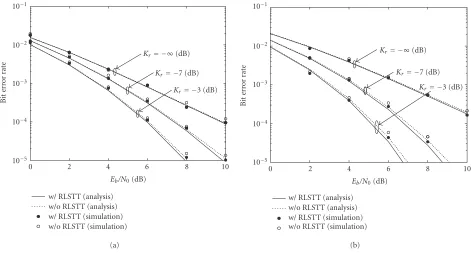
0 2 4 6 8 10
w/ RLSTT (analysis) w/o RLSTT (analysis) w/ RLSTT (simulation) w/o RLSTT (simulation)
(a)
w/ RLSTT (analysis) w/o RLSTT (analysis) w/ RLSTT (simulation) w/o RLSTT (simulation)
(b)
Figure1: BER versusEb/N0in AA with RLSTT and AA without RLSTT (user=12,M=4,Lr=L(k)=3,Kr = −∞,−7, and−3 (dB)). (a) δ=0.0 (uniform MIP). (b)δ=1.0 (exponential MIP).
be evaluated as
Pe= for exponential MIP,
∞ for uniform MIP,
(26) a chi-squared distribution with 2(Lr−1) and 2 degrees of
freedom, respectively.
4. NUMERICAL RESULTS
In this paper, we have investigated the BER performance of AA system both with RLSTT and without RLSTT, consider-ing several important factors such as the ratio of the specular component power to the Rayleigh fading power, the shape of MIP, and the number of antennas. In all evaluations, process-ing gain is assumed to be 128, and the number of paths and taps in RAKE is assumed to be the same for all users and de-noted by three, where it includes the specular component.
The decaying factor is considered as 1.0 for the exponen-tial MIP and 0.0 for the uniform MIP. The sensor spacing is half the carrier wavelength, and an important parameter that characterizes a Rician fading channel is defined as the ratio of the specular component power to the Rayleigh fad-ing power which is assumed to be the same for all users, that is,Kr(k)=Kr.
Figure 1shows uncoded BER performance as a function of Eb/N0, when the number of users is twelve, the
num-ber of antennas is four, and Kr = −∞,−7, and −3 (dB)
are assumed. It is noted that using RLSTT may enhance the achievable performance of the AA system, since RLSTT tends to make better the estimation of covariance matri-ces for beamformer-RAKE receiver. Furthermore, it is shown that the performance gains between AA with RLSTT and AA without RLSTT increase as the ratio of specular power in-creases. The results confirm that the analytical results are well matched to the simulation results.
Figure 2shows the BER system performance as a func-tion of number of antennas, whenEb/N0=10 (dB) and the number of users is sixty. The curves are parameterized by dif-ferent values ofKr= −3,−2,−1, and 0 (dB) and indicate that
the CS AA system with RLSTT increasingly outperforms the corresponding system without RLSTT when the parameter ofKrincreases. Note that comparingFigure 2aandFigure 2b
characterizes the effects of increasing the MIP decay factor fromδ=0.0 toδ=1.0. Intuitively, the received power of the nonfaded specular component increases as the parameterδ
1 2 4 8 10−10
10−9
10−8
10−7
10−6
10−5
10−4
10−3
10−2
10−1
Bi
t
er
ror
ra
te
Number of antennas (M)
Kr= −3 (dB) Kr= −2 (dB) Kr= −1 (dB) Kr=0 (dB) w/ RLSTT w/o RLSTT
(a)
1 2 4 8
10−10
10−9
10−8
10−7
10−6
10−5
10−4
10−3
10−2
10−1
Bi
t
er
ror
ra
te
Number of antennas (M)
Kr= −3 (dB) Kr= −2 (dB) Kr= −1 (dB) Kr=0 (dB) w/ RLSTT w/o RLSTT
(b)
Figure2: BER versus number of antennas in AA with RLSTT and AA without RLSTT (user=60,Eb/N0 =10 (dB),Lr =L(k) =3, Kr = −3,−2,−1, 0 (dB)). (a)δ =0.0 (uniform MIP). (b)δ=1.0
(exponential MIP).
InFigure 3, the BER performance is reflected as a func-tion of the number of users, when the various ratios such as
Kr= −3,−2,−1, and 0 are considered,Eb/N0=10 (dB), and the number of antennas is chosen to be four. RLSTT makes a DS-CDMA system with AA insensitive to the number
12 24 36 48 60 72 84
10−10
10−9
10−8
10−7
10−6
10−5
10−4
Bi
t
er
ror
ra
te
Number of users
Kr= −3 (dB) Kr= −2 (dB) Kr= −1 (dB) Kr=0 (dB) w/ RLSTT w/o RLSTT
(a)
12 24 36 48 60 72 84
10−10
10−9
10−8
10−7
10−6
10−5
10−4
Bi
t
er
ror
ra
te
Number of users
Kr= −3 (dB) Kr= −2 (dB) Kr= −1 (dB) Kr=0 (dB) w/ RLSTT w/o RLSTT
(b)
Figure 3: BER versus number of users in AA with RLSTT and AA without RLSTT (Eb/N0 = 10 (dB),M = 4,Lr = L(k) = 3, Kr = −3,−2,−1, 0 (dB)). (a)δ =0.0 (uniform MIP). (b)δ=1.0
(exponential MIP).
of users and thus increases the achievable overall system ca-pacity. For example, in case of Kr = 0 (dB) and δ = 0.0,
12 24 36 48 60 72 84 −4
−3 −2 −1 0 1 2 3
Kr
(dB)
Number of users δ=0.0
δ=1.0
Figure4: RequiredKr-factor versus number of users in AA with
RLSTT and AA without RLSTT (Eb/N0 = 10 (dB),M =4,Lr = L(k)=3,δ=0.0, 1.0, BER=10−7).
system with RLSTT, compared to the system without RLSTT, increases as the parameterδincreases.
InFigure 4, the minimumKrrequired to achieve BER of
10−7 is encounted as a function of the number of users for different decay factors, that is,δ = 0.0 andδ = 1.0, when
Eb/N0 = 10 (dB),M = 4, andLr = L(k) = 3. The figure
demonstrates that while in the exponential MIP ofδ=1.0, AA without RLSTT is required to keep more than 1 (dB) in order to achieve the user capacity of 60 users, AA with RLSTT may make loose the requirement to−3 (dB). The figure can also be used to find the overall system capacity for a givenKr
and the decay factor.
5. CONCLUSIONS
In this paper, we presented an improved AA, in which RL-STT is incorporated to effectively make better an estimation of covariance matrices at a beamformer-RAKE receiver. The results show that the addition of an unfaded specular compo-nent to the channel model increases the performance diff er-ence between with RLSTT and without RLSTT in the CS AA systems. Furthermore, the exponential MIP decay factor has a substantial effect on the system BER performance in a Ri-cian fading channel. These results, however, do not take into account effects such as coding and interleaving. Additionally, it is apparent that RLSTT has superior performance and/or reduces the complexity of the system since AA with RLSTT with fewer numbers of antennas can obtain the better perfor-mance than AA without RLSTT.
APPENDIX
SPATIAL CORRELATION STATISTICS
From (10), we can obtain the optimal beamformer weight presented as
wl(k)=ξ·R(l,kuu)−1vθl(k)
, (A.1)
sinceξ does not affect the SINR, we can setξ = 1. When the total number of paths is large, a large code length yields
Rl(,kuu) =(σs(,kl))2·I
M[4]. However, it means that the total
unde-sired signal vector can be modeled as a spatially white Gaus-sian random vector. Here, (σs(,kl))2 is the total
interference-plus-noise power. From (7), the total interference-plus-noise for thelth path of thekth user in the matched filter output is shown as
ul(k)=I(l,sik)+Il(,maik) +I(l,nik). (A.2) If we assume that the angles of arrival of the multipath com-ponents are uniformly distributed over [0,π), the total inter-ference vectorI(l,ksi)+I(l,maik) will be spatially white [4, Chapter 6]. In this case, the variance of an undesired signal vector is given by
Eu(lk)·ul(k) H
=σs(,kl)
2
·IM
=σmai,(k)l
2 +σsi,(kl)
2 +σni,(k)l
2
·IM,
(A.3)
where (σmai,(k)l)2 and (σ
(k)
si,l)2 are noise variances of MAI and
SI in a one-dimension antenna system. In the case of the reverse-link asynchronous DS-CDMA system, we can obtain the variance of the total interference-plus-noise calculated as
σs(,kl) 2
=EbT
(N−1)(K−1)α2+Ω 0q
Lr,δ
6N2
+Ω0
qLr,δ
−1
4N +
η0 4Eb
forl≥0.
(A.4)
For the RLSTT model [7,16], all active users are synchronous in the mainpath branch. Therefore, the different variances forl=0 and forl≥1, respectively, are expressed as follows:
σs(,0k)
2
=EbT
(2N−3)(K−1)Ω0
qLr,δ
−1
12N(N−1)
+Ω0
qLr,δ
−1
4N +
η0 4Eb
forl=0,
σs(,kl) 2
=EbT
(N−1)(K−1)α2+Ω 0q
Lr,δ
6N2
+Ω0
qLr,δ
−1
4N +
η0 4Eb
forl≥1.
(A.5)
Using Hermite polynomial approach we can evaluate the av-erage total interference-plus-noise power per antenna array element. With these assumptions, the optimal beamformer weight ofkth user at thelth multipath can be shown to be
wl(k) = (σs(,kl))−2·v(θ
(k)
l ). Therefore, between the array
expressed as
The second-order characterization of the spatial correlation is calculated as
h have uniform
dixstribution in [0,π) independently. So,
ECR(lhk,m)
whereJ0(x) is the zero-order Bessel function of the first kind.
REFERENCES
[1] L. C. Godara, “Application of antenna arrays to mobile com-munications. II. Beam-forming and direction-of-arrival con-siderations,”Proc. IEEE, vol. 85, no. 8, pp. 1195–1245, 1997.
[2] A. J. Paulraj and C. B. Papadias, “Space-time processing for wireless communications,” IEEE Signal Processing Mag., vol. 14, no. 6, pp. 49–83, 1997.
[3] A. Stephenne and B. Champagne, “Effective multi-path vector channel simulator for antenna array systems,” IEEE Trans. Veh. Technol., vol. 49, no. 6, pp. 2370–2381, 2000.
[4] A. F. Naguib, Adaptive antennas for CDMA wireless networks, Ph.D dissertation, Stanford University, Stanford, CA, 1996. [5] J. S. Thompson, P. M. Grant, and B. Mulgrew, “Smart antenna
arrays for CDMA systems,”IEEE Pers. Commun., vol. 3, no. 5, pp. 16–25, 1996.
[6] W. Ye and A. M. Haimovich, “Performance of cellular CDMA with cell site antenna arrays, rayleigh fading, and power con-trol error,” IEEE Trans. Commun., vol. 48, no. 7, pp. 1151– 1159, 2000.
[7] E. K. Hong, S. H. Hwang, K. J. Kim, and K. C. Whang, “Syn-chronous transmission technique for the reverse link in DS-CDMA terrestrial mobile systems,” IEEE Trans. Commun., vol. 47, no. 11, pp. 1632–1635, 1999.
[8] S. H. Hwang and D. K. Kim, “Performance of reverse-link synchronous DS-CDMA system on a frequency-selective multipath fading channel with imperfect power control,” EURASIP J. Appl. Signal Process., vol. 8, pp. 797–806, 2002. [9] L. Hanzo, L-L. Yang, E-L. Kuan, and K. Yen,Single- and
Multi-Carrier DS-CDMA, John Wiley & IEEE Press, 2003.
[10] 3GPP TR25.854, Uplink Synchronous Transmission Scheme, May 2001, ftp://ftp.3gpp.org/.
[11] H.-H. Chen, Y.-C. Yeh, C.-H. Tsai, and W.-H. Chang, “Up-link synchronisation control technique and its environment-dependent performance analysis,”IEE Electronics Letters, vol. 39, no. 24, pp. 1755–1757, 2003.
[12] D. Li, “The perspectives of large area synchronous CDMA technology for the fourth-generation mobile radio,” IEEE Commun. Mag., vol. 41, no. 3, pp. 114–118, 2003.
[13] Y. S. Kim, S. H. Hwang, D. K. Cho, and K. C. Whang, Per-formance of Antenna Arrays with Reverse-Link Synchronous Transmission Technique for DS-CDMA System in Multipath Fading Channels, vol. 2402 ofLecture Notes in Computer Sci-ence, Springer, Heidelberg, 2002.
[14] K. W. Yip and T. S. Ng, “Matched filter bound for multipath Rician-fading channels,”IEEE Trans. Commun., vol. 46, no. 4, pp. 441–445, 1998.
[15] J. Wang and L. B. Milstein, “CDMA overlay situations for mi-crocellular mobile communications,” IEEE Trans. Commun., vol. 43, no. 234, pp. 603–614, 1995.
[16] S. H. Hwang and L. Hanzo, “Reverse-link performance of synchronous DS-CDMA systems in dispersive rician multi-path fading channels,”IEEE Electronics Letters, vol. 39, no. 23, pp. 1682–1684, 2003.
[17] Rec. ITU-R TG8-1,Guideline for evaluation of radio transmis-sion technologies for IMT-2000, 1997, Rec. M.1225.
[18] D. Parsons,The Mobile Radio Propagation Channels, Addison-Wesley, 1992.
[19] J. Litva and T. K. Lo, Digital Beamforming in Wireless Com-munication, Artech House, Boston, 1996.
[20] M. Pursley and D. Sarwate, “Evaluation of correlation param-eters for periodic sequences,”IEEE Trans. Inform. Theory, vol. 23, no. 4, pp. 508–513, 1977.
[21] T. Eng and L. B. Milstein, “Coherent DS-CDMA performance in nakagami multipath fading,” IEEE Trans. Commun., vol. 43, no. 234, pp. 1134–1143, 1995.
Yong-Seok Kimreceived his B.S. degrees in electronic engineering from the Kyung Hee University, Yongin-si, Korea, in 1998, and M.S. and Ph.D. degrees in communication systems from Yonsei University, Seoul, Ko-rea, in 2000 and 2005, respectively. Since 2005, he has worked for Samsung Electron-ics. His current research interests include multiantenna system, multiuser communi-cation, and multicarrier system in the 4G communication environments.
Keum-Chan Whang received his B.S. de-gree in electrical engineering from Yonsei University, Seoul, Korea, in 1967, and the M.S. and Ph.D. degrees from the Polytech-nic Institute of New York, in 1975 and 1979, respectively. Since 1980, he has been a Pro-fessor in the Department of Electrical and Electronic Engineering, Yonsei University. For the government, he performed various duties such as being a Member of the