Volume 2006, Article ID 78259, Pages1–18 DOI 10.1155/WCN/2006/78259
Integrating a Trust Framework with a Distributed Certificate
Validation Scheme for MANETs
Giannis F. Marias, Konstantinos Papapanagiotou, Vassileios Tsetsos, Odysseas Sekkas, and Panagiotis Georgiadis
Department of Informatics and Telecommunications, University of Athens, Panepistimiopolis, Ilissia, Athens 15784, Greece
Received 1 October 2005; Revised 5 May 2006; Accepted 17 May 2006
Many trust establishment solutions in mobile ad hoc networks (MANETs) rely on public key certificates. Therefore, they should be accompanied by an efficient mechanism for certificate revocation and validation. Ad hoc distributed OCSP for trust (ADOPT) is a lightweight, distributed, on-demand scheme based on cached OCSP responses, which provides certificate status information to the nodes of a MANET. In this paper we discuss the ADOPT scheme and issues on its deployment over MANETs. We present some possible threats to ADOPT and suggest the use of a trust assessment and establishment framework, named ad hoc trust framework (ATF), to support ADOPT’s robustness and efficiency. ADOPT is deployed as a trust-aware application that provides feedback to ATF, which calculates the trustworthiness of the peer nodes’ functions and helps ADOPT to improve its performance by rapidly locating valid certificate status information. Moreover, we introduce the TrustSpan algorithm to reduce the overhead that ATF produces, and the TrustPath algorithm to identify and use trusted routes for propagating sensitive information, such as third parties’ accusations. Simulation results show that ATF adds limited overhead compared to its efficiency in detecting and isolating malicious and selfish nodes. ADOPT’s reliability is increased, since it can rapidly locate a legitimate response by using information provided by ATF.
Copyright © 2006 Giannis F. Marias et al. This is an open access article distributed under the Creative Commons Attribution License, which permits unrestricted use, distribution, and reproduction in any medium, provided the original work is properly cited.
1. INTRODUCTION
Mobile ad hoc networks (MANETs) are dynamically con-figured, multihop wireless networks with varying topology. Mobile nodes in such networks are continuously associated or disassociated with each other, according to their topolog-ical arrangements. Thus, the network topology varies with time due to the ataxic locomotion of the participating nodes. In such a dynamic environment, cooperation between nodes is essential for the network’s well-being. In order to enforce cooperation, adjacent nodes should build up trust with time. Such trust establishment procedure can improve security, connectivity, and quality of service in the network, and, thus, enhance its performance. Applications in a MANET can take advantage of such trust relationships, by exploiting them to improve their performance and efficiency.
MANETs are dynamic and open: nodes join or leave the network at any time, are constantly moving in any direc-tion, while the electromagnetic spectrum, being the transfer medium, is considered publicly available. In such a context selfish and malicious nodes are likely to appear. Selfish nodes are characterized by their reluctance to spending resources to
maximize social welfare (e.g., by forwarding packets that are not destined for them). Conversely, they demand from other nodes to exploit resources for their profit. Malicious nodes attack directly the network’s robustness and the nodes’ avail-ability through common techniques such as denial of service (DoS), flooding and sleep deprivation torture [1]. Hence, se-curity schemes that are based on symmetric or public keys are considered essential for the establishment of authenticity, confidentiality, and integrity services in MANETs, being fo-cused on the avoidance of the malicious nodes’ actions. On the other hand, if the primary goal is the maximization of the network’s availability, robustness, and overall through-put, then cooperation enforcement schemes fit better. They mainly encourage the collaboration between the nodes of a MANET, trying to overcome egoistic behaviors that jeopar-dize the network’s operation.
have proposed a distributed scheme based on OCSP (on-line certificate status protocol) called ADOPT, that can pro-vide on demand up-to-date CSI to any node in a MANET. ADOPT is based on the concept of distributing and caching preissued and presigned OCSP responses in selected nodes of the network. Its goal is to provide an efficient, lightweight and always-available scheme for determining the status of certificates within a MANET.
On the other hand, when the availability of nodes and network, and the overall throughput are required, then the cooperation enforcement techniques might fit better. These models face mainly the question of encouragement of col-laboration between the nodes of a MANET so that the right implementation of routing and forwarding tasks is achieved. In [6] we have proposed the ad hoc trust framework (ATF), a generic, distributed, framework for self-evolving trust es-tablishment. ATF incorporates self-evidences, recommen-dations, subjective judgment and historical evidences to continuously evaluate the trust level of peers. To capture such semantics, ATF is armed with a novel trust computa-tion model. The model consolidates user’s natural behavior, through a trust policy. ATF does not use any symmetric or public cryptography for trust building, or message authenti-cations schemes. Thus, it avoids complex computations and the expenditure of resources (power, CPU, and memory). In that sense, ATF is usable in different types of distributed, or peer systems (ad hoc networks, pervasive computing devices, autonomic systems), although in this work it is primarily ex-ploited in the context of ad hoc networking.
In this paper we propose the integration of these two frameworks, namely ADOPT and ATF, in order to demon-strate how ATF can be used to increase ADOPT’s efficiency. ATF, being a general purpose, self-evolving trust scheme can support trust aware applications. Such an application could take advantage of trust values assigned by ATF and use them to improve its efficiency. In ADOPT’s case, as we will see in the following sections, ATF can be used to prevent attacks that could flood the MANET with useless messages. Threats to ADOPT, not only affect the usage of this service, but may also cause exhaustion of node’s resources. Hence, ADOPT could rely on ATF for improving its robustness. ATF provides trust information for specific nodes, so that selfish and ma-licious nodes can be detected and isolated as soon as possi-ble. Additionally, ATF can disseminate trust metrics concern-ing the behavior of nodes when executconcern-ing ADOPT, providconcern-ing more accurate trust information for ADOPT, but also assess-ing the trustworthiness of a node in a MANET in a more complete way.
The structure of this paper is as follows. InSection 2 we present and explain the functionality of ADOPT. Details of proposed caching alternatives are also given as well as some characteristics of the ADOPT protocol and messages. InSection 3we describe ATF, its architecture, how it man-ages trust and reputations using a specified trust policy. Fur-thermore, the details of theTrustSpan algorithm are given. Subsequently, inSection 4we analyze the threats and attacks that ADOPT may have to face. In addition, we describe the reasons that led us into integrating ADOPT and ATF and the
specifics of this integration. Moreover, the TrustPath algo-rithm and Cerberusfunction are analyzed. InSection 5we discuss details of this integration, providing and assessing several simulation results. Finally, we provide some examples of related work and conclude with our remarks and sugges-tions for future research.
2. ADOPT
ADOPT [5] is an on-demand, distributed OCSP scheme, based on cached OCSP responses, and designed in such a way, so that it can be successfully and efficiently deployed in MANETs. Its purpose is to create a fast, light, distributed, and always available certificate revocation protocol for MANETs.
2.1. ADOPT architecture
OCSP is a simple protocol involving requests and responses that provide the current status of one or more certificates. A client can send a request to a server (usually called OCSP re-sponder) asking for information on the status of one or more certificates. This request can be digitally signed and contains a reference to the queried certificate(s) (certID). The server responds with a signed message that contains the status of the referenced certificate(s). The response message also con-tains time and date information. OCSP responses are always digitally signed either by the CA, a trusted or an authorized responder.
We distinguish three different kinds of nodes in ADOPT: ServerNodes,CachingNodes, andClientNodes.ClientNodes re-quest the status of a certificate by broadcasting a message similar to an OCSP request. CachingNodescache preissued and presigned OCSP responses and act as OCSP responders by providing such responses when needed.ServerNodesare nodes that announce the revocation status of the certificates, such as OCSP responders. They issue and sign certificate sta-tus responses which are then stored inCachingNodes.
AClientNodewishing to determine the status of a cer-tificate forms an OCSP-like request message. In traditional OCSP, this message should then be sent to an OCSP re-sponder, which would be identified by the authorityInfoAc-cessextension [7] of theX.509 certificate. However, MANETs are highly dynamic in nature, as nodes may enter or leave the network anytime and may be moving constantly. There-fore, a DSR-like [8] mechanism has been proposed [5], more appropriate for such environments. Thus, the request mes-sage is broadcasted by the ClientNode. Intermediate nodes that receive the message rebroadcast it if they do not act as CachingNodes. On the other hand, CachingNodes examine their cache for a preissued response corresponding to the re-quested certificate. If such a response is found, it is forwarded back to theClientNode; else the request message is rebroad-casted. Similarly, if the message reaches aServerNode, a cor-responding response is issued.
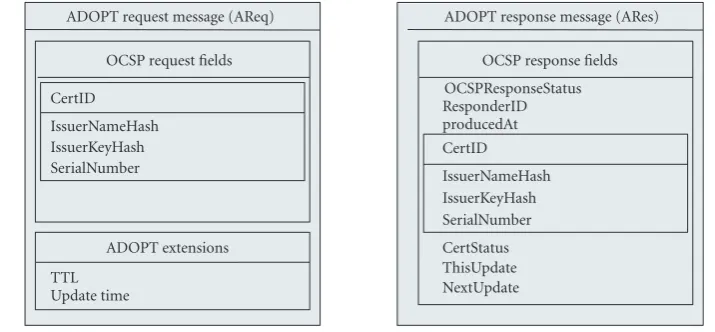
ADOPT request message (AReq) OCSP request fields CertID
IssuerNameHash IssuerKeyHash SerialNumber
ADOPT extensions TTL
Update time
ADOPT response message (ARes) OCSP response fields OCSPResponseStatus ResponderID producedAt CertID IssuerNameHash IssuerKeyHash SerialNumber CertStatus ThisUpdate NextUpdate
Figure1: ADOPT messages.
In detail, theClientNodedetermines the maximum number of hops that the request message is allowed to travel through. ThisTTL (time-to-live)parameter is included in the request message. Every intermediate node that receives the message decreasesTTLby one, until the maximum number of hops is reached and the message is dropped.
2.2. ADOPT protocol
The main advantage of ADOPT lies in the fact that the nodes of a MANET can receive up-to-date CSI anytime, using a dis-tributed scheme that ensures the availability of this service. In addition, this information is delivered with a minimum cost in terms of both network and node resources. As a mat-ter of fact, OCSP messages are rather small in size [9] and CachingNodesdo not need to resign cached information sta-tus. The authenticity and integrity of the responses can be verified by the OCSP responder’s signature on the response. However, the freshness of CSI depends on the freshness of the cached responses, and thus, on the mechanism used for cache updating.
OCSP requests reference the queried certificate using a hash of the issuer’s name and key as well as the serial number of the certificate. These fields uniquely identify a certificate [10]. OCSP responses include three time parameters, critical to OCSP’s operation. The first one, indicated by the field pro-ducedAt, denotes the time when the OCSP response was is-sued. Two additional parameters specify the validity interval of the OCSP response. In detail,thisUpdateindicates when revocation information regarding the queried certificate was last obtained, whilenextUpdateis the time when the respon-der is expected to have new information concerning this cer-tificate. The most important fields contained in an ADOPT request (AReq) and response message (ARes) can be seen in Figure 1.
AResfreshness can be of a great importance to ClientN-odes as some critical user applications may require up-to-date responses. ADOPT [5] introduces a parameter (update-Time) in the request message that allows a ClientNode to
specify how fresh the expected response should be. In such terms, if a CachingNode does not have a fresh enough re-sponse, it rebroadcasts or drops the request, depending on theTTLparameter.
Ideally, aCachingNodeshould deliver the most recently issued cached response. Nevertheless, it is possible that its cache is not updated. An efficient mechanism for cache up-dating should be in place to ensure thatCachingNodesget the most updated responses. ADOPT suggests that CachingN-odesget updated directly from an OCSP responder (ServerN-ode), either periodically or on demand. Even when commu-nication withServerNodesoccurs using out-of-band means (e.g., through a GSM or GPRS bridge), it is possible that these OCSP responders may not be always available. Thus, ADOPT also suggests thatCachingNodescan eavesdrop on messages that they forward in order to detectAResdesignated for other nodes but also useful to them, for updating their cache.
Efficient cache placement policies ensure that there is no unwanted flooding of OCSP requests in the MANET. Cached AResmay be placed in strategic elements within a MANET, for example, in high mobility nodes [11]. Each node in the network should be able to reach a CachingNodewith a cached response to his request in a few hops, so thatAReqdo not have to travel far in the network. Moreover, each node chooses for itself a cache update and deletion policy. Its de-cision depends on its position within the MANET and its re-sources in terms of processing power, memory capacity, and power autonomy. Thus, in ADOPT, a node may choose be-tween a greedy or selective caching policy [11] as follows.
(i) Greedy caching state. The node caches everyAResthat passes through it.
(ii) Selective caching state. The node caches a response af-termappearances, withmbeing the popularity index of that response.
window (WW)parameters ensure that request propagation stops once a response has been located. AClientNodehas to set theTTLparameter, which specifies the maximum num-ber of nodes that the request can pass through. If a response is not found within the specified number of nodes, the re-quest will be dropped. TheClientNodewill be able to resend the same request with a different TTL parameter, depend-ing on theWW. Thewaiting windowparameter indicates the time aClientNodehas to wait until receiving anAResand its calculation is based on a node’s observations of network de-lays. Evidently, a legitimate request message will only reach a specific number of hosts, without forming any loops, thus consuming only the necessary network resources.
3. ATF
ATF uses a layered architecture and consists of the following components:trust sensors (TS), trust builder (TB), and repu-tation manager (RM). The proposed framework is fully dis-tributed. Every node hosts these components and provides a number of routine functions (services), such as packet for-warding, routing, and so forth. Moreover, every node im-plements a special function, calledrecommendation function (RF). This is a simple service that provides recommendations to third parties, upon request.
3.1. ATF architecture components
ATF follows [12] for the definition of the reputation of a node’s function: reputation is expressed through the triple {nodeid, function, trust value}. Thus, the reputation of a function f of nodenis defined asR(n,f)= {n,f,TVn,f}, where TVn·f is thetrust value (TV) for the function f of noden.
In the context of ATF, adetector is a node that directly monitors the behaviour of another node’s functions, called target. In such a case the detector captures direct evidence (DE)about the trustworthiness of a particular function of the target. Arequestoris a node that asks for recommendations. Arecommenderissues recommendation responses (upon re-quest).
In general, a trust building mechanism could be laid out based on two diverse architectural directions. The first relies on an on-demand, and the second on an event-driven rep-utation mechanism. The difference between these two ap-proaches lies in the way that nodes are being informed for changes intrust values (TVs). The ATF architecture is capable of supporting on-demand recommendations. The ATF archi-tecture consists of the following modules (seeFigure 2).
Trust sensors (TS)
The majority of the proposed reputation systems agree that the most significant factor for trust building is the evidence. In ATF, for every function offered by an adjacent node there is atrust sensor (TS)that monitors its execution/operation. ATSis an abstraction of common physical sensors: trans-lates a (physical) phenomenon in a machine interpretable
Trust policy Trust builder
Trust matrix
TS1 TS2 RFTS Reputation manager
Network and application stack
Figure2: ATF Architecture.
form. In our case this phenomenon is the trustworthiness of a node. ATSmonitors the behaviour through real-time measurements or statistical analysis of logs, and compares it to a predefined reference attitude (i.e., expected functional-ity). In that sense, the ATF scheme usesTSsto assist a node in defining the credibility of other collaborating peers. ATS maps the captured evidence (i.e., observation) to a numerical value and forwards this value to thetrust builderfor further trust computation.
Trust builder (TB)
This component computes the TV of other nodes’ func-tions. ATV value is distinct for each discrete function per node. A node, for example, may be trustworthy to perform packet forwarding, but unreliable to contribute on routing. TV computation depends on several factors, such as direct evidence, recommendations, historical data, and subjective criteria. Each node follows its own trust policy, which spec-ifies the user’s subjectivity (e.g., distrustful, deceivable) and the weights.
Reputation manager (RM)
The RM’s main role is to provide recommendations from third parties to theTBin order for the latter to compute the TVs.TBrequests recommendations for atarget when it has inadequate information for it. Next, RMselects the recom-mendersin order to obtain requested values. These should be as trusted as possible and close enough so as to limit com-munication overheads. For that purpose, theRMtakes into account theTVsof therecommenders’recommendation func-tion.
Recommendation function trust sensor (RFTS)
3.2. Trust computation in ATF
ATF incorporates several user-defined weights and time-dependent parameters, defined separately for each entity in itstrust policy(TP). Time-dependence is important, since it allows the modeling of temporal trust strategies, which can be followed by the participating nodes. In the context of ATF, time is discrete and is measured through counting successful interactions.
The majority of the trust computation approaches ac-knowledge that for the evaluation ofTV two main compo-nents should be taken into consideration: the DEand the recommendations (RECs) from third parties. TheDEis cal-culated from theTSs’ feedbacks and is useful for evaluation of adjacent nodes’ functionality.RECs are communicated be-tween the entities participating in the trust network, accord-ing to a reputation dissemination protocol, implemented in RM. Many sociocognitive approaches for trust, for ex-ample, [13], dictate that trust computation should also in-clude a subjective component. Thus, asubjective-factor com-ponent(SUB) is introduced in the trust computation model. This time-dependent component enables time-variant trust-ing behaviour of peers.SUBis defined by theTPof each indi-vidual node, and can model typical trust characters, such as unwary, suspicious, disbelieving, and so forth. This compo-nent provides flexibility in the trust strategy of a user, with-out imposing significant complexity in the overall trust com-putation. History is an additional concept that has drawn at-tention in the trust community. Several researchers use his-tory as an implicit component in the trust computation, as in [14–16]. In ATF, a significant weight is assigned in the cur-rent observation. This enables a peer entity to rapidly identify when atarget starts to misbehave. Additionally, the history of the observations that will be considered for the evaluation of a trust value of atarget, when a new observation is pro-duced, depends on the subjective behaviour of the requestor. Thus, a distrustful peer entity might need past observations, whilst a deceivable peer entity might need only the newer ones. Thus, when a new observation (i.e., TS(n,f)) occurs, a distrustful entity takes into account the historyh1 of the di-rect evidences, as seen inFigure 3, whilst a deceivable entity takes into account the historyh2.
Thus, for each new observation or recommendation (i.e., newvalue) the following equation is used to relate historical data with current observations (1):
NewValuen,f(t)=w∗CurrentValuen,f to denote the weighted average over the lastHdata and the new value recorded at timet. According to the analysis in [6], moderate values ofw (e.g., 0.2) ensure that the calcu-lated values belong to a range that is not deviated from the real behaviour. Thus, moderate values ofwin (1) ensure that the direct evidence will capture the actual behaviour of the target, without significant deviations due to sporadic misbe-haviors or rational errors. Additionally, the historical average
DEn,f(t i) TS(
Figure3: Different observation windows for the assessment of the
DE trust value.
component of (1) introduces different sharpness on the esti-mation. When only the recent observations are required (e.g.,
H =3, corresponding to an impressionable entity) then the DEapproaches faster the minimum or maximum values, il-lustrating sudden fluctuations. On the other hand, when the requestor takes into account long history (e.g.,H = 8, for a disbeliever entity) then theDEapproaches less rapidly the threshold values, illustrating smooth fluctuations.
Each node maintains anN×Ftrust matrix (TM), repre-senting theTVthat the entity computes per monitored func-tion of atarget, whereNis the number of nodes in the net-work, andFcorresponds to the overall number of supported functions. Each element TMn,f (1≤n≤Nand 1≤ f ≤F) refers to a specific function f of a particular noden, and it varies with time. The formulae forTMandTVare
TV≡TV(n,f,t)=a∗DEn,f+b∗RECn,f step increasing and decreasing functions. In order to map the TV values within the [0,1] interval we use a unit step functionu(t) (see (3)). The range ofTV(n,f,t)is [0,1], where 0 means that the detector distrusts atarget nfor a specific function f, and 1 means that it fully trustsnforf. served by the correspondingTSof thedetector. AnN×F ma-trixDE, stored in every node, is defined asDE≡(DEn,f)∈ [0, 1], where the matrix elements DEn,f are computed ac-cording to (1), as follows:
DEn,f(t)=WAH(n,f,t),
Table1: The parameters of the trust policy.
Parameter Semantics
MI The minimum interactions required for being confident about theTVof atarget
a The impact (weight) of theDEon theTV(0≤a≤1,a+b=1), in (2)
b The impact (weight) of theRECon theTV(0≤b≤1,a+b=1), in (2)
w The weight of history (2)
TTH(RF) The minimum allowableTVRFassessed to a node in order to be arecommender
HFI
Honourable friend index is the minimum number of trustedrecommenders, required to be consulted by arequestorto reliably evaluate the trustworthiness of an unclassifiedtarget
The lower value (i.e., 0) denotesfailure, while the higher (i.e., 1) denotessuccess. The coefficientsw1andw2adjust the weights assigned to recent and historicalDEvalues, respec-tively.RECn,f stands for the aggregated recommendations we have for the function f on nodenfrom third parties. The SUBcomponent of theTV computation formula incorpo-rates the node’s subjectivity. This subjectivity is a key diff er-entiator between the various nodes and stems from the so-ciocognitive approaches to trust modeling [17]. SUBis an
N×F matrix with elements in the{f : T → [0, 2]} do-main. Thus, its elements are time-functions. The range [0,2] allows thedetector to distrust (i.e., value 0) thetarget, trust it (i.e., value 1), be enthusiastic about thetarget (i.e., value 2) or develop any other intermediate form of subjective trust strategy. We have chosen the value 2 as an upper bound to allow enthusiastic entity but not to such a degree that would endanger the network’s rationality. Thus, we might consider nodes with diverse trust strategies, but we want to restrict the deviation of this diversity. An example SUB time-function could be defined as
SUBn,f(t)=u(t−2). (5)
This function indicates that no matter whatDEsorRECs arequestorhas for a function of a target (n,f), it will not trust the latter until two successful (positive) direct interac-tions have been observed. In case the aforementioned defined SUBcomponent is used indiscriminately for alltargetsand provided functions, it will be identical for all the elements of thedetector’s SUBmatrix. The set of theSUBfunctions is de-fined in theTPand it can be adjusted depending on thetarget and the monitored function. However, in practice, it is highly unlikely that a node will haveN×FdifferentSUBfunctions. Instead, adetectorwill usually use identicalSUBfunction for everytargetor every function.
3.3. Trust policy
For each node, aTPdefines the functionality of itsRMand TB. A TP captures the conceptual subjective behaviour of the entity (e.g., end-users). The parameters of the TP are summarized inTable 1. The parameterHFI is used by the
proposedRMmodule and its application is described in the following section.
The parametersaandb(see (2)) are step increasing and decreasing functions onMI. This policy was chosen because when a detector realizes the existence of a newcomer only the recommendations of the trustedrecommendersshould be used (high values of parameterb). Thus, in the initial phase theRECsare essential. With time, theDEsbecome more im-portant, and this happens only when the MI value is ex-ceeded.
3.4. Trusted recommenders
As illustrated in (2) a requestor is based on recommenda-tions to compute the TV of other nodes. However, trusted recommenders(i.e., nodes illustrating a highTVvalue for the RF) should be conducted to provide these recommendations. This will minimize the effects of rumour spreading and avoid potential DoS attacks [18]. Moreover, the selected recom-mendersshould be as close as possible to therequestorso as to have limited communications overhead. The work in [19] ranks routes according to security metrics (e.g., reputation of nodes in the path), and avoids paths containing malicious nodes. Path ranking is also proposed in [20] to mitigate the effects of routing misbehavior. In [6] we have introduced a mechanism, calledTrustSpanthat is used by theRMof a re-questorto consult only trusted nodes whenever recommen-dations for the evaluation of newcomer nodes’ trustworthi-ness are required.
Inputs:
int HFI ; -- Honorable Friend Index
int DM[]; -- The distance of therecommenderfrom therequestor, 1,. . .,M
int TM[][]; -- Trust Matrix,M×N
int TTH(RF); -- The minimumTVRFof therecommenderin order to be trusted Output:
int trusted IDs[] -- IDs of nearest, HFI trustedrecommenders procedureTrustSpan (){
intTVRF[], NodeID[];
int Number Of Trusted Nodes For RF;
for(j=0;j <Number Of Nodes;j+ +)
if( TM[j][RF]≥TTH(RF)){ -- Trust Value for the RF for therecommenderj NodeID[j]=j;
Number Of Trusted Nodes For RF ++; }
if(Number Of Trusted Nodes For RF≤HFI ) return(NodeID[]);
order(DM[], NodeID[]); -- orders NodeID[] according to DM[] for(j=0;j <HFI;j+ +)
trusted IDs[j]=NodeID[j]; returntrusted Ids[];
}
Algorithm1: TrustSpan algorithm.
TrustSpantries to minimize both the delay in the prop-agation of the requested recommendations and the commu-nication overhead. It is invoked only when a node has inad-equate number of direct interactions with a newcomer. This number is defined inTPthrough the parameterMI.MIalso affects which nodes reply to recommendation requests. In particular, therecommendersselected byTrustSpanthat have less than MI direct interactions with a target will not give recommendations about it. When theTrustSpanreturns the IDs of the nearest trustedrecommenders, theRMasks for rec-ommendations (through unicasting) from the correspond-ingRMsof the trustedrecommenders. When the required rec-ommendations arrive or a respective timeout expires, the re-questor’sRMforwards the incoming information to theTB where the actual trust computation takes place.
4. ADOPT OVER ATF: INTEGRATION APPROACH
In this section we show how ADOPT can take advantage of ATF in order to ensure the availability and reliability of its service. ATF can also include TVs that are calculated accord-ing to a node’s behaviour when executaccord-ing ADOPT, regardless if it is a ClientNode, a CachingNode, or simply an interme-diate node forwarding ADOPT messages. Furthermore, we will examine how ATF and ADOPT can be integrated using a trust plane and also suggest some functions that will opti-mize the performance of the integration approach.
4.1. Attacks and threats against ADOPT
The presence of malicious or selfish nodes is substantial, and should be considered when providing CSI. In this section we analyze how selfishness and malicious behavior can be dealt with using ATF as a trust component. However, we do not take into account selfish or malicious behaviours against the robustness of other protocol layers, such as route request flooding, or routing table fabrication, materialized in the net-work layer of a MANET, since we assume that these attacks will be prevented on the corresponding layer of the stack. We only discuss selfishness and malicious behaviour on the ADOPT layer. We first consider a malicious node that ei-ther initiates flooding attacks to cause serious disruption to ADOPT, or fabricates the valid status information of a cer-tificate.
AReq flooding
important issue is that the network will be flooded with in-valid requests that can never be replied. Assigning a highTTL to the invalid requests can easily scale this attack. Such re-quests will not be withdrawn, as a corresponding response will never be located. As a result, these requests will be circu-lated in the entire network, reserving the scarce bandwidth and resources.
ARes flooding
This similar type of attack might cause more damage as far as robustness is concerned. In an attempt to find an updated response as quickly as possible, ADOPT broadcasts AReqs, which are propagated in the network. Malicious nodes can take advantage of this, by issuing and propagating falseARes. Such nodes can be acting as CachingNodes. In such a case they keep in their repository a variety of cachedARes, issued by various OCSP responders. TheseAResmight be valid, but probably are out-of-date, or they correspond to different se-rial numbers from the ones which a status was requested for. Each issuedAReswill traverse the reverse path, until it is dis-carded as invalid by the requestorClientNode.
ARes fabrication
Malicious caching nodes can fabricate responses in order to trickClientNodesinto acting as if they were valid. In detail, a maliciousCachingNodecan randomly pick a valid cached response from its repository and alter the referenced certifi-cate in order to match the queried one. Alternatively it can keep only aged responses that, for example, make a currently revoked certificate appear as valid. Actually, such responses are valid, but out-of-date. In any case, aClientNode receiv-ing a cachedAReswill first try to verify the signature on it. If the response has been altered by a malicious node, the sig-nature will be found invalid and theClientNodewill drop the response and broadcast a second request message, probably with a higherTTL, when theWW will expire. In case of an aged response, the signature will be found valid and it is left to theClientNodeto decide if it will look for a fresher sta-tus or regard it as valid. Otherwise, the digital signature will fail verification. Nevertheless, theClientNodewill have ver-ified the signature spending its power in processing public-key algorithms. A node flooded by such responses may soon consume a lot of its resources in vain (i.e., without ever get-ting a valid response). Several malicious nodes located near a ClientNodecan flood it with false responses until completely exhausting its power, materializing a sleep deprivation tor-ture attack [1].
A large number of malicious nodes, strategically placed within the MANET may cause serious disruptions to ADOPT and the network as a whole. These nodes could manage to provide invalid responses to most request messages, before legitimate nodes could manage to respond. This kind of at-tack resembles to DoS atat-tacks. The availability of ADOPT is affected as practically valid responses cannot be delivered. In extreme cases the nodes’ availability may be in risk too, since
if they continue to look for valid responses, they will soon run out of resources. In addition, ADOPT’s reliability and robustness become questionable too, as it appears unable to operate properly.
Apart from being malicious, some nodes may be selfish as well. Such nodes do not wish to spend their resources for the profit of other peers, or even for the social welfare. Addition-ally, they demand from others to use resources for their own profit. In terms of ADOPT, selfish nodes may decide to al-ways follow a noncaching policy. Alternatively, selfish nodes may choose not to process request messages at all. In the lat-ter case, they relay theAReqmessages without checking their cache for responses or reducing the TTL. Thus, a request message will travel in the MANET more than intended. Fi-nally, selfish nodes may decide not to forward any request or response message. In any one of the aforementioned cases, such nodes affect the performance of ADOPT or may even cause disruption of the service.
4.2. Motivation
The attacks analyzed in the previous section are rather sim-ple but if deployed on a large scale in a MANET, they could result in network congestion and partitioning as well as sig-nificant node resource consumption. In order to prevent and deal with these attacks we propose the use of the ATF frame-work as a trust component. Such a component would eval-uate nodes’ trustworthiness according to their behaviour so that peers could decide whether they should trust each other. In this section we examine how the use of ATF can enhance ADOPT’s efficiency and prevent the aforementioned attacks. We also propose some customizations for ATF in order to match ADOPT’s needs.
We consider here a MANET in which ATF is already de-ployed andtrust valuesare estimated for certain node func-tions (e.g., packet forwarding) [6]. Even though a generic trust framework which estimates nodes’ trust based on their performance on fundamental functions would be useful for any MANET application, the calculation of application-specific TVs would increase the efficiency of the applica-tion and of the network overall. ATF supports any trust-aware function and application, and, thus can also support ADOPT. A node receiving anAReqorARescan retrieve the TVsof the node that issued these messages from its trust ma-trix. Then, a decision should be made, based on the retrieved TVs, whether the originator should be trusted or not. In case of anAReq, the message should be processed as normal if the originator is considered trusted and, thus, the intermediate node should seek for a cached response in his cache and act accordingly. Similarly, anAResshould be forwarded to the next node if the originator is considered trusted. Conversely, if the node which issued the corresponding message should not be trusted, the request or response should be dropped.
responses that originate from such nodes. Furthermore, in Section 4.4we introduce optimizations in order to facilitate the detection and isolation of misbehaving nodes. Thus, the AResfabrication attack is also faced, as nodes that continu-ously fabricate invalid responses will be eventually isolated.
This approach solves the general issue of attacks to ADOPT but may result in many false positive ifTVsare not based on the node’s behaviour while executing ADOPT, but on other possibly routine functions. In some cases a node may not be behaving rationally in terms of routine tasks, but may legitimately request the status of a certificate. This request should not be dropped by the network nodes, nor should a request indicate an unusually high TTL parame-ter or a very recentupdateTime parameter. Such a request might have been constructed by a node unable to find suffi -ciently recent cached responses inCachingNodesof its neigh-bourhood. All similar legitimate requests should be replied as knowledge of certificate revocation status may be critical for some applications.
A combination of general and ADOPT-specificTVs is considered necessary for ADOPT’s efficient operation. Tak-ing into account parameters concernTak-ing how nodes behave when they execute ADOPT results in having a more complete view of trust for each node. Regarding requests, an interme-diate node receiving AReq messages should check its TTL andupdateTimeparameters. If these two values are consid-ered reasonable (e.g., lowTTLand recentupdateTime), the request may be legitimate even if othertrust valuesindicate otherwise. Of course, the specific message may have travelled a lot in the MANET before reaching the specific node, so that its initially largeTTLmay now appear low. As a result, node proximity should also be considered. A node’s trust builder wishing to evaluate another node’s trust, in terms of its be-haviour regardingAReqmessages, should, thus, consider the TTLparameter in each request message combined with the node’s location. On the other hand, it is very hard to decide if a queried certificate actually exists, as it is impossible for a node to have knowledge of all issued certificates. Regarding updateTime, values indicating a time in the future demon-strate a possibly illegitimate request message. However, mes-sages containing values that are near to the current time can-not be regarded malicious by default. In such inconclusive cases, otherTVsshould be also examined in order to provide the most possible accurate result.
Concerning response messages, the following steps are required to verify their validity:
(1) the digital signature on them should be valid,
(2) the referenced certificate should be the one that was queried,
(3) thethisUpdateandproducedAtfields should be recent enough, while thenextUpdate field should indicate a time in the future [10].
As we have already mentioned, signature verification requires considerable resources and, thus, should not be performed in every node for a large number of messages. Similarly, check-ing the referenced certificate for every response is also im-practical, as each node would also have to cache the
corre-sponding request message. Consequently, the only parameter that should be considered by thetrust builderis the combina-tion of the two OCSP date fields. Nodes sending aged cached responses should be considered suspicious for malicious be-haviour. Likewise, messages whoseproducedAtorthisUpdate values indicate a future time must have been originated from malicious nodes.
Ideally, some trusted nodes in the MANET should be able to perform the aforementioned tasks in order to verify re-sponses and provide trust feedback to other nodes. ATF al-ready supports a similar function as it introduces the no-tion of trusted recommenders. These are nodes that have proved their trustworthiness and provide trust recommen-dations to other nodes on demand. In ADOPT’s case, such nodes could verify response messages and provide recom-mendations to nodes that suspect malicious behaviour. Nor-mally, recommenders should be nodes with increased pro-cessing, memory, and energy resources and thus should be capable of performing the required cryptographic func-tions.
A common problem in trust and reputation systems is false accusations, where a network entity is given a wrong classification (e.g., malicious, or selfish). Inadvertently, ATF, and the ADOPT over ATF framework, may face such sit-uations due to unseemly estimation of nodes’ trustworthi-ness. To minimize false accusations, ATF relies on several mechanisms that have been already described. Firstly, the TrustSpanalgorithm aims at filtering out recommendations from “inexperienced” nodes in order to limit rumour spread-ing. TrustSpan relies on the predefined RF. The value up-date for this function is performed automatically through the RFTS or can be triggered by explicit testing mecha-nisms (i.e., ask nearest nodes about the trustworthiness of a node T for which you have already a very strong evi-dence).
Additionally, as we have already mention, the weights of RECandDEin theTV computation depend onMI. Thus, a node can flexibly control how much it should rely on rec-ommenders. In general, the minimization of false depends, among others, on the trust policy followed by each node. An explicit evaluation of the false accusations effects as a func-tion of possibleTPsis left as future work.
4.3. Integration of trust
Trust management for MANETs raises, as happens with every new computing paradigm, questions regarding its seamless integration with current network protocol stacks. In particu-lar, one should define how the introduction of trust affects the architecture and operation of current services, in our case of ADOPT, and identify potential difficulties or prob-lems during such integration. In general, the following three types of modifications are necessary for the desired integra-tion (see alsoFigure 4).
(1)Introduction of a trust plane
Application layer Transport layer
Network layer Link layer Physical layer
(a)
TApplication layer TTransport layer TNetwork layer
TLink layer TPhysical layer
T
rust
p
lane
TApplication layer TTransport layer
TNetwork layer TLink layer TPhysical layer
T
rust
p
lane
Trust protocol
(b)
Figure4: (a) Traditional network stack. (b) Net stack elements imposed by incorporation of trust.
includes all the necessary components in order to assess trust of third entities: sensing mechanisms, policy-driven evolu-tion of trust, interacevolu-tion history, and so forth. Trust plane operates also as a broker since it disseminates to all other interested layers the observations of each specific layer. For example, it may give feedback to the networking layer (i.e., routing) about the physical layer operation of peer entities.
(2)Recommendation exchange through a trust protocol
Such protocol could be implemented in the application layer and is responsible for the request and receipt of recommen-dations (i.e., in ATF it would be part of thereputation man-ager).
(3)Trust-aware versions of current protocols
The observations collected by the trust plane or the rec-ommendations collected through the trust protocol should somehow affect the operation of the network stack. This can be only performed if the protocols support trust-driven re-configurability.
An example of a trust-aware, self-adapted and reconfig-urable system is the software radio. Specifically, software ra-dio serves as a rara-dio communication system technology that uses software methods for the modulation and demodula-tion of the transmitted signal. The interface to the physical layer is no more hardware-based and fixed, but a set of inter-faces provided by the deployed software. A straight-forward result of a trust-aware version of the software-defined radio is that the physical layer can be altered to any supported pro-tocol by simple software redeployment, triggered by the trust plane. The initial triggering may be caused by an application that identifies poor quality of service, such as high bit error rate. Alternatively an upper layer might demand switching to a more secure version of the physical layer protocol, that is, modified hopping sequences of the CDMA, possibly due to distrusted neighbours.
The trust plane that deals with trust management issues is distributed, and resides in each MANET node. It is similar
in nature to the knowledge plane proposed in [21]. The sim-ilarities consist of the autonomic and distributed nature of the planes, and the “subjective” approach the proposed con-structs follow. The trust plane, however, imposes require-ments, which are harder and of narrower scope, on the de-sign. The representation and reasoning of trust entities and relationships is strict and the operation of the whole auto-nomic systems network is very sensitive to any weak inter-pretation of trust.
In our case, ATF acts as the trust plane and ADOPT as a trust-aware application. When integrating the ATF trust plane with the ADOPT scheme, several performance mea-surements should be considered, such as the following.
(i) The communication overhead introduced when ADO-PT invokes the ATF component and produces on-demand recommendation requests, and the corre-sponding responses.
(ii) The time required by each node to identify the actual behavior of a peer (i.e., how rapidly ATF enables peers to identify the realTVthat corresponds to an ADOPT misbehaving node).
4.4. Optimizations: trustpath algorithm and Cerberus function
Definitions:
FF, CF -- Forwarding and caching function, respectively Vc --ClientNodeid
Vr --CachingNodeid Inputs:
Vp -- Vector of nodes,{V1,. . .,VK, Vr}, in the path traversed by theARes
TTH(RF); -- The minimumTVRFof the recommender in order to be trusted
Output:
Boolean valid -- If the response is valid
procedureTrustPath (){
Θ[]; -- positions of unclassified nodes in Vp TrustedRecs[]; -- TrustedRecommenders
K -- Path length
KU -- Number of unclassified nodes in Vp (i.e., nodes with no TV assigned),KU< K KD -- Number of distrusted nodes in Vp (i.e., nodes with TV less that TTH),KD< K
if( TV(Vr, CF)<TTH(CF) ) return−1; -- rule 1 for(j=1 toK){
if (TV(Vj, FF)<TTH(FF))KU+ +; if (TV(Vj, FF)==UNKNOWN){
KU+ +; Θ[j] + +; }
if(KD>0) return−1; -- rule 2 if(KU<HFI) return−1; -- rule 3 for(j=1 toK) -- rule 4
if ((Θ[j]>0 ) && ( j<MU)) return−1;
TrustedRecs[]=TrustSpan(); -- find nearest HFI trustedrecommenders for(j=1 toK) -- rule 5
if(Θ[j]>0 ){
Ask Recommendations(); -- ask for HFI recommendation for Vj’s FF RECvj,FF()=WAH(j, FF, t); -- calculateRECfor node’s Vj FF
TV(Vj, FF)=(a∗DE (Vj, FF)+ b∗REC(Vj, FF))∗SUB (Vc, FF); -- TV for Vj’s FF If(TV(Vj, FF)<TTH(FF))
return−1; -- Node is distrusted and rule 2 applies }
return1; -- rule 6
}
Algorithm2: TrustPath algorithm.
For this reason, we have developed theTrustPathalgorithm to identify the trustworthiness of the reverse path. Trust-Pathdetermines if the response is originated by a legitimate CachingNodeorServerNodeand if it passes through trusted nodes, as far as theforwarding function (FF) is concerned. For the calculation of the reliability of paths, theTrustPath defines the following rules concerning the admission ofARes at the destination (i.e.,ClientNode).
Rule 1. If it was produced by a maliciousCachingNode, then it is dropped (caching function, CF) inAlgorithm 2.
Rule 2. If it traverses through a path that consists of at least one distrusted node concerning the FF function, then it is dropped.
Rule 3. If it traverses through a path that consists of many (i.e., more than HFI) unclassified nodes concerning the trustworthiness of theFFfunction, then it is dropped.
Rule 5. If it traverses through a path that consists of few un-classified (i.e., less thanHFI) concerning the trustworthiness of the FF function, but nearby nodes, then it is stored as pending. TheClientNodeasks recommendations for the un-classified nodes, using theTrustSpanalgorithm (Section 3.4). If all nodes are reported to be trusted concerning theFF func-tion, then the pendingAResis ranked as trusted in terms of forwarding and candidate to be examined as valid, otherwise is dropped.
Rule 6. If it traverses through a path that consists of trust-worthy nodes, then it is accepted.
The TrustPath procedure is presented in Algorithm 2. TheMUis defined as the maximum tolerated hop distance between an unclassified node and theClientNodein order for the latter to ask for recommendations.
Moreover, in order to further minimize the number of ARes that a node has to evaluate, but also the total net-work traffic overhead that ADOPT produces, we have in-troduced theCerberusfunction.Cerberustakes into account ATF measurements concerning the trustworthiness of nodes, and drops packets originated from or forwarded to malicious nodes. In our case,CerberusdropsAReqforwarded to ma-liciousServerNodes orCachingNodes. Additionally, it drops responses initiated by maliciousServerNodes or CachingN-odes. Its purpose is to isolate these malicious nodes from the MANET, in order to reduce the total number of malicious messages that circulate in it. Malicious nodes that attempt to deploy attacks similar to those we described inSection 4 are first flagged by ATF as malevolent and then theCerberus function ensures that they are isolated from the MANET. The possibility ofAReqorAResflooding is thus minimized. Nodes that fabricate ARes are also flagged as malicious by ATF and isolated. TheTrustPathalgorithm additionally en-sures that even responses that have been forwarded by such nodes will be ignored.
5. SIMULATION RESULTS AND ASSESSMENT
In a prototype simulation implementation of the ADOPT and ATF schemes, we have evaluated the performance of the integrated scheme, using the J-SIM wireless package simu-lator [22]. We used the IEEE 802.11 protocol as MAC layer and the AODV as an IP routing protocol. Nodes were de-ployed in a 500 m×500 m terrain, whereas their radio trans-mission range was set equal to 50 m. Initially, the nodes were distributed randomly on the terrain grid.
In the simulations we used topologies of different den-sity, using 30, 40, and 50 nodes. Nodes’ mobility was simu-lated according to the random waypoint mobility model [8], in which each node moves to a randomly selected location at a configured speed (i.e., 2 m/s) and then stops for a config-ured pause time (i.e., 5 sec), before choosing another random location. For our tests we used the test certificates that gave us 115 byteAReqand 460 byteARes, including ADOPT ex-tensions. We assumed that one certificate was issued for each node. Each node was assumed to support a cache of 30, 40,
and 50 OCSP entries. The number of malicious CachingN-odes, Nc, was set to 5 and 8, and each one of them was con-figured to alter all the cached OCSP entries. The number of maliciousServerNodes, Ns, was set to 5 and 8, and each one of them was configured to provide only maliciousAResfor any queried certificate.Table 2summarizes the parameters of the simulation environment.
Various different policies were evaluated concerning how often nodes examine ADOPT messages in order to verify AResbefore caching them. In detail, we assumed that a node may choose to follow a “LIGHT” policy and check only 50% of the messages before caching them or to follow a “HARD” policy performing all checks. Furthermore, in some scenarios ATF’sCerberusfunction was also enabled. In our simulations we have measured the following.
(i) The communication overhead introduced when ADO-PT invokes the ATF component and produces on-demand recommendation requests and the corre-sponding responses.
(ii) The average number of malicious responses that a node receives and has to evaluate before receiving a le-gitimate response.
(iii) The profit, in terms of discarded malicious messages, gained fromCerberusfunction.
(iv) The impact of caching policies and cache size on the delay of receiving a valid response.
During the simulations various nodes request CSI at dif-ferent points in time. We only observe two specific nodes’ requests (IDs 10 and 20), concerning the certificates of 10 targets(with serial numbers 2, 5, 7, 9, 12, 15, 19, 22, 25, 29).
5.1. Communication overhead
The communication cost that the ADOPT produces over ATF due to recommendations (i.e.,TrustPath) is depicted in Figure 5. For this scenario the HFIwas set to 3. Addition-ally, theMIparameter was set to 20 and 30 direct evidences. As shown inFigure 5, the overhead decreases with time, and eventually reaches the 20% of the actual traffic. This hap-pens because the number of direct evidences that the pairs of the nodes obtain increases with time, and, thus, fewer recommendations are requested from trusted peers. Addi-tionally, for higher MI values the overhead is higher, since the minimum direct evidences required for being confident about theTV of atarget is higher and more recommenda-tions are requested from trusted peers.
5.2. Detection time
Figure 6 illustrates the detection times of ATF, that is, the number of direct evidences required for a fair node i(i =
0,. . ., 19, 30,. . ., 40) to detect a specific misbehaving node
Table2: Simulation environment parameters.
Number of nodes 30, 40, or 50
Number of malicious caching nodes (Nc) 5 or 8 Number of malicious server nodes (Ns) 5 or 8
Maximum speed 2 m/s
Pause time 5 s
Terrain dimensions 500 m×500 m
Radio transmission range 50 m
OCSP cache size (entries) 30, 40, and 50
Caching policies Greedy (GRE), selective (SEL,m=3)
0 30 60 90 120 150 180 210 240 270 300 Time
0 20 40 60 80 100
Ov
er
head
(%)
MI=30 MI=20
ATF overhead
Figure5: Overheads produced when ADOPT requires recommen-dations of peers.
function of the ten selfish nodes. Each selfish node was pre-configured to drop, without forwarding, 30% of the pack-ets that it receives. Thus, we assume that a node has success-fully detected selfish behaviour of node 27 when theTVthat it maintains for the packet forwarding function of node 27 reaches 0.7. In this scenario, the weight of history,w, was set equal to 0.7 or 0.9 (1). AsFigure 6depicts, moderate values ofw(e.g., 0.7) produce low detection times, since less than 10 direct evidences are required for the recognition of the selfish node 27. Some nodes (except for the selfish ones, 21–30) did not manage to compute a TV for node 27 at all (e.g., nodes 2,14, and 42). This is because they are far away from node 27 and, thus, do not have an adequate number of direct evi-dences to evaluate node’s 27TV. Finally, nodes’ random mo-bility patterns also result in some time detection deviations, which have been measured for the two scenarios ofFigure 6. For example, node 20 in the second scenario (i.e.,w =0.9) was moving using a trajectory pattern that did not come near node 27 as the trajectory of the first scenario (i.e.,w=0.7), and, thus, it delayed in detecting node’s 27 selfish behaviour.
5.3. Number of responses and trusted paths
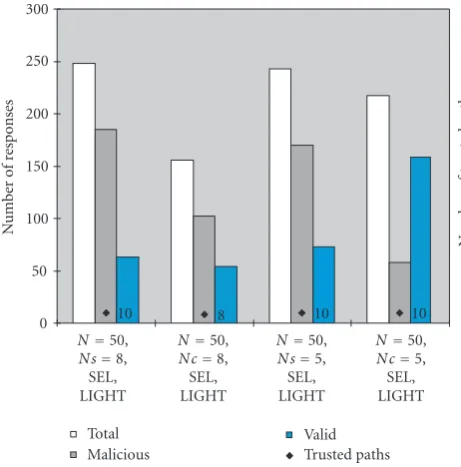
Let us assume thatClientNode20 issuesAReqfor the CSI that corresponds to ten (10)targets.Figure 7illustrates the total number ofAResreceived by theClientNode, under different
0 4 8 12 16 20 24 28 32 36 40 44 46 52 Node id
0 5 10 15 20 25 30 35 40 45 50
N
o
.o
f
int
er
actions
req
uir
ed
w=0.7
w=0.9
Detection time for selfish node=27
Figure6: ATF detection time.
number of malicious caching and server nodes (values of Nc, and Ns, respectively), when the LIGHT policy is used. The large set of the captured responses consists of invalid (i.e., malicious) and valid responses. Thus, theClientNodeshould parse and verify 250 (Ns = 8), or 150 (Nc = 8), or 245 (Ns = 5), or 225 (Nc = 5) responses in order to find the most recent and valid certificate. Such a procedure might re-quire significant resources and time. As shown inFigure 7, for every simulation scenario, the number of trusted paths whenClientNode20 issuesAReqfor the CSI that corresponds to tentargetsis equal to or less than 10. Thus, theClientNode takes advantage of theTrustPathmechanism to select the ten (whenNs =8, or 5, andNc = 5) or eight (Nc= 8) valid responses, in order to identify the most recent one. Similar results appear when theHARDpolicy was used, asFigure 8 depicts. Trusted paths are much less than the received valid and invalid responses.
N=50,
Figure7: ADOPT total and valid responses in comparison with trusted paths for theLIGHTand selective caching policies.
N=50,
Figure8: Total and valid ARes in comparison with trusted paths for theHARDand various caching policies.
CachingNodes. For instance, from Figure 8 it is concluded that there are 50% invalid responses whenNs=8 and 35% invalid responses whenNc = 8 (GRE). Additionally, there are 46% invalid responses when Ns = 8 and 40% invalid responses whenNc= 8 (SEL). Furthermore, theTrustPath algorithm introduces an overhead in terms of recommenda-tions that nodes ask in order to evaluate a path. As we have al-ready mentioned aClientNodeusing theTrustPathalgorithm may ask for recommendations for unclassified nodes. The number of recommendations thatClientNode10 requested
Table3: Recommendations asked for the TrustPath algorithm.
Scenario Number of RECs
during various simulation scenarios is depicted inTable 3. AsTable 3indicates, the overhead due to the requested rec-ommendations is tolerable, especially when the number of invalid responses is maximized. For instance, whenN=50,
Nc = 8, and theGREandHARDpolicies apply, there is a huge need for validation of 300 CSI responses, whilst only 52 recommendations are asked before identifying a trusted path.
5.4. Cerberus function gain
In this section we will discuss the effect of theCerberus func-tion. Table 4 illustrates the number of malicious ADOPT messages that were discarded by theCerberusfunction. When theLIGHTpolicy applies the number of malicious responses that are dropped is quite high. This is because caching and server nodes maintain a larger number of altered entries in theLIGHTpolicy than in theHARDpolicy. Such entries are mapped to CSI requests, and then are returned by the mali-cious nodes. The first rightful node in the reverse path im-mediately discards these responses.
Additionally,Figure 9shows that whenCerberusis acti-vated the number of responses thatClientNodereceives is sig-nificantly decreased. Additional measurements, not shown here, indicated that for the dense scenario (N=50) there was 25%, and 80% reduction of receivedARes, for theHARDand LIGHT policies, respectively. Concerning the malicious re-sponses, the corresponding reduction was 20% (HARD) and 75% (LIGHT).
5.5. Roundtrip delay for receiving a response
Table4: Cerberus function and packet discarding.
Originated Dropped malicious messages
Requests Responses Scenario Requests Responses
3450 710 N=30,Ns=8,GRE,HARD 164 5
3480 929 N=30,Ns=8,GRE,LIGHT 143 532
3600 573 N=30,Nc=8,GRE,HARD 73 4
3480 534 N=30,Nc=8,GRE,LIGHT 69 149
3570 787 N=30,Ns=5,GRE,HARD 96 2
3390 856 N=30,Ns=5,GRE,LIGHT 95 511
3600 540 N=30,Nc=5,GRE,HARD 49 0
3570 666 N=30,Nc=5,GRE,LIGHT 70 126
w/o Cerb. total
w/o Cerb. malicious
w. Cerb. total
w. Cerb. malicious 0
20 40 60 80 100 120 140 160
N
u
mb
er
of
re
sp
onses
N=30,Ns=8, GRE, LIGHT
N=30,Nc=8, GRE, LIGHT
N=30,Ns=5, GRE, LIGHT
N=30,Nc=5, GRE, LIGHT
Responses arrived on a ClientNode when Cerberus is active or inactive
Figure9: Responses on aClientNodewith and withoutCerberus.
2 5 9 15 19 25 29 12 7 22
CertID 0
2 4 6 8 10 12 14 16 18
Ho
p
d
el
ay
GRE,Cs=40,Ns=8 SEL,Cs=40,Ns=8
GRE,Cs=30,Ns=8 SEL,Cs=30,Ns=8 Round-trip hop delay
Figure10: ClientNode round-trip hop delay until receiving a valid response.
significant roundtrip delay (e.g., 17 hops for the certificate with ID 25), and, thus, it should be avoided if peer entities are equipped with efficient buffers.
6. RELATED WORK
Public key cryptography schemes efficiently support confi-dentiality services to prevent passive attacks (e.g., eavesdrop-ping), authentication of nodes, and integrity of messages to avoid fabrications. The architectures proposed in [2–4] exploit threshold cryptography schemes to distribute the CA functionality over different nodes. In [23] GSM/GPRS tech-nologies are proposed, enabling the nodes of a MANET to ac-cess CA services. An off-line CA is considered in [24], as well, to control an ad hoc network. Furthermore, in MANETs, dig-ital certificates and signatures are employed to protect rout-ing as well as packet forwardrout-ing. Secure routrout-ing protocols, such as ARAN [25], SAODV [26], and forwarding modules, such as TRM [27], involve CAs. Some of the aforementioned proposals [4,23,25] include, or assume the existence of, a scheme for retrieving CSI, a service which is essential wher-ever digital certificates are involved. ADOPT was proposed in [5] to provide on demand up-to-date CSI to any node in a MANET. To the best of our knowledge no other scheme like ADOPT has been proposed so far.
On the other hand, key-based schemes are considered computationally hard for MANETs, due to complicated key management techniques, namely generation, distribu-tion, verificadistribu-tion, and revocation of keys or certificates. For this reason, many trust establishment solutions in MANETs rely on the trustworthiness of peers. These, self-evolving, reputation-based, schemes are considered suitable for avoid-ance of selfishness. They are practical if certificate distri-bution centres are ephemerally present and computation resources (e.g., energy, memory) are scarce. They are based on the determination of the trustworthiness of nodes, re-garding their offered functionality. A primary goal of rational nodes is to cooperate in order to avoid, or even mutually iso-late, notorious nodes (i.e., selfish, malicious) from routine network operations. Such cooperation requires the exchange of recommendations and the identification of trusted rec-ommenders. Several cooperation enforcement schemes have been proposed in the literature, such as CONFIDANT [14], CORE [15], SORI [28], and OCEAN [29].
monitor, (b) reputation records for first-hand and trusted second-hand observations about routing and forwarding function of other nodes, (c) trust records to control trust that is given to received warnings, and, (d) a path manager to take routing decisions. In CONFIDANT, node can de-tect selfish behaviour of the next node in the route either directly, by promiscuously sensing its transmission, or in-directly, by observing routing protocol misbehaviour. The monitor component registers these deviations. As soon as a specific misbehaviour occurs, the reputation system is called, and ALARM messages are sent. Recipients of the ALARM messages are friends, which are maintained in a friends list. Incoming ALARMs that originate from “strangers” are checked for trustworthiness before triggering a reaction.
CORE relies on the DSR routing protocol as well [15]. It uses first- and second-hand experiences, and a Watch-dog mechanism for the evaluation of other nodes’ behaviour. Each node monitors the behaviour of its neighbours, with respect to the requested function, and collects observations about the execution of that function. If the observed be-haviour is different than the outcome of a predefined func-tion, then the rating of the observed node is altered. Obser-vations are recorded on the reputation table (RT). Each row corresponds to a neighbour node and consists of three en-tries, regarding the monitored function: a collection of recent (first-hand) observations, a list of the recent second-hand TVs provided by other nodes, and the TV evaluated for the monitored function. The formula used to evaluate the TV avoids false detections by using an aging factor that gives more relevance to past observations. However, such an ap-proach is vulnerable to an attack where a node builds up a good reputation before misbehaving.
The secure and objective reputation-based incentive scheme (SORI) for ad hoc networks focuses on the packet forwarding function [28]. SORI, consists of three basic components: neighbour monitoring, reputation propaga-tion, and punishment. A promiscuous mode is assumed, where a node is capable of overhearing the transmissions of its neighbours and maintains a neighbouring node list. SORI combines features of the fist-hand schemes and those that use reputation spreading. The nodes exchange repu-tation information only with their neighbours. This way a no-cooperative node will be punished by all of its neigh-bours (who share the reputation information about its mis-behaviour), instead of just the ones who are directly affected by this node.
The observation-based cooperation enforcement in ad hoc Networks (OCEAN) introduces an intermediate layer that resides between the network and MAC layers [29]. This layer helps nodes in making intelligent routing and forward-ing decisions. OCEAN relies only on first-hand observations. Every node maintains ratings for each neighboring node and monitors behaviours promiscuously. Positive or negative events are recorded through the reaction of a neighbor that is expected to forward a packet. In OCEAN, the absolute value of a decrement is chosen to be bigger than the value of an increment. When the rating of a node drops below a thresh-old, called faulty threshthresh-old, the node is added to a faulty list.
This list is attached to the route request message of the DSR protocol in order to be flooded. A route is rated good or bad, based on whether the next hop in the route belongs to the avoid-list. The receiver of an RREQ decides to drop or to fur-ther process it (through relaying or a route reply), if the in-tersection of the avoid-list and the DSR route in the RREQ packet is void. This way, each node along a route makes its own decision about the trustworthiness of other nodes, and has control only over routes that it belongs to. Every node rejects data packets that arrive from nodes belonging to its faulty list. Thus, misbehaving nodes are eventually isolated.
CONFIDANT and CORE were designed as an extension to the DSR routing protocol for trusted route establishment, SORI focuses on the packet forwarding function, and, finally, OCEAN, introduces an intermediate layer between the net-work and the MAC layers. Thus, these netnet-work, DLC, and MAC layer specific schemes cannot be directly integrated with the ADOPT, which is an application layer trust-building framework. On the other hand, even though ATF illustrates similarities to the aforementioned schemes, it does not con-centrate on routing and packet forwarding mechanisms and demonstrates significant innovations. These include the de-ployment of theTrustSpanalgorithm to reduce the commu-nication overhead that recommendations produce, and the TrustPath algorithm to identify and use trusted routes for propagating recommendations. It introduces the Cerberus function to isolate selfish nodes. It uses a trust sensor to mon-itor and evaluate the trustworthiness of the recommendation function provided by peers, using tests with predefined re-sults. It incorporates historical, subjective, and trust policy parameters to evaluate the trustworthiness of nodes’ func-tions. Finally, it provides a second chance mechanism, where isolated nodes always have the opportunity to reenter, if they start to cooperate.
7. CONCLUSIONS