R E S E A R C H
Open Access
Virtual machine scheduling strategy based
on machine learning algorithms for load
balancing
Xin Sui
1,2, Dan Liu
1, Li Li
1*, Huan Wang
1and Hongwei Yang
1Abstract
With the rapid increase of user access, load balancing in cloud data center has become an important factor affecting cluster stability. From the point of view of green scheduling, this paper proposed a virtual machine intelligent scheduling strategy based on machine learning algorithm to achieve load balancing of cloud data center. Firstly, a load forecasting algorithm based on genetic algorithm (SVR_GA), k-means clustering algorithm based on optimized min-max, and adaptive differential evolution algorithm (ESA_DE) to enhance local search ability are proposed to solve the load imbalance problem in cloud data center. The experimental results showed that compared with other classical algorithms, the proposed virtual machine scheduling strategy reduces the number of virtual machine migration by 94.5% and the energy consumption of cloud data center by 49.13%.
Keywords: Load balancing, Virtual machine, Support vector regression, Clustering, Differential evolution
1 Introduction
Load balancing plays an important role in resource management of cloud data center. It can not only im-prove the resource utilization of servers and prevent servers from being overloaded, but also effectively re-duce the migration frequency of virtual machines and avoid unnecessary waste of resources. At present, most load balancing strategies are optimized from the following aspects: load balancing strategy based on server CPU and memory resource utilization, load balancing migration strategy based on service-level agreement (SLA), load balancing strategy based on network traffic prediction, load balancing strategy based on quality of service (QoS), load balancing strategy based on service response time prediction, and load balancing strategy based on cloud storage.
Yu et al. proposed a stochastic load balancing scheme which aimed to provide probabilistic guarantee against the resource overloading with virtual machine migration, while minimizing the total migration overhead. Our scheme effectively addressed the prediction of the
distribution of resource demand and the multidimensional resource requirements with stochastic characterization. Moreover, as opposed to the previous works that mea-sured the migration cost without considering the network topology, our scheme explicitly took into account the dis-tance between the source physical machine and the des-tination physical machine for a virtual machine migration. The trace-driven experiments showed that our scheme outperformed the previous schemes in terms of SLA viola-tion and the migraviola-tion cost [1].
Elrotub and Gherbi adopted the machine learning technique, which was classification, was used to make groups of VMs based on their CPU and RAM utilization, as well as to classify user jobs/tasks into different groups based on their sizes and based on in-formation from log files. The approach arranged vir-tual machines in groups, and several tasks shared the same VM resources. The goal of our proposal was to allow more dynamic resources and to improve the QoS requirements by maximizing the usage of the sources and user satisfaction, such as increasing re-source utilization and reducing the number of job rejections [2].
Ramezani developed a multi-objective load balancing (MO-LB) system that avoided VM migration and
© The Author(s). 2019Open AccessThis article is distributed under the terms of the Creative Commons Attribution 4.0 International License (http://creativecommons.org/licenses/by/4.0/), which permits unrestricted use, distribution, and reproduction in any medium, provided you give appropriate credit to the original author(s) and the source, provide a link to the Creative Commons license, and indicate if changes were made.
* Correspondence:[email protected]
1College of Computer Science and Technology, Changchun University of Science and Technology, Changchun 130022, China
achieved system load balancing by transferring extra workload from a set of VMs allocated on an overloaded PM to other compatible VMs in the cluster with greater capacity. To reduce the time factor even more and optimize load balancing over a cloud cluster, MO-LB contained a CPU usage prediction (CUP) sub-system. The CUP not only predicted the performance of the VMs but also determined a set of appropriate VMs with the potential to execute the extra workload imposed on the VMs of an overloaded PM [3].
Hieu et al. presented a virtual machine consolidation algorithm with usage prediction (VMCUP) for improving the energy efficiency of cloud data centers. Their algorithm was executed during the virtual machine consolidation process to estimate the short-term future CPU utilization based on the local history of the considered servers. The joint use of the current and predicted CPU utilization metrics allowed a reliable characterization of overloaded and underloaded servers, thereby reducing both the load and the power consumption after consolidation [4].
Chen et al. proposed a load balancing algorithm based on server running state, which could calculate compre-hensive loading according to the CPU utilization, memory utilization, and network traffic of the servers. Further-more, a load balancing solution based on software-defined networks technology (SDN) was applied in this paper, and it was designed and implemented in OpenFlow network. We combined network management and server state monitor in this scheme, in which the OpenFlow switched forward the request to the least comprehensive loading server by modifying the packet [5].
In cloud computing, load balancing is a technique to distribute the workload for balancing between two or more cloud servers. Load balancing aims to optimize resource use, maintain the cost of data center and virtual machines, maximize throughput, minimize response time, and avoid overload of any single resource. The main objective of this research paper was to reduce cost and re-sponse times using throttled load balancing policy across VM’s in multi data center and optimize response time ser-vice broker policy. This study has evaluated the throttled load balancing algorithm and their scheduling criteria like overall response time, data center processing time, and total cost of virtual machine and data transfer cost [6].
From the perspective of green scheduling, this paper studied the load balancing strategy of cloud data center from three aspects: server load forecasting, virtual ma-chine selection, and target server selection. The main work was as follows:
1. Aiming at the optimization problem of three parametersε, C, andσin the support vector regression algorithm, a load forecasting algorithm based on support vector regression optimized by
genetic algorithm was proposed, which could accurately predict the CPU utilization of servers. 2. Aiming at the problem of the cluster number
and the selection of initial cluster centers in
k-means algorithm, this paper proposed a
k-means clustering algorithm based on optimized min-max. This algorithm found virtual machines with less migration cost, network traffic, and performance interference from overloaded servers.
3. In this paper, the traditional differential evolution algorithm was improved, and an adaptive differential evolution algorithm (ESA_DE) was proposed to enhance the local search ability. The virtual machine found by clustering algorithm was migrated to the target server with the lowest migration cost, network traffic, and performance disturbance, so as to achieve load balancing of cloud data center.
2 Support vector regression load prediction based on genetic algorithms
When the tasks on the virtual machine executed a period of time, some tasks have been completed, and the virtual machine where these tasks were located would release the server resources, which might cause the ser-ver to be in a low-load state, while some tasks required a lot of computation, and the virtual machine where these tasks were located would occupy as much server re-sources as possible, resulting in the server being over-loaded. In order to balance the load of cloud data centers, it was necessary to predict the load status of servers and determine whether the servers were over-loaded or under-over-loaded in the next step. In order to ac-curately predict the load state of servers, this paper studied the traditional algorithm of support vector regression, found out three parameters to solve the ac-curacy of the traditional support vector regression algo-rithm, and proposed a load prediction algorithm based on genetic algorithm optimization support vector regres-sion (SVR_GA).
In cloud environment, the load state of servers was re-lated to the number of virtual machines, resource requests for each virtual machine, virtual machine migration, the memory size of the migrated virtual machine, network flow, and the processing capacity of the current server. The load state of the server was non-linear, sudden, and periodic to some extent. Therefore, in the process of solv-ing support vector regression, the Gauss kernel was stud-ied as a kernel function.
the parameters ε represented the approximation accuracy of training data points, that was, the maximum allowable deviation.
Therefore, the support vector regression SVR model could be simplified to formula (2), in which parameter C played a balancing role in the model complexity and training error.
The Gauss kernel function was shown in formula (3), in which the parameterσrepresented the approximation accuracy of the Gauss kernel function [7].
k xi;xj
These three parameters usually needed to be set manually by users. In order to obtain the optimal predic-tion results, this paper used genetic algorithm to optimize the three parametersε, C, andσin the process of solving the support vector regression model. The flow chart is shown in Fig.1.
The load forecasting algorithm based on genetic algo-rithm optimized support vector regression (SVR_GA) is as follows:
3k-means clustering algorithm-based optimized min-max (K-Means-OMM)
The traditional k-means clustering algorithm had the following problems: the selection of k value in the k-means clustering algorithm was very difficult to estimate, and it was not known in advance how
many categories the samples should be divided into. Clustering algorithm was very sensitive to the initial clustering mean, and different initial clustering mean would lead to different clustering results. If the dis-tance of the initial clustering mean was very close, the number of iterations and the time of clustering would be greatly increased in the process of cluster-ing, and it was easy to fall into the local optimal so-lution. During the implementation of the clustering algorithm, it was necessary to constantly calculate the mean of each cluster and adjust the sample classifica-tion according to the mean of each cluster. When the number of sample sets was very large, the execution time of the algorithm was long. If there were outliers in the sample set, the clustering mean would deviate seriously.
Aiming at the problems of the k-means clustering al-gorithm, this paper optimized the k-means algorithm from two aspects of clustering numberkand initial clus-tering center and proposed an optimized min-max k-means algorithm (K-Means-OMM) for clustering number and initial clustering center.
3.1 Selectingkvalue of cluster
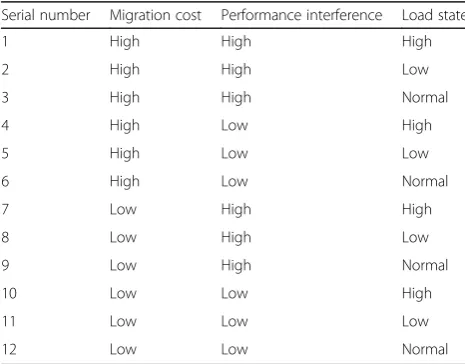
In the k-means clustering algorithm, selecting K value was very important for clustering results. This paper classified virtual machines from three aspects: migra-tion cost, server load, and performance interference. The clustering results of virtual machines could be dis-played as three-dimensional cubes. Migration cost could be divided into two categories: high migration cost and low migration cost. Performance interference could be divided into two categories: high-performance interference and low-performance interference. Server load state could be divided into three states: high load, low load, and normal load. Therefore, this paper set K value of 12; the specific description of the category could be seen in Table1.
3.2 Selection of initial clustering centers
The k-means clustering algorithm usually chose K samples randomly as the initial clustering centers and completed the clustering process by iteration. Different initial clustering centers would produce dif-ferent clustering results. The sensitivity of the k-means algorithm to the initial clustering centers would lead to the instability of clustering results. The results of each clustering were different and not the optimal solution.
occurrence of local optimal solutions. In this paper, three clustering center selection schemes were studied experimentally.
The first scheme: randomly selectedKsamples as ini-tial clustering centers and increased the number of itera-tions in the clustering process. This method was simple but ineffective.
The second scheme: using the min-max algorithm to select the initial clustering centers. Firstly, a
sample was randomly selected as the first clustering center C0; secondly, calculating the distance between
each sample point and C0, the farthest sample point
served as the second clustering center C1; calculate
the distance between the rest of the sample points and the cluster center C0 and C1 respectively; choose
the smaller distance, and then choose the largest dis-tance from these disdis-tance as the third clustering center. By analogy, K clustering centers were finally found [8].
The third scheme: this paper optimized it on the basis of the min-max algorithm. Firstly, two sample points farthest from each sample point were calcu-lated as the first and second clustering centers C0
and C1. Secondly, the distances between each
sam-ple point and the clustering centers C0 and C1 were
calculated separately. The smaller distance was se-lected to form a set, and the largest distance was selected as the third clustering center from the smaller set, and K clustering centers were selected by analogy.
As shown in Algorithm 2, lines 3–10: find the two far-thest sample points as C0and C1; lines 11–13: calculate
the sample points and the initial clustering center C0 , C1, …,Cj; line 15: choose the shortest distance from the
cluster centers, and then choose the farthest distance from the smaller set.
Fig. 1Flow chart of support vector regression optimized by genetic algorithms
Table 1Virtual machine classification
Serial number Migration cost Performance interference Load state
1 High High High
2 High High Low
3 High High Normal
4 High Low High
5 High Low Low
6 High Low Normal
7 Low High High
8 Low High Low
9 Low High Normal
10 Low Low High
11 Low Low Low
4 Adaptive differential evolution algorithm-based enhancing local search capacity (ESA_DE)
In this paper, the traditional differential evolution algorithm was improved, and an adaptive differential evolution algorithm (ESA_DE) was proposed to enhance the local search ability. It was applied to virtual machine migration to optimize the migration process in terms of network traffic, migration cost, performance interfer-ence, and energy consumption [9].
In order to achieve multi-objective optimization, four fitness functions were designed in this paper:
(1). The network flow generated in the process of virtual machine migration was related to the memory size and network routing of the virtual machine migration; this paper usedNetworkfitness
¼ MinðNetworkFlowViÞas the fitness function
of network traffic,NetworkFlowVi represented
network traffic of virtual machinei; it could be expressed by formula (4).
Network¼X m
i¼1
dtidri ð4Þ
In formula (4), dti represented the data transmission
size of the virtual machine i when it migrated, that is, the memory size of the virtual machinei.drirepresented
the length of network links when virtual machinei mi-grated, and the value is related to the network topology of cloud data center, the location of the source server, and the target server in the network topology. It could be calculated by formula (5):
dri¼
32;routing through core switches 22;routing through aggregate switches
12;routing through edge switch
8
(2). The memory size and network bandwidth directly affected the migration cost; this paper used Costfitness= Min(MC) as the fitness function of the
migration cost and MC represented the migration cost of all virtual machines.
MC¼Xm
In formula (6),MCVi represented the migration cost of
virtual machinei, t0represented the migration start time
of virtual machine i, tVi represented the total migration
time of virtual machinei, and UVi represented the CPU
utilization of servers occupied by migration of virtual ma-chinei. It could be calculated by formula (7):
tVi ¼
MVi
BVi
ð7Þ
In formula (7), tVi represented the migration time of
virtual machine i, MVi represented the memory size of
virtual machine i, and BVi represented the network
bandwidth occupied by virtual machinei.
(3). When the migration of virtual machines was completed, it would cause some performance interference to other virtual machines on this server, this paper usedCfitness¼ MinðCPDViÞas
the fitness function of the performance interference. It could be calculated by formula (8):
CPDi ¼1−a
T PDi −T i
T i ð8Þ
In formula (8), Ti represented the running time of
vir-tual machineion a single server, TPD
i represented the
run-ning time of the virtual machineiand the virtual machine set on a single server, andarepresented regulation param-eters of performance interference.
(4). In the process of running the server, it would use Efitness= Min(Ei) as the fitness function of energy
server i at time tj, and P(ui(tj)) could be expressed by
formula (10).
Pið Þ ¼u riPmaxi þð1−riÞ Pmaxi ui ð10Þ
Therefore, the multi-objective energy-saving optimization factor was shown in formula (11):
F¼k1Efitnessþk2Networkfitnessþk3Costfitness
þk4Cfitness ð11Þ
In formula (11), k1,k2, k3, k4 was the balance factor of
each factor, its scope belonged to [0,1], k1+k2+k3+k4=
1, and the parameters were used to adjust and control the influence of various factors on the comprehensive fitness.
In the process of research, we set the size of popula-tion to N, the number of virtual machines migration to D, the number of servers toM, and randomly generated N individuals whose length was D. Individuals repre-sented a virtual machine migration scheme, in which the placement value of each virtual machine was taken from [1,M]. The maximum iterations number wasK, the mu-tation ratio factorϕ∈[0, 2], and the crossover probabil-ity factor Pc∈[0, 1]. The first generation of the ith kth virtual machine of the 0th generation that needed to be migrated and xk
ijð0Þ;ði¼1;2;…;D;j¼1;2;…;MÞ
represented the migration of the ith virtual machine to the jth server; its range of values was randomly gener-ated by formula (13).
x¼xj minþ randð0;1Þ xj max−xj min
ð13Þ
In formula (13), xj_ min represented the minimum
value of vector and xj_ max represented the maximum
value of vector, mapping to [1,M].
According to the differential evolution algorithm, differ-ent virtual machine migration schemesxt1ðgÞ, xt2ðgÞ, and xt3ðgÞ were randomly selected from the g generation population. The mutation operation was carried out to generate new individuals of the population increasing the diversity of the population. The variation scaling factor of the difference process could be expressed as formula (14):
vector¼ϕðxt1ð Þg −xt2ð Þg Þ ð14Þ
In formula (14), xt1ðgÞ−xt2ðgÞ represented the differen-tial vector and vector represented vectors by weighted; constituting the variation vector by the third individualxt3
ðgÞ, a new virtual machine migration scheme was gener-ated, and its expression was shown in formula (15):
vtðgþ1Þ ¼xt3þvector ð15Þ
In formula (15),vt(g+ 1) represented newly generated
individuals,t= 1, 2, 3,…,N.
In order to increase the diversity of the population, cross-over operation was introduced. New mutated indi-vidualsvt(g+ 1) and original individualsxt(g) were crossed
to produce new individualsutðgþ1Þ ¼ ðut1jðgþ1Þ;ut2jðg þ1Þ;…;ut
djðgþ1ÞÞ . The expression of the crossover
process was shown in formula (16):
ut random number between (0, 1), cross probability factorPc,
andrand(t)∈[1,N].
Then, the population entering the next cycle was se-lected through the selection operation, and the fitness function of the cross-generated individual ut(g+ 1) was
compared with that of the target individualxt(g). The
ex-pression of the fitness function was as follows:
xtðgþ1Þ ¼ utðgþ1Þ;F utð ðgþ1ÞÞ>F xtð ð Þg Þ
xtð Þg;others
ð17Þ
In formula (17), F(x) represented the fitness function which individual needed to satisfy and xt(g+ 1)
repre-sented individuals of the next generation.
In the experiment, it was found that the convergence speed of the traditional differential evolution rithm was slower and the search ability of the algo-rithm was lower. In the process of cross-mutation, infeasible individuals or overload were prone to occur. In order to avoid this situation, this paper improved the traditional differential evolution algorithm by add-ing a local search operator. The specific process is shown in Algorithm 4:
In the above process, a local search was performed on the current optimal solution. Filter results in an infeas-ible or overloaded migration program so that the solu-tion of its neighborhood met the condisolu-tion of migrasolu-tion and was closer to the optimal solution.
5 Simulation experiment and result analysis
CloudSim4.0, a cloud computing simulation software, was used to simulate the proposed model and algorithm. The proposed server load detection algorithm (SVR_GA), virtual machine classification selection algo-rithm (K-Means-OMM), and server selection algoalgo-rithms based on load balancing target (ESA_DE) were com-pared with classical algorithms.
5.1 Experimental environment and parameter configuration
5.1.1 Experimental environment
1. Experimental server configuration: (1) CPU: Intel® Core™i7 4770 3.4 GHz (2) Memory(RAM): 8.0G
(3) Hard disk: 1024G
(4) Operating System: Windows 7 (64 bits)
2. Development environment: Eclipse 4.5.1,JDK1.8.0_111
3. CloudSim version: CloudSim4.0
5.1.2 Server and virtual machine parameter
1. Server configuration
In this paper, seven types of servers are involved in the experiment. The MIPS of server ranges from 1.86GHZ to 3.067GHz, the core number is 2-12, the memory size is 4G-16G, the bandwidth is 1000Mbit/s, and the hard disk size is 50G-320G. 2. Virtual machine configuration
In this paper, four types of virtual machines are involved in the experiment. The MIPS of server ranges from 0.5GHZ to 2.5GHz, the core number is 1, the memory size is 613M-1740M, the bandwidth is 100Mbit/s, and the hard disk size is 2.5G.
5.2 Experimental result
5.2.1 Load forecasting experiment
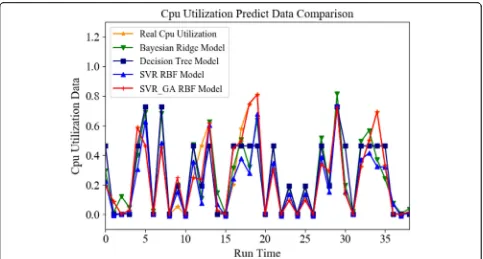
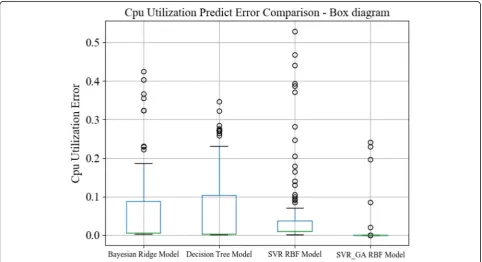
Figures 2, 3, and 4 are comparative experiments of CPU utilization between the server load detection al-gorithm (SVR_GA) and Bayesian Ridge Regression [11], Decision Tree Regression [12], and Support Vec-tor Regression (SVR RBF Model) in the process of virtual machine scheduling.
Figure 2 is the CPU utilization which predicts data comparison of the four algorithms with the actual CPU utilization data when the server ID was 3. From the graph, it could be seen that the predicted value of the support vector regression Gaussian model deviated from the actual value greatly, and the decision tree model and the Bayesian ridge regression model deviated little from the actual value, while the support vector regression Gaussian model optimized by the genetic algorithm de-viated least from the actual value.
Figure3shows the error comparison between the pre-dicted CPU utilization and the actual CPU utilization of the four algorithms when the server ID was 3. The pre-diction error range of CPU utilization based on Bayesian ridge regression model was −0.42~0.23. The prediction error range of CPU utilization based on the decision tree model was −0.35~0.32. The prediction error range of CPU utilization of the support vector regression Gauss model was −0.53~0.25. The prediction error range of CPU utilization of the support vector regression Gauss model optimized by the genetic algorithm was − 0.22~0.24. Among the four algorithms, the CPU utilization prediction error range of the proposed algo-rithm was the smallest.
graph, it could be clearly seen that the minimum error of the Bayesian ridge regression model and decision tree model is close to 0, the maximum value is near 0.2, and there were a few outliers, which showed that the predic-tion error of the two algorithms was small and the sta-bility is high; the minimum error of support vector regression Gaussian model was close to 0, the maximum value is less than 0.1, but there were many outliers, which showed that the algorithm had small error and high stability. Although CPU utilization could be pre-dicted accurately, it lacked stability due to the large number of outliers. The maximum and minimum errors of the support vector regression Gauss model optimized by the genetic algorithm were close to 0, and there were fewer outliers. It showed that the optimization algorithm could improve the accuracy of the support vector regres-sion Gauss model and increase the stability of the algorithm.
5.2.2 Virtual machine classification experiment
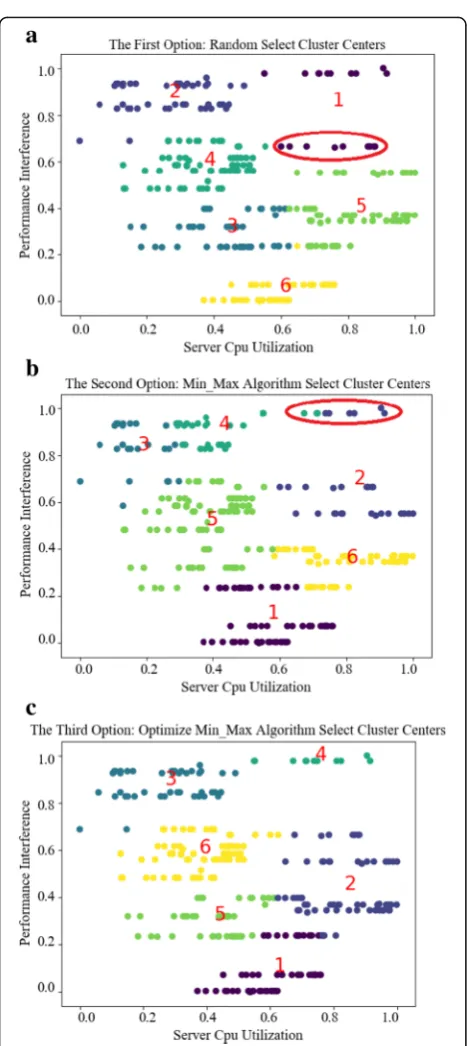
In this paper, three initial clustering center selection schemes were compared. The first scheme used the ran-dom algorithm to select the initial clustering center; the second scheme used the min-max algorithm to select the initial clustering center; and the third scheme was optimized on the basis of the min-max algorithm. In the above, the performance interference of virtual machines could be divided into two categories: high-performance
interference and low-performance interference. The ser-ver load state could be divided into three categories: high load, low load and normal load. Therefore, the vir-tual machines were divided into six categories in this ex-periment. The experimental results are shown in Fig.5.
Figure 5 classifies 280 sample points (virtual ma-chines). The X coordinate represented the remaining CPU utilization of the server after the virtual ma-chine migration, and the Y coordinate represented the remaining performance interference after the vir-tual machine migration. The sample points in the graph were normalized and could not represent the actual values.
From Fig. 5a, we could see that the random selec-tion algorithm chose the cluster center to divide the purple sample points into the first category, the upper and lower parts. The upper and lower parts were far away. The sample points in the red ellipse were close to the sample points in the fifth category. The random selection algorithm had some problems in classifying the purple sample points.
From Fig. 5b, we could see that the min-max algo-rithm chose the clustering center to divide the sample points in the red ellipse into two categories, and the dis-tance between these sample points was relatively close, which should be divided into one category. The min-max algorithm had some problems in dividing these points.
From Fig. 5c, the improved min-max algorithm pro-posed in this paper was more suitable for the division of initial clustering centers. Therefore, this paper took the optimized min-max algorithm as the initial clustering cen-ter selection scheme of thek-means clustering algorithm.
5.2.3 Load balancing experiment
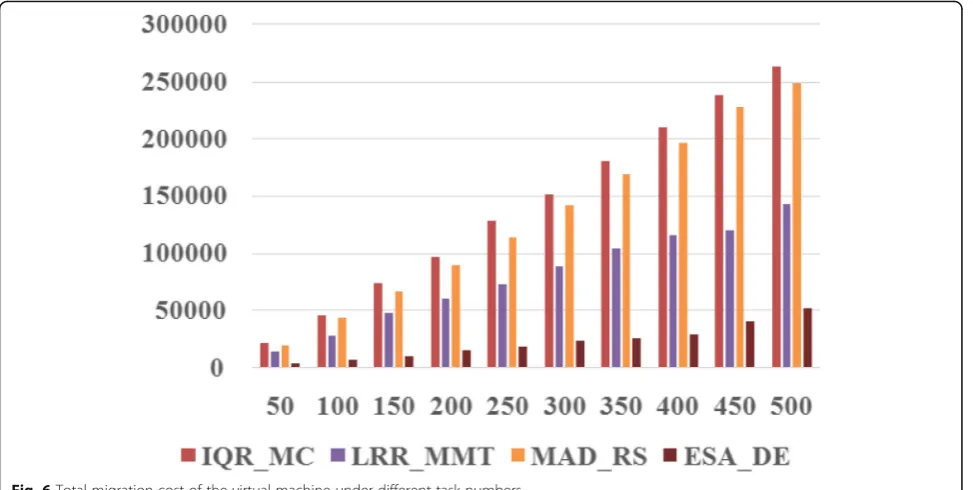
5.2.3.1 Migration cost Figure 6 is an experimental
comparison of the total cost of virtual machine mi-gration between ESA_DE and IQR_MC, LRR_MMT and MAD_RS under different number of tasks. From Fig. 3Comparison of server load prediction errors
the graph, it could be seen that the ESA_DE algo-rithm proposed in this paper could greatly reduce the migration cost of virtual machines under each task number. The experimental data showed that the ESA_DE algorithm was 80.56~ 87.22% lower than the
IQR_MC algorithm, 64.24~ 80.01% lower than the LRR_MMT algorithm, and 79.44~ 85.95% lower than MAD_RS algorithm.
Figure 7 is an experimental comparative analysis of the migration cost of the ESA_DE algorithm and IQR_MC, LRR_MMT, and MAD_RS at different time. From the graph, we could see that in the ini-tial stage of task execution, the migration cost of the four algorithms were all in a high position, which showed that the load of the data center was unanced at this time, and the load needed to be bal-anced by virtual machine migration. Over time, the migration cost of the four algorithms was gradually reduced, indicating that the load of the data center was in a relatively balanced state. The virtual ma-chine migration cost of the ESA_DE algorithm is the lowest among the four algorithms.
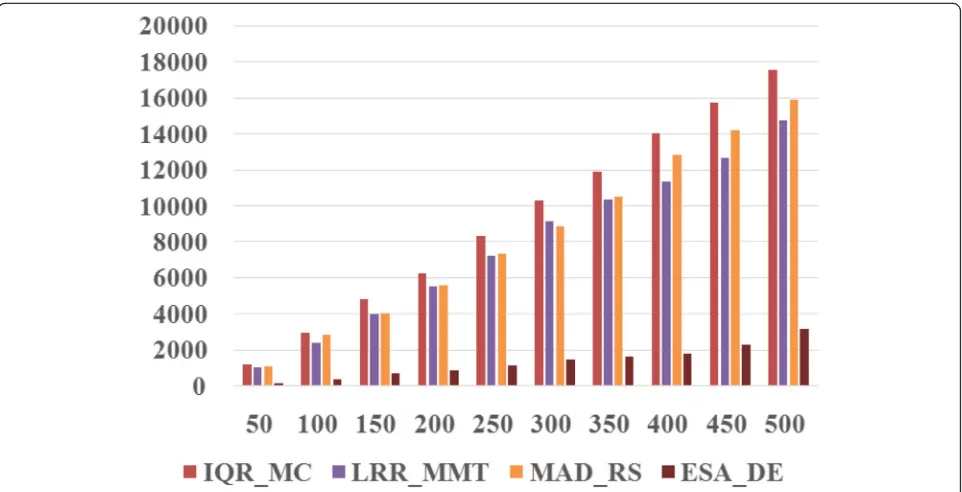
5.2.3.2 Performance interferenceFigure8is an
experi-mental comparison of the ESA_DE algorithm and IQR_MC, LRR_MMT, and MAD_RS algorithms for vir-tual machine performance interference under different number of tasks. It was obvious from the graph that the ESA_DE algorithm proposed in this paper could minimize the performance interference between virtual machines. The experimental data showed that the ESA_DE algorithm was 81.91~ 88.36% lower than the IQR_MC algorithm, 78.45~ 86.24% lower than the LRR_MMT algorithm, and 80.02~ 87.05% lower than the MAD_RS algorithm.
Figure 9 is an experimental comparison and analysis of the performance interference between ESA_DE and IQR_MC, LRR_MMT, and MAD_RS at different time. It could be clearly seen from the graph that in the initial stage, the performance interference of the four algorithms was very large, which was caused by more virtual machine migration in the initial stage; with the gradual reduction of the migration number, the per-formance interference between virtual machines also decreased; and the performance interference of the ESA_DE algorithm proposed in this paper was the smallest among the four algorithms.
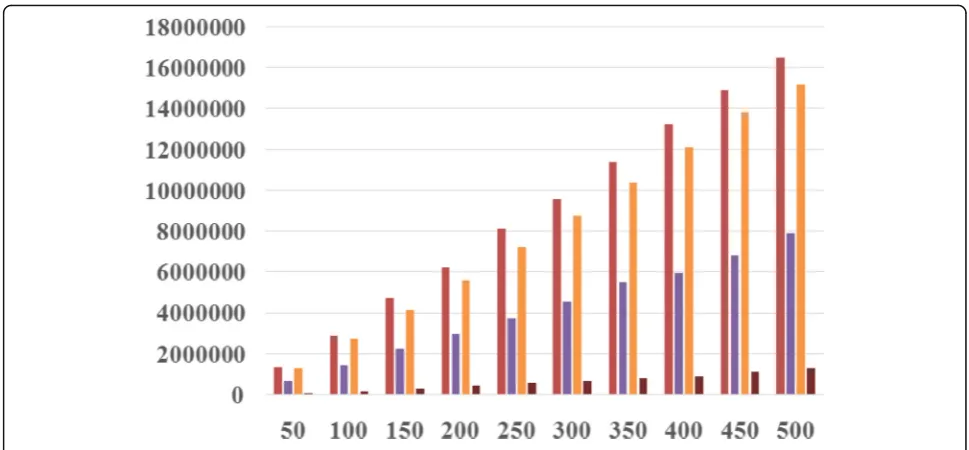
5.2.3.3 Network flowFigure10is an experimental
com-parative analysis of the total network flow between the ESA_DE algorithm and IQR_MC, LRR_MMT, and MAD_RS algorithms under different number of tasks. Compared with other three algorithms, the ESA_DE algorithm proposed in this paper effectively reduced the total network flow of data center. From the experimental data, the total network flow of the ESA_DE algorithm was 6.1~ 7.87% of the IQR_MC algorithm, 12.52~ 16.69% of the LRR_MMT algorithm, and 6.43~ 8.56% of the MAD_RS algorithm.
Figure 11 is a comparative experiment of the aver-age network flow between ESA_DE and IQR_MC, LRR_MMT, and MAD_RS at different time. As could be seen from the graph, the average network flow of
the four algorithms was IQR_MC, MAD_RS,
LRR_MMT, and ESA_DE in turn. In the vicinity of 5000, 10,000, 20,000, and other time points, the average network flow showed a sudden increase, which was caused by the migration of virtual ma-chines due to server overload and the completion of virtual machine tasks. In the whole operation cycle,
no matter how the virtual machine migrated, the average network flow of the ESA_DE algorithm was the lowest.
5.2.3.4 CPU utilizationFigure 12 is a comparative
ex-periment of the average CPU utilization of the ESA_DE algorithm and IQR_MC, LRR_MMT and MAD_RS under different task numbers. From the ex-perimental data, it could be concluded that the aver-age CPU utilization of the IQR_MC algorithm ranged
from 39.06 to 41.36%, that of the LRR_MMT
Fig. 6Total migration cost of the virtual machine under different task numbers
algorithm ranged from 44.17 to 46.76%, and that of the MAD_RS algorithm ranged from 43.52 to 46.13%.
The average CPU utilization of the ESA_DE
algorithm proposed in this paper ranged from 73.19 to 84.87%. With the increase of the number of tasks, the average CPU utilization of the four algorithms is also increasing. This paper proposes that the average CPU utilization of the ESA_DE algorithm is 87.38~ 106.8% higher than that of the random algorithm and 65.69~ 83.22% higher than that of the LRR_MMT al-gorithm. It is 68.19~ 86.68% higher than the MAD_RS algorithm. The average CPU utilization of the ESA_DE algorithm proposed in this paper is basically maintained above 80%. This is because the ESA_DE algorithm balances the load status of each server in
the cloud data center through the virtual machine mi-gration strategy.
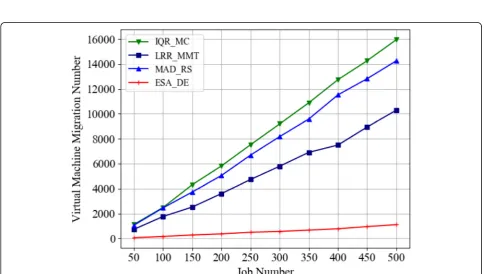
5.2.3.5 Virtual machine migration number Figure 13
is an experimental comparison of the proposed ESA_DE algorithm on virtual machine migration number with IQR_MC, LRR_MMT, and MAD_RS under different task numbers. It can be seen from the figure that compared with the other three algorithms, the virtual machine migration number of the ESA_DE algorithm proposed in this paper is effectively re-duced. Experimental data shows that the number of virtual machine migrations of the ESA_DE algorithm is 93.05~ 94.5% lower than that of the IQR_MC
algo-rithm, 88.79~ 91.56% lower than that of the
Fig. 8Total performance interference of virtual machine under different task numbers
LRR_MMT algorithm, and 92.22~ 94.17% lower than that of the MAD_RS algorithm.
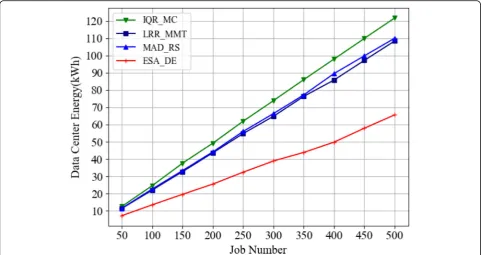
5.2.3.6 Data center energy consumption Figure14is a
comparison of the data center energy consumption
experiments of the ESA_DE algorithm and the
IQR_MC, LRR_MMT, and MAD_RS algorithms under different task numbers. It can be seen from the ex-perimental results that the data center energy
con-sumption of the four algorithms is IQR_MC,
MAD_RS, LRR_MMT, and ESA_DE algorithms from large to small. In this paper, the data center energy consumption of the ESA_DE algorithm is reduced by 42.44~ 49.13% compared with that of the IQR_MC al-gorithm, 36.8~ 42.54% lower than that of the LRR_MMT algorithm, and 37.29~44.36% lower than that of the MAD_RS algorithm.
6 Conclusion
From the perspective of green scheduling, this paper proposed the load forecasting algorithm (SVR_GA) based on machine learning algorithm, virtual ma-chine classification algorithm (K-Means-OMM), and multi-objective optimization algorithm (ESA_DE) based on heuristic. The SVR_GA algorithm could ac-curately predict the CPU utilization of servers, and the prediction error was only −0.22~0.24; the K-means-OMM algorithm could accurately classify virtual machines, which was better than random se-lection and the min-max algorithm on initialing clustering centers; compared with the IQR_MC, LRR_MMT, and MAD_RS algorithms, the migration cost, network flow, and performance interference of the ESA_DE algorithm proposed in this paper were lower than others. The average utilization of data center is higher than that of other algorithms, reaching about
Fig. 11Average network flow at different time
Fig. 12Average CPU utilization of the data center under different task numbers
80%; the maximum number of virtual machine migra-tion is reduced by 94.5%; the maximum energy con-sumption of data center is reduced by 49.13%; and the goal of load balancing is achieved.
Abbreviations
ESA_DE:Adaptive differential evolution algorithm-based enhancing local search capacity; IQR_MC: Inter quartile range and maximum correlation algorithm; K-Means-OMM:k-means clustering algorithm-based optimized min-max; LRR_MMT: Local regression robust and minimum migration time algorithm; MAD_RS: Median absolute deviation and random selection algorithm; MO-LB: Multi-objective load balancing; QoS: Quality of service; SDN: Software-defined networks technology; SLA: Service-level agreement; SVR: Support vector regression; SVR_GA: Support vector regression load forecasting algorithm based on genetic algorithm optimization; VMCUP: Virtual machine consolidation algorithm with usage prediction
Acknowledgements
This work was supported in part by the Science and Technology project of “13th Five-Year”planning of the Education Department of Jilin Province (JJKH20180750KJ and JJKH20190593KJ), the Key Science and Technology Project of Jilin Province (20160204019GX), and the CERNET Innovation Project (NGII20180127).
Authors’contributions
XS and DL designed the algorithm. XS wrote this paper. XS and HW did the experimental tests. LL optimized the algorithm. LL and H-wY checked the whole paper and figures. All authors read and approved the final manuscript.
Competing interests
The authors declare that they have no competing interests.
Publisher’s Note
Springer Nature remains neutral with regard to jurisdictional claims in published maps and institutional affiliations.
Author details 1
College of Computer Science and Technology, Changchun University of Science and Technology, Changchun 130022, China.2Jilin Provincial Institute of Education, Changchun 130022, China.
Received: 22 February 2019 Accepted: 25 April 2019
References
1. L. Yu, L. Chen, Z. Cai, et al., Stochastic load balancing for virtual resource management in datacenters. IEEE Trans. Cloud Comput. 1–14 (2016) 2. M. Elrotub, A. Gherbi, Virtual machine classification-based approach to
enhanced workload balancing for cloud computing applications. Procedia Comput. Sci.130, 683–688 (2018)
3. F. Ramezani, J. Lu, J. Taheri, et al., A multi-objective load balancing system for cloud environments. Comput. J.60(9), 1316–1337 (2017):comjnl; bxw109v2
4. N.T. Hieu, M., D. Francesco, A. Ylajaaski, in IEEE International Conference on Cloud Computing. Virtual machine consolidation with usage prediction for energy-efficient cloud data centers. IEEE, 750-757 (2015)
5. W. Chen, Z. Shang, X. Tian, et al., Dynamic server cluster load balancing in virtualization environment with OpenFlow. Int. J. Distributed Sensor Networks11(7), 531538 (2015)
6. V. Tyagi, T. Kumar, ORT broker policy: reduce cost and response time using throttled load balancing algorithm☆. Procedia Comput. Sci.48, 217–221 (2015)
7. G. Cao, L. Wu, Support vector regression with fruit fly optimization algorithm for seasonal electricity consumption forecasting. Energy115, 734–745 (2016)
8. X. Wang, Y. Bai, The global Minmax k-means algorithm. SpringerPlus5(1), 1665 (2016)
9. Z.H. Zhan, X.F. Liu, H. Zhang, et al., Cloudde: a heterogeneous differential evolution algorithm and its distributed cloud version. IEEE Trans. Parallel Distrib. Syst.28(3), 704–716 (2017)
10. A. Leivadeas, C. Papagianni, S. Papavassiliou, Efficient resource mapping framework over networked clouds via iterated local
based request partitioning. IEEE Trans. Parallel Distrib. Syst.24(6), 1077–1086 (2013)
11. W. Gao, Q. Chen, Y. Ge, et al., The probabilistic model and forecasting of power load based on variational Bayesian expectation maximization and relevance vector machine. Wirel. Pers. Commun.102(4), 3041–3053 (2018) 12. H. Wang, T. Wang, Y. Zhou, et al., Information classification algorithm based