R E S E A R C H
Open Access
A PARAFAC-based algorithm for
multidimensional parameter estimation in
polarimetric bistatic MIMO radar
Hong Jiang
*, Yu Zhang, Jia Li and Haijing Cui
Abstract
In this article, we investigate the problem of applying the parallel factor quadrilinear decomposition technique to multidimensional target parameter estimation in a polarimetric bistatic multiple-input multiple-output (MIMO) radar system with a uniform rectangular array at the transmitter and a cross-dipole-based uniform rectangular array at the receiver. The signal model is developed, and a novel algorithm is proposed exploiting the quadrilinear alternating least squares to jointly estimate the two-dimensional direction of departure (2D-DOD), two-dimensional direction of arrival (2D-DOA), polarization parameters and Doppler frequency. Multidimensional parameters can be automatically paired by this algorithm to avoid the performance degradation resulting from wrong pairing. The developed algorithm requires neither multidimensional spectral peak searching nor covariance matrix estimation and several eigen-value decompositions that may bring error accumulation. Furthermore, multiple targets having close 2D-DODs and close 2D-DOAs or even the same 2D-DOD or 2D-DOA are distinguishable by means of polarization diversity. The algorithm improves the performance of multi-target identification and three-dimensional localization. Numerical simulations demonstrate the effectiveness of the proposed algorithm.
Keywords: Multidimensional parameter estimation; 2D-DOD; 2D-DOA; Polarization diversity; PARAFAC; Quadrilinear decomposition; Bistatic MIMO radar
1 Introduction
In recent years, joint parameter estimation in multiple-input multiple-output (MIMO) radar [1-3] has drawn considerable attention for target identification, local-ization, imaging, etc. Specifically, bistatic MIMO radar with respectively colocated transmitter and receiver array antennas is widely investigated by many researchers for its capability of jointly estimating the direction of depar-ture (DOD) and direction of arrival (DOA) of targets. Many spatial spectrum estimation approaches have been developed for joint DOD and DOA estimation in a bistatic MIMO radar [4-11]. In [4], a two-dimensional (2D) Capon-based method was developed by search-ing through all the 2D space to find the DOA and DOD of a target. By exploiting the invariance prop-erty of both the transmitter and receiver arrays, some
*Correspondence: [email protected]
College of Communication Engineering, Jilin University, Changchun 130012, China
approaches using the estimation of signal parameter via rotational invariance techniques (ESPRIT) [5-7] have been presented for joint DOA and DOD estimation, avoid-ing the exhaustive peak searchavoid-ing. However, an addi-tional pair matching between the DOAs and DODs is required for ESPRIT-like methods. Besides, polyno-mial root finding [8] and combined ESPRIT-multiple signal classification (MUSIC) approach [9] were inves-tigated by decomposing the 2D angle estimation into double one-dimensional (1D) angle estimation, allowing an automatic pairing between the DOAs and DODs. To reduce computation load, a reduced-dimension MUSIC method was proposed in [10]. Considering the charac-teristics of non-stationary target signals, joint estima-tion of DOD and DOA informaestima-tion of maneuvering targets was examined in [11] exploiting spatial time-frequency distribution. For moving targets, the literatures in [12-14] addressed to joint DOD, DOA and Doppler frequency estimation.
Notably, the polarization state of a target will change upon reflection. Polarization diversity has been proved to be important in target identification especially when multiple targets are so closely spaced that they cannot be distinguished well in spatial domain. In [15,16], joint DOD-DOA-polarization estimation and joint DOD, 2D-DOA and polarization estimation exploiting the ESPRIT technique were proposed for bistatic MIMO radar. The simulations have shown that multiple targets having close DODs or DOAs but different polarizations own differ-ent array manifolds and are distinguishable based on their polarization diversity.
Recently, parallel factor (PARAFAC) analysis, as an anal-ysis method of high-dimensional data, has become a new technology applied to signal processing and communica-tion field [17,18]. The parallel factor model is a general-ization of low-rank decomposition to three- or multi-way arrays, which was first introduced as a data analysis tool in psychometrics. Over the past decades, PARAFAC ideas have been applied in multiple-invariance sensor array processing with emphasis on identifiability results [18]. In recent years, PARAFAC has become a new research means in MIMO radar [19-21]. The PARAFAC analy-sis algorithms [19,20] and adaptive PARAFAC algorithm [21] have been developed for the estimation of DOAs and DODs of multiple targets.
Despite the fact that several PARAFAC-based methods have been proposed for DOA and DOD estimation in bistatic MIMO radars, trilinear decomposition algorithms [17-21] with trilinear alternating least square (TALS) are commonly used to fit PARAFAC model. In this article, we investigate joint estimation of DOD, DOA, Doppler frequency and polarization. The polarization can be con-sidered as the fourth dimension and hence a four-way description happens to fit better as long as the targets have diverse polarizations. Thus, PARAFAC quadrilin-ear decomposition [22,23] with quadrilinquadrilin-ear alternat-ing least square (QALS) is applied to multidimensional parameter estimation in polarimetric bistatic MIMO radar.
With the restriction that targets can only be located on a 2D plane in previous algorithms based on 1D-DOD and 1D-DOA estimation using uniform linear arrays, the estimation of 2D-DOD and 2D-DOA is inves-tigated in this article exploiting a uniform rectangular array at the transmitter and a cross-dipole-based uni-form rectangular array at the receiver. The signal model for polarimetric bistatic MIMO radar is developed, and a novel PARAFAC QALS-based algorithm is presented for joint estimation of seven target parameters, including the 2D-DOA, 2D-DOD, two polarization parameters and Doppler frequency. The proposed algorithm avoids mul-tidimensional spectral peak searching, covariance matrix estimation and several eigen-decompositions that may
bring error accumulation, which can enhances the accu-racy of estimation. Multidimensional parameter pairing is obtained automatically by this algorithm, which can avoid the performance degradation resulting from wrong pair-ing. Furthermore, polarization diversity of multiple target characteristics is exploited to distinguish multiple tar-gets having close 2D-DODs and 2D-DOAs or even the same 2D-DOD or 2D-DOA, which can improve the res-olution of multi-target identification and 3D localization. The merits of the algorithm are investigated via numerical simulations.
This paper is organized as follows: in the next section, the signal model for polarimetric bistatic MIMO radar is developed. A novel PARAFAC quadrilinear decomposition-based algorithm for 2D-DOA, 2D-DOD, polarizations and Doppler frequency estimation is pre-sented in section 3. In section 4, the results of simula-tion are given to verify the performance of the proposed method. Finally, a conclusion is drawn in section 5.
2 Signal model for polarimetric MIMO radar 2.1 Received signal
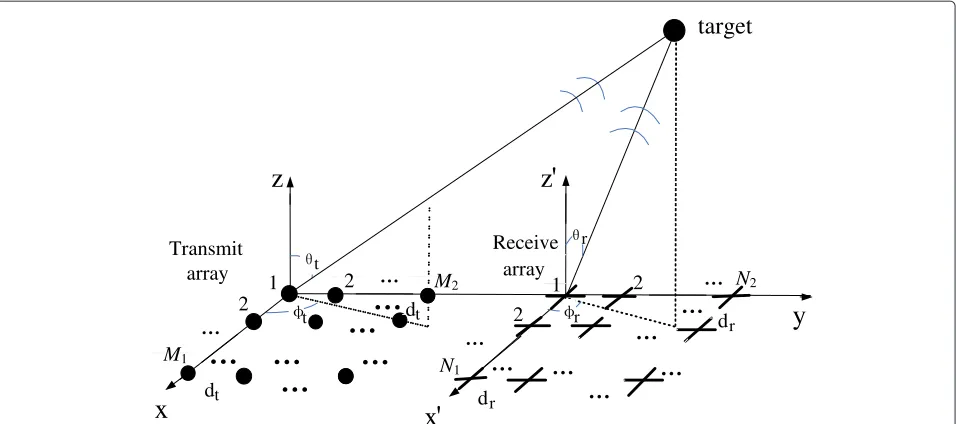
As illustrated in Figure 1, consider a polarimetric bistatic MIMO radar equipped with a uniform rectangular trans-mit array having M = M1M2 sensors and a uniform
rectangular receive array having N = N1N2 crossed
dipole sensors, where M1,M2 and N1,N2 are the
num-bers of the transmit and receive sensors in the x-axis andy-axis, respectively. At the receiver array, the crossed dipoles are used to measure the polarization states of a transverse electromagnetic (TEM) wave and exploit polarization diversity. The antennas are of ideal, identical isotropic sensors. The inter-sensor spacings at the trans-mit and receive arrays are dt and dr, respectively, their lengths being no more than half wavelength (λ/2). At the transmit site,Mdifferent coded signals with identical bandwidth and center frequency are emitted simultane-ously, which are temporally orthogonal. Denote sm = [sm(1),· · ·,sm(K)] the mth transmit waveform vector having a code length ofKand a unit norm,m=1,· · ·,M. There are P targets located in the same range-bin of the receiver site. They are assumed to be point sources. For the pth target, p = 1,· · ·,P, we denote θtp and
φtp its transmit elevation and azimuth angles (namely, 2D-DOD),θrp andφrp its receive elevation and azimuth angles (namely, 2D-DOA),γpandηpits polarization angle and polarization phase difference, and fdp its Doppler frequency.
DenoteX(ml),n,pthe reflected signal of thepth target from the mth transmit sensor to thenth receive sensor in the
lth snapshot,l = 1,· · ·,L,m = 1,· · ·,M,n = 1,· · ·,N,
target
y
'
t
t
r Transmit
1 2
M1
M2
2
r 1 2
2
N1
N2
x
x
z
z
'
dt d
r
dr dt
array
Receive array
Figure 1A polarimetric bistatic MIMO radar.With a uniform rectangular array at the transmitter and a cross-dipole uniform rectangular array at the receiver.
receive sensor. The incoming signals of fully polarized electric field TEM wave impinge on the reference receive sensor with crossed dipole antenna. For thepth target, we assume that it arrives at the receive array with the eleva-tion/azimuth anglesθrpandφrp. Thus, the observed signal
X(1,1,l)p consists of two polarization components in the x
direction andydirection [24], the composite of which can be written as
X(1,1,l)p=
cosθrpcosφrp −sinφrp cosθrpsinφrp cosφrp
sinγpejηp cosγp
βpe
j2πfdptl
×s1+Z(1,1,l)p,
(1)
where βp denotes the complex amplitude proportional to the radar cross section of the pth target. The tar-get amplitude remains constant in theLsnapshots.tl =
lTs is the slow time with Ts being the duration of a snapshot. Z(1,1,l)p is the noise measured at the reference
sensor. Since the observed signal X(ml),n,p coming from the mth transmit sensor to the nth receive sensor has the phase shifts relative to X(1,1,l)p, it can be described as
X(ml),n,p=
cosθrpcosφrp −sinφrp cosθrpsinφrp cosφrp
sinγpejηp cosγp
× ξn1−1
rp ζrpn2−1ξtpm1−1ζtpm2−1βpe
j2πfdptl
sm+Z(ml),n,p (2)
m = 1,· · ·,M, n = 1,· · ·,N, p = 1,· · ·,P, mi = 1,· · ·,Mi, nj=1,· · ·,Nj, i,j=1, 2, and
ξtpe−j2π(dt/λ)sinθtpcosφtp, ζtpe−j2π(dt/λ)sinθtpsinφtp (3a)
ξrpe−j2π(dr/λ)sinθrpcosφrp, ζrpe−j2π(dr/λ)sinθrpsinφrp (3b)
Z(ml),n,p is the observed noise. Collect the data ofX(ml),n,p for m=1,· · ·,M, n= 1,· · ·,N, p=1,· · ·,P, forming a 2N×Kcomplex matrix
X(l)=
P
p=1 ar
θrp,φrp⊗gθrp,φrp,γp,ηpβpej2πfdptl
×aTt θtp,φtp
⎡ ⎢ ⎣
s1
.. .
sM
⎤ ⎥ ⎦+Z(l),
(4)
where⊗denotes the Kronecker product, and
g(θrp,φrp,γp,ηp)
cosθrpcosφrp −sinφrp cosθrpsinφrp cosφrp
×
sinγpejηp cosγp
(5)
is a 2×1 polarization vector for a crossed dipole antenna array, 0 ≤ γp ≤ π/2,−π ≤ ηp < π. Thepth steering vectors with respect to the transmit and receive uniform rectangular arrays are written asat(θtp,φtp) ∈ CM×1and
ar(θrp,φrp)∈CN×1, respectively, with
at(θtp,φtp)=at1p⊗at2p, ar(θrp,φrp)=ar1p⊗ar2p,
where
at1p=
1,ξtp,· · ·,ξM1−1
tp
T ,
at2p=
1,ζtp,· · ·,ζtpM2−1
T
(7a)
ar1p=
1,ξrp,· · ·,ξrpN1−1
T ,
ar2p=
1,ζrp,· · ·,ζN2−1
rp
T
. (7b)
The observed matrix in (4) can be rewritten as
X(l)=Ar(θr,φr)G(θr,φr,γ,η)diag(b(l))AtT(θt,φt)S+Z(l), (8)
where represents the Khatri-Rao product (colum-nwise Kronecker product). At(θt,φt), Ar(θr,φr) and
G(θr,φr,γ,η) denote the transmit steering matrix, receive steering matrix and polarization matrix, respectively. At(θt,φt) = [at(θt1,φt1),· · ·,at(θtP,φtP)],
Ar(θr,φr) = [ar(θr1,φr1),· · ·,ar(θrP,φrP)], and G(θr,
φr,γ,η) =
g(θr1,φr1,γ1,η1),· · ·,g(θrP,φrP,γP,ηP)
. The matrixS ∈ CM×K containsMtransmit waveforms,
S = s1T,· · ·,sMT
T
, and SSH = IM due to wave-form orthogonality and normalization. Z(l) ∈ C2N×K
denotes the noise matrix, and b(l) is the target vector,
b(l)=
β1e
j2πfd1tl
,· · ·,βPe
j2πfdPtlT
.
2.2 Pulse compression and vectorization
The received signals are pulse-compressed usingM trans-mit waveforms, forming the output matrixX(l)=X(l)SH, which can be expressed by
X(l)=Ar(θr,φr)G(θr,φr,γ,η)diag(b(l))AtT(θt,φt)
+Z(l)SH,
(9)
where Z(l)SH denotes the noise matrix after pulse com-pression. VectorizingX(l)in (9) yields the following 2MN
column vector:
y(l)=vec(X(l))=A(θt,φt,θr,φr,γ,η)b(l)+n(l), (10)
where A(θt,φt,θr,φr,γ,η) denotes the total steering matrix with
A(θt,φt,θr,φr,γ,η)=At(θt,φt)Ar(θr,φr)G(θr,φr,γ,η) (11)
In (10) and (11), the transformation of vec(ABC) = (CT⊗A)vec(B)has been used. Collecting all the observed data ofy(l)overLtime slots yields the following 2MN×L
complex matrix
Y=A(θt,φt,θr,φr,γ,η)BT+N (12)
with Y = y(1),· · ·,y(L)andN = n(1),· · ·,n(L) rep-resenting the observed matrix and noise matrix. B =
b(1),· · ·,b(L)T denotes the target matrix, which con-tains the estimated parameter of Doppler frequencyfd.
Based on the signal model of polarimetric MIMO radar developed in (12), the problem of interest is to jointly esti-mate the multidimensional parameters θt,φt,θr,φr,γ,η
andfd.
3 PARAFAC quadrilinear decomposition-based
algorithm for multidimensional parameter estimation
In this section, we present the multidimensional param-eter estimation algorithm in polarimetric MIMO radar using PARAFAC quadrilinear decomposition.
3.1 PARAFAC quadrilinear decomposition model and uniqueness theorem
The definition of PARAFAC quadrilinear decomposition model can be derivatively described from the trilinear decomposition model [19-21].
Definition 1. (Quadrilinear decomposition in tensor format) A quadrilinear decomposition of a four-order ten-sorX ∈ CI×J×K×L is a decomposition of the type X =
M
m=1
am◦bm◦cm◦dm, wheream,bm,cm,dmare themth
columns of the matrices A ∈ CI×M,B ∈ CJ×M, C ∈ CK×M andD ∈ CL×M, respectively, and ◦ is the outer product, i.e.,(am◦bm◦cm◦dm)ijkl =aimbjmckmdlm, for all values of the indicesi,j,kandl.
Definition 2.(Quadrilinear decomposition in matrix format) LetX(1) ∈ CIJK×L,X(2) ∈ CLIJ×K,X(3) ∈CKLI×J
andX(4)∈CJKL×Ibe the four matrix representations of a four-way array. The quadrilinear decomposition ofXcan be written as four equivalent matrices X(1) = (AB C)DT,X(2) =(DAB)CT,X(3)=(CDA)BTand
X(4)=(BCD)AT.
Under certain conditions, X can be decomposed uniquely into matricesA,B,CandD. These conditions are based on the notion of Kruskal-rank [17,18].
Definition 3.(Kruskal-rank or k-rank) [18] Consider a matrix A ∈ CI×M. If rank(A) = r, then Acontains a collection ofrlinearly independent columns. Moreover, if everyk < Mcolumns ofAare linearly independent, but this does not hold for every k+1 columns, thenAhas
k-rankkA=k. Note thatkA<rank(A),∀A.
Theorem 1.(Uniqueness of quadrilinear decomposi-tion) [25] Consider that a matrix representation ofXis
CK×M and D ∈ CL×M are the four mode matrices of
X, andMdenotes the common dimension. If
kA+kB+kC+kD≥2M+3, (13)
thenA,B,CandDare unique up to permutation and scal-ing of columns, meanscal-ing that any other quadrupleA,B,
C andD that gives rise toXis related toA,B,C,D via
A= A1,B= B2,C=C3,D=C4where is a permutation matrix,1,2,3and4are diagonal scaling matrices satisfying1234=IM.
3.2 Parameter matrix estimation using QALS
In this subsection, QALS algorithm is applied to uniquely identify the four parameter matricesAt(θt,φt),Ar(θr,φr),
G(θr,φr,γ,η)andB(fd) for multidimensional parameter estimation. We write the observed matrix Y in (12) as follows:
Y=At(θt,φt)Ar(θr,φr)G(θr,φr,γ,η)BT(fd)+N (14)
withAt(θt,φt) ∈CM×P,Ar(θr,φr) ∈CN×P,G(θr,φr,γ,η)
∈C2×P,B(f
d)∈CL×P.
Based on definition 2, it is clear that (14) corresponds to one of the matrix representations of quadrilinear decom-position of a four-way array Y ∈ CM×N×2×L, with P
denoting the common dimension. For clear analysis, we express the 2MN×LmatrixYasY(1). Thus, quadrilinear decomposition can obtain an equivalentLMN×2 matrix representation as the following form:
Y(2)=B(fd)At(θt,φt)Ar(θr,φr)GT(θr,φr,γ,η)+N2
(15)
an equivalent 2LM×Nmatrix representation
Y(3)=G(θr,φr,γ,η)B(fd)At(θt,φt)ArT(θr,φr)+N3
(16)
and an equivalent 2LN×Mmatrix representation
Y(4)=Ar(θr,φr)G(θr,φr,γ,η)B(fd)AtT(θt,φt)+N4,
(17)
where Y(1), Y(2), Y(3) and Y(4) denote the slice sets of the four-way array Y along the snapshot, polarization, reception and transmission ways, respectively.
From definition 3 and theorem I in section 3.1, it is obvi-ous that the k-ranks ofAt,Ar,GandBarekAt =kAr =P,
kG = min(2,P), kB = min(L,P), respectively. If multi-ple targets and enough snapshots are taken into account, i.e. L ≥ P ≥ 2, then the following inequality is always satisfied:
kAt+kAr+kG+kB=P+P+2+P≥2P+3, (18)
which means that the four-way array Y satisfies the Kruskal-rank Theorem. Thus, At, Ar, G and B can
be recovered uniquely up to permutation and scaling ambiguity.
Based on the four matrix representations Y(1), Y(2),
Y(3)andY(4), the parameter matricesAt(θt,φt),Ar(θr,φr),
G(θr,φr,γ,η) and B(fd) can be estimated using quadri-linear alternating least square (QALS) to fit PARAFAC model. The basic idea behind QALS is to update one parameter matrix using the least squares algorithm, conditioned on previously obtained estimates for the remaining parameter matrices that define the decompo-sition. This process is repeated until convergence in the least squares fit. The detailed iterative algorithm is as follows:
i) Initialize the estimationAˆt(θt,φt),Aˆr(θr,φr),
ˆ
G(θr,φr,γ,η)andBˆ(fd)with random matrices, denoting them asAˆt0(θt,φt),Aˆr0(θr,φr),
ˆ
G0(θr,φr,γ,η)andBˆ0(fd). The iteration number is
k=1, 2, 3,· · ·.
ii) GivenAˆt(k−1)(θt,φt),Aˆr(k−1)(θr,φr)and
ˆ
G(k−1)(θr,φr,γ,η), obtain the least squares solution of thek th iteration ofBˆk(fd)according to
ˆ
Bk(fd)=arg min
ˆ
B
Y(1)− ˆAt(k−1)(θt,φt) ˆAr(k−1)(θr,φr)
ˆG(k−1)(θr,φr,γ,η)BˆTk(fd)
F ,
(19)
where Fdenote the Frobenius norm of its matrix argument.
iii) Update thek th iteration solutionGˆk(θr,φr,γ,η) based onBˆk(fd),Aˆt(k−1)(θt,φt)andAˆr(k−1)(θr,φr), such that
ˆ
Gk(θr,φr,γ,η)=arg min
ˆ
G
Y(2)− ˆBk(fd) ˆAt(k−1)(θt,φt)
ˆAr(k−1)(θr,φr)GˆTk (θr,φr,γ,η)
F (20)
iv) Update thek th iteration solutionAˆrk(θr,φr)based onGˆk(θr,φr,γ,η),Bˆk(fd)andAˆt(k−1)(θt,φt), such that
ˆ
Ark(θr,φr)=arg min
ˆ
Ar
Y(3)− ˆGk(θr,φr,γ,η) ˆBk(fd)
ˆAt(k−1)(θt,φt)AˆTrk(θr,φr)
F
v) Substitute the estimatedAˆrk(θr,φr),Gˆk(θr,φr,γ,η)
acquiring the least squares solution of thek th iterationAˆtk(θt,φt).
vi) Compute the errorδk=Y(1)− ˆA
tk(θt,φt) ˆArk(θr,
φr) ˆGk(θr,φr,γ,η)BˆTk(fd)Fat thek th iteration. The algorithm has converged when|δk−δk−1|≤ε, whereεis an error threshold.
3.3 Multidimensional parameter estimation
Upon obtaining the estimates of Aˆt(θt,φt), Aˆr(θr,φr),
ˆ
G(θr,φr,γ,η)andBˆ(fd), the following problem is to esti-mate multidimensional parameters ofPtargets from these parameter matrices. The algorithm is based on avail-able Vandermonde structure [26] and Kronecker product structure in the matrix blocks, also uses the polarization-sensitive array processing technology [27].
3.3.1 2D-DOD estimation
. Equation 23 reveals that At(θt,φt) is composed of M1 blocks according to
rows, each block being a M2× P matrix with
Vander-monde structure. [ξt1,· · ·,ξtP] is the ratio between the corresponding elements of the(m1+1)th andm1th blocks
of At(θt,φt) form1 = 1,· · ·,M1−1, and [ζt1,· · ·,ζtP] is the ratio between the corresponding elements of the
(m2 +1)th and m2th rows in each block of At(θt,φt),
m2=1,· · ·,M2−1. Therefore, calculating the average of M1(M2−1)ratios respectively yields
ˆ
ζtp, respectively. From (24) and (25), we have
θtpandφtp, respectively. Thus, the estimates of 2D-DOD can be calculated if givenξˆtpandξˆtp. For 0 ≤ ˆθtp < π/2
Similarly, the parameters of 2D-DOA can be attained from the matrix Aˆr(θr,φr). The estimates of θrp and φrp are can be obtained by
3.3.3 Polarization parameter estimation
Upon obtainingθˆrp andφˆrp, the estimates of two polar-ization parametersγpandηpcan be calculated based on the polarization matrixGˆ(θr,φr,γ,η). From (5), thepth
Define ςp as the ratio between the second and first elements of the polarization vector g(θrp,φrp,γp,ηp) in
The estimate ofςpcan be calculated by
ˆ 0 ≤ θrp < π/2, the estimates of polarization parameters
γpandηpcan be calculated by
3.3.4 Doppler frequency estimation
The estimate of Doppler frequency is derived from the matrixBˆ(fd). Defineωpej2πfdpTs, then average of ratios yielding
ˆ
where ωˆp is the estimate ofωp. Therefore, the Doppler frequency can be estimated by
ˆ
Upon the above analysis, multidimensional parameter
θt,φt,θr,φr,γ,ηandfdfor thepth target can be effectively calculated,p=1,· · ·,P.
3.4 Discussion
Note that the proposed method can obtain unique parametric identification even when multiple targets have close 2D-DODs or close 2D-DOAs while they are diversely polarized. Specifically, we consider the situation that Ptargets have the same DOD or the same 2D-DOA, while the other parameters are different. In this case, the inequality in (18) becomes
kAt+kAr+kG+kB=1+P+2+P=P+1+2+P=2P+3.
(42)
From the Kruskal-rank Theorem in section 3.1, the suf-ficient condition is derived herein to guarantee that the quadrilinear decomposition model is unique. Therefore, with polarization diversity, the 2D-DODs and 2D-DOAs of multiple closely spaced targets in MIMO radar can be uniquely identified, and high-resolution estimation can be achieved. It is mentioned that, based on the signal model described in (14), the trilinear decomposition-based algo-rithm with TALS can also be applied to identify multidi-mensional parameters using three matricesAt,ArGand
Bas the slice sets of three-way arrayY. However, for trilin-ear decomposition, the Kruskal-rank condition can not be satisfied in the situation thatPtargets have the same 2D-DOD, since the inequality kAt+kArG+kB≥2P+2 is
Besides, robust iterative fitting of multilinear approa-ches such as linear programming (LP) or weighted median filtering iteration [28] can also be applied here to fur-ther yield a better solution for robust estimation in non-Gaussian noise.
The following assumption is made in the article: (i) The antennas are assumed to be ideal, identical isotropic scatterers. In practical MIMO radar systems, the effect of mutual coupling and array self-calibration methods should be considered. (ii) The target amplitude is assu-med to remain constant during snapshot collection (Swerling I model). The condition can be relaxed to Swerling II model [29] when Doppler shift is known. (iii) The number of targets is assumed to be known. In prac-tical situation, the detection of the number of targets, such as the minimum description length (MDL) crite-rion, should be investigated to obtain the rank of the four-way array Y. (iv) The targets are assumed to be point sources. In practical MIMO radar implementation, distributed target models and methods can be further considered.
4 Simulation
The simulations are conducted to verify the effectiveness of the proposed method in this section. Consider a polari-metric bistatic MIMO radar system withM1 = M2 = 3
andN1 = N2 = 3. The inter-sensor spacings aredt =
dr = λ/2. The duration of a snapshot isTs = 50μs, and the length of transmit codes isK =1024. The amplitudes ofP targets areβ1 = β2 = · · ·βP = 1. The number of snapshots isL=100, and Monte Carlo trials are 100.
Simulation 1.ConsiderP = 3 targets with 2D-DOD, 2D-DOA, polarization parameters and Doppler frequency respectively being(θt1,θt2,θt3) = (10°, 30°, 70°),(φt1,φt2, φt3) = (40°,−60°,−10°), (θr1,θr2,θr3) = (50°, 80°, 20°), (φr1,φr2,φr3) = (10°, 30°, 60°),(γ1,γ2,γ3) = (π/10,π/4,
9π/20),(η1,η2,η3)=(π/5, 4π/5, 2π/5)and(fd1,fd2,fd3)= (1, 000, 3, 000, 5, 000)Hz.
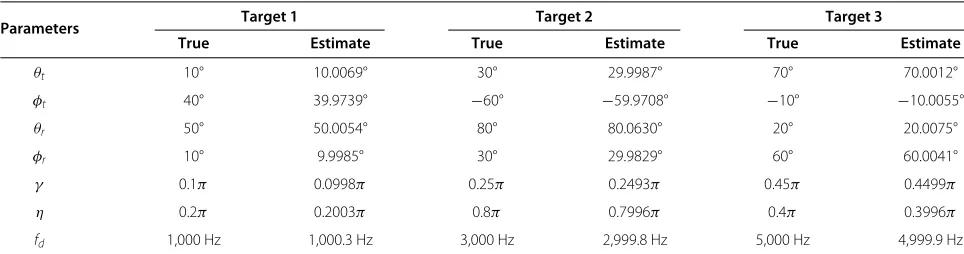
First, we present the simulation results of DOD, 2D-DOA, polarizations and Doppler frequency estimation for three targets when signal-to-noise ratio (SNR) = 10 dB. The average of 100 Monte Carlo trials is shown in Table 1. From Table 1, it is observed that the estimates of seven parameters are close to their true values. The effectiveness and accuracy of the proposed algorithm can be verified from the simulation.
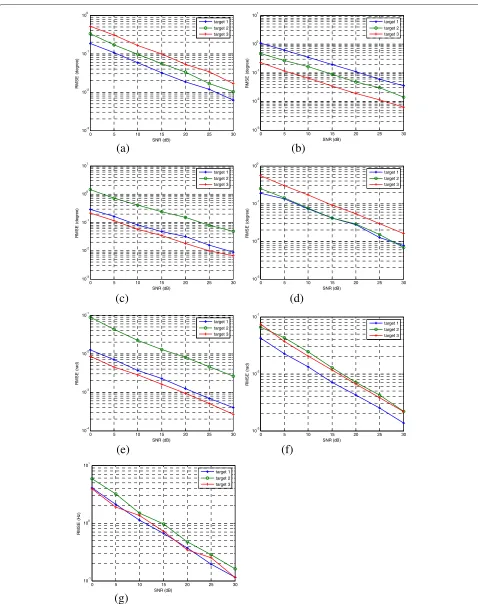
Further, the performance of the proposed algorithm is evaluated through root-mean-square error (RMSE). For estimating a parameterα, the RMSE of thepth target can be calculated by
RMSE(p)= ! ! "1
Nt Nt
t=1
(αˆp(t)−αp)2, (43)
where Nt is the number of Monte Carlo trials. Figure 2a,b,c,d,e,f,g respectively show the RMSE versus SNR for joint estimation of transmit elevation, transmit azimuth, receive elevation, receive azimuth, two polariza-tion parameters and Doppler frequency. From Figure 2, we observe that the performance of multidimensional parameter estimation has been improved gradually with the increase of SNR. The seven parameters for each tar-get can be efficiently obtained without peak searching, and the parameters for multiple targets can be paired automatically without wrong pairing. The additional pair-ing computation is eliminated uspair-ing our algorithm. Based on the estimated multidimensional parameters, accurate identification and 3D localization of multiple targets can be achieved in MIMO radar.
Simulation 2.This simulation examines the estimates of 2D-DOD and 2D-DOA when there are P = 2 closely spaced targets. SNR = 10 dB. The two tar-gets are diversely polarized with polarization parameters
(γ1,γ2) = (π/10, 9π/20), (η1,η2) = (π/5, 4π/5). The
Table 1 Multidimensional parameters estimation result for three targets (SNR = 10 dB)
Parameters Target 1 Target 2 Target 3
True Estimate True Estimate True Estimate
θt 10° 10.0069° 30° 29.9987° 70° 70.0012°
φt 40° 39.9739° −60° −59.9708° −10° −10.0055°
θr 50° 50.0054° 80° 80.0630° 20° 20.0075°
φr 10° 9.9985° 30° 29.9829° 60° 60.0041°
γ 0.1π 0.0998π 0.25π 0.2493π 0.45π 0.4499π
η 0.2π 0.2003π 0.8π 0.7996π 0.4π 0.3996π
0 5 10 15 20 25 30 10-3
10-2 10-1 100
SNR (dB)
RM
S
E
(d
e
g
re
e
)
target 1 target 2 target 3
0 5 10 15 20 25 30
10-3 10-2 10-1 100 101
SNR (dB)
RM
S
E
(d
egre
e)
target 1 target 2 target 3
0 5 10 15 20 25 30
10-3 10-2 10-1 100 101
SNR (dB)
R
M
S
E
(degr
ee)
target 1 target 2 target 3
0 5 10 15 20 25 30
10-3 10-2 10-1 100
SNR (dB)
RM
S
E
(
d
e
g
ree)
target 1 target 2 target 3
0 5 10 15 20 25 30
10-4 10-3 10-2 10-1
SNR (dB)
RM
S
E
(
ra
d
)
target 1 target 2 target 3
0 5 10 15 20 25 30
10-3 10-2 10-1
SNR (dB)
R
M
SE (
ra
d
)
target 1 target 2 target 3
0 5 10 15 20 25 30
10-1 100 101
SNR (dB)
R
M
SE (
H
z)
target 1 target 2 target 3
(a)
(b)
(c)
(d)
(e)
(f)
(g)
Doppler frequency is(fd1,fd2) = (1, 000, 3, 000)Hz. The
following three scenarios are respectively considered. Firstly, we assume that the two targets have close 2D-DODs, i.e. (θt1,θt2) = (10°, 11°), (φt1,φt2) = (40°, 41°)
and close 2D-DOAs, i.e. (θr1,θr2) = (50°, 52°), (φr1, φr2) = (68°, 70°). The average result of 100 Monte Carlo
trials for 2D-DOD and 2D-DOA estimation is shown in Table 2.
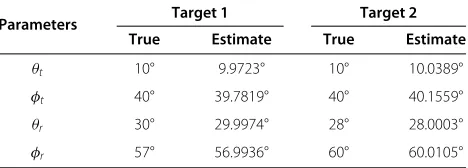
Secondly, we assume that the two targets have the same 2D-DOD, i.e.(θt1,θt2) = (10°, 10°),(φt1,φt2) = (40°, 40°)
and close 2D-DOAs, i.e. (θr1,θr2) = (30°, 28°),(φr1,
φr2) = (57°, 60°). The average result of 100 Monte Carlo trials for 2D-DOD and 2D-DOA estimation is shown in Table 3.
Thirdly, we assume that the two targets have close 2D-DODs, i.e. (θt1,θt2) = (10°, 12°),(φt1,φt2) = (30°,
32°) and the same 2D-DOA, i.e. (θr1,θr2) = (20°, 20°), (φr1,φr2) = (80°, 80°). The average result of 100 Monte
Carlo trials for 2D-DOD and 2D-DOA estimation is shown in Table 4.
The simulations of the above scenarios indicate that the proposed algorithm can distinguish multiple targets having close 2D-DODs and 2D-DOAs, or even the same 2D-DOD or 2D-DOA by polarization diversity. Therefore, it can uniquely identify the 2D transmit/receive angles of multiple closely spaced targets with high-resolution. However, traditional methods only contain angle param-eter estimation without polarization information, leading to their performance degradation in locating multiple closely spaced targets.
Simulation 3.In this example, the proposed QALS-based algorithm is compared with TALS-QALS-based algorithm and ESPRIT-based algorithm to evaluate the performance of 2D-DOD and 2D-DOA estimation. For the other two algorithms, we extend the conventional PARAFAC TALS-based algorithm in [19] and the ESPRIT algorithm in [5] from 1D-estimation version to 2D-estimation version in order to compare them. Similarly, a uniform rectangular transmit array and a cross-dipoled uniform rectangular receive array are used in the two algorithms to estimate multidimensional parameters based on the signal model of polarimetric MIMO radar given in (12). In the extended
Table 2 2D angle estimation result when two targets have close 2D-DODs and close 2D-DOAs (SNR = 10 dB)
Parameters Target 1 Target 2
True Estimate True Estimate
θt 10° 10.0040° 11° 10.9966°
φt 40° 40.0082° 41° 40.9680°
θr 50° 50.0184° 52° 52.0120°
φr 68° 67.9970° 70° 69.9983°
Table 3 2D angle estimation result when two targets have the same 2D-DOD and close 2D-DOAs (SNR = 10 dB)
Parameters Target 1 Target 2
True Estimate True Estimate
θt 10° 9.9723° 10° 10.0389°
φt 40° 39.7819° 40° 40.1559°
θr 30° 29.9974° 28° 28.0003°
φr 57° 56.9936° 60° 60.0105°
TALS-based algorithm, the observed matrix Yin (12) is written as
Y=At(θt,φt) ˜Ar(θr,φr,γ,η)BT(fd)+N, (44)
whereA˜r(θr,φr,γ,η) = Ar(θr,φr)G(θr,φr,γ,η). From (44), it is shown thatYis a PARAFAC trilinear decompo-sition model. Thus, TALS-based algorithm in [19] can be applied to recover the three parameter matricesAt(θt,φt),
˜
Ar(θr,φr,γ,η) andB(fd). Following this, DOD, 2D-DOA as well as polarization and Doppler frequency can be estimated exploiting the Vandermonde structure and Kronecker matrix products in the three parameter matri-ces. The extended ESPRIT-based algorithm employs the shift invariance property of transmit and receive arrays, in which both the steering vectors of transmit and receive arrays have the form of kronecker product for the rect-angular arrays, as shown in (6). The signal subspace can be obtained by eigen-value decomposition of covariance matrix of the observed matrix Y in (12). Then, mul-tidimensional parameters can be estimated by properly partitioning the signal subspace matrix into different sub-matrices [16]. The procedure of pairing 2D-DODs and 2D-DOAs for multiple targets is performed similarly to [30].
In simulation 3, we consider a scenario that there are P = 2 targets. Their polarization parameters and Doppler frequency are(γ1,γ2)= (π/10,π/4), (η1,η2) = (π/5, 4π/5)and(fd1,fd2) = (1, 000, 3, 000)Hz. We firstly
evaluate these three algorithms in the condition of targets with different 2D-DODs and 2D-DOAs. Assume that they
Table 4 2D angle estimation result when two targets have the same 2D-DOA and close 2D-DODs (SNR = 10 dB)
Parameters Target 1 Target 2
True Estimate True Estimate
θt 10° 10.0125° 12° 11.9841°
φt 30° 29.9970° 32° 31.9930°
θr 20° 19.9717° 20° 20.0278°
are located at(θt1,θt2) = (10°, 20°), (φt1,φt2) = (50°,
60°), (θr1,θr2) = (30°, 40°), (φr1,φr2) = (70°, 80°). The
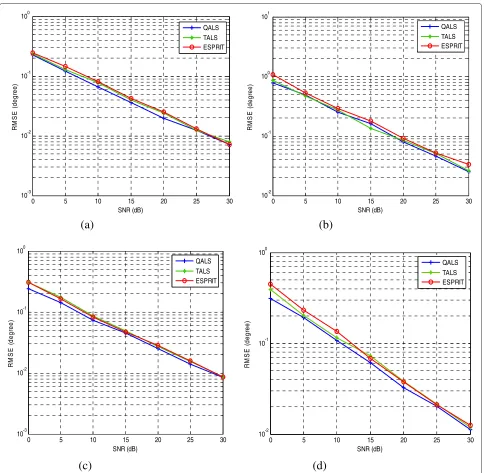
performance comparison of transmit elevation/azimuth (2D-DOD) and receive elevation/azimuth (2D-DOA) among the three algorithms is respectively shown in Figure 3a,b,c,d, where the RMSE is the average of the two targets. Figure 3 reveals that the three algorithms have close estimation performance in this condition, with QALS-based algorithm being a little better than the other two algorithms. Next, we evaluate the three
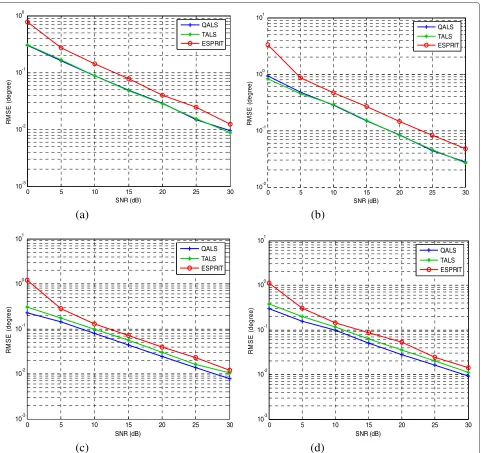
algorithms in the condition of targets with the same 2D-DOA. Assume that they are located at (θt1,θt2) = (10°, 20°), (φt1,φt2) = (50°, 60°), (θr1,θr2) = (40°, 40°), (φr1,φr2) = (80°, 80°). The performance
com-parison is respectively shown in Figure 4a,b,c,d. Figure 4 demonstrates that all the three algorithms can identify two targets with the same 2D-DOA since the receive array manifolds for the two targets are distinguishable by polarization diversity. However, the performance of QALS-based algorithm outperforms that of the other two
0 5 10 15 20 25 30
10-3 10-2 10-1 100
SNR (dB)
R
M
S
E
(
degr
ee)
QALS TALS ESPRIT
0 5 10 15 20 25 30
10-2 10-1 100 101
SNR (dB)
R
M
S
E
(
deg
ree)
QALS TALS ESPRIT
0 5 10 15 20 25 30
10-3 10-2 10-1 100
SNR (dB)
RM
S
E
(
d
e
g
re
e
)
QALS TALS ESPRIT
0 5 10 15 20 25 30
10-2 10-1 100
SNR (dB)
RM
S
E
(
d
e
g
re
e
)
QALS TALS ESPRIT
(a)
(b)
(c)
(d)
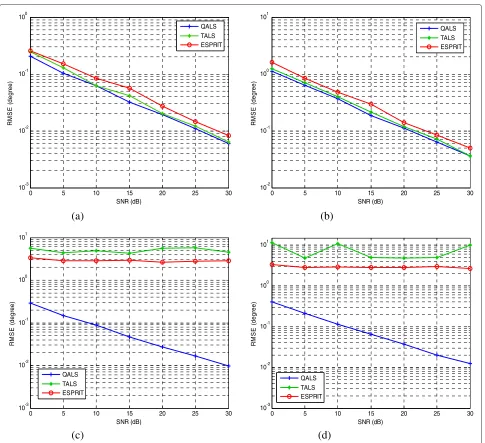
algorithms, especially for 2D-DOA estimation. We finally evaluate the three algorithms in the condition of targets with the same 2D-DOD. Assume that they are located at
(θt1,θt2)= (10°, 10°), (φt1,φt2)=(50°, 50°), (θr1,θr2) = (30°, 40°), (φr1,φr2)= (70°, 80°). The performance
com-parison is respectively shown in Figure 5a,b,c,d. From Figure 5, we can see that in this condition, TALS-based algorithm and ESPRIT-based algorithm cannot work in receive elevation/azimuth estimation because of the rank deficiency. Also, for transmit elevation/azimuth estima-tion, the RMSE of QALS-based algorithm is smaller than
that of the other two algorithms. The reason is that for the QALS-based method, the Kruskal-rank condition of qudrilinear decomposition in (42) is well satisfied in the scenario that P targets have the same 2D-DOD. Thus, multidimensional parameters can be uniquely identified, and the proposed algorithm still works well in this sce-nario, whereas the TALS-based algorithm and ESPRIT-based algorithm have severe performance deterioration. In addition, for the ESPRIT-based algorithm, an additional multidimensional parameter pairing for multiple targets is needed.
0 5 10 15 20 25 30
10-3 10-2 10-1 100
SNR (dB)
RM
S
E
(
degr
e
e
)
QALS TALS ESPRIT
0 5 10 15 20 25 30
10-2 10-1 100 101
SNR (dB)
R
M
S
E
(d
e
g
re
e
)
QALS TALS ESPRIT
0 5 10 15 20 25 30
10-3 10-2 10-1 100 101
SNR (dB)
RM
S
E
(
d
egr
e
e
)
QALS TALS ESPRIT
0 5 10 15 20 25 30
10-3 10-2 10-1 100 101
SNR (dB)
RM
S
E
(
d
e
g
re
e
)
QALS TALS ESPRIT
(a)
(b)
(c)
(d)
0 5 10 15 20 25 30 10-3
10-2 10-1 100
SNR (dB)
RM
S
E
(
d
eg
re
e)
QALS TALS ESPRIT
0 5 10 15 20 25 30
10-2 10-1 100 101
SNR (dB)
RM
S
E
(
d
eg
re
e)
QALS TALS ESPRIT
0 5 10 15 20 25 30
10-3 10-2 10-1 100 101
SNR (dB)
R
M
S
E
(d
e
g
re
e
)
QALS TALS ESPRIT
0 5 10 15 20 25 30
10-3 10-2 10-1 100 101
SNR (dB)
R
M
S
E
(d
e
g
re
e
)
QALS TALS ESPRIT
(a)
(b)
(c)
(d)
Figure 5Performance comparison of QALS-based algorithm with TALS-based algorithm and ESPRIT-based algorithm.Two targets have the same 2D-DOD.(a)transmit elevationθt,(b)transmit azimuthφt,(c)receive elevationθrand(d)receive azimuthφr.
5 Conclusions
In this article, we investigate multidimensional target parameter estimation in a polarimetric bistatic MIMO radar system using PARAFAC quadrilinear decomposi-tion. The signal model has been developed and a novel algorithm for joint estimation of 2D-DOA, 2D-DOD, polarization parameters and Doppler frequency has been presented based on QALS. The algorithm has many mer-its: (i) it requires neither multidimensional spectral peak searching nor covariance matrix estimation and several eigen-decompositions that may bring error accumulation, which enhances the accuracy of estimation; (ii) multidi-mensional parameters can be well paired automatically,
Competing interests
The authors declare that they have no competing interests.
Acknowledgements
The work is supported by the National Natural Science Foundation of China (No. 61071140). The authors wish to thank the anonymous reviewers for their valuable comments and suggestions which greatly improved the manuscript.
Received: 6 July 2012 Accepted: 19 July 2013 Published: 2 August 2013
References
1. E Fisher, A Haimovich, R Blum, D Chizhik, L Cimini, R Valenzuela. MIMO radar: an idea whose time has come, inProc. IEEE Radar Conf.,Philadelphia, 26-29 April (IEEE Piscataway, 2004), pp. 71–78
2. I Bekkerman, J Tabrikian, Target detection and localization using MIMO radars and sonars. IEEE Trans. Signal Process.54(10), 3873–3883 (2006) 3. J Li, P Stoica,MIMO Radar Signal Processing. (Wiley, New York, 2009) 4. H Yan, J Li, G Liao, Multitarget identification and localization using bistatic
MIMO radar systems. EURASIP J. Adv. Signal Process.2008, 283483 (2008) 5. C Duofang, C Baixiao, Q Guodong, Angle estimation using ESPRIT in
MIMO radar. Electron. Lett.44(12), 770–771 (2008)
6. M Jin, G Liao, J Li, Joint DoD and DoA estimation for bistatic MIMO radar. Signal Process.89(2), 244–251 (2009)
7. J Chen, H Gu, W Su, A new method for joint DOD and DOA estimation in bistatic MIMO radar. Signal Process.90, 714–719 (2010)
8. ML Bencheikh, Y Wang, Polynomial root finding technique for joint DOA DOD estimation in bistatic MIMO radar. Signal Process.
90(9), 2723–2730 (2010)
9. ML Bencheikh, Y Wang, Joint DOD-DOA estimation using combined ESPRIT-MUSIC approach in MIMO radar. Electron. Lett.
46(15), 1081–1083 (2010)
10. X Zhang, L Xu, L Xu, D Xu, Direction of Departure (DOD) and Direction of Arrival (DOA) estimation in MIMO radar with reduced-dimension MUSIC. IEEE Commun. Lett.14(12), 1161–1163 (2010)
11. YD Zhang, MG Amin, B Himed, Joint DOD/DOA estimation in MIMO radar exploiting time-frequency signal representations. EURASIP J. Adv. Signal Process.2012(102) (2012)
12. C Yunhe, Joint estimation of angle and Doppler frequency for bistatic MIMO radar. Electron. Lett.46(2), 170–172 (2010)
13. J Gong, H Lv, Y Guo. Multidimensional parameters estimation for bistatic MIMO radar, inProc. 7th International Conf., Wireless Communications, Networking and Mobile Computing(WiCoM, 2011) Wuhan, 23-25, Sept 2011 (Piscataway, 2011), pp. 1–4
14. J Zhang, Z Zheng, X Li, An algorithm for DOD-DOA and Doppler frequency jointly Estimating of bistatic MIMO radar. J. Electron Inf. Technol, (In Chinese).32(8), 1843–1848 (2010)
15. H Jiang, DF Wang, C Liu, Joint parameter estimation of
DOD/DOA/polarization for bistatic MIMO radar. J. China Universities Posts Telecommunications.17(5), 32–37 (2010)
16. H Jiang, DF Wang, C Liu. Estimation of DOD and 2D-DOA and polarizations for bistatic MIMO radar, inProc. 19th Annual Wireless and Optical Communications Conf.,Shanghai, 14-15 May, 2010
(IEEE Piscataway, 2010), pp. 1–5
17. ND Sidiropoulos, GB Giannakis, R Bro, Blind PARAFAC receivers for DS-CDMA systems. IEEE Trans. Signal Process.48(3), 810–823 (2000) 18. ND Sidropoulos, R Bro, GB Giannakos, Parallel factor analysis in sensor
array processing. IEEE Trans. Signal Process.48(8), 2377–2388 (2000) 19. D Nion, ND Sidiropoulos, Tensor algebra and multidimensional harmonic
retrieval in signal processing for MIMO Radar. IEEE Trans Signal Process. 58(11), 5693–5705 (2010)
20. X Zhang, Z Xu, L Xu, D Xu, Trilinear decomposition-based transmit angle and receive angle estimation for multiple-input multiple-output radar. IET Radar Sonar Navigation.5(6), 626–631 (2011)
21. D Nion, ND Sidiropoulos, Adaptive algorithms to track the PARAFAC decomposition of a third-order tensor. IEEE Trans. Signal Process. 57(6), 2299–2310 (2009)
22. X Liu, ND Sidiropoulos, Cramer Rao lower bounds for low-rank decomposition of multidimensional arrays. IEEE Trans. Signal Process. 49(9), 2074–2086 (2011)
23. Y Shi, X Zhang, Quadrilinear decomposition-based blind signal detection for polarization sensitive uniform square array. Prog. Electromagnetics Res.83, 263–278 (2008)
24. J Li, RT Compton, Two-dimensional angle and polarization estimation using the ESPRIT algorithm. IEEE Trans. Antennas Propagation. 40(5), 550–555 (1992)
25. ND Sidropoulos, R Bro, On the uniqueness of multilinear decomposition of N-way arrays. J. Chemometrics.14, 229–239 (2000)
26. GH Golub, CFV Loan,Matrix Computations, 3rd edn. (The Johns Hopkins University, Baltimore, 1996)
27. N Fourikis,Advanced Array Systems, Applications and RF Technologies. (Academic, London NW, 2000)
28. SA Vorobyov, Y Rong, ND Sidiropoulos, AB Gershman, Robust iterative fitting of multilinear models. IEEE Trans. Signal Process.
53(8), 2678–2689 (2005)
29. MI Skolnik,Introduction to Radar System, 3rd edn. (Academic, London NW, 2001)
30. J Chen, H Gu, W Su, Angle estimation using ESPRIT without pairing in MIMO radar. Electron. Lett.44(24), 1422–1423 (2008)
doi:10.1186/1687-6180-2013-133
Cite this article as:Jianget al.:A PARAFAC-based algorithm for multidimen-sional parameter estimation in polarimetric bistatic MIMO radar.EURASIP Journal on Advances in Signal Processing20132013:133.
Submit your manuscript to a
journal and benefi t from:
7Convenient online submission 7Rigorous peer review
7Immediate publication on acceptance 7Open access: articles freely available online 7High visibility within the fi eld
7Retaining the copyright to your article